
Life, 1929-03-08 · page 26 of 44
Life — March 8, 1929 — page 26: what you’re looking at
What you’re looking at
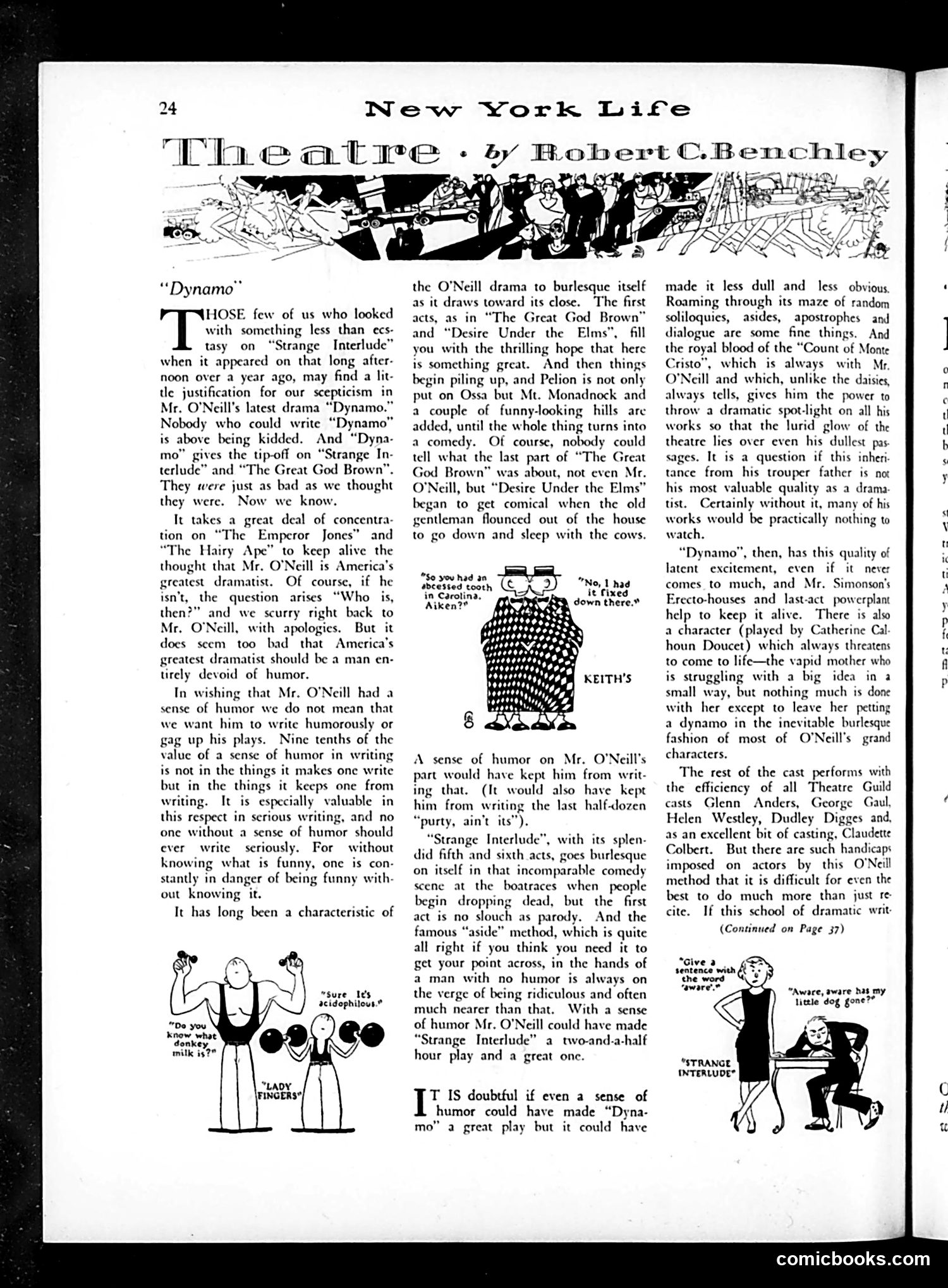
This is a theater criticism column by Robert C. Benchley reviewing Eugene O'Neill's recent plays, particularly "Dynamo." The page contains three small comic illustrations accompanying the text. **The Core Critique:** Benchley argues that O'Neill, America's greatest dramatist, fatally lacks a sense of humor. He's not suggesting O'Neill should write comedies, but rather that humor—understanding what's funny—prevents serious writers from *accidentally* becoming ridiculous. Benchley notes O'Neill's plays consistently descend into unintentional comedy in their final acts (citing "The Great God Brown," "Desire Under the Elms," and "Strange Interlude"), suggesting O'Neill doesn't recognize when his dramatic devices become absurd. **The Cartoons:** Simple line-drawings illustrate O'Neill's theatrical techniques—the "aside" method (characters speaking directly to audiences) and dramatic excess—rendered comically absurd to support Benchley's argument. **Historical Context:** This reflects 1920s-30s debates about modernist theater's legitimacy and O'Neill's reputation during his most experimental, critically divisive period.
📄 Transcribed text from this page (OCR, searchable)
Machine-transcribed from the original scan — historical spelling and the odd misread are preserved.
New York Life “Dynamo” HOSE few of us who looked with something less than ecs- tasy on “Strange Interlude” when it appeared on that long after- Noon over a year ago, may find a lit- tle justification for our scepticism in Mr. O'Neill's latest drama “Dynamo.” Nobody who could write “Dynamo” above being kidded. And “Dyna- es the tip-off on “Strange In- terlude” and “The Great God Brown”. They were just as bad as we thought they were. Now we know. It takes a great deal of concentra- tion on “The Emperor Jones” and “The Hairy Ape” keep alive the thought that Mr. O° is America’s greatest. dramatist. Of course, if he isn't, the question arises “Who is, then?” and we scurry right back to Mr. O'Neill, with apologies. But it does seem too bad that America’s greatest dramatist should be a man en- tirely devoid of humor. In wishing that Mr. O'Neill had a sense of humor we do not mean that we want him to write humorously or gag up his plays. Nine tenths of the value of a sense of humor in writing is not in the things it makes one write but in the things it keeps one from writing. It is especially valuable in this respect in serious writing, and no one without a sense of humor should ever write seriously. For without knowing what is funny, one is con- stantly in danger of being funny with out knowing it. It has long been a characteristic of wsure It’s acidophilous.* know what donkey milk is?” the O'Neill drama to burlesque itself as it draws toward its close. The first acts, as in “The Great God Brown” and “Desire Under the Elms”, fill you with the thrilling hope that here is something great. And then things begin piling up, and Pelion is not only put on Ossa but Mt. Monadnock and a couple of funny-looking hills are added, until the whole thing turns into a comedy. Of course, nobody could tell what the last part of “The Great God Brown” was about, not even Mr. O'Neill, but “Desire Under the Elms” began to get comical when the old gentleman flounced out of the house to go down and sleep with the cows. "$0 you had an adcessed tooth in Carolina, “No, 1 had it fixed \ down there.* KEITH'S A sense of humor on Mr. O'Neill's part would have kept him from writ- ing that. (It would also have kept him from writing the last half-dozen “purty, ain’t its”). “Strange Interlude”, with its splen- did fifth and sixth acts, goes burlesque on itself in that incomparable comedy scene at the boatraces when people begin dropping dead, but the first act is no slouch as parody. And the famous “aside” method, which is quite all right if you think you need it to get your point across, in the hands of a man with no humor is always on the verge of being ridiculous and often much nearer than that. With a sense of humor Mr. O'Neill could have made “Strange Interlude” a two-and-a-half hour play and a great one. T IS doubtful if even a sense of humor could have made “Dyna- mo” a great play but it could have made it less dull and less obvious Roaming through its maze of random soliloquies, asides, apostrophes and dialogue are some fine things. And the royal blood of the “Count of Monte Cristo”, which is always with Mr, O'Neill and which, unlike the daisies, always tells, gives him the power to throw a dramatic spot-light on all his works so that the lurid glow of the theatre lies over even his dullest pas. sages. It is a question if this inheri- tance from his trouper father is not his most valuable quality as a drama- tist. Certainly without it, many of his works would be practically nothing to watch, “Dynamo”, then, has this quality of latent excitement, even if it never comes to much, and Mr. Simonson’s Erecto-houses and last-act_ powerplant help to keep it alive. There is also a character (played by Catherine Cal houn Doucet) which always threatens to come to life—the vapid mother who is struggling with a big idea in a small way, but nothing much is done with her except to leave her petting a dynamo in the inevitable burlesque fashion of most of O'Neill's grand characters. The rest of the cast performs with the efficiency of all Theatre Guild casts Glenn Anders, George Gaul, Helen Westley, Dudley Digges and, as an excellent bit of casting, Claudette Colbert. But there are such handicaps imposed on actors by this O'Neill method that it is difficult for even the best to do much more than just re cite. If this school of dramatic writ (Continued on Page 37) “Aware, aware bas my little ‘dog gone?” “STRANGE INTERLUDE? comicbooks.com