
A complete issue · 44 pages · 1929
Life — February 15, 1929
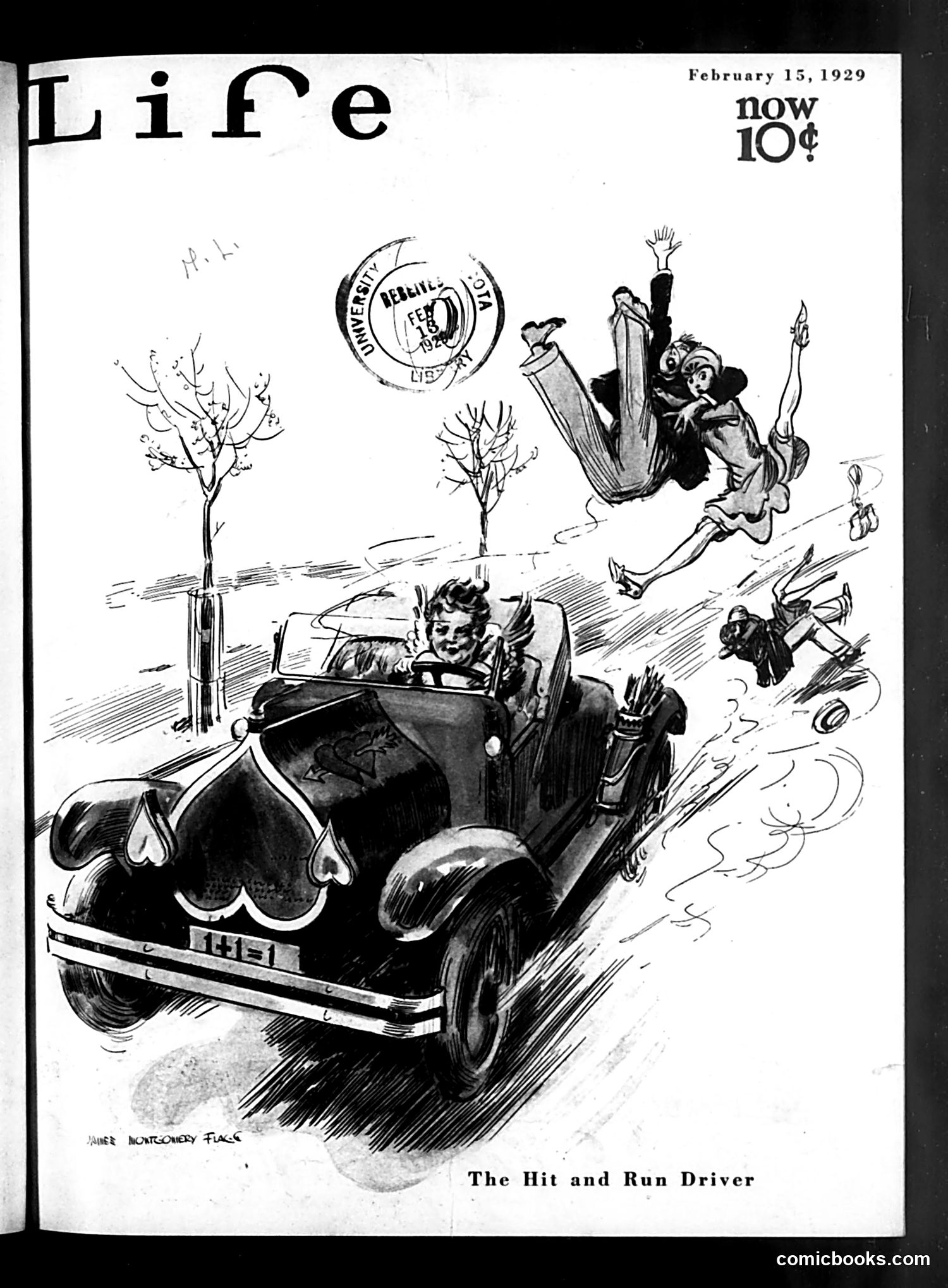
This 1929 *Life* magazine cover satirizes the contemporary social problem of hit-and-run automobile accidents. The cartoon depicts a reckless driver fleeing in a car decorated with heart symbols, leaving behind chaos: scattered debris, an injured person on the ground, and another figure gesturing in distress. The "Hit and Run Driver" was a genuine public concern in the late 1920s, as automobile ownership surged but traffic laws and enforcement remained weak. The satirical point critiques both the irresponsible driver who abandons accident victims and, implicitly, the inadequacy of legal consequences for such crimes. The playful visual style (by James Montgomery Flagg, a prominent illustrator) contrasts sharply with the serious subject matter—typical of *Life*'s approach to social commentary through humor.
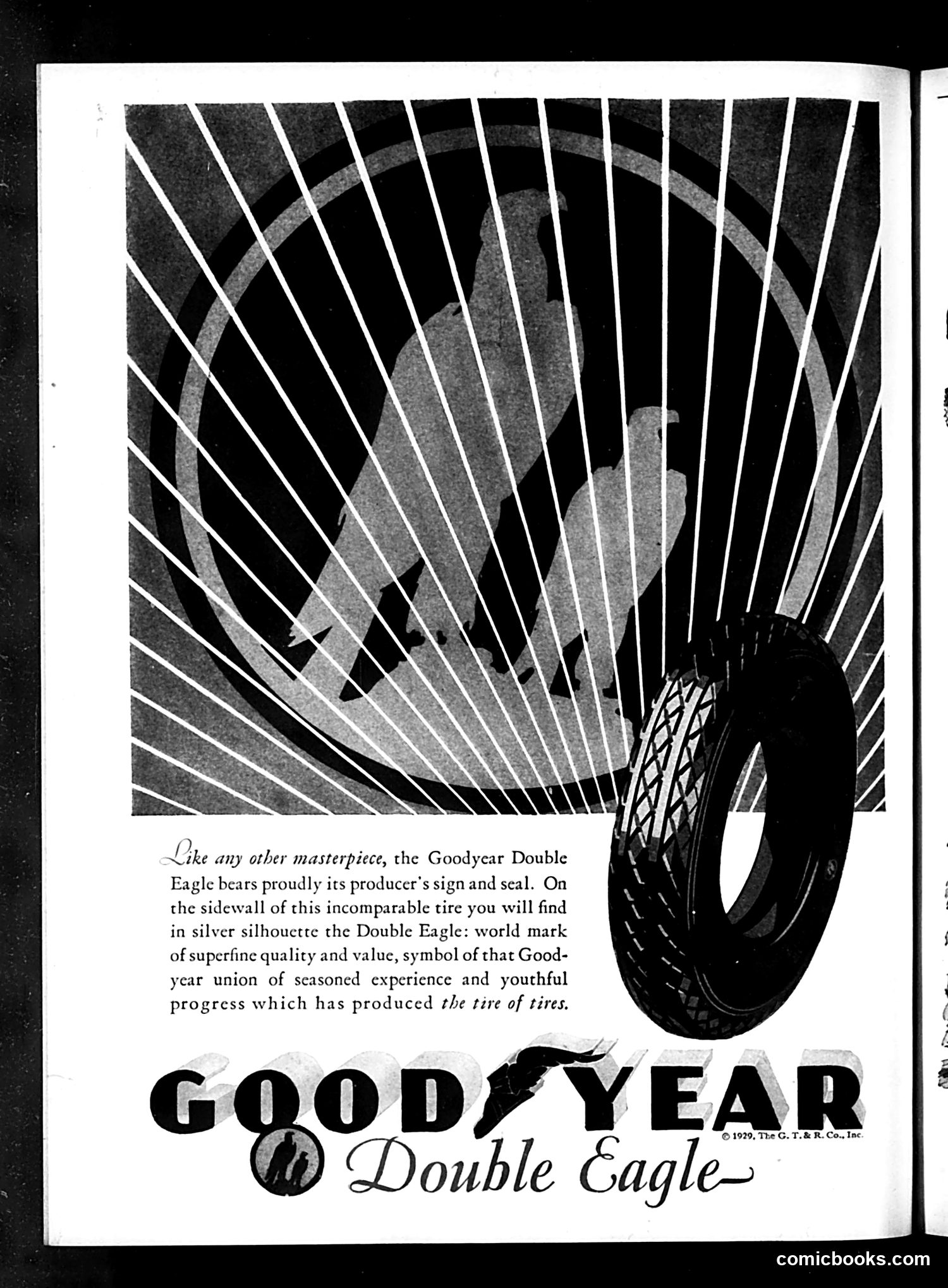
This is **not a cartoon or satirical content** — it's a **straightforward advertisement** for Goodyear Double Eagle tires, published in 1929 (per the copyright mark). The page features an abstract graphic design showing radiating lines (suggesting motion or tire tread patterns) with a photograph of an actual tire. The accompanying text promotes the tire as a "masterpiece" bearing Goodyear's mark of quality, emphasizing the company's "seasoned experience and youthful progress." There is no political satire, caricature, or social commentary present. This is commercial advertising using modernist design aesthetics typical of 1920s-era marketing. The "Double Eagle" branding and emphasis on superior manufacturing represent standard product differentiation strategies of the era.
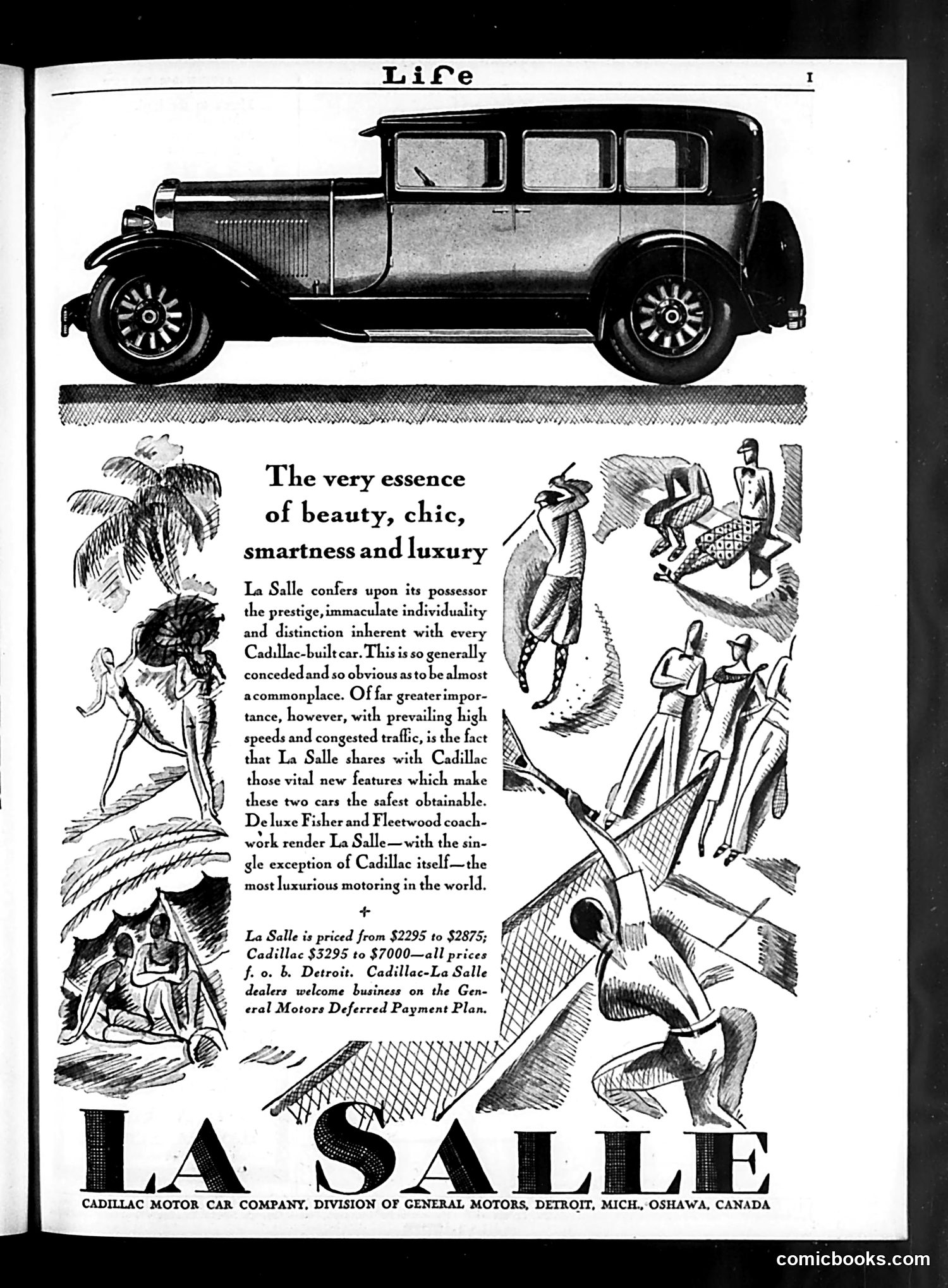
This is primarily a **Cadillac luxury car advertisement**, not political satire. The page promotes the La Salle automobile model through decorative illustrations showing affluent leisure activities—tropical settings, fashionable people, and glamorous lifestyle scenes. The ad emphasizes that La Salle shares prestige with Cadillac while offering "vital new features" and safety advantages over competitors at higher speeds and in congested traffic. It positions the car as accessible luxury, priced from $2,295 to $2,875 (compared to Cadillac's $3,295-$7,000). The decorative vignettes are not satirical commentary but lifestyle imagery designed to associate vehicle ownership with wealth, sophistication, and social distinction—typical advertising strategy of the era.
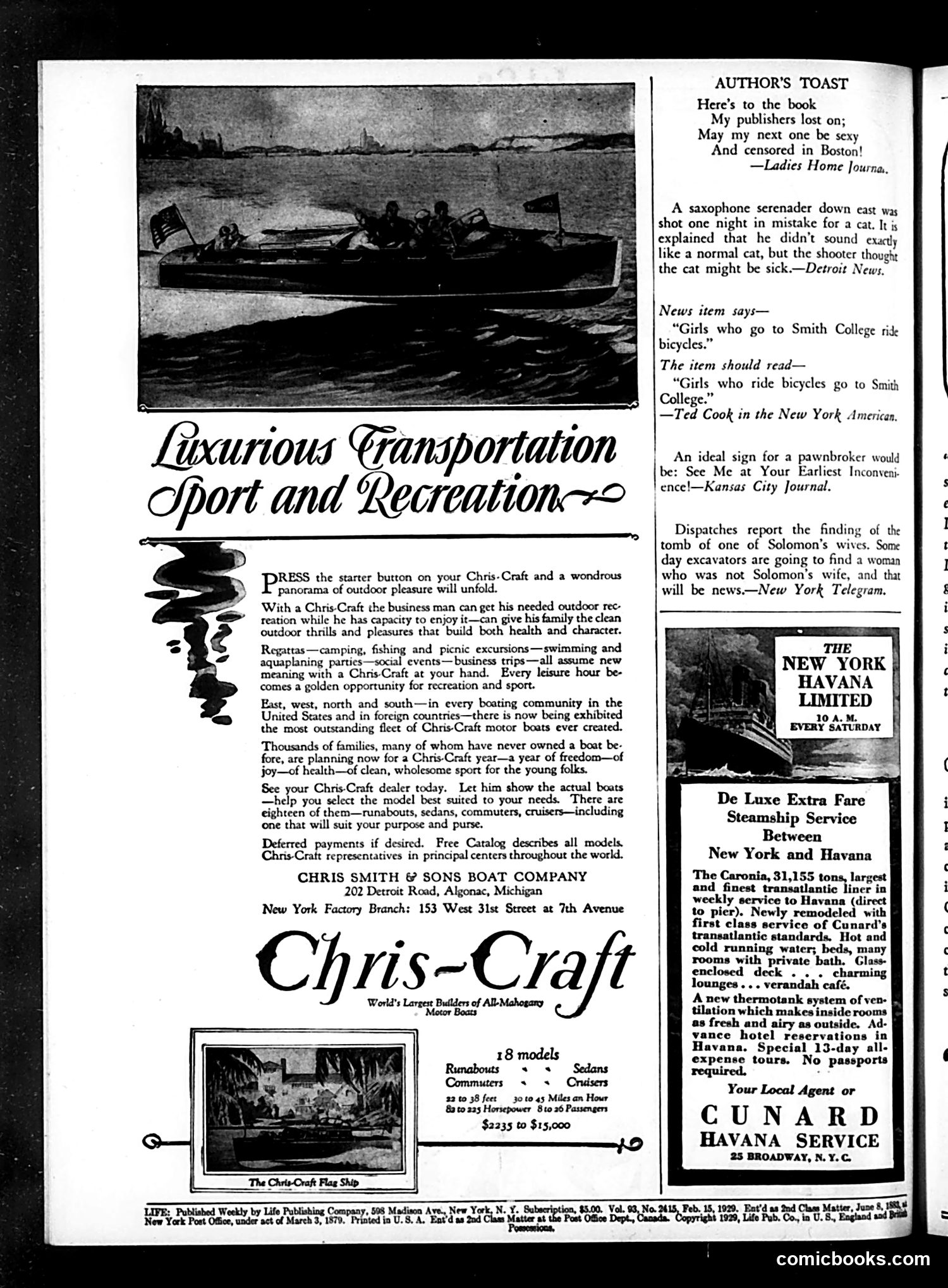
This page is primarily **advertising**, not political satire. The main feature is a Chris-Craft boat company advertisement promoting "Luxurious Transportation Sport and Recreation." The ad emphasizes how Chris-Craft motorboats enable family outdoor activities like camping, fishing, and picnicking across American waterways. The right side contains a separate Cunard steamship advertisement for service between New York and Havana, highlighting the "Caronia" liner's luxury amenities. The "Author's Toast" section at top right consists of humorous editorial corrections and newspaper blunders—brief satirical commentary on media errors (a saxophone mistaken for a cat, etc.)—rather than political commentary. This is typical filler content for Life magazine's satirical sections.
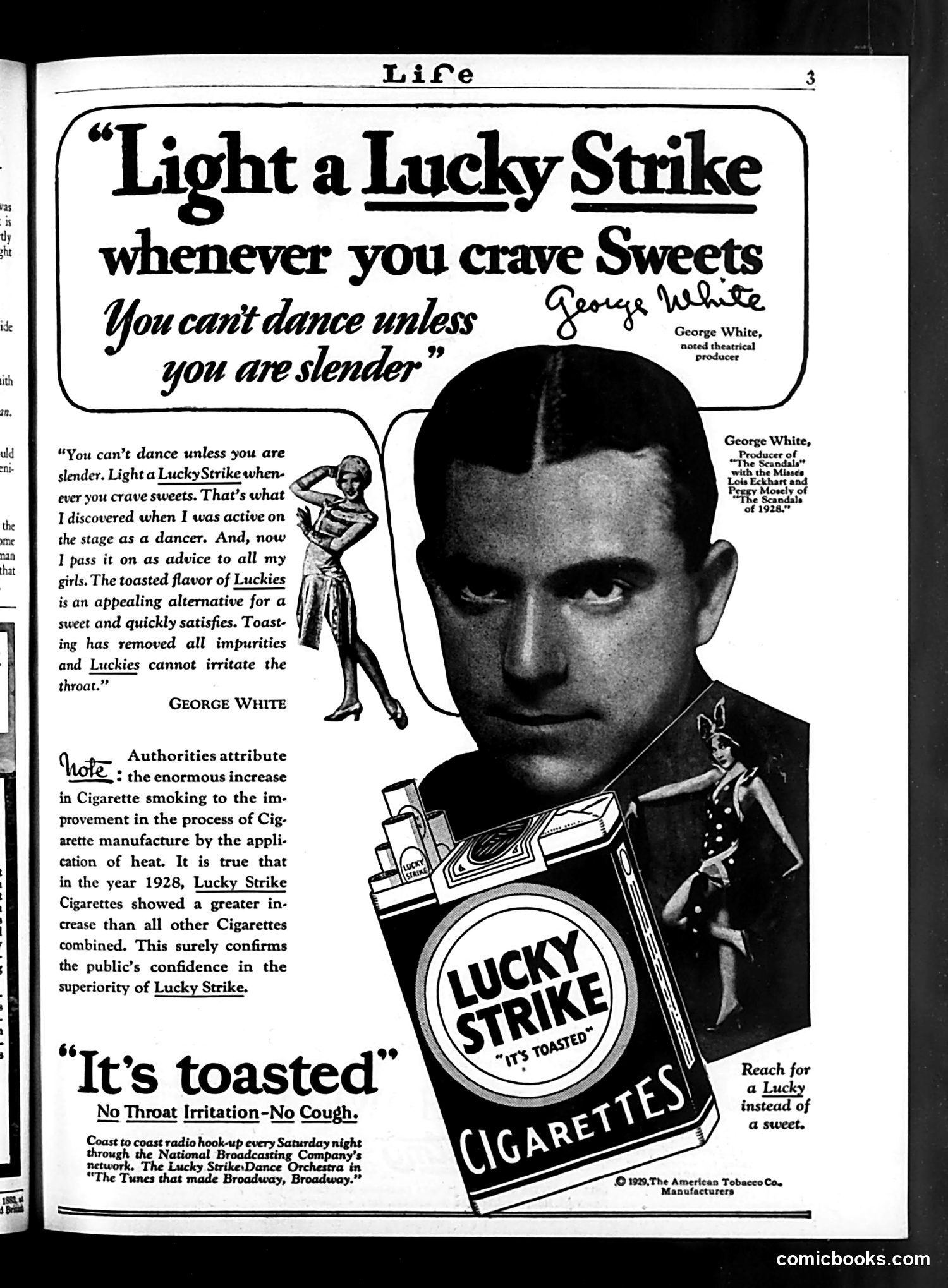
This is primarily a **cigarette advertisement**, not satire. It features George White, a noted theatrical producer, endorsing Lucky Strike cigarettes circa 1928. The ad's "joke" relies on period stereotypes: White claims dancers must stay "slender" to perform, so he recommends Lucky Strikes as a weight-control alternative to eating sweets. The tagline "It's toasted" and claims of "No Throat Irritation" were Lucky Strike's marketing hooks. The accompanying note boasts Lucky Strike outsold competitors in 1928, framing this as proof of public confidence. **For modern readers**: This reflects early cigarette marketing's brazen health claims and the normalization of smoking as appetite suppression—tactics now recognized as deceptive and harmful. The ad exemplifies how cigarette companies exploited celebrity endorsements and dubious health assertions before regulation.
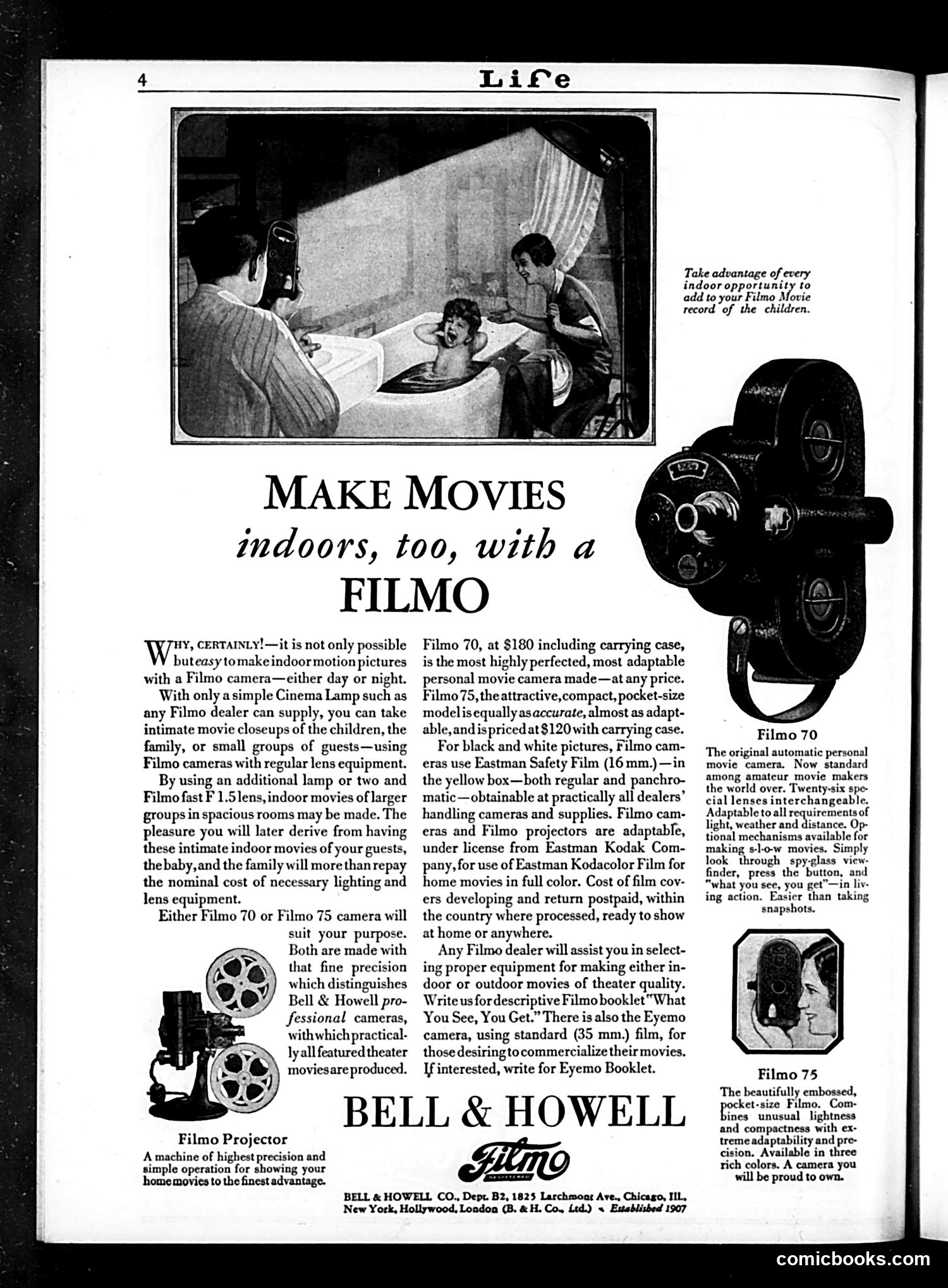
This page is primarily **advertising, not satire or political commentary**. It's a Bell & Howell advertisement for Filmo movie cameras, appearing in Life magazine. The content promotes home movie-making technology, specifically the Filmo 70 and Filmo 75 cameras. The top photograph shows a domestic scene of people filming indoors with a movie camera. The advertisement emphasizes that amateur filmmakers can now capture intimate family moments indoors using Filmo equipment, with proper lighting. It highlights the cameras' precision and adaptability for both indoor and outdoor use, and mentions compatibility with Eastman Kodak film stock. This reflects early 20th-century consumer enthusiasm for accessible home cinema technology as a novelty consumer product for affluent households.
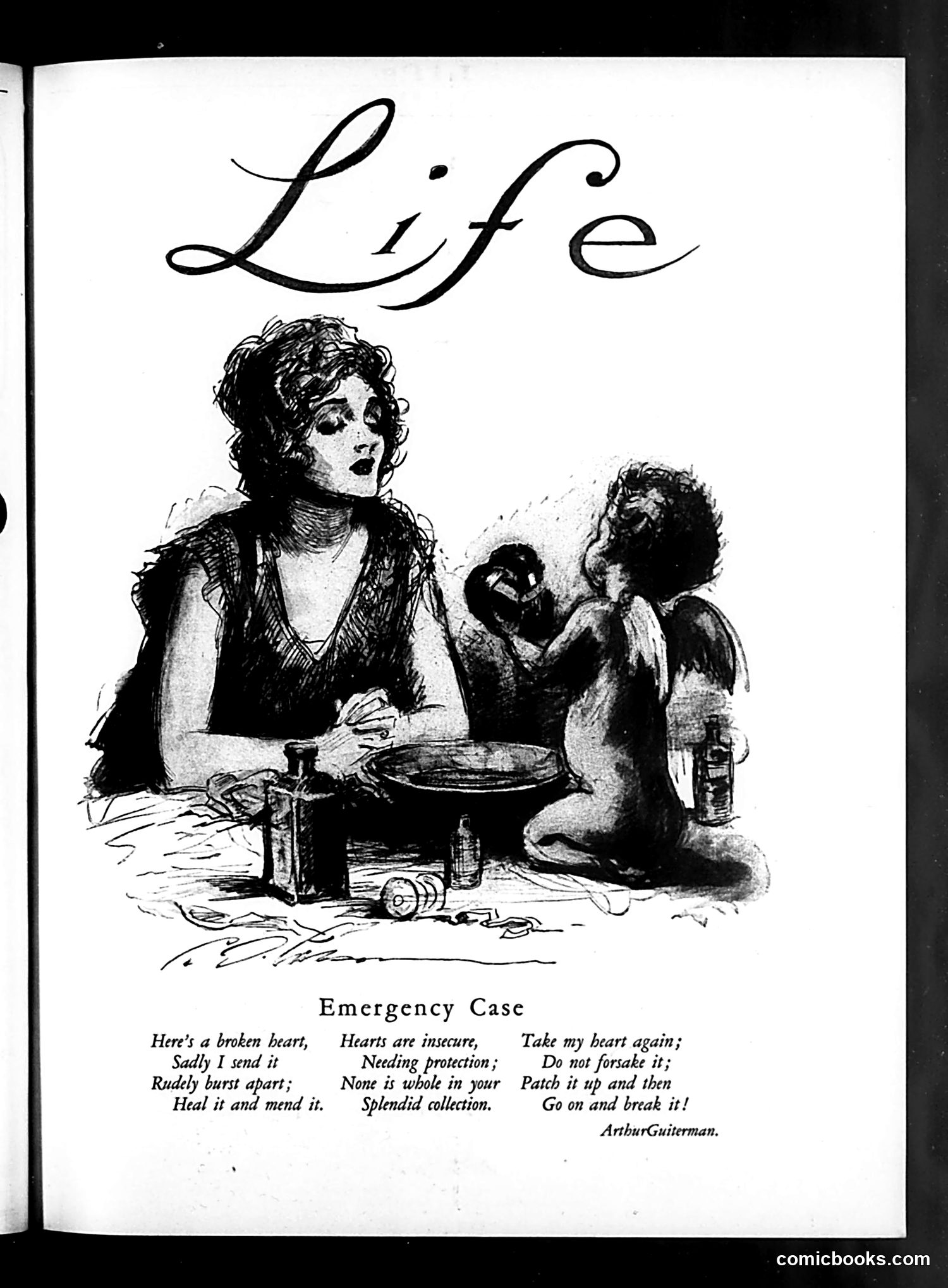
This page satirizes romantic heartbreak through an illustration showing a woman and cherubs gathered around what appears to be a medical kit or collection of bottles and supplies. The title "Emergency Case" treats emotional pain as a medical emergency requiring treatment. The accompanying poem by Arthur Guiterman uses medical language humorously—"broken heart," "Heal it and mend it"—to describe the speaker sending their damaged heart to someone for repair. The final couplet subverts this by mocking the recipient's advice to "break it" further, suggesting cynical commentary on romantic relationships and the futility of trying to fix a broken heart through another person's intervention. The overall tone is satirical commentary on romantic suffering in early 20th-century culture.
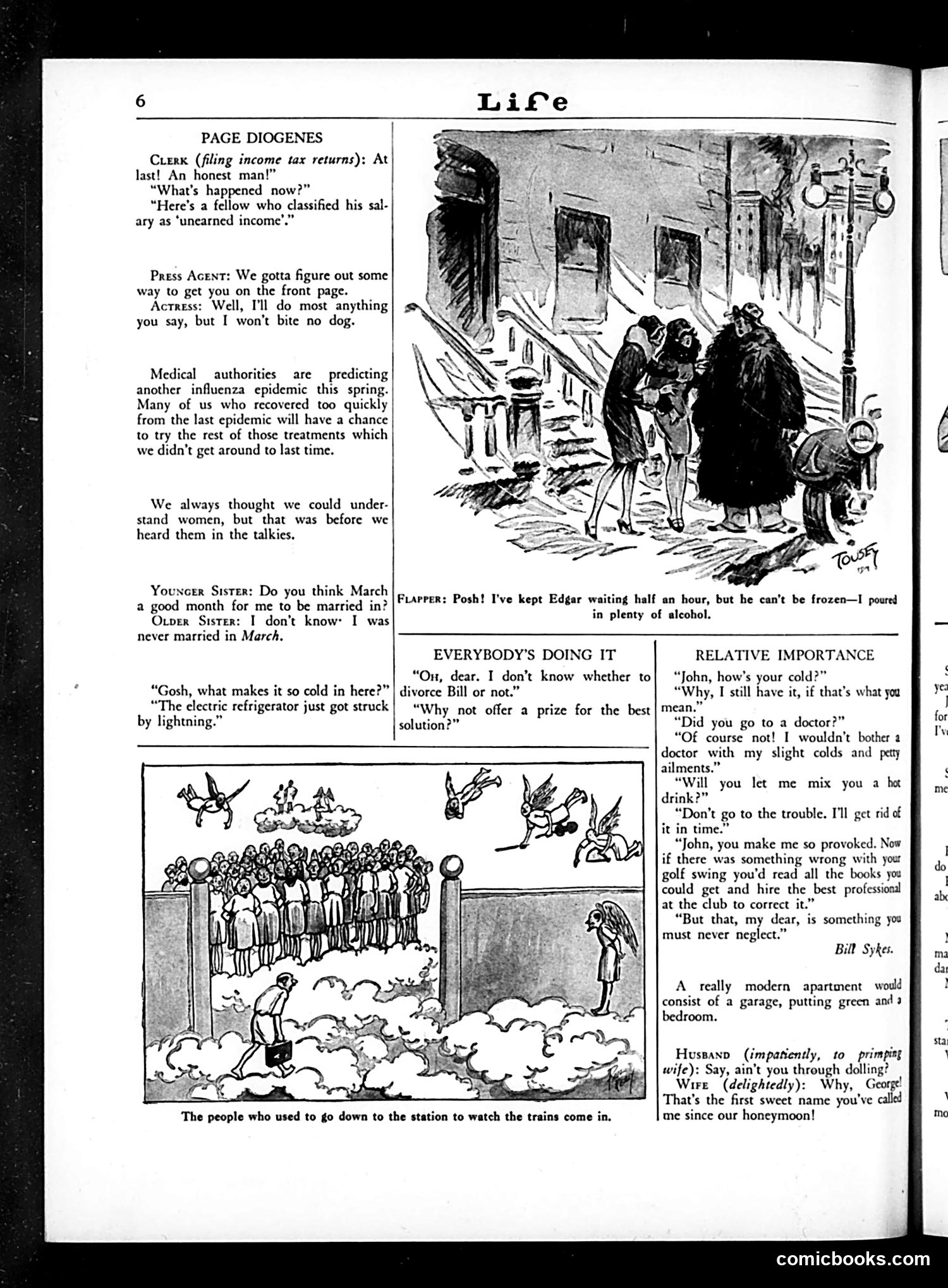
This page contains several humorous vignettes satirizing contemporary social situations: **"Page Diogenes"** jokes mock various professions and pretensions—a clerk's "unearned income," a press agent seeking publicity, an actress's vanity. **The main cartoon** depicts a street scene where a woman keeps her date Edgar waiting in the cold, claiming he can't freeze because he's "in plenty of alcohol"—satirizing both male patience in courtship and drinking culture. **"Everybody's Doing It"** and **"Relative Importance"** present contrasting perspectives on mundane problems (cold, divorce), suggesting how people downplay issues based on social class or pride. **The large cartoon below** shows crowds who once gathered at train stations to watch trains arrive—mocking a now-vanished entertainment, suggesting how quickly public amusements and social habits become obsolete. The page overall satirizes changing social customs and human absurdities.
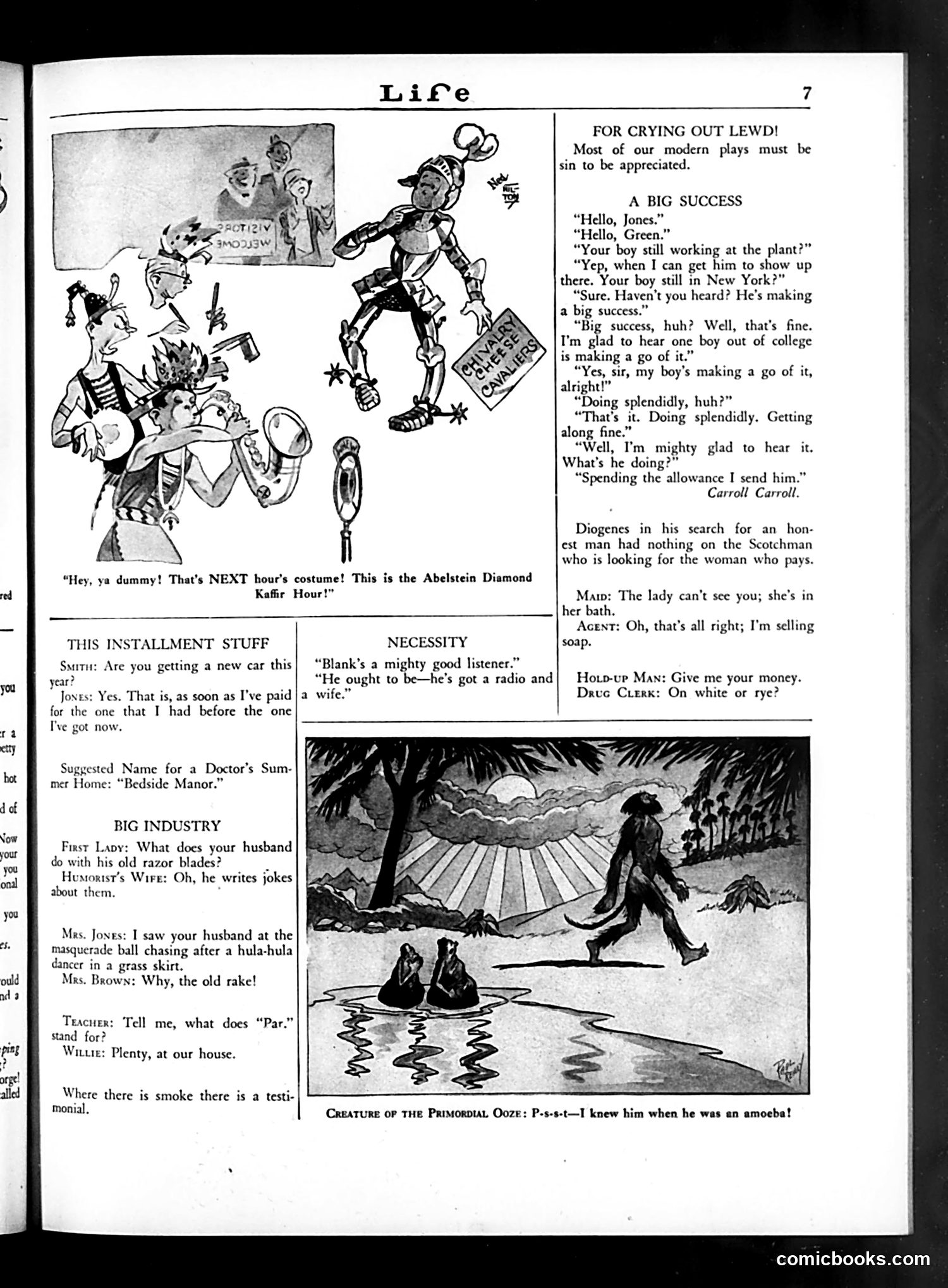
This page contains several humor sections typical of early 20th-century Life magazine: **Top cartoon** ("Abelstein Diamond Kaffir Hour"): Satirizes theatrical costume changes and vaudeville entertainment trends, though the specific reference is unclear without additional context. **Middle jokes** poke fun at: - Car installment payments (financial strain of new consumer goods) - A doctor's summer home naming convention - Husbands' occupations and hobbies - Social pretensions at masquerade balls **Bottom illustration** ("Creature of the Primordial Ooze"): A prehistoric-looking figure emerges from water while observers watch. The caption's punchline references evolutionary biology—the figure knew someone "when he was an amoeba"—satirizing popular interest in Darwin and evolution theory during this era. The humor relies on contemporary social anxieties about modernity, consumerism, and scientific ideas.
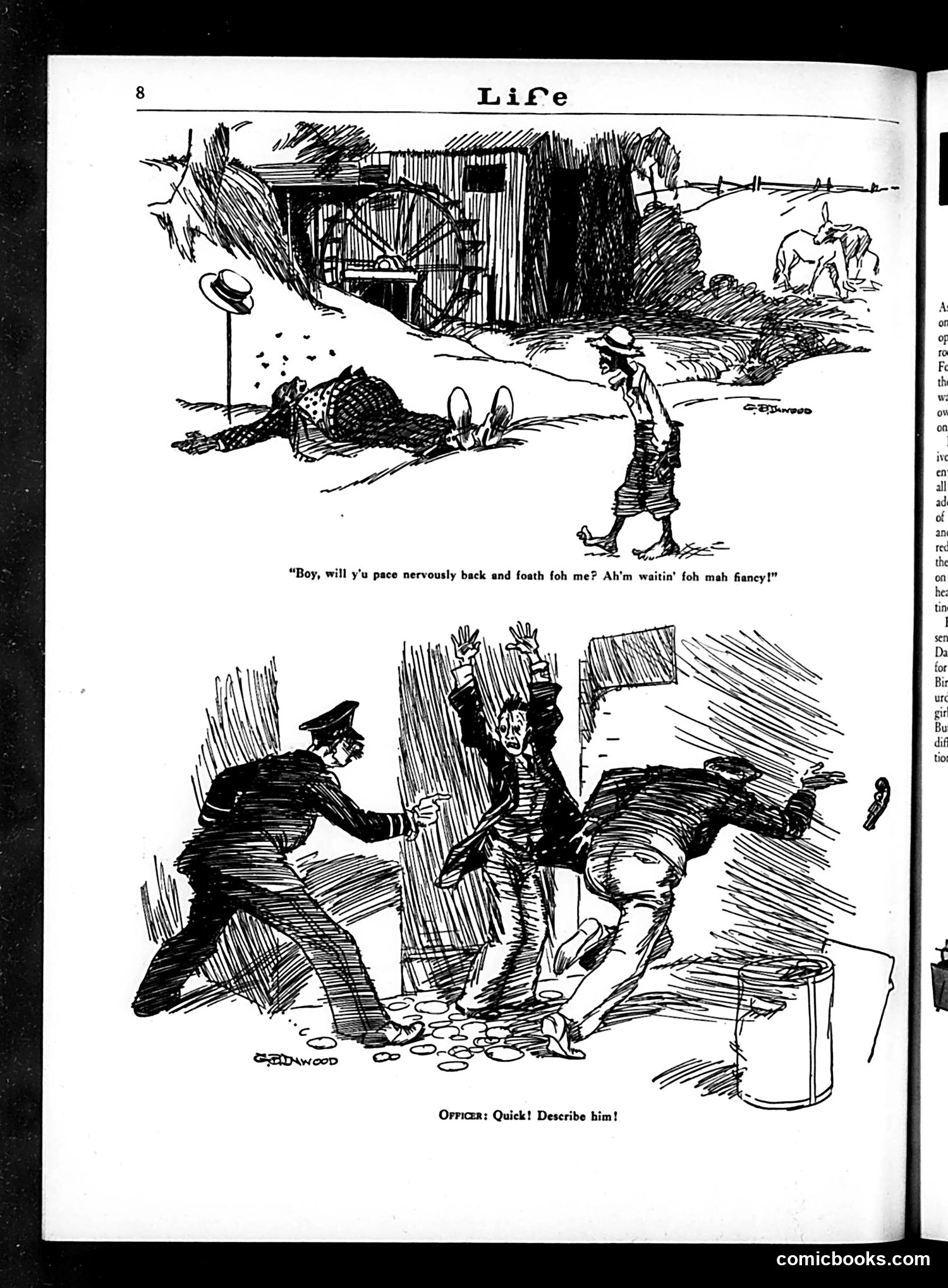
This page contains two satirical cartoons: **Top cartoon**: A man in rural/frontier clothing asks another man to "pace nervously back and forth" for him while he waits for his "fancy" date—a humorous domestic scene playing on anxious courtship behavior. **Bottom cartoon**: Police officers struggle to apprehend a suspect while one shouts "Quick! Describe him!"—a joke about the chaos of law enforcement, where officers are too busy fighting to actually observe what they're supposed to be catching. Both cartoons use exaggerated ink-line illustration style typical of early-20th-century American humor. The satire targets everyday situations: romantic nervousness and police incompetence. These appear designed as general comic observations rather than topical political commentary.
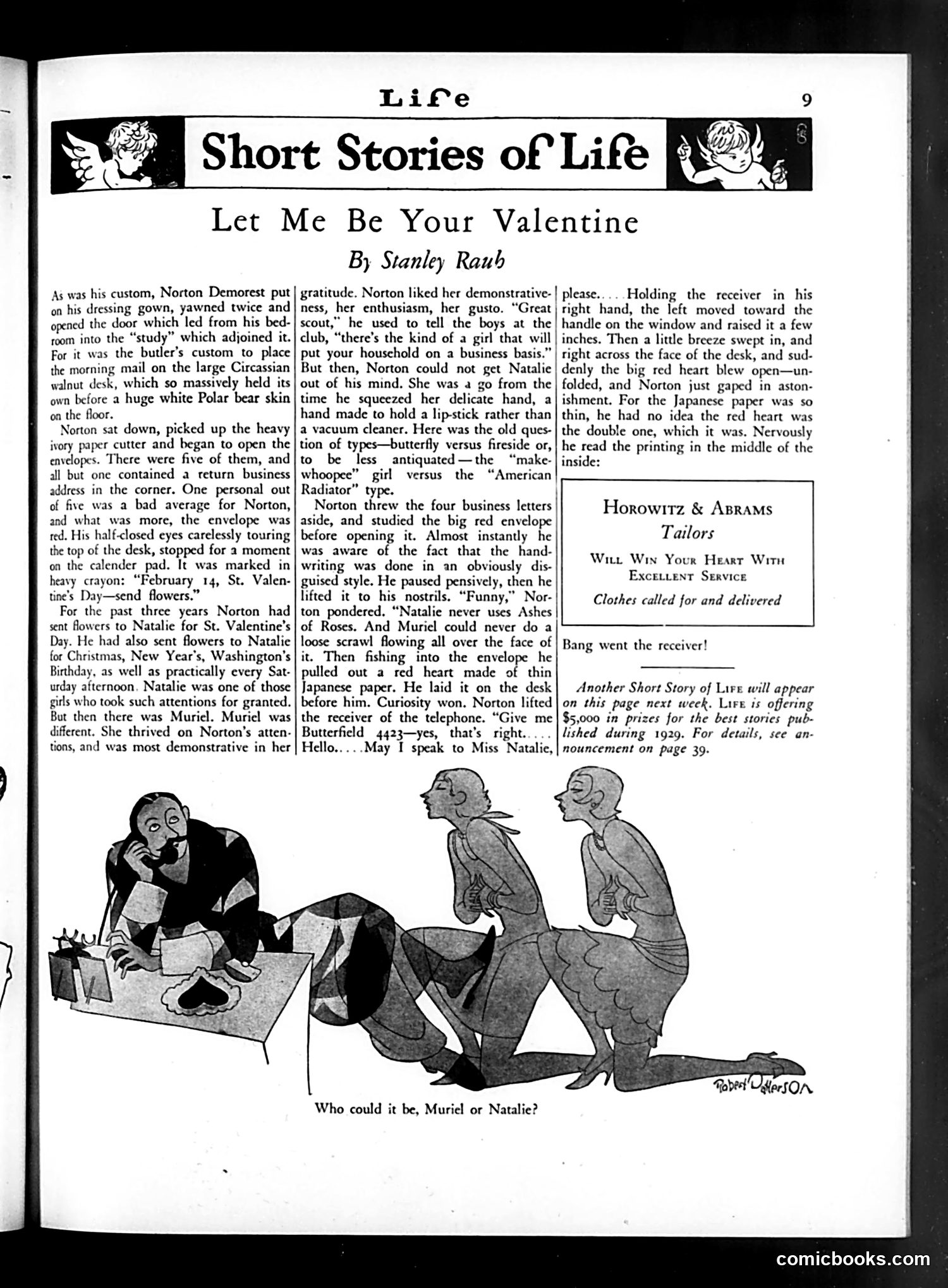
This short story satirizes romantic conventions of the 1930s. The plot follows Norton Demorest, who receives business mail and discovers a Valentine's Day heart from an admirer—but cannot determine whether it's from Natalie or Muriel, two women vying for his attention. The cartoon at bottom, captioned "Who could it be, Muriel or Natalie?", shows two identical mermaid-like figures approaching Norton at his desk, making the ambiguity visual. The satire mocks male indecision in romance and the similar, interchangeable nature of his suitors—both women present themselves identically, suggesting Norton views them as essentially the same despite their competitive efforts for his affection.
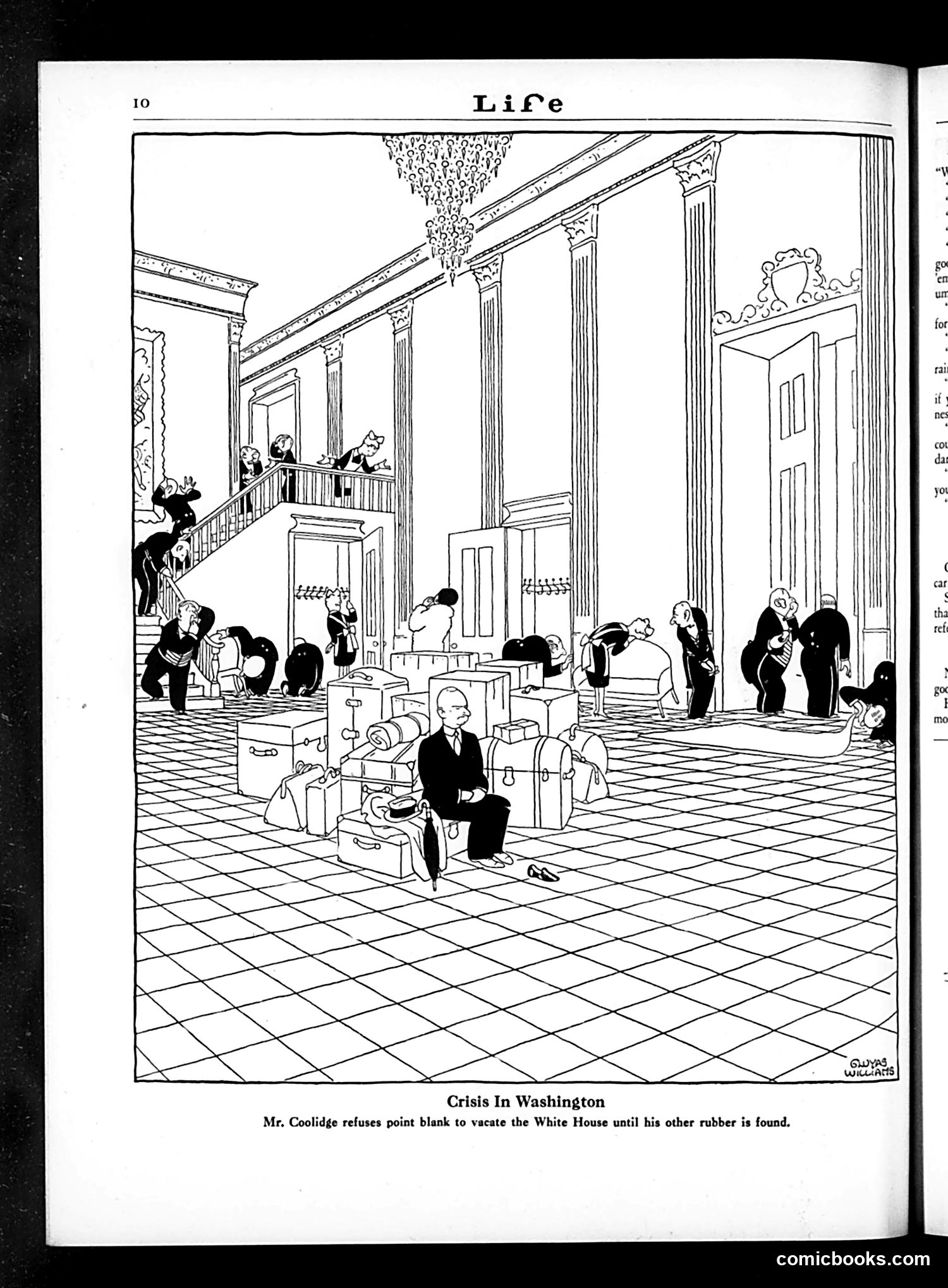
This political cartoon satirizes President Calvin Coolidge during his administration. The caption reads: "Mr. Coolidge refuses point blank to vacate the White House until his other rubber is found." The joke plays on Coolidge's reputation for extreme frugality and caution. The cartoon depicts him sitting surrounded by luggage in the White House's grand hall, refusing to leave until a missing rubber (likely a rubber shoe or galosh) is located. The satire mocks both Coolidge's penny-pinching nature and his perceived indecisiveness or stubbornness—suggesting he would hold up the entire machinery of government over a trivial lost item. The elaborate White House setting contrasts absurdly with the mundane domestic concern, amplifying the ridicule.
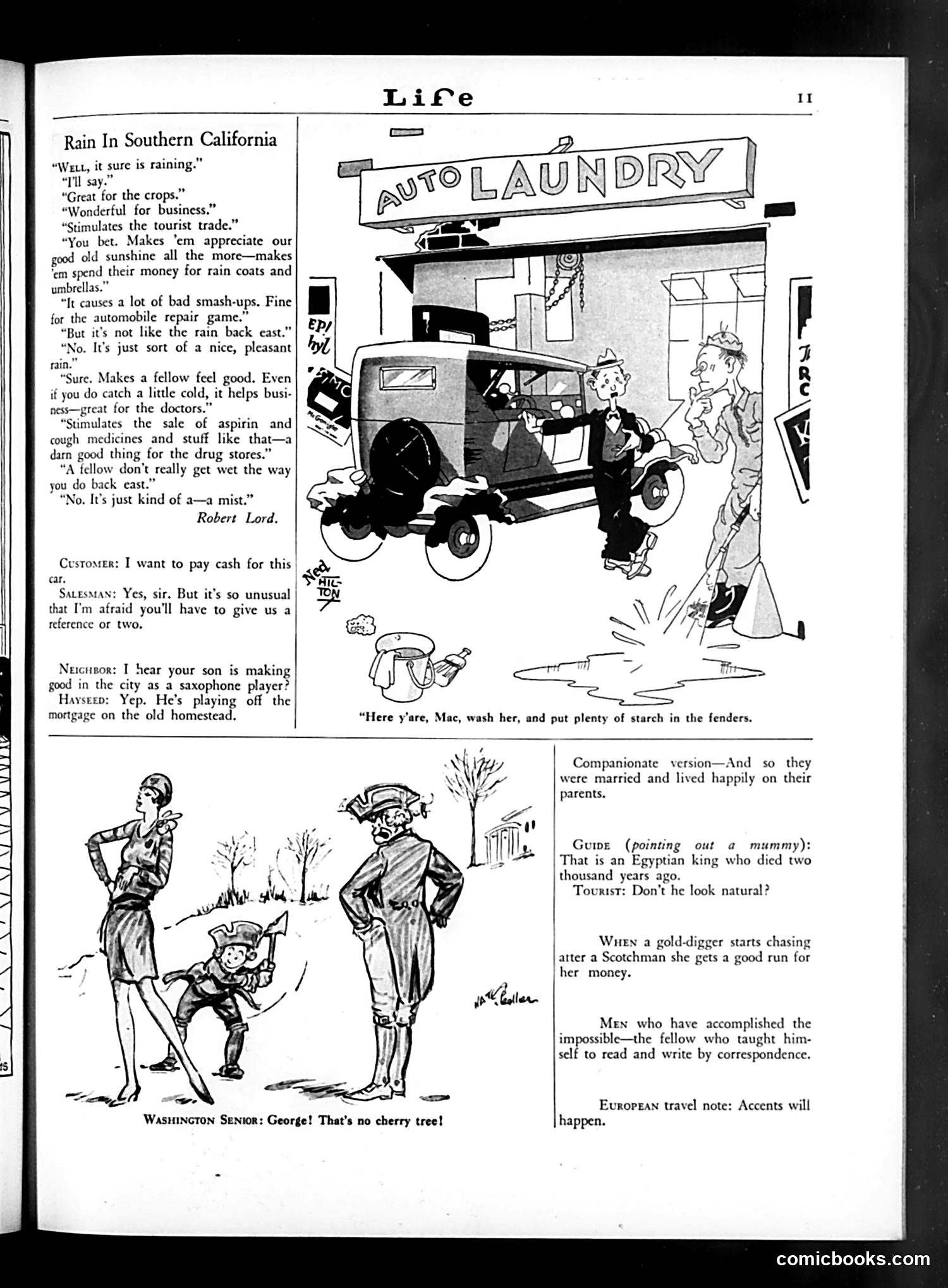
This page contains several unrelated humorous pieces typical of Life's satirical format: **Top section** discusses rain in Southern California, with various witty observations about its effects on crops, tourism, and daily life—attributed to Robert Lord. **Main cartoon** depicts an "Auto Laundry" scene where a car owner drops off his vehicle for cleaning, with the caption joking about washing and starching the car's fenders—a play on the nascent automobile service industry. **Bottom cartoons** include a "Washington Senior" joke referencing the cherry tree legend associated with George Washington, and scattered brief humorous observations about marriage, Egyptian mummies, gold-diggers, and European travel. The page exemplifies Life's format of mixing short jokes, observations, and cartoon commentary on everyday American life and contemporary culture.
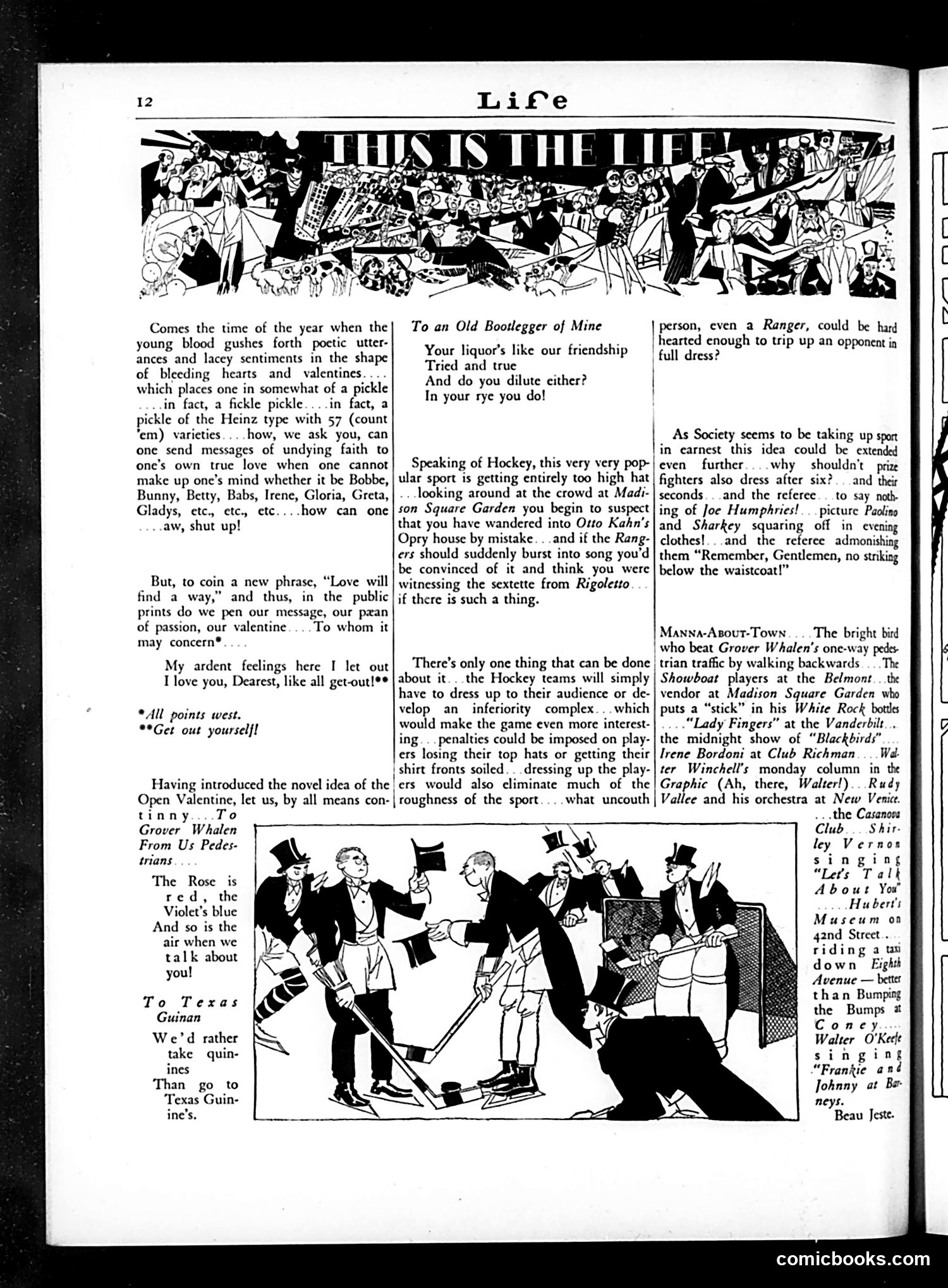
This page satirizes 1920s social customs and sports culture. The main cartoon depicts men in formal dress (top hats and tails) playing hockey indoors—likely mocking the sport's growing popularity among high society. The text references Madison Square Garden hockey matches becoming fashionable entertainment for the wealthy elite. The surrounding content pokes fun at Valentine's Day sentiments and includes humorous items about various entertainers and venues (Grover Whalen, Club Richman, vaudeville acts). The overall satire targets how the upper class was adopting previously working-class pastimes like hockey as trendy leisure activities, while maintaining their formal social conventions—hence the absurdity of elegant gentlemen in evening wear playing a rough sport.
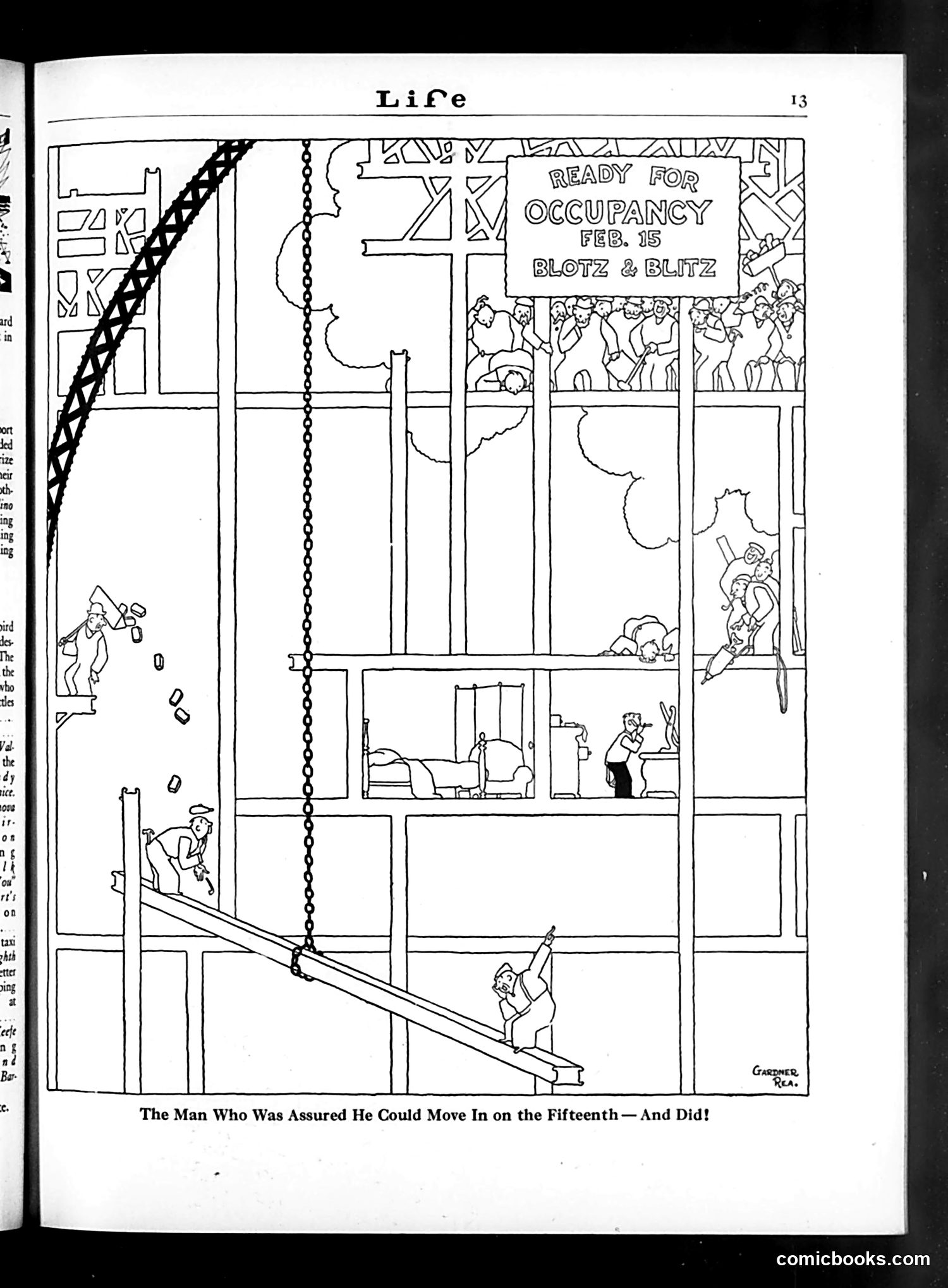
This is a humorous cartoon about apartment moving day, captioned "The Man Who Was Assured He Could Move In on the Fifteenth — And Did!" The joke depicts a chaotic moving scene in a multi-story building where a tenant, assured he could occupy his apartment on February 15th (as stated in the "Ready for Occupancy Feb. 15 Blotz & Blitz" sign), literally *does* move in on that date—but the building is still under construction. Workers continue laboring on scaffolding and within the building's framework while the tenant moves his belongings via an improvised chute/ramp system. The satire mocks both tenant expectations and landlord/developer promises about move-in dates. It's a comment on the housing market's chronic delays and the gap between promised and actual availability—a timeless issue in real estate.
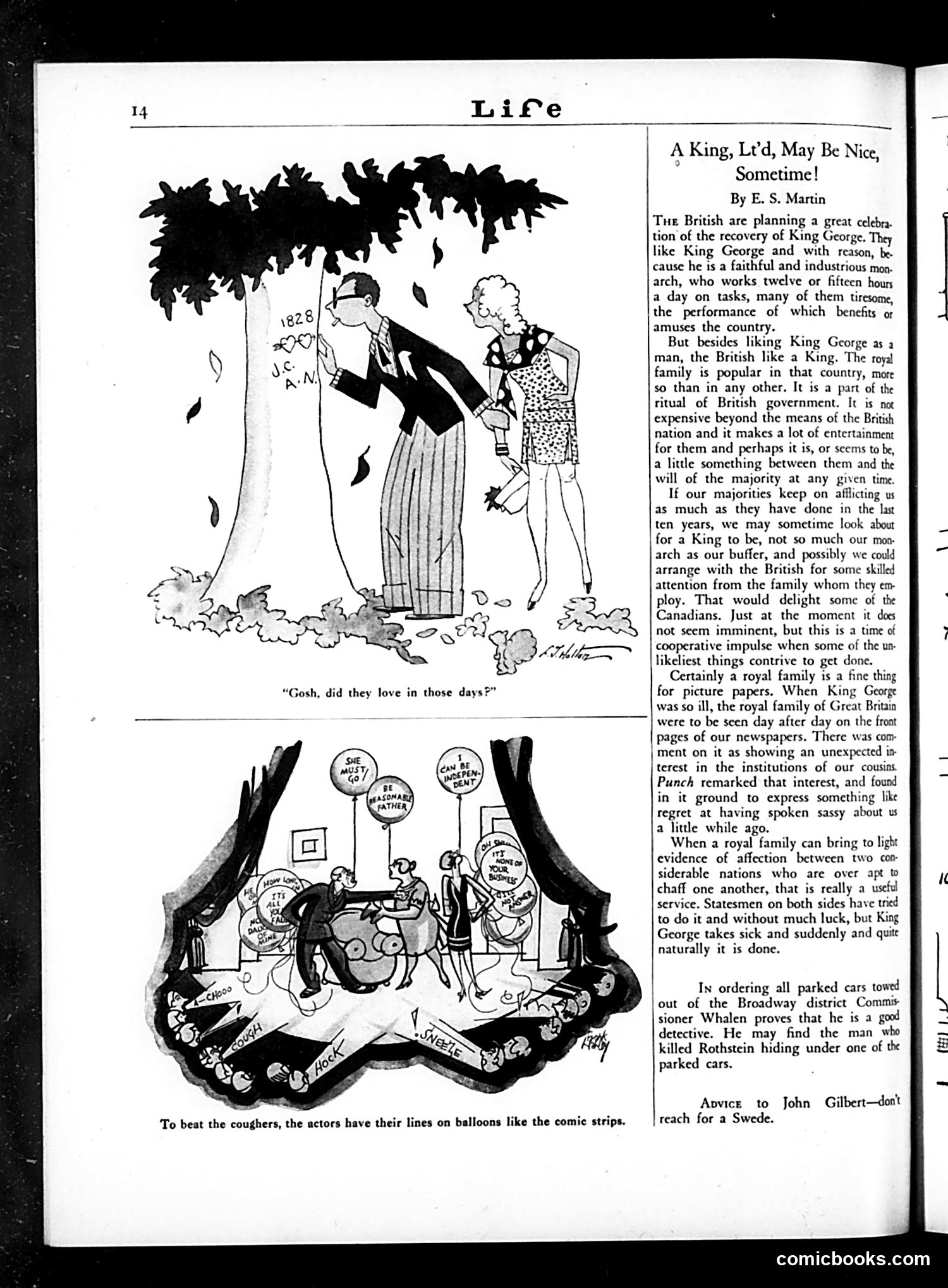
This page from *Life* magazine contains two cartoons and an article titled "A King, Lr'd, May Be Nice, Sometime!" by E. S. Martin. The **top cartoon** shows a woman and man beneath a large tree shedding leaves, with the caption "Gosh, did they love in those days?" — likely satirizing nostalgia for romantic ideals of an earlier era. The **bottom cartoon** depicts actors on a stage with dialogue in balloons, captioned "To beat the coughers, the actors have their lines on balloons like the comic strips." This mocks Broadway theater-goers who cough during performances, forcing actors to resort to visible dialogue balloons (comic-strip style) to be heard. The accompanying **article** discusses the British royal family's popularity and suggests their presence might benefit Canadian-British relations, while joking about King George's recent illness.
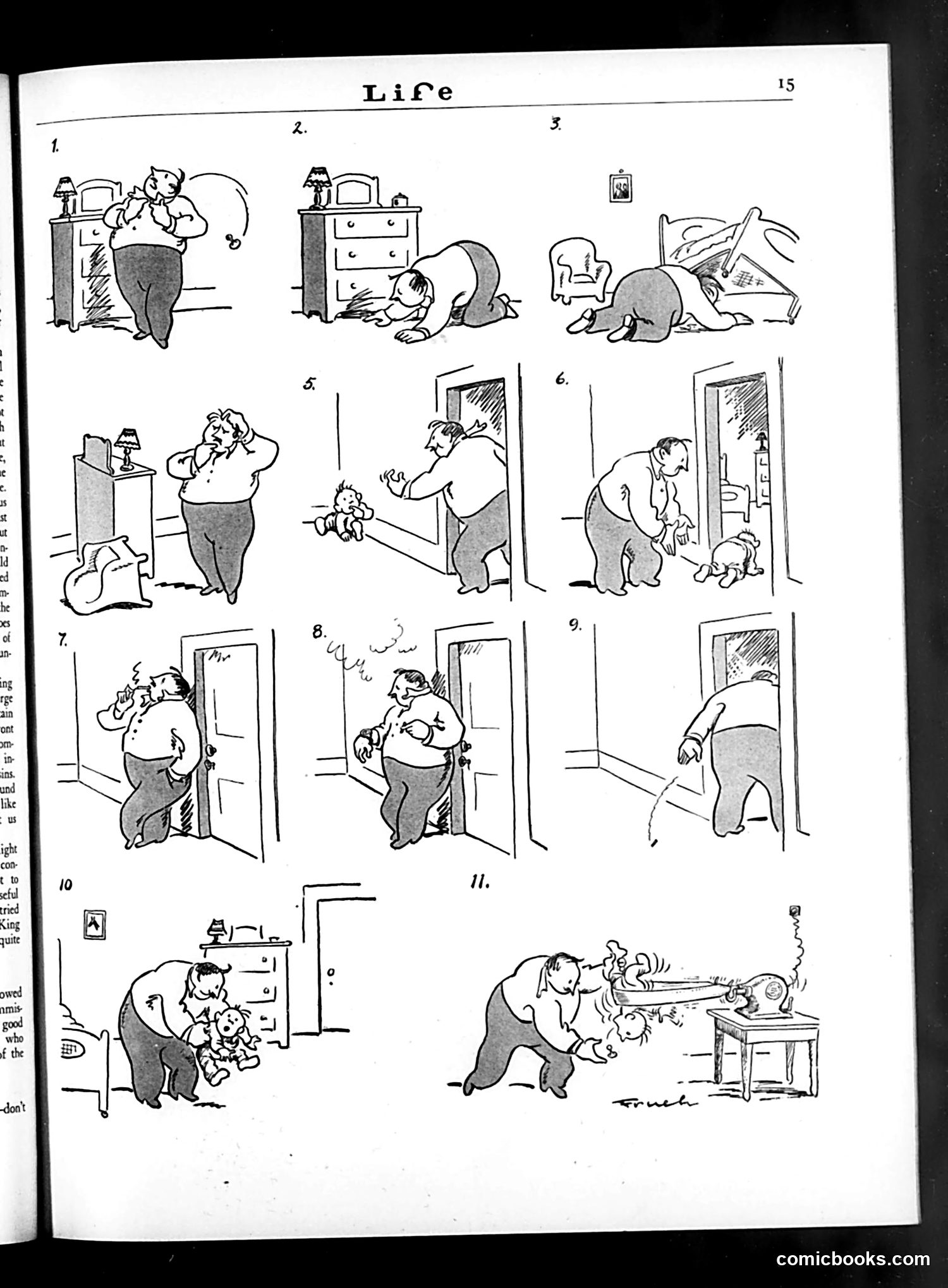
This is a sequential comic strip titled "Life" depicting a domestic scenario involving a heavyset man and a young child. The narrative appears to show: 1. A man discovering a child making mischief (panels 1-3) 2. The man's escalating frustration and attempts at discipline (panels 4-9) 3. The child escaping or evading punishment through doorways 4. A final confrontation involving what appears to be mechanical or electrical equipment (panels 10-11) The satire mocks parenting struggles and domestic chaos of the era—specifically the difficulty fathers face controlling unruly children. The humor derives from the man's repeated failures to catch or discipline the child, suggesting the child's cleverness outmatches parental authority. This reflects early 20th-century attitudes about childhood discipline and household management.
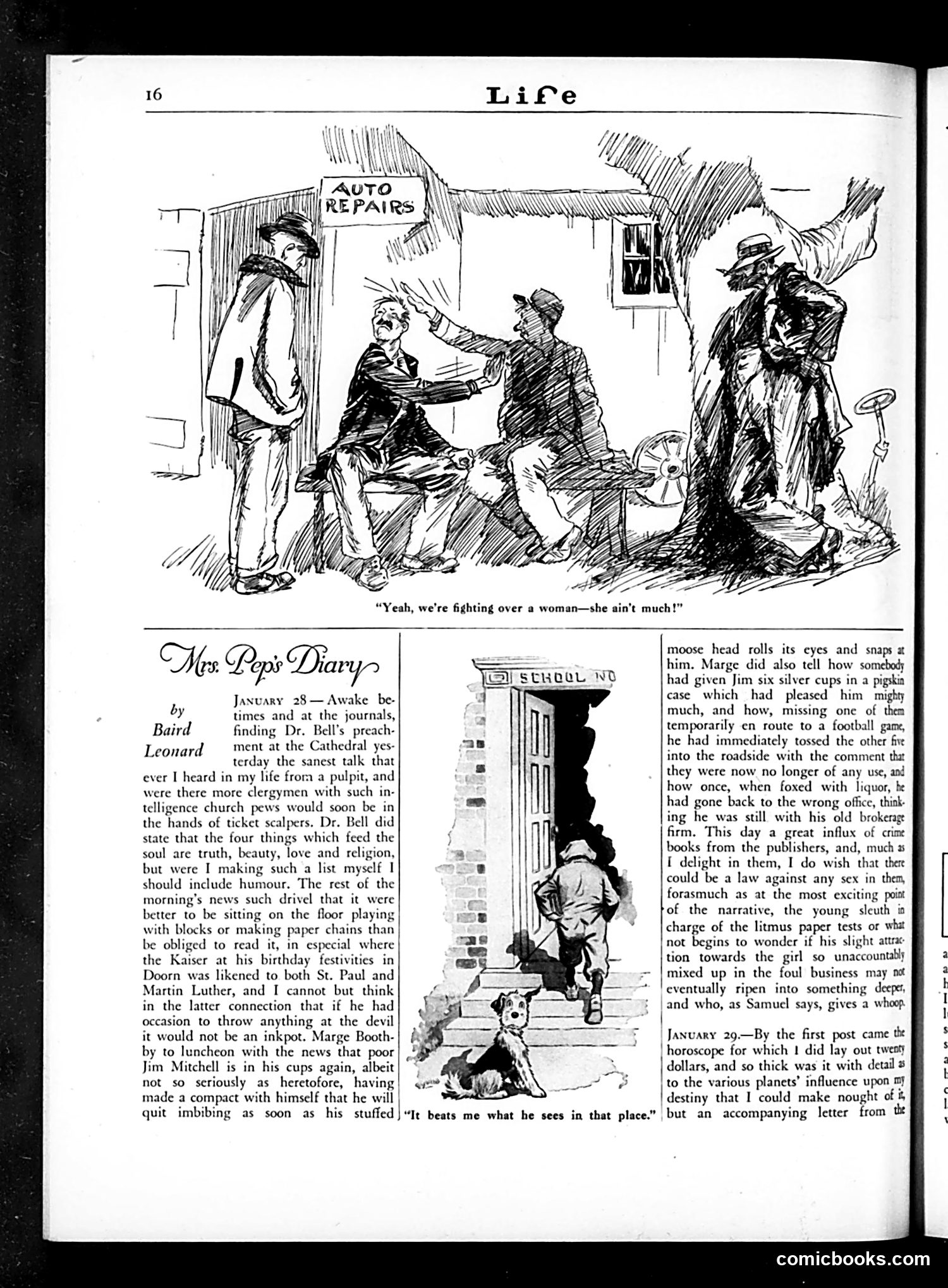
The top cartoon depicts four men outside an "Auto Repairs" shop, with one saying "Yeah, we're fighting over a woman—she ain't much!" This is a humorous domestic scene suggesting marital discord or romantic rivalry—common satirical fodder about working-class life. Below is "Mrs. Pep's Diary" by Baird Leonard, a serialized humor column. The January 28-29 entries describe domestic observations: a preacher's sermon about church news, gossip about neighbors (Dr. Bell, Jim Mitchell), and commentary on sensational books from publishers. The accompanying illustration shows someone on schoolhouse steps. The humor derives from middle-class social pretension and small-town gossip—typical Life magazine satire of the era targeting provincial American manners and morality.
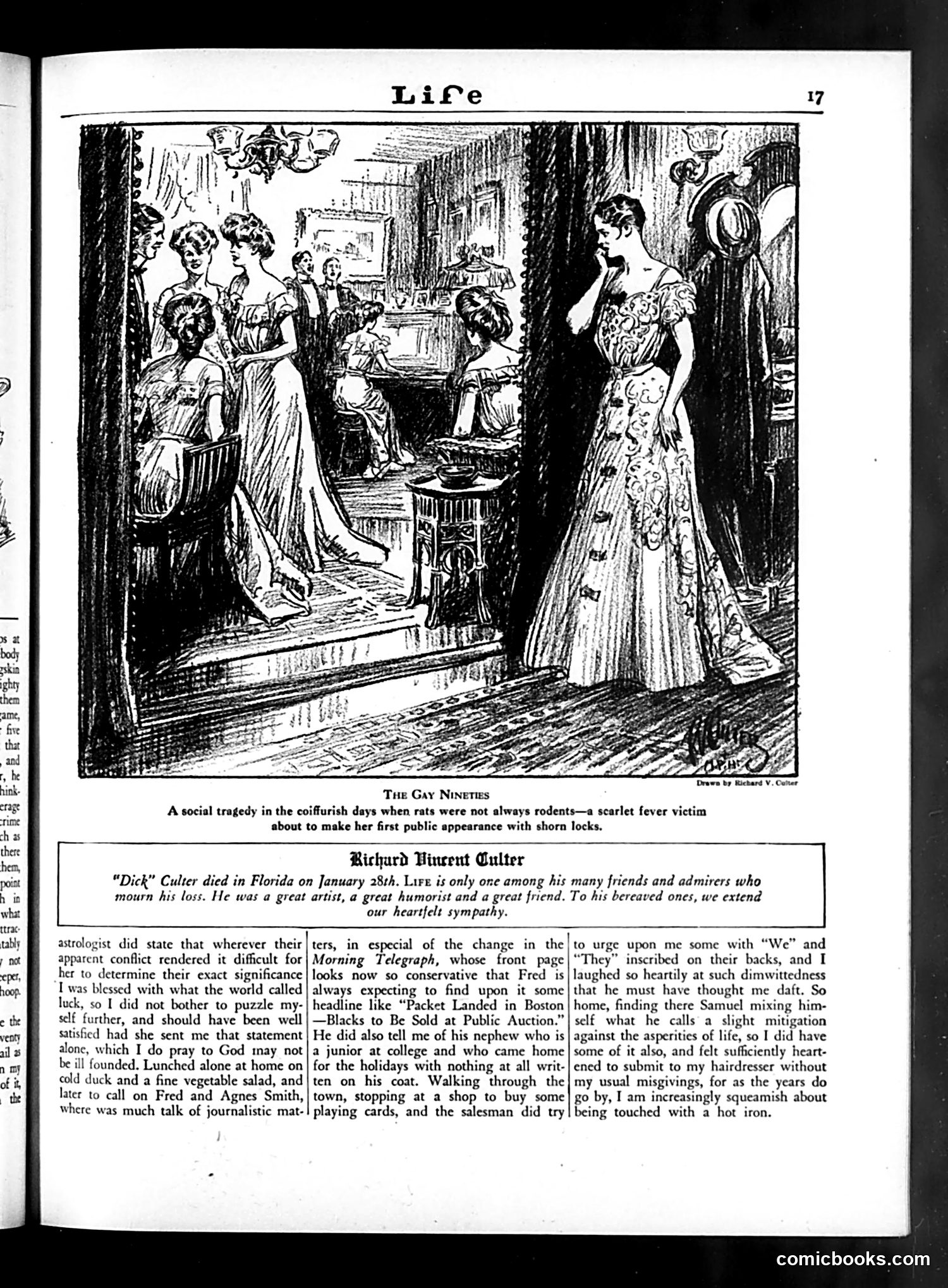
The illustration depicts an elegant woman in 1890s formal dress admiring herself in a mirror, surrounded by other fashionably dressed women at what appears to be a social gathering or party. The caption reads: "A social tragedy in the eightieth days when rats were not always rodents—a scarlet fever victim about to make her first public appearance with shorn locks." The satire concerns female vanity and social propriety of the 1890s. The "tragedy" is that a young woman recovering from scarlet fever (which required head-shaving during treatment) must now appear publicly with short hair—a severe social embarrassment in an era when long hair was essential to feminine beauty and acceptability. The joke mocks both the woman's vanity and society's shallow judgment of women's worth based on appearance.
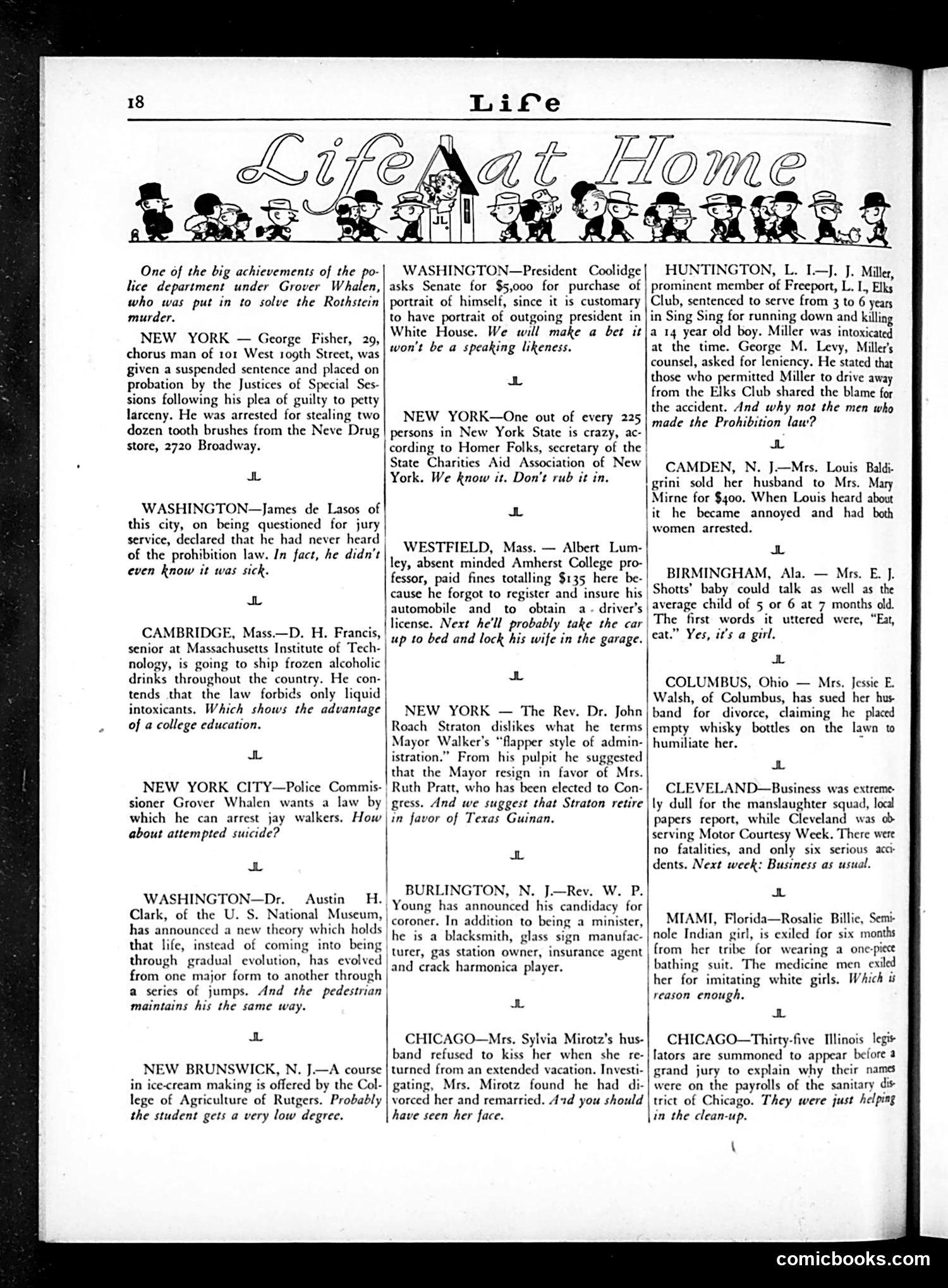
This page from *Life* magazine's "Life at Home" column presents brief, sardonic news items mocking 1920s American society and Prohibition-era absurdities. **Key Targets:** The satire focuses on Prohibition's failures and contradictions. MIT students ship "frozen alcoholic drinks" to circumvent the law; a jury candidate claims ignorance of Prohibition itself. A drunk driver kills a child, and the columnist pointedly asks why blame falls on the driver rather than "the men who made the Prohibition law"—directly criticizing the legislation itself. **Other Social Satire:** The column mocks New York's crime (the unsolved Rothstein murder, petty theft), incompetent government (police commissioner wanting jaywalking laws), and absurd bureaucrats (a minister running for coroner with five unrelated occupations). **Tone:** Throughout, the humor is darkly cynical—using deadpan commentary ("Don't rub it in") to critique both lawbreakers and lawmakers. The column suggests Prohibition created worse problems than it solved, reflecting *Life*'s skeptical stance toward this controversial policy.
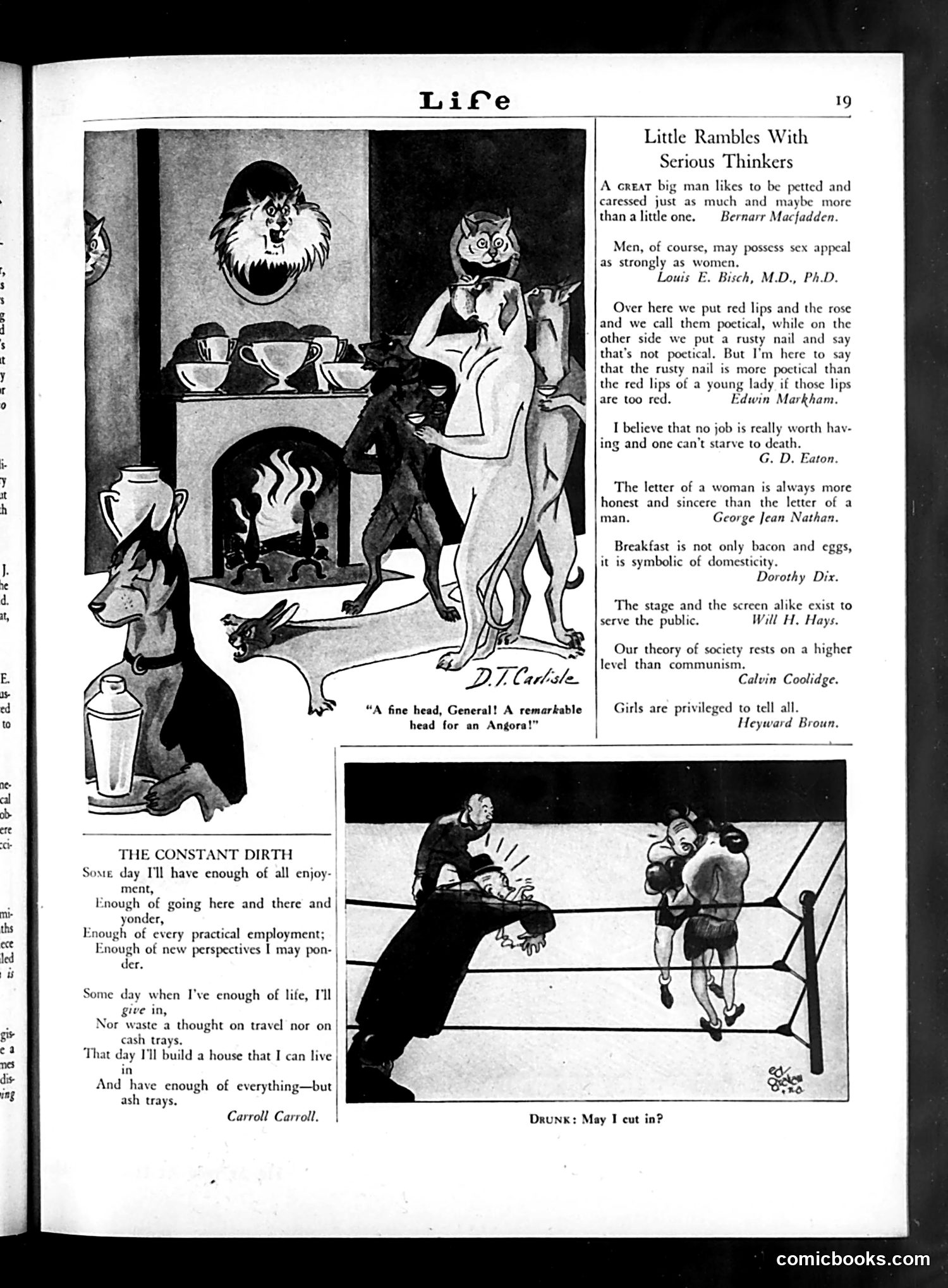
This page contains satirical commentary typical of 1920s Life magazine. **"Little Rambles with Serious Thinkers"** presents quotes from public figures (Bernarr Macfadden, Louis Bisch, Calvin Coolidge, Dorothy Dix, etc.) on relationships, work, and society—likely selected to highlight contradictions or absurdities in their positions. **"The Constant Dirth"** (poem by Carroll Carroll) satirizes modern life's endless consumption and restlessness, culminating in the joke that one can have "everything—but ash trays"—mocking both materialism and the futility of accumulation. **The two cartoons** use animals as stand-ins for humans: the top image shows dogs and cats in a domestic kitchen scene with the caption "A fine head, General! A remarkable head for an Angora!"—likely satirizing vanity or aristocratic pretension. The bottom cartoon depicts a drunk attempting to cut in on a couple dancing, a common social comedy scenario of the era. The overall theme mocks contemporary attitudes about domesticity, social climbing, and behavior.
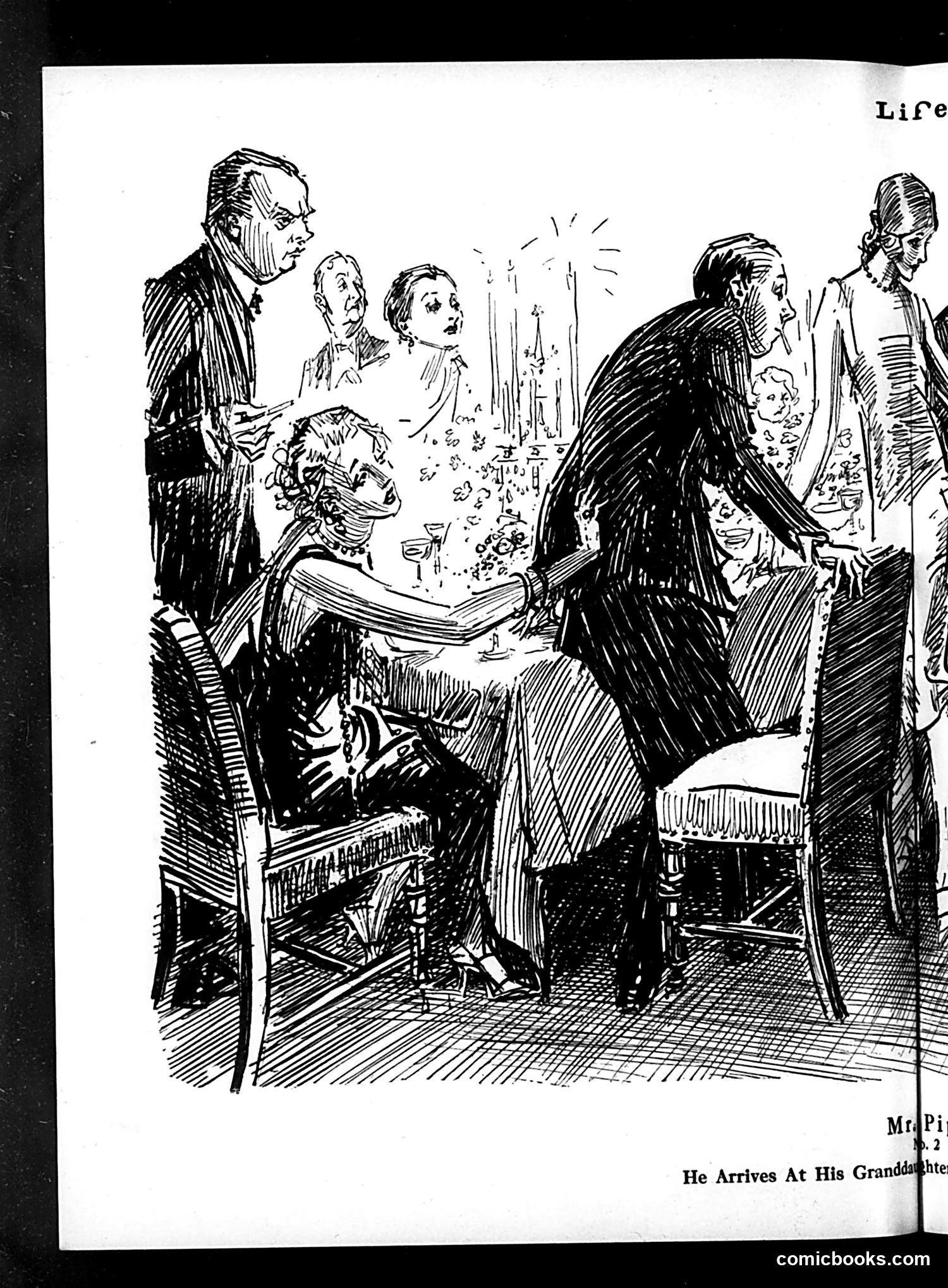
This appears to be a satirical cartoon from *Life* magazine depicting a formal social gathering, likely at a wealthy household based on the elegant dress and dining setting. The caption "He Arrives At His Granddaughter's" suggests the humor involves a generational or social class clash—possibly an older man (perhaps from a rural or working-class background) visiting his granddaughter's refined urban home. The other figures' expressions of surprise or concern hint at comedic awkwardness stemming from different social expectations or manners. Without additional context or visible names, the specific identity of "he" and the particular social commentary remain unclear, though the cartoon likely satirizes class differences or generational gaps common in early-20th-century American humor.
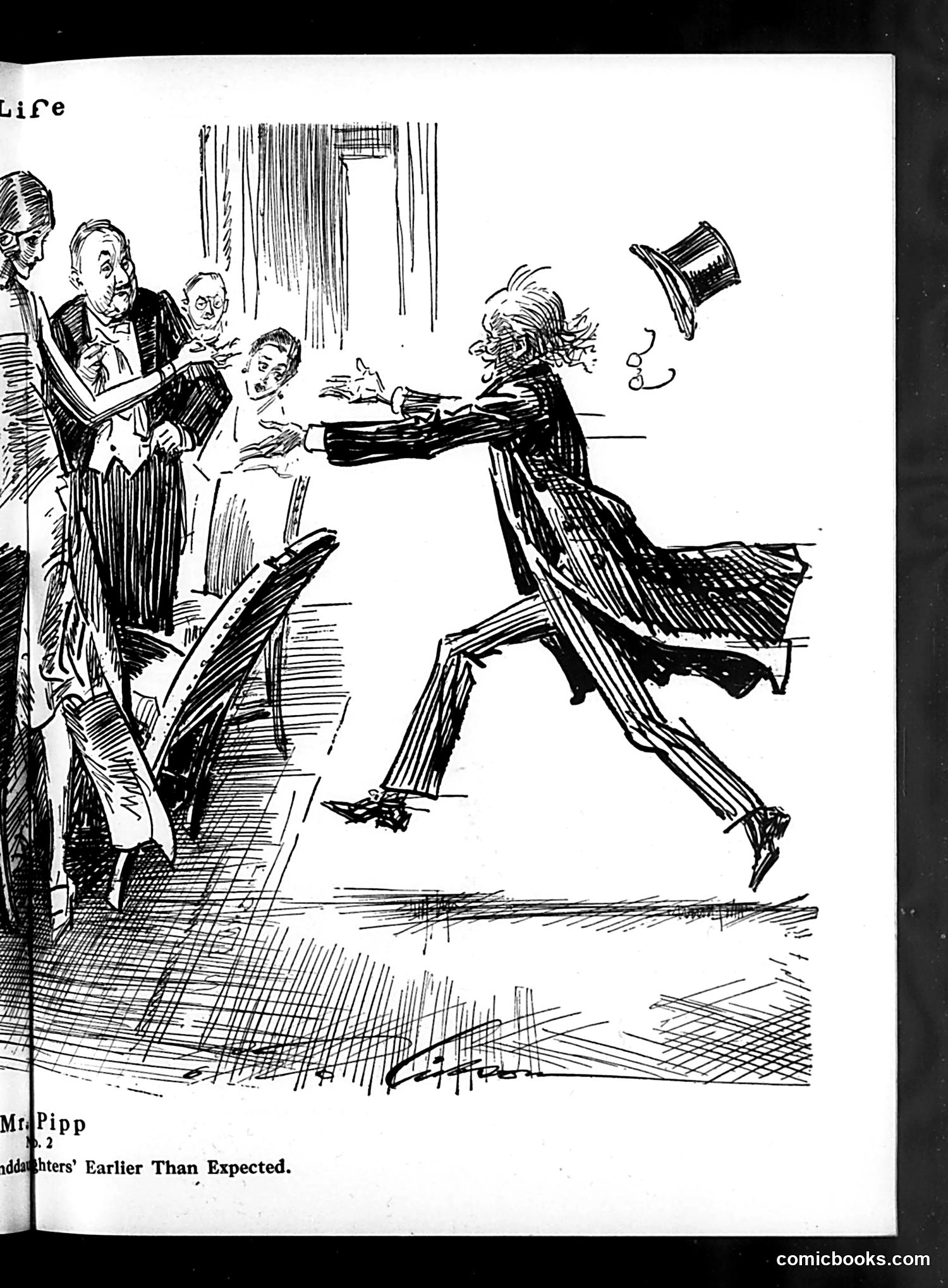
This appears to be a satirical cartoon from Life magazine titled "Daughters' Earlier Than Expected," credited to "Mr. Pipp" (visible at bottom left). The cartoon depicts a man in formal attire being violently ejected from a doorway by what appears to be a woman in a long coat and hat, who is kicking him forcefully out. His top hat flies through the air. A group of well-dressed men and women observe from inside, appearing shocked or amused by the scene. The satire likely comments on unexpected romantic rejections or unwanted courtship—the "daughters" arriving "earlier than expected" suggests either an unplanned visit disrupting social plans, or possibly commentary on women's increasing assertiveness in romantic or social situations. The violent ejection serves as humorous exaggeration of social disapproval. Without additional context about 1910s-1920s Life magazine conventions, the specific target remains somewhat unclear.
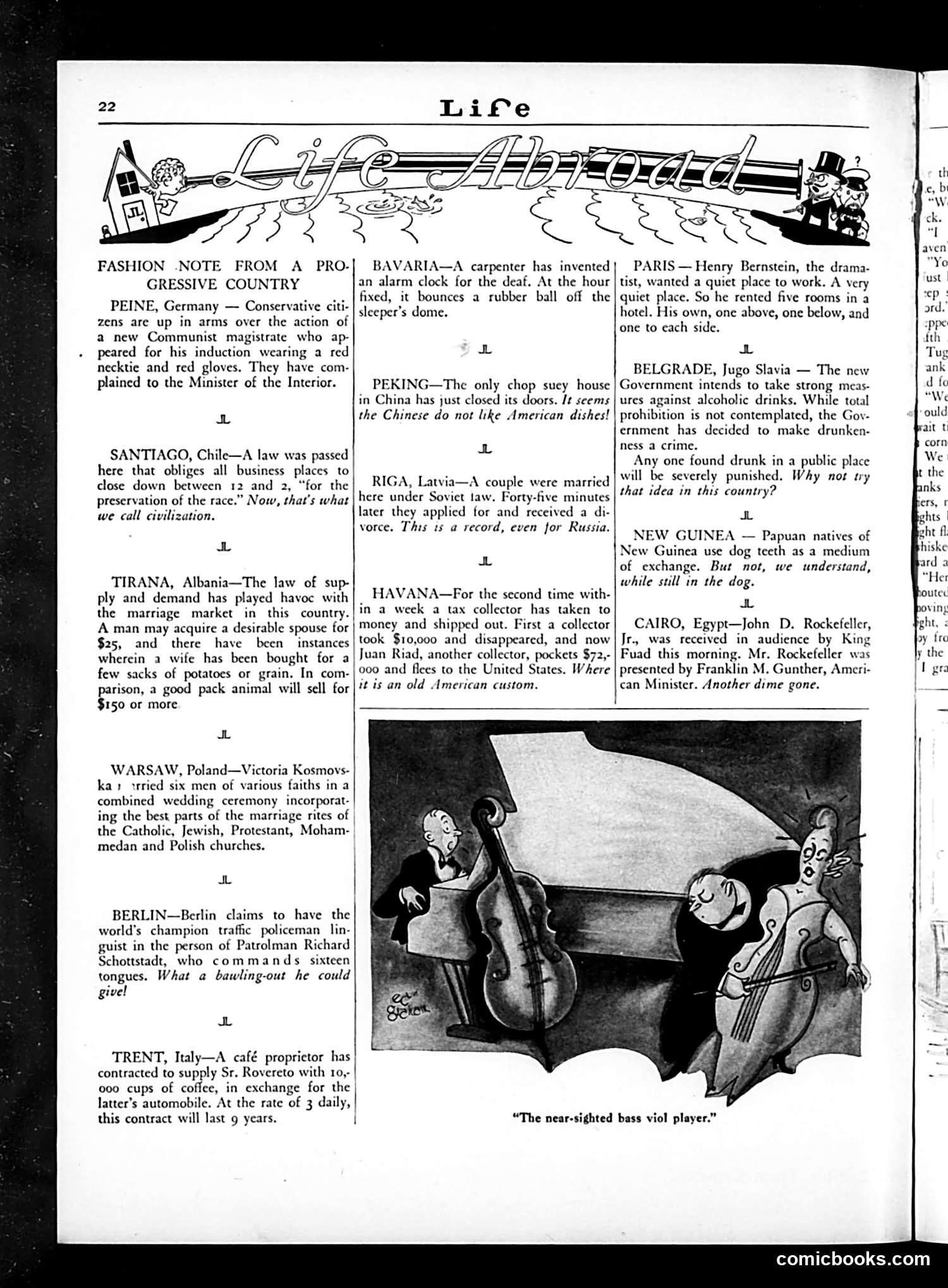
This page from *Life* magazine presents international "news briefs" paired with satirical commentary, mocking foreign customs and politics through American exceptionalism. The items target: **Political targets:** Communist Germany (red necktie scandal), Soviet Russia (quick divorce), and authoritarian regimes with absurd laws. **Cultural mockery:** Chile's mandatory siesta "for preservation of the race," Albania's bride-selling, and China rejecting American chop suey. **American superiority jokes:** Havana's corrupt tax collectors are dismissed as following "an old American custom" (embezzlement); Egypt's King Fuad meeting Rockefeller Jr. prompts "Another dime gone" (mocking wealth concentration). **The cartoon below** shows a near-sighted bass viol player, illustrating the page's humorous tone about human folly globally. The satire works bidirectionally—mocking foreign absurdities while implicitly critiquing American hypocrisy and capitalism. The brief format allows rapid-fire jabs at 1920s-30s geopolitics and social systems.
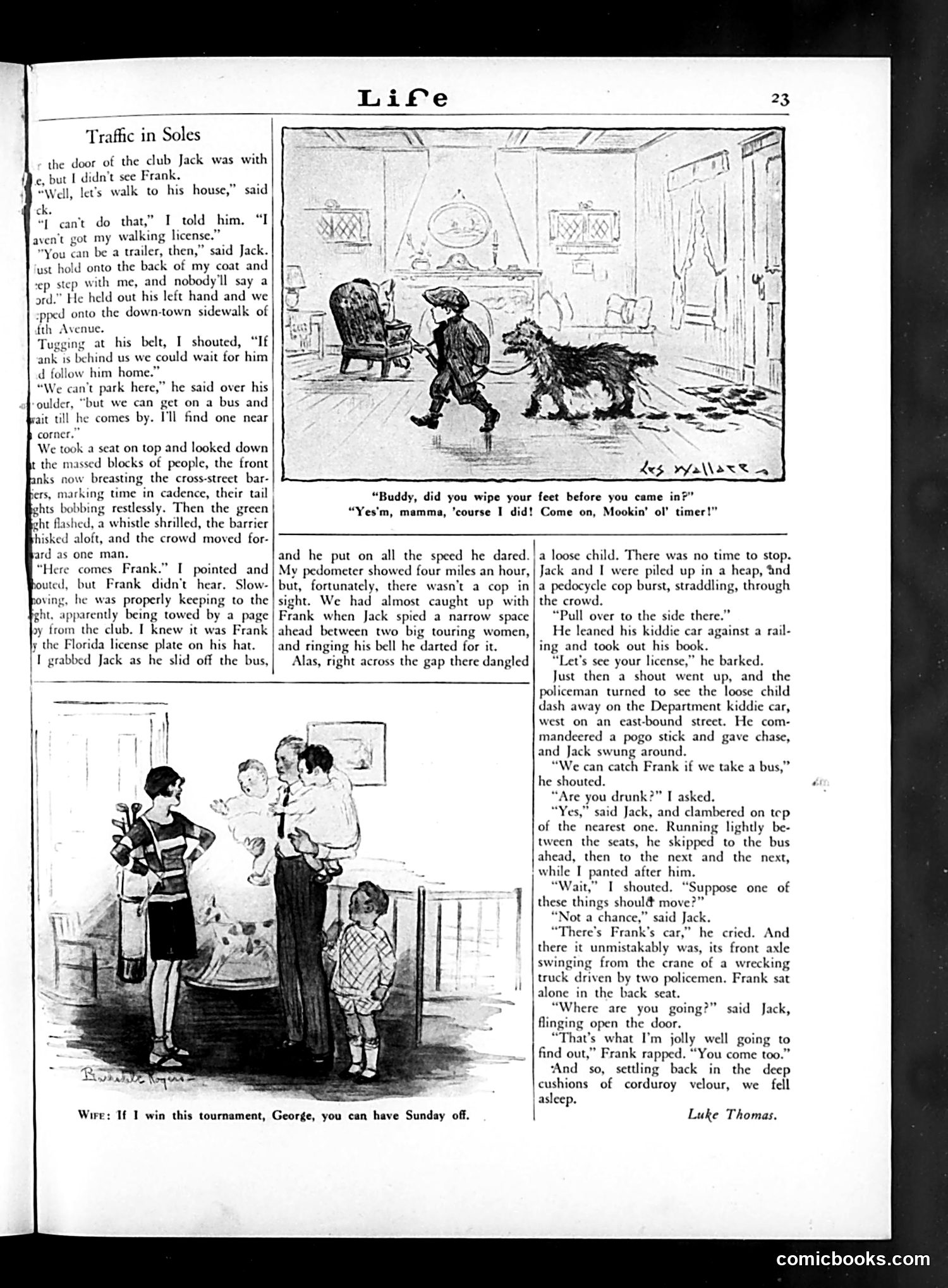
This illustrated story satirizes the absurd congestion and bureaucratic confusion of modern city life. The protagonist and his friends attempt a simple task—following someone home—but encounter escalating obstacles: pedestrian traffic so dense they must "hold onto" each other's coats like a train; a "walking license" requirement; a "pedocycle cop" (a police officer on a children's vehicle); and a loose child on a "Department kiddie car" causing a multi-vehicle pileup. The humor lies in exaggerating real 1920s urban problems—overcrowded streets, traffic regulations, and gridlock—to absurd extremes. The "Florida license plate on his hat" suggests tourists adding to congestion. The story mocks how mechanized and rule-bound city life has become, where even simple pedestrian movement requires documentation and coordination. The final image (bottom) shows a woman promising her husband "Sunday off" if he wins a tournament—reinforcing themes of modern life's regimentation and lack of leisure.
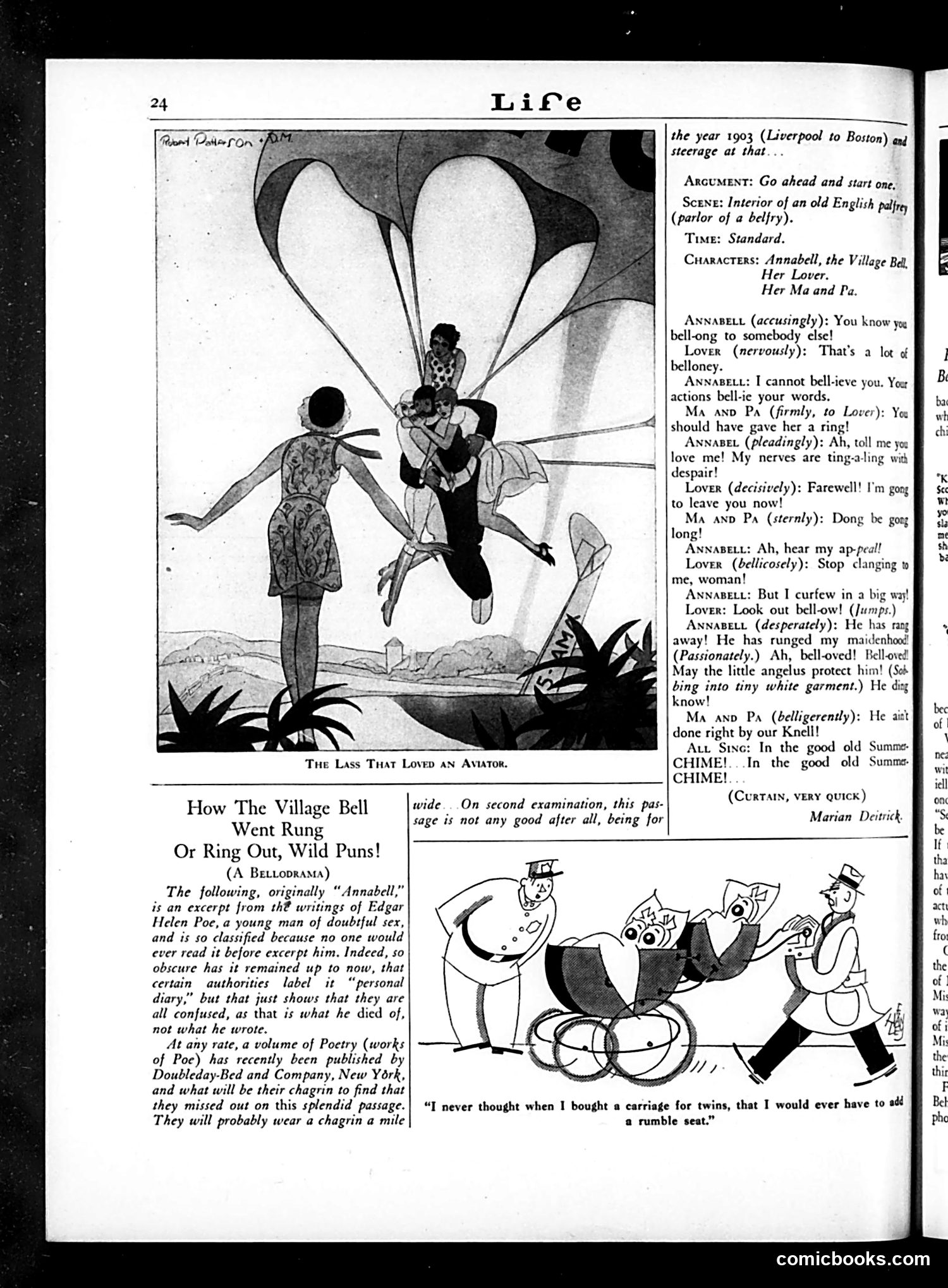
This page contains two distinct pieces of satire from *Life* magazine (circa 1903). **Top section:** "The Lass That Loved an Aviator" is an illustration satirizing early aviation romance—a fashionable subject of the era. The image shows a woman and man in a giant flower-shaped hot air balloon or aircraft, poking fun at the novelty and absurdity of early flight technology and the romantic fantasies surrounding aviators. **Bottom section:** "How The Village Bell Went Rung" is a comedy sketch brutally mocking Edgar Allan Poe's writing. The editors claim this is an "excerpt" from Poe's works, but it's actually an invented parody stuffed with terrible bell-related puns ("bell-ong," "bell-ieve," "ting-a-ling"). The joke is that this nonsense is so bad, Poe's actual publisher must have missed it—and the piece satirizes both Poe's reputation and pretentious literary obscurity. The final cartoon mocks the new automobile technology: a man complaining that his carriage built for twins now requires an extra "rumble seat" for overflow.
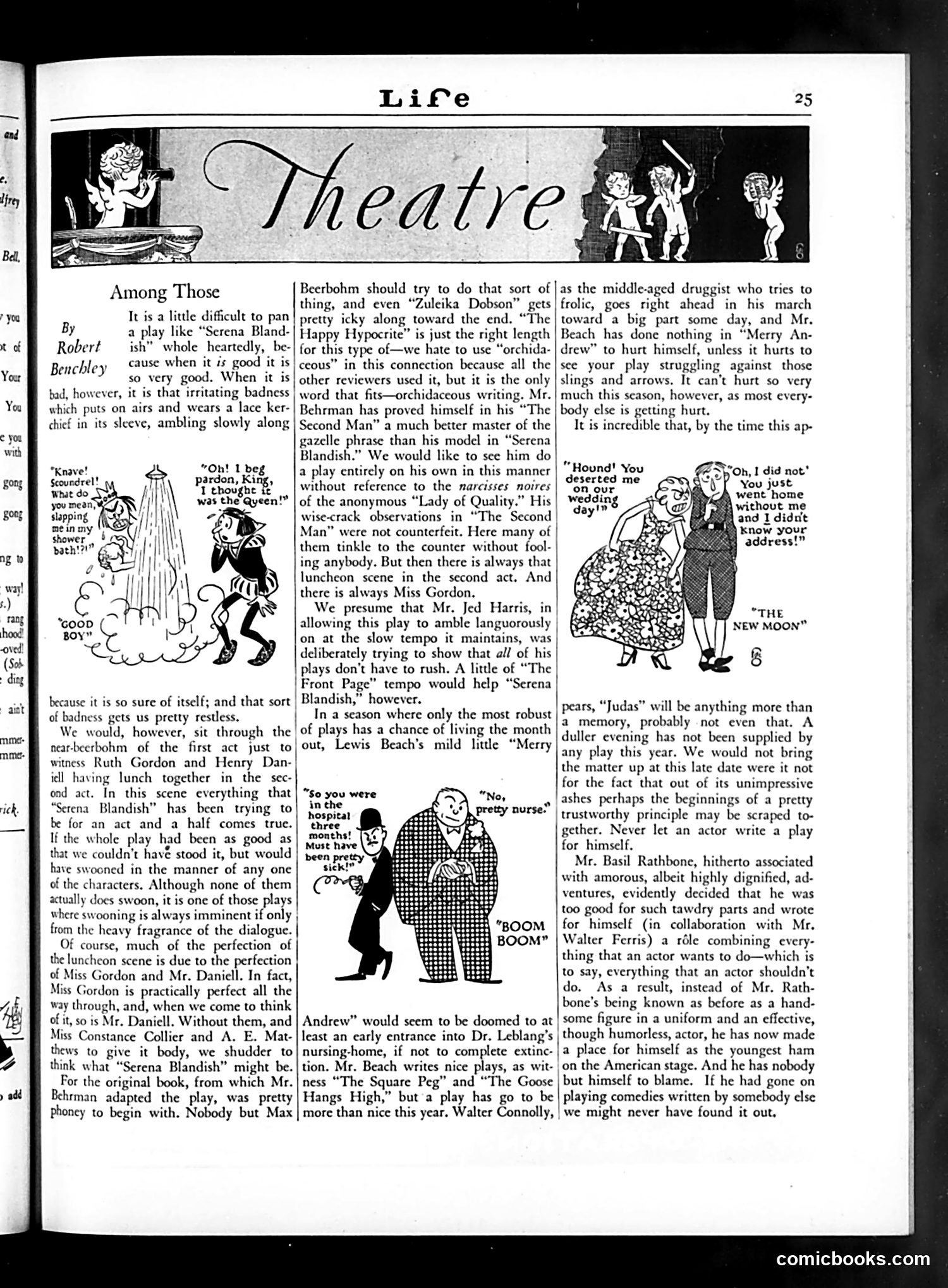
This is Robert Benchley's theatre column reviewing three Broadway plays: "Serena Blandish," "Merry Andrew," and "Judas." The cartoons illustrate his critiques humorously. The top cartoon shows a character apologizing to a "King," mocking the play's affected, flowery dialogue style. The middle cartoon depicts two men discussing a hospital scene, likely satirizing overwrought dramatic moments. The bottom cartoon from "The New Moon" shows a domestic quarrel, typical of period comedies. Benchley praises Ruth Gordon and Henry Daniell's luncheon scene in "Serena Blandish" while criticizing the play's pretentious language—comparing it unfavorably to Max Beerbohm's literary parody work. He notes the season is so competitive that even mediocre productions struggle. "Judas" receives harsh dismissal as "a duller evening" than most contemporary offerings, suggesting it will soon be forgotten. The tone is witty critique of both plays and theatrical trends of the era.
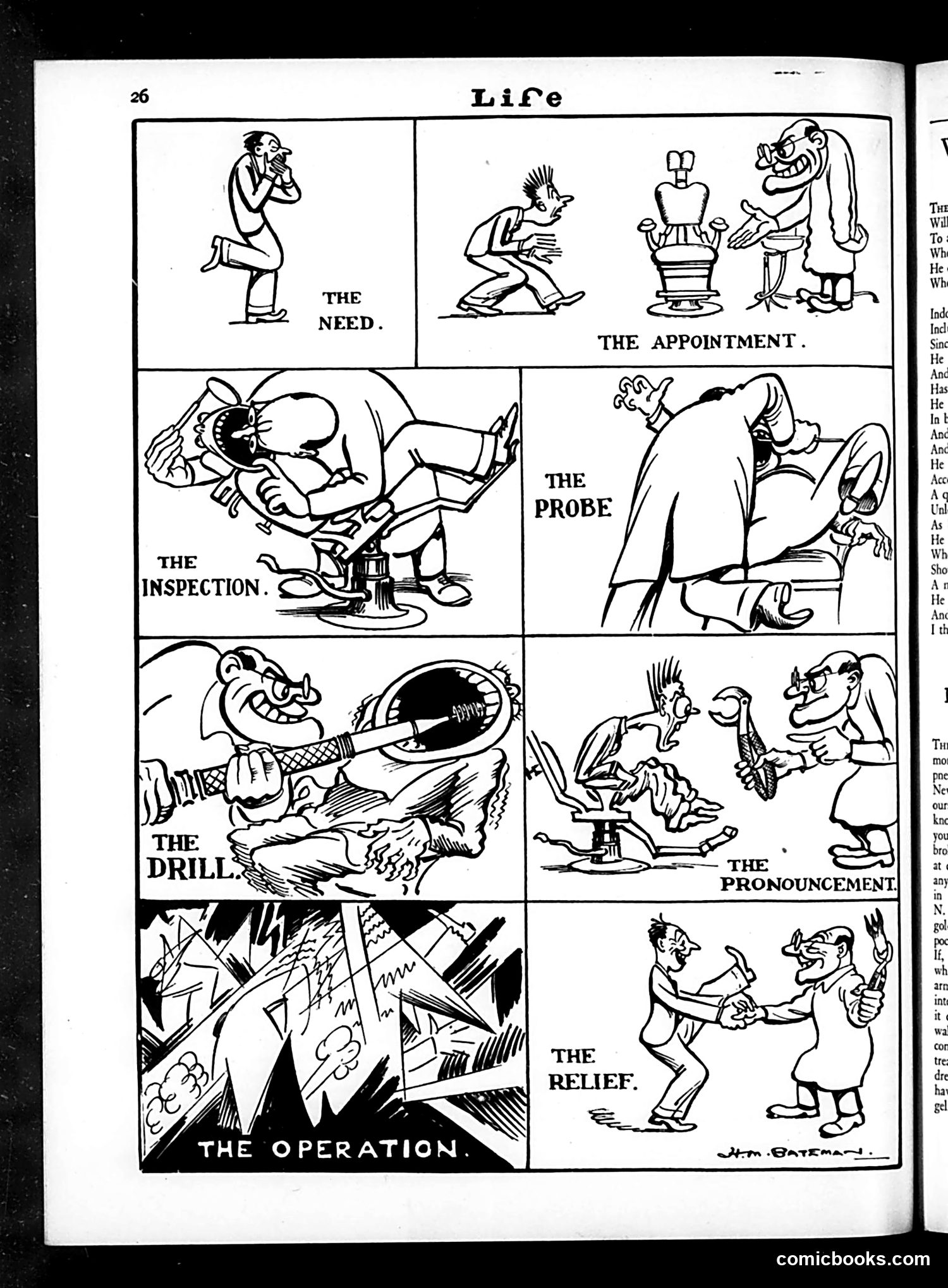
This comic strip by Jim Garenat satirizes a dental visit through eight sequential panels labeled: "The Need," "The Appointment," "The Inspection," "The Probe," "The Drill," "The Pronouncement," "The Operation," and "The Relief." The humor relies on exaggerated visual comedy—depicting the patient's mounting anxiety and discomfort during examination and treatment, with grotesque expressions and physical contortions. The dentist appears menacing with caricatured features. The strip plays on universal anxiety about dental procedures, a relatable theme for general audiences. The final panel shows the patient's relief upon completion—suggesting the whole ordeal's psychological ordeal versus actual pain. This represents typical early-20th-century American satirical humor about everyday unpleasant experiences.
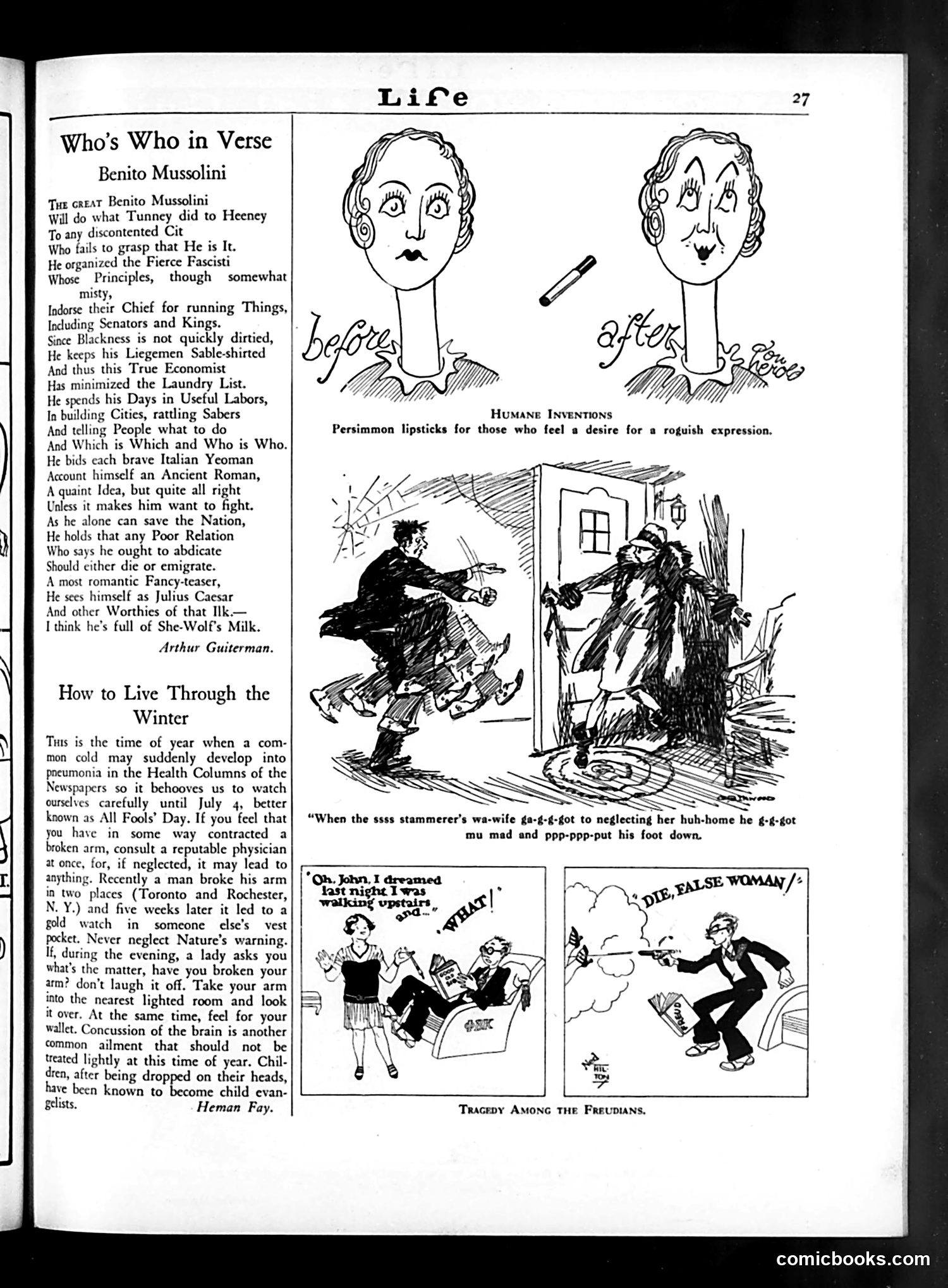
This page satirizes 1920s American concerns through multiple pieces: **"Who's Who in Verse: Benito Mussolini"** — A mocking poem by Arthur Guiterman about Italy's fascist leader. It ridicules Mussolini's authoritarian control, his black-shirted followers (Fascisti), his self-aggrandizement as a modern Caesar, and his nationalist ideology forcing Italians to see themselves as ancient Romans. The reference to "She-Wolf's Milk" evokes the Roman she-wolf legend, suggesting Mussolini feeds on propaganda. **"How to Live Through the Winter"** — Humorous medical advice satirizing hypochondria and newspaper health columns, mocking readers' obsession with diagnosing themselves from newspaper articles. **"Humane Inventions"** — Cartoon jokes on modern absurdities, including persimmon lipsticks and a stutter-joke about a stammering husband's marital conflict. **"Tragedy Among the Freudians"** — A cartoon mocking Freudian psychology's popularity in the 1920s, showing someone's dream analysis creating domestic chaos—satirizing both the dream-interpretation fad and psychoanalysis's cultural influence.
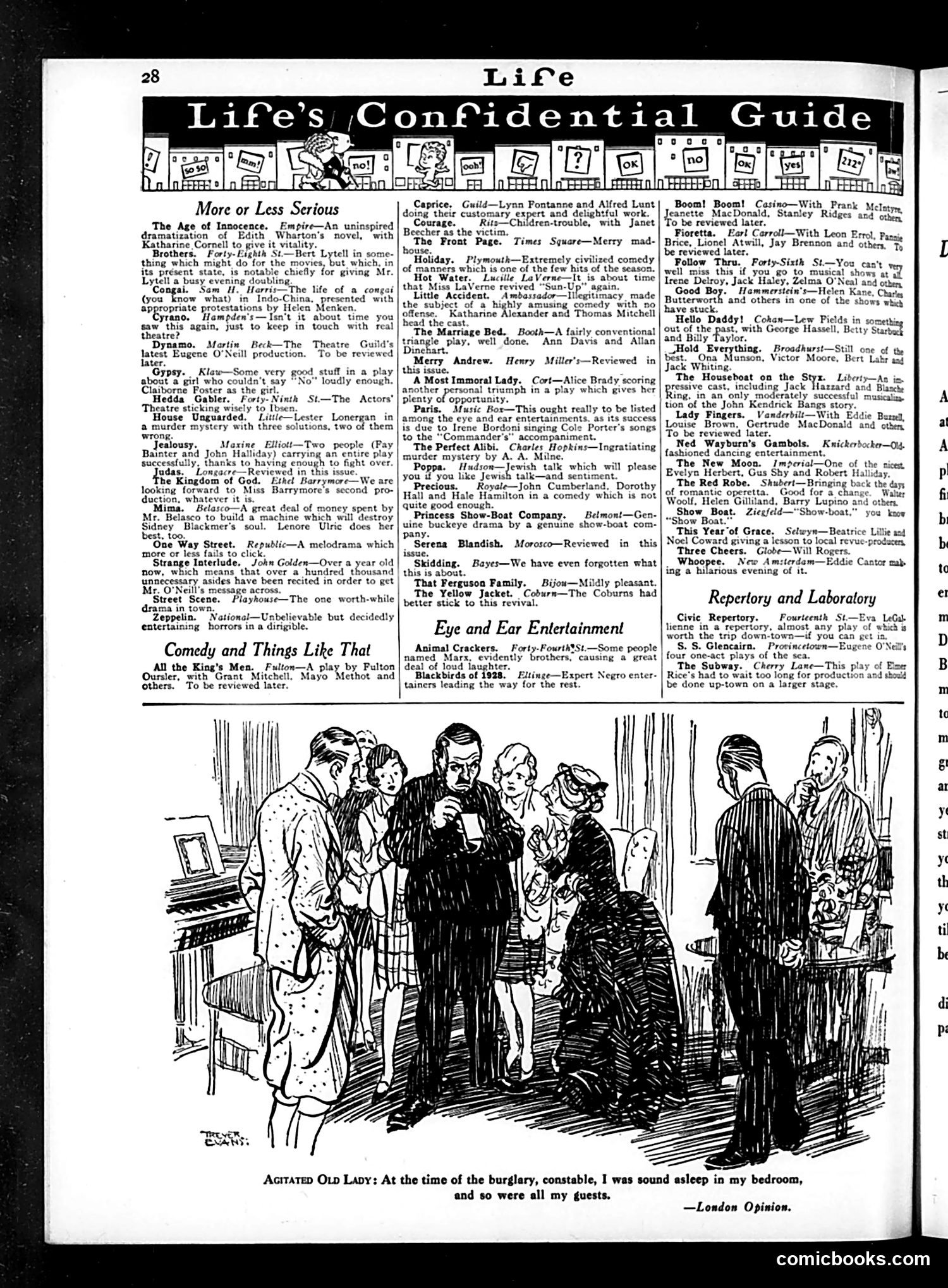
This page from Life magazine presents theater reviews and entertainment commentary circa the 1920s-30s. The main cartoon depicts a police constable questioning an elderly woman about a burglary at her home, while well-dressed guests stand nearby. The joke's satire lies in the caption: the "Agitated Old Lady" claims she slept soundly through the entire burglary, as did all her guests—an implausible alibi suggesting either the guests were complicit, intoxicated, or that the woman's story is fabricated. The cartoon satirizes both unreliable witnesses and the absurdity of such convenient explanations. The surrounding text comprises brief, witty reviews of Broadway productions, using sharp critiques and wordplay typical of Life's satirical style—mocking theatrical pretension and actors' performances while maintaining the sophisticated tone expected by educated readers of that era.
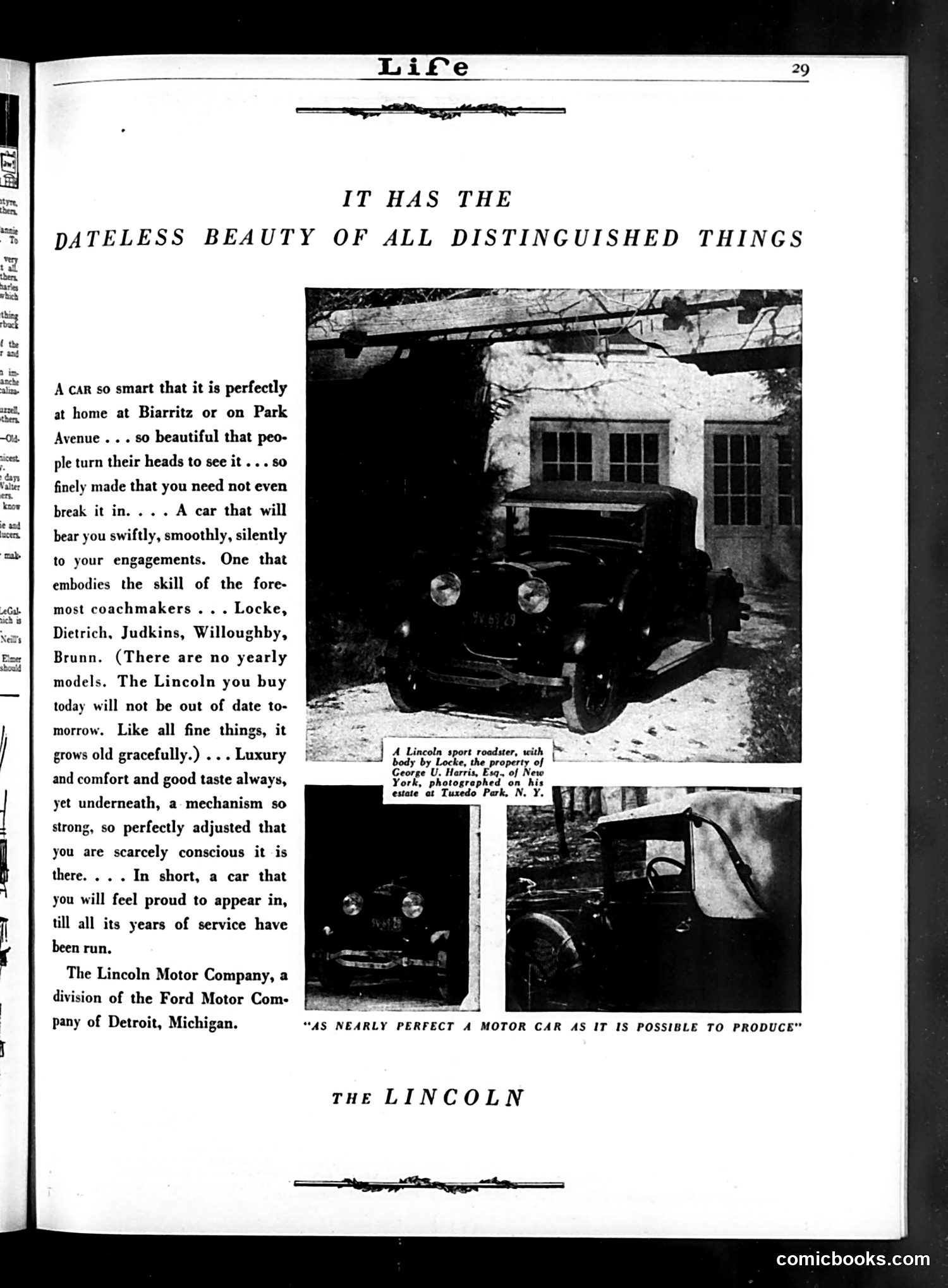
This is a **luxury car advertisement**, not satire or political commentary. It promotes the Lincoln automobile as a status symbol for wealthy Americans. The ad emphasizes that Lincolns are appropriate for elite locations like Biarritz (French resort) and Park Avenue (Manhattan's wealthy enclave). It lists prestigious coachmakers—Locke, Dietrich, Judkins, Willoughby, Brunn—to signal craftsmanship and exclusivity. The tagline "dateless beauty" and claim that Lincolns "grow old gracefully" (no yearly model changes) position the car as timeless rather than subject to fashion. One photograph shows a Lincoln at "Tuxedo Park, N.Y.," a wealthy estate community, reinforcing its association with the ultra-rich. The advertisement subtly mocks conspicuous consumption through its florid language while selling exactly that—a car you'll "feel proud to appear in." The Lincoln Motor Company's ownership by Ford Motor Company is mentioned at the bottom, suggesting mass-production infrastructure behind an elite product.
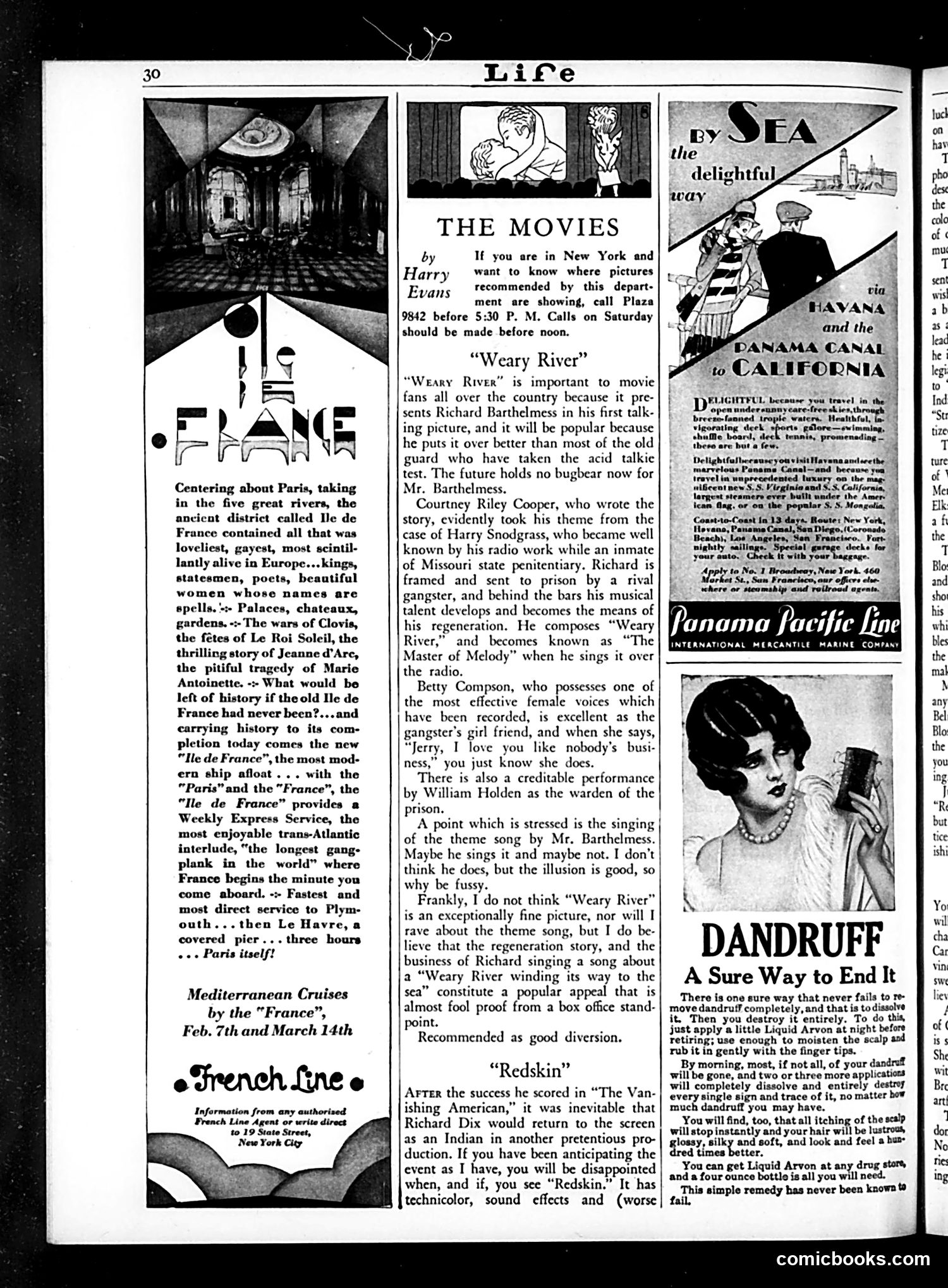
This page combines advertisements and entertainment reviews from Life magazine's "Movies" section by Harry Evans. **The Cartoon/Advertisement (Left):** A stylized Art Deco illustration labeled "FRANCE" advertises the French Line's luxury ocean liner "Ile de France." The geometric, modernist design celebrates Paris and French cultural heritage—referencing historical figures like Clovis, Joan of Arc, and Louis XIV—while promoting transatlantic travel as the ultimate romantic escape. **The Movie Reviews:** Evans critiques two early "talking pictures" (talkies): - **"Weary River"** stars Richard Barthelmess in his first sound film. The plot involves a framed man imprisoned for murder who achieves redemption through composing and singing. Evans notes this is significant because Barthelmess performs the talkie test better than older actors, though he suggests the film's appeal relies more on formula sentiment than genuine quality. - **"Redskin"** stars Richard Dix as a Native American. Evans dismisses it as disappointing despite Dix's previous success, criticizing its reliance on technicolor gimmickry. The reviews reflect the early sound-film era's uncertainty about which performers could transition successfully to audible dialogue.
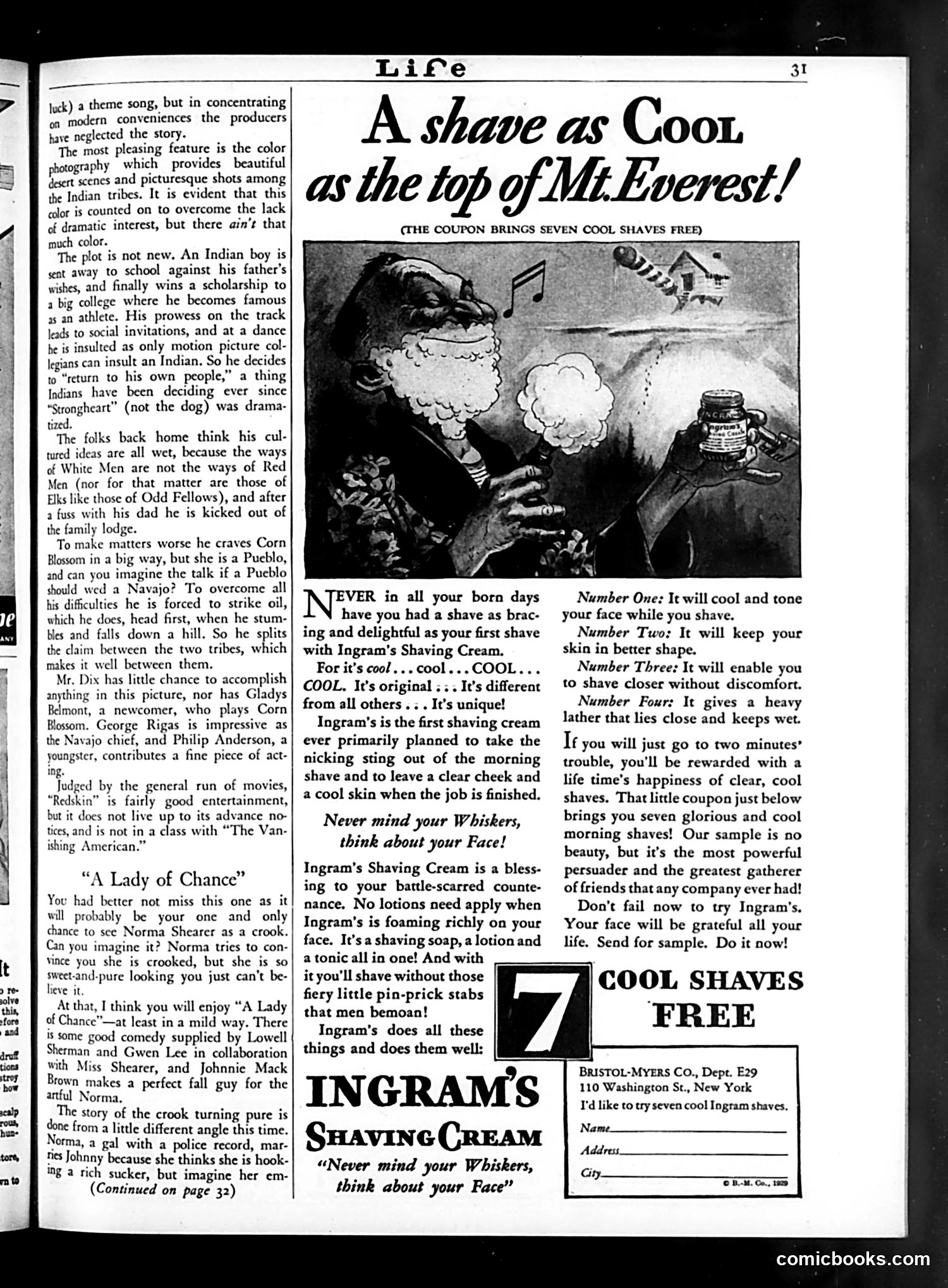
This page is primarily an **advertisement for Ingram's Shaving Cream**, not satire or political commentary. The large illustration shows a man shaving at high altitude (the headline references Mt. Everest), combining humor with product promotion. The left column contains **movie reviews**, briefly discussing films including "Rockin'" and "A Lady of Chance," with commentary on their entertainment value and acting performances. The shaving cream ad uses comedic exaggeration—claiming the product works so well it enables shaving at extreme elevations—as a marketing hook. The coupon offers "seven cool shaves free" to encourage trial. This represents typical 1920s-era Life magazine content: mixing entertainment criticism with full-page commercial advertising designed to appear witty and engaging rather than purely promotional.
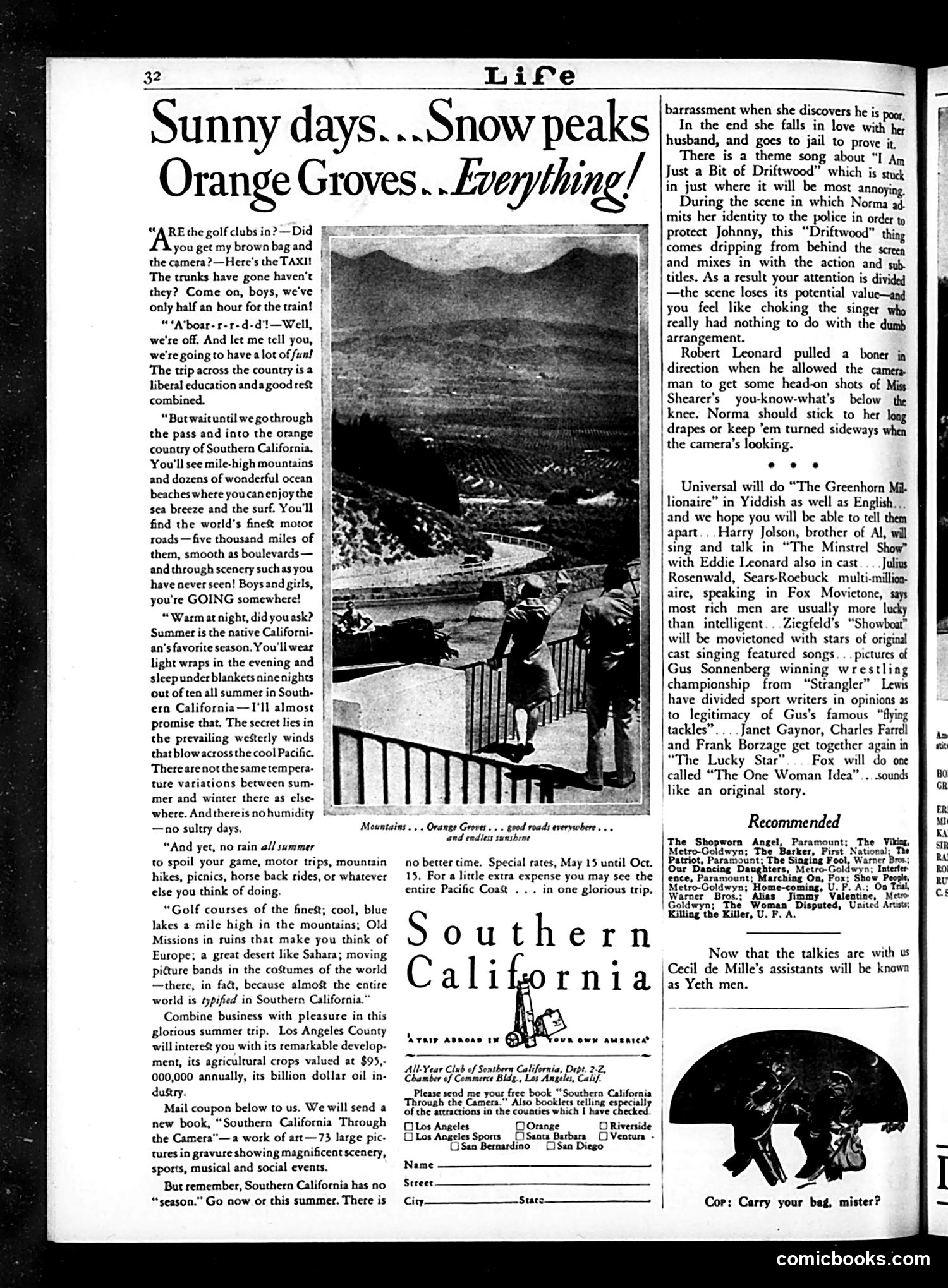
This page is primarily **tourism advertising** for Southern California, disguised as editorial content. The large headline and accompanying photograph promote travel to Orange County and Southern California's attractions—mountains, beaches, golf courses, and mild weather. The text uses an enthusiastic narrator (likely a tour guide or travel agent) to pitch the region's benefits: year-round sunshine, no summer rain, excellent roads, and diverse scenery. The "Recommended" section and small cartoon (bottom right: "Cop: Carry your bag, mister?") appear to be standard Life magazine features unrelated to the main advertisement. The coupon at the bottom solicits readers' information to receive a promotional book. This represents early 20th-century **native advertising**—promotional content formatted to resemble genuine editorial matter rather than flagged as paid advertising. The goal is to drive tourism and development to the Los Angeles area during a period of regional economic expansion.
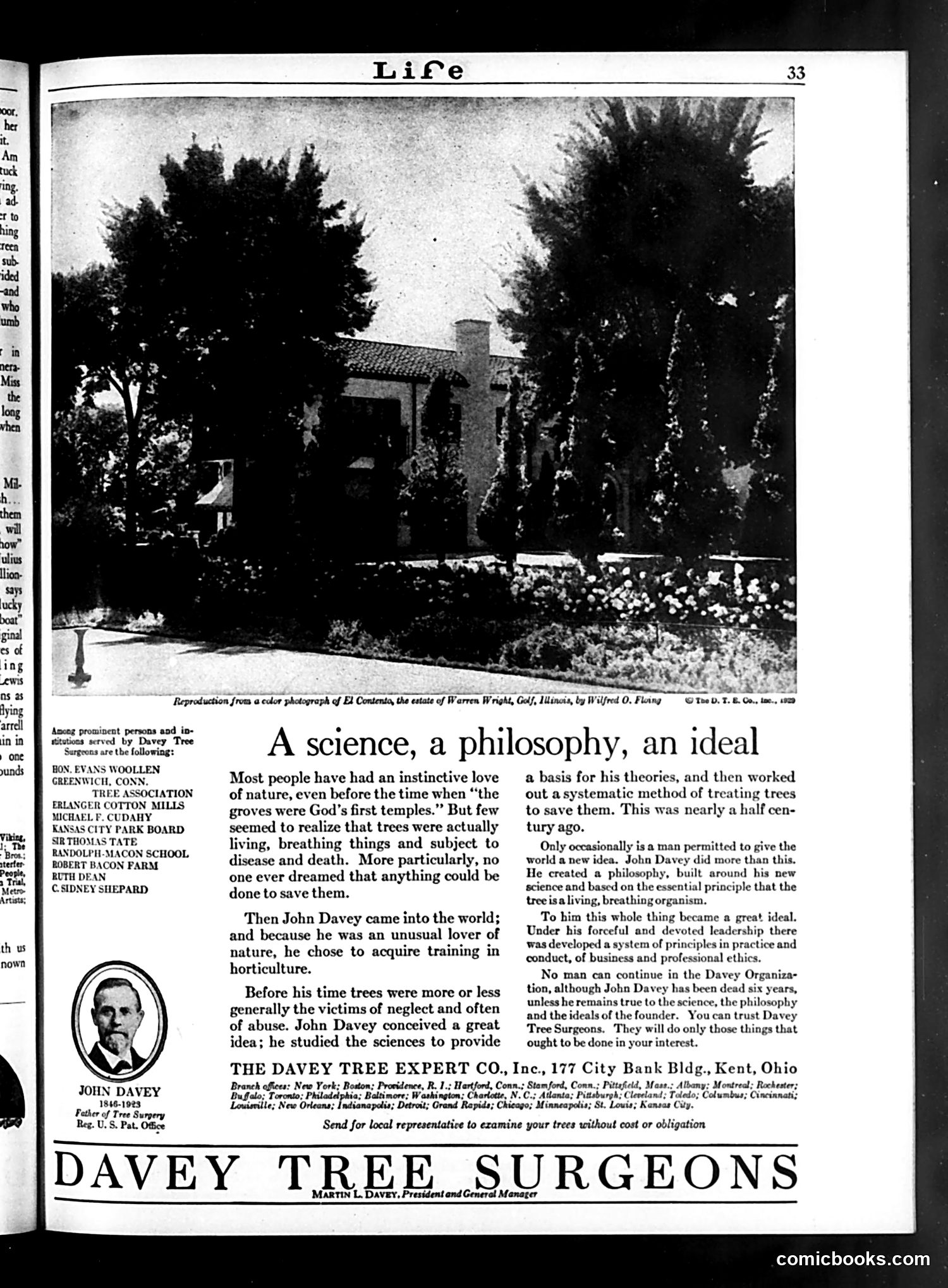
This is **not a cartoon but a full-page advertisement** for the Davey Tree Expert Company, published in *Life* magazine in 1929. The page promotes John Davey, founder of a tree-surgery business, portraying him as a visionary who revolutionized tree care by treating trees as living organisms requiring scientific medical intervention. The text frames this as both a practical innovation and an ethical philosophy—Davey allegedly developed a systematic approach to tree treatment and built an organization devoted to his ideals even after his death (six years prior to publication). The photograph shows an elegant estate (El Contenta, owned by golfer Warren Wright in Illinois), exemplifying the upscale clientele served. A list of prominent industrial clients—mills, parks, wealthy individuals—establishes credibility. **The implicit message**: Tree surgery is a legitimate, scientific profession worthy of trust and investment. This targets wealthy homeowners and institutions concerned with property maintenance. There is **no satire here**—this is earnest corporate promotion capitalizing on Progressive-era ideals about expertise, science, and business ethics.
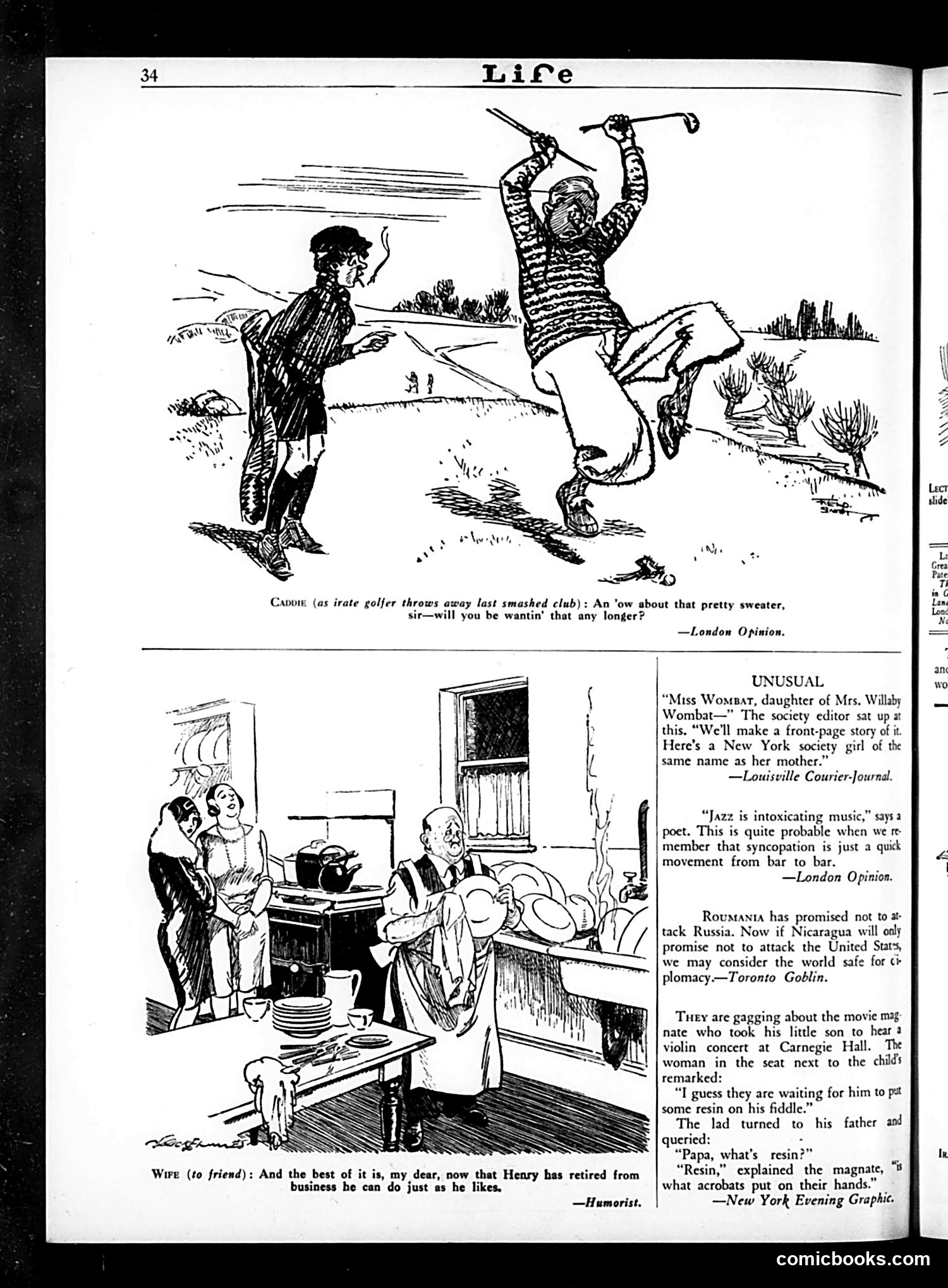
**Top Cartoon:** A British caddie mocks an angry golfer who has just destroyed his last club in frustration. The caddie asks if he'll want the ruined sweater anymore—humor derived from the golfer's uncontrolled rage and the servant's deadpan observation of collateral damage. **Bottom Cartoon:** A wealthy man tells a friend that his retired colleague Henry can now "do just as he likes"—satirizing the irony that retirement doesn't actually grant freedom; retirees simply continue their same habits and preferences without work as an excuse. **"Unusual" Section:** Brief satirical items lampooning contemporary absurdities: a society editor's bizarre naming-coincidence story, a poet's pseudo-intellectual definition of jazz as mere "bar-to-bar movement," geopolitical naiveté about Rumania and Nicaragua, and a child asking what "resin" is at a concert, with a magnate confusing it with circus acrobat equipment. The page exemplifies *Life*'s style: punching up at pretension, authority, and logical inconsistency through brief, witty observations.
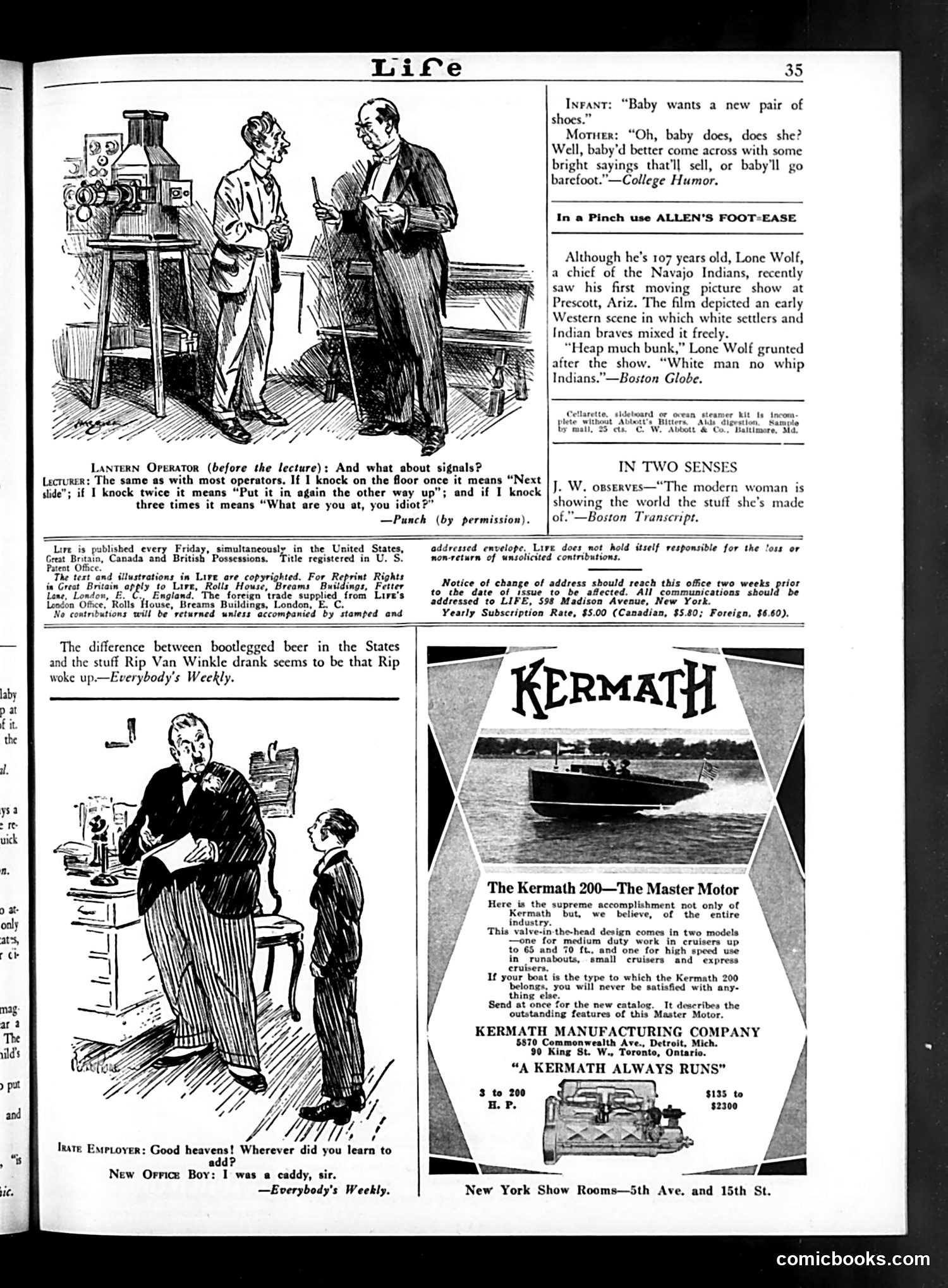
This page contains several brief satirical items typical of Life's humor section: **The Lantern Operator cartoon** jokes about the frustration of operating projection equipment during lectures. The operator and lecturer have developed a crude "signal system" using floor knocks to communicate—one knock means advance slides, two means go backward, three means "What are you at, you idiot?"—mocking the primitive technology and poor coordination of early cinema presentations. **Other brief jokes** mock contemporary issues: a baby who must earn money through cute sayings to afford shoes (reflecting Depression-era economic hardship); a 107-year-old Navajo chief seeing his first film and dismissing a Western battle scene as "heap much bunk" because "white man no whip Indians" (satirizing both stereotypical Native American speech and Hollywood's inaccurate depictions); and references to Prohibition-era bootlegged beer and flappers. The page is primarily **advertising** for Kermath boat motors, occupying substantial space.
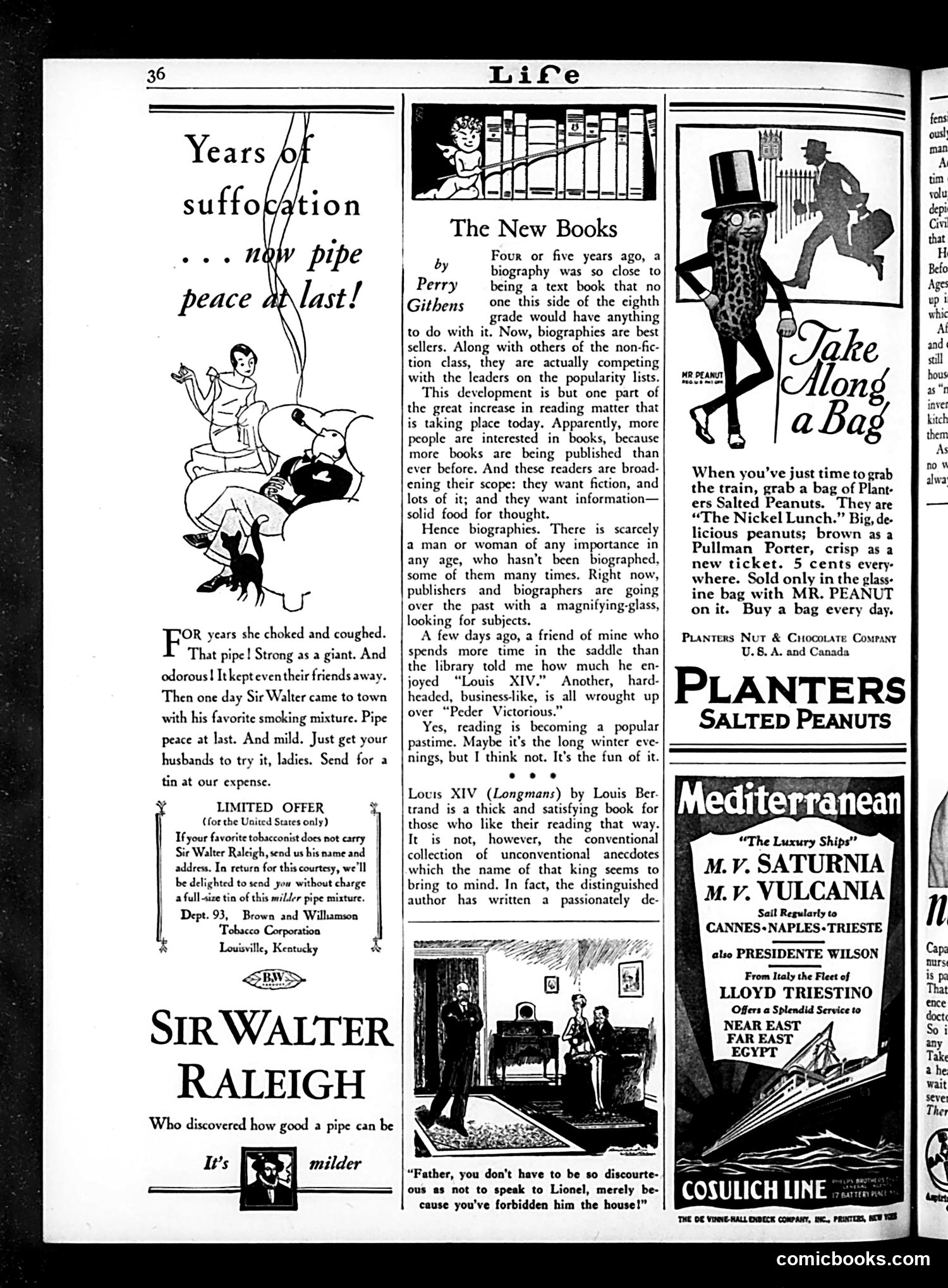
**The Advertisement (Left):** This is a tobacco ad presenting a domestic scene where a wife's chronic coughing from her husband's pipe smoking has driven away their social circle. "Sir Walter Raleigh" brand pipe tobacco promises to solve this problem by being "milder"—a satirical jab at how advertising exploits women's complaints to sell products. The historical reference to Sir Walter Raleigh (who popularized tobacco in England) lends false gravitas. **"The New Books" (Center):** Perry Githens discusses the rise of biography as a bestselling genre, noting that biographies—once considered textbook material—now compete with fiction. The essay reflects 1920s-30s reading trends: increased leisure reading, public appetite for historical figures, and publishers' profit-driven focus on whatever subjects currently interest readers. A cartoon dialogue about a father forbidding his son Lionel illustrates social tensions of the era. The page is primarily **advertising and light cultural commentary**, typical of *Life* magazine's mixed-content format.
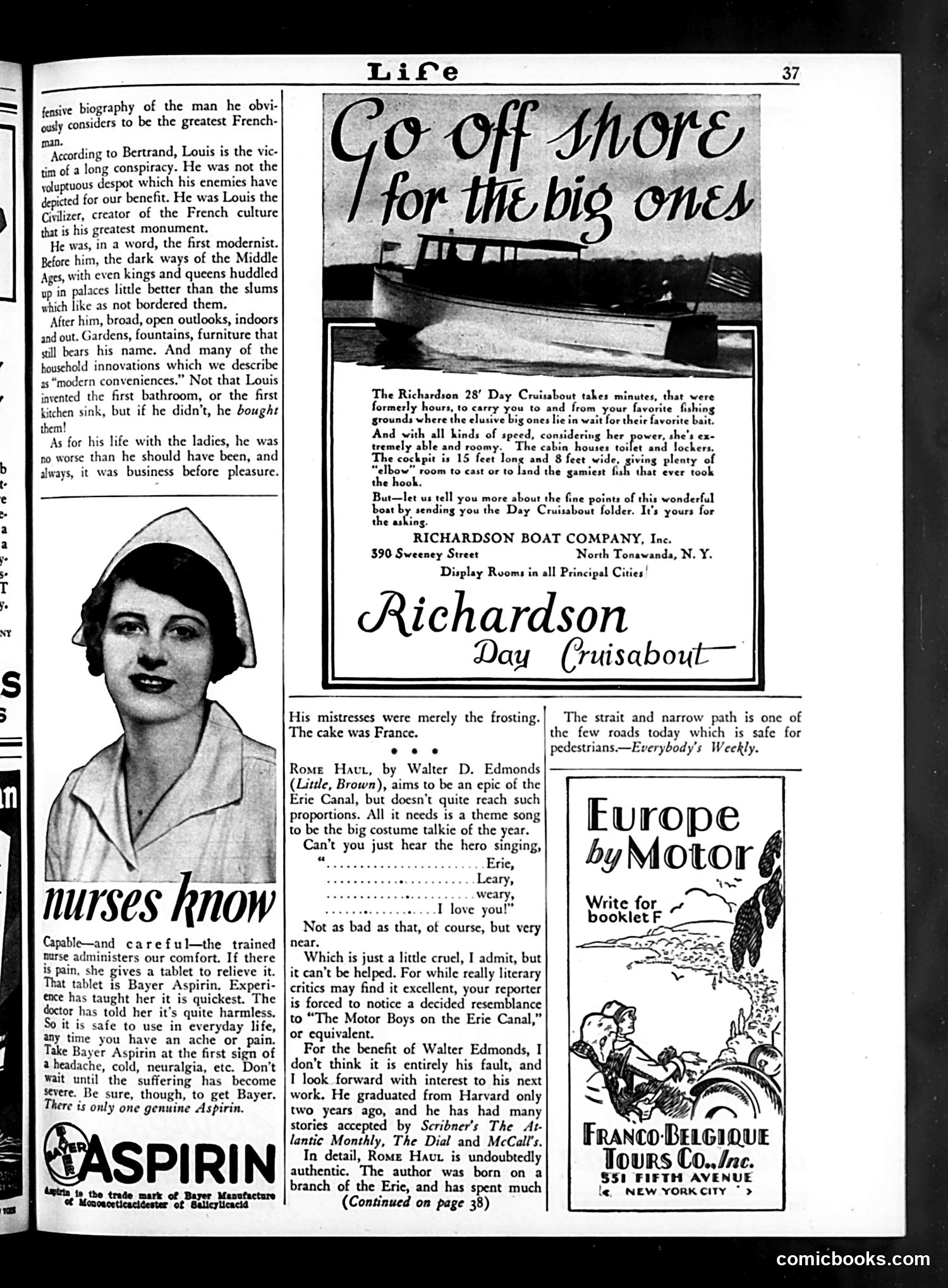
This page mixes editorial content with period advertisements, primarily from the 1920s. The main text discusses **Louis XIV of France**, defending him against critics' depictions as a "voluptuous despot." The writer argues Louis was instead a "modernist" who civilized France through cultural innovations—furniture, gardens, and household conveniences bearing his name—though humorously noting he "didn't invent" bathrooms and kitchens, merely "bought them." A tongue-in-cheek line about his mistresses concludes: "His mistresses were merely the frosting. The cake was France." **The advertisements include:** - A **Bayer Aspirin ad** featuring a trained nurse, marketed as safe for everyday use - A **Richardson Day Cruisaboat** luxury fishing boat advertisement - A **Franco-Belgique Tours** travel promotion The page reflects 1920s consumer culture celebrating modern conveniences and leisure activities. The Louis XIV discussion appears satirical—reframing historical excess as progressive modernization—a common rhetorical move of the era.
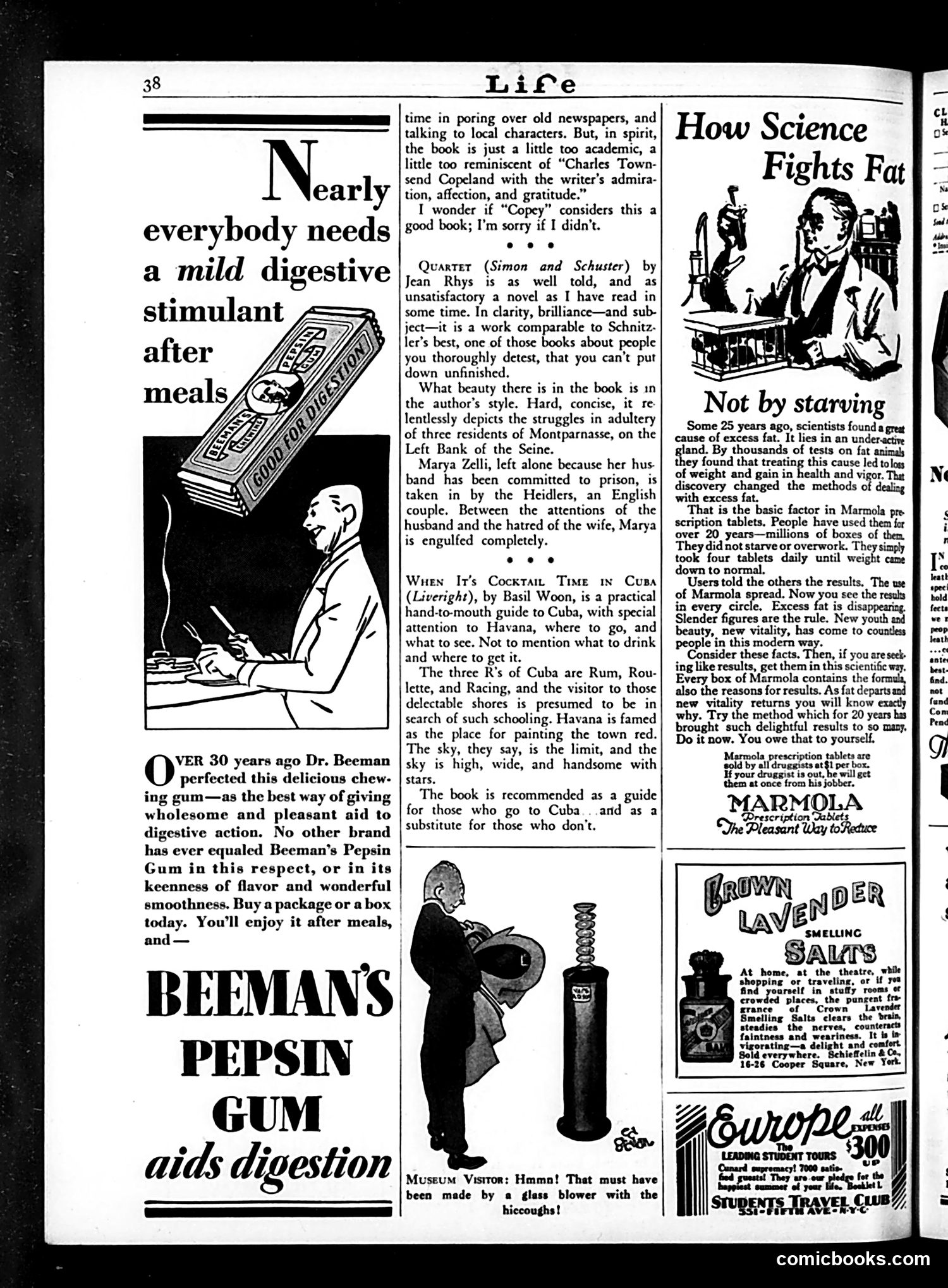
This page contains advertisements and book reviews from an early 20th-century Life magazine issue. **Advertisements:** - **Beeman's Pepsin Gum** (left): Promotes chewing gum as a digestive aid, claiming 30+ years of scientific backing. This reflects period marketing that credited gum with health benefits—a common claim before modern FDA regulations. - **Marmola** (right): Advertises weight-loss tablets targeting an "underactive gland" (likely thyroid), claiming scientific validation from animal tests. This exemplifies dangerous vintage diet advertising; such products often contained harmful substances like thyroid extracts. - **Brown Lavender Smelling Salts** and **Europe travel tours** (bottom): Additional period advertisements. **Cartoon:** A single-panel cartoon shows a museum visitor observing what appears to be a glass object, quipping that it "must have been made by a glass blower with the hiccoughs!"—a simple visual pun about the object's irregular shape. **Book Reviews:** The page includes literary reviews of contemporary novels, notably Jean Rhys's *Quartet* and Basil Woon's *When It's Cocktail Time in Cuba*.
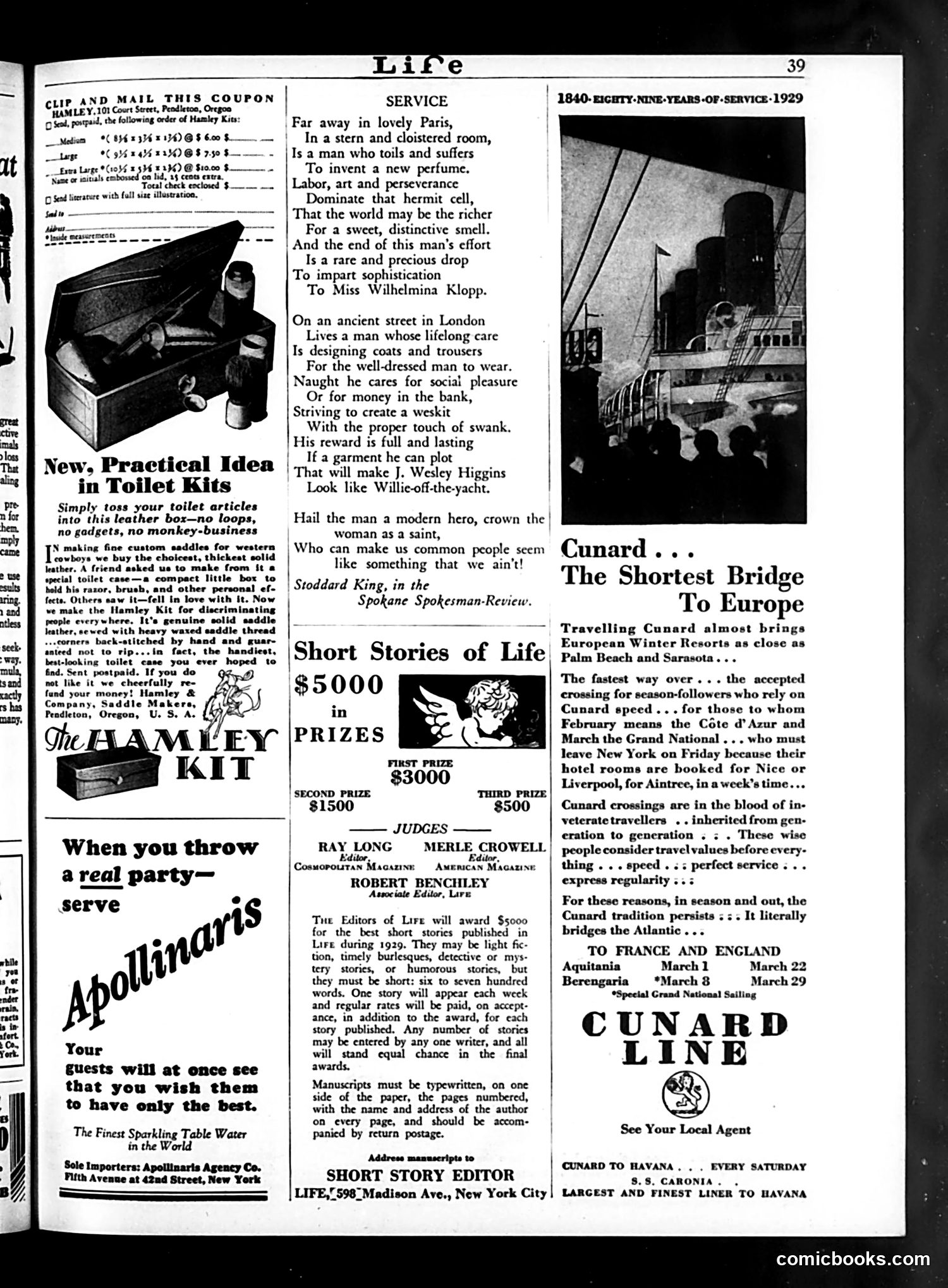
This page is primarily **advertising and editorial content** rather than political satire. The main elements are: **"Service" Poem** (center-left): A sentimental verse by Stoddard King celebrating working-class dedication. It contrasts a Parisian perfume inventor and a London tailor—both laboring obscurely to serve wealthy clients like "Miss Wilhelmina Klopp" and "J. Wesley Higgins." The joke is gently mocking: these craftsmen take pride in serving the "common people" look sophisticated, when really they're just serving the upper class. It's satire of social pretension rather than politics. **Short Story Contest**: Life announces a $5,000 prize competition for short fiction (1929), with judges Ray Long, Merle Crowell, and Robert Benchley. **Advertisements**: Hamley Kit (leather toilet case), Apollinaris water, and Cunard shipping line ads dominate the margins. The page contains **no political cartoons**—it's a typical 1920s magazine format mixing light humor, promotional content, and luxury product marketing.
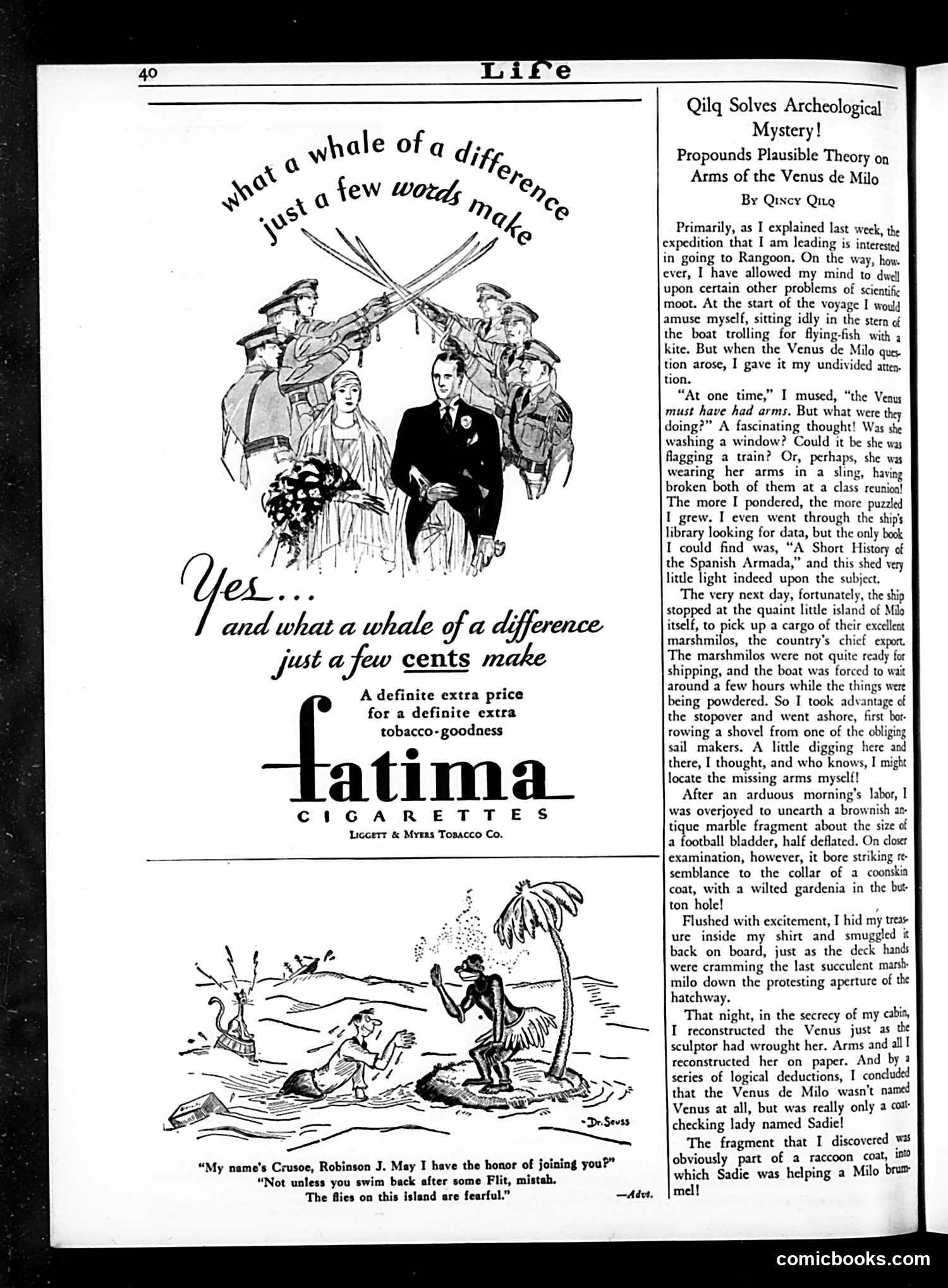
This humorous article mocks charlatan "adventurer-scholars" who claim to solve historical mysteries through flimsy logic and dubious artifacts. The narrator, "Quincy Qilq," is presented as an expedition leader who encounters the Venus de Milo statue during a stopover. Rather than recognize the famous armless sculpture, Qilq spends time idly speculating on absurd scenarios (was she flagging a train? wearing a sling?). He then "discovers" a fragment that suspiciously resembles a raccoon coat collar—and concludes, through "logical deduction," that the priceless ancient statue actually depicts a coat-check girl named Sadie. The satire targets: gullible amateur archaeologists, contrived expedition narratives, confirmation bias in "research," and the willingness to completely reimagine established historical facts based on negligible evidence. The joke is that Qilq's ridiculous conclusion is presented with complete seriousness, exposing the absurdity of pseudoscientific claims made confidently without actual expertise.
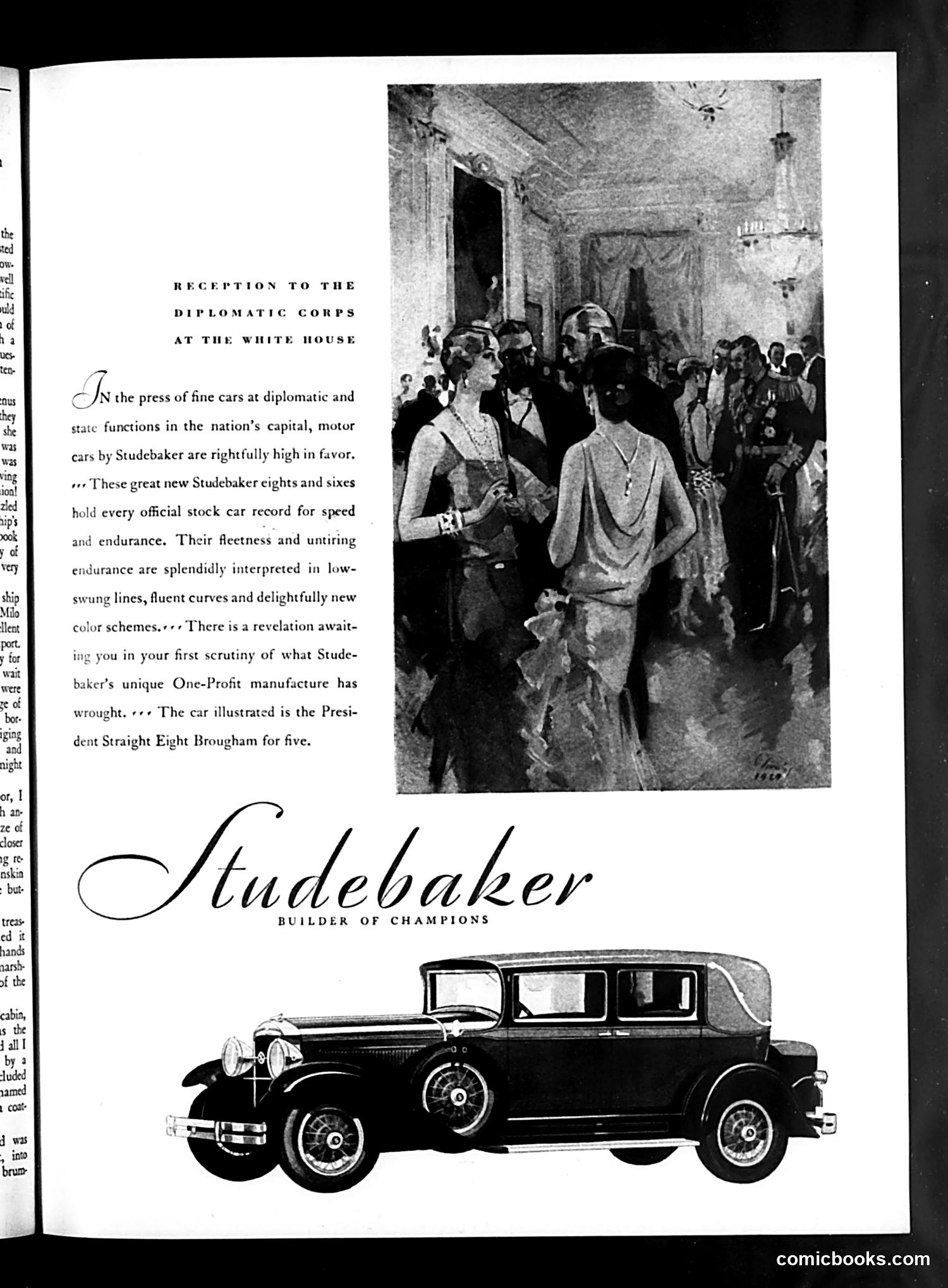
This is **advertising copy, not satire**. The page promotes Studebaker automobiles by associating them with prestigious White House diplomatic functions. The photograph shows an elegant reception with formally dressed diplomats and officials in what appears to be a White House state room—establishing social prestige and exclusivity. The text claims Studebaker cars are "rightfully high in favor" at such elite gatherings and hold "every official stock car record for speed and endurance." The specific model advertised is the "President Straight Eight Brougham for five." This is straightforward 1920s-era aspirational marketing: by linking the automobile brand to presidential authority, diplomatic importance, and upper-class social functions, Studebaker positioned their cars as vehicles for the successful and well-connected. There is no joke or political critique—only brand elevation through association with power and refinement.
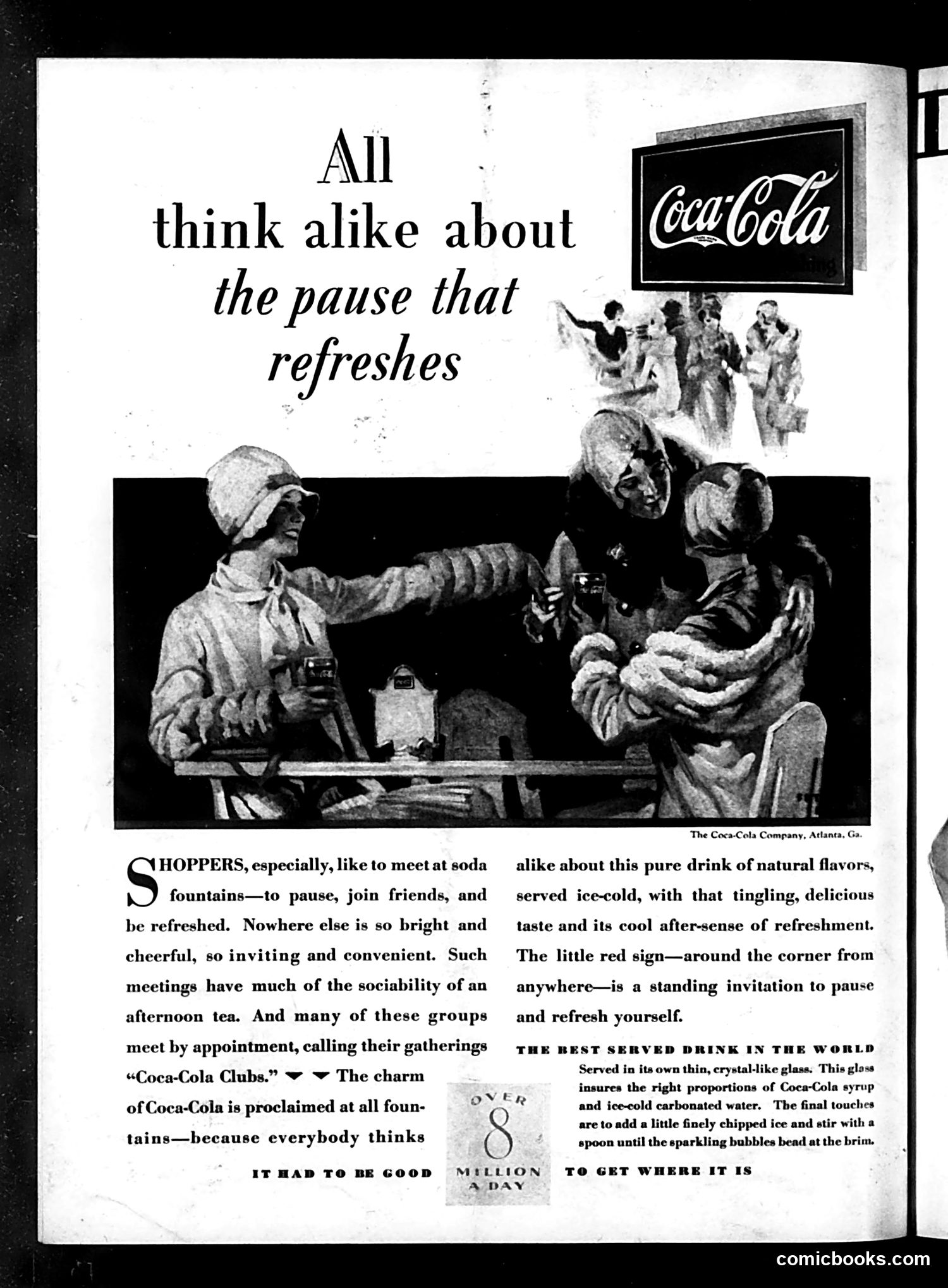
This is a **Coca-Cola advertisement**, not political satire. The page promotes Coca-Cola as a social beverage by depicting soldiers or workers (identifiable by their military-style uniforms and caps) taking a refreshment break at what appears to be a soda fountain. The ad's central claim—"All think alike about the pause that refreshes"—suggests universal agreement on Coca-Cola's appeal across social groups. The imagery of uniformed figures meeting for drinks emphasizes communal bonding and sociability, comparing soda fountain gatherings to formal "afternoon tea" traditions. The text mentions "Coca-Cola Clubs," apparently informal social groups organized around fountain visits. The phrase "IT HAD TO BE GOOD" reinforces mass consensus appeal. This reflects early 20th-century marketing strategy: positioning a commercial product as a democratizing social institution where diverse people unite. The military-adjacent dress of the figures likely references wartime patriotism or industrial workforce camaraderie, though the specific historical moment remains unclear from the image alone.