
Life, 1929-02-15 · page 27 of 44
Life — February 15, 1929 — page 27: what you’re looking at
What you’re looking at
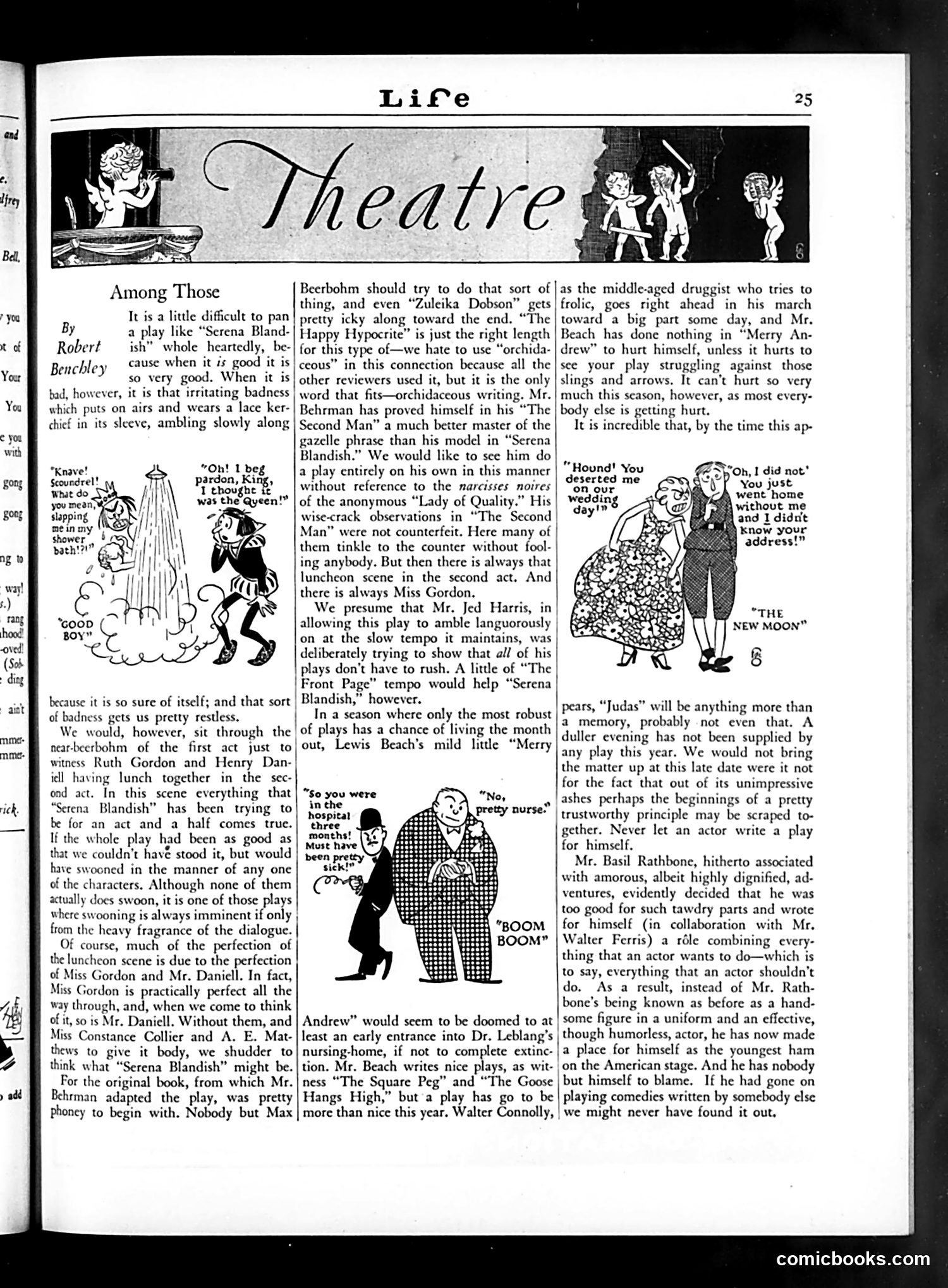
This is Robert Benchley's theatre column reviewing three Broadway plays: "Serena Blandish," "Merry Andrew," and "Judas." The cartoons illustrate his critiques humorously. The top cartoon shows a character apologizing to a "King," mocking the play's affected, flowery dialogue style. The middle cartoon depicts two men discussing a hospital scene, likely satirizing overwrought dramatic moments. The bottom cartoon from "The New Moon" shows a domestic quarrel, typical of period comedies. Benchley praises Ruth Gordon and Henry Daniell's luncheon scene in "Serena Blandish" while criticizing the play's pretentious language—comparing it unfavorably to Max Beerbohm's literary parody work. He notes the season is so competitive that even mediocre productions struggle. "Judas" receives harsh dismissal as "a duller evening" than most contemporary offerings, suggesting it will soon be forgotten. The tone is witty critique of both plays and theatrical trends of the era.
📄 Transcribed text from this page (OCR, searchable)
Machine-transcribed from the original scan — historical spelling and the odd misread are preserved.
Among Those It is a little difficult to pan a play like “Serena Bland- ish” whole heartedly, be- cause when it is good it is so very good. When it is bad, however, it is that irritating badness which puts on airs and wears a lace ker- chief in its sleeve, ambling slowly along By Robert Benchley “On! 1 beg ardon, King, I thoughe was the Queen!” > ~ “Knave! Scoundrel! ‘What do you mean, of badness gets us pretty restless. We would, however, sit through the near-beerbohm of the first act just to witness Ruth Gordon and Henry Dan- il having lunch together in the sec- ond act. In this scene everything that “Serena Blandish” has been trying to be for an act and a half comes true. If the whole play had been as good as that we couldn't have stood it, but would have swooned in the manner of any one of the characters, Although none of them actually does swoon, it is one of those plays where swooning is always imminent if only from the heavy fragrance of the dialogue. Of course, much of the perfection of the luncheon scene is due to the perfection of Miss Gordon and Mr. Daniell. In fact, Miss Gordon is practically perfect all the way through, and, when we come to think of it, so is Mr. Daniell. Without them, and Miss Constance Collier and A. E. Mat- thews to give it body, we shudder to think what “Serena Blandish” might be. For the original book, from which Mr. Behrman adapted the play, was pretty Phoney to begin with. Nobody but Max Beerbohm should try to do that sort of thing, and even “Zuleika Dobson” gets pretty icky along toward the end. “The Happy Hypocrite” is just the right length for this type of—we hate to use “orchida- ceous” in this connection because all the other reviewers used it, but it is the only word that fits—orchidaceous writing. Mr. Behrman has proved himself in his “The Second Man” a much better master of the gazelle phrase than his model in “Serena Blandish.” We would like to see him do a play entirely on his own in this manner without reference to the narcisses noires of the anonymous “Lady of Quality.” His | wise-crack observations in “The Second Man” were not counterfeit. Here many of them tinkle to the counter without fool- ing anybody. But then there is always that luncheon scene in the second act. And there is always Miss Gordon. We presume that Mr. Jed Harris, in allowing this play to amble languorously | on at the slow tempo it maintains, was deliberately trying to show that all of his plays don’t have to rush. A litde of “The |Front Page” tempo would help “Serena because it is so sure of itself; and that sort | Blandish,” however. In a season where only the most robust of plays has a chance of living the month out, Lewis Beach’s mild little “Merry as the middle-aged druggist who tries to frolic, goes right ahead in his march toward a big part some day, and Mr. Beach has done nothing in “Merry An- drew” to hurt himself, unless it hurts to see your play struggling against those slings and arrows. It can’t hurt so very much this season, however, as most every- body else is getting hurt. It is incredible that, by the time this ap- Z>}y0n, 1 did not’ eP "Hound! You deserted me ‘on our You just went home without me and I didnt know your address!” “THE NEW MOON” 8 pears, “Judas” will be anything more than a memory, probably not even that. A duller evening has not been supplied by any play this year. We would not bring the matter up at this late date were it not for the fact that out of its unimpressive ashes perhaps the beginnings of a pretty ° trustworthy principle may be scraped to- Andrew” would seem to be doomed to at least an early entrance into Dr. Leblang’s nursing-home, if not to complete extinc- tion. Mr. Beach writes nice plays, as wit- ness “The Square Peg” and “The Goose Hangs High,” but a play has go to be more than nice this year. Walter Connolly, gether. Never let an actor write a play for himself. Mr. Basil Rathbone, hitherto associated with amorous, albeit highly dignified, ad- ventures, evidently decided that he was too good for such tawdry parts and wrote for himself (in collaboration with Mr. Walter Ferris) a réle combining every- thing that an actor wants to do—which is to say, everything that an actor shouldn't do. As a result, instead of Mr. Rath- bone’s being known as before as a hand- some figure in a uniform and an effective, though humorless, actor, he has now made |a place for himself as the youngest ham on the American stage. And he has nobody but himself to blame. If he had gone on playing comedies written by somebody else we might never have found it out, comicbooks.com