
A complete issue · 44 pages · 1926
Life — June 10, 1926
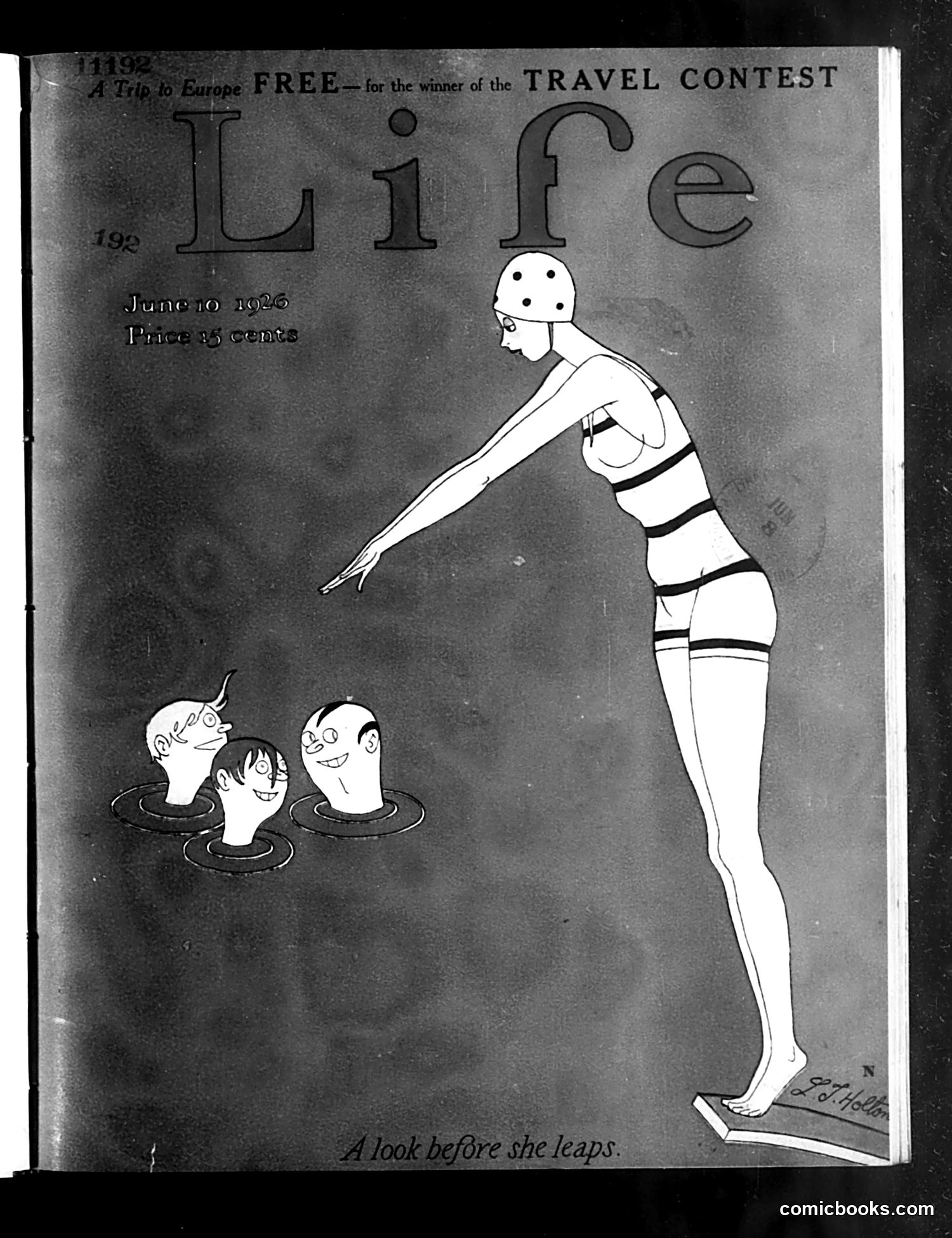
This is a Life magazine cover advertising a travel contest with a European trip as the prize. The illustration shows a woman in 1920s bathing attire on a diving board, preparing to jump while three men's heads emerge from the water below, watching her intently. The caption reads "A look before she leaps," a double entendre playing on both diving and romantic decision-making. The cartoon satirizes the "modern woman" of the Jazz Age—sexually liberated, confident, and aware of male attention. The exaggerated male faces and their focused gaze mock male fascination with women's newfound freedom and fashionable revealing swimwear. This reflects 1920s anxieties about changing gender roles and women's independence during the post-WWI era.
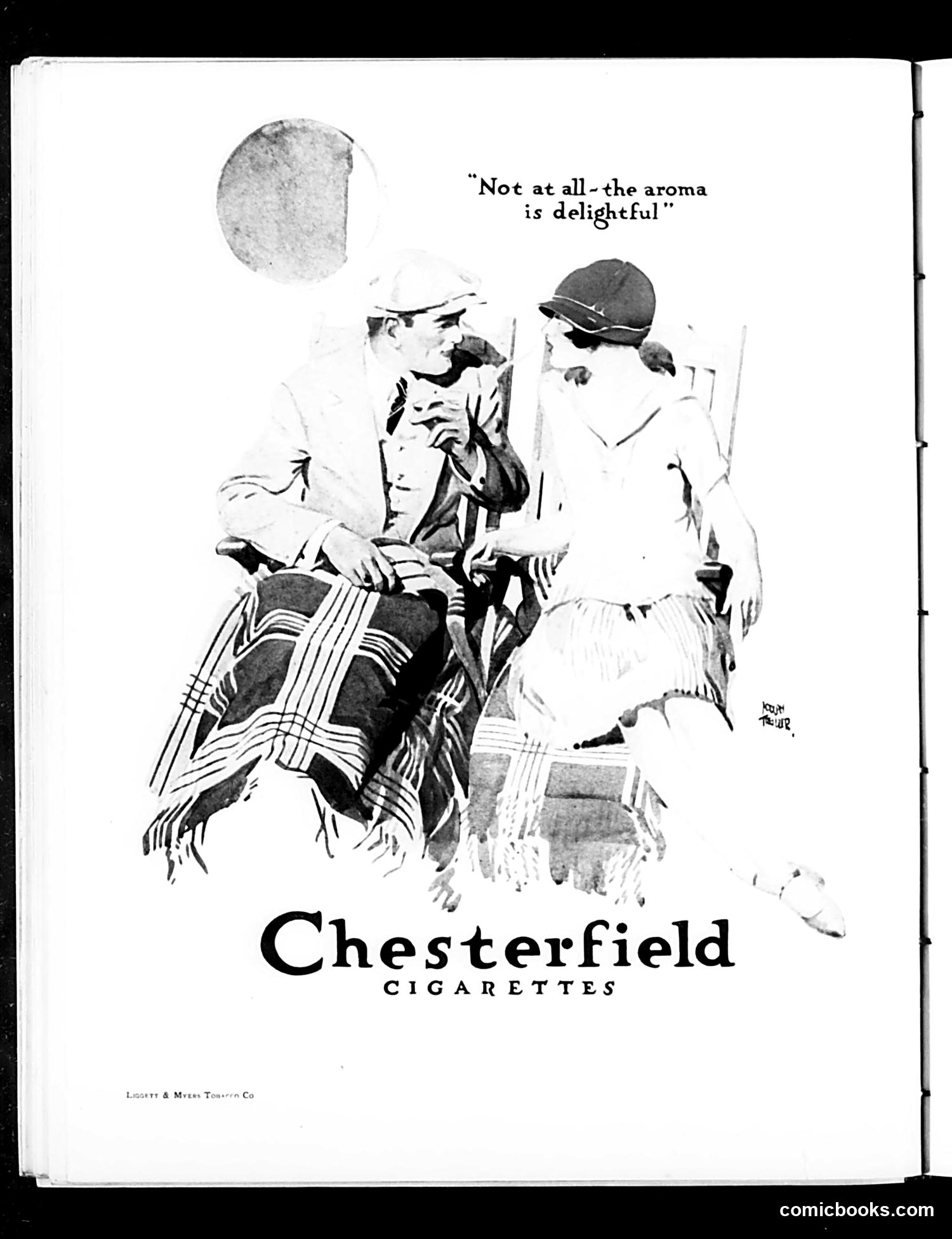
This is a **Chesterfield Cigarettes advertisement**, not political satire. The image shows two figures in 1920s-style clothing and hats engaged in conversation, with one smoking. The quoted text—"Not at all—the aroma is delightful"—appears to be dialogue, likely suggesting that even a non-smoker finds Chesterfield cigarettes' aroma pleasant enough to enjoy. The advertisement uses the appeal of social sophistication and masculine leisure to market the product. The artistic style and fashion suggest this ran in the early-to-mid 20th century. The "Liggett & Myers Tobacco Co." credit at the bottom confirms the manufacturer. This is commercial advertising rather than editorial content or political commentary.
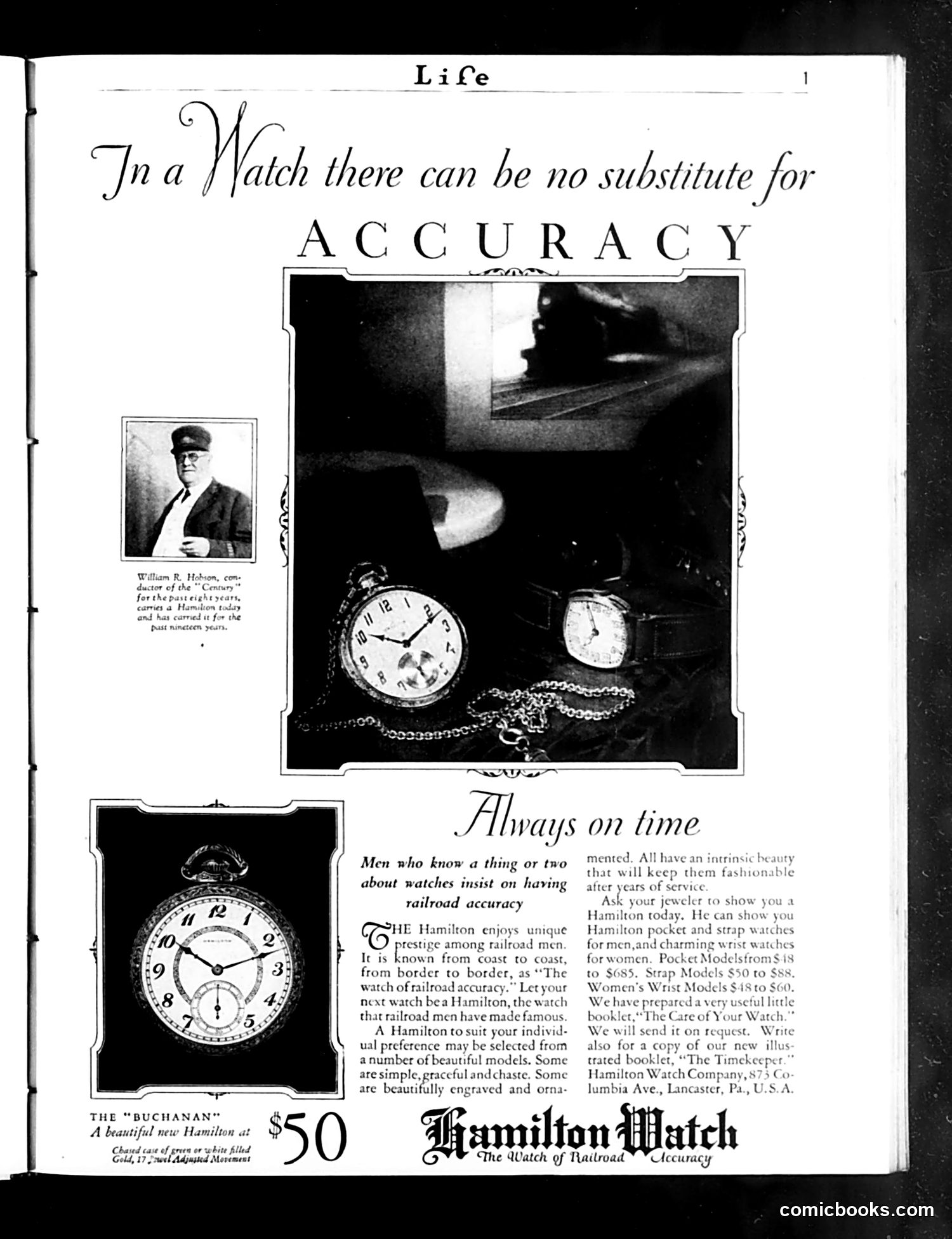
This page is primarily a **product advertisement**, not political satire. It promotes Hamilton pocket watches, emphasizing their reliability for railroad workers—a major market segment in early 20th-century America. The headline "In a Watch there can be no substitute for ACCURACY" appeals to railroad professionals who depend on precise timekeeping for safety and scheduling. The copy notes Hamilton watches are "known from coast to coast...as 'The watch of railroad accuracy.'" The imagery shows pocket watches and a railroad scene. William B. Hudson's photo on the left appears to be a satisfied customer testimonial, a common advertising technique of the era. The "$50" price and mentions of various models (Buchanan, women's Strap Models) indicate this targets middle-class consumers. There is **no political content**—this is straightforward commercial promotion.
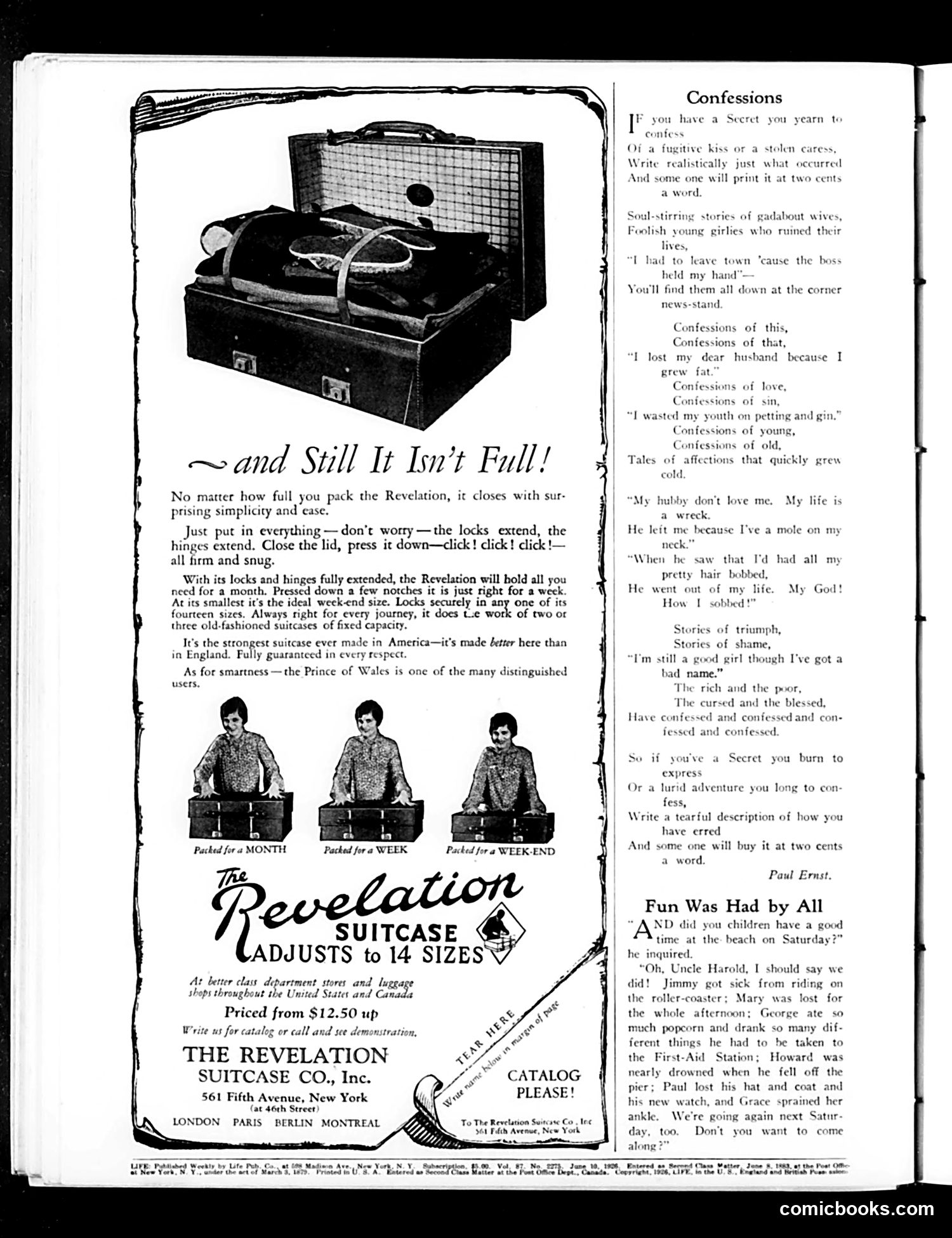
This page is primarily **advertising and light editorial content**, not political satire. The left side features a **Revelation Suitcase advertisement** showing how much luggage fits in different time periods ("Packed for a MONTH," "WEEK," "WEEK-END"). The copy emphasizes the suitcase's expandability and durability, claiming it's "better here than in England." The right side contains a poem titled "Confessions" by Paul Ernst, inviting readers to submit personal secrets for publication at two cents per word—a common early 20th-century magazine practice blending confession culture with monetization. Below is a brief humorous piece, "Fun Was Had by All," describing children's beach mishaps (illness, loss, near-drowning). This represents typical Life magazine content: consumer advertising mixed with light humor and reader participation features.
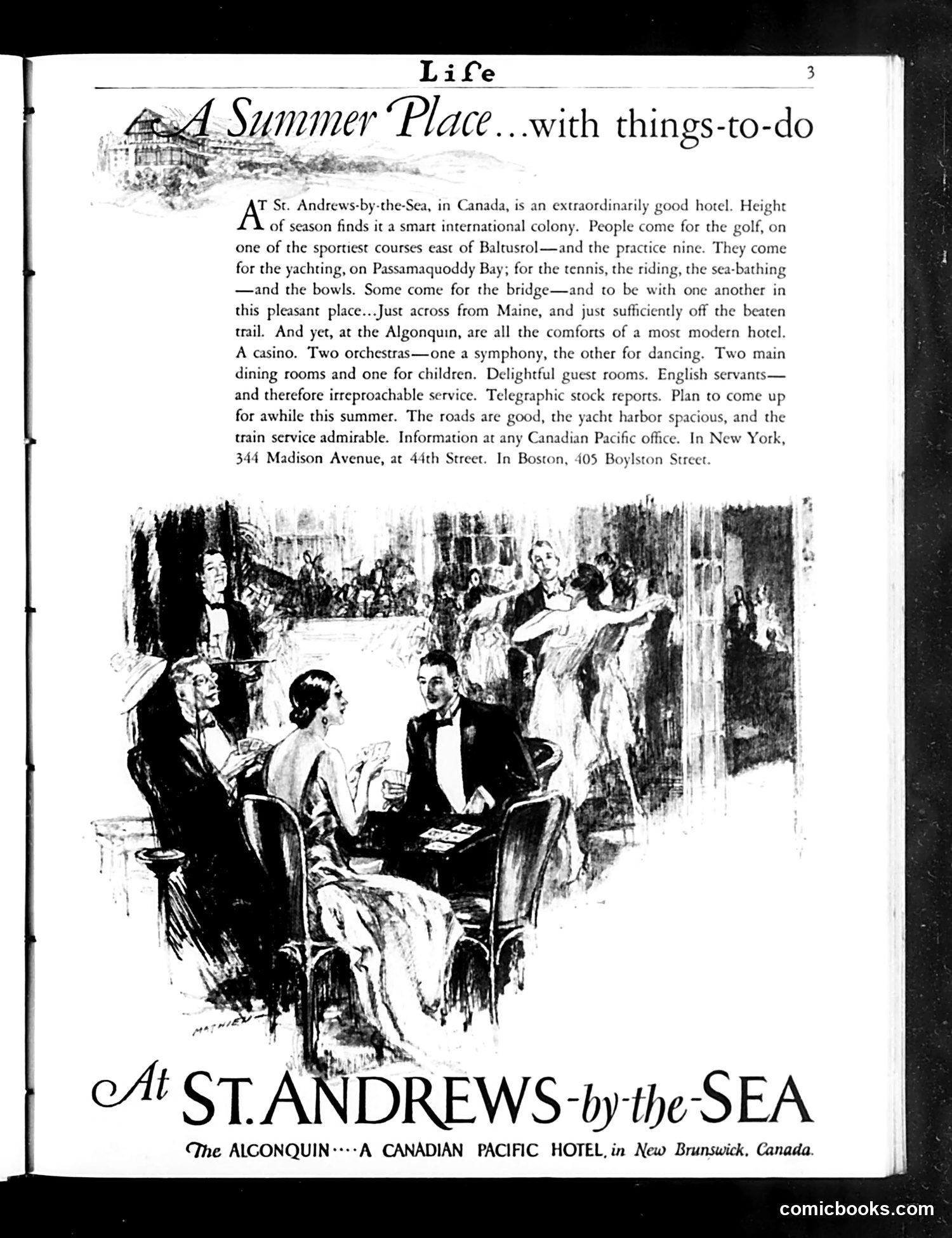
This page is **primarily advertising, not satire or political commentary**. It's a advertisement for the Algonquin Hotel at St. Andrews-by-the-Sea in New Brunswick, Canada, published in *Life* magazine. The illustration shows elegant, formally-dressed guests in what appears to be a hotel dining or social room—depicting the hotel's appeal to affluent travelers. The ad emphasizes luxury amenities: golf courses, yachting, tennis, sea-bathing, bridge games, orchestras, dining rooms, and "English servants." There is no discernible political satire or cartoon here. This is a straightforward promotional piece highlighting the hotel as a fashionable summer destination for wealthy North Americans, with contact information for Canadian Pacific offices in New York and Boston.
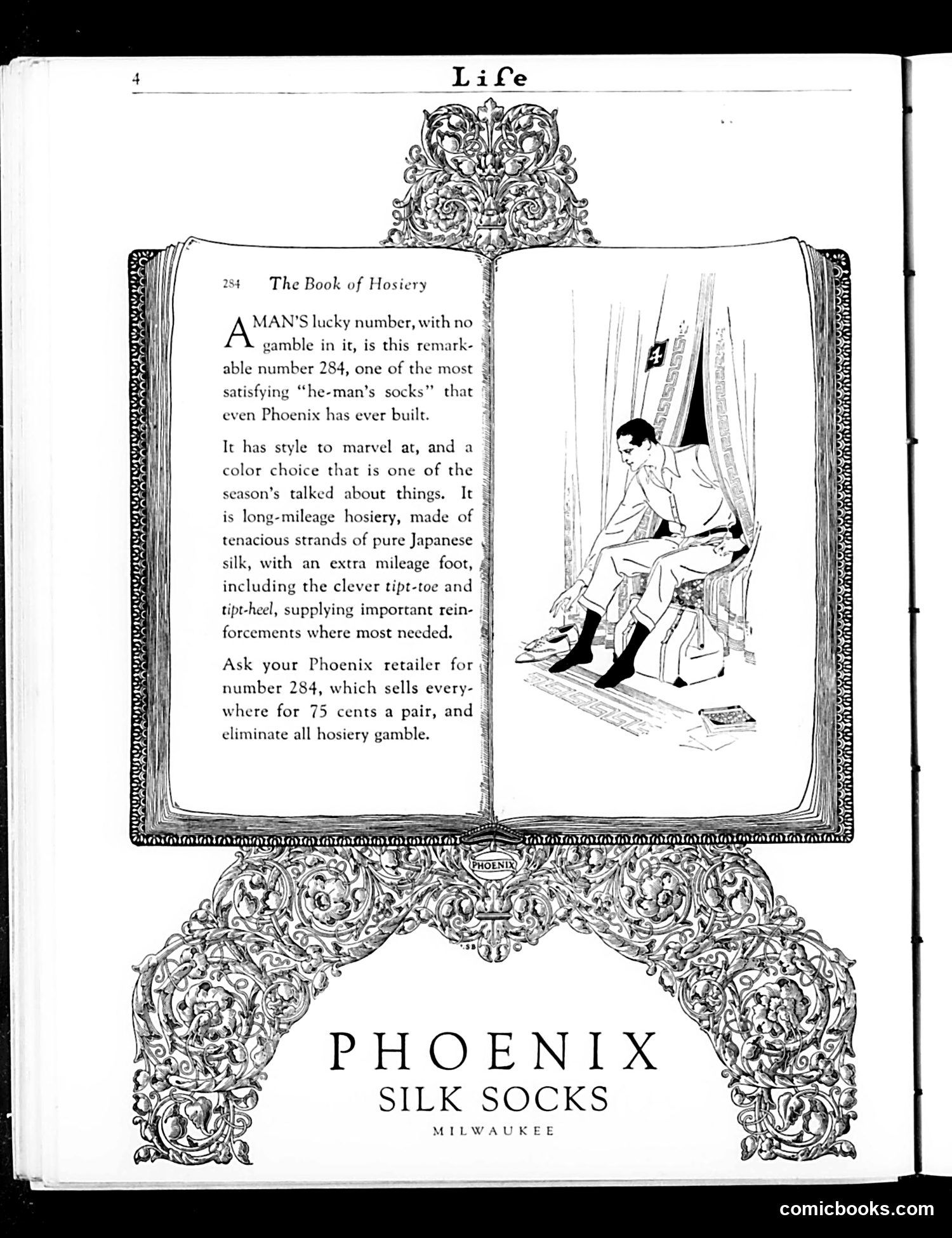
This is primarily a **Phoenix Silk Socks advertisement**, not political satire. The page from *Life* magazine's "Book of Hosiery" section promotes number 284, described as a premium men's sock made from Japanese silk with reinforced areas. The illustration shows a man in a tent or enclosed space examining socks, appearing to be a soldier or traveler. The ad's language—"eliminate all hosery gamble" and "long-mileage hosiery"—appeals to practical durability concerns. The only satirical element is subtle: calling socks a "man's lucky number" with "no gamble in it" gently mocks the era's superstitions about lucky numbers and gambling, positioning quality hosiery as the rational alternative. The price (75 cents) and Milwaukee origin are straightforward product information.
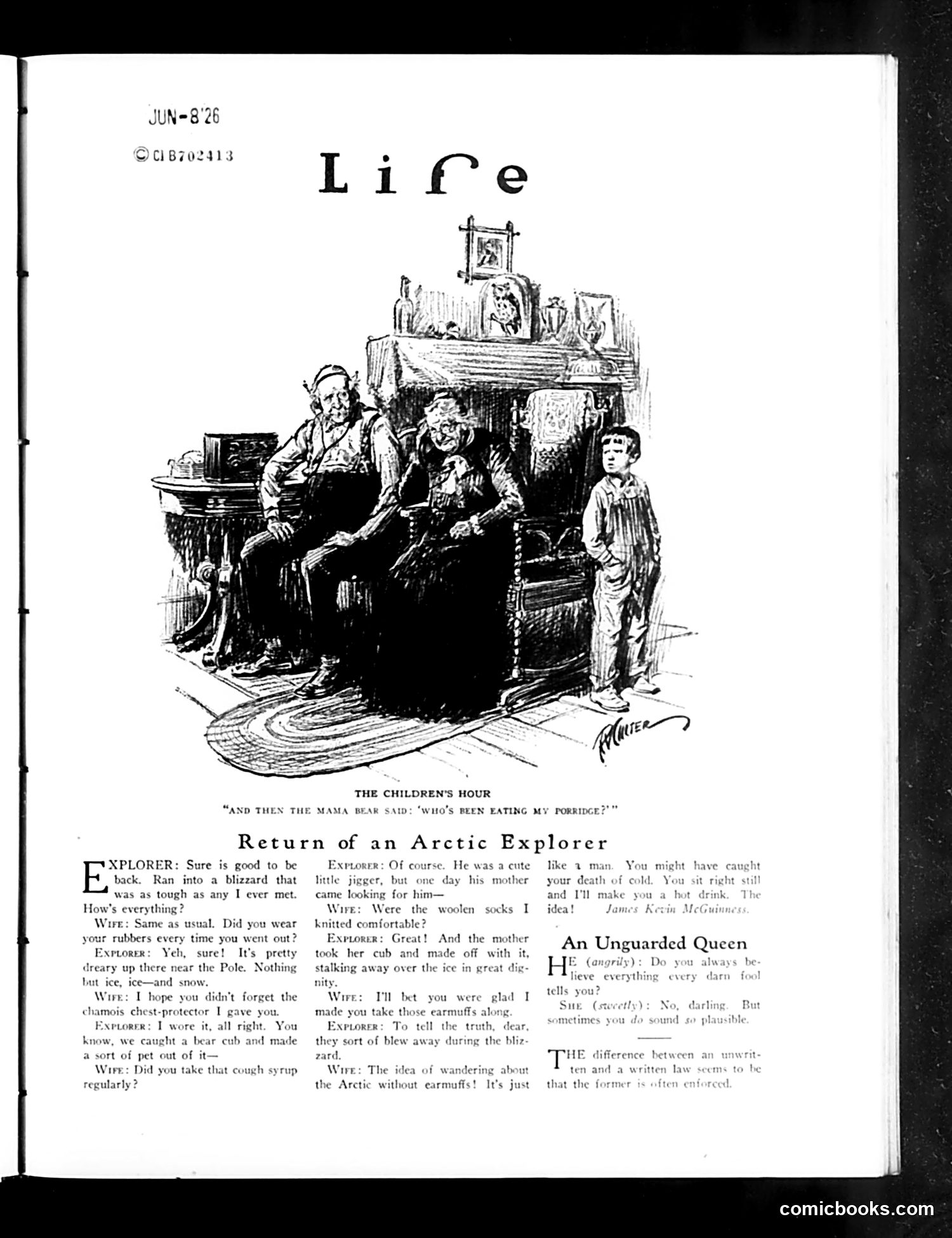
This page contains two distinct pieces: **"The Children's Hour"** is an illustration captioned with a Mama Bear saying line, depicting a domestic scene with adults and a child around furniture. It appears to be general family humor. **"Return of an Arctic Explorer"** is a dialogue-based satire between an EXPLORER and his WIFE. The joke mocks explorers' tall tales: the wife skeptically questions his Arctic adventure claims—earmuffs, bear encounters, syrup consumption—suggesting he's exaggerating or fabricating details. The satire targets the popular "explorer returning with fantastic stories" genre, implying such adventurers embellish their experiences for dramatic effect. **"An Unguarded Queen"** appears to be a brief piece about the difference between unwritten and written laws, though context is limited.
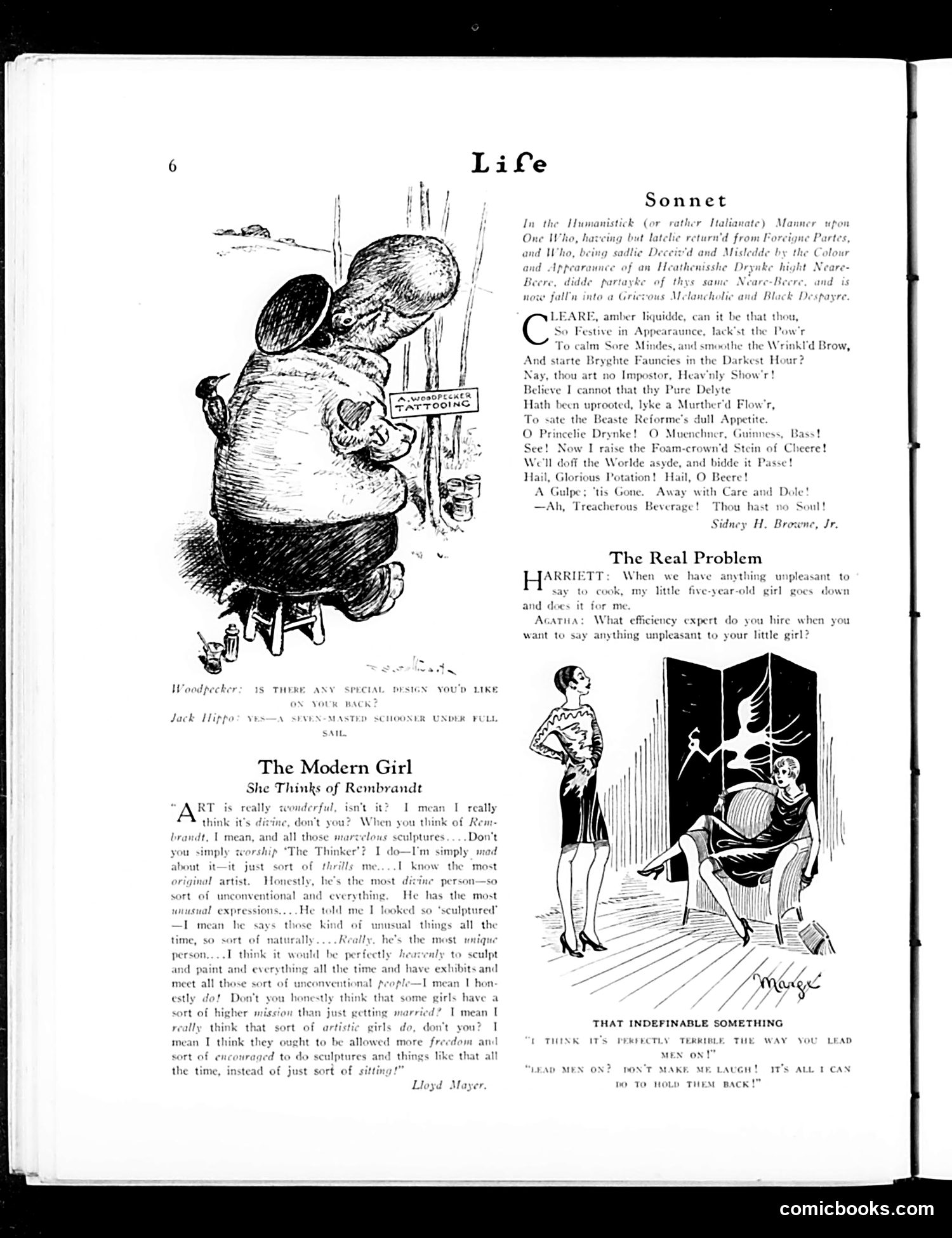
This page contains three distinct pieces of satirical content: **"Sonnet"** (top right): A mock-heroic poem by Sidney H. Broome, Jr., mocking overly earnest artistic pretension through exaggerated language about a mundane subject. **"The Modern Girl"** (left): Lloyd Mayer satirizes a young woman who discusses Rembrandt in trendy, superficial terms. The joke targets her affected intellectualism—she claims to admire Rembrandt's "unconventional" style while actually knowing little about art, representing the 1920s phenomenon of women adopting sophisticated cultural poses without genuine understanding. **"The Real Problem"** and **"That Indefinable Something"** (right): These companion pieces humorously critique gender relations. A woman complains about hiring domestic help; a man struggles to control his wife's behavior, suggesting marital power dynamics and the challenges of the modern era's changing social roles.
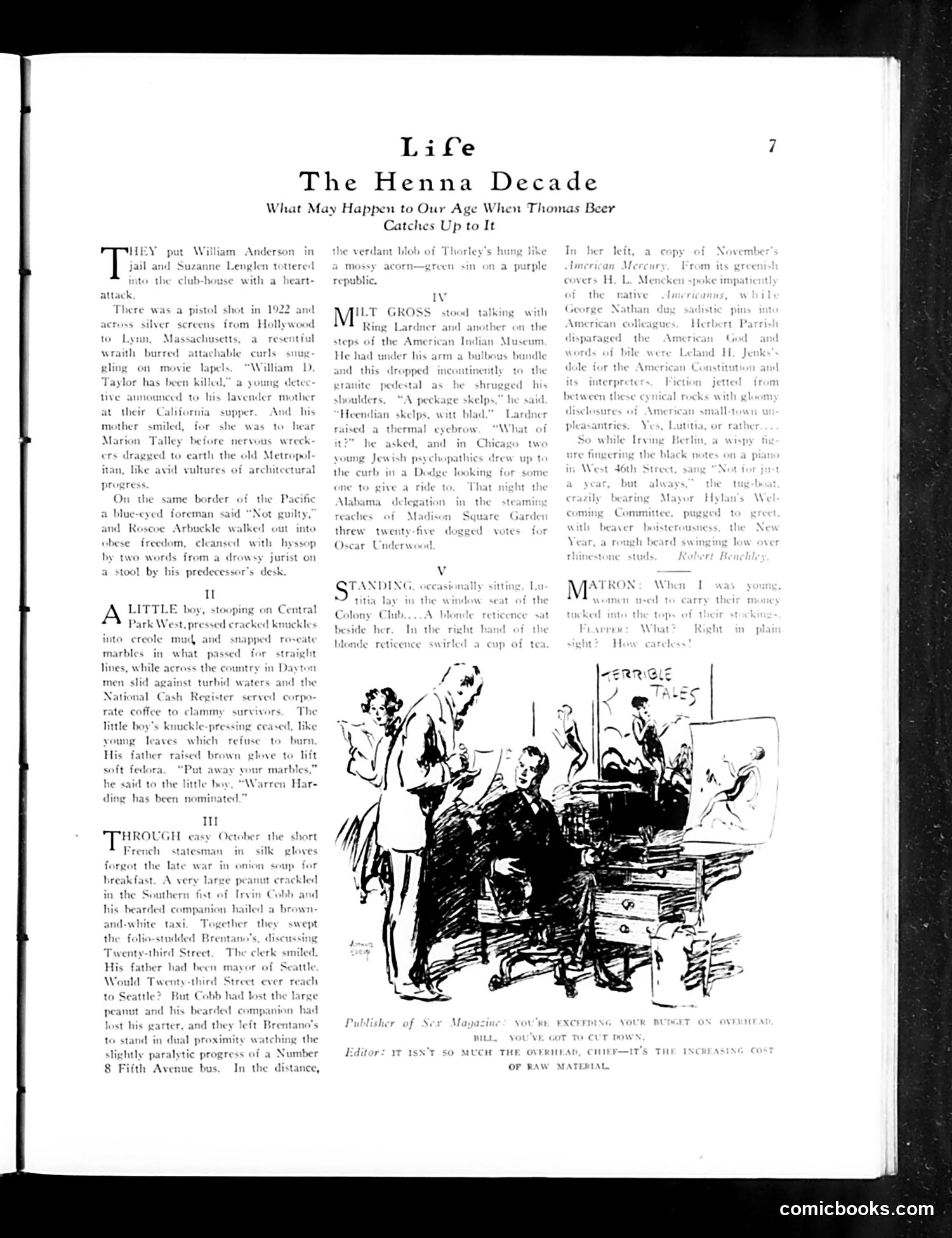
This page satirizes 1920s publishing and editorial management. The main cartoon depicts a heated exchange between a magazine publisher and editor over budget cuts. The publisher complains about overhead expenses, while the editor protests the need for quality raw materials to maintain the magazine's content. The satire targets the tension between business efficiency and editorial integrity—a publisher focused on cutting costs versus an editor insisting that reducing material expenses will harm the publication's quality. The cartoon suggests the absurdity of expecting good journalism while slashing budgets for essential materials. The page's title references "The Henna Decade" (the 1920s), and includes vignettes about various 1920s social observations, critiquing the era's cultural trends and societal changes through humor.
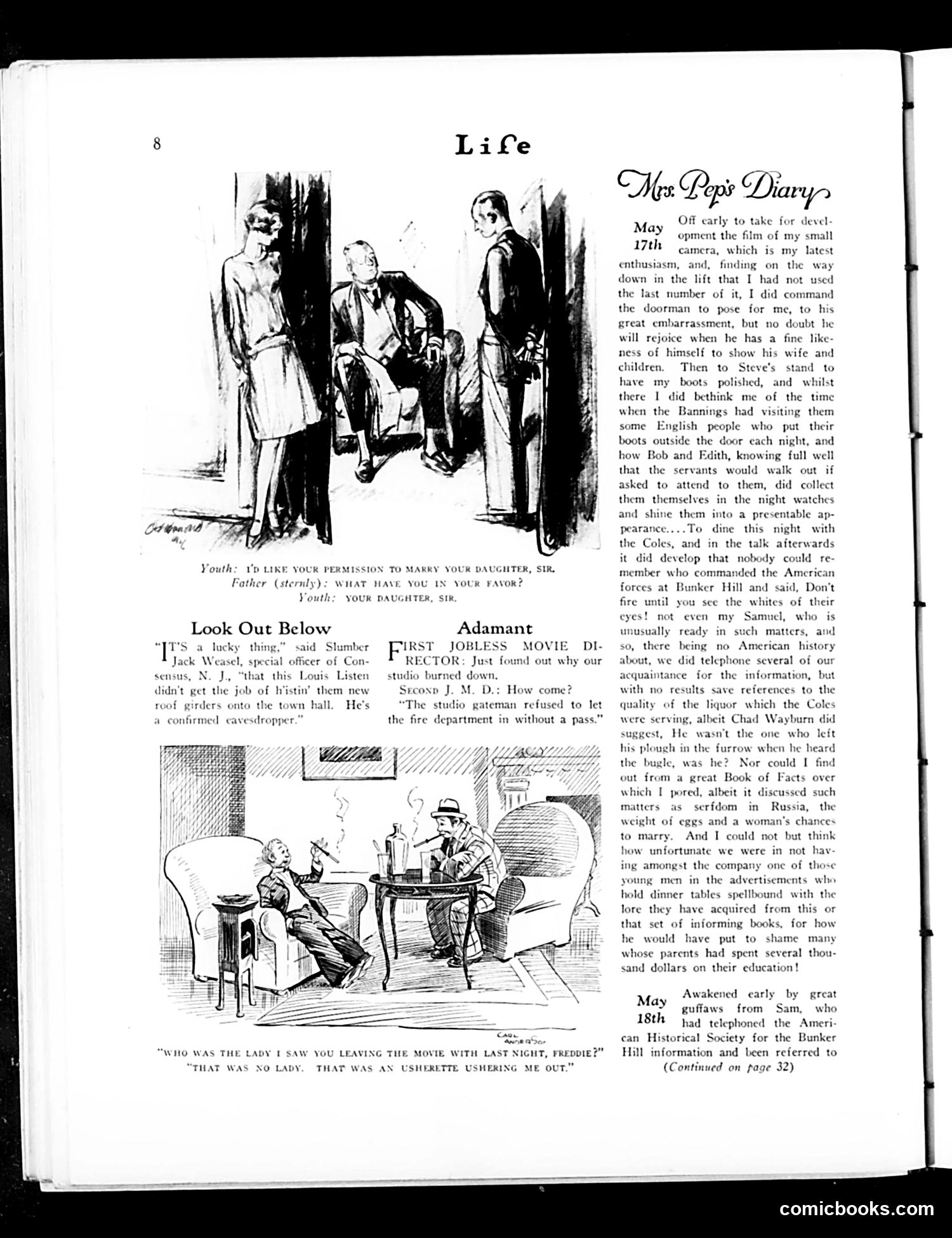
This page contains two distinct sections: **"Look Out Below"** (top): A short anecdote about a man named Slumber Jack in Consis, N.J., whose roof girders fell onto a town hall. The accompanying illustration shows the structural incident—a straightforward humorous story with no apparent political satire. **"Adamant"** (bottom): A joke about a jobless movie director refused entry to a studio without a pass. The cartoon depicts two men at a desk, with the punchline playing on the absurdity of bureaucratic gatekeeping during what appears to be economic hardship (likely 1920s-30s era, given the joblessness reference). **"Mrs. Pep's Diary"** (right): A dated diary entry discussing camera film and social observations, including references to American forces at Bunker Hill and servants. The content reflects typical Life magazine satire: workplace absurdities, class dynamics, and bureaucratic humor.
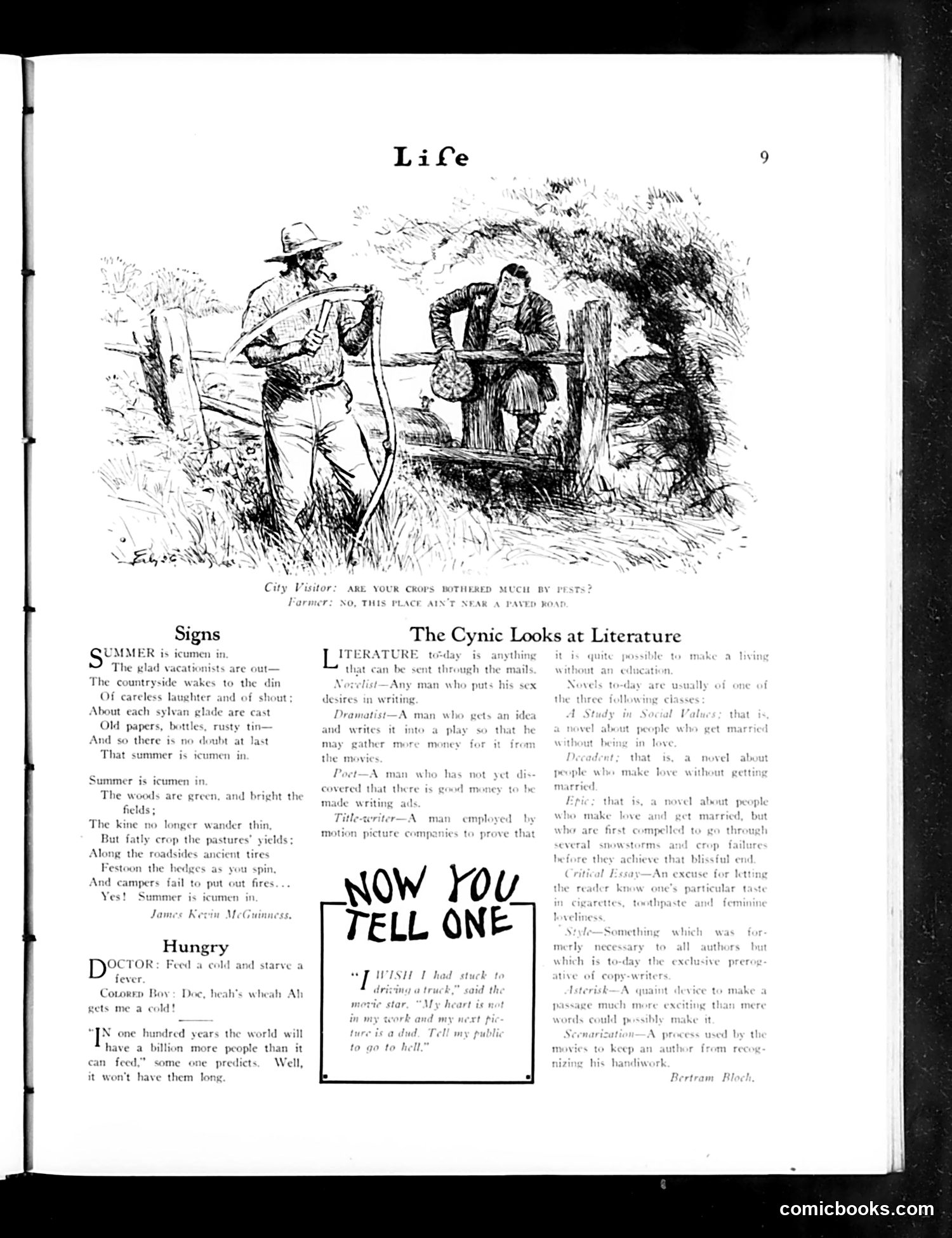
The top illustration depicts a **City Visitor** and **Farmer** in conversation near a fence. The city visitor asks if the farmer's crops are "much distressed by pests," and the farmer replies "this place ain't near a paved road"—a joke about how rural areas, lacking modern infrastructure and urban conveniences, escape certain urban problems. Below are three sections: **Signs** (a poem about summer), **Hunger** (a doctor-patient dialogue about food scarcity), and **The Cynic Looks at Literature**—which cynically defines literary terms and novel types. The centered callout **"Now You Tell One"** invites reader contributions. The overall page satirizes rural simplicity, urban problems, and literary pretension typical of early-20th-century American humor magazines.
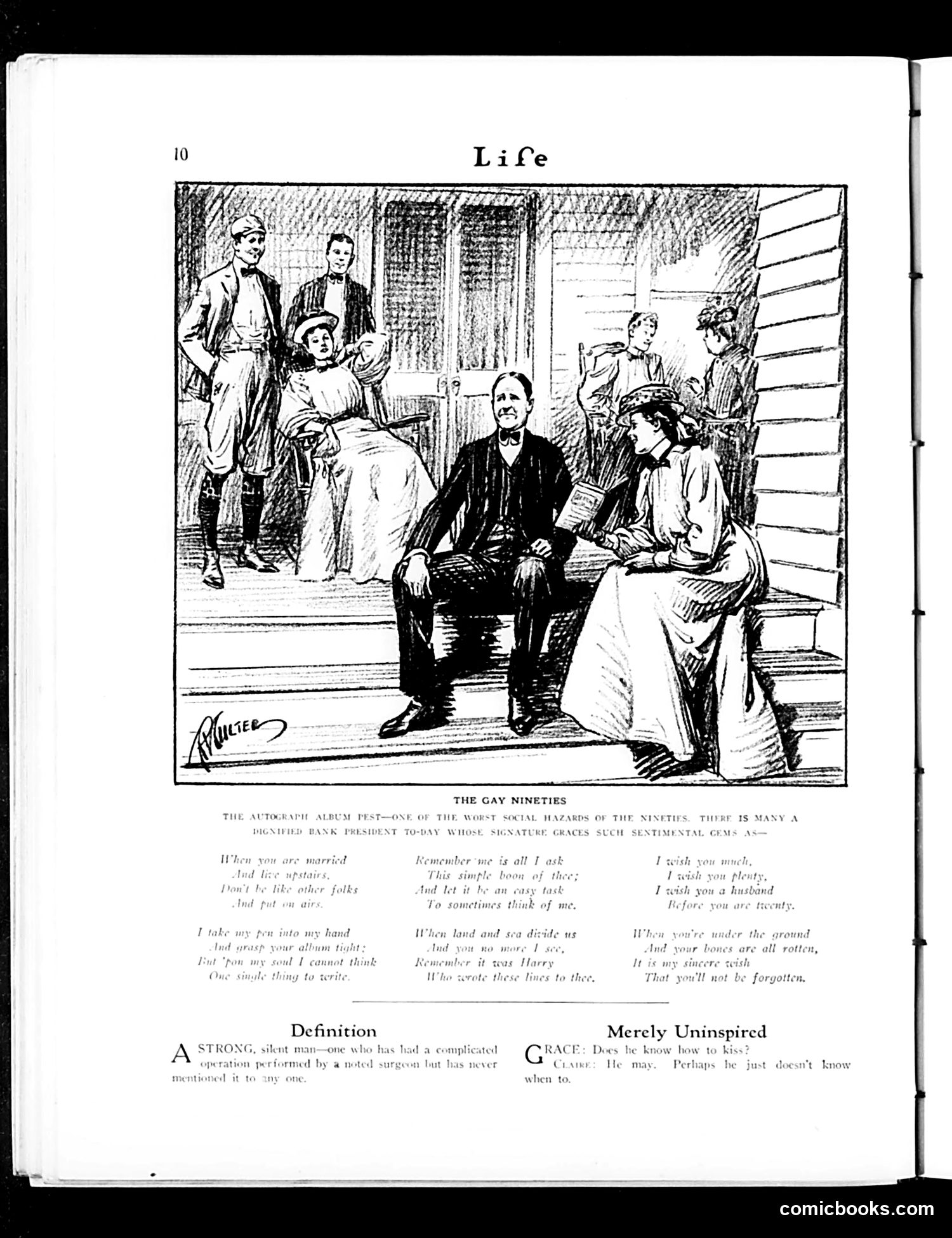
This satirical illustration depicts a nostalgic scene labeled "The Gay Nineties," showing an older man in dark formal dress conversing with a young woman, while other figures observe in the background. The accompanying verses suggest the humor concerns *autograph albums*—described as "one of the worst social hazards of the nineties." The joke targets the era's custom of young women collecting signed, sentimental inscriptions in decorative albums from male acquaintances. The verses mock this practice, with the woman wishing the man would inscribe something memorable while he struggles to compose an appropriate message. The satire critiques both the sentimentality of the 1890s and the social awkwardness this innocent tradition created, positioning it as a quaint embarrassment worthy of ridicule.
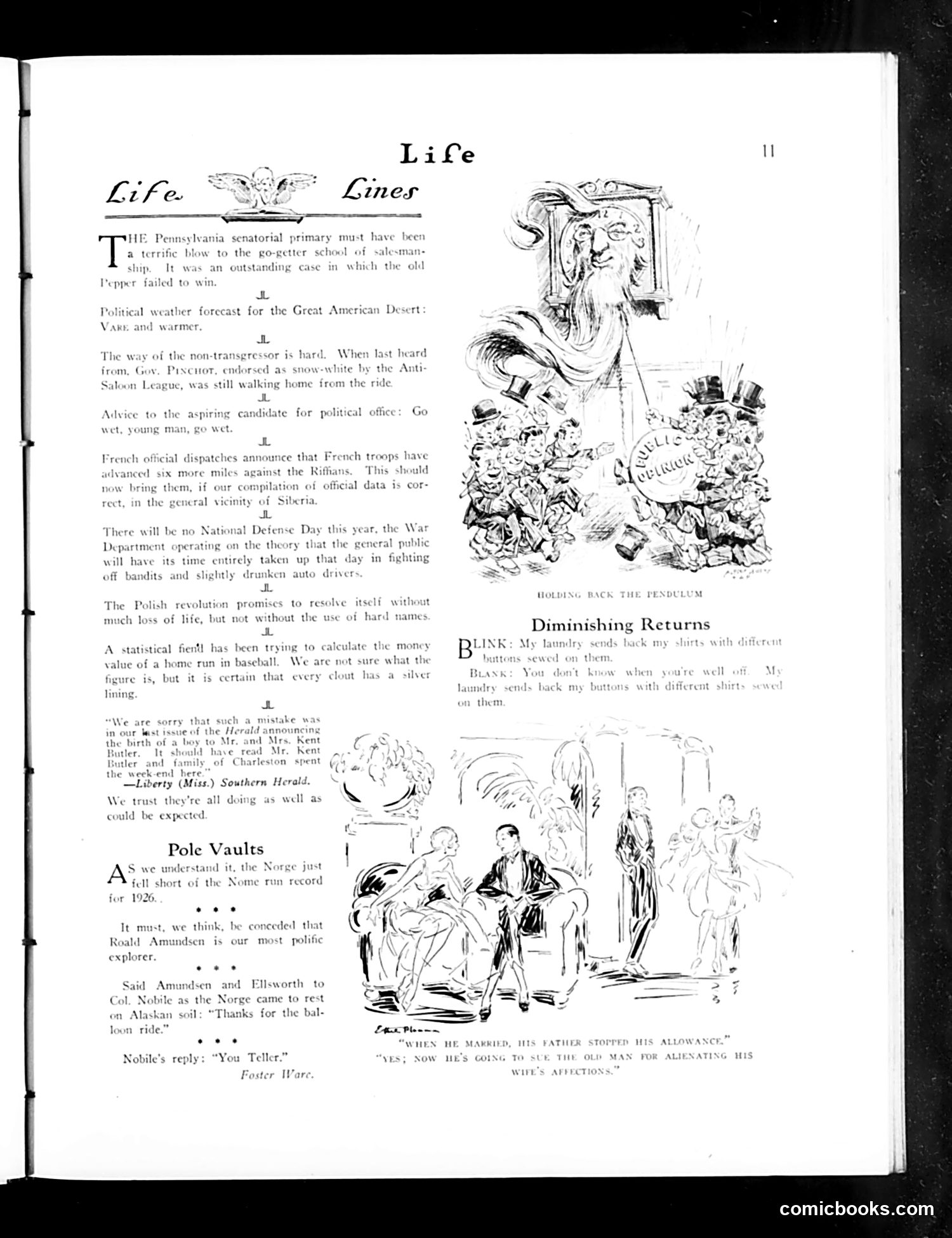
This page contains brief political commentary items and two illustrated pieces. **"Holding Back the Pendulum"** (top right) depicts Uncle Sam as a bearded figure straining to hold back a large swinging pendulum labeled "Policies," suggesting difficulty controlling political momentum or policy direction. **"Diminishing Returns"** (lower section) is a domestic humor dialogue about laundry—a wife complains her laundry returns shirts with different buttons; her husband suggests she send back differently-sewn shirts. The accompanying sketch shows various domestic scenes. **"Pole Vaults"** references Norwegian explorer Roald Amundsen and mentions an Alaska expedition, apparently joking about pole-vaulting as metaphor for Arctic exploration achievements. The page primarily contains light satirical commentary on contemporary political and social matters from this era.
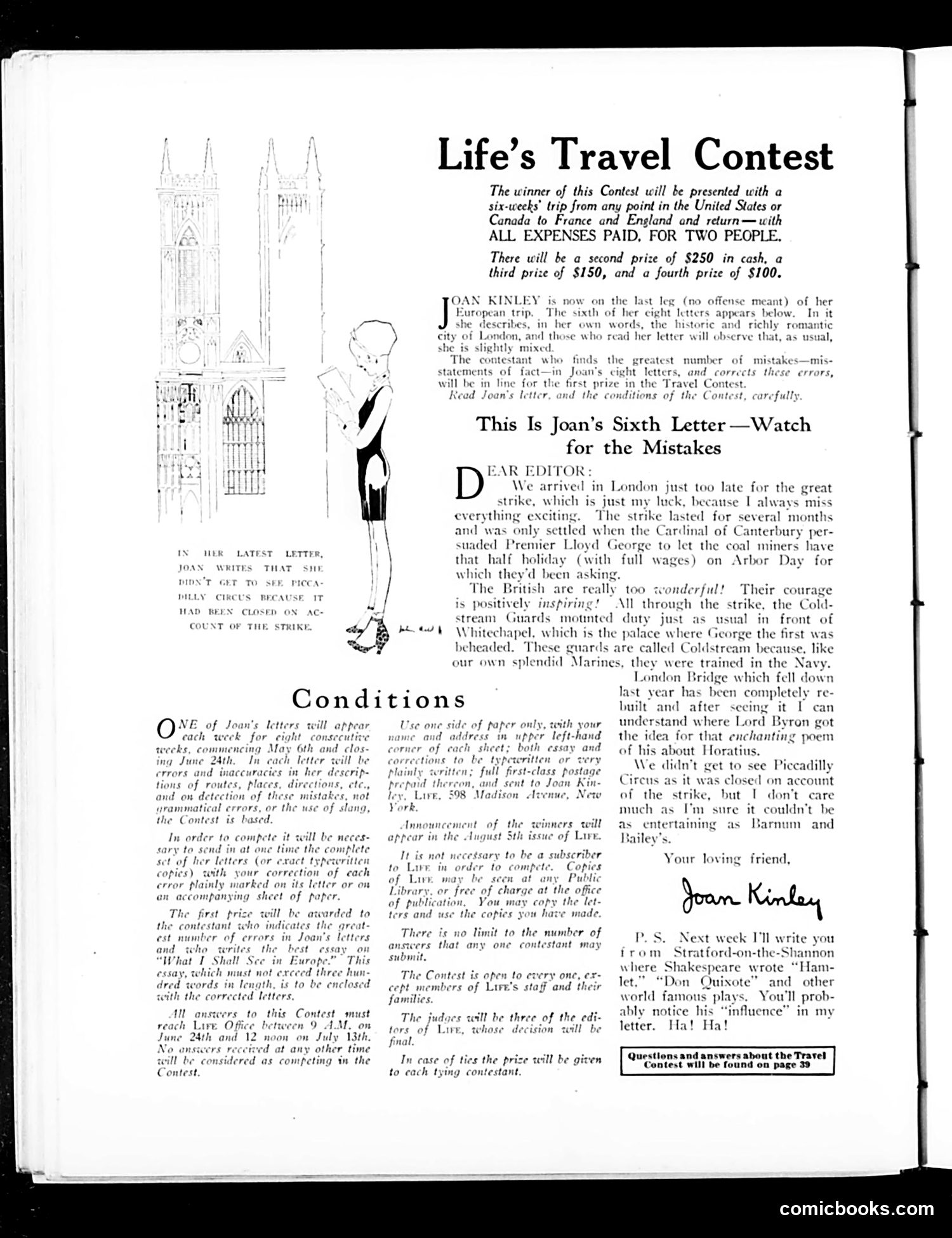
This page announces **Life's Travel Contest**, offering a grand prize of an all-expenses-paid six-week European trip for two people. The main content features **Joan Kinley's sixth letter** from her ongoing European travels. Joan describes her experiences in London, including the Coldstream Guards at Whitechapel and the recent London Bridge collapse. She mentions missing Piccadilly Circus due to a strike and references famous London landmarks and cultural sites. The cartoon illustration shows a fashionable woman in 1920s-style dress, presumably Joan, drawn in an elegant line-art style typical of the era. The page functions primarily as a contest announcement and travel narrative rather than political satire—it's entertainment content showcasing the magazine's travel reporting feature.
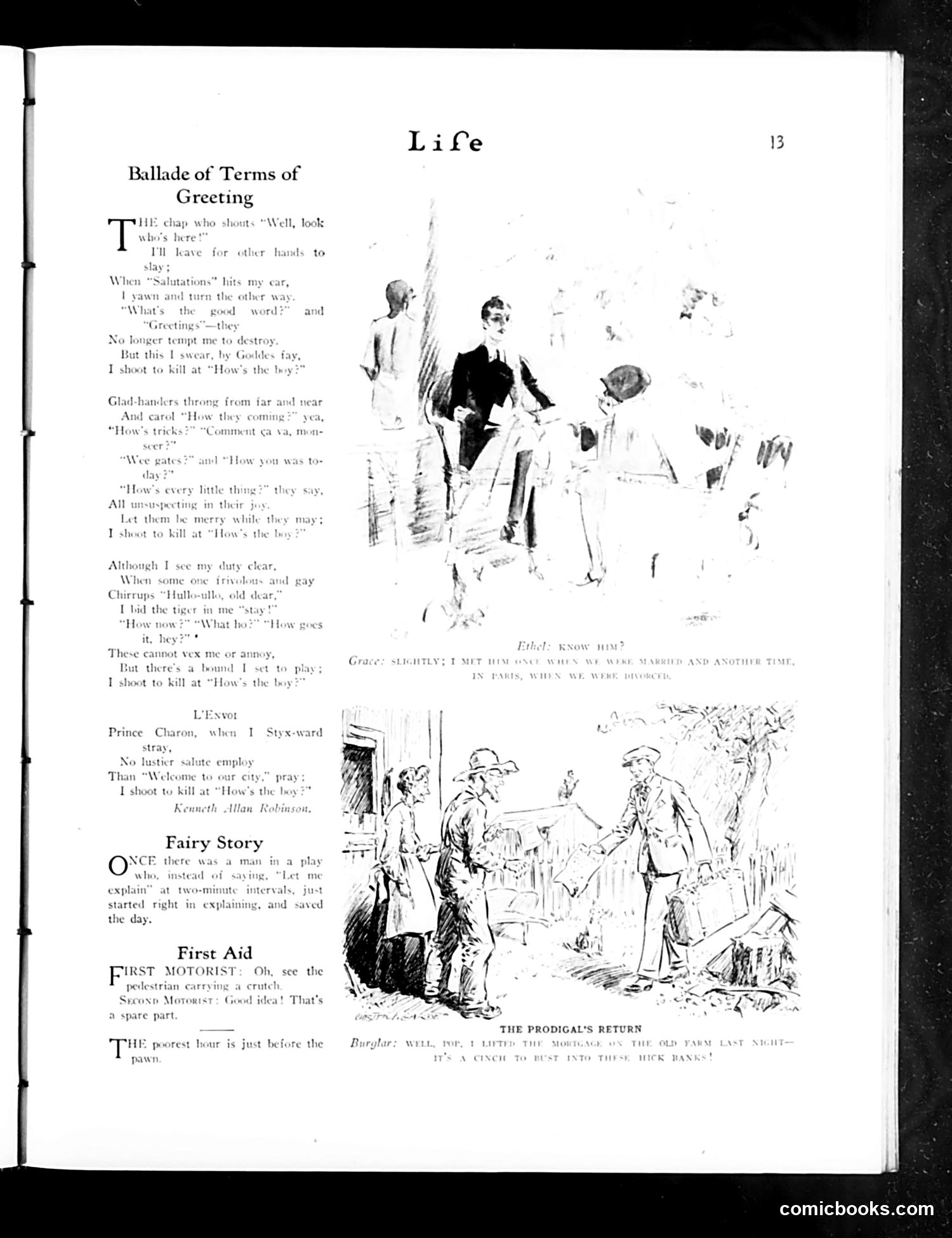
This page contains three separate humorous pieces: 1. **"Ballade of Terms of Greeting"**: A satirical poem mocking insincere social pleasantries ("How's the boy?" "We gay?") that people use in greeting rituals. It critiques hollow conversation starters. 2. **"L'Envoi"**: A brief poetic section crediting Kenneth Allan Robinson, referencing Prince Charon (likely a mythological allusion). 3. **"Fairy Story" and "First Aid"**: Two joke sections with accompanying illustrations showing comedic scenarios—one involving a motorist and a spare part, another about the "poorest hour" before dawn. These appear to be gentle, whimsical humor pieces typical of early-to-mid 20th century satirical magazines. The page uses text and illustrations together to deliver light social commentary on manners and everyday situations.
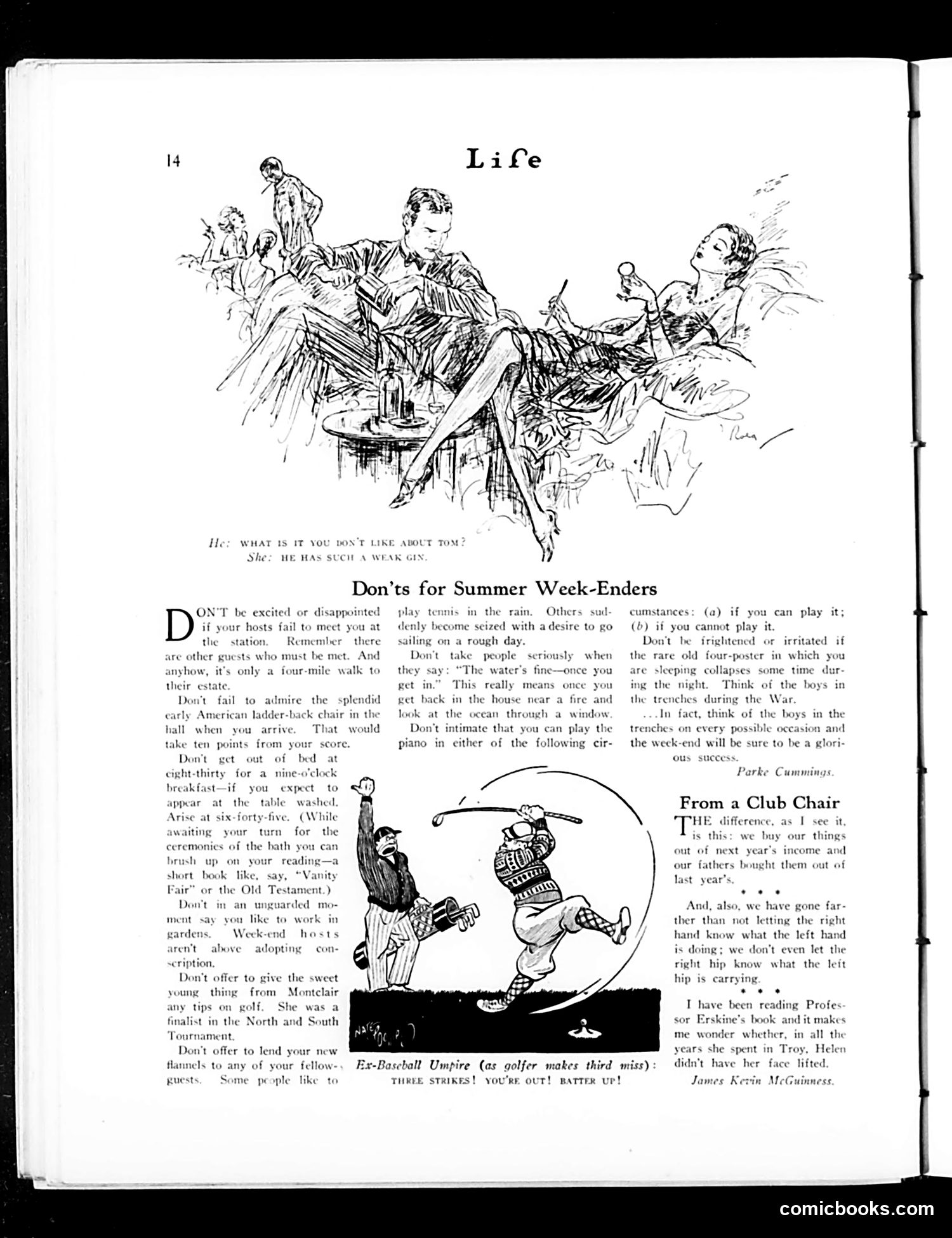
This page offers etiquette advice for weekend guests, illustrated with a satirical sketch of an elegantly dressed couple relaxing. The main article warns against common social missteps: arriving late, sleeping in past breakfast, appearing unwashed or unkempt, playing piano badly, and lending one's belongings to fellow guests. The baseball cartoon below depicts an umpire making a controversial call—the humor lies in the umpire's physical comedy (contorted pose) while declaring "THREE STRIKES! YOU'RE OUT!" The "From a Club Chair" essay critiques modern consumer behavior, suggesting wealthy people thoughtlessly purchase items on credit without understanding their financial consequences or moral implications. The author appears to contrast this with earlier restraint.
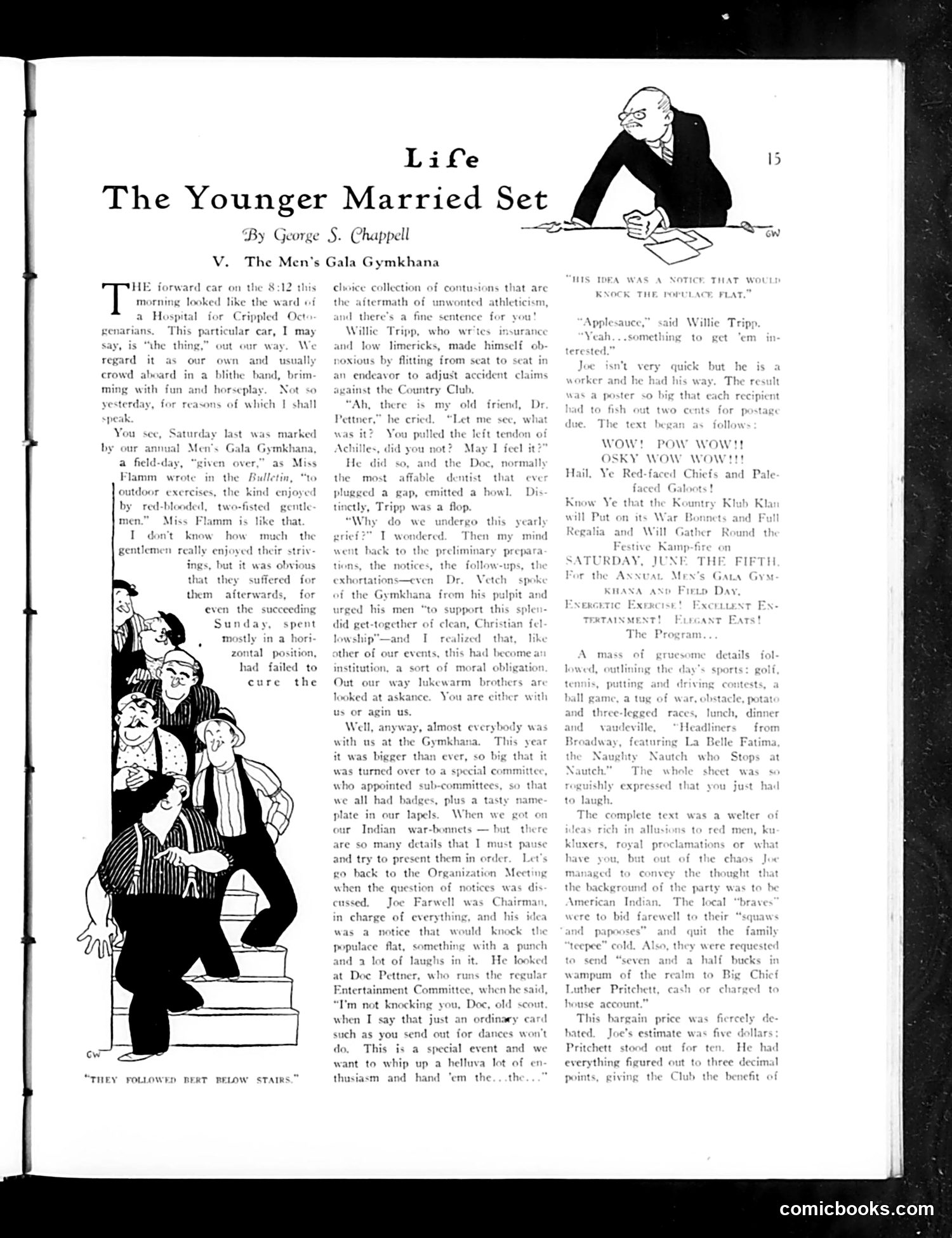
This satirical article describes the annual Men's Gala Gymkhana, a social event for wealthy young married people. The cartoon illustrates the article's tone: a rotund, formal gentleman escorts several fashionably dressed women and children down stairs, captioned "They followed Bert below stairs." The satire mocks the elaborate social rituals and pretentious organization of upper-class leisure activities. References to sub-committees, badges, name-plates, and formal notices suggest ridicule of bureaucratic excess in what should be casual socializing. Details about "Indian war-bonnets," entertainment committees, and quirky fundraising schemes (requesting "seven and a half bucks in wampum") parody both the self-importance of organizers and the conspicuous consumption of the younger wealthy set during this era.
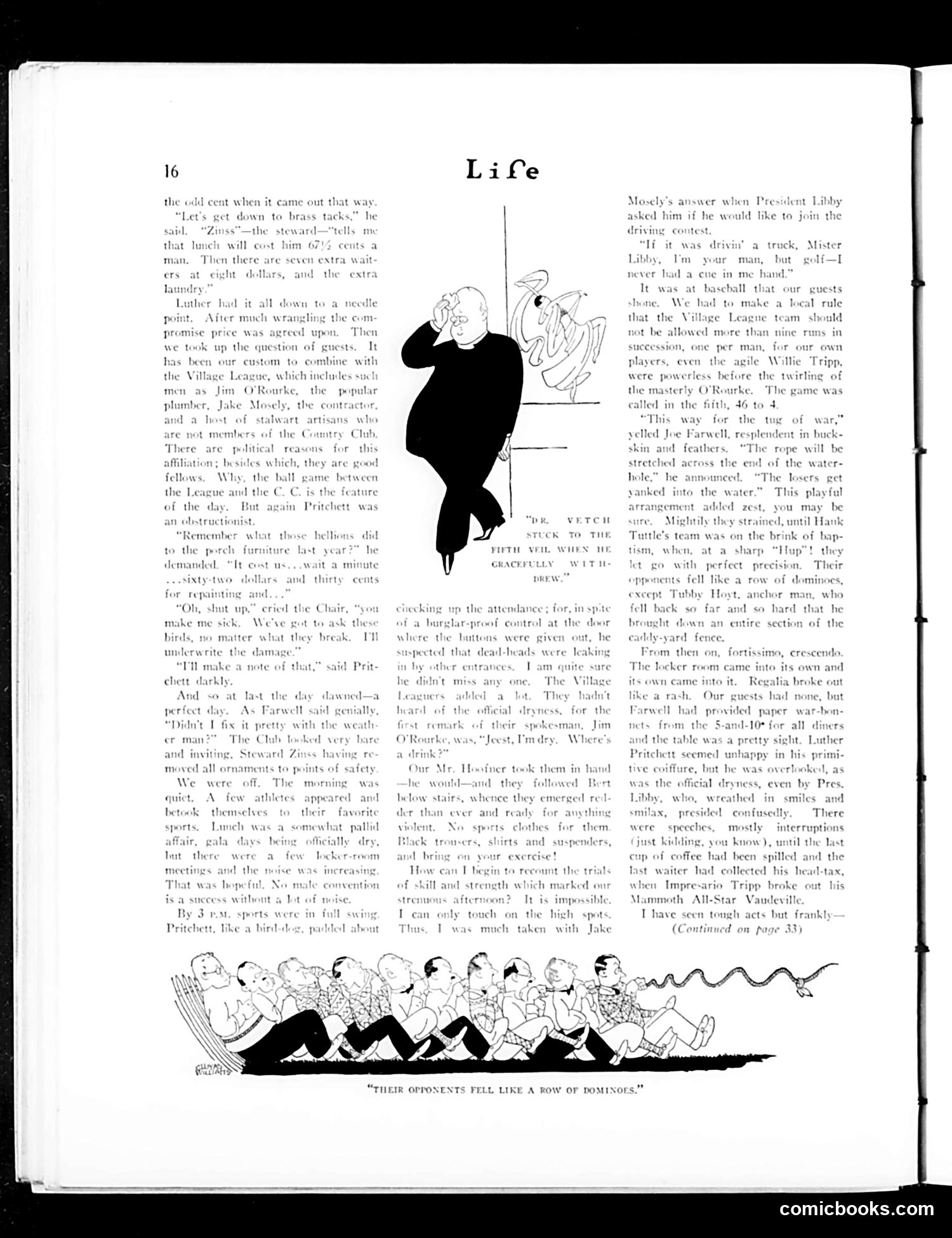
This page contains a short story with accompanying illustrations about a social gathering at what appears to be a country club. The main cartoon depicts a humorous incident during a baseball game involving the Village League team. The illustration shows a portly gentleman in formal attire gesturing animatedly—likely representing a club member or official—while describing or reacting to sports events. The bottom cartoon shows a line of people fallen like "dominoes" with the caption "THEIR OPPONENTS FELL LIKE A ROW OF DOMINOES." The satire targets upper-class leisure activities and social pretension, mocking both the participants' earnestness about amateur sports and the trivial dramas that emerge around such affairs. The writing emphasizes the genteel but somewhat ridiculous nature of Country Club society during this era.
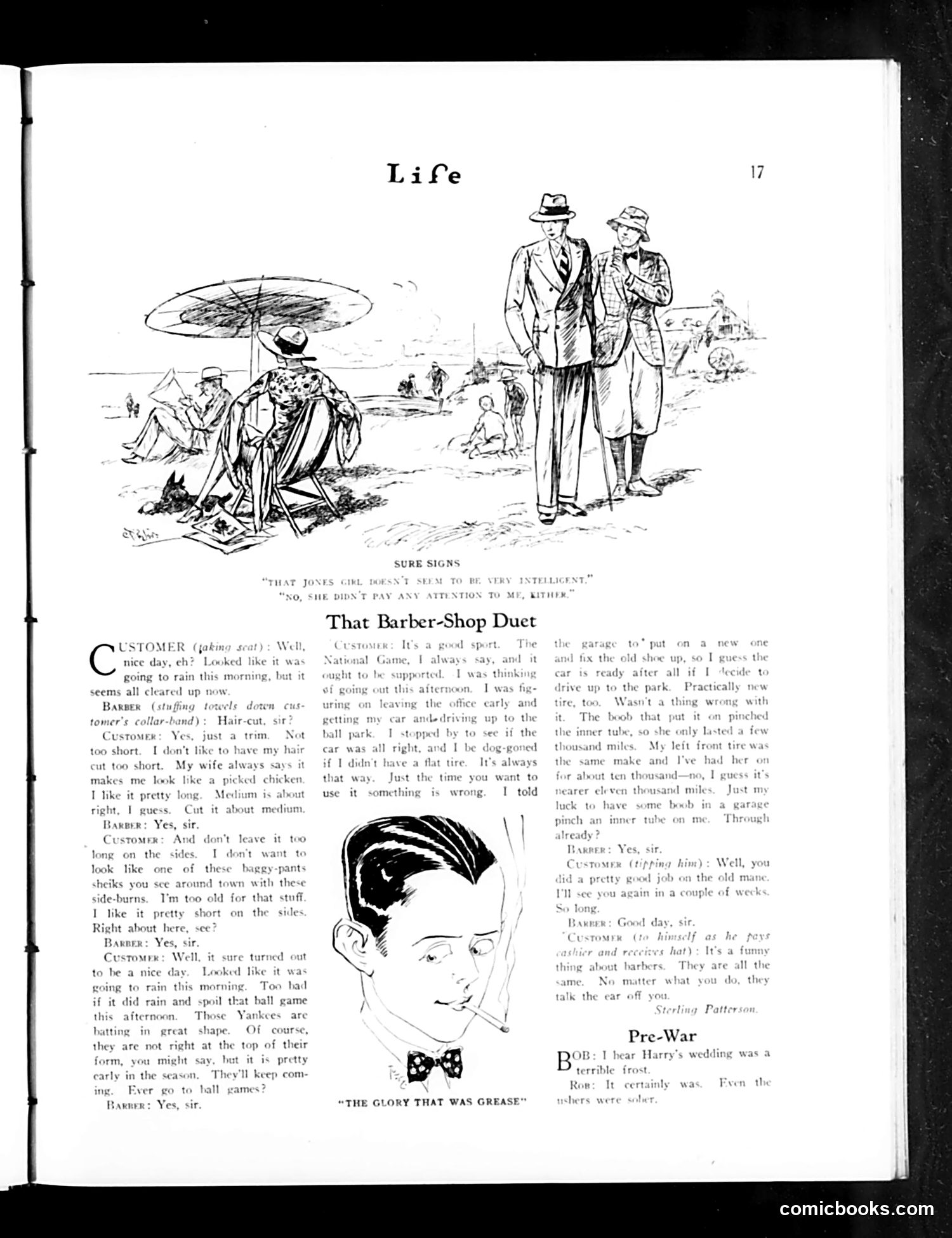
This is a humorous dialogue between a barber and customer—a common comic setup. The satire targets the triviality of barber-shop conversation: the customer obsesses over minutiae (hair length, side-burns) while discussing baseball and weather in tedious detail. The cartoon's title, "The Glory That Was Grease," mocks the customer's concern with hair grooming and styling products—specifically the pomade or "grease" men used for their hair, suggesting vanity about appearance. The broader joke: barbers are stereotyped as venues for endless, pointless male gossip about sports and personal grooming. The exaggerated dialogue illustrates how men spent time discussing inconsequential matters rather than substantive topics. This reflects early 20th-century social commentary on masculine culture and consumer preoccupation with grooming products—barber-shop culture as both socially important and utterly frivolous.
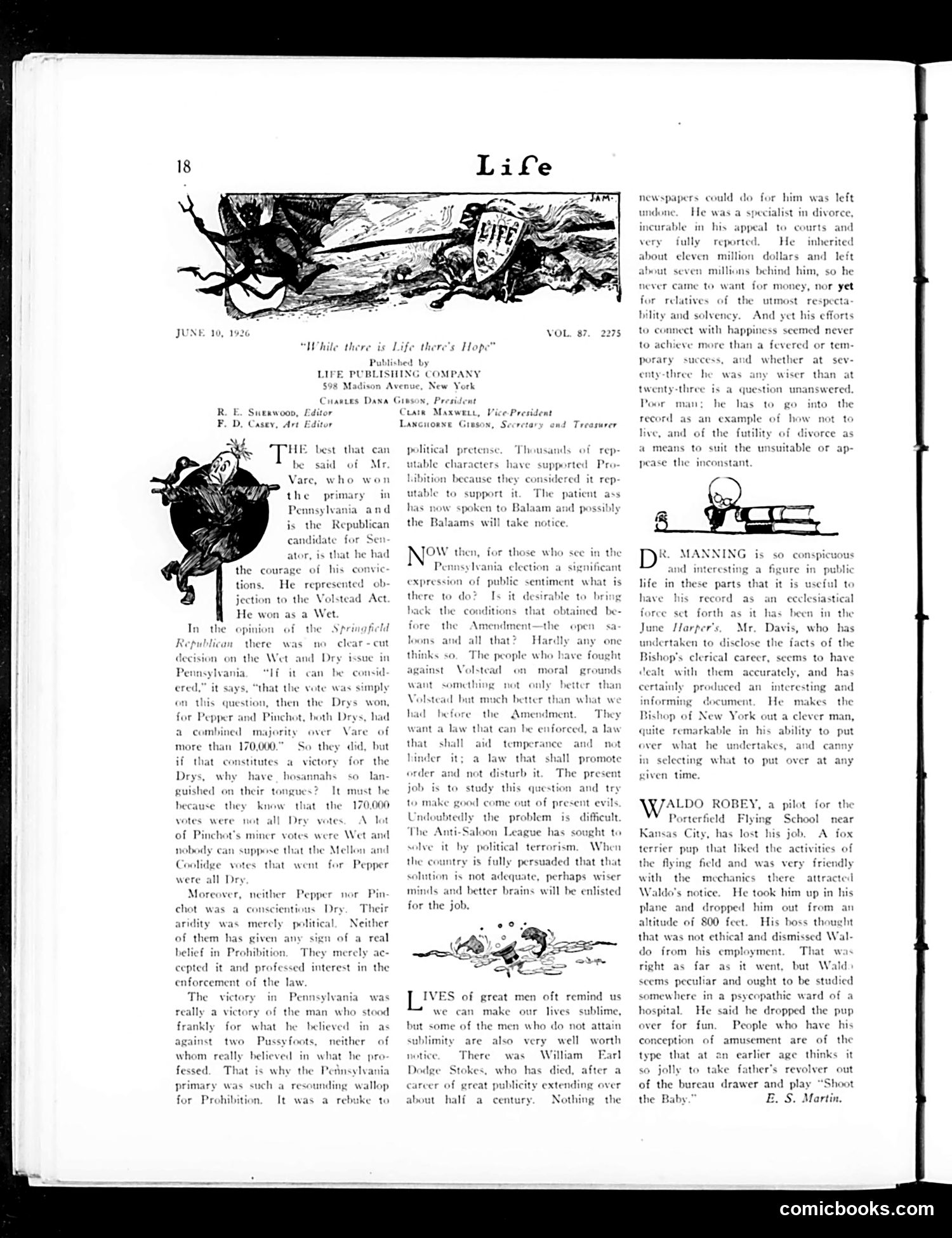
The page contains two main editorial pieces addressing contemporary political issues: **The Vare Election Commentary** discusses William S. Vare, who won Pennsylvania's Republican senatorial primary as a "Wet" (opposing Prohibition). The editorial criticizes this as merely political opportunism rather than principled conviction. It notes that Vare's victory over "Dry" candidates like Pepper and Pinchot wasn't actually a mandate on Prohibition—voters supported various candidates for different reasons. The piece suggests Pennsylvania's political establishment only cynically embraces Prohibition enforcement without genuine commitment to it. **The Waldo Robey Item** briefly reports on a pilot who lost his job after dropping a puppy from an airplane at altitude. The account questions whether this dismissal was ethically justified, though acknowledging the act seemed "peculiar." Both pieces exemplify *Life's* satirical approach: mocking political hypocrisy and commenting on contemporary social absurdities. The Vare piece particularly reflects 1920s debates over Prohibition's enforcement versus genuine public sentiment.
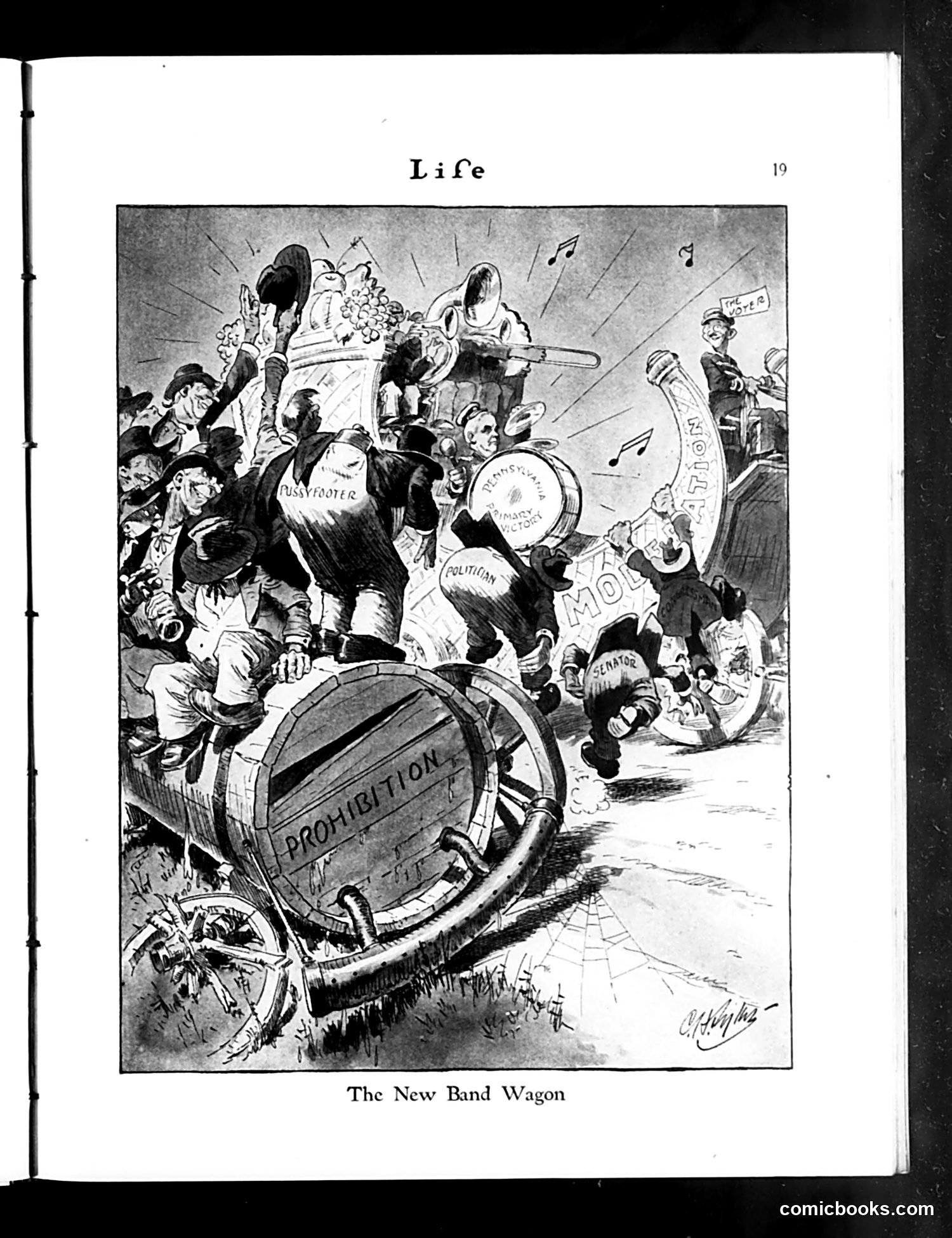
This political cartoon satirizes the Prohibition movement. A large barrel labeled "PROHIBITION" serves as a wagon, pulled by various figures playing musical instruments—depicting Prohibition as a festive "bandwagon" that people eagerly join. The cartoon identifies several labeled figures riding on or around the barrel, though some labels are difficult to read clearly in this image. The style suggests multiple political/social groups are depicted as opportunistically climbing aboard the Prohibition movement, treating it as popular entertainment rather than serious policy. The satire implies that Prohibition support was driven by fashionable momentum and public enthusiasm rather than genuine conviction—people were simply "following the band" rather than thoughtfully considering the policy's merits or consequences.
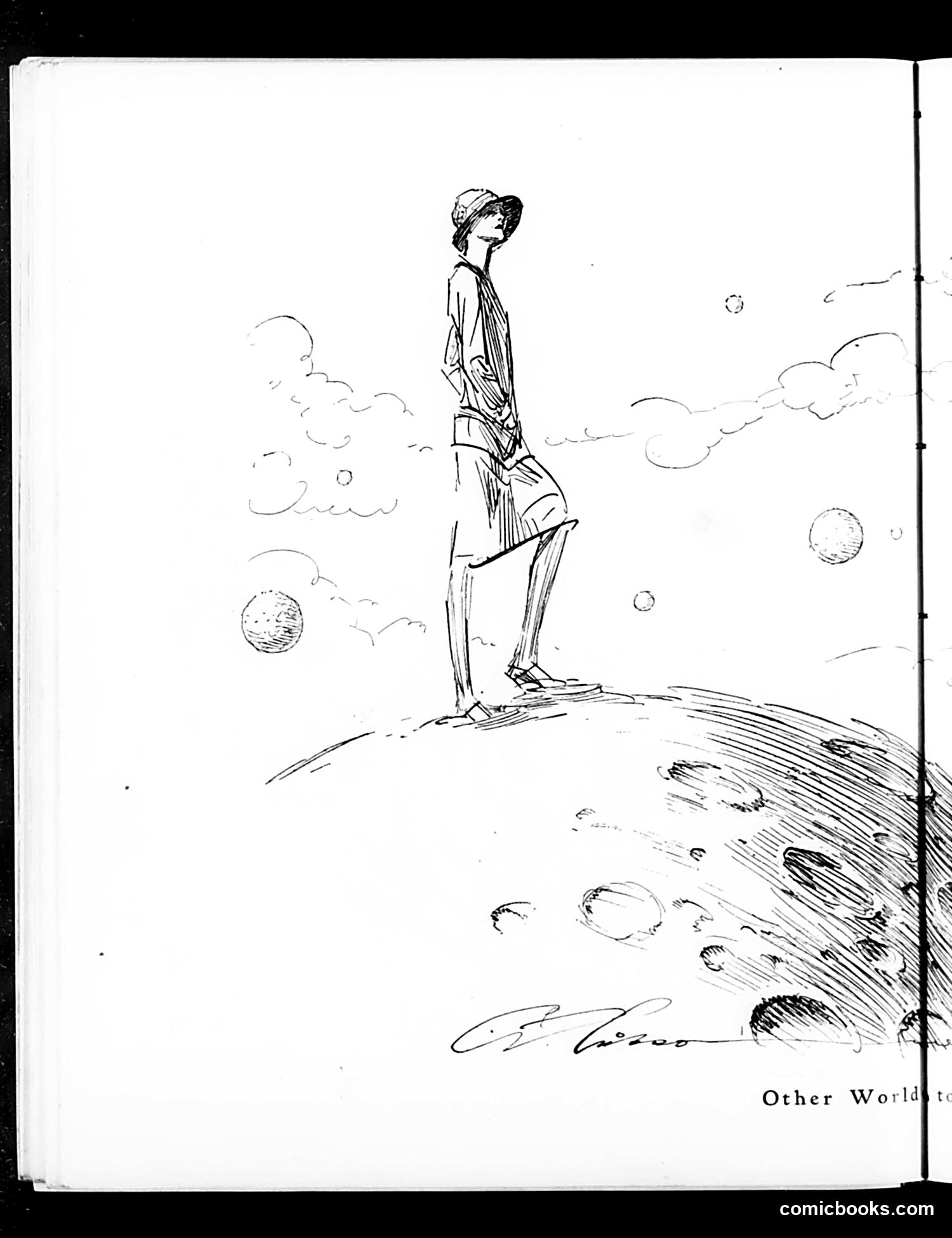
This page appears to be from *Life* magazine and depicts a figure standing alone on what looks like a celestial body or alien landscape, surrounded by floating spheres (planets or moons) and clouds. The figure wears period clothing and gazes outward contemplatively. The partial text "Other Worlds to" (likely continuing on the next page) suggests this illustrates a science fiction or philosophical theme—possibly about space exploration, cosmic wonder, or humanity's place in the universe. The solitary pose conveys isolation or existential reflection. Without the complete caption or article text, the specific satirical target remains unclear. The drawing's style and the *Life* magazine context suggest it may comment on contemporary attitudes toward scientific progress, imagination, or perhaps social/political idealism of its era.
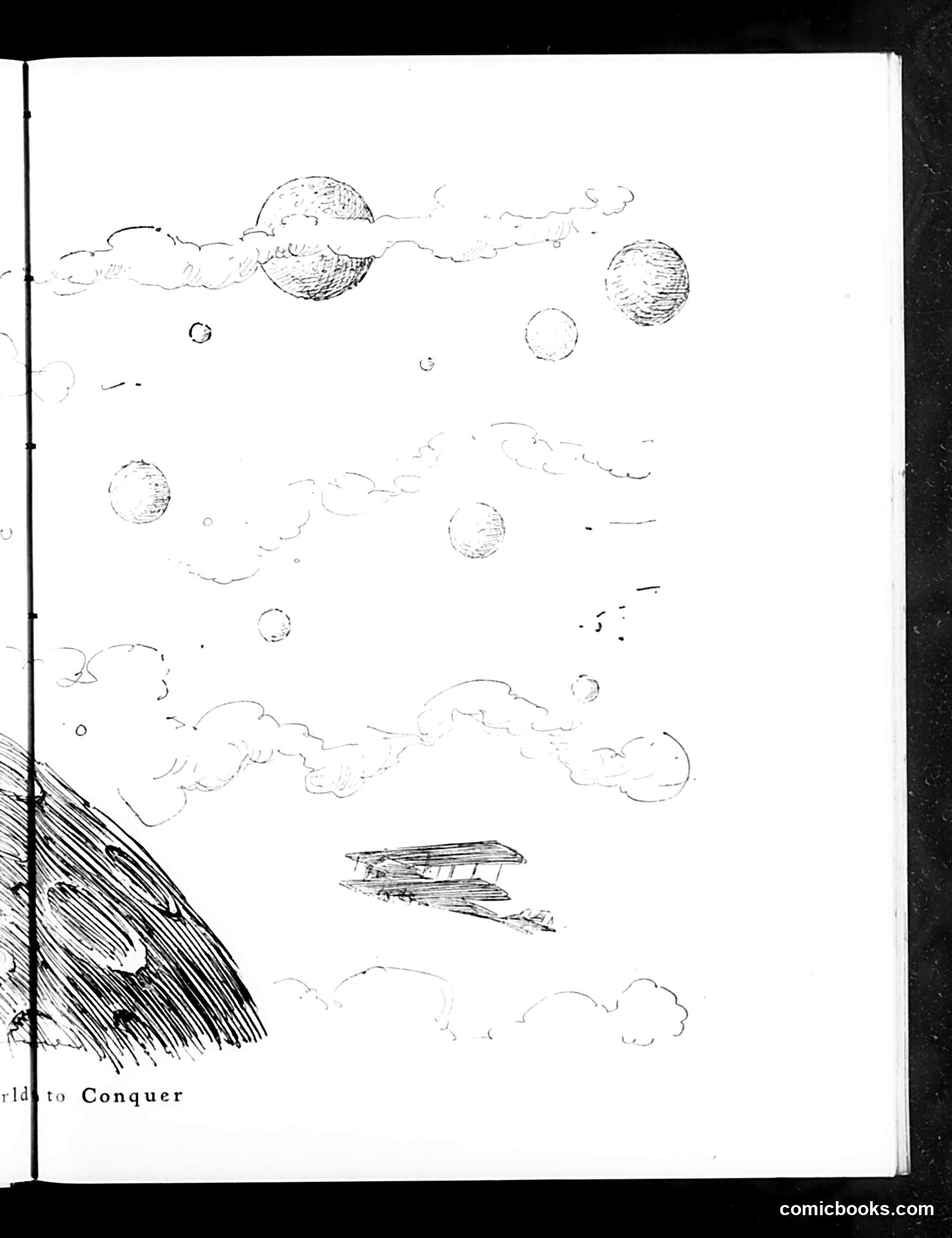
This page appears to be from a vintage publication's archive (noted "comicbooks.com" at bottom). The image shows a sketch-style illustration featuring several spherical objects (possibly planets or celestial bodies) with shading, cloud-like formations, and what appears to be an aircraft in the center. On the lower left is a heavily cross-hatched dark shape. The partial text visible reads "rld to Conquer" (likely "World to Conquer"), suggesting militaristic or imperialist themes common to early-to-mid 20th century American satire. However, without clearer context, OCR text, dates, or complete visible captions, I cannot confidently identify specific political figures, events, or the satirical target. The sketch quality and composition suggest wartime or Cold War-era commentary, but specifics remain unclear from this image alone.
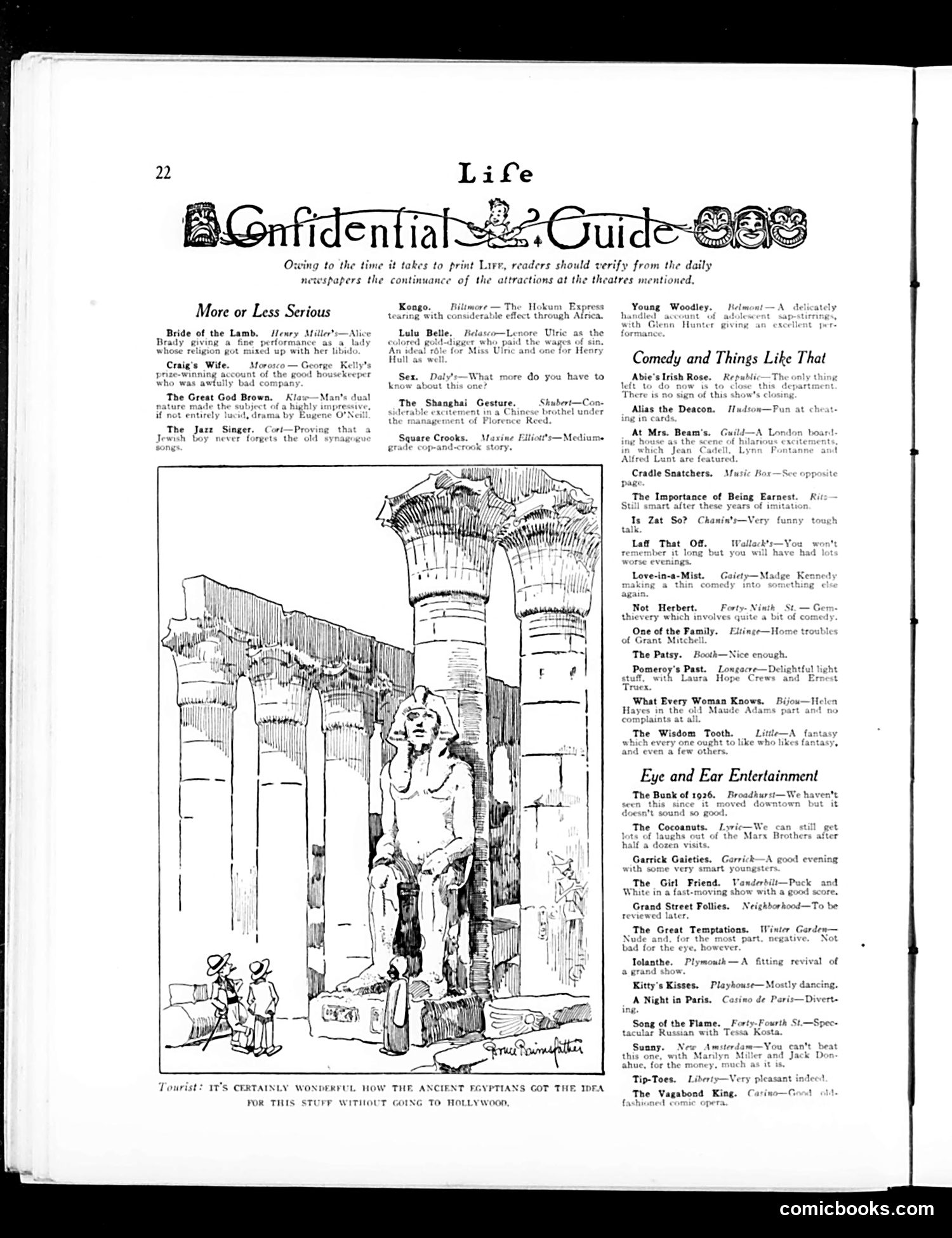
This page is primarily a **theater listing and review guide** for Broadway shows, not a political cartoon. The main illustration shows a tourist marveling at an Egyptian statue/monument, with a caption making a joke about ancient Egyptian engineering: "Tourist? It's certainly wonderful how the ancient Egyptians got the idea for this stuff without going to Hollywood." **The satire:** This is a self-deprecating American joke suggesting that Hollywood (the entertainment industry) is so dominant and inventive that even ancient civilizations seem to have copied its ideas—when logically the opposite is true. It playfully mocks American entertainment's inflated sense of its own importance and cultural influence. The rest of the page lists current theatrical attractions like "The Jazz Singer," "Craig's Wife," and "The Cocoanuts," categorized as "More or Less Serious" and "Comedy and Things Like That," providing theatergoers with show recommendations and venue information.
This page critiques the theatrical controversy surrounding **Rahman Bey**, an apparent magician or performer who recently gave a dramatic performance in New York. The text references "Cradle Snatchers," a play being discussed for its moral implications regarding relationships between middle-aged men and younger women. The article satirizes both Rahman Bey's act (involving apparent feats of rigidity or hypnosis) and the moral panic surrounding "Cradle Snatchers." The writer mocks dramatic critics who attended a Monday opening and the subsequent committee that supervised Rahman Bey's performance, even requesting he perform specific acts. The satire targets: overly serious theater criticism, the policing of "immoral" entertainment, and the absurdity of the situation where a committee essentially micromanaged a performer's routine. The tone is skeptical of both the performer and the theatrical establishment's hand-wringing about moral corruption.
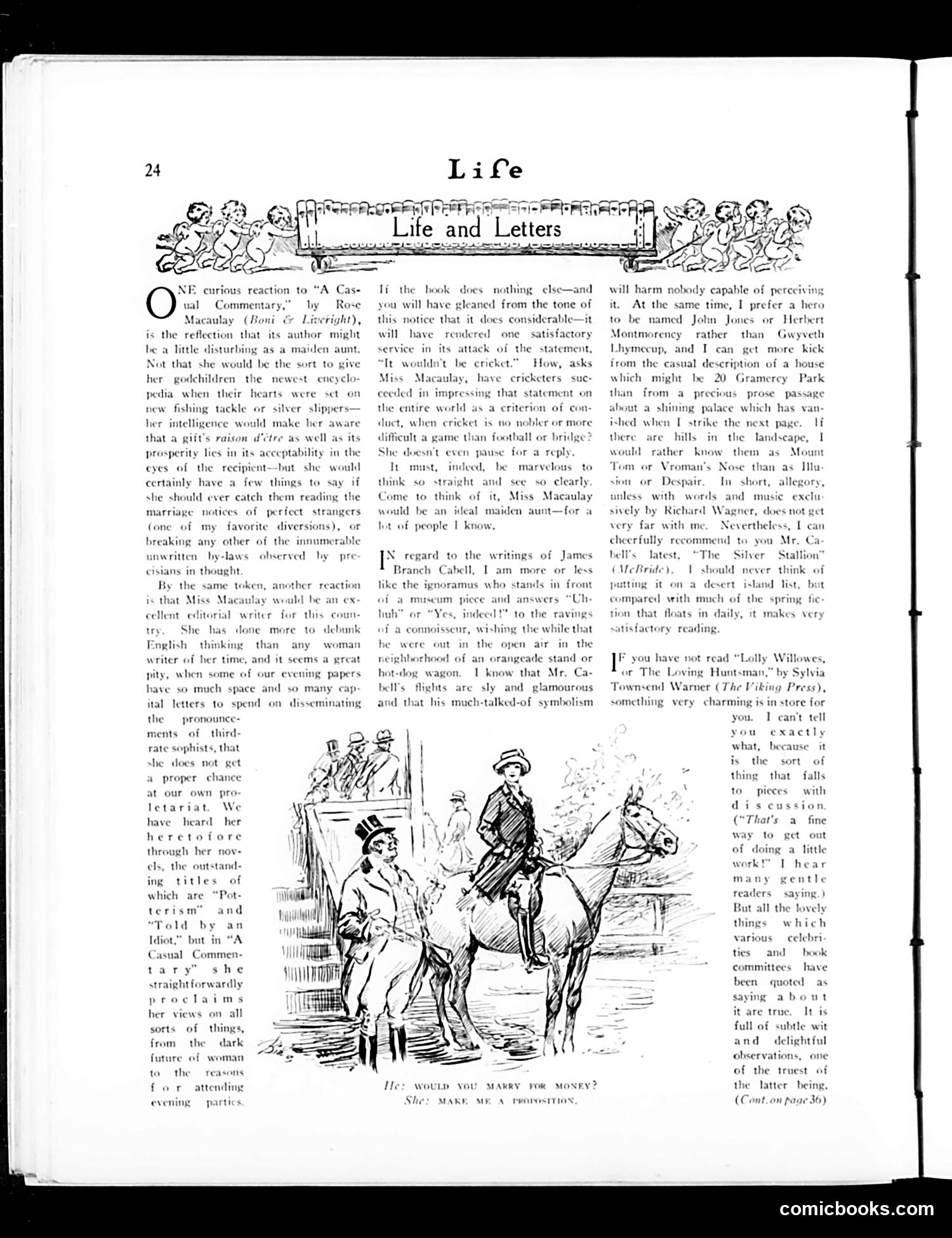
This page from *Life* magazine contains a literary column reviewing books by Rose Macaulay, James Branch Cabell, and Sylvia Townsend Warner. The central cartoon depicts a man on horseback proposing to a woman, with the caption "HE WOULD YOU MARRY FOR MONEY? / SHE: MAKE ME A PROPOSITION." This illustrates a satirical commentary on transactional marriage attitudes of the era—mocking both the mercenary nature of matrimonial negotiations and the frank, unromantic approach taken by both parties. The text criticizes Macaulay's *Casual Commentary* for her overly cerebral approach to life, while praising her intellectual contributions to debunking "English thinking." The reviewer expresses frustration that newspapers give space to "third-rate sophists" rather than serious thinkers like Macaulay. Regarding Cabell's work, the reviewer dismisses his symbolic, allusory style as pretentious, preferring straightforward character names over elaborate allegories. Warner's *Lolly Willowes* receives gentle praise for its charming, witty observations about life—described as full of "subtle wit and delightful observations."
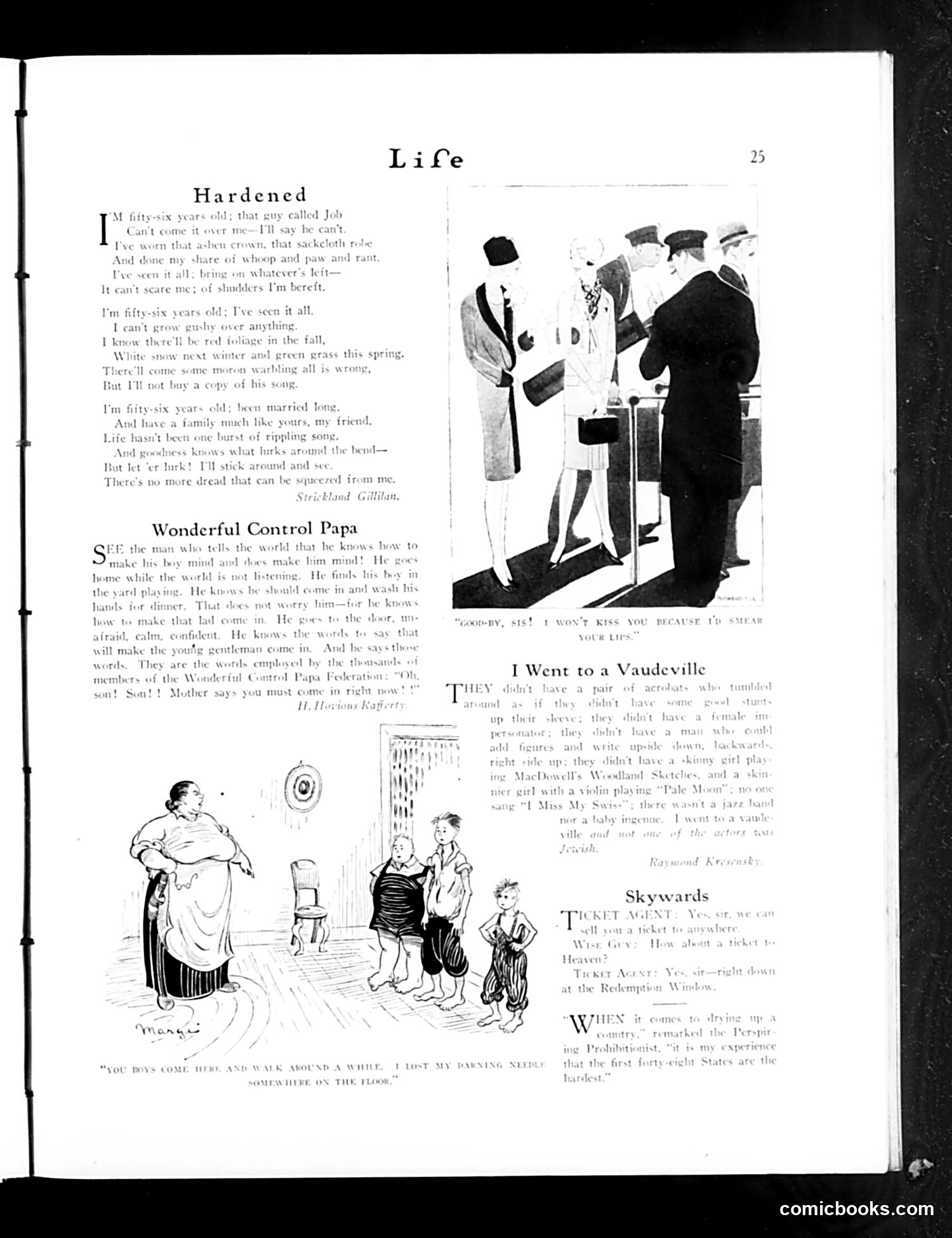
This cartoon satirizes a father's claimed authority over his household. The illustration shows a rotund man confidently instructing children to "walk around a while" while he rests, declaring mastery over his domain. The accompanying text humorously undercuts this authority—describing how he actually has no control: his wife manages finances, children ignore him, and he merely performs confidence while lacking genuine command. The satire targets masculine pretense about domestic authority. The "Wonderful Control Papa" is wonderful only in his delusional self-perception; in reality, he's manipulated by family members while maintaining the appearance of control. This reflects early-20th-century humor about the gap between patriarchal ideals and domestic reality, where wives and children actually wielded practical power despite formal male authority.
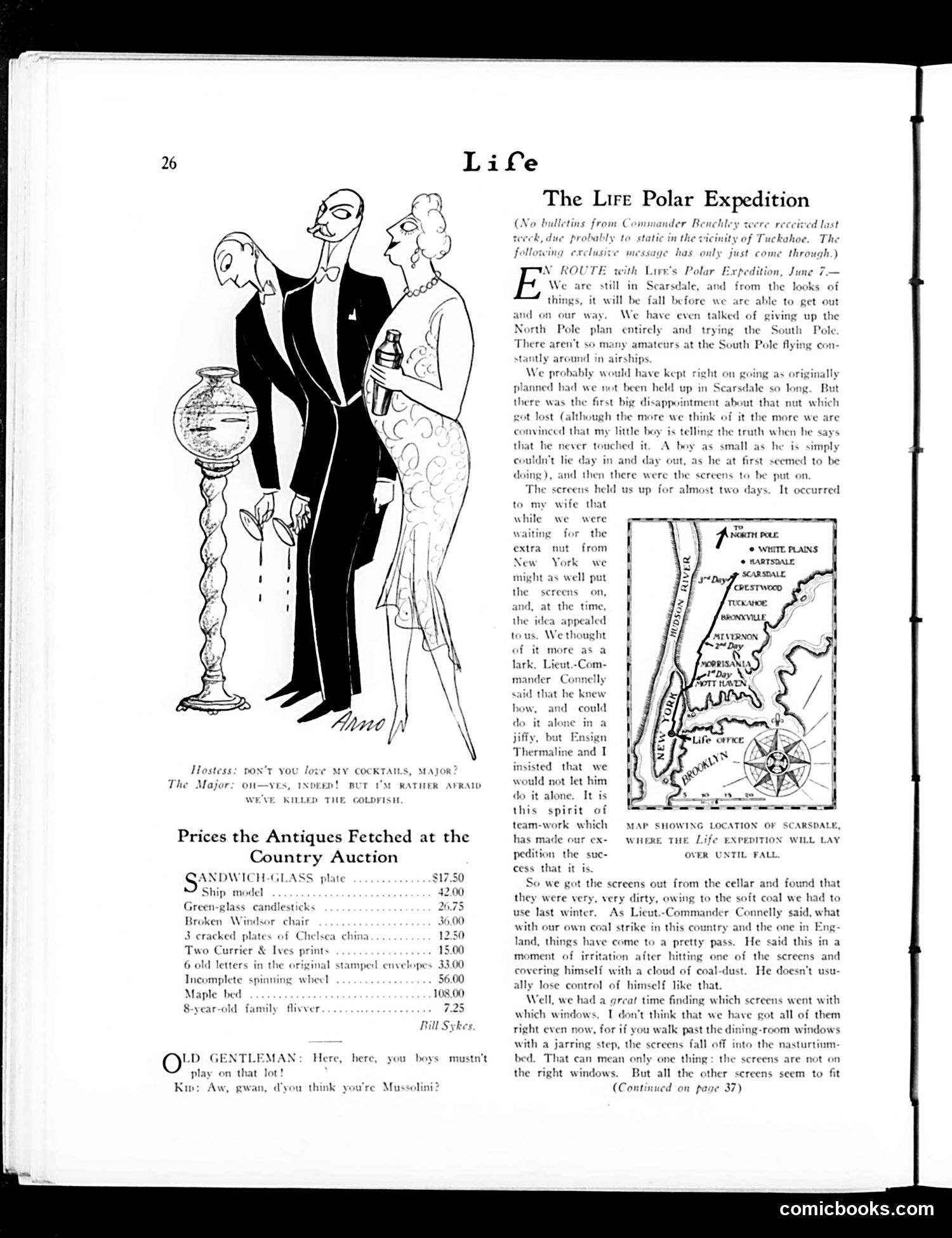
This is a humorous satirical piece mocking ambitious but poorly executed expeditions. The main cartoon at top left depicts a society couple (a man in formal dress and an elegant woman) admiring what appears to be a globe or navigational instrument, with the caption joking that they've "killed the goldfish"—suggesting comic incompetence. The bulk of the page is a tongue-in-cheek travel letter from someone claiming to be on Life magazine's "Polar Expedition," which is actually stuck in Scarsdale (a suburban New York town). The satire lies in the contrast: they're supposedly attempting a major polar journey but are delayed by mundane domestic tasks like installing window screens, dealing with a lost nut, and coal dust. The piece mocks upper-class dilettantes and their grandiose plans that collapse into suburban domestic comedy. References to "Lieut.-Commander Connelly" and "Ensign Thermaline" parody military expedition structure applied to trivial home improvement. The "Country Auction" section listing antique prices is separate filler content.
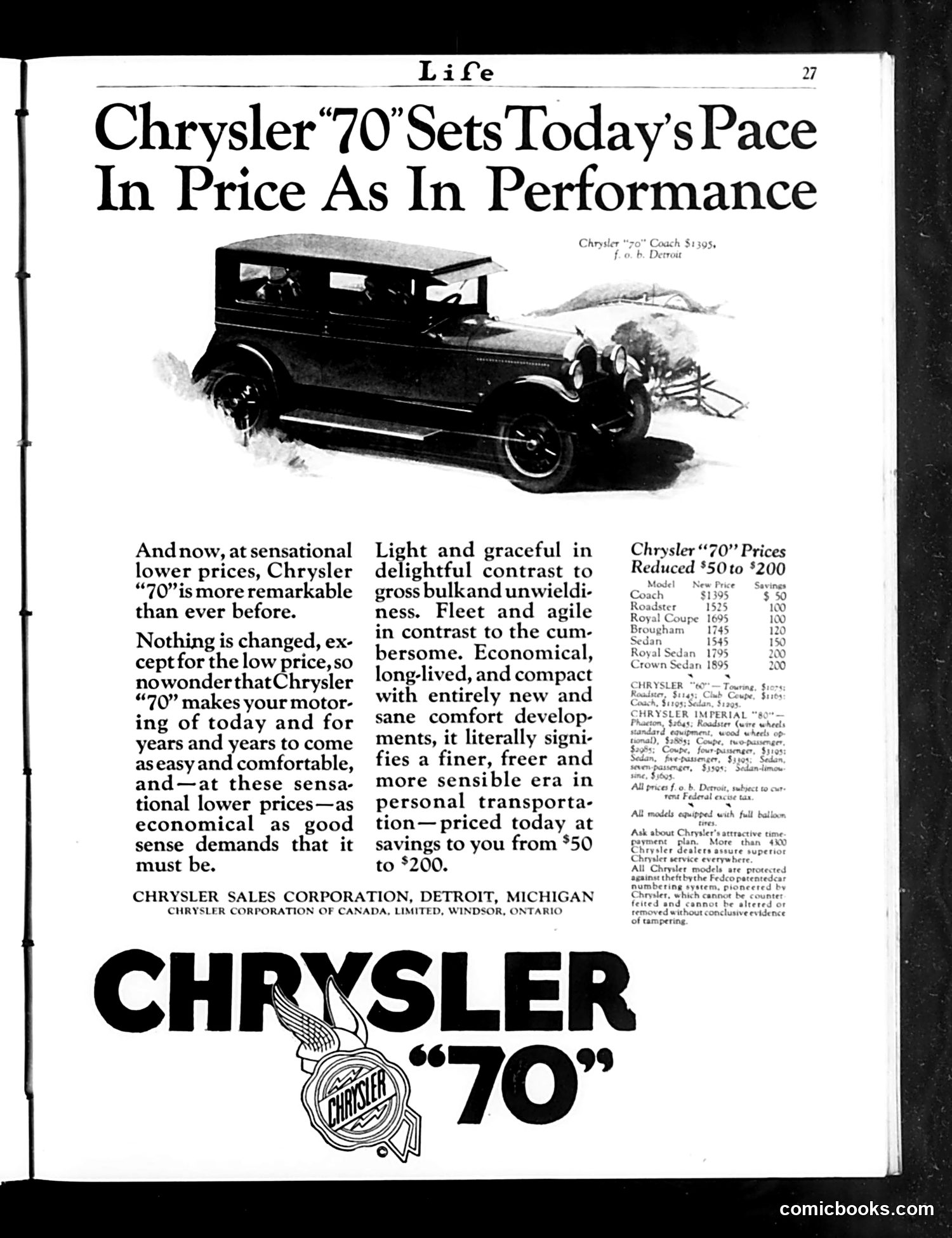
This is a **Chrysler automobile advertisement**, not a political cartoon. The page promotes the Chrysler "70" model with price reductions of $50-$200. The advertisement emphasizes that despite lower prices, nothing has changed except cost—the car remains reliable, comfortable, and economical. The car is depicted as "light and graceful" and representing "a finer, freer and more sensible era in personal transportation." For a modern reader: This reflects 1920s automotive marketing strategy, when manufacturers competed heavily on value. The "70" designation refers to horsepower. The ad's rhetoric—claiming quality remains unchanged despite price cuts—mirrors modern sales tactics. The vehicle's boxy design and the formal presentation are typical of period advertising, targeting middle-class buyers seeking reliable transportation at reasonable cost. There is no satirical content or political commentary present. This is straightforward commercial advertising from *Life* magazine's commercial pages.
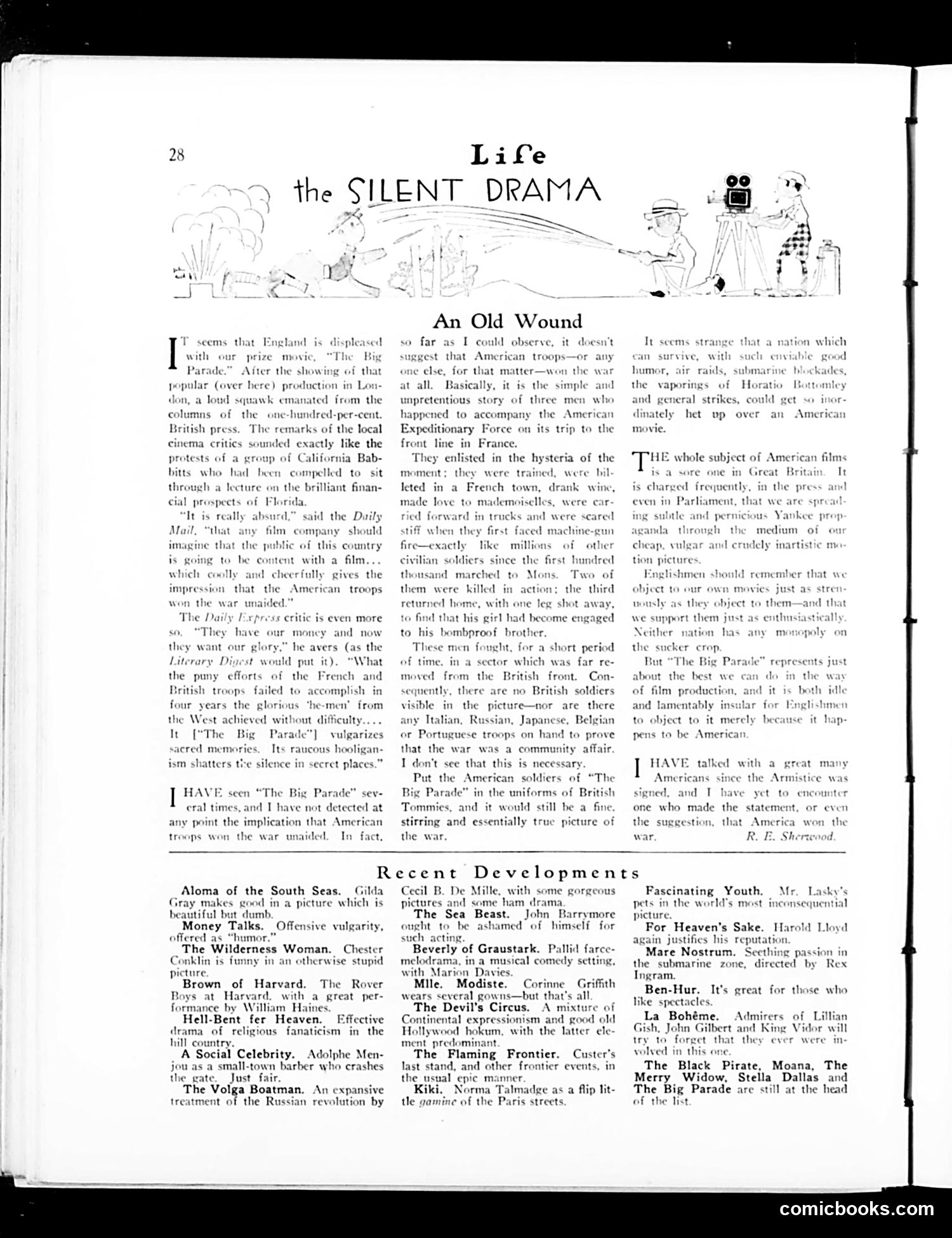
This page critiques British complaints about American war films, specifically "The Big Parade." The controversy: British critics accused American cinema of portraying American troops as single-handedly winning WWI, while marginalizing British contributions. The article's author (R.E. Sherwood) defends the film, noting it simply tells a modest story of three American soldiers—not a triumphalist narrative. He points out that the film contains no British, Italian, Russian, Japanese, Belgian, or Portuguese troops, which British critics cite as proof of American bias. Sherwood argues this criticism is hypocritical: English cinema receives equal British support despite similar nationalist blind spots. He concludes by noting Americans don't actually believe they won the war alone—the complaint reflects cultural anxiety about Hollywood's growing international dominance rather than factual movie content.
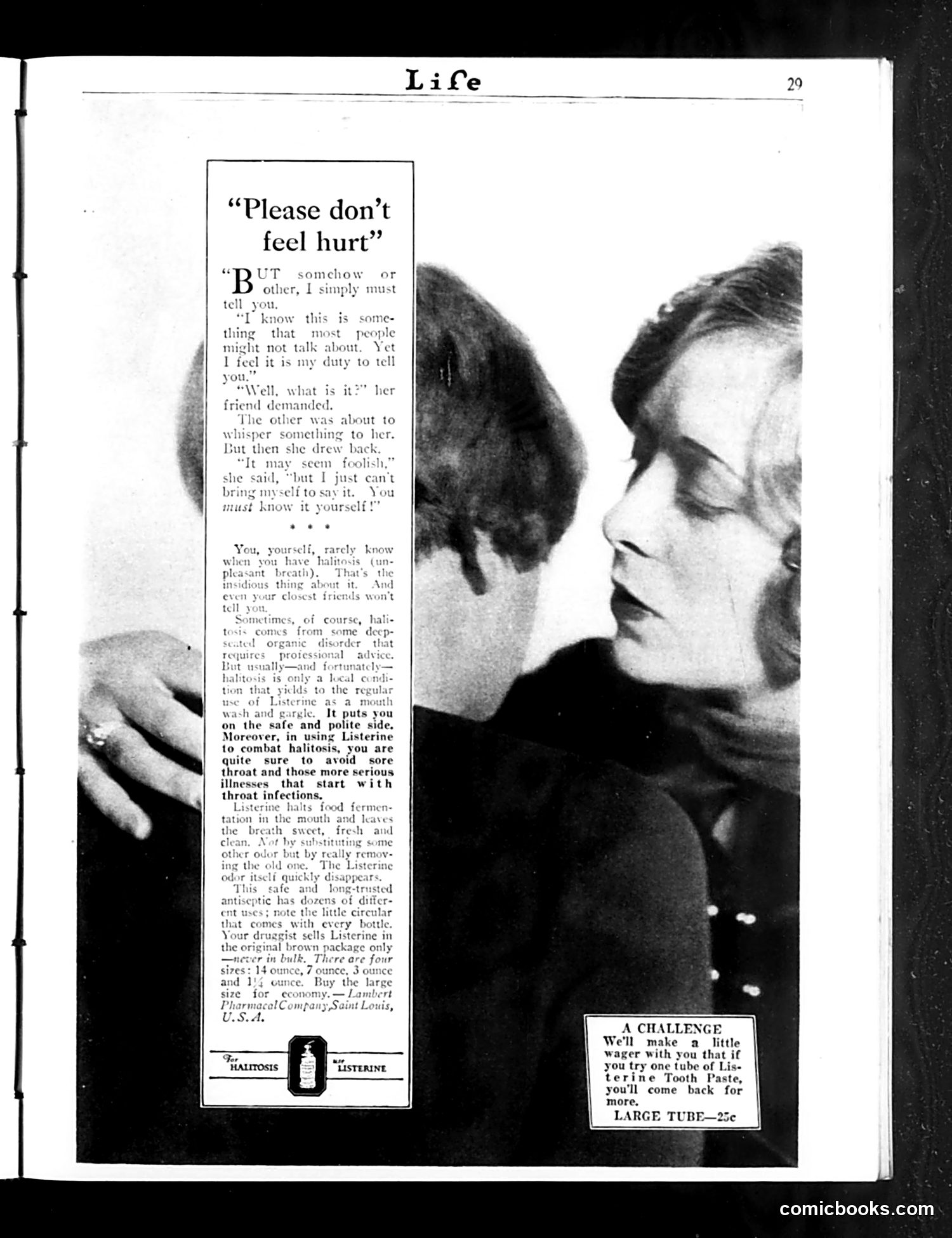
This page is primarily a **Listerine advertisement** disguised as a cartoon dialogue, a common advertising technique in early 20th-century magazines. The "cartoon" depicts two women in conversation. One is about to confide something embarrassing but hesitates, saying "It may seem foolish." The implication is clear: she suspects her friend has **halitosis (bad breath)** but is too polite to say so directly. The ad's satirical angle plays on social anxiety—the unspoken embarrassment of body odor issues. It presents Listerine as the discreet solution to this mortifying problem. The accompanying text emphasizes how halitosis is a "local condition" easily remedied by Listerine mouthwash, positioning the product as both a social necessity and a healthcare tool. The bottom section offers a "challenge" promoting Listerine Tooth Paste, encouraging trial purchase. The satire targets Victorian-era politeness: the joke is that people won't tell you uncomfortable truths, so you must self-police with commercial products.
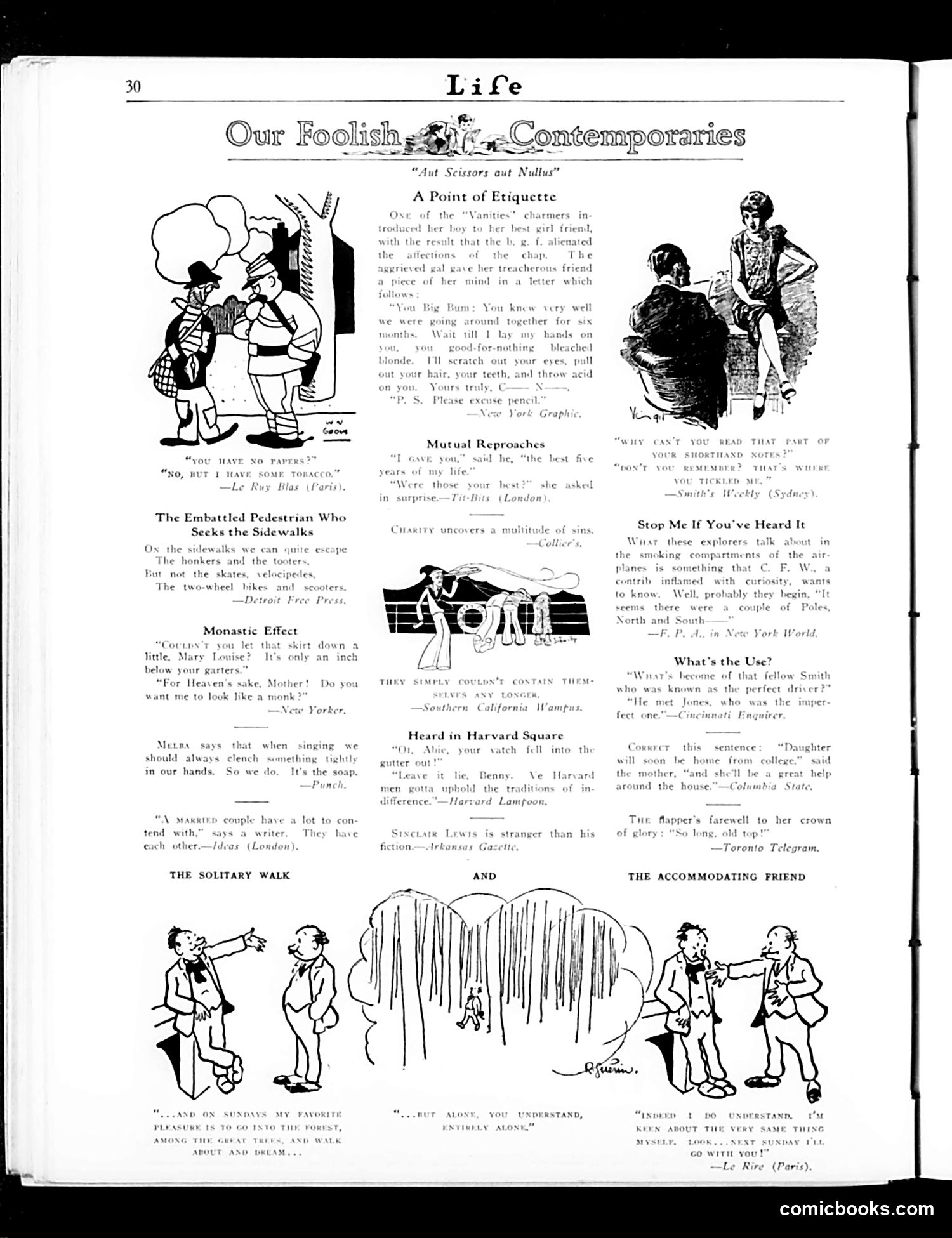
This page of *Life* magazine presents satirical vignettes mocking social behavior of the era. The cartoons target: **Social pretension and rudeness**: "A Point of Etiquette" ridicules a woman introducing her boy to a friend, resulting in jealous betrayal. "Mutual Reproaches" shows a couple quarreling over past romantic interests. **Physical comedy and manners**: "The Embattled Pedestrian" jokes about sidewalk congestion; various quips mock singing technique, married couples' arguments, and social awkwardness. **Modern technology**: References to shorthand notes and airplanes suggest early-20th-century concerns. The drawings use simple line work typical of period humor. These aren't political cartoons but rather gentle social satire—poking fun at everyday etiquette failures, romantic drama, and the absurdities of contemporary urban life that *Life* magazine's educated readership would recognize.
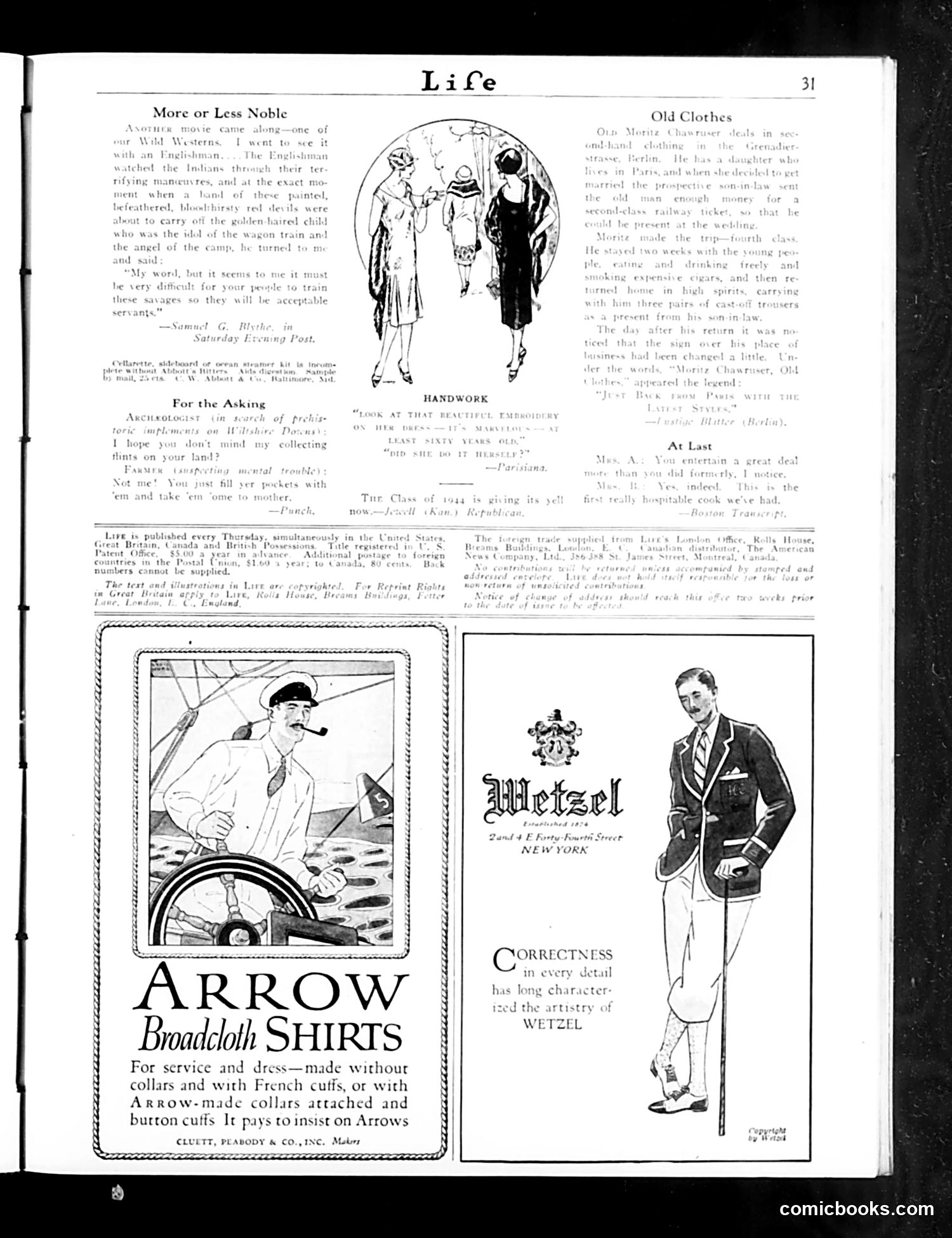
This page contains mostly **advertising and miscellaneous content** rather than political satire. The main elements are: **Arrow Shirts Advertisement** (left): Features an illustrated man at a ship's wheel, promoting "Broadcloth Shirts" with detachable collars and cuffs—a practical selling point for the era when collar replacements extended garment life. **Wetzel Advertisement** (right): Shows a well-dressed man modeling menswear from this New York clothier, emphasizing "correctness in every detail." **Editorial Content** (top): Brief articles on class distinctions ("More or Less Noble"), servants, and secondhand clothing markets. One anecdote describes a working-class man unexpectedly receiving formal attire to attend a wedding—likely satirizing class pretension or the awkwardness of social mobility. The page reflects early 20th-century concerns with *propriety*, *class markers*, and *conspicuous consumption*—humor derived from social anxieties about clothing as identity rather than political commentary.
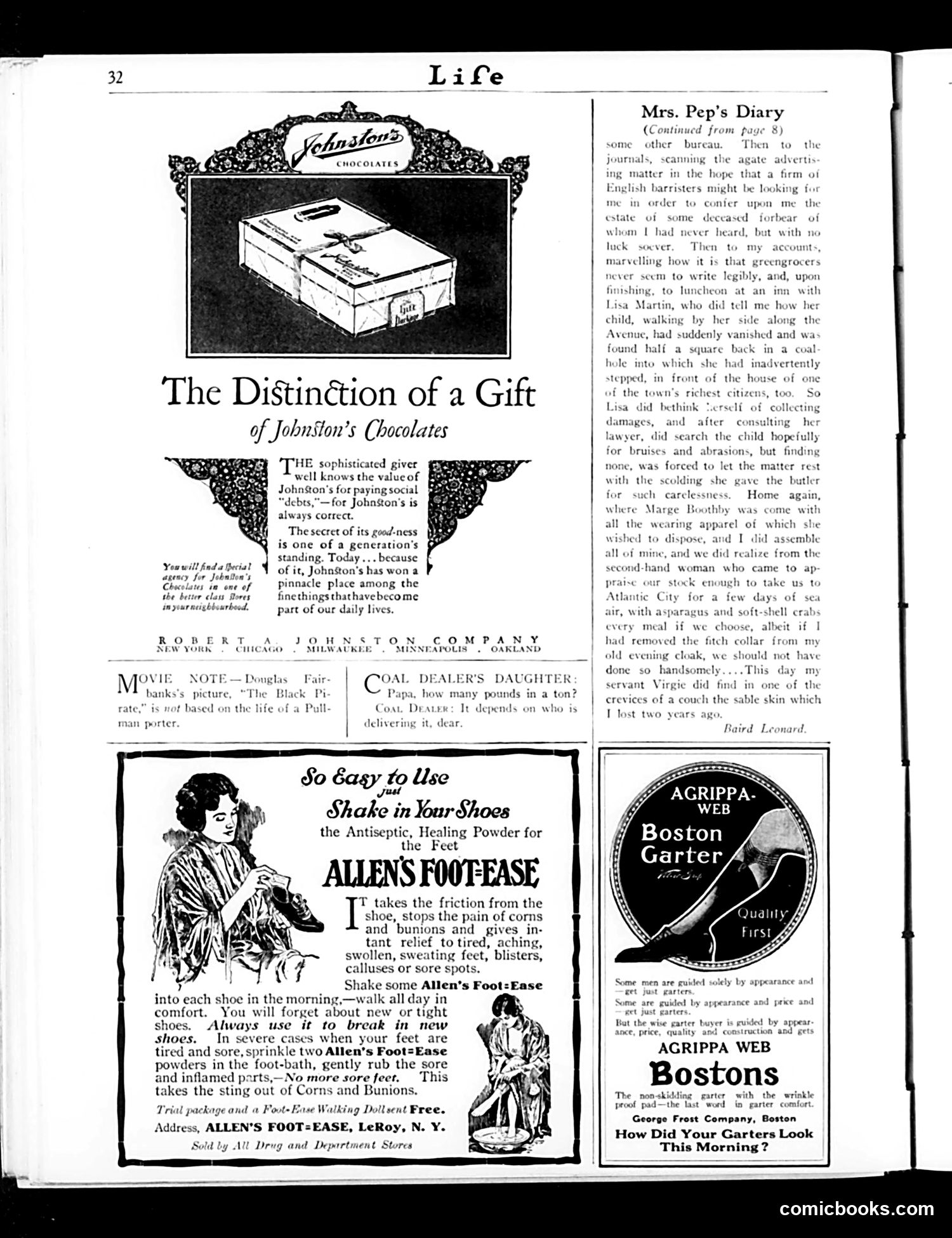
This page is primarily **advertising**, not political satire. It contains three major ads: 1. **Johnston's Chocolates** — A luxury gift brand emphasizing social propriety ("always correct"). The ad targets affluent gift-givers concerned with maintaining proper social standing. 2. **Allen's Foot-Ease** — A patent medicine powder for foot comfort, promising relief from corns, bunions, and tired feet. The language emphasizes breaking in new shoes and all-day comfort. 3. **Agrippa-Web Boston Garters** — Men's garters marketed with the tagline "How Did Your Garters Look This Morning?" emphasizing quality construction and comfort. **Context**: These ads reflect early 20th-century consumer culture, targeting middle and upper-class readers worried about etiquette, foot hygiene, and personal grooming. The page also includes "Mrs. Pep's Diary," a society column about genteel domestic concerns. **No political satire is evident** — this is straightforward period advertising.
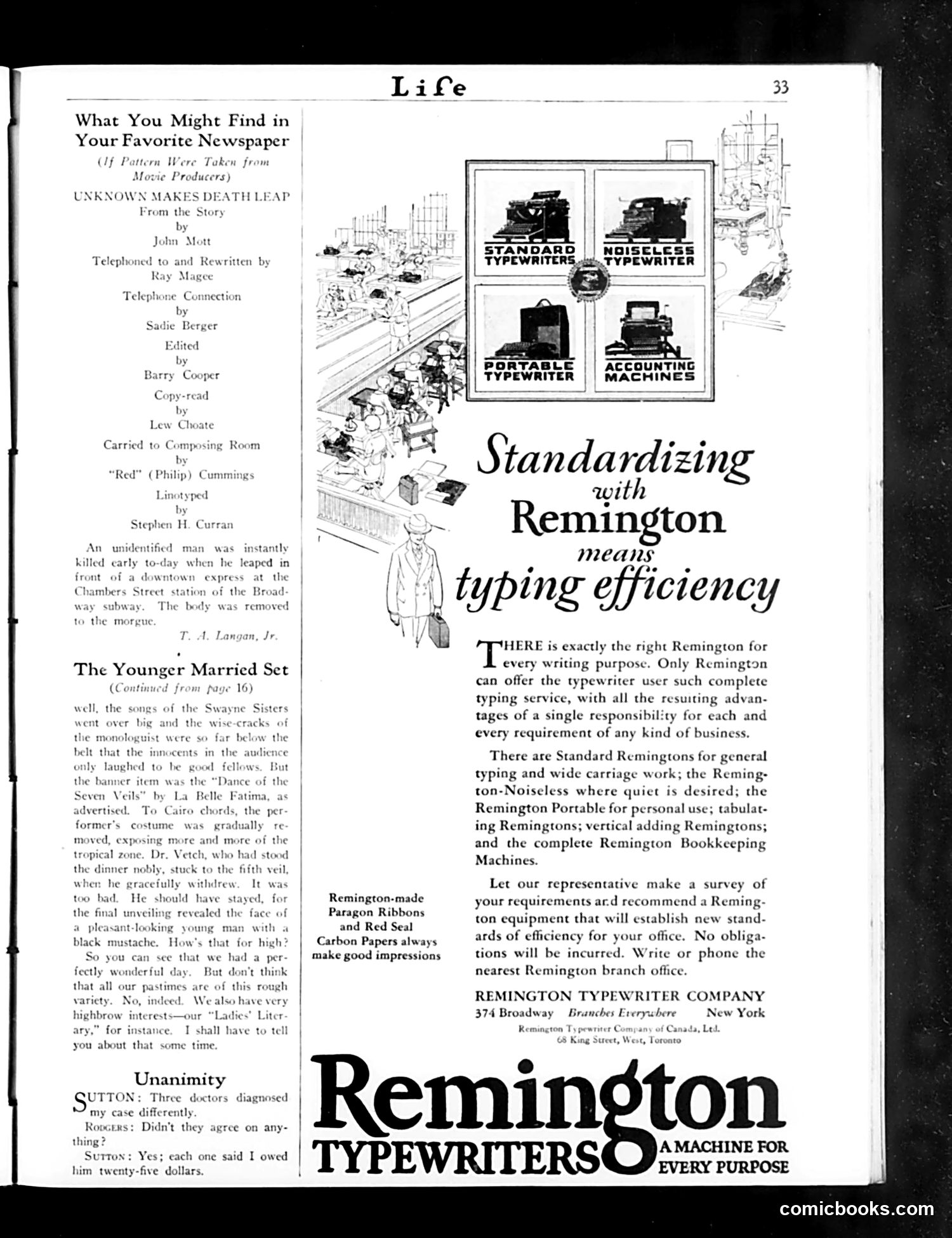
This page combines satirical newspaper content with advertising. The left side presents **"What You Might Find in Your Favorite Newspaper,"** satirizing how stories are processed through multiple hands—telephoned in, rewritten, edited, and carried through composing rooms by named workers. The example headline "Unknown Makes Death Leap" parodies sensationalist journalism of the era. Below, **"The Younger Married Set"** humorously describes a society dinner featuring the "Dance of the Seven Veils"—a reference to the famous Salome dance that scandalized audiences. The joke involves a prudish doctor who withdraws at the fifth veil rather than witness full undressing. The **"Unanimity"** joke is a brief punchline: three doctors all diagnosed the author's case "differently," but agreed on one thing—they each charged him twenty-five dollars. It satirizes medical profession profiteering and disagreement. The dominant right side is a **Remington Typewriter advertisement** emphasizing standardized office efficiency, offering various models for different business purposes. This reflects 1920s corporate modernization rhetoric.
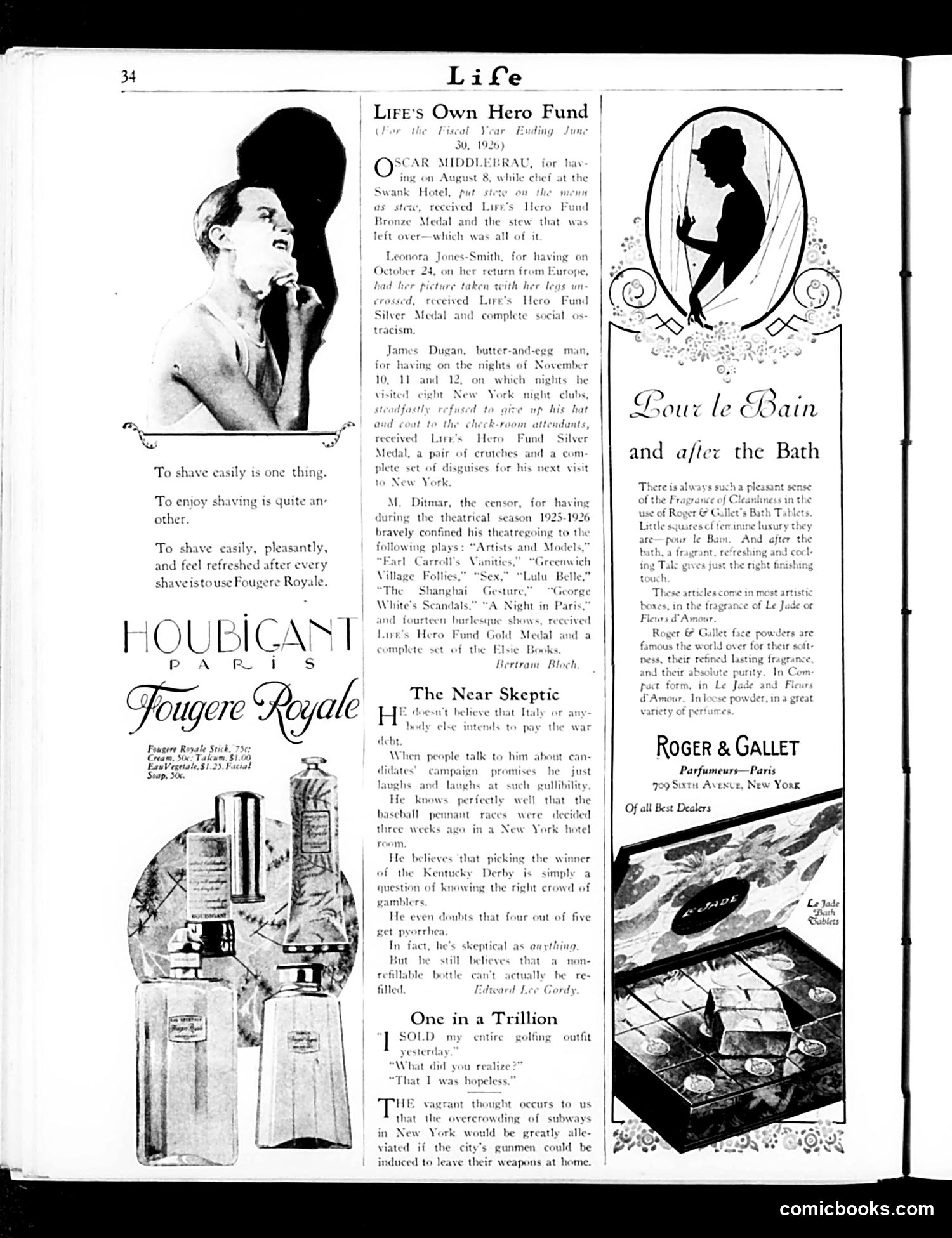
This page contains satirical commentary on contemporary American life and culture from 1926. The main content includes: **Life's Own Hero Fund section**: A mock awards program satirizing heroic achievements. The "heroes" are ordinary people who performed absurd or morally questionable acts—a chef who saved leftover stew, a woman photographed with "legs uncrossed," a man who visited nightclubs, and a theater censor who attended suggestive plays. The satire mocks what society considers worthy of recognition, suggesting Life's readers would find these "achievements" ridiculous rather than heroic. **"The Near Skeptic"**: A character sketch of a cynic who doubts everything—Italian war debt repayment, election promises, baseball outcomes, and even basic facts. The humor targets 1920s social anxieties and political skepticism. **Advertisements**: For Houbigant's Fougere Royale shaving products and Roger & Gallet perfumes, typical luxury goods marketing of the era. The overall tone is sardonic commentary on American consumer culture and social pretension.
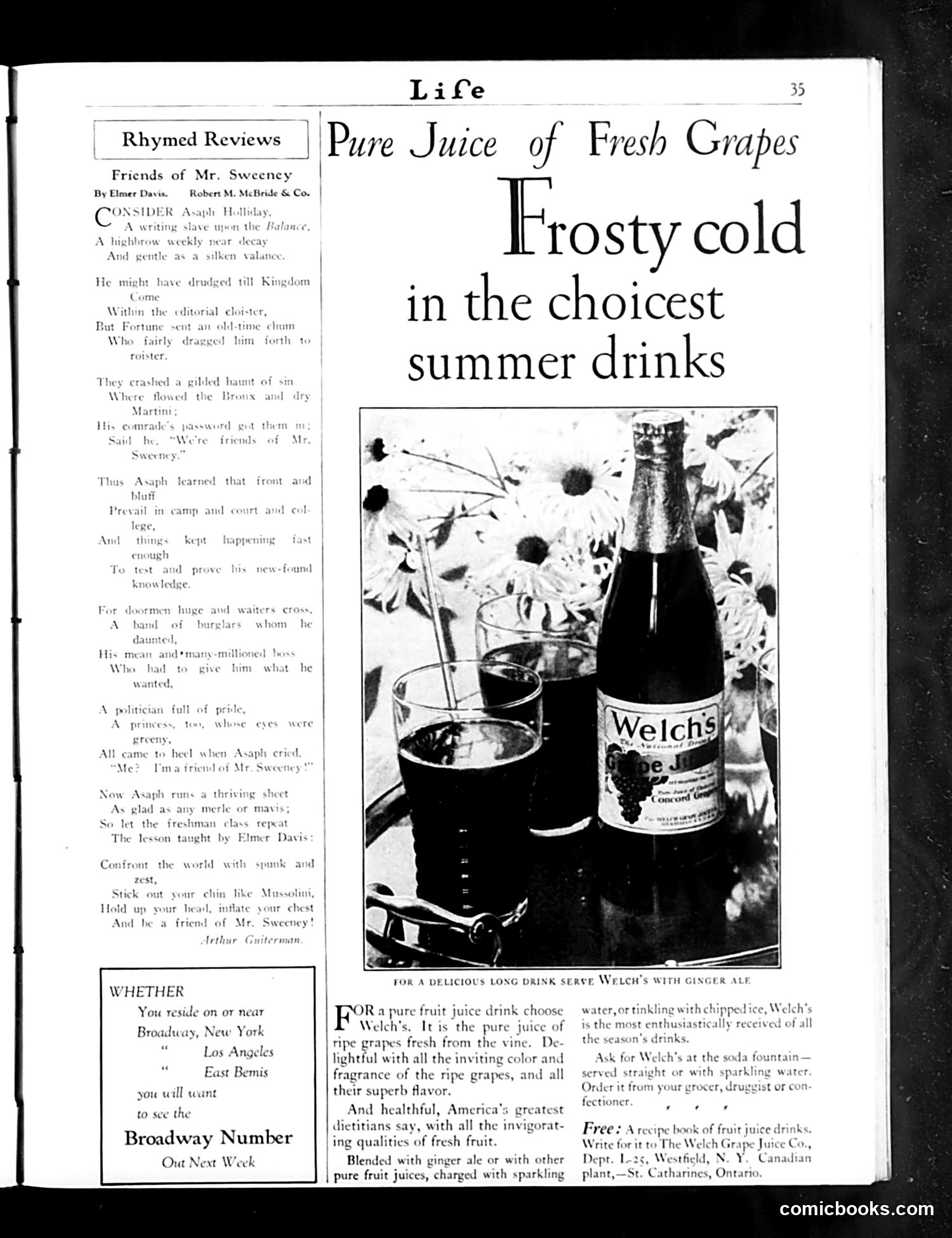
This page contains primarily **advertising** rather than political satire. The dominant content is a **Welch's grape juice advertisement** featuring a photograph of an ice-cold bottle alongside two glasses, positioned as a "summer drink." The left column includes a "Rhymed Review" of a book called *Friends of Mr. Sweeney* by Elmer Davis (published by Robert M. McBride & Co.), written in verse. The poem appears to be a lighthearted literary critique, mentioning characters like "Asaph" and referencing themes of fortune and social climbing, but **no specific political satire is evident** from the visible text. The advertisement emphasizes Welch's as a "pure fruit juice drink" made from fresh grapes, marketed as healthful and suitable for blending with ginger ale. A small box announces that *Life* magazine's "Broadway Number" will come out "Next Week." This is a typical early 20th-century magazine page mixing literary content with commercial advertisements.
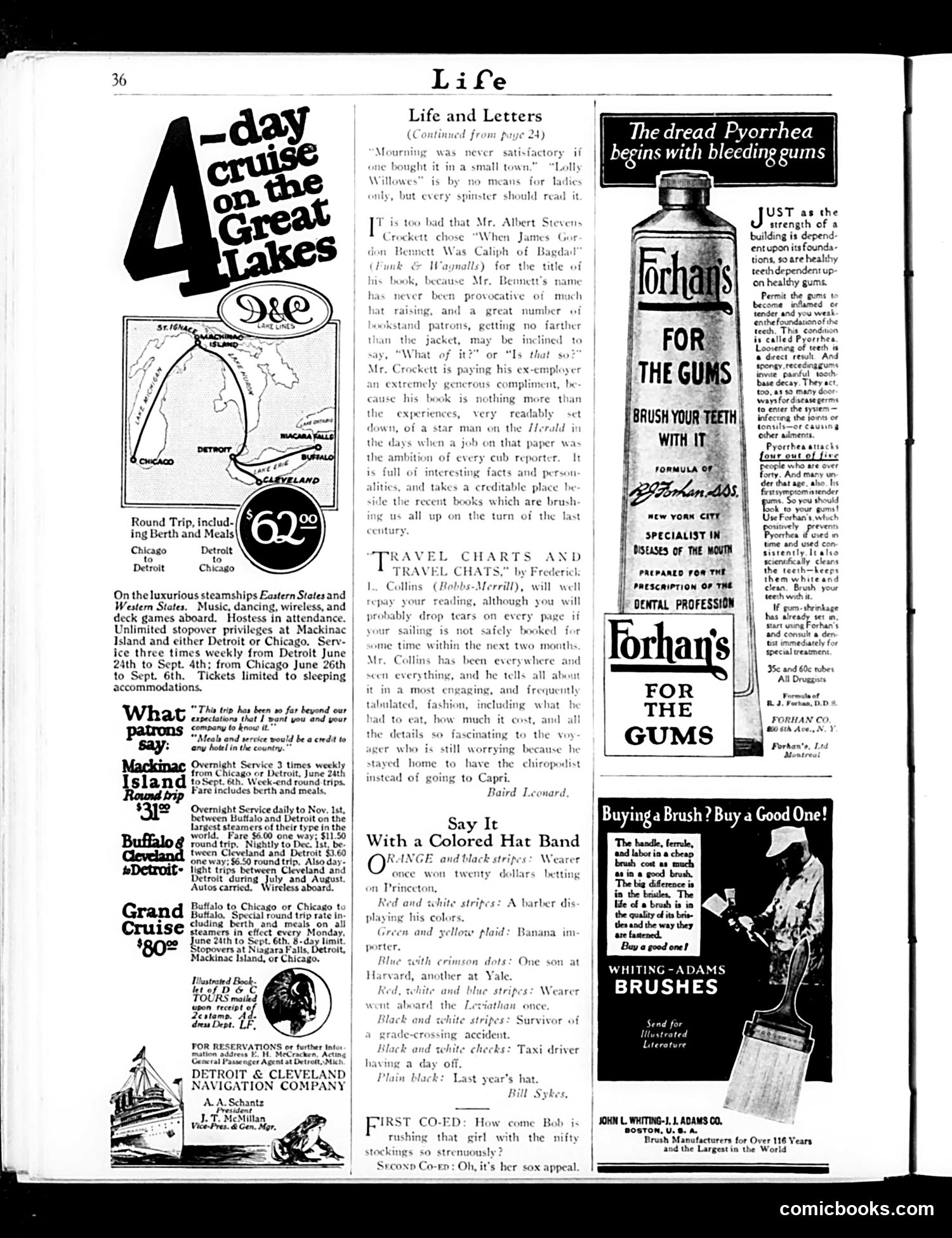
This page is primarily **advertising and editorial content** rather than political satire or comics. The notable visual element is a **4-day Great Lakes cruise advertisement** featuring a map showing routes between Chicago, Detroit, and Cleveland via steamship. This was a genuine vacation offering, reflecting early 20th-century leisure travel for middle-class Americans. The editorial section "Life and Letters" contains book reviews and social commentary typical of the era, discussing works like *Travel Charts and Travel Chats* by Frederick L. Collins. There's also humorous readers' submissions (letters to the editor), such as "Say It With a Colored Hat Band" and "First Co-Ed." The remaining space contains **product advertisements**: Forhan's dental products and Whiting-Adams brushes—standard commercial copy emphasizing health benefits. **There is no political cartoon on this page.** The page represents Life magazine's hybrid model of satirical editorial content mixed with straightforward advertising and travel promotion.
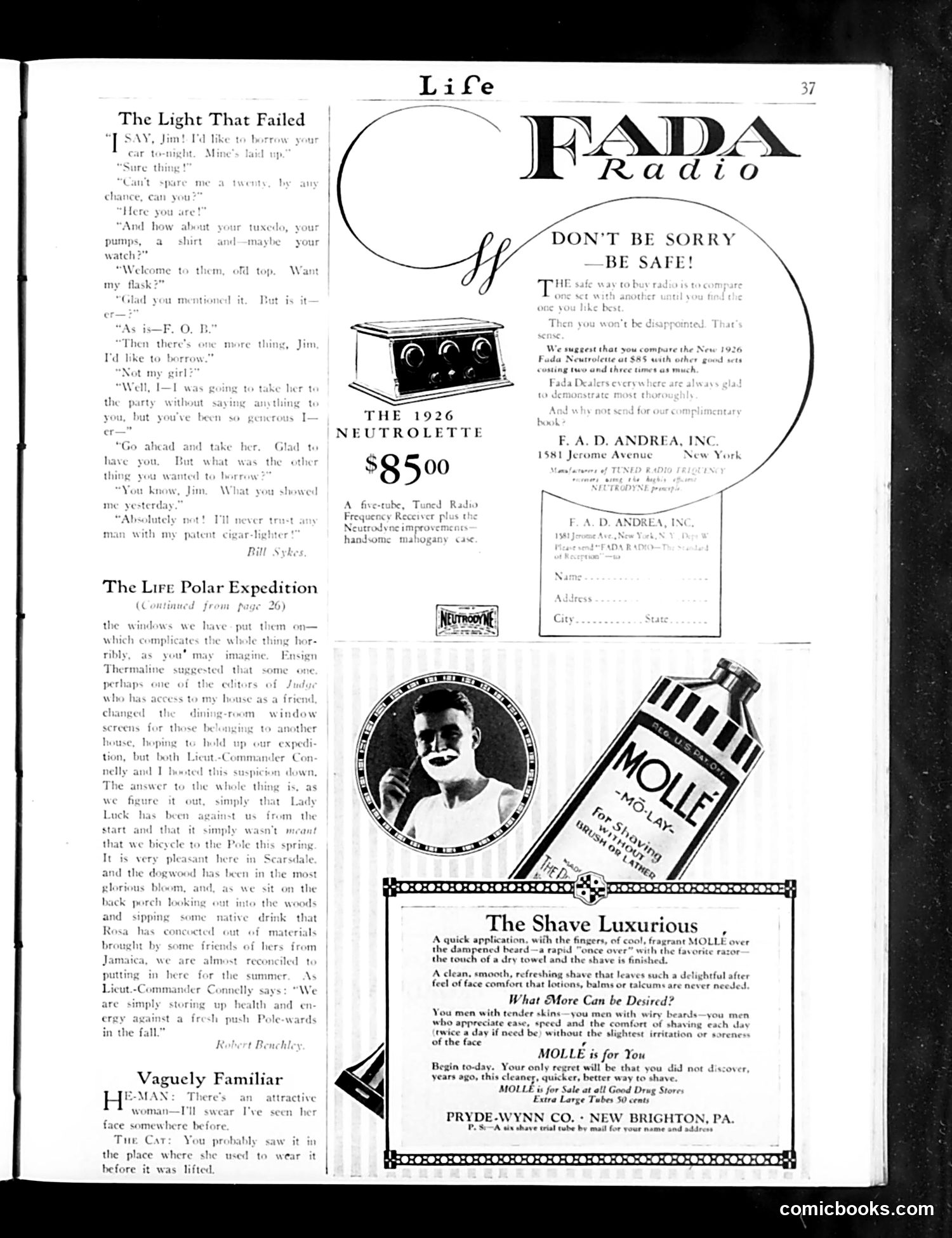
This page contains **primarily advertisements** rather than editorial cartoons. The main content includes: 1. **"The Light That Failed"** - A brief humorous dialogue (top left) about borrowing a car, appearing to be a short joke or comic sketch rather than political satire. 2. **"The Life Polar Expedition"** - A longer narrative piece about an expedition, seemingly a fictional adventure story with no clear satirical intent. 3. **"Vaguely Familiar"** - A very brief dialogue between a man and a cat about a woman, likely a mild joke about mistaken identity or recurring acquaintances. The page is **dominated by commercial advertisements** for the 1926 Fada Neurolette radio ($85), Mollé shaving cream, and related products. These ads reflect 1920s consumer culture and marketing approaches. There is **no evident political satire or social commentary** on this particular page. It represents typical Life magazine content from this era: mixed entertainment snippets alongside period advertisements.
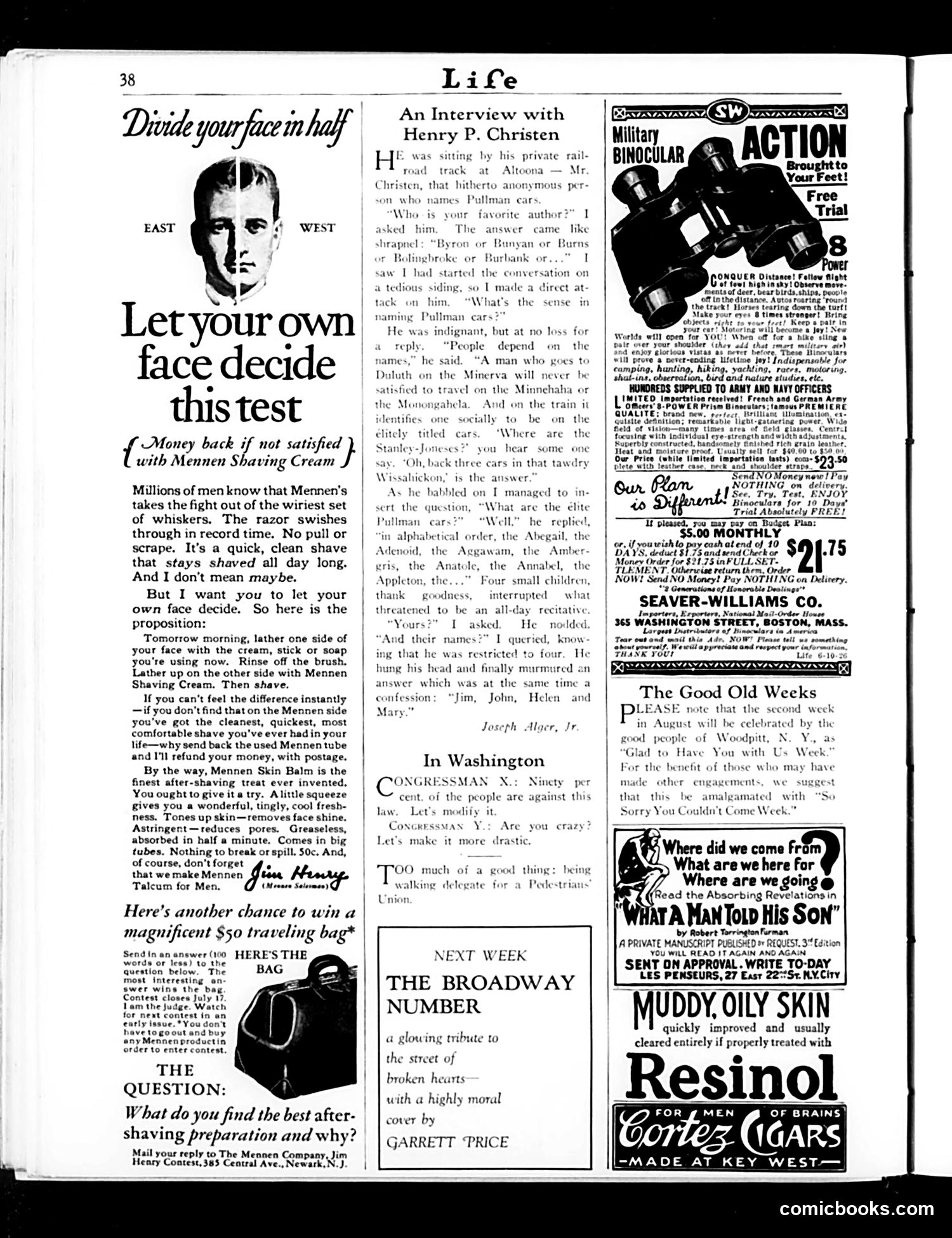
This page is primarily an **advertisement for Mennen Shaving Cream** that dominates the left side, using what appears to be a phrenology-style diagram titled "Divide your face in half" to test the product's effectiveness by comparing shaved sides. The ad promises a money-back guarantee and promotes the accompanying "Mennen Skin Balm." The right and center contain brief humorous pieces typical of Life's satirical content: 1. **"An Interview with Henry P. Christen"** mocks the snobbish obsession with Pullman car names among wealthy travelers—the character can name four children but extensive elite train car names, satirizing status consciousness. 2. **"In Washington"** presents a brief political joke about Congressional hypocrisy: one congressman notes 90% oppose a law but the other suggests making it more extreme anyway, mocking partisan obstruction. The remaining content includes period advertisements for binoculars, cigars, and skin cream, along with a notice about next week's "Broadway Number" issue.
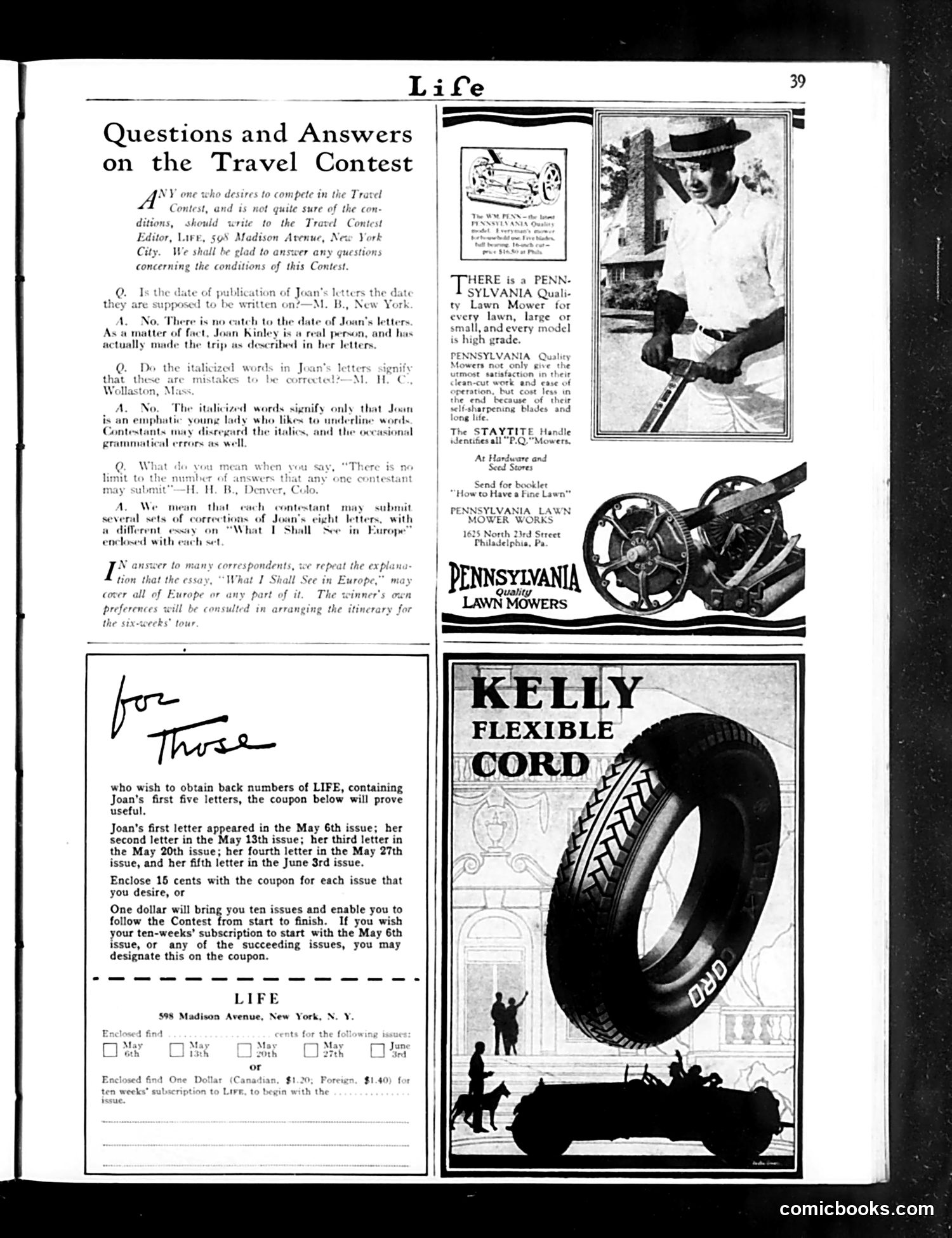
This page primarily contains **administrative content for a serialized travel contest** rather than satirical cartoons. The main feature is "Questions and Answers on the Travel Contest," addressing reader queries about a contest involving letters from someone named Joan describing a European trip. The right side features **advertisements**: Pennsylvania Quality Lawn Mowers (with an image of a man in a hat holding equipment) and Kelly Flexible Cord (showing a large tire with silhouetted figures). The contest mechanics are explained: Joan's letters appeared weekly (May 6th through June 3rd), and readers could purchase back issues for 15 cents each or subscribe for a dollar to follow the contest. The text clarifies that Joan actually took the trip described and that italicized words in her letters are intentional stylistic choices, not errors. This appears to be a typical early-20th-century magazine reader-engagement strategy—serialized content with subscription incentives.
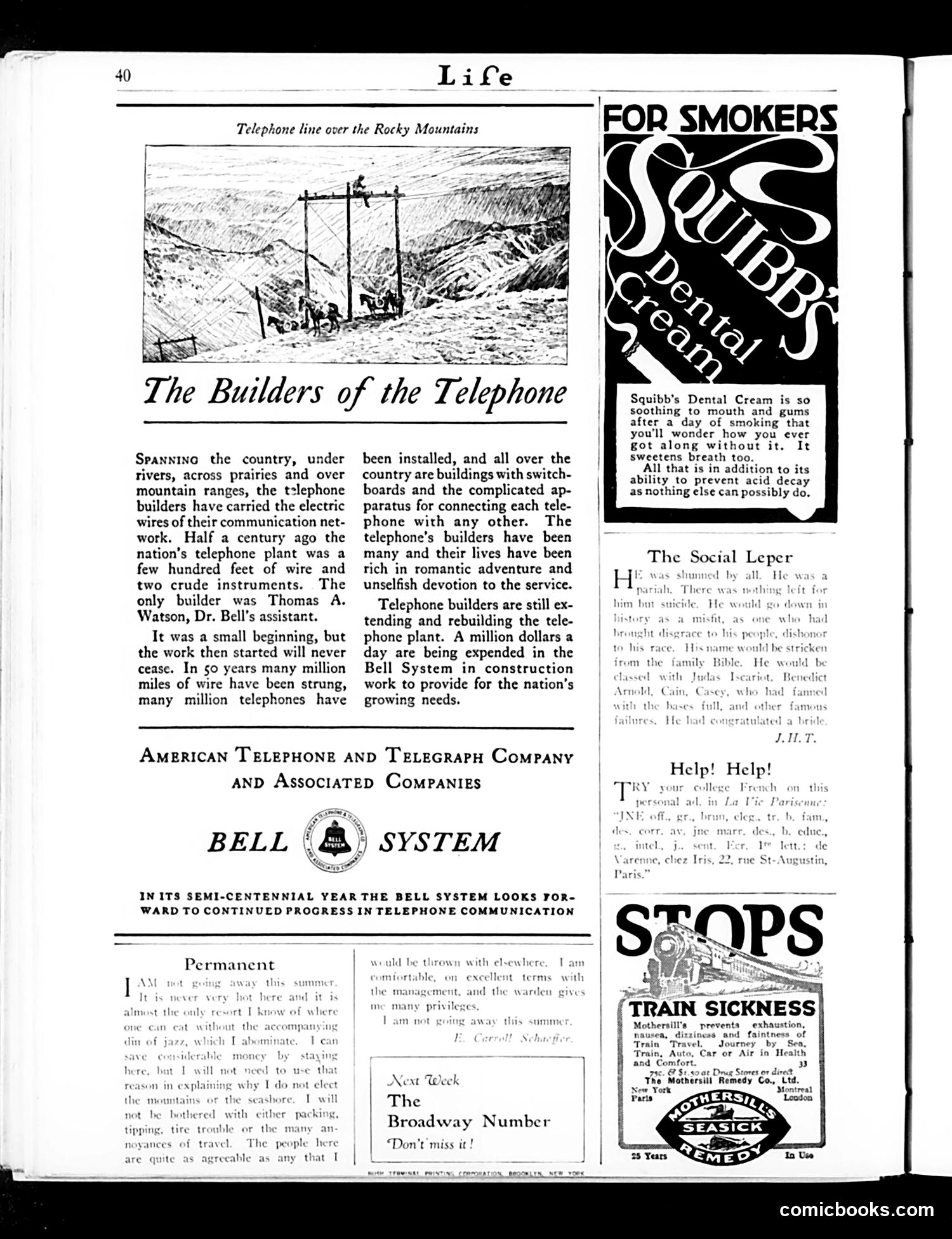
This page celebrates the Bell System's infrastructure expansion, featuring a photograph of telephone poles spanning the Rocky Mountains and promotional text titled "The Builders of the Telephone." The article credits Thomas A. Watson (Bell's assistant) as the original builder and emphasizes the massive scale of modern telephone construction—millions of miles of wire installed over fifty years, with a million dollars daily being spent on expansion. The page is primarily **corporate advertising** for AT&T and the Bell System, not satire. It presents the telephone builders as heroic figures engaged in "romantic adventure and unselfish devotion." The remaining content consists of standard period advertisements: Squibb's Dental Cream (for smokers), Mothersill's Remedy (for train/travel sickness), and notices for French lessons and a Broadway theater number. No political cartoons or satire appears on this page—it's largely promotional material celebrating American industrial progress during the Bell System's fifty-year anniversary.
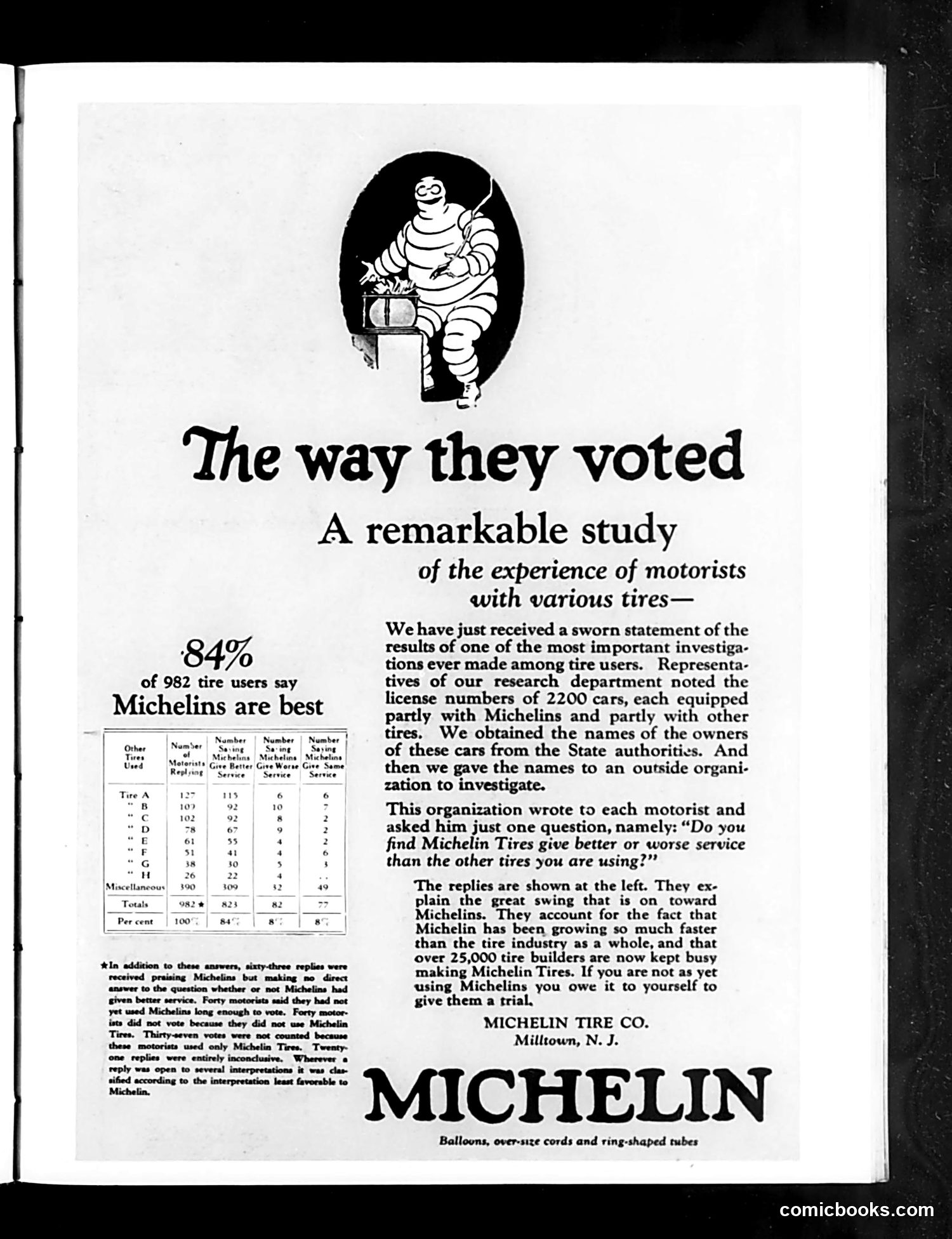
This is primarily a **Michelin tire company advertisement**, not political satire. The page presents what appears to be a consumer survey claiming 84% of 982 tire users prefer Michelin tires. The small cartoon at top shows the **Michelin Man** (Bibendum), the company's mascot—a rotund figure made of tire rings, smiling and sitting. This cheerful character was Michelin's iconic brand image. The "remarkable study" describes a supposedly objective investigation: researchers obtained license plates from state authorities, then had an independent organization survey those motorists about tire performance. The accompanying table displays the voting results by tire type (A through H, plus Miscellaneous). **The appeal to modern readers:** This represents early 20th-century **advertising as pseudo-scientific marketing**—the company presents survey data as objective fact to suggest consumer preference validates their product. Today, we'd recognize this as marketing spin; the methodology (who conducted it? sample bias? leading questions?) raises obvious questions about credibility that weren't as commonly scrutinized then.
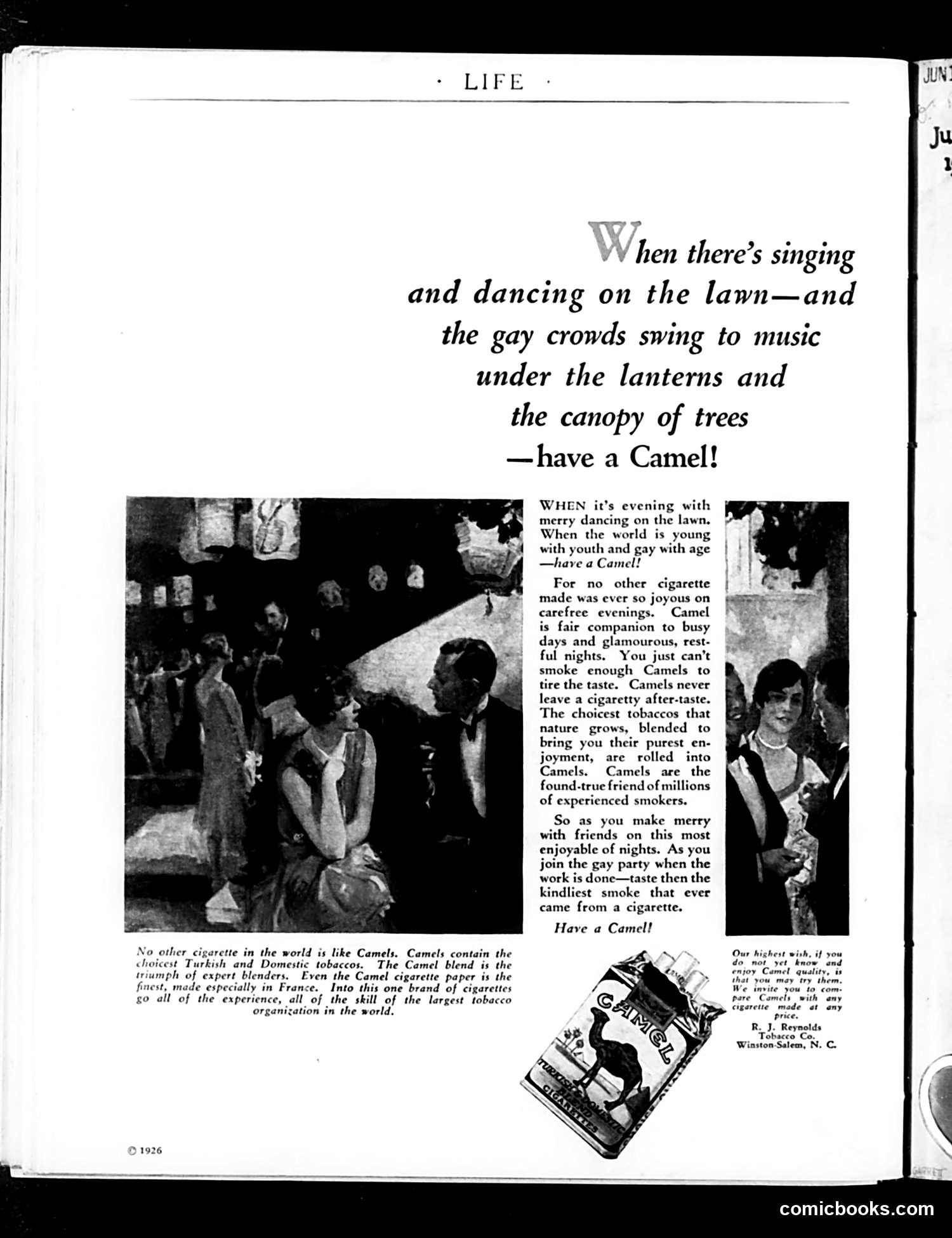
This is not political satire but a **cigarette advertisement** for Camel brand, circa 1925. The page depicts idealized scenes of 1920s leisure—young people dancing on manicured lawns under lanterns—to market smoking as sophisticated and glamorous. The ad targets the **Jazz Age aesthetic**: carefree youth, evening entertainment, and social sophistication. There is no cartoon or satirical commentary. Instead, Life's advertising pages used aspirational lifestyle imagery to sell products. The claim that Camels are "the finest" because they use "Turkish and Domestic tobaccos" and paper "made especially in France" represents typical period advertising hyperbole, before tobacco health warnings existed. This reflects how early 20th-century magazines normalized and romanticized smoking as part of modern, pleasurable living—now recognized as predatory marketing.