
Life, 1926-06-10 · page 30 of 44
Life — June 10, 1926 — page 30: what you’re looking at
What you’re looking at
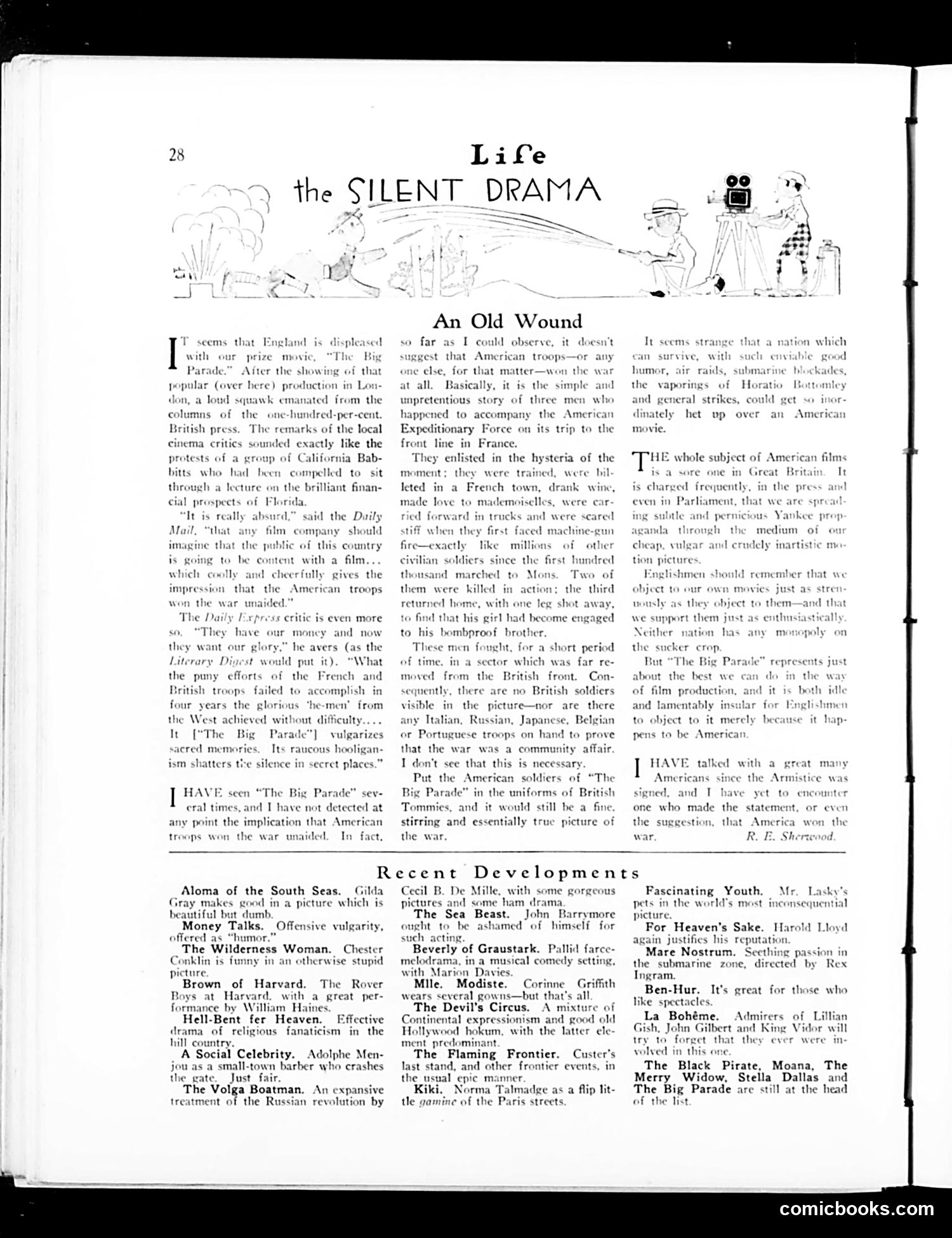
This page critiques British complaints about American war films, specifically "The Big Parade." The controversy: British critics accused American cinema of portraying American troops as single-handedly winning WWI, while marginalizing British contributions. The article's author (R.E. Sherwood) defends the film, noting it simply tells a modest story of three American soldiers—not a triumphalist narrative. He points out that the film contains no British, Italian, Russian, Japanese, Belgian, or Portuguese troops, which British critics cite as proof of American bias. Sherwood argues this criticism is hypocritical: English cinema receives equal British support despite similar nationalist blind spots. He concludes by noting Americans don't actually believe they won the war alone—the complaint reflects cultural anxiety about Hollywood's growing international dominance rather than factual movie content.
📄 Transcribed text from this page (OCR, searchable)
Machine-transcribed from the original scan — historical spelling and the odd misread are preserved.
28 5 ae as} - England is displeased rize movie ade Alter the show popular (over here) production wk emanated from the don, a kc columns of the one-hundred-per-cent. The remarks of the local cinema critics sounded exactly like the of California Bab- sit 1 British press. protests of a STL bitts who ha wen compelled t on the brilliant fin Florida d,” said the Daily should untry tent with a film.. through a lecture cial prospects of “It is really Mail, imagine that the pu “that any Im ce mpany Nic of this ¢ is g cheerfully gives the American troops © war una The Daily | so, “They s critic is even more have m wey and now they want our glory ers (as the Literary Digest would put it). “What the puny efforts of the French and British troops failed to accomplish in four years the glorious ‘he-men’ from the West achieved without ¢ It ["The Big Pa sacred memories arizes Its raucous hooligan- ism shatters the silence in secret places.” HAVE seen “The eral time Big Parade” sev- nd T have not detected at any point the implication that American fact, troops won the war unaided. In Life the SILENT DRAMA An Old Wound » far as I could observe, it doesn't that American troops—or any ine else, for that matter—we war at all. Basically, it is the simple and unpretentious story of three men who hi 1 to accompany the American Expeditionary Force on its trip to the front line in France. They enlisted in the hysteria of the moment; they were trained, were bil Ieted in a French town, drank wine, mademoiselles, we tr made love car icks and were scared faced machine-gun they fi like an soldiers since the thousand im ed to Mc them killed i returned hom millions of first 1 fire—exactly civil s. Two of the third were actic with one leg vt away, to find that his girl had become engaged » his bombproof brother These men fought 1 short pei of time. in a sector which was far r moved from the British front. Cor no British soldiers —nor are there . Belgian ently, there a visible in’ the any Ttalian, Ru an, Japan or Portuguese troops on hand to prove that the war was a community affair I don’t see that this is necessary Put the of “The x Parade” in the uniforms of British and it would still be a fine ly true picture American soldiers Pommies, stirring and essenti: the war. humor, the vaporir and general strikes, : dinately het up over an American movie. TT HE whole subject of American films we one in Great Brita It is charged frequently, in the press a even in Parliament, that we ai Yankee medium of « and erndely inartistic m 1 pictures Englishmen should remember that w object to our own moy uously as they object we support them just as Neither nation has ar I about of film production, « at “The Bi Parade” the best we ¢ and lamentably to it merely bee ject t pens to be America great: many ] HAVE talked with a Americans since the Armistice was ed, and T have yet to ence unter ¢ who made the statement a won the the suggestion, that Ame war RE. Recent Aloma of the South Seas. Gilda Gray makes good in a picture which is beautiful but dumb. Money Talks. Offensive vulgarity, offered as “humor,” The Wilderness Woman. Conklin is fut Chester ny in an otherwise stupid picture. Brown of Harvard. The Rover Roys at Harvard. with a great per- formance by William Haines. Hell-Bent fer Heaven. Effective drama of religious fanaticism in the hill country. A Social Celebrity. Adolphe Men- jou as a small-town barber who crashes the gate. Just fair. The Volga Boatman. An expansive treatment of the Russian revolution by Developmen Cecil B. De Mille, with some gorgeous pictures and some ham drama The Sea Beast. John Barrymore ought to be ashamed of himself for h acting. Beverly of Graustark. Pallid farce- melodrama, ina musical comedy setting, with Marion Davies. Mile. Modiste. Corinne Griffith wears several gowns—but that’s all. The Devil's Circus. A mix: of pod old Continental expressionism and Hollywood hokum, with the latter ele- ment predominant The Flaming Frontier. Custer’s last stand, and other frontier event the usual epic manner Kiki. Norma Talmadge as a flip lit- tle gan the Paris streets. in s Fascinating Youth. Mr. Lasky’s pets in the world’s most inconsequential picture For Heaven's Sake. again justifies his reputa Mare Nostrum. Secth Harold Lloyd nin the submarine zone, directed by Rex Ingram Ben-Hur. It's great for those who like spectacles. La Bohéme. Admirers of Lillian Gish, John Gilbert and King Vidor will hat they try to volved in this The Black Pirate, Moana, The Merry Widow, Stella Dallas and The Big Parade are still at the head of the list ever were in comicbooks.com