
A complete issue · 46 pages · 1924
Life — May 15, 1924
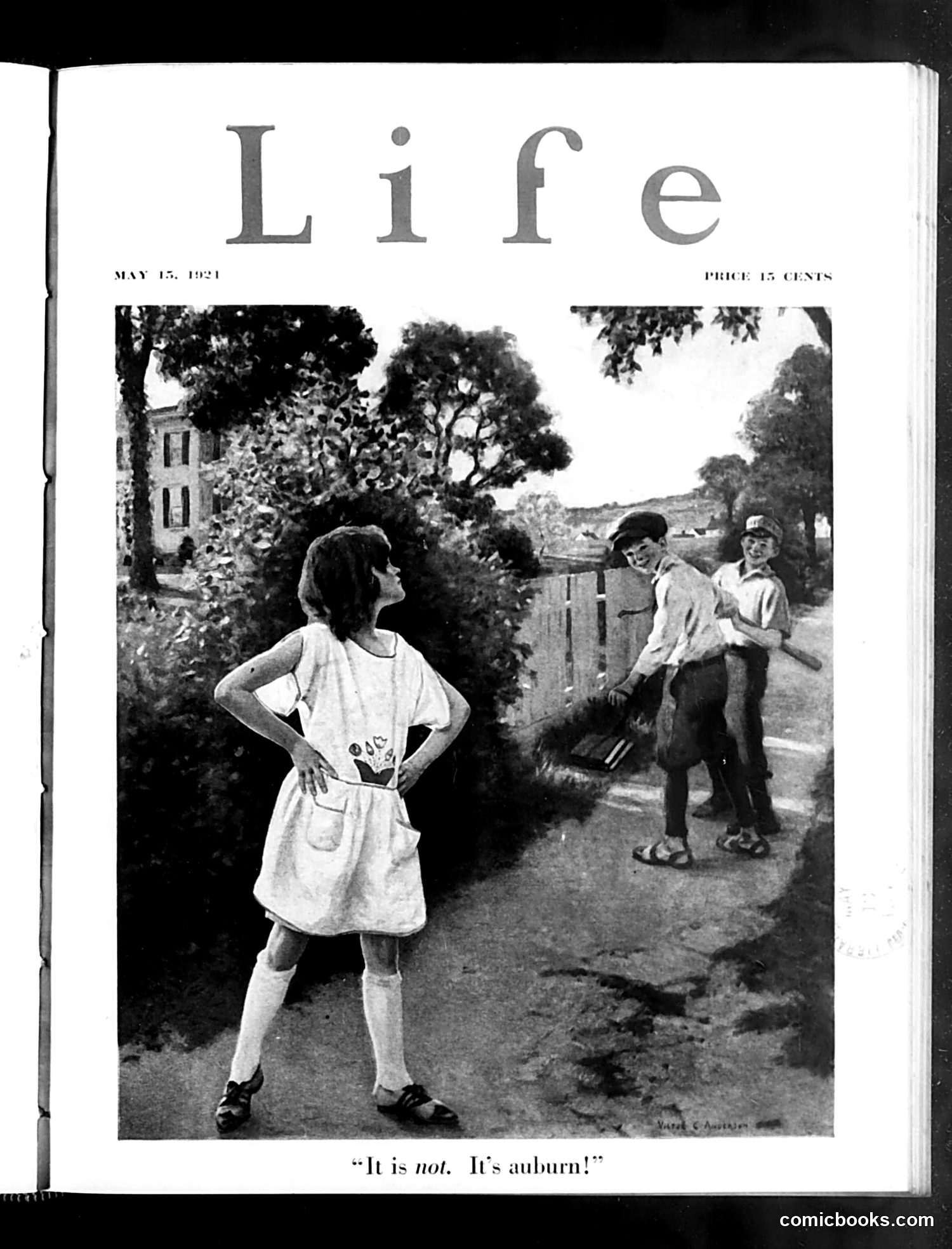
This cover depicts a humorous domestic dispute about hair color. A young woman in a simple dress stands with hands on hips, facing three men down a country lane. The caption reads: "It is not. It's auburn!" The joke appears to be about a disagreement over whether the woman's hair is red or auburn—a distinction that mattered to early 1920s vanity and social conventions. The men's skeptical expressions suggest they doubt her insistence. This plays on period attitudes about female appearance and the sometimes absurd precision women applied to describing their hair color, particularly relevant to the flapper era when women's fashion and self-presentation were increasingly scrutinized topics for satire.
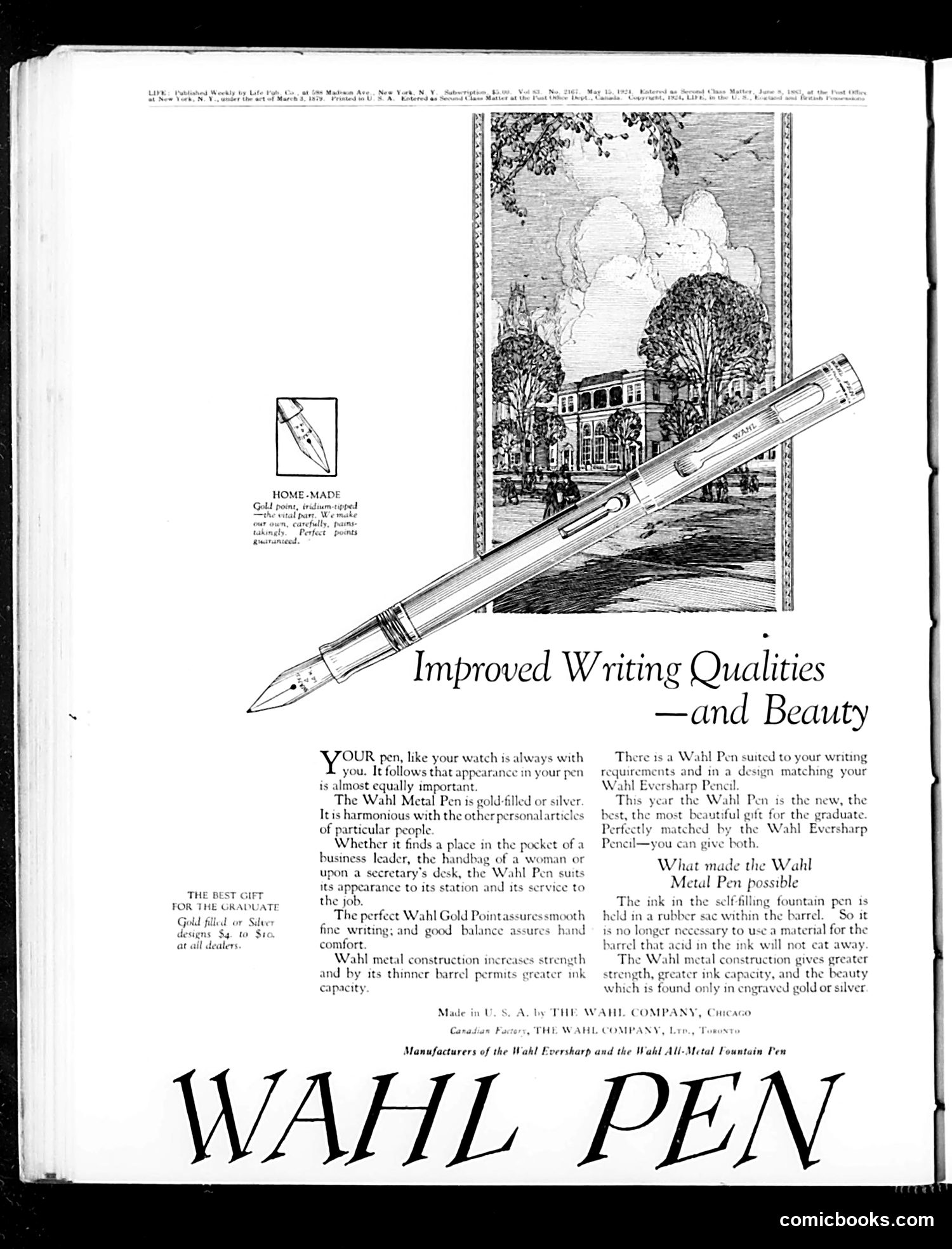
This page is primarily **advertising, not political satire**. It's a 1924 advertisement for Wahl pens and pencils, published in *Life* magazine. The content features: - A decorative architectural illustration in the upper right (a neoclassical building with trees) - A detailed drawing of a Wahl fountain pen as the central visual element - A small inset showing a "home-made" pen for comparison - Marketing copy emphasizing the pen's quality, durability, and aesthetic appeal The ad positions the Wahl pen as an appropriate gift, particularly for graduates, by appealing to notions of sophistication and professional success. The headline "Improved Writing Qualities—and Beauty" targets consumers seeking both functionality and status symbols. There is **no political cartoon or satire present** on this page—it is straightforward commercial advertising typical of 1920s *Life* magazine content.
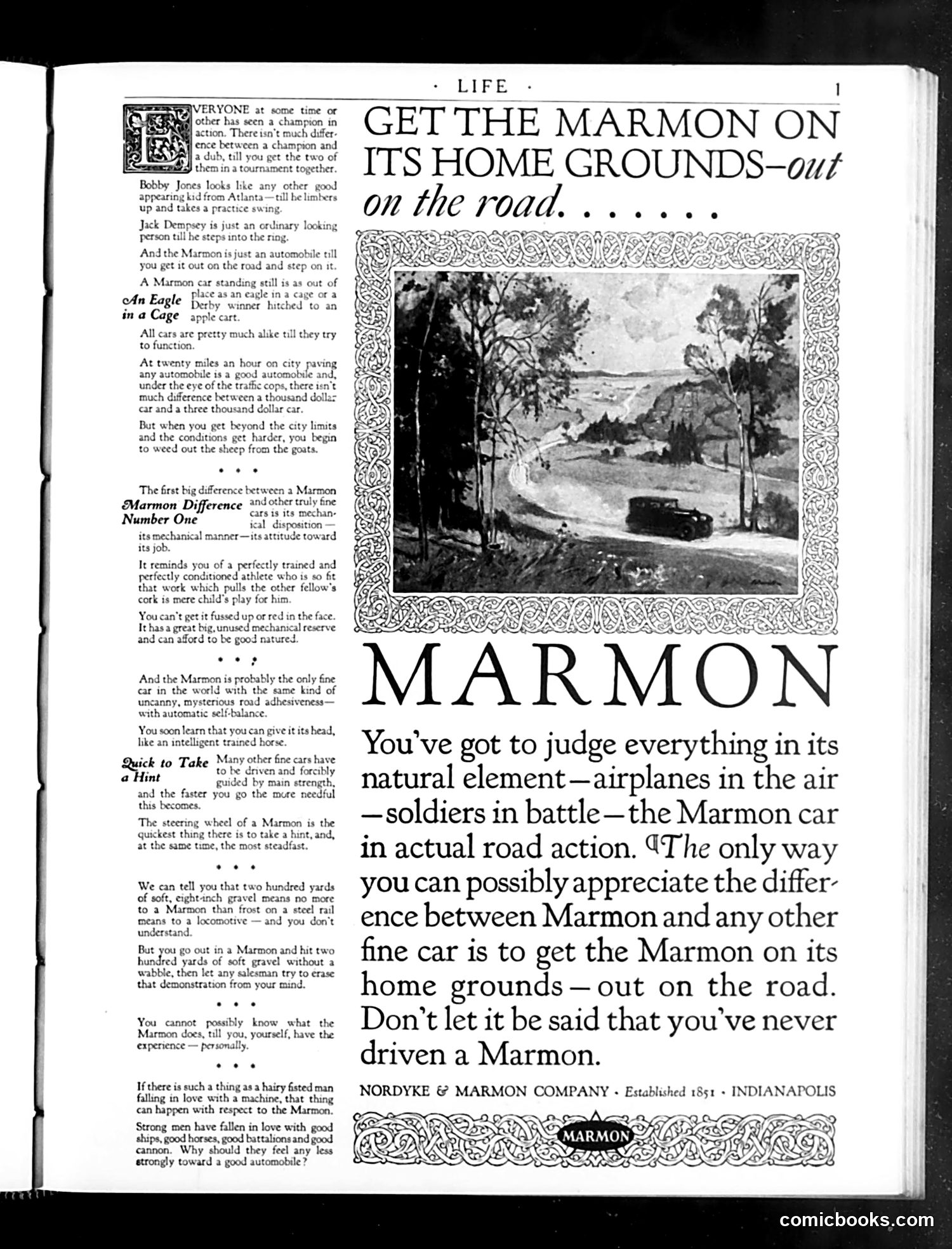
This page is primarily **advertising, not satire or political cartooning**. It's a Marmon automobile advertisement from the Nordyke & Marmon Company (established 1851, Indianapolis). The ad uses comparative rhetoric to position the Marmon as superior to other fine cars. It argues readers must experience the Marmon "on its home grounds—out on the road" to appreciate its mechanical differences. The text references the car's "mysterious adhesiveness" and precise mechanical disposition, framing these as distinctive qualities. The photograph shows a Marmon automobile on a tree-lined road, meant to demonstrate the car's real-world performance capabilities. This is straightforward product promotion typical of early 20th-century automotive marketing, emphasizing engineering excellence and inviting test drives.
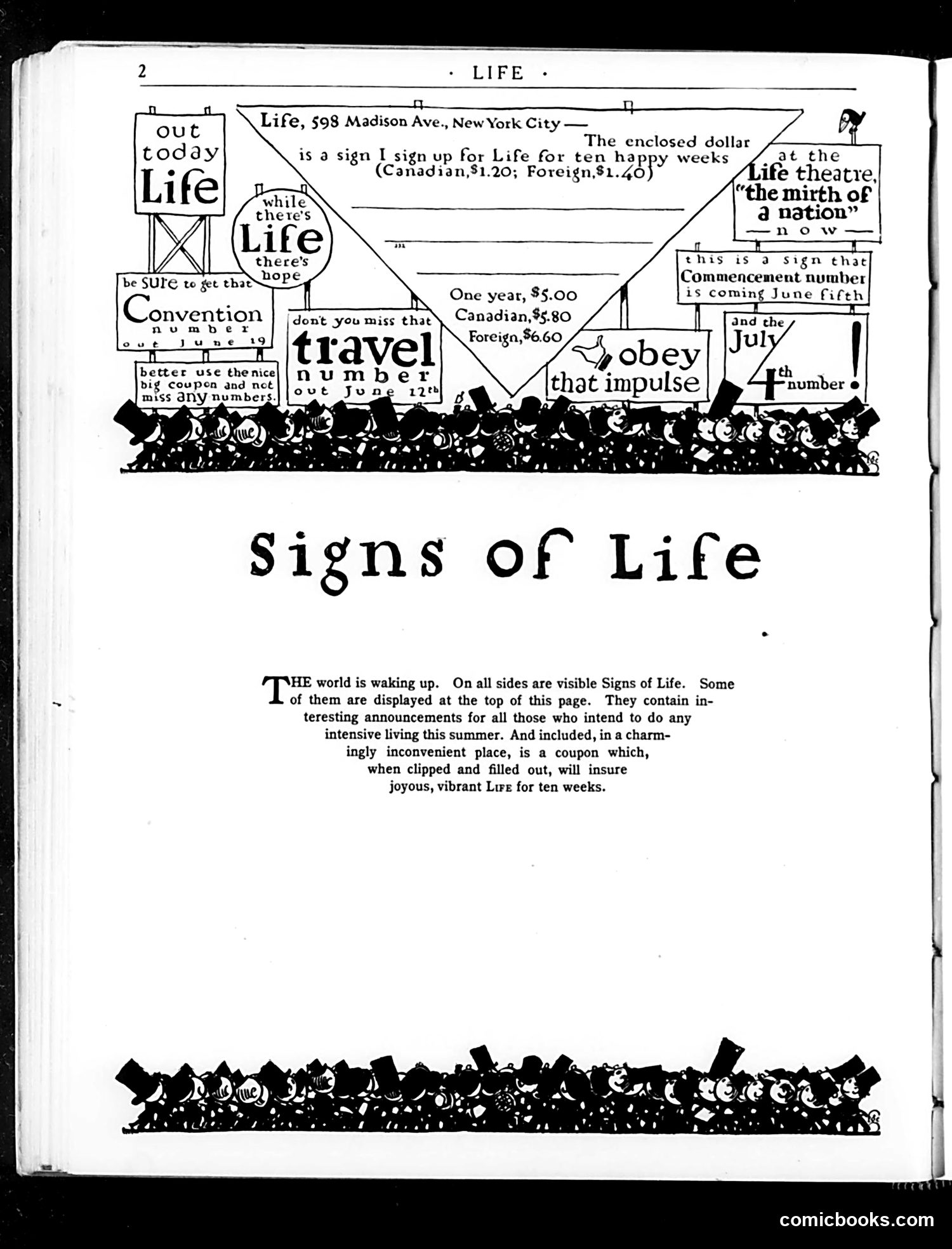
This page is primarily **advertising for Life magazine subscriptions**, not political satire. The top section shows various promotional "Signs of Life"—subscription offers and announcements for summer 1919, including: - Convention number (June 19) - Travel number (June 12) - Theater advertisement for "The Mirth of a Nation" - Commencement issue (June) - One-year subscription pricing The heading "Signs of Life" and accompanying text use metaphorical language about "the world waking up" and "intensive living," typical marketing rhetoric of the era. The silhouetted crowd illustrations at top and bottom suggest energy and public engagement—appealing to readers' desire for current events and cultural participation during the immediate post-WWI period. This is essentially a **subscription drive**, not editorial content requiring historical context beyond understanding early-20th-century magazine marketing conventions.
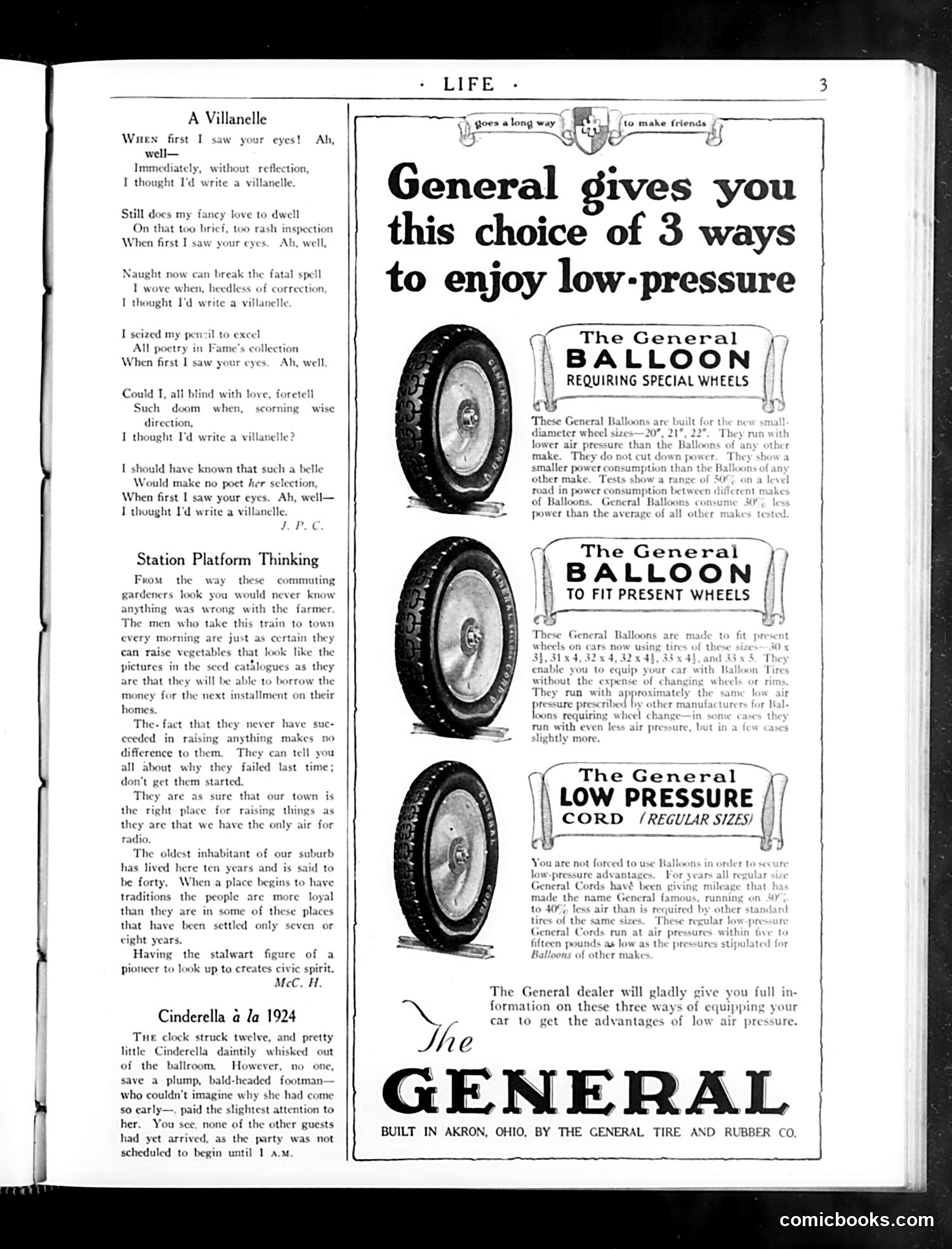
This page contains **no political cartoons or satire**. Instead, it features: 1. **Poetry section** ("A Villanelle," "Station Platform Thinking," "Cinderella à la 1924") — lighthearted verse with no satirical intent 2. **Major advertisement** for General Tire and Rubber Company, promoting three low-pressure tire options for automobiles The "Cinderella à la 1924" poem appears to offer gentle social commentary on modern manners (a guest arriving late to a ball), but it's mild humor rather than sharp satire. The page is primarily **advertising-driven content**, typical of 1920s *Life* magazine, which relied heavily on advertisements alongside literary and humorous material. No political figures or events are referenced.
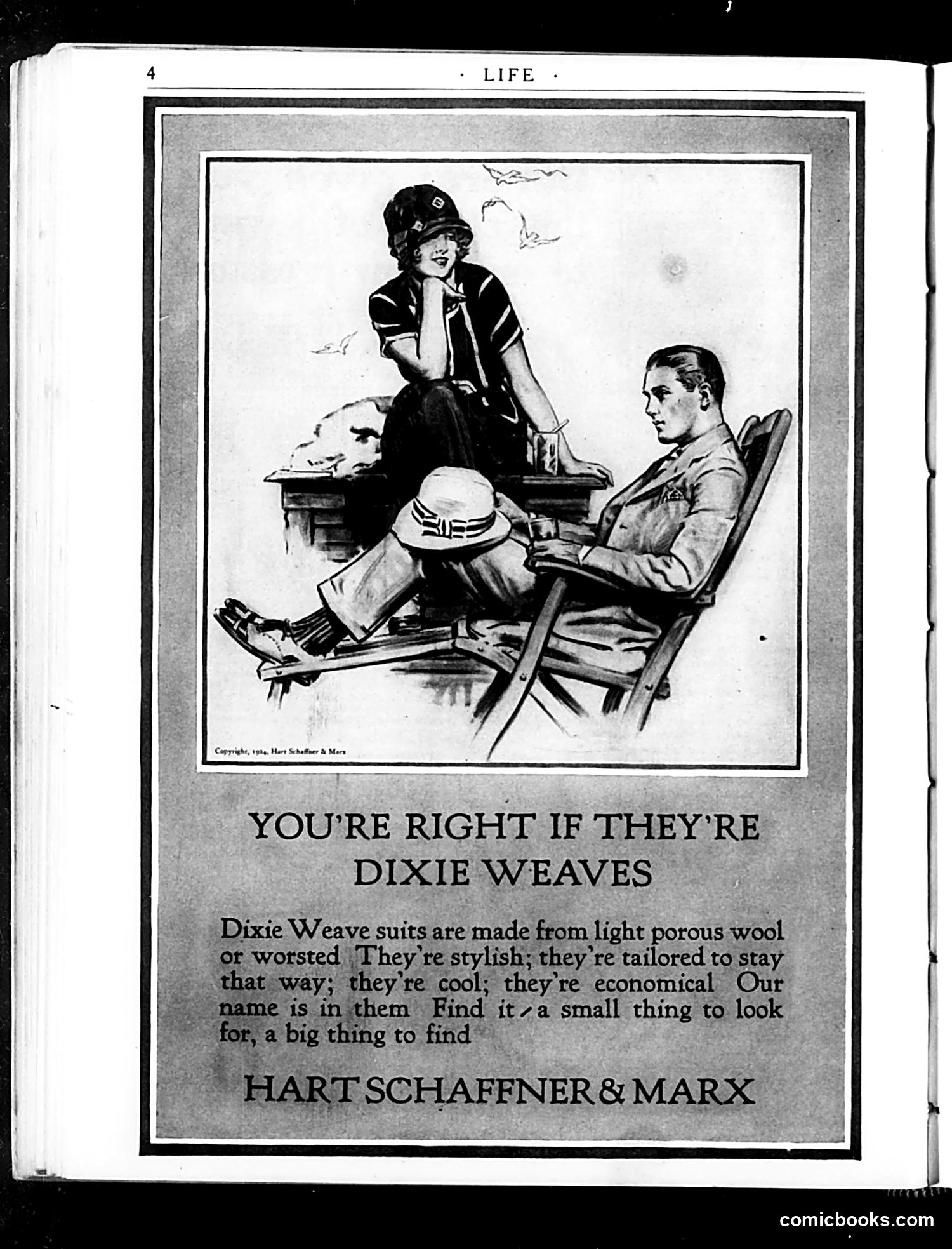
This is primarily an **advertisement**, not satire or political commentary. Hartschaffner & Marx, a menswear company, promotes their "Dixie Weave" suits to male consumers. The illustration depicts a flirtation scene: a woman in a baseball cap sits on a desk between two relaxed men in suits and hats. The ad's wordplay—"YOU'RE RIGHT IF THEY'RE DIXIE WEAVES"—suggests that wearing these suits makes a man attractive or successful with women. The advertisement emphasizes practical benefits: suits made from "light porous wool or worsted" that are "stylish," well-tailored, cool, and economical. The brand name appearing in the garment itself is highlighted as a quality marker. This reflects early 20th-century advertising conventions targeting male vanity and social success through clothing.
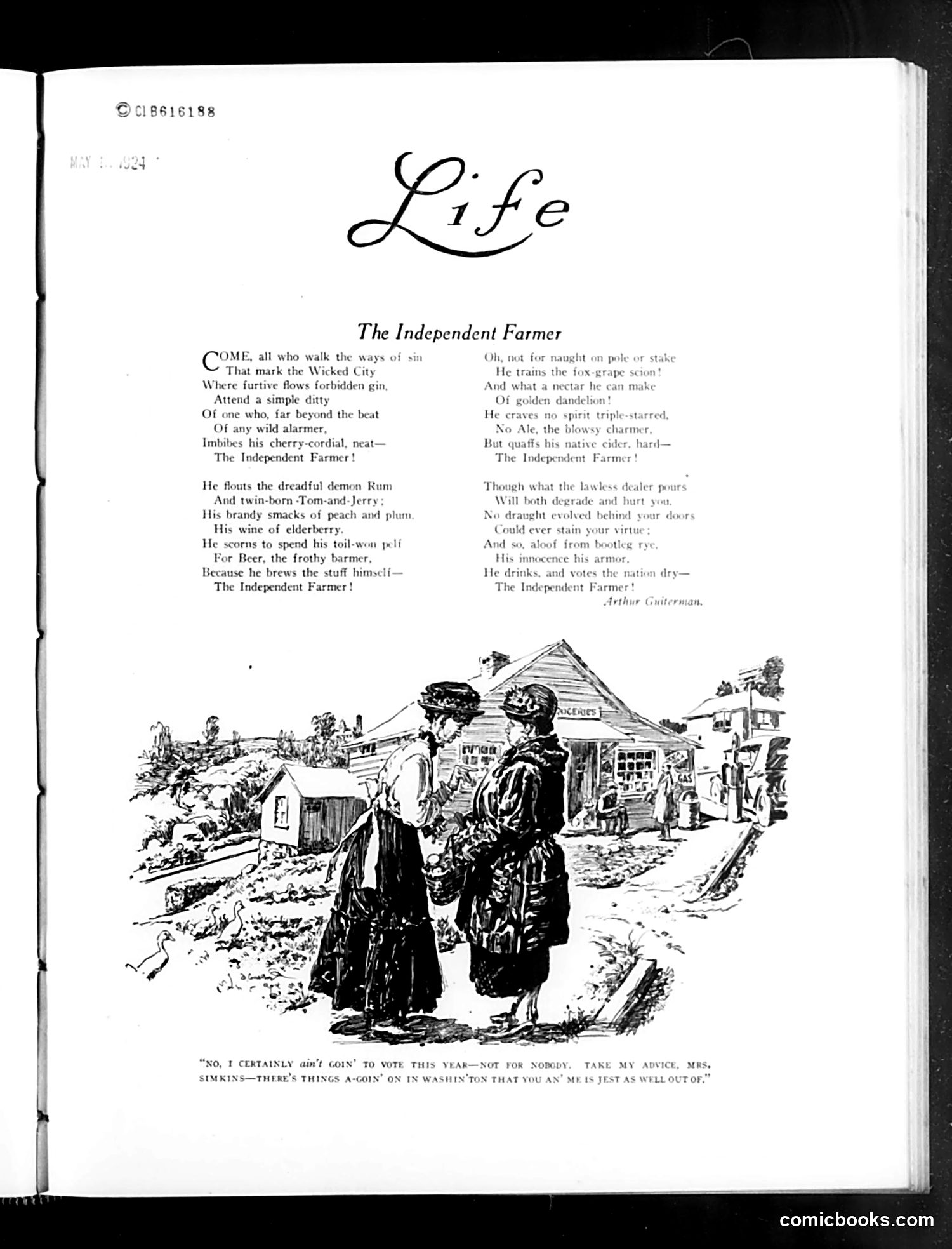
This poem by Arthur Guiterman celebrates the "Independent Farmer" as a virtuous figure who avoids urban vices—the "Wicked City" with its gambling, drinking, and moral corruption. The farmer maintains integrity through hard work and temperance. The illustration shows two figures in rural dress discussing farming life, with farmhouses and agricultural activity in the background. The caption quotes advice against voting, suggesting farmers should avoid Washington politics, which the poem implies would compromise their independence and virtue. This reflects early 20th-century agrarian ideology: farmers as morally superior to urban populations, and political detachment as preferable to involvement in what was viewed as a corrupt system. It romanticizes rural life as a bastion of American virtue against urban decadence.
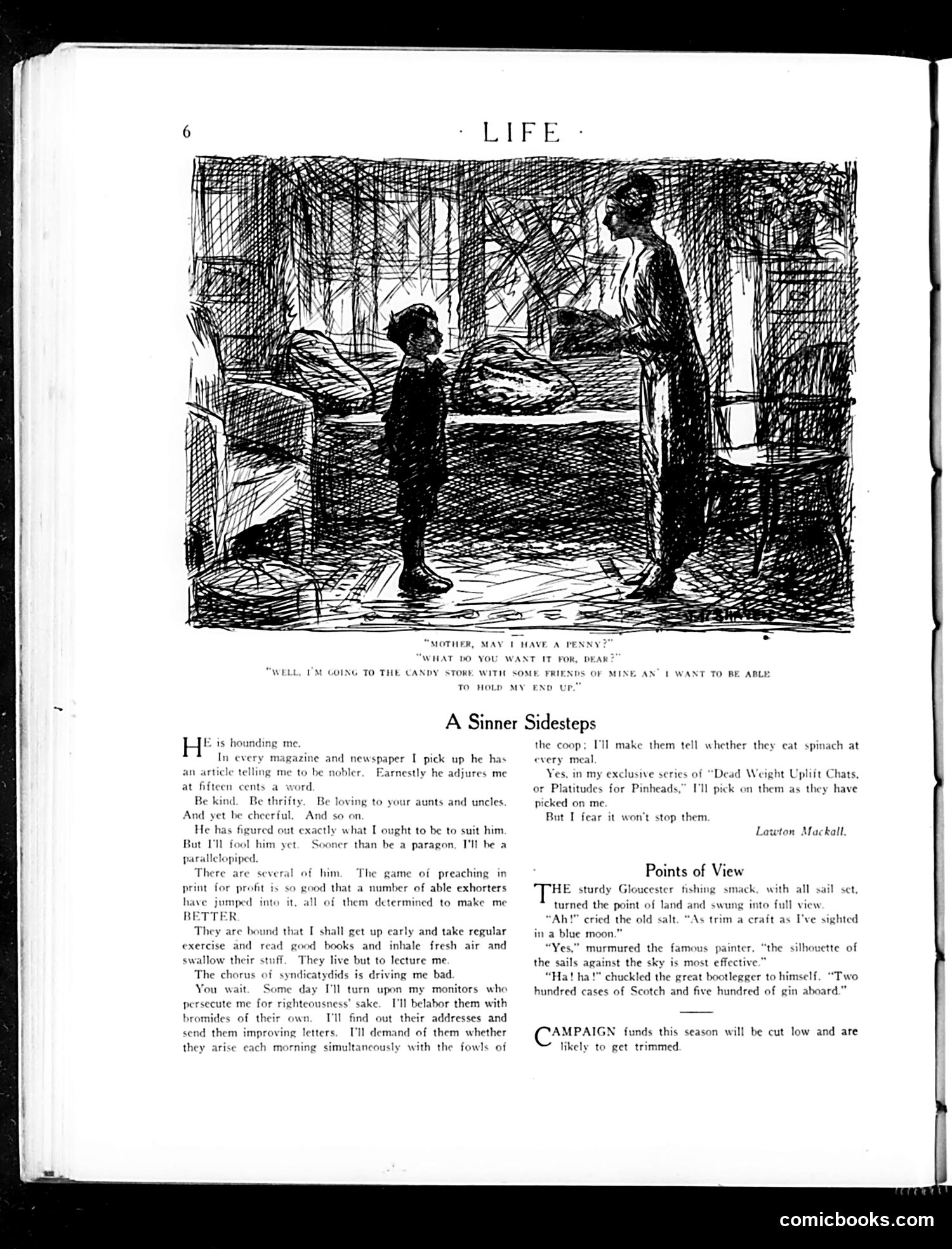
This page contains a satirical illustration titled "A Sinner Sidesteps" depicting what appears to be a domestic scene with a child and adults. The accompanying text is a first-person monologue from someone (likely a child or young person) boasting about evading parental supervision and moral guidance. The satire targets the speaker's self-righteous hypocrisy: they claim to read improving literature and associate with morally upright people, yet they're actually planning to circumvent oversight by manipulating authority figures. They brag about surveilling others' behavior while avoiding their own scrutiny. The cartoon critiques the gap between professed virtue and actual conduct—a common Life magazine theme mocking self-deception and moral pretense among the American public.
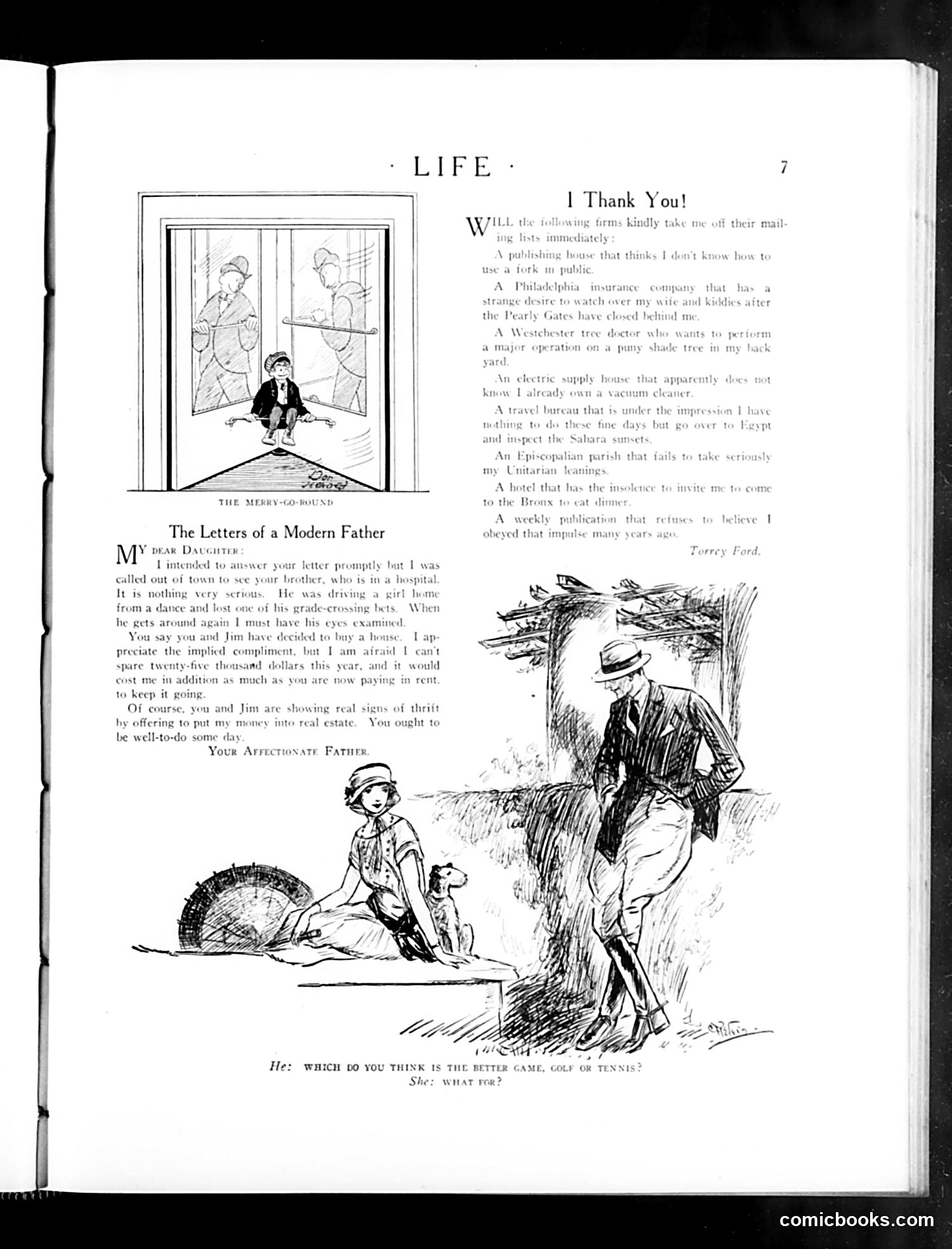
This page contains two distinct pieces: **"Thank You!" letter** lists humorous requests from various organizations Torrey Ford wants removed from his mailing list—including a publishing house, insurance company, and doctor seeking to operate on his "pony shade tree." **"The Letters of a Modern Father"** is a satirical piece where a father responds to his daughter's letter about needing money for a house. He deflects, citing his brother's hospital stay and explaining he cannot spare additional funds beyond her current rent. The humor lies in the father's gentle evasion and somewhat self-justifying tone. **The cartoon below** shows a man and woman with fishing and golfing equipment, captioned with the woman asking "which do you think is the better game, golf or tennis?" and the man responding "what for?"—satirizing masculine indifference to recreational distinctions, likely critiquing gender dynamics in leisure activities during this era.
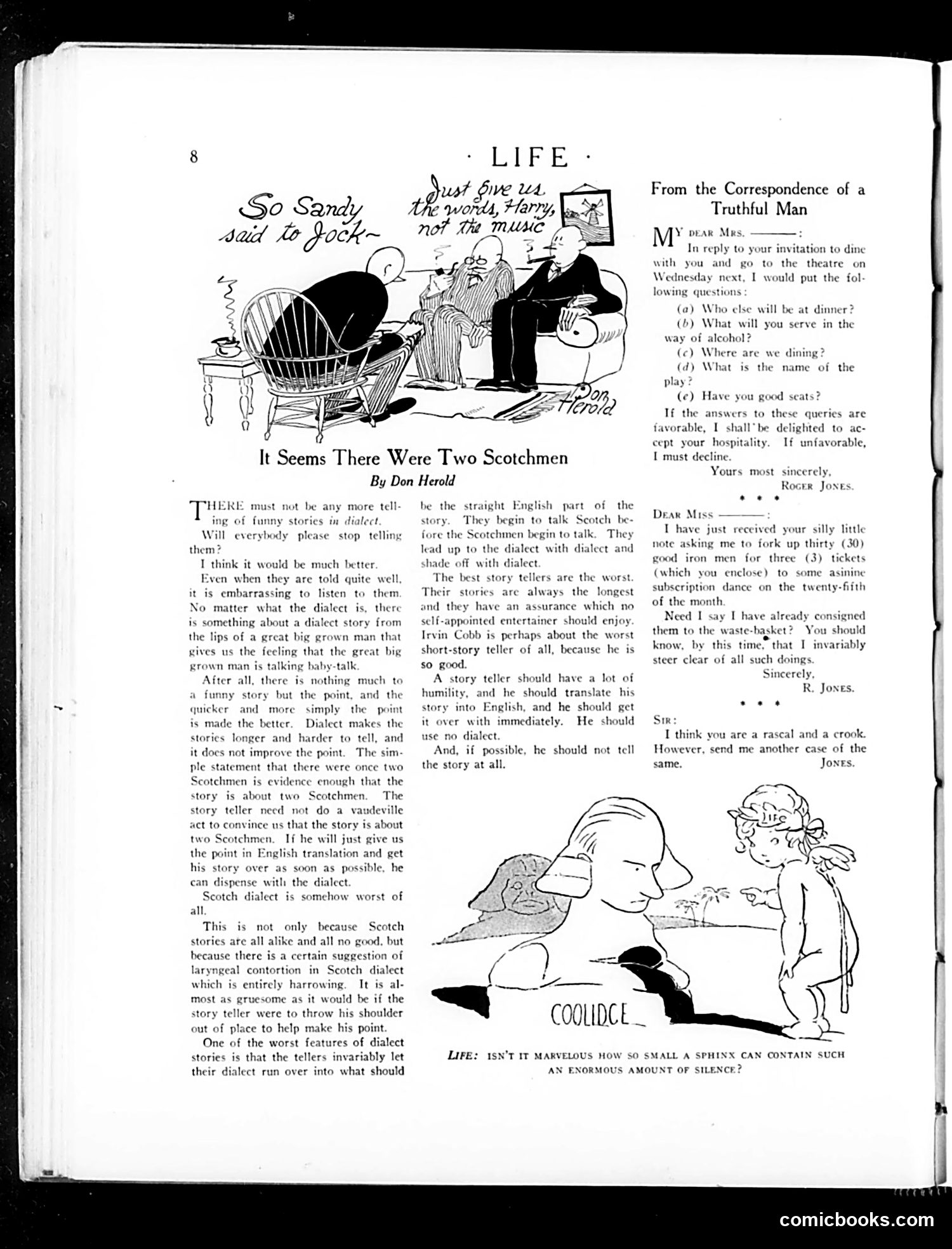
**Main Content:** A humorous essay by Don Herald criticizing dialect storytelling, particularly Scottish dialect stories. Herald argues these tales are tedious and that storytellers should translate dialect into standard English for clarity and brevity. **Cartoon Illustration:** Shows a sphinx (classical figure of mystery and silence) with the caption: "ISN'T IT MARVELOUS HOW SO SMALL A SPHINX CAN CONTAIN SUCH AN ENORMOUS AMOUNT OF SILENCE?" **The Satire:** Herald's essay mocks the then-popular practice of entertaining audiences with heavy Scottish-dialect narratives—a common comedy genre of the era. The sphinx cartoon reinforces his point about silence being preferable to prolonged, incomprehensible storytelling. **Social Context:** In early 20th-century America, ethnic dialect humor was mainstream entertainment, though increasingly criticized as tedious.
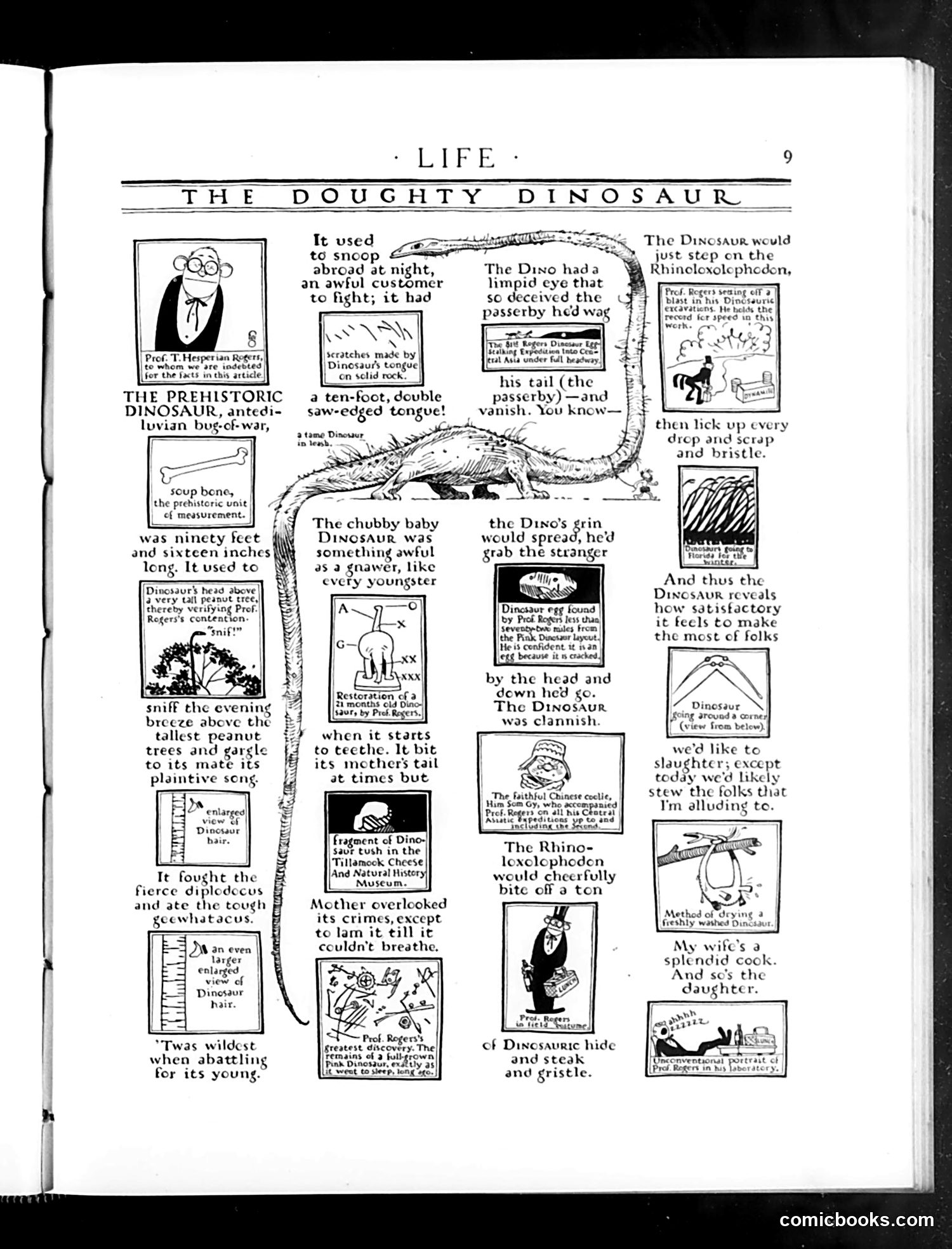
This is a humorous illustrated essay mocking what appears to be Professor T. Hopkinson Rogers (named in the left margin), presented as an expert on prehistoric dinosaurs. The satire works by treating the dinosaur as if it were a contemporary character with absurd human qualities—it "used to snoop abroad at night," has a "grin," and the professor describes its behaviors with pseudo-scientific authority. The joke targets professorial pretension: Rogers confidently explains dinosaur anatomy and habits with the same tone used for serious natural history, despite the subjects being obviously ridiculous (a dinosaur that ate peanuts, had a "doughty" personality, fought "fiercely drunk"). The repeated small illustrations of Rogers lecturing reinforce that this is satirizing academic pomposity and the absurdity of presenting speculative prehistoric knowledge as established fact.
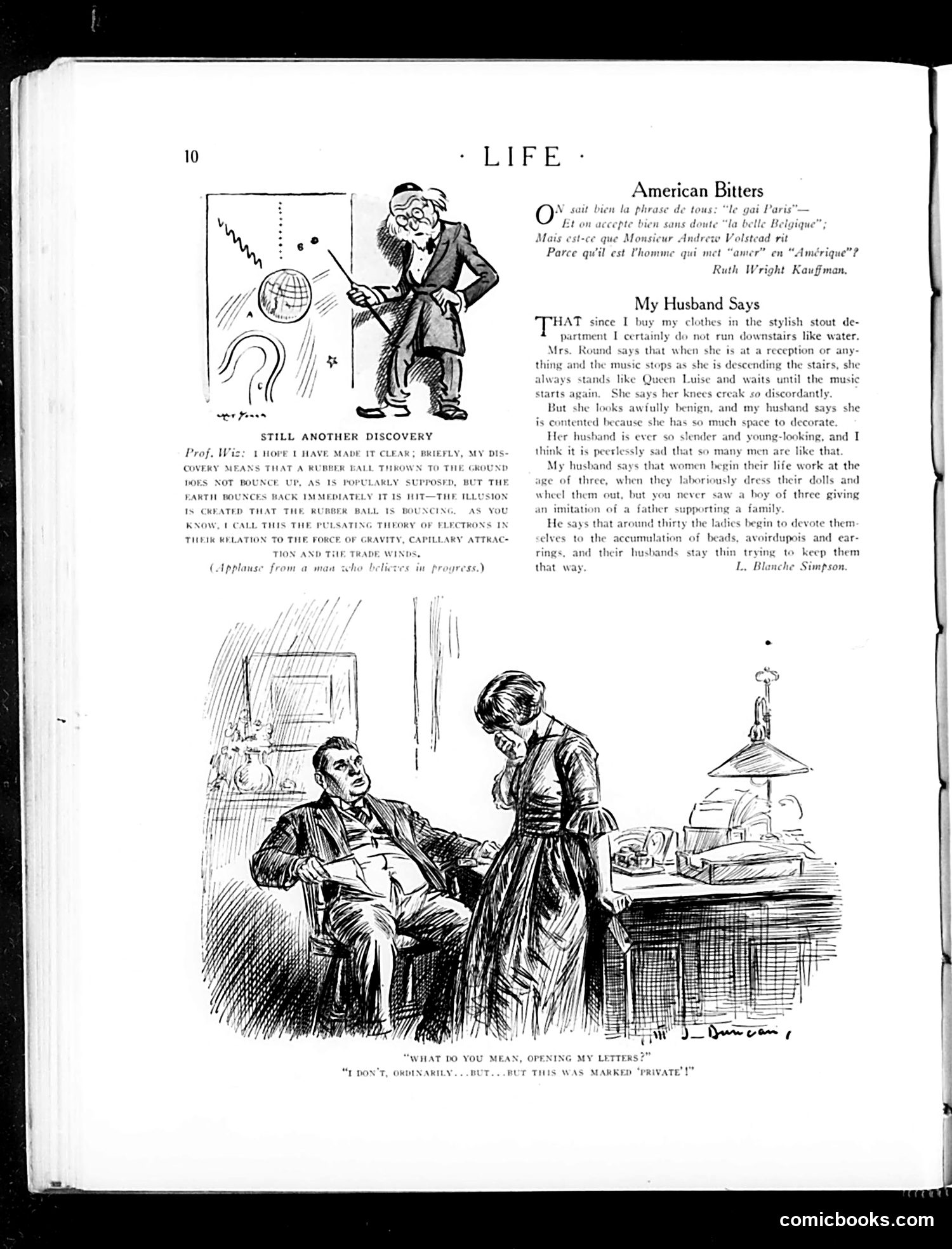
This page contains two distinct pieces of satire: **"Still Another Discovery"** (top): A professor demonstrates a pseudo-scientific discovery, claiming a rubber ball bounces due to "capillary attraction and the trade winds" rather than gravity. The satire mocks intellectuals who overcomplicate obvious phenomena with absurd theoretical explanations. **"My Husband Says"** (right column): A humorous domestic piece by L. Blanche Simpson about wives' decorating habits and fashion choices. The accompanying cartoon shows a wife caught opening her husband's mail, claiming it was marked "private." The satire targets wives' domestic authority and boundary-crossing behavior, reflecting early 20th-century gender dynamics and marital tensions around privacy and household control. Both pieces employ gentle ridicule of everyday behavior and social pretensions.
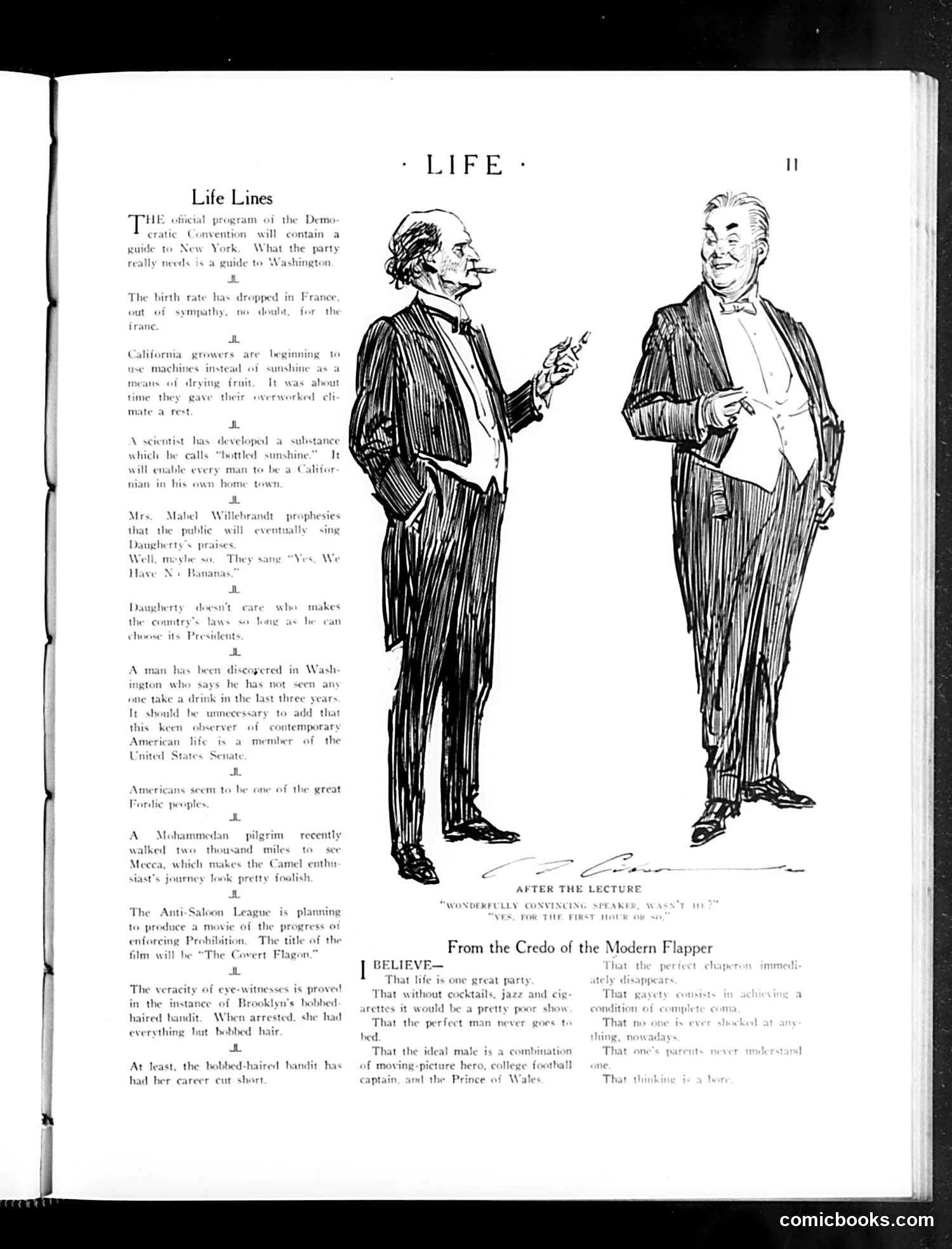
This cartoon satirizes a lecture on modern social customs ("The Creed of the Modern Flapper"). The two men depicted appear to be discussing the speaker's arguments about contemporary behavior and values. The caption reads: "Wonderfully convincing speaker, wasn't it?" with the response "Yes, for the first hour or so." The satire targets the "Modern Flapper"—the 1920s figure representing young women who rejected traditional Victorian propriety through smoking, drinking, dating freely, and adopting casual attitudes toward morality. The joke suggests the lecture was persuasive initially but ultimately unconvincing or absurd upon reflection. The cartoon mocks both the flapper lifestyle being defended and perhaps the earnest advocates attempting to justify or explain it to skeptical audiences.
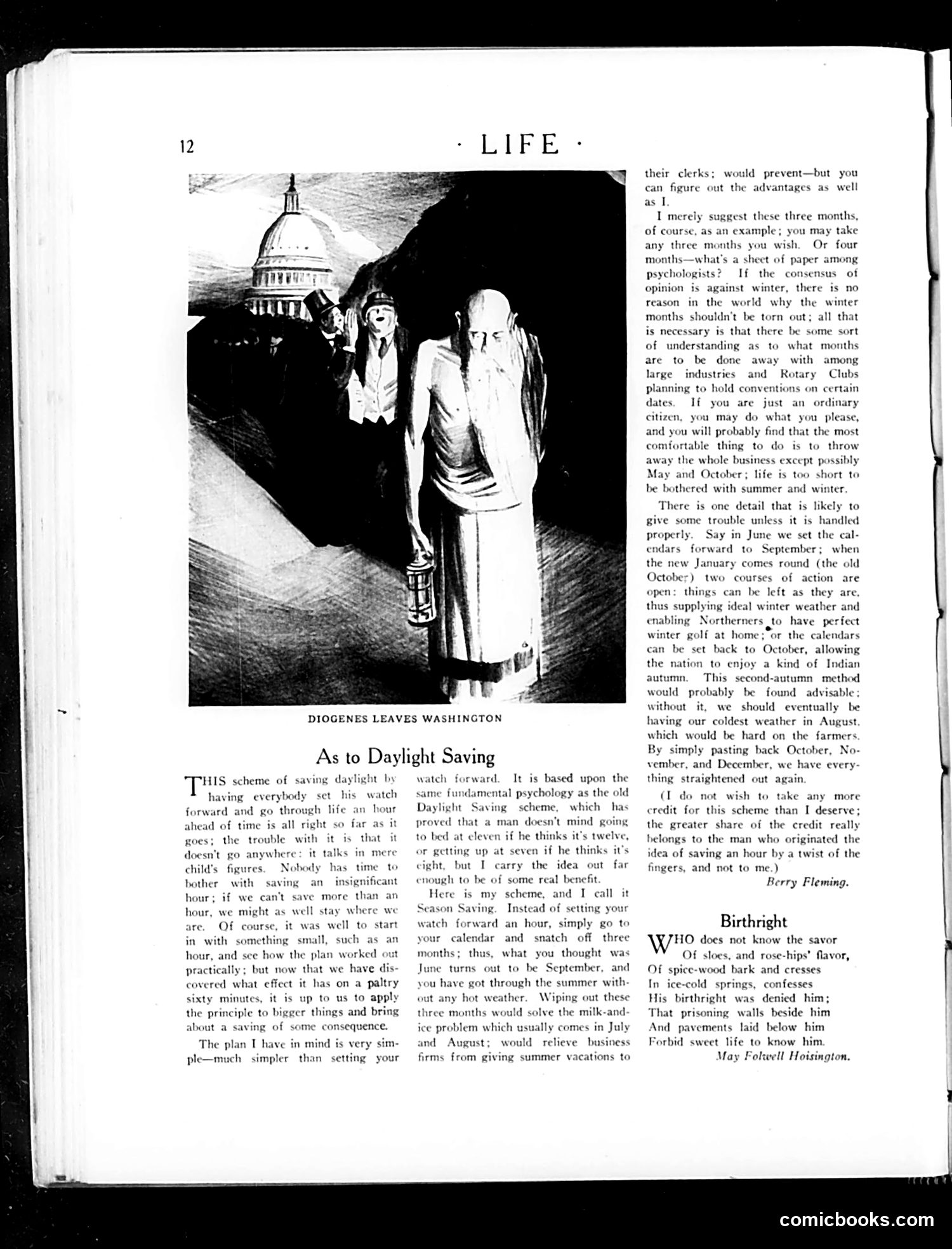
This page discusses "Daylight Saving" in an article attributed to Henry Fleming. The illustration shows two figures leaving Washington, with the Capitol building visible in the background, labeled "DIOGENES LEAVES WASHINGTON." The satire compares daylight saving time proposals to Diogenes, the ancient Greek cynic philosopher who famously searched for an honest man. By depicting Diogenes "leaving" Washington, the cartoonist suggests the government's daylight saving scheme lacks honesty or integrity. The article proposes a "Season Saving" alternative: rather than resetting clocks, simply shift the calendar backward three months, allowing different seasons to align with preferred working schedules. The satire mocks government inefficiency and overly complicated solutions to practical problems, presenting the absurd calendar-shifting idea as equally (or more) sensible than actual daylight saving proposals.
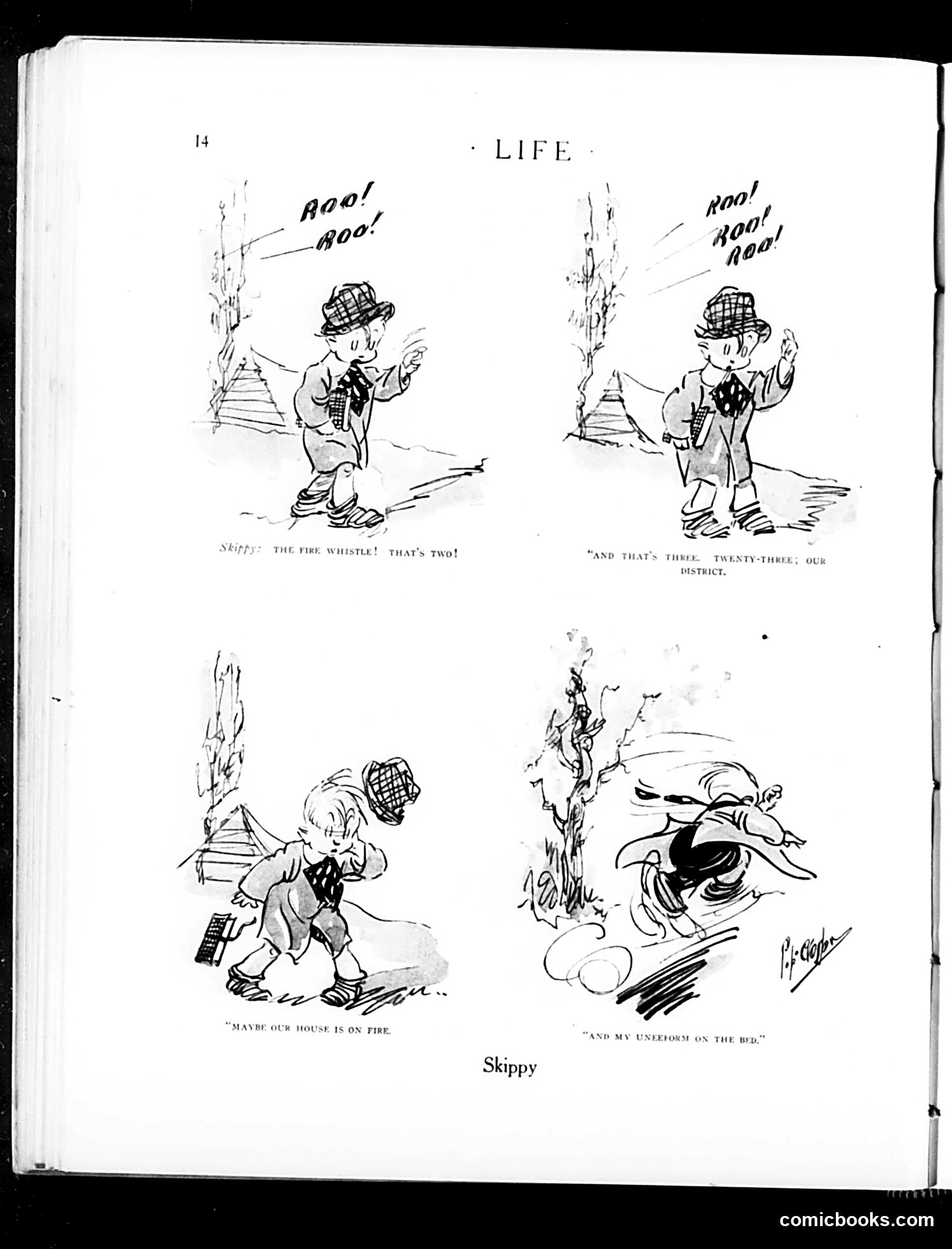
This is a humorous comic strip about a young boy named Skippy responding to fire alarm whistles in his neighborhood. The four-panel sequence shows: 1. Skippy hears fire whistles and counts them ("That's two!") 2. He continues counting ("And that's three—twenty-three; our district") 3. Realizing the fire is nearby, he panics ("Maybe our house is on fire") 4. He rushes outside in distress, losing his uniform in the chaos The satire targets a child's overactive imagination and tendency to catastrophize minor events. By counting the whistle blasts as a code for fire location, Skippy jumps to the worst conclusion—that *his* house is burning—despite having no actual information. It's gentle humor about childhood anxiety and dramatic overreaction to everyday occurrences.
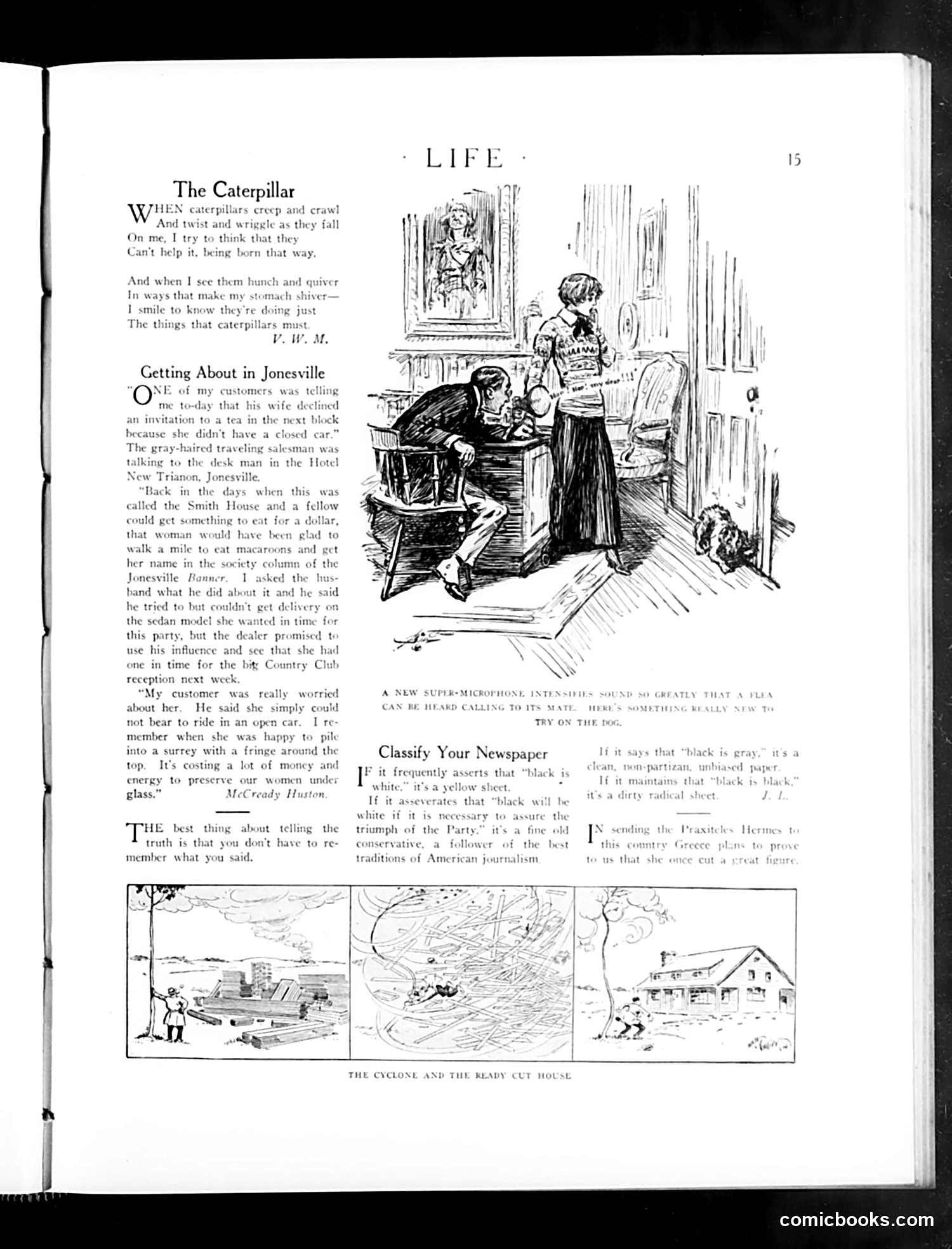
This page contains three distinct pieces of content: 1. **"The Caterpillar"** — A short poem about caterpillars' movements, credited to V.H.M. 2. **"Getting About in Jonesville"** — A humorous anecdote by McCready Huston about a traveling salesman trying to arrange transportation in a small town. The joke plays on rural inconvenience and social climbing (the woman wanting to be seen at a country club). 3. **"Classify Your Newspaper"** — A satirical commentary on newspaper partisanship, suggesting papers claim objectivity while secretly promoting political parties. The joke critiques hypocrisy in journalism's claims of neutrality. 4. **Bottom illustration** — Three panel cartoon titled "The Cyclone and the Brady Cut House" depicting natural disaster versus domestic architecture, though specifics are unclear from this image. The page exemplifies Life's satirical approach to American social and institutional pretense.
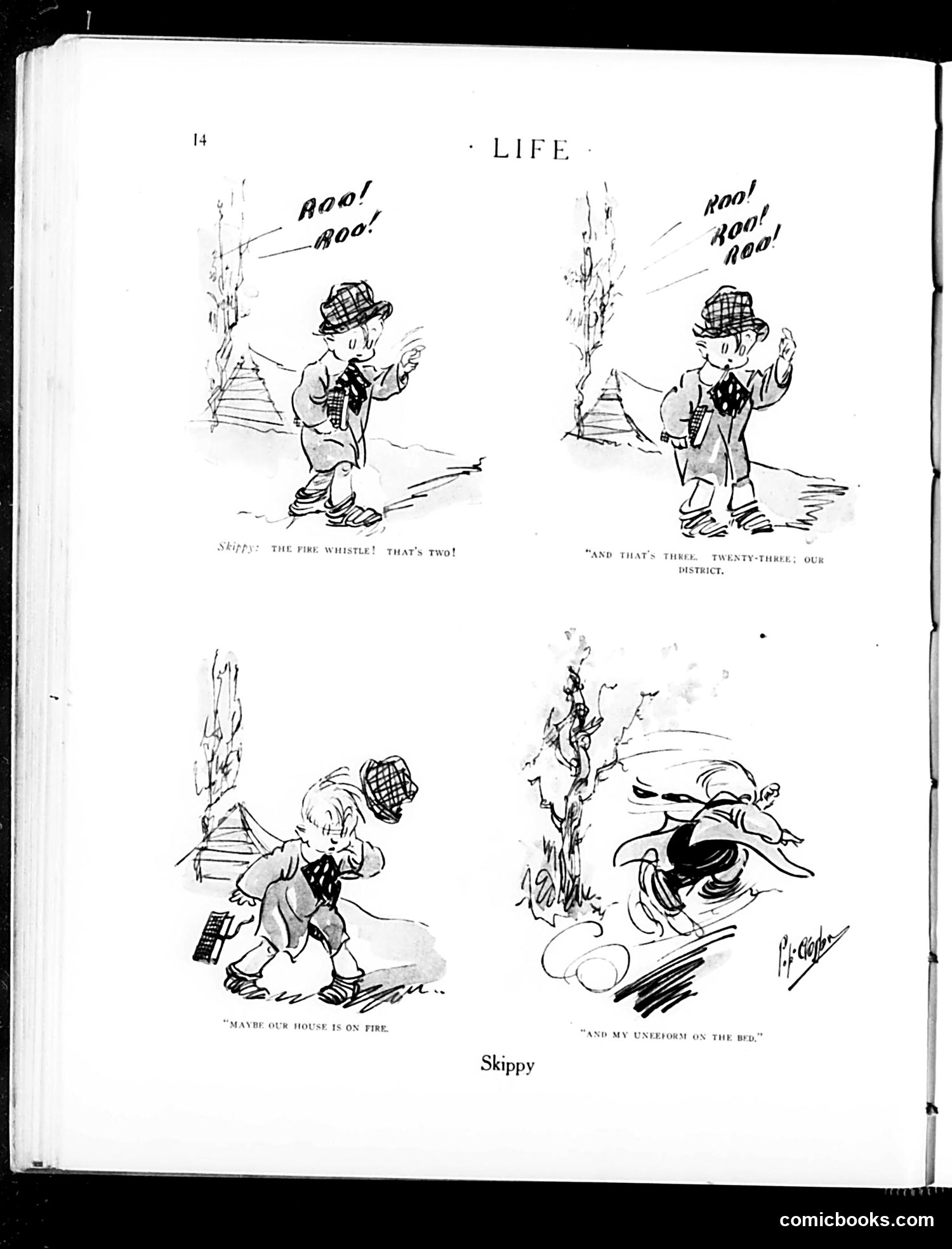
This is a four-panel comic strip titled "Skippy" featuring a young boy character responding to fire department activity. The humor operates on multiple levels: **The Joke:** Skippy hears fire engine sirens ("Roo! Roo!") and counts them enthusiastically, treating the emergency calls as a game. He announces "that's two" and "that's three, twenty-three; our district," suggesting he's keeping a personal tally of fires in his neighborhood. **The Satire:** The strip gently mocks childhood innocence and obliviousness to danger—Skippy treats serious emergencies as entertainment. The escalating panic (culminating in "maybe our house is on fire" and losing his uniform) underscores the absurdity of his casual attitude toward what are actually dangerous situations affecting his community. The strip satirizes how children can find excitement in urban emergencies without grasping their seriousness.
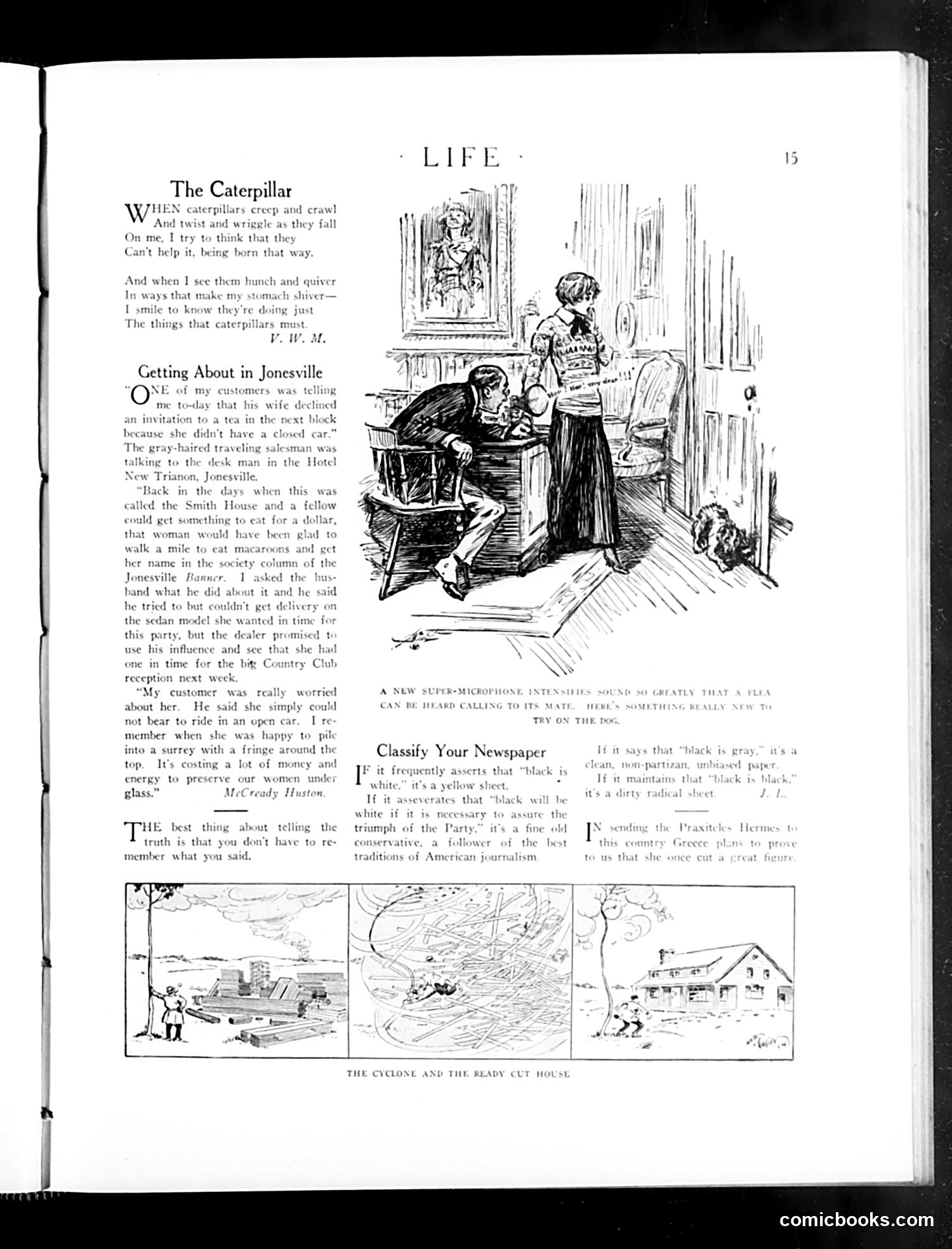
This page contains three distinct pieces: **"The Caterpillar"** — A humorous poem about tolerating caterpillars despite finding them disgusting, using them as a metaphor for accepting unpleasant things beyond anyone's control. **"Getting About in Jonesville"** — A satirical anecdote mocking social climbing and conspicuous consumption in small-town America. A salesman arranges for a customer to attend an exclusive Country Club reception by helping her acquire a closed sedan (modern, expensive car), rather than an open surrey (old-fashioned). The joke ridicules how quickly people abandon humble origins and how dealers exploit social anxiety to sell luxury goods. **"Classify Your Newspaper"** — A brief editorial commentary suggesting that labeling newspapers as "black" (Democratic) or "white" (Republican) is misleading partisanship. It advocates for objective journalism over party loyalty. **Bottom panel** ("The Cyclone and the Ready Cut House") — Illustration (illegible text) appears to contrast natural disaster with pre-fabricated housing, likely satirizing early 20th-century construction trends.
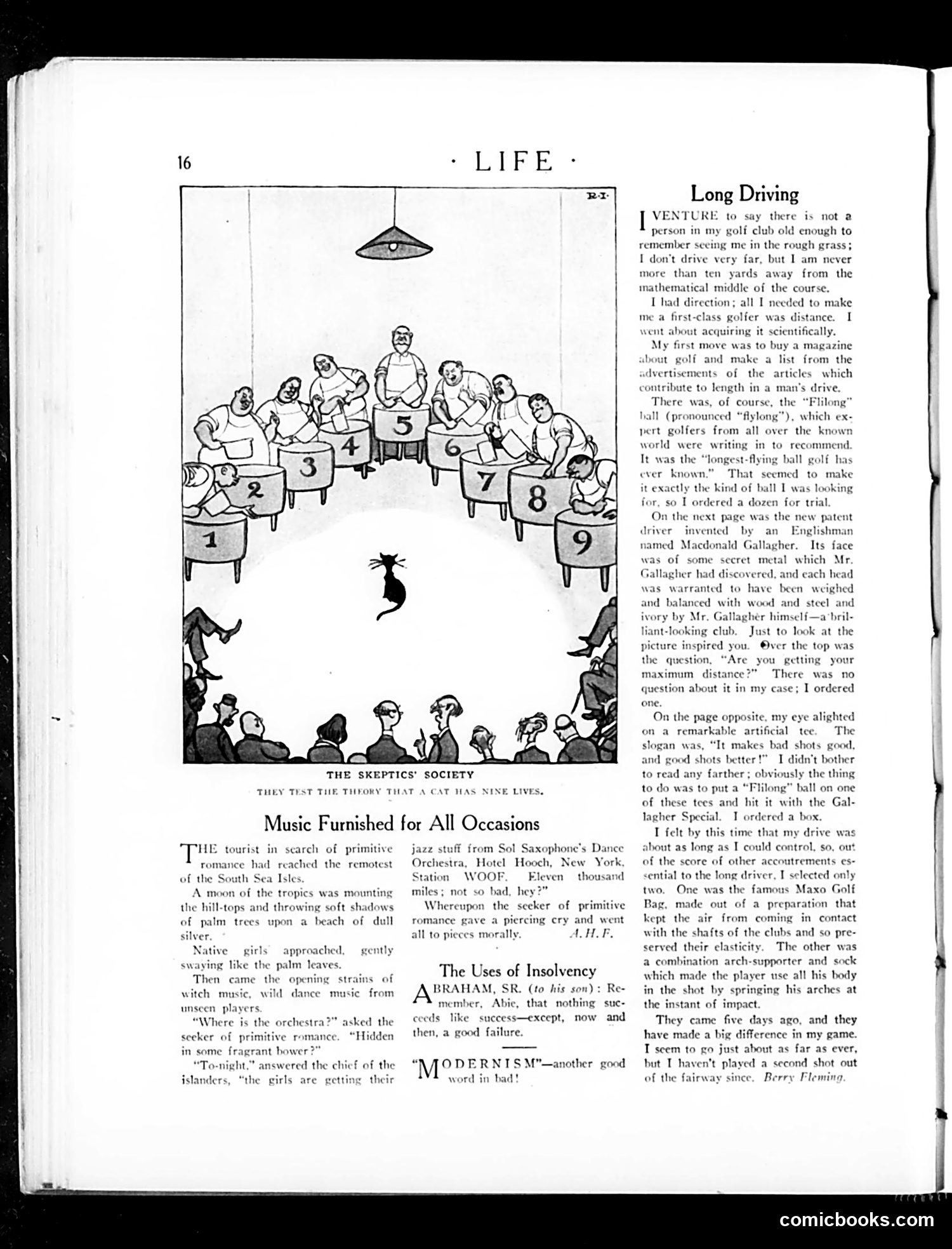
This cartoon satirizes pseudoscientific claims and consumer gullibility. The image shows nine numbered figures arranged in a circle around a dead cat, illustrating the old superstition that cats have nine lives. The caption reads: "They test the theory that a cat has nine lives." The joke targets people who believe unproven claims without evidence—here, literally testing folklore. In context with the page's other articles (which mock "modernism" and dubious inventions), it's satirizing 1920s American consumer culture: people eagerly purchasing golf equipment with exaggerated claims, artificial tees, and "secret metal" drivers, much as the cartoon's characters naively test folk superstitions. The cartoon mocks both superstition and the modern marketplace's equivalent: believing marketing hype over reason.
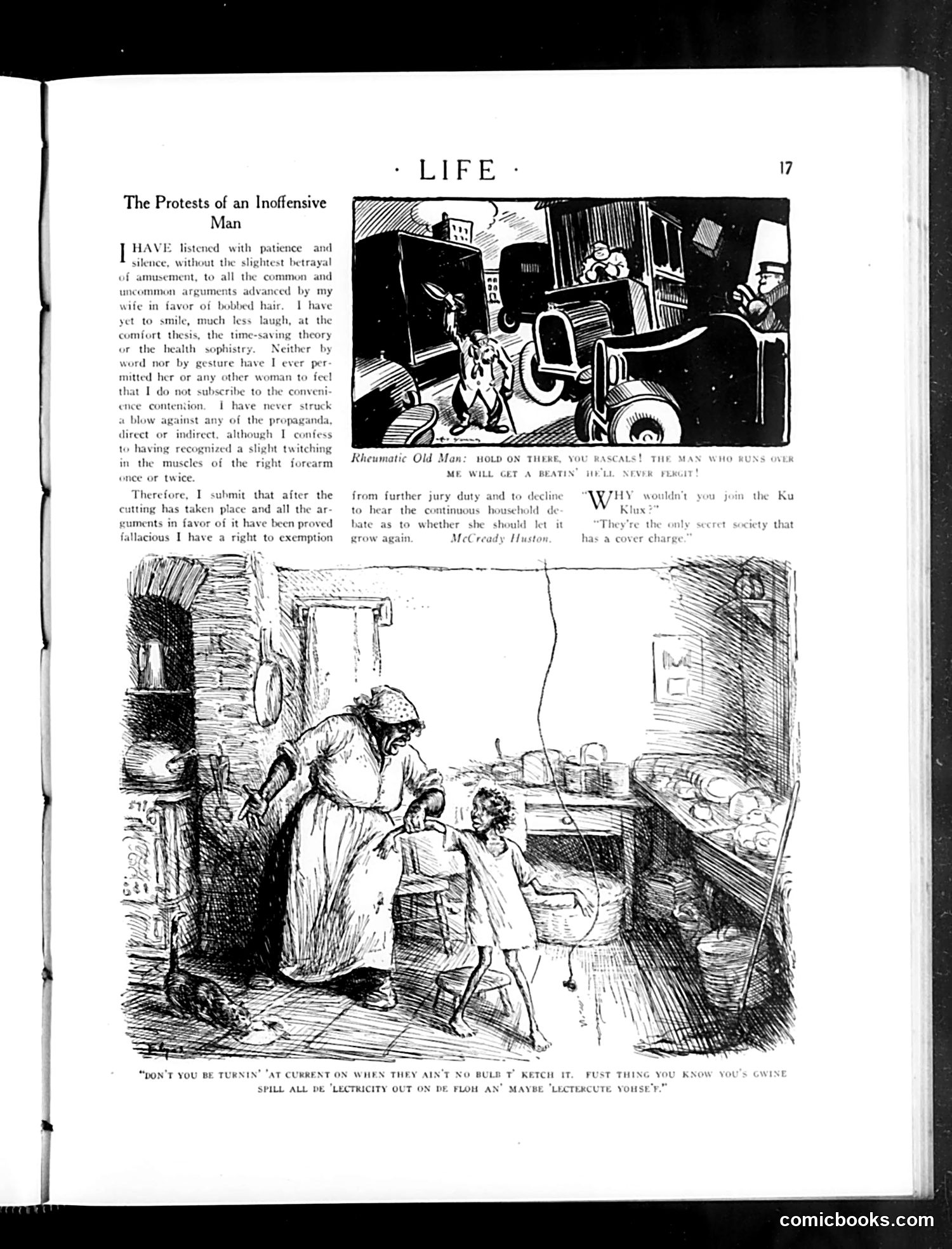
This page satirizes the "bobbed hair" debate of the 1920s. The main article features a husband sarcastically claiming patience while his wife argues for the fashionable short hairstyle—framing women's bodily autonomy as nagging. The top cartoon shows a car accident, captioned with a working-class man threatening violence over a vehicle collision, illustrating rough urban masculinity. The bottom cartoon depicts a tenement kitchen where a mother warns children not to touch an electrical cord, fearing electrocution and property damage. This mocks working-class superstition and ignorance about electricity—a technology newly entering poor households. Both images mock lower-class Americans: one through aggressive masculinity, the other through comedic fear of modern technology. The satire reflects 1920s attitudes viewing working-class urban life as crude and amusing to middle-class readers.
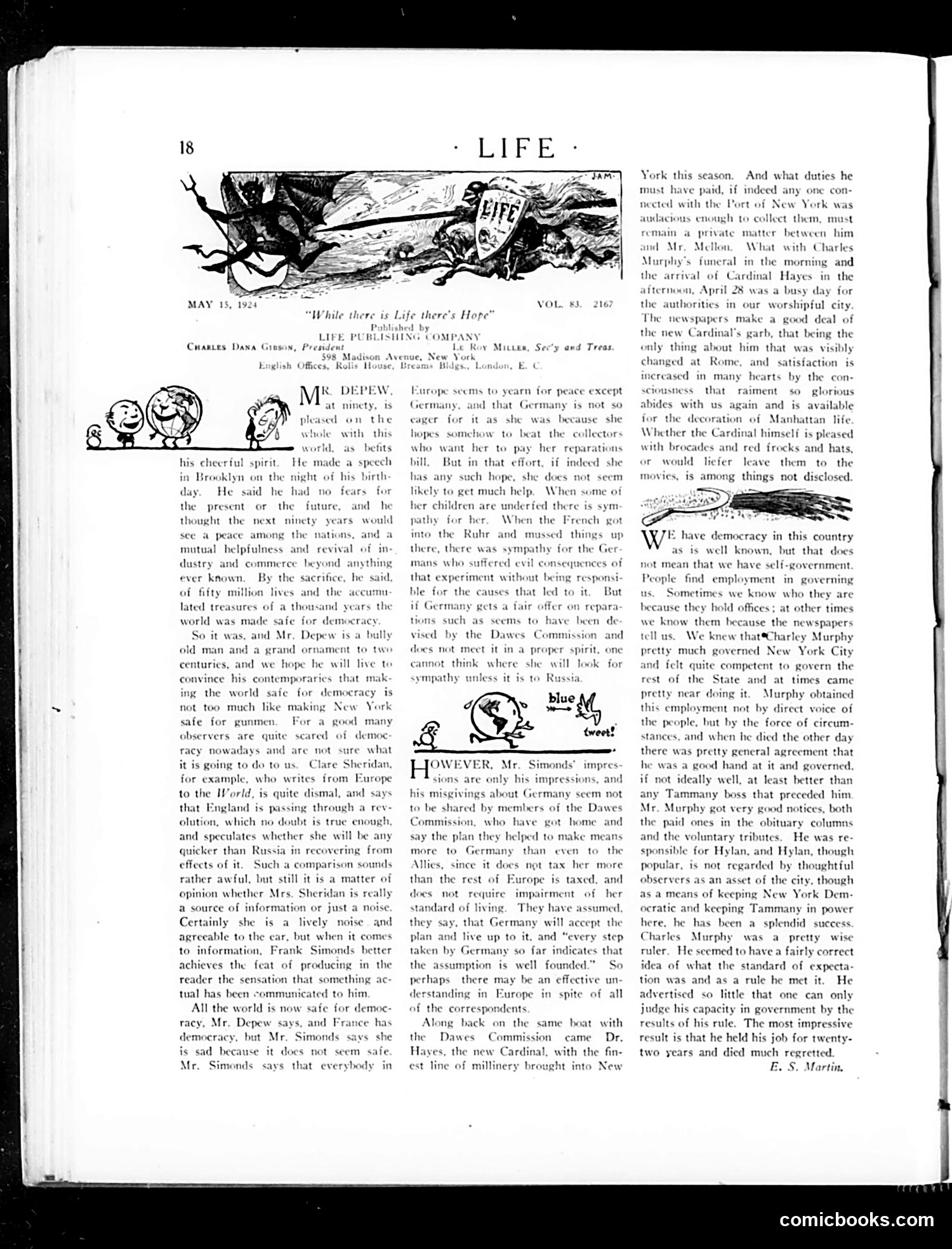
This page discusses Chauncey Depew, a 90-year-old politician who gave an optimistic birthday speech in Brooklyn, predicting peace among nations despite the enormous cost of World War I ("fifty million lives"). The satirist notes the irony: the world was made "safe for democracy," yet observers like Clare Sheridan and Frank Simonds worry democracy itself remains fragile—particularly in Germany and France, which struggle with war debts and reparations. The cartoon at top depicts Life magazine's mascot confronting a skeleton labeled "Life," symbolizing the dark irony of sacrificing millions for democracy's survival. The commentary questions whether post-war recovery and peace are genuinely possible, especially given Germany's resistance to the Dawes Commission reparations plan and France's continued struggle. The satire targets both Depew's naive optimism and the deeper anxieties about whether democratic nations can truly recover from war's devastation.
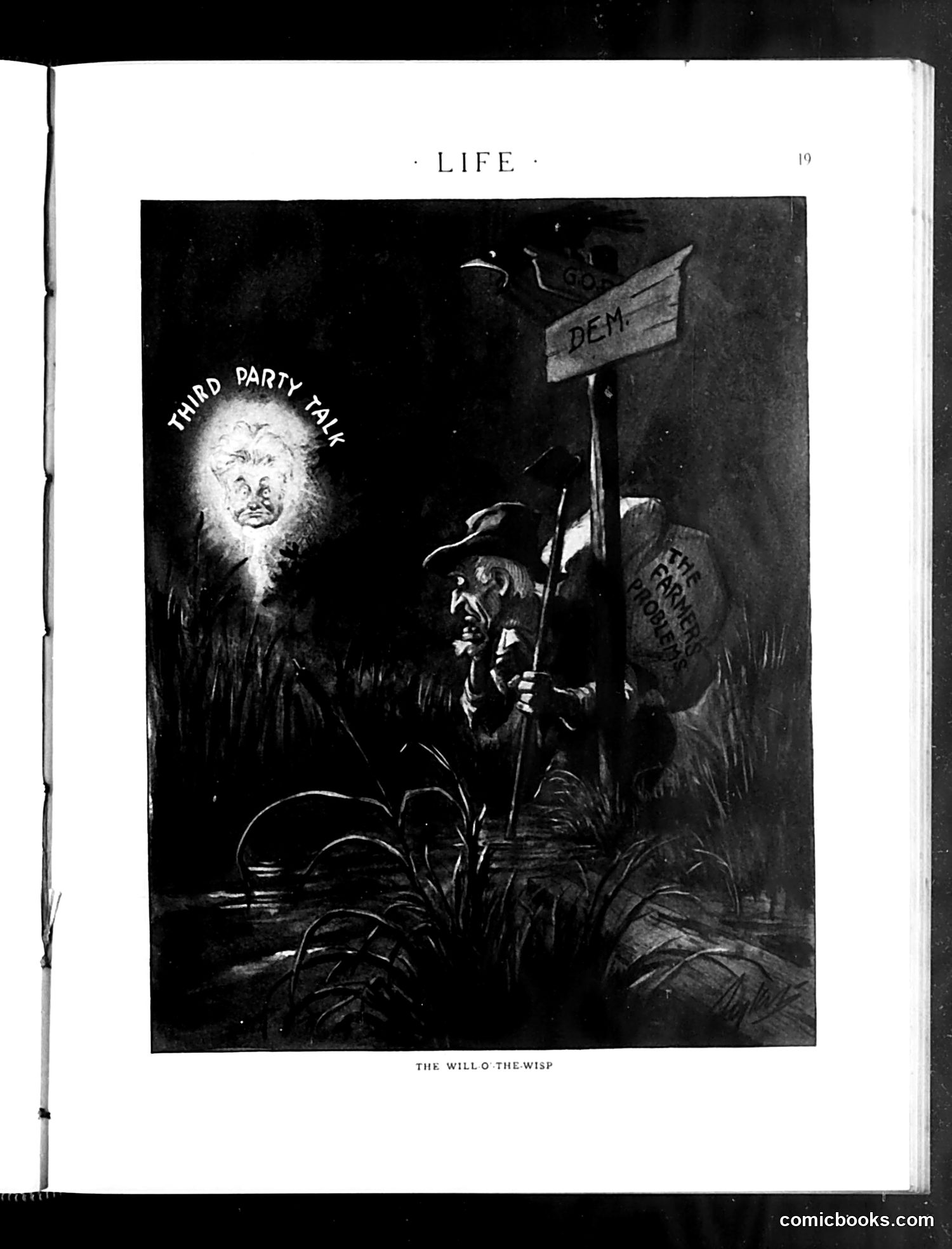
This political cartoon satirizes the "Third Party Talk"—likely referring to third-party political movements or candidates of its era. The image depicts a demonic or ghostly figure labeled "THIRD PARTY TALK" appearing as a glowing, ethereal head in darkness, while a figure holding a flag marked "DEM" (Democrat) and another marked "REPUB" (Republican) pursue it. The "will-o'-the-wisp" metaphor—a deceptive light that lures travelers astray—suggests third-party political movements are illusory temptations that distract voters from the two major parties. The cartoon warns that chasing third-party alternatives is a fool's errand, leading away from established political structures. This reflects longstanding American anxieties about third-party "spoiler" candidates fragmenting the Democratic and Republican vote.
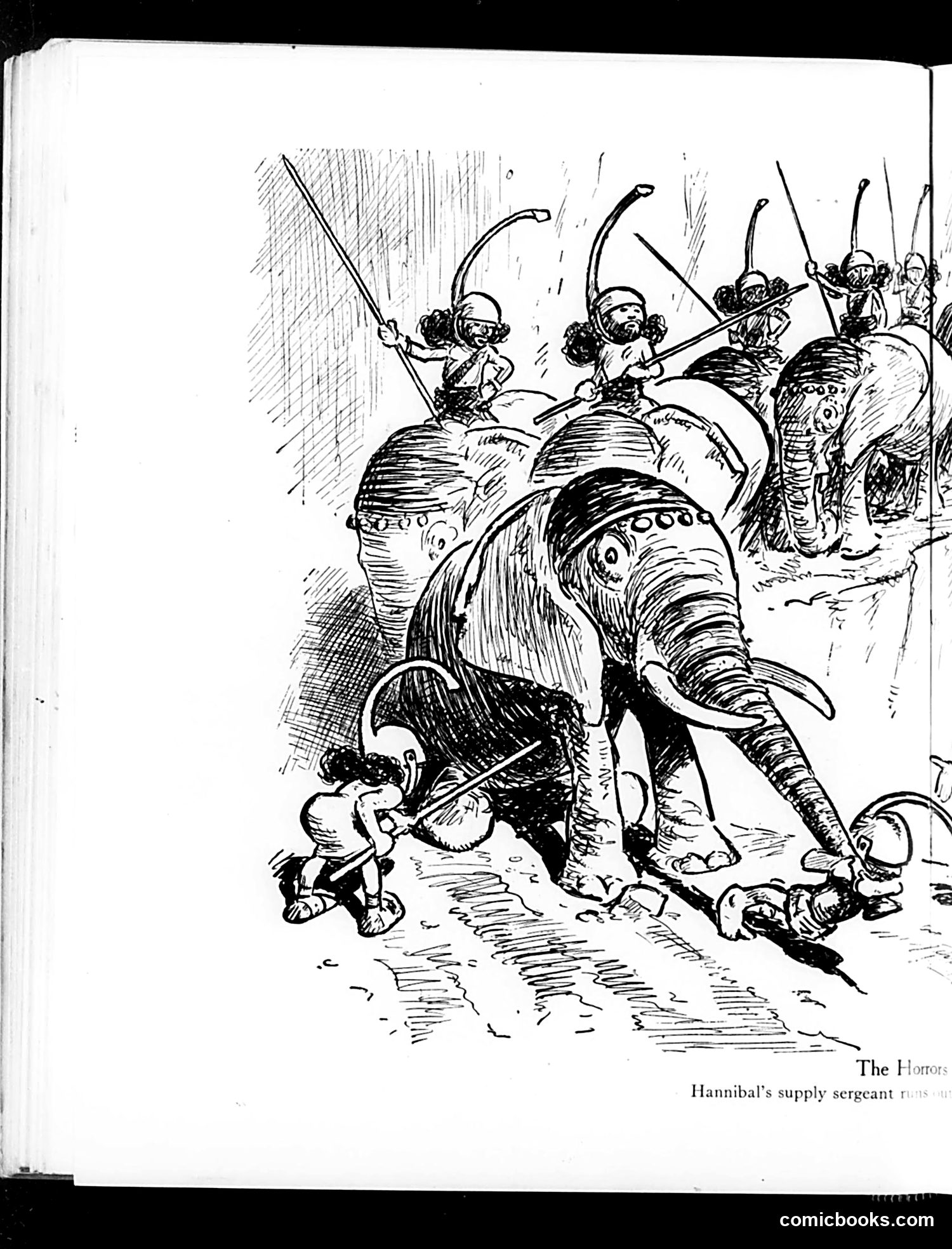
This is a satirical cartoon depicting Hannibal (the ancient Carthaginian general) with his war elephants. The caption reads "The Horror: Hannibal's supply sergeant," though the OCR text is largely corrupted. The joke appears to be a visual pun: the image shows a small figure (the "supply sergeant") confronted with the massive, impractical task of provisioning war elephants—iconic symbols of Hannibal's famous military campaigns. By labeling the sergeant as experiencing "the horror," the cartoonist satirizes the logistical nightmare of maintaining such exotic animals in warfare. This likely mocks either military bureaucracy, the absurdity of maintaining supply lines for unconventional forces, or contemporary political figures attempting impossible administrative tasks. Without the full caption, the specific political reference remains unclear.
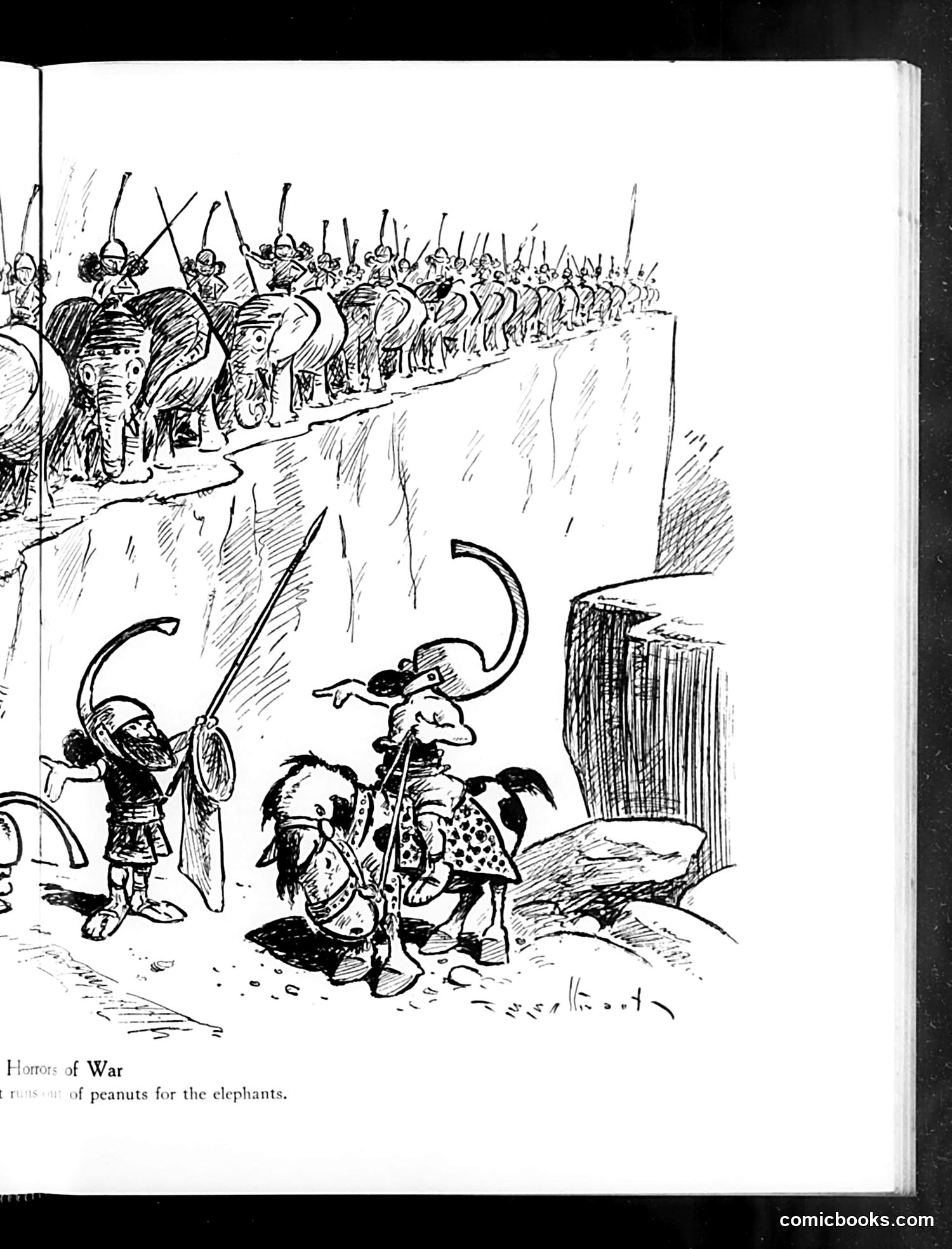
This cartoon from *Life* magazine satirizes military logistics during wartime. The image shows a massive army marching in the background (with elephants and soldiers carrying weapons), while in the foreground, three military figures argue over provisions—specifically, peanuts for the elephants. The satire targets the absurdity of wartime bureaucracy and supply chain management: while vast military resources mobilize for combat, officials squabble over seemingly trivial provisioning details. The elephants suggest this may reference a historical conflict involving war elephants (possibly an ancient or colonial campaign), but the cartoon's broader point mocks how wars bog down in administrative disputes over supplies, however small, even as enormous forces assemble.
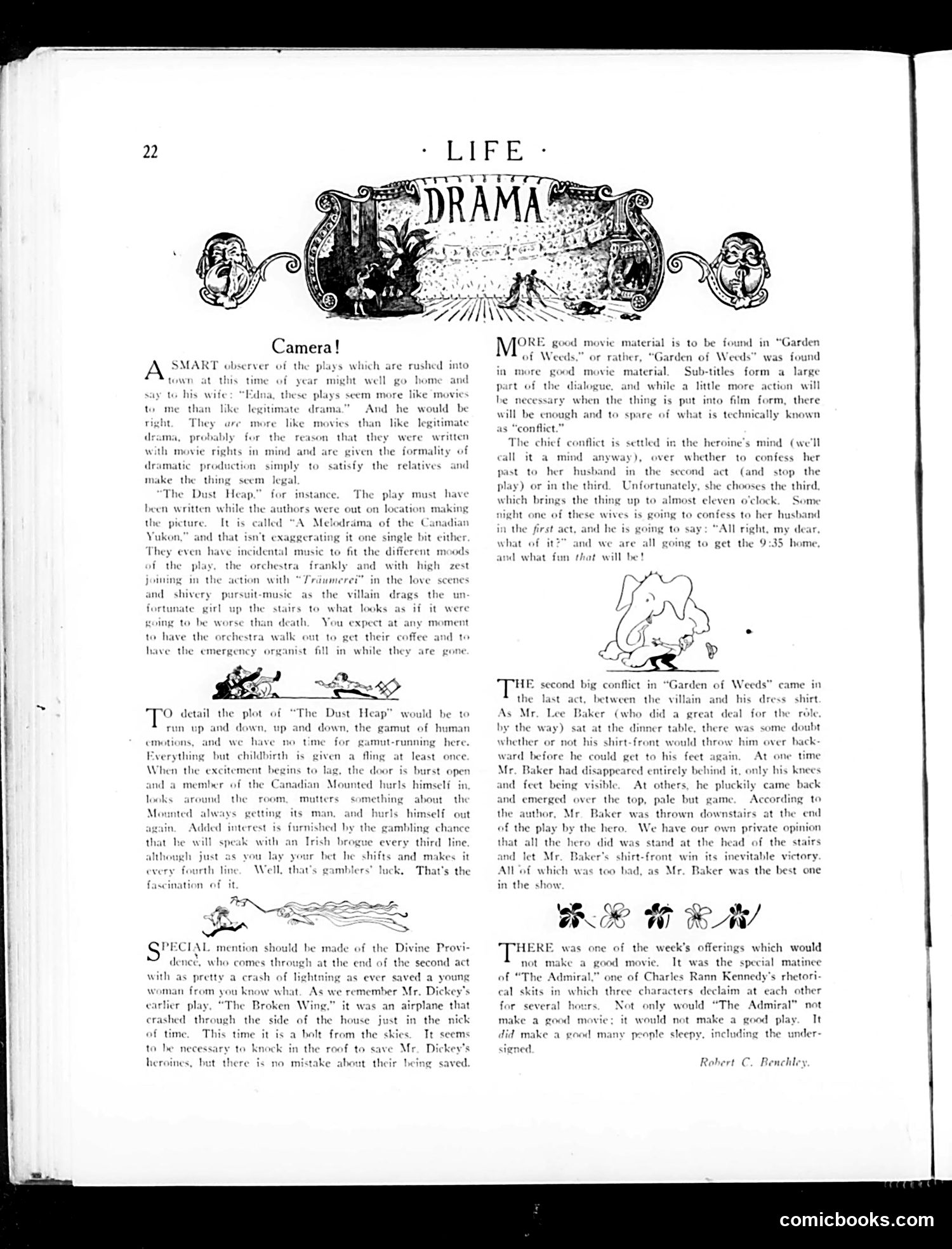
This is a theater review by Robert C. Benchley critiquing plays adapted for film. The piece satirizes how theatrical productions are increasingly written to accommodate movie studios rather than artistic merit. The main targets are plays like "The Dust Heap" (set in the Canadian Yukon) and "Garden of Weeds," which Benchley mocks for their melodramatic plots, overwrought staging, and contrived conflicts. He ridicules how playwrights now consider "movie rights" before artistic integrity, and how orchestras must provide accompaniment for every scene's mood. The humor lies in Benchley's deadpan descriptions of absurd theatrical moments—villains dragging heroines up stairs, emergency organists filling in gaps, actors vanishing backstage—presented as if serious drama. The small cartoon vignettes (four club symbols) appear decorative. Benchley's satire reflects 1920s anxieties about Hollywood's influence corrupting legitimate theater, treating these film-focused plays as cynical, formulaic products rather than genuine art.
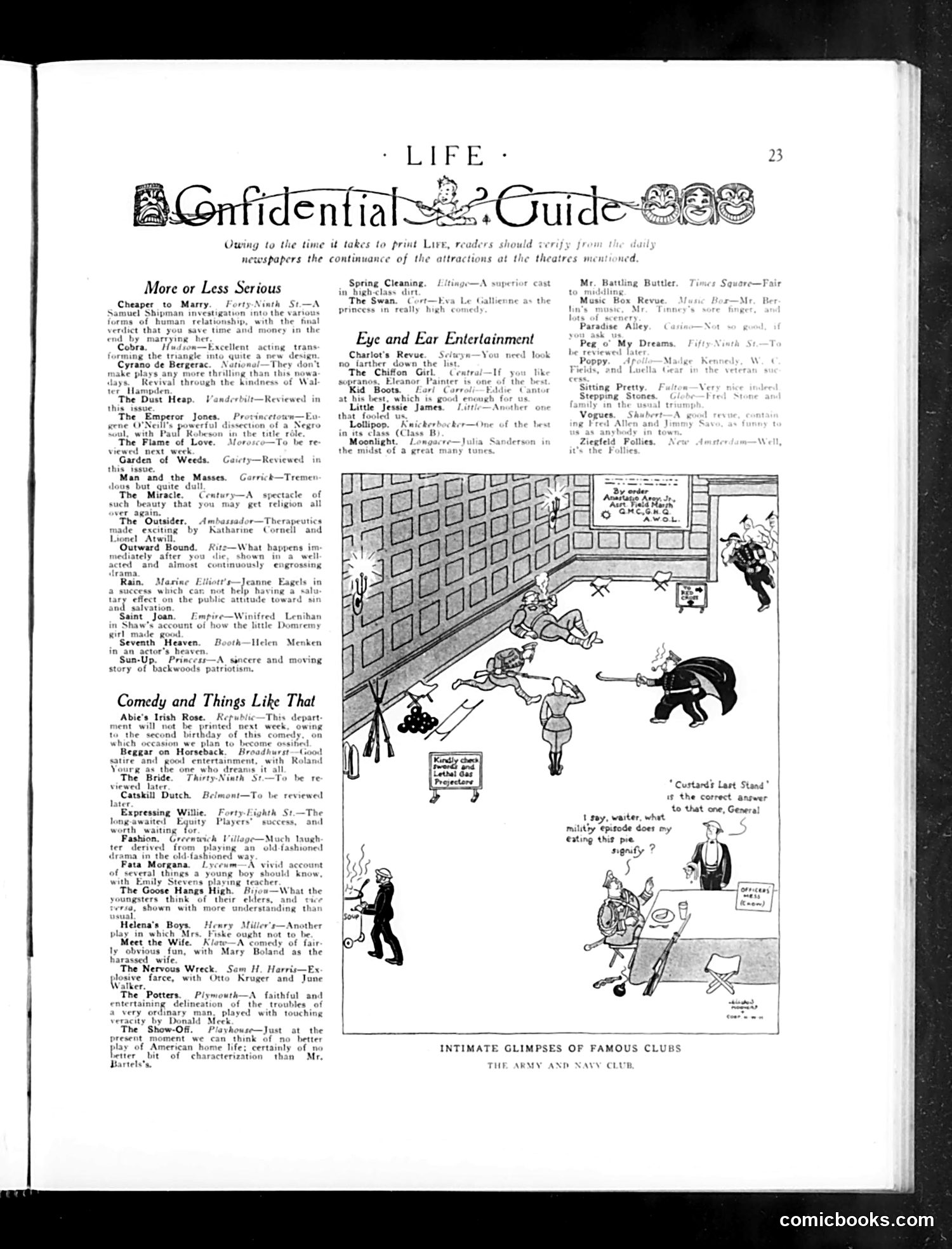
This is a theater review and entertainment guide page, not primarily a political cartoon. The page contains two main elements: **Left column:** Theatrical reviews organized by tone—"More or Less Serious" and "Comedy and Things Like That"—critiquing Broadway productions. Notable reviews mention plays like *Cyrano de Bergerac*, *Abie's Irish Rose*, and *The Show-Off*, offering brief judgments on acting quality and theatrical merit. **Right side:** Cartoon illustrations depicting scenes from the Army and Navy Club, captioned "Intimate Glimpses of Famous Clubs." These appear to be humorous vignettes of club life—showing members in various social situations with dialogue bubbles. One exchange reads: "I say, waiter, what mighty episode does my eating this pie suggest?" with response "'Custard's Last Stand' is the correct answer to that one, General!" The cartoons mock upper-class club culture through gentle humor rather than sharp satire. The page primarily serves as entertainment and cultural commentary for Life's sophisticated urban readership circa the 1920s.
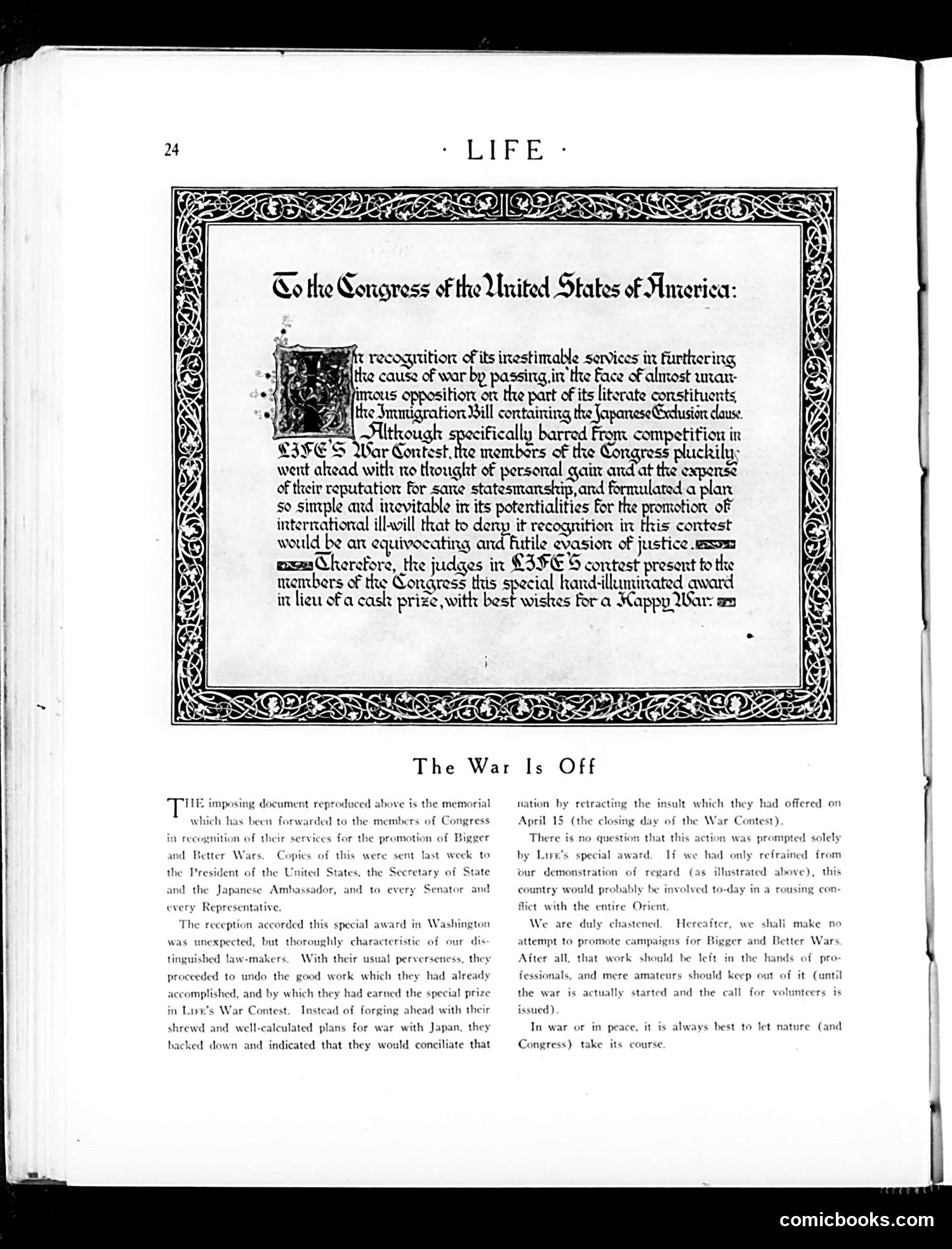
This page satirizes Congress's passage of an anti-Japanese immigration bill during a period of U.S.-Japan tension. Life awarded Congress a mock "special hand-illuminated award" for their work promoting international conflict through the discriminatory legislation (which specifically barred Japanese competition—likely referring to economic or labor competition). The satire's point: Congress passed this inflammatory bill recklessly, without regard for diplomatic consequences or their own reputations. Life then suggests their own satirical "award" somehow shamed Congress into backing down by April 15 (retracting the insult), thus preventing war with Japan. The joke mocks both Congress's initial recklessness *and* their reversal, suggesting amateur politicians bungle both war-making and peace-making equally. Life presents itself as having accidentally derailed international conflict through mockery—a tongue-in-cheek claim about satire's actual power.
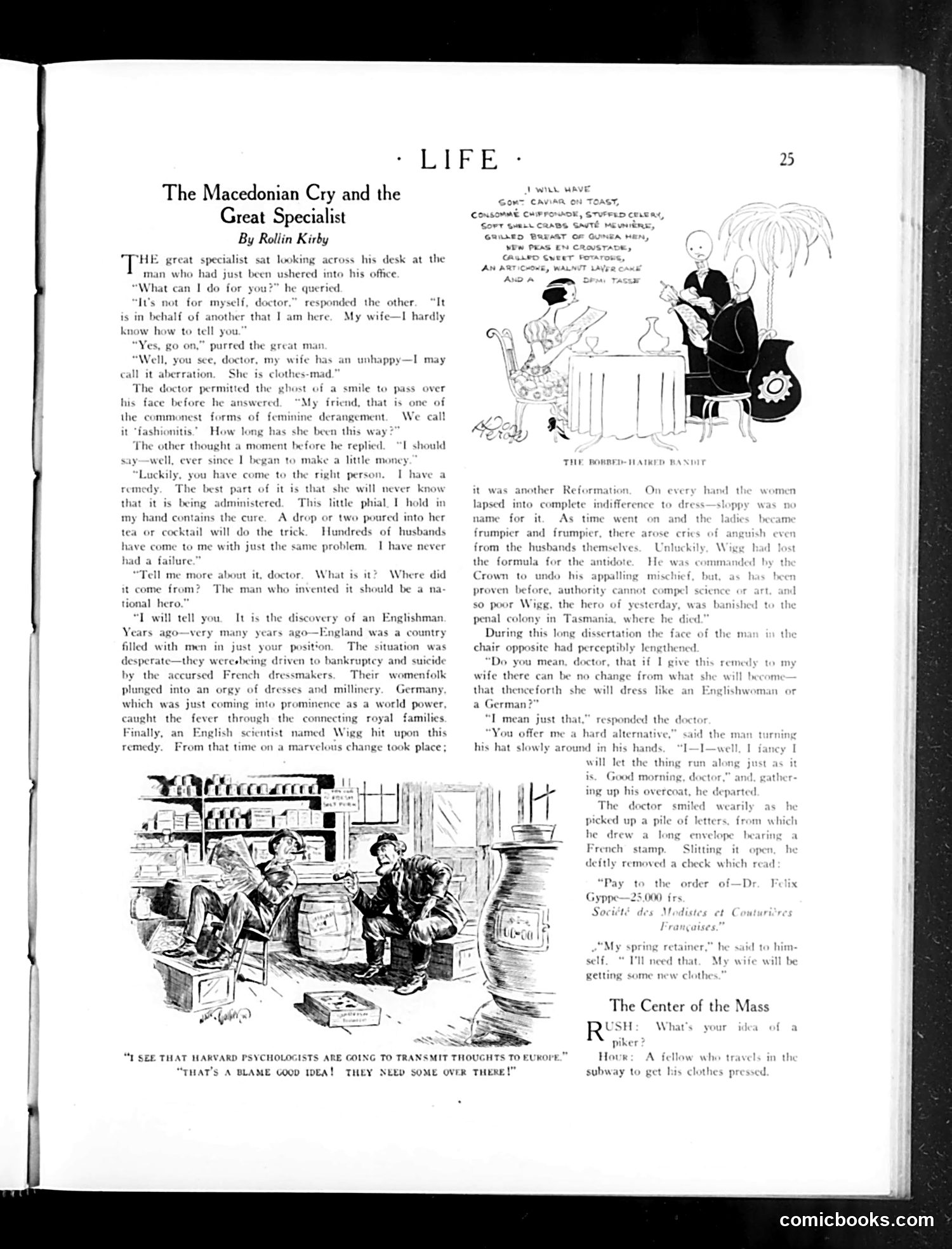
This satirical piece mocks both marital discord and medical quackery. A desperate husband consults a "great specialist" about his wife's "fashionitis"—compulsive clothing purchases that drain the family finances. The doctor offers a secret potion to slip into her tea, claiming an English scientist named Wigg invented it to solve this epidemic among wealthy wives. The joke: the "cure" is presented as miraculous, yet the doctor reveals Wigg was exiled to Tasmania—suggesting the remedy either doesn't work or is morally questionable. The husband accepts this dubious solution anyway. This satirizes early 20th-century anxieties about women's fashion spending, the proliferation of dubious medical "treatments," and husbands' powerlessness over their wives' behavior. The cartoon below reinforces the theme with a separate joke about transmitting thoughts to Europe, suggesting Americans view Europeans as intellectually deficient.
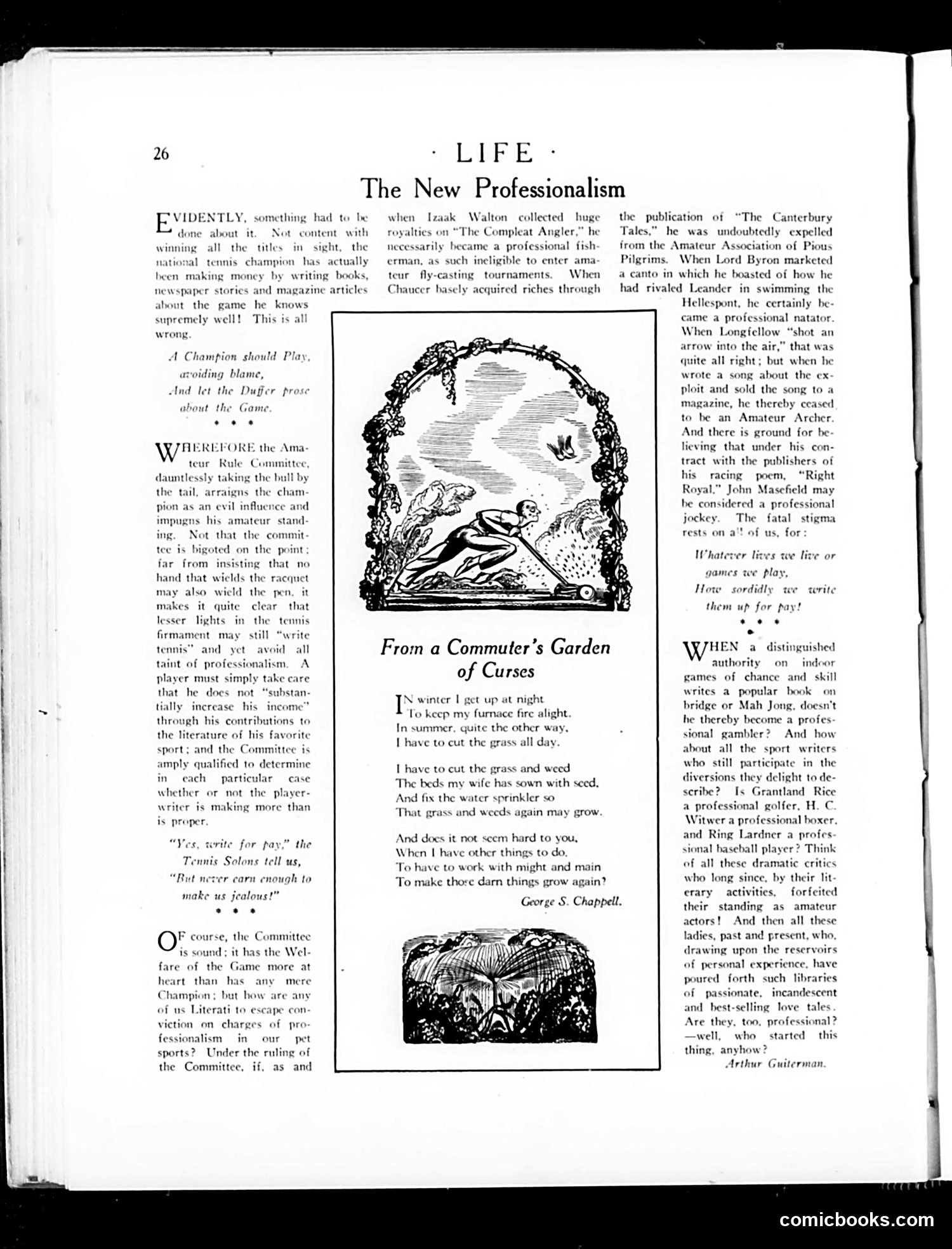
This satirical article mocks the Amateur Athletic Union's rigid rules against athletes earning money from writing about their sports. The satire uses absurd historical examples: Izaak Walton became a "professional fisherman" by publishing about fishing; Chaucer was "expelled" for profiting from *Canterbury Tales*; Lord Byron became a "professional natator" (swimmer) by selling a poem about swimming the Hellespont; Longfellow a "professional archer" for monetizing his arrow poem. The joke: if amateurs can't profit from writing about their sport, then any writer who describes sports or games they participate in—sportswriters, romance novelists—should logically be banned too. The Committee's rules are exposed as arbitrary and impossible to enforce consistently. The accompanying poem "From a Commuter's Garden of Curses" (unrelated) complains about lawn maintenance.
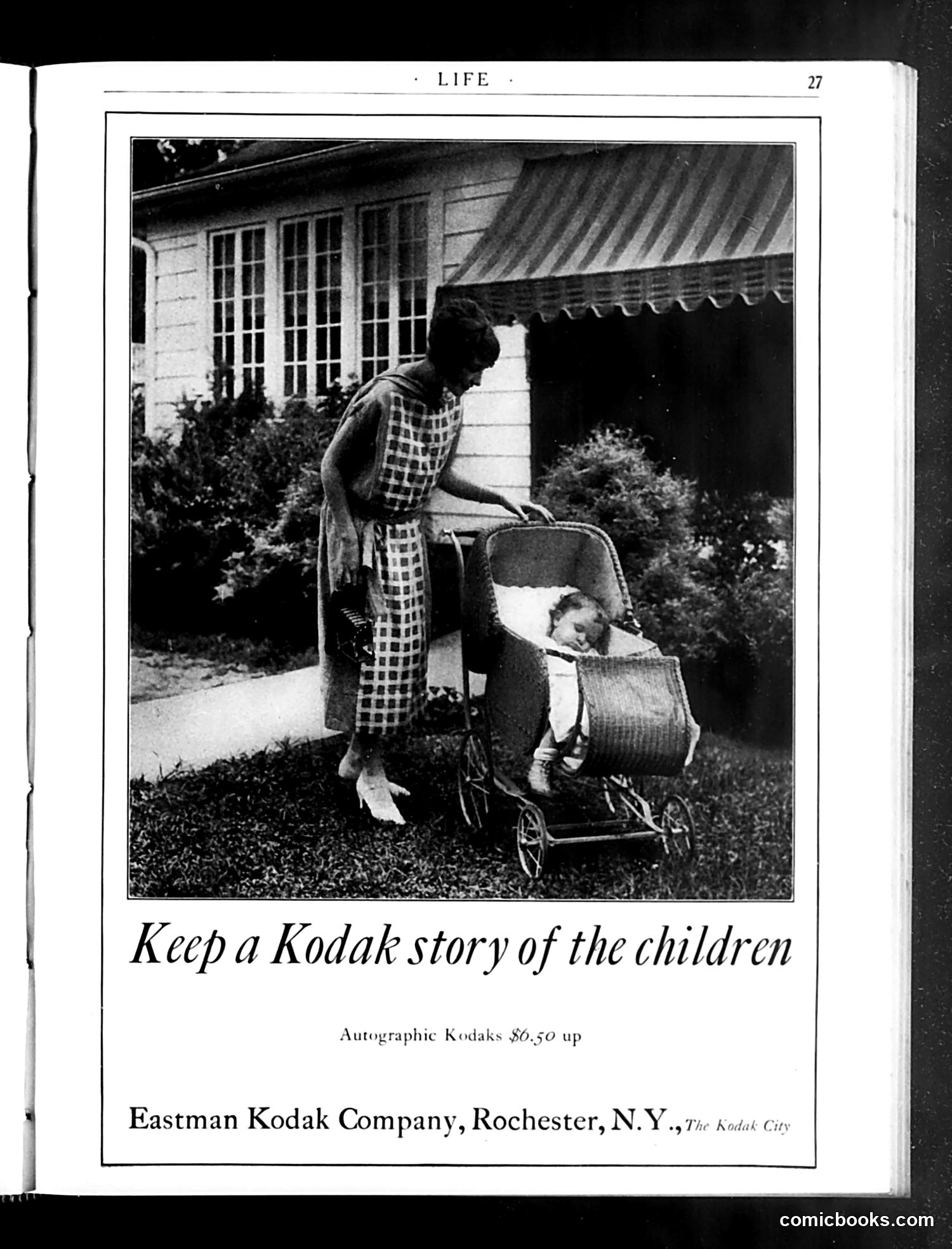
This is a **Kodak advertisement**, not satire or political commentary. It appears in *Life* magazine's advertising section (page 27). The image shows a woman with a baby carriage outside a residential home, with the tagline "Keep a Kodak story of the children." The ad promotes Autographic Kodak cameras starting at $6.50. The appeal is straightforward domestic marketing: it encourages mothers and families to photograph their children and everyday moments, positioning photography as a way to preserve family memories. The "story" metaphor suggests cameras help create a visual narrative of childhood. There is no satire or political commentary present—this is commercial advertising targeting middle-class households, emphasizing family values and consumer product ownership as normal domestic practice.
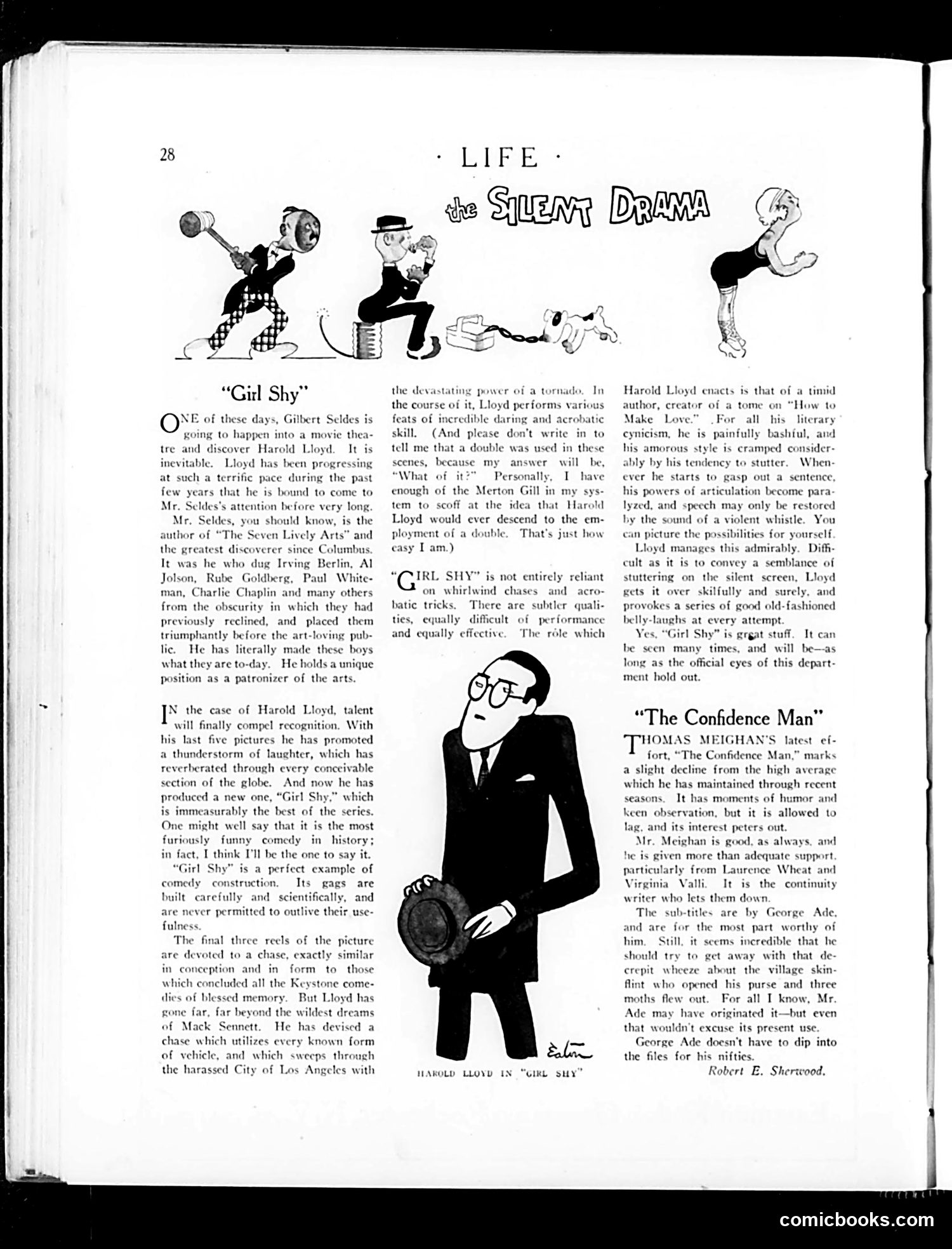
This page contains two film reviews from Life magazine's "The Silent Drama" section, critiquing contemporary silent films. **"Girl Shy"** reviews Harold Lloyd's latest comedy, praising it as his best work. The critic notes Lloyd's rise to prominence through increasingly daring physical comedy—particularly an elaborate chase sequence through Los Angeles utilizing various vehicles. The film's plot involves Lloyd as a timid author of a romance manual who stutters when attempting romantic interaction. The review celebrates Lloyd's ability to convey stuttering visually on the silent screen and his willingness to perform dangerous stunts himself. **"The Confidence Man"** reviews Thomas Meighan's film, finding it a slight decline from his recent work. While praising Meighan's performance and supporting actors (Laurence Wheat and Virginia Valli), the critic blames weak writing ("continuity") for the film's lag in interest. Both reviews exemplify early cinema criticism—emphasizing physical comedy construction, stunt work, and visual storytelling techniques essential to silent film.
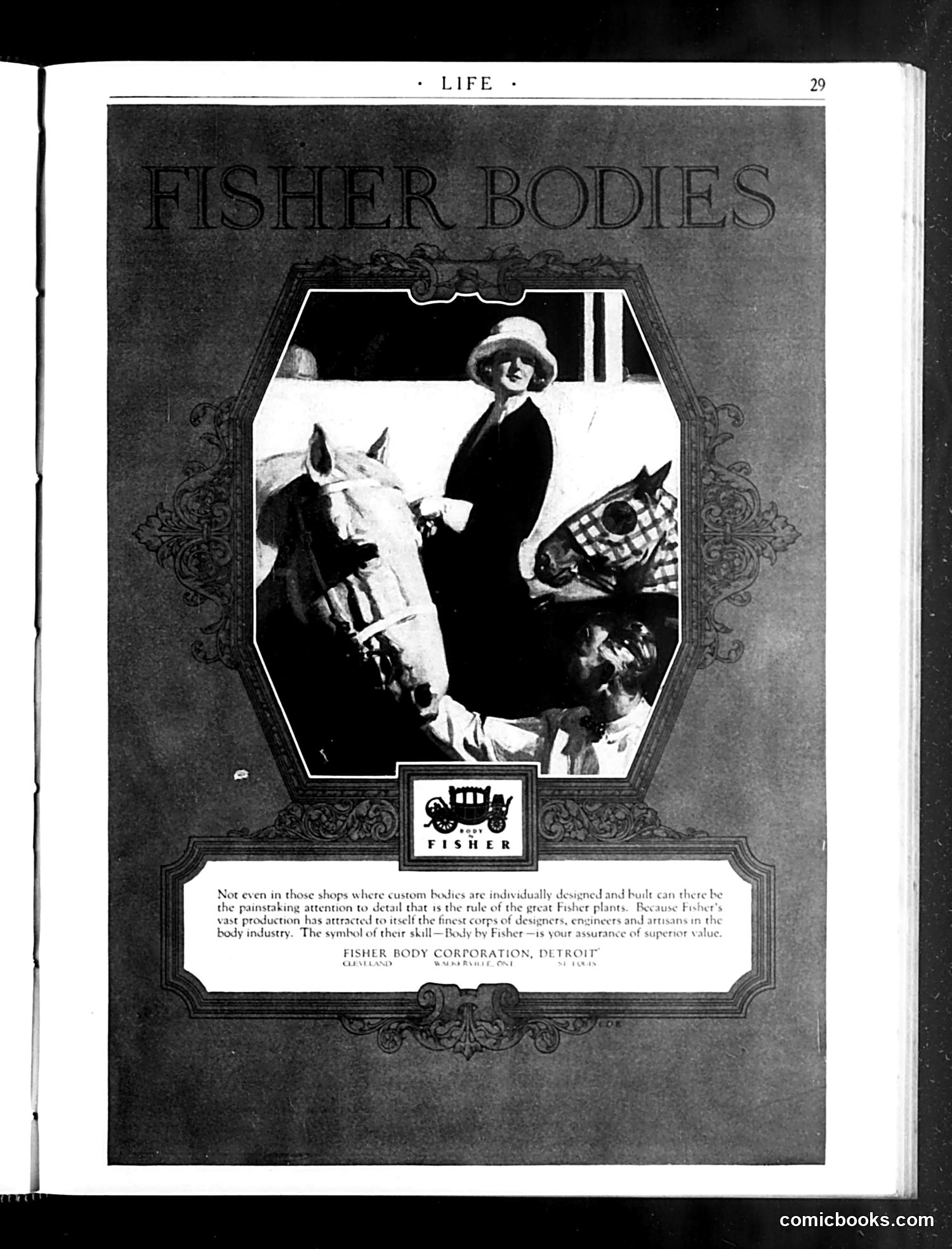
This is a full-page advertisement for Fisher Body Corporation, a Detroit-based automobile body manufacturer. The image shows a fashionable woman in a cloche hat and coat standing beside two horses in what appears to be an open-air automobile body. The ad argues that Fisher's mass production doesn't compromise quality—in fact, their large scale attracts top designers and craftsmen. The comparison to custom body shops suggests Fisher offers handcrafted quality at industrial scale. The equestrian setting implies luxury and refinement. This appears to be from the 1920s, when Fisher was a major supplier of car bodies to General Motors and other manufacturers. The "Body by Fisher" trademark became a prestigious selling point, suggesting superior craftsmanship despite mass production.
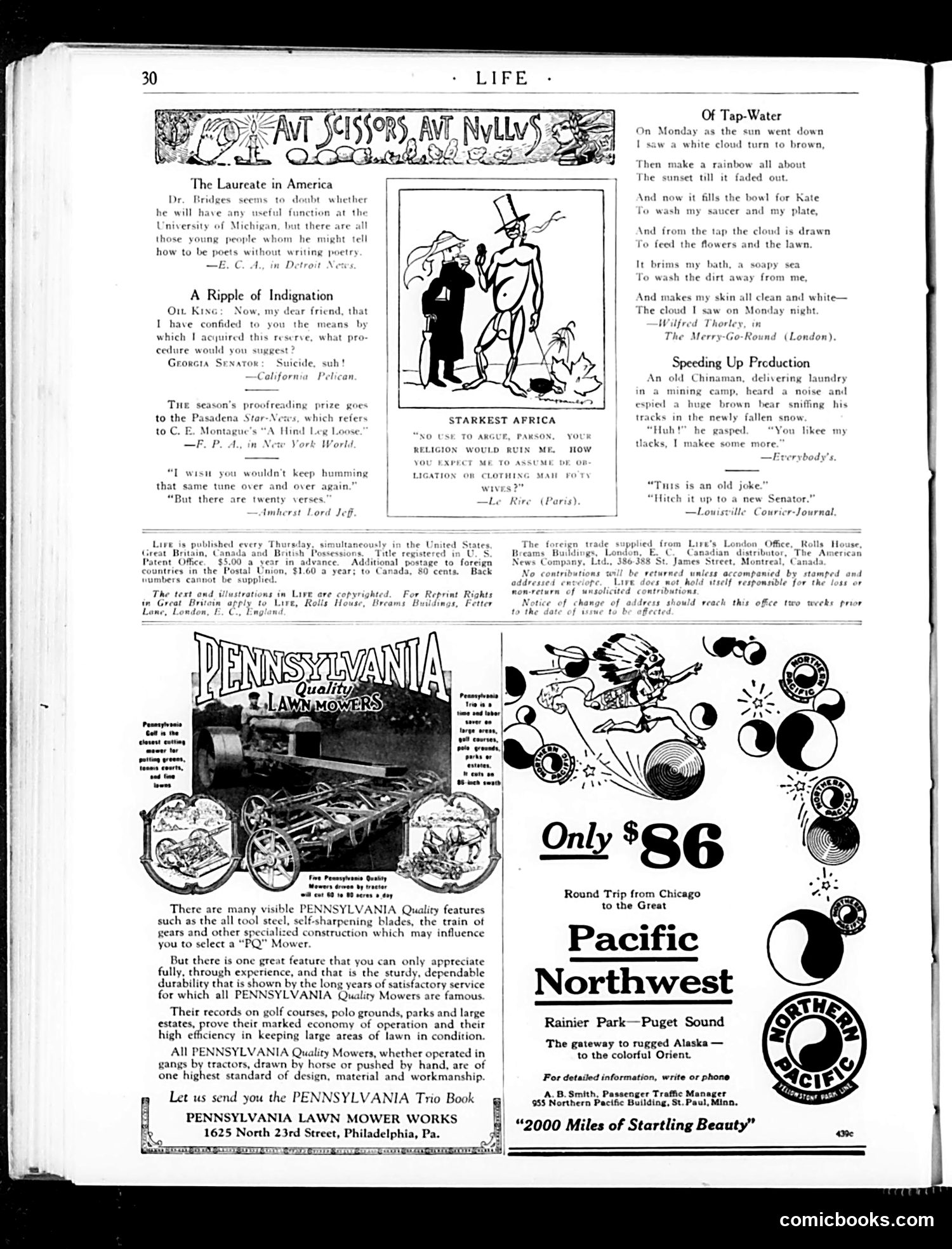
This page contains several satirical humor pieces typical of Life magazine's format: **"The Laureate in America"** mocks Dr. Robert Bridges (British Poet Laureate), questioning whether he'll find useful employment at the University of Michigan, suggesting American institutions have limited need for traditional poets. **"A Ripple of Indignation"** presents a brief dialogue where Oil King confides in a friend about acquiring "reserve" (likely wealth/status), and Georgia Senator responds with a dark joke about suicide—reflecting early 20th-century social anxieties about class and status. **Short humor pieces** include jokes about proofreading errors, marital disputes, and ethnic humor (a Chinese laundyman joke). **"Of Tap-Water"** is a sentimental poem by Wilfred Thorley about rainwater's cycle from cloud to tap. The page is primarily **advertising-heavy**, featuring Pennsylvania Lawn Mowers and a Northern Pacific Railway travel advertisement for the Pacific Northwest at $86. The satirical content reflects period concerns: immigrant labor, class status, marital discord, and American cultural identity versus European traditions.
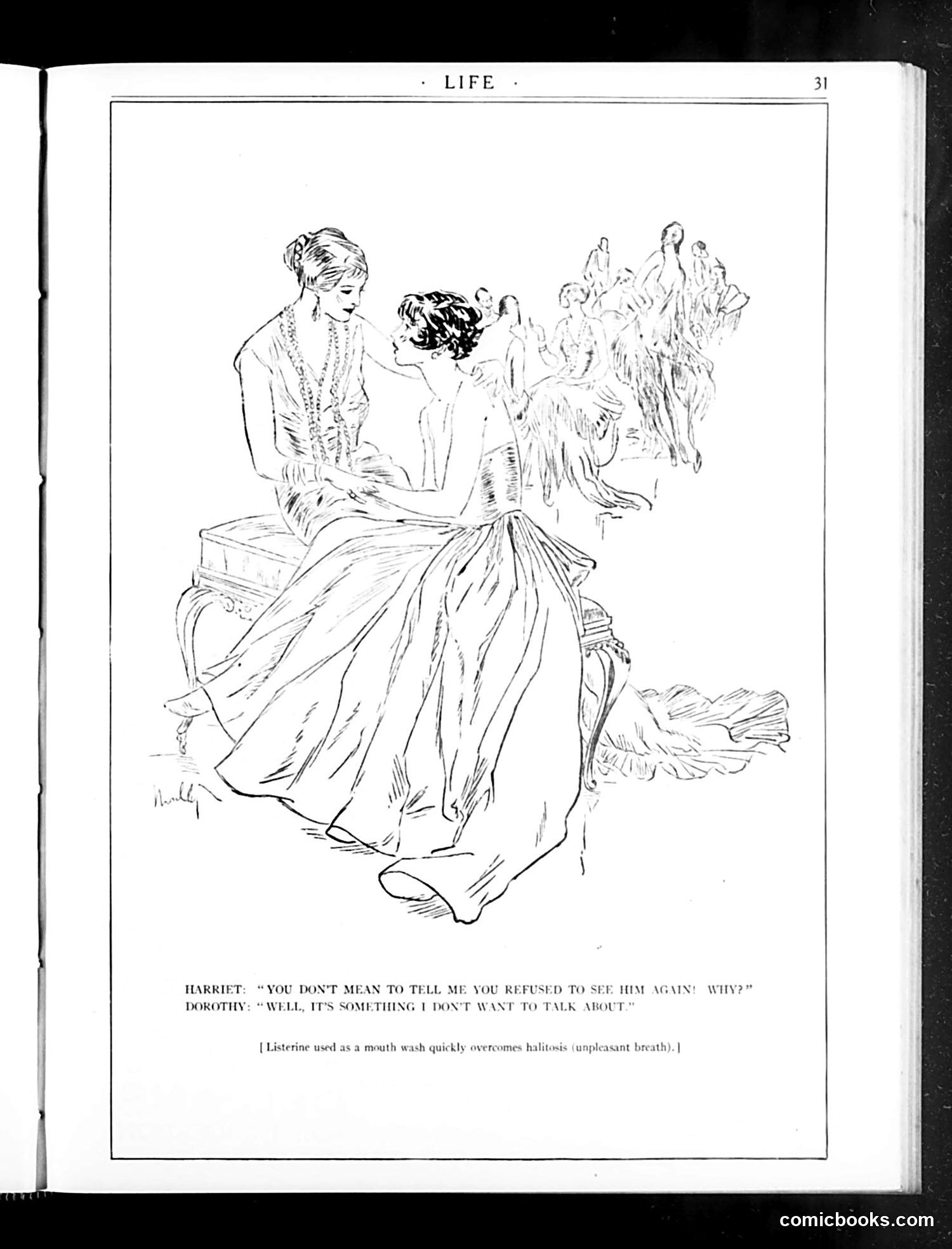
This is a **Listerine advertisement disguised as a comic scene**. Two women, Harriet and Dorothy, discuss why Dorothy refused a second date. Dorothy's evasive response ("something I don't want to talk about") implies an embarrassing reason. The caption reveals the joke: **halitosis** (bad breath) caused the romantic rejection. The ad suggests Listerine mouthwash solves this problem, allowing women to secure romantic prospects. This reflects early 20th-century advertising that weaponized insecurity—particularly targeting women with the implication that personal hygiene directly affects marriageability and social success. The cartoon's format makes the pitch entertaining rather than overtly promotional, a common advertising technique of the era.
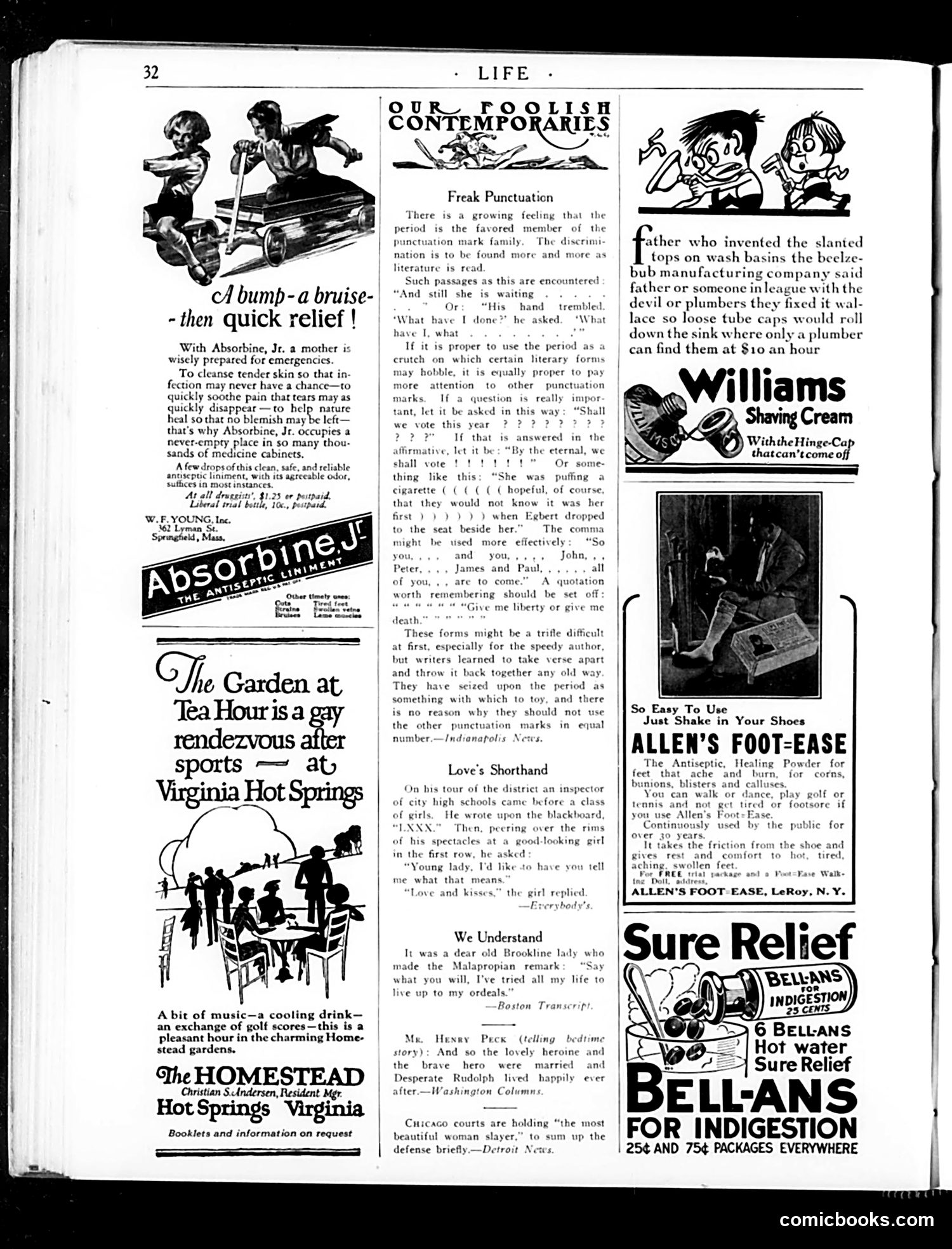
This page is primarily **advertisements and short humorous pieces**, not political commentary. The main content includes: **"Our Foolish Contemporaries"** section: A satirical critique of modern punctuation abuse in literature. The writer mocks authors who overuse periods, commas, and question marks as stylistic "crutches" rather than grammatical tools—citing absurd examples like "22222?" instead of proper punctuation. This reflects early 20th-century debates about literary modernism and unconventional writing styles. **Short humor pieces** (Love's Shorthand, We Understand): Gentle jokes about miscommunication and malapropisms, typical of *Life* magazine's light humor. **Advertisements**: Products like Absorbine Jr. (antiseptic), Allen's Foot-Ease (powder), and Bellans (indigestion relief) dominate the page—reflecting common health concerns of the era. The **Virginia Hot Springs resort ad** promotes leisure culture for the wealthy. No political figures or events are referenced.
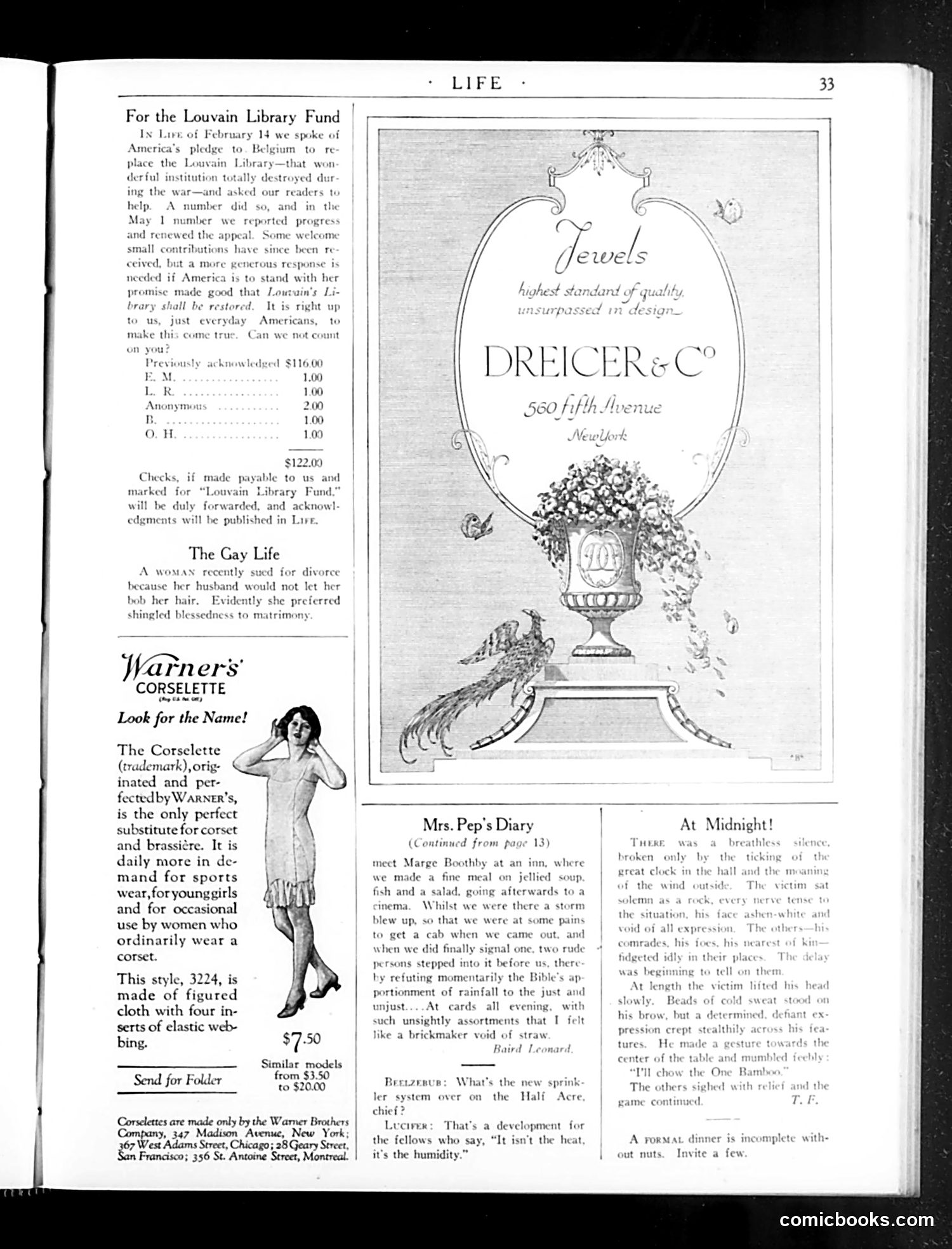
This page is primarily **advertising and fundraising**, not political satire. The main content solicits donations for the **Louvain Library Fund**—a real WWI relief effort to rebuild Belgium's university library, destroyed during the German occupation. Life magazine is appealing to American readers' patriotism and generosity to restore this "wonderful institution." The other items are standard magazine fare: a brief humorous anecdote ("The Gay Life") about a woman divorcing her husband over hair styling preferences; a Warner Brothers corset advertisement; and the continuation of a serialized diary column ("Mrs. Pep's Diary"). The decorative jewelry advertisement for Dreicer & Co. is typical luxury marketing of the era. No political cartoons or satirical commentary appears on this page—it's a mix of fundraising, light humor, and period advertising aimed at the magazine's middle-to-upper-class female readership.
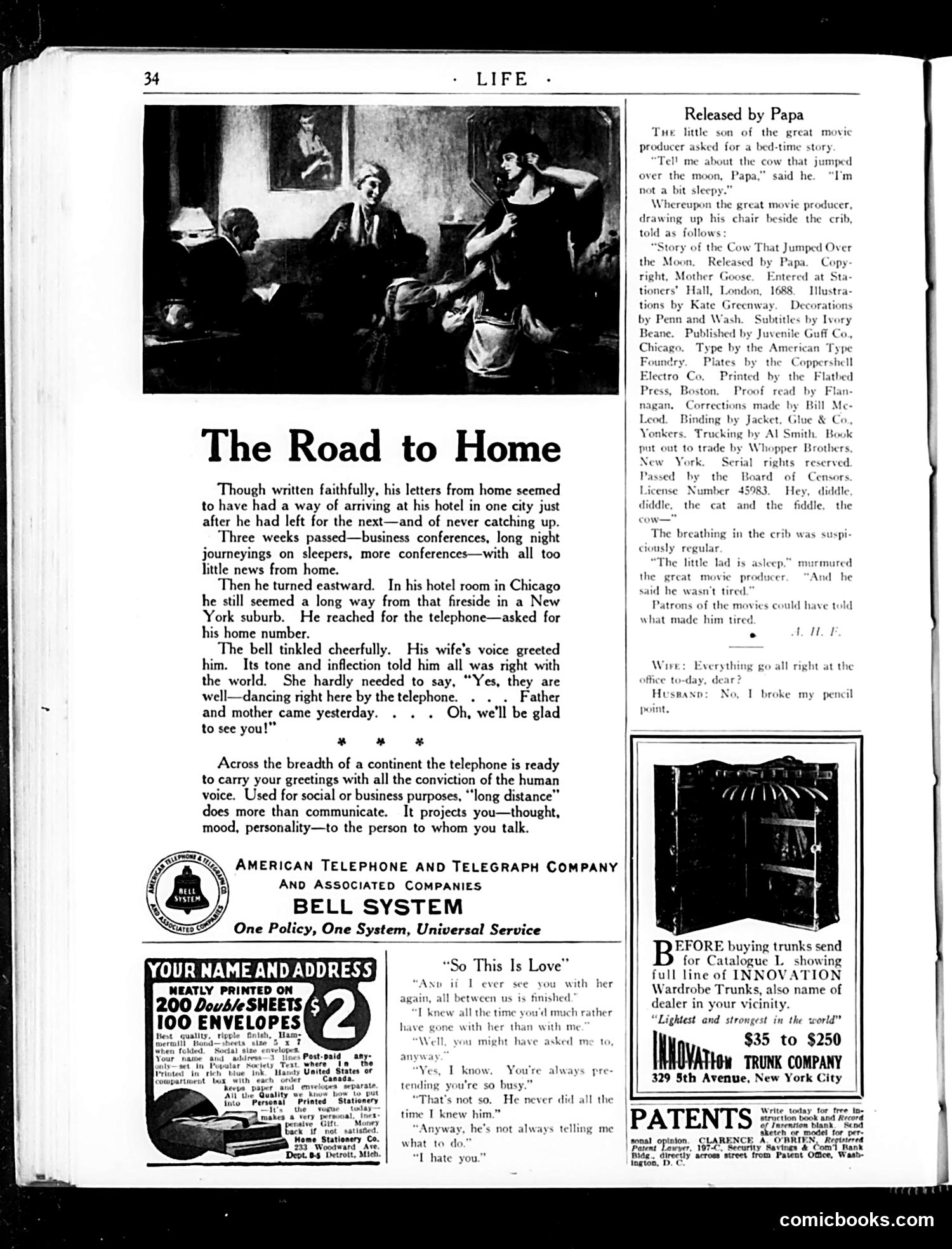
This page is primarily a **Bell System telephone advertisement** disguised as editorial content. The main narrative describes a businessman traveling for work who feels disconnected from his family despite faithful letter-writing. The solution: he calls home long-distance from Chicago, and his wife's voice instantly reassures him that all is well—family members are present, children are happy. The satire is implicit rather than explicit: the piece gently mocks both the emotional strain of modern business travel and celebrates the telephone as a solution to emotional distance. The accompanying vignettes ("So This Is Love," "Released by Papa") are separate humorous sketches about romance and parenting—likely unrelated to the ad's main message. The page includes typical early 20th-century classified advertisements (printing services, trunk company, patent lawyer). **No political content is present.** This is commercial propaganda presenting the telephone as emotionally and socially essential.
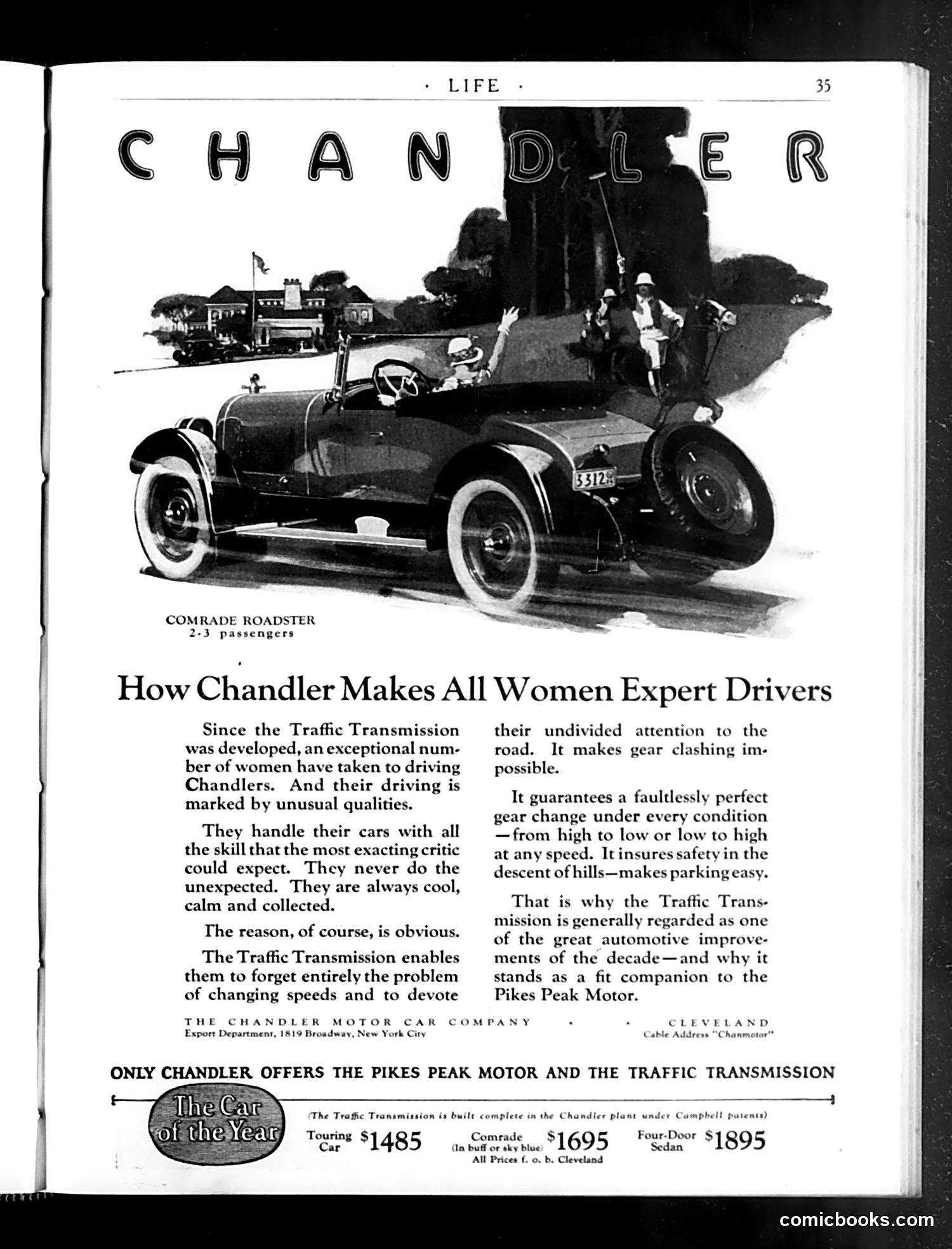
This is a **Chandler automobile advertisement**, not a satirical cartoon. It uses period-typical gender stereotyping to promote the car's "Traffic Transmission." The ad claims that women drivers of Chandlers are exceptionally skilled and composed—but the humor lies in the *implied reason*: not because women are naturally good drivers, but because the automatic transmission does the work *for* them. By eliminating manual gear-shifting, women supposedly can't make mistakes and thus appear competent. This reflects 1920s attitudes: women were stereotyped as poor drivers prone to panic, yet the ad backhanded compliments them by suggesting mechanical aids make them "expert drivers." The imagery of women confidently at the wheel was meant to appeal to the growing female automotive market, while the subtext reinforces that they needed technological help to drive safely. The "Comrade Roadster" name is unclear in meaning here.
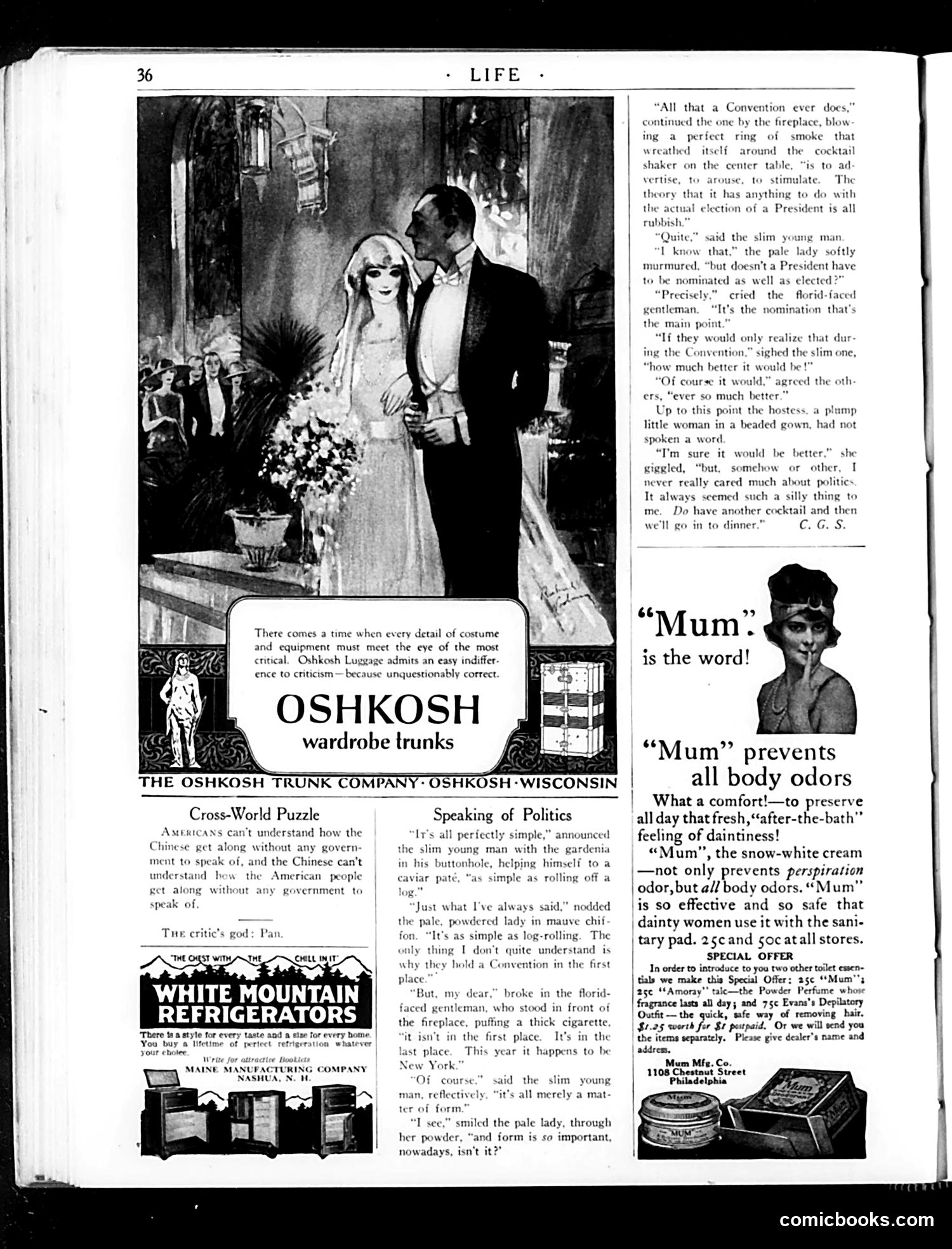
This dialogue satirizes wealthy, upper-class Americans' shallow understanding of presidential politics during the convention season (the page appears to be from the 1920s era, likely). The characters—a man with a gardenia, a powdered socialite in chiffon, and a florid-faced gentleman by the fireplace—casually dismiss the presidential convention as mere "form" and spectacle rather than a serious democratic process. They debate whether conventions actually affect elections, with one character suggesting they exist only to "advertise" and "stimulate" public interest. The joke's punchline comes from the hostess—a woman in a beaded gown—who admits she's never cared about politics at all and finds the whole subject "silly," preferring to discuss cocktails and dinner instead. The satire mocks how the privileged classes, while enjoying the fruits of democracy, treat its fundamental processes as trivial social conversation—mere entertainment between drinks. The characters' vapid sophistication masks complete political indifference.
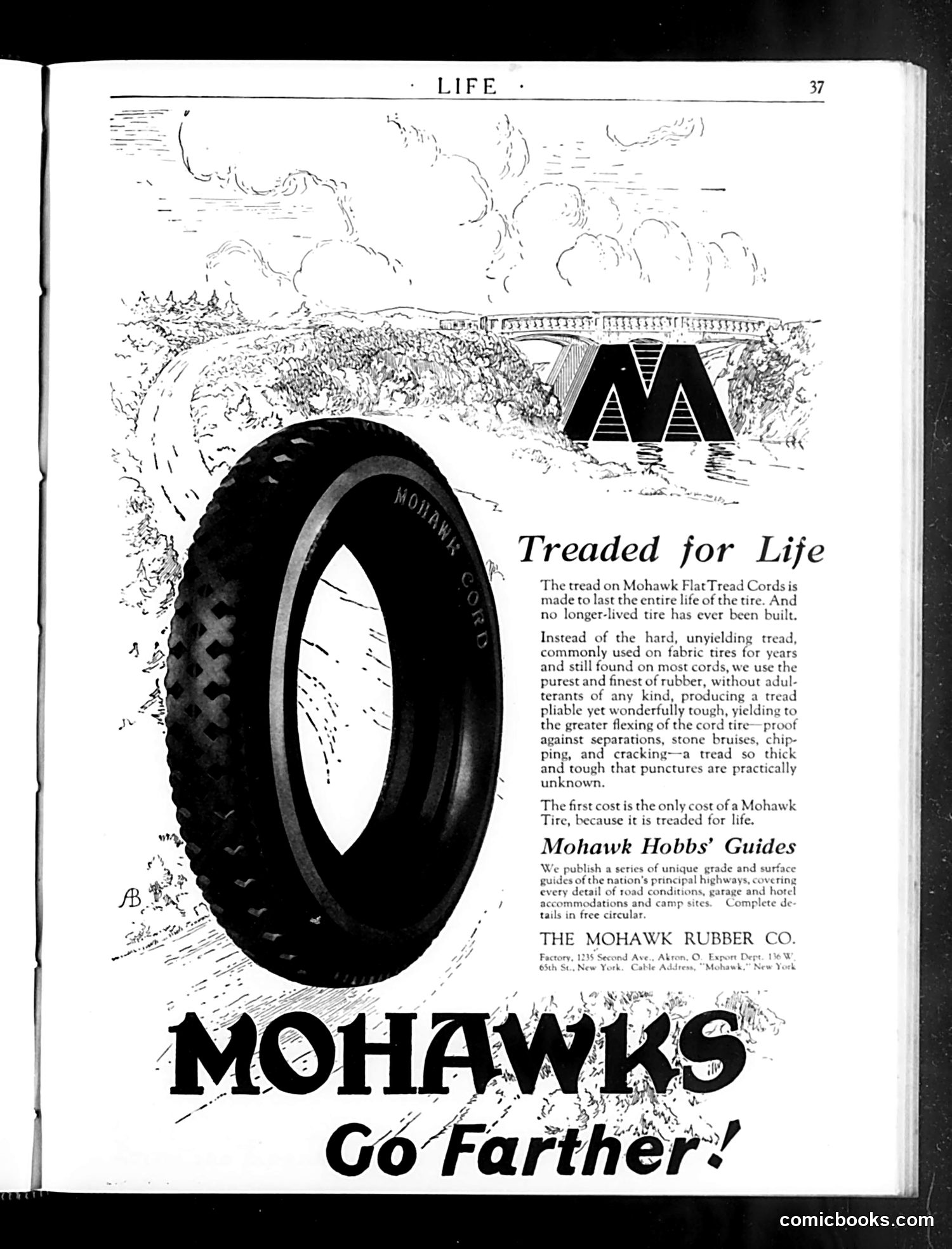
This is a **tire advertisement**, not political satire or a cartoon. The Mohawk Rubber Company is promoting their "FlatTread Cords" automobile tires in a Life magazine ad (page 37). The imagery shows a large tire photographed against a landscape sketch featuring a bridge and road, emphasizing durability for travel. The accompanying text makes a straightforward sales pitch: Mohawk tires last "the entire life of the tire" because they use superior rubber that resists punctures, cracking, and separation—making them economical despite higher initial cost. The secondary section advertises "Mohawk Hobbs' Guides," travel guidebooks covering American highways with accommodations and camping information. The tagline "Go Farther!" is a period motoring slogan playing on both the product's durability and the era's enthusiasm for automobile travel and road trips.
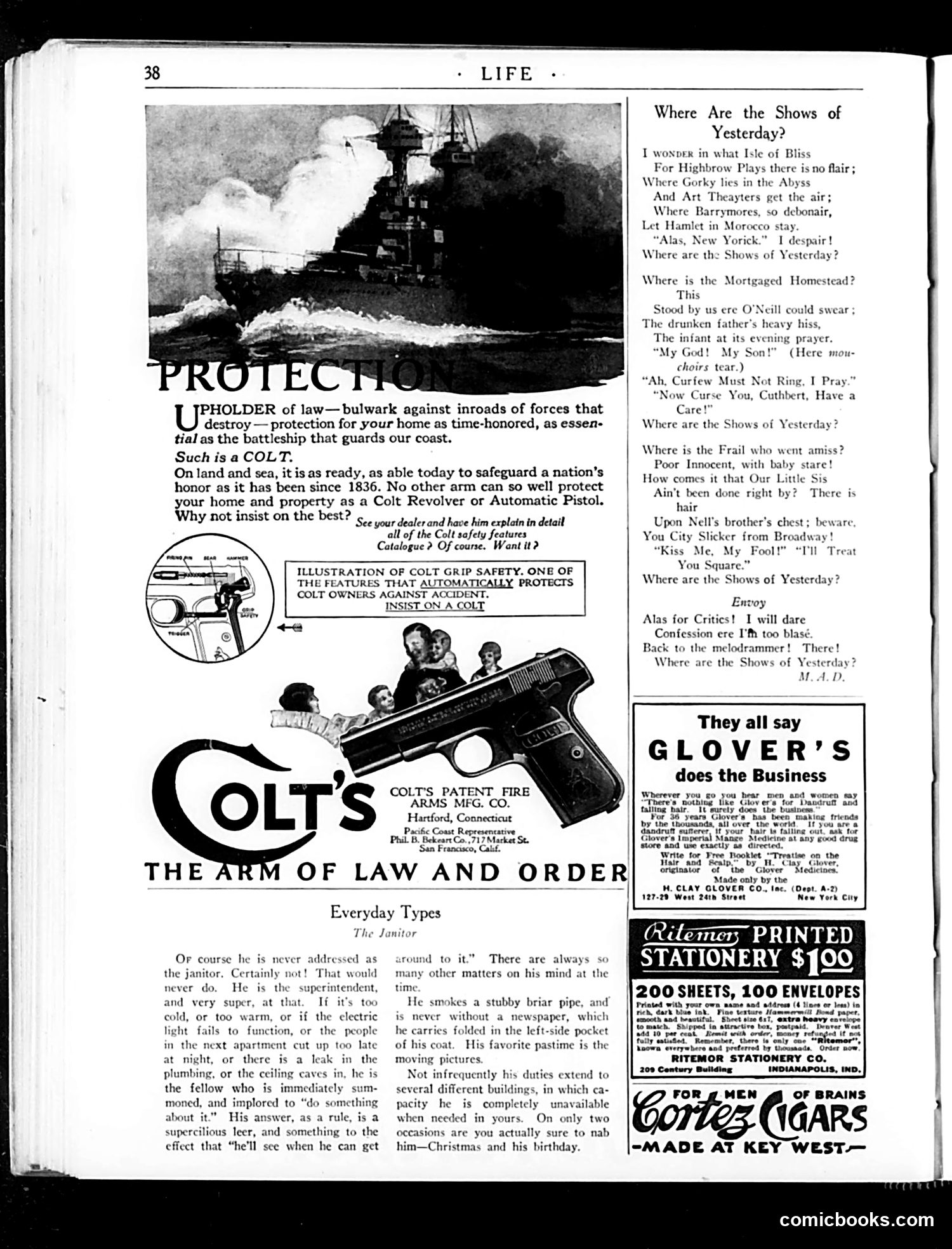
This page is primarily **advertising**, not editorial satire. The dominant content features a Colt firearms advertisement ("The Arm of Law and Order") emphasizing home protection, alongside ads for Glover's medicines, Palemer stationery, and Cortez cigars. The only editorial content is a poem titled "Where Are the Shows of Yesterday?"—a nostalgic lament about defunct New York theaters (Highbrow Plays, Gorky, Art Theaters, Barrymores, Hamlet in Morocco). The poem's author is credited as "M.A.D." There is **no political cartoon** on this page. The Colt advertisement includes an illustration of the pistol and a grip-safety diagram, but this is product marketing rather than satire. The page reflects early 20th-century consumer culture and theatrical nostalgia rather than political commentary.
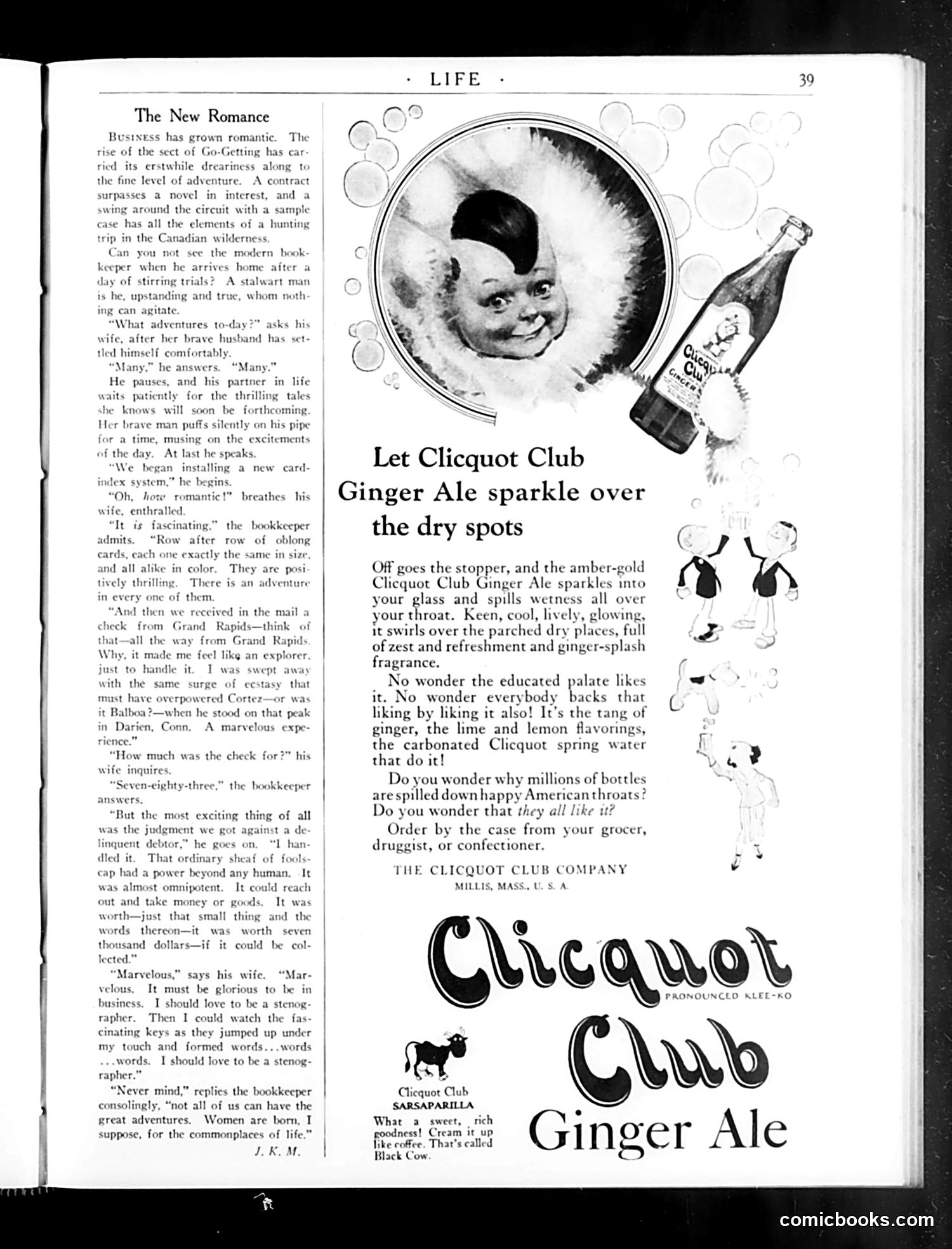
This page satirizes the romanticization of mundane business life in early 20th-century American culture. The article mocks how salesmen and office workers—particularly bookkeepers—have begun treating their dreary daily tasks as grand adventures comparable to exploration or warfare. The satire centers on a bookkeeper describing his workday to his wife: installing a card-index system and receiving a check from Grand Rapids. He inflates these tedious activities into epic narratives, comparing himself to explorers like Cortez or Balboa. His wife, eager for excitement, fantasizes about becoming a stenographer to experience similar "adventures." The humor lies in the absurdity of finding heroic meaning in clerical work and the era's "Go-Getting" business culture that elevated commercial success to romantic status. The remainder of the page is a Clicquot Club Ginger Ale advertisement, unrelated to the satire.
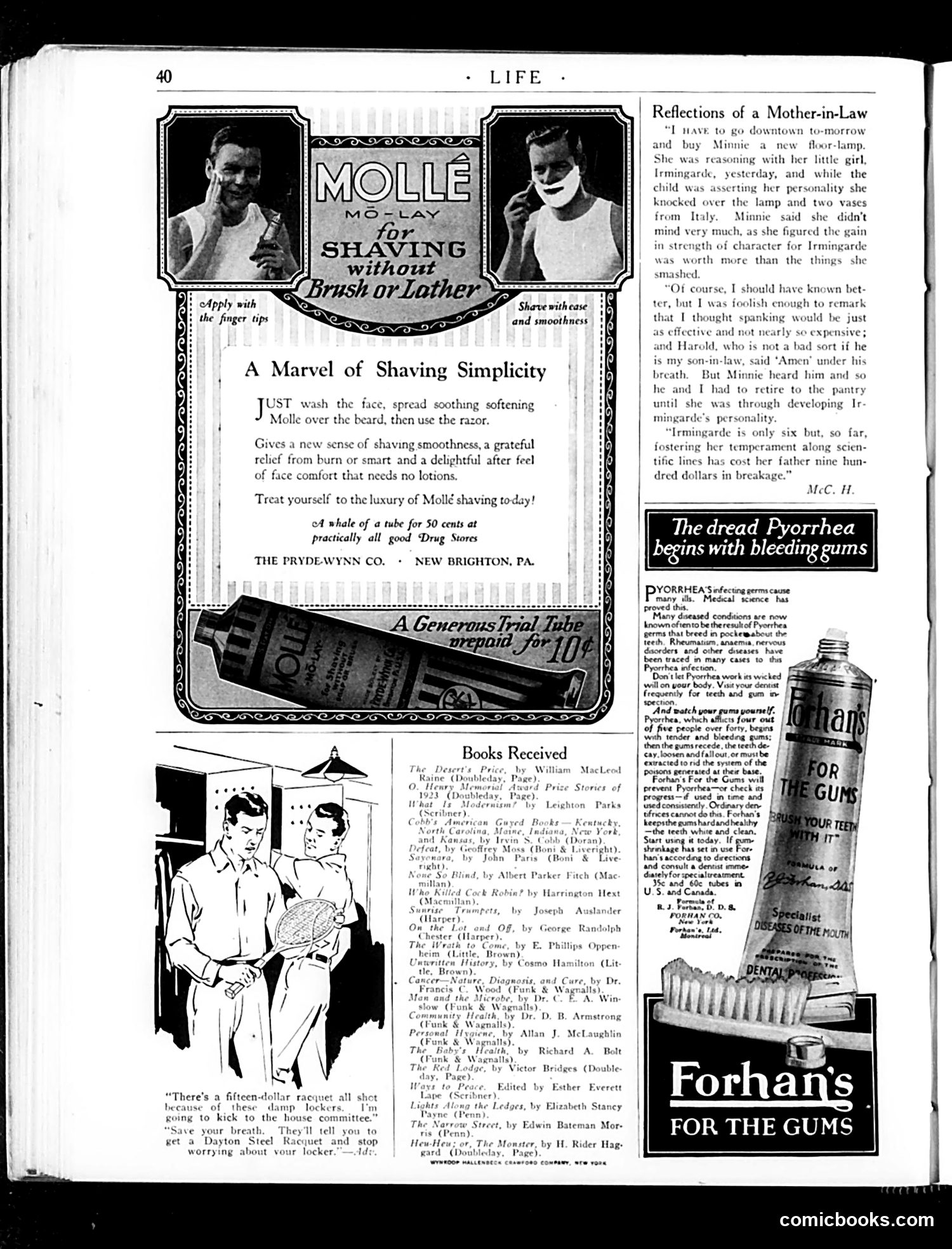
This page is primarily **advertising and book reviews** from Life magazine, with one brief satirical cartoon. The main advertisement promotes **Molle shaving cream**, emphasizing simplicity and comfort—typical early 20th-century grooming marketing. The small cartoon at bottom left appears to be social satire about **tennis racquet lockers**—a man complains about "damp lockers" damaging his equipment and threatens to complain to the club committee. Another character dismissively tells him to stop worrying and just buy a Dayton Steel Racquet instead. The joke mocks how institutions ignore maintenance complaints and how consumerism offers a "solution": buy better equipment rather than fix the problem. The right column contains a personal essay titled "Reflections of a Mother-in-Law" about disciplining a child, and advertisements for **Forhan's toothpaste** (treating pyorrhea/gum disease) and a dental product—reflecting period concerns about oral hygiene. This is a typical mixed-content magazine page: ads, book listings, and light humor.
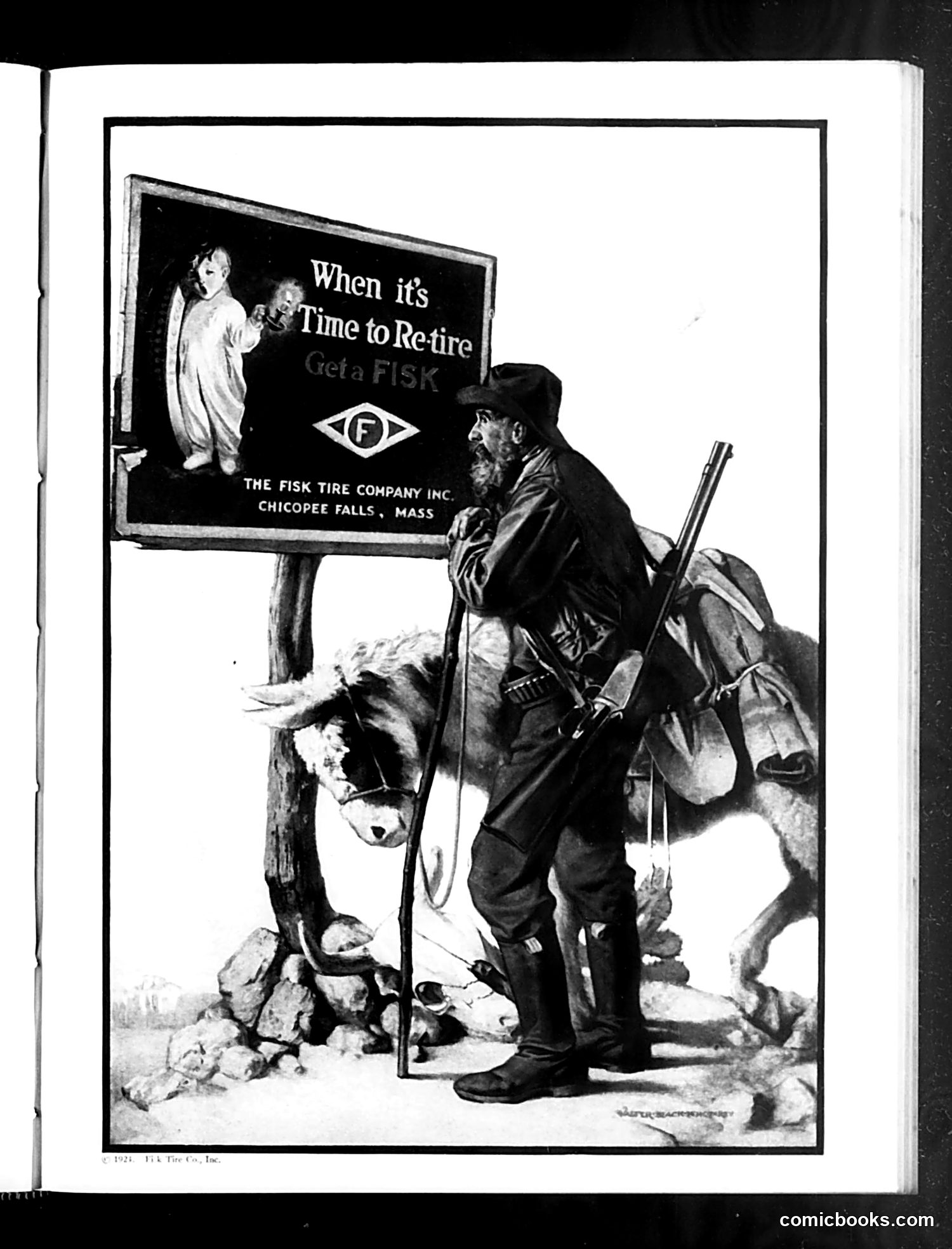
This is a **Fisk Tire Company advertisement** from Life magazine, not political satire. The image shows an old prospector or frontiersman with a rifle and pack mule, standing before a roadside billboard advertising Fisk tires. The ad's humor relies on a visual pun: the weathered prospector, representing an outdated era of American life, is urged by the billboard to "Get a FISK" when retiring. The joke suggests that even old-timers should modernize and purchase Fisk tires for their vehicles—contrasting the primitive frontier lifestyle with contemporary 1920s automobile culture. The Fisk Tire Company was based in Chicopee Falls, Massachusetts. The advertisement uses the juxtaposition of old versus new to humorously sell tires to consumers.
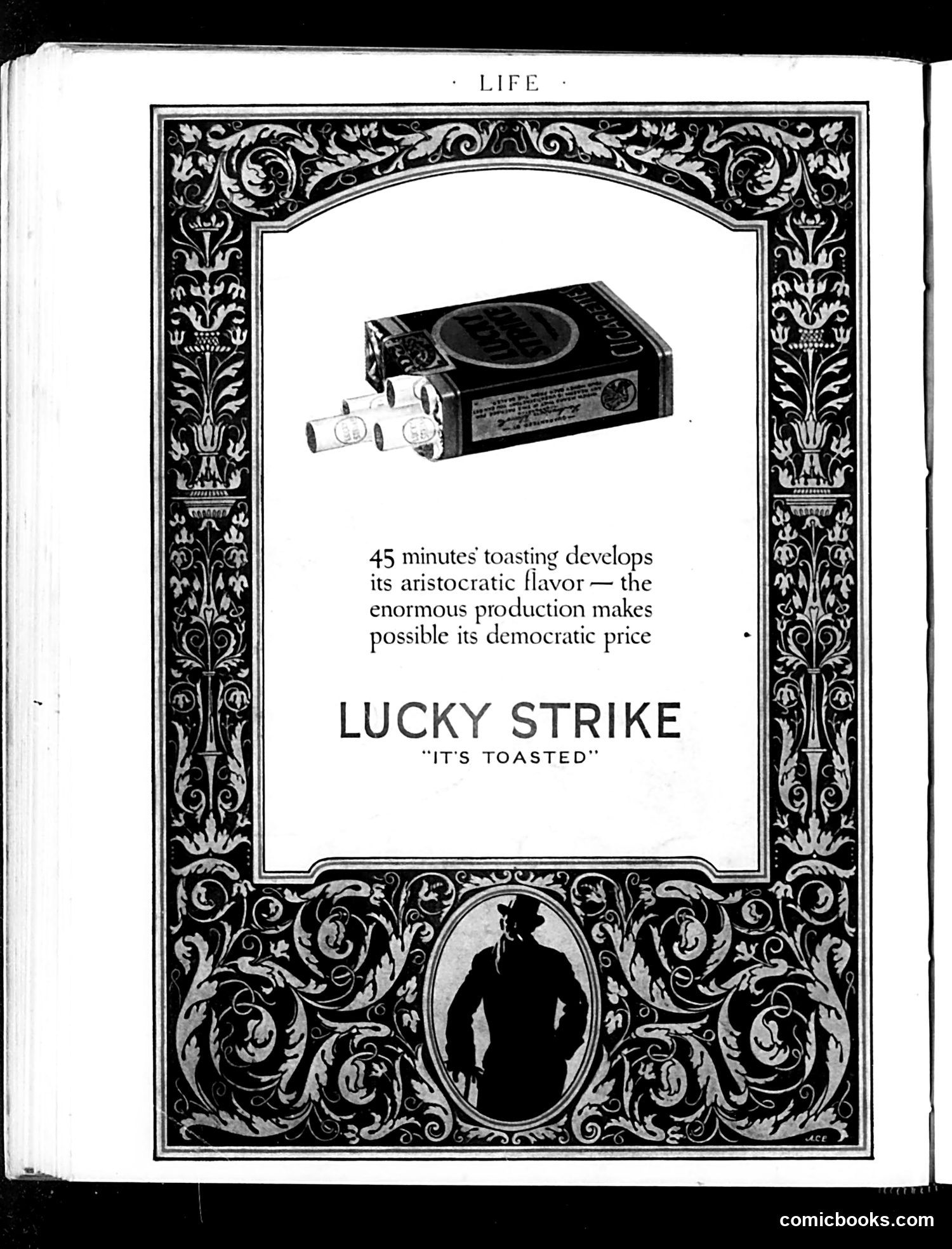
This is a Lucky Strike cigarette advertisement, not a political cartoon. The ad promotes Lucky Strike's "toasted" cigarettes, emphasizing a class paradox: the product achieves an "aristocratic flavor" through mass production, making luxury accessible at a "democratic price." The ornate decorative border frames the message in elegant typography, reinforcing the aspirational positioning. The silhouetted figure at the bottom appears decorative rather than referential. This reflects 1920s-30s advertising strategy: positioning mass-produced consumer goods as democratizing luxury by making high-quality products affordable to ordinary Americans. The "toasting" process is presented as the key to superior taste.