
Life, 1924-05-15 · page 26 of 46
Life — May 15, 1924 — page 26: what you’re looking at
What you’re looking at
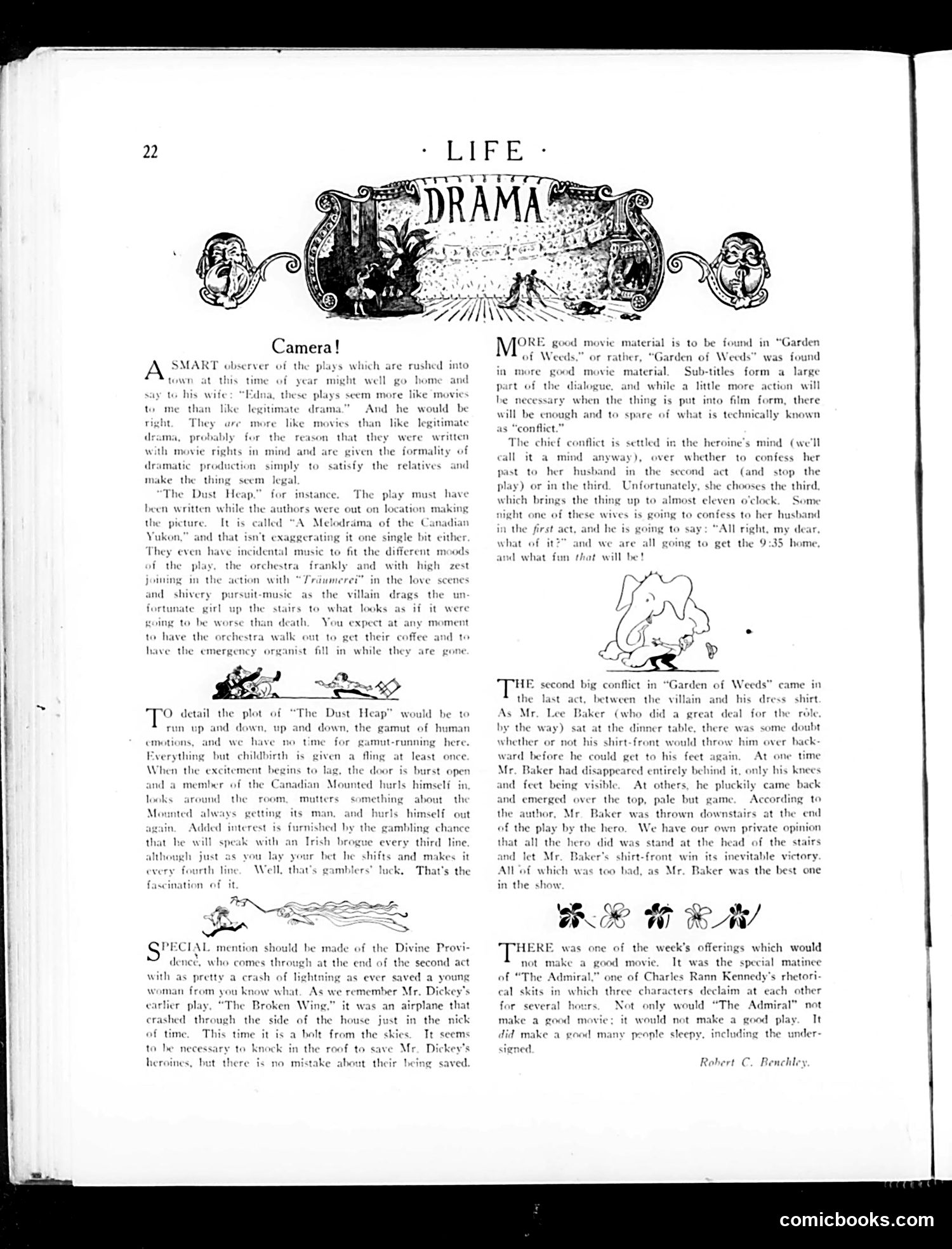
This is a theater review by Robert C. Benchley critiquing plays adapted for film. The piece satirizes how theatrical productions are increasingly written to accommodate movie studios rather than artistic merit. The main targets are plays like "The Dust Heap" (set in the Canadian Yukon) and "Garden of Weeds," which Benchley mocks for their melodramatic plots, overwrought staging, and contrived conflicts. He ridicules how playwrights now consider "movie rights" before artistic integrity, and how orchestras must provide accompaniment for every scene's mood. The humor lies in Benchley's deadpan descriptions of absurd theatrical moments—villains dragging heroines up stairs, emergency organists filling in gaps, actors vanishing backstage—presented as if serious drama. The small cartoon vignettes (four club symbols) appear decorative. Benchley's satire reflects 1920s anxieties about Hollywood's influence corrupting legitimate theater, treating these film-focused plays as cynical, formulaic products rather than genuine art.
📄 Transcribed text from this page (OCR, searchable)
Machine-transcribed from the original scan — historical spelling and the odd misread are preserved.
Camera! of the plays which are rushed into se plays seem more like movies © drama.” And he would be They « like movies than like legitimate reason that they were written ma, probably with movie rights 1 and are given the form. dramatic prody nply to. satisfy the relati make the thing seem legal The Dust been written while the authors were out on location mab the picture. It is called “A Melodrama of the Canadia Yukon,” and that isn't exaggerating it one single bit ei They even have incidental music to fit the differ f the play. the orchestra frankly Heap.” for instance. The play must 1 with high zest joining in the action with “riumerei” in the love scenes 1 shivery p e villain drags the un tit-music as girl up the stairs to what looks as if it were he worse than death. You expect a » have the ore sing ny moment a walk out to get their coffee and to have the emergency organist fill in while they are ed ads T° detail the plot of “The Dust Heap” would be and ch fe we have no time for gamut-running here. ut childt When the excitement run up and down wn, the gamut of human emotions, Everythi is given a fling at least once. the door i: ted hurls hi the room, mutters somet and a member of the Canadian M i Mounted always ge iround. about — the again. Added interest is furnished by the gambling chance that he will speak with an Trish brogue every third lir het he shifts and mal gamblers’ every fourth lir Well, that just as you lay y fascination of PECIAL mention sh dence, who comes th: 1 be made of the Divine Provi- at the end of as ever saved a young woman from you know what. As we remember Mr. Dickey’s earlier play, “The Broken Wing,” it was an airplane that rough the side of the house just in the nick his time it is a bolt from the skies. Tt seems f to save Mr. Dickey's there is no mistake about their } second act with as pretty a crash crashed of time to he necessary to knock in the re heroines, x saved Mere good movie material is to be nd in “Garden of Weeds,” of rather, “Garden of Weeds” was found in m part of the d movie material. Sub-titles form a large logue, and while a ttle more action will ng is put into film form, there will be enough and to spare of what is techn he necessary when the known as “conflict.” The chief conflict is settled in the heroine’s mind (we'll call it/a mind anyway), over whether to. confess her past to. her play) or in the husband in the second act (and stop. the h . she chooses the third, hird. Un ortunate which brings the thing up to almost eleven o'clock. Some night one of these wives is g in the first act, and hy xing to confess to her husband to say: “All right, my dear gz to get the 9:35 home what of it?” and we are all g and what fun that will be! ae Yonh second big conflict HE rden of Weeds” came in the last act, between the villain 1 his dress shirt As Mr. Lee Baker (who did a great deal for the role by the way) sat at the di whether r table, there was some doubt nt would throw him over back ward before he « get to his feet again, At one time Mr. Baker had disappeared entirely be and fect being visible. At others, he not his shirt-f nd it, only his knees kily came back F 1 over the top, pale but game. According to the author, Mr. Baker was thrown downstairs at the end of the play by the hero. We have our own hat all the hero did was t Mr 's. shirt-f All of which was too had, in the show emerg. pr opinion dat the head of the stairs nt win its inevitable victory. Mr. Baker was the best one Qa fm OI BA NES) HERE was « r of the week’s offerings which would t make xd movie. It was the special matinee of “The Admir » of Charles Rann Kennedy's rhetori cal skits in which three characters declaim at each other for several hours, Not only would “The Admiral” not make a good movie; it would not m fid make a good many people sleepy. i a good play. It ¢ the lud luc Rohert C. comicbooks.com