
Life, 1924-05-15 · page 30 of 46
Life — May 15, 1924 — page 30: what you’re looking at
What you’re looking at
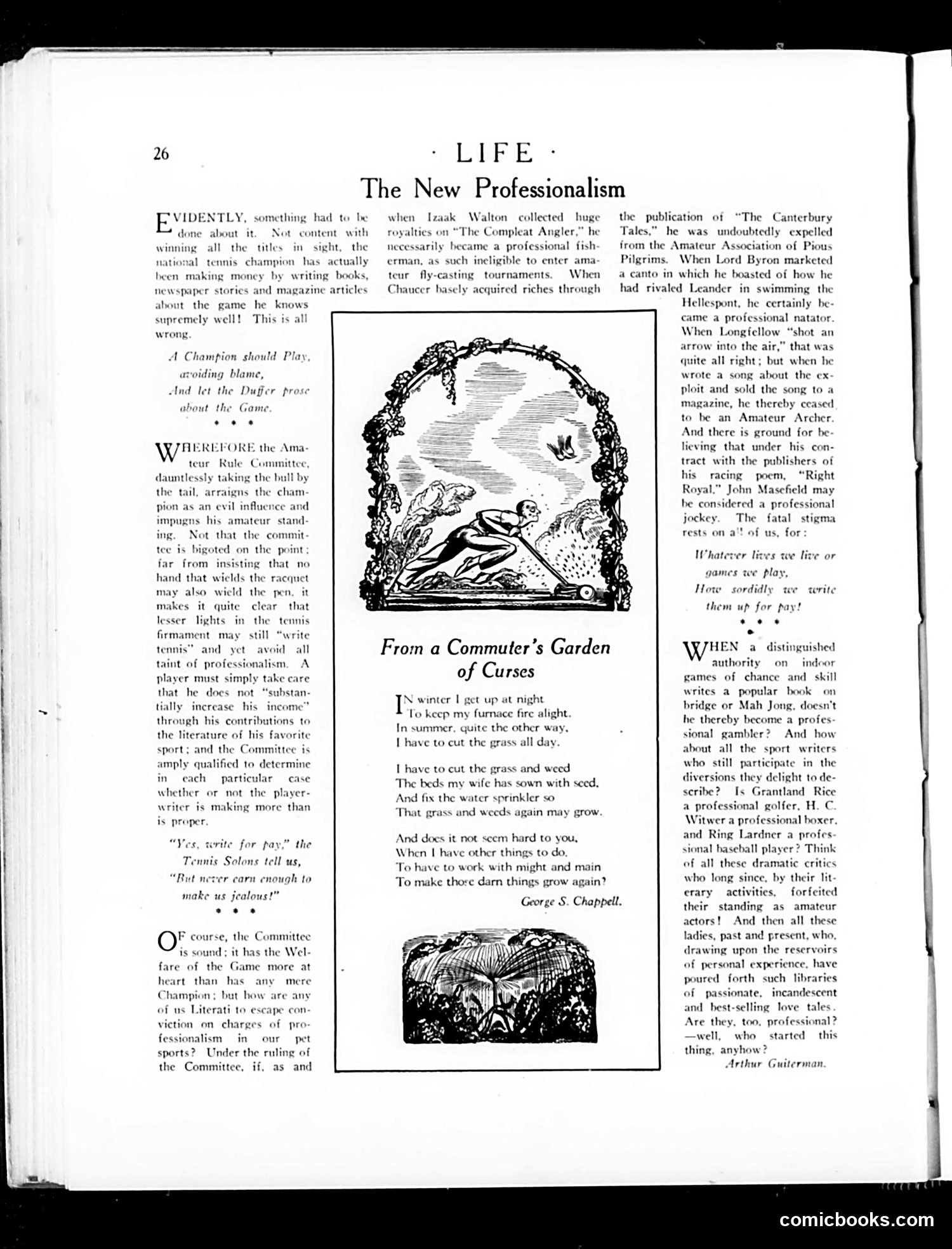
This satirical article mocks the Amateur Athletic Union's rigid rules against athletes earning money from writing about their sports. The satire uses absurd historical examples: Izaak Walton became a "professional fisherman" by publishing about fishing; Chaucer was "expelled" for profiting from *Canterbury Tales*; Lord Byron became a "professional natator" (swimmer) by selling a poem about swimming the Hellespont; Longfellow a "professional archer" for monetizing his arrow poem. The joke: if amateurs can't profit from writing about their sport, then any writer who describes sports or games they participate in—sportswriters, romance novelists—should logically be banned too. The Committee's rules are exposed as arbitrary and impossible to enforce consistently. The accompanying poem "From a Commuter's Garden of Curses" (unrelated) complains about lawn maintenance.
📄 Transcribed text from this page (OCR, searchable)
Machine-transcribed from the original scan — historical spelling and the odd misread are preserved.
26 winning all the titles in been making money by writing books, newspaper stories and magazine articles about the game he knows supremely well! This is all wrong A Champion should Play, voiding blame, end let about the Game. the Duffer prose AEREFORE the Ama- teur Rule Committee dauntlessly takir the tail, arraigns the cham pion as an evil influence at x the hull by impugns his amateur stand- ing. Not that the commit- tee is bigoted on the point far from insisting that no hand that wields the racquet may also wield the pen, it makes it quite clear that lesser lights in the tennis firmament may still “write and yet ‘oid all taint of professionalism. A player must simply take that he does not “substan- tennis” care tially increase his income” through his contributions to the literature of his favorite sport; and the Committee is amply qualified to determine in cach particular — case whether or not the player- writer is making more than is proper. ” the Tennis Solons tell us, es, write for pa “Rut never carn enough to make us jealous!” eee F course, the Committee is sound; it has the Wel- fare of the Game more at heart than has any mere Champion; but how are any of us L erati to escape con ion on charges of pro fessionalism in our pet sports? Under the ruling of the Committee, if, as and al tennis champion has actually * LIFE = The New Professionalism E’ IDENTLY, something had to be done about it. Not content when Izaak Walton collected huge “The Compleat Angler,” he professional fish erman, as such ineligible to enter ama teur fly-casting tournaments, When Chaucer hasely acquired riches through royalties « necessarily became From a Commuter’s Garden of Curses N winter I get up at night To keep my furnace fire alight In summer, quite the other way, I have to cut the grass all day I have to cut the grass and weed The beds my wife has sown with seed, And fix the water sprinkler so ‘That grass and weeds again may grow. And does it not scem hard to you, When | have other things to do, To have to work with might and main To make thore darn things grow again? George S. Chappell. publication of “The Canterbury he was undoubtedly expelled from the Amateur Association of Pious When Lord Byron marketed a canto in which he boasted of how he had rivaled Leander in swimming the Hellespont, he certainly be- came a professional natator When Longfellow “shot an arrow into the air,” that was quite all right; but when he wrote a song about the cx- ploit and sold the song to a magazine, he thereby ceased to be an Amateur Archer, And there is ground for be lieving that under his con- tract with the publishers of his racing poem, “Right Royal,” John Masefield may he considered a professional jock The fatal stigma a't of us, for How sordidly them up for pay! write HEN authority on indoor games of chance and skill writes a popular boc bridge or Mah Jong, doesn't he thereby become a profes distinguished on sional gambler? And how about all the sport writers who still participate in the diversions they delight to de- scribe? Is Grantland Rice a professional golfer, H. C Witwer a professional boxer, and Ring Lardner a profes al baseball player? Think all these dramatic critics who long since, by their lit erary activ forfeited their standing as amateur actors! And then all these ladies, past and present, who, drawing upon the reservoirs of personal experience, have poured forth such libraries of passion, incandescent and best-selling love tales Are they, too, professional? —well, who started this thing, anyhow? Arthur Guiterman comicbooks.com