
A complete issue · 38 pages · 1919
Life — February 27, 1919
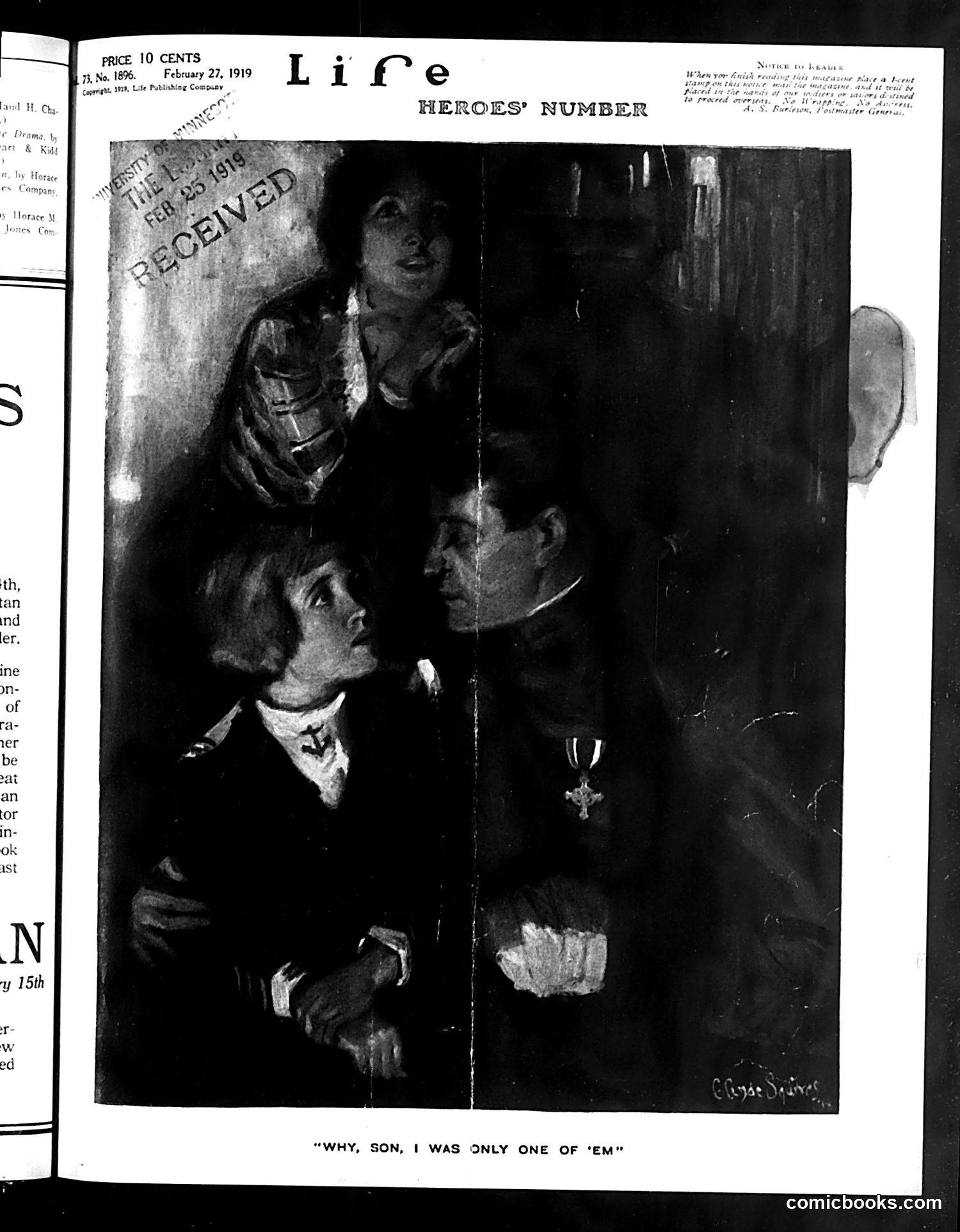
This is a dramatic scene from a World War I-themed issue titled "Heroes' Number." The image shows what appears to be a military decoration ceremony, with a uniformed soldier wearing a medal visible on his chest. The caption reads: "WHY, SON, I WAS ONLY ONE OF 'EM." The satire appears to critique the widespread distribution of military medals and honors following WWI's conclusion (November 1918). The joke suggests that decorations had become so common that even ordinary soldiers received them—hence the older figure's casual, almost dismissive remark about his own medal. This reflects post-war sentiment questioning whether such honors retained meaning when awarded so liberally.
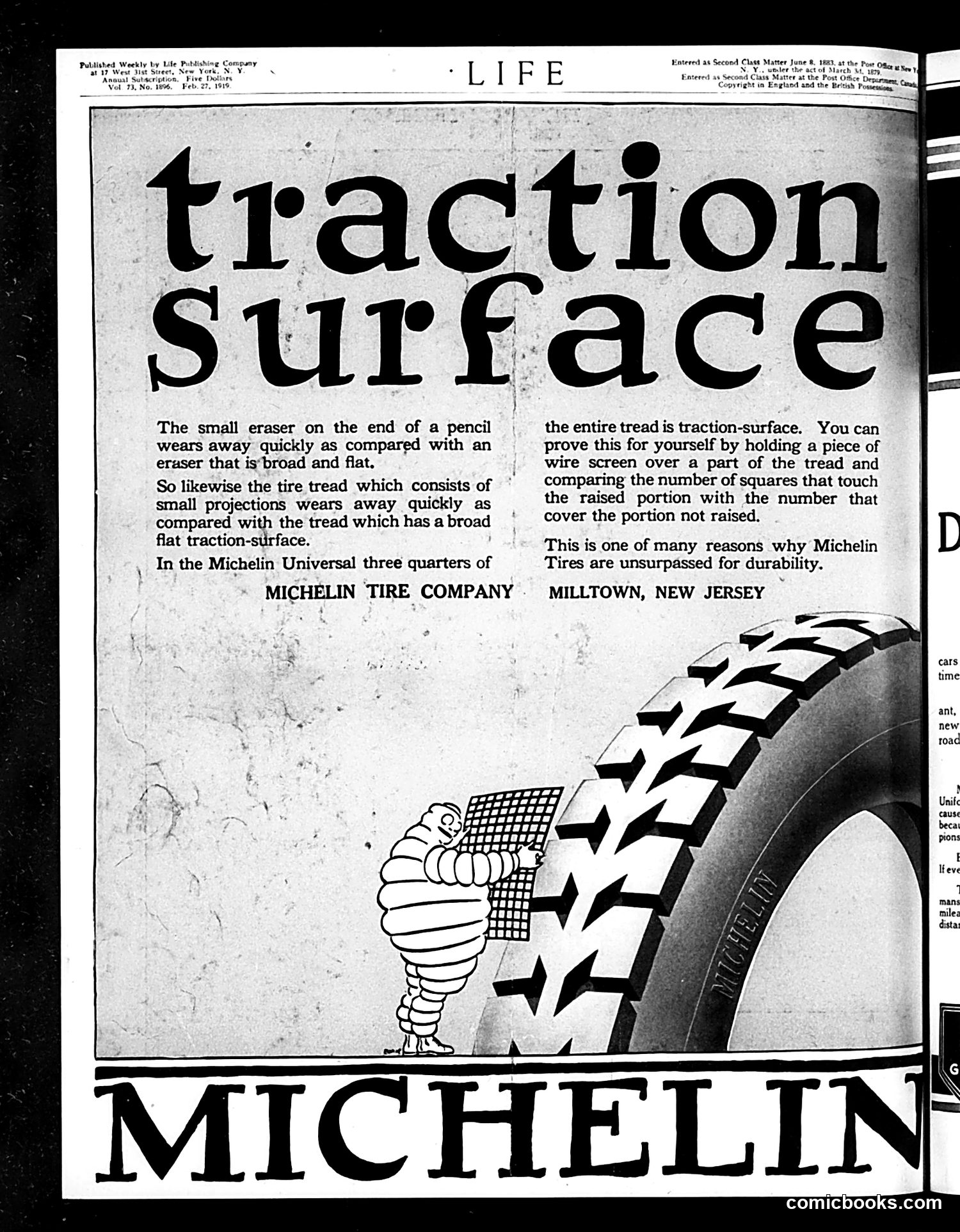
This is primarily a **Michelin Tire advertisement**, not political satire. The page appears in *Life* magazine (dated Feb. 27, 1919, based on the header). The ad uses the famous **Michelin Man** mascot (the puffy, tire-constructed character visible in the illustration) to demonstrate tire durability. The "traction surface" refers to the tire's tread pattern—the raised blocks visible on the tire shown. The ad compares tire wear to a pencil eraser: just as small projections wear away, so do tire treads, but Michelin's broad, flat tread surface supposedly lasts longer. This is straightforward product marketing emphasizing durability and superior engineering, not satirical commentary. The Michelin Man became an iconic advertising figure throughout the early-to-mid 20th century.
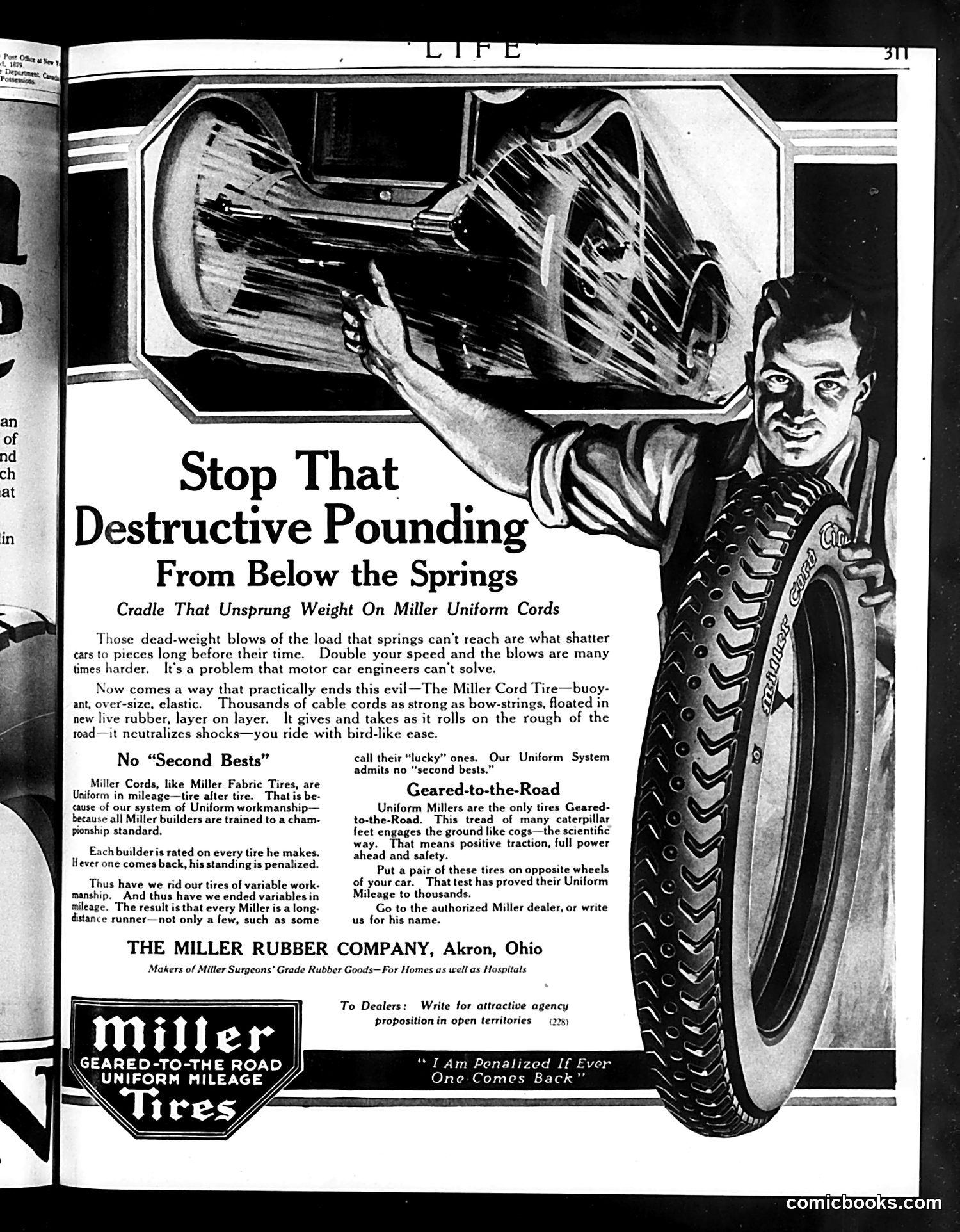
This is **not a political cartoon but a product advertisement** from Life magazine. It promotes Miller Rubber Company's "Geared-to-the-Road Uniform Mileage" tires, marketed to automobile owners. The ad addresses a genuine automotive concern of the era: springs bouncing under load create impacts that damage tires prematurely. Miller's solution was a tire design with caterpillar-like treads that supposedly engage the ground like cogs, providing better traction and shock absorption. The illustration shows a male mechanic or salesman displaying the tire. The copy emphasizes that Miller tires, like Miller fabric tires generally, have no "second bests"—all are built to uniform standards. This reflects early 20th-century automobile culture when tire quality significantly affected vehicle performance and longevity.
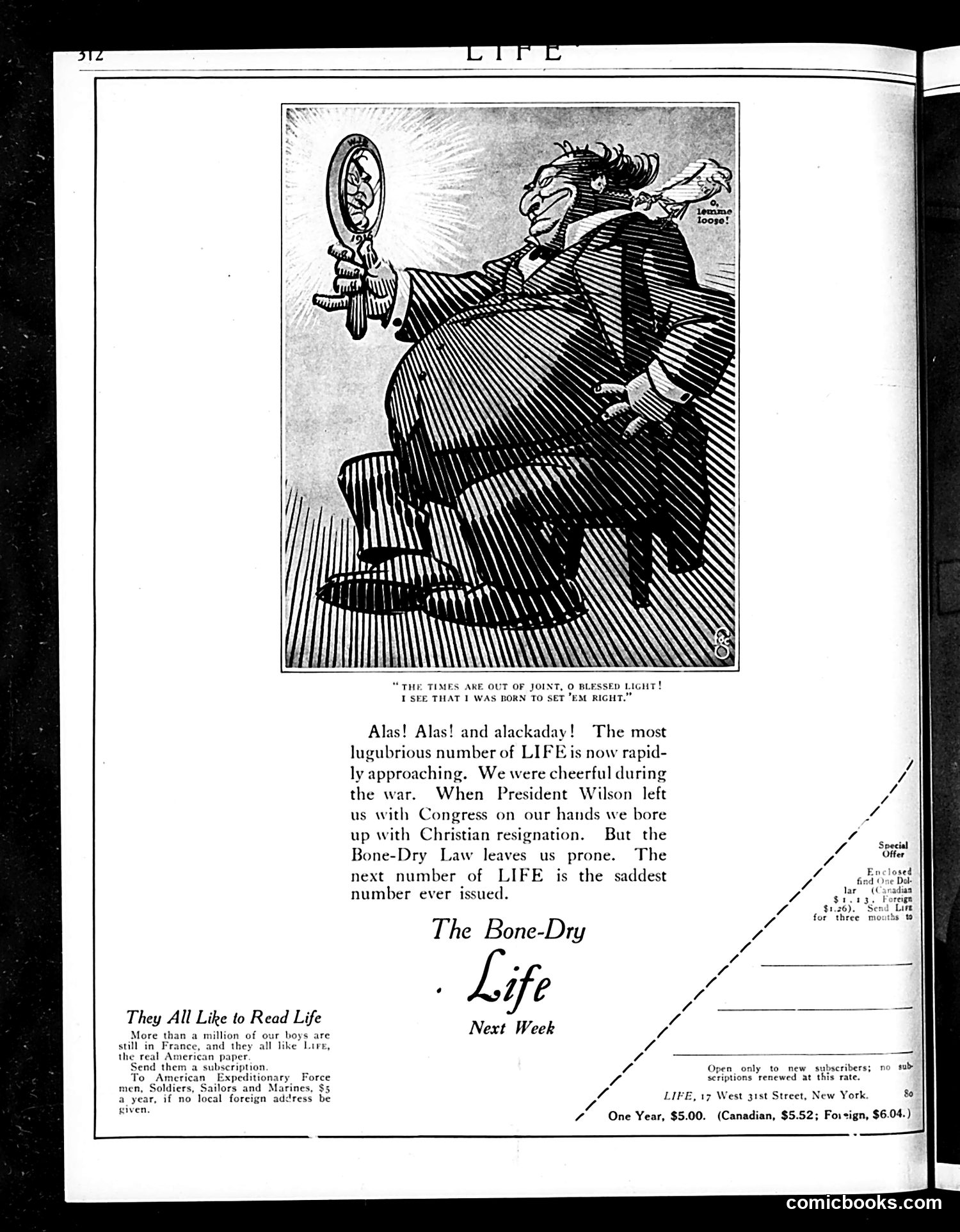
This is primarily a **subscription advertisement** for LIFE magazine, not a political cartoon. The illustration shows a grotesquely caricatured figure (likely representing Prohibition or its effects) admiring himself in a mirror, holding what appears to be a flask. The caption reads: "The times are out of joint, O blessed light! I see that I was born to see 'em right." The accompanying text references the **Bone-Dry Law** (strict Prohibition legislation), suggesting the magazine's next issue will address this policy. The advertisement claims this will be "the saddest number ever issued," satirizing Prohibition's unpopularity. The joke targets Prohibition enforcement and its social consequences, presented as a "bone-dry" or humorless topic—a common complaint about Prohibition-era restrictions on alcohol.
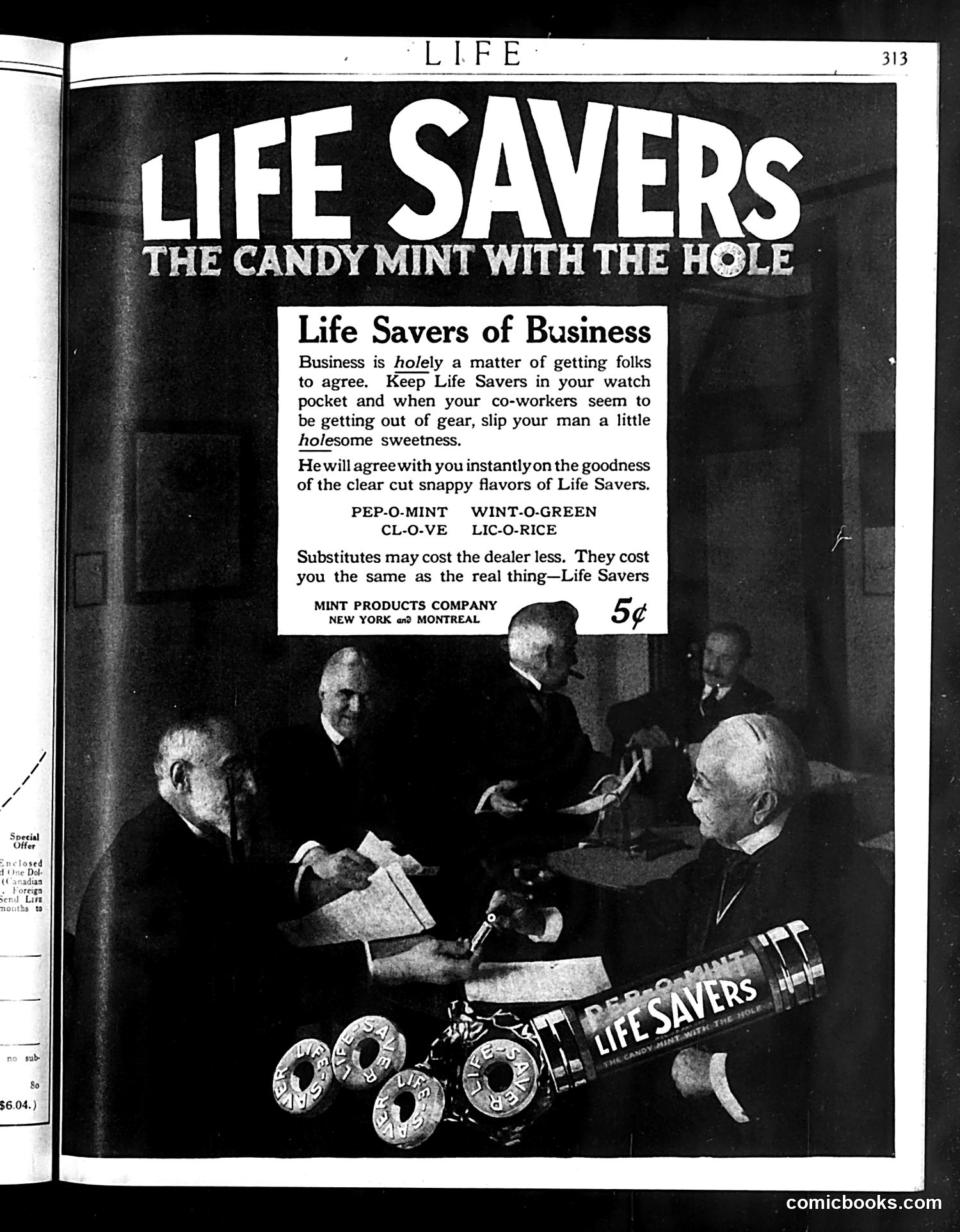
This is a **straightforward product advertisement**, not satire or political commentary. The page promotes Life Savers candy mints, manufactured by Mint Products Company (New York and Montreal), priced at 5¢. The ad uses a business-themed photograph showing five men in suits exchanging or examining Life Savers candies, with the tagline "Life Savers of Business." The copy humorously argues that keeping Life Savers handy helps smooth workplace interactions—when coworkers "seem to be getting out of gear," offering them candy provides "wholesome sweetness" that ensures agreement. The ad lists four flavors: Pep-O-Mint, Wint-O-Green, Cl-O-Ve, and Lic-O-Rice, emphasizing they cost the same as inferior substitutes. This is purely commercial messaging without political meaning.
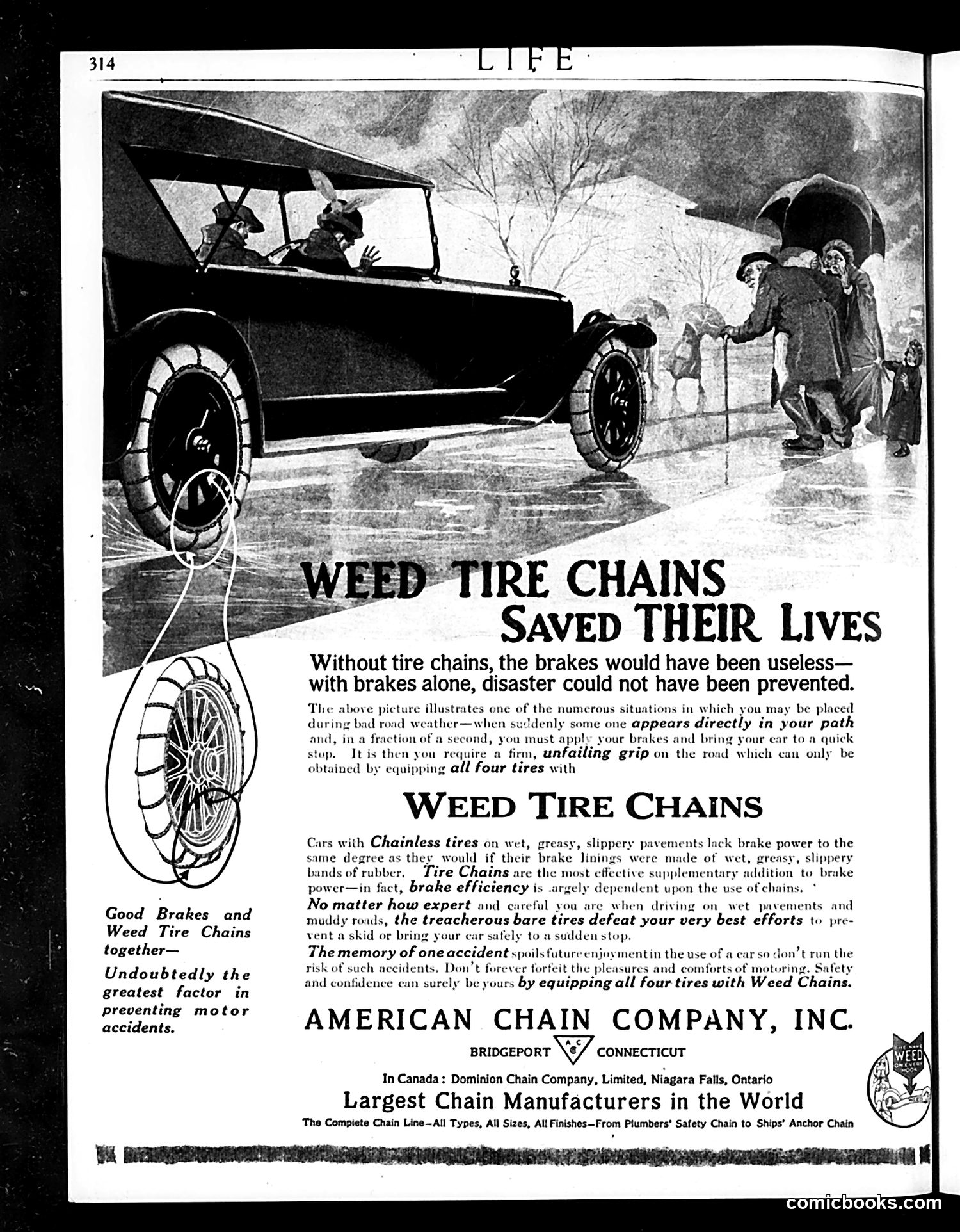
This page is **primarily an advertisement**, not satire or political commentary. It's a 1920s-era ad for Weed Tire Chains, manufactured by American Chain Company in Bridgeport, Connecticut. The advertisement uses a dramatic safety narrative: an illustration shows a car with two occupants approaching pedestrians in rain on what appears to be a slippery road. The headline claims "Weed Tire Chains Saved Their Lives," arguing that without tire chains, brakes alone would have been insufficient to prevent an accident. The ad emphasizes that tire chains provide essential traction on wet or icy roads—a genuine safety concern before modern tire technology. It's a straightforward product advertisement exploiting contemporary automotive safety anxieties, not satirical content.
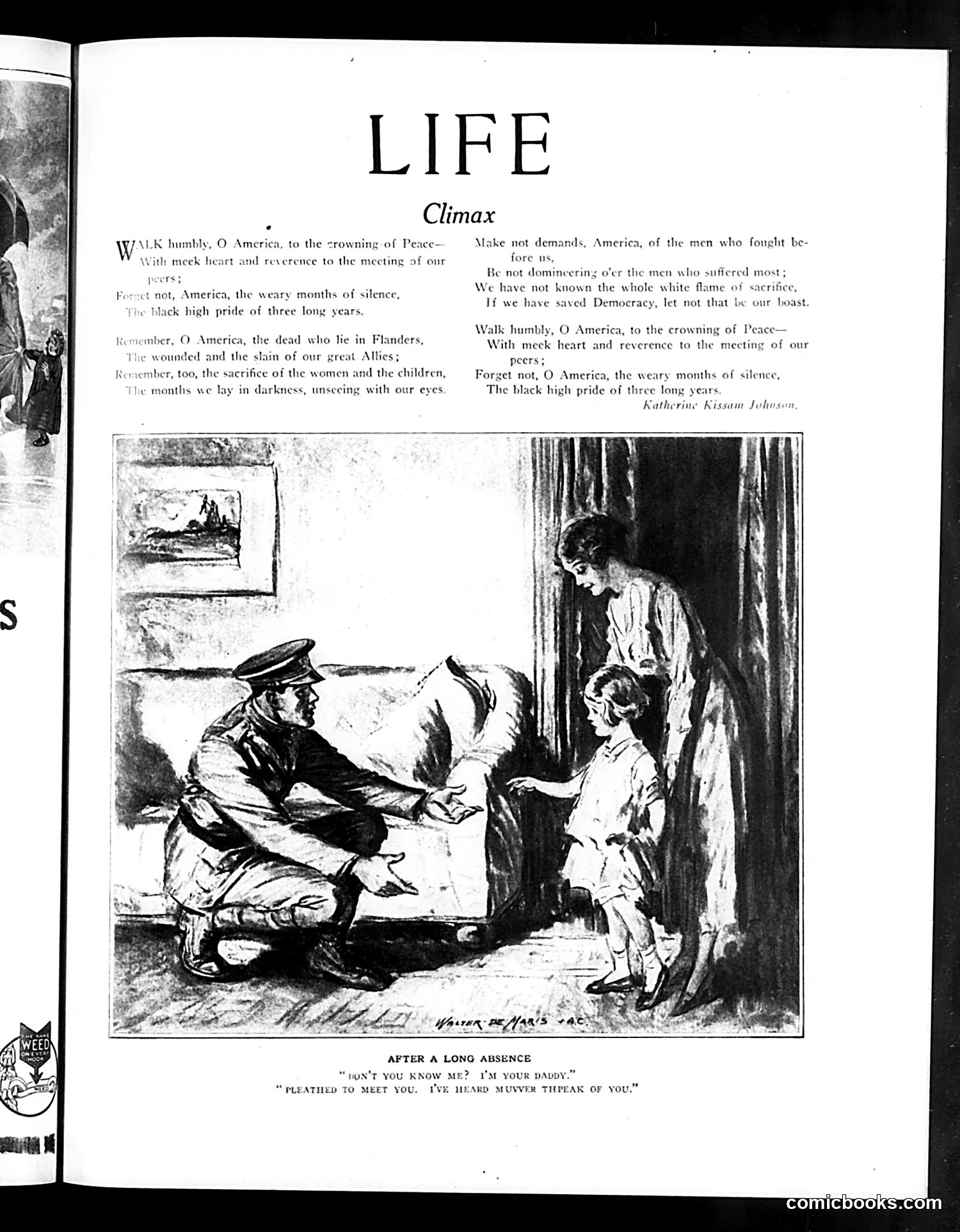
This page presents a poem titled "Climax" by Katherine Kissum Johnson, addressing post-WWI America. The verse urges humble remembrance of fallen soldiers ("the dead who lie in Flanders") and sacrifice by women and children during "three long years" of war, cautioning against triumphalism or forgetting wartime suffering. The accompanying illustration, titled "After a Long Absence," depicts an emotional reunion: a soldier kneeling before a young child who asks, "Don't you know me? I'm your daddy," while a woman (likely the mother) watches from a doorway. The soldier responds he's "heard much talk of you." This illustration powerfully illustrates the human cost of prolonged war—the estrangement of fathers from children during years of separation—complementing the poem's call for solemn remembrance rather than celebration.
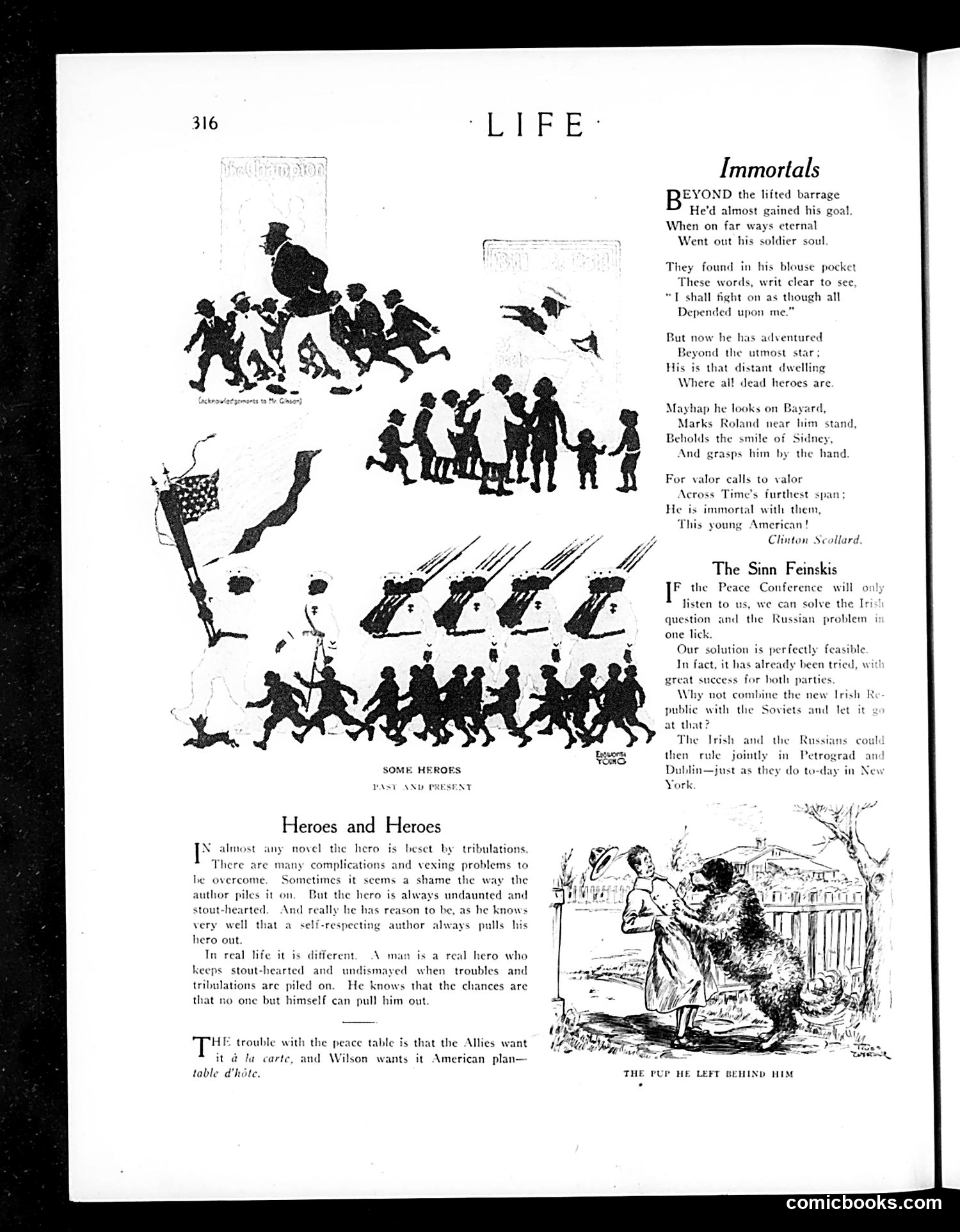
This page contains satirical commentary on post-World War I peace negotiations. "The Sinn Féiners" section mocks proposed solutions to Irish and Russian conflicts at the Peace Conference, sarcastically suggesting combining an Irish Republic with Soviet Russia—presenting this as absurd. The illustrated section "Some Heroes Past and Present" uses silhouettes showing figures (likely political leaders) with crowds and military imagery, commenting on heroism and leadership. "Heroes and Heroes" (note the spelling play) discusses the nature of heroes in literature versus real life, contrasting fictional protagonists who overcome tribulations with real-world heroes who face actual consequences. The final reference mentions disputes over the peace table's format—the Allies wanting "à la carte" versus Wilson's "American plan"—likely referencing Woodrow Wilson and Allied disagreements at the Paris Peace Conference (1919).
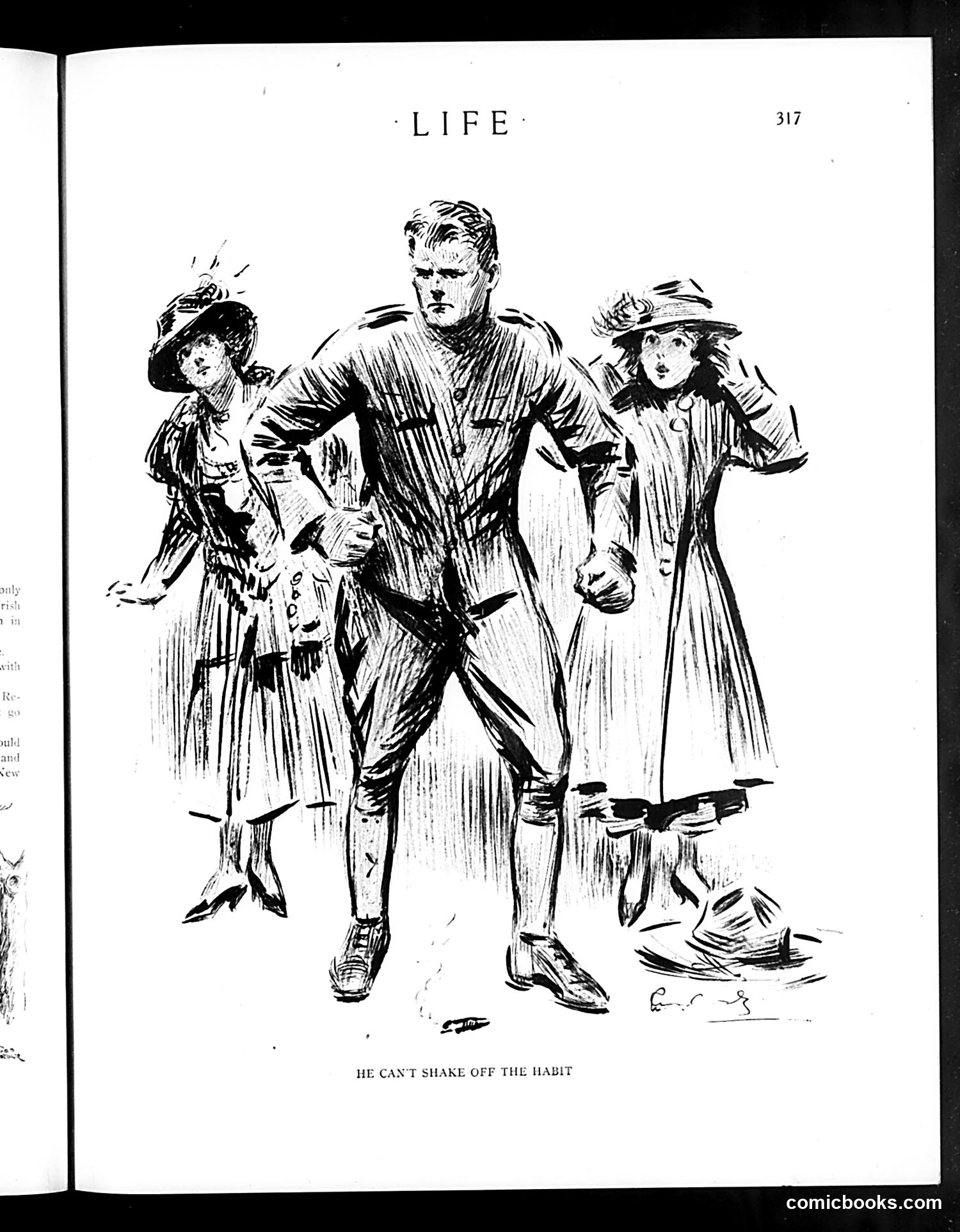
This satirical illustration shows a man in military uniform flanked by two women in fashionable early 20th-century dress. The caption suggests the soldier cannot abandon ingrained military behavior or mannerisms despite being in civilian contexts with women. The cartoon likely comments on soldiers returning to civilian life after military service, struggling to shed military habits and deportment. The women appear to represent domestic or social settings where such rigid military bearing would seem out of place or inappropriate. Without additional context or visible attribution, the specific historical moment (likely post-WWI era based on the art style) and the intended target remain unclear, though the satire appears to mock the difficulty of transitioning from military to civilian life.
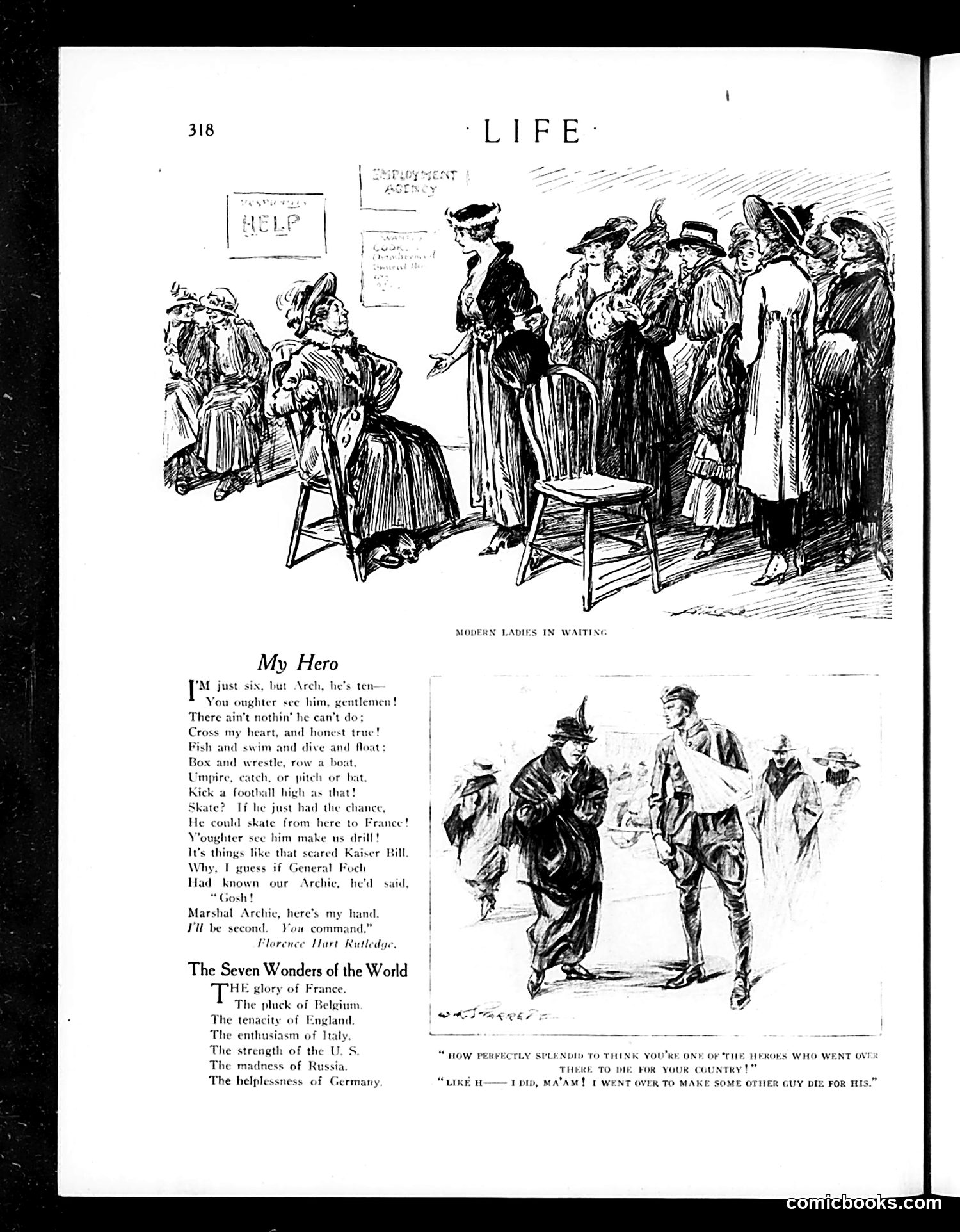
This Life magazine page contains two satirical pieces about World War I heroism and sacrifice. **"Modern Ladies in Waiting"** (top): Shows women eagerly awaiting military heroes, satirizing romanticized attitudes toward war and soldiers. **"My Hero"** (middle): A poem praising an unnamed soldier ("Arch") for various martial abilities—boxing, wrestling, football—suggesting blind admiration for combat prowess without questioning war itself. **"The Seven Wonders of the World"** (bottom): Lists national characteristics of warring nations (France's glory, Belgium's pluck, Italy's enthusiasm, Germany's "helplessness"), using bitter irony. Germany's listing as "helpless" is particularly pointed—likely mocking German military capacity or sarcastically commenting on post-war defeat. The lower illustration shows soldiers, possibly depicting the reality versus the romanticized "hero" worship above—contrasting propaganda with ground truth.
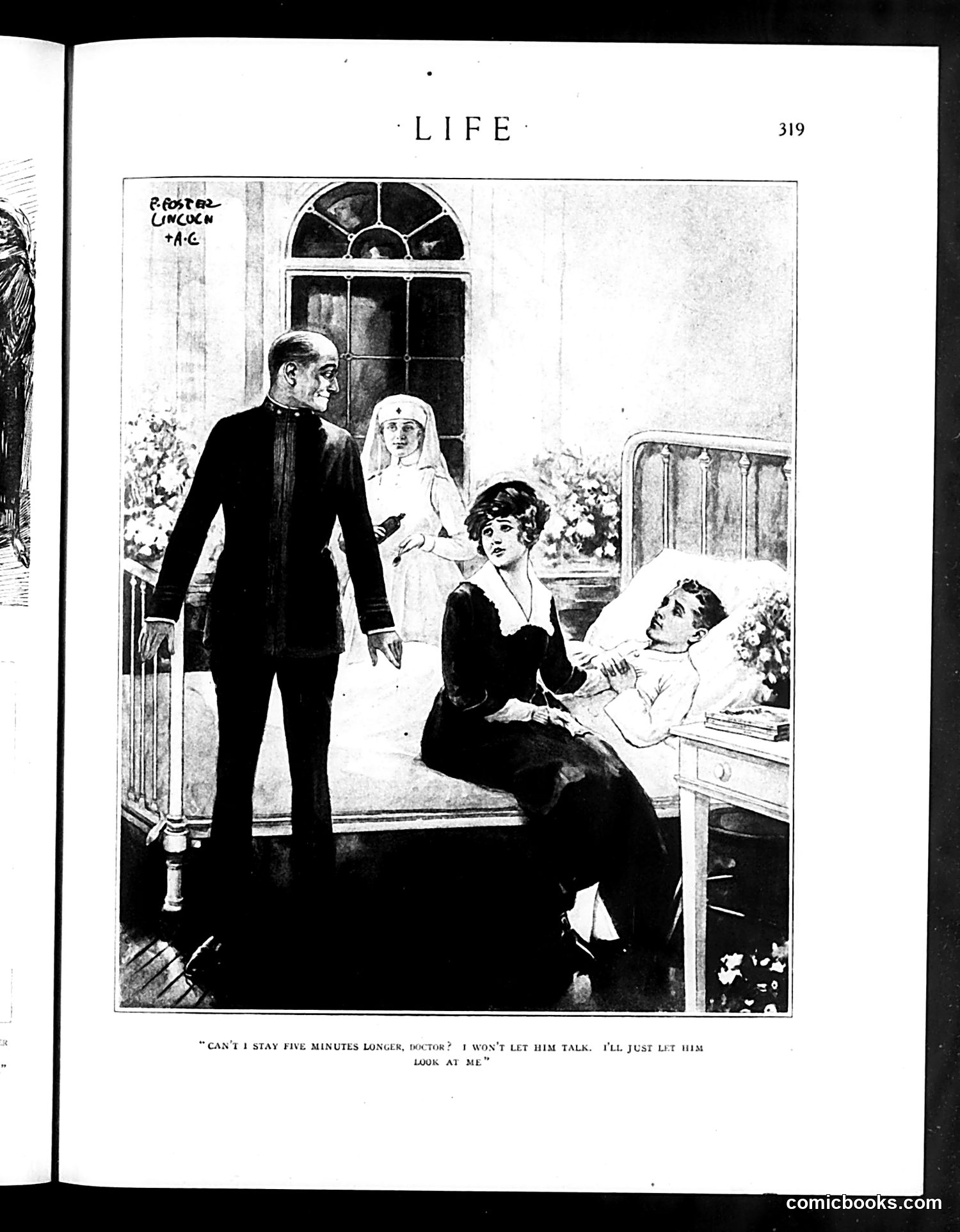
This is a domestic drama illustration from *Life* magazine (page 319). The scene depicts a sickbed visit: a stern-faced man in formal dress stands observing while a woman sits beside an ill young man in bed. A nurse attends in the background. The caption reads: "Can't I stay five minutes longer, doctor? I won't let him talk. I'll just let him look at me." The satire concerns romantic devotion and medical authority. The woman's plea suggests she wishes to remain with her ill companion despite the doctor's orders for rest. Her statement—that she'll allow only visual contact, not conversation—is humorous because it implies her mere presence is therapeutic, contradicting medical protocol. The joke satirizes both romantic sentimentality and the tension between matters of the heart and medical science.
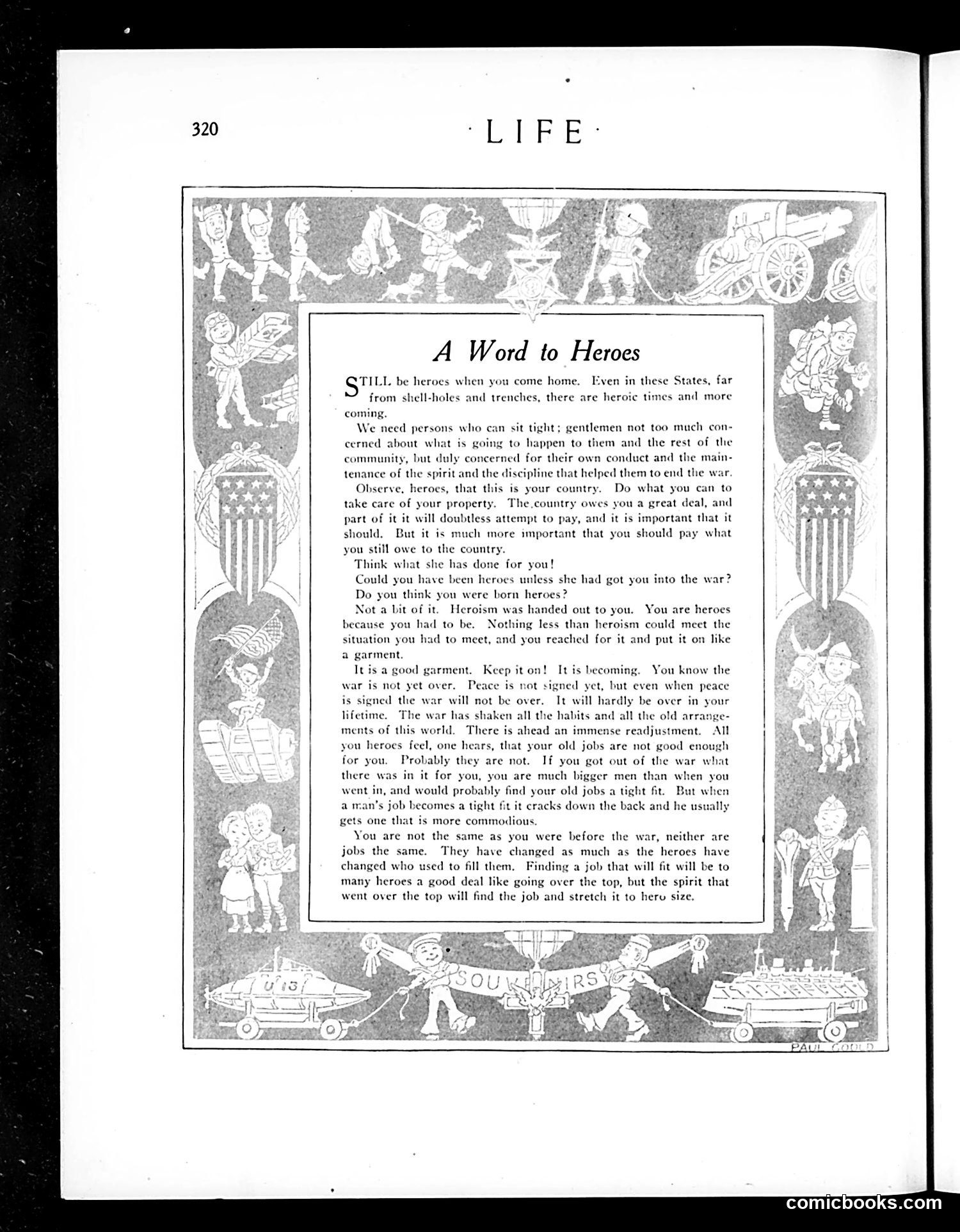
This is an editorial address to returning World War I soldiers. The decorative border features cherubs and patriotic imagery (shield, flag motifs). The text urges veterans to maintain the "heroism" and discipline that characterized their military service, now applying it to civilian life and employment. Key points: The author acknowledges that peace hasn't officially ended the war, and veterans face an "immense readjustment." Rather than complaining about unsuitable postwar jobs, veterans should approach civilian work with the same spirit of duty they showed in combat. The piece argues that their old prewar jobs won't fit anymore—veterans and the world have both changed—so they should embrace new opportunities and "stretch it to hero size." The message reflects post-WWI concerns about veteran reintegration and social stability.
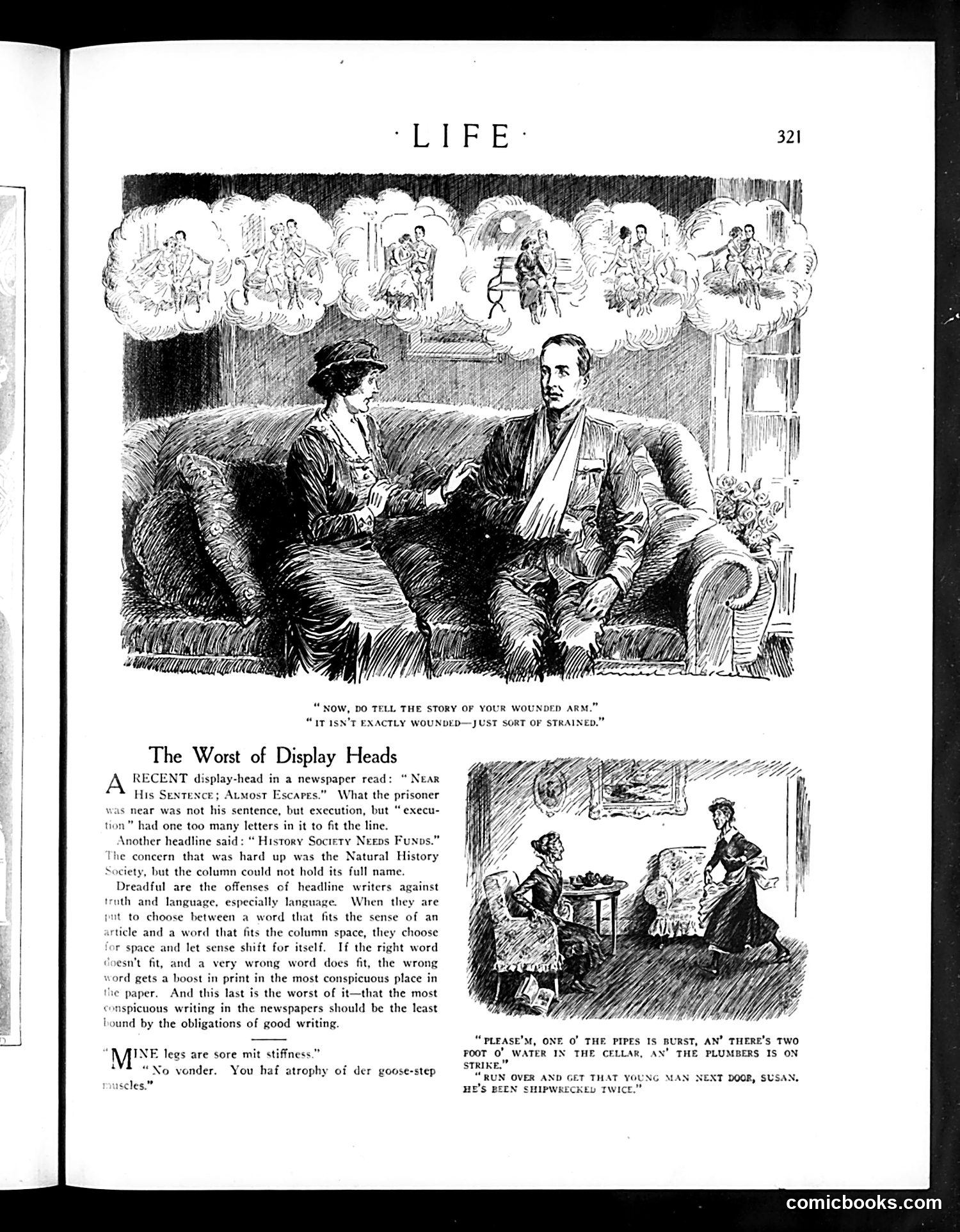
This article critiques newspaper headline writing. The author argues that headline writers often choose wrong words to fit column space, prioritizing fit over accuracy and sense. When the correct word doesn't fit, they select an inappropriate substitute—the "worst" practice in journalism. The examples show actual headlines that absurdly misstate meaning: "Near His Sentence; Almost Escapes" (conflating execution with escape) and "History Society Needs Funds" (where "Natural History Society" was truncated). The accompanying cartoons illustrate social awkwardness resulting from poor word choice—appearing to show conversations where someone's malapropism or misstated remark creates embarrassment. The satire targets the carelessness of newspaper editors who sacrifice accuracy for layout mechanics, damaging both truth and readability.
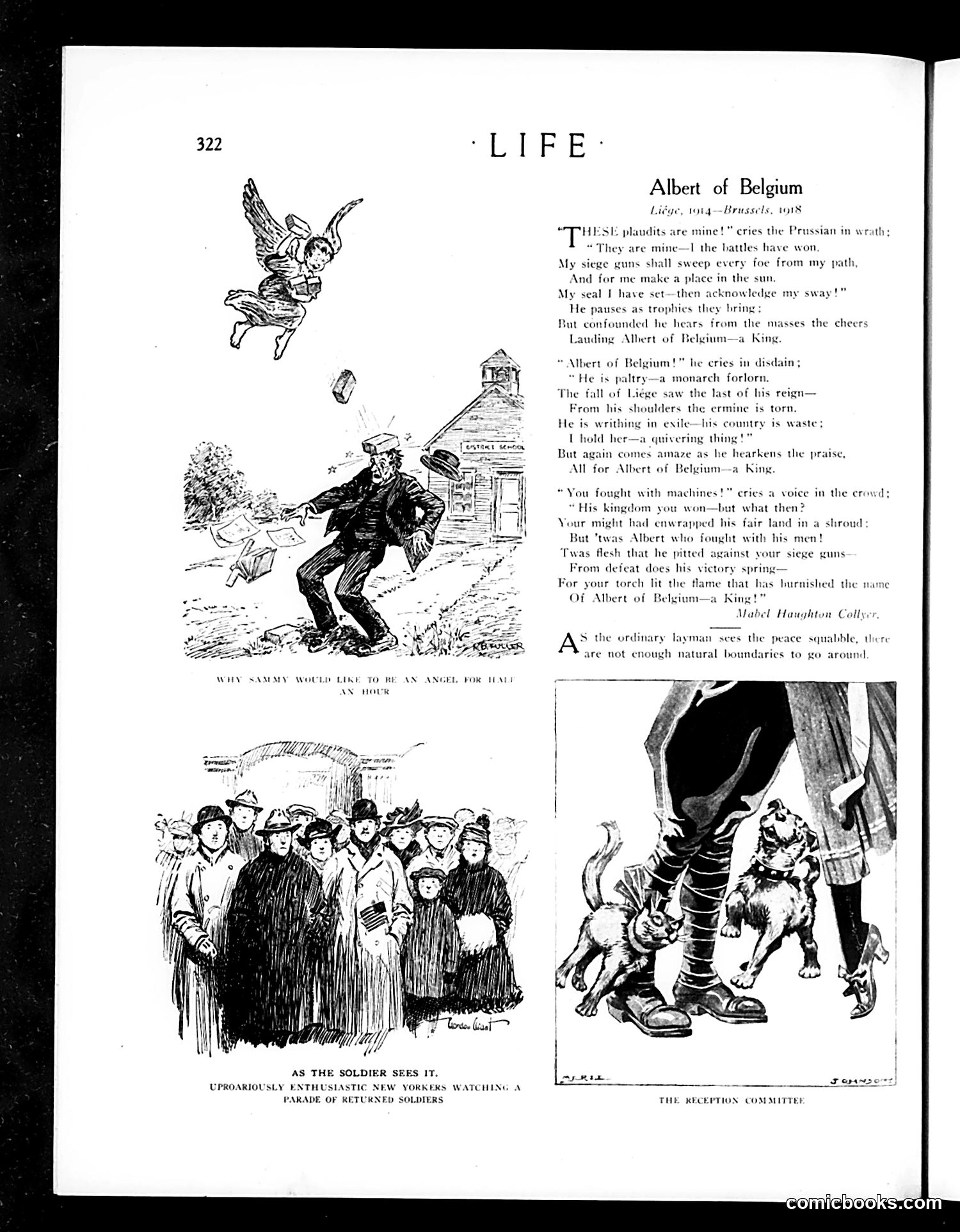
This page satirizes **Albert of Belgium** (ruled 1909-1934) during World War I. The central cartoon depicts the Belgian king amid destruction—a ruined building and angel overhead—responding defiantly to Prussian threats. The accompanying poem praises Albert's resistance against German occupation, portraying him as a noble monarch fighting "with his men" rather than surrendering. The lower cartoons show contrasting American responses: New Yorkers enthusiastically welcoming returned soldiers, and a "Reception Committee" of dogs greeting a soldier's boot. The satire celebrates Belgian courage while subtly mocking American civilian enthusiasm—suggesting their support, while heartfelt, lacks the actual sacrifice soldiers endured. The page presents wartime propaganda celebrating Allied leadership.
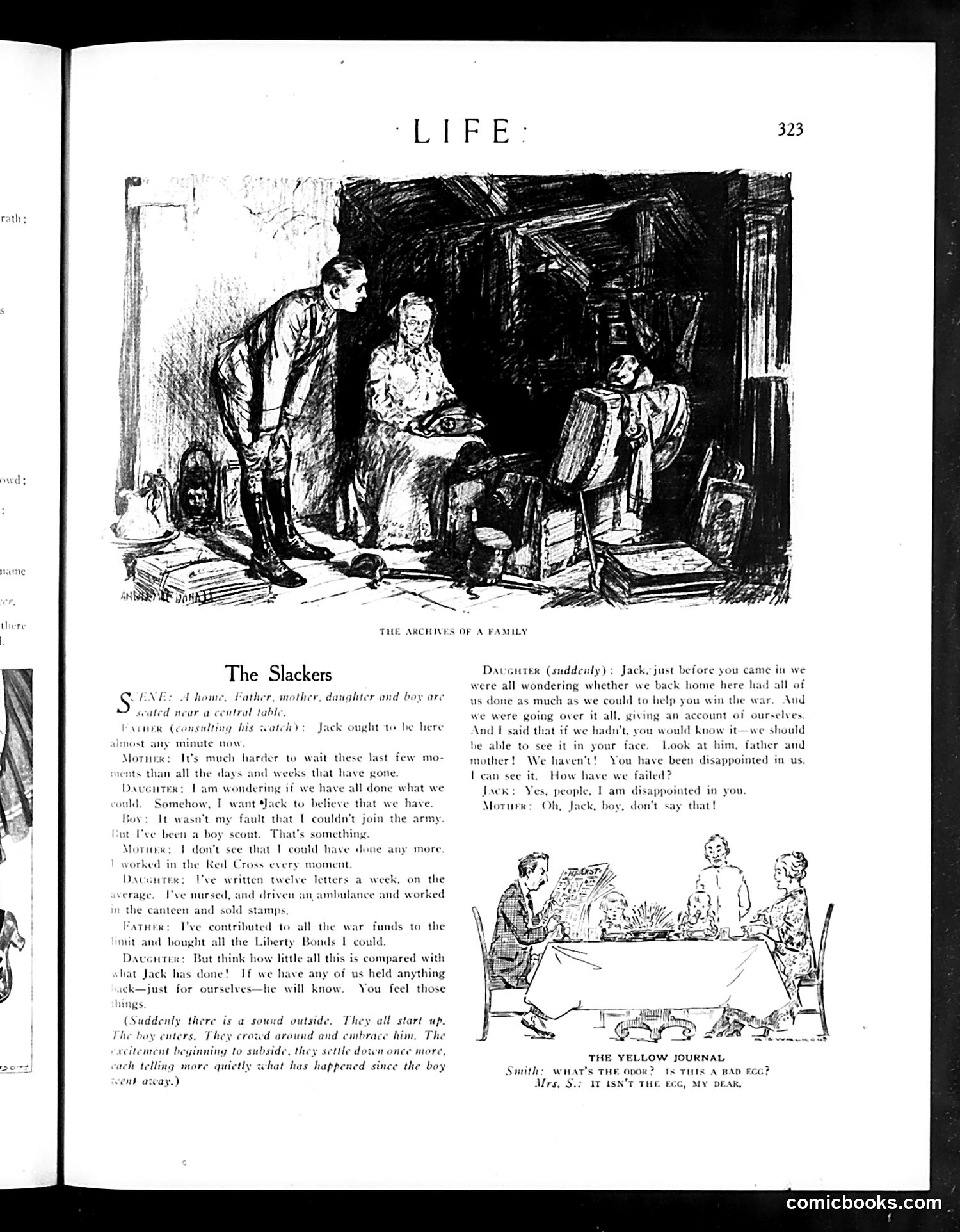
This page presents a domestic drama satirizing those who avoided military service during World War I (the war is explicitly referenced in dialogue). The sketch titled "The Archives of a Family" depicts a father confronting his son Jack, who failed to enlist or serve. The family—mother and daughter included—express disappointment and shame. Jack admits he's "disappointed" in himself, while the mother says "don't say that." The lower cartoon, "The Yellow Journal," shows a family dinner scene where someone asks about a "bad egg," likely a metaphorical reference to Jack's failure as a patriotic citizen. The satire targets "slackers"—men of military age who avoided conscription or service—portraying them as moral failures bringing family disgrace during wartime.
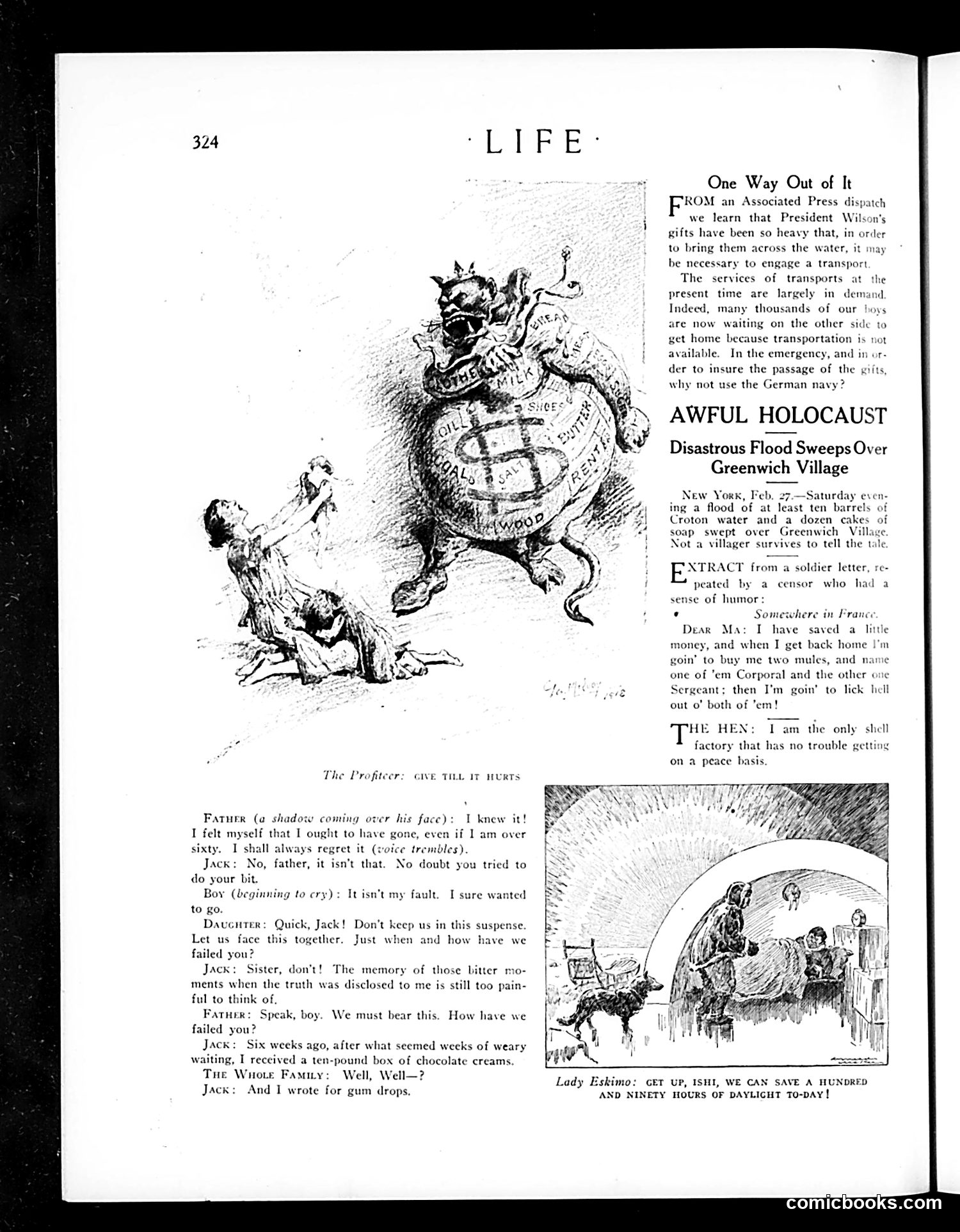
This page contains wartime satire from World War I era (the text references soldiers overseas and President Wilson's gifts being shipped). **Top cartoon:** A bloated profiteer labeled with war industries sits atop suffering soldiers. The caption sarcastically suggests using the German navy to transport Wilson's gifts—mocking profiteers who accumulate wealth while soldiers lack basic transportation home. **"Awful Holocaust"** mockingly reports a flood in Greenwich Village (a bohemian neighborhood), trivializing actual war casualties by treating minor civilian mishaps as equivalent disasters. **Family dialogue:** A soldier's son confesses his "failure"—he received chocolate creams instead of requested gum drops. This absurdist humor satirizes melodramatic war literature while poking fun at home-front complaints that seem trivial compared to soldiers' actual suffering. **Bottom right:** A lady Eskimo celebrates gaining daylight hours, irrelevant to wartime concerns—more absurdist satire. The page's overall point: criticizing profiteering, home-front hypocrisy, and disconnect between civilian concerns and soldier sacrifices.
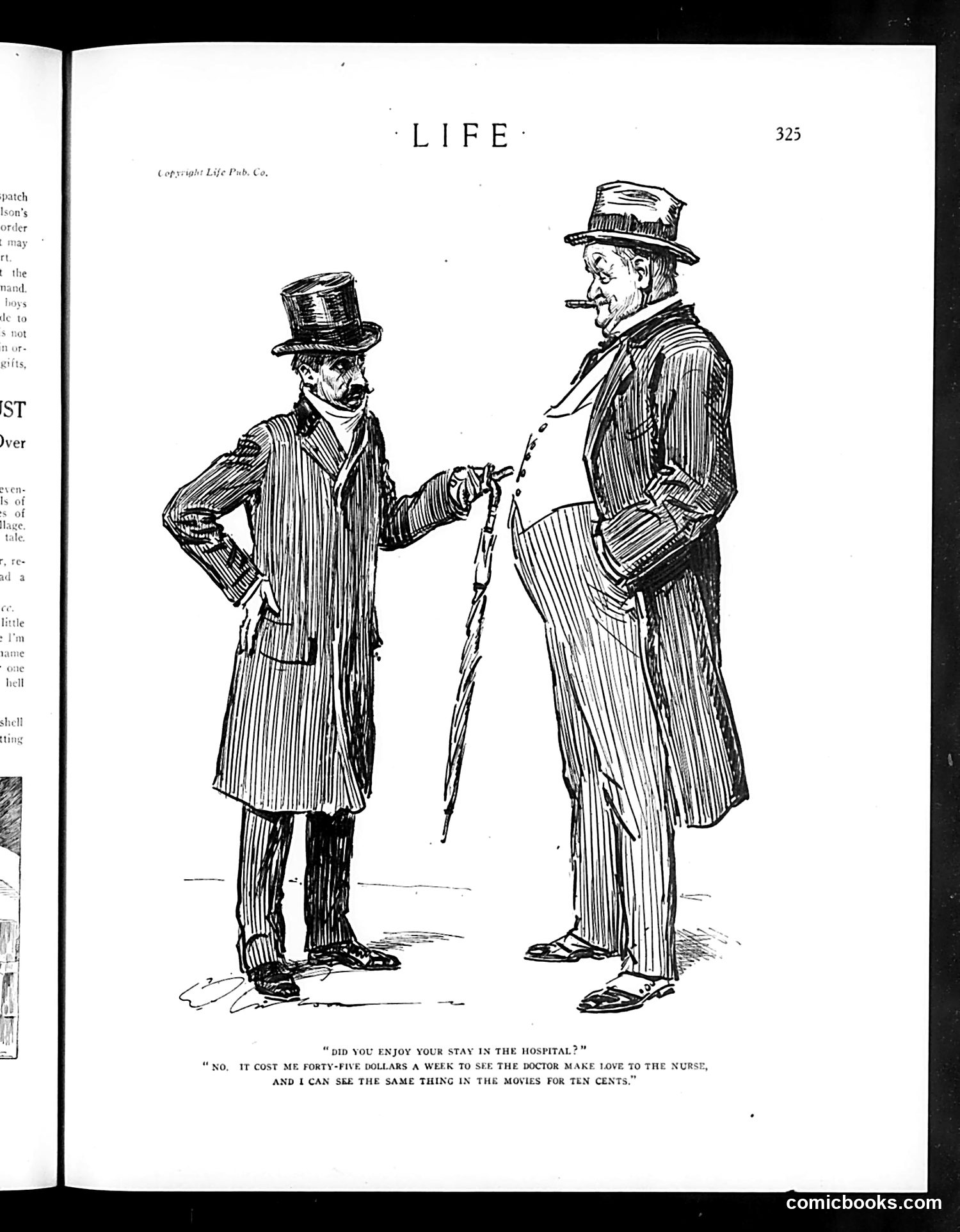
This single-panel cartoon depicts two men in formal attire (top hats and overcoats) engaged in conversation. The caption reveals the joke: one man asks if the other enjoyed his hospital stay. The response mocks the high cost of medical care—forty-five dollars weekly to watch "the doctor make love to the nurse"—compared to seeing the same thing in movies for ten cents. The satire targets early 20th-century hospital economics and costs, suggesting that patients were being overcharged for basic care. It also plays on period humor about romantic workplace behavior between doctors and nurses. The cartoon's point: hospitals exploit patients financially while providing entertainment value comparable to cheap cinema.
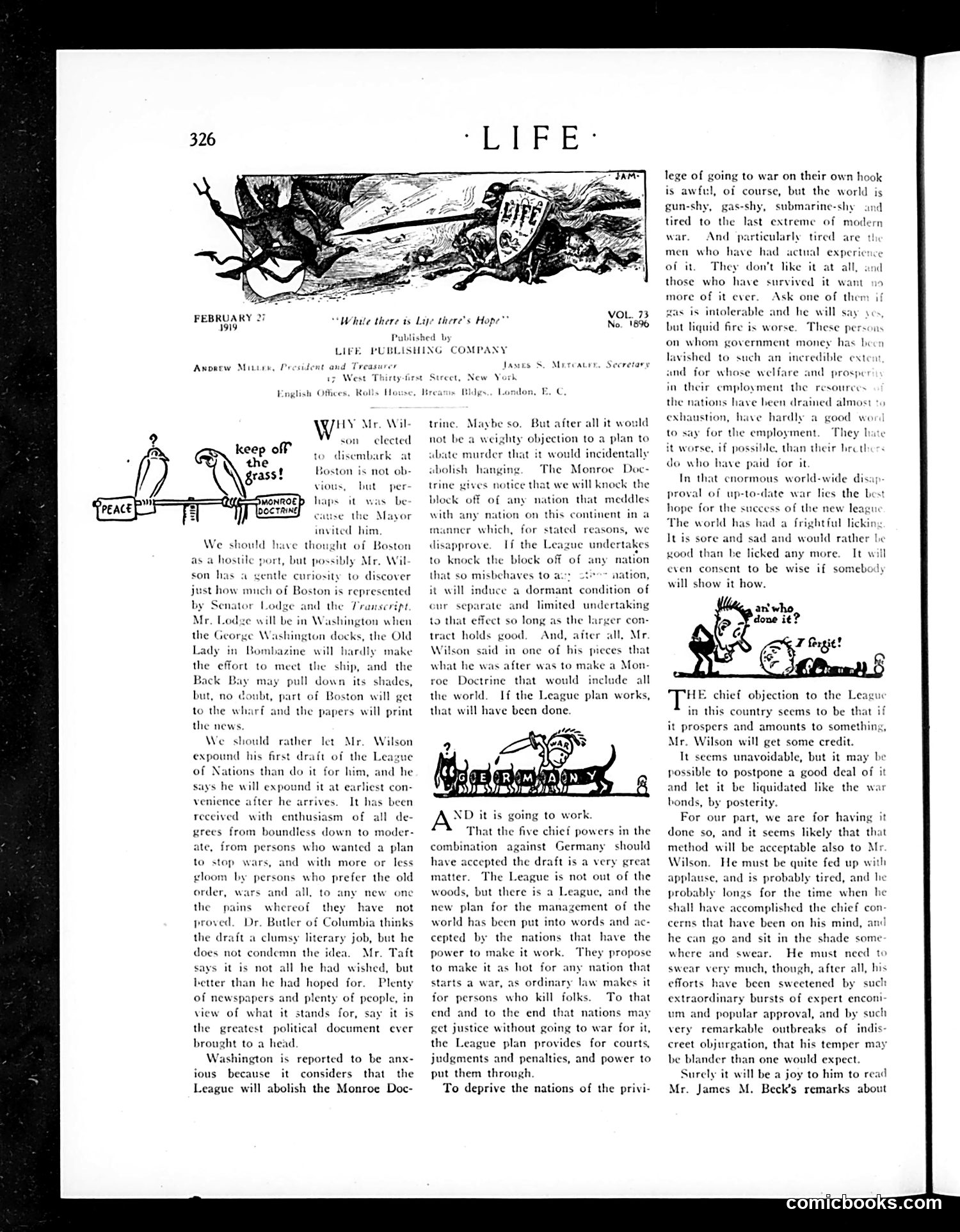
This page discusses President Wilson's return to Boston to promote his newly drafted **League of Nations**—a major diplomatic initiative after World War I. ## Key Figures & References: **President Wilson**: Recently presented his first League draft; the editorial supports his plan despite reservations from critics like Senator Lodge (a prominent Republican opponent of the League) and the *Boston Transcript*. **The Monroe Doctrine**: Mentioned as a concern—some feared the League would supersede America's independent foreign policy. ## The Satire: The cartoon ("Keep Off the Grass") and editorial are largely **favorable** to Wilson's League, though gently mocking Boston's parochial political resistance. The piece argues the League's benefits—preventing war through international courts and enforcement—outweigh traditional objections about American sovereignty. The real targets are isolationists and those "tired to the last extreme of modern war" who nonetheless resist binding international commitments.
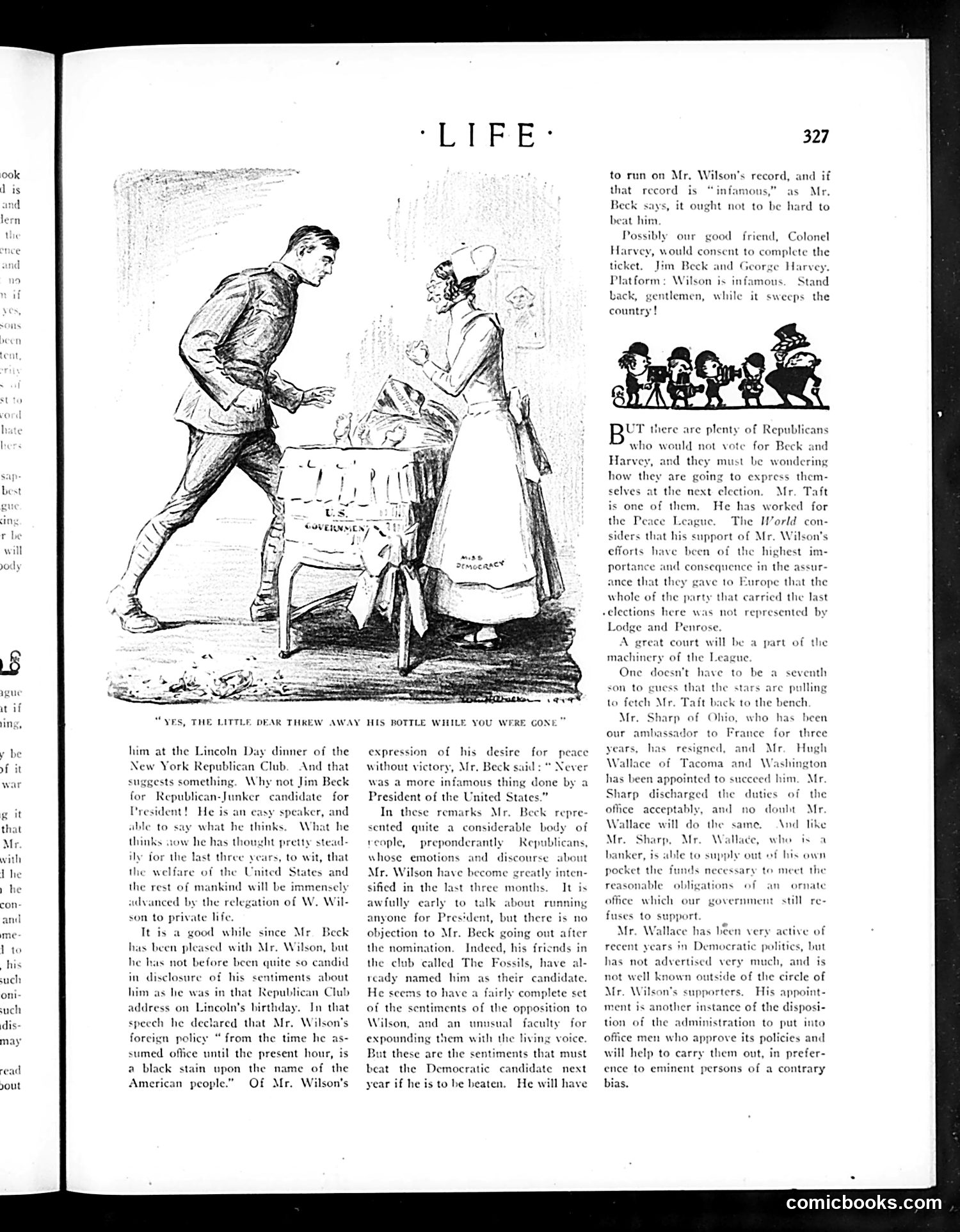
This page satirizes Republican opposition to President Woodrow Wilson ahead of the 1916 election. The cartoon depicts a man (identified in text as Jim Beck, a Republican Club speaker) discarding Wilson's record like a bottle—suggesting Republicans want to discard Wilson from office. The text discusses Beck's harsh Lincoln Day speech attacking Wilson's foreign policy as "a black stain" and his "peace without victory" stance as "infamous." Life mocks Republicans' eagerness to nominate Beck for president, sarcastically suggesting pairing him with Colonel Harvey on a platform simply opposing Wilson. The article also notes that President Taft and other prominent Republicans—who *supported* Wilson's peace efforts—would likely oppose such a candidacy, creating party fracture. The page concludes discussing diplomatic appointments, suggesting Wilson strategically places loyalists in office. **Context:** This reflects the 1916 presidential campaign's deep divisions over American neutrality and intervention in World War I.
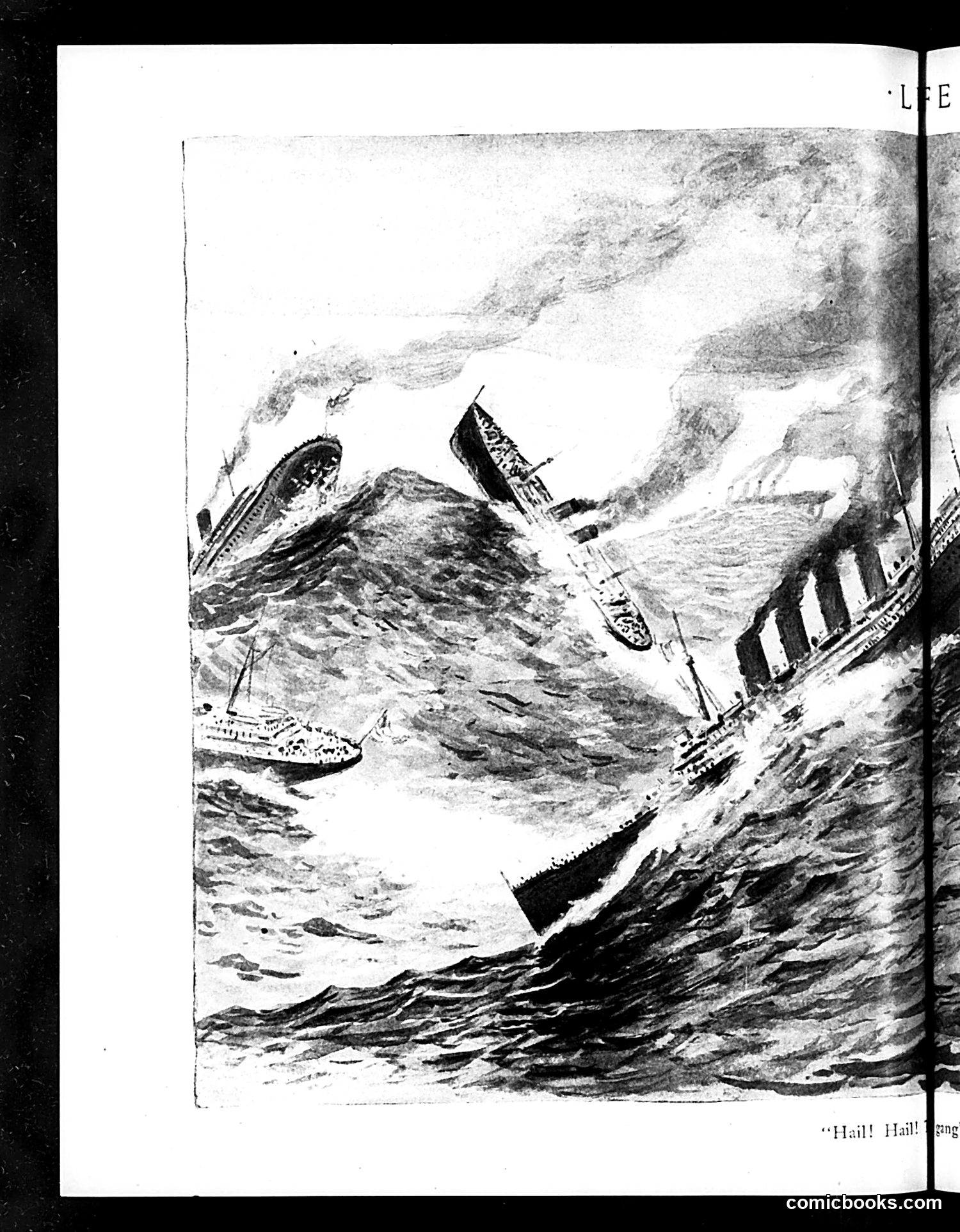
This appears to be a satirical illustration depicting a maritime disaster with multiple ships in distress amid turbulent waves. The image shows several vessels tilting at dangerous angles, with some partially submerged or colliding. The partial caption visible reads "Hail! Hail!" suggesting ironic commentary. Without clearer text or date information visible on this page, I cannot definitively identify which specific historical maritime disaster this references or what political/social point the satire makes. The style and printing quality suggest early-to-mid 20th century Life magazine. To accurately explain the satire's target and meaning, I would need either: the publication date, complete caption text, or additional identifying text from the page. The illustration technique is skilled, but the specific historical reference remains unclear from what's legible here.
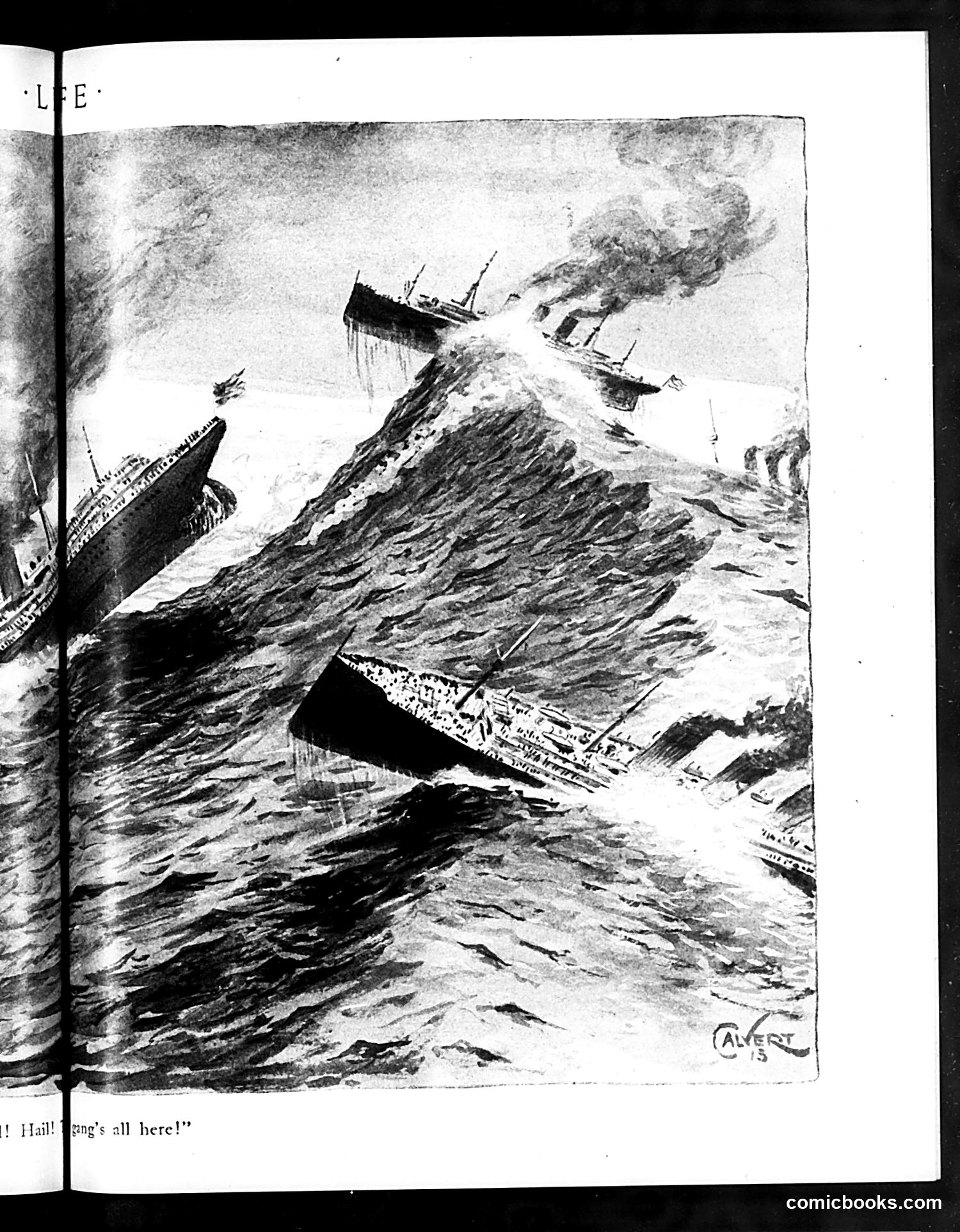
This is a dramatic illustration depicting multiple ships in distress, sinking in turbulent waters. The sketch shows several vessels at various angles—some capsizing, others already submerged—amid churning waves and smoke. The signature reads "CALVERT" (likely the artist). The partial caption reads "all here!" suggesting a complete or total disaster. Without a clear date or additional context from surrounding text, the specific historical event is unclear. However, given Life magazine's satirical nature, this likely comments on a contemporary maritime tragedy or, possibly, uses shipwreck imagery metaphorically for a political or economic crisis. The composition emphasizes chaos and total collapse—multiple vessels failing simultaneously suggests systemic failure rather than isolated incident.
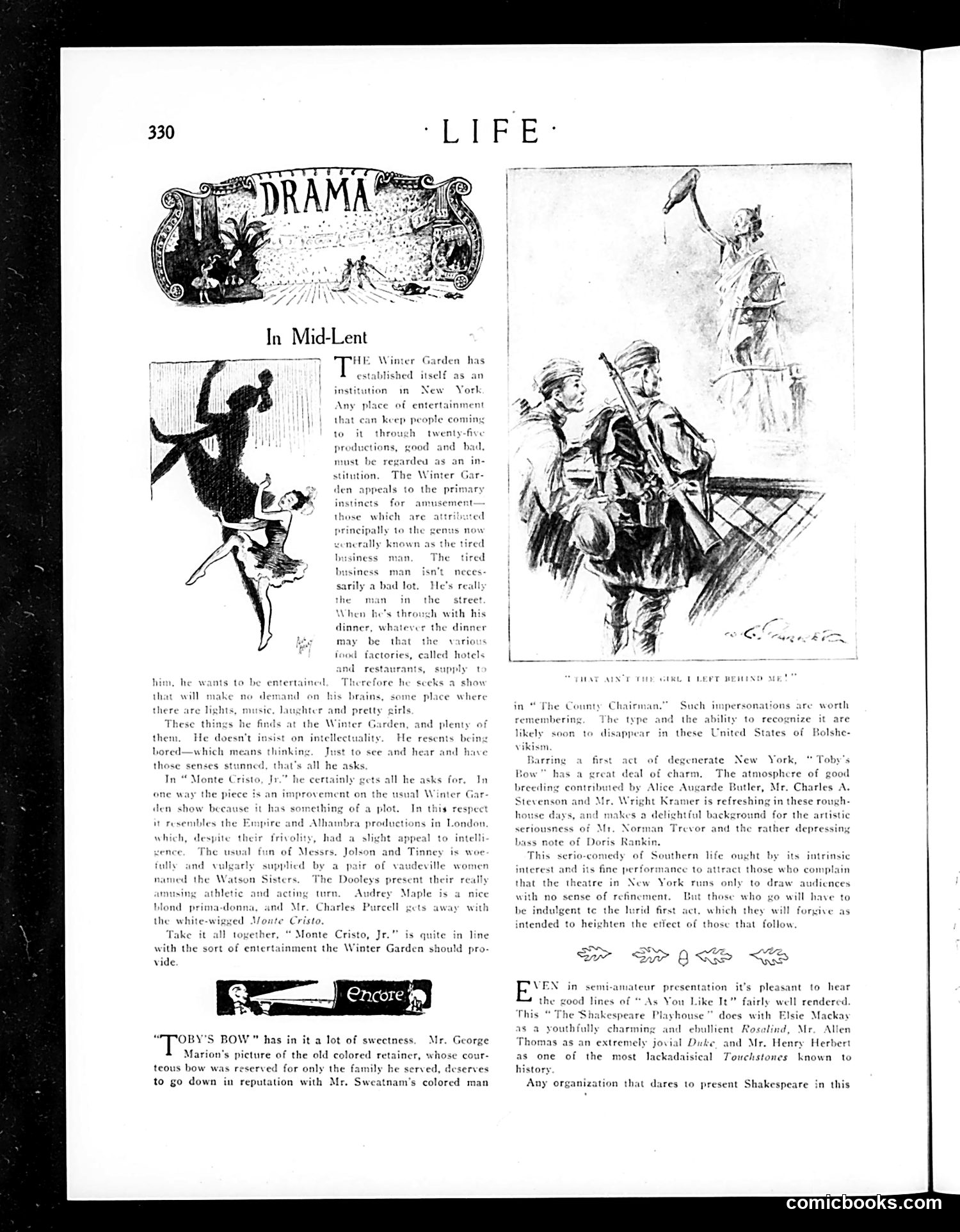
This page reviews Winter Garden Theatre productions in New York during Lent season. The cartoons illustrate theatrical entertainment aimed at the tired businessman—the primary audience for these shows. The left illustration depicts a dancer performing acrobatic moves, embodying the "lights, music, laughter and pretty girls" that constitute the Winter Garden's appeal. The right illustration shows soldiers, likely from a production like "Toby's Bow" or "The County Chairman," referencing contemporary military themes. The text criticizes these entertainments as deliberately anti-intellectual, designed to stun the senses rather than engage the mind. The reviewer notes that tired businessmen seek escapism and sensory stimulation rather than serious drama. References to Al Jolson and other performers anchor these as specific 1910s-era productions. The tone is gently mocking—the satire targets both the vapid entertainment industry and the audience's willingness to be entertained without thinking.
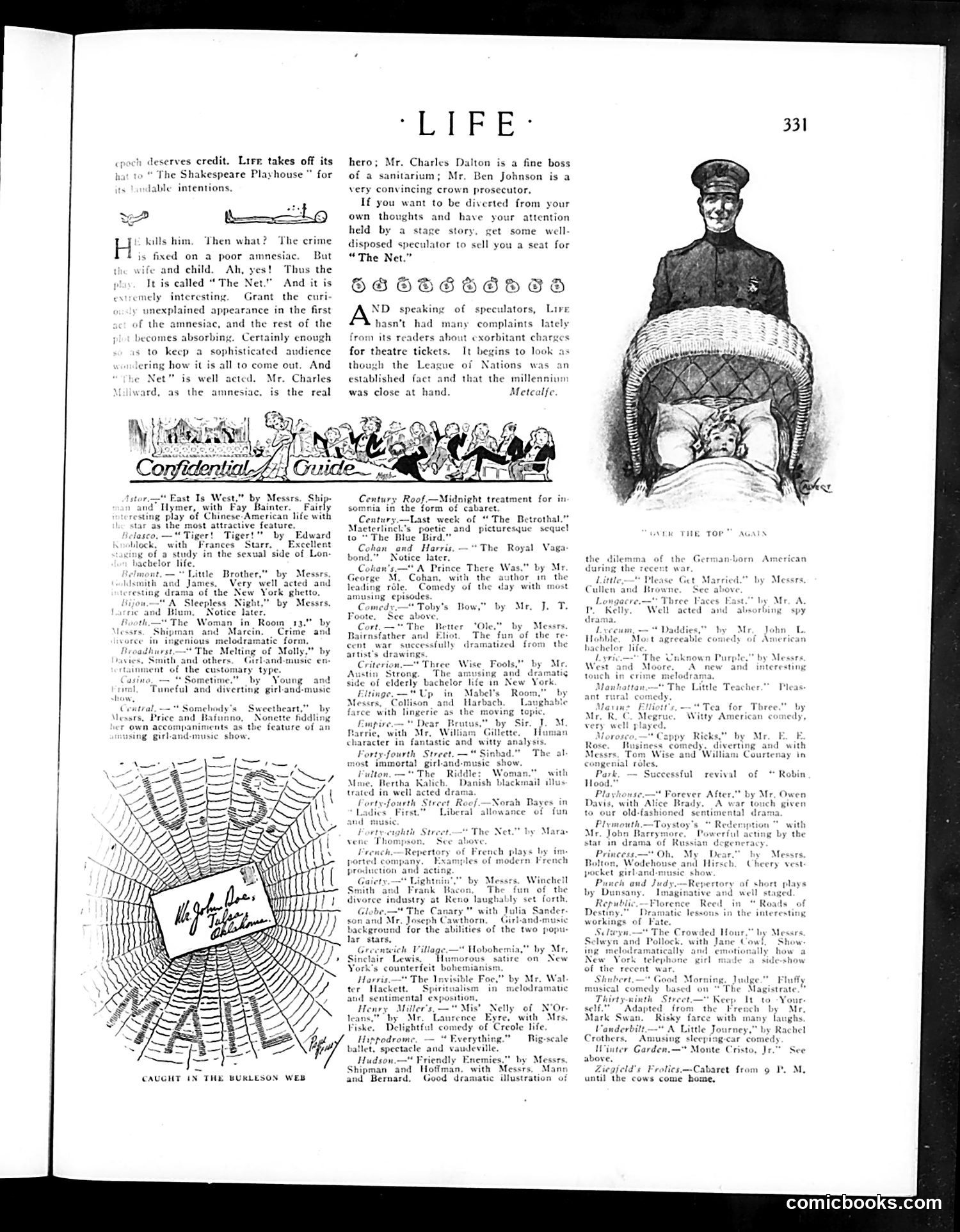
This page from *Life* magazine reviews theatrical productions, with particular focus on "The Net," a play about a murder mystery centered on an amnesiac husband. The text praises the Shakespeare Playhouse's production, commending Charles Dalton as "a fine boss of a sanitarium" and Ben Johnson as a "very convincing crown prosecutor." The page also includes a satirical illustration labeled "Caught in the Burleson Web"—a spider web with a signature inside. This appears to reference Albert Burleson, Postmaster General under President Wilson, who was controversial for censoring mail and suppressing dissent during World War I. The "web" metaphor suggests entrapment by government censorship authority. The bulk of the page comprises theater listings and reviews for New York productions, demonstrating *Life*'s role as both satirical commentary and cultural guide for urban audiences of the era (likely early 1920s).
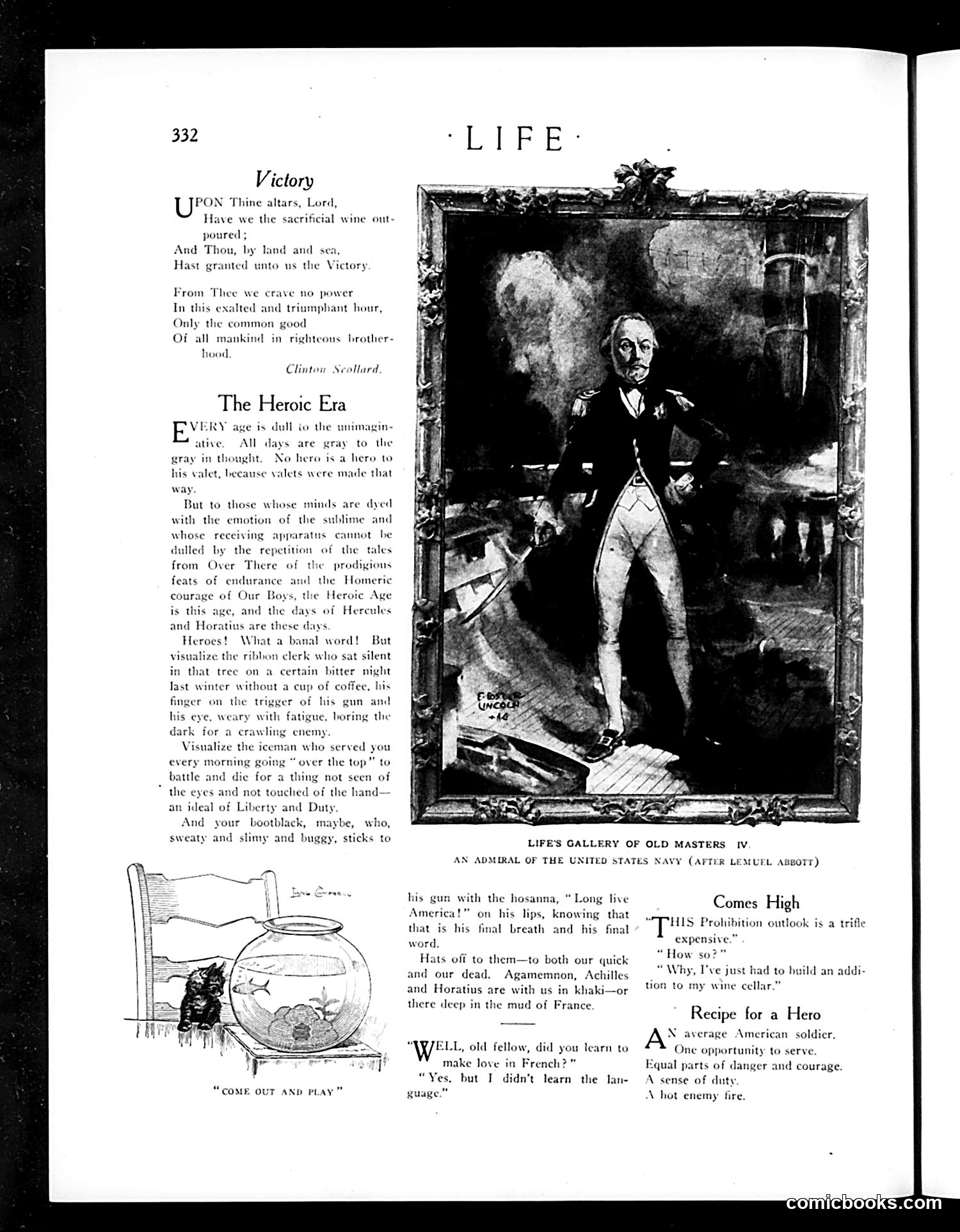
This WWI-era page celebrates American soldiers as modern heroes through multiple pieces: **"Victory" poem** (top left): A patriotic prayer thanking God for military victory, attributed to Clinton Scollard, emphasizing collective good rather than individual power. **"The Heroic Era" essay**: Argues that ordinary working-class men—ribbon clerks, icemen, bootblacks—become heroes through service in France. It romanticizes soldiers enduring hardship ("finger on the trigger") and dying for abstract ideals of "Liberty and Duty." References to classical heroes (Achilles, Horatius) elevate these common laborers. **Naval portrait**: Shows an admiral in formal military dress, captioned as "after Lemuel Abbott," establishing gravitas through art history reference. **Bottom jokes**: Satirize civilian concerns during wartime—a soldier asking about learning French while fighting, and a wealthy man's "Prohibition outlook" being expensive because he's built a wine cellar addition. This mocks profiteering and disconnection from soldiers' sacrifice. **"Recipe for a Hero"**: Summarizes the essay's message: ordinary Americans plus duty equals heroism under enemy fire. The page overall glorifies working-class sacrifice while subtly criticizing civilian indulgence.
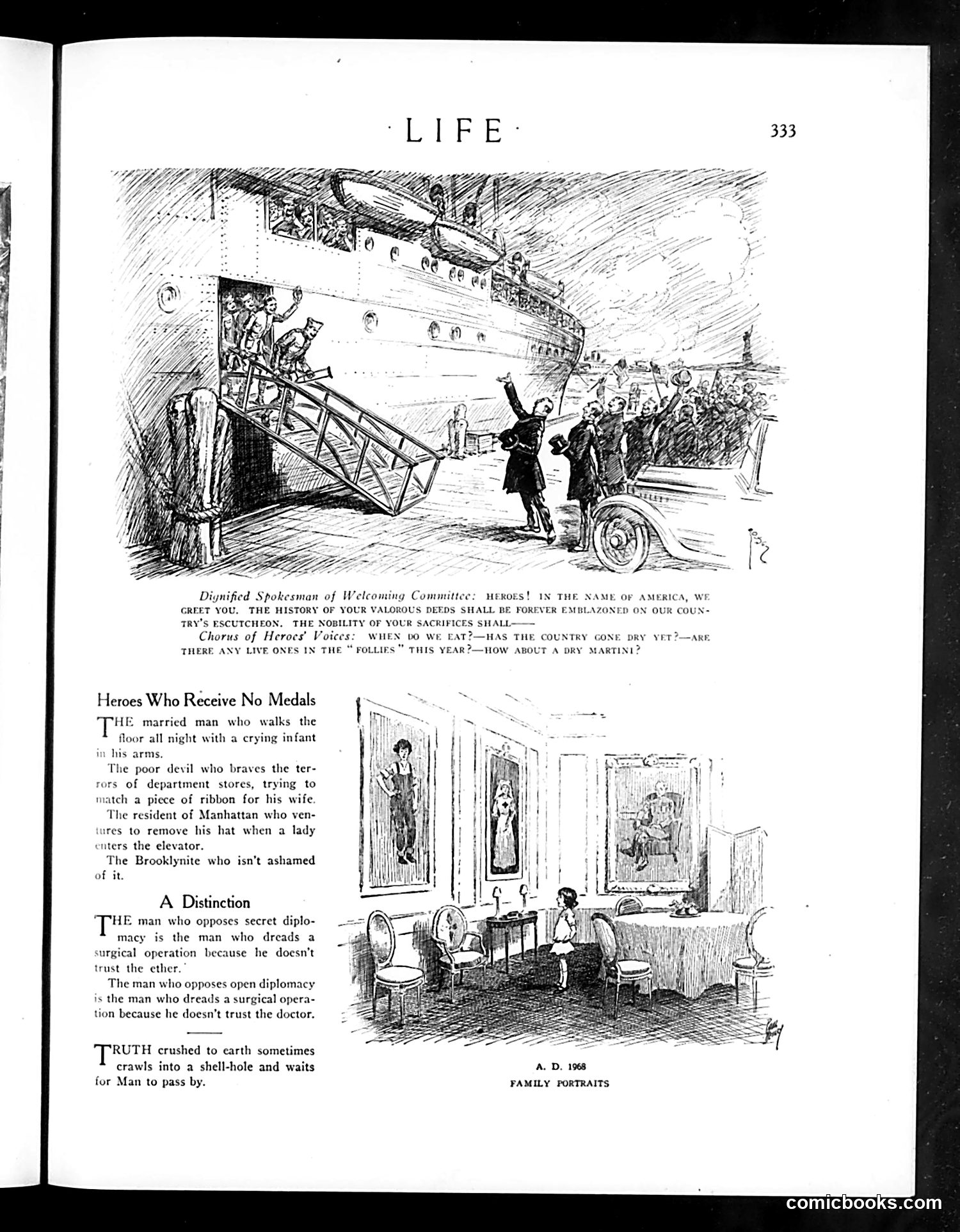
**Top Cartoon:** Depicts returning WWI soldiers being welcomed by a pompous official who praises their "valorous deeds" and sacrifices. The soldiers, however, interrupt with cynical demands: "When do we eat? Has the country gone dry yet? Are there any live ones in the 'Follies' this year? How about a dry martini?" **The satire:** Mocks the disconnect between grandiose public rhetoric honoring war heroes and soldiers' actual concerns—food, Prohibition-era drinking, and entertainment. It critiques both government hypocrisy and soldiers' apparent materialism. **Lower sections:** Brief humorous observations about unrecognized "heroes"—ordinary men enduring domestic hardships (crying infants, shopping ordeals) and minor courtesies (removing hats in elevators). These contrast with decorated soldiers, suggesting everyday life contains its own heroism. The piece satirizes post-WWI American society: empty patriotic gestures, Prohibition tensions, and the gap between celebrated military service and mundane civilian struggles.
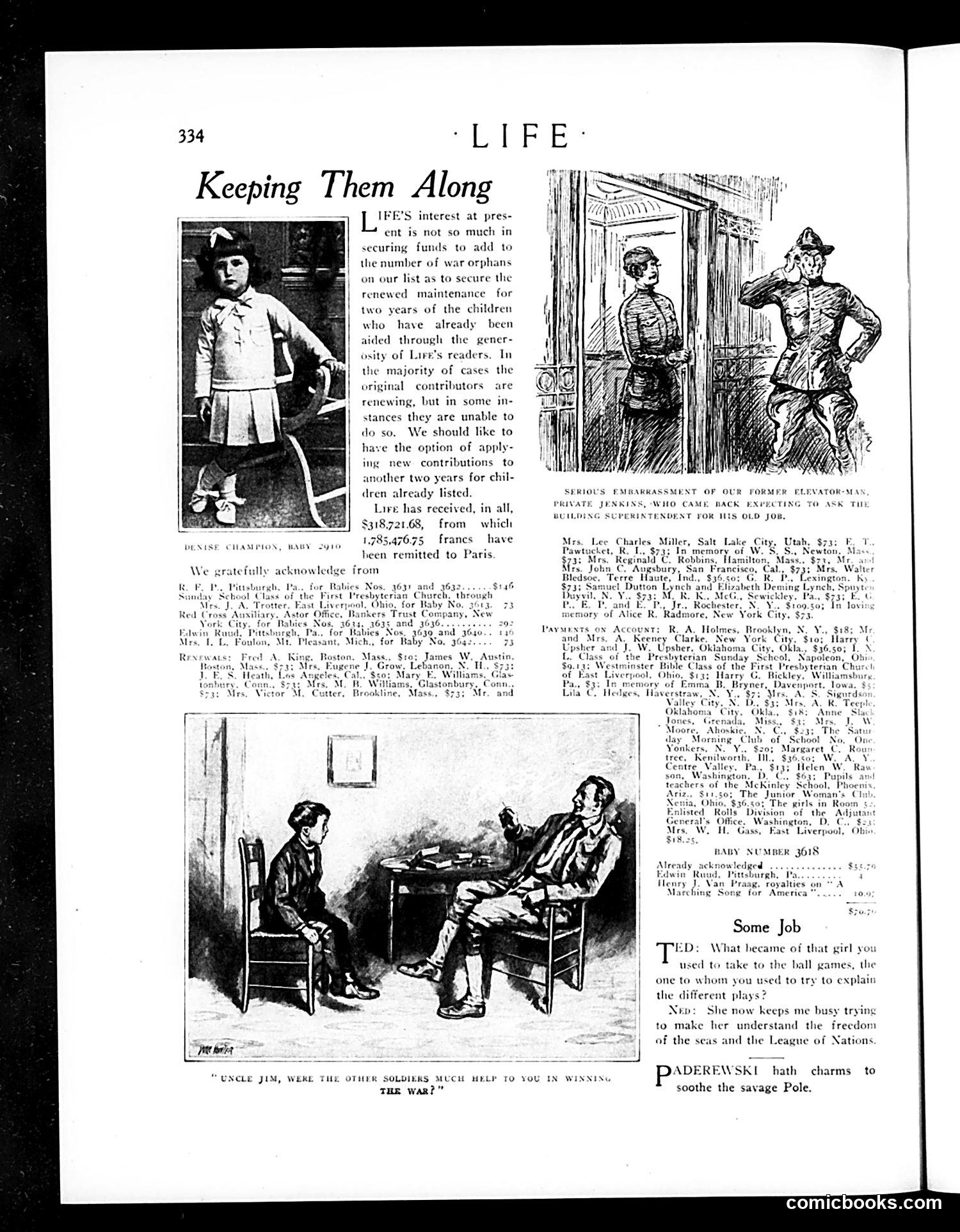
This page documents LIFE magazine's charitable fundraising for **war orphans** from World War I. The magazine had collected over $318,000 and distributed nearly 1.8 million francs to Paris for orphan care. They're now seeking donors to **renew support for two more years** for children already in the program. The two illustrations are humorous vignettes about social change: 1. **Top cartoon**: A former elevator operator is embarrassed when his old employer unexpectedly asks for his job back—suggesting post-war employment instability. 2. **Bottom cartoon**: "Uncle Jim" asks a soldier if other soldiers helped win the war. The answer reveals the soldier's girlfriend now spends her time studying international affairs (the League of Nations) rather than attending baseball games—satirizing how women's interests shifted during/after WWI toward serious world politics. The final line references **Ignacy Jan Paderewski**, the famous Polish pianist and statesman, playing his role in post-war peace negotiations ("soothe the savage Pole").
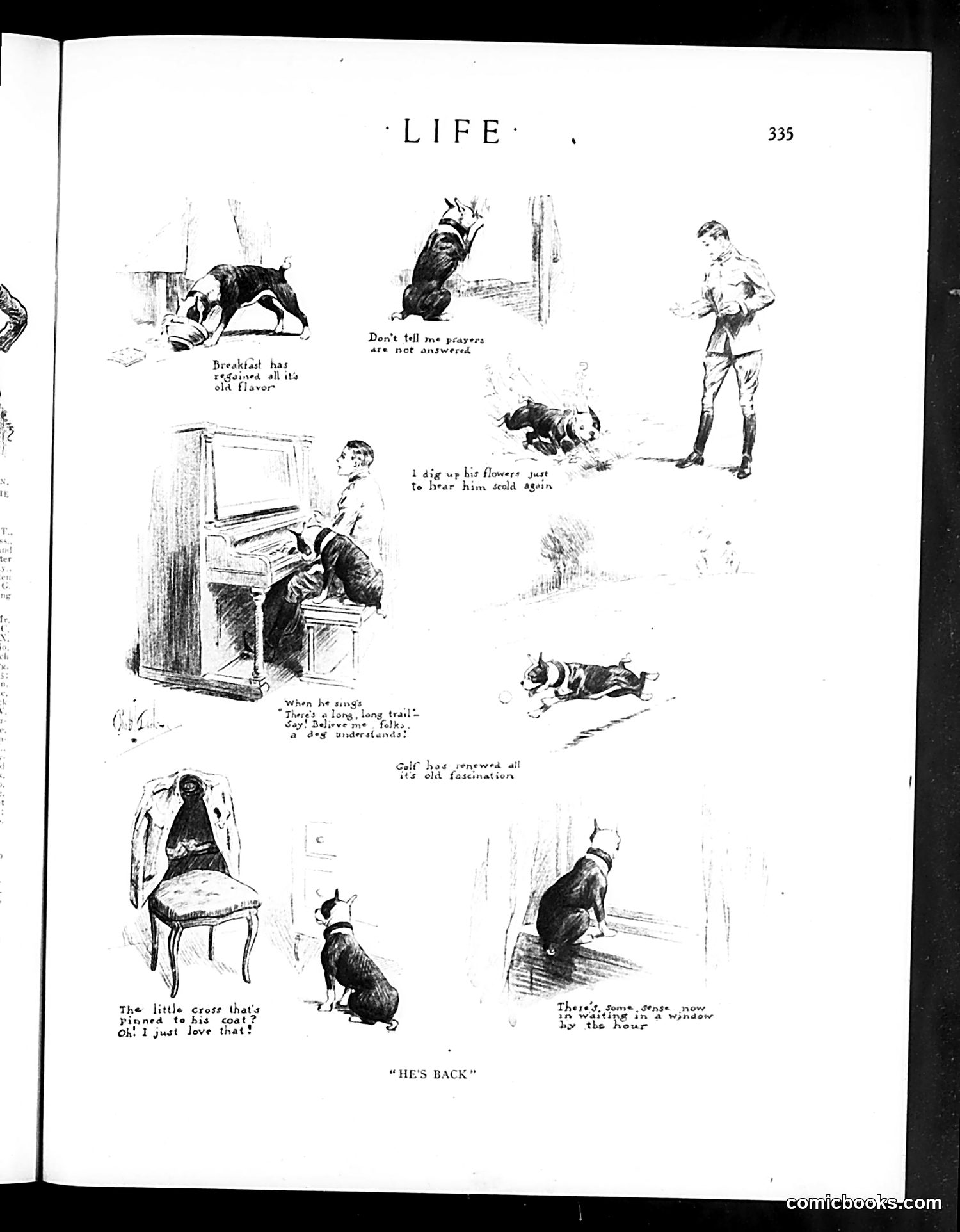
This page depicts a husband's return home, likely from World War I military service. The title and vignettes celebrate how his presence has restored domestic life to normalcy and joy. Each sketch illustrates a wife's delight in ordinary activities now meaningful because her husband is home: breakfast tastes better, she enjoys his scolding her for digging up flowers, golf excites him again, his singing pleases her despite being off-key, she admires his military decoration (the cross pin), and window-watching for his arrival now has "sense." The comic's satire is gentle—it mocks how women's wartime sacrifices and longing transform mundane domestic routines into sources of happiness. The recurring dog emphasizes domestic contentment. This reflects post-WWI sentimentality about soldiers' homecomings and the restoration of "normal" family life, though it presents an idealized, sentimental view of women's experience during and after the war.
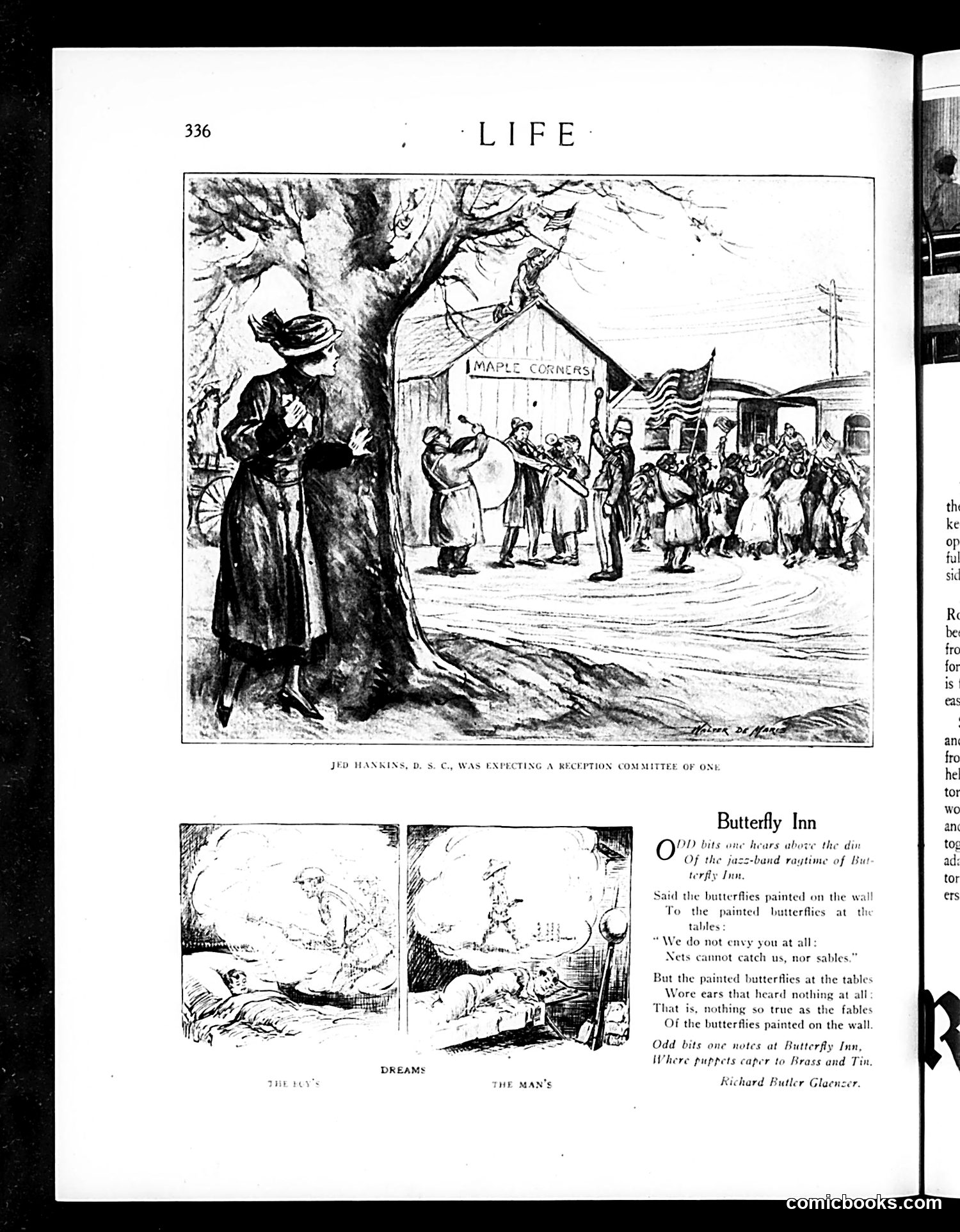
The page contains two distinct pieces: **Top cartoon:** Shows "Jed Hankins, D.S.C." (likely a political or social figure) standing alone by a large tree, expecting to meet a "reception committee of one" at what appears to be "Maple Corners"—a small-town gathering. A large crowd has assembled instead at the building behind him, suggesting ironic disappointment or a comedic contrast between expectation and reality. **"Butterfly Inn" poem and illustrations:** A satirical piece by Richard Butler Glaenzer contrasting painted butterflies on walls with real painted butterflies at tables. The poem's irony: the real butterflies at tables (representing actual people) hear nothing true, while the wall paintings (representing ideals or art) speak honest "fables." This likely satirizes artificial social pretense—people performing at fashionable establishments while missing authentic meaning. The accompanying sketches labeled "Dreams" and "The Man's" remain unclear without fuller context. Both pieces appear to target small-town pretension and social artificiality.
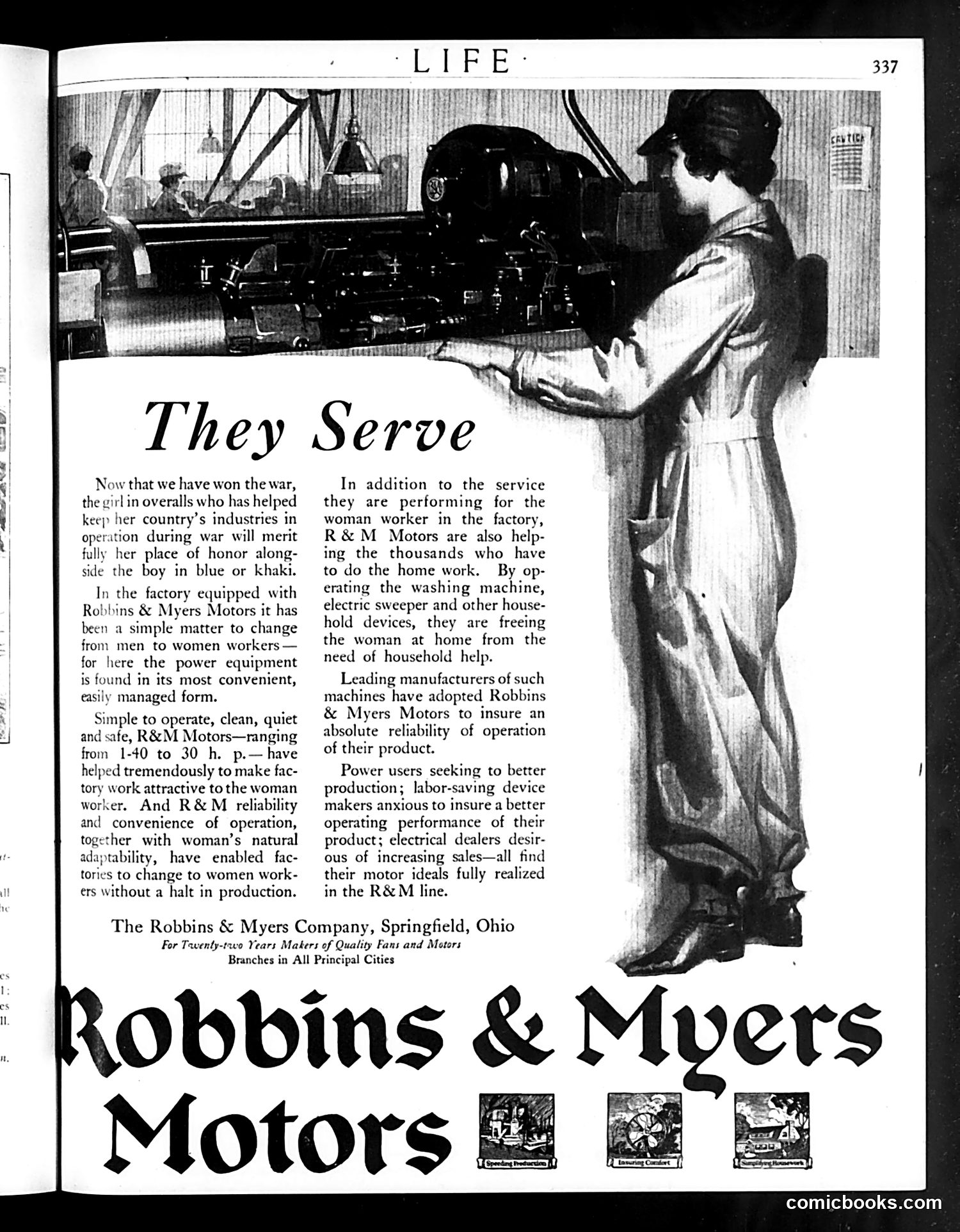
This is primarily an **advertisement**, not satire. It promotes Robbins & Myers electric motors for post-WWI industrial use. The page capitalizes on women's wartime factory work ("the girl in overalls who has helped keep her country's industries in operation during war"). Rather than satirizing gender roles, the ad argues that R&M Motors made factory work "attractive to the woman worker" by being safe and easy to operate—implying women could continue in industrial roles. Notably, the copy also emphasizes how these motors power household appliances (washing machines, sweepers), "freeing the woman at home from the need of household help." This dual messaging reflects post-war anxieties: women should be valued for war service, yet simultaneously directed toward domestic labor-saving devices—keeping them home. The accompanying illustration shows a woman in work dress operating factory machinery, presenting her contribution as dignified service to the nation.
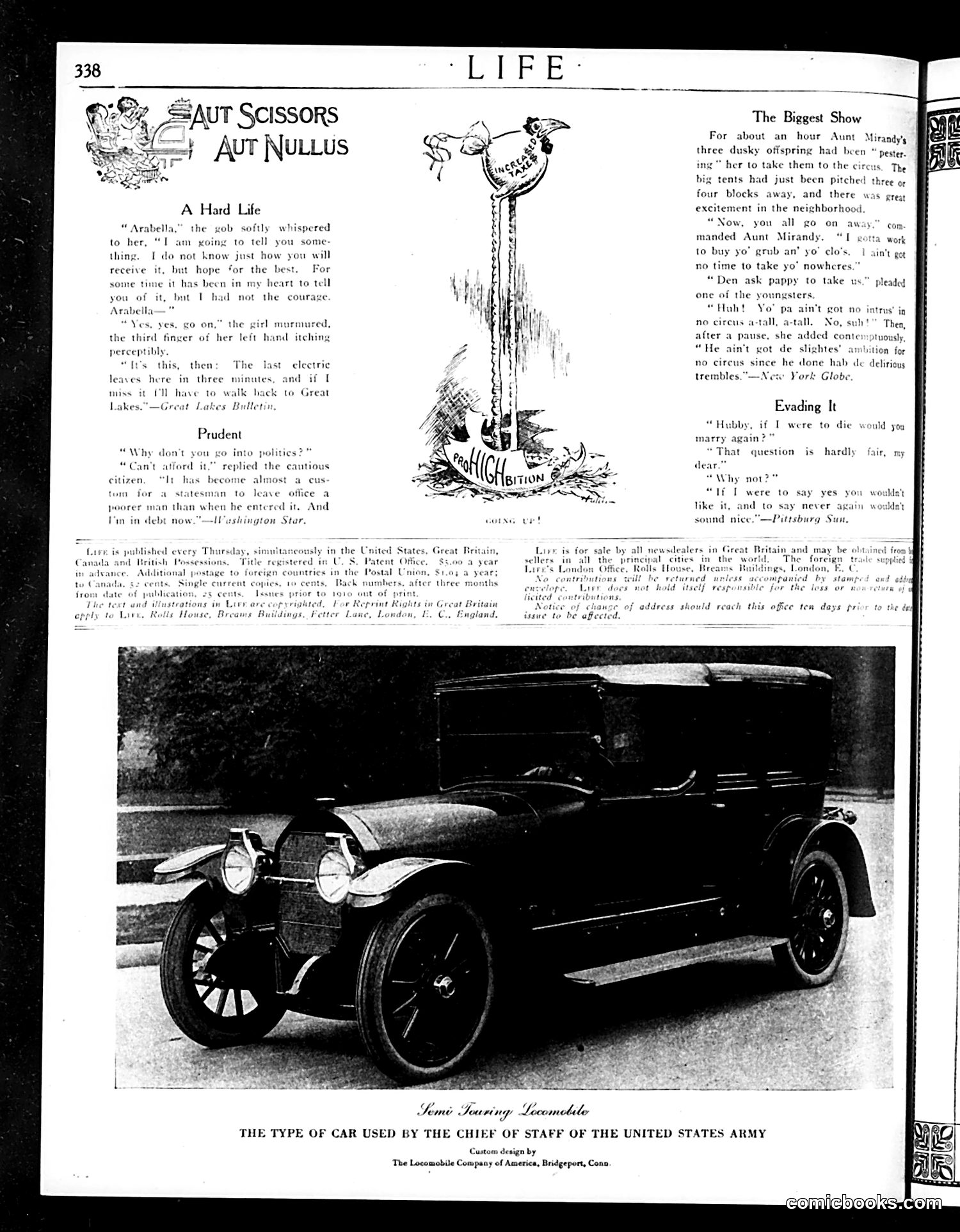
This page contains three distinct satirical pieces typical of *Life* magazine's social commentary: **"Aut Scissors Aut Nullus" (top):** A visual pun showing a ostrich with extremely long legs labeled "HIGH AMBITION." The accompanying jokes mock working-class aspirations—particularly African American characters ("Arabella," "Aunt Mirandy") denied circus attendance due to poverty and parental indifference. **"A Hard Life":** Military humor about a soldier unable to afford dating because of financial hardship from military service. **"Prudent":** Political satire suggesting politicians routinely leave office poorer than they entered, now normalized as corrupt practice. **"Evading It":** Brief marital humor about a husband reluctant to commit to remarriage after death. The page concludes with an advertisement for a Locomobile automobile "used by the Chief of Staff of the United States Army," ironically juxtaposing luxury goods against the preceding jokes about poverty and hardship.
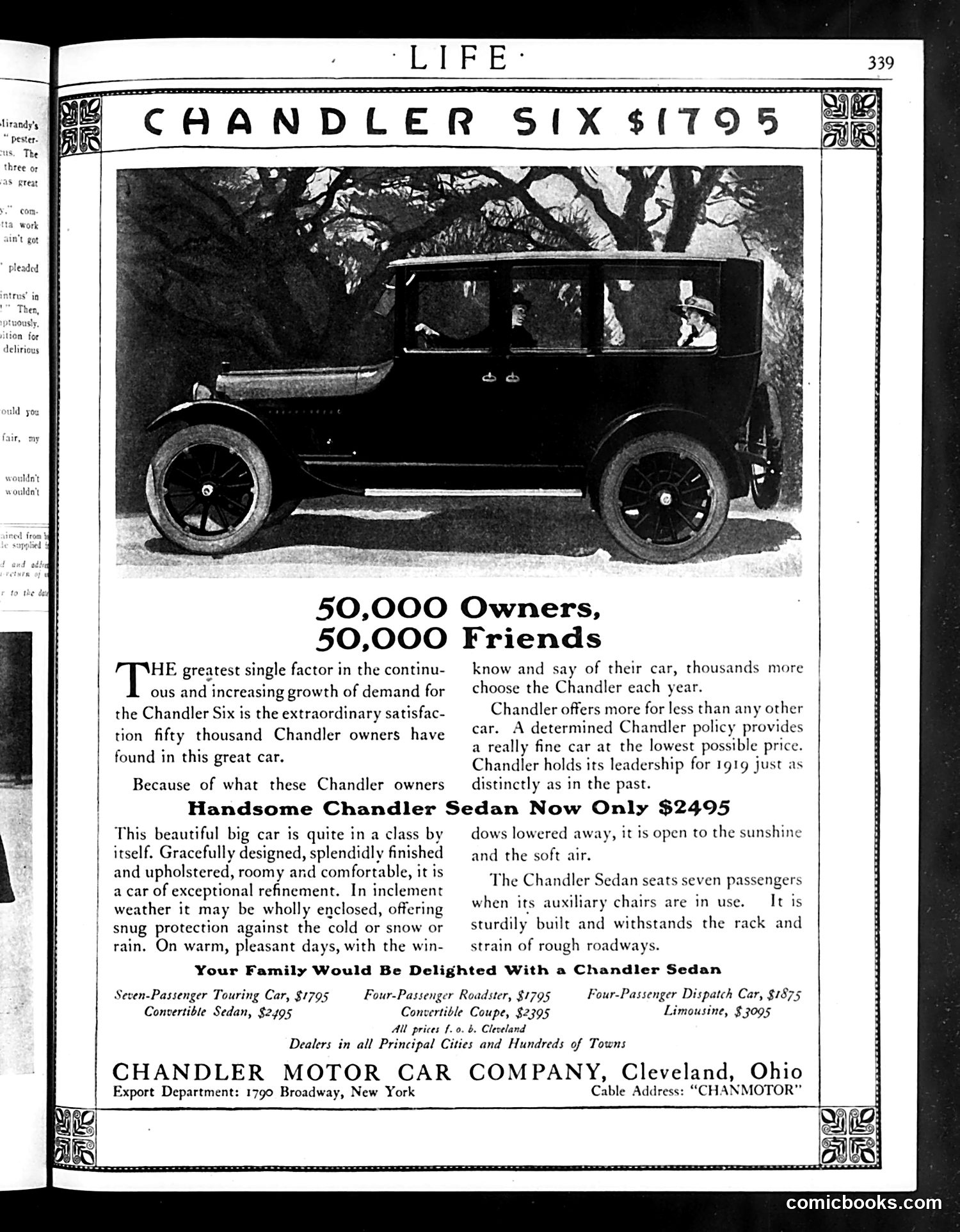
This is a **full-page automobile advertisement**, not a cartoon or satire. It promotes the Chandler Six automobile from the Chandler Motor Car Company (Cleveland, Ohio). # The Content The ad claims the car's success stems from owner satisfaction: "50,000 Owners, 50,000 Friends." It emphasizes value—offering "more for less than any other car"—and highlights the sedan model at $2,495, describing it as gracefully designed, roomy, and comfortable. The vehicle seats seven passengers and functions as both an enclosed winter car and an open-air summer automobile. Additional models listed include touring cars, roadsters, and limousines at various price points. The ad concludes with dealer availability information and export contact details in New York. **Historical note**: This represents typical 1920s automotive marketing, emphasizing reliability, family suitability, and competitive pricing during the early automobile era.
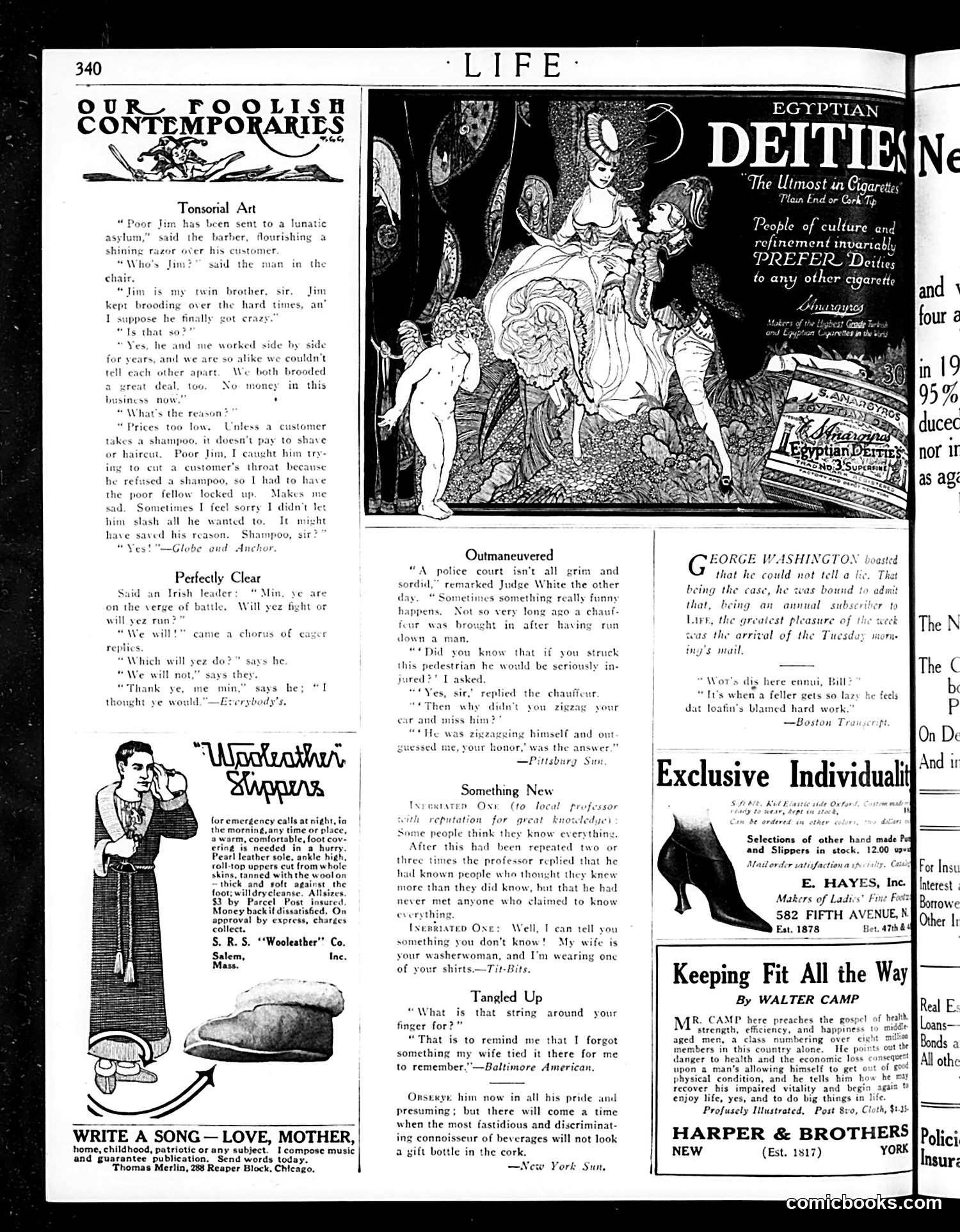
This page's main cartoon satirizes a barber's explanation for why business is bad. The barber describes his twin brother Jim, who "went crazy" from brooding over hard times and attempted to cut a customer's throat after being refused a shampoo. The joke plays on the barber's deadpan acceptance of this tragedy: he regrets not letting Jim "slash all he wanted to" because it might have "saved his reason." The satire targets economic hardship during what appears to be a recession—the barber blames poor business on customers refusing basic services like shampoos due to financial strain. The dark humor suggests how desperation can drive men to madness, while the barber's casual attitude reflects the period's cynical acceptance of suffering among working-class men.
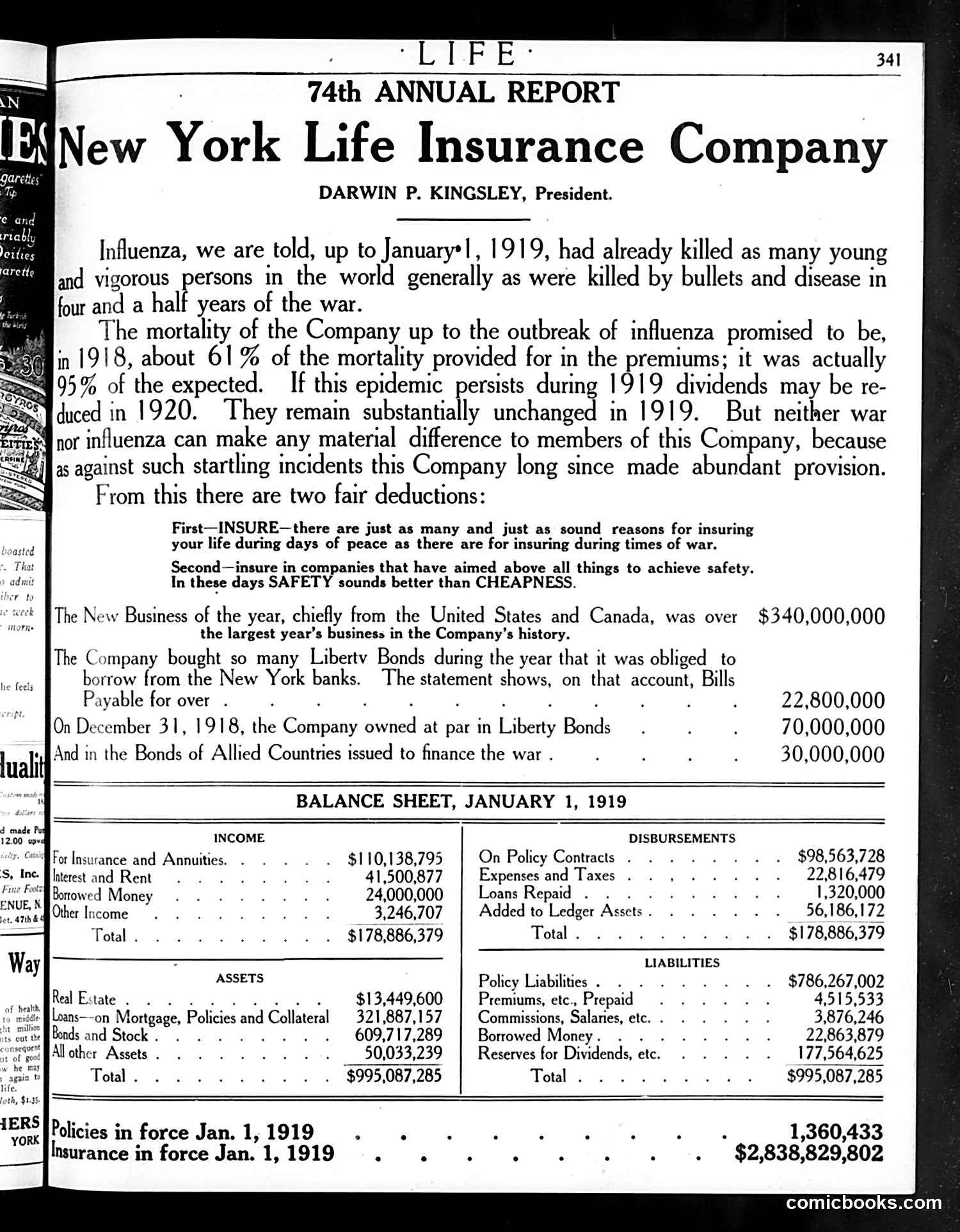
This is **not a cartoon or satirical content**—it's a straightforward corporate annual report from *Life* magazine's 74th issue. The page presents New York Life Insurance Company's financial statements as of January 1, 1919. The key context for modern readers: President Darwin P. Kingsley addresses the **1918-1919 influenza pandemic**, which killed as many young, healthy people as four-and-a-half years of World War I. He notes the company's mortality claims reached 495% of projected levels but assures policyholders the company remains solvent due to "abundant provision" made in advance. The report emphasizes two selling points: (1) life insurance is as necessary during peacetime as wartime, and (2) choose companies prioritizing "safety" over "cheapness"—a defensive marketing message during economic uncertainty. The balance sheet shows $995 million in assets and $2.8 billion in insurance in force, including heavy wartime Liberty Bond investments.
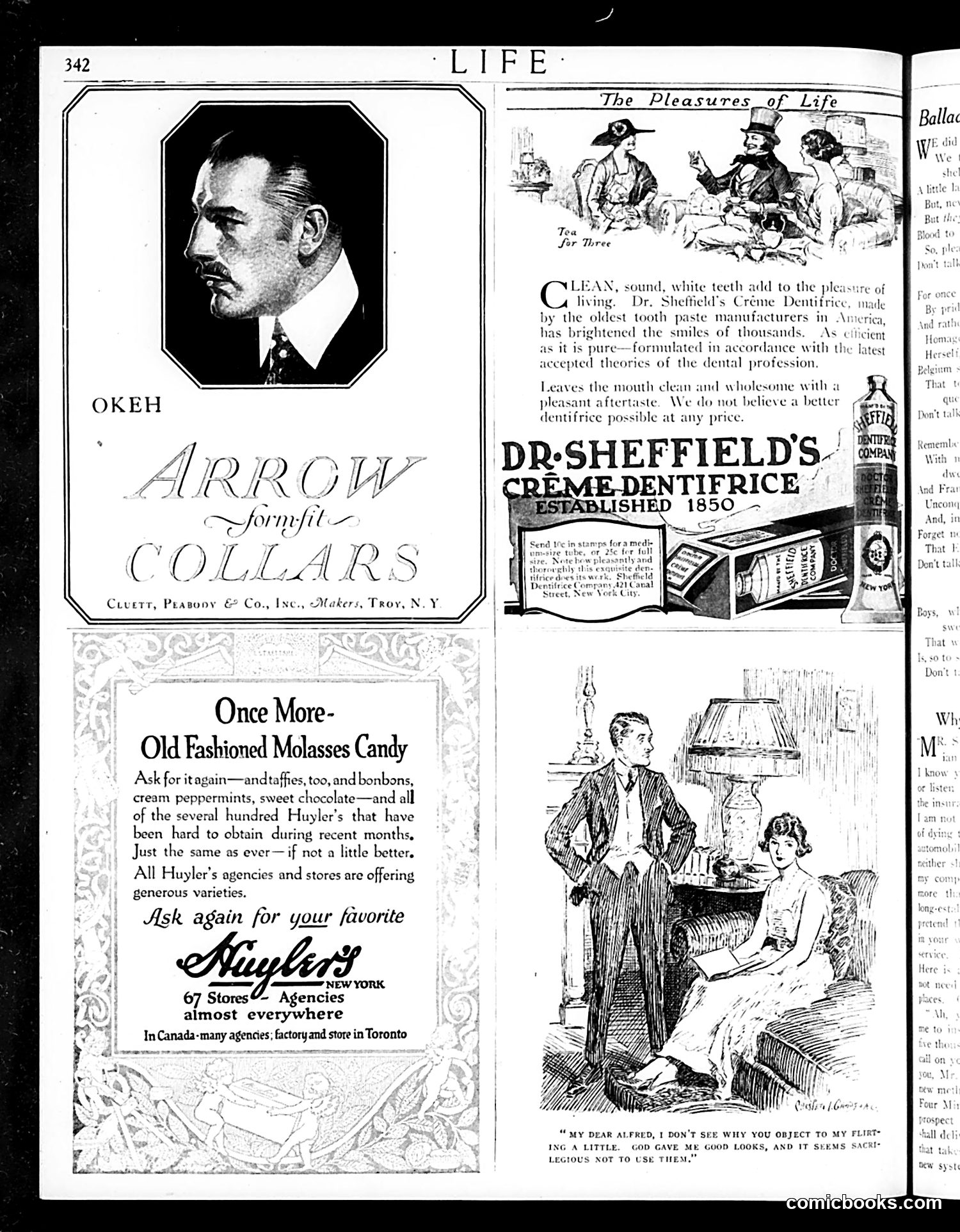
This page is primarily **advertising**, not political satire. It contains: 1. **Arrow Collar ad** (top left): Features a man in profile wearing a formal collar—a standard product advertisement for a major shirt collar manufacturer. 2. **Dr. Sheffield's Creme Dentifrice ad** (top right): Promotes toothpaste as a product of dental science, claiming it brightens teeth and follows professional dental theory. 3. **Huyler's Molasses Candy ad** (bottom left): Announces the return of hard-to-find candies during what appears to be a wartime shortage period ("recent months"). 4. **Domestic sketch** (bottom right): An illustration accompanying a caption where a woman justifies flirtation to a man (Alfred) as appropriate use of her God-given looks. This reflects period attitudes about gender and propriety rather than political commentary. The page represents typical early 20th-century magazine advertising mixed with light social humor about domestic relationships.
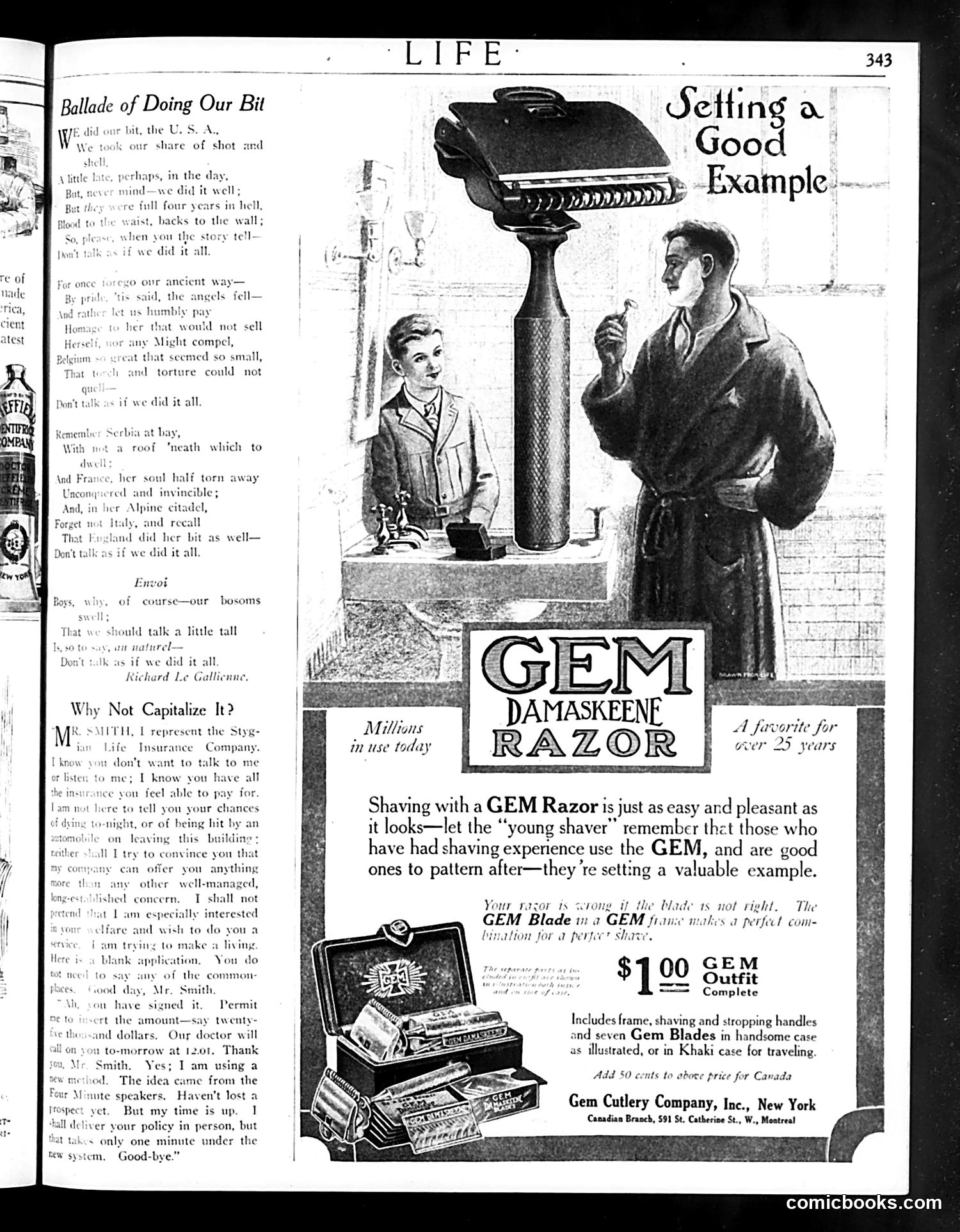
**Left Side - "Ballade of Doing Our Bit":** A poem by Richard Le Gallienne commemorating American WWI sacrifice. The verse celebrates soldiers' wartime contributions—"four years in hell" of combat—while critiquing hollow post-war rhetoric. The final envoi warns against empty boasting: "Don't talk as if we did it all," emphasizing humility about sacrifice. **Center - "Why Not Capitalize It?":** A satirical business pitch where an insurance salesman ("Mr. Smith") attempts to sell life insurance by emphasizing its practical value while ironically admitting he's only pitching to meet his quota ("your policy in person, but...only one minute under the new system"). The humor lies in his transparent, self-serving motivation masquerading as helpful advice. **Right Side - Advertisement:** A Gem Damascene Razor advertisement exploiting the patriotic mood: depicting a father teaching his son to shave, captioned "Setting a Good Example." This commercializes wartime themes of generational duty and moral instruction to sell razors—a cynical juxtaposition of corporate profit-seeking against the serious tone of the patriotic poem.
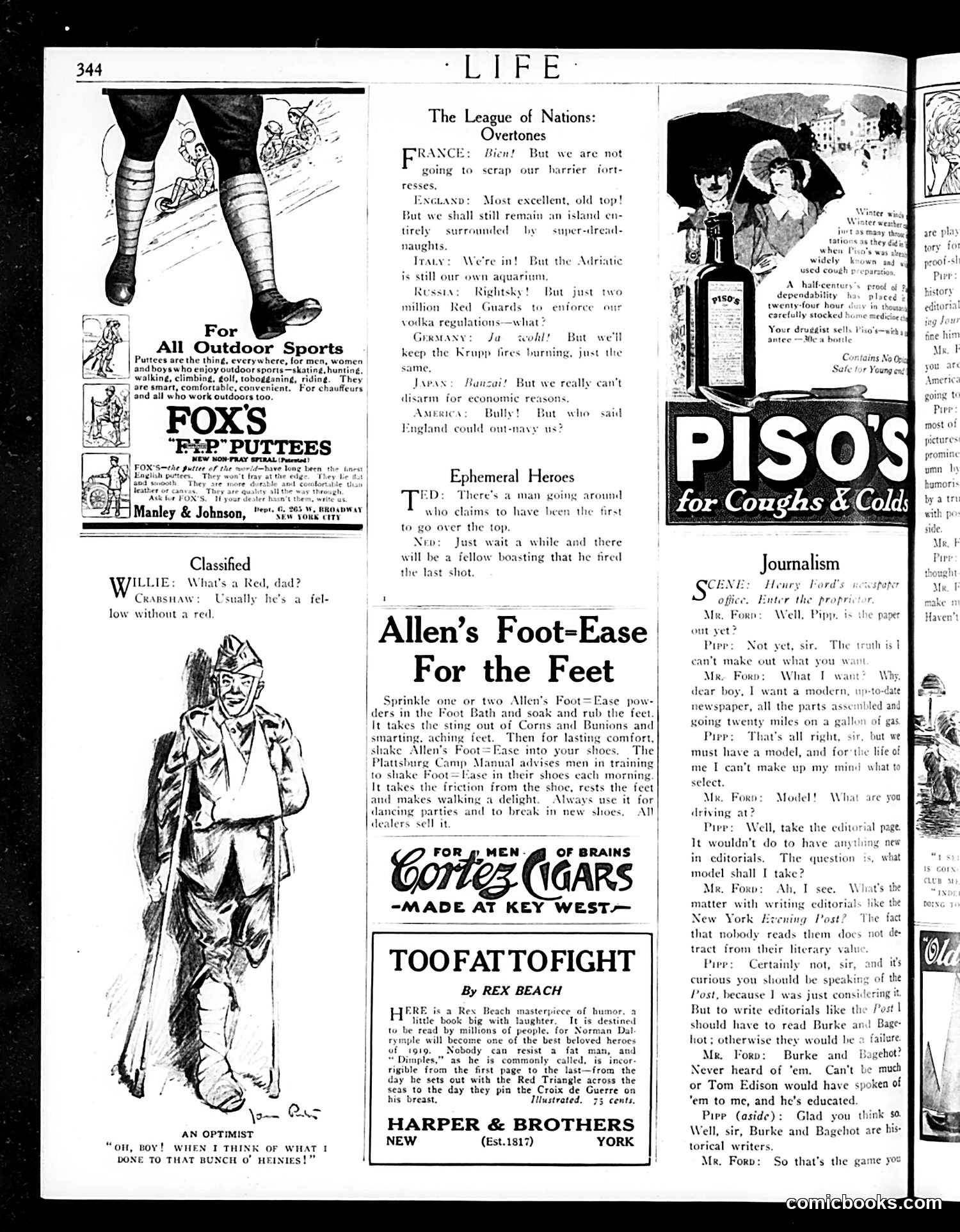
This page contains several distinct satirical pieces: **"The League of Nations: Overtones"** depicts world powers discussing disarmament hypocritically. France, England, Italy, Russia, Germany, Japan, and America each claim peaceful intentions while revealing selfish motives—France won't surrender fortresses, England won't reduce naval power, Russia needs troops to enforce vodka laws. The satire mocks post-WWI peace negotiations where nations publicly support the League of Nations while privately refusing to actually disarm. **"Ephemeral Heroes"** briefly mocks soldiers claiming to be "first over the top" in combat, satirizing self-aggrandizing war narratives. **"An Optimist" cartoon** shows a soldier boasting about killing German soldiers ("Heinies"), presenting naive patriotic braggadocio as humor. The remaining content is advertisements (puttees, foot powder, cigars, a Rex Beach novel) typical of Life's revenue model. The overall page reflects post-WWI American skepticism about international peace efforts and satirizes both nationalist posturing and popular war mythology.
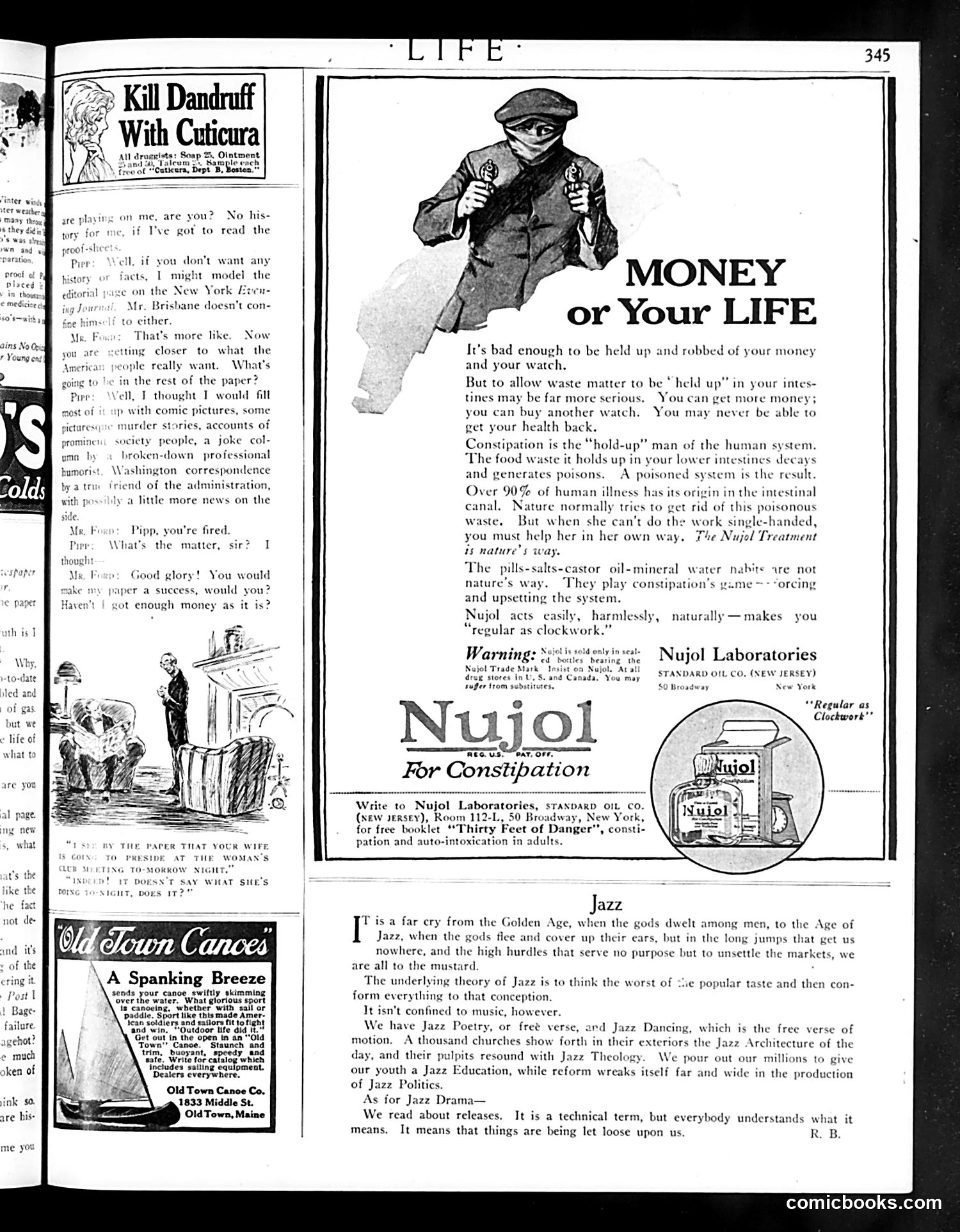
This page contains **three distinct elements**: ## Left: Editorial Cartoon Dialogue A conversation between newspaper editor "Mr. Pipp" and a reporter, satirizing sensationalist journalism. Pipp explicitly states he wants the paper filled with "comic pictures," "picturesque murder stories," and gossip about society figures—not facts or serious news. When the reporter suggests adding substantive content, Pipp fires him, declaring he already has "enough money." The joke critiques how profitable yellow journalism is, making accurate reporting commercially undesirable. ## Center: Nujol Advertisement A patent medicine ad using fear-based marketing ("Money or Your Life") to sell a constipation treatment, claiming 90% of human illness originates in the intestinal tract. Typical of early 20th-century dubious medical advertising. ## Right: Jazz Essay A cultural critique dismissing jazz as embodying lowbrow taste—characterizing it as formless chaos corrupting American society, from music and poetry to architecture and theology. This reflects conservative anxiety about jazz as a modern cultural threat.
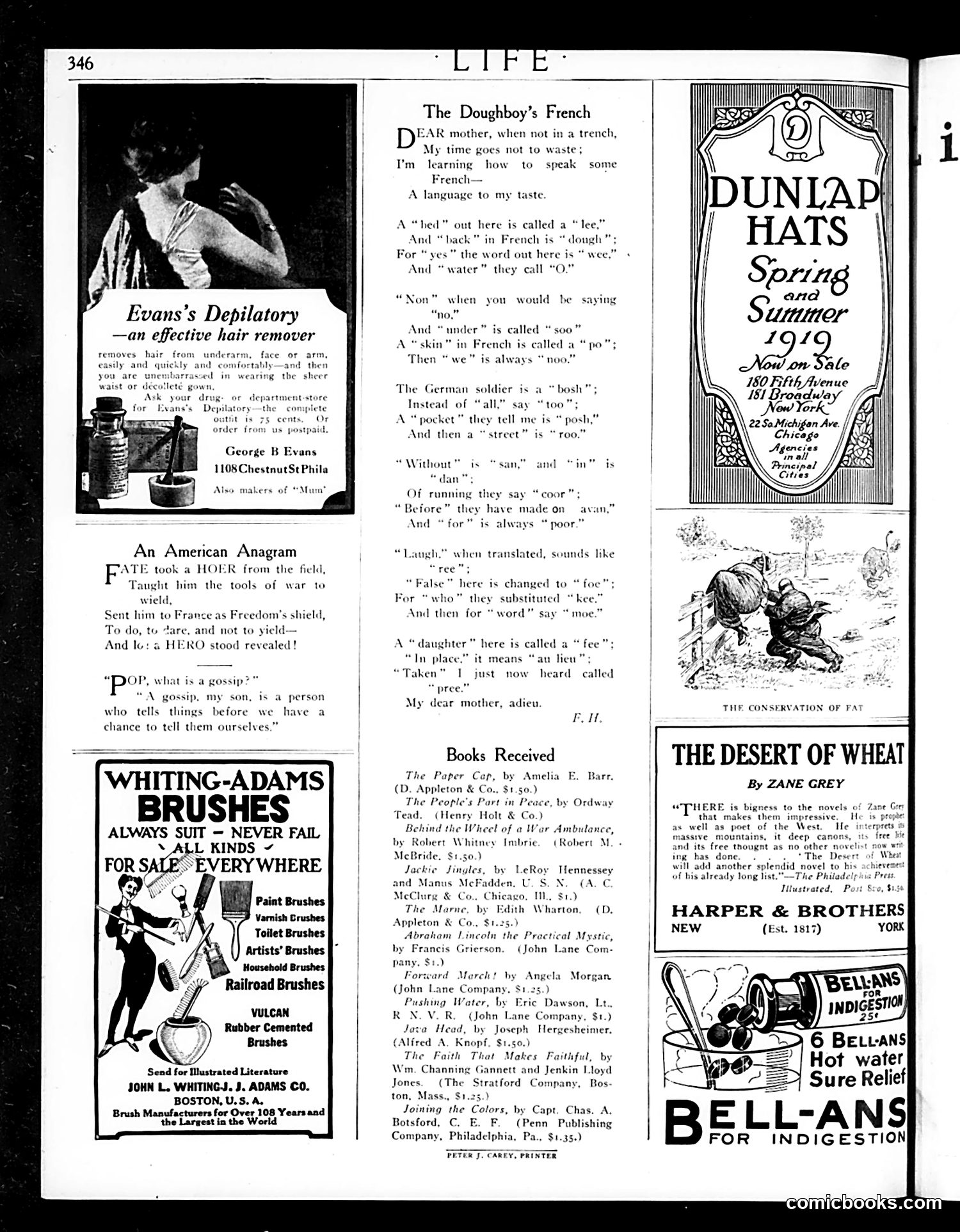
This poem mocks American soldiers stationed in France during World War I by presenting hilariously garbled "French" phrases. The humor relies on intentional malapropisms and nonsense—claiming French words sound nothing like their actual pronunciation. For example, the doughboy claims "bed" is "lee," "yes" is "wee," and "water" is "O"—none of which are remotely accurate French. The joke satirizes the soldiers' complete linguistic incompetence and their comical attempts to communicate in a foreign language they don't understand. The poem's framing as a letter home ("My dear mother, adieu") adds pathos to the comedy: despite being stationed in France as "Freedom's shield," these American soldiers are hilariously lost linguistically. It's gentle satire of military life abroad, playing on period anxieties about American doughboys struggling to adapt to European conditions during the war.