
Life, 1919-02-27 · page 33 of 38
Life — February 27, 1919 — page 33: what you’re looking at
What you’re looking at
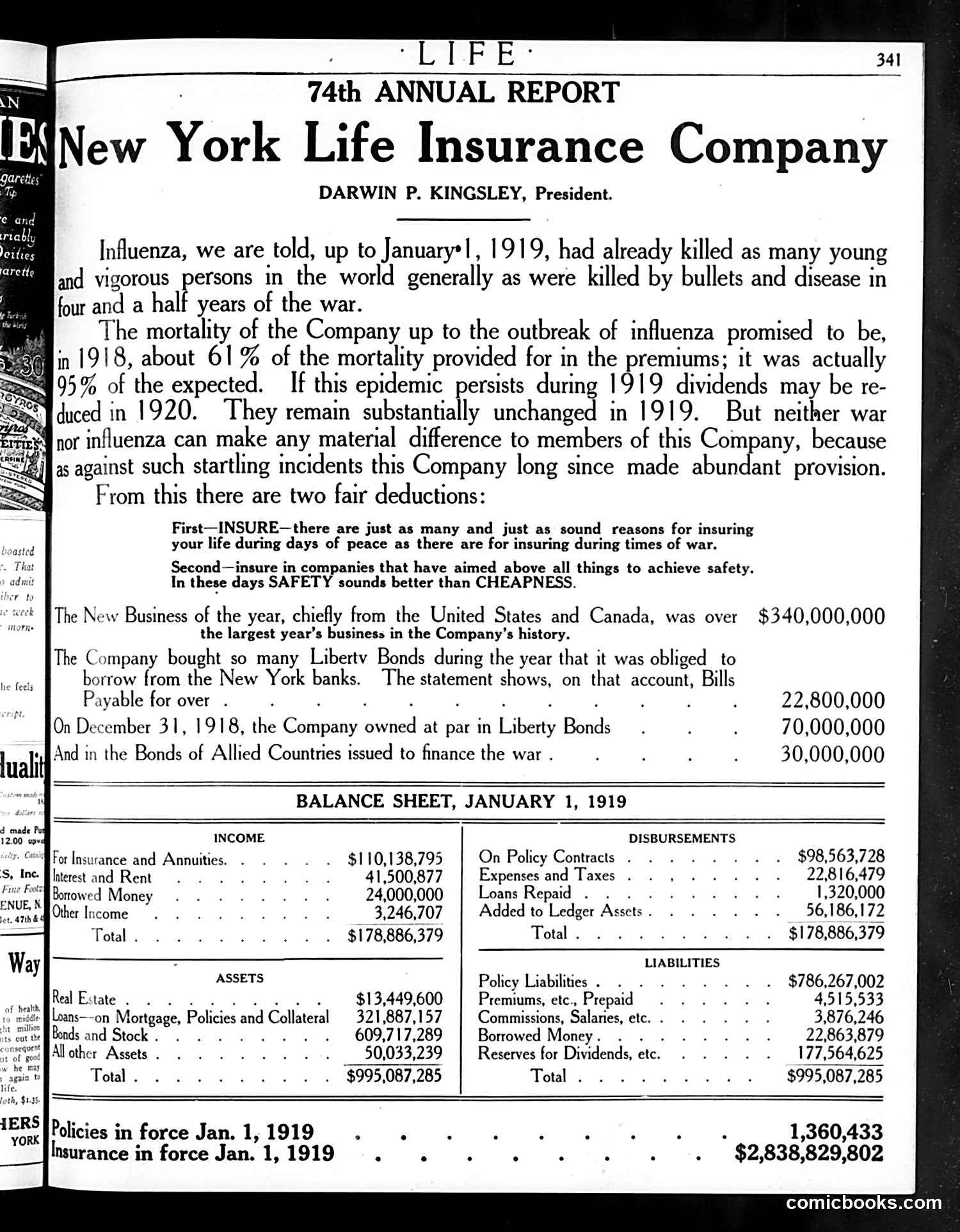
This is **not a cartoon or satirical content**—it's a straightforward corporate annual report from *Life* magazine's 74th issue. The page presents New York Life Insurance Company's financial statements as of January 1, 1919. The key context for modern readers: President Darwin P. Kingsley addresses the **1918-1919 influenza pandemic**, which killed as many young, healthy people as four-and-a-half years of World War I. He notes the company's mortality claims reached 495% of projected levels but assures policyholders the company remains solvent due to "abundant provision" made in advance. The report emphasizes two selling points: (1) life insurance is as necessary during peacetime as wartime, and (2) choose companies prioritizing "safety" over "cheapness"—a defensive marketing message during economic uncertainty. The balance sheet shows $995 million in assets and $2.8 billion in insurance in force, including heavy wartime Liberty Bond investments.
📄 Transcribed text from this page (OCR, searchable)
Machine-transcribed from the original scan — historical spelling and the odd misread are preserved.
DARWIN P. KINGSLEY, President. Influenza, we are told, up to January*!, 1919, had already killed as many young a vigorous persons in the world generally as were killed by bullets and disease in four and 4 half years of the war. The mortality of the Company up to the outbreak of influenza promised to be, Ya in 1918, about 61% of the mortality provided for in the premiums; it was actually 495% of the expected. If this epidemic persists during 1919 dividends may be re- duced in 1920. They remain sabstantially unchanged in 1919. But neither war nor influenza can make any material difference to members of this Company, because as against such startling incidents this Company long since made abundant provision. From this there are two fair deductions: First—INSURE—there are just as many and just as sound reasons for insuring your life during days of peace as there are for insuring during times of war. Second—insure in companies that have aimed above all things to achieve safety. In these days SAFETY sounds better than CHEAPNESS. The New Business of the year, chiefly from the United States and Canada, was over $340,000,000 the largest year’s business in the Company’s history. The Company bought so many Libertv Bonds during the year that it was obliged to borrow from the New York banks. The statement shows, on that account, Bills Payable for over . On December 31, 1918, the Company owned at par in Liberty Bonds ef And in the Bonds of Allied Countries issued to finance the war . 22,800,000 70,000,000 30,000,000 BALANCE SHEET, JANUARY 1, 1919 eA For Insurance and Annuities. . INCOME . . $110,138,795 *Binterestand Rent 2 2 2. 1 eee 41,500,877 **BBonowed Money 24,000,000 4 Other Income 3,246,707 Total . $178,886,379 ASSETS Real Estate. Loans—on Mortgage, Policies and Collateral Bonds and Stock . Allother Assets . Total . $13,449,600 321,887,157 609,717,289 50,033,239 $995,087,285 DISBURSEMENTS On Policy Contracts . Expenses and Taxes . Loans Repaid . ; Added to Ledger Assets . Total . LIABILITIES Policy Liabilities . Premiums, etc., Prepaid Commissions, Salaries, etc. . Borrowed Money . z Reserves for Dividends, ete, Total . $98,563,728 22,816,479 1,320,000 56,186,172 $178,886,379 $786,267,002 4,515,533 3,876,246 22,863,879 177,564,625 $995,087,285 Policies in force Jan.1,1919 lhsurance in force Jan. 1, 1919 1,360,433 ” $2,838,829,802 comicbooks.com