
A complete issue · 34 pages · 1918
Life — September 12, 1918
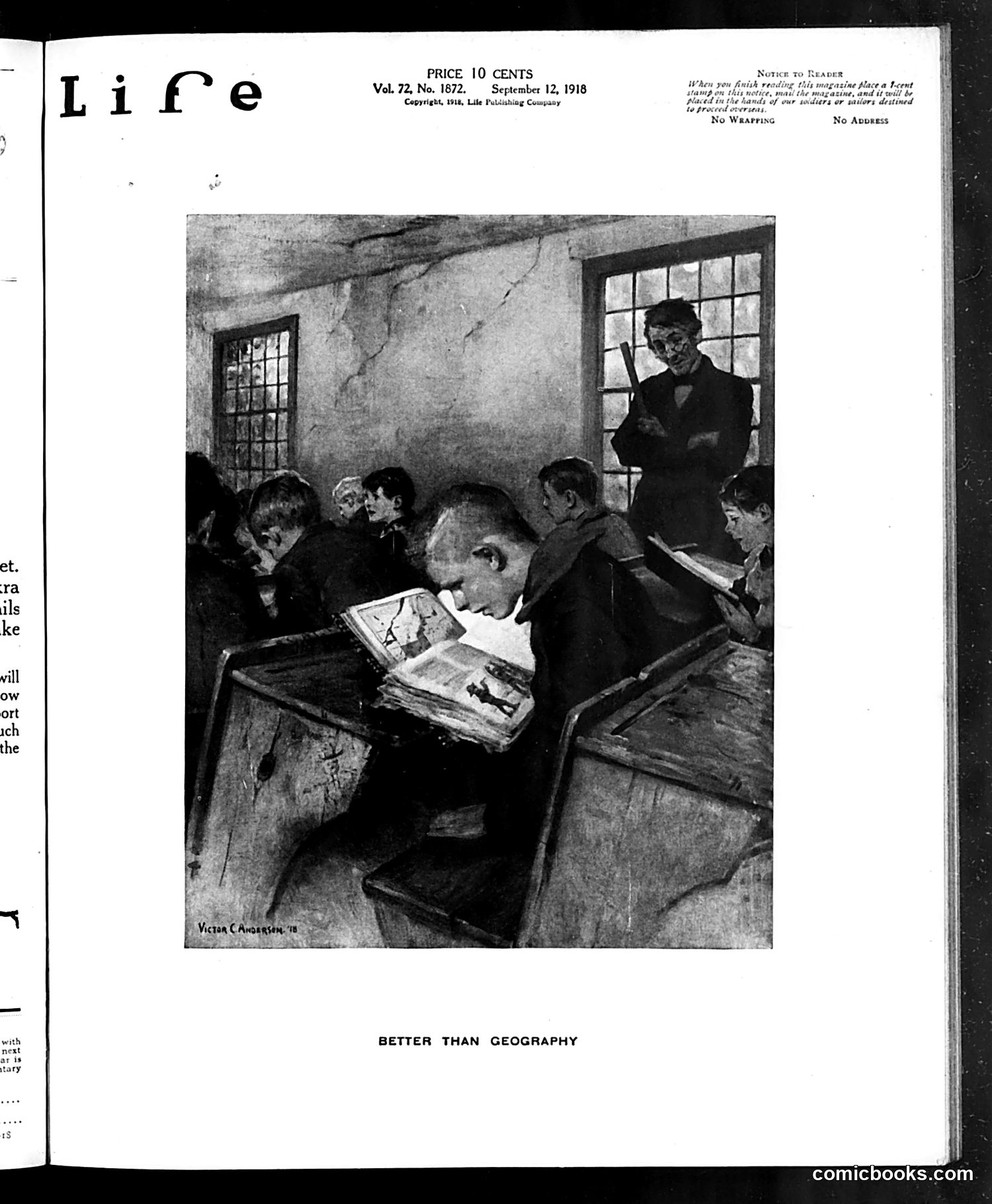
This Life magazine page from September 12, 1918, shows a classroom scene where a teacher instructs students using what appears to be illustrated materials or comics rather than traditional geography textbooks. The title "Better Than Geography" suggests satire about educational methods. The photograph, credited to Victor Chiarenza, depicts children engaged with visual learning materials during a lesson. Given the 1918 date—near the end of World War I—this likely comments on how illustrated magazines and comics were becoming recognized as effective educational tools, potentially superior to dry textbook instruction for engaging young learners. The satire appears to celebrate or mock this modern pedagogical shift toward visual media in schools.
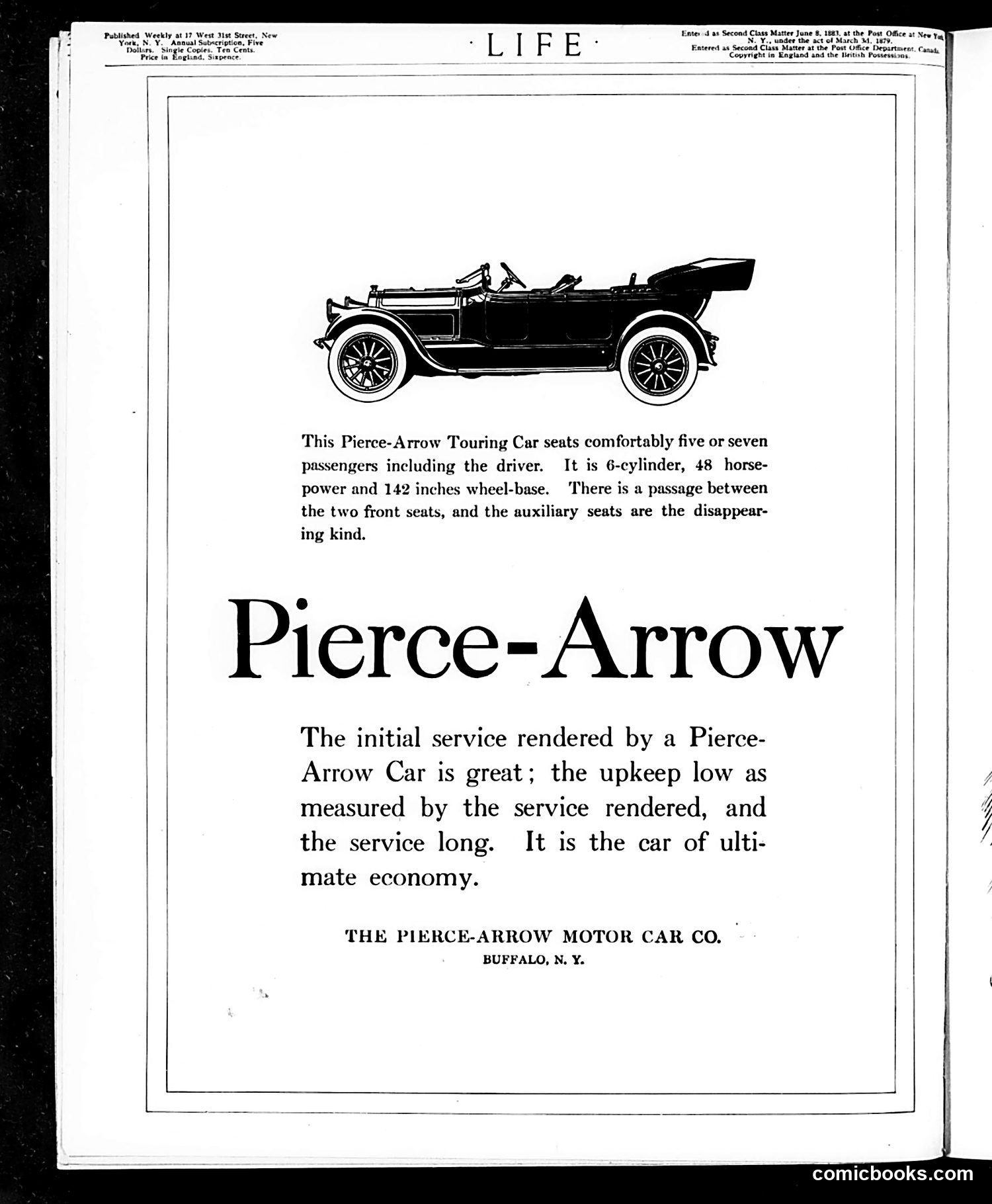
This page is **not a political cartoon or satire** — it is a straightforward advertisement for the Pierce-Arrow automobile, published in *Life* magazine. The image shows a detailed technical drawing of a Pierce-Arrow touring car with specifications: 6-cylinder, 48 horsepower, 142-inch wheelbase, seating five to seven passengers with retractable auxiliary seats. The text emphasizes the car's practical virtues: superior initial service, low maintenance costs, and long-term reliability — positioning it as "the car of ultimate economy." This represents early 20th-century automobile advertising in a prestigious publication, targeting affluent readers. Pierce-Arrow was a genuine luxury marque based in Buffalo, New York. The ad contains no satirical elements or social commentary.
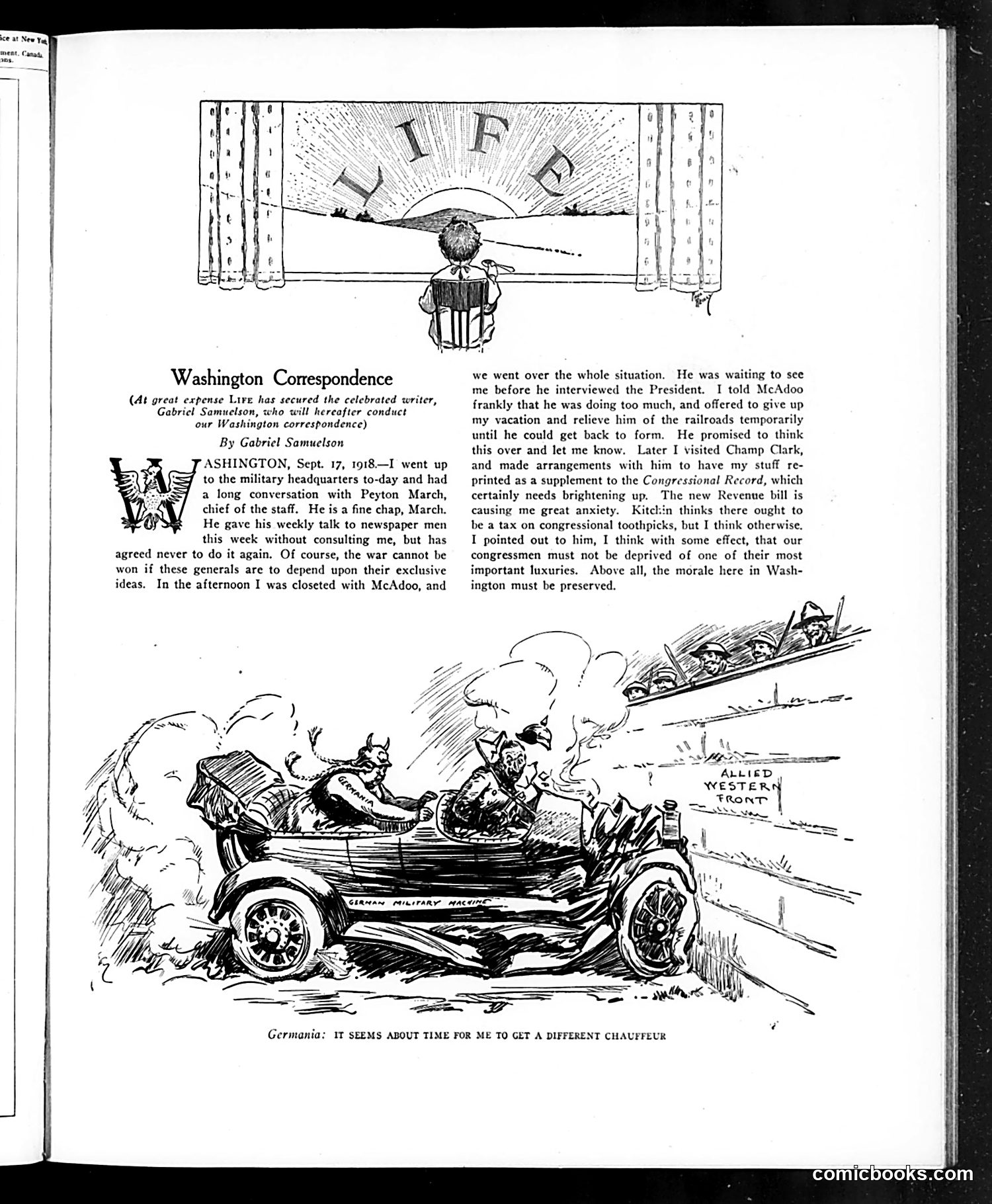
This page contains Gabriel Samuelson's column about World War I military politics, dated September 17, 1918. The accompanying cartoon satirizes the German military situation on the Western Front. The cartoon depicts a damaged German military vehicle ("GERMAN MILITARY MACHINE") with anthropomorphized devils or demons as occupants, crashing near the "ALLIED WESTERN FRONT." The caption reads: "GERMANIA: IT SEEMS ABOUT TIME FOR ME TO GET A DIFFERENT CHAUFFEUR." The satire suggests Germany's military leadership—personified as incompetent drivers—is responsible for steering the nation toward catastrophic defeat. By late 1918, Germany faced imminent collapse, making this cartoon's mockery of failed German command particularly timely and pointed at the war's conclusion.
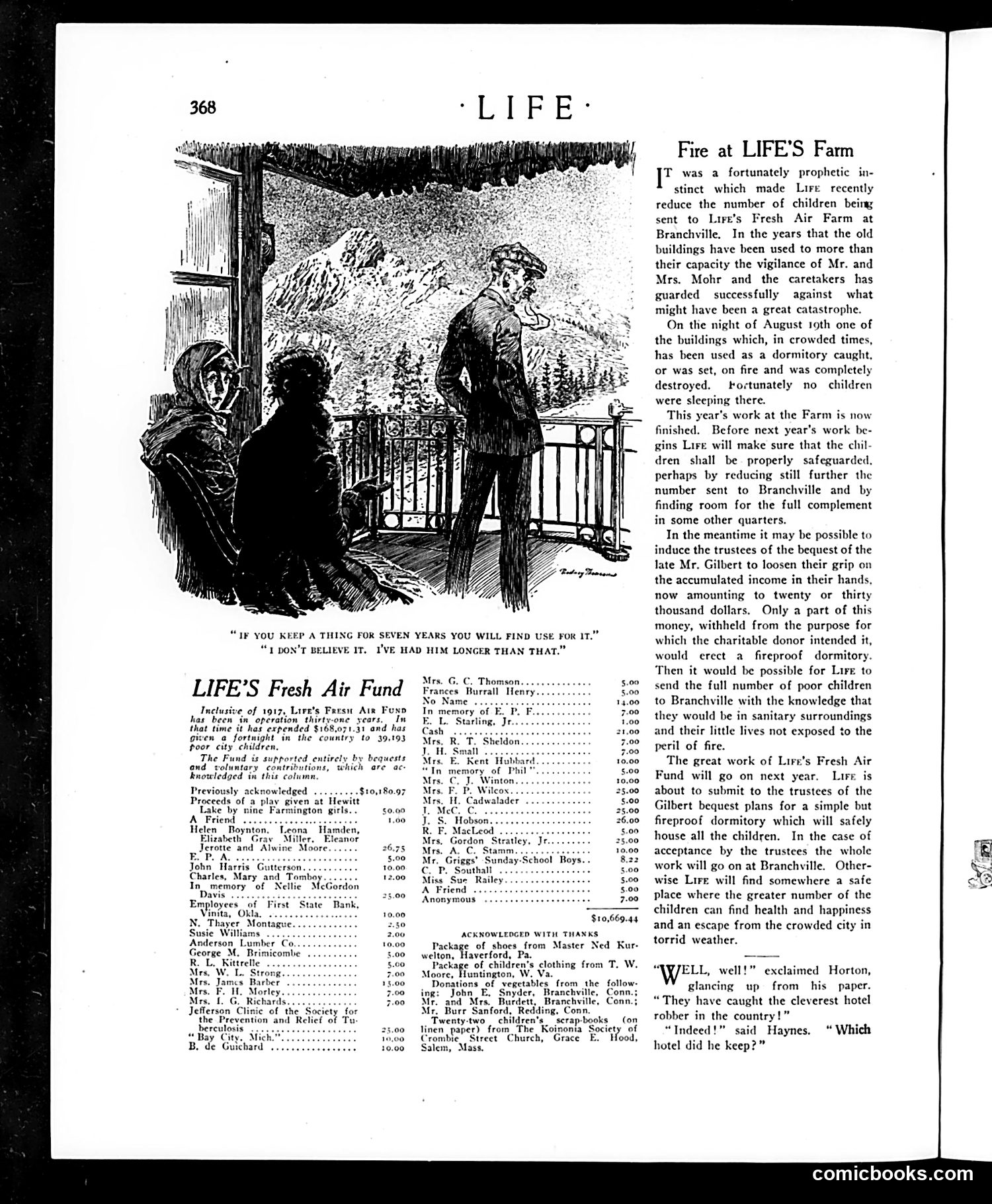
This page contains an article titled "Fire at LIFE's Farm" describing a 1917 fire that destroyed a dormitory building at Life's Fresh Air Farm in Branchville. The article explains how the farm provides care for poor city children and discusses future safeguarding measures. Below the article text is a list of donors to "LIFE's Fresh Air Fund," with amounts contributed. The cartoon at the top depicts two figures in period dress looking out at a rural landscape. The caption reads: "IF YOU KEEP A THING FOR SEVEN YEARS YOU WILL FIND USE FOR IT." / "I DON'T BELIEVE IT. I'VE HAD HIM LONGER THAN THAT." This appears to be a humorous domestic scene unrelated to the farm fire, using a common proverb as its basis for a joke about keeping an unwanted family member or servant.
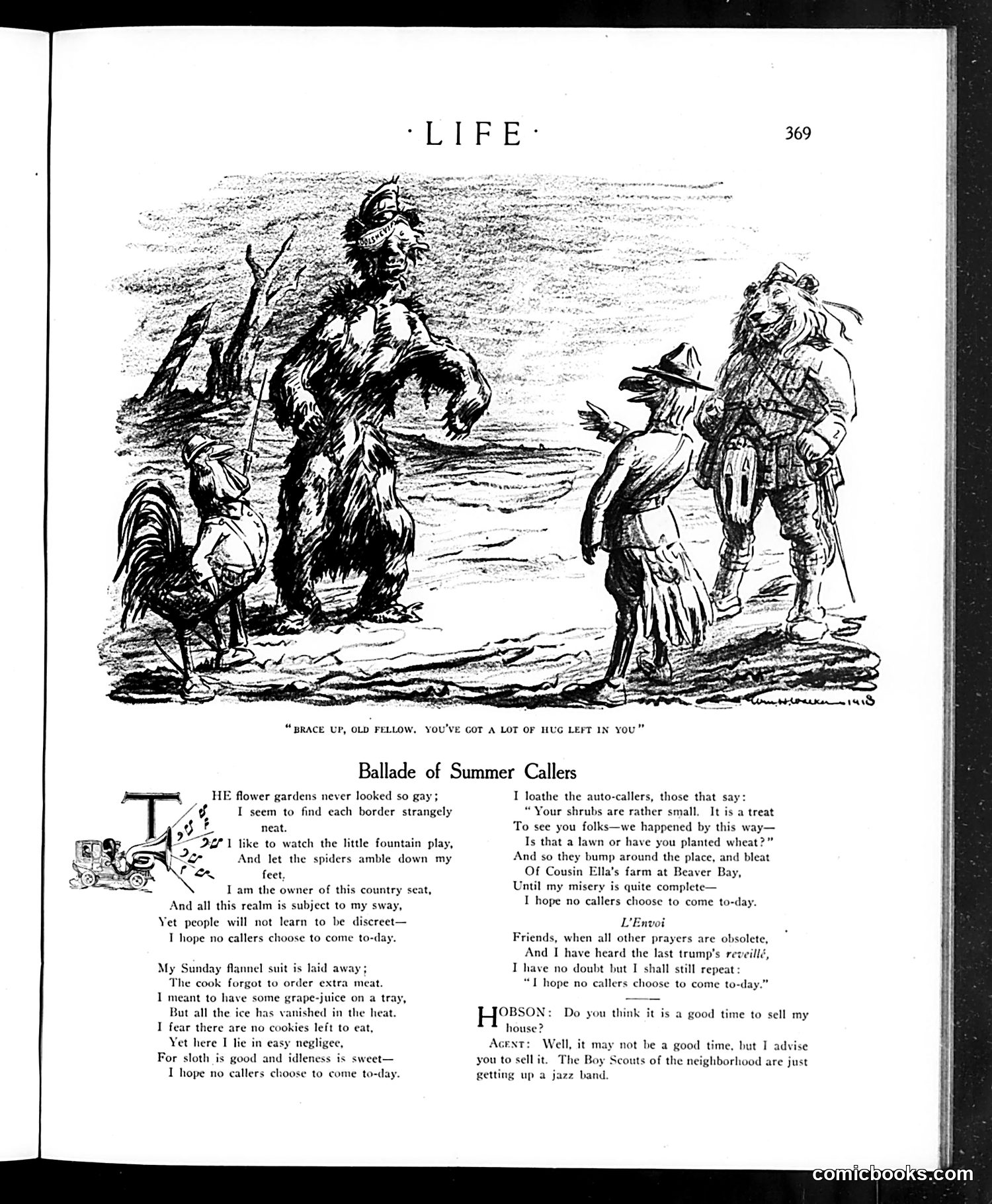
This page satirizes **unwanted summer social visits**—a common upper-class annoyance of the era. The cartoon depicts anthropomorphic animals (a rooster, bear, and fox) as "summer callers" visiting a country estate, with the caption: "Brace up, old fellow, you've got a lot of hug left in you." The poem expresses the speaker's frustration with unexpected guests disrupting domestic life—wilted flower gardens, forgotten Sunday meals, vanished provisions. The refrain "I hope no callers choose to come to-day" emphasizes the exasperation. A brief dialogue follows where a homeowner (Hobson) asks about selling his house; an agent suggests waiting, as "Boy Scouts of the neighborhood are just getting up a jazz band"—implying even worse future disturbances. The satire targets the social obligation to receive visitors, viewed as invasive and exhausting.
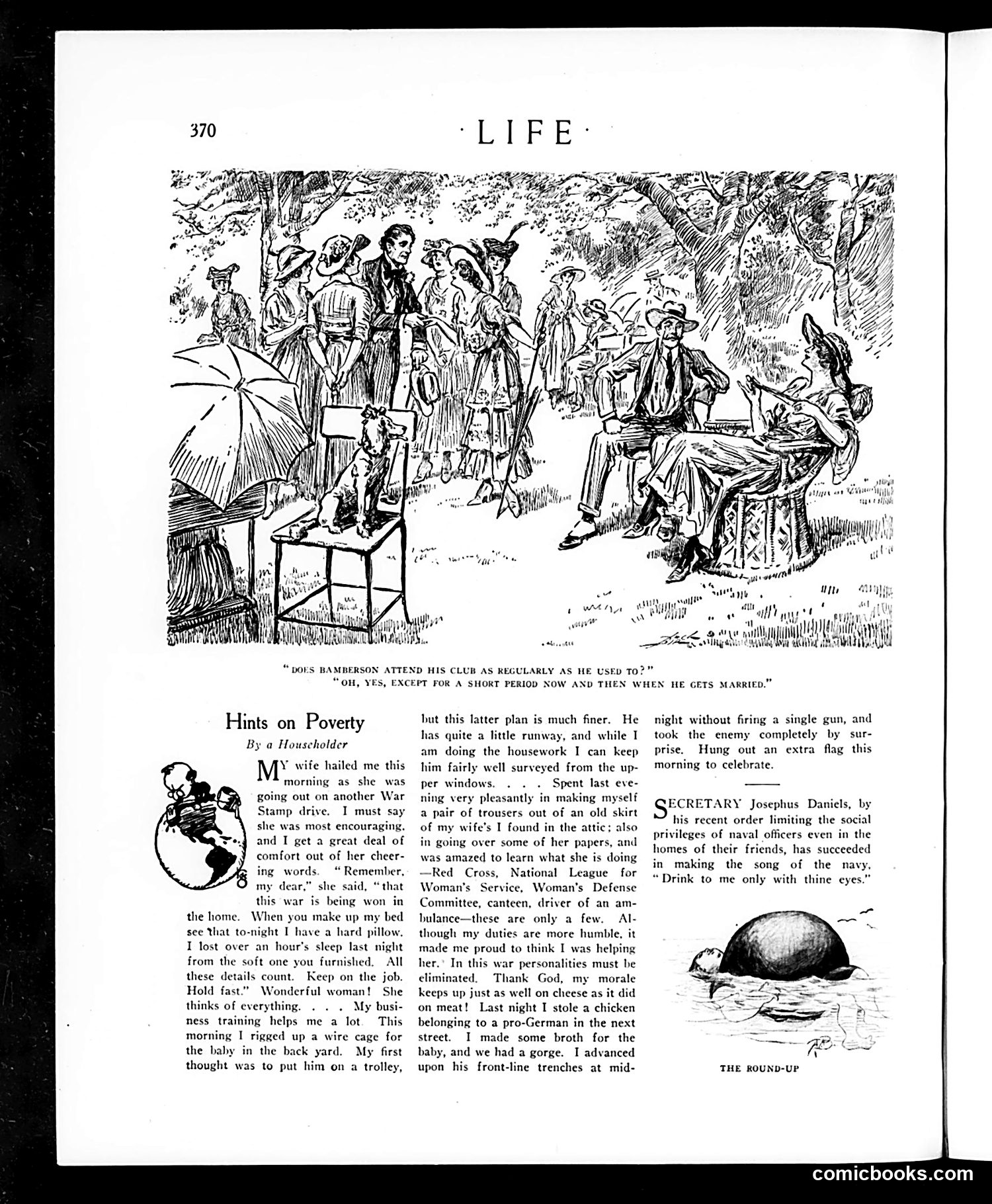
The main cartoon depicts a social club scene with the caption "DOES BAMBERSON ATTEND HIS CLUB AS REGULARLY AS HE USED TO?" Answer: "Oh, yes, except for a short period now and then when he gets married." This is a satirical joke about marriage interrupting a man's club attendance—a common leisure activity for upper-class men of the era. The humor relies on the assumption that marriage temporarily disrupts bachelors' social habits, though they eventually return to their clubs. Below is an article titled "Hints on Poverty" by a householder describing wartime domestic management strategies, including repurposing clothing and managing household resources during what appears to be World War I. The small illustration "The Round-Up" depicts an armadillo, likely unrelated to the surrounding content.
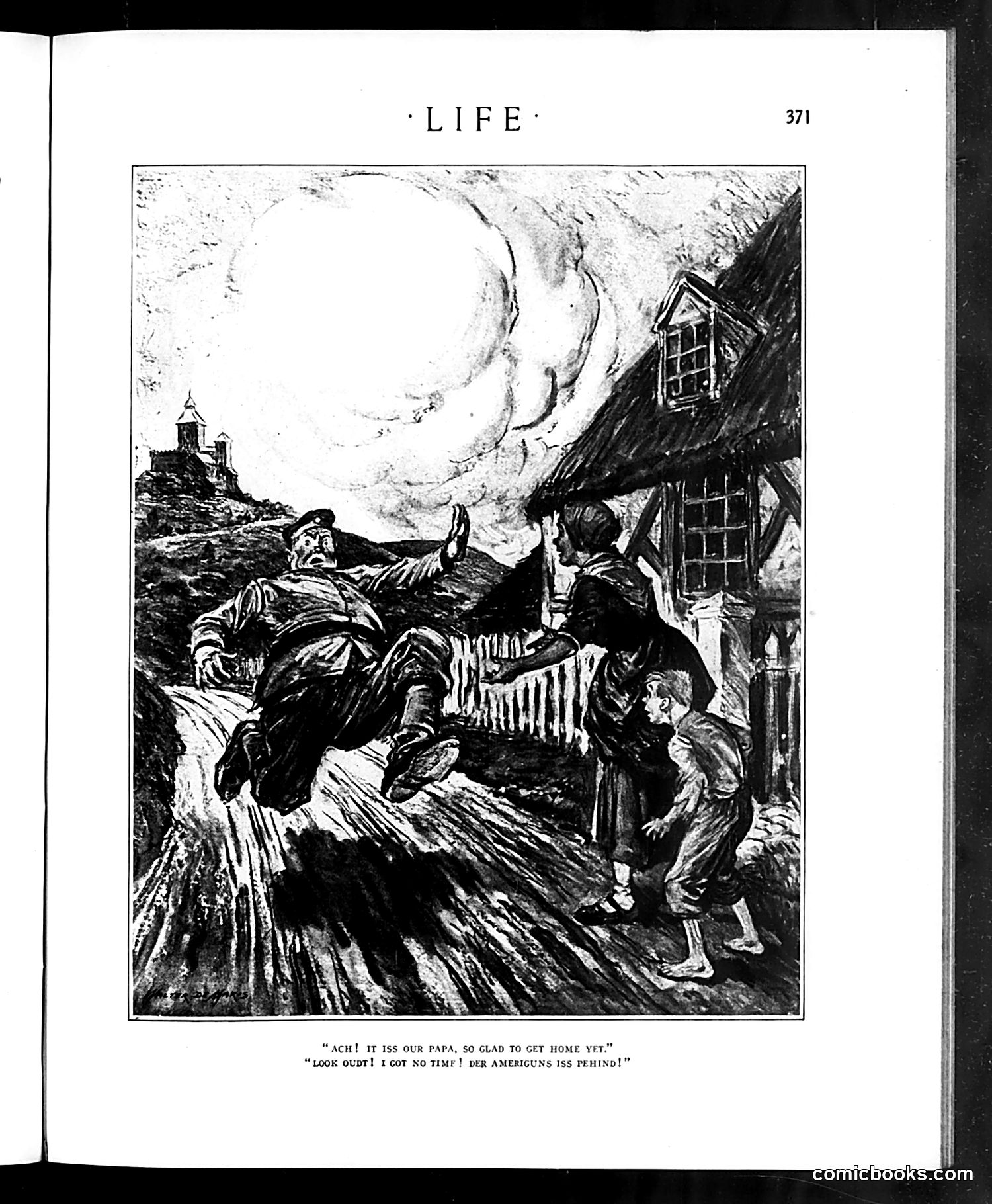
This illustration depicts a domestic scene with satirical commentary on wartime separation and patriotic duty. A soldier, apparently returning home, is greeted by his family outside a cottage. The caption reads: "Ach! It is our Papa, so glad to get home yet!" and "Look out! I got no time! Der Americans iss behind!" The humor relies on ethnic caricature—the heavy German accent in the dialogue ("iss" for "is," "yet" as an emphatic) marks this as a German-American family. The satire appears to mock either: (1) German-Americans' divided loyalties during a war involving Germany, or (2) the absurdity of a soldier prioritizing military duty over family reunion. The rushing soldier figure and pursuing "Americans" suggest wartime urgency overriding personal bonds, likely referencing early 20th-century American military conflicts.
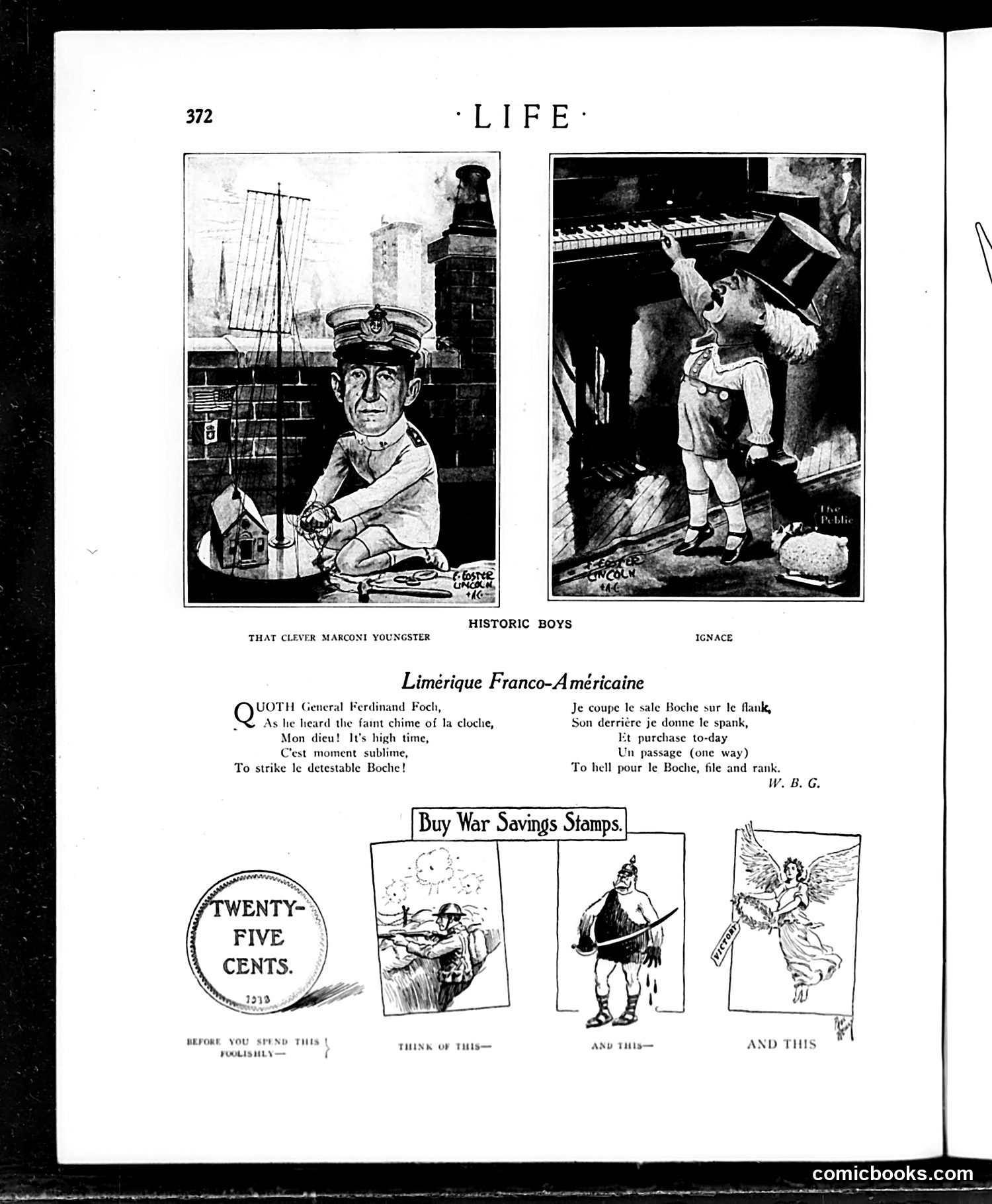
This page contains two political cartoons labeled "Historic Boys" satirizing World War I figures: **Left cartoon** ("That Clever Marconi Youngster"): Shows a caricatured figure with a ship and tower in background, likely referencing Guglielmo Marconi's wireless technology innovations. **Right cartoon** ("Ignace"): Depicts a child figure with what appears to be a military or political authority figure. Below is a French-language limerick mocking **General Ferdinand Foch**, the French military commander, using crude wordplay about "Boche" (German soldiers). The bottom section advertises **War Savings Stamps** (25 cents), a U.S. government fundraising tool during WWI. The advertisement urges patriotic spending by showing what one's money might purchase: military equipment, soldiers, and an angel representing victory. The page blends satirical commentary with patriotic war-bond promotion.
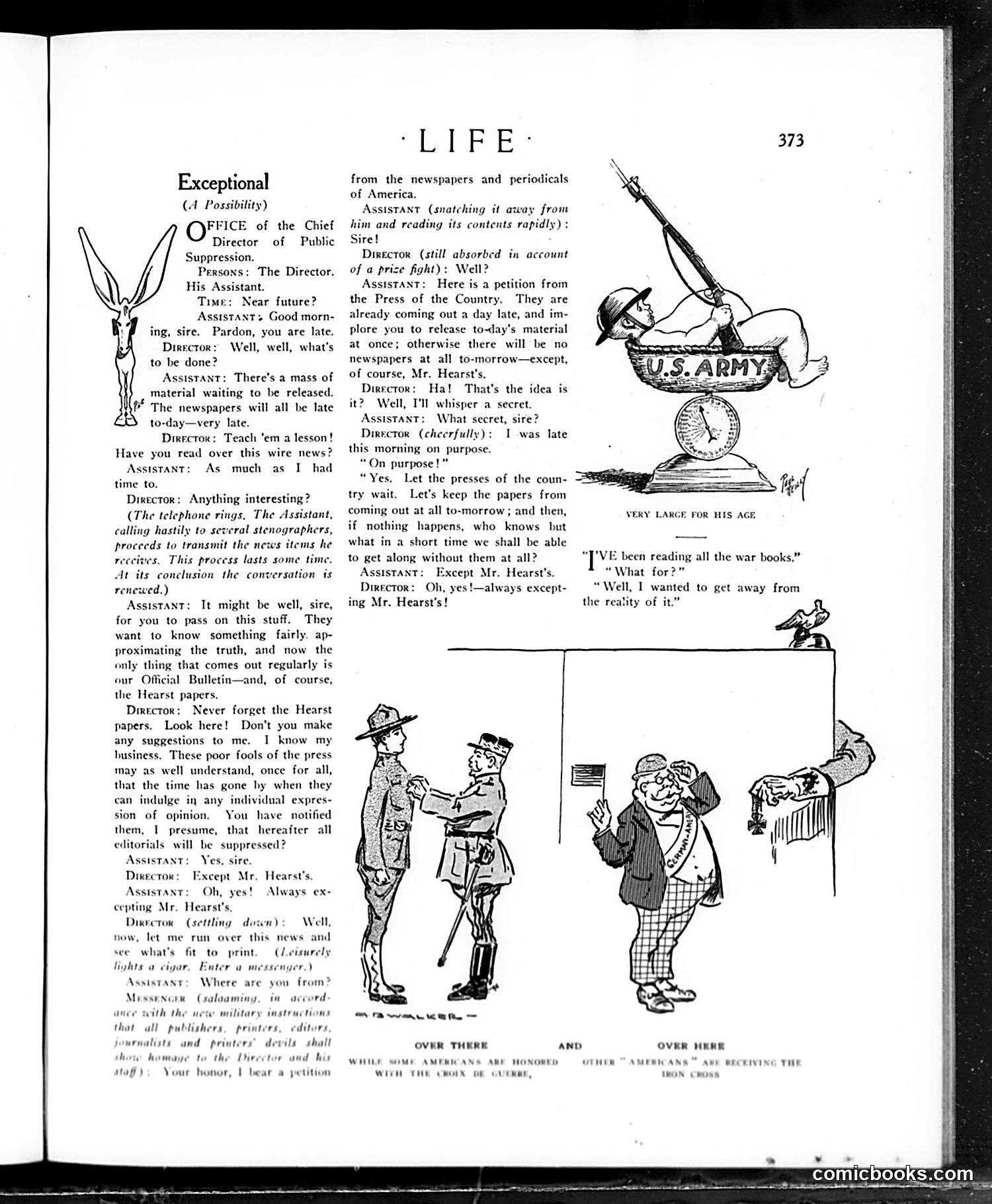
This satirical piece depicts a confrontation between a newspaper **Director** and his **Assistant** over press censorship during wartime (likely WWI, given the "U.S. Army" imagery). The Director insists on suppressing unfavorable news, particularly regarding **Mr. Hearst** (William Randolph Hearst, the powerful newspaper magnate). The Assistant argues that journalists and the press need access to truthful information. The bottom cartoons show the contrast: American soldiers honored "over there" while other Americans receive the "Iron Cross" (German decoration) "over here"—satirizing how the suppressed domestic press fails to inform citizens while soldiers fight abroad. The satire critiques wartime censorship and media manipulation by powerful publishers.
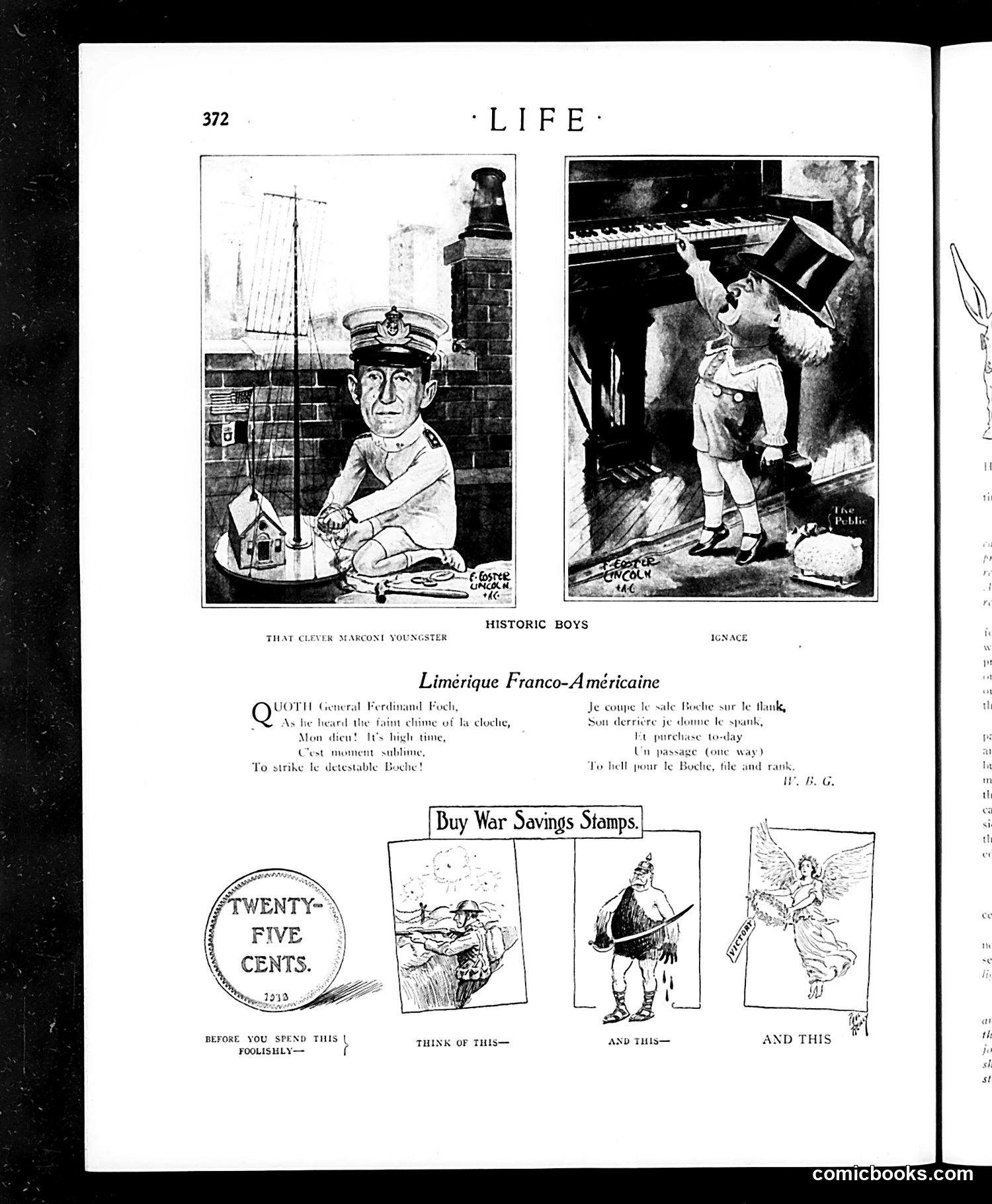
This page contains two satirical cartoons labeled "Historic Boys" plus a Franco-American limerick and a war savings stamp advertisement. The left cartoon depicts a naval officer in a captain's hat, labeled "That Clever Marconi Youngster," mocking someone's maritime pretensions. The right cartoon, titled "Ignace," shows a child at a piano wearing a top hat, apparently ridiculing a young musical prodigy. Below is a limerick in English and French mocking General Ferdinand Foch, a WWI French military leader, calling for him to "strike the detestable Boche" (derogatory term for Germans). The bottom section promotes "War Savings Stamps" at twenty-five cents, using patriotic imagery (soldiers, Liberty) to encourage Americans to purchase war bonds during World War I.
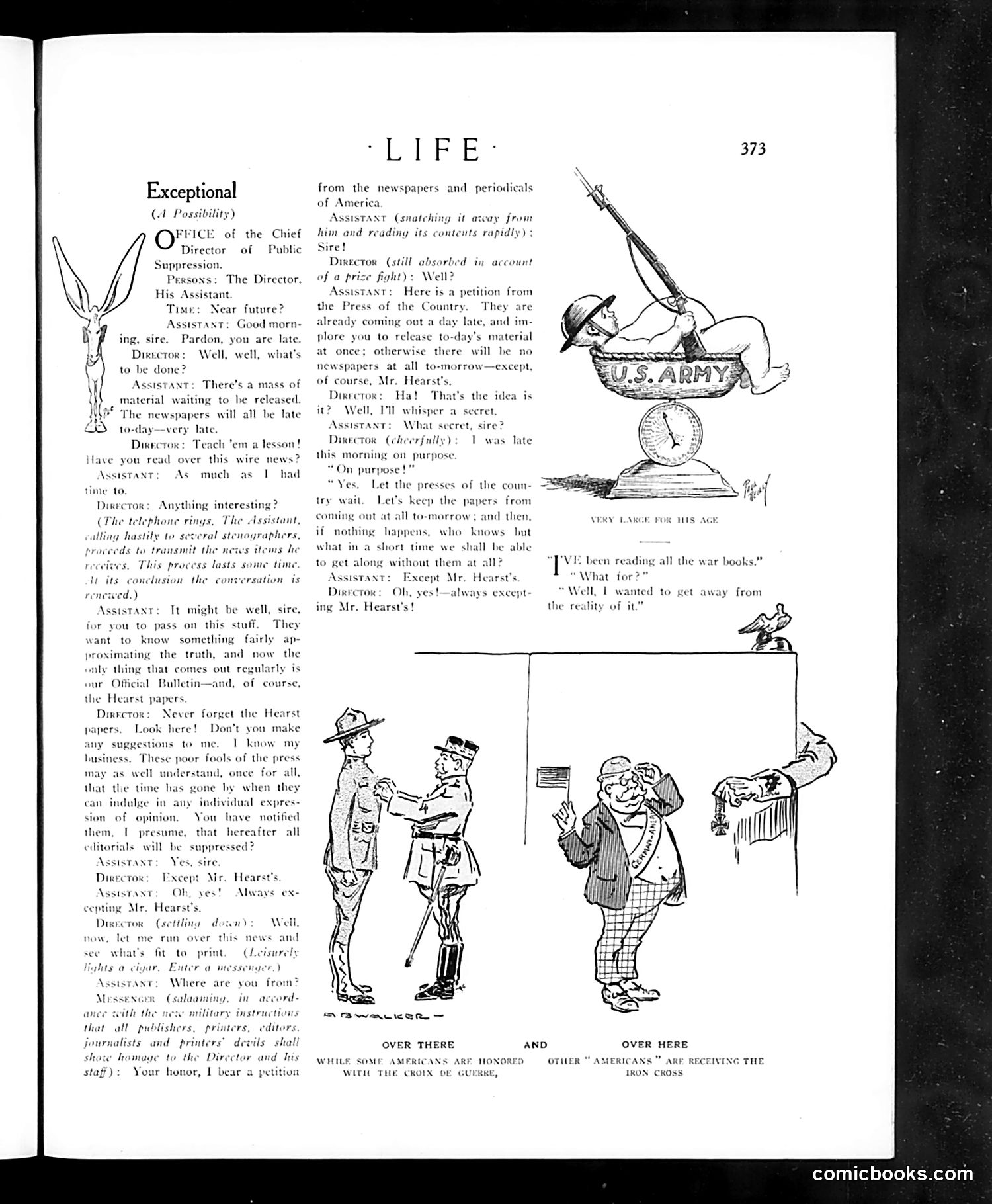
This page satirizes **press censorship during World War I**. The dialogue shows a Director of Public Suppression ordering his Assistant to delay newspaper publication and suppress war news—deliberately keeping the public uninformed "for at least 24 hours." The cartoon below illustrates the contrast: American soldiers "over there" receive the Iron Cross (a German military decoration), while American civilians "over here" receive nothing but censored, delayed information. The satire criticizes the U.S. government's information control strategy during the war, suggesting that while soldiers sacrifice abroad, Americans at home are treated like the enemy through deliberate news suppression. The "U.S. Army" scale underscores the military's role in this propaganda effort.
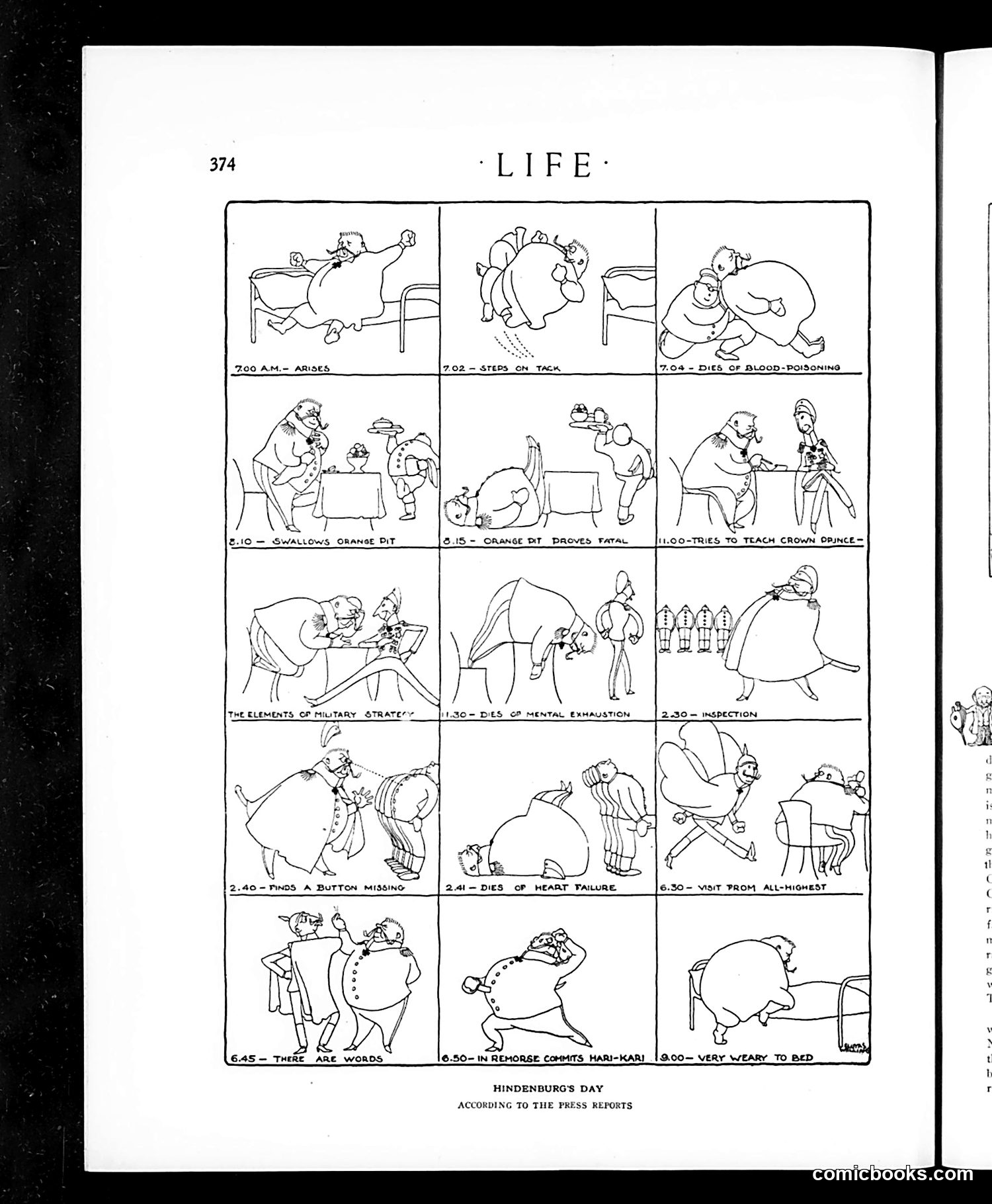
This is a satirical comic strip mocking sensationalized newspaper coverage of Paul von Hindenburg, the German military leader and president. The strip presents a absurdly exaggerated, melodramatic daily schedule of disasters befalling the portly figure—poisoning, blood disease, swallowing orange pits, fatal accidents, military failures, heart attacks, and more—all presented as if reported breathlessly by the press. The satire targets how newspapers of the era (likely 1920s-30s) sensationalized political figures' activities and engaged in hyperbolic reporting. By compressing an impossible series of calamities into one day, the cartoonist ridicules press hysteria and lack of journalistic restraint regarding this controversial German political figure.
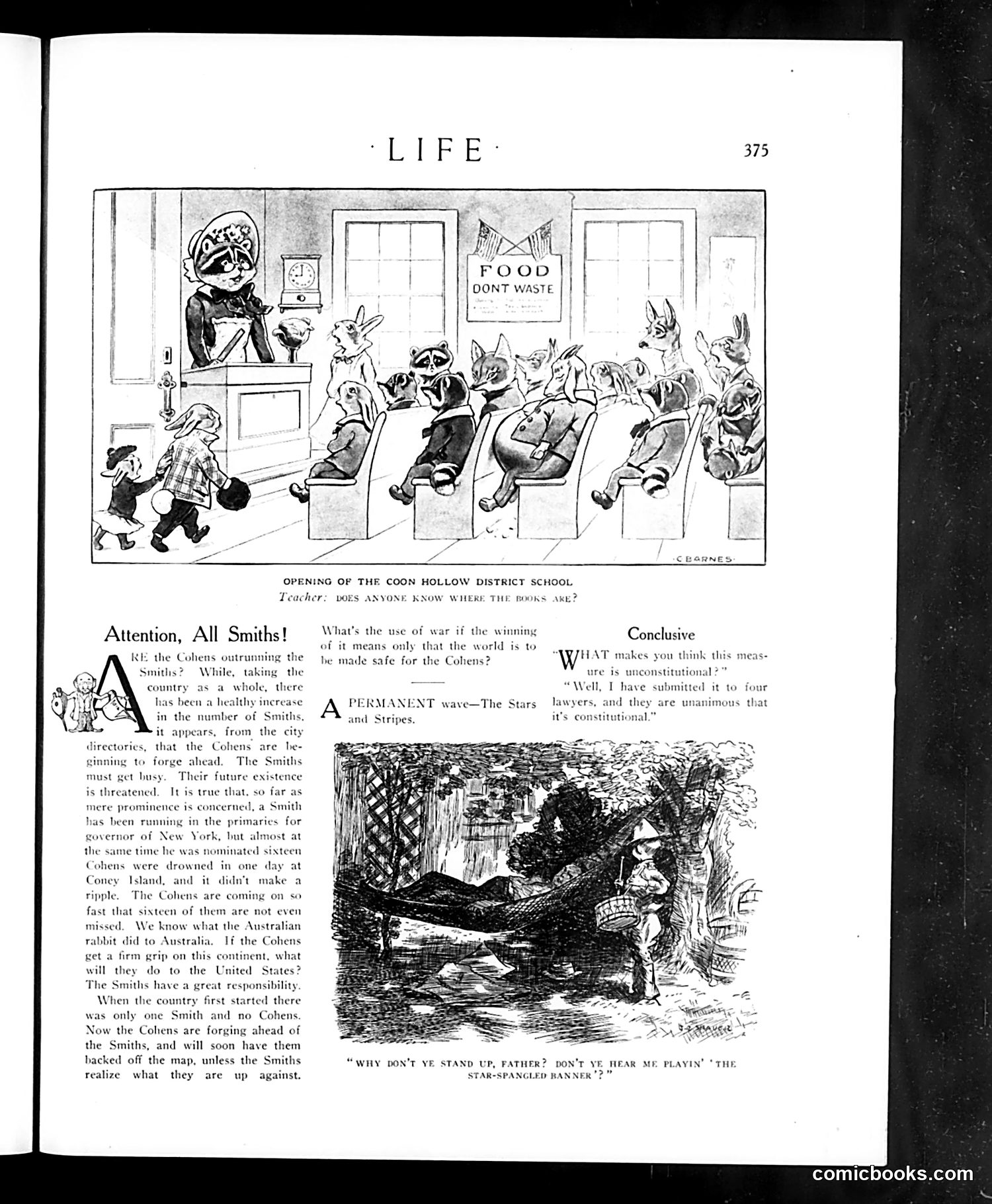
The top cartoon titled "Opening of the Coon Hollow District School" depicts a classroom scene with animal characters (appearing to be rabbits or similar creatures) seated at desks. A teacher stands at a podium with a "Food Don't Waste" poster visible—referencing wartime rationing. The satire criticizes the Cohens outrunning the Smiths in population growth and economic success, as explained in the accompanying article "Attention, All Smiths!" The text warns that Smiths are being demographically displaced and must "get busy." The cartoon uses the school setting to visualize this ethnic/demographic anxiety during what appears to be a World War I-era publication, employing period racial caricature conventions common to *Life* magazine's satirical approach.
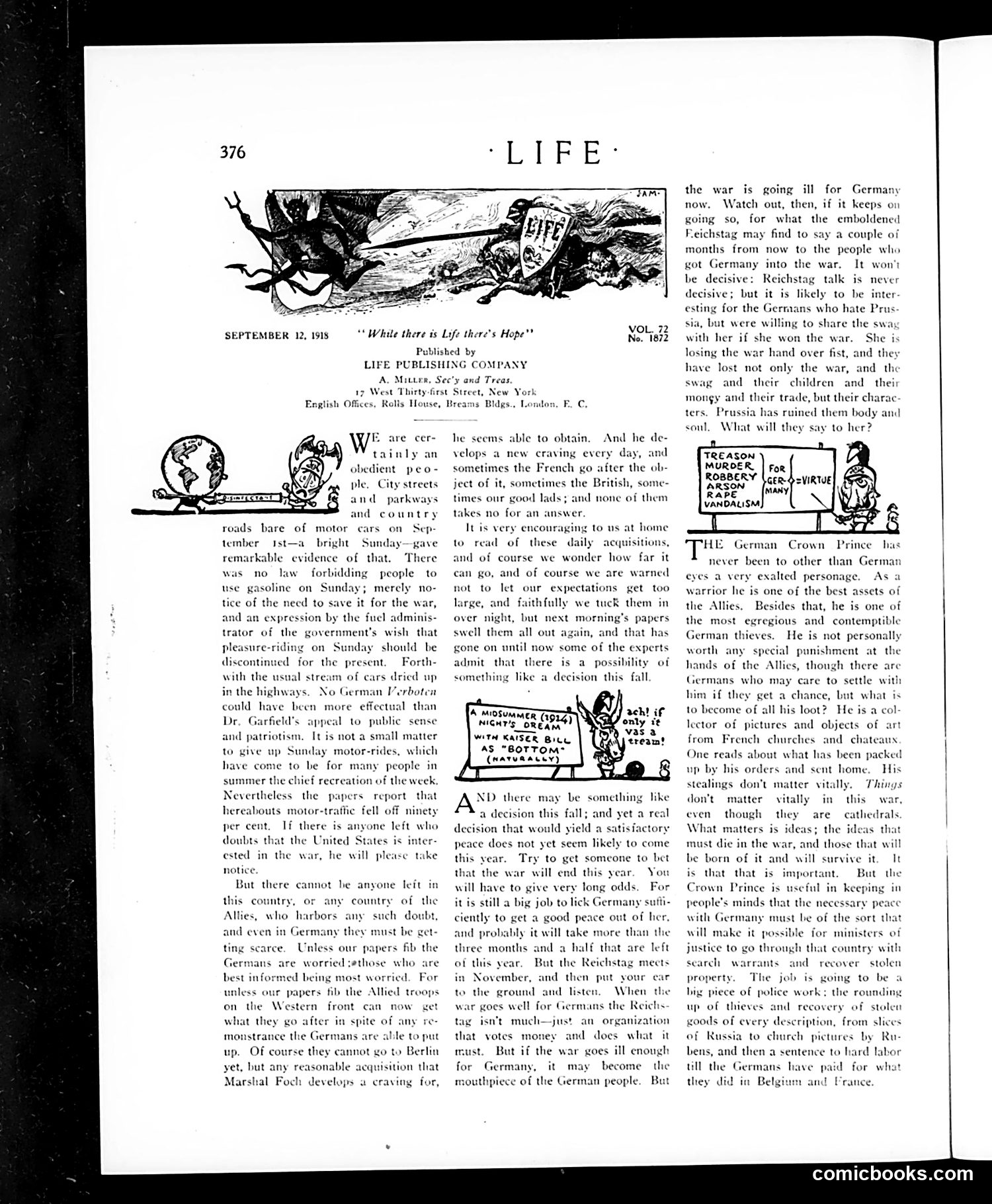
This page contains political commentary on World War I, specifically addressing Germany's deteriorating military situation. The main text discusses whether Germany might seek peace before year's end, given Allied military pressure. Two small cartoon insets appear embedded in the text. One references "treason" and mentions Kaiser Bill "as bottom" (apparently criticizing German leadership). Another depicts what appears to be a caricatured figure making a statement, likely mocking German military or political figures. The accompanying article expresses skepticism about German peace prospects while warning Americans not to lower their guard. It also discusses the German Crown Prince's potential fate—suggesting he might face justice for wartime actions, including alleged looting from Belgium and France. The overall tone is confident in Allied victory while cautioning against premature optimism.
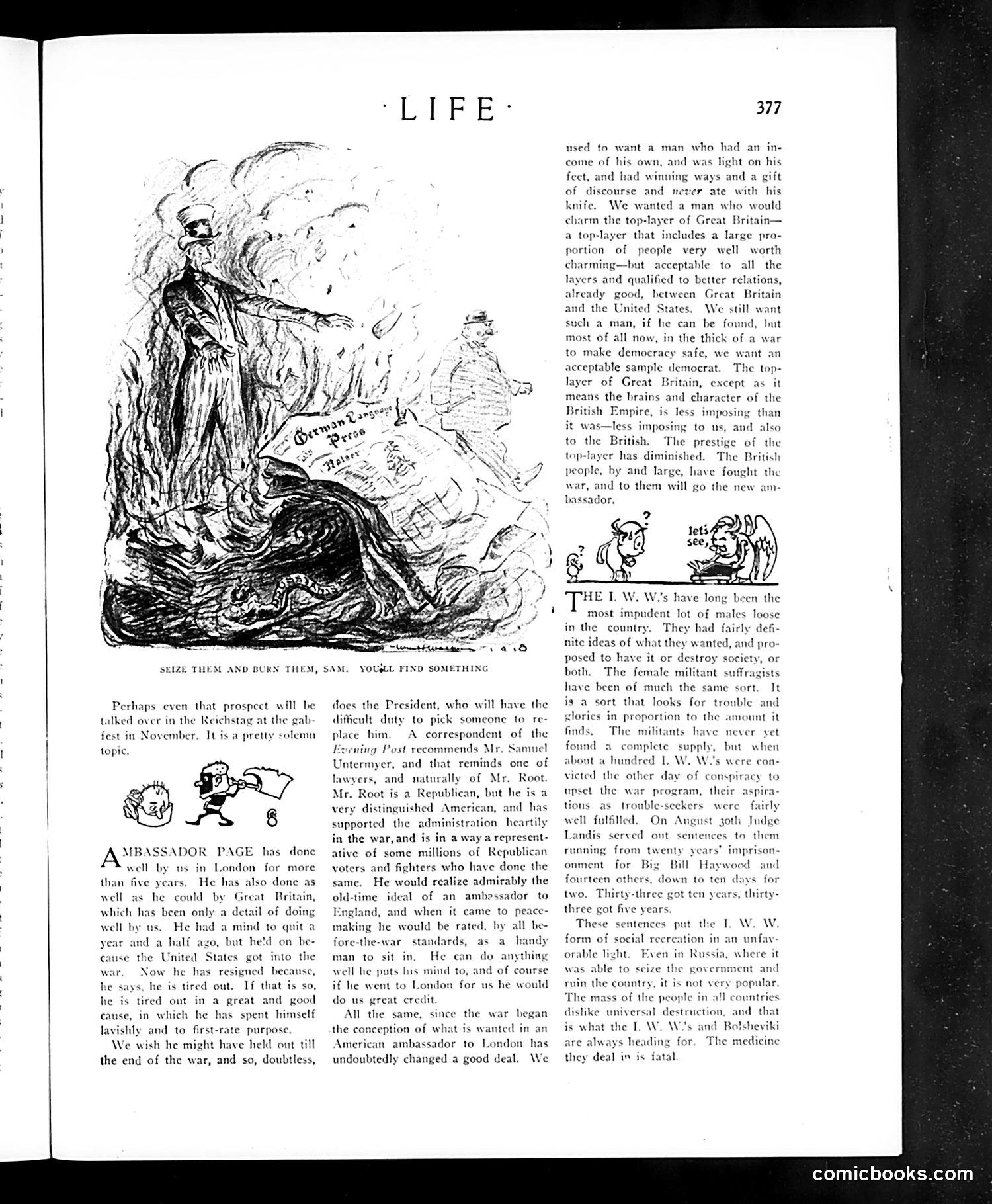
The main cartoon depicts a figure labeled "Germany's Last Card" being seized and burned—representing Germany's final military desperation near WWI's end. The accompanying text discusses potential American ambassadors to post-war Britain, specifically praising Ambassador Page's London service and proposing Samuel Untermyer as his replacement. The satirical content mocks the I.W.W. (Industrial Workers of the World), describing their radical activities and suggesting their sentences were appropriately harsh. The text positions them as troublemakers whose imprisonment served public order during wartime. Small decorative illustrations appear throughout. The overall tone reflects wartime American attitudes: supporting military action, endorsing harsh treatment of radical organizations, and debating diplomatic appointments for the anticipated post-war period.
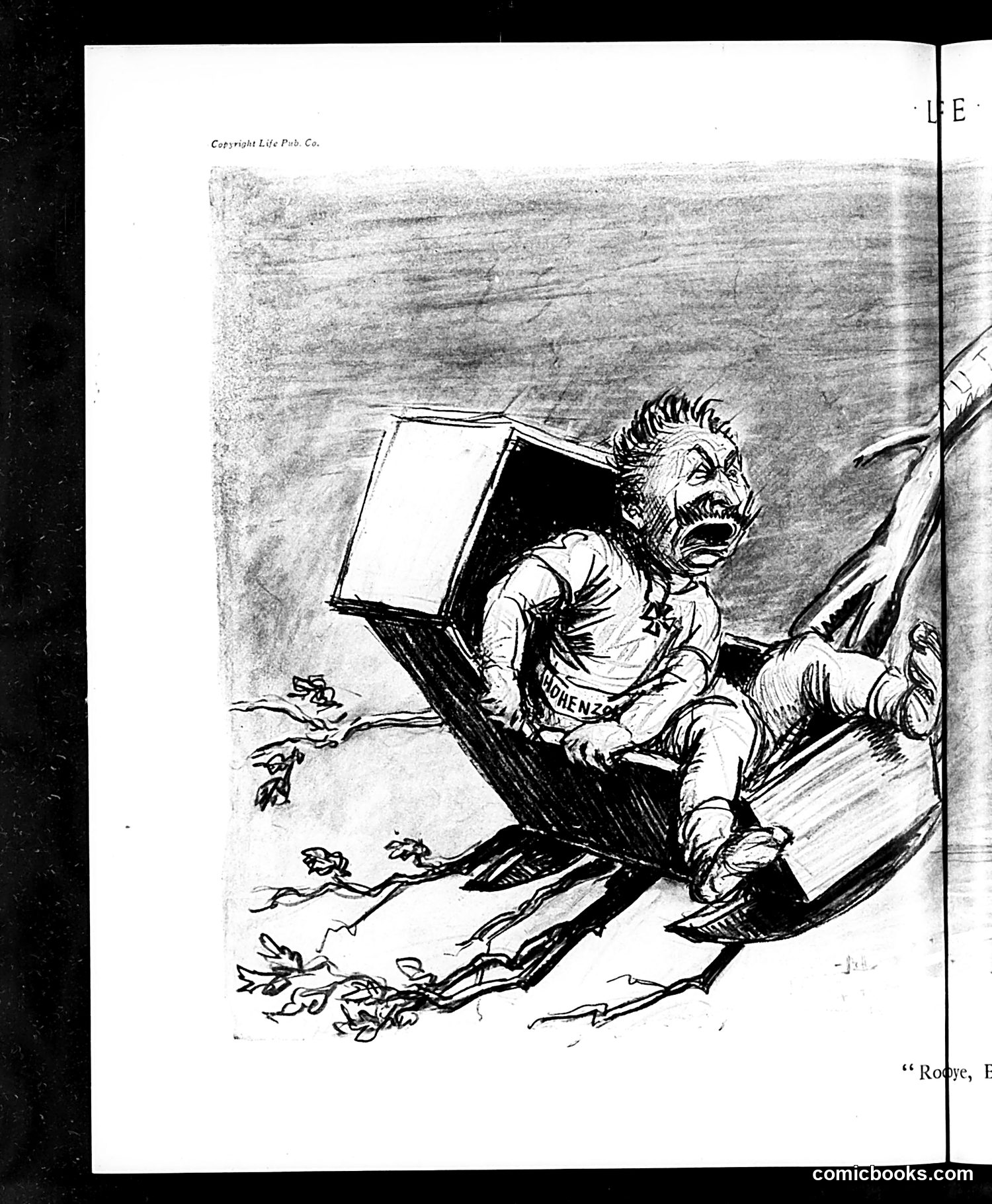
This appears to be a satirical cartoon from *Life* magazine showing a caricatured figure labeled "GOETHALS" (likely referring to George Washington Goethals, the Panama Canal chief engineer) depicted as a baby or cherub struggling with what looks like construction plans or documents. The figure is shown in an exaggerated, undignified pose amid scattered debris or materials. The satire likely critiques Goethals or Panama Canal construction management—perhaps mocking the project's difficulties, delays, or administrative challenges. The infantilization suggests incompetence or foolishness in handling the massive engineering undertaking. The scattered papers and distressed expression convey chaos or mismanagement. The exact political point remains somewhat unclear without fuller context, but the cartoon uses physical humor and caricature to mock canal-related leadership or construction issues that were apparently newsworthy to *Life*'s readers.
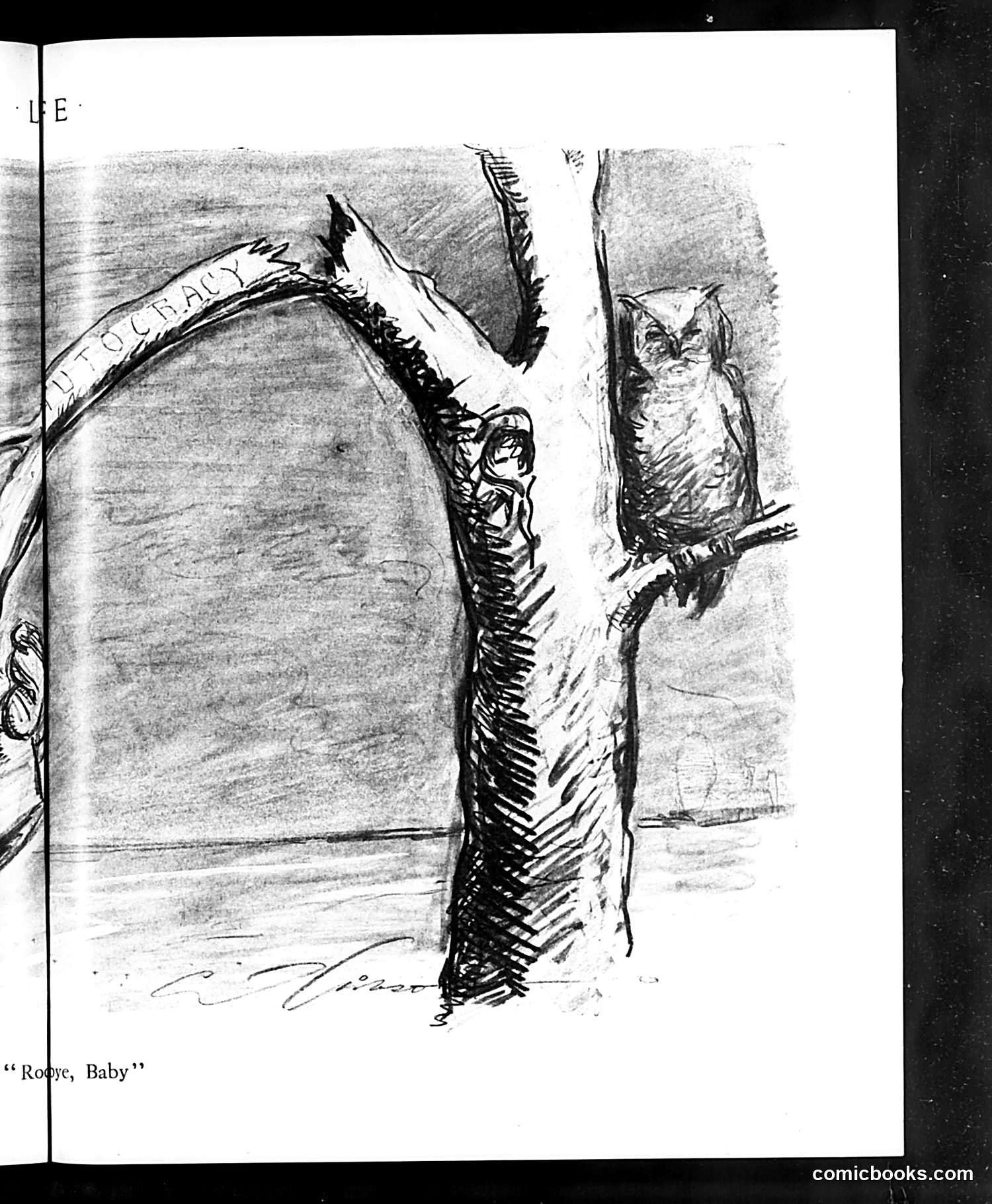
This appears to be a sketch-style cartoon showing an owl perched on a bare tree branch. The owl has distinctive facial features rendered with heavy cross-hatching in ink. The caption reads "Rooye, Baby" - a phonetic pun on "roo" (the sound an owl makes) combined with "baby," a casual American slang term. The humor relies on a simple visual-verbal pun: the cartoon depicts an actual owl making its characteristic call sound, presented colloquially as if the owl were addressing someone casually. The minimalist, sketchy rendering and the bare tree suggest a somewhat melancholic or wintry setting, though the lighthearted caption undercuts any darker mood. Without additional context from the magazine issue, the broader satirical target—if any—remains unclear.
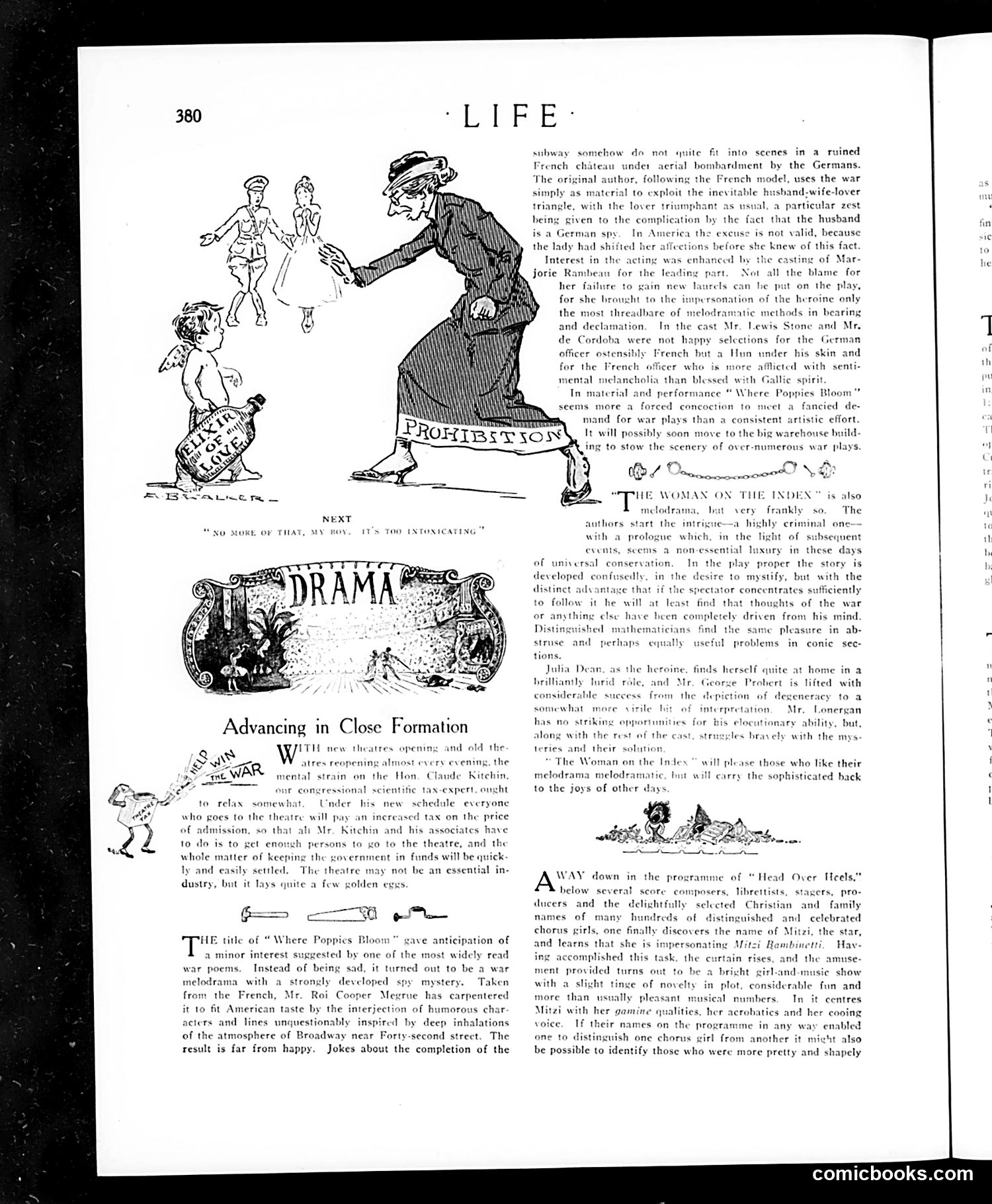
This page contains theatrical reviews from what appears to be the WWI era. The cartoons and illustrations satirize wartime drama productions. **Top cartoon ("No More of That, My Boy"):** Shows a man in formal dress rejecting a woman's advances, labeled "PROHIBITION." This satirizes how war-themed melodramas were being artificially forced onto audiences—the joke being that audiences were "intoxicated" or oversaturated with war plays. **Main section ("Advancing in Close Formation"):** Reviews two theatrical productions. The text criticizes "Where Poppies Bloom," a war melodrama adapted from a French play, as a forced attempt to capitalize on wartime interest rather than genuine artistic merit. It mocks how theaters use war themes mechanically to attract audiences. **"The Woman on the Index":** Another melodrama review, described as frankly derivative but potentially entertaining for those who enjoy such fare. The underlying satire: Broadway producers were cynically mass-producing war-themed plays ("advancing in close formation") to exploit public wartime anxieties and patriotic sentiment, rather than creating substantive art. The reviews suggest this commercialization was transparent and tiresome to sophisticated audiences.
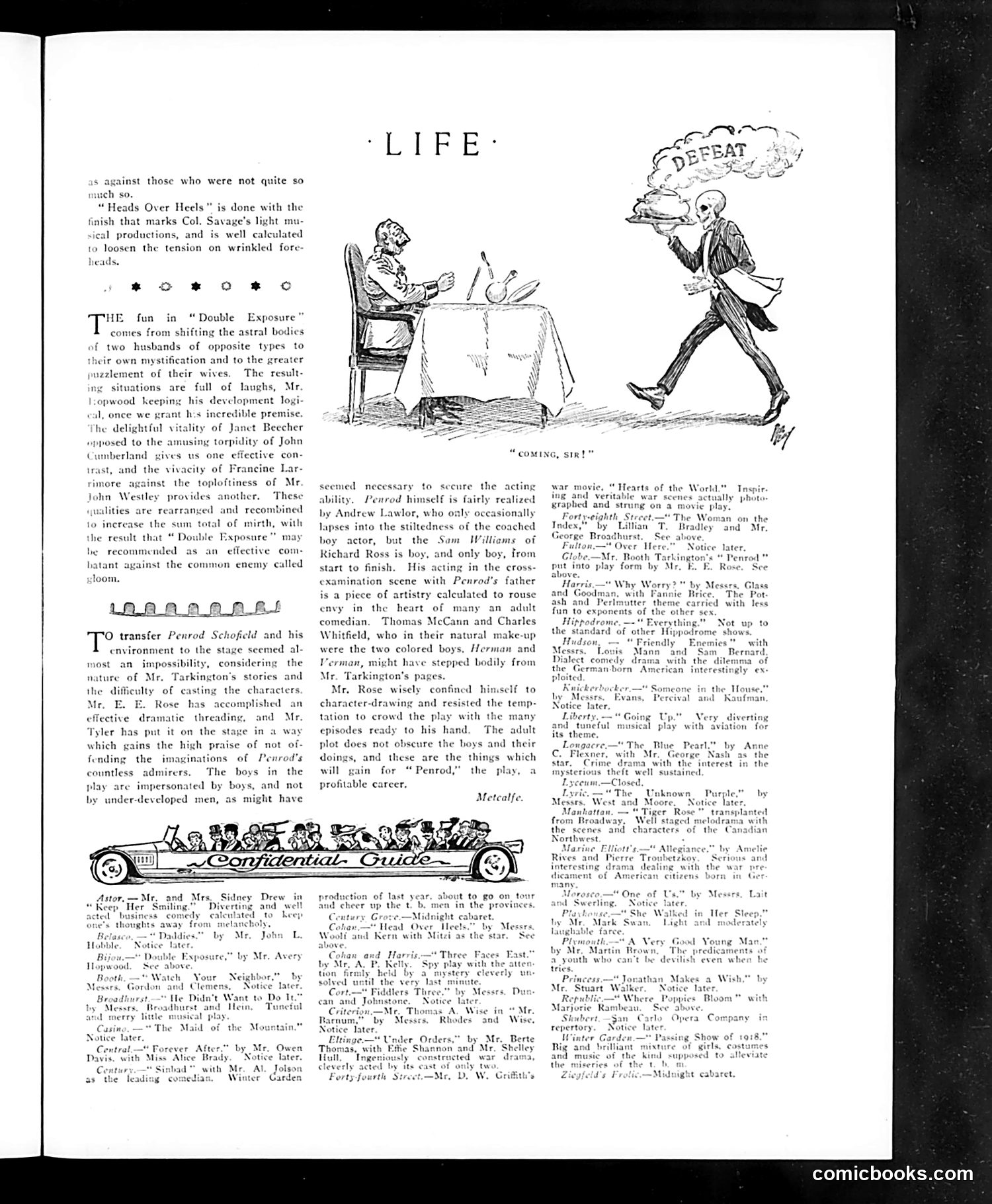
This page from *Life* magazine reviews theatrical productions. The main cartoon depicts "Coming, Sir!" — a joke about a man at a table representing the concept of "Defeat" personified as Death or a skeletal figure, arriving uninvited. The bulk of the page reviews stage plays, including *Penrod* (adapted from Booth Tarkington's novel), *Double Exposure* (a comedy about husbands and wives), and *Heads Over Heels*. The text praises child actors playing boys in *Penrod* rather than adult men, and commends the director E.E. Rose for adapting the literary work successfully to stage. Notable is a review of D.W. Griffith's war film *Hearts of the World*, described as featuring actual war footage. The reviews use period theatrical terminology and reference specific actors and theaters (Booth, Casino, Criterion, etc.) familiar to 1918 New York audiences.
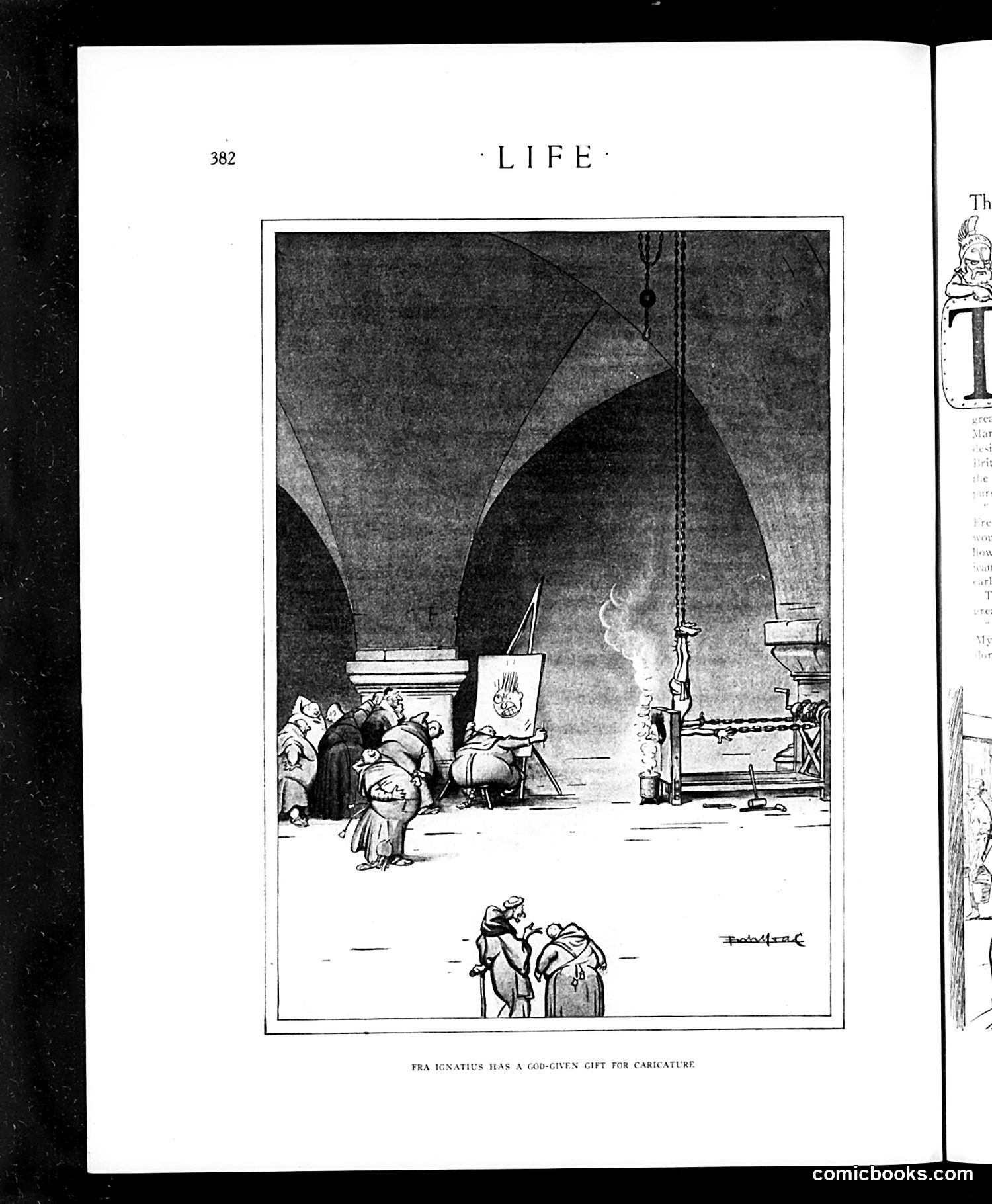
This is a satirical illustration captioned "Fra Ignatius Has a God-Given Gift for Caricature." The scene depicts what appears to be a medieval or religious setting with vaulted arches, where a figure (Fra Ignatius) is shown creating caricatures or artistic works. The satire seems to mock someone named Fra Ignatius—likely a historical or contemporary figure known for caricature work—by suggesting his talent is "god-given," potentially ironizing either his actual skill level or his pretensions about his abilities. The medieval architectural setting may reference religious authority or classical artistic tradition, contrasting with the crude nature of caricature as an art form. Without additional context about who Fra Ignatius specifically was, the precise target of the satire remains unclear, though it appears to be personal commentary on an artist's reputation.
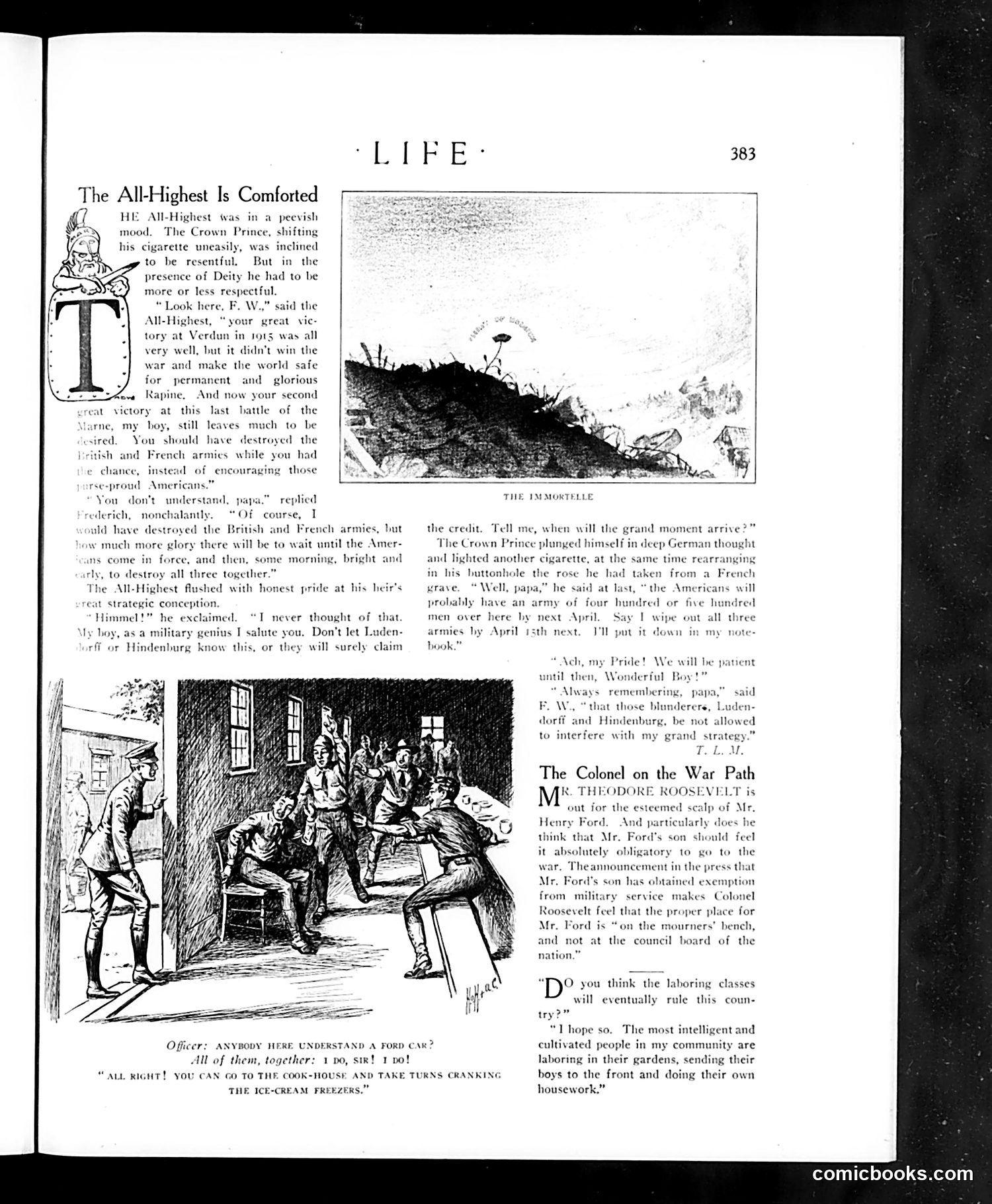
This page contains two political cartoons mocking WWI leadership and American industrialists. **"The All-Highest Is Comforted"** ridicules German Emperor Wilhelm II ("the All-Highest") and the Crown Prince. The satire depicts them strategizing about defeating British and French armies—but realizing they must wait for American intervention to succeed. The Crown Prince foolishly suggests destroying all three armies simultaneously, prompting Wilhelm's delight at this "strategic conception." The joke: German leadership is so incompetent they require American entry to win, and they're openly discussing it. The lower cartoon mocks American soldiers who don't understand Ford automobiles—suggesting industrial ignorance among the ranks. **"The Colonel on the War Path"** targets Theodore Roosevelt's public criticism of Henry Ford's son obtaining a military exemption. Roosevelt (the "Colonel") believes Ford should be on the "mourners' bench" rather than on corporate boards. The final exchange satirizes wealthy elites claiming patriotism while their children avoid service and they profit from war. Both cartoons critique wartime hypocrisy: German delusion, American industrial incompetence, and privileged exemptions from sacrifice.
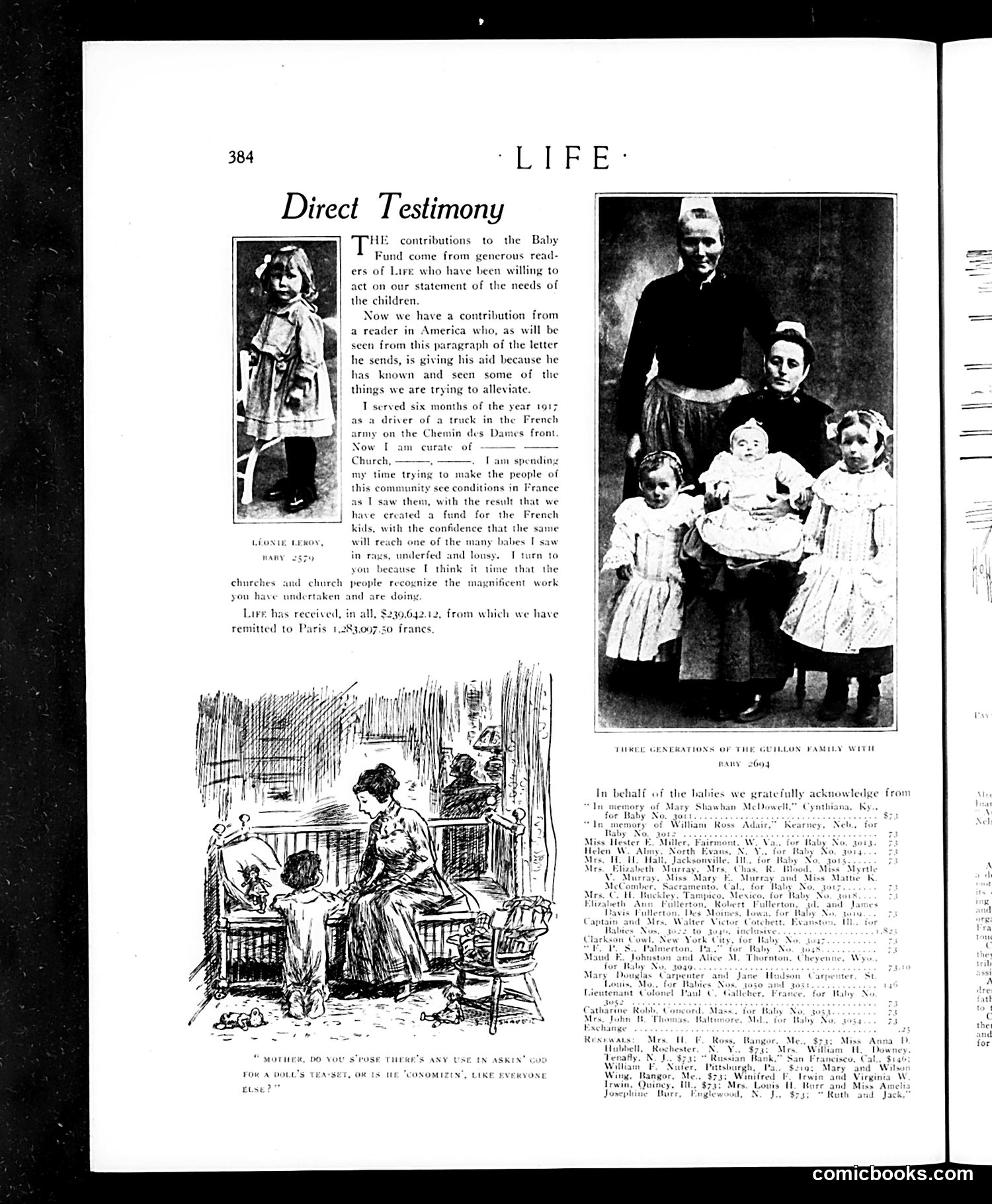
This page documents **Life magazine's Baby Fund**, a charitable initiative supporting malnourished and impoverished French children following World War I. The featured letter from Leone Leroy, an American who served as a truck driver on the front lines in 1917, provides "direct testimony" to justify the fund's existence. Leroy witnessed firsthand the desperate conditions—children "in rags, underfed and lousy"—motivating his donation. The accompanying sketch shows a mother and child, illustrating the domestic poverty Life aimed to address. The photograph depicts three generations of the Guillon family with Baby 2604, a specific child sponsor program where donors supported individual infants. The satirical caption ("Mother, do you s'pose there's any use in askin' God for a doll's tea-set, or is he 'economizing,' like everyone else?") uses child-focused humor to suggest wartime scarcity affected even American children, connecting readers emotionally to the European crisis. The page concludes with donor acknowledgments—evidence of successful fundraising.
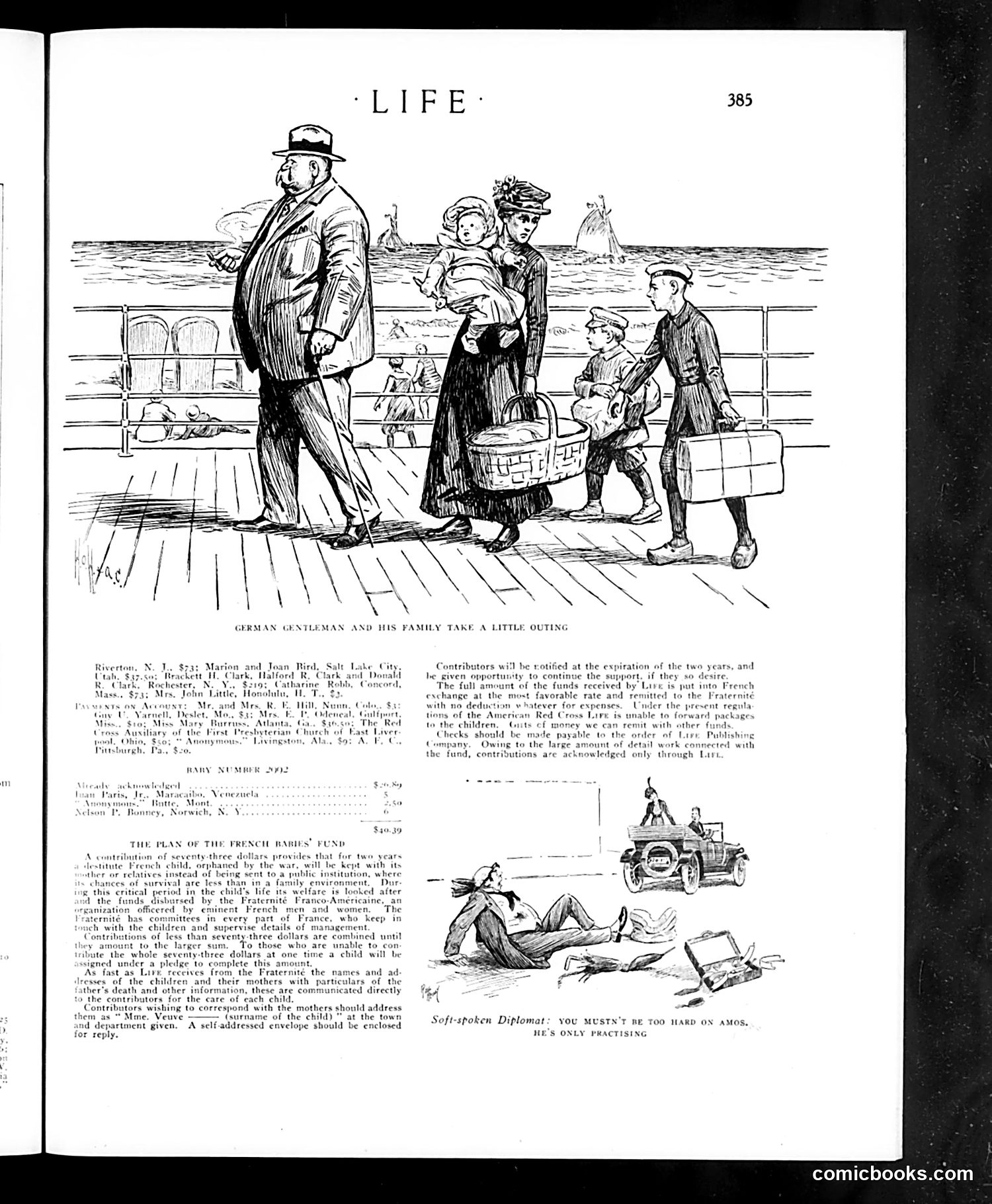
The top illustration depicts a German family on a boat outing, satirizing German militarism and expansionism during a period of international tension (likely early 20th century). The portly German gentleman represents German imperial ambition, while his family suggests how such aggression affected civilian populations. The bottom cartoon shows an automobile crash with the caption "Soft-spoken Diplomat: you mustn't be too hard on Amos, he's only practising." This appears to satirize diplomatic excuses for aggressive national behavior—a diplomat defending destructive conduct as mere "practice." The figure labeled "Amos" remains unclear, but likely represents a nation or leader whose reckless actions were being excused or minimized by diplomatic rhetoric. Both cartoons critique how serious international conflicts were trivialized or explained away.
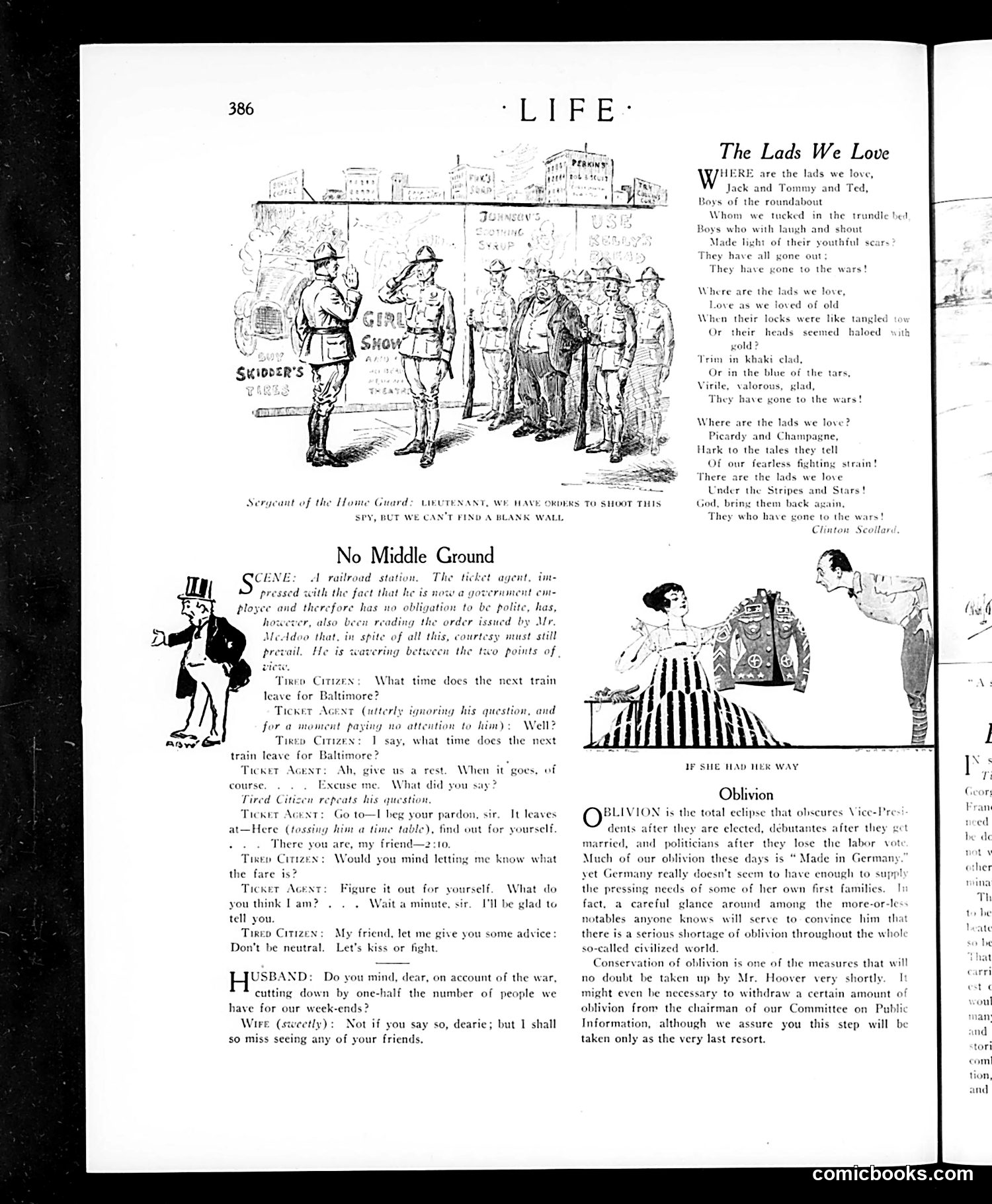
This page contains WWI-era satirical content from Life magazine (likely 1917-1918). **"No Middle Ground"** depicts a clash between a railroad ticket agent and exhausted civilian passenger. The agent, emboldened by a government order from Secretary McAdoo, refuses basic courtesy while technically following rules. The ticket agent oscillates between rudeness and grudging compliance—hence "no middle ground." The satire mocks how wartime bureaucratic authority corrupts civility and how both citizens and officials struggle with conflicting demands. **"The Lads We Love"** is a patriotic poem mourning young soldiers sent to war in France (Picardy, Champagne). It contrasts their youthful beauty with their sacrifice, asking repeatedly "where are the lads we love?"—acknowledging they're gone to war, likely dead. **"Oblivion"** sarcastically observes how wartime creates convenient amnesia: Vice-Presidents disappear from public memory after election defeats, politicians forget labor after winning votes. It suggests Mr. Hoover's Information Committee might eventually need to conserve "oblivion" by suppressing uncomfortable truths. All pieces reflect American WWI anxieties about sacrifice, government overreach, and selective memory.
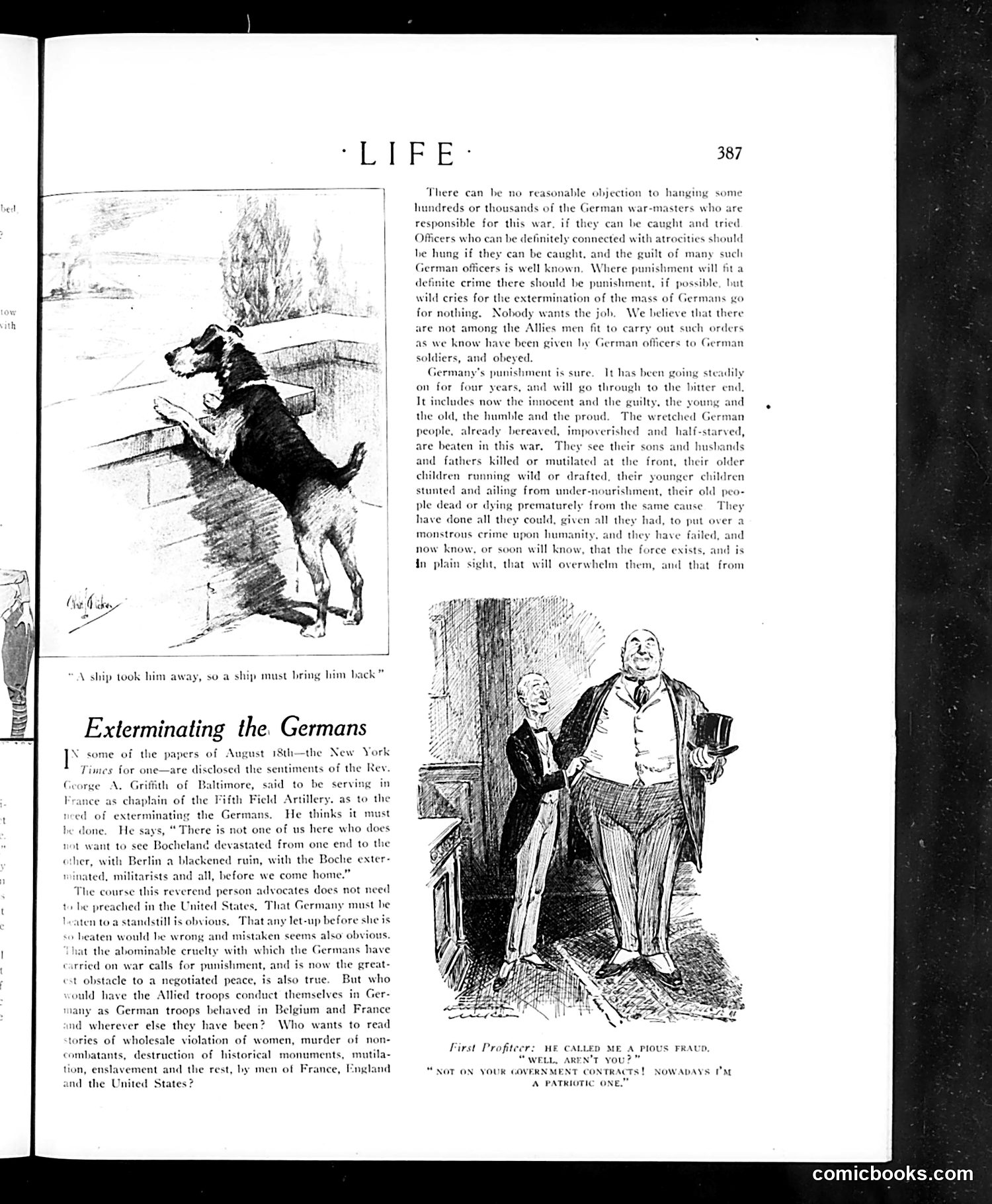
This page discusses post-WWI justice while satirizing wartime profiteering. The main article debates whether Germans should face extermination versus legal punishment. The author argues that while German war crimes warrant prosecution of leaders and responsible officers, wholesale extermination is both morally wrong and impractical—Allied soldiers shouldn't conduct themselves as German troops did in Belgium and France. The cartoon below mocks American hypocrisy: a profiteer calls himself a "patriot" while explicitly stating he profits from government contracts rather than patriotic motives. The figure appears to be a businessman or war contractor, suggesting that American businesses exploited the war effort for profit while claiming moral superiority over Germany. The dog illustration above captioned "A ship took him away, so a ship must bring him back" likely references soldiers' return home—a separate sentiment about military service.
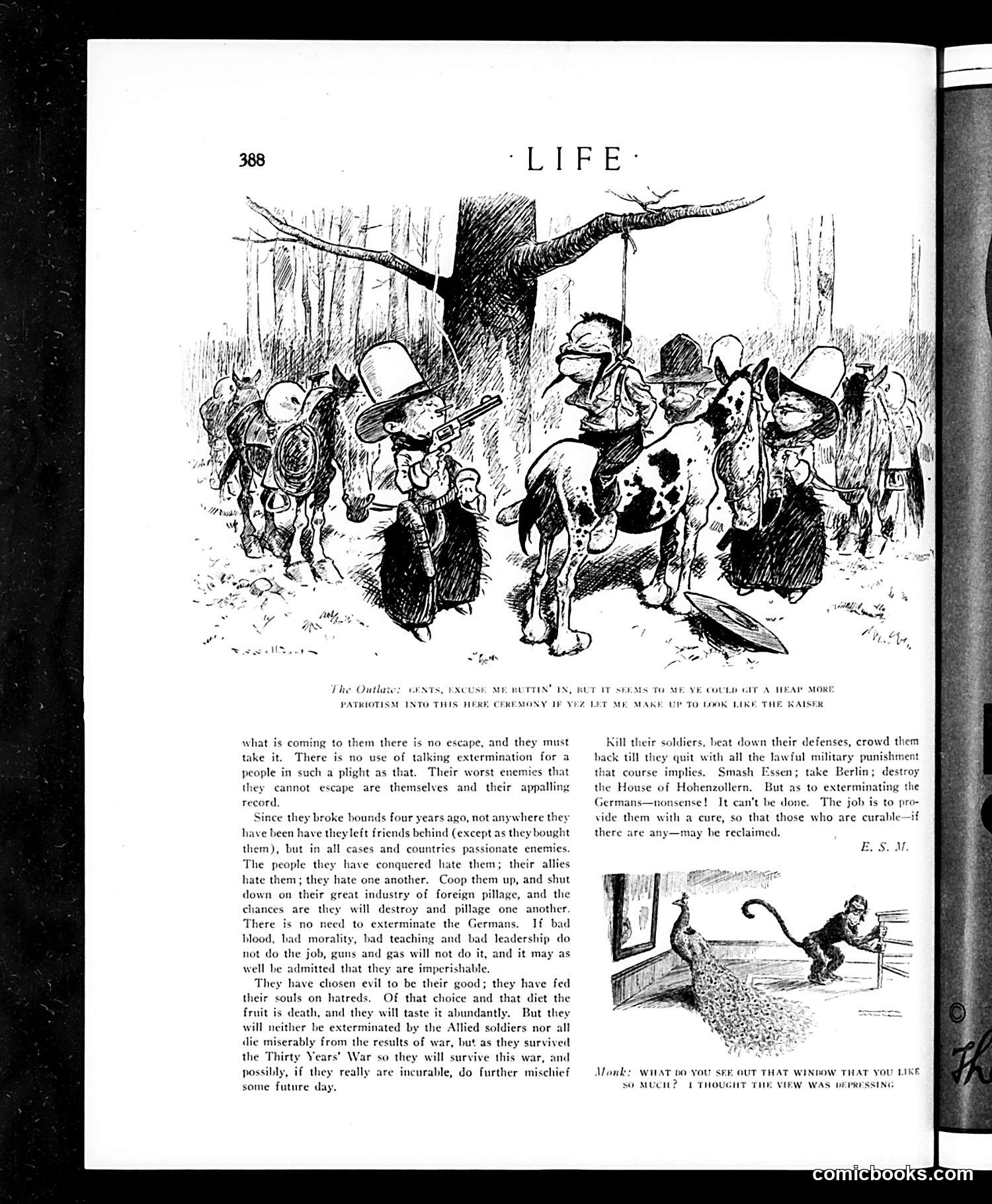
The top cartoon depicts **"The Outlaw,"** showing a ragged, disreputable figure (representing Germany or a German leader) interrupting a formal military ceremony. The figure suggests the assembled officers could inject more "patriotism" by letting him dress up to resemble the Kaiser—a crude joke suggesting Germany's leadership is fundamentally lawless and absurd. The accompanying article argues against exterminating Germany after World War I, contending that Germans have destroyed themselves through moral corruption and internal hatred. Instead, the author advocates military defeat and dismantling the Hohenzollern dynasty as sufficient punishment. The bottom cartoon shows a monk at a window, asked why he enjoys a depressing view—likely commenting on monks taking unhealthy pleasure in bleak perspectives, though its specific satirical target is unclear from the visible text. Both pieces reflect wartime-era arguments about Germany's fate during or immediately after WWI.
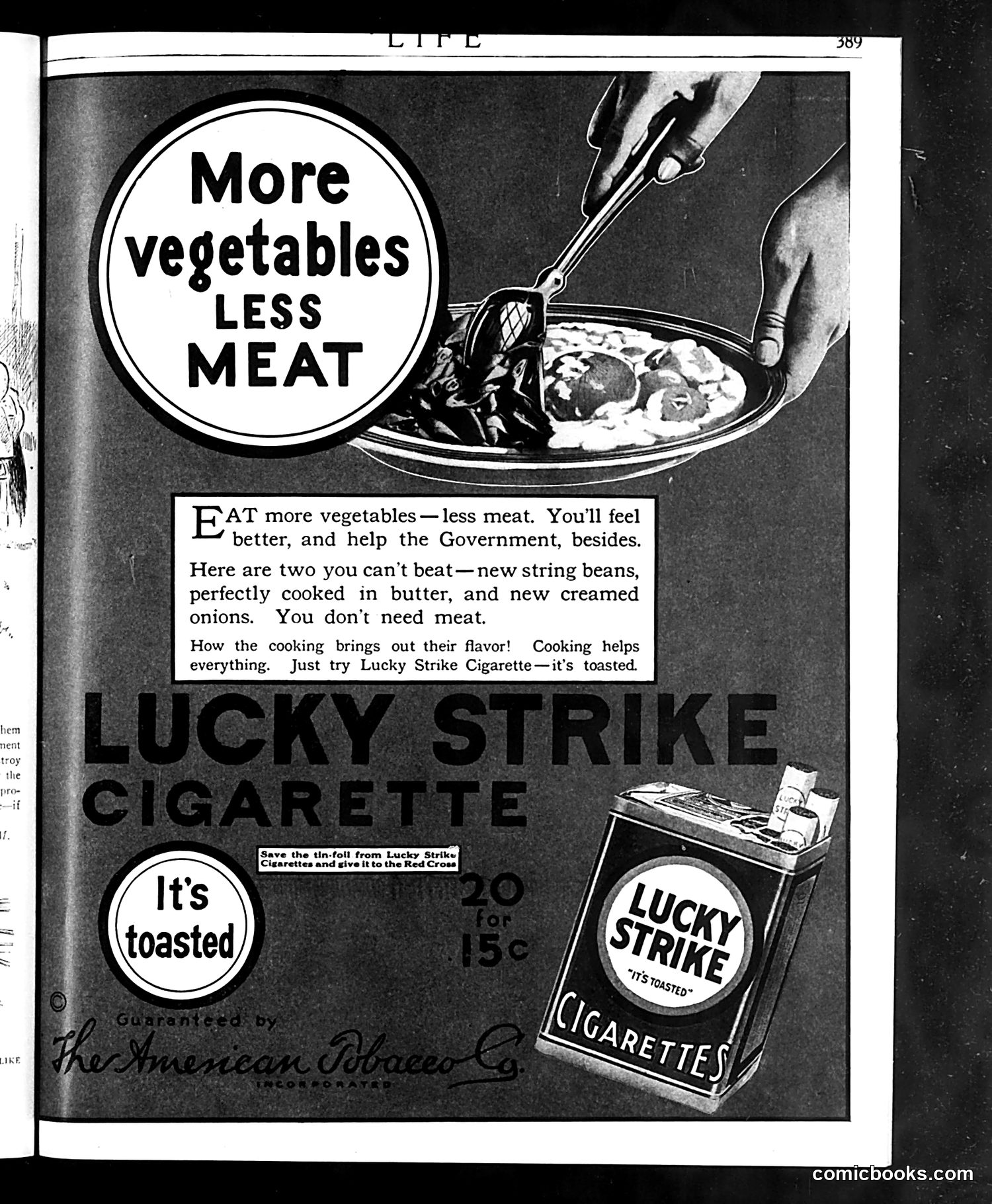
This is a wartime propaganda advertisement (likely WWI or WWII era, based on the Red Cross reference and meat rationing context). The ad urges civilians to eat more vegetables and less meat to support government war efforts—meat was needed for troops. The satirical element: Lucky Strike cigarettes capitalize on this patriotic messaging by claiming their "toasting" process enhances flavor, analogous to how cooking brings out vegetable flavors. The ad then awkwardly pivots to selling cigarettes as part of the same "help the Government" theme. The humor lies in the absurd juxtaposition: cigarettes are promoted as a patriotic wartime contribution alongside actual food rationing. The advertisement also mentions saving tin-foil from cigarette packages for the Red Cross—a common WWII recycling initiative—further blending commercial advertising with genuine wartime sacrifice.
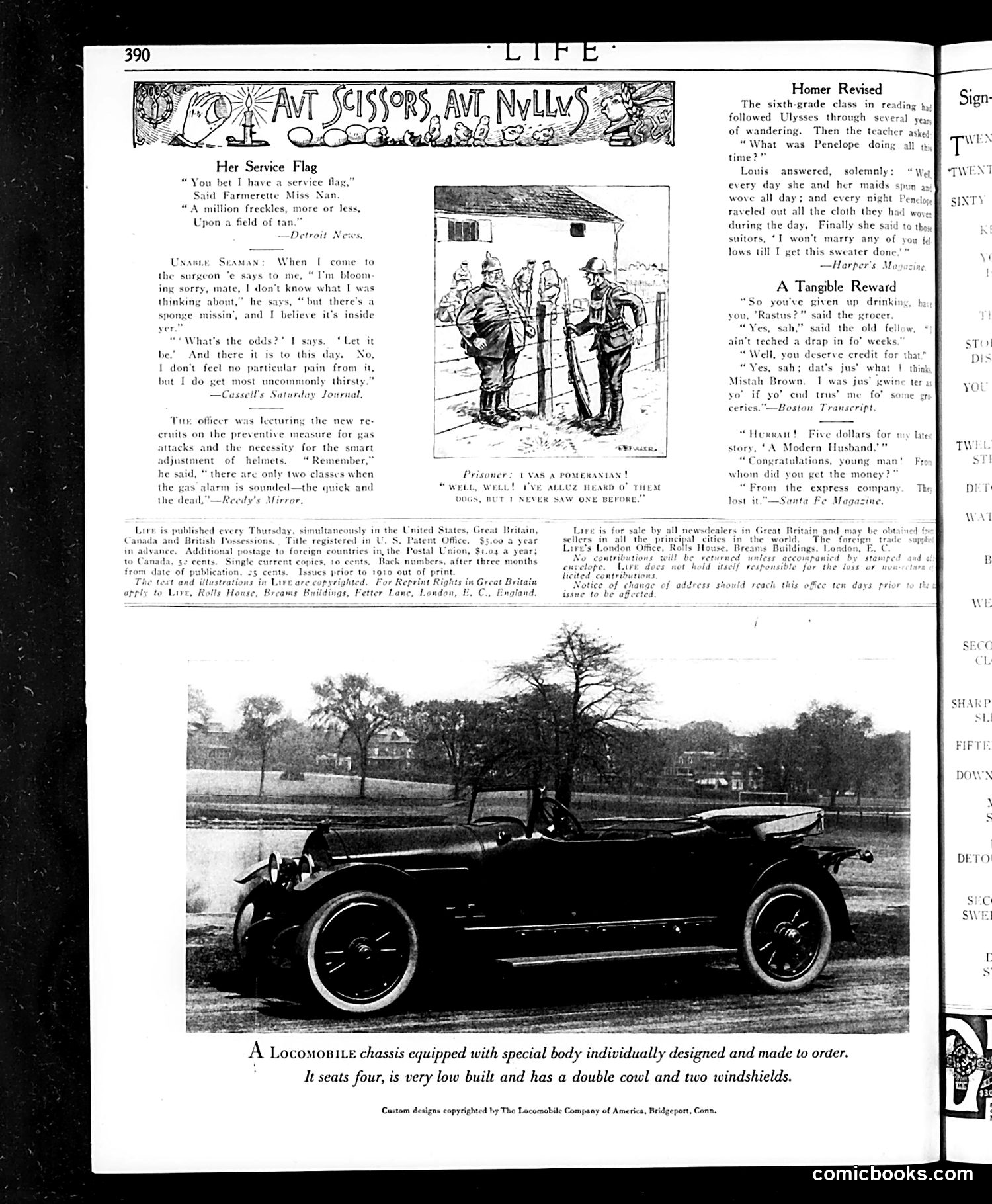
This page from *Life* contains several short humorous pieces typical of early 20th-century American satire: **"Her Service Flag"** mocks a farm girl ("Farmerette Miss Nan") who claims freckles as her patriotic "service flag"—satirizing women's contributions during wartime (likely WWI era). **"A Pomeranian"** is a brief joke about mistaking a dog breed, relying on dialect humor common to the period. **"Homer Revised"** jokes about a schoolchild reinterpreting Homer's *Odyssey*: the student conflates Penelope's famous faithful weaving with modern complaint about finishing a sweater, humorously reducing classical literature to domestic mundanity. **"A Tangible Reward"** presents a dialect-heavy exchange where a man gets credit for quitting drinking—typical period humor using working-class speech patterns. The page also advertises a **Locomobile automobile** with custom body design, representing luxury vehicles of the era. The cartoons and jokes reflect early 20th-century American humor: patriotic sentiment, classical education, temperance themes, and class-based dialect comedy.
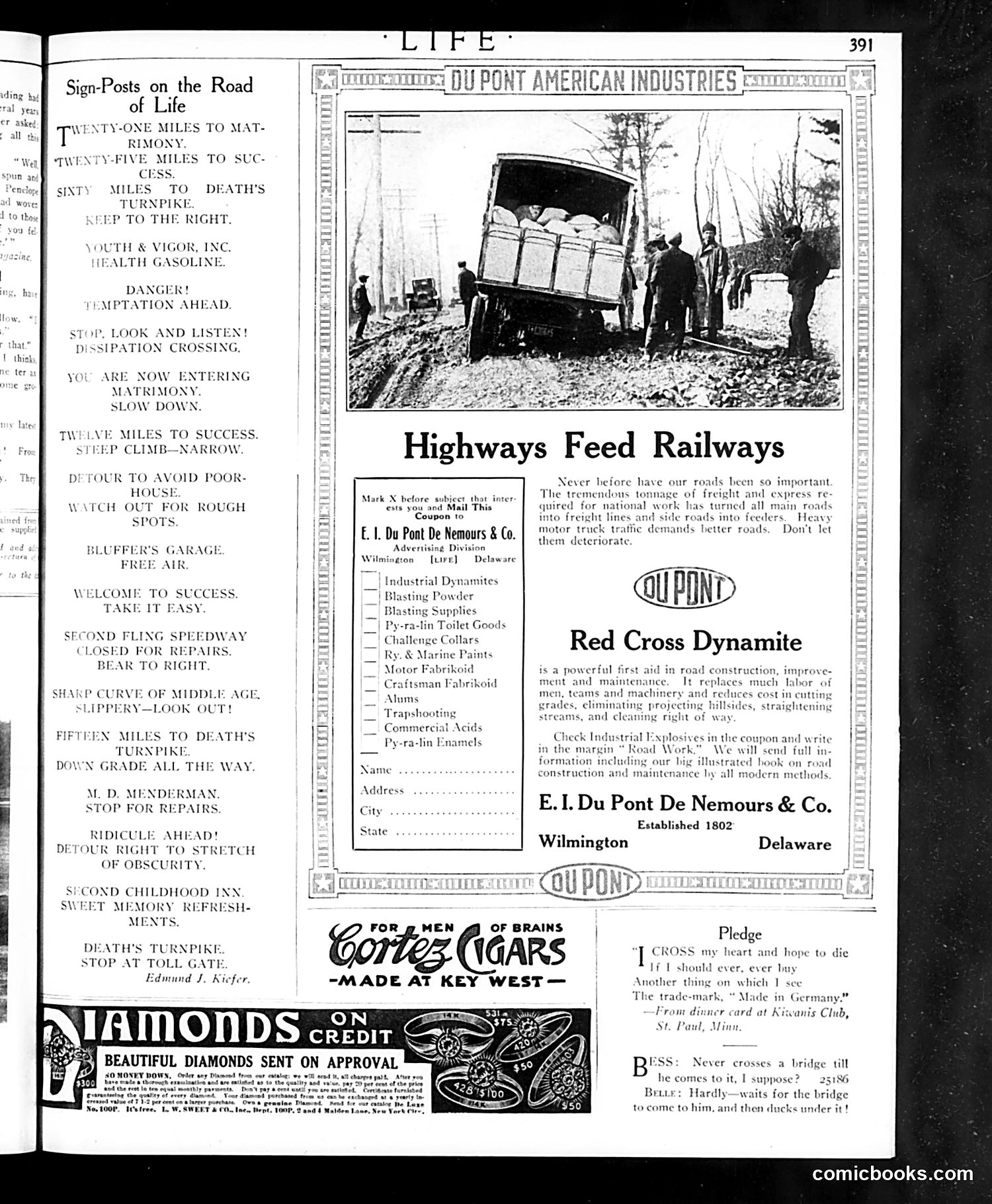
This page combines satirical road signs with advertising for DuPont industries. ## "Sign-Posts on the Road of Life" The left column presents humorous roadside-style signs marking life's journey toward marriage and old age. Titles like "Twenty-One Miles to Matrimony," "Danger! Temptation Ahead," and "Death's Turnpike" mock conventional life milestones using automotive metaphors—a modern, somewhat irreverent approach for the era. The humor treats serious life events (marriage, aging, death) as comic highway stages, with warnings about "Bluffer's Garage" and "Second Childhood Inn" poking fun at human pretension and inevitable decline. ## Advertising Content The right side features DuPont advertisements for dynamite and industrial products, alongside a cigar ad and a Kiwanis Club joke. The main pitch argues that improved roads (built with DuPont explosives for construction/blasting) benefit railways and commerce. The page reflects 1920s American attitudes: satirical toward marriage and aging, promotional of industrial progress, and casually inclusive of commercial messaging within editorial space.
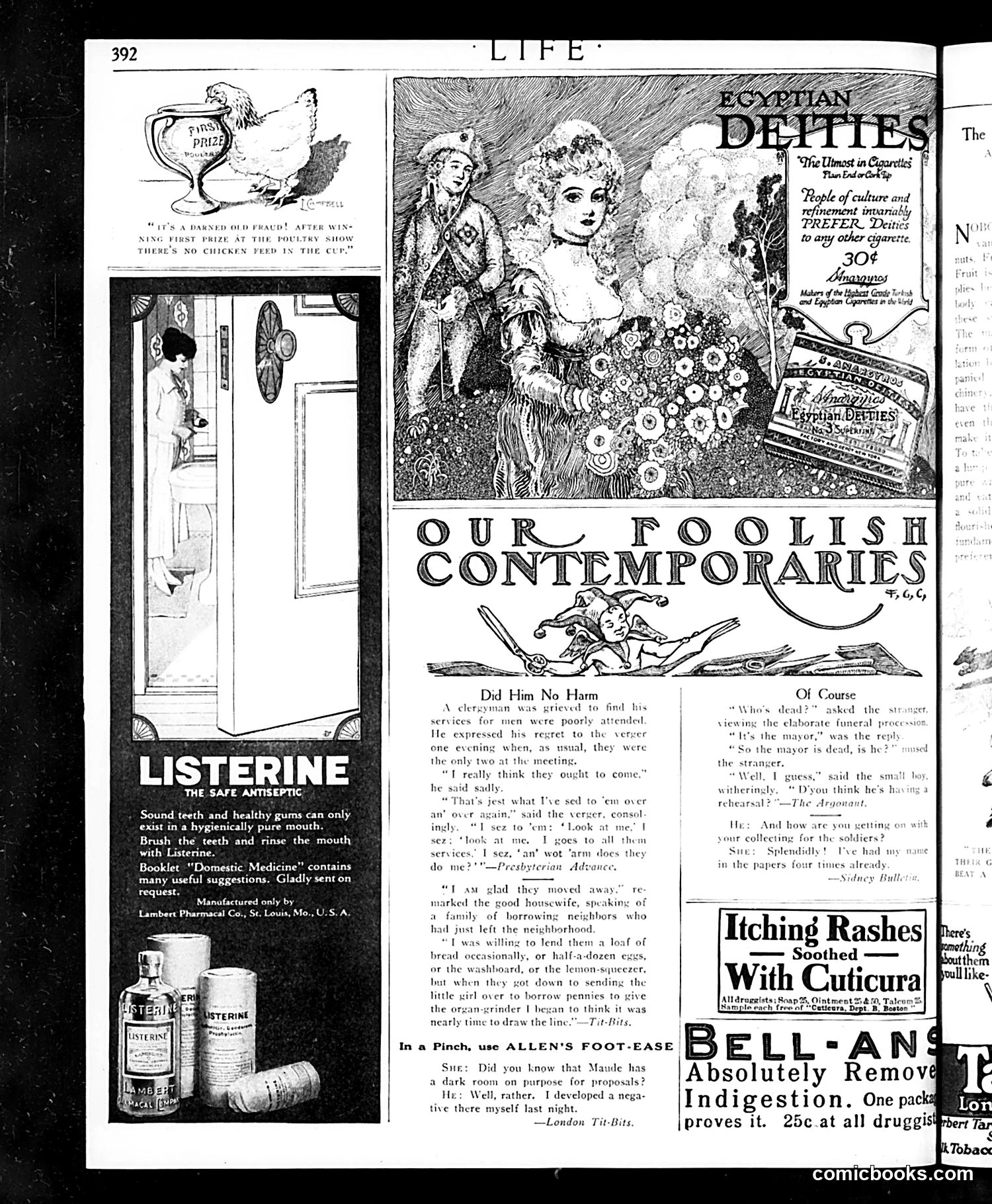
This page is primarily **advertising**, with one small satirical cartoon at top-left. **The Cartoon:** A hen has won "First Prize" at a poultry show. The joke's caption reads: "It's a darned old fraud! After winning first prize at the poultry show there's no chicken feed in the cup"—mocking the absurdity that winning a competition yields no practical reward (no actual feed for the bird). It's a simple joke about hollow victories. **Advertisements:** The page features Listerine mouthwash, Allen's Foot-Ease, Cuticura ointment, and Bell-Ans indigestion remedy—typical patent medicines of the era. There's also an "Egyptian Derbies" advertisement (unclear product type). **Humor Columns:** Several brief jokes appear under "Our Foolish Contemporaries"—anecdotes about clergymen, borrowed items, and romantic mishaps—typical light domestic humor for the period. The page reflects early 20th-century concerns: hygiene, consumer products, and genteel domestic comedy.
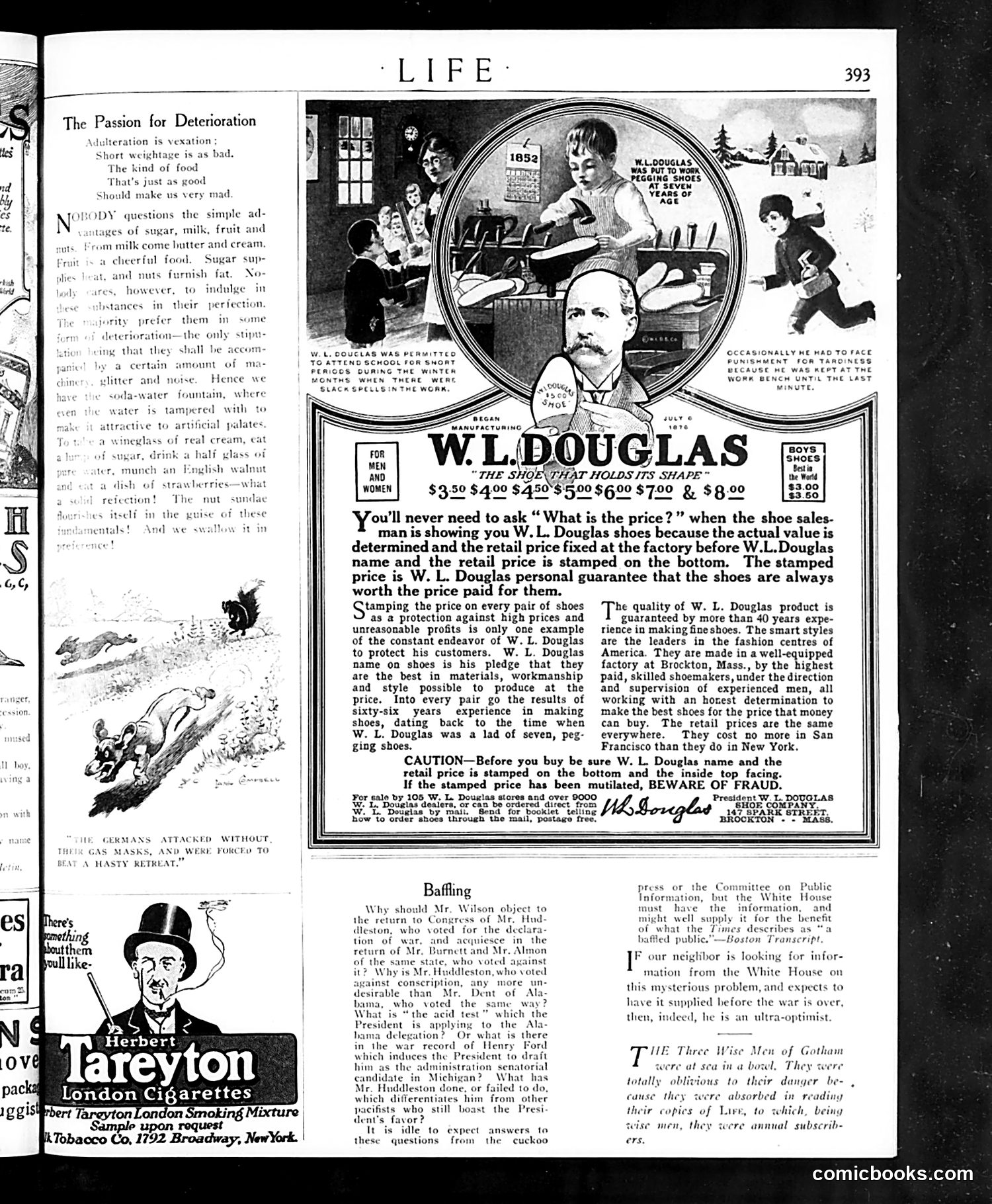
This page is predominantly a **W.L. Douglas shoe advertisement**—a major commercial endorsement of the period. The ad features biographical vignettes of founder W.L. Douglas (shown in the central portrait), emphasizing his humble origins as a child shoemaker and his rise to prominence. The advertisement highlights the company's innovation: stamping the retail price directly on shoes to prevent fraud and price-gouging—a consumer protection measure presented as Douglas's pledge to protect customers from "unreasonable profits." The ad targets both men and women, listing prices from $3.50 to $8.00. The surrounding text emphasizes quality, American manufacturing in Brockton, Massachusetts, and nationwide price consistency. The page also contains unrelated text fragments about wartime food adulteration (top left) and a political column titled "Baffling" (bottom), critiquing President Wilson's inconsistent positions on allowing certain congressmen to return to office based on their war votes.
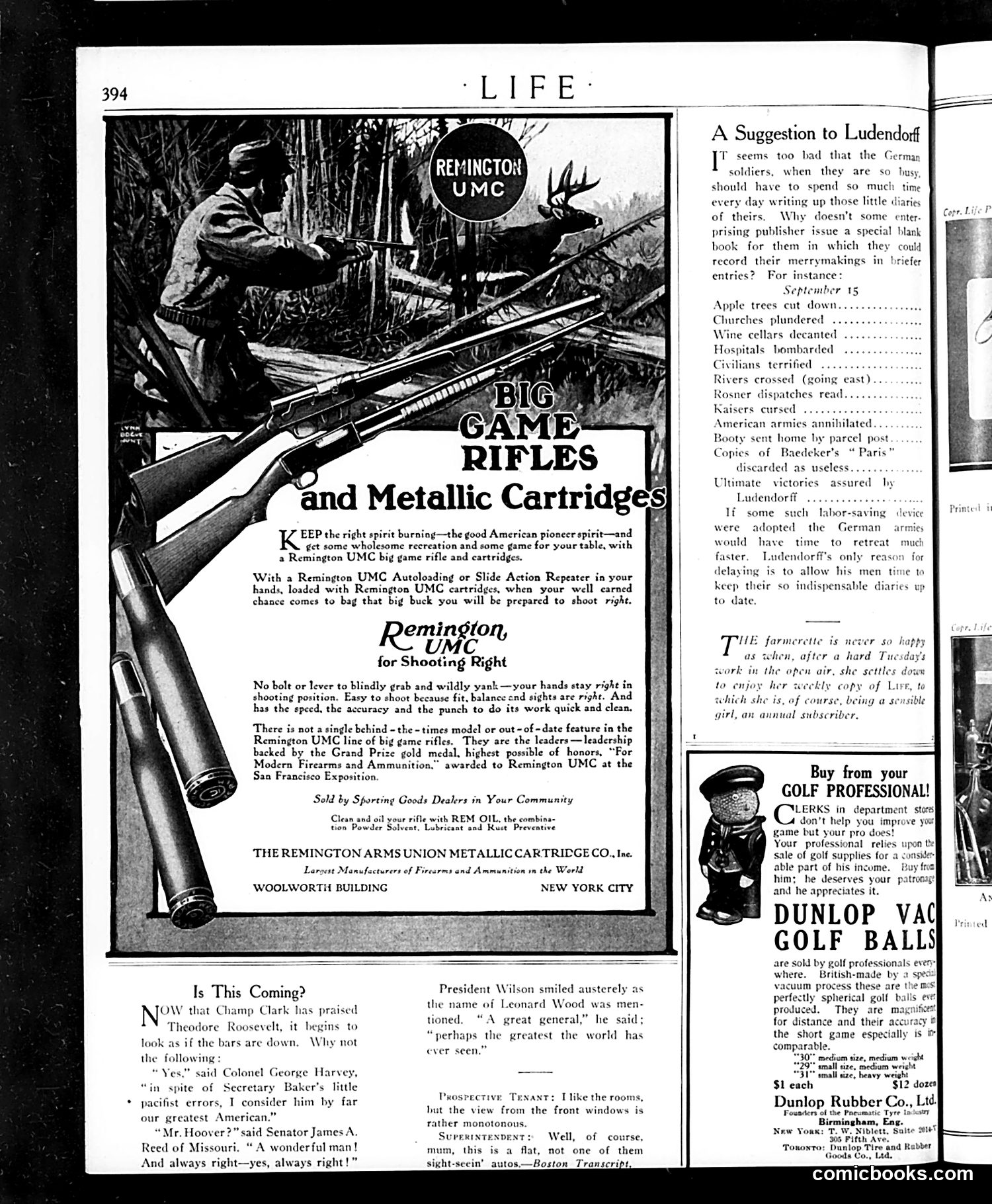
This page mixes advertising with satirical commentary on World War I. **Main Advertisement:** A Remington UMC rifle ad appeals to "American pioneer spirit" for hunting—typical early 20th-century marketing linking firearms to American identity. **Political Cartoon ("Is This Coming?"):** The cartoon satirizes American political figures praising potential presidential candidates. It references praise from Champ Clark for Theodore Roosevelt, and mentions Leonard Wood and Secretary Baker being lauded by various politicians. The satire suggests politicians are circling around potential successors to President Wilson, with the cartoon's title questioning whether this jockeying for future leadership is inevitable. **"Suggestion to Ludendorff":** This is anti-German WWI satire. Ludendorff was the German general. The piece mockingly suggests German soldiers keep diaries of their conquests (plundering churches, terrorizing civilians, etc.), sarcastically portraying German military actions as systematic atrocities. It's wartime propaganda humor aimed at American readers, presenting German conduct as brutish and mechanical. The page reflects 1918 American attitudes during active WWI combat.
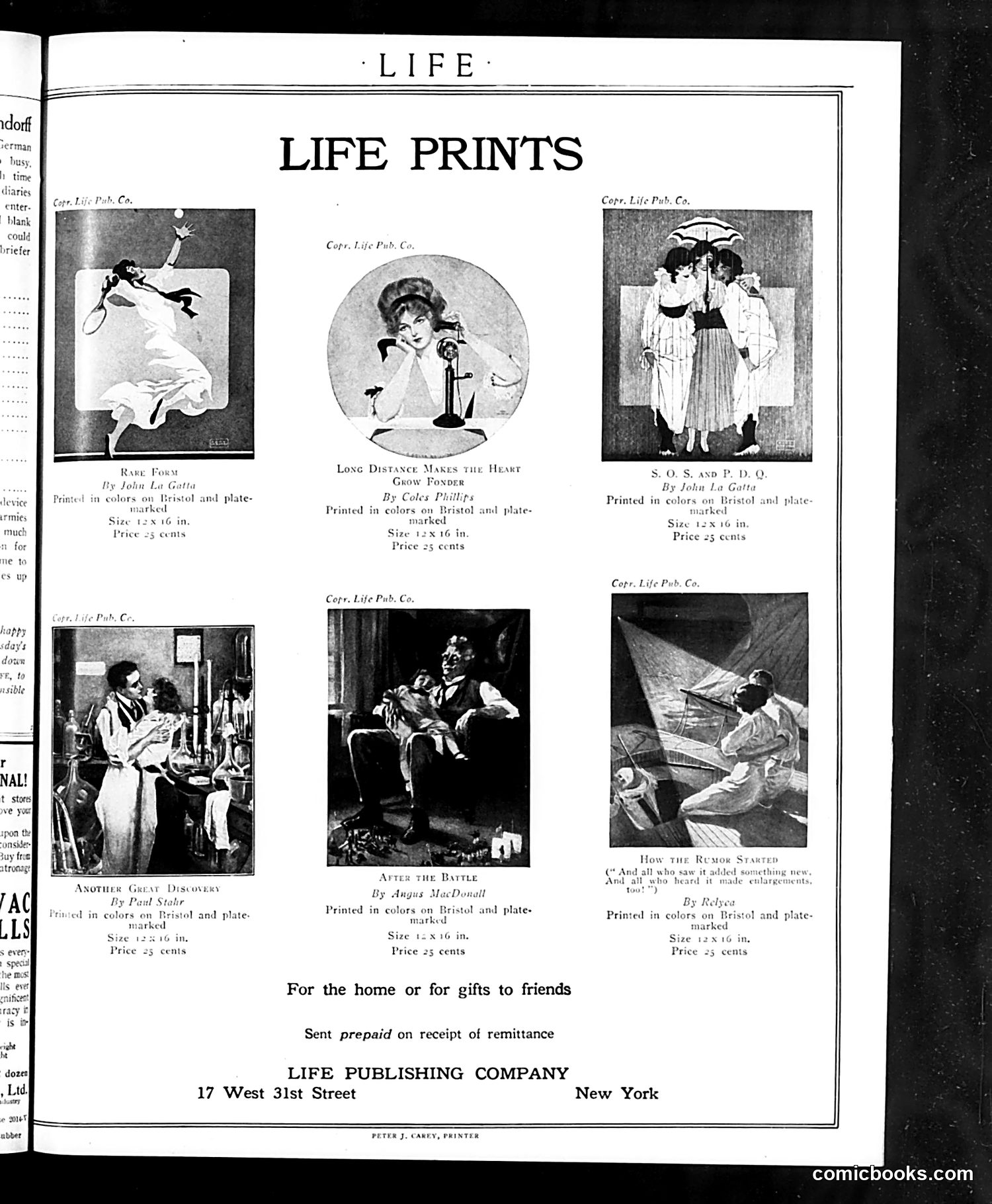
This is a catalog page advertising decorative prints for sale by Life Publishing Company. Rather than political satire, it showcases six sentimental illustrations by various artists (John La Gatta, Coles Phillips, Paul Stube, Angna MacDonald, and Rolyea), priced at 25 cents each. The prints depict romanticized domestic and leisure scenes typical of early 20th-century popular art: a reclining woman, a woman at a microphone, women with an umbrella, a man with a child, figures in an interior scene, and a reclining figure in hammock. The page emphasizes these are "For the home or for gifts to friends," positioning them as affordable, mass-produced decorative merchandise. This represents Life magazine's diversified business model—beyond publishing satirical content, they marketed consumer goods to middle-class households.
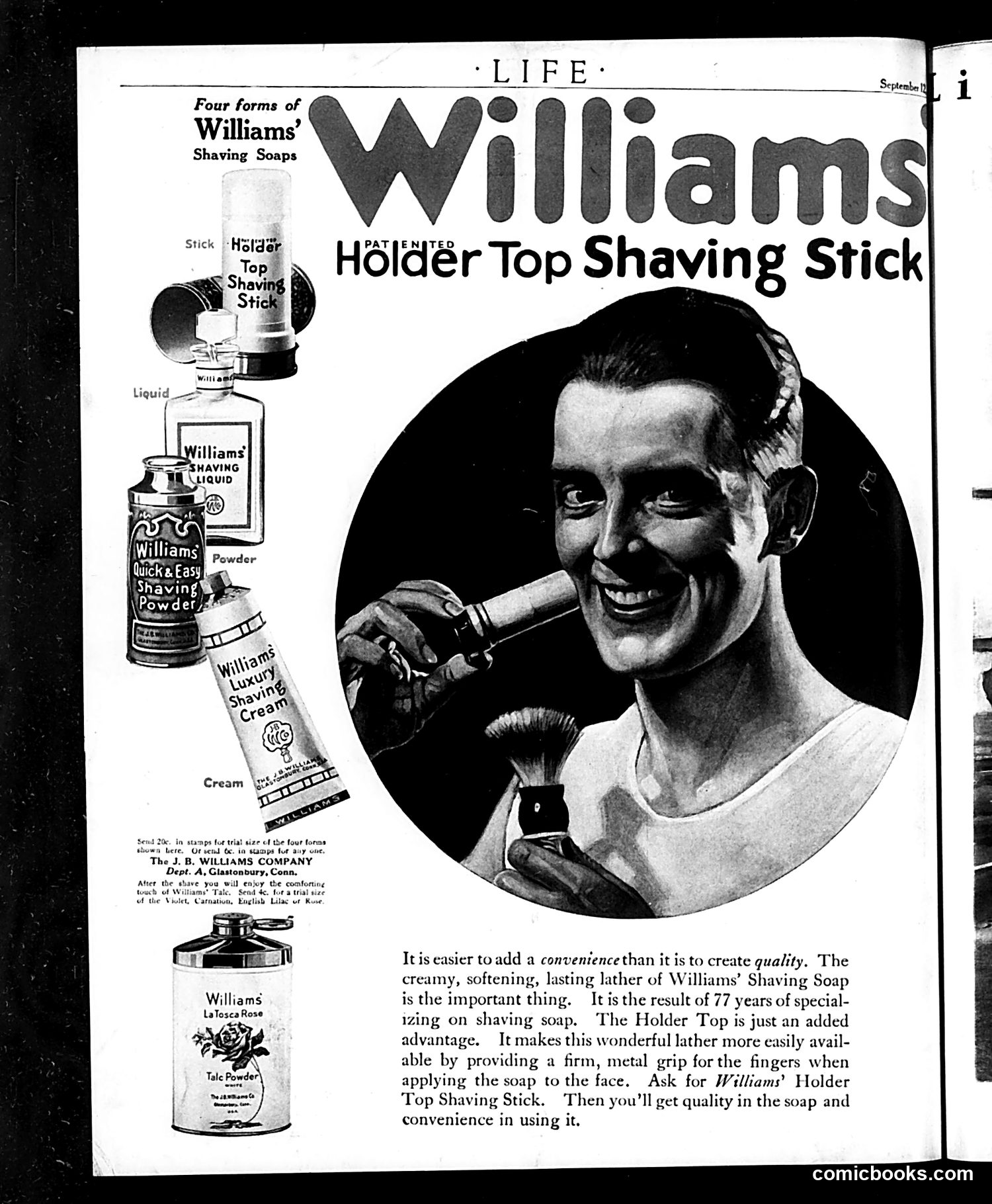
This is **not a cartoon or satire** — it's a straightforward advertisement for Williams' shaving products, appearing in Life magazine (likely early 20th century, given the date notation "September"). The page showcases four Williams' shaving soap products: a stick, liquid, powder, and cream. The central image is a cheerful man demonstrating the "Holder Top Shaving Stick," the featured innovation. The ad's pitch is straightforward: Williams claims 77 years of expertise in shaving soap quality. The "Holder Top" is presented as a convenience feature — a metal grip that makes applying soap easier. The text emphasizes this philosophy: quality comes first (the soap itself), with convenience as a secondary bonus. There is no political content, satire, or hidden meaning — this is period advertising aimed at male consumers, emphasizing both product quality and practical user improvement.