
A complete issue · 20 pages · 1908
Life — August 13, 1908
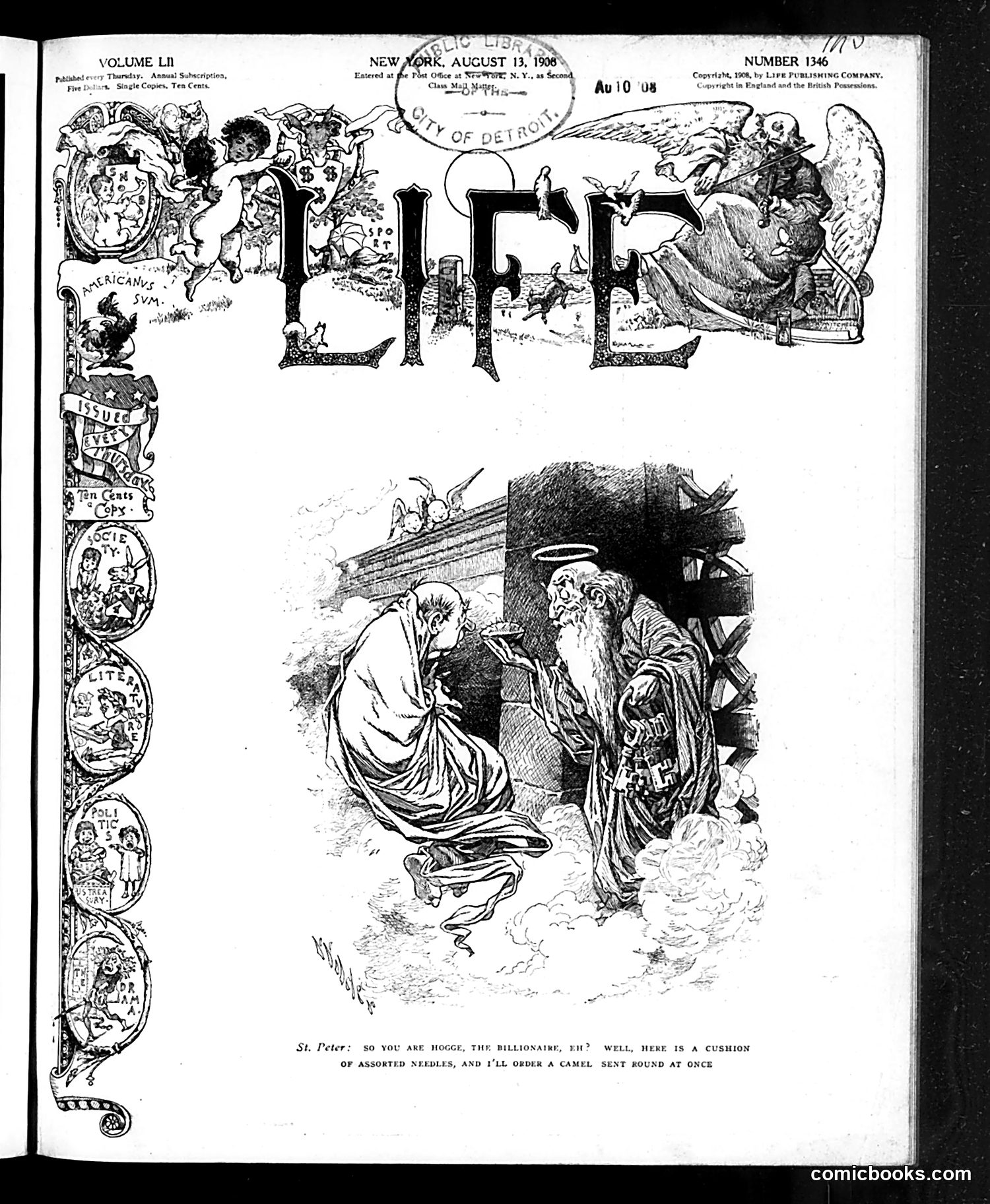
This cartoon depicts St. Peter at the gates of heaven encountering a newly arrived soul identified as "Hogg, the billionaire." The joke plays on the biblical difficulty of wealthy people entering heaven (referencing Jesus's teaching that "it is easier for a camel to go through the eye of a needle than for a rich man to enter the kingdom of God"). St. Peter offers the billionaire a "cushion of assorted needles" and sarcastically promises to send a camel—mocking the contradiction between the billionaire's earthly wealth and moral/spiritual standing. The cartoon satirizes Gilded Age excess and the perceived incompatibility between riches and virtue, suggesting that even death and divine judgment won't spare the wealthy from scrutiny of their character.
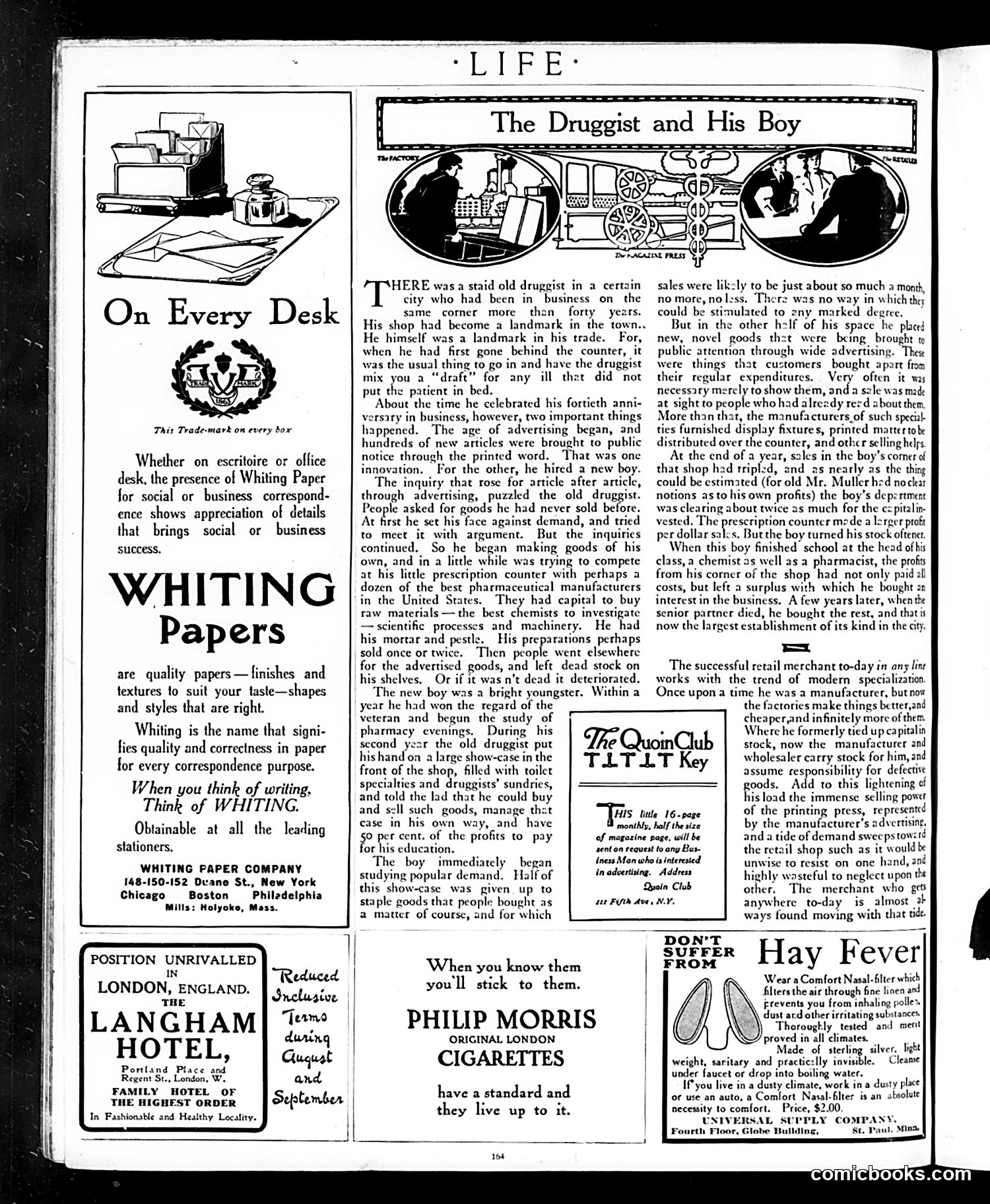
This page is primarily **advertising and fiction content** rather than political satire. The main feature is a serialized story titled "The Druggist and His Boy," illustrated with silhouette vignettes. The narrative describes an old pharmacist who built his business over forty years, then hired a young boy. The story illustrates how the boy modernizes the shop through advertising and merchandising innovations, eventually becoming a successful retail merchant himself. The piece subtly advocates for **modern business practices** and specialization in retail—reflecting early 20th-century American capitalism. The surrounding advertisements (Whiting Papers, Langham Hotel, Philip Morris Cigarettes, Hay Fever remedy) suggest this magazine targeted educated, business-minded readers. There is **no political satire** evident on this page.
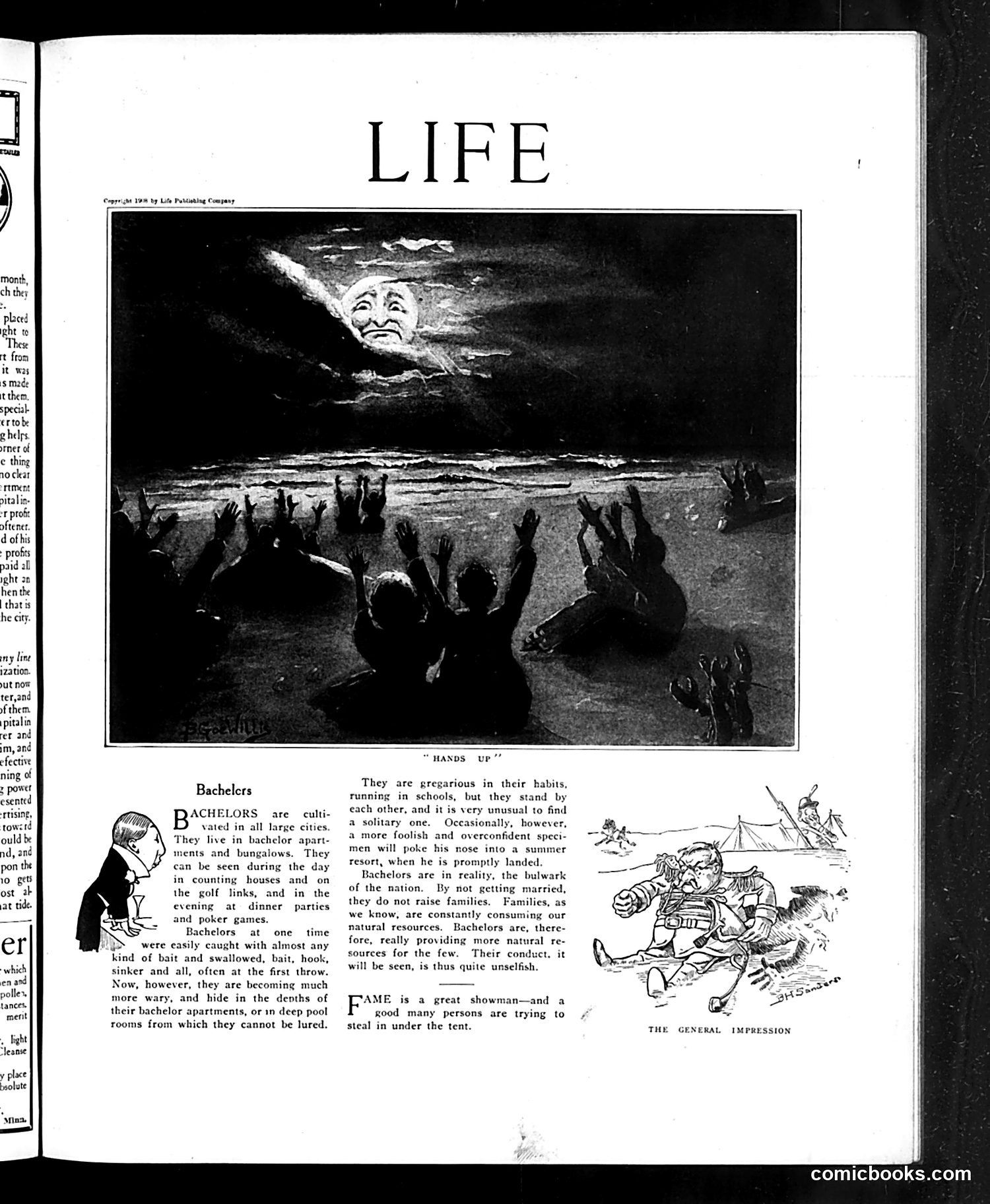
The main illustration titled "Hands Up" depicts a surreal, nightmarish scene: a grotesque face looms in a dark sky while multiple figures below raise their hands in surrender or desperation. This appears to be satirizing fear or panic—possibly related to crime, social disorder, or perceived threats to public safety that concerned early 20th-century readers. The text section on "Bachelors" is satirical social commentary. It describes bachelors as wasteful (consuming resources without families), increasingly problematic in cities, and "unselfish" (sarcastically—they burden society rather than contribute). The accompanying illustration shows a disheveled bachelor, reinforcing the stereotype of unmarried men as parasitic or degenerate. This reflects period anxieties about unmarried males in urban society.
The page contains political commentary rather than cartoons. The main text discusses President Roosevelt's handling of the Standard Oil antitrust case, where the Circuit Court of Appeals blocked communications between the President and the Attorney General during proceedings. The satire criticizes Roosevelt for attempting to influence judicial decisions, suggesting he views himself as above the separation of powers. The article argues this undermines judicial independence—judges should make decisions based on law, not presidential preference. A secondary piece critiques the New York Park Board's failure to enforce automobile emission standards, using this as an example of regulatory weakness affecting public health and quality of life in cities. The illustrations appear decorative rather than specific political caricatures.
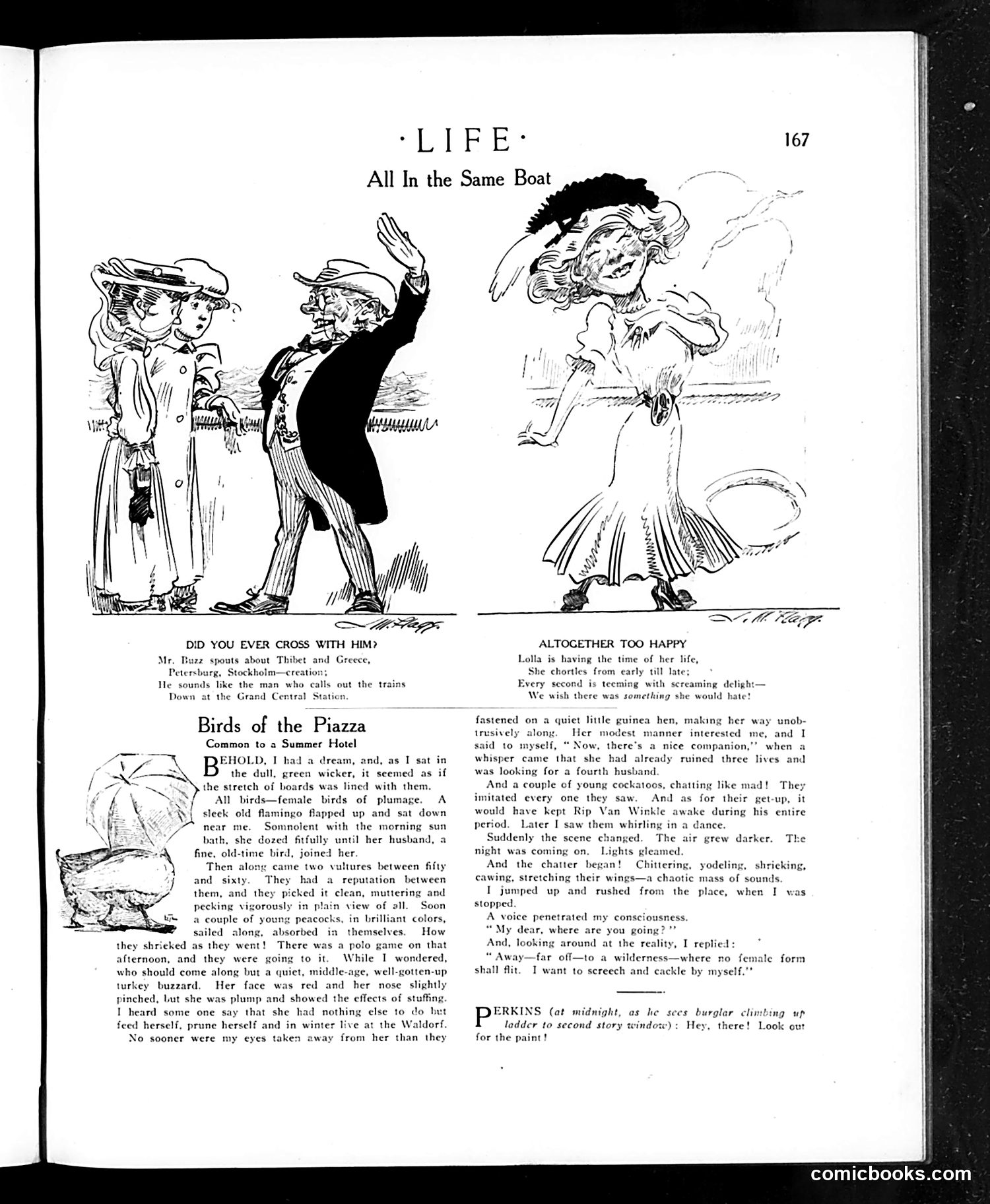
This page contains three unrelated satirical cartoons and humorous stories typical of early Life magazine's format. **"All in the Same Boat"** (top left) depicts a man tipping his hat to two women, with text referencing someone named Fuzzy who traveled between Petersburg, Stockholm, and Greece—appearing to mock excessive or pretentious travel. **"Altogether Too Happy"** (top right) shows a caricatured woman in an exaggerated dancing pose, mocking a character named Lolla who supposedly has "screaming delight" in life despite her troubled romantic history. **"Birds of the Piazza"** (bottom) is a longer illustrated story about a woman observing vultures in a Mediterranean setting, using the birds metaphorically while describing her own social observations. The page reflects turn-of-the-century American humor targeting social pretension and romantic misadventures.
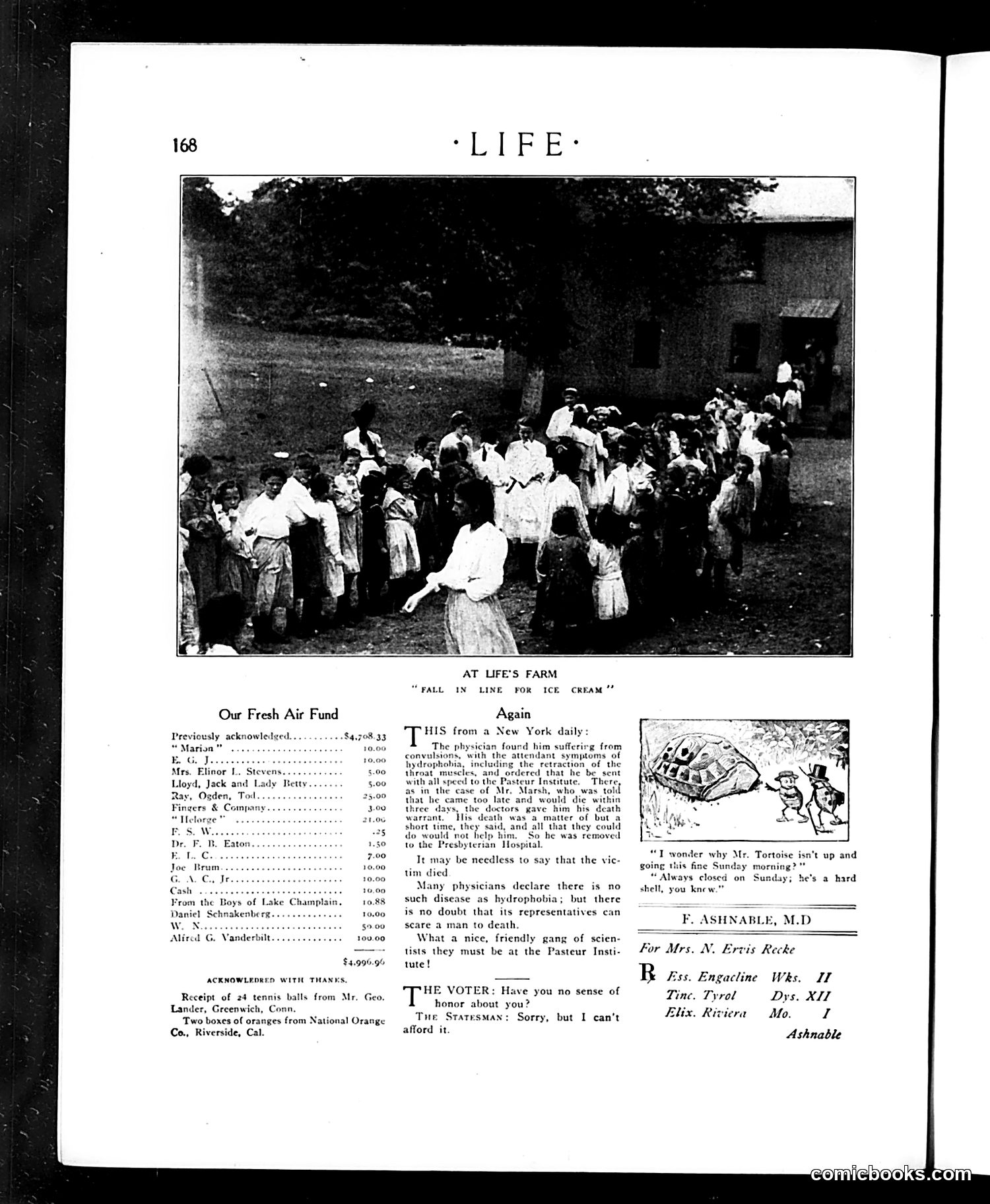
The main photograph shows a large group of children and adults gathered outdoors at "Life's Farm" for an ice cream social—a common early 20th-century charitable event. The caption "Fall in Line for Ice Cream" suggests this was part of the "Fresh Air Fund," a program providing outdoor recreation to underprivileged urban children. The page documents contributions to this charitable initiative, listing donors and amounts. The small cartoon features a tortoise and appears to be a humorous aside about laziness ("I wonder why Mr. Tortoise isn't up and doing his Sunday morning running?" / "Always closed on Sunday; he's a hard shell, you know"). The content reflects Progressive Era enthusiasm for child welfare and outdoor recreation as social reform.
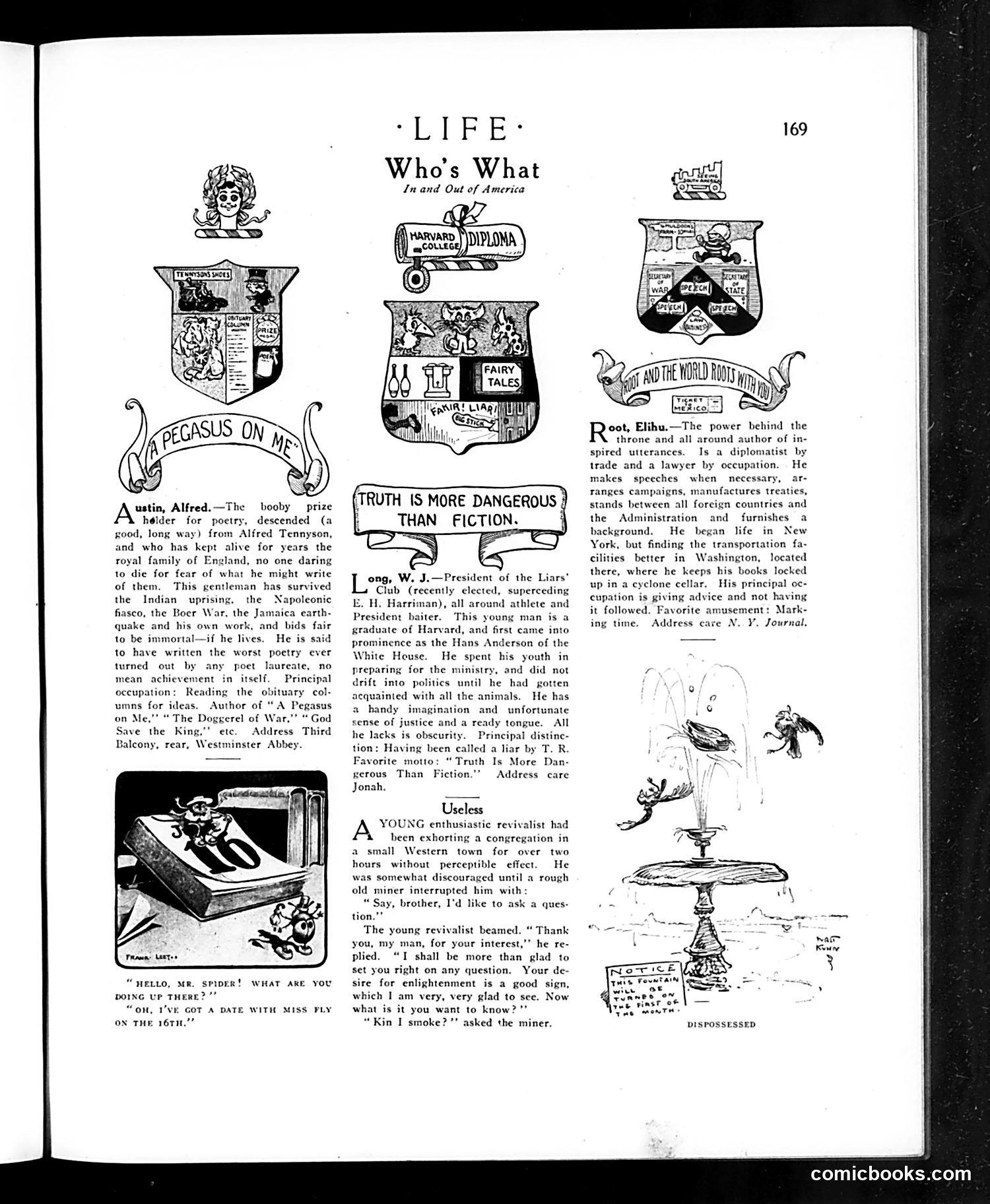
This page features satirical biographical sketches titled "Who's What: In and Out of America." The visible entries mock public figures through exaggerated heraldic shields and descriptive text. **Austin, Alfred** is ridiculed as a poet with "the worst poetry ever turned out," despite his aristocratic English background and attempt at immortality through verse. **Long, W.J.** (President of the Liars' Club) is caricatured as someone who talks excessively and lacks obscurity—his motto: "Truth Is More Dangerous Than Fiction." The bottom cartoon depicts a young religious revivalist interrupted by a skeptical miner, mocking revival evangelism's earnest naïveté when confronted with worldly cynicism. Overall, the page uses heraldic parody and satirical biography to ridicule literary pretension, political windbags, and religious enthusiasm through humorous character assassination typical of Life magazine's satirical approach.
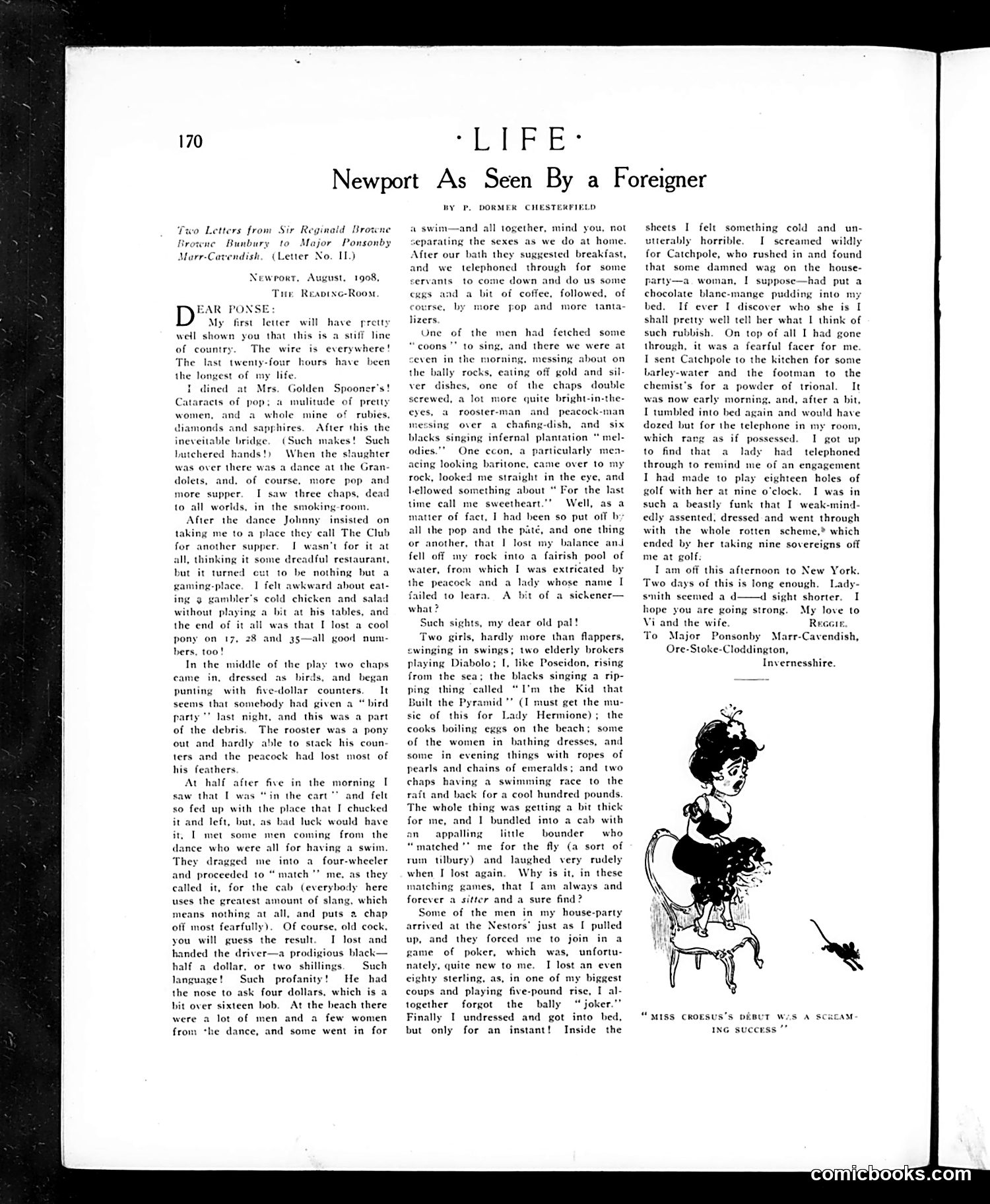
This page contains a humorous travel essay titled "Newport As Seen By a Foreigner" by F. Dormer Chesterfield. The accompanying illustration shows a fashionably dressed woman seated, captioned "MISS CROESUS'S DEBUT WAS A SCREAMING SUCCESS." The essay describes the author's observations of Newport's wealthy elite during an 1908 visit, emphasizing their excessive leisure activities, conspicuous consumption (diamonds, sapphires), and peculiar social customs like elaborate bathing parties and frivolous entertainments. The satire targets the American nouveau riche and their ostentatious display of wealth. The illustration likely represents a debutante from a wealthy family ("Miss Croesus" referencing King Midas's wealth), satirizing how society celebrated young women from rich families entering social circles regardless of actual accomplishment or merit. The piece mocks Gilded Age excess and superficiality.
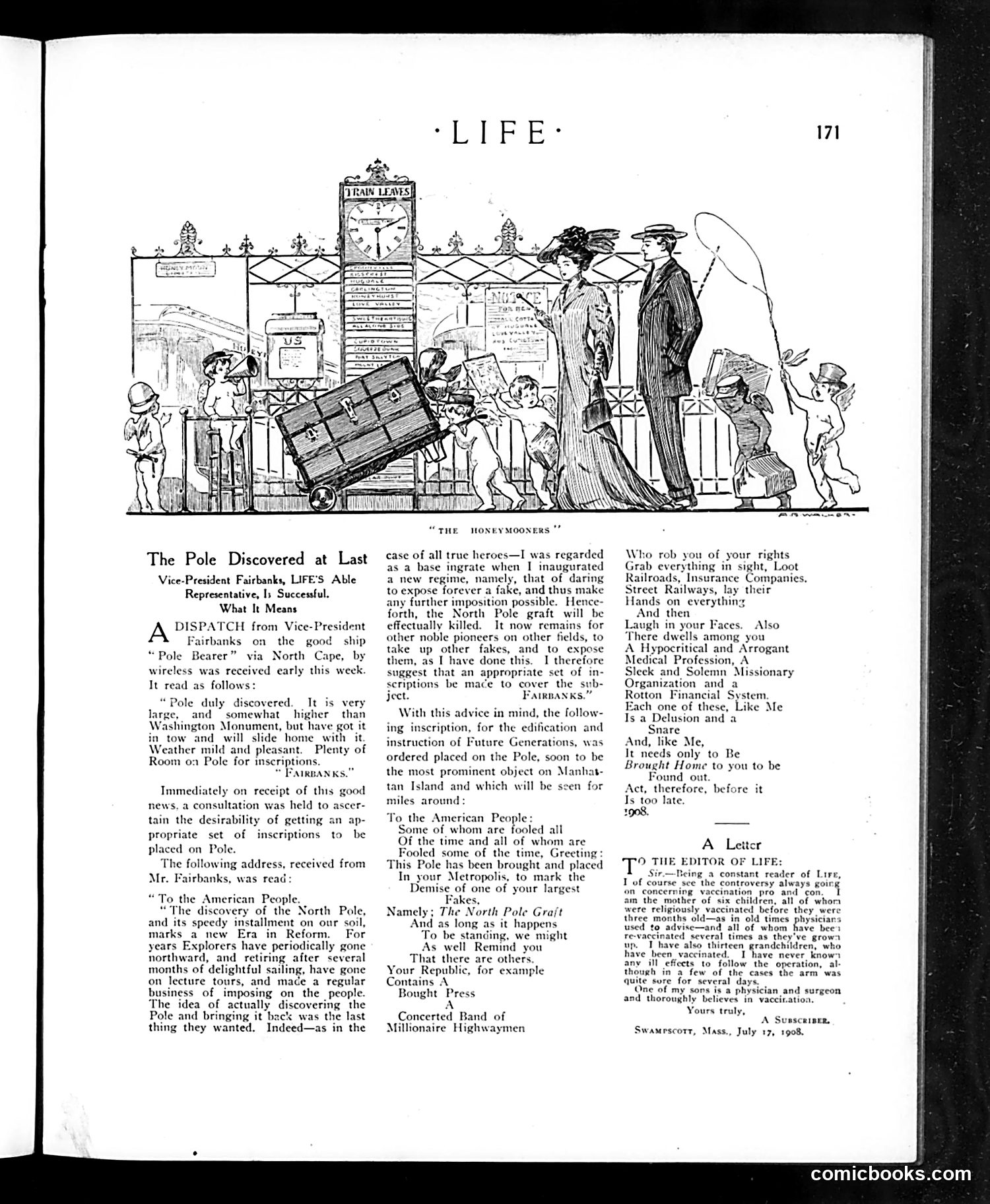
This political cartoon satirizes the discovery of the North Pole by Vice-President James Fairbanks. The illustration depicts various American institutions and figures as "honeymooners" at the Pole—a metaphor for newly-acquired or celebrated achievements. The cartoon mocks those who profited from false claims and impositions, suggesting the Pole's discovery exposed such frauds. The accompanying text proposes inscriptions celebrating American accomplishments, including jabs at "Hypocritical and Arrogant Medical Profession" and railways that "robbed" citizens of rights. The satire criticizes both the celebration surrounding polar exploration and those exploiting it for personal gain or publicity—a commentary on American imperialism and commercial opportunism of the early 1900s.
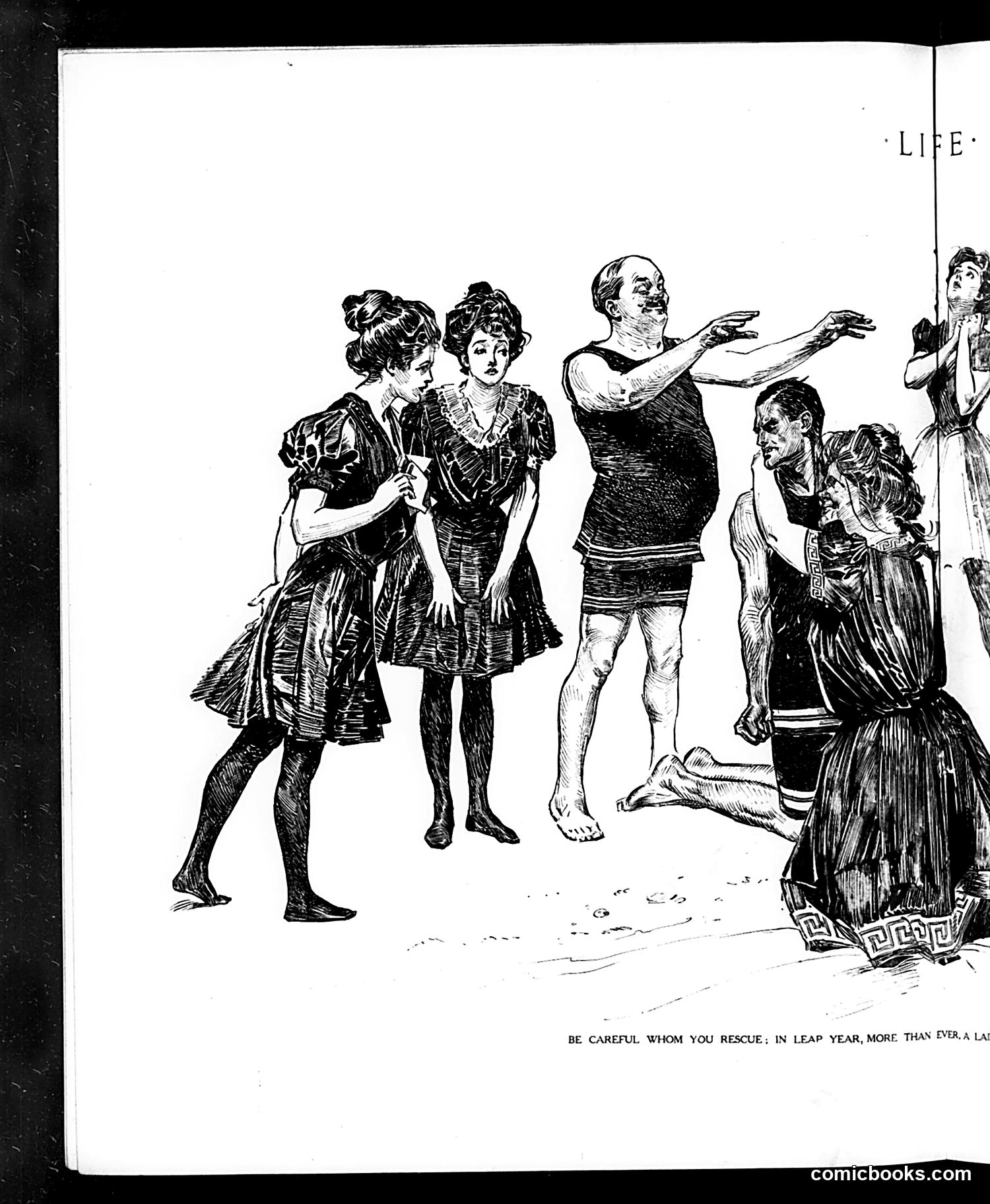
This appears to be a satirical cartoon about Leap Year traditions. The visible caption reads: "BE CAREFUL WHOM YOU RESCUE, IN LEAP YEAR, MORE THAN EVER, A LAD—" The illustration depicts a social scene where women are actively pursuing or "rescuing" men—inverting traditional gender roles. In early 20th-century culture, Leap Year (occurring every four years) was associated with a humorous tradition allowing women to propose to men or take the romantic initiative, reversing conventional courtship norms. The cartoon satirizes this brief period of female agency by showing multiple women in various states of pursuit around a seminude man, while men appear concerned or distressed. The joke mocks both the temporary liberation women experienced and men's anxiety about losing control of courtship rituals.
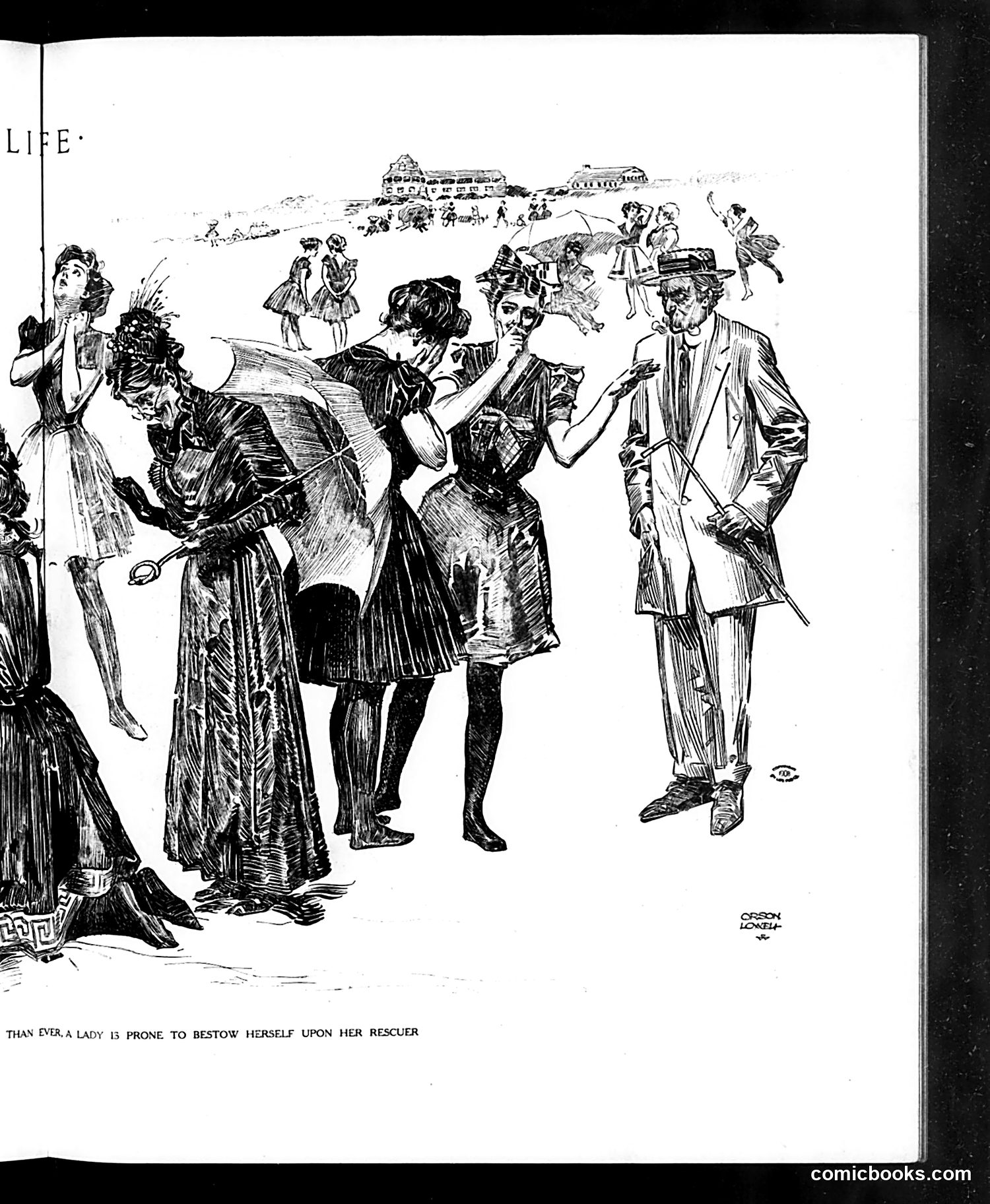
This is a satirical illustration from *Life* magazine showing a social scene at what appears to be a beach resort (visible in the background). The caption reads: "THAN EVER, A LADY IS PRONE TO BESTOW HERSELF UPON HER RESCUER." The cartoon satirizes romantic conventions and gender dynamics. It depicts a woman dramatically throwing herself at a man who has apparently rescued her from some predicament (possibly the ocean, given the beach setting). The exaggeration of her gesture—coupled with her elaborate dress and his somewhat bemused expression—mocks the trope of feminine gratitude transforming into romantic interest. The satire likely critiques both the artificial rescue scenario and the assumption that women automatically owe romantic attention to their saviors. Other fashionably-dressed figures observe the scene, suggesting this is commentary on social expectations and courtship rituals among the leisure class.
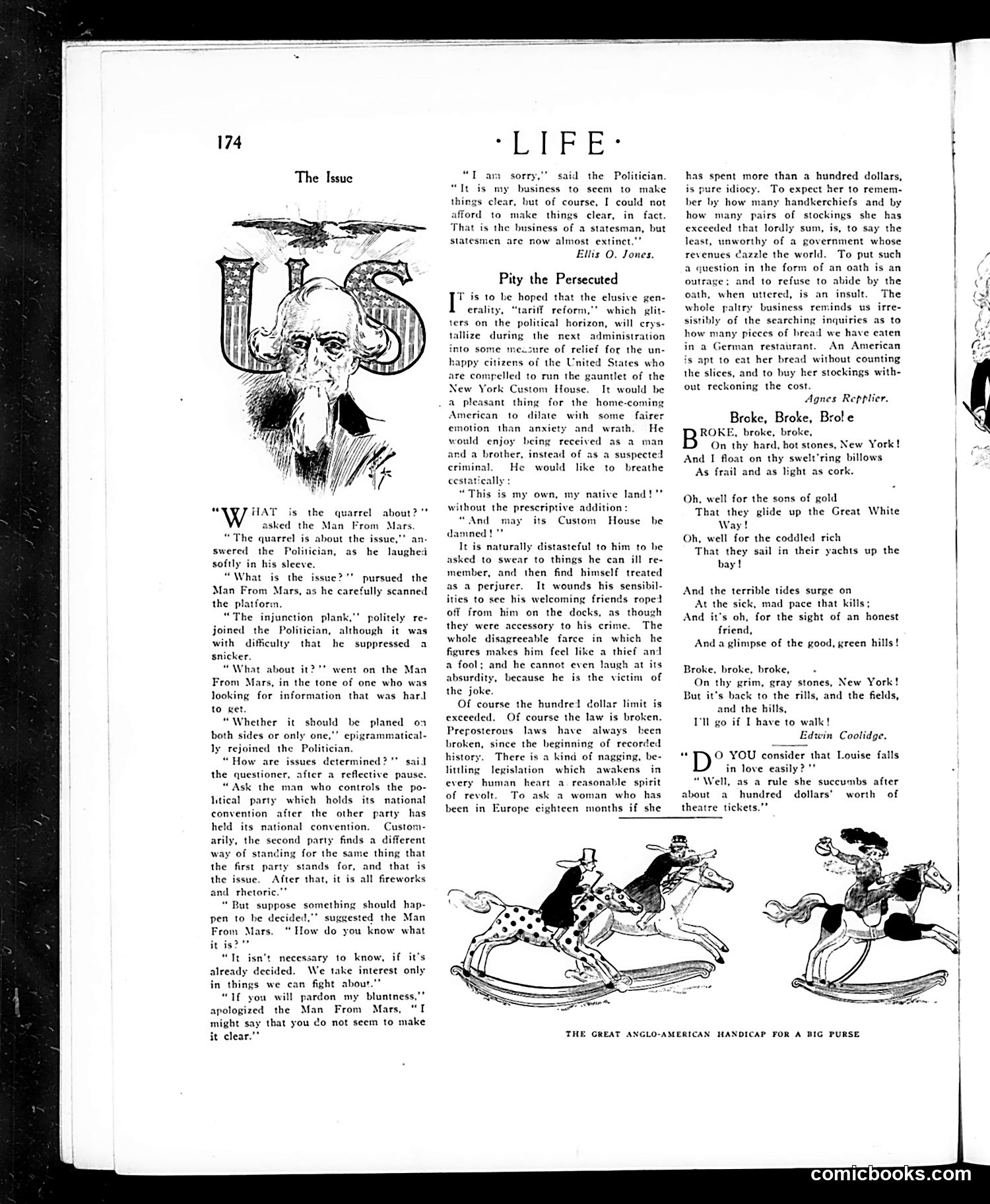
This page contains three distinct pieces of satirical commentary: 1. **"The Issue"**: A debate between a Politician and "Man from Mars" about tariff reform and political responsibility. The Politician admits he cannot "make things clear," suggesting governmental incompetence or evasion—a jab at political obfuscation. 2. **"Pity the Persecuted"**: Critiques persecution of "elusive 'tariff reform'" on the political horizon, satirizing how politicians use reform rhetoric without substantive action. 3. **Bottom cartoons and poem "Broke, Broke, Broke"**: Depict wealthy Americans (on rocking horses labeled with yachts and Great White Way references) contrasted with financial hardship, satirizing wealth inequality and the gap between the rich and struggling citizens. The overall theme: political evasion combined with economic disparity during an era of debate over tariff policy.
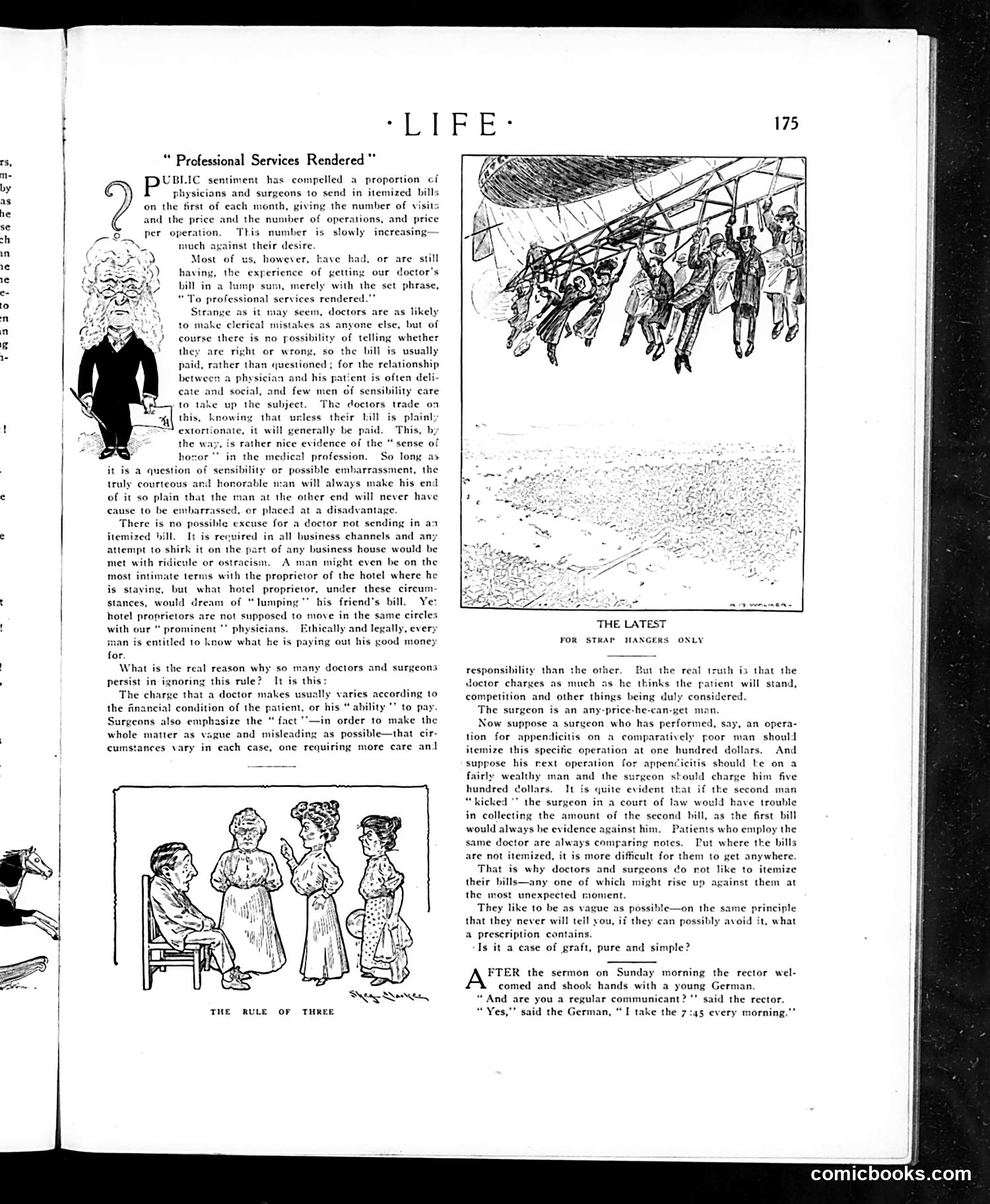
This page discusses doctors' billing practices, specifically their tendency to itemize charges rather than presenting a lump sum. The text argues this practice is socially awkward—patients prefer saying "professional services rendered" to receiving detailed bills. The bottom cartoon, titled "THE RULE OF THREE," depicts a female nurse or medical attendant with three women patients, likely illustrating the common practice of doctors' offices during this era. The top illustration shows what appears to be medical/anatomical imagery related to the discussion. The satire critiques the medical profession's lack of discretion: itemized bills embarrass patients by forcing them to confront exactly what they're paying for, whereas a vague charge maintains social dignity. The piece argues doctors should adopt business etiquette practiced in hotels—providing unmarked bills to preserve the patient's sense of honor and propriety.
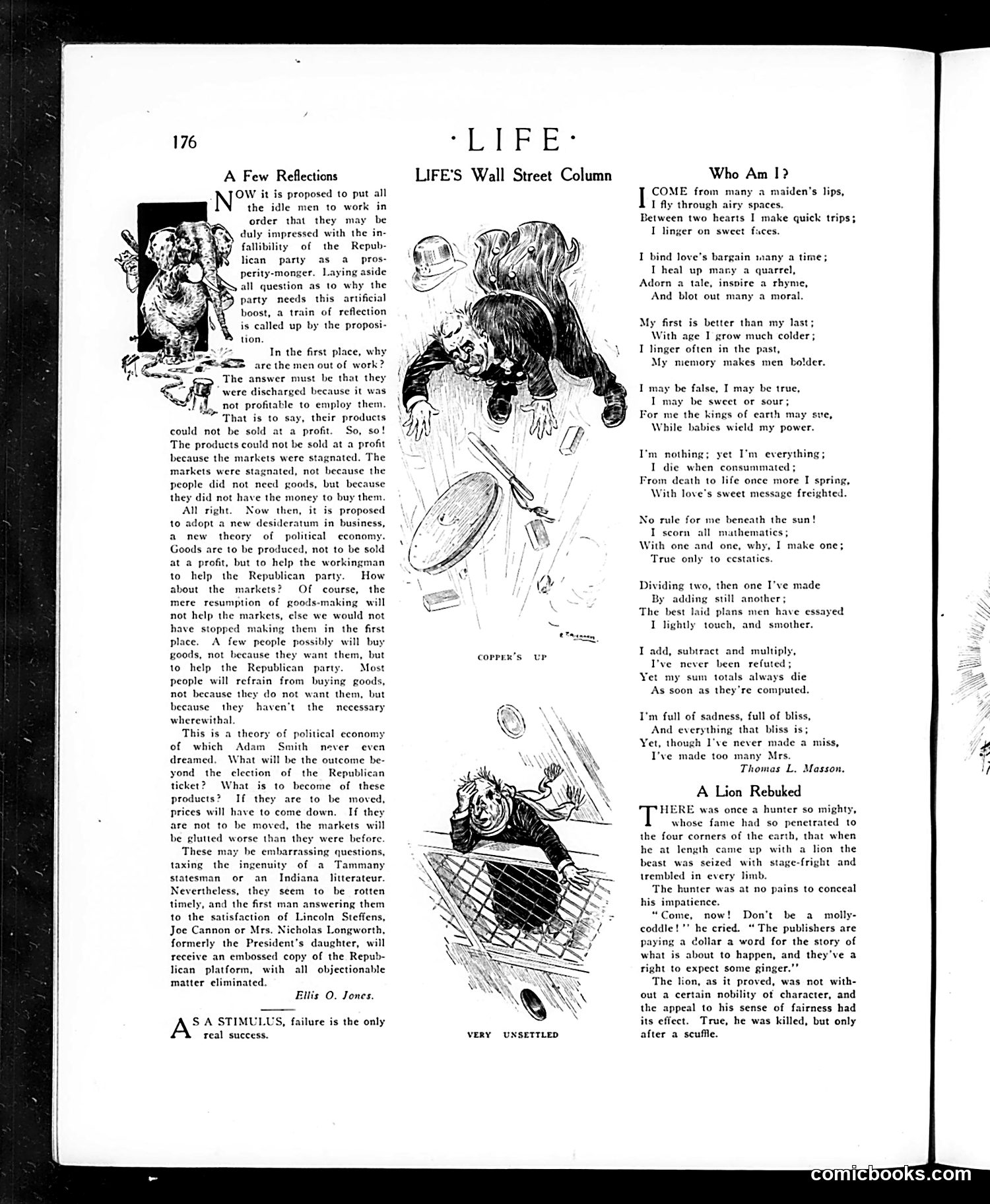
This page contains political satire critiquing Republican economic policy during an era of unemployment (likely early 1900s, given references to Lincoln Steffens and Joe Cannon). **"A Few Reflections"** (left column): Ellis O. Jones attacks a proposed Republican plan to employ idle workers to demonstrate party competence. His satire exposes the logical flaw: goods can't sell at profit because markets lack money, yet merely producing more goods won't create that purchasing power. He mocks this as abandoning Adam Smith's economics purely for electoral advantage, sarcastically inviting Republican leaders to answer how this solves the fundamental problem. **"LIFE's Wall Street Column"**: A brief market note mentioning copper prices, reflecting the magazine's business coverage. **"Who Am I?"**: A riddle poem (answer appears to be "a kiss") provides lighthearted content. **"A Lion Rebuked"**: An incomplete humorous story about a famous hunter confronting a lion, serving as filler material. The page demonstrates Life's satirical approach to contemporary political-economic debates through editorial commentary.
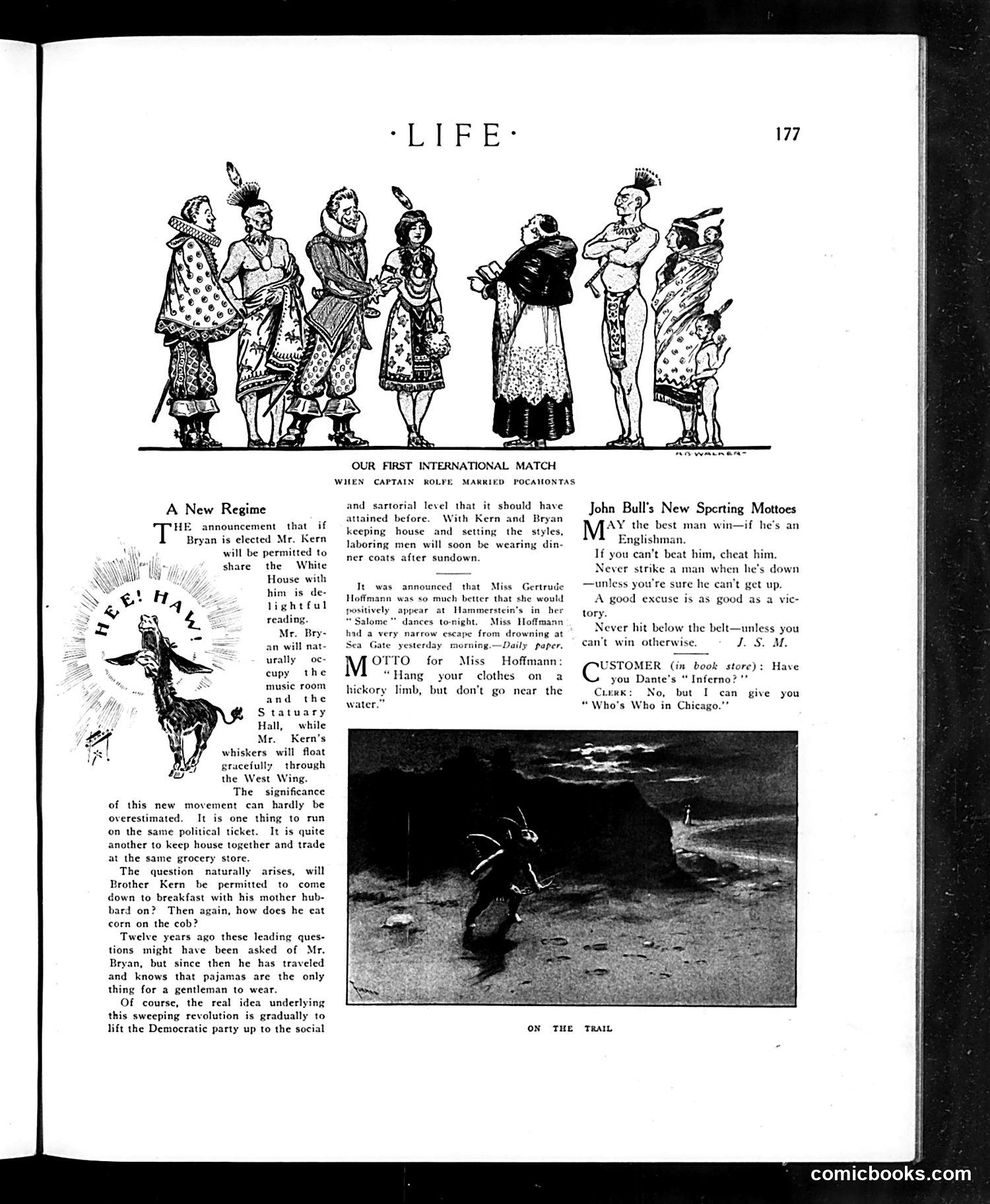
This page satirizes American politics circa 1908, likely referencing William Jennings Bryan's presidential ambitions. The main article jokes that if Bryan wins, fellow Democrat John Kern will share the White House, humorously imagining them as domestic housemates negotiating breakfast and etiquette. The satire mocks the Democratic Party's perceived lack of sophistication, suggesting that Bryan and Kern's cohabitation would somehow elevate Democratic "sartorial" standards—that laborers would soon wear dinner jackets. The piece absurdly treats political partnership as literal roommate arrangement, poking fun at both the party and the candidates' public images. The sidebar "John Bull's New Sporting Mottoes" makes cynical jabs at British athletic ethics (cheating, hitting below the belt), reflecting anti-British sentiment. The bottom item jokes that a bookstore clerk substitutes "Who's Who in Chicago" for Dante's *Inferno*—implying Chicago society is as hellish as Dante's underworld. Overall: partisan ridicule of Democratic politicians and social pretension.
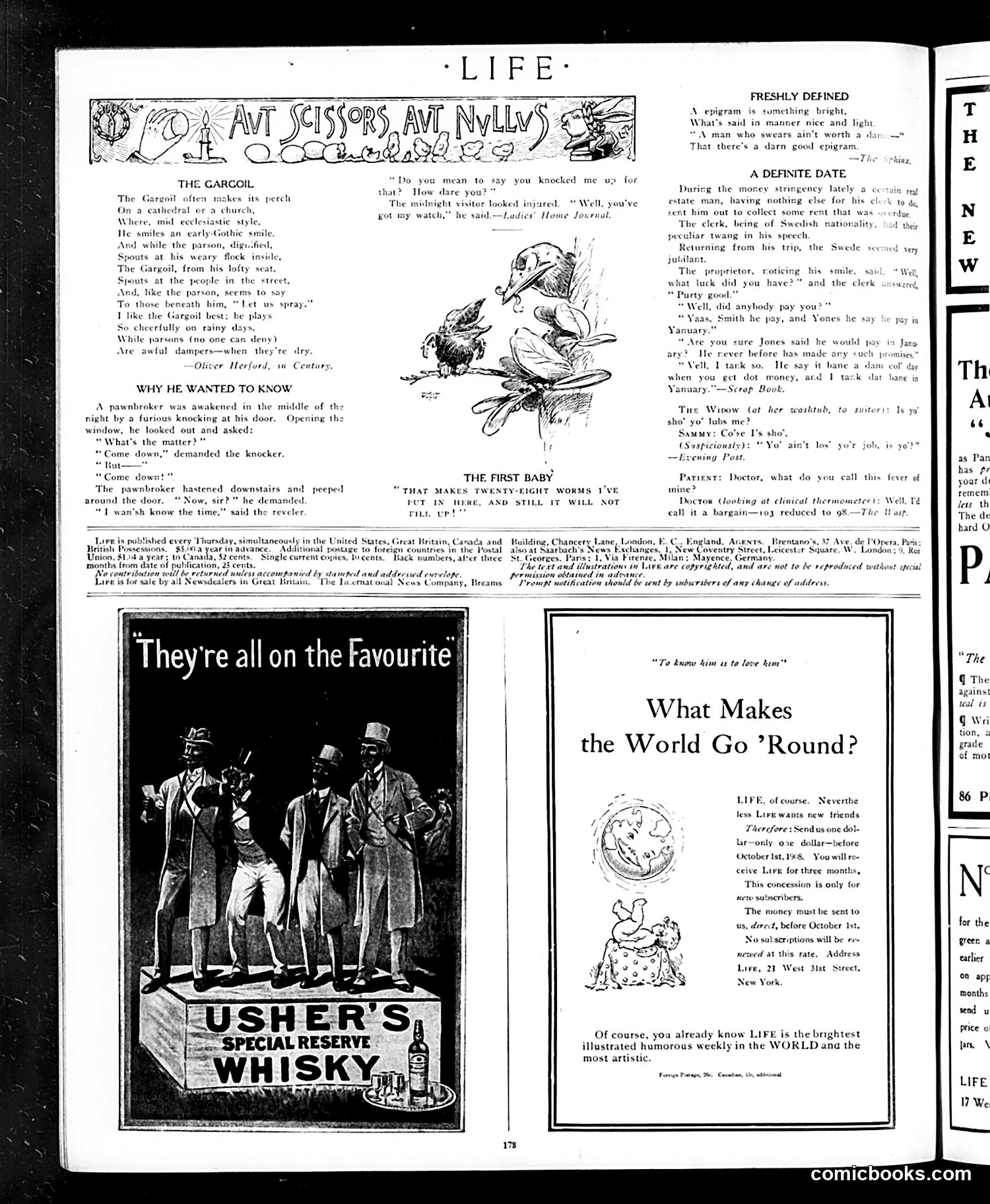
This page from *Life* magazine contains several brief humorous sketches typical of early 20th-century American satirical humor: **"The Gargoil"** is a whimsical poem praising gargoyles on cathedral architecture for their cheerful demeanor compared to dreary human parsons (clergymen). It's gentle social mockery of religious figures. **"Why He Wanted to Know"** jokes about a drunk man pounding on a pawnbroker's door at night demanding to know the time—an absurd, pointless drunk scenario. **"The First Baby"** appears to reference someone finding 28 worms, with a doctor's comment; the exact reference is unclear from the visible text. The page also contains an **Usher's Whisky advertisement** showing three well-dressed men. A **subscription promotion** for *Life* itself dominates the lower right, urging readers to subscribe for three months at one dollar before October 1st. Overall, this represents *Life's* typical mix of short comic pieces, advertisements, and self-promotion rather than focused political satire.
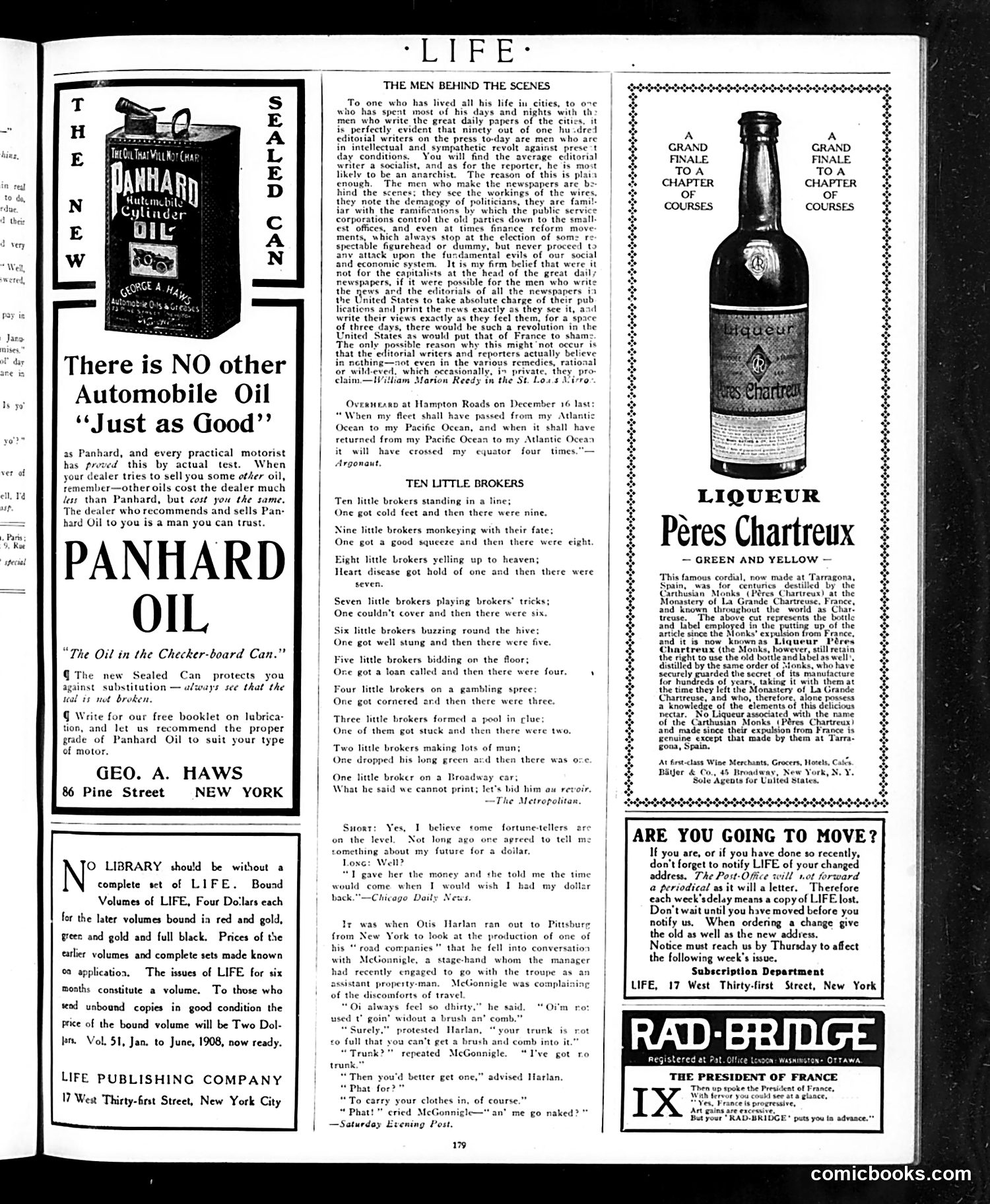
This page is primarily **advertising and miscellaneous content**, not political satire requiring historical context. The left side features ads for **Panhard Oil** (automobile lubricant) and **Life magazine subscriptions**. The center contains an essay titled "The Men Behind the Scenes" discussing newspaper editors and reporters as closet socialists and anarchists who, the author argues, are disgusted by political corruption and corporate control of public services. The author (William Marion Reedy) speculates that if these journalists could freely report without capitalist newspaper owners' interference, they'd foment revolution. The right side advertises **Pères Chartreux liqueur** and includes a brief satirical poem, "Ten Little Brokers," using the "Ten Little" nursery-rhyme format to humorously describe brokers' fates (cold feet, squeezes, heart disease). There's also a "moving notice" for Life subscribers. The page reflects Progressive-era skepticism about press freedom and corporate influence, but contains no specific political cartoons or identifiable caricatures requiring decoding.
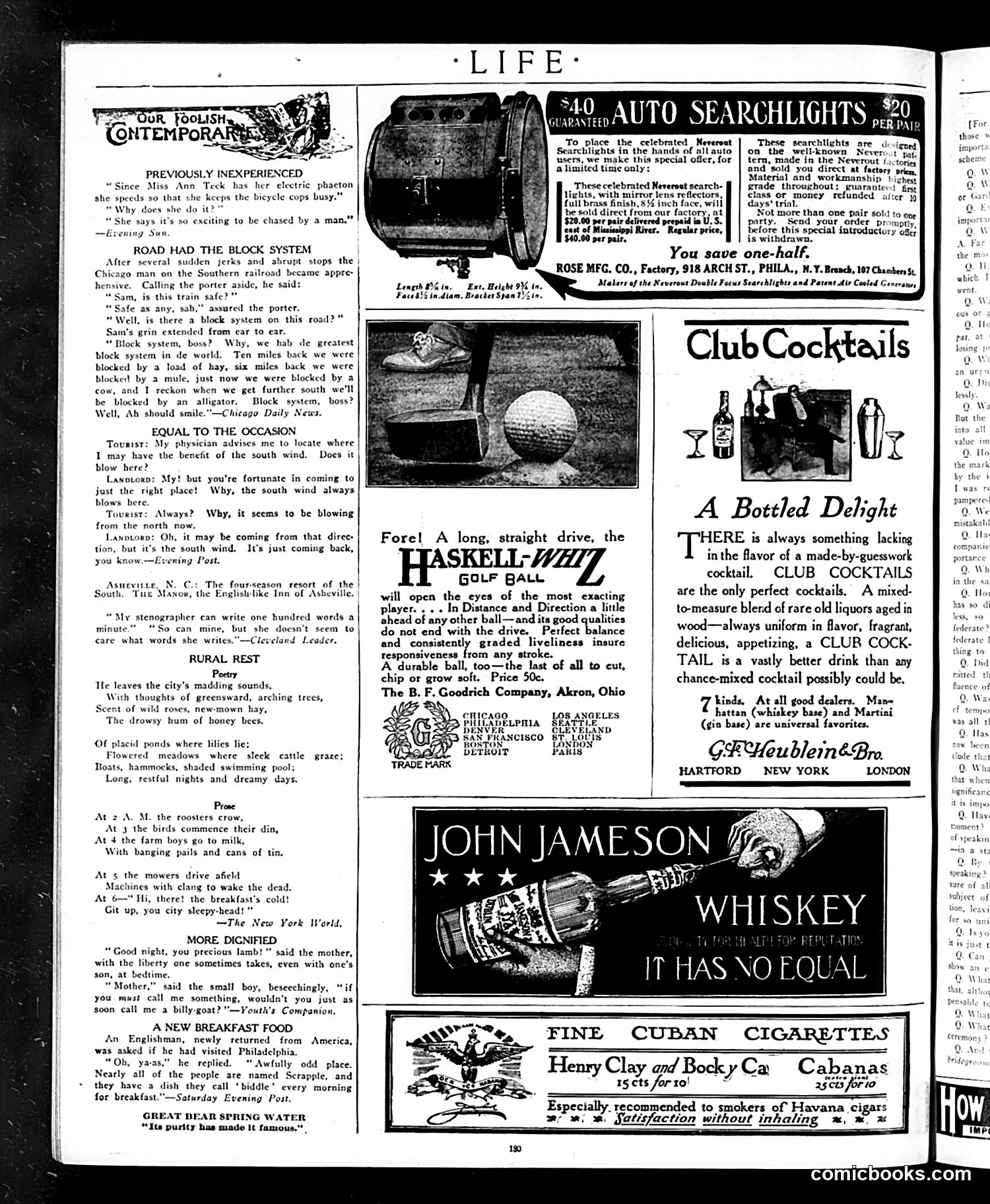
This page from *Life* magazine consists primarily of **humorous anecdotal sketches** and **advertisements** rather than political cartoons. The main humor pieces include jokes about: 1. **"Previously Inexperienced"** — A quip about a woman driving recklessly in an electric car, evading bicycle police 2. **"Road Had the Block System"** — A dialect-heavy joke where a porter on a Southern railroad boasts about frequent delays caused by hay, mules, cows, and alligators as their version of a "block system" 3. **"Equal to the Occasion"** — A tourist's confusion about wind direction, with a local's nonsensical explanation These sketches use period stereotypes (particularly the African American porter rendered in exaggerated dialect) and gentle mockery of rural Southern attitudes and modern urban life. The page is dominated by **product advertisements** for auto searchlights, golf balls, whiskey, cigars, and cocktails — typical of *Life*'s era as a magazine mixing satire with commercial content.
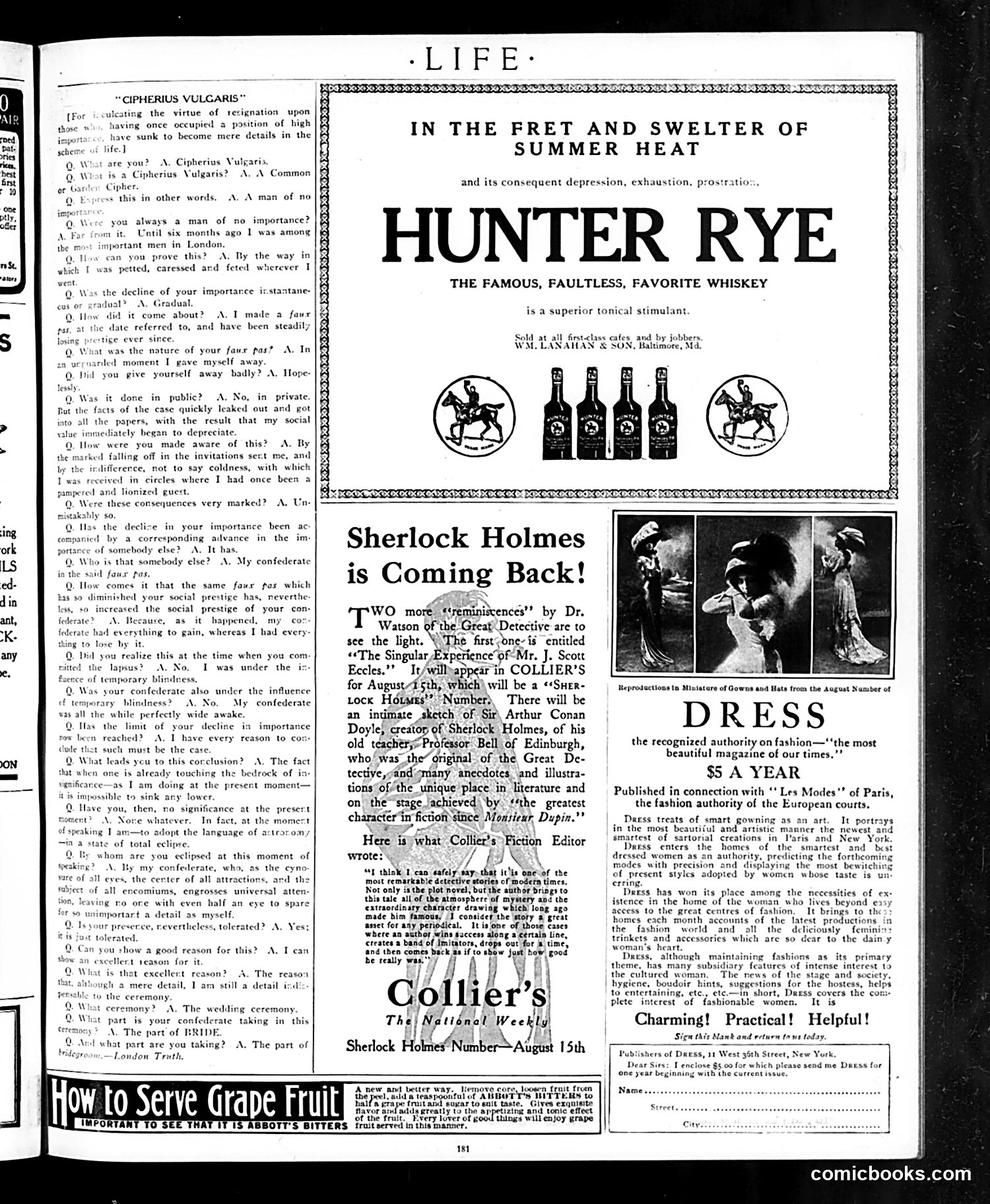
This page combines satirical content with period advertising. The main humor piece, "Cipherius Vulgaris," is a Q&A interview mocking social pretension. It depicts a man who was once important in London society but suffered a "faux pas"—he inadvertently revealed something compromising at a social gathering. His social status collapsed immediately; invitations ceased and coldness replaced the previous flattery. The joke targets how shallow social climbing is: his importance was entirely constructed, dependent on others' perception, not actual merit. The irony is that his confederate (likely his bride, from the wedding reference) gained status from the same incident—suggesting he was the convenient scapegoat for their shared transgression. The page also advertises Hunter Rye whiskey as a "tonical stimulant" for summer heat exhaustion, and announces Sherlock Holmes stories returning to *Collier's* magazine—reflecting early 20th-century magazine culture and popular fiction consumption.
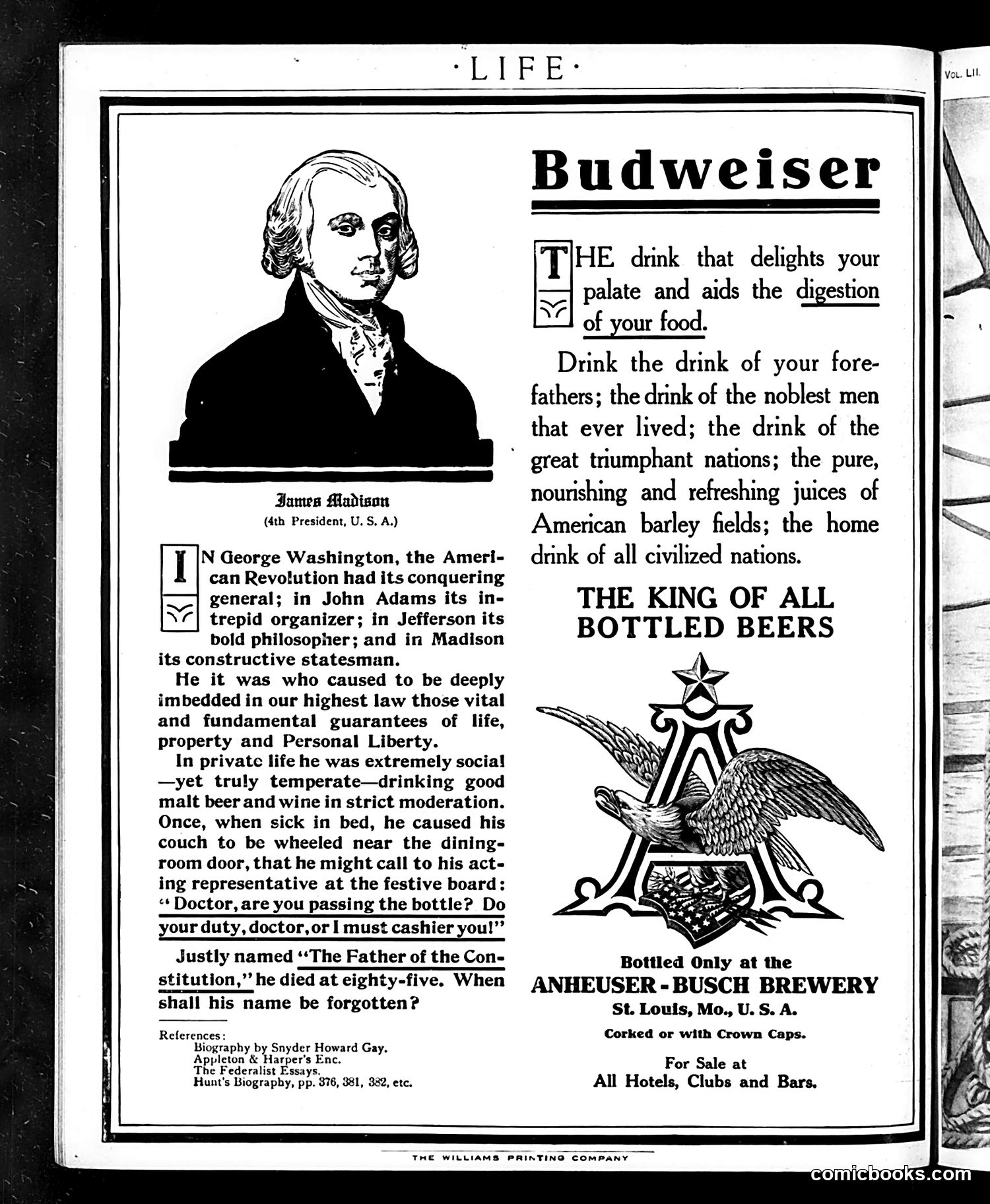
This is primarily a **Budweiser beer advertisement** masquerading as historical content. The page uses James Madison (4th U.S. President) to endorse beer by claiming he was "temperate" and drank "good malt beer and wine in strict moderation." The anecdote about Madison calling from his sickbed demanding the doctor pass the bottle is presented as charming rather than problematic—and serves to normalize beer-drinking as patriotic and founding-father-approved. The satire is subtle: Life magazine is using American history and constitutional authority to legitimize commercial product consumption. By framing Budweiser as "the drink of your forefathers" and "the home drink of all civilized nations," the ad conflates nationalism with beer consumption. The page exploits readers' reverence for the founding fathers to sell alcohol—a pitch that would face significant regulatory scrutiny today.