
Life, 1908-08-13 · page 12 of 20
Life — August 13, 1908 — page 12: what you’re looking at
What you’re looking at
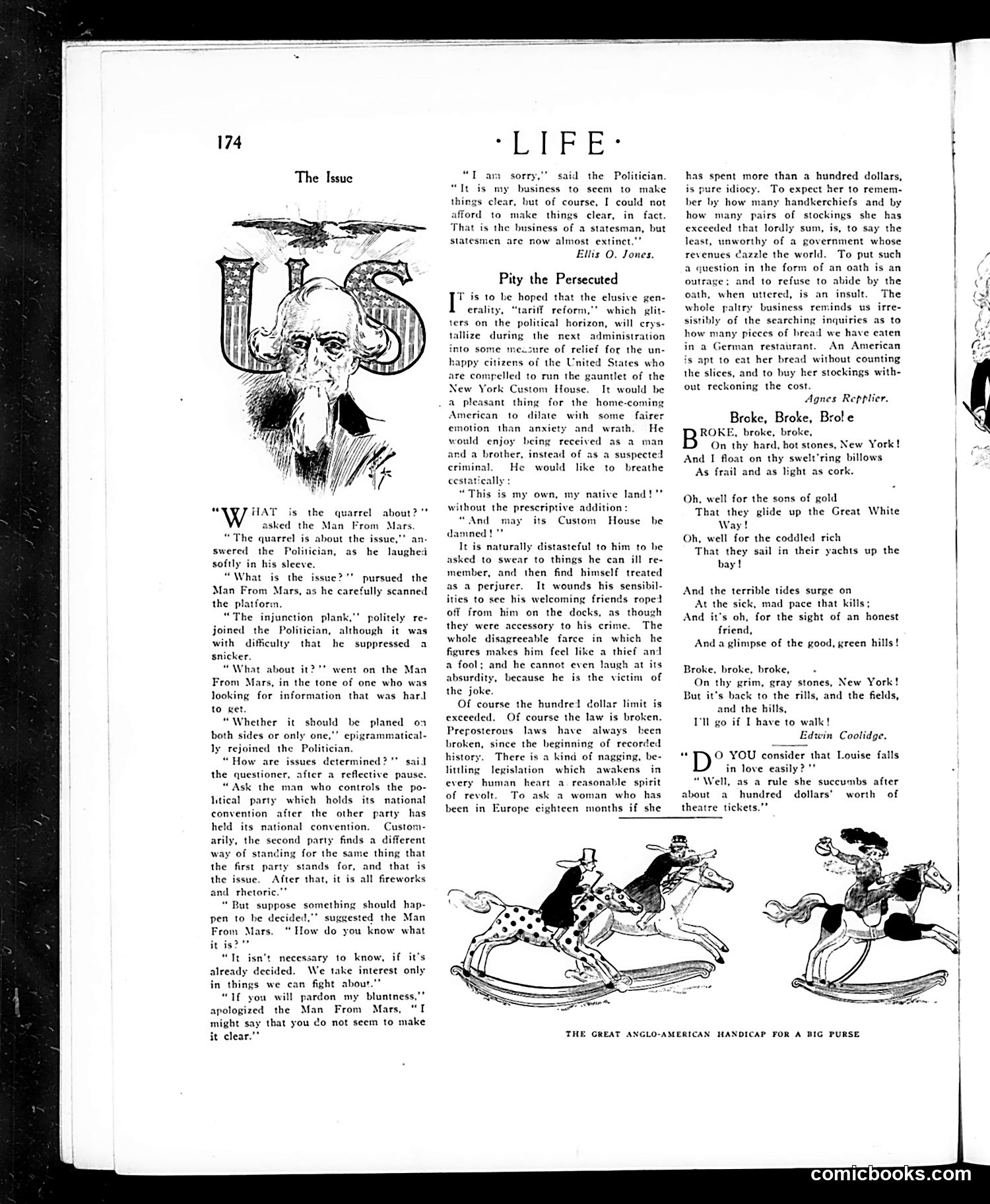
This page contains three distinct pieces of satirical commentary: 1. **"The Issue"**: A debate between a Politician and "Man from Mars" about tariff reform and political responsibility. The Politician admits he cannot "make things clear," suggesting governmental incompetence or evasion—a jab at political obfuscation. 2. **"Pity the Persecuted"**: Critiques persecution of "elusive 'tariff reform'" on the political horizon, satirizing how politicians use reform rhetoric without substantive action. 3. **Bottom cartoons and poem "Broke, Broke, Broke"**: Depict wealthy Americans (on rocking horses labeled with yachts and Great White Way references) contrasted with financial hardship, satirizing wealth inequality and the gap between the rich and struggling citizens. The overall theme: political evasion combined with economic disparity during an era of debate over tariff policy.
📄 Transcribed text from this page (OCR, searchable)
Machine-transcribed from the original scan — historical spelling and the odd misread are preserved.
“War is the quarrel about?” asked the Man From Mars. The quarrel is about the issue," an swered the Politician, as he laughed softly in his sleeve. “What is the issue?" Man the pursued the rom Mars, as he carefully scanned latfor he injunction plank,’ politely re- joined the Politician, although it was with difficulty that he suppressed a snicker. “What about it? ’? went on the Maa From Mars, in the tone of one who was looking for information that was har. to Ket. “Whether it should be planed o2 both sides or only one,”’ epigeammatical- ly rejoined the Politician. “How are issues determined?" said the questioner, after a reflective pause. “Ask the man who controls the po- Itical party which holds its national convention after the other party has held its national convention. Custom- arily, the second party finds a different way of standing for the same thing that the first party stands for, and that is the issue. After that, it is all fireworks and rhetoric.” “But suppose something should hap- pen to he decided,” suggested the Man From Mars. “How do you know what it is?” It isn’t necessary to know, if it’s already decided. We take interest only in things we can fight abour.”” “Tf you will pardon my bluntness,’’ apologized the Man From Mars, “T might say that you do not seem to make “T am sorry," said the Politician. “Tt is my business to seem to make things clear, but of course, I could not afford to make things clear, in fact. That is the business of a statesman, but en are now almost extinct.’’ Ellis O. Jones. statest Pity the Persecuted I" is to be hoped that the elusive gen- erality, “tariff reform,’ which glit- ters on the political horizon, will crys- tallize during the next administration ure of relief for the un- happy citizens of the United States who are compelled to run the gauntlet of the New York Custom House. It would be a pleasant thing for the home-coming American to dilate with some fairer emotion than anxiety and wrath, He would enjoy being received as a man 1a brother, instead of as a suspected criminal. He would like to breathe cestatically : “This is my own, my native land!" without the prescriptive addition : “And may its Custom House be nto some damned! It is naturally distasteful to him to he asked to swear to things he can ill re- member, and then find himself treated asa perjurer. It wounds his sensibil- ities to see his welcoming friends roped off from him on the docks, as though they were accessory to his cr The whole disagreeable farce in which he figures makes him feel like a thief ant a fool; and he cannot even laugh at its absurdity, because he is the victim of the joke. Of course the hundret exceeded. Of course the law is broken. Preposterous laws have always been broken, since the beginning of recorded history. There is a kind of nagging, be- littling legislation which awakens in every human heart a reasonable spirit of revolt. To ask a woman who has been in Europe eighteen months if she Mar limit is has spent more than a hundred dollars, is pure idiocy. To expect her to remem- ber by how many handkerchiefs and by how many pairs of stockings she has exceeded that lordly sum, is, to say the t, unworthy of a government whose revenues Cazzle the world. To put such a question in the form of an oath is an outrage: and to refuse to abide by the oath, when uttered, is an insult. The whole paltry business reminds us irre- sistibly of the searching inquiries as to how: many:picces of bread’ we have eaten in a German restaurant. An American is apt to cat her bread without counting the slices, and to buy her stockings with- out reckoning the cost. Agnes Repplier. Broke, Broke, Bro! e ROKE, broke, broke, On thy hard, bot stones, New York! And I float on thy swelt’ring billows As frail and as light as cork. Oh, well for the sons of gold That they glide up the Great White ! W: Oh, well for the coddled rich That they sail in their yachts up the bay! And the terrible tides surge on At the sick, mad pace that kills; And it’s oh, for the sight of an honest friend, And a glimpse of the good, green hills! Broke, broke, broke On thy grim, gray stones, New York! But it’s back to the rills, and the fields, and the hills, I'll go if I have to walk! Edwin Coolidge. “ D° YOU consider that Louise falls in love easily?” “Well, as a rule she succumbs after about a hundred dollars’ worth of theatre tickets.”” THE GREAT ANGLO-AMERICAN HANDICAP FOR A BIG PURSE comicbooks.com