
Life, 1908-08-13 · page 4 of 20
Life — August 13, 1908 — page 4: what you’re looking at
What you’re looking at
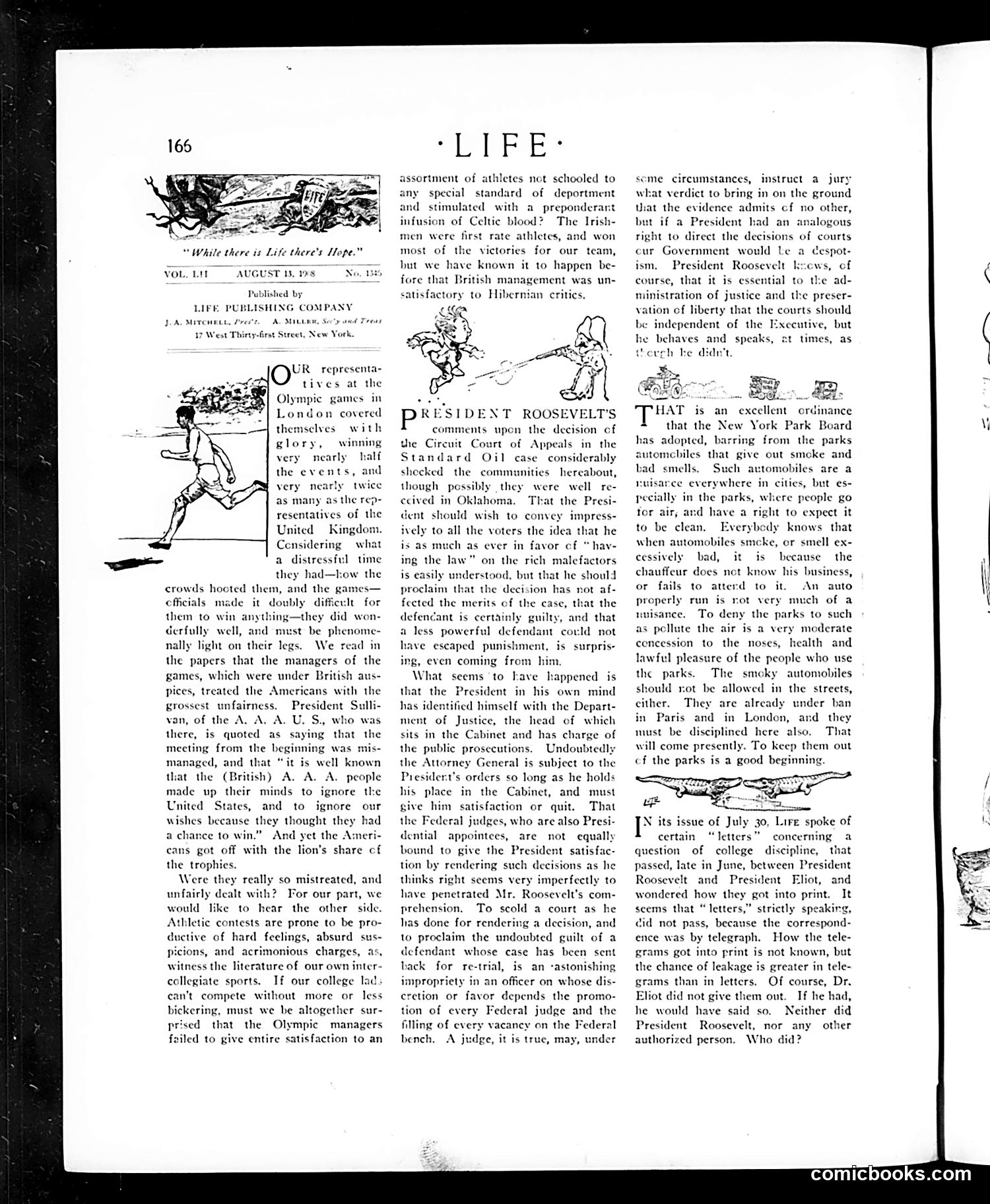
The page contains political commentary rather than cartoons. The main text discusses President Roosevelt's handling of the Standard Oil antitrust case, where the Circuit Court of Appeals blocked communications between the President and the Attorney General during proceedings. The satire criticizes Roosevelt for attempting to influence judicial decisions, suggesting he views himself as above the separation of powers. The article argues this undermines judicial independence—judges should make decisions based on law, not presidential preference. A secondary piece critiques the New York Park Board's failure to enforce automobile emission standards, using this as an example of regulatory weakness affecting public health and quality of life in cities. The illustrations appear decorative rather than specific political caricatures.
📄 Transcribed text from this page (OCR, searchable)
Machine-transcribed from the original scan — historical spelling and the odd misread are preserved.
ST 13, 1x8 Published by LIFE PUBLISHING COMP: AM ect, New York, JA. MErCHELE, Je 17 West Thirty-first UR representa- tives at the Olympic games in London covered themselves with glory, winning very nearly half the events, and very nearly twice as many asthe rep- resentatives of the United Kingdom. Considering what a distressful they had—kow the crowds hooted them, and the games— efficials made it doubly difficult’ for them to win anything—they did won- derfully well, and must be phen nally light on their legs. We read in the papers that the managers of the games, which were under British aus- pices, treated the Americans with the grossest unfairness. President Sulli- van, of the A, A. A. U. S., who was there, is quoted as saying that the meeting from the beginning was mis- managed, and that “it is well known that the (British) A. A. people made up their minds to ignore the United States, and to ignore our wishes because they thought they had a chance to win.” And yet the Ameri- cans got off with the lion's share cf the trophies. Were they really so mistreated, and unfairly dealt with? For our part, we would to hear the other side. Athletic contests are prone to be pro- ductive of hard feelings, absurd sus- picions, and acrimonious charges, as, witness the literature of our own inter- collegiate sports. If our college lads can't compete without more or less bickering, must we he altogether sur- prised that the Olympic managers foiled to give entire satisfaction to an time me- “PEE * assortment of athletes not schooled to any special standard of deportment and stimulated with a_ preponderant infusion of Celtic blood? The Irish- rate athletes, and won most of the victories for our team, but we have known it to happen be- fore that British management was un- satisfactory to Hibernian critics. men were first Pres! DENT ROOS. comments upon the decision ¢ the Circuit Court of Appeals in the Standard Oil case considerably shecked the communities hereabout, though possibly they were well re- ecived in Oklahoma, That the Presi- dent should wish to convey impress- ively to all the voters the idea that he is as much as ever in favor cf “ hav- ing the law” on the rich malefactors is easily understood, but that he should proclaim that the decision has not af- fected the merits of the case, that the defencant is certainly guilty, and that a less powerful defendant could not have escaped punishment, is. surpris- ing, even coming from him, What seems to have happened is that the President in his own mind has identified himself with the Depart- ment of Justice, the head of which sits in the Cabinet and has charge of the public prosecutions. Undoubtedly the Attorney General is subject to the Presidert’s orders so long as he holds his place in the Cabinet, and must give him satisfaction or quit. That the Federal judges, who are also Presi- dential appointees, are not equally bound to give the President. satisfac- tion by rendering such decisions as he thinks right seems very imperfectly to have penetrated Mr. Roosevelt’s com- prehension. To scold a court as he has done for rendering a decision, and to proclaim the undoubted guilt of a defendant whose case has been sent back for re-trial, is an ‘astonishing impropriety in an officer on whose dis- cretion or favor depends the promo- tion of every Federal judge and the filling of every vacancy on the Federal bench, A judge, it is true, may, under seme circumstances, instruct a jury wkat verdict to bring in on the ground that the evidence admits cf no other, but if a President had an analogous right to direct the decisions of courts cur Government would Le a Cespot- ism. President Roosevelt kzews, of course, that it is essential to the ad- ministration of justice and the prese vation of liberty that the courts should be independent of the Executive, but he behaves and speaks, ct times, as therch ke didn't & Ce & TM! excellent ordinance that the New York Park Board has adopted, barring from the parks automebiles that give out smoke and bad smells. Such automobiles are a itisaree everywhere in cities, but es- pecially in the parks, where people go tor air, and have a right to expect it to be clean. Everybody knows that when automobiles smcke, or smell ex- cessively bad, it is because the chauffeur does not know his business, or fails to atterd to it. An auto properly run is rot very much of a nuisance. To deny the parks to such as pollute the air is a very moderate concession to the noses, health and lawful pleasure of the people who use the park: The smoky automobiles should rot be allowed in the streets, cither. They are already under ban in Paris and in London, and they must be disciplined here also. That will come presently. To keep them out cf the parks is a good beginning. < its issue of July 30, Lire spoke of certain “letters” concerning a question of college discipline, that passed, late in June, between President Roosevelt and President jot, and wondered how they got into print. It scems that “letters,” strictly speaking, cid not pass, because the correspond- ence was by telegraph. How the tele- grams got into print is not known, but the chance of leakage is greater in tele- grams than in letters. Of course, Dr. Eliot did not give them out. If he had, he would have said so, Neither did President Roosevelt, nor any other authorized person. Who did? comicbooks.com