
Life, 1908-08-13 · page 13 of 20
Life — August 13, 1908 — page 13: what you’re looking at
What you’re looking at
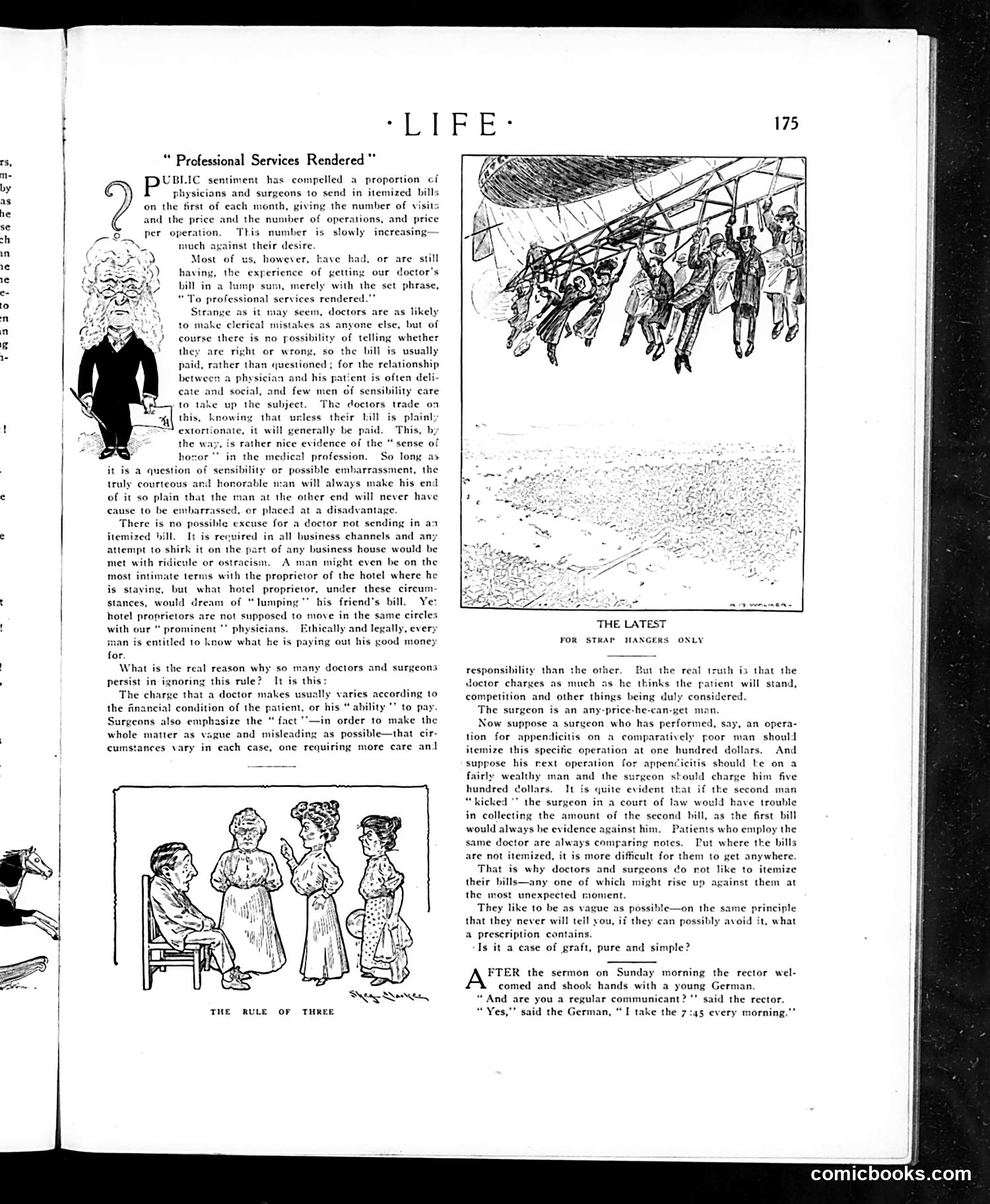
This page discusses doctors' billing practices, specifically their tendency to itemize charges rather than presenting a lump sum. The text argues this practice is socially awkward—patients prefer saying "professional services rendered" to receiving detailed bills. The bottom cartoon, titled "THE RULE OF THREE," depicts a female nurse or medical attendant with three women patients, likely illustrating the common practice of doctors' offices during this era. The top illustration shows what appears to be medical/anatomical imagery related to the discussion. The satire critiques the medical profession's lack of discretion: itemized bills embarrass patients by forcing them to confront exactly what they're paying for, whereas a vague charge maintains social dignity. The piece argues doctors should adopt business etiquette practiced in hotels—providing unmarked bills to preserve the patient's sense of honor and propriety.
📄 Transcribed text from this page (OCR, searchable)
Machine-transcribed from the original scan — historical spelling and the odd misread are preserved.
rs, m- by as he “ Professional Services Rendered” UBLIC sentiment has compelled a proportion of physicians and surgeons to send in itemized bills on the first of cach month, giving the number of visits ons, and price and the price and the number of opera per is slowly increasing © per operation. This nun’ . much against their desire. Most of us, however, kave had, of are still having, the experience of getting our doctor's Lill in a lump sum, merely with the set phrase, “To professional services rendered.”* Strange as it may seem, doctors are as likely to make clerical mistakes as anyone else, but of course there is no possibility of telling whether th paid, rather than questioned; for the relationship and his patient is often deli- n of sensibility care re right or wrong, so the bill is usually between a physician cate and social, and few to take up the subject. The doctors trade on this, knowing that unless their Lill is plaint extortionate, it will generally be paid. This, b; the way, is rather nice evidence of the “ sense of ho in the medical profession. So long as it is a question of sensibility or possible embarrassment, the truly courteous and honorable man will always make his end of it so plain that the man at the other end will never have cause to be embarrassed, or placed at a disadvantage. There is no possible excuse for a doctor not sending in aa itemized bill, It is required in all business channels and any attempt to shirk it on the part of any business house would be met with ridicule or ostracism. A man might even be on the most intimate terms with the proprietor of the hotel where he is staying, but what hotel proprictor, under these circum stances, would dream of “lumping” his friend's bill. Ye: hotel proprietors are not supposed to move in the same circles with our “ prominent" physicians. Ethically and legally, every man is entitled to know what he is paying out his good money for. What is the real reason why so many doctors and surgeons persist in ignoring this rule? It is this: The charge that a doctor makes usually varies according to the financial condition of the patient, or his “ability ' to p Surgeons also emphasize the “ fact "—in order to make the whole matter as vague and misleading as possible—that cir- cumstances vary in each case, one requiring more care and THE RULE OF THREE THE LATEST FOR STRAP NGERS ONLY uth is that the ient will stand, responsibility than the other. But the real t doctor charges as much as he thinks the p: competition and other things being duly considered. The surgeon is an any-price-he-can-get_ man. Now suppose a surgeon who has performed, say, an opera- tion for appendicitis on a comparatively poor man should itemize this specific operation at one hundred dollars. And suppose his rext operation for appencicitis should te on a fairly wealthy man and the surgeon should charge him five hundred Collars. It is quite evident that if the second man “kicked ’ the surgeon in a court of law would have trouble in collecting the amount of the second bill, as the first bill would always he evidence against him, Patients who employ the same doctor are always comparing notes. Put where the bills are not itemized, it is more difficult for them to get anywhere. That is why doctors and surgeons do not like to itemize their bills—any one of which might rise up against them at the most unexpected moment They like to be as vague as possible—on the same principle that they never will teil you, if they can possibly avoid it, what a prescription contains. Is it a case of graft, pure and ple? FTER the sermon on Sunday morning the rector wel- comed and shook hands with a young German. And are you a regular communicant? " said the rector. “Yes,’’ said the German, “I take the 7:45 every morning.”” comicbooks.com