
A complete issue · 24 pages · 1908
Life — May 28, 1908
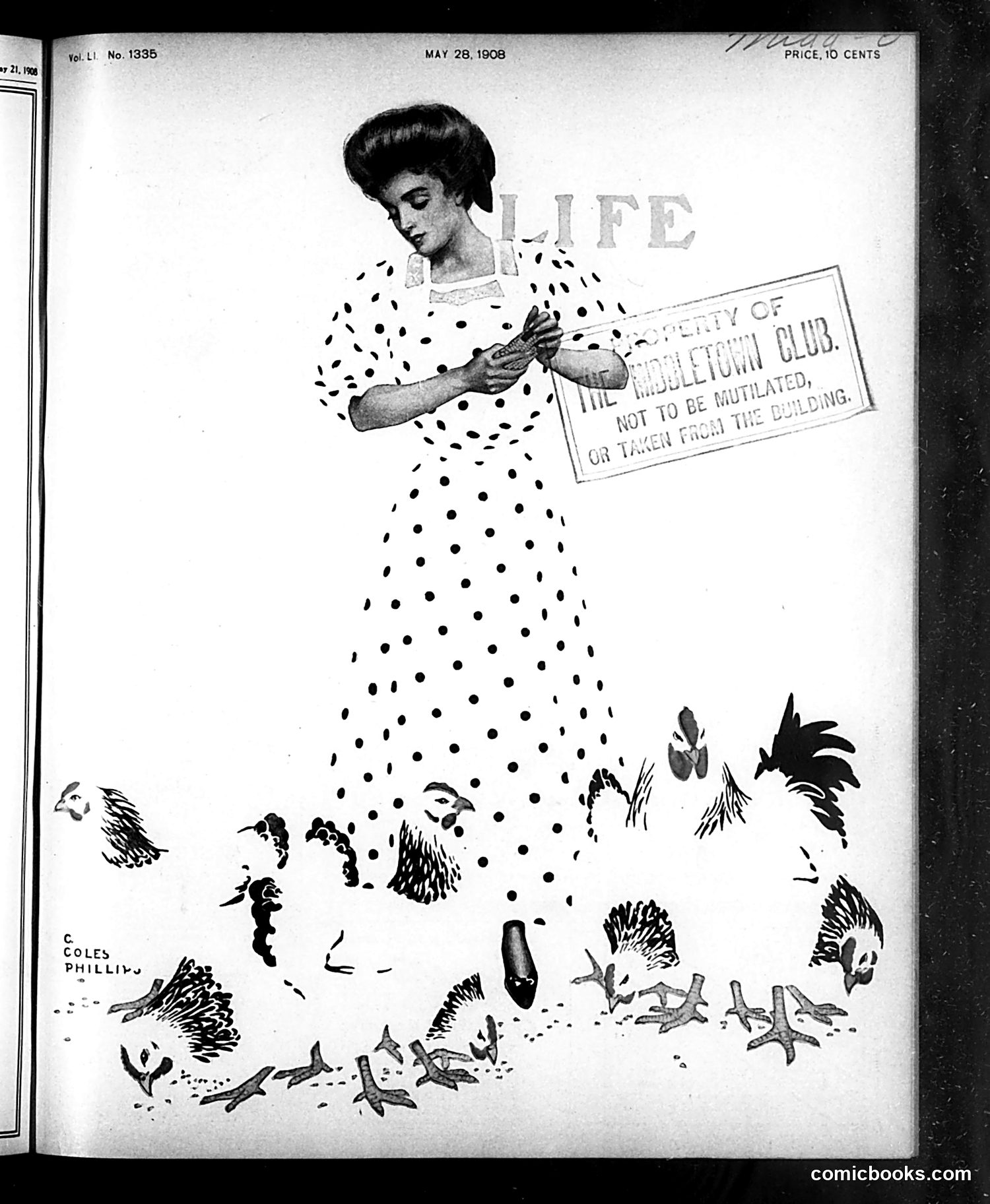
This satirical cover depicts a fashionable woman in an elaborate polka-dot dress surrounded by various birds and poultry at her feet. The illustration criticizes the Edwardian-era fashion trend of adorning women's clothing and hats with feathers and dead birds—a practice driven by the millinery industry's demand for exotic plumage. The stamp reading "Property of the Middletown Club—Not to be mutilated or taken from the building" appears to be a library or club ownership mark, not part of the satire itself. The cartoon mocks the wasteful and cruel practice of using real birds as fashion decoration, presenting it as absurd by literally surrounding the fashionable woman with the living creatures whose feathers adorned her garments. This reflects early conservation concerns about bird populations decimated by the hat trade.
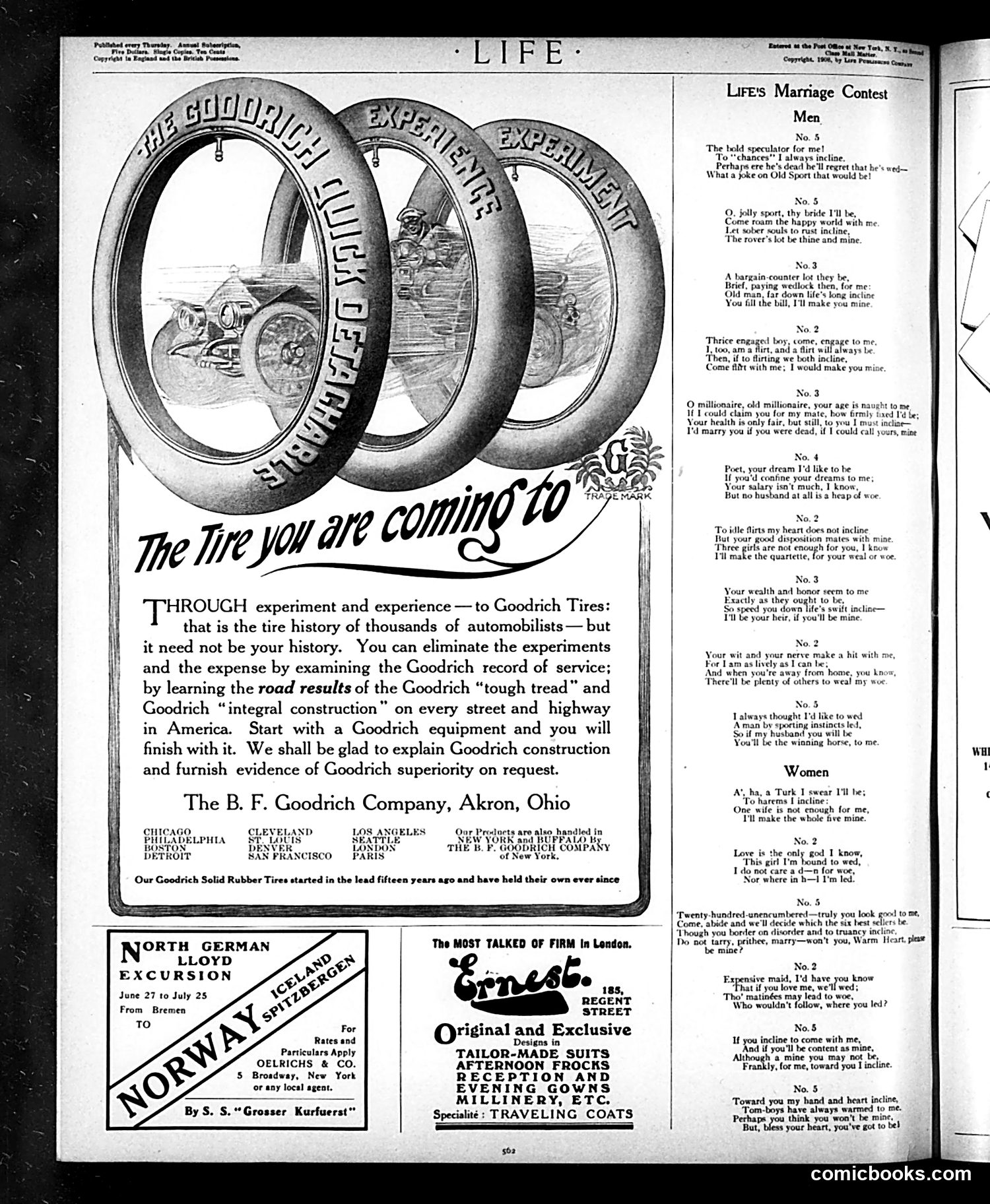
This page is primarily **advertising**, not political satire. The dominant image is a Goodrich Tire Company advertisement featuring three large tire cross-sections arranged to show their construction. The ad emphasizes that consumers can benefit from Goodrich's "experience" and proven "road results" without having to experiment themselves. The right column contains **"Life's Marriage Contest"** — humorous marriage proposal verses submitted by readers, split between "Men" and "Women" sections. These are lighthearted romantic appeals using witty wordplay rather than satire. Below are smaller ads for a North German Lloyd ocean excursion and Ernest clothing/millinery services in London. The page reflects early 20th-century magazine content: consumer advertising mixed with reader-submitted humor features.
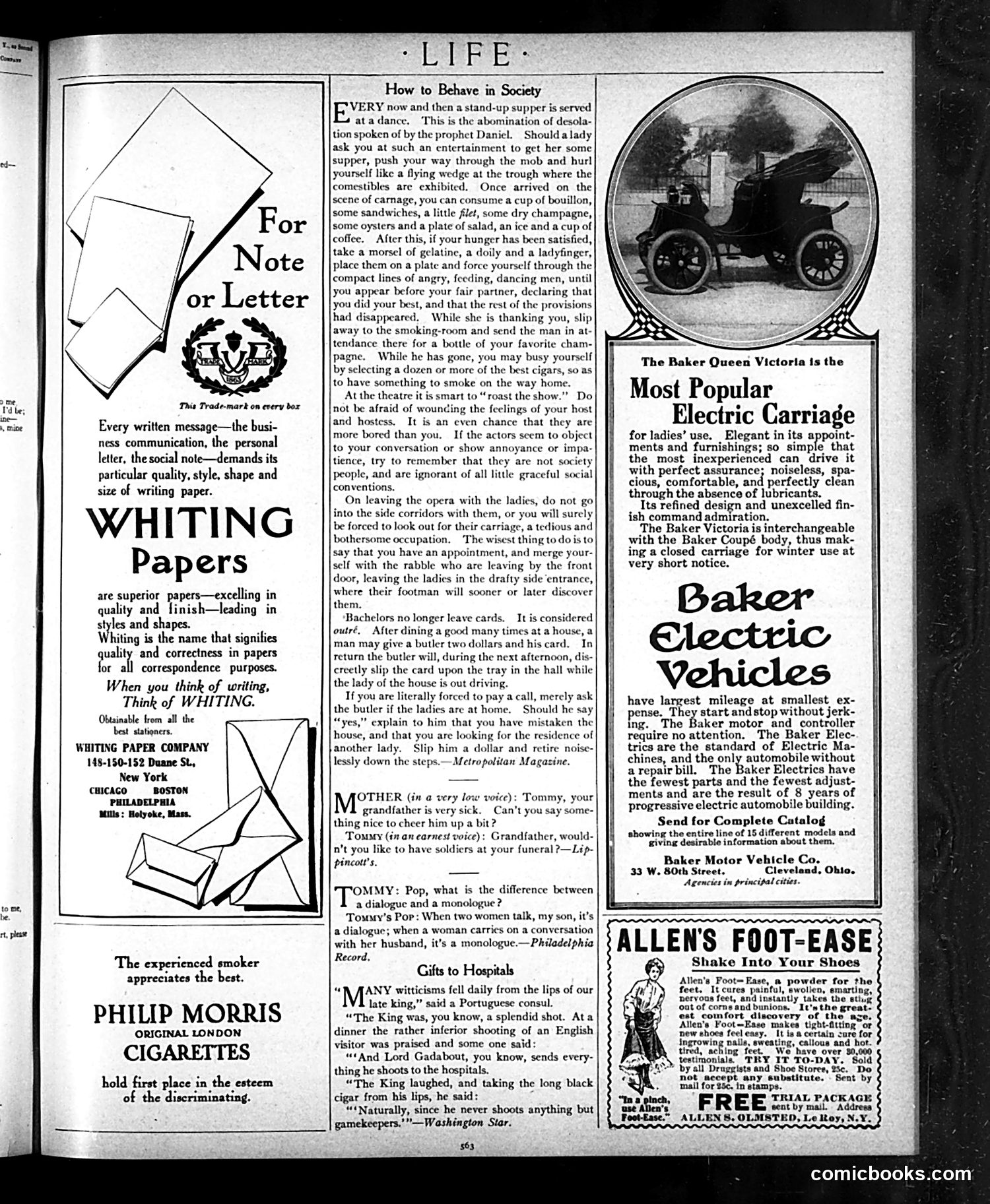
This page is primarily **advertising and etiquette advice**, not political satire. The main content includes: 1. **"How to Behave in Society"** — humorous etiquette guidance about stand-up suppers at dances, theater behavior, and proper social conventions. The tone is gently mocking of pretentious social rituals. 2. **Left sidebar** — advertisement for Whiting writing papers, emphasizing quality and correctness for correspondence. 3. **Right side** — full-page advertisement for Baker Electric Vehicles, marketed to women as the "Most Popular Electric Carriage." 4. **Bottom** — smaller ads for Philip Morris cigarettes and Allen's Foot-Ease powder. The page reflects early 20th-century consumer culture and gender norms (electric cars marketed specifically to women drivers). The etiquette column's humor derives from exaggerating social pretension rather than political commentary.
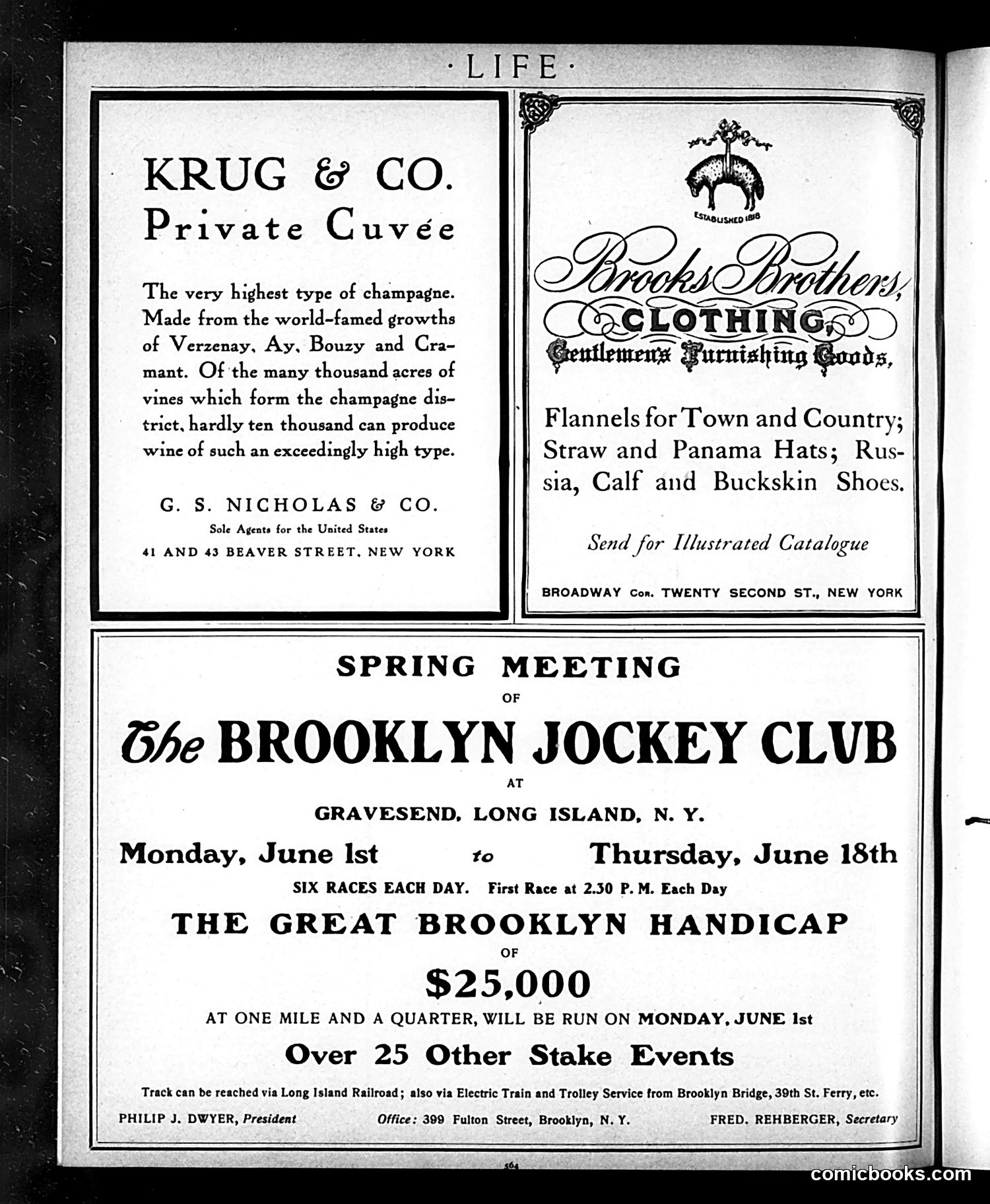
This page contains **no cartoons or satirical content**—it's purely advertising from what appears to be an early 20th-century *Life* magazine. The ads include: 1. **Krug & Co. champagne** (left)—promoting French wine through a New York distributor 2. **Brooks Brothers clothing** (right)—advertising gentlemen's furnishings, hats, and shoes 3. **Brooklyn Jockey Club** (bottom)—announcing a spring horse-racing event at Gravesend, Long Island, featuring a $25,000 handicap race These advertisements reflect the leisure activities and consumer goods marketed to wealthy American readers of the period. There is no political or social satire present on this page.
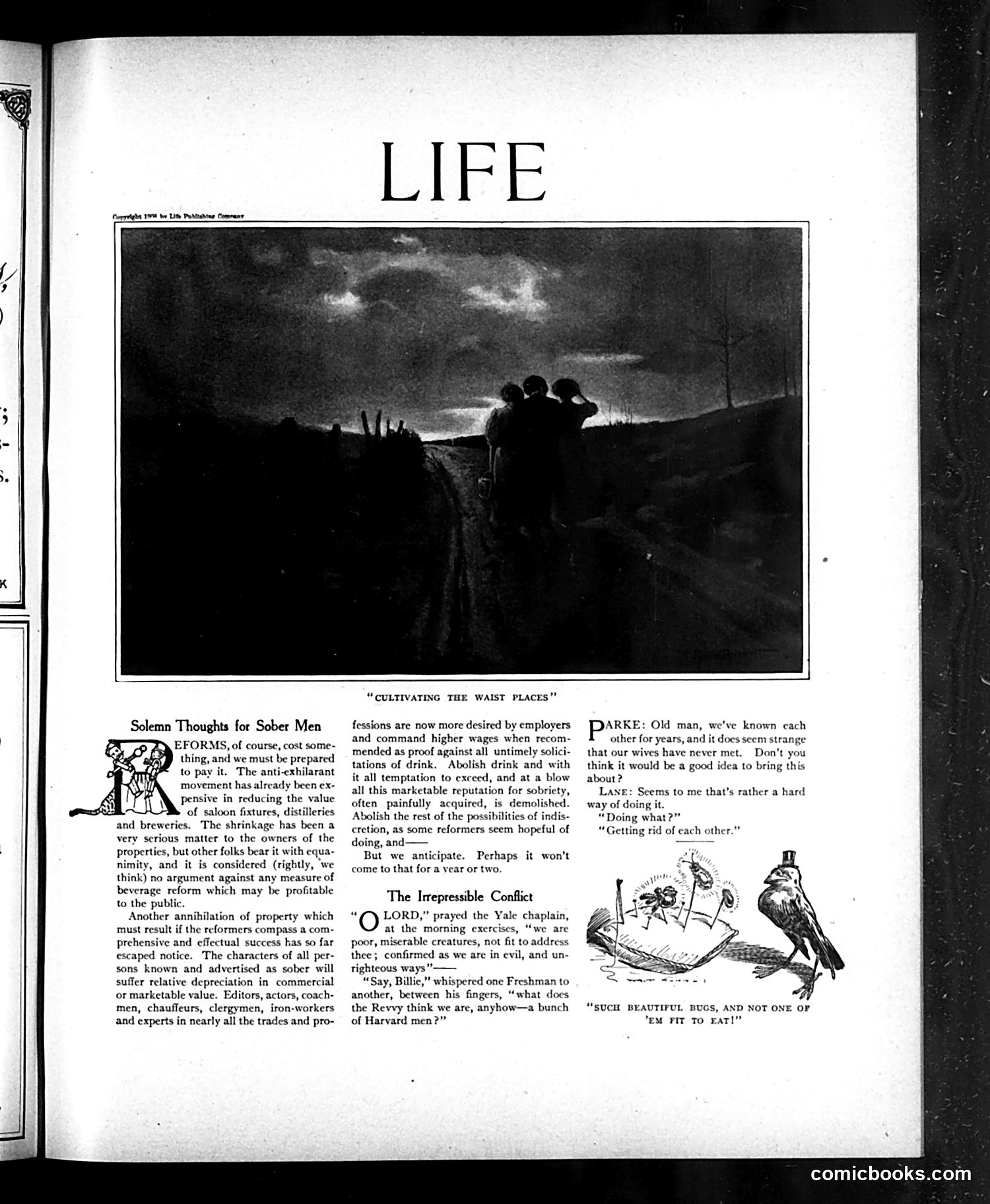
This Life magazine page presents social commentary on temperance and prohibition. The main photograph "Cultivating the Waist Places" appears to depict silhouetted figures in a landscape, likely illustrating consequences of drinking. The text includes "Solemn Thoughts for Sober Men," which argues against alcohol by referencing saloon closures and breweries as serious matters affecting property values and commercial reputation. The piece advocates for comprehensive prohibition, anticipating reform efforts. "The Irrepressible Conflict" presents a dialogue between characters (including "Lord" and "Billie," apparently a Yale chaplain and freshman) debating morality and Harvard/Yale student behavior, with religious language about sin and wickedness. The illustration of birds at bottom with caption "SUCH BEAUTIFUL BUGS, AND NOT ONE OF 'EM FIT TO EAT!" appears to be separate satirical commentary, though its specific target remains unclear from this excerpt.
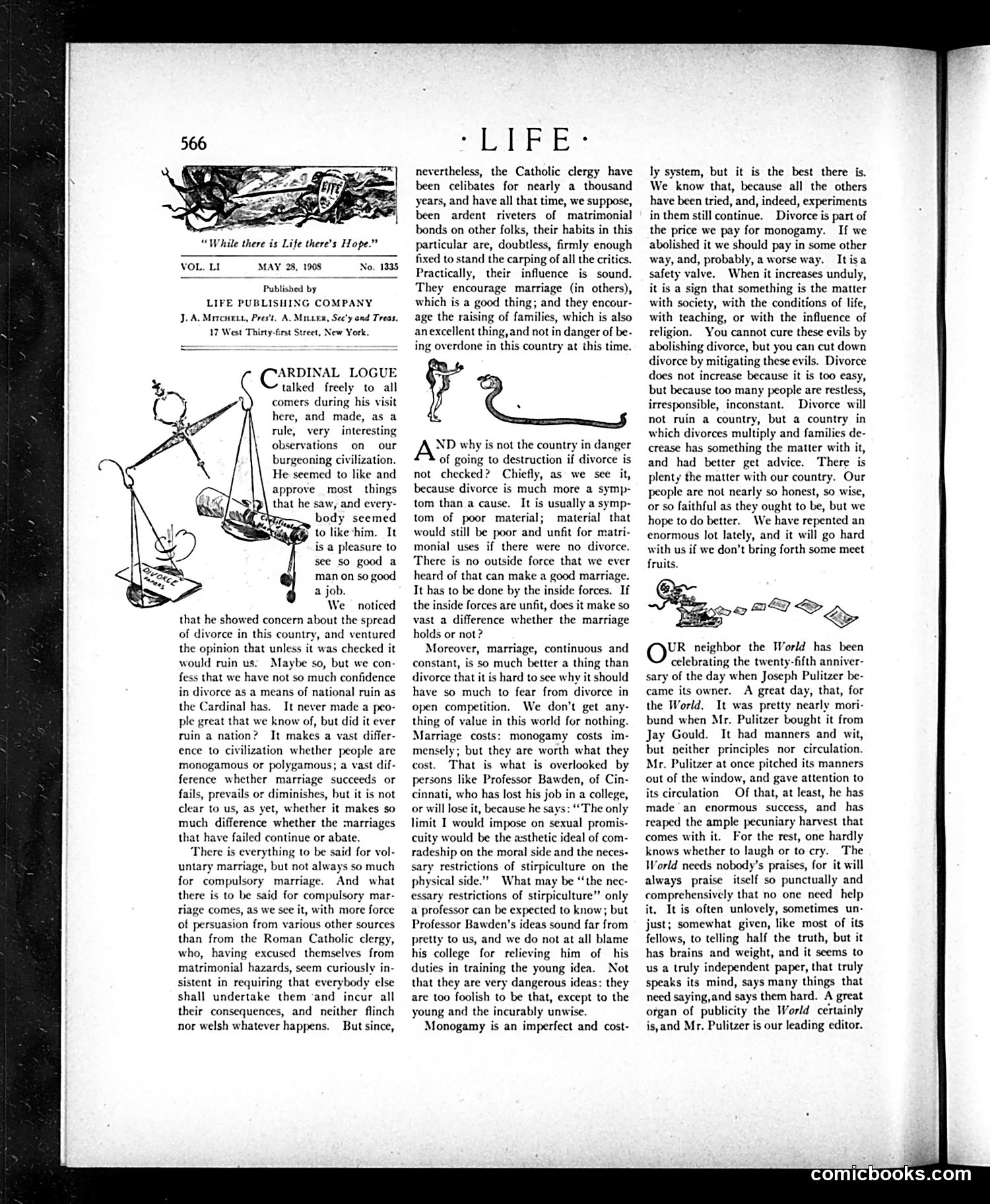
The page features an editorial about divorce and marriage, with a decorative illustration showing figures in classical/allegorical style (likely representing concepts rather than specific people). The text references **Cardinal Logue**, who apparently visited and made public statements supporting Catholic opposition to divorce. The editorial discusses whether divorce should be legally restricted, debating monogamy's merits versus its costs. The piece also praises **Joseph Pulitzer**, editor of the *World* newspaper, for his journalistic success and independent editorial voice, contrasting him favorably with Professor Bawden of Cincinnati. The cartoon's classical style appears meant to dignify the serious debate about marriage, family, and social policy rather than mock specific individuals. The satire is subtle—targeting ideas about divorce policy rather than personal caricature.
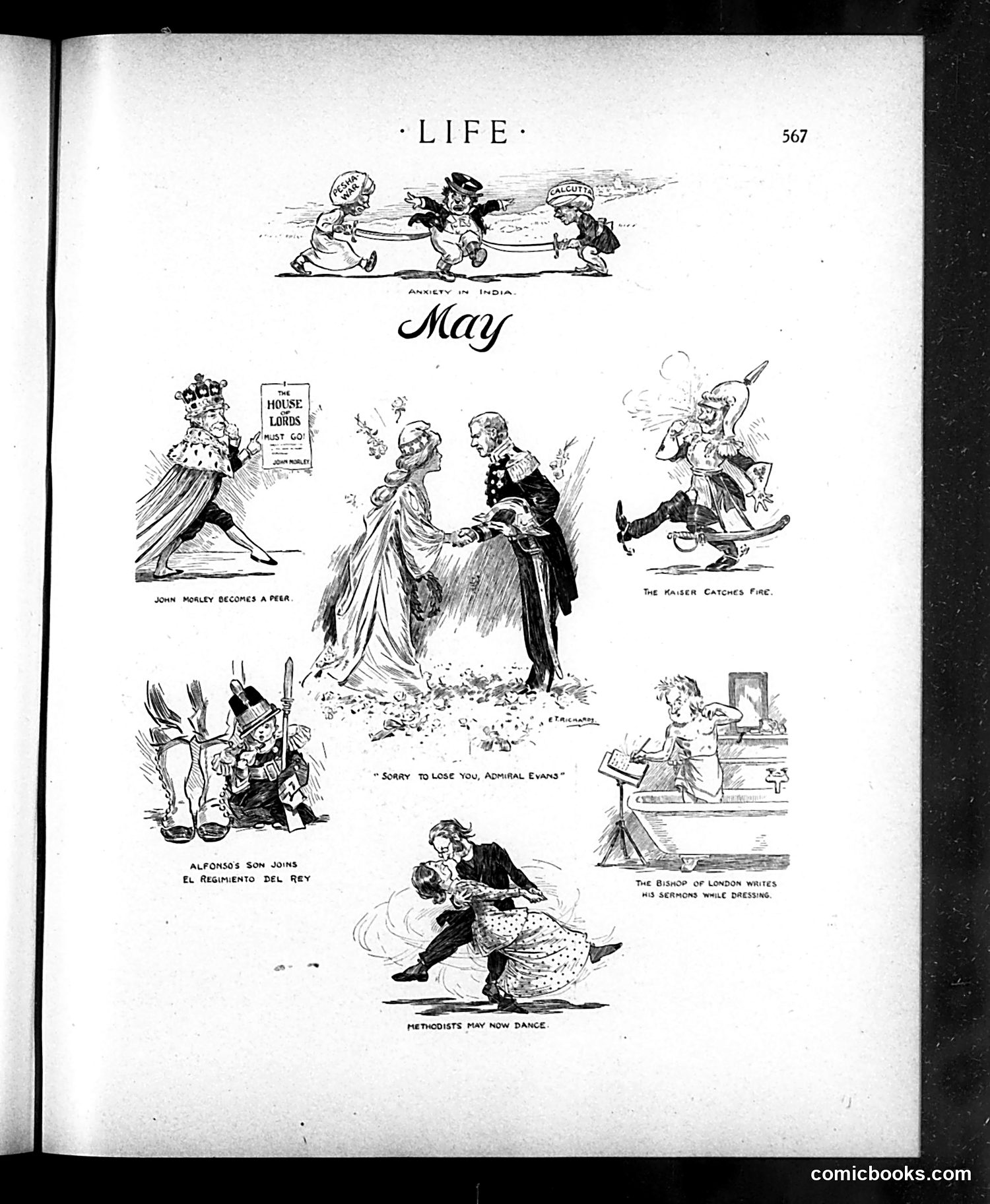
This satirical page depicts British political and social events from May (year unclear from image). The cartoons mock: **"John Morley Becomes a Peer"** - depicts the politician's elevation to the House of Lords with exaggerated ceremony. **"Sorry to Lose You, Admiral Evans"** - appears to reference a naval figure's departure or loss. **"The Kaiser Catches Fire"** - likely satirizes German Emperor Wilhelm II in an embarrassing situation. **"Alfonso's Son Joins El Regimiento del Rey"** - references Spanish royal family military service. **"The Bishop of London Writes His Sermon While Dressing"** - mocks clerical multitasking or absent-mindedness. **"Methodists May Now Dance"** - satirizes religious social restrictions relaxing. **"Anxiety in India"** (top) - depicts colonial concern, possibly related to political unrest. The page employs caricature and exaggeration typical of early 20th-century British satirical humor.
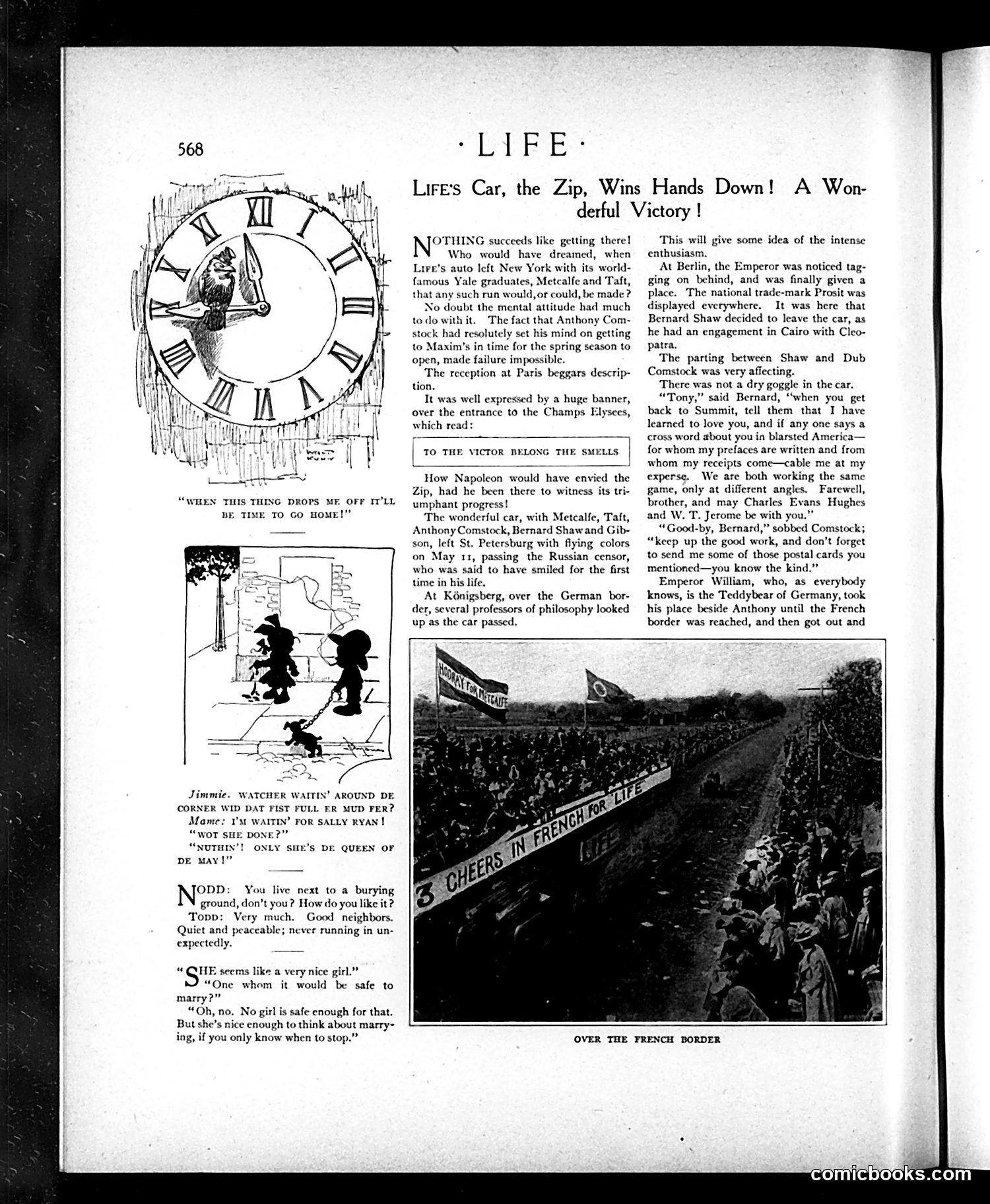
This page celebrates **Life's Car**, apparently an automobile that completed a remarkable journey from New York to Paris. The headline announces "Life's Car, the Zip, Wins Hands Down!" The main text describes the car's arrival in Paris, where it was received with enthusiasm. Notable figures mentioned include **Bernard Shaw** (the famous playwright), who reportedly left the vehicle in Cairo. The article references the car crossing the German border and being greeted by crowds in France. The bottom photograph shows a large crowd cheering "over the French border," with visible banners and flags suggesting a celebratory reception. The cartoons appear to be humorous filler—one depicts characters discussing neighbors, unrelated to the main story. This appears to be early 20th-century automotive journalism celebrating a record-breaking endurance run.
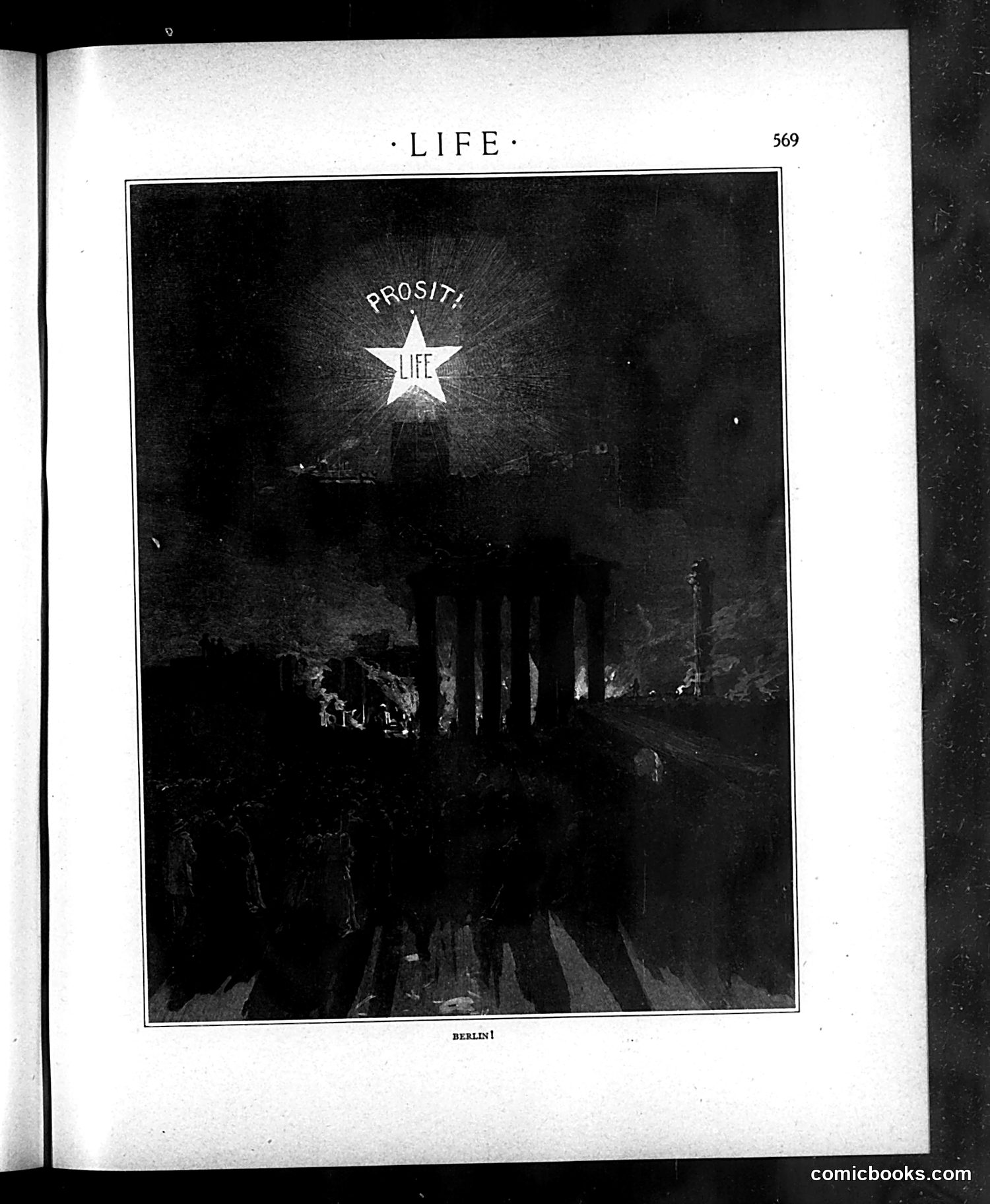
This appears to be a title page or cover illustration from *Life* magazine (page 569). The image shows a nighttime scene with a bright star labeled "PROSPERITY" shining above, while below lie dark, silhouetted ruins of buildings and structures. The word "BERLIN" appears at the bottom. The satire appears to reference post-World War I Germany, likely depicting the contrast between promises of prosperity and the actual devastated condition of Berlin after the war. The bright star symbolizes hope or promised economic recovery, while the ruins beneath suggest the grim reality facing the city. This likely comments on either the gap between optimistic political rhetoric and harsh conditions, or perhaps criticism of reparations and reconstruction efforts in defeated Germany.
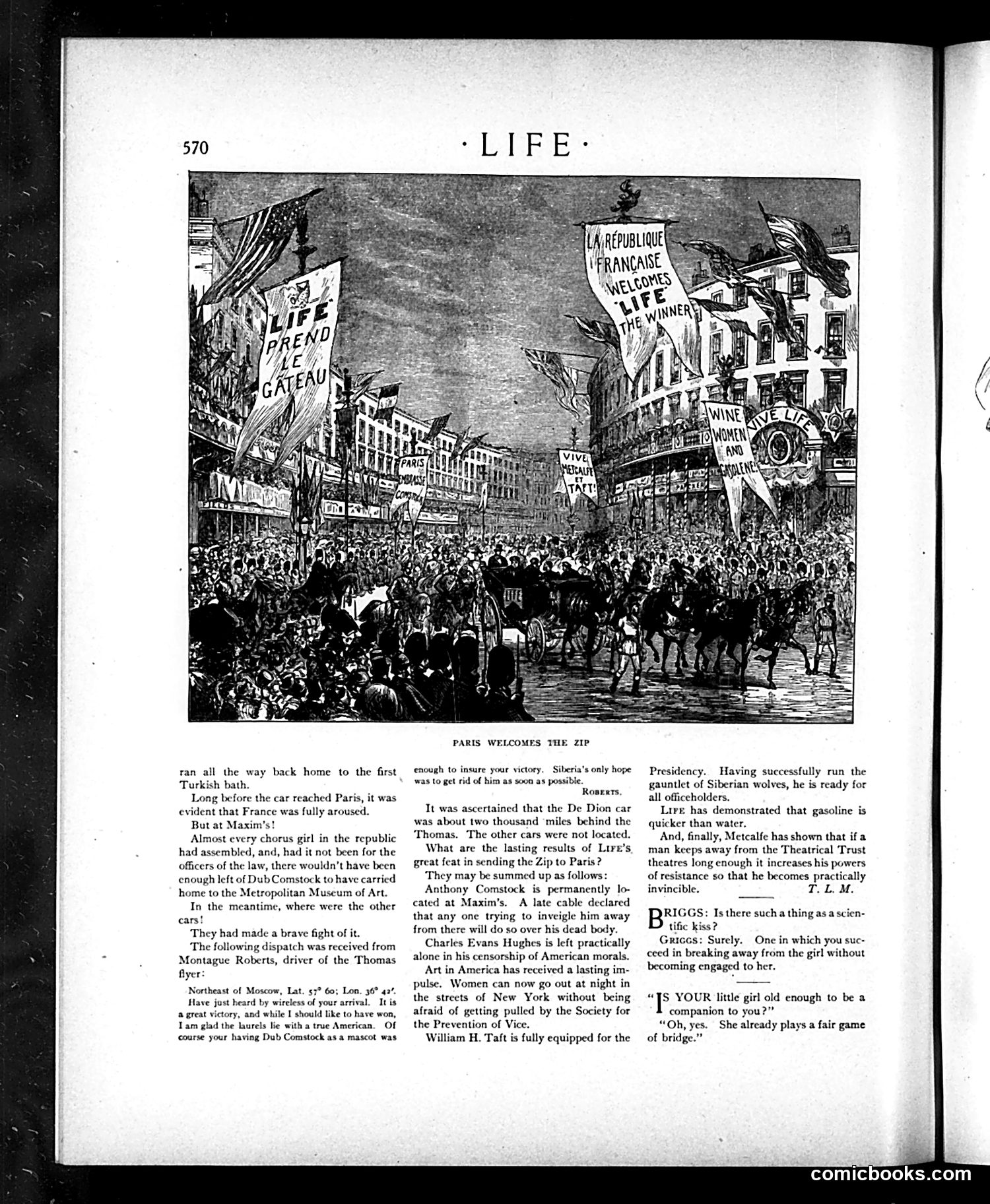
This illustration depicts a massive celebratory parade in Paris welcoming "the Zip"—apparently a car that has completed a remarkable race or endurance test. The image shows dense crowds, French and American flags, and celebratory banners including "LA REPUBLIQUE FRANCAISE WELCOMES LIFE THE WINNER." The accompanying article references competing automobiles in what appears to be an early 20th-century long-distance race. Key figures mentioned include Anthony Comstock (permanently located at Maxim's), Charles Evans Hughes, and William H. Taft, suggesting this celebrates American automotive achievement and innovation. The satire seems to mock both the grandiose French reception and American competitive pride in mechanical prowess during an era of rapid technological development.
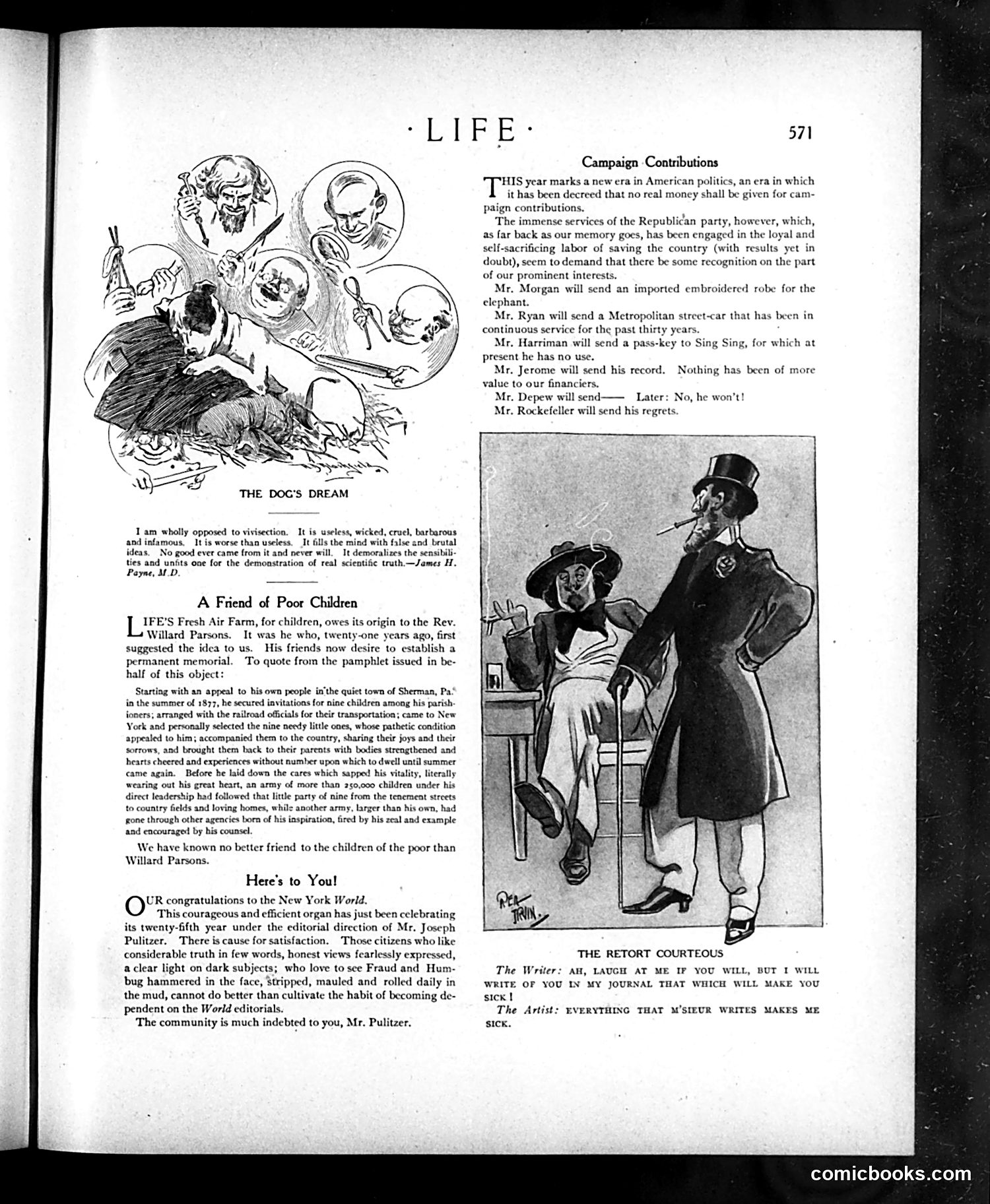
**The Dog's Dream** (left cartoon) shows a sleeping dog dreaming of wealthy figures—likely prominent businessmen or politicians of the era. The satire critiques the concentration of wealth and power among the elite, with the dog representing ordinary citizens fantasizing about wealth they cannot achieve. **Campaign Contributions** (top right) mocks a "new era in American politics" where "no real money shall be given for campaign contributions." The text then lists prominent wealthy figures (Morgan, Ryan, Harriman, Jerome, Rockefeller) offering symbolic gifts instead of cash—an embroidered robe, a street-car, a pass. The satire suggests these wealthy men are unwilling to actually donate money despite their vast fortunes, exposing hypocrisy in political financing reform.
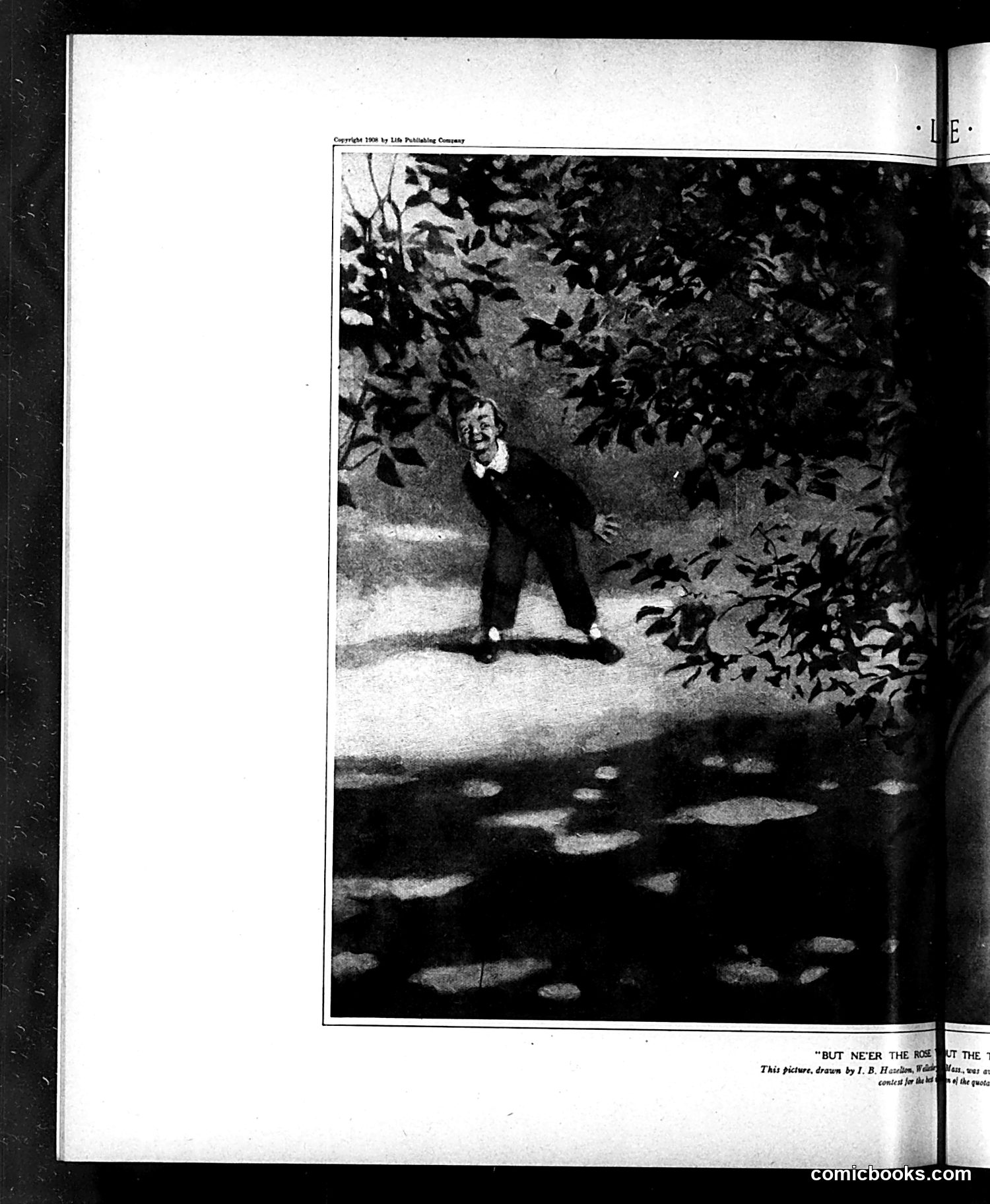
This appears to be an illustration from Life magazine showing a man in formal attire standing in a garden or wooded setting with a stream. The caption fragment reads "BUT NEER THE ROSE AT THE..." (text cut off), suggesting this is likely a literary or theatrical reference. The credit line indicates the drawing is "by I. B. Haldan, Esther" (names unclear from OCR). Without the complete caption or full context visible on the page, I cannot definitively identify the specific political or social satire being referenced. The scene suggests a dramatic moment—possibly relating to a poem, play, or literary work—but the truncated text prevents me from explaining the precise joke or satirical point to a modern reader with confidence.
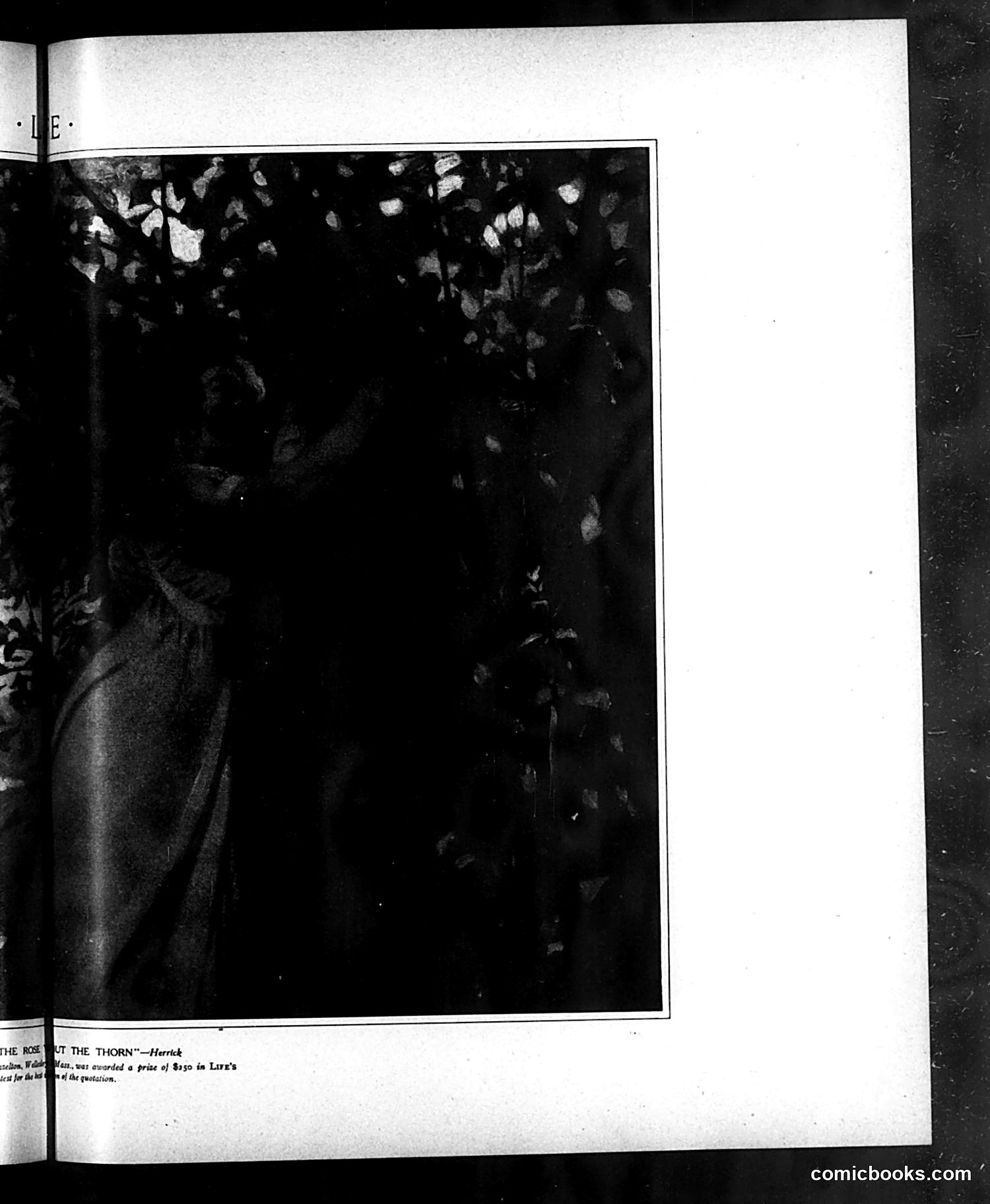
This page appears to be from Life magazine and contains a dramatic black and white photograph labeled "THE ROSE AND THE THORN"—Harrick. The caption mentions that "Man and swordad a prize of $350 in Life's $1,000 prize for pictures" (text partially obscured). The image shows what appears to be a theatrical or artistic scene with figures among foliage or floral elements, rendered in high contrast. Without clearer visibility of details or complete caption text, I cannot definitively identify the specific figures, the nature of the "prize" reference, or the satirical point being made. The title's rose/thorn metaphor suggests commentary on beauty and danger, or perhaps a contrast between appearance and reality—common satirical themes—but the exact subject and context remain unclear from what's legible here.
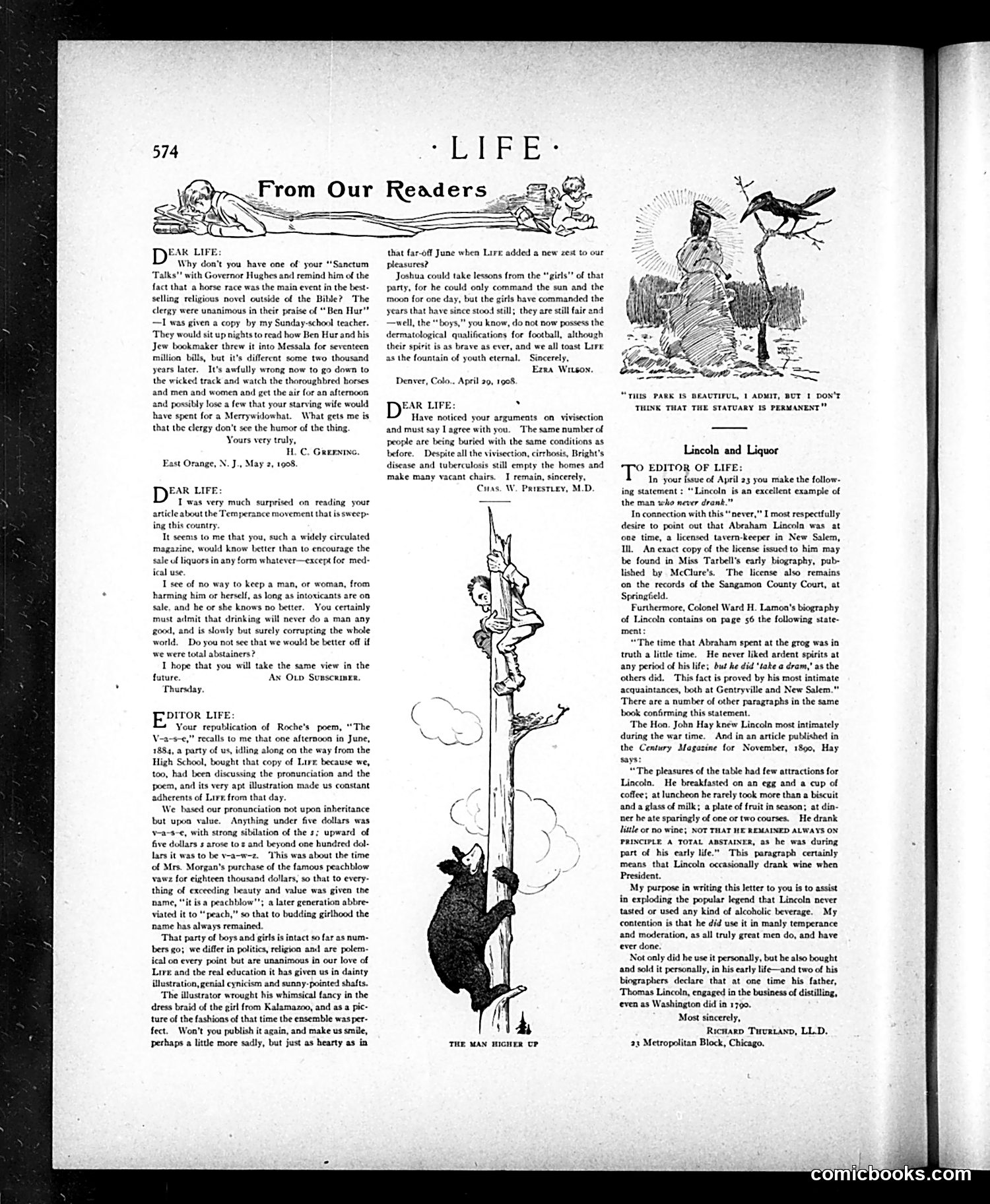
This page presents **reader letters** responding to Life's editorial content—a common magazine feature. Key points: **The Horse Racing Complaint**: A reader criticizes the hypocrisy of clergy praising "Ben-Hur" (a popular novel featuring chariot racing) while condemning actual horse-racing attendance as immoral. The satire targets religious inconsistency: the clergy found entertainment in a *fictional* race acceptable but condemn the *real* activity as sinful. **The Temperance Debate**: Another reader urges Life to oppose alcohol sales, reflecting the pre-Prohibition temperance movement gaining momentum in 1908. **The "Lure" Nostalgia**: A third letter fondly recalls a 1884 poem/illustration from Life, describing how a group of friends remained united across decades despite disagreeing on politics and religion—unified only by their appreciation of Life's "dainty illustration" and "genial cynicism." The accompanying illustrations show a man climbing a tree (likely depicting temptation or struggle) and a woman in period dress on a pedestal—visual humor complementing the written commentary on social hypocrisy and changing values.
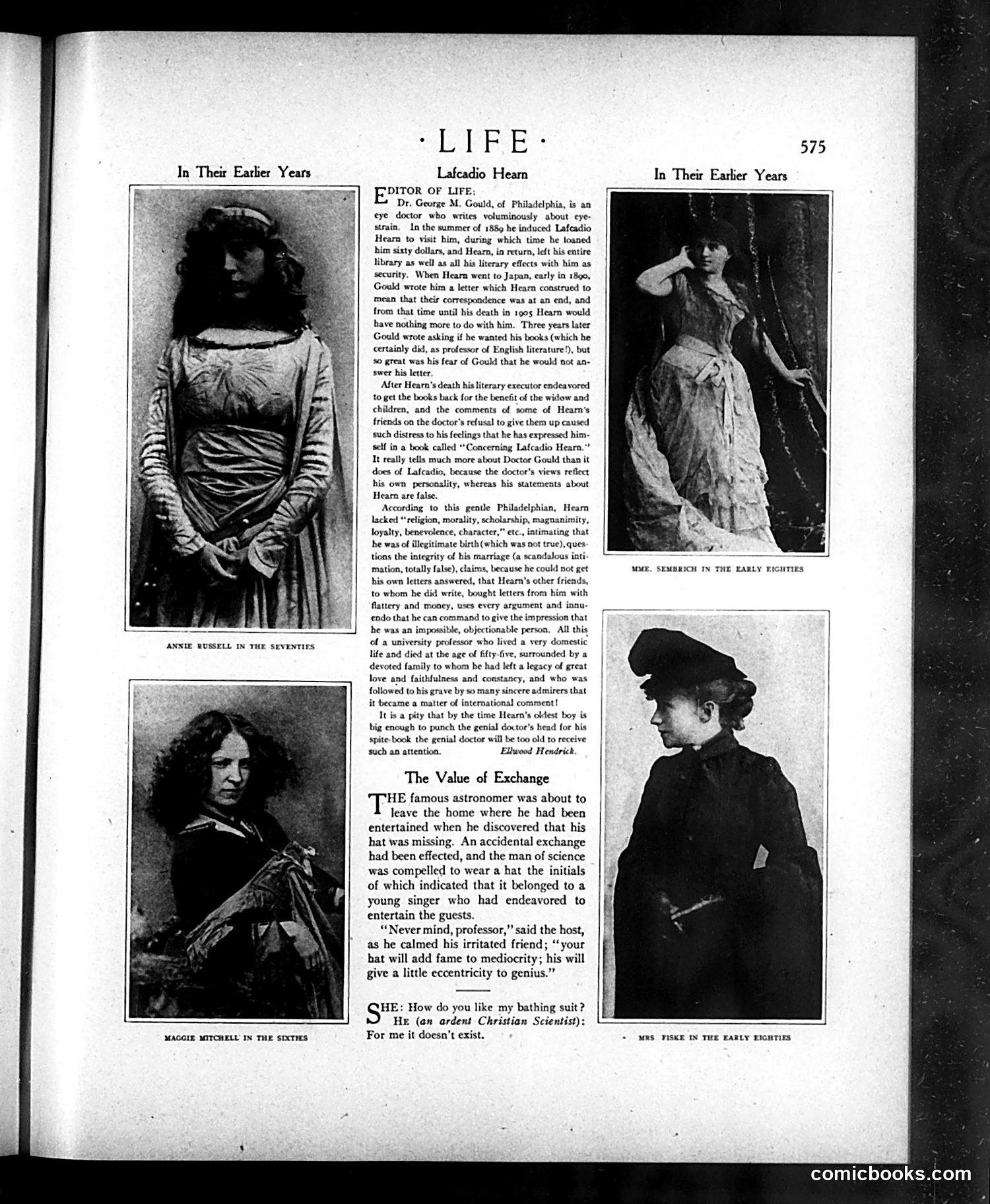
This page from *Life* magazine contains two distinct elements: **Main Article**: A letter to the editor defending writer Lafcadio Hearn against Dr. George M. Gould's published criticisms. Gould loaned Hearn money in 1889, held his library as security, and after a misunderstanding, refused to return the books even after Hearn's death in 1905. Years later, Gould published a book attacking Hearn's character—calling him immoral, illegitimate, and impossible. The letter writer argues Gould's book reveals more about Gould's own petty vindictiveness than about Hearn, noting Hearn died respected and surrounded by admirers. **Cartoon ("The Value of Exchange")**: A brief humorous anecdote about an astronomer accidentally wearing a young singer's hat at a dinner party. The host jokes that the hat will give the mediocre singer "eccentricity" while adding "fame" to the genius astronomer—a playful comment on how association elevates or diminishes reputation. **Historical Note**: The photographs show theatrical figures from the 1860s-1880s.
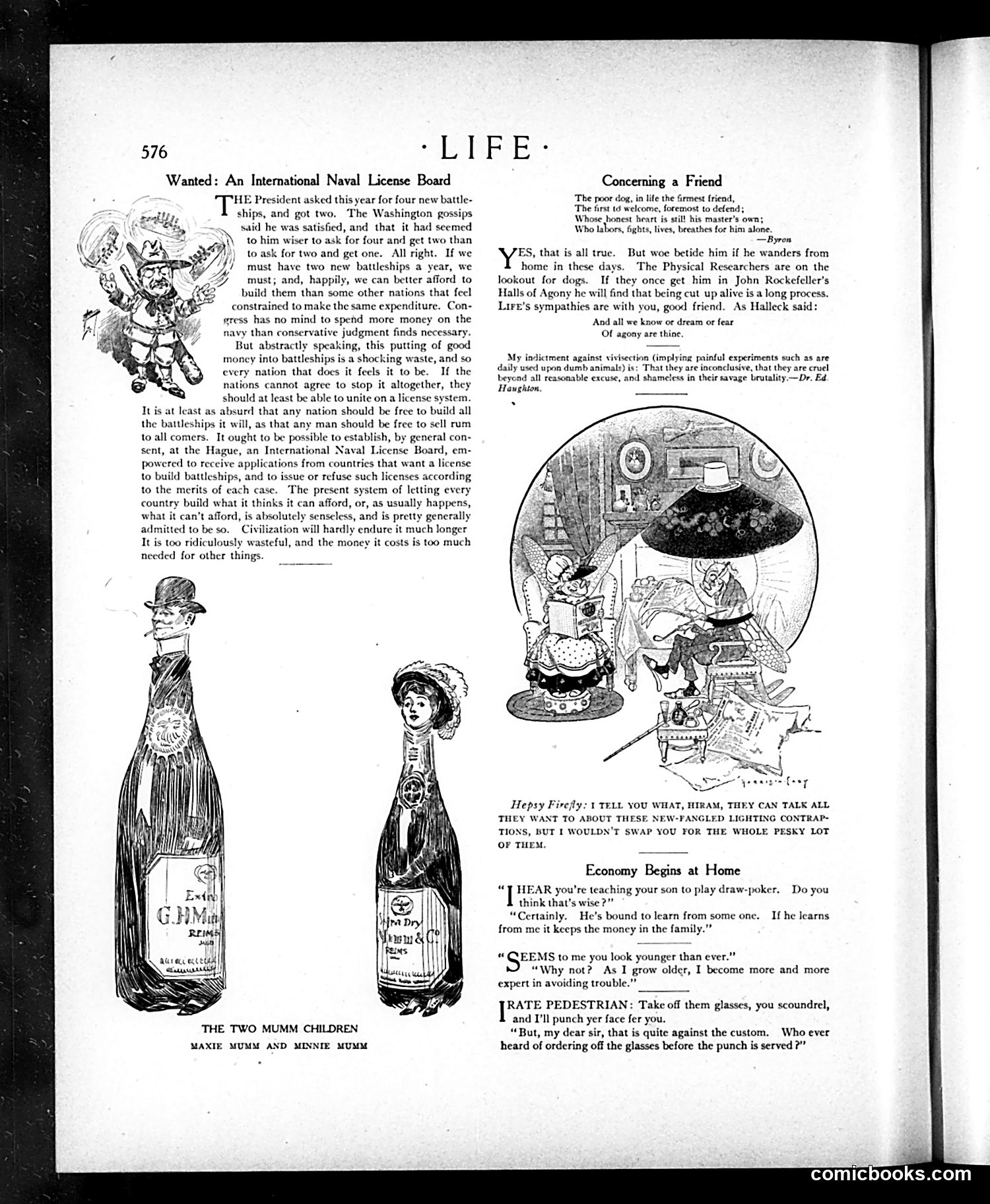
This page contains three distinct satirical pieces: **"Wanted: An International Naval License Board"** argues that naval arms racing is wasteful. The editorial proposes an international licensing system at The Hague to regulate battleship construction, comparing it to liquor licensing. The underlying critique: nations compete in destructive military spending they acknowledge as wasteful—a paradox the author finds absurd. **"The Two Mumm Children"** (champagne bottle illustrations) is an advertisement disguised as satire, playing on the product name. **"Concerning a Friend"** attacks vivisection (animal experimentation), particularly at research institutions like Rockefeller's. Life expresses sympathy for dogs used in painful experiments, citing Dr. Ed. Haughton's criticism that such tests are "inconclusive" and "cruel." **"Economy Begins at Home"** includes three brief comic dialogues about teaching children gambling, aging gracefully through avoiding trouble, and etiquette absurdities—light humor on domestic themes. The page reflects early 20th-century Progressive Era concerns: military expenditure, animal welfare, and social hypocrisy.
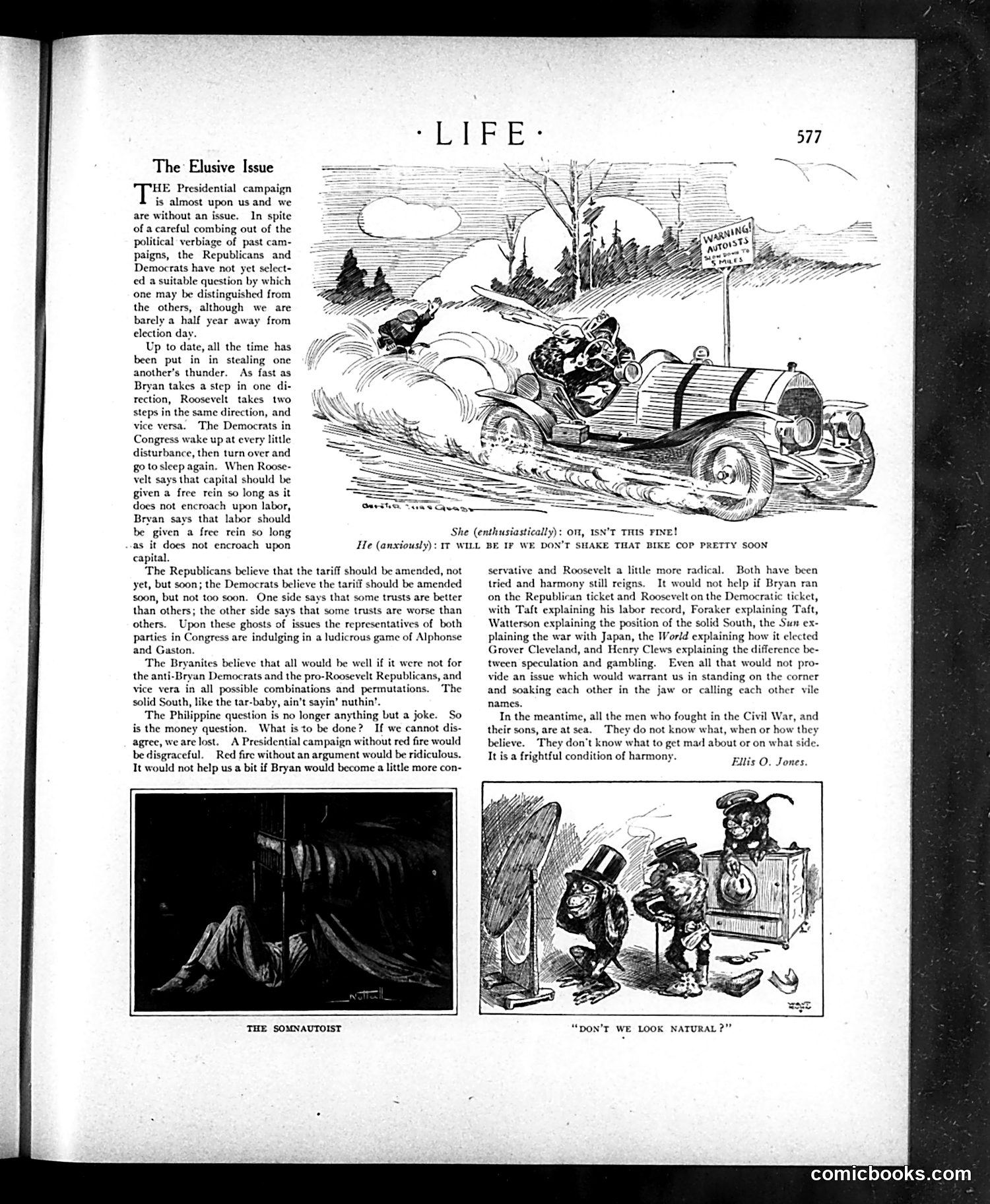
This page satirizes the 1908 U.S. presidential campaign, criticizing both major parties for lacking distinguishing positions. The article argues that Republicans and Democrats have become indistinguishable—when Bryan (William Jennings Bryan, the Democratic candidate) moves in one direction, Roosevelt moves two steps the same way. Issues like tariffs, trusts, and labor are presented as hollow rhetorical games of "Alphonse and Gaston" (a reference to exaggerated politeness). The top cartoon depicts a reckless car race, likely symbolizing the campaign's dangerous lack of meaningful debate or clear direction. The bottom cartoon, "Don't We Look Natural?" shows caricatured political figures attempting to appear authentic while clearly performing artifice—emphasizing the satire's core complaint: both parties are engaged in hollow theater rather than substantive disagreement. The page's thrust: without genuine ideological differences, American voters—especially Civil War veterans—are adrift and confused about what they actually believe.
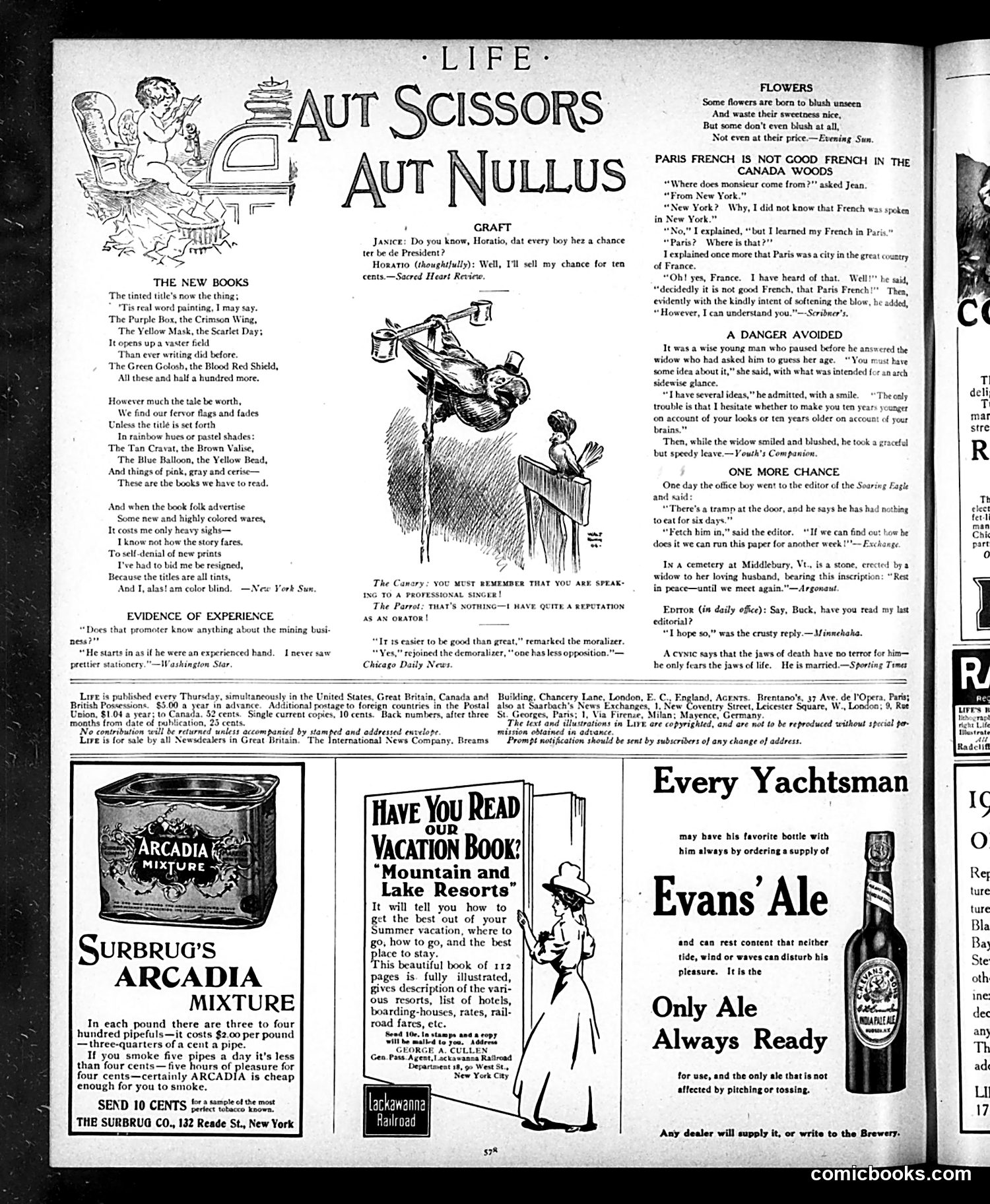
This page contains several humor pieces satirizing early 20th-century American life: **"Aut Scissors / Aut Nullus"** mocks book marketing trends—publishers using colorful, attention-grabbing titles (like "The Purple Box" or "The Scarlet Day") regardless of actual literary merit. The author, who is colorblind, cannot appreciate these tactics, satirizing both publishers' shallow marketing and consumers' susceptibility to packaging over substance. **"Evidence of Experience"** jokes that someone merely *acts* knowledgeable about mining without actual expertise—critiquing bluffing and false confidence in business. Other brief pieces satirize period concerns: a Canadian who dismisses "Paris French," a young man avoiding a widow's age-guessing trap, and office humor about underfed tramps. The overall tone is lighthearted social commentary on commercialism, pretension, and human folly rather than serious political critique.
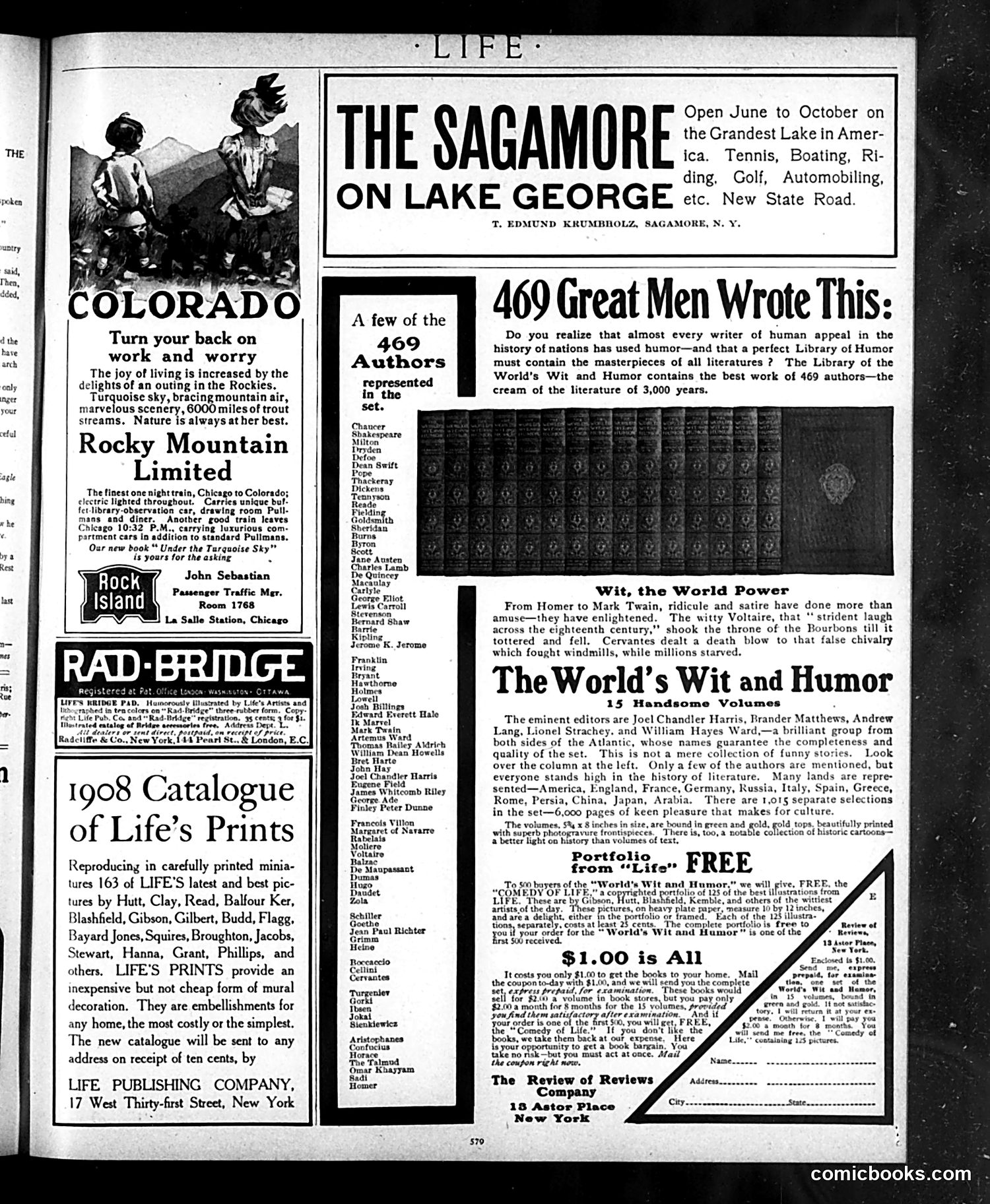
This page is primarily **advertising and promotional content** rather than political satire or comics. The dominant features are: 1. **"The Sagamore on Lake George"** — a resort advertisement highlighting leisure activities (tennis, boating, golf) available seasonally. 2. **"Rocky Mountain Limited"** — a railroad advertisement for Chicago-to-Colorado passenger service. 3. **"The World's Wit and Humor"** — the page's main promotional feature, advertising a 15-volume literary collection edited by prominent American editors (Joel Chandler Harris, Brander Matthews, etc.). The copy argues that humor and satire throughout history have been vehicles for social enlightenment, citing Voltaire's attacks on the Bourbon monarchy and Cervantes's critique of false chivalry. 4. **"1908 Catalogue of Life's Prints"** — promoting Life's art reproductions. The page lacks political cartoons or satirical commentary. It's essentially a **commercial page** designed to sell upscale products and services to Life's educated, wealthy readership.
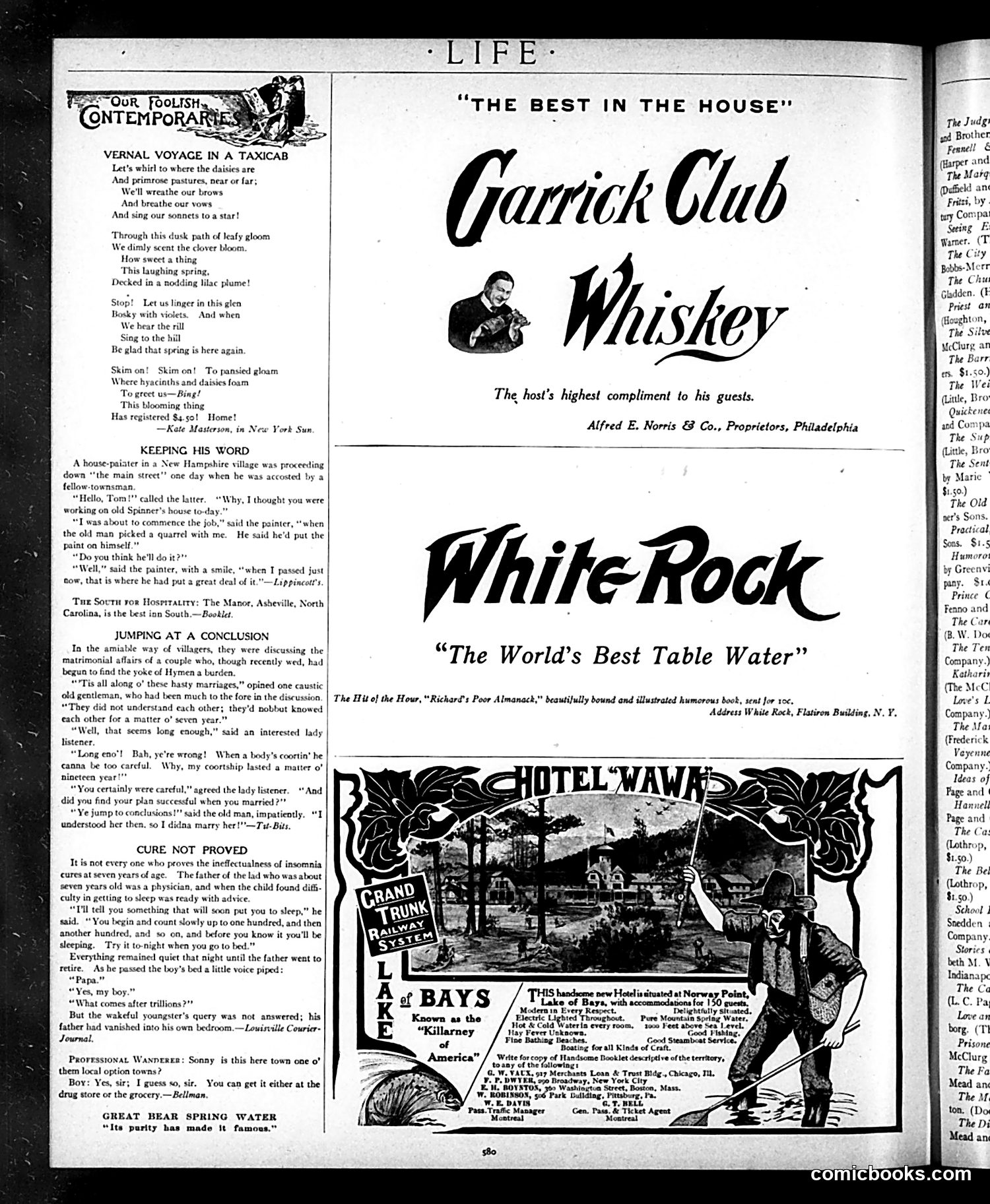
This page is primarily **advertising** interspersed with light humor columns typical of early 20th-century Life magazine. The left side contains four brief humorous anecdotes ("Our Foolish Contemporaries"), including a satire on romantic taxi rides where lovers fantasize about spring flowers—only to discover the meter reads $4.50, deflating their sentimentality with modern commercialism. The right side features **product advertisements**: Garrick Club Whiskey, White Rock table water, and Hotel Wawa (a Grand Trunk Railway destination). These ads use the language of quality and refinement ("host's highest compliment," "world's best"). The humor reflects genteel, middle-class concerns of the era: romantic disappointment, marital misunderstandings, and the gap between Victorian ideals and practical reality. There are **no political cartoons** on this page—the satire is social rather than political, poking fun at contemporary manners and foolish behavior among ordinary people. The page represents Life's dual function: satirical commentary paired with upscale advertising targeting educated, affluent readers.
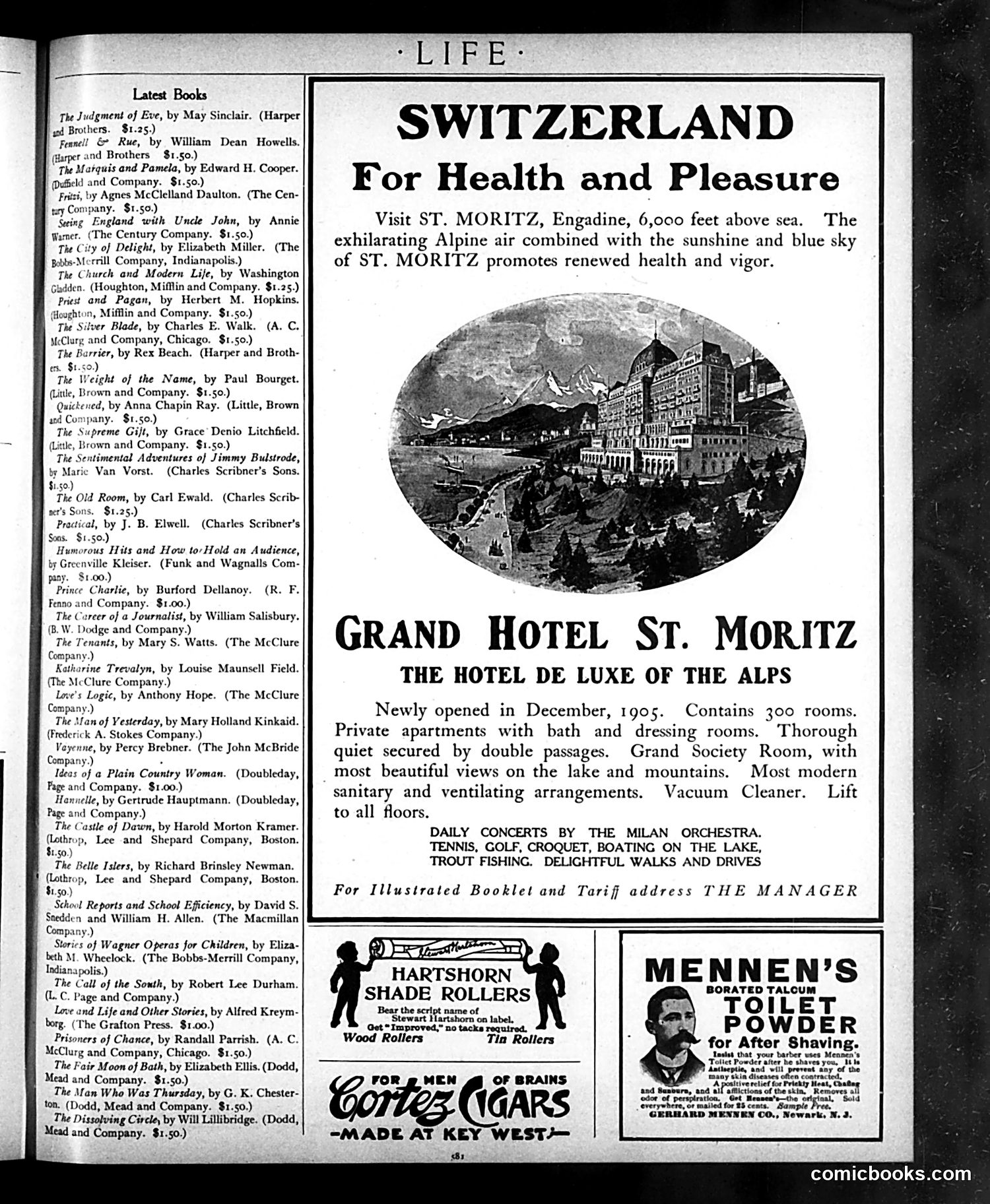
This page is primarily a book review section and advertisements, not political cartoons. The left column lists recent book publications with titles, authors, and publishers—typical literary content for *Life* magazine circa 1905-1906. The main advertisement promotes the Grand Hotel St. Moritz in Switzerland, newly opened in December 1905, emphasizing its luxury amenities (300 rooms, private apartments with baths, modern sanitation, vacuum cleaners, lifts) and recreational activities (concerts, tennis, golf, boating, fishing). This targets wealthy Americans seeking Alpine health retreats. Below are smaller ads for Hartshorn Shade Rollers, Cortez Cigars (marketed "for men of brains"), and Mennen's Borated Talcum Toilet Powder for aftershave. There are no political cartoons or satirical commentary visible on this page—it's a standard magazine layout mixing literature announcements with period luxury goods advertising.
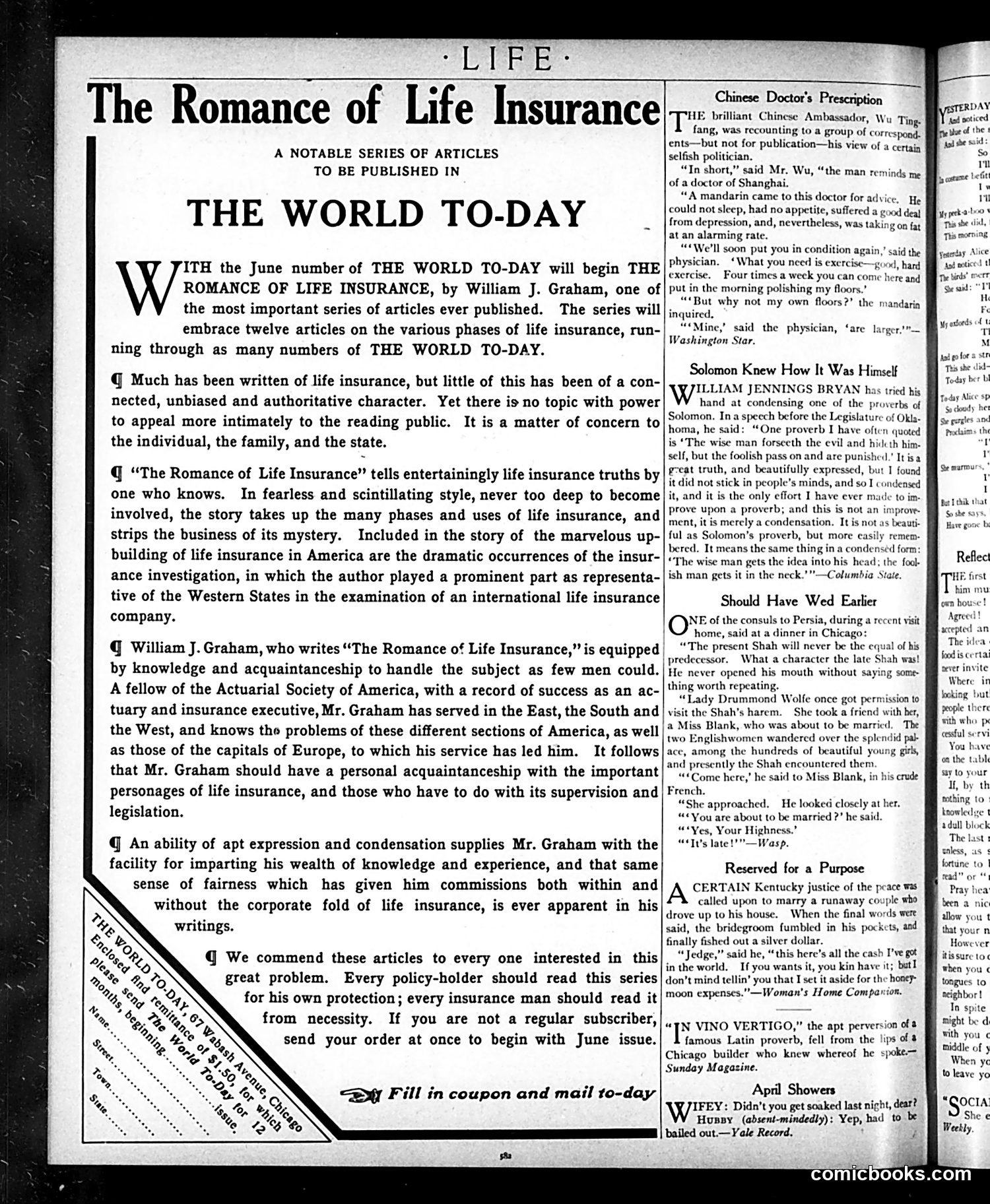
This page is primarily **advertising and editorial promotion** rather than satirical content. It announces "The Romance of Life Insurance," a twelve-part article series by William J. Graham for *The World To-Day* magazine, beginning in June. The page includes three brief **humorous anecdotes** in the right column: 1. **"Chinese Doctor's Prescription"**: A Chinese ambassador recounts a Shanghai doctor's self-serving advice to a mandarin—exercise by polishing the doctor's floors (which are "larger") rather than his own. The joke satirizes pretexts for personal benefit disguised as professional guidance. 2. **"Solomon Knew How It Was Himself"**: References William Jennings Bryan condensing a biblical proverb about wise men foreseeing evil. (Text cuts off mid-sentence, so full context is unclear.) 3. **"Should Have Wed Earlier"** and **"Reserved for a Purpose"**: Brief anecdotes (partially visible). These are light, character-driven jokes typical of *Life* magazine's satirical humor section—not political cartoons. They mock human nature and hypocrisy through short narratives rather than visual caricature.
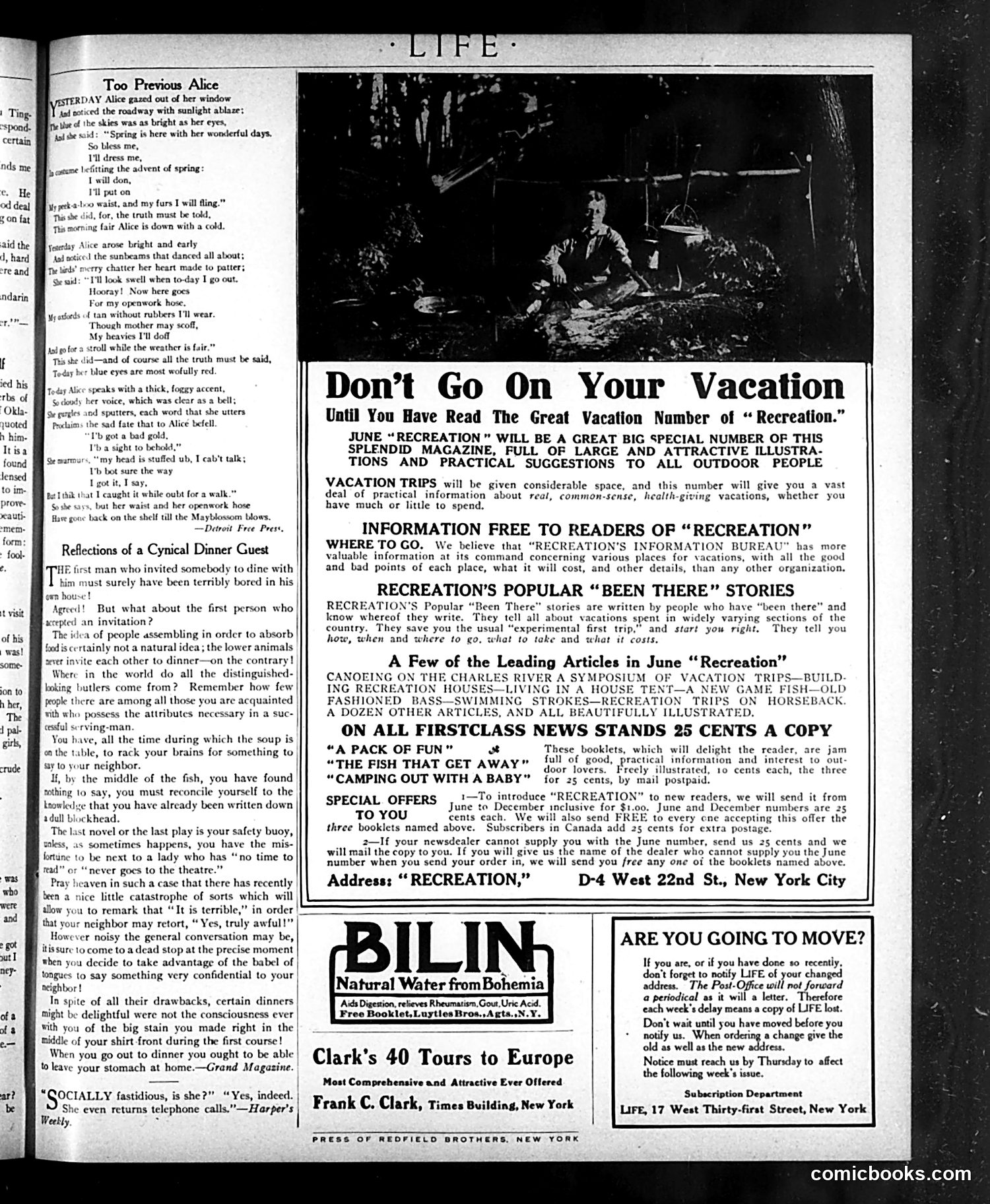
This page contains two separate humor pieces, both satirizing social behavior. **"Too Previous Alice"** (left column) is a cautionary verse about a young woman who, upon seeing spring's first sunny day, dresses lightly in fashionable attire—including an open-work waist and no rubbers (galoshes). The joke: she catches a cold and must retreat into heavy clothing until May. "Too previous" means premature; the satire targets women who abandon winter clothes too eagerly at the first hint of warm weather, ignoring practical wisdom. **"Reflections of a Cynical Dinner Guest"** (lower left) mocks formal dinner-party conventions. The author cynically observes that dinner invitations are inherently unnatural social rituals, and that dinner guests must endure forced conversation, anxiety about etiquette, and the constant fear of making embarrassing mistakes (like spilling food on oneself). The piece satirizes the pretentiousness and awkwardness of upper-class social obligations. The page also contains advertisements for vacation magazine *Recreation* and tour services—complementing the dinner-etiquette satire by offering escape from such tedious social expectations.
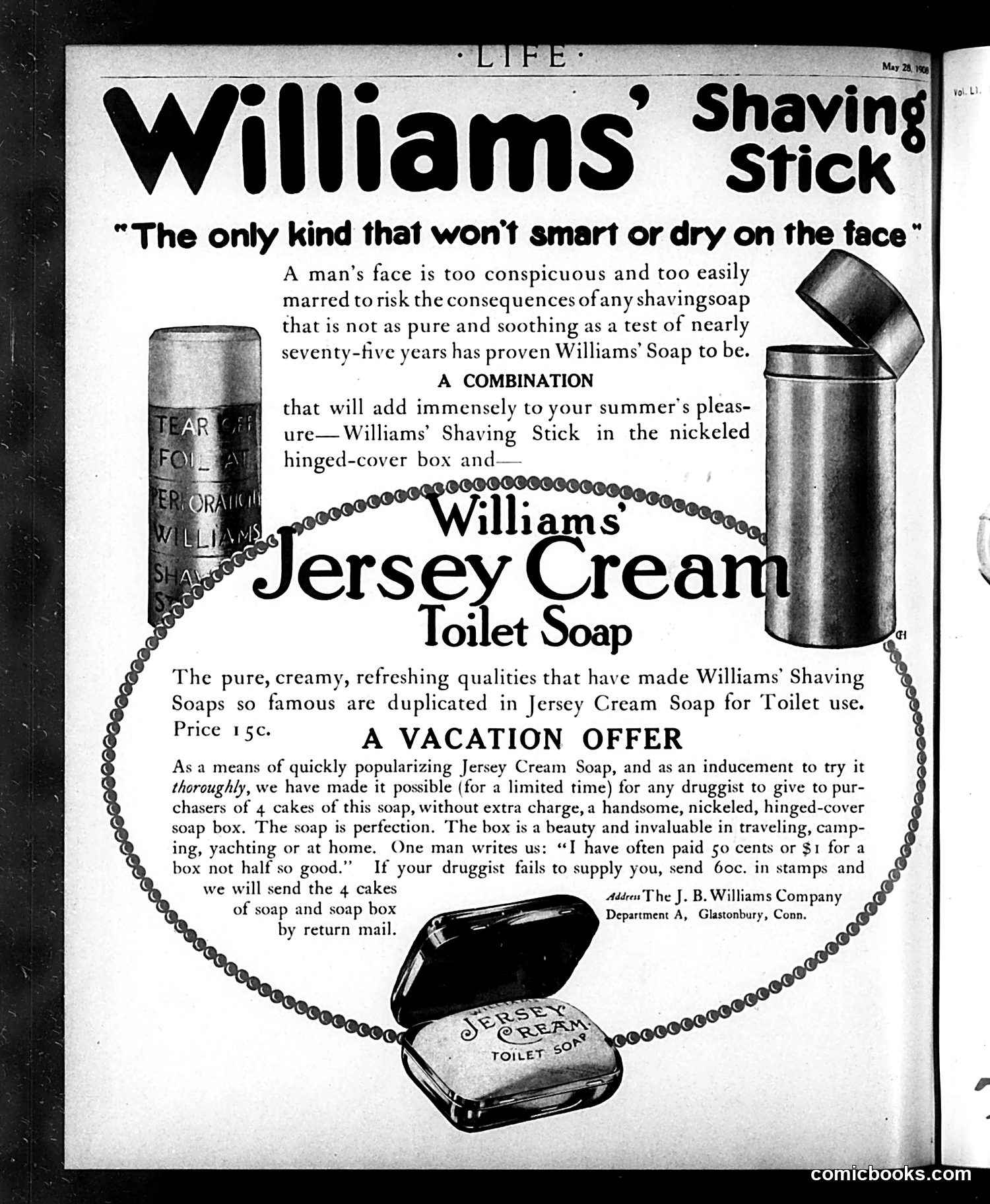
This page is a commercial advertisement for Williams' Shaving Stick and Jersey Cream Toilet Soap, published in *Life* magazine (dated May 23, 1903, visible in header). It contains **no political cartoon or satire**. The ad promotes two grooming products by emphasizing their purity and quality—claiming 75 years of proven effectiveness. The "vacation offer" at center is a marketing promotion: druggists would give customers a free nickeled soap box with purchase of four cakes of Jersey Cream Soap, positioning the box as desirable for travel and camping. The testimonial quote ("I have often paid 50 cents or $1 for a box not half so good") functions as early advertising copy designed to build consumer confidence in the product's value. This reflects early-1900s advertising strategies targeting middle-class men concerned with grooming and summer leisure activities.