
Life, 1908-05-28 · page 14 of 24
Life — May 28, 1908 — page 14: what you’re looking at
What you’re looking at
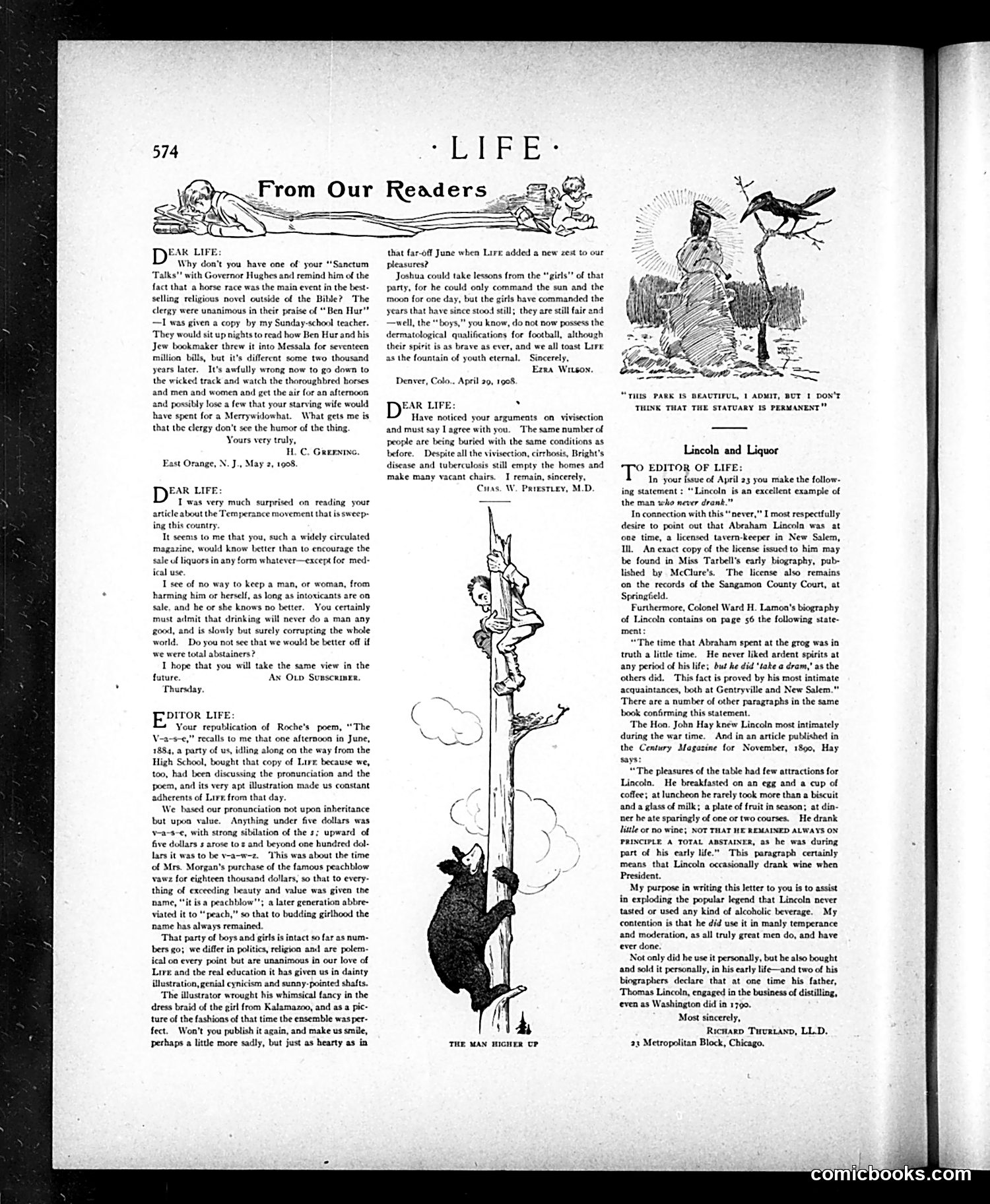
This page presents **reader letters** responding to Life's editorial content—a common magazine feature. Key points: **The Horse Racing Complaint**: A reader criticizes the hypocrisy of clergy praising "Ben-Hur" (a popular novel featuring chariot racing) while condemning actual horse-racing attendance as immoral. The satire targets religious inconsistency: the clergy found entertainment in a *fictional* race acceptable but condemn the *real* activity as sinful. **The Temperance Debate**: Another reader urges Life to oppose alcohol sales, reflecting the pre-Prohibition temperance movement gaining momentum in 1908. **The "Lure" Nostalgia**: A third letter fondly recalls a 1884 poem/illustration from Life, describing how a group of friends remained united across decades despite disagreeing on politics and religion—unified only by their appreciation of Life's "dainty illustration" and "genial cynicism." The accompanying illustrations show a man climbing a tree (likely depicting temptation or struggle) and a woman in period dress on a pedestal—visual humor complementing the written commentary on social hypocrisy and changing values.
📄 Transcribed text from this page (OCR, searchable)
Machine-transcribed from the original scan — historical spelling and the odd misread are preserved.
Why don't you have one of your ‘Sanctum ‘Talks"" with Governor Hughes and remind him of the fact that a horse race was the main event in the best- selling religious novel outside of the Bible? The clergy were unanimous in their praise of “Ben Hur"? —I was given a copy by my Sunday-school teacher. ‘They would sit up nights to read how Ben Hur and his Jew bookmaker threw it into Messala for seventeen million bills, but it’s different some two thousand years later. It's awfully wrong now to go down to the wicked track and watch the thoroughbred horses and men and women and get the air for an afternoon and possibly lose a few that your starving wife would have spent for a Merrywidowhat. What gets me is that the clergy don’t see the humor of the thing. Yours very truly, H. C. Garextne. Orange, N. J., May 2, 1098. EAR LIFE: T was very much surprised on reading your article about the Temperance movement that is sweep- ing this country. It seems to me that you, such a widely circulated magazine, would know better than to encourage the sale of liquors in any form whatever—except for med ical use. T sce of no way to keep a man, of woman, from harming him or herself, as long as intoxicants are on sale, and he or she knows no better. You certainly must admit that drinking will never do a man any good, and is slowly but surely corrupting the whole world. Do you not see that we would be better off if we were total abstainers? T hope that you will take the same view in the future. Ax OLp Sumsceumee, Thursday, DITOR LIFE: Your republication of Roche's poem, “The ,” recalls to me that one afternoon ia June, 1884, a party of us, idling along oa the way from the High School, bought that copy of Lure because we, too, had been discussing the pronunciation and the poem, and its very apt illustration made us coastant adherents of Lire. from that day. We hased our pronunciation not upon inheritance but upon value. Anything under five dollars was wa-s-e, with strong sibilation of the s; upward of five dollars s arose to # and beyond one hundred dol- lars it was to be v-a-w-2, ‘This was about the time of Mrs. Morgan's purchase of the famous peachblow vawz for eightcen thousand dollars, so that to every- thing of exceeding beauty and value was given the name, “it isa peachblow’’; a later generation abbre- viated it to “peach,” so that to budding girlhood the name has always remained ‘That party of boys and girls is intact so far as num- bers go; we differ in politics, religion and are polem- ical on every point but are unanimous in our love of Lire and the real education it has given us in dainty illustration, genial cynicism and sunny-pointed shafts. ‘The illustrator wrought his whimsical fancy in the dress braid of the girl from Kalamazoo, and as a pic ture of the fashions of that time the ensemble was per- fect. Won't you publish it again, and make us smile, pethaps a little more sadly, but just as hearty as in BAIL F Je 6 that far-off June when Lirr added a new zest to our pleasures? Joshua could take lessons from the "girls" of that party, for he could oaly command the sun and the moon for one day, but the girls have commanded the years that have since stood still; they are still fair and —well, the “boys,” you know, do not now possess the dermatological qualifications for football, although their spirit is as brave as ever, and we all toast Lire as the fountain of youth eternal. Sincerely, Ezra Wrtsoy. Denver, Colo.. April 29, 1908. AR LIFE: . Have noticed your arguments on vivisection and must say [agree with you. ‘The same number of people are being buried with the same conditions as before. Despite all the vivisection, cirrhosis, Bright's disease and tuberculosis still empty the bomes and make many vacant chairs. I remain, sincerely, Cuas. W. Prrestiry, M.D. THE MAN MIGHER CP PARK IS BEAUTIFUL, 1 ADMIT, BUT 1 DON'T THINK THAT THE STATUARY 15 PERMANENT"? Lincoln and Liquor ‘0 EDITOR OF LIFE: In your fssue of April 23 you make the follow- ng statement : “Lincoln is an excellent example of the man who never drank.” In connection with this" never,” I most respectfully desire to point out that Abraham Lincoln was at ove time, a licensed tavern-keeper in New Salem, Il. An exact copy of the license issued to him may be found in Miss Tarbell’s early biography, pub- lished by McClure's. ‘The license also remains fon the records of the Sangamon County Court, at Springfield Furthermore, Colonel Ward H. Lamoa's biography ‘of Lincoln contains on page 56 the following state- ment “The time that Abraham spent at the grog was in truth a little time. He never liked ardent spirits at any period of his life; but he did ‘take a dram,’ as the others did. This fact is proved by his most intimate acquaintances, both at Gentryville and New Salem." There are a number of other paragraphs in the same book confirming this statement, ‘The Hoa. John Hay knew Lincoln most intimately during the war time. And in an article published in the Century Magazine for November, 1890, Hay says: “The pleasures of the table had few attractions for Lincoln. He breakfasted on an egg and a cup of coffee; at luncheon he rarely took more than a biscuit and a glass of milk; a plate of fruit in season; at din- ner he ate sparingly of one or two courses. He drank little of no wine; NOT THAT HE REMAINED ALWAYS ON PRINCIPLE A TOTAL ABSTAINER, as he was during part of his early life." This paragraph certainly means that Lincola occasionally drank wine when President. My purpose in writing this letter to you is to assist in exploding the popular legend that Lincoln never tasted or used any kind of alcoholic beverage. My contention is that he did use it in manly temperance and moderation, as all truly great men do, and have ever done. Not only did he use it personally, but he also bought ‘and sold it personally, in his early life—and two of his biographers declare that at one time his father, ‘Thomas Lincoln, engaged in the business of distilling, even as Washington did in 1790. Most sincerely, Ricnarp Tuvatanp, LL.D. 23 Metropolitan Block, Chicago.