
Life, 1908-05-28 · page 6 of 24
Life — May 28, 1908 — page 6: what you’re looking at
What you’re looking at
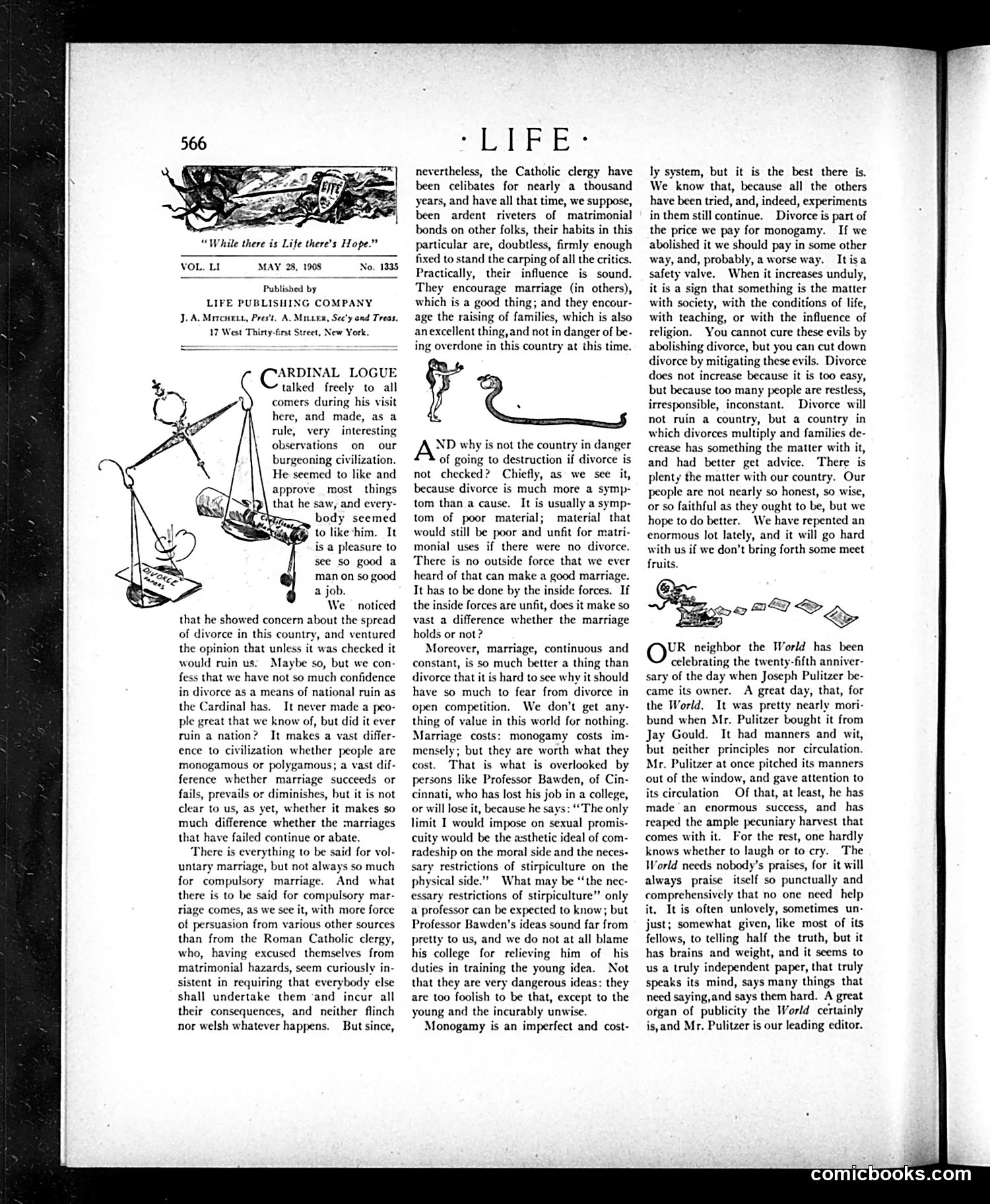
The page features an editorial about divorce and marriage, with a decorative illustration showing figures in classical/allegorical style (likely representing concepts rather than specific people). The text references **Cardinal Logue**, who apparently visited and made public statements supporting Catholic opposition to divorce. The editorial discusses whether divorce should be legally restricted, debating monogamy's merits versus its costs. The piece also praises **Joseph Pulitzer**, editor of the *World* newspaper, for his journalistic success and independent editorial voice, contrasting him favorably with Professor Bawden of Cincinnati. The cartoon's classical style appears meant to dignify the serious debate about marriage, family, and social policy rather than mock specific individuals. The satire is subtle—targeting ideas about divorce policy rather than personal caricature.
📄 Transcribed text from this page (OCR, searchable)
Machine-transcribed from the original scan — historical spelling and the odd misread are preserved.
“While there is Life there's Hope.” VOL. LI No. 1335 MAY 28, 1908 Published by LIFE PUBLISHING COMPANY J.A. Mrrcent, Pres’t, A, Mit 17 West Thirty-first Street, RDINAL LOGUE talked freely to all comers during his visit here, and made, as a rule, very interesting observations on our burgeoning civilization. He seemed to like and approve most things that he saw, and every- body seemed to like ‘him. It is a pleasure to see so good a man on so good a job. We noticed that he showed concern about the spread of divorce in this country, and ventured the opinion that unless it was checked it would ruin us. Maybe so, but we con- fess that we have not so much confidence in divorce as a means of national ruin as the Cardinal has. It never made a peo- ple great that we know of, but did it ever ruin a nation? It makes a vast differ- ence to civilization whether people are monogamous or polygamous; a vast dif- ference whether marriage succeeds or fails, prevails or diminishes, but it is not clear to us, as yet, whether it makes so much difference whether the marriages that have failed continue or abate. There is everything to be said for vol- untary marriage, but not always so much for compulsory marriage. And what there is to be said for compulsory mar- riage comes, as we see it, with more force of persuasion from various other sources than from the Roman Catholic clergy, who, having excused themselves from matrimonial hazards, seem curiously in- sistent in requiring that everybody else shall undertake them ‘and incur all their consequences, and neither flinch nor welsh whatever happens. But since, AERA: nevertheless, the Catholic clergy have been celibates for nearly a thousand years, and have all that time, we suppose, been ardent riveters of matrimonial bonds on other folks, their habits in this particular are, doubtless, firmly enough fixed to stand the carping of all the critics. Practically, their influence is sound. They encourage marriage (in others), which is a good thing; and they encour- age the raising of families, which is also anexcellent thing, and not in danger of be- ing overdone in this country at this time. ANP why is not the country in danger of going to destruction if divorce is not checked? Chiefly, as we see it, because divorce is much more a symp- tom than a cause. It is usually a symp- tom of poor material; material that would still be poor and unfit for matri- monial uses if there were no divorce. There is no outside force that we ever heard of that can make a good marriage. It has to be done by the inside forces. If the inside forces are unfit, does it make so vast a difference whether the marriage holds or not? Moreover, marriage, continuous and constant, is so much better a thing than divorce that it is hard to see why it should have so much to fear from divorce in open competition. We don’t get any- thing of value in this world for nothing. Marriage costs: monogamy costs im- mensely; but they are worth what they cost. That is what is overlooked by persons like Professor Bawden, of Cin- cinnati, who has lost his job in a college, or will lose it, because he says: “The only limit I would impose on sexual promis- cuity would be the asthetic ideal of com- radeship on the moral side and the neces- sary restrictions of stirpiculture on the physical side.” What may be “the nec- essary restrictions of stirpiculture” only a professor can be expected to know; but Professor Bawden’s ideas sound far from pretty to us, and we do not at all blame his college for relieving him of his duties in training the young idea. Not that they are very dangerous ideas: they are too foolish to be that, except to the young and the incurably unwise. Monogamy is an imperfect and cost- ly system, but it is the best there is. We know that, because all the others have been tried, and, indeed, experiments in them still continue. Divorce is part of the price we pay for monogamy. If we abolished it we should pay in some other way, and, probably, a worse way. It isa safety valve. When it increases unduly, it is a sign that something is the matter with society, with the conditions of life, with teaching, or with the influence of religion. You cannot cure these evils by abolishing divorce, but you can cut down divorce by mitigating these evils. Divorce does not increase because it is too easy, but because too many people are restless, irresponsible, inconstant. Divorce will not ruin a country, but a country in which divorces multiply and families de- crease has something the matter with it, and had better get advice. There is plenty the matter with our country. Our people are not nearly so honest, so wise, or so faithful as they ought to be, but we hope to do better. We have repented an enormous lot lately, and it will go hard with us if we don’t bring forth some meet fruits. Poe Se Ov neighbor the World has been celebrating the twenty-fifth anniver- sary of the day when Joseph Pulitzer be- came its owner. A great day, that, for the World. It was pretty nearly mori- bund when Mr. Pulitzer bought it from Jay Gould. It had manners and wit, but neither principles nor circulation. Mr. Pulitzer at once pitched its manners out of the window, and gave attention to its circulation Of that, at least, he has made an enormous success, and has reaped the ample pecuniary harvest that comes with it. For the rest, one hardly knows whether to laugh or to cry. The World needs nobody’s praises, for it will always praise itself so punctually and comprehensively that no one need help it. It is often unlovely, sometimes un- just; somewhat given, like most of its fellows, to telling half the truth, but it has brains and weight, and it seems to us a truly independent paper, that truly speaks its mind, says many things that need saying,and says them hard. A great organ of publicity the World certainly is,and Mr. Pulitzer is our leading editor. comicbooks.com