
A complete issue · 24 pages · 1907
Life — October 10, 1907
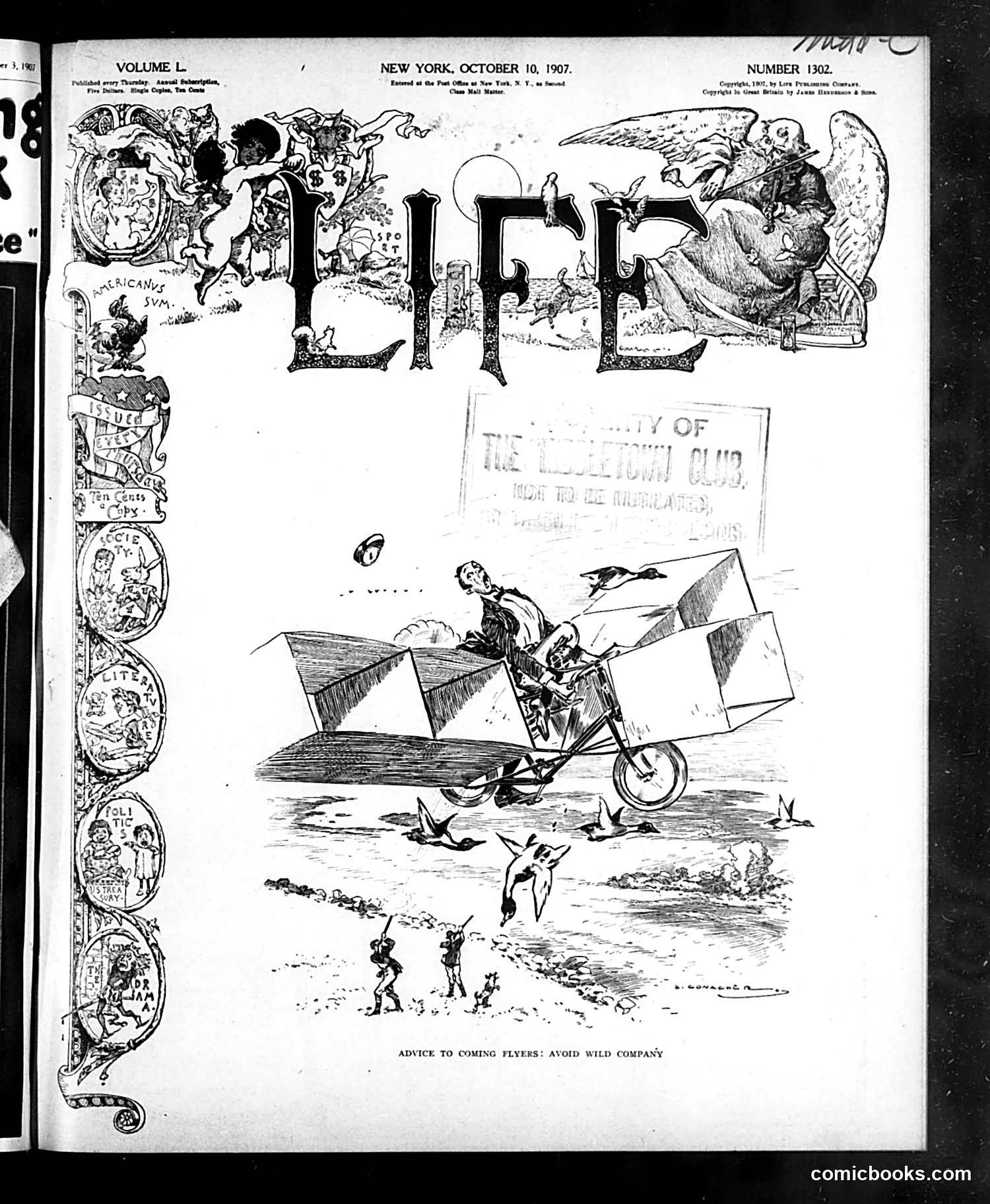
**Main Cartoon:** "Advice to Coming Flyers: Avoid Wild Company" The illustration depicts an early aviator on a primitive aircraft encountering mischievous figures below—devils or imps—seemingly interfering with the flight. This is satirical commentary on early aviation's dangers and public fascination with the new technology. **Historical Context:** 1907 was the dawn of powered flight (Wright Brothers' 1903 flight was recent). The cartoon jokes that aviators should avoid "wild company"—meaning reckless associates or perhaps the inherent chaos of experimental flight itself. The devils represent the unpredictability and danger aviation posed. **Left Border:** Decorative zodiac or astrological symbols, standard Life magazine ornamentation. The cartoon humorously suggests that aviation's greatest hazard might be human folly rather than mechanical failure.
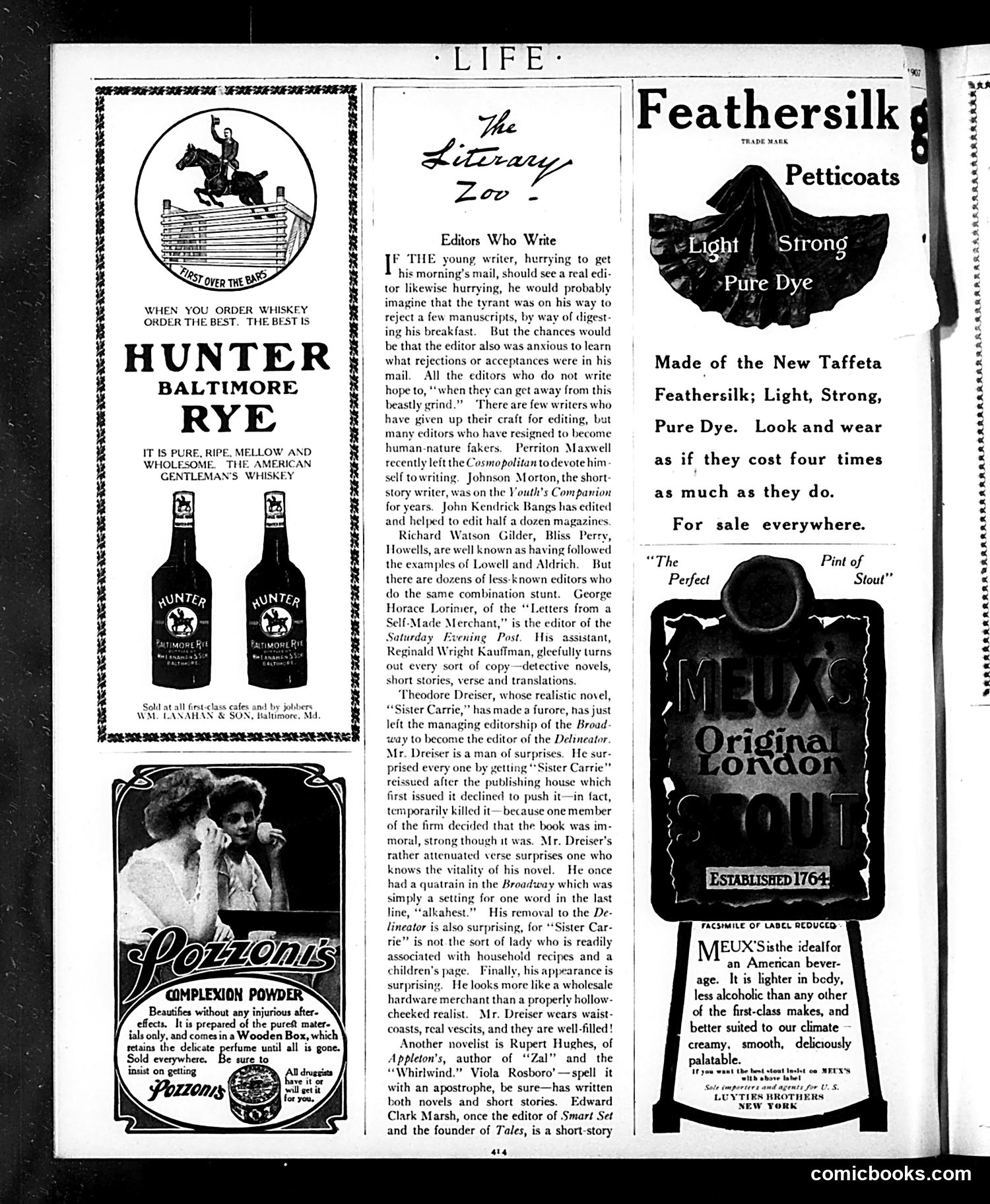
This page is primarily **advertising**, not satirical content. The left side advertises **Hunter Baltimore Rye whiskey**, featuring a circular logo of a horseman jumping over a barrel, with two bottle images below. The center contains "The Literary Zoo," an article discussing editors of major publications who also write—listing figures like Perriton Maxwell, Johnson Morton, John Kendrick Bangs, and others. It's a straightforward editorial feature, not satire. The right side advertises **Feathersilk petticoats** (made of new "Taffeta" fabric) and **Meux's Original London** stout beer, plus **Pozzoní's Complexion Powder** below. This is a typical early 20th-century magazine layout mixing editorial content with period product advertisements. No political cartoons or satire appear on this particular page.
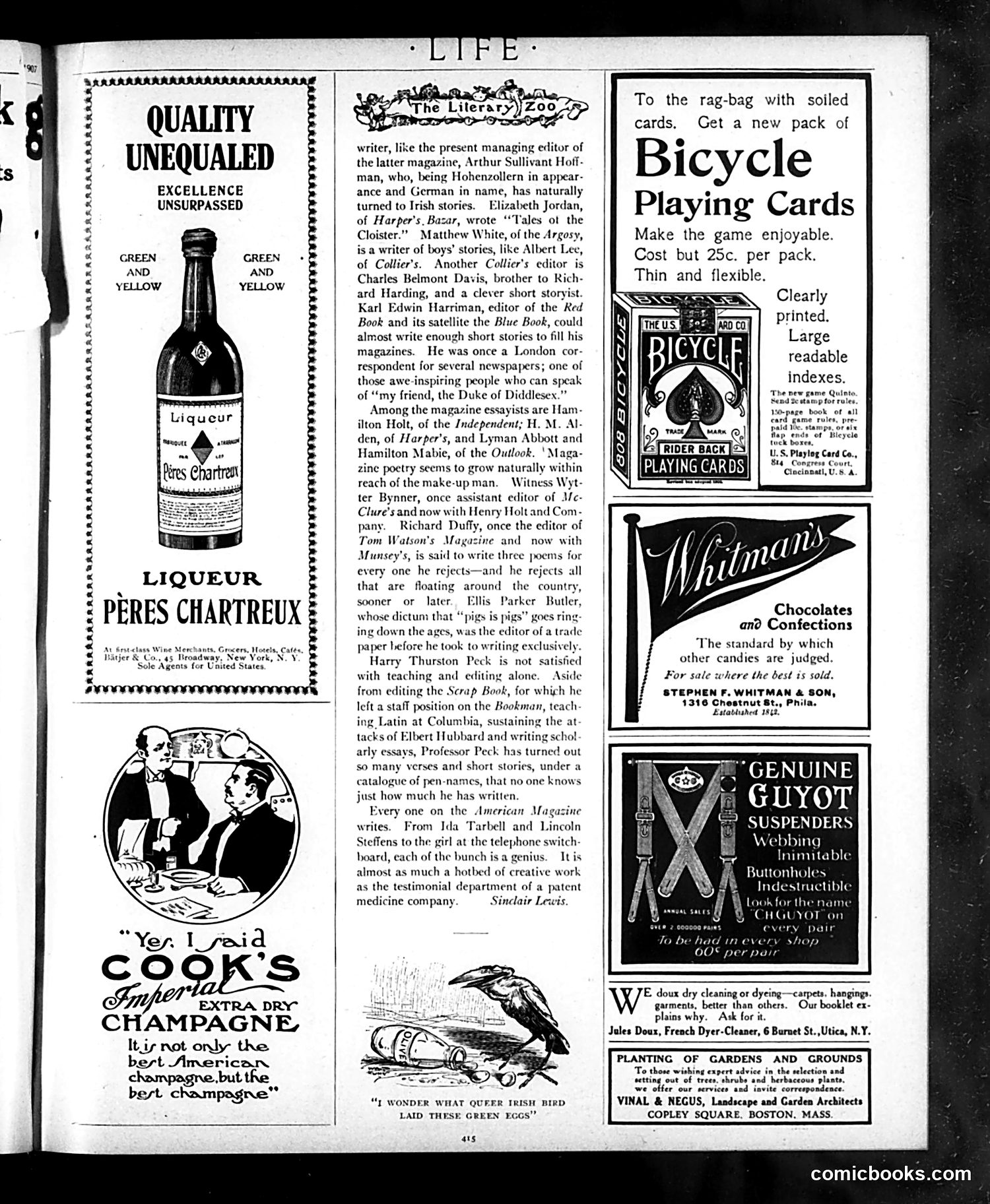
This page is **primarily advertisements** with one small cartoon. The main cartoon, titled **"Yes! I said Cook's Imperial Extra Dry Champagne,"** depicts two men in formal attire examining documents at a table. The joke appears to reference a mix-up or misunderstanding about champagne—one man seems to be clarifying or insisting on the champagne brand name, suggesting either a miscommunication or perhaps a humorous situation involving the product. The remainder of the page contains period advertisements for luxury goods: liqueur, playing cards, chocolates, and suspenders. These ads reflect early-20th-century consumer culture targeting affluent readers. Without additional historical context about the specific champagne brand or any contemporary controversy, the cartoon's precise satirical target remains **unclear**.
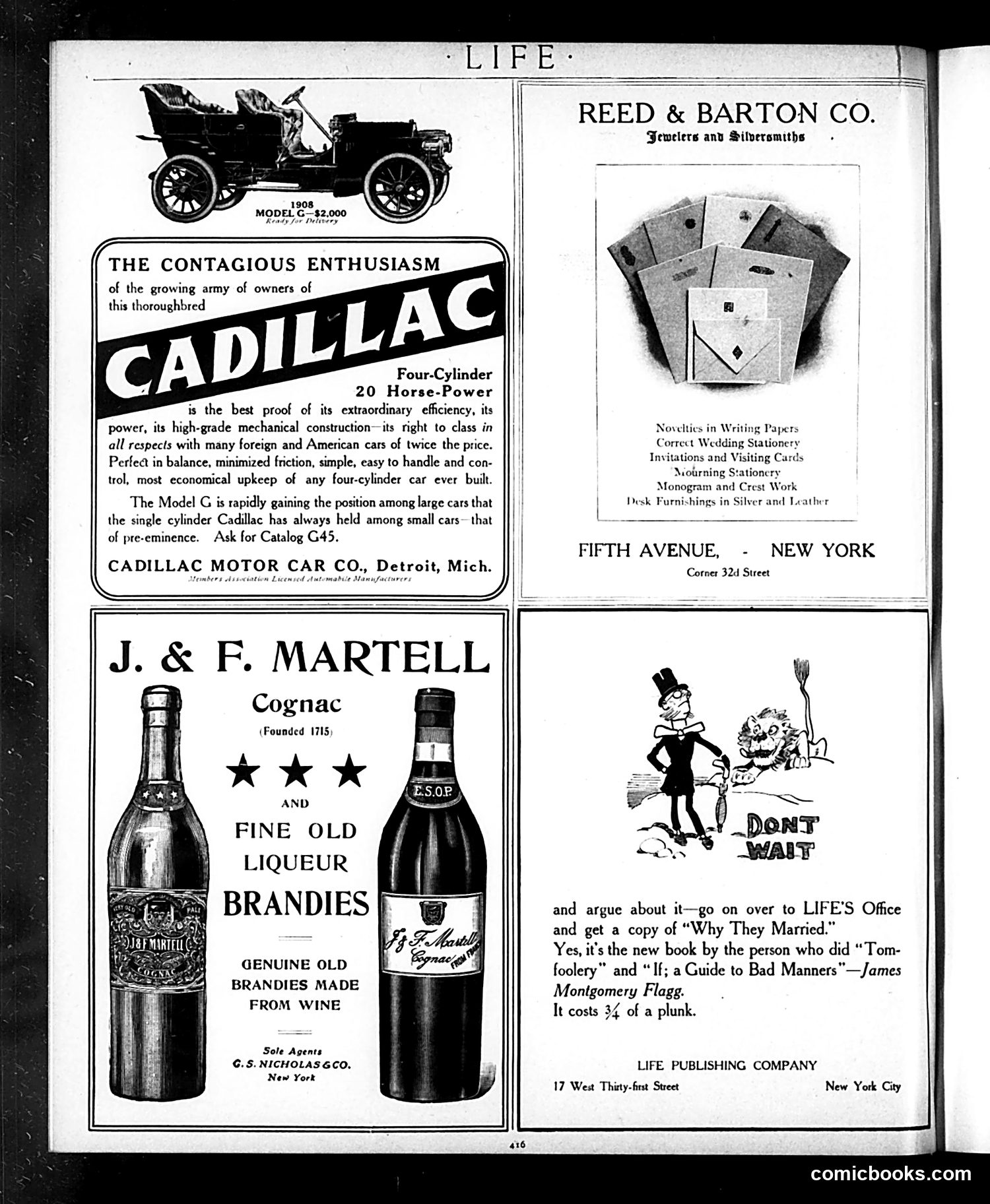
This page is primarily **advertising**, not satire or political commentary. The top-left features a **Cadillac automobile ad** (1908 Model G, $2,000) emphasizing its four-cylinder engine and efficiency compared to foreign cars—typical early automotive marketing. The bottom-left advertises **J. & F. Martell Cognac brandy**, founded 1715, sold by C.S. Nicholas & Co. in New York. The right side shows **Reed & Barton Co.** (jewelers/silversmiths) advertising stationery and desk items. The bottom-right contains a **humorous cartoon** with a well-dressed man and cherub figure promoting "Why They Married" by James Montgomery Flagg—a book about manners, priced at 3/8 of a plank (likely "a plank" being period slang for a dollar). No significant political content is evident here.
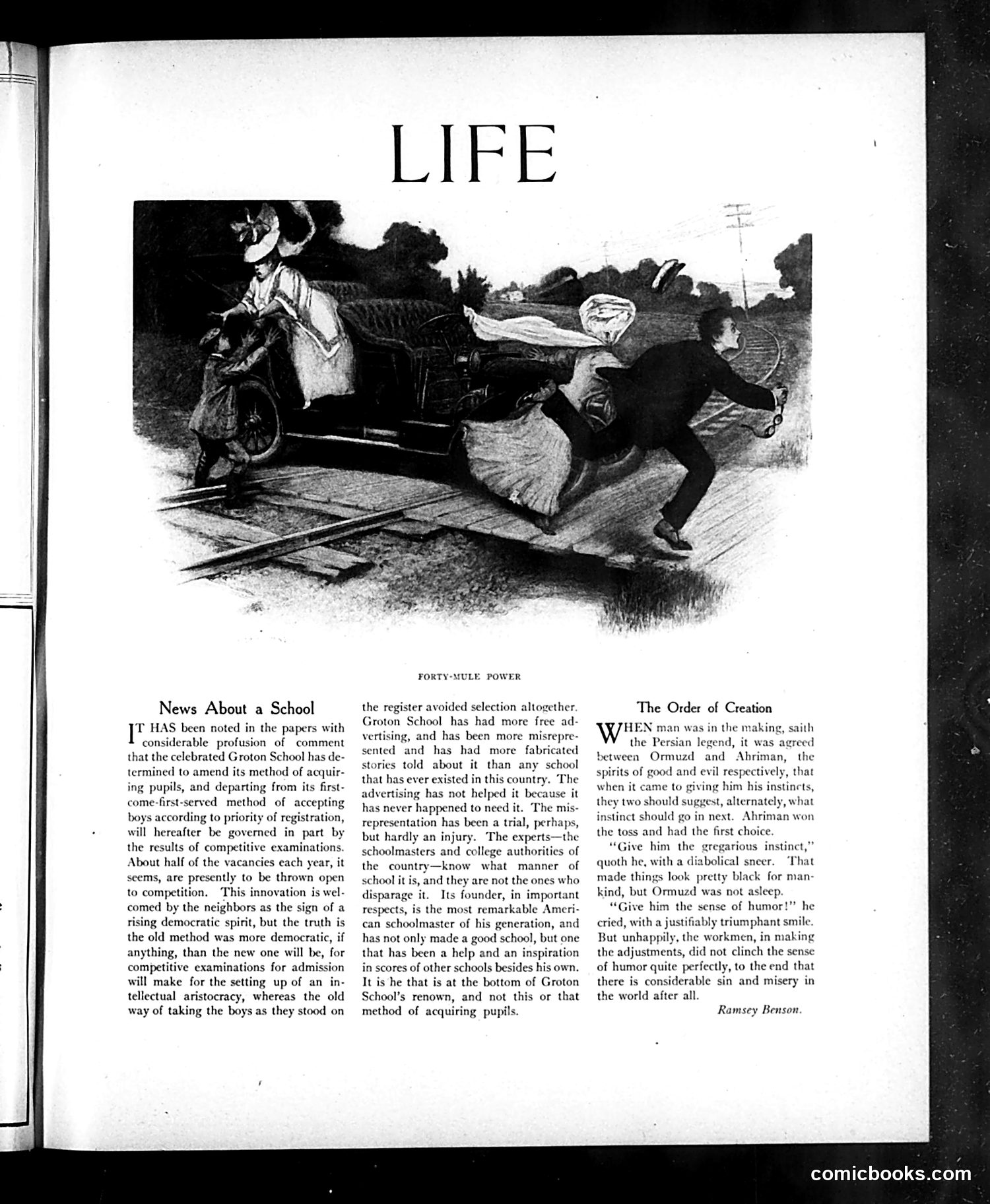
The page features two distinct pieces: **"Forty-Mule Power" (cartoon):** This appears to be a humorous illustration showing a man being pulled backward by a mule while attempting to operate an early automobile. The satire likely mocks the unreliability or difficulty of early motor vehicles compared to traditional animal power—a common theme in early 1900s humor about nascent automobile technology. **"News About a School" and "The Order of Creation" (articles):** These are satirical commentary pieces. The left article criticizes Groton School's admissions practices and institutional reputation. The right piece, attributed to Ramsey Benson, presents a tongue-in-cheek creation myth comparing human instincts to those of animals (Ormuzd and Ahriman—Persian religious concepts). Together, they appear to critique educational pretension and institutional authority of the era.
The page critiques President Woodrow Wilson's plan to split Princeton University into smaller residential colleges. The text discusses whether this experimental educational restructuring will succeed, noting it would cost approximately two million dollars. The **cartoon (five owls in a row)** likely symbolizes wisdom or learned observation—possibly representing Princeton faculty or educators watching Wilson's ambitious but uncertain plan unfold. Owls traditionally represent academic wisdom in political cartooning. The article expresses skepticism about whether Wilson can secure funding and whether other universities will follow suit. It mentions that even Harvard rejected a similar scheme, suggesting the plan is risky and unproven. The satire questions Wilson's Utopian idealism against practical educational realities.
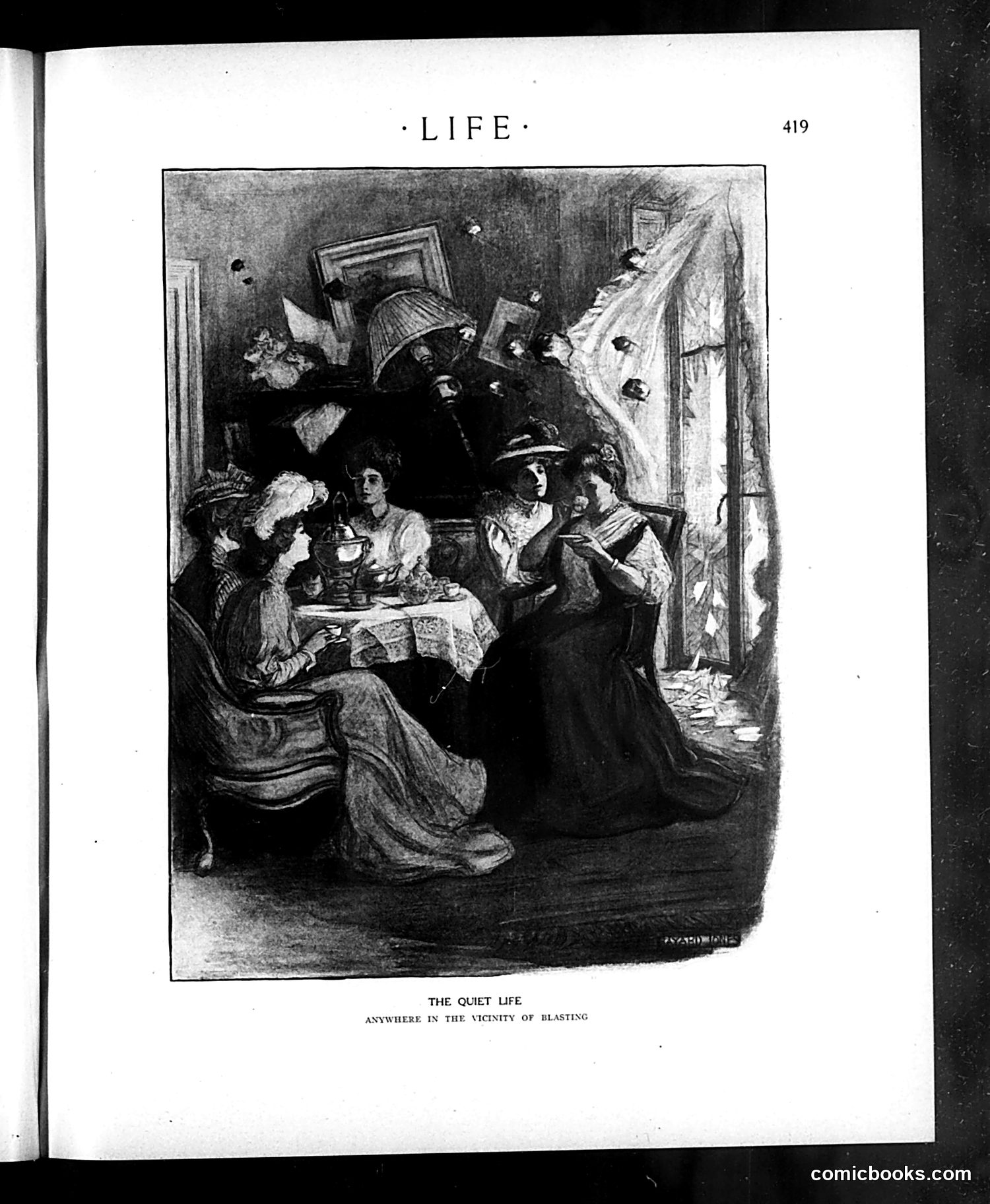
This satirical cartoon depicts women attempting to have a civilized tea gathering while military or industrial blasting occurs around them. Soldiers or workers (shown standing in the background) are actively engaged in explosions and construction work, with debris flying. The satire contrasts the title's promise of "quiet life" with the chaotic reality of their actual situation. The women sit composed at their table despite the literal explosions nearby—a commentary on either civilian resilience during wartime, or more likely, the absurdity of trying to maintain normal domestic life amid military operations or industrial activity. The humor lies in the contradiction between the genteel, peaceful activity (tea time) and the violent, disruptive circumstances surrounding it.
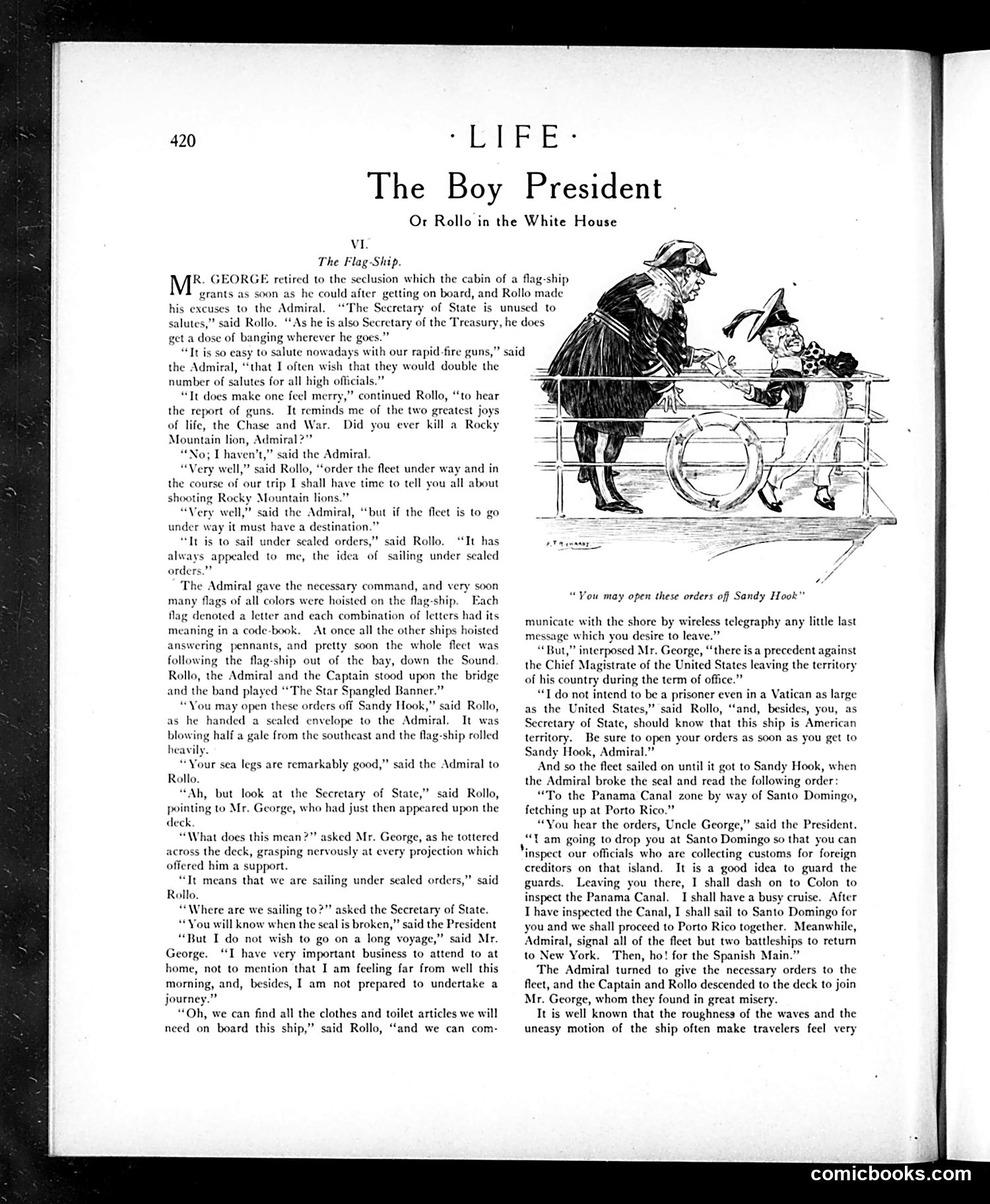
This satirical story mocks a young, inexperienced U.S. President through the character "Rollo," who is portrayed as childishly naive. The illustration shows Rollo seated at a desk with an older authority figure (likely Secretary of State Mr. George), establishing the joke that the President needs adult supervision. The satire centers on Rollo's absurd incompetence: he's unfamiliar with basic governmental procedures like sealed orders and flag signals, requiring the Admiral to explain elementary concepts. References to "Sandy Hook" and canal inspections suggest contemporary political events, while the overall tone ridicules a President seen as unprepared—suggesting this targets a specific historical figure perceived as youthfully unqualified for office, though the exact president remains unclear from this excerpt alone.
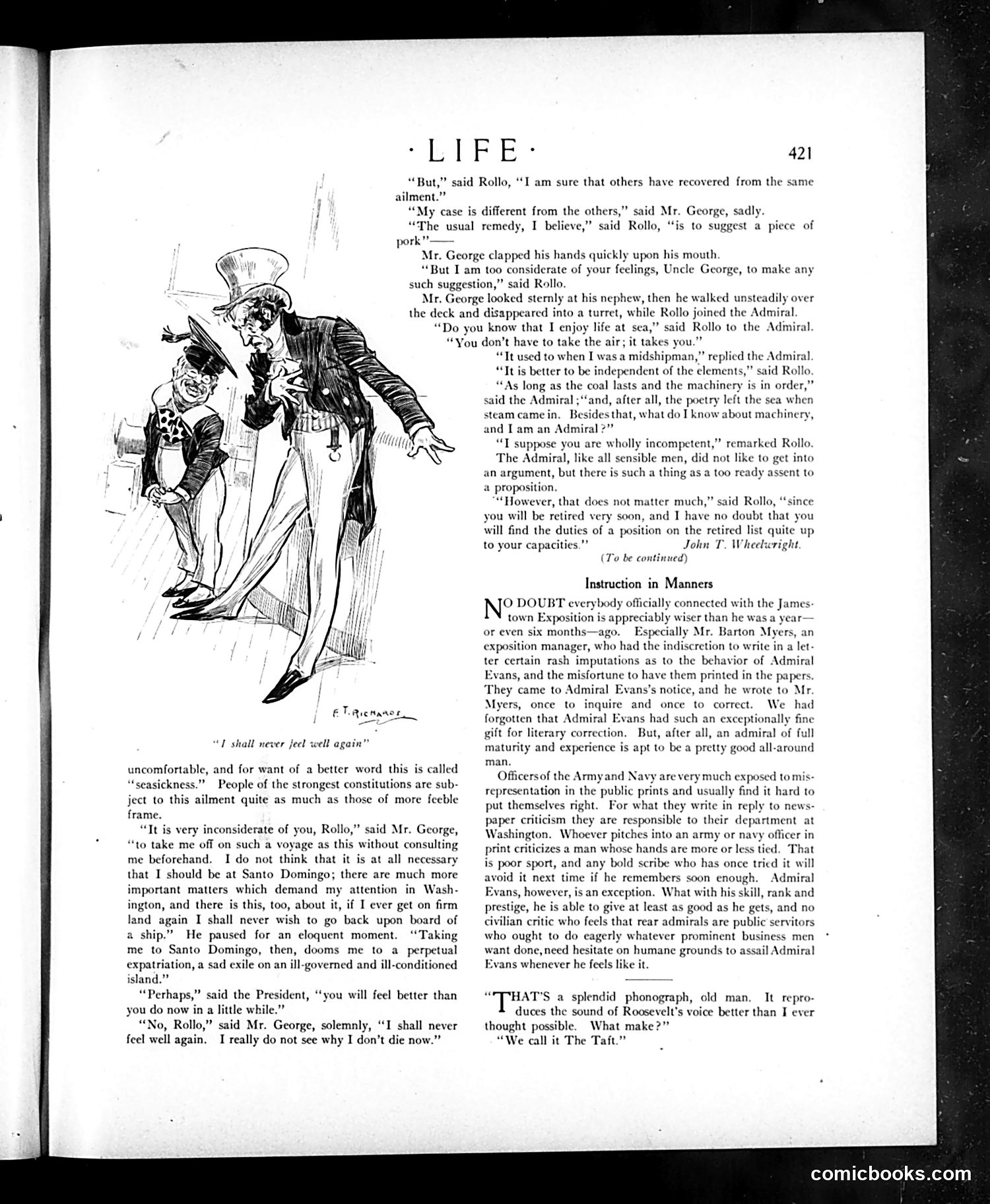
The cartoon depicts two naval officers in conversation, with the taller figure (likely representing authority/command) gesturing dismissively toward a smaller, distressed officer below. The illustration style is typical early 20th-century satirical cartooning. The accompanying text discusses Admiral Evans and exposure to misrepresentation in public prints regarding "the Jamestown Exposition." The passage critiques how military officers face unfair newspaper criticism, noting that Admiral Evans has received corrective letters about inaccurate reporting. The cartoon appears to satirize the vulnerability of military figures to press scrutiny and public perception—showing the tension between naval officers' dignity and their inability to control their public image through newspaper commentary. The specific reference to "seasickness" in dialogue suggests mockery of naval vulnerability to criticism.
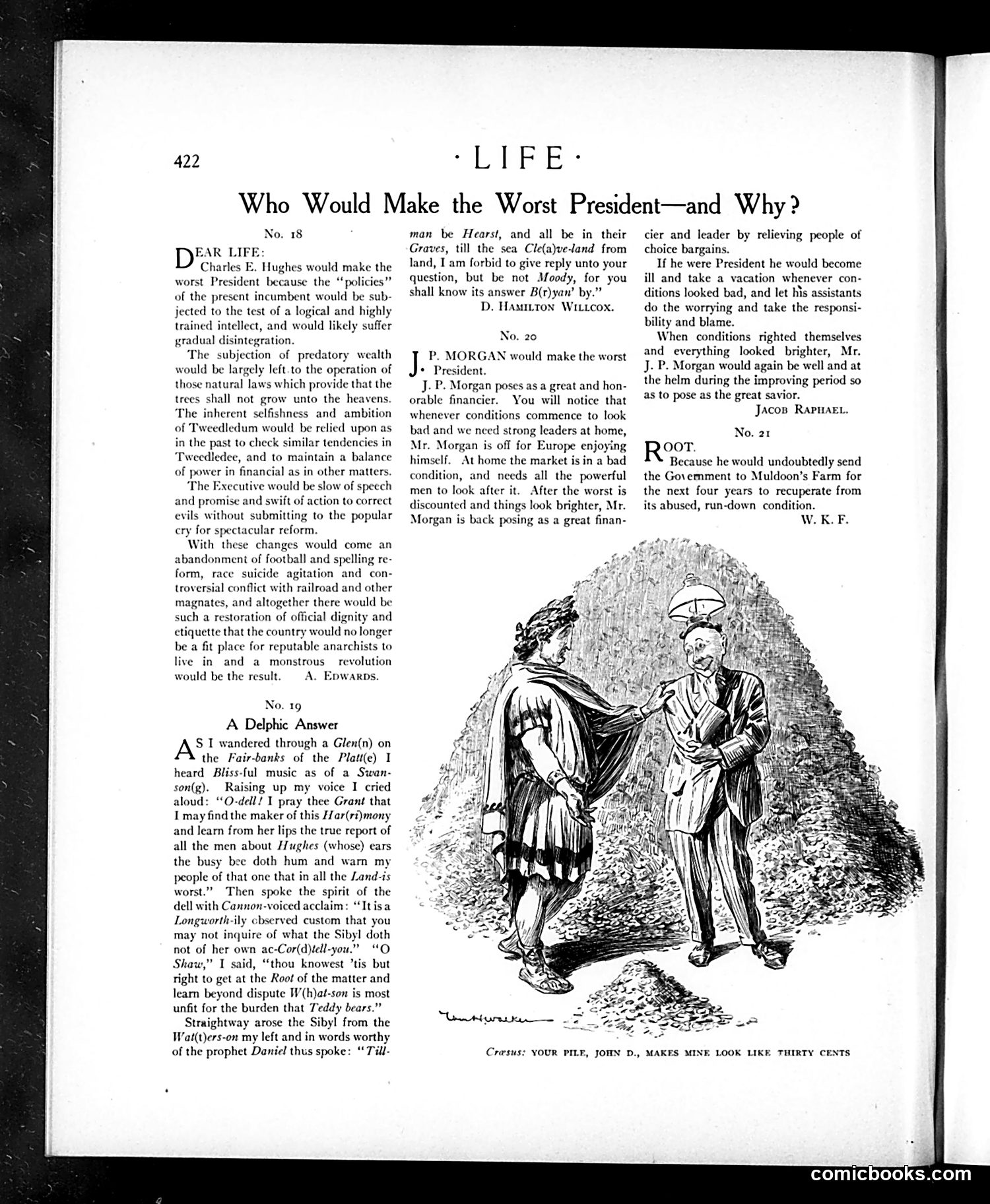
This page from *Life* magazine presents reader responses to "Who Would Make the Worst President—and Why?" (No. 18). The cartoon illustrates one response, showing two figures in what appears to be a rural or farm setting, with the caption: "CRITICS: YOUR FILE, JOHN D., MAKES MINE LOOK LIKE THIRTY CENTS." The reference is to **John D. Rockefeller**, the oil magnate and one of America's wealthiest men. The satire suggests that Rockefeller's financial empire and controversial business practices make him an unsuitable presidential candidate. The visual joke plays on wealth disparity—one figure sarcastically claims his own file (presumably of misdeeds or scandals) appears trivial compared to Rockefeller's. The various written responses debate presidential qualifications, touching on administrative competence, financial management, and moral fitness for office.
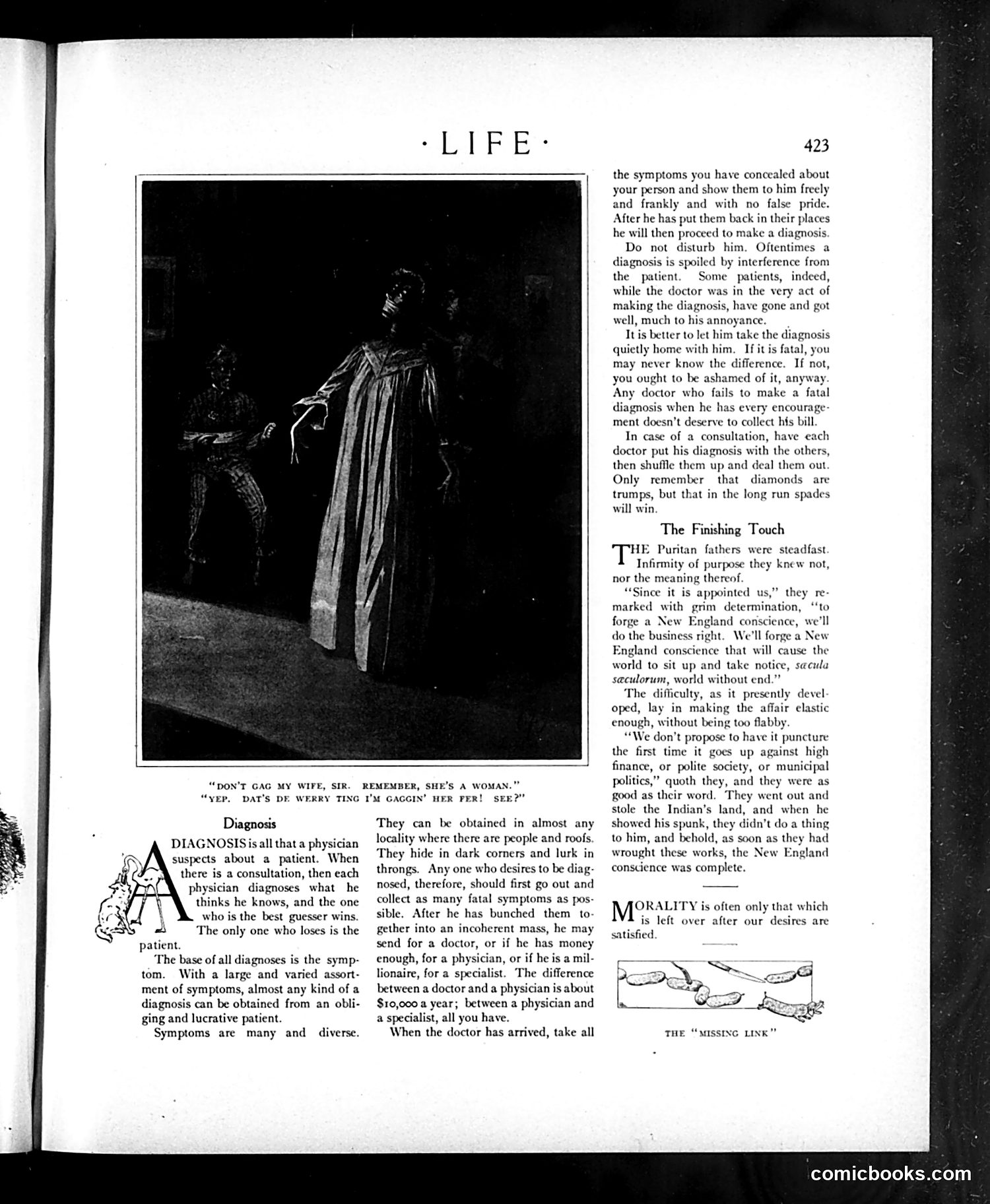
The main illustration depicts a Puritan-era figure in period dress confronting another figure in darkness—likely representing early American Puritan values meeting modern challenges. The accompanying text discusses the Puritan fathers' intent to "forge a New England conscience" that would serve as a moral model ("sacula saeculorum, world without end"). The satire critiques how this idealistic moral mission became diluted or compromised over time. Below are sections on "Diagnosis" (medical advice) and "Morality," with a small illustration labeled "The Missing Link" at the bottom—likely a visual pun suggesting evolutionary or philosophical connections. The page satirizes the gap between Puritan aspirations and actual American social/moral outcomes, questioning whether that founding moral project succeeded or failed.
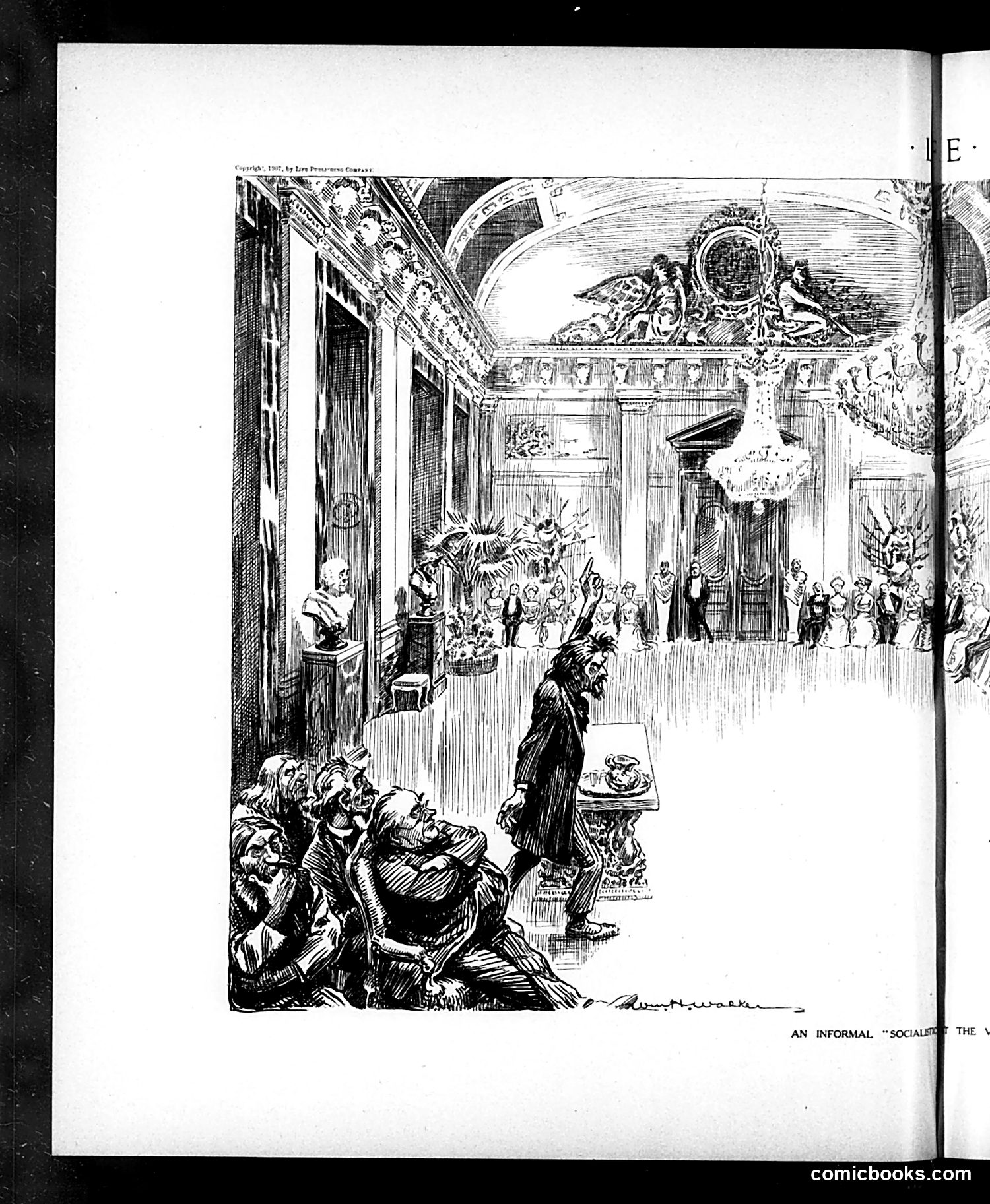
This illustration, titled "An Informal 'Socialite'" (text partially visible at bottom), depicts a grand interior space with classical architecture—tall columns, ornate ceiling details, and elaborate decorative elements. A well-dressed man in formal attire stands centrally, gesturing or speaking, while crowds of people fill the vast hall around him. The satire appears to mock wealthy social gatherings or "society" events. The contrast between the solitary, prominent figure and the numerous attendees suggests commentary on social hierarchy or the performative nature of high-society gatherings. The architectural grandeur emphasizes the pretension being satirized. The specific identities of figures remain unclear, but the overall message critiques the artificial formality and social posturing of elite social circles.
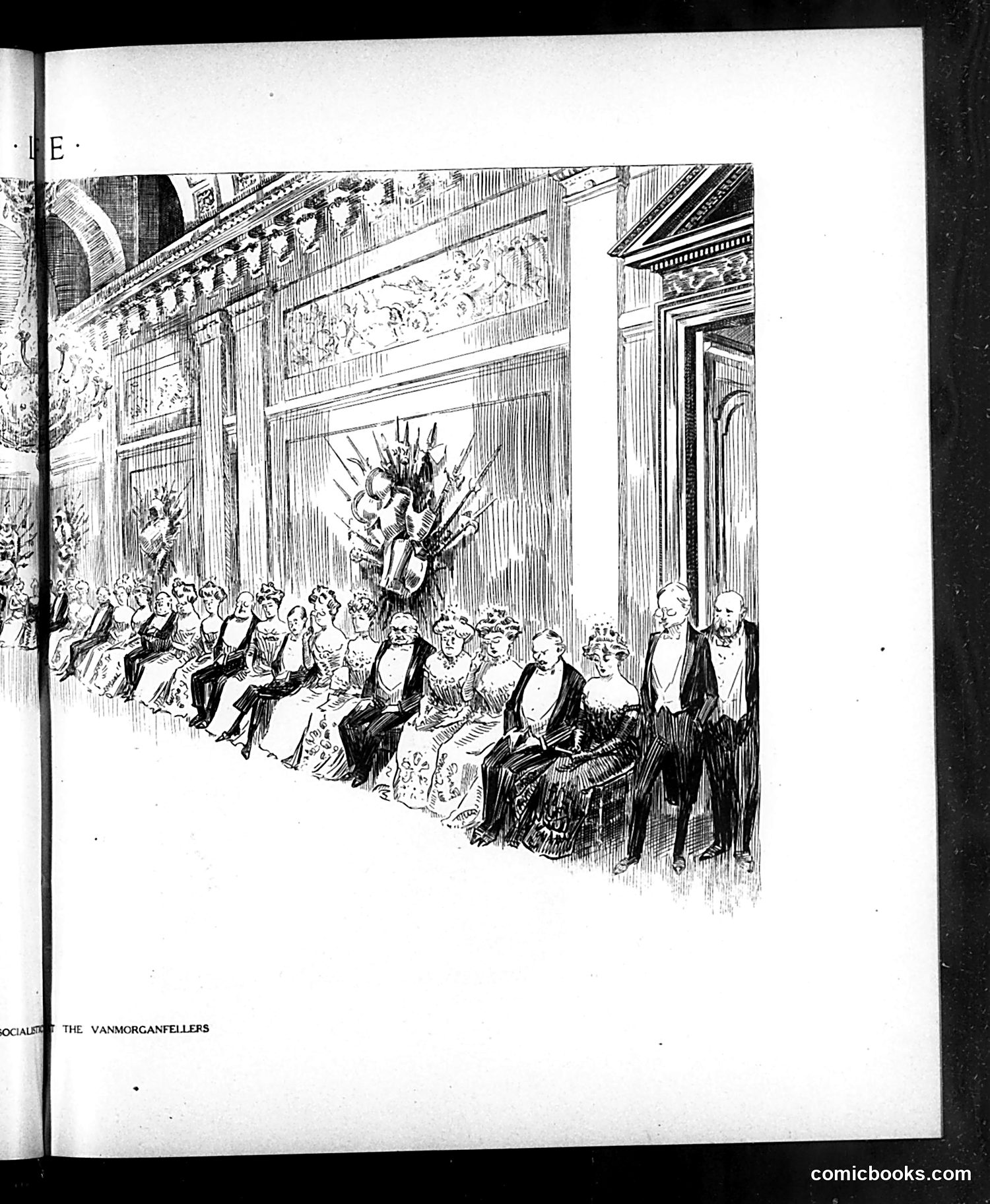
This illustration depicts an elegant interior scene with well-dressed aristocratic figures seated in formal attire. The caption reads "THE VANMORGANFELLERS," a satirical name that appears to mock wealthy elites by combining "Van" (a Dutch surname prefix associated with old money) with "Morgan" and "Fellers." The scene shows what appears to be a high society gathering or performance in an ornate room with decorative murals. The figures' formal dress and the grand architectural setting suggest this satirizes the pretensions and social affectations of the wealthy upper class. The composite name "Vanmorganfellers" likely parodies how nouveau riche families would adopt aristocratic-sounding names to claim social status, making fun of American wealth accumulation and social climbing during the Gilded Age era.
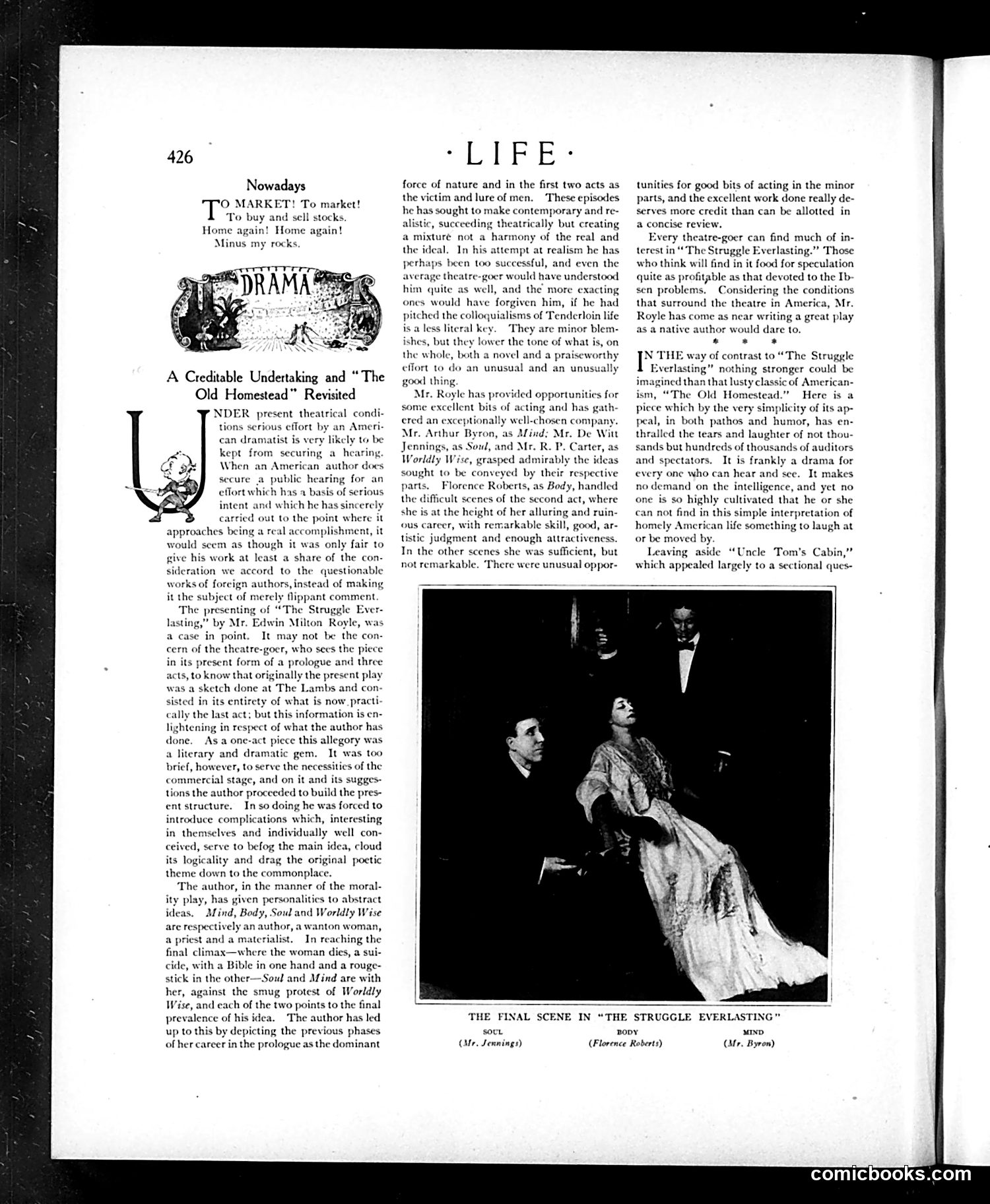
This page reviews Edwin Milton Royle's play "The Struggle Everlasting," an allegorical morality play where abstract concepts are personified as characters: Mind (an author), Body (a wanton woman), Soul (a priest), and Worldly Wise (a materialist). The critic praises the serious dramatic effort but faults the execution. Originally a one-act literary gem, Royle expanded it for commercial theater, introducing realistic Tenderloin-life dialogue that undermines the idealistic allegory. The result confuses rather than clarifies the play's philosophical point about competing human impulses. The photograph shows the final scene where Body dies by suicide, clutching both a Bible and rouge-stick—symbolizing her internal spiritual and material conflicts, with Soul and Mind present as competing moral forces. The critique reflects early 20th-century theater debates: how to balance artistic integrity with commercial viability.
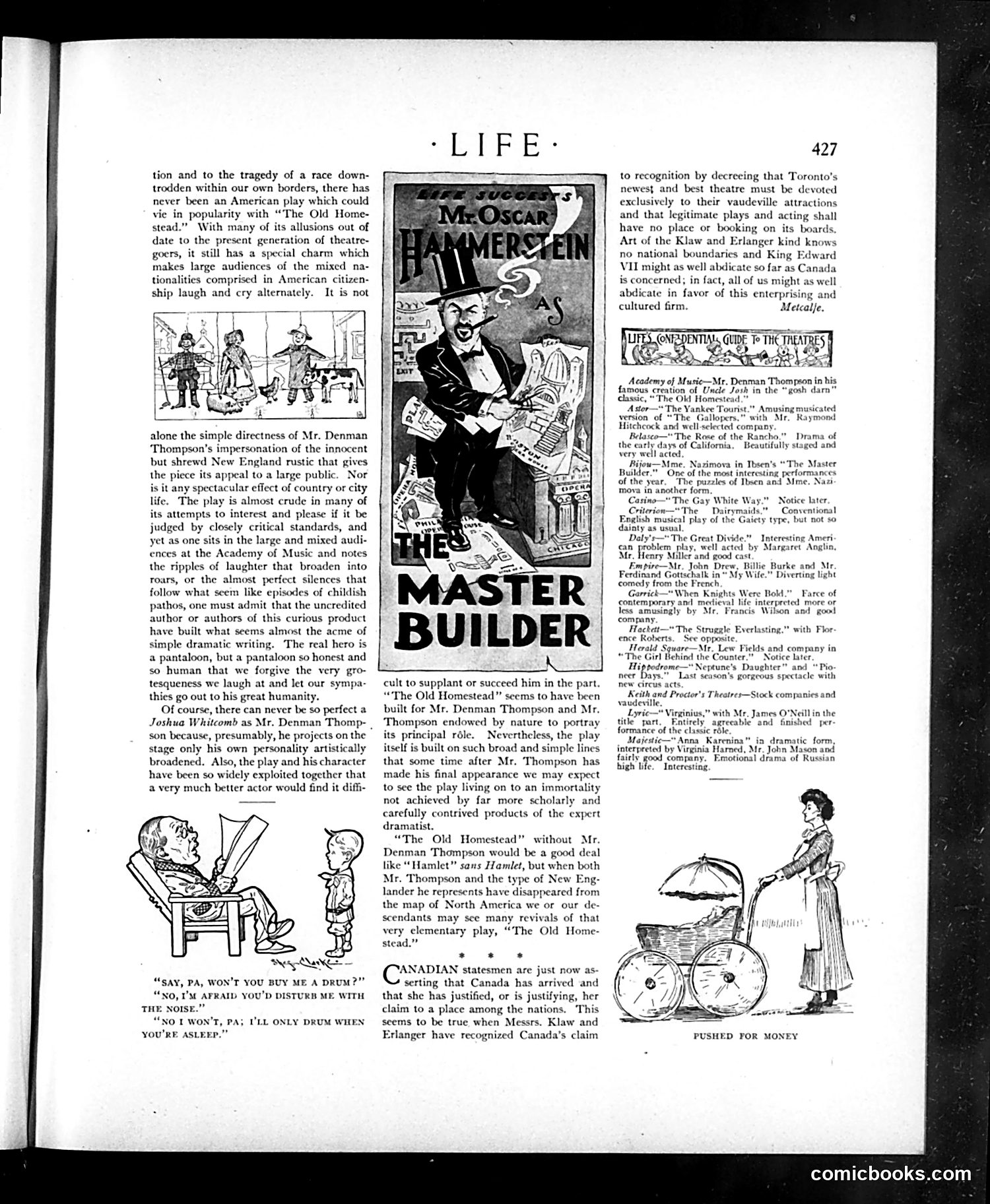
This page reviews "The Old Homestead," a popular American play starring Denman Thompson as the rustic New England character Joshua Whitcomb. The critic praises Thompson's performance as so perfectly suited to the role that the play's continued success depends entirely on him, predicting it will outlive more sophisticated dramas once he retires. The page's satire targets **Klaw and Erlanger**, powerful theater magnates who controlled vaudeville circuits. The writer mocks their recent decision to dedicate Toronto's newest theater exclusively to vaudeville, excluding legitimate drama. The sarcastic point: these American businessmen wield such cultural dominance that they effectively control entertainment across national borders—suggesting Canadian sovereignty means little when foreign commercial interests dictate what Canadians can see performed. The satire questions whether Canada's claimed nationhood is genuine if foreign monopolies control its cultural institutions. Illustrations show childhood humor (a boy asking his father to buy a drum) and theatrical scenes.
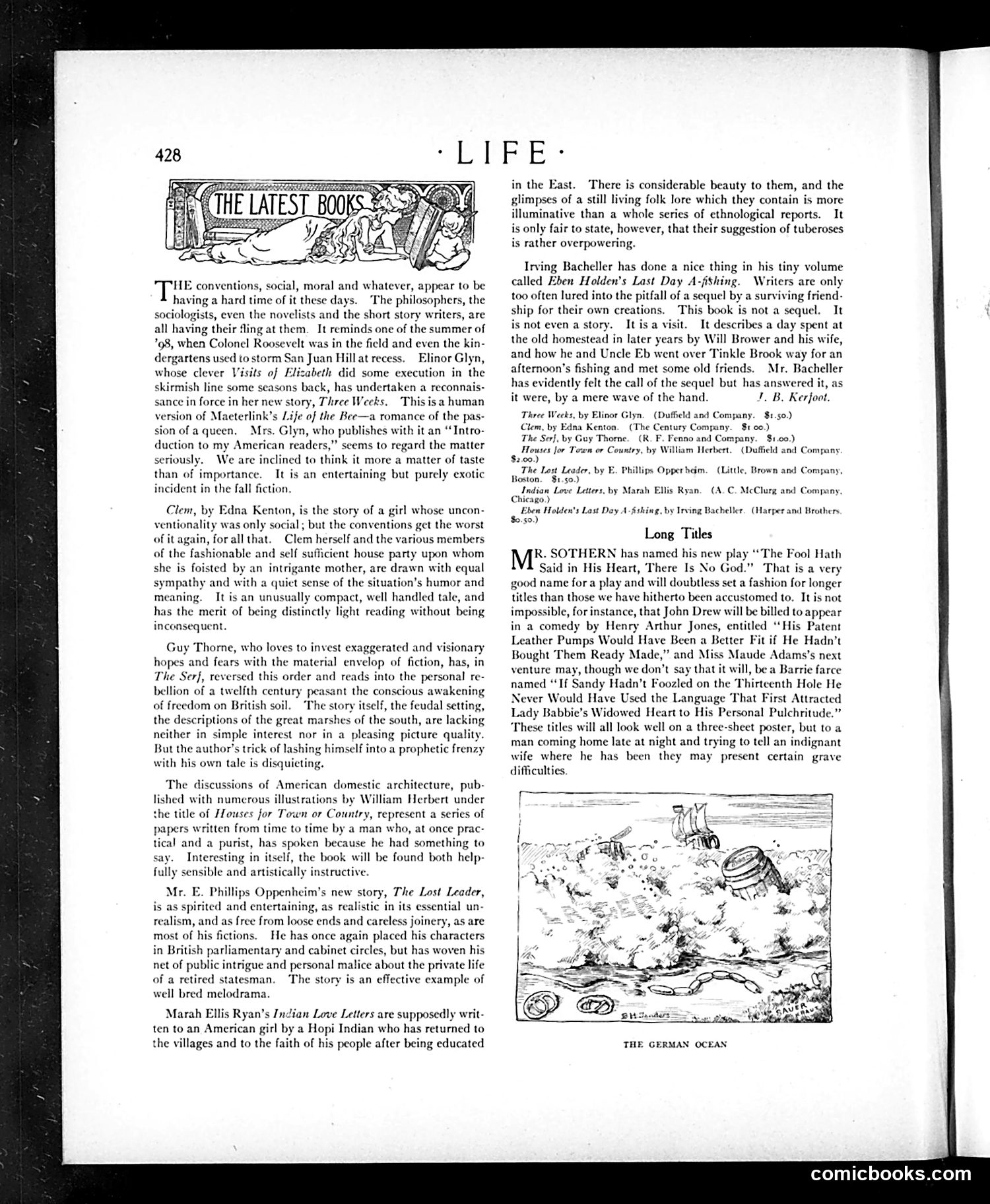
This page reviews recent books and includes an illustration titled "The German Ocean." The cartoon depicts a shipwreck or naval disaster scene with debris scattered across a beach, likely referencing contemporary maritime concerns or a specific historical incident familiar to Life's 1908 readership. The text focuses on literary criticism of novels by popular authors including Elinor Glyn, Edna Kenton, and Guy Thorne. The reviewer critiques these works' treatment of social conventions and unconventionality—a recurring theme. Notably, the opening paragraph references Colonel Roosevelt's 1898 San Juan Hill campaign, using it as a cultural reference point for social upheaval. The review tone is sophisticated but accessible, employing gentle satire about authors' pretensions while acknowledging genuine literary merit. The "German Ocean" illustration's significance remains unclear without additional context, though its placement suggests it relates to contemporary geopolitical concerns or a reviewed work.
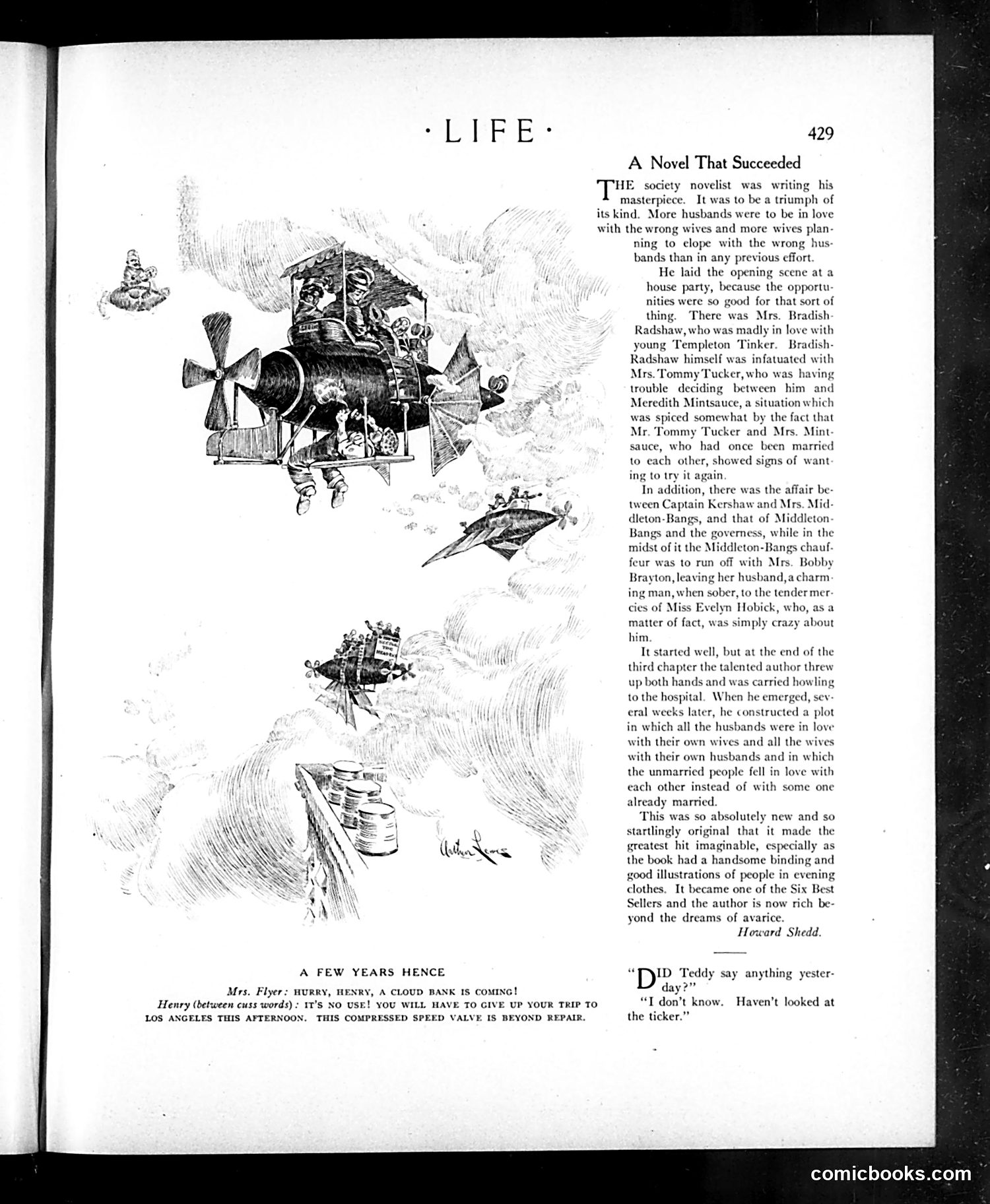
This page satirizes early 20th-century society fiction—specifically the popularity of romantic melodramas featuring tangled love triangles among wealthy characters. The text mocks the formula: elaborate plots where nearly everyone is in love with the *wrong* person, creating maximum romantic chaos. The satire's point: a novelist attempting such a complex "masterpiece" of interconnected affairs actually suffers a nervous breakdown. When he recovers, he writes something radically different—a novel where husbands love their own wives and unmarried people pursue each other normally. This "shockingly original" premise becomes wildly successful. The joke targets both the absurdity of overcomplicated society novels and readers' appetite for them. The irony is that depicting *normal* relationships becomes the real innovation. The bottom section appears to be an unrelated brief comedic scene involving Mr. and Mrs. Flyer and a malfunctioning aircraft valve—typical period humor about emerging aviation technology.
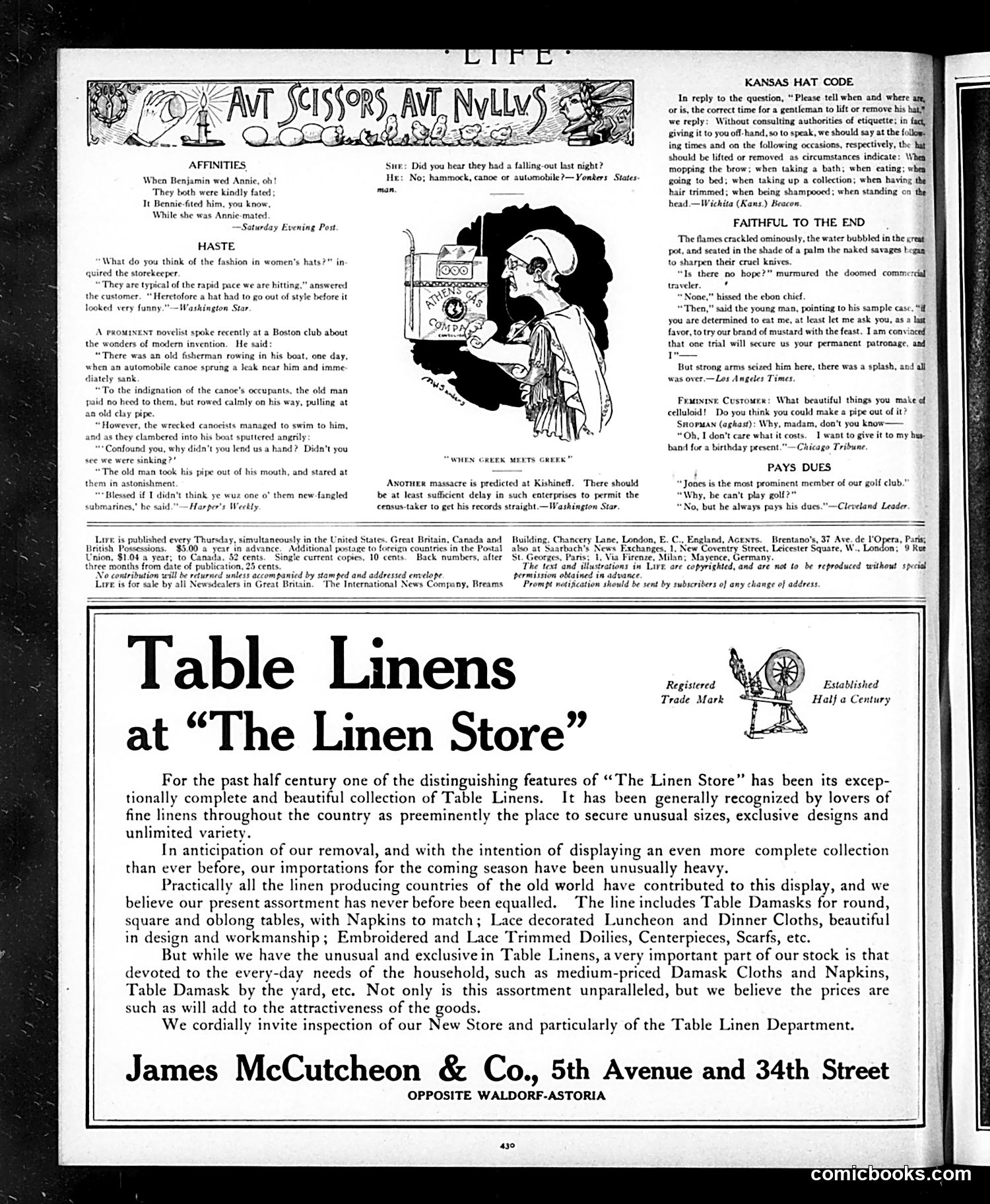
This page contains multiple short humorous pieces typical of early 20th-century American satirical magazines: **"Affinities"** is a pun-based poem playing on the names Benjamin and Annie with wordplay ("Bennie-fited," "Annie-mated"). **"Haste"** satirizes modern fashion, suggesting women's hats change so rapidly that styles become ridiculous before they naturally go out of fashion—a jab at the fast pace of contemporary life. **The fisherman anecdote** mocks the confusion created by new automobile technology, with an old man mistaking a sinking motorized canoe for a submarine. **"When Greek Meets Greek"** references predicted violence at Kishineff (a historical pogrom site) with dark humor about census records. **Various other items** mock social conventions (hat etiquette), advertising (a traveling salesman selling mustard to cannibals), and social climbing (a golf club member known only for paying dues, not skill). The page primarily consists of **advertising for "The Linen Store"** at James McCutcheon & Co., emphasizing their table linens collection and competitive pricing.
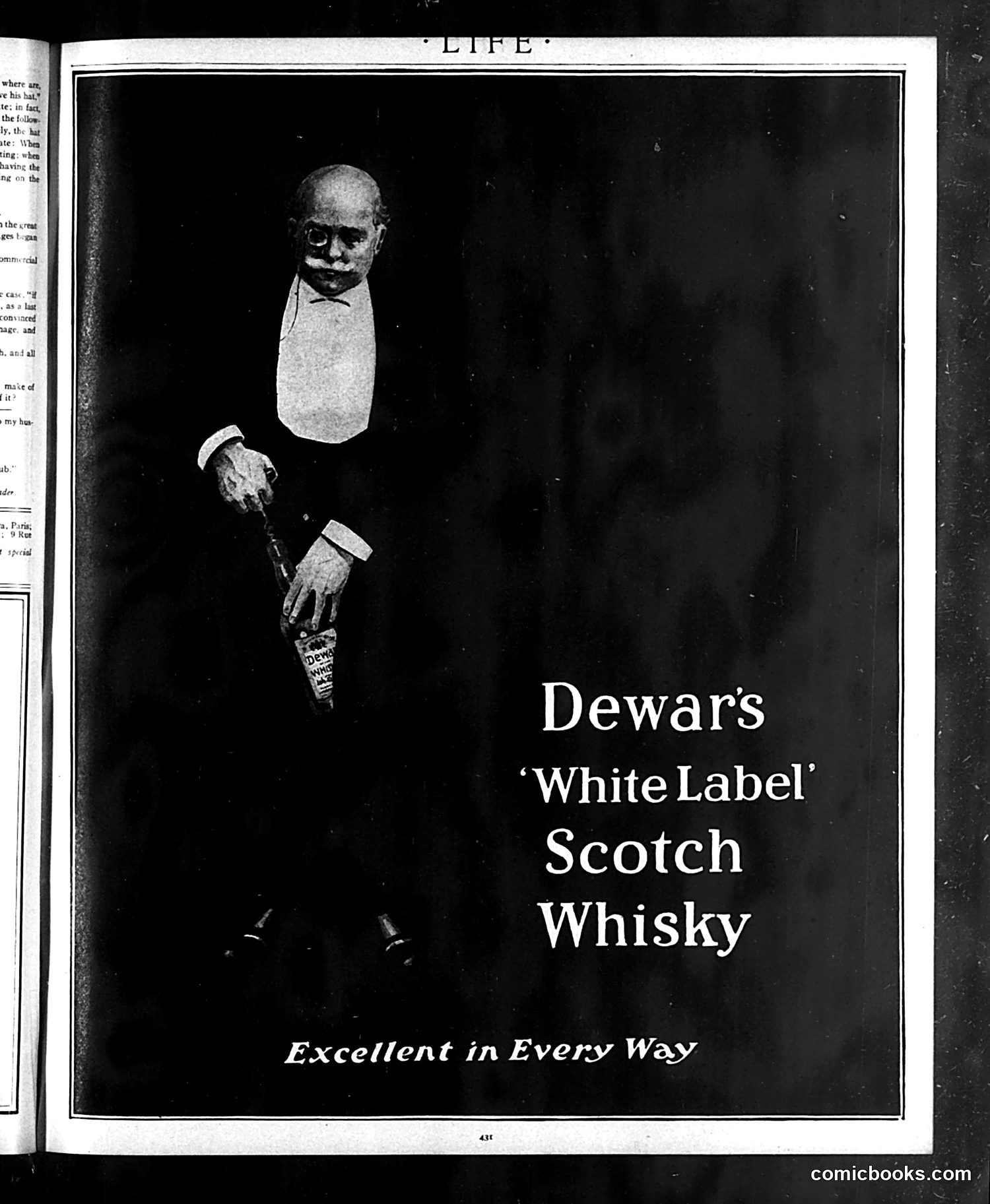
This is a **full-page advertisement** for Dewar's White Label Scotch Whisky from *Life* magazine. It's not a cartoon or satire, but rather a commercial product ad. The image shows a well-dressed gentleman in formal evening wear (tuxedo with white shirt front) holding a bottle of Dewar's. The figure appears dignified and sophisticated, embodying aspirational upper-class masculinity of the era. The ad's appeal is straightforward: associating the whisky with refined elegance and social status. The tagline "Excellent in Every Way" emphasizes quality. This represents typical early-to-mid 20th century advertising strategy—linking alcohol consumption to sophistication and respectability rather than highlighting the product's actual taste or characteristics.
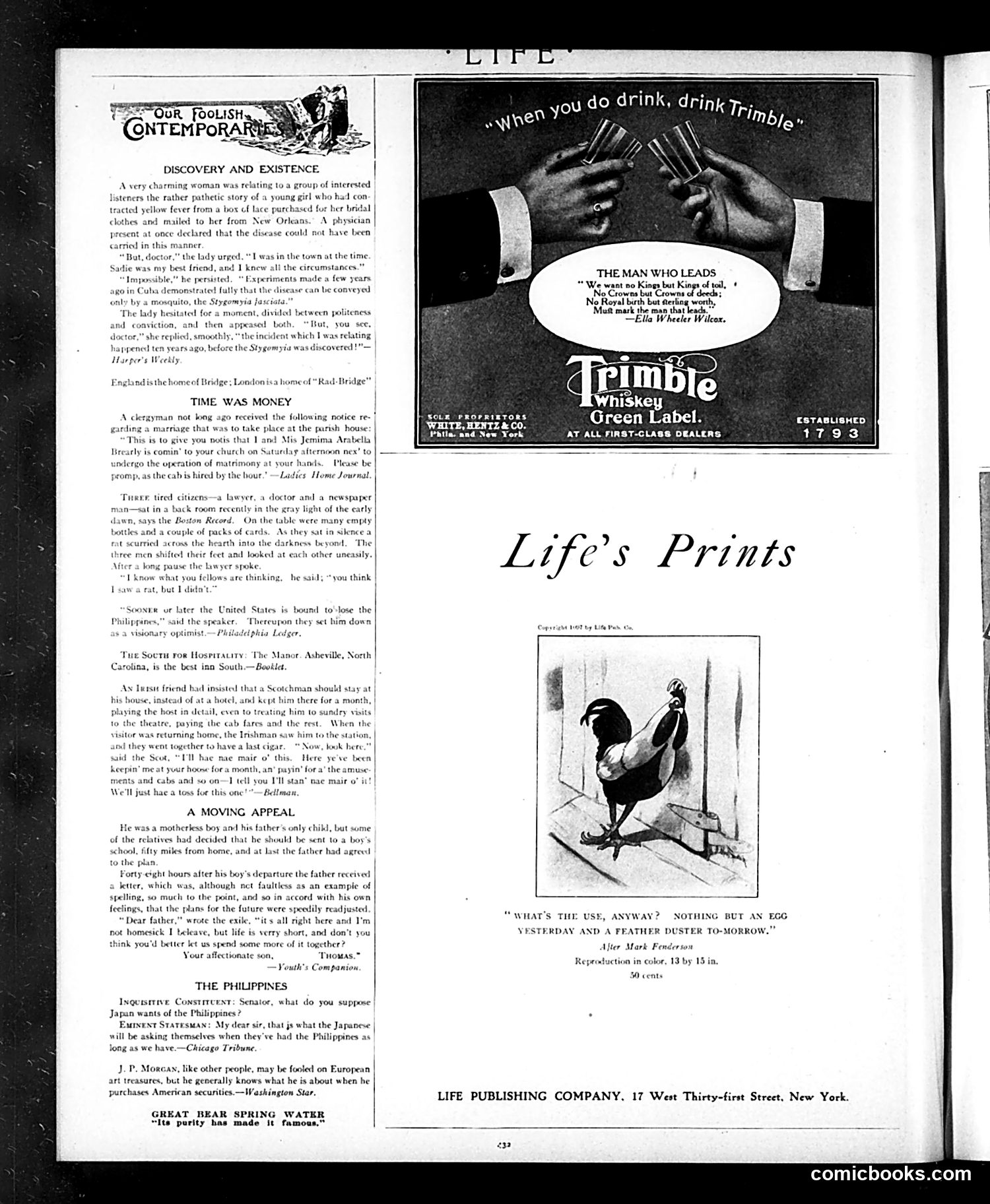
This page from *Life* magazine contains multiple satirical short stories and a whiskey advertisement, rather than a single coherent cartoon. **Key Content:** The "Our Foolish Contemporaries" section collects brief humorous anecdotes mocking contemporary attitudes and logic. Notable examples include a doctor's inability to accept that yellow fever could be transmitted via lace (despite Cuban experiments proving it), and a lawyer's self-delusional denial of seeing a rat. **The Advertisement:** A Trimble Whiskey ad features "The Man Who Leads"—a quote valuing merit over aristocracy ("Kings of toil" rather than hereditary rulers). This reflects Progressive Era American values questioning traditional hierarchy. **The Cartoon ("Life's Prints"):** Shows a chicken with the caption about it being useless except for yesterday's egg and tomorrow's feather duster—a joke about diminishing utility, likely mocking wasteful or obsolete things. **Overall Tone:** The page satirizes human foolishness, faulty reasoning, and social pretension typical of early 20th-century *Life* magazine humor.
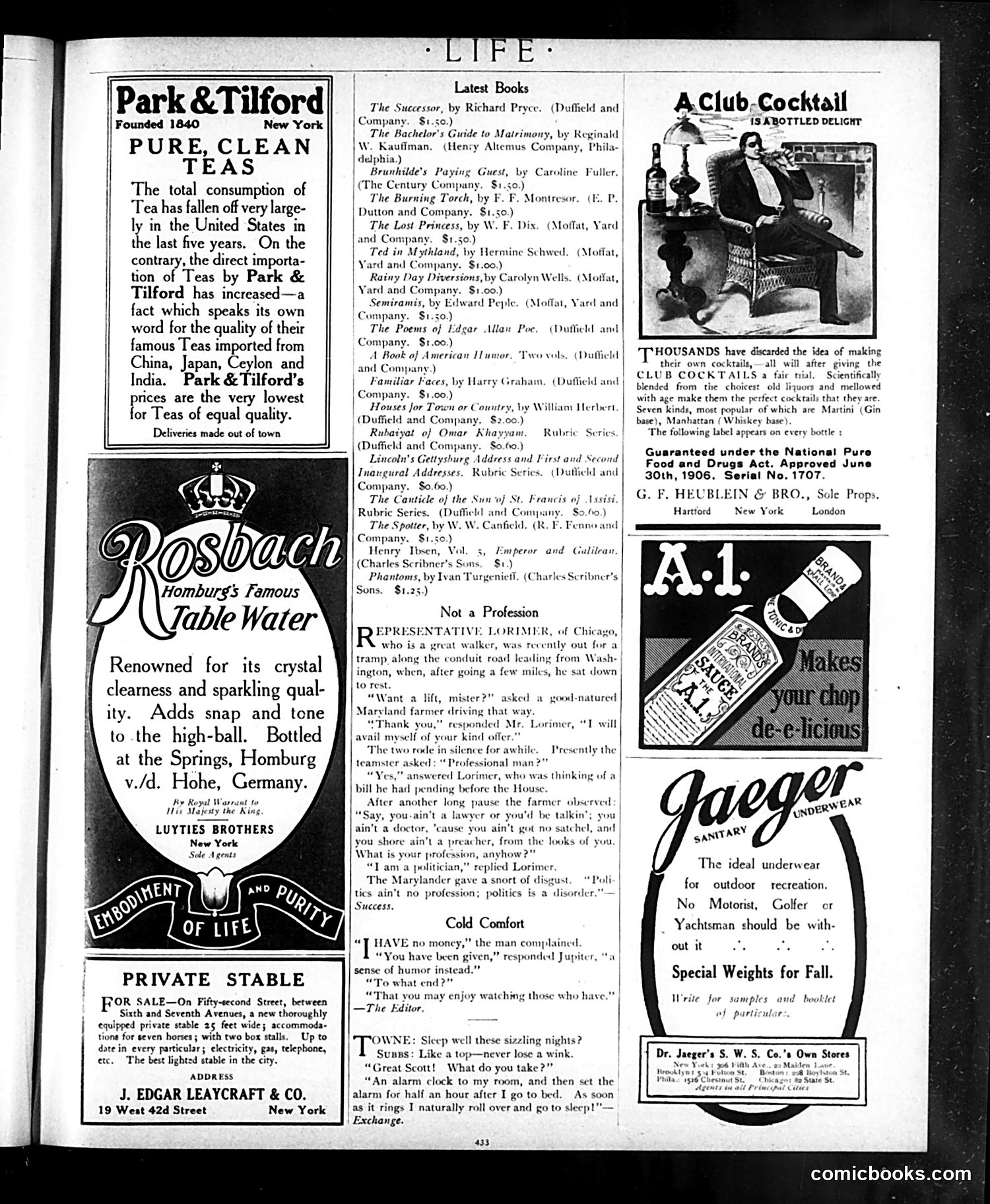
This page is primarily **advertising with some light satirical content** typical of early 1900s Life magazine. The main satirical piece, "Not a Profession," features **Representative Lorimer of Chicago**—a congressman who, when asked by a farmer what his profession is, replies "I am a politician." The farmer dismisses this, saying "politics is a disorder," not a profession. The satire mocks politicians by suggesting they lack a legitimate trade or skill, reducing politics to mere disorder rather than honest work. The page also contains a brief joke exchange ("Cold Comfort") about enjoying wealth and poverty, and another about insomnia remedies. The bulk of the page consists of **period advertisements** for Park & Tilford teas, Rosbach mineral water, a private stable for horses, and various consumer goods—reflecting the magazine's commercial content alongside its humor and social commentary.
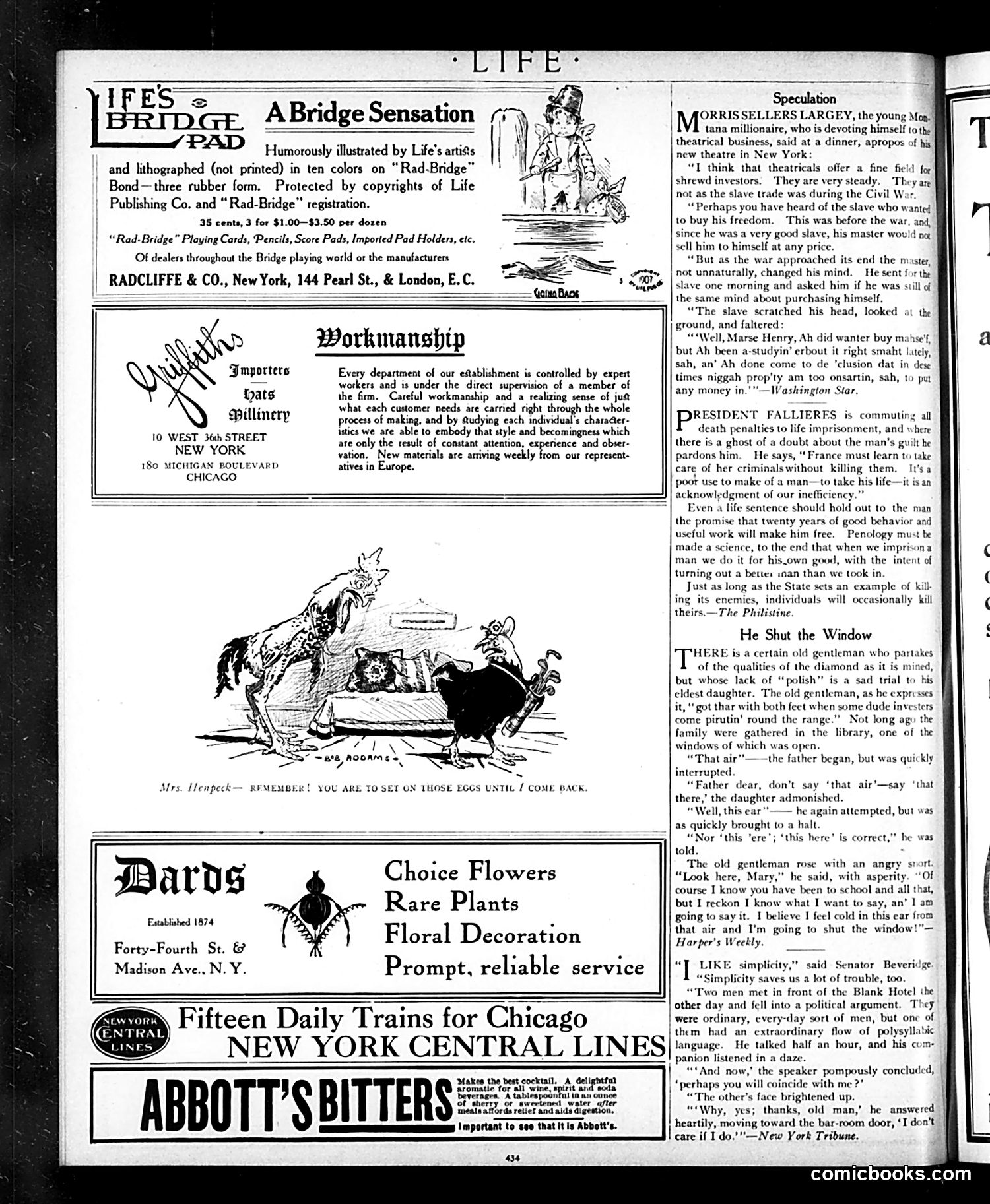
This page contains multiple unrelated advertisements and short satirical pieces typical of Life's format. **Main Cartoon ("Mrs. Henpeck"):** Shows a domestic scene where a wife dominates her hen-pecked husband. The caption reads: "Mrs. Henpeck—REMEMBER: YOU ARE TO SET ON THOSE EGGS UNTIL I COME BACK." The satire mocks both nagging wives and emasculated husbands, a common early-20th-century comedy trope. **"A Bridge Sensation":** A humorous anecdote about a wealthy theater investor comparing theatrical investment to slavery. It includes a dialect story about a slave reconsidering purchasing his own freedom because he deems "niggah prop'ty" too uncertain—a satirical commentary on economic instability, likely post-Civil War. **Other pieces** address penology reform (President Fallieres commuting death sentences) and a father struggling with his daughter's corrections of his rural dialect ("that air" vs. "that there"). The page is primarily **advertisements** for playing cards, hats, flowers, and trains interspersed with these satirical vignettes.
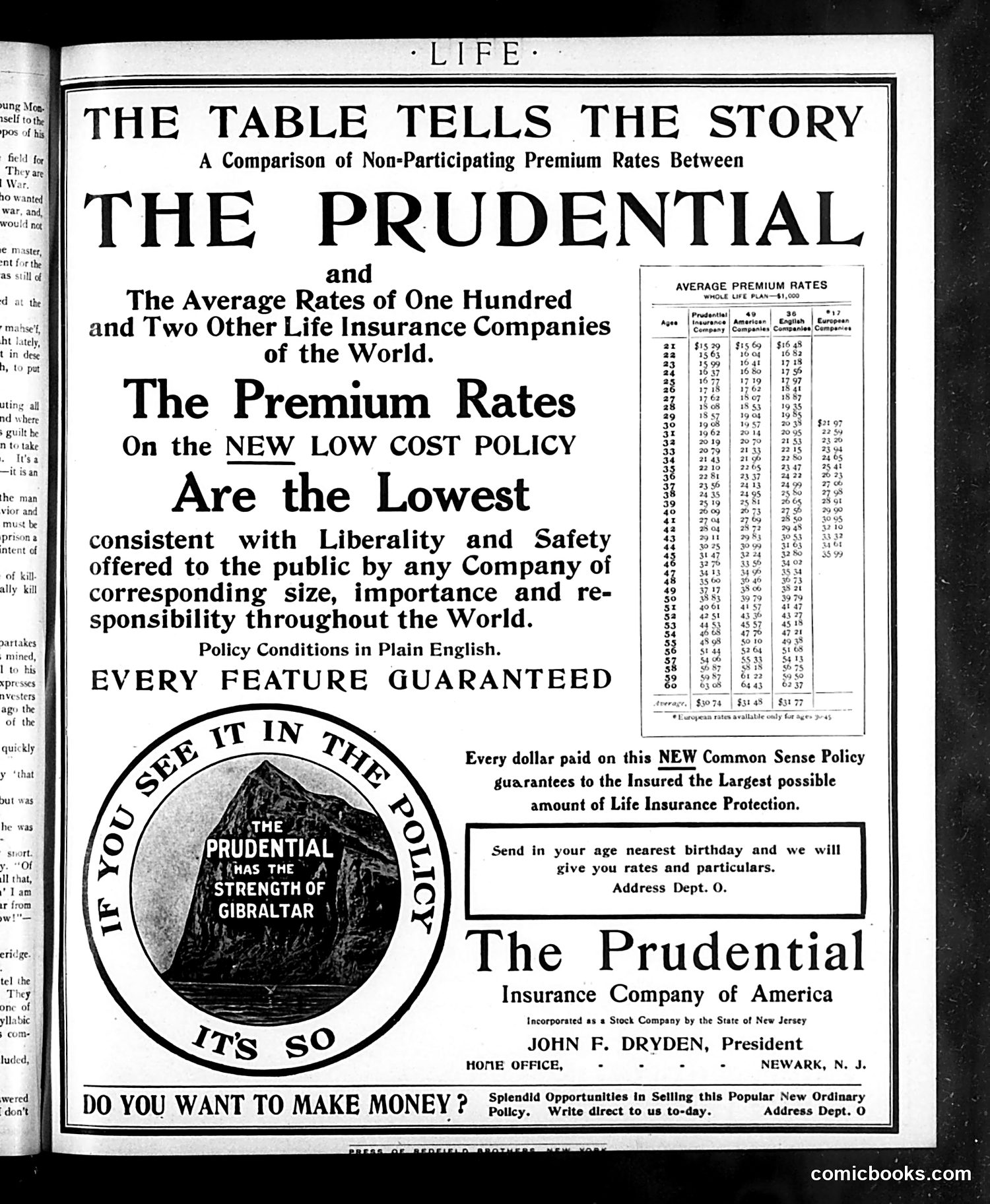
This is primarily a **life insurance advertisement**, not satire or political commentary. The Prudential Insurance Company uses Life magazine's pages to market their "New Low Cost Policy." The key claim: Prudential's rates are the lowest among 102 major insurance companies worldwide, proven by the comparison table shown. The circular seal featuring Gibraltar ("The Prudential has the Strength of Gibraltar / If you see it in the proof, it's so") was Prudential's actual corporate branding, emphasizing rock-solid stability and trustworthiness. The advertisement targets potential customers and salespeople ("Do you want to make money?"), promising simple language ("Plain English"), guaranteed features, and maximum protection per dollar. The call-to-action invites interested parties to request rates. This represents early 20th-century insurance marketing using mass media—emphasizing competitive pricing, company strength, and accessibility to build consumer confidence in a then-novel financial product.
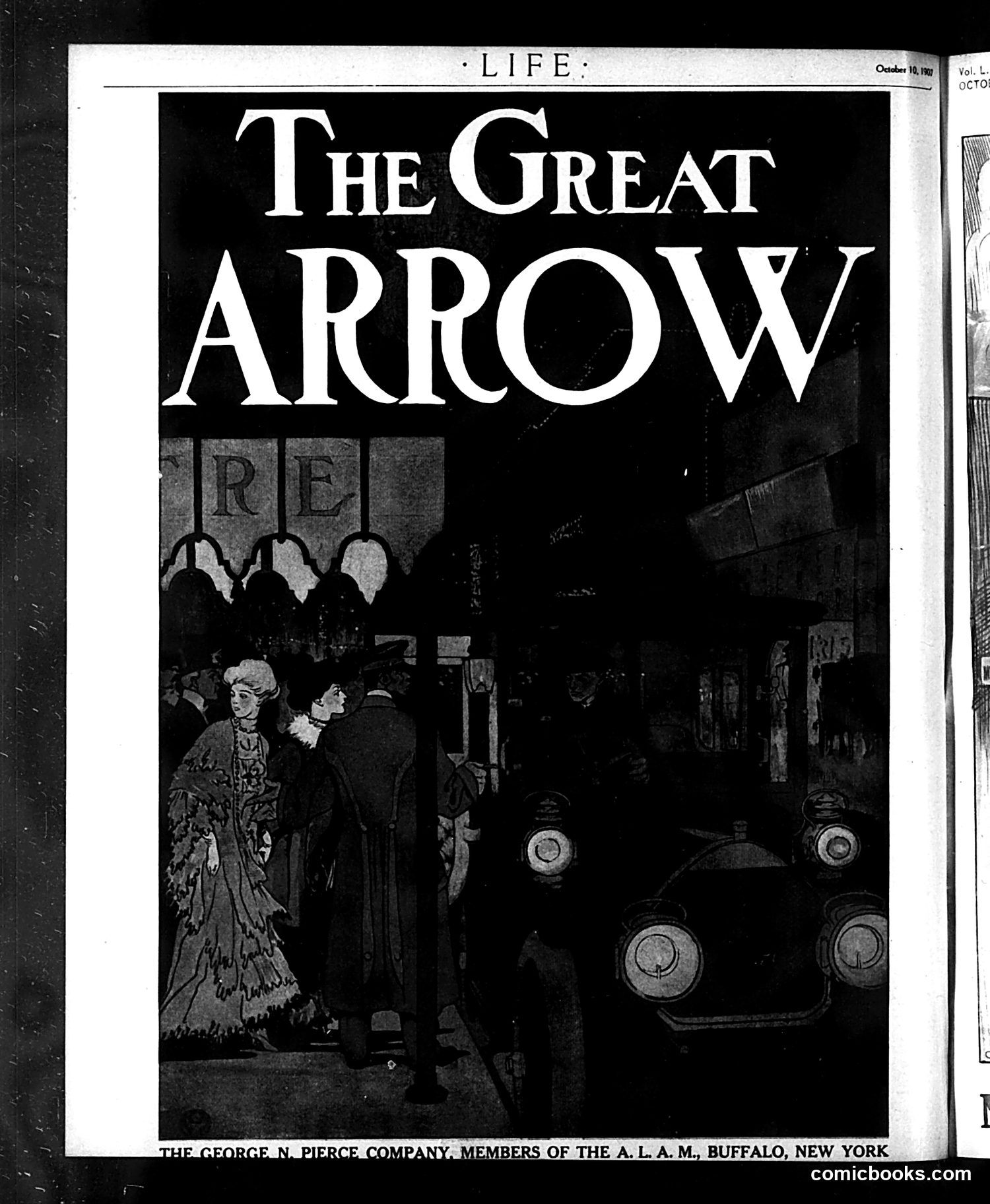
This appears to be a **title page or cover** for "The Great Arrow," published by the George N. Pierce Company (a Buffalo, New York automobile manufacturer). The image shows a nighttime street scene with well-dressed figures examining what appears to be an early automobile displaying multiple headlights. The satire likely centers on **automotive advertising and technological showmanship** of the early 1900s. The prominent headlights suggest this is promoting the Arrow automobile's modern features. The elegant pedestrians' interest implies the car represents luxury and progress. Without additional context, the specific satirical point remains unclear—it could mock automotive obsession, wealth display, or technological excess. The "A.L.A.M." reference (likely the Association of Licensed Automobile Manufacturers) suggests industry-focused satire. This functions primarily as **commercial advertising disguised as editorial content** in Life magazine.