
Life, 1907-10-10 · page 9 of 24
Life — October 10, 1907 — page 9: what you’re looking at
What you’re looking at
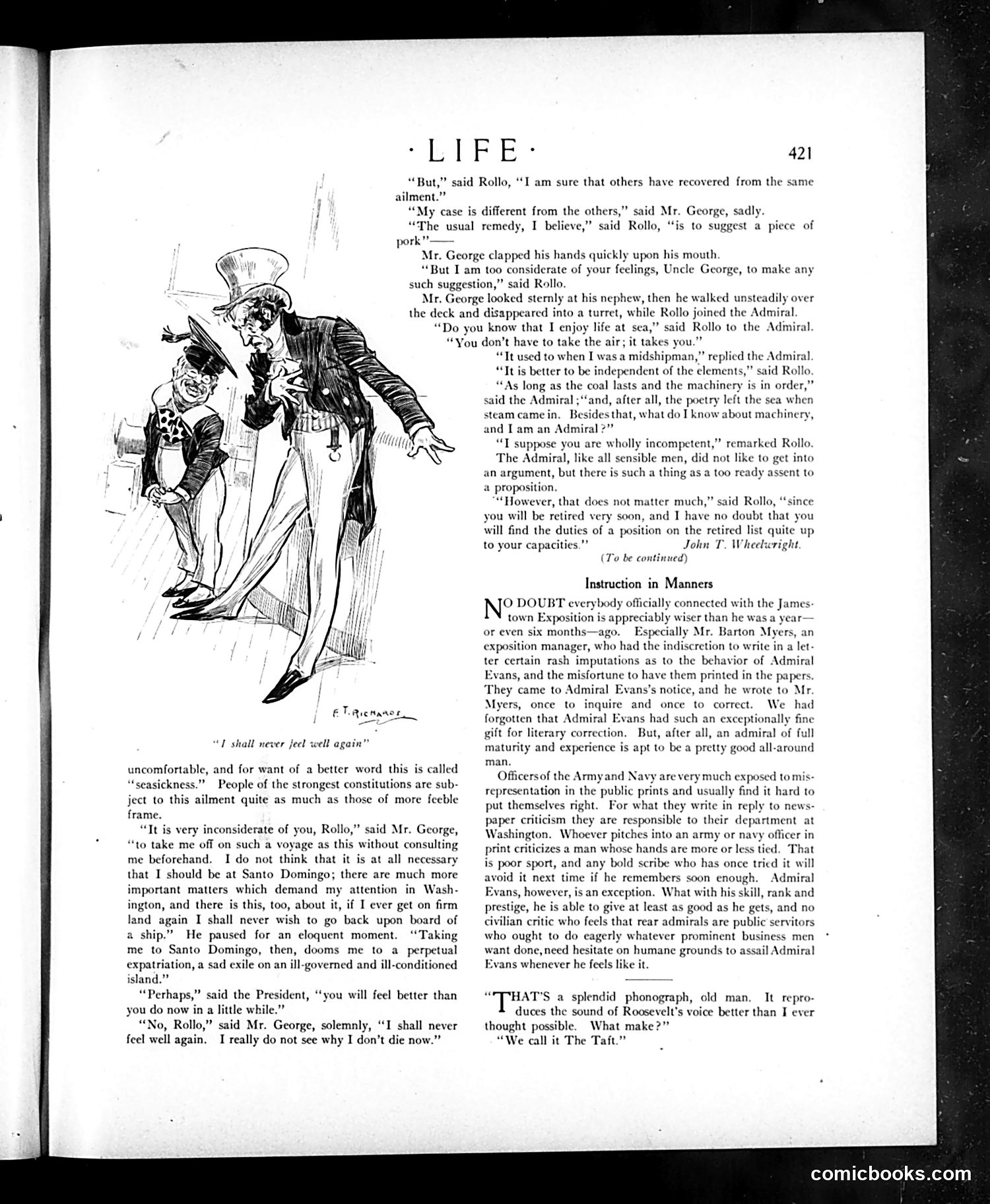
The cartoon depicts two naval officers in conversation, with the taller figure (likely representing authority/command) gesturing dismissively toward a smaller, distressed officer below. The illustration style is typical early 20th-century satirical cartooning. The accompanying text discusses Admiral Evans and exposure to misrepresentation in public prints regarding "the Jamestown Exposition." The passage critiques how military officers face unfair newspaper criticism, noting that Admiral Evans has received corrective letters about inaccurate reporting. The cartoon appears to satirize the vulnerability of military figures to press scrutiny and public perception—showing the tension between naval officers' dignity and their inability to control their public image through newspaper commentary. The specific reference to "seasickness" in dialogue suggests mockery of naval vulnerability to criticism.
📄 Transcribed text from this page (OCR, searchable)
Machine-transcribed from the original scan — historical spelling and the odd misread are preserved.
“LIFE: 42I “But,” said Rollo, ‘(I am sure that others have recovered from the same ailment.” “My ca “The usual remedy, I believe, pork” — is different from the othe said Mr. George, sadly. ” said Rollo, “‘is to suggest a piece of Mr. George clapped his hands quickly upon his mouth “But I am too considerate of your feelings, Uncle George, to make any such suggestion,” said Rollo. Mr. George looked sternly at his nephew, then he walked unsteadily over the deck and disappeared into a turret, while Rollo joined the Admir “Do you know that I enjoy life at sea,” s id Rollo to the Admiral “You don’t have to take the air; it takes you.” “1 shall never jeel well again” uncomfortable, and for want of a better word this is called “‘seasickness.” People of the strongest constitutions are sub- ject to this ailment quite as much as those of more feeble frame. “It is very inconsiderate of you, Rollo,” said Mr. George, “to take me off on such a voyage as this without consulting me beforehand. I do not think that it is at all necessary that I should be at Santo Domingo; there are much more important matters which demand my attention in Wash- ington, and there is this, too, about it, if I ever get on firm land again I shall never wish to go back upon board of a ship.” He paused for an eloquent moment. “Taking me to Santo Domingo, then, dooms me to a_ perpetual expatriation, a sad exile on an ill-governed and ill-conditioned island.” “Perhaps,” said the President, “‘you will feel better than you do now in a little while.” “No, Rollo,” said Mr. George, solemnly, “I shall never feel well again. I really do not see why I don’t die now.” “Tt used to when I was a midshipman,” replied the Admiral “Tt is better to be independent of the elements,” said Rollo “As long as the coal lasts and the machinery is in order, said the Admiral ;‘‘and, after all, the poetry left the sea when steam came in. Besides that, what do I know about machinery, and I am an Admiral ?” “T suppose you are wholly incompetent,” remarked Rollo The Admiral, like all sensible men, did not like to get into an argument, but there is such a thing as a too ready assent to a proposition. “However, that does not matter much,” said Rollo, ‘‘since you will be retired very soon, and I have no doubt that you will find the duties of a position on the retired list quite up to your capacities.” John T. Wheelwright (To be continued) Instruction in Manners O DOUB everybody officially connected with the Jame town i eciably wiser than he was a year or even six months— exposition manager, who y Barton Myers, an indiscretion to write in a let- ter certain rash imputatio to the behavior of Admiral Evans, and the misfortune to have them printed in the papers. They came to Admiral Evans's notice, and he wrote to Mr. Myers, once to inquire and once to correct. We had forgotten that Admiral Evans had such an exceptionally fine gift for literary correction. But, after all, an admiral of full maturity and experience is apt to be a pretty good all-around man Officersof the Army and Navy are very much exposed to mis- representation in the public prints and usually find it hard to put themselves right. For what they write in reply to news- paper criticism they are responsible to their department at Washington. Whoever pitches into an army or navy officer in print criticizes a man whose hands are more or less tied. That is poor sport, and any bold scribe who has once tried it will avoid it next time if he remembers soon enough. Admiral Evans, however, is an exception. What with his skill, rank and prestige, he is able to give at least as good as he gets, and no civilian critic who feels that rear admirals are public servitors who ought to do eagerly whatever prominent business men want done, need hesitate on humane grounds to assail Admiral Evans whenever he feels like it. “THAT'S a splendid phonograph, old man. It repro- duces the sound of Roosevelt's voice better than I ever thought possible. What make?” “We call it The Taft.” comicbooks.com