
Life, 1907-10-10 · page 16 of 24
Life — October 10, 1907 — page 16: what you’re looking at
What you’re looking at
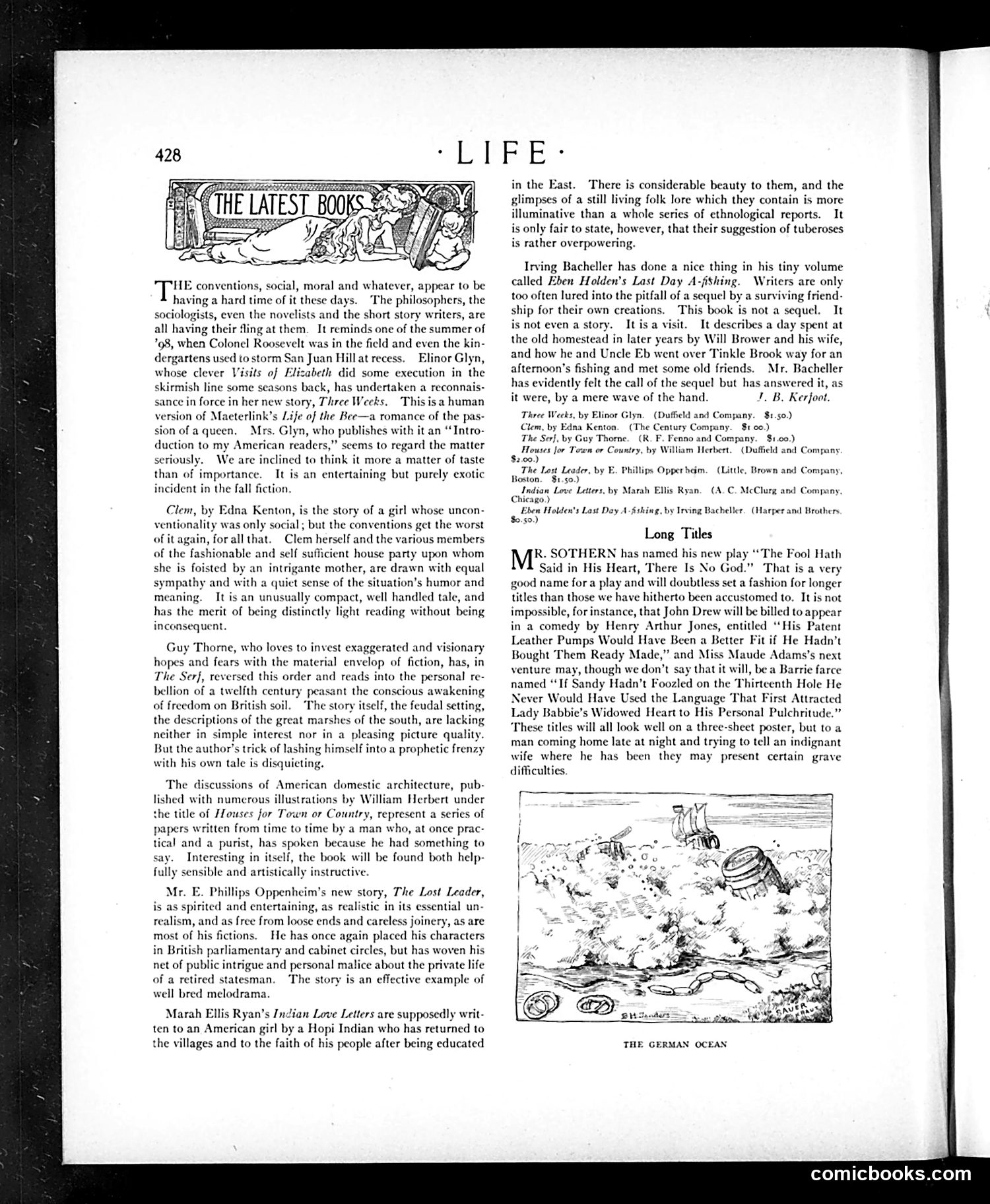
This page reviews recent books and includes an illustration titled "The German Ocean." The cartoon depicts a shipwreck or naval disaster scene with debris scattered across a beach, likely referencing contemporary maritime concerns or a specific historical incident familiar to Life's 1908 readership. The text focuses on literary criticism of novels by popular authors including Elinor Glyn, Edna Kenton, and Guy Thorne. The reviewer critiques these works' treatment of social conventions and unconventionality—a recurring theme. Notably, the opening paragraph references Colonel Roosevelt's 1898 San Juan Hill campaign, using it as a cultural reference point for social upheaval. The review tone is sophisticated but accessible, employing gentle satire about authors' pretensions while acknowledging genuine literary merit. The "German Ocean" illustration's significance remains unclear without additional context, though its placement suggests it relates to contemporary geopolitical concerns or a reviewed work.
📄 Transcribed text from this page (OCR, searchable)
Machine-transcribed from the original scan — historical spelling and the odd misread are preserved.
EP E conventions, social, moral and whatever, appear to be having a hard time of it these days. The philosophers, the sociologists, even the novelists and the short story writers, are all having their fling at them. It reminds one of the summer of ’98, when Colonel Roosevelt was in the ficld and even the kin- dergartens used to storm San Juan Hillat recess. Elinor Glyn, whose clever Visits of Elizabeth did some execution in the skirmish line some seasons back, has undertaken a reconnais- sance in force in her new story, Three Weeks. Thisisa human version of Maeterlink’s Life of the Bee—a romance of the pas- sion of a queen. Mrs. Glyn, who publishes with it an “Intro- duction to my American readers,” seems to regard the matter seriously. We are inclined to think it more a matter of taste than of importan It is an entertaining but purely exotic incident in the fall fiction. Clem, by Edna Kenton, is the story of a girl whose uncon- ventionality was only social ; but the conventions get the worst of it again, forall that. Clem herself and the various members of the fashionable and self sufficient house party upon whom she is foisted by an intrigante mother, are drawn with equal sympathy and with a quict sense of the situation’s humor and meaning. It is an unusually compact, well handled tale, and has the merit of being distinctly light reading without being inconsequent. Guy Thorne, who loves to invest exaggerated and visionary hopes and fears with the material envelop of fiction, has, in The Serj, reversed this order and reads into the personal re- bellion of a twelfth century peasant the conscious awakening of freedom on British soil. The story itself, the feudal setting, the descriptions of the great marshes of the south, are lac neither in simple interest nor in a pleasing picture quali But the author’s trick of lashing himself into a prophetic frenzy with his own tale is disquieting. The discussions of American domestic architecture, pub- lished with numerous illustrations by Will Herbert under the tide of Houses for Town or Country, represent a series of papers written from time to time by a man who, at once prac- tical and a purist, has spoken because he had something to say. Interesting in itself, the book will be found both help- fully sensible and artistically instructive. Mr. E. Phillips Oppenhcim’s new story, The Lost Leader, is as spirited and entertaining, as realistic in its essential un- realism, and as free from loose ends and careless joinery, as are most of his fictions. He has once again placed his characters in British parliamentary and cabinet circles, but has woven his net of public intrigue and personal malice about the private life of a retired statesman. The story is an effective example of well bred melodrama. Marah Ellis Ryan’s Indian Love Letters are supposedly writ- ten to an American girl by a Hopi Indian who has returned to the villages and to the faith of his people after being educated in the East. There is considerable beauty to them, and the glimpses of a still living folk lore which they contain is more illuminative than a whole series of ethnological reports. It is only fair to state, however, that their suggestion of tuberoses is rather overpowering. Irving Bacheller has done a nice thing in his tiny volume called Eben Holden's Last Day A-fishing. Writers are only too often lured into the pitfall of a sequel by a surviving friend- ship for their own creations. This book is not a sequel. It is not even a story. Itisa visit. It describes a day spent at the old homestead in later years by Will Brower and his wife, and how he and Uncle Eb went over Tinkle Brook way for an afternoon's fishing and met some old friends. Mr. Bacheller has evidently felt the call of the sequel but has answered it, as it were, by a mere wave of the hand. 1. B. Kerfoot. Three Weeks, by Elinor Glyn. (Duffield and Company. $1.50.) Clem, by Edna Kenton. (The Century Company. $1 00.) The Ser}, by Guy Thome. (R. F. Fenno and Company. $1.00.) gp {Hewses lor Town or Country, by William erbert, (Dufield and Comgans 2.00.) The Lost Leader, by E. Phillips Opper heim Boston. $1.59.) Indian Love Letters, by Marah Ellis Ryan. Chicago.) Eben Holden's Last Day A-Ashing, by Irving Bacheller. (Harper and Brothers, $0.89) Long Titles M* SOTHERN has named his new play “The Fool Hath Said in His Heart, There Is No God.” That is a very good name fora play and will doubtless set a fashion for longer titles than those we have hitherto been accustomed to. It is not impossible, for instance, that John Drew will be billed to appear in a comedy by Henry Arthur Jones, entitled “His Patent Leather Pumps Would Have Been a Better Fit if He Hadn't t Bought Them Ready Made,” and M venture may, though we don’t say that it will, be a Barrie farce named “If Sandy Hadn’t Foozled on the Thirteenth Hole He Never Would Have Used the Language That First Attracted Lady Babbie’s Widowed Heart to His Personal Pulchritude.” ‘These titles will all look well on a three-sheet poster, but to a man coming home late at night and trying to tell an indignant wife where he has been they may present certain grave difficulties. (Lite, Brown and Company, (A.C. McClurg and Company THE GERMAN OCEAN comicbooks.com