
Life, 1907-10-10 · page 14 of 24
Life — October 10, 1907 — page 14: what you’re looking at
What you’re looking at
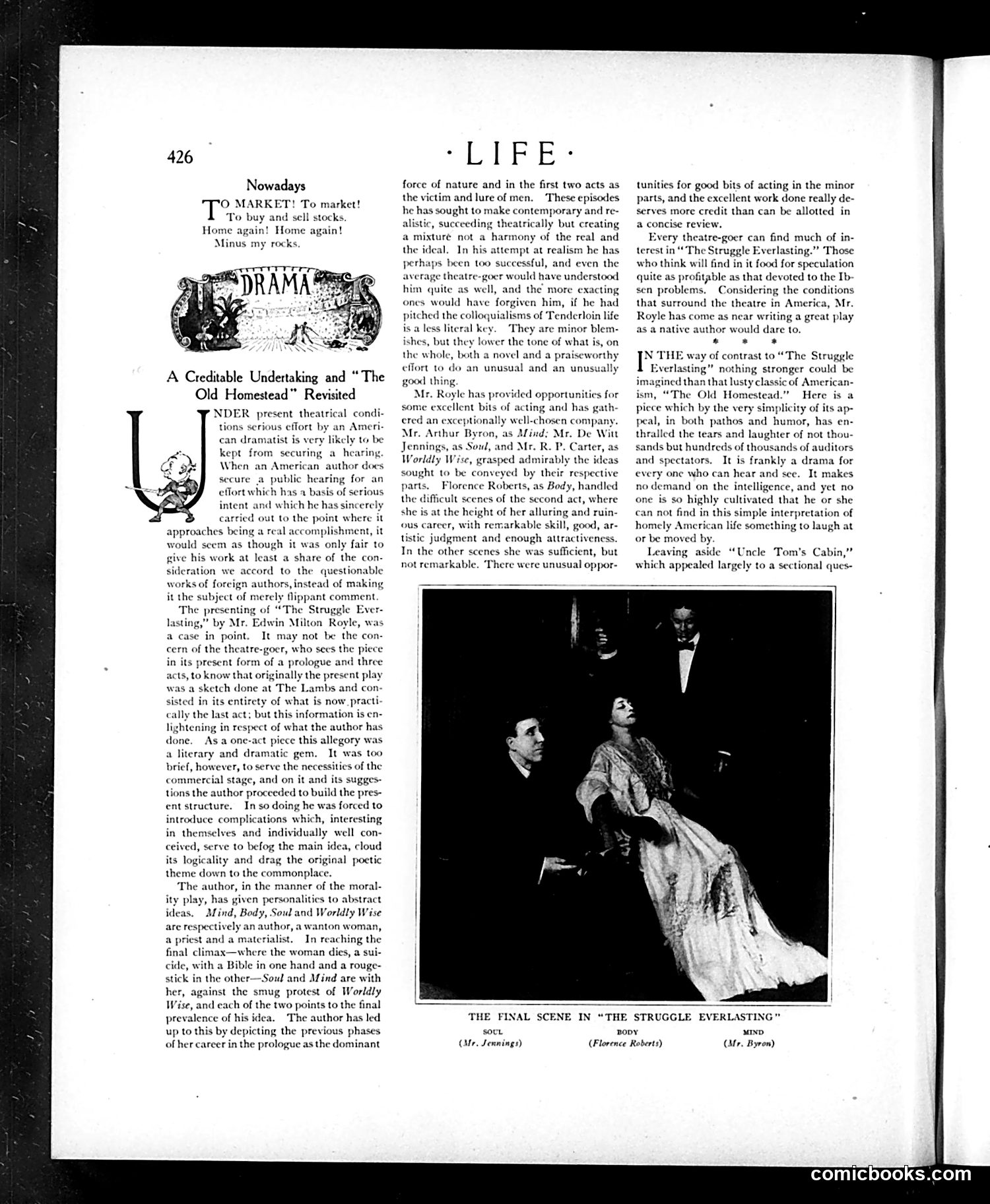
This page reviews Edwin Milton Royle's play "The Struggle Everlasting," an allegorical morality play where abstract concepts are personified as characters: Mind (an author), Body (a wanton woman), Soul (a priest), and Worldly Wise (a materialist). The critic praises the serious dramatic effort but faults the execution. Originally a one-act literary gem, Royle expanded it for commercial theater, introducing realistic Tenderloin-life dialogue that undermines the idealistic allegory. The result confuses rather than clarifies the play's philosophical point about competing human impulses. The photograph shows the final scene where Body dies by suicide, clutching both a Bible and rouge-stick—symbolizing her internal spiritual and material conflicts, with Soul and Mind present as competing moral forces. The critique reflects early 20th-century theater debates: how to balance artistic integrity with commercial viability.
📄 Transcribed text from this page (OCR, searchable)
Machine-transcribed from the original scan — historical spelling and the odd misread are preserved.
Nowadays (0 MARKET! To market! To buy and sell stocks. ain! Home A Creditable Undertaking and “ The Old Homestead” Revisited NDER present theatrical condi- tions serious effort by an Ameri- can dramatist is very likely to be kept from securing a hearing. When an American author does secure a public hearing for an effort which has a basis of serious intent and which he has si carried out to the point where it approaches bei would seem as though it was only fair to give his work at least a share of the con- sideration we accord to the questionable works of forcign authors, instead of making it the subject of merely flippant comm ‘The presenting of “The Struggle Ever- lasting,” by Mr. Edwin Milton Ro: a case in point. It may not be the cc cern of the theatre-goer, who secs the piece in its present form of a prologue and three acts, to know that originally the present play was a sketch done at The Lambs and con- sisted in its entirety of what is now. practi cally the last act; but this information is en- lightening in respect of what the author has done. AS a one-act piece this allegory was a literary and dramatic gem. It was too brief, however, to serve the necessities of the commercial stage, and on it and its sugges- tions the author proceeded to build the pres- ent structure. In so doing he was forced to introduce complications which, interesting in themselves and individually well con- ceived, serve to befog the main idea, cloud its logicality and drag the original poctic theme down to the commonplace. The author, in the manner of the moral- ity play, has given personalities to abstract ideas. Mind, Body, Soul and Worldly Wise are respectively an author, a wanton woman, a priest and a materialist. In reaching the final climax—where the woman dies, a sui- cide, with a Bible in one hand and a rouge- stick in the other—Soul and Mind are with her, against the smug protest of Worldly Wise, and each of the two points to the final prevalence of his idea. ‘The author has led up to this by depicting the previous phases of her career in the prologue as the dominant ercly 1g a real accomplishment, it * LIFE force of nature and in the first two acts as victim and lure of men. ‘These episodes he has sought to make contemporary and r. alistic, succeeding theatrically but creating a mixture not a harmony of the real and the ideal. In his attempt at realism he has perhaps been too successful, and even the average theatre-goer would have understood him quite as well, and the’ more exacting ones would have forgiven him, if he had hed the colloquialisms of Tenderloin life s a less literal key. ‘They are minor blem- ishes, but they lower the tone of what is, on the whole, both a novel and a praiseworthy cfiort to do an unusual and an unusually good thin Mr. Royle has provided opportunities for some excellent bits of acting and has gath- cred an exceptionally well-chosen company. Mr. Arthur Byron, as find: Mr. De Witt Jennings, as Sond, and Mr. R. P. Carter, as Worldly Wise, grasped admirably the ideas sought to be conveyed by their respective rts. Florence Roberts, as Body, handled the difficult scenes of the second act, where she is at the height of her alluring and ruin- ous career, with remarkable skill, good, ar- tistic judgment and enough attractiveness. In the other scenes she was sufficient, but not remarkable. ‘There were unusual oppor- tunities for good bits of acting in the minor parts, and the excellent work done really de- serves more credit than can be allotted in a concise review. Every theatre-gocr can find much of in- terest in “The Struggle Everlasting.” ‘Those who think will find in it food for speculation quite as profitable as that devoted to the Ib- sen problems. Considering the conditions that surround the theatre in America, Mr. Royle has come as near writing a great play as a native author would dare to. + s * N THE way of contrast to “The Struggle Everlasting” nothing stronger could be imagined than that lusty classic of American- ism, “The Old Homestead.” Here is a picce which by the very simplicity of its ap- peal, in both pathos and humor, has en- thralled the tears and laughter of not thou- sands but hundreds of thousands of auditors and spectators. It is frankly a drama for every one who can hear and see. It makes no demand on the intelligence, and yet no one is so highly cultivated that he or she can not find in this simple interpretation of homely American life something to laugh at or be moved by. Leaving aside “Uncle Tom's Cabin,” h appealed largely to a sectional ques- THE FINAL SCENE sou (Mr, Jennings) IN “TH (Florence Roberts) EVERLASTING sax (Mr, Byron) HE STRUGGLE popy comicbooks.com