
A complete issue · 24 pages · 1905
Life — November 30, 1905
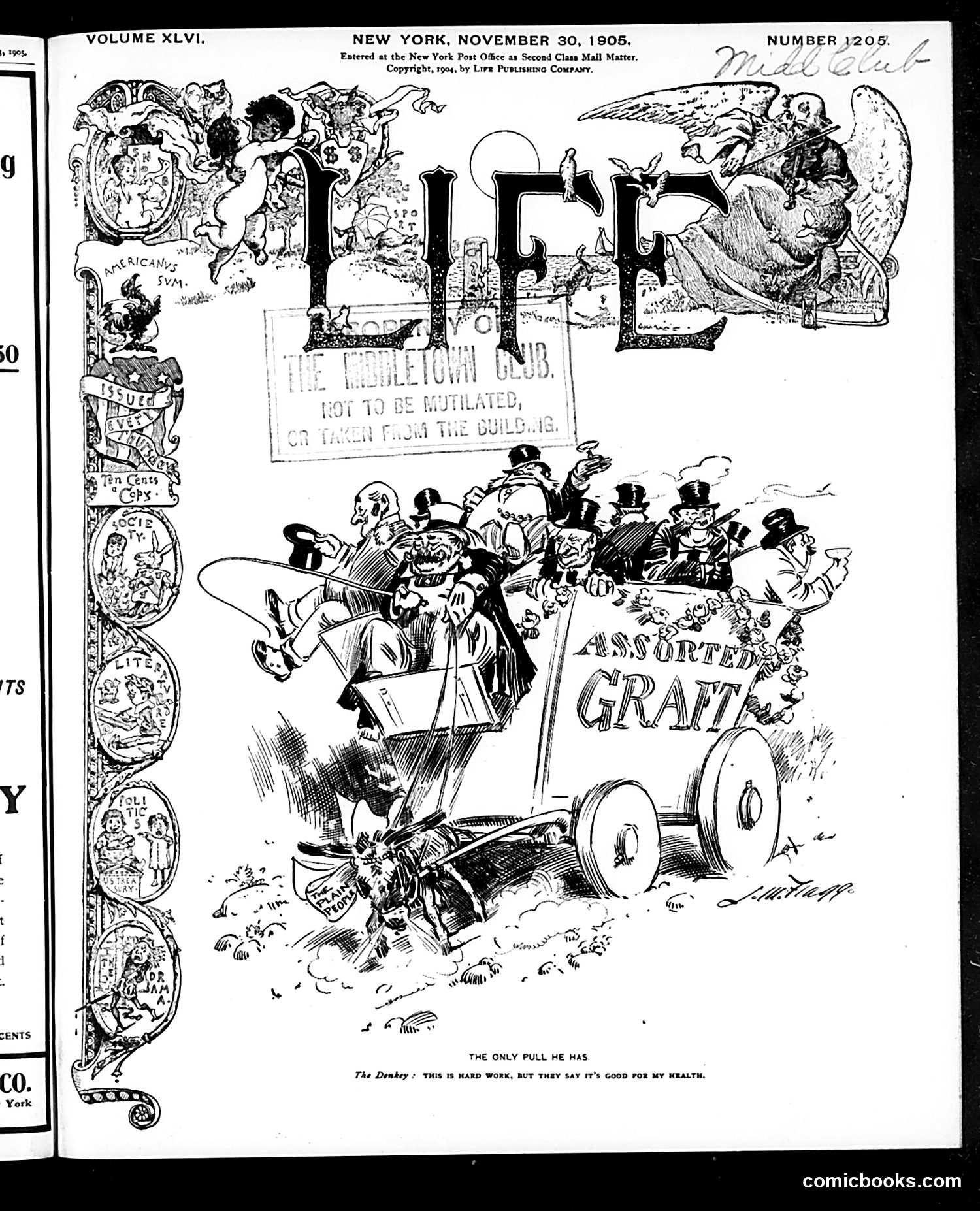
This satirical cartoon depicts "Assorted Graft"—a donkey cart overloaded with well-dressed politicians and businessmen in top hats, labeled as carrying "the only pull he has." The caption reads: "This is hard work, but they say it's good for my health." The donkey represents the common laborer or working class being exploited. The "graft" refers to political corruption and bribery—a major Progressive Era concern around 1905. The cartoon satirizes how corrupt officials and wealthy interests used their "pull" (political influence and connections) to enrich themselves while claiming their schemes benefited public welfare. The elaborate decorative border and prominent placement suggest this was a major editorial statement against the widespread corruption that characterized the early 1900s.
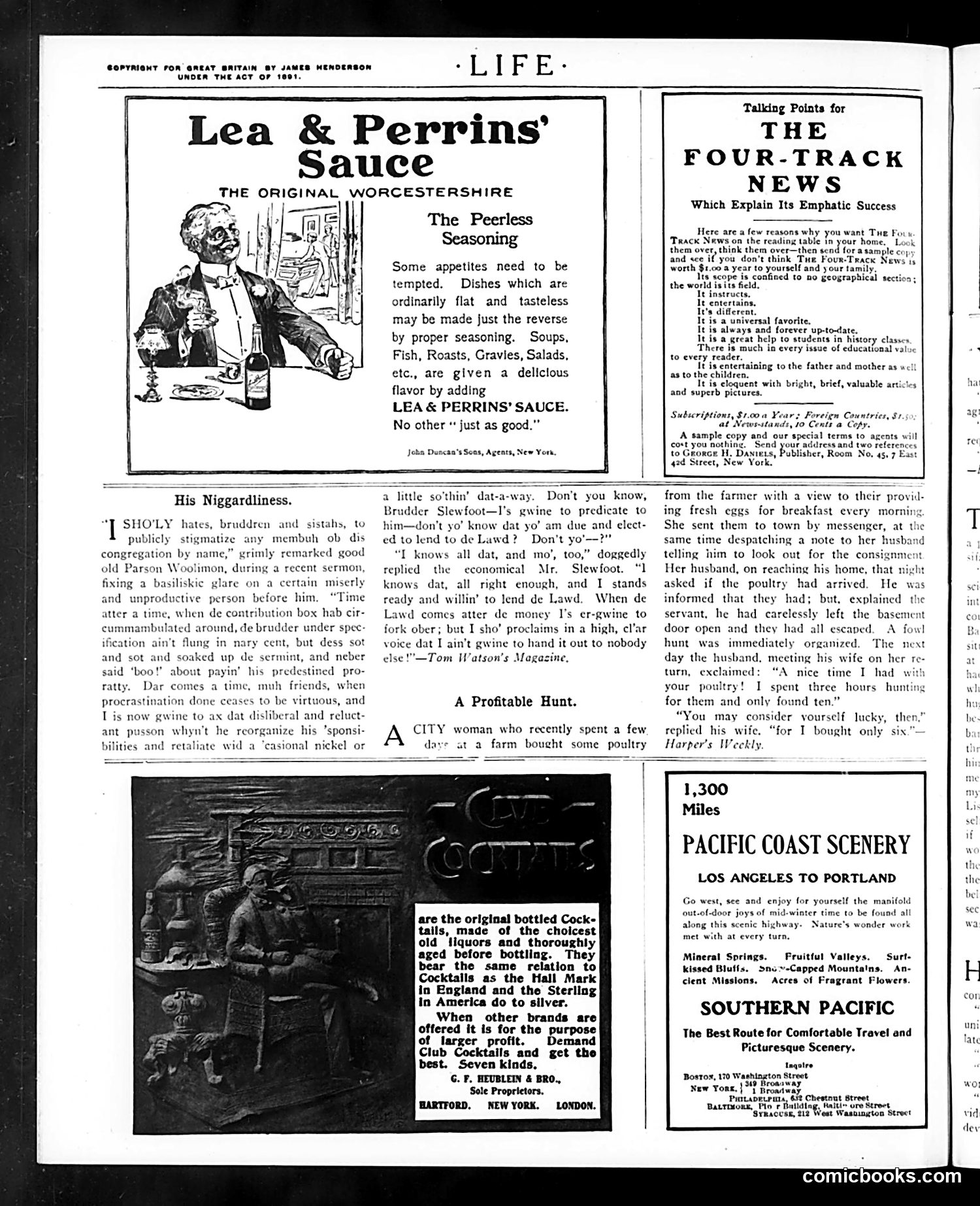
This page is primarily **advertising and humorous anecdotes** rather than political satire. The main visual content includes ads for **Lea & Perrins' Worcestershire Sauce** (featuring a Victorian-era figure) and **Club Cocktails**. The text sections contain three brief humorous pieces: "His Niggardliness" (about a clergyman's sermon on frugality), "A Profitable Hunt" (a domestic anecdote about poultry), and travel advertisements for Pacific Coast scenery. The tone is genteel humor typical of early 20th-century American magazines—social satire targeting middle-class behavior, domestic relations, and consumer culture rather than explicit political commentary. The period language and references (Parson Woolman, specific magazine citations) reflect the era's concerns with respectability and propriety among educated readers.
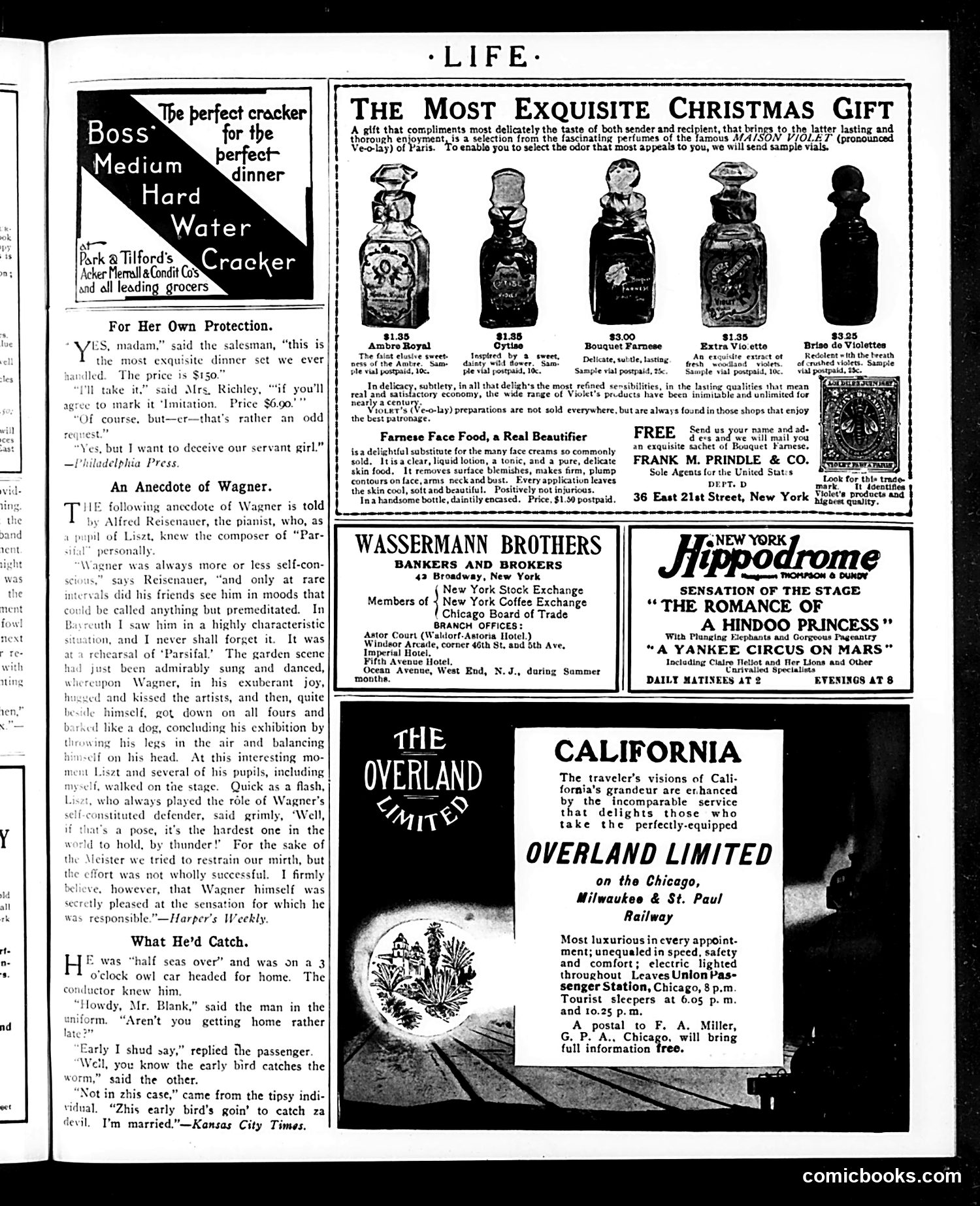
This page is **primarily advertisements** rather than satirical content. The top half features perfume and gift ads (Boss cracker, Frank M. Prindle & Co. perfumes, Wassermann Brothers banking, and Hippodrome theater). The bottom half advertises rail travel (Overland Limited train service to California). The only satirical content appears to be **"An Anecdote of Wagner"** and **"What He'd Catch"**—brief humorous stories about the composer Richard Wagner. The Wagner piece humorously depicts him as self-conscious and physically unrestrained during a rehearsal. The second story is a joke about catching early birds, playing on the proverb. These are minor filler pieces typical of *Life* magazine's mixed entertainment content rather than political satire.
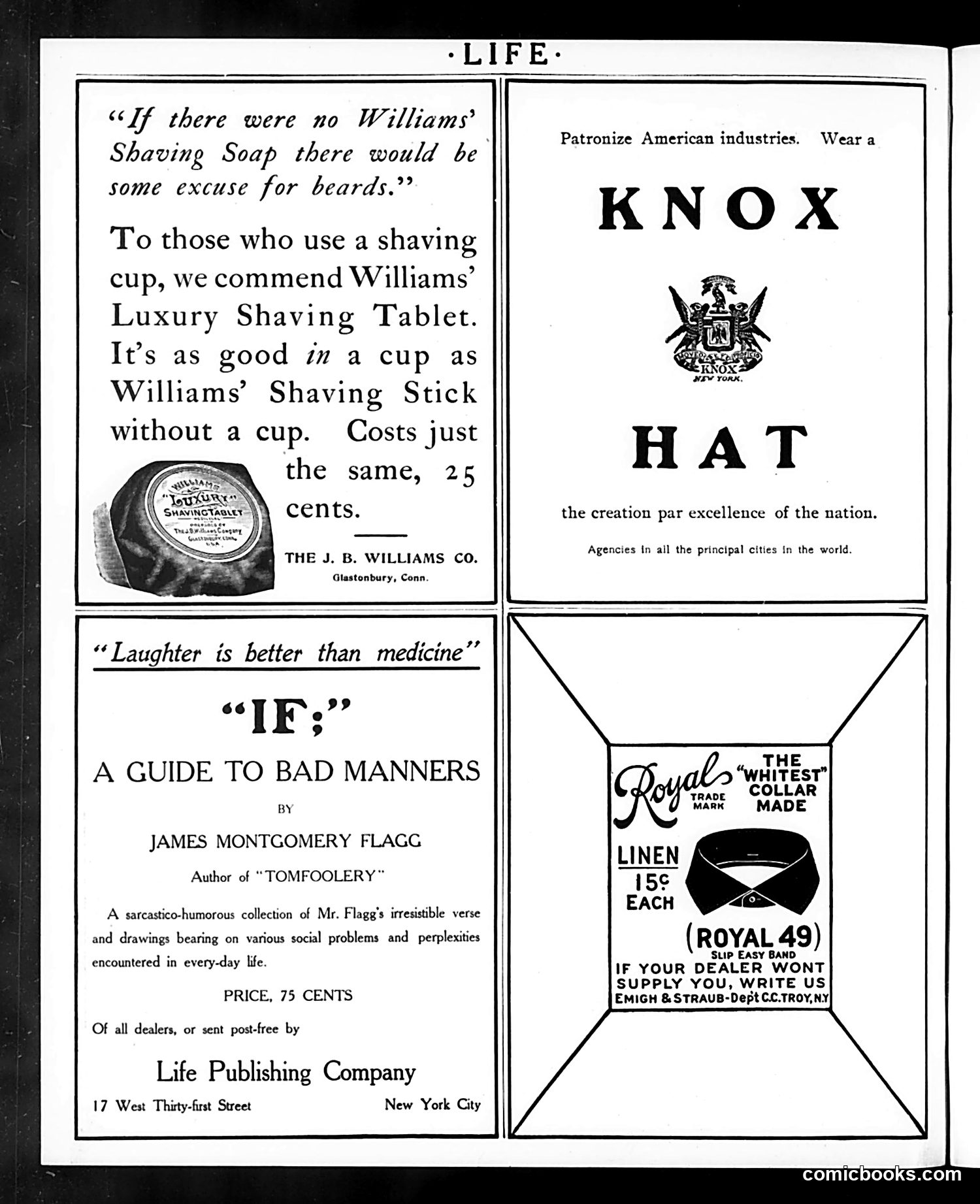
This page is primarily **advertising**, not political satire. It contains four vintage ads from what appears to be an early 20th-century Life magazine: 1. **Williams' Shaving Soap** - promotes their luxury tablet as equal to their shaving stick, both 25 cents 2. **Knox Hat** - advertises their hats as "the creation par excellence of the nation" with worldwide agencies 3. **"IF" book** - announces James Montgomery Flagg's humorous guide to bad manners, priced 75 cents, available from Life Publishing Company 4. **Royal Collar** - promotes linen collars at 15 cents each with an easy slip band The only potentially satirical element is Flagg's "IF: A Guide to Bad Manners," which uses humor about social etiquette. Otherwise, this is straightforward period advertising with no discernible political messaging.
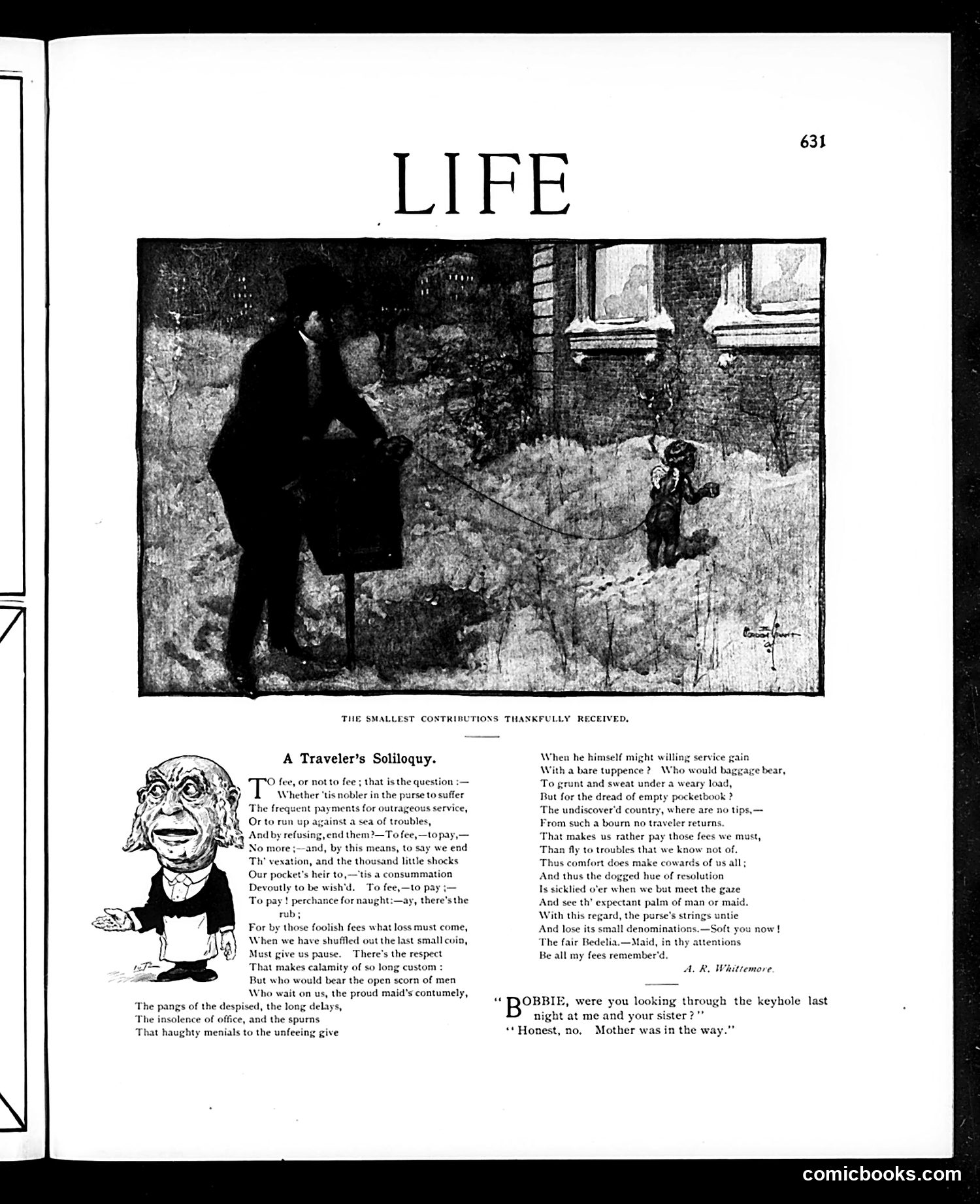
**Main Image:** Shows two figures with a child on a leash in snowy conditions—"The Smallest Contributions Thankfully Received" likely satirizes charitable giving or public assistance. **"A Traveler's Soliloquy":** The caricatured figure (with exaggerated features typical of period satire) delivers a monologue about paying small fees and gratuities during travel. The piece mocks the culture of tipping and minor charges travelers face—porters, servants, etc. The speaker rationalizes these expenses as necessary costs of service, though complaining about their accumulation. **Bottom dialogue:** A brief exchange ("Dobbie, were you looking through the keyhole...") appears to be separate comic content. The satire targets the frustrating nickel-and-diming aspect of travel and service culture in this era.
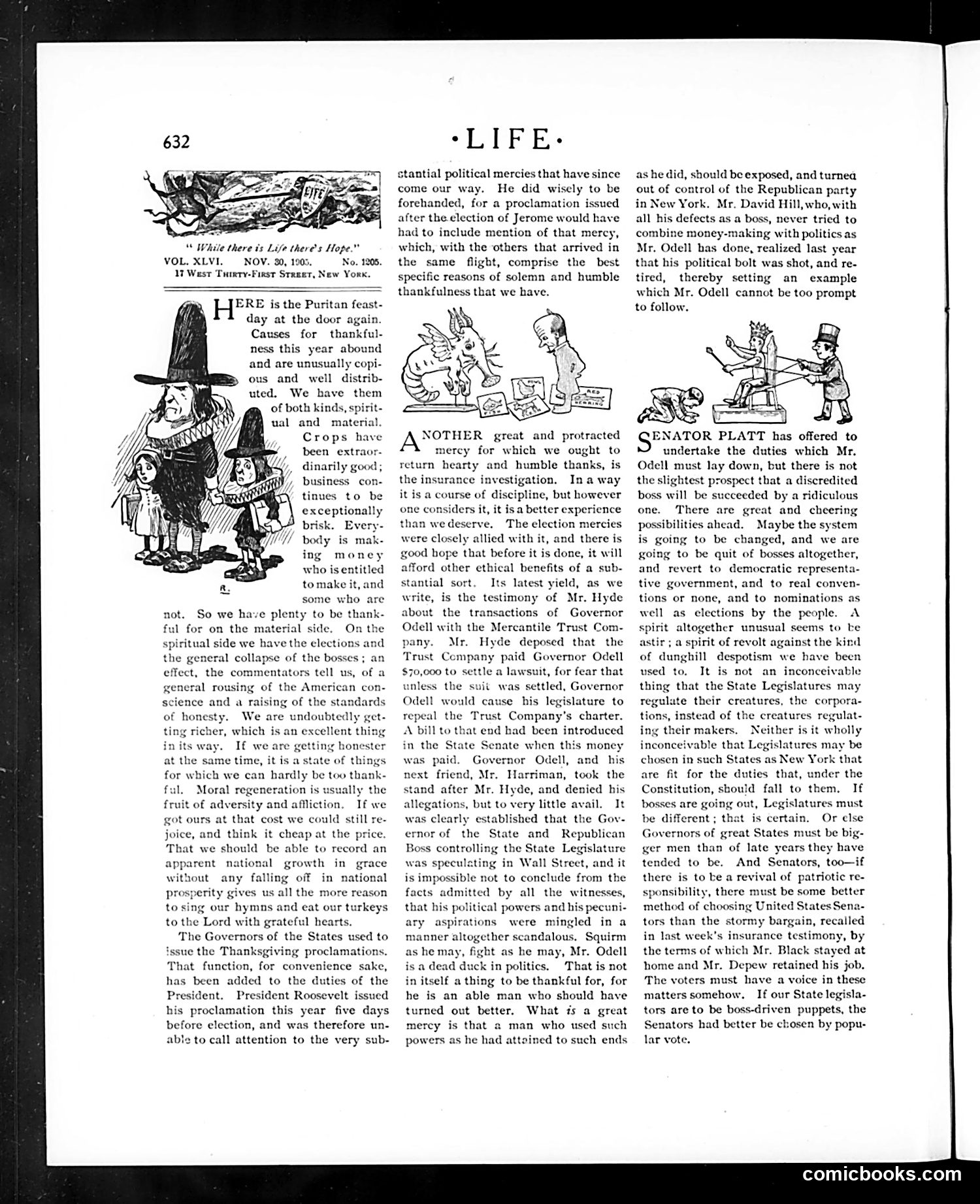
The left cartoon depicts a Puritan figure with children, illustrating the article's discussion of Thanksgiving proclamations and national gratitude. The imagery connects historical Puritan traditions to contemporary American values. The right cartoons appear to reference Governor Odell and political corruption, specifically the Mercantile Trust Company scandal. The text criticizes how Odell's political powers became intertwined with Wall Street speculation, suggesting he functioned as a "Republican Boss controlling the State Legislature" while pursuing private financial interests. Senator Platt's potential involvement in resolving these issues is presented with skepticism—the cartoons suggest political insiders cannot be trusted to regulate themselves without popular oversight and democratic accountability. The satire critiques gilded-age corruption and the need for electoral reform.
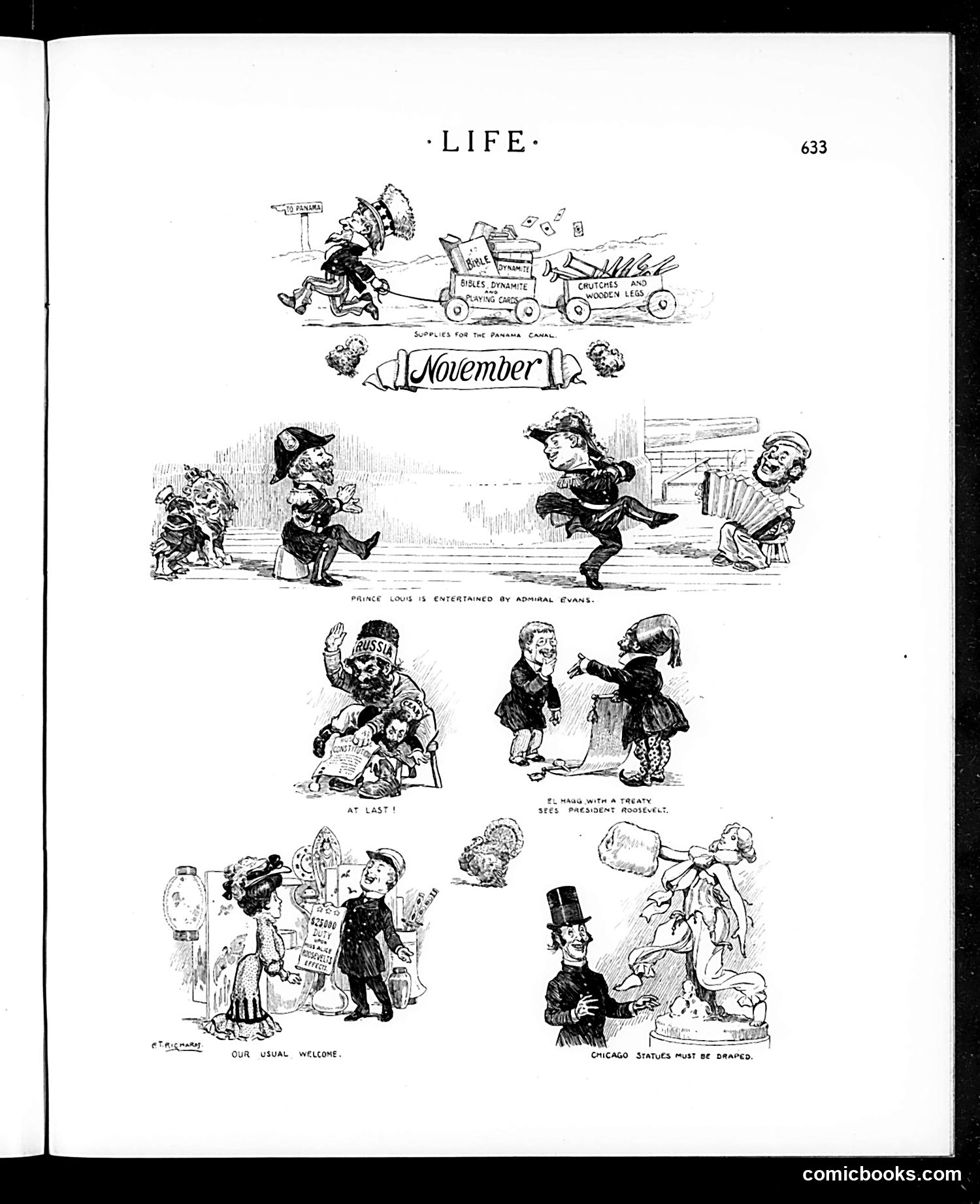
This page contains six satirical sketches commenting on November 1912 events: **Top panel**: A chaotic "supplies for the Panama Canal" scene, likely mocking construction delays or mismanagement. **Middle panels**: References to Prince Louis of Battenberg (entertained by Admiral Evans), and a figure labeled "Russia" with children, likely commenting on Russian politics or diplomatic relations. **Lower panels**: "Our Usual Welcome" depicts American immigration/reception, while "Chicago Statues Must Be Draped" appears to reference controversy over public monuments—possibly obscuring artwork deemed inappropriate. The cartoons employ exaggerated caricature typical of early 1900s satire, combining domestic political commentary with international affairs. Without specific publication dates visible, the exact events referenced remain somewhat unclear, though they reflect contemporary Progressive Era concerns about infrastructure, immigration, and public morality.
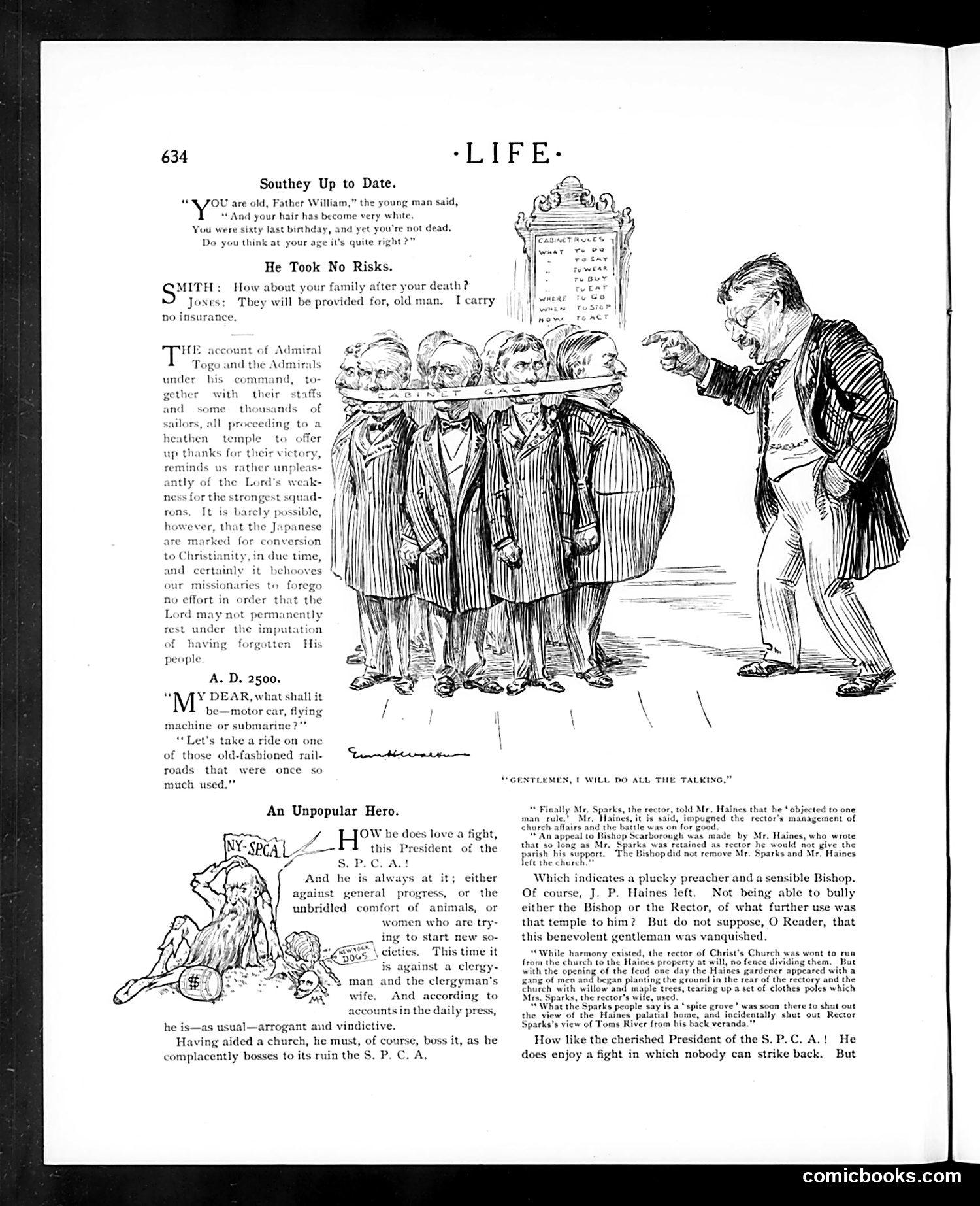
This page contains two satirical pieces attacking prominent figures and institutions: **"He Took No Risks"** mocks an unnamed man (likely a public figure) who claims to carry "no insurance" for his family's welfare, implying reckless irresponsibility disguised as bold principle. **"An Unpopular Hero"** attacks the President of the S.P.C.A. (Society for the Prevention of Cruelty to Animals). The satire suggests this President fights against progress and modern conveniences (motors, flying machines, submarines) while championing animal welfare—positioning him as hypocritically opposed to human advancement. The cartoon shows him declaring "I will do all the talking," suggesting he silences reasonable debate. The accompanying text criticizes both his management and a Rector's position on the same issue, portraying the S.P.C.A. President as arrogant and obstructive to progress.
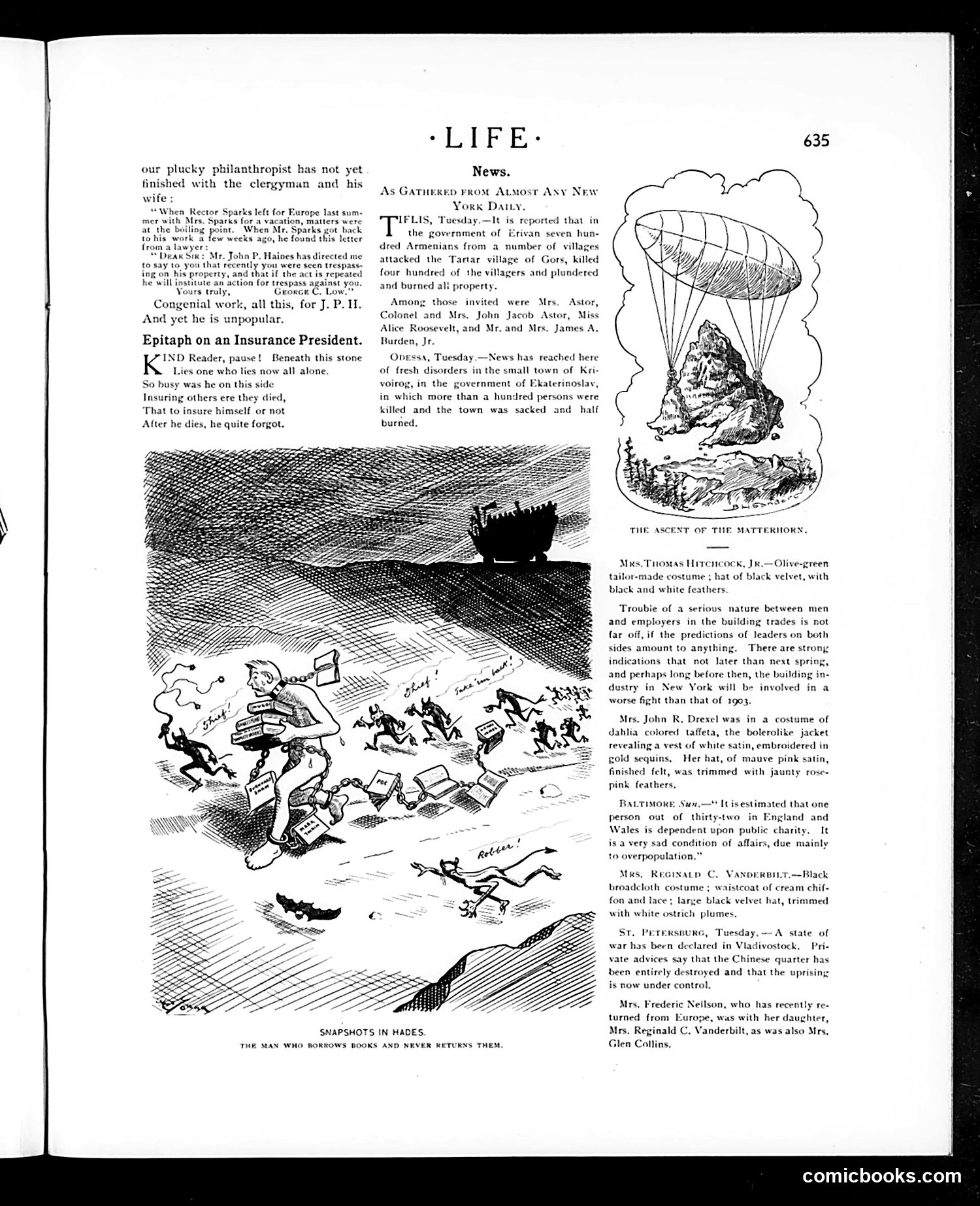
This satirical cartoon depicts a man in Hell surrounded by demons and chaos, labeled as "the man who borrows books and never returns them." The joke plays on the moral weight given to this common social transgression—treating chronic book-borrowing as a sin deserving eternal punishment in the underworld. The cartoon mocks both the petty annoyance of unreturned borrowed items and society's tendency to dramatize minor moral failures. By placing this ordinary social offense among traditional Hell imagery, Life magazine humorously suggests that such inconsiderate behavior deserves damnation—a satirical commentary on social etiquette and personal responsibility in early 20th-century American culture.
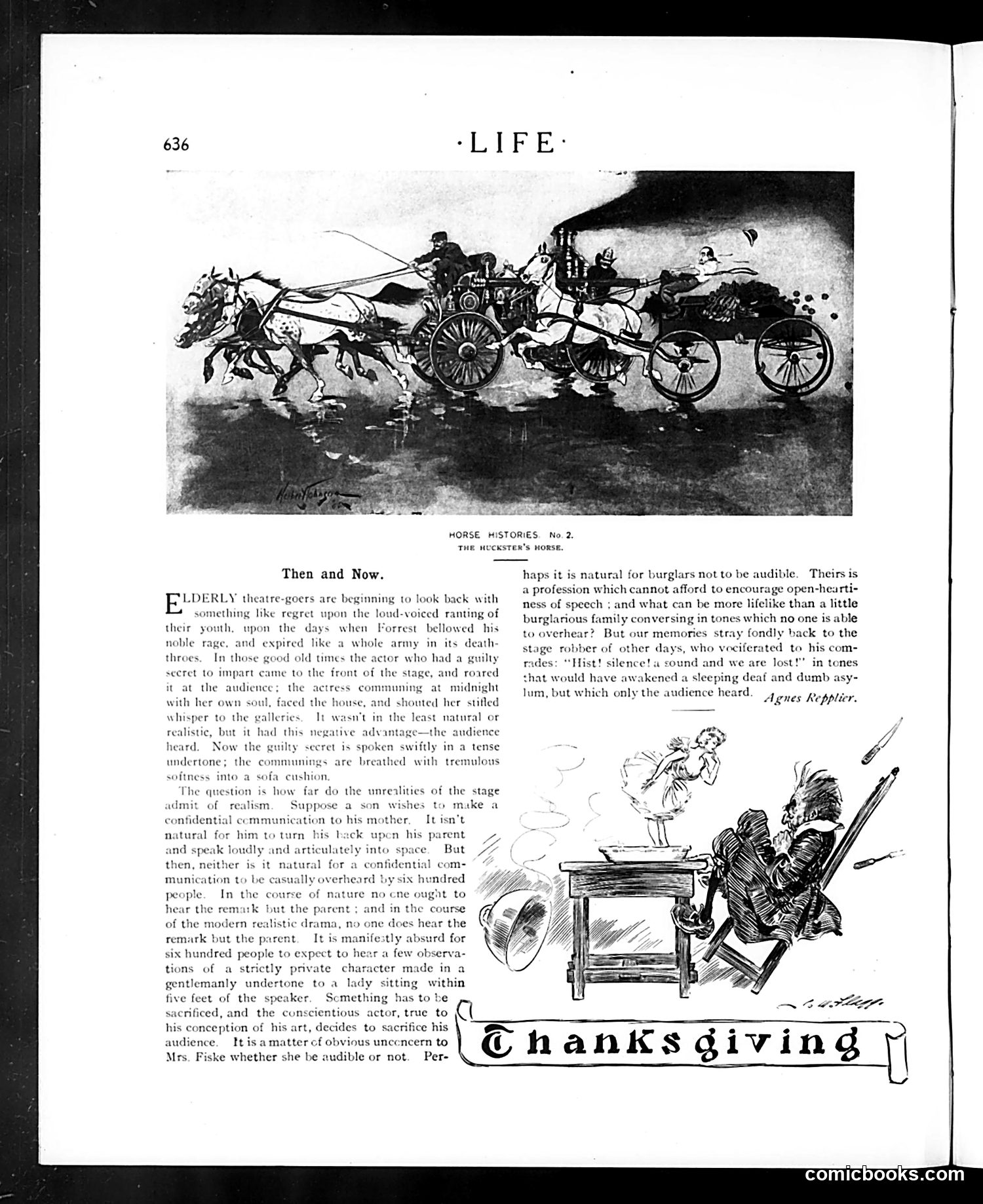
This page contains an essay titled "Then and Now" discussing theatrical performance styles, followed by a humorous illustration labeled "Thanksgiving." **The top illustration** ("Horse Histories No. 2: The Heckler's Horse") depicts a runaway horse-drawn carriage careening past an automobile, satirizing the collision of old and new transportation methods. **The main joke** (bottom illustration) shows a pilgrim-era figure being launched from a cannon at a table laden with Thanksgiving food. The satire appears to target the contrast between idealized historical narratives of Thanksgiving and harsh reality—the figure is literally being "shot" toward the feast, suggesting violence or desperation underlying the holiday's romanticized image. The essay's discussion of theatrical authenticity and audience perception provides context for the magazine's broader critique of how Americans consume and misunderstand their own history and traditions.
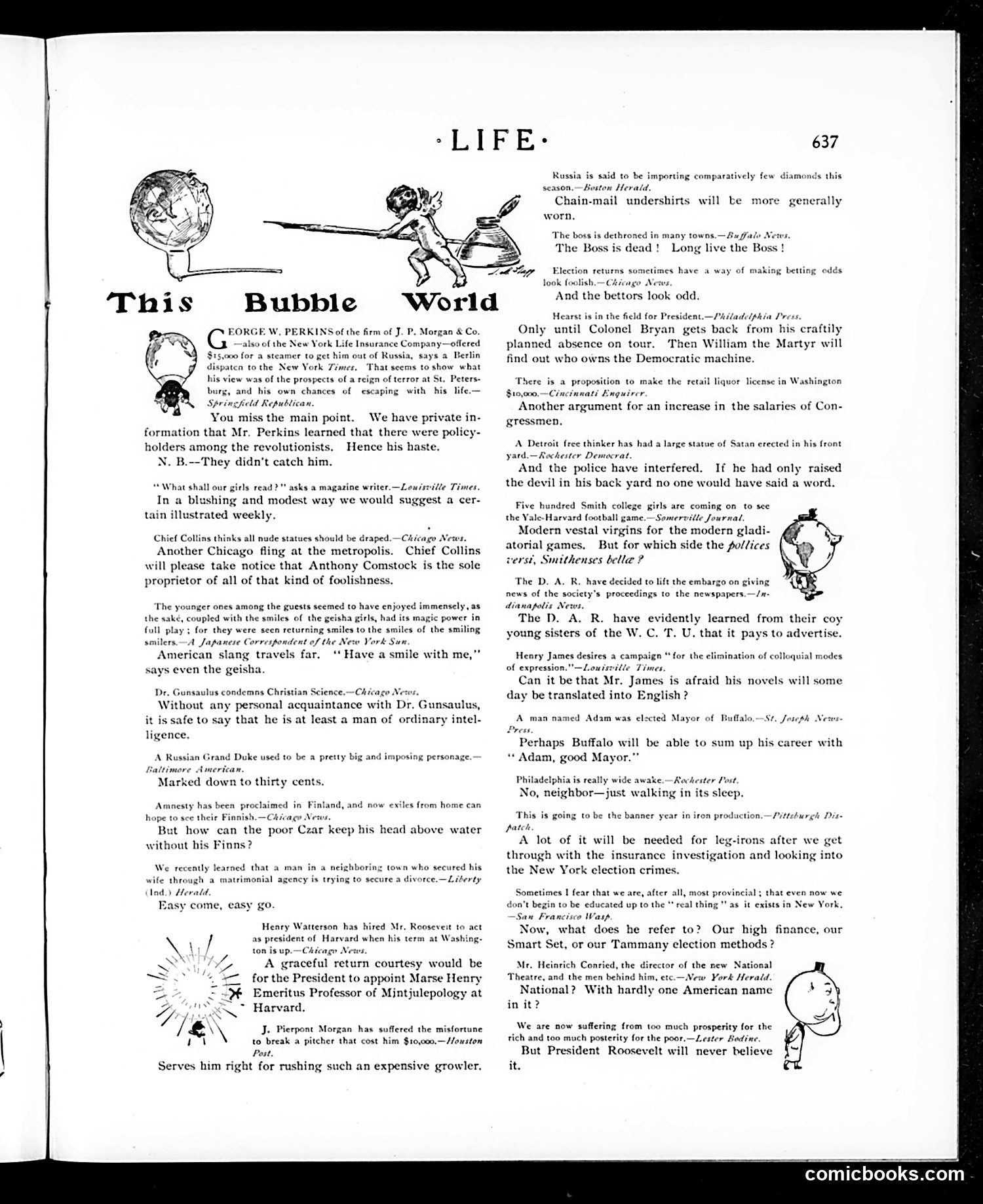
This page features a satirical column titled "This Bubble World" alongside editorial commentary. The main cartoon depicts a cherub or child figure blowing bubbles, with one large bubble containing a globe—a visual metaphor for the fragility of the world or current events. The text consists of brief satirical quips about contemporary issues: insurance company deception, political campaigns (referencing Colonel Bryan), Congressional salary debates, and social commentary on fashion and behavior. One item mocks a Detroit free-thinker's statue of Satan, suggesting hypocrisy about free speech. Another references the D.A.R. (Daughters of the American Revolution) and their advertising practices. The overall tone is typical of *Life*'s early-20th-century style: cynical, topical commentary on politics, society, and prominent figures, using humor to critique institutional absurdities and contemporary follies.
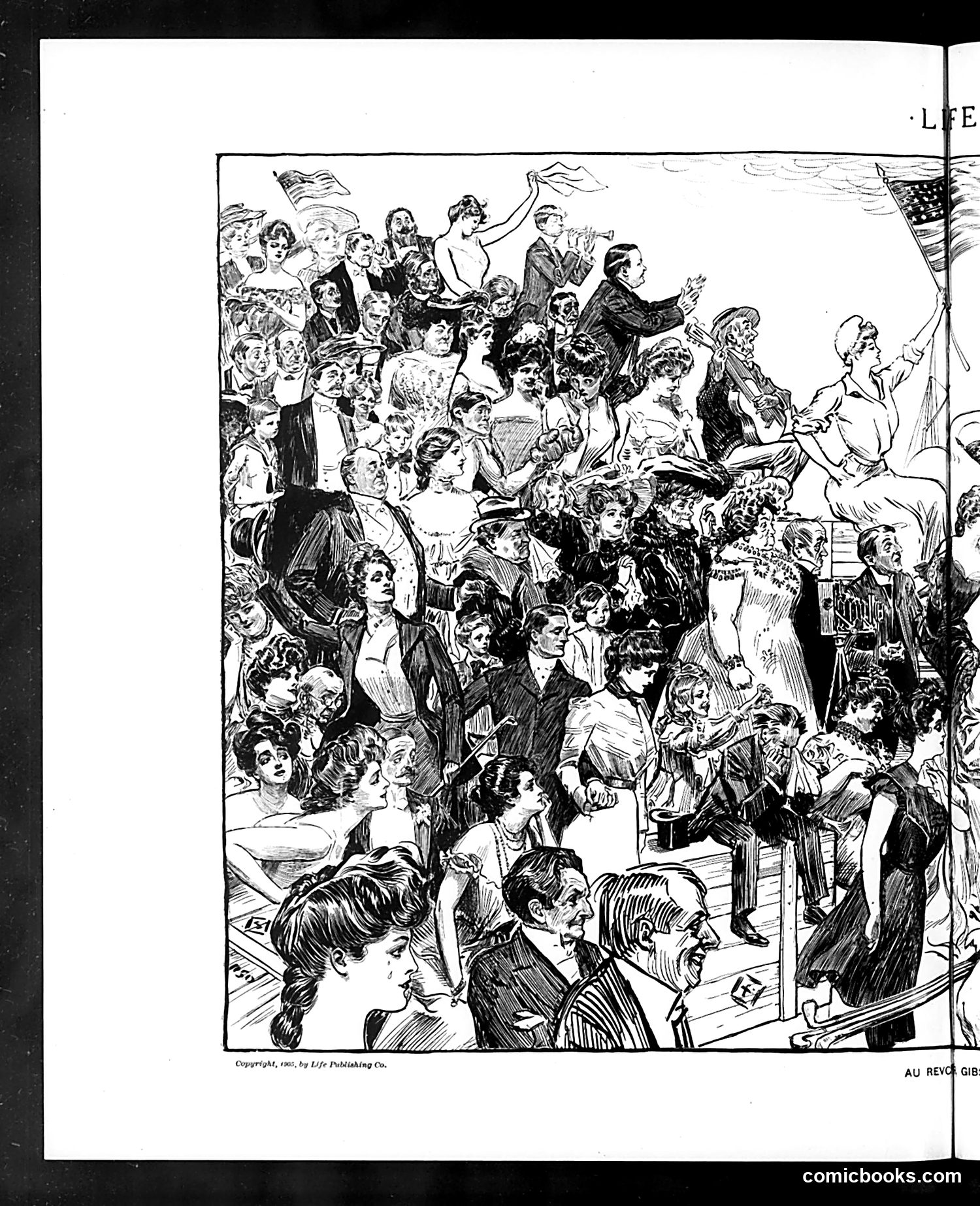
This is a densely crowded illustration depicting what appears to be a patriotic public gathering or celebration, likely from the early 1900s based on the artistic style and the visible American flag. The scene shows men, women, and children in period dress gathered together, with some figures elevated or gesturing enthusiastically. The copyright notation indicates this is from Life Publishing Co. The partial text visible ("AU REVO GIB") at bottom right is unclear—likely a cropped caption or title. Without complete text or clearer identifying details, I cannot confidently identify specific political figures or satirical targets. The gathering itself appears celebratory rather than overtly critical, though Life was known for political satire. More context would be needed to explain the cartoon's specific meaning to modern readers.
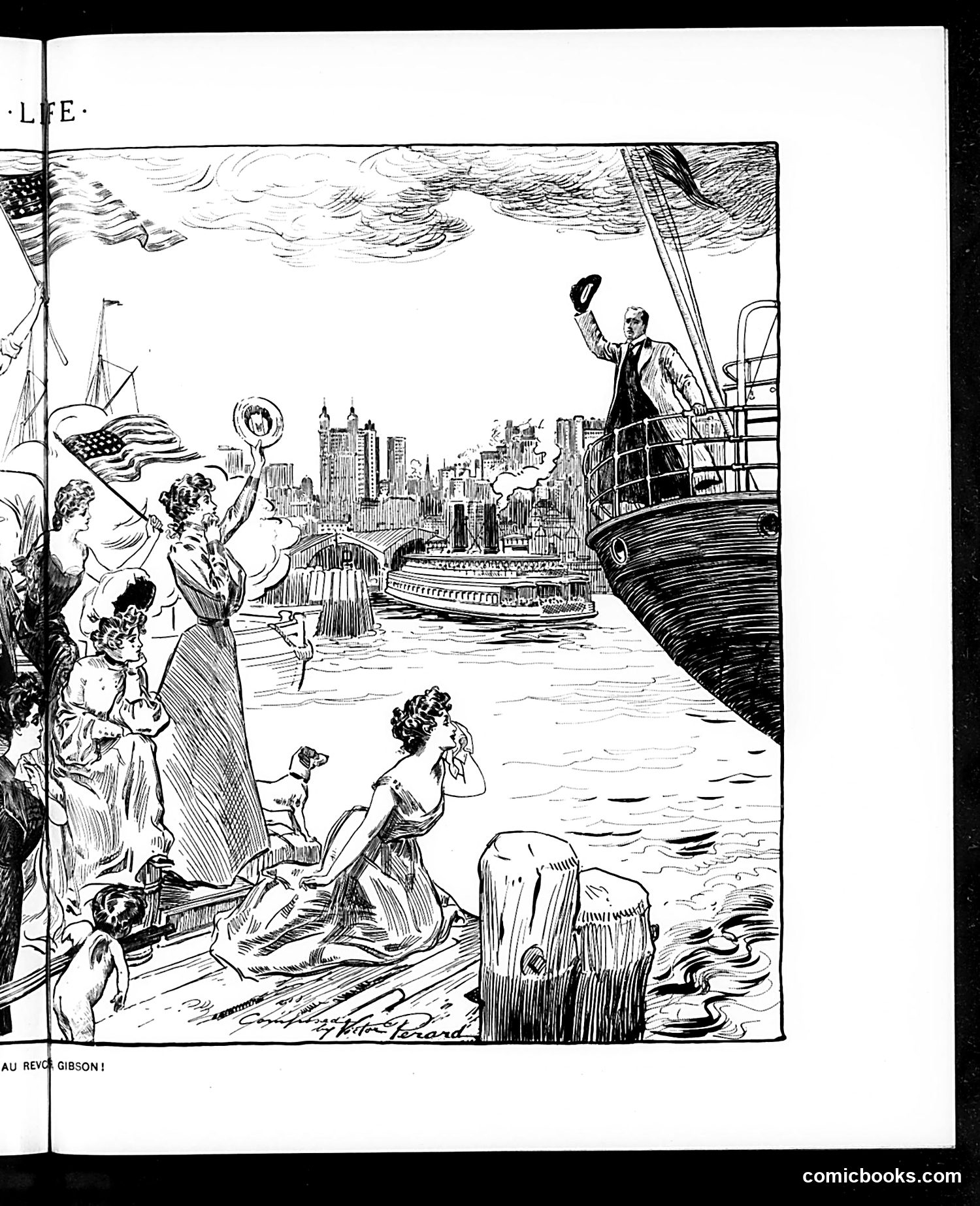
This illustration depicts a romanticized scene of arrival at New York Harbor, likely from the early 20th century. A well-dressed gentleman on a steamship tips his hat in greeting while observing the Manhattan skyline. On the dock below, women and children wave American flags in welcome. The scene celebrates immigration and arrival in America, portraying it as a joyous, patriotic moment. The cartoon appears to satirize the idealized version of immigration that was promoted in popular culture, contrasting the romantic depiction with the actual experiences many immigrants faced. The emphasis on flags, formal dress, and celebratory poses suggests this may be gently mocking the sanitized, patriotic narrative of American immigration rather than acknowledging its complexities and hardships.
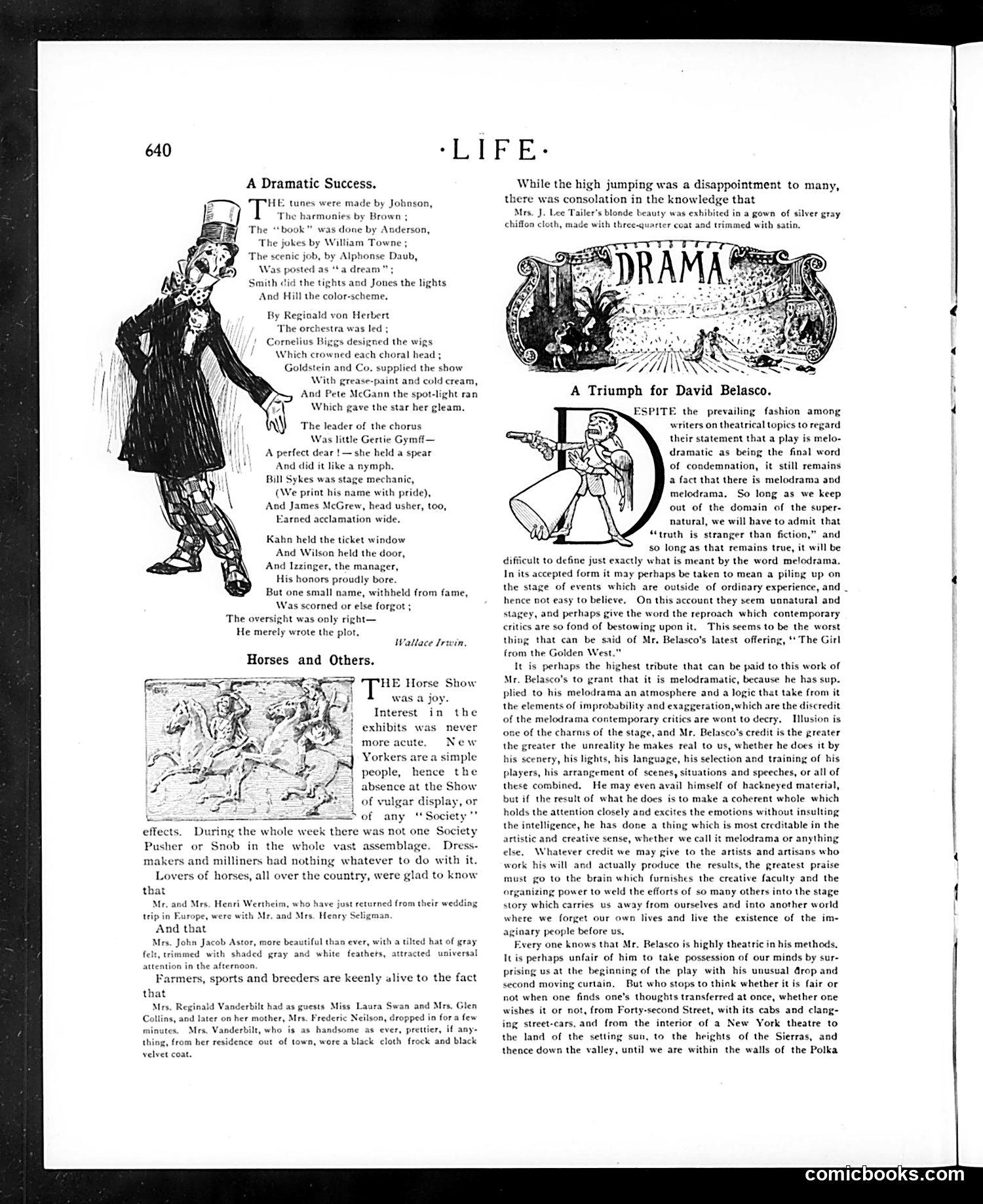
This page satirizes theatrical production and high society through two pieces: **"A Dramatic Success"** (left): A poem by Wallace Irwin listing every contributor to a theatrical production—composers, writers, scenic designers, lighting technicians, costume makers, stagehands, ushers, managers—while pointedly omitting credit for the actual **playwright**. The joke is that the person who "merely wrote the plot" is scorned or forgotten entirely, despite being essential. This satirizes how theater credit often goes to designers and performers while writers receive little recognition. **"Horses and Others"** (center/right): Mocks the pretension of New York's high society attending the Horse Show. The text sarcastically claims there was "no vulgar display" and "not one Society Pusher or Snob," then immediately catalogs numerous wealthy society figures (Vanderbilts, Astors, etc.), exposing the contradiction—these elite attendees represent exactly the ostentatious society the passage claims was absent. **"A Triumph for David Belasco"** (right): Praises theater director Belasco's melodrama *The Girl from the Golden West*, arguing that calling it melodramatic is actually a compliment because he creates believable atmosphere.
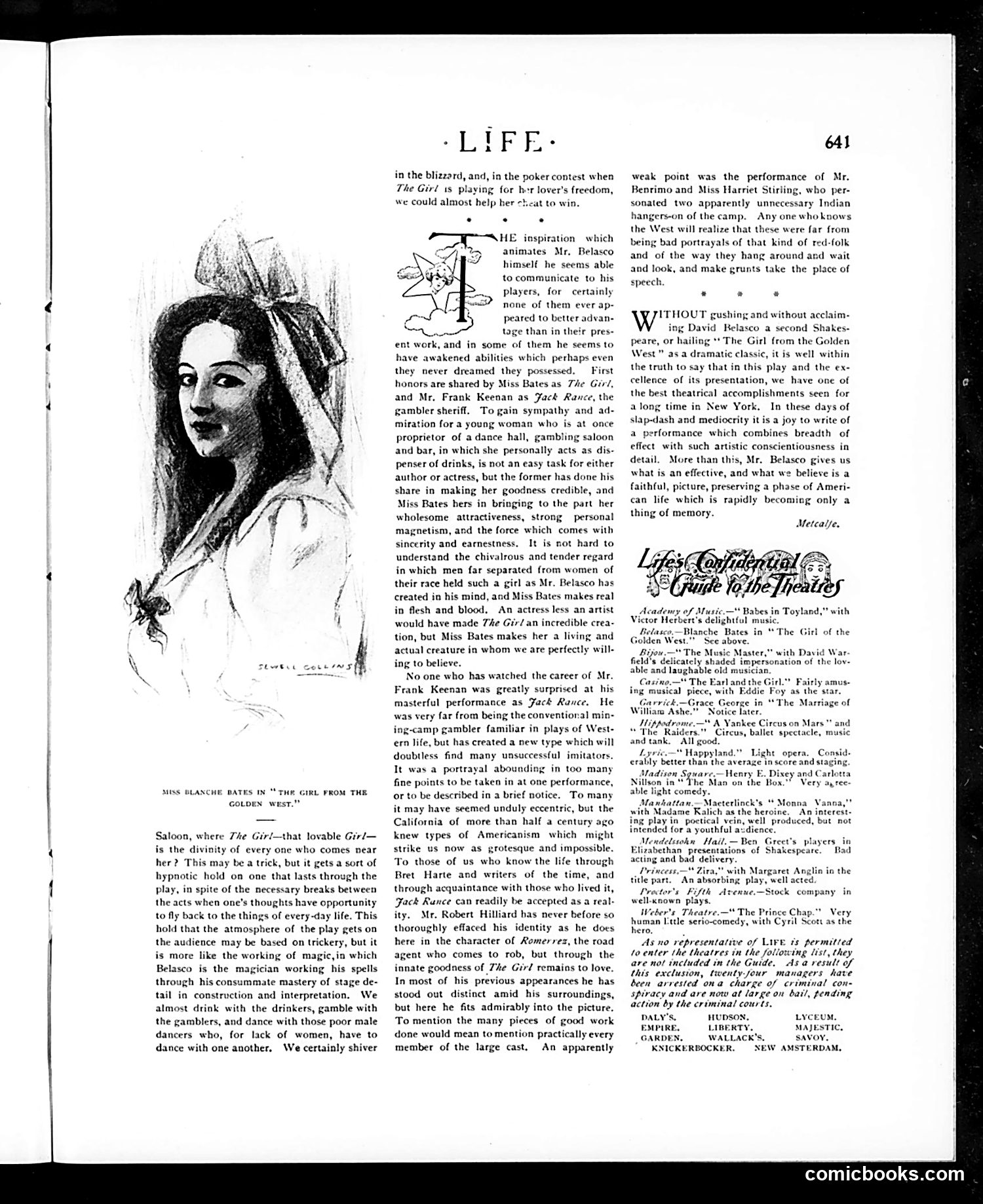
This page reviews David Belasco's theatrical production of *The Girl from the Golden West*, featuring actress Blanche Bates in the title role. The sketch shows Bates in character. The review praises Belasco's directorial mastery in creating an immersive Wild West saloon atmosphere where audiences emotionally invest in the plot—even sympathizing with the protagonist, a woman who runs a gambling hall and dispenses drinks. The critic notes this required skillful acting; a less talented actress would make the character incredible. The review highlights Frank Keenan's performance as Jack Rance, the gambler-sheriff, as a fresh departure from conventional Western theater types. It also praises Robert Hilliard's supporting role as Romerrez, a road agent. The piece is essentially a positive critical assessment of the play's theatrical craftsmanship and cast performances, not satire or political commentary—it's a standard theater review from this era of *Life* magazine.
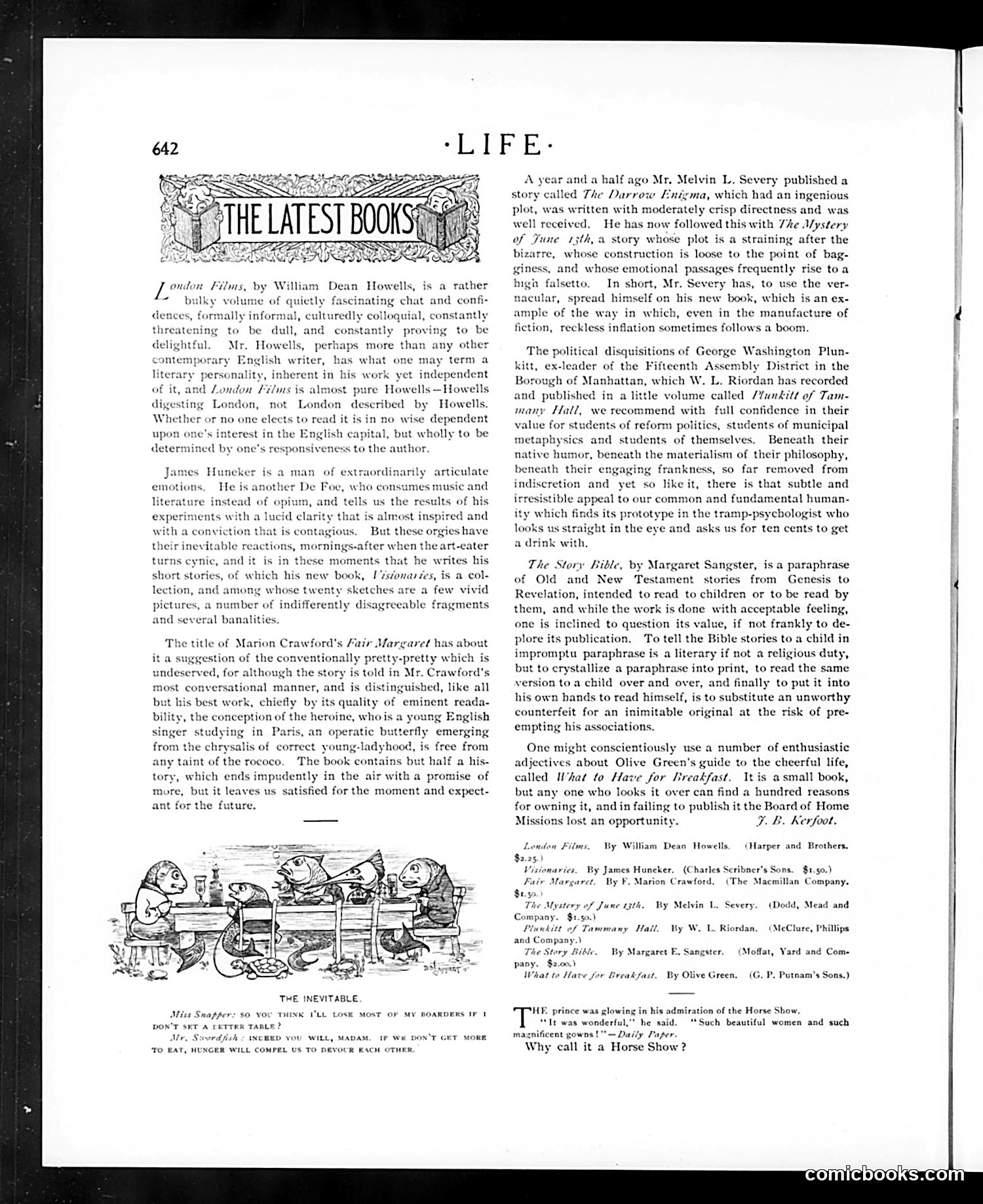
This single-panel cartoon depicts a landlady (Miss Snapper) and what appears to be a boardinghouse resident (Swordfish) in conversation. The joke plays on economic hardship during what appears to be a period of financial difficulty. **The satire:** Miss Snapper asks if improving her table service will retain boarders. Swordfish bluntly replies that better food won't help—hunger will force them to leave anyway because they cannot afford to eat there. The "inevitable" outcome is that poverty, not poor hospitality, drives away her tenants. **The point:** This reflects working-class economic anxiety of the era. The humor is dark: it satirizes both the landlady's misguided priorities (thinking presentation matters when people are starving) and the grim reality that desperation will scatter her boarders regardless. The cartoon critiques the disconnect between small business owners and the desperate financial conditions their customers face.
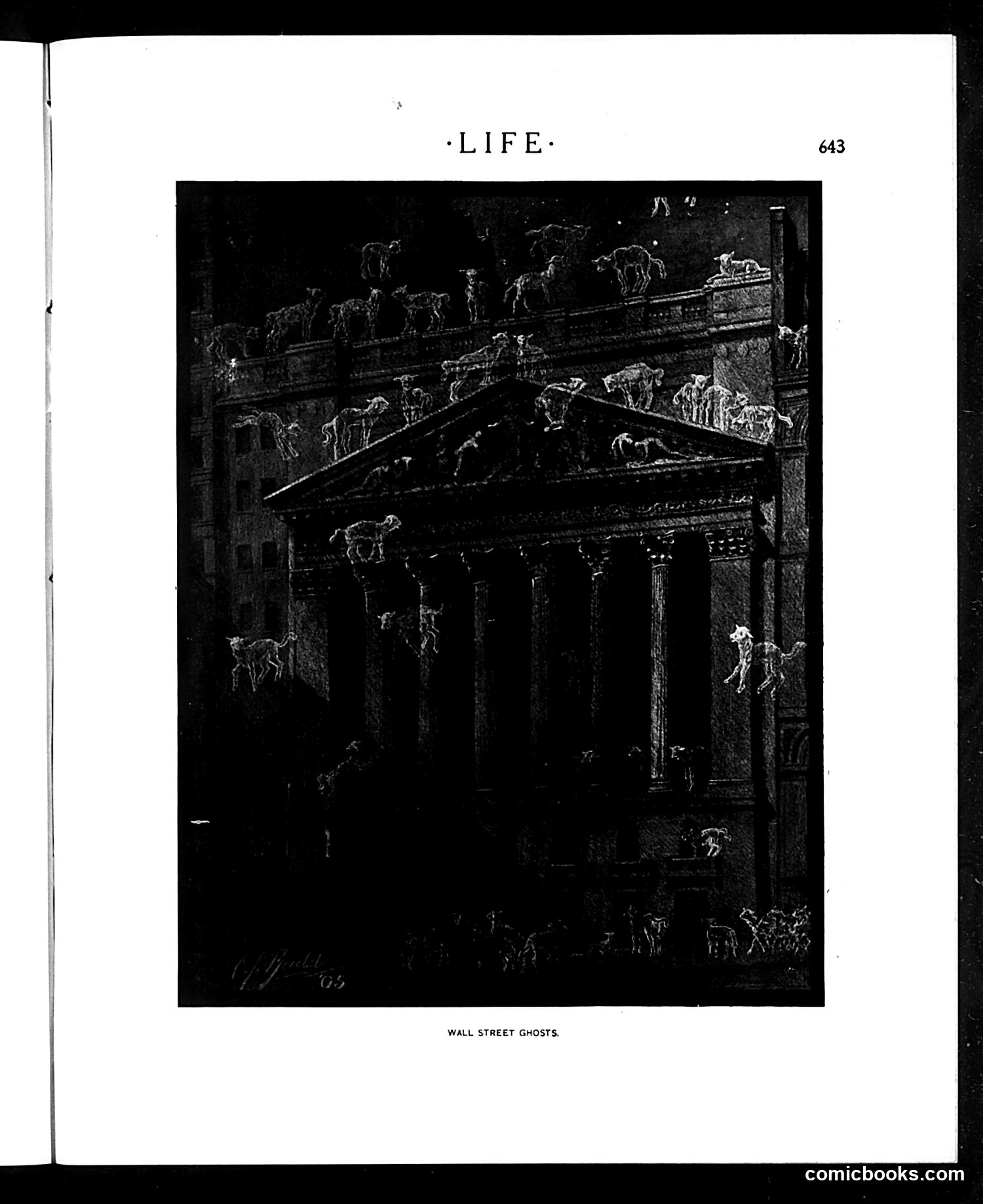
This political cartoon depicts a classical Greek or Roman temple—representing the institutions of Wall Street and finance—now haunted by ghostly figures. The ghosts appear to be climbing on the building's structure and roofline, suggesting spectral presences inhabiting what should be solid, trustworthy institutions. The title "Wall Street Ghosts" implies that the financial district is now populated by insubstantial or illusory forces—likely referencing financial collapse, fraud, or the disappearance of promised wealth. The classical architecture contrasts sharply with the ghostly chaos, suggesting a once-grand system now corrupted or failing. Without a visible date, the exact historical crisis referenced remains unclear, though the imagery suggests post-1929 stock market crash commentary or similar financial scandal satire.
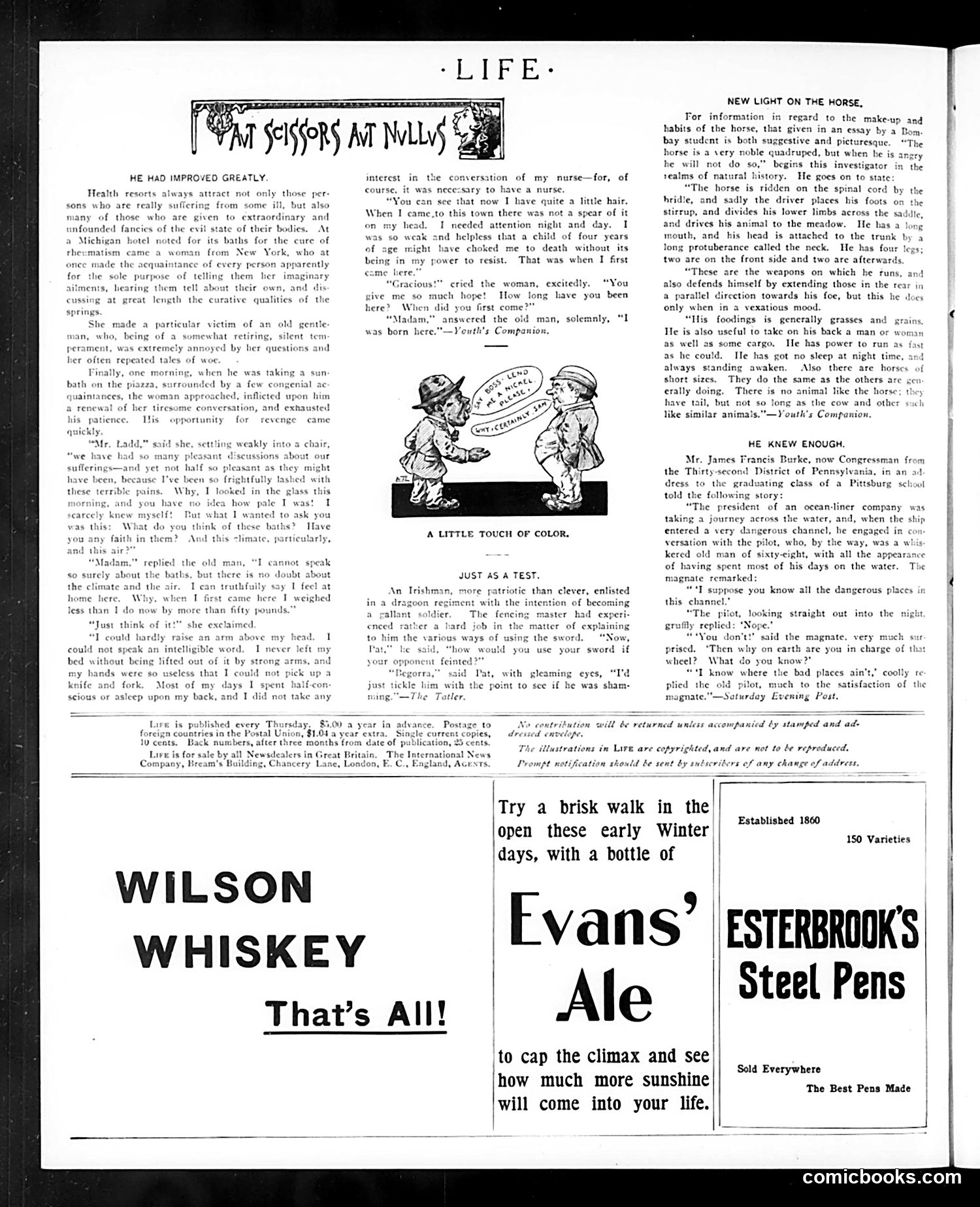
This page from *Life* magazine contains three distinct elements: **Main Story ("At Scissors at Nullus")**: A humorous anecdote about a talkative woman at a Michigan health resort who constantly complains about her ailments. An elderly gentleman she bothers takes revenge by claiming the baths have made him gain 50 pounds and regrow hair—shocking her into silence. The joke satirizes hypochondriacs and people who monopolize conversation with health complaints. **"New Light on the Horse"**: A brief humorous piece mocking a poorly-written essay by an Indian student about horses. It quotes absurdly awkward descriptions (the horse has a "long protuberance called the neck") to ridicule the writer's English and anatomical knowledge. **Advertisements**: Three period ads for Wilson Whiskey, Evans' Ale, and Esterbrook's Steel Pens occupy the lower half. The cartoons complement the text's satire of human foibles—health obsession and pretension—through gentle mockery typical of early 20th-century American humor magazines.
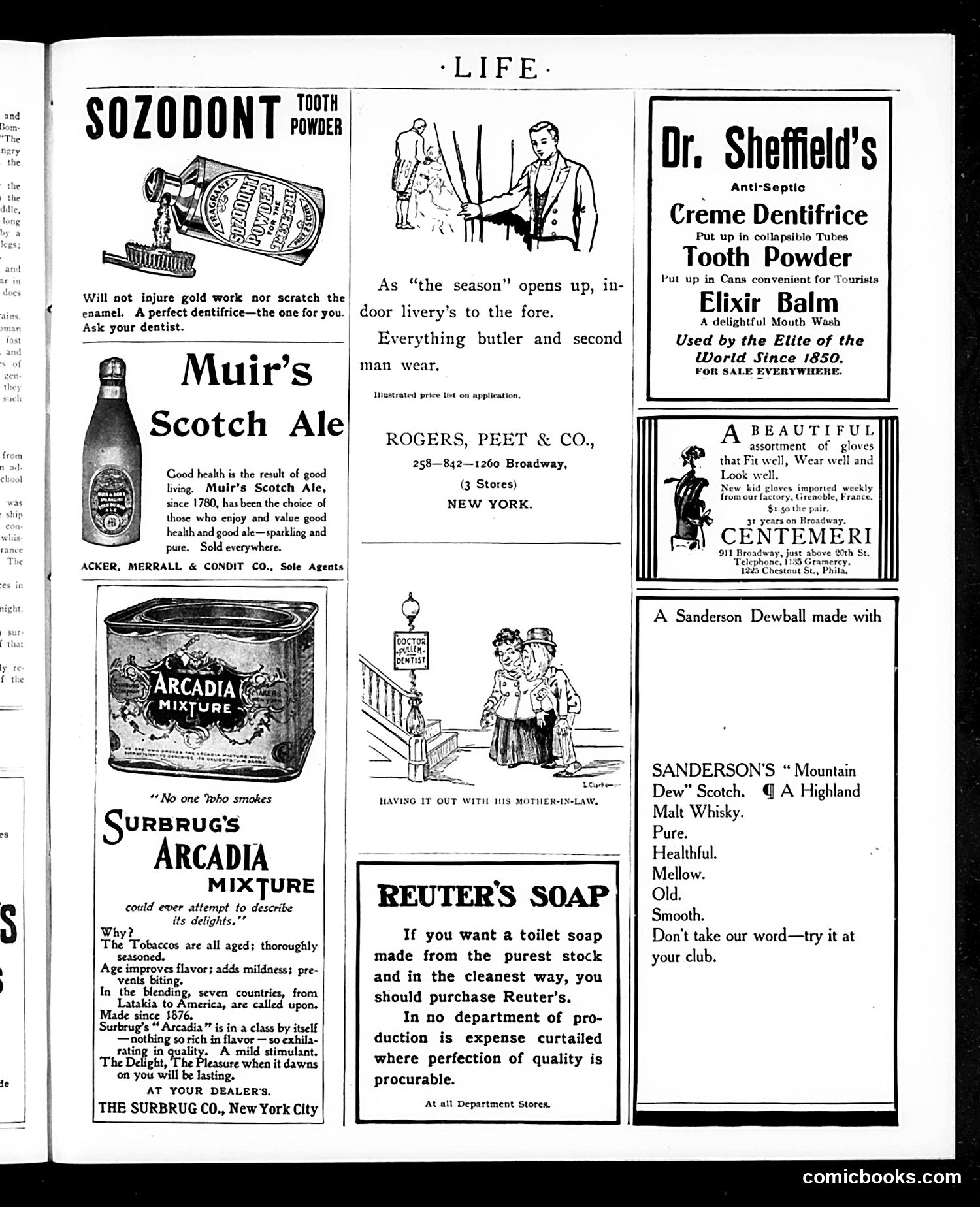
This page is primarily **advertising**, not political satire or editorial cartoons. It contains vintage product advertisements from approximately the late 19th or early 20th century. The two illustrated vignettes are **promotional imagery** rather than satirical commentary: 1. **Top center**: Shows a man and woman in formal attire at what appears to be a social season opening—used to advertise Rogers, Peet & Co. clothing ("Everything butler and second man wear"). 2. **Bottom center**: Depicts a man with his mother-in-law, promoting Reuter's Soap with the sales pitch that no expense is spared on quality. These sketches function as lifestyle marketing—associating products with aspirational social situations and respectability rather than making political points. The other advertisements promote tooth powder, Scotch ale, whisky, gloves, and tobacco mixture using similar appeals to health, quality, and social status typical of period advertising. **No political satire is evident on this page.**
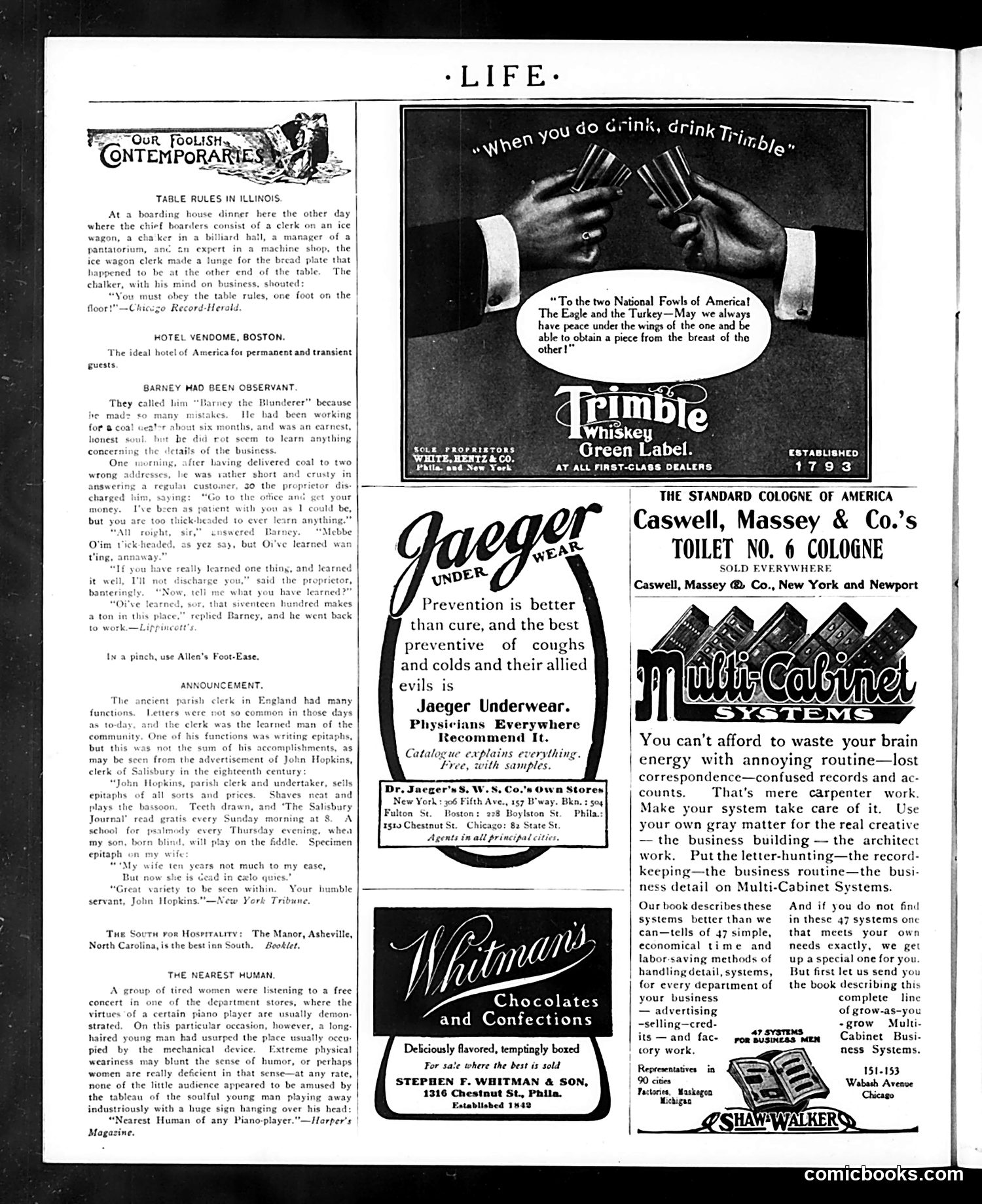
This page is primarily **advertising with accompanying humor columns** rather than political cartoons. The content includes: **Main Features:** 1. **"Our Foolish Contemporaries"** section: Satirical anecdotes mocking social absurdities—a clerk obsessed with table rules, a hotel's "permanence," and a worker nicknamed "Barney the Blunderer." 2. **"The Nearest Human"** column: A humorous story about concertgoers who mistake a tired woman at a piano for a performer, praising her "realistic" playing while she sleeps from exhaustion. 3. **Prominent Advertisement**: A **Trimble Whiskey ad** featuring a toast to "the two National Fowls of America" (the Eagle and Turkey), playing on patriotic imagery for commercial purposes. **The Satire's Point:** The humor targets everyday social pretension and obliviousness—people following arbitrary rules, mistaking incompetence for virtue, and audiences seeing what they expect rather than reality. The whiskey ad appropriates patriotic symbols for marketing, typical of early 20th-century commercial culture. The page reflects *Life's* role as satirizing middle-class American society's peculiar customs.
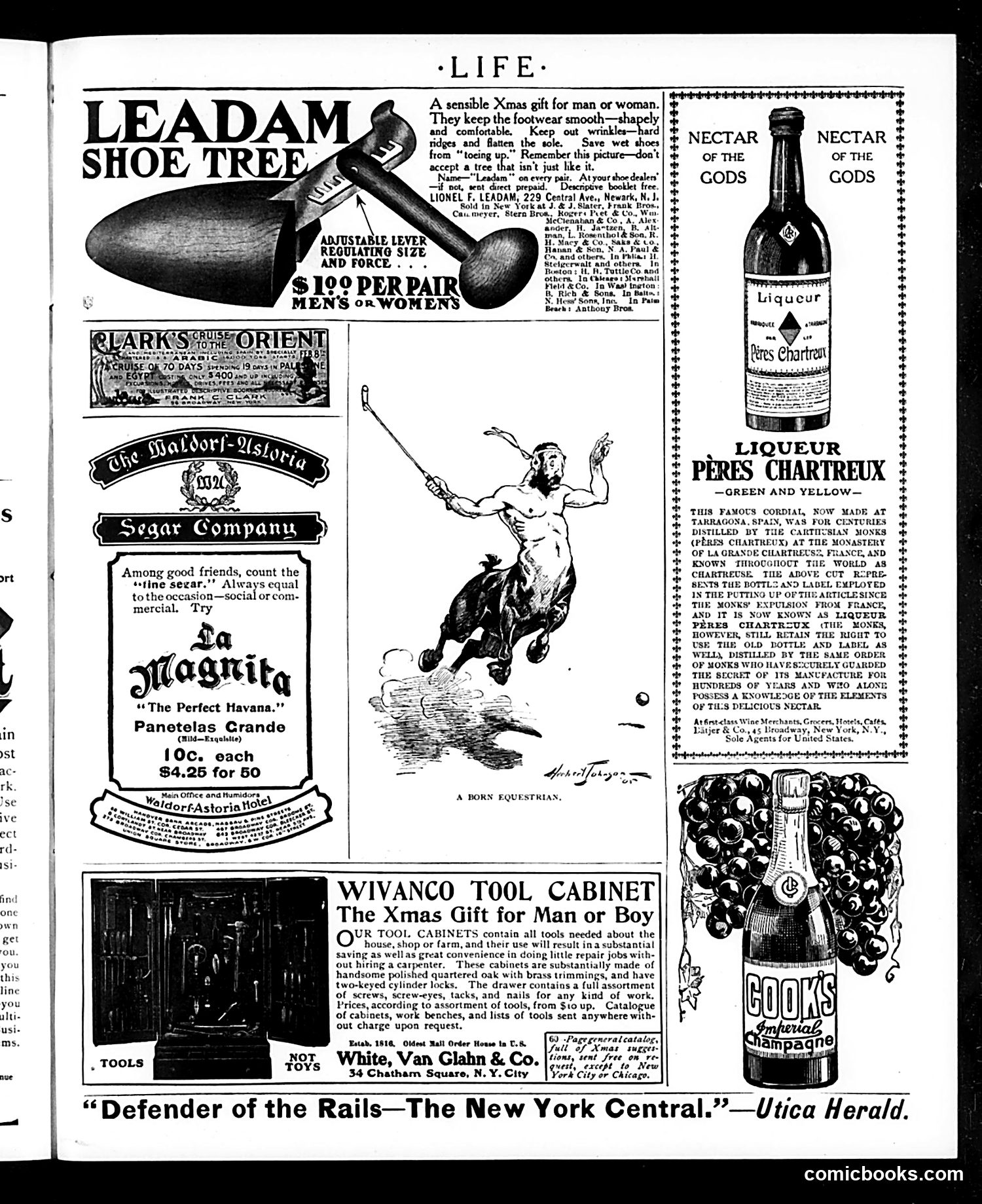
This is primarily a **Christmas advertising page** with minimal editorial content. The single cartoon—titled "A Born Equestrian"—depicts a figure on horseback apparently losing control, with the horse bucking wildly. The sketch is signed and appears to be humorous commentary on horsemanship or riding ability, though without additional context, the specific satirical target is unclear. The page consists almost entirely of **product advertisements** for Christmas gifts: a Leadam Shoe Tree ($1.99), Clark's Oriental cruise tour, Segar Company cigars, a Wivanco Tool Cabinet, and imported liqueurs (Peres Chartreux and Cook's Champagne). These reflect typical early 20th-century luxury gift marketing. The bottom tagline credits the *Utica Herald* newspaper, suggesting this page may have been syndicated content or a house ad promoting the publication itself.
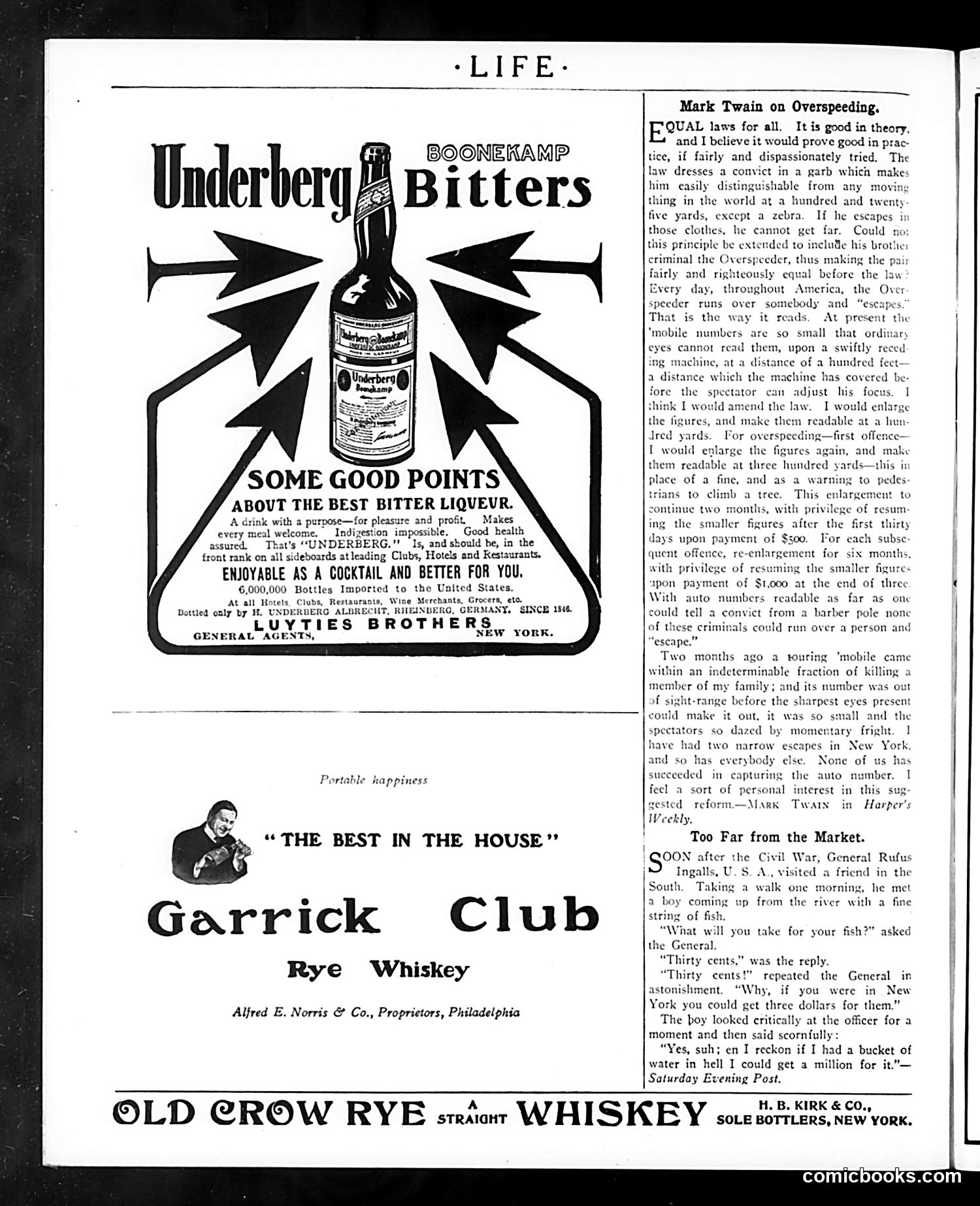
This page contains **primarily advertisements**, not political satire. Three liquor brands dominate: Underberg Bitters, Garrick Club Rye Whiskey, and Old Crow Rye—typical of early 20th-century Life magazine content. The non-advertising material includes two anecdotes: 1. **Mark Twain on Overspeeding**: A satirical essay proposing that speeding motorists' license plates be enlarged progressively (like convict uniforms) so they're readable at distance. If enlarged plates don't deter reckless driving after two months, fines escalate. This mocks both dangerous drivers and the ineffectiveness of current traffic laws. 2. **"Too Far from the Market"**: A humorous post-Civil War anecdote where a Southern boy refuses General Ingalls' offer of three dollars for fish, arguing he could get a million if he had "a bucket of water in hell"—absurdist humor about Southern poverty and market isolation after the war. Neither contains political cartoons or caricatures. The page reflects period concerns: automobile safety and regional economic disparity.
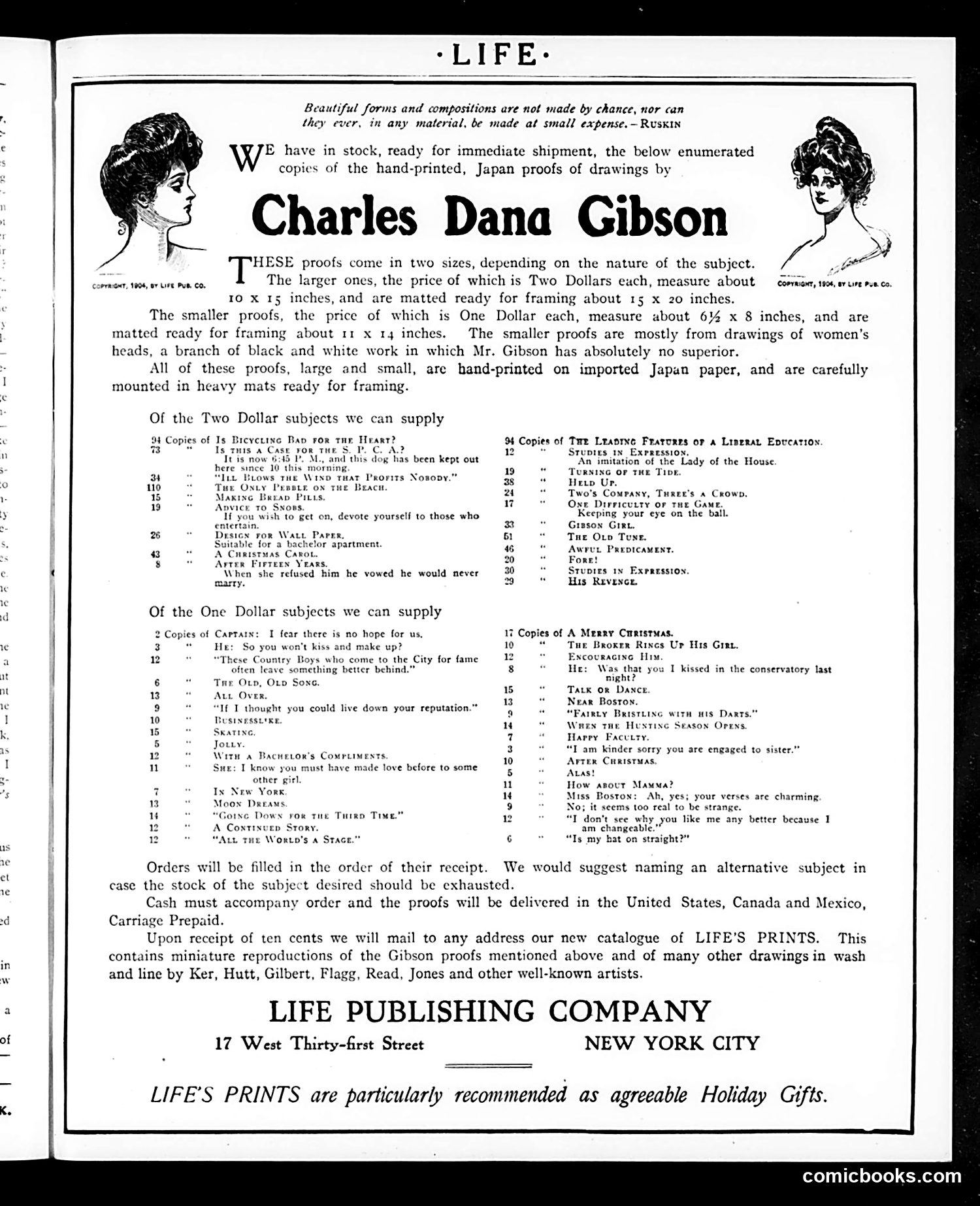
This is primarily an **advertisement for prints by Charles Dana Gibson**, the famous illustrator of the "Gibson Girl." The page showcases available hand-printed proofs available for purchase—larger pieces at $2 and smaller ones at $1. **Key Content:** The listings show Gibson's drawing subjects, which reveal his satirical focus: social commentary on courtship, gender relations, and urban life. Titles like "These Country Boys Who Come to the City for Fame Often Leave Something Better Behind" and "If I Thought You Could Live Down Your Reputation" mock romantic pretense and social climbing. References to "The Broken Rings Up His Grat" and various "after" scenes suggest Gibson specialized in depicting romantic consequences and social embarrassment. **Historical Context:** Gibson was hugely popular for depicting the "modern woman" and dating dynamics of the early 1900s. This ad positions his work as suitable **holiday gifts**, appealing to affluent readers who could afford framed art for their homes.
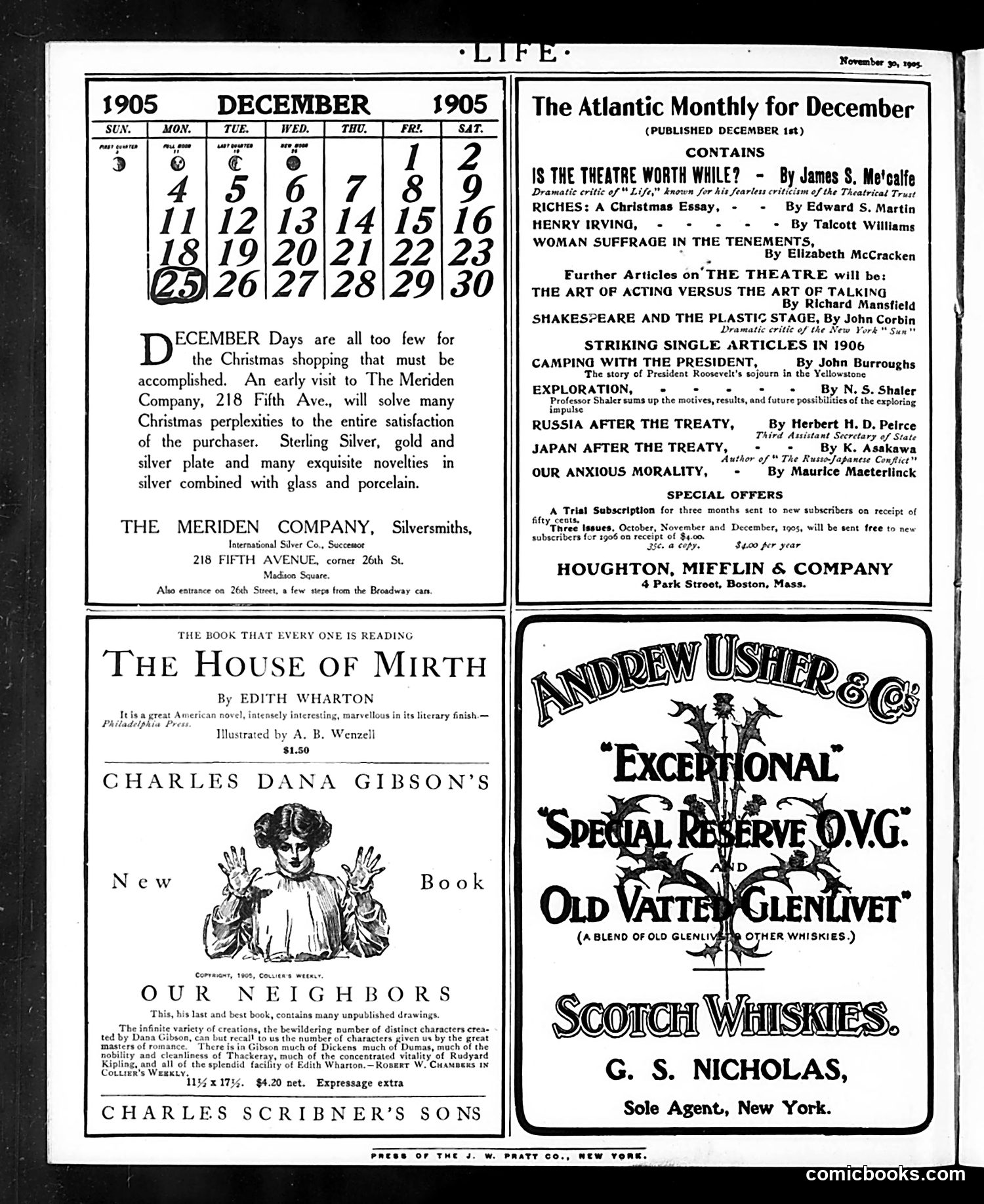
This is primarily an advertising and contents page for *Life* magazine's December 1905 issue, not a political cartoon page. The layout promotes upcoming articles in *The Atlantic Monthly*, including pieces on theater criticism, women's suffrage, and post-treaty geopolitics (Russia and Japan after the Russo-Japanese War). Notable content includes James S. Metcalfe's article "Is the Theatre Worth While?"—referencing his criticism of the "Theatrical Trust," likely the monopolistic theater booking system of the era that controlled stage productions. The page also advertises contemporary bestsellers: Edith Wharton's *The House of Mirth* and Charles Dana Gibson's *Our Neighbors* (featuring his famous "Gibson Girl" illustrations). Other ads promote luxury goods (Meriden Company silverware) and Scotch whisky—typical of *Life*'s affluent readership. The overall tone reflects early 1900s concerns with theatrical monopoly, women's rights, and American foreign policy following the Russo-Japanese War.