
Life, 1905-11-30 · page 22 of 24
Life — November 30, 1905 — page 22: what you’re looking at
What you’re looking at
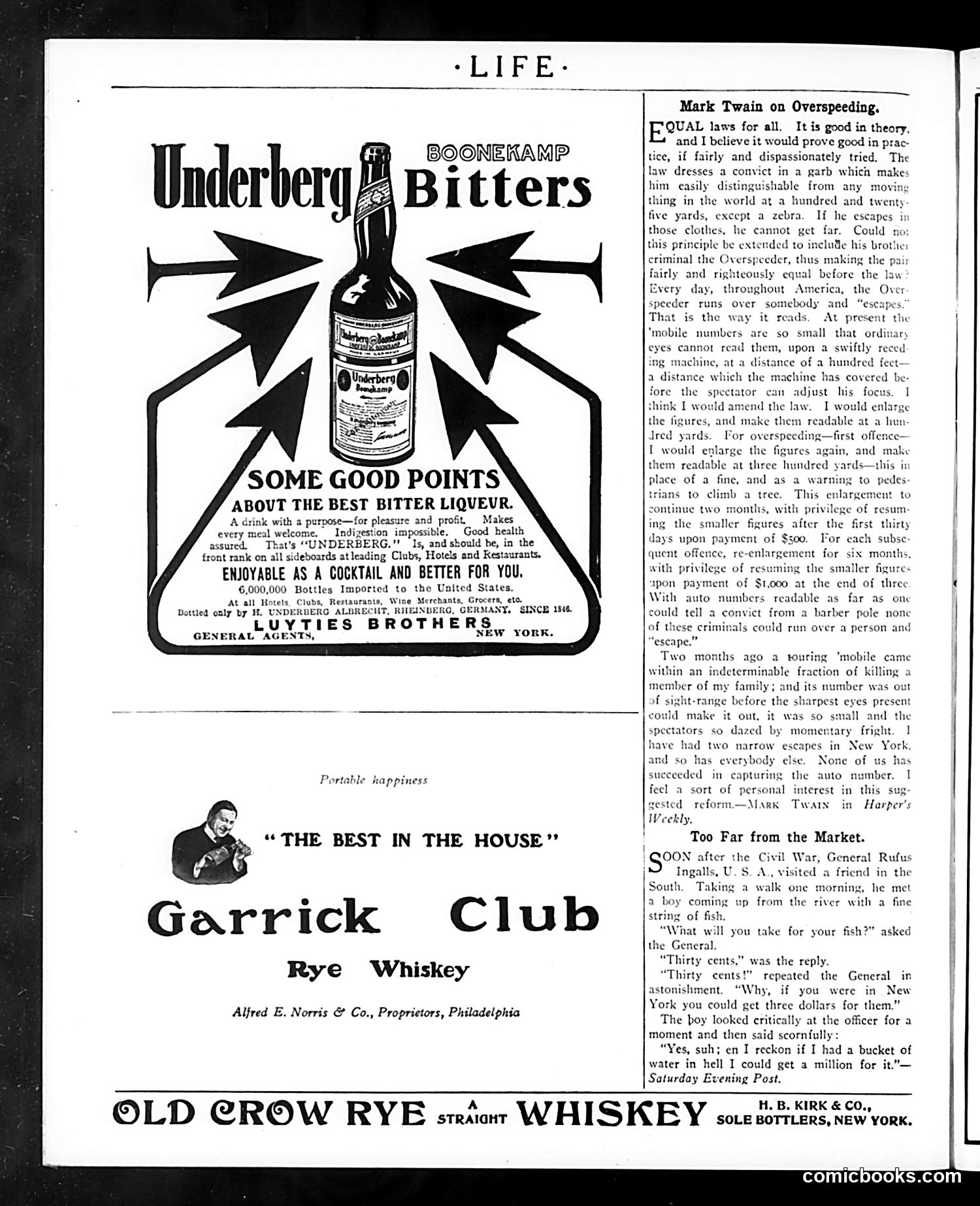
This page contains **primarily advertisements**, not political satire. Three liquor brands dominate: Underberg Bitters, Garrick Club Rye Whiskey, and Old Crow Rye—typical of early 20th-century Life magazine content. The non-advertising material includes two anecdotes: 1. **Mark Twain on Overspeeding**: A satirical essay proposing that speeding motorists' license plates be enlarged progressively (like convict uniforms) so they're readable at distance. If enlarged plates don't deter reckless driving after two months, fines escalate. This mocks both dangerous drivers and the ineffectiveness of current traffic laws. 2. **"Too Far from the Market"**: A humorous post-Civil War anecdote where a Southern boy refuses General Ingalls' offer of three dollars for fish, arguing he could get a million if he had "a bucket of water in hell"—absurdist humor about Southern poverty and market isolation after the war. Neither contains political cartoons or caricatures. The page reflects period concerns: automobile safety and regional economic disparity.
📄 Transcribed text from this page (OCR, searchable)
Machine-transcribed from the original scan — historical spelling and the odd misread are preserved.
‘LIFE: BOONEKAMP Bitters ‘SOME GOOD POINTS ABOVT THE BEST BITTER LIQUEUR. A crink with a purpose—for pleasure and profit, Makes every meal welcome, _Indizestion impossible. Good health assured. That's “UNDERBERG.” Is, and should be, in the front rank on all sideboards at leading Clubs, Hotels and Kestaurants. ENJOYABLE AS A COCKTAIL AND BETTER FOR YOU. 6,000,000 Bottles Imported t the United States, batted ealy by It, UNDERDERO ALDRECHT, RHTINDERG, GERMA UYTIES BROTHERS L Sov GENERAL AGENTS, NEW YORK. Portable happiness %, “THE BEST IN THE HOUSE” Garrick Club Rye Whiskey Alfred E. Norris & Co., Proprietors, Philadelphia Mark Twain on Overspeeding. Foca laws for all. It is good in theory, and I believe it would prove good in prac. tice, if fairly and dispassionately tried. The law dresses a convict in a garb which mak him easily distinguishable from any mo: thing in the world at a hundred and twenty five yards, except a zebra. If he escapes those clothes, he cannot get far. Could no: this principle be extended to include his brother criminal the Overs; der, thus making the pai fairly and righteously equal before the law Every day, throughout America, the Over speeder runs over somebody and “escapes.” That is the way it reads. At pres ‘mobile numbers are so small that or eyes cannot read them, upon a swiftly reced ta distance of a hundred feet- chine has covered be- fore the can adjust his focus. I think I woul nd the law. I would ent: the figures, and make them readable at a hun- dred yards. For overspeeding—first off T would ela the figures again, and make them readable at three hundred yards—this iv place of a fine, and as a warning to pedes trians to climb a tree. This enlargement to continue two months, with privilege of r ing the smaller figures after the first th days upon payment of $300. For each subs: quent off ‘gement for six months, with privilege of resuming the smaller figures spon payment of $1,000 at the end of three With auto numbers readable as far as one could tell a convict from a barber pole none : nals could run over a person and Two months ago a touring ‘mobile came within an indeterminable fraction of killing a member of my famil id its number was out of sight-range before the sharpest eyes present could make it out, it was so small and the spectators so dazed by momer fright. 1 have had two narrow esi and so has ev succeeded in capturing the a feel a sort of personal interest in this gested reform—Mark Twatn in Harper's | Weekly. ! Too Far from the Market. OON after the Civil War, General Rufus Ingalls, U. S. A., visited a friend in the outh. Taking a walk one morning, he met a boy coming up from the river with a fine string of fish. “What will you take for your fish?” asked the General. “Thirty cents,” was the reply. “Thirty cents!” repeated the General in astonishment. “Why, if you were in New York you could get three dollars for them.” The boy looked critically at the officer for a moment and then said scornfully : “Yes, suh; en I reckon if I had a bucket of water in hell I could get a million for i Saturday Evening Post. OLD CROW RYE sratioor WHISKEY sore sormees, new vork.