
Life, 1905-11-30 · page 16 of 24
Life — November 30, 1905 — page 16: what you’re looking at
What you’re looking at
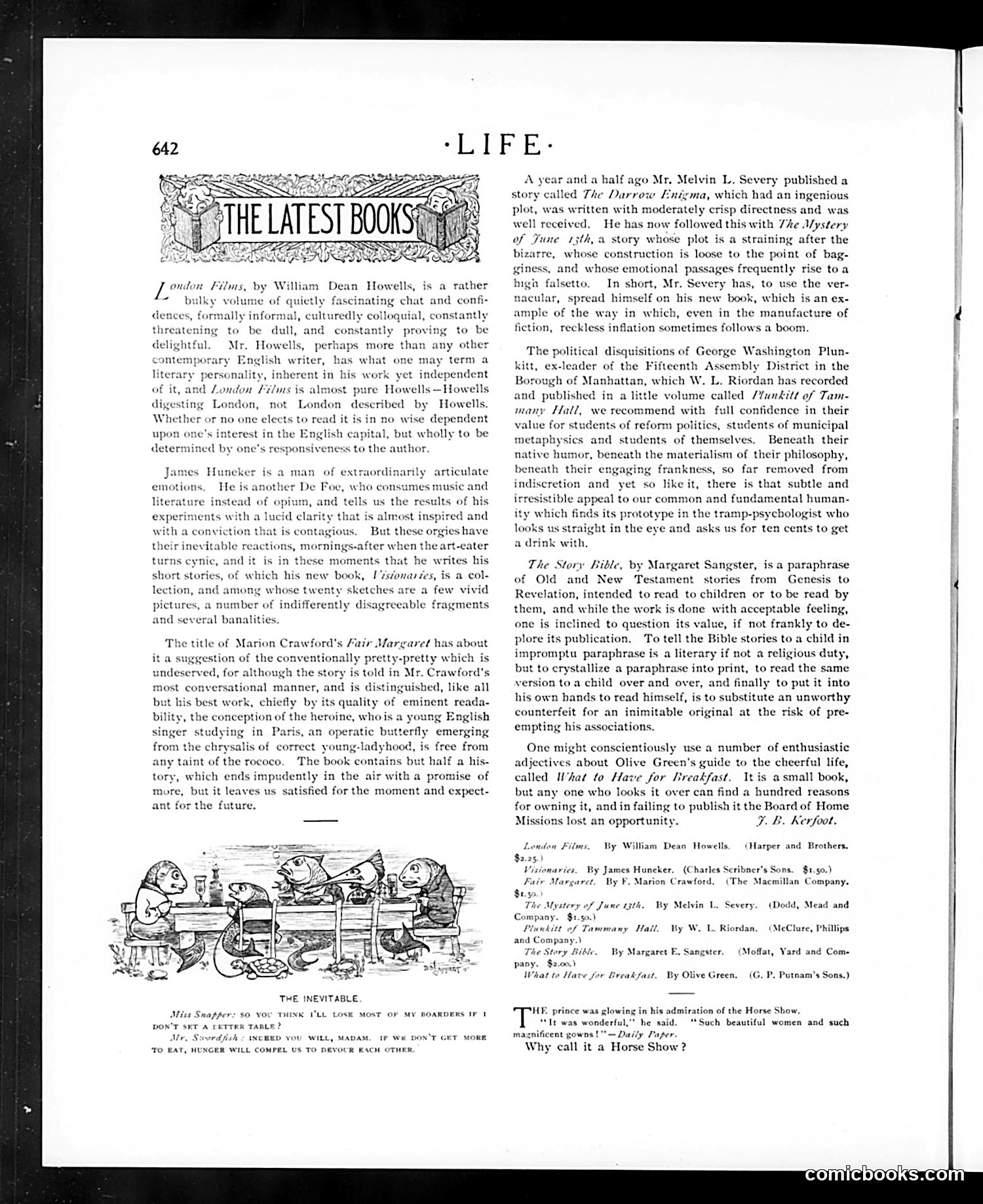
This single-panel cartoon depicts a landlady (Miss Snapper) and what appears to be a boardinghouse resident (Swordfish) in conversation. The joke plays on economic hardship during what appears to be a period of financial difficulty. **The satire:** Miss Snapper asks if improving her table service will retain boarders. Swordfish bluntly replies that better food won't help—hunger will force them to leave anyway because they cannot afford to eat there. The "inevitable" outcome is that poverty, not poor hospitality, drives away her tenants. **The point:** This reflects working-class economic anxiety of the era. The humor is dark: it satirizes both the landlady's misguided priorities (thinking presentation matters when people are starving) and the grim reality that desperation will scatter her boarders regardless. The cartoon critiques the disconnect between small business owners and the desperate financial conditions their customers face.
📄 Transcribed text from this page (OCR, searchable)
Machine-transcribed from the original scan — historical spelling and the odd misread are preserved.
Londen Films, by William Dean Howells, is a rather ~ bulky volume of quietly fascinating chat and confi- iy informal, culturedly colloquial, constantly threatening to be dull, and constantly proving to be delightful. Mr. Howells, per more than any other contemporary English writer, has what one may term a literary personality, inherent in his work yet independent of it, and London Films is almost pure Howells—Howells digesting L bed by Howells. dences, forma jon, not London dese Whether or no one elects to read it is in no wise dependent ‘s interest in the English capital, but wholly to be determined by one’s responsiveness to the author upon on Hunceker is a man articulate © consumes music and nordina ext other De Foe, wt emotions, He isa literature instead of 0) , and tells us the results of his experiments with a lucid clar ed and at is almost ins) ious. But these orgies have after when the art-eater it he writes his short stories, of which his new book, IZsvonarzes, is a col- lection, and among whose twent with a conviction that is conta; their inevitable reactions, morning: turns cynic, and it is in these moments y sketches are a few vivid sreeable fragments pictures, a number of indifferently disa and several banalities. The title of Marion Crawford's Fair Margaret has about rgestion of the conventionally pretty-pretty which is undeserved, for although the story is told in Mr. Crawford's most conversational manner, and is di guished, like all but his best work, chiefly by its quality of eminent reada- bility, the conception of the heroine, whois a young English singer studying in Paris, an operatic butterfly emerging from the chrysalis of correct young-ladyhood, is free from any taint of the rococo. The book contains but half a his- tory, which ends impudently in the air with a promise of more, but it leaves us satisfied for the moment and expect- ant for the future. ita su THE INEVITABLE. Miss Snapper: $0 YOU THINK ULL LOSE MOST OF MY BOARDERS IF DON'T SET A PETTRR TABLE? Ssvordfish > INCHED YOU WILL, MADAM. IF Wx DON'T GET MoRE TO EAT, HUNGER WILL COMPEL US TO DEYOUR RACH © rR. y and a half ago Mr, Melvin L. Severy published a story called The Darrow Enigma, which had an ingenious plot, was written with moderately crisp directness and w well received, He has now followed this with 7he Mystery of June 13th, a story whose plot is a straining after the bizarre, whose construction is loose to the point of bag- giness, and whose emotional passages frequently rise toa hight falsetto. In short, Mr. Severy has, to use the ver- cular, spread himself on his new book, which is an ex- ample of the way in which, even in the manufacture of inflation sometimes follows a boom. fiction, reckles: ‘The political disquisitions of George Washington Plun- kitt, ex-leader of the Fifteenth Assembly District in the Borough of Manhattan, which W. L. Riordan has recorded and published in a little volume called /Yunkitt of Tam- many Hall, we recommend with full confidence in their value for students of reform politics, students of municipal hysics and students of themselves, Beneath their or, beneath the materialism of their philosophy, beneath their engaging frankness, so far removed from indiscretion and yet so like it, there is that subtle and native hum irresistible appeal to our common and fundamental human- ity which finds its prototype in the tramp-psychologist who looks us straight in the eye and asks us for ten cents to get a drink w: The Story Bible, by Margaret Sangster, is a paraphrase of Old and New Testament stories from Genesis to Revelation, intended to read to children or to be read by them, and while the work is done with acceptable feeling, one is inclined to question its value, if not frankly to de- plore its publication. To tell the Bible stories to a child in impromptu paraphrase is a literary if not a religious duty, but to crystallize a paraphrase into print, to read the same version to a child over and over, and finally to put it into his own hands to read himself, is to substitute an unworthy counterfeit for an inimitable original at the risk of pre- empting his associations. One might conscientiously use a number of enthusiastic adjectives about Olive Green's guide to the cheerful life, called What to Have for Breakfast. tis asmall book, but any one who looks it over can find a hundred reasons for owning it, and in failing to publish it the Board of Home Missions lost an opportunity. 7. B. Kerfoot. fon Films, By William Dean Howells. (Harper and Brothers, Visionaries, By James Huneker. (Charles Scribner's Sons. $1.50.) Fair Margaret. By ¥, Marion Crawford, (The Macmillan Company. of June t3th. (Dodd, Mead and pany. $2.50.) Ry Melvin L. Severy By W. L. Riordan. (McClure, Phillips The Story | By Margaret E. Sangster. (Moffat, Yard and Come pany. $2.00.) What to He nam's Sons.) Sor Breakfast. By Olive Green, (G.P.P HE, prince was glowing in his admiration of the Horse Show, “It was wonderful,” he said. “Such beautiful women and such icent gowns !"—Daily Paper. Why call it a Horse Show ? A i F I