
A complete issue · 30 pages · 1905
Life — November 16, 1905
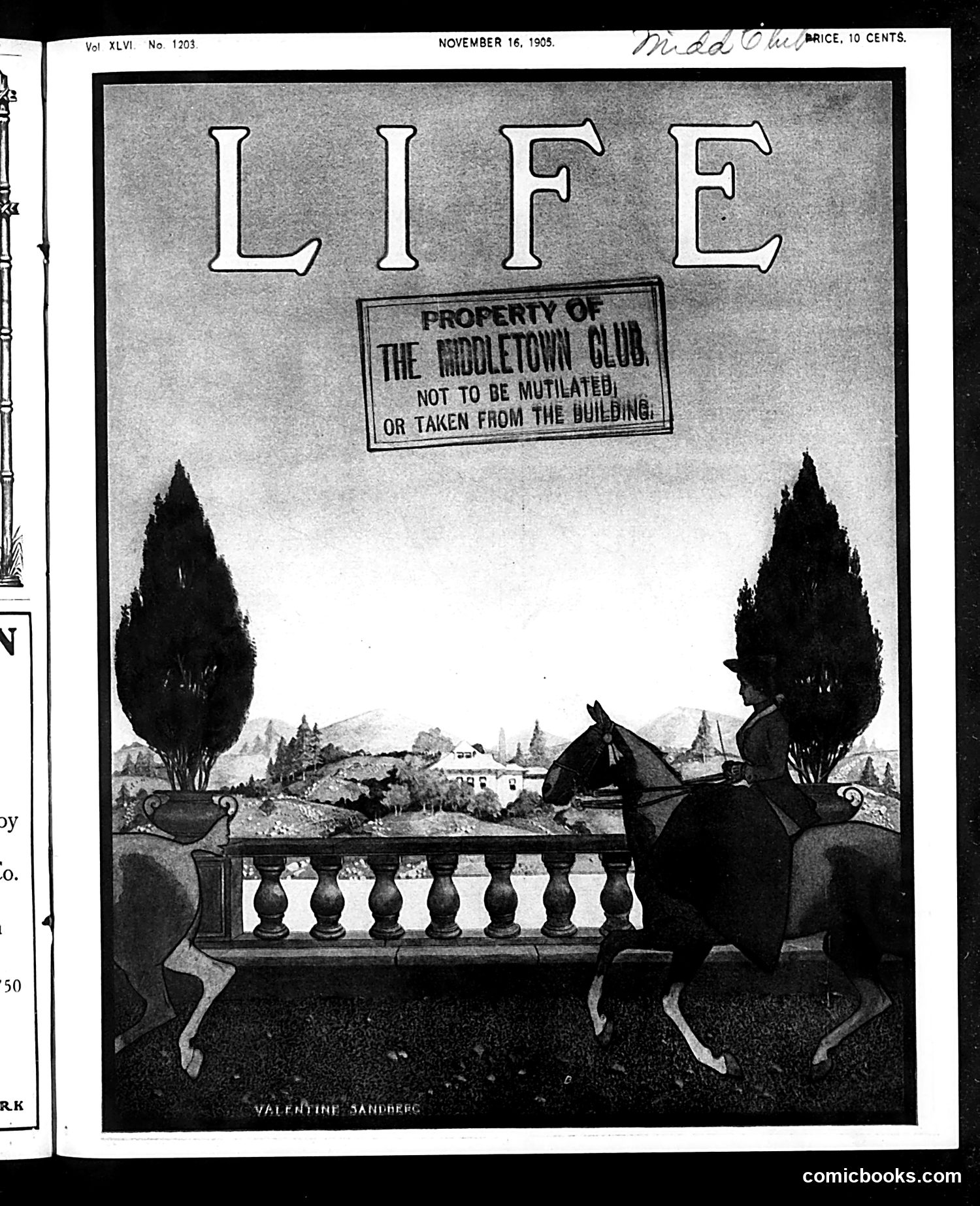
This is the cover of *Life* magazine (Vol. XLVI, No. 1203), priced at 10 cents. The main illustration by Valentine Sandberg depicts two figures in silhouette sitting on a balcony overlooking a pastoral landscape with cypress trees, a distant villa, and countryside. The image appears to be a romantic or contemplative scene. The stamp reading "PROPERTY OF THE MIDDLETOWN CLUB / NOT TO BE MUTILATED OR TAKEN FROM THE BUILDING" indicates this particular copy belonged to a private club's library. Without additional context from the magazine's interior content, the specific satirical meaning or identity of the figures remains unclear from the cover alone. The title "LIFE" and artistic composition suggest commentary on leisure, romance, or contemporary social themes typical of the magazine's satirical focus.
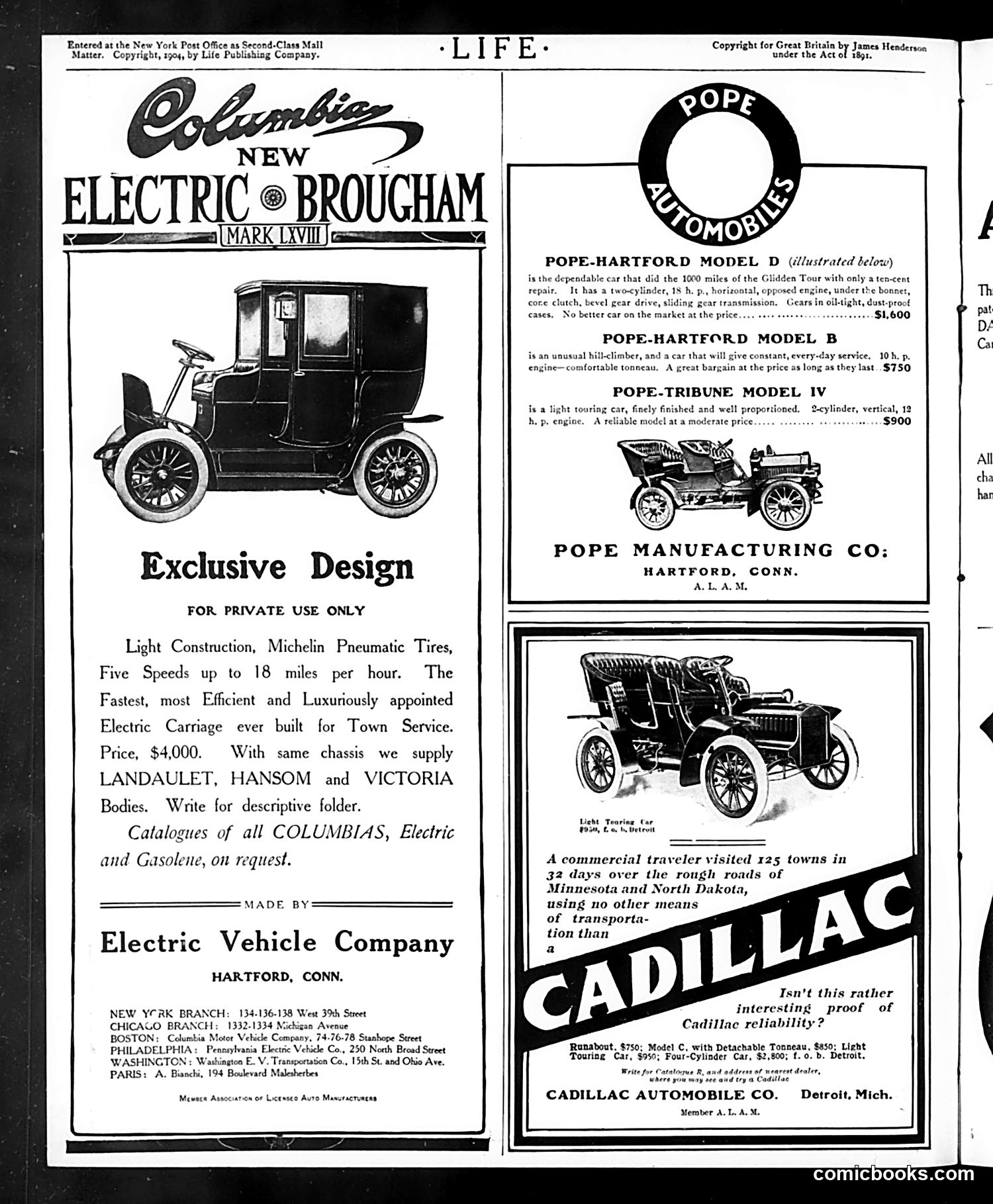
This page is **primarily advertising**, not satire or political commentary. The left side advertises the **Columbia Electric Brougham Mark LXVIII**—an electric vehicle made by the Electric Vehicle Company in Hartford, Connecticut. It emphasizes luxury features: light construction, pneumatic tires, five speeds reaching 18 mph, and a $4,000 price tag. The company also offered Landaulet, Hansom, and Victoria body styles. The right side features competing automobile ads: **Pope automobiles** (Pope Manufacturing Co., Hartford) and **Cadillac** (Cadillac Automobile Co., Detroit). The Cadillac ad includes a testimonial about a commercial traveler using only Cadillacs across Minnesota and North Dakota—early advertising emphasizing reliability and performance. This reflects the early 1900s automotive industry's rapid development and competing manufacturers.
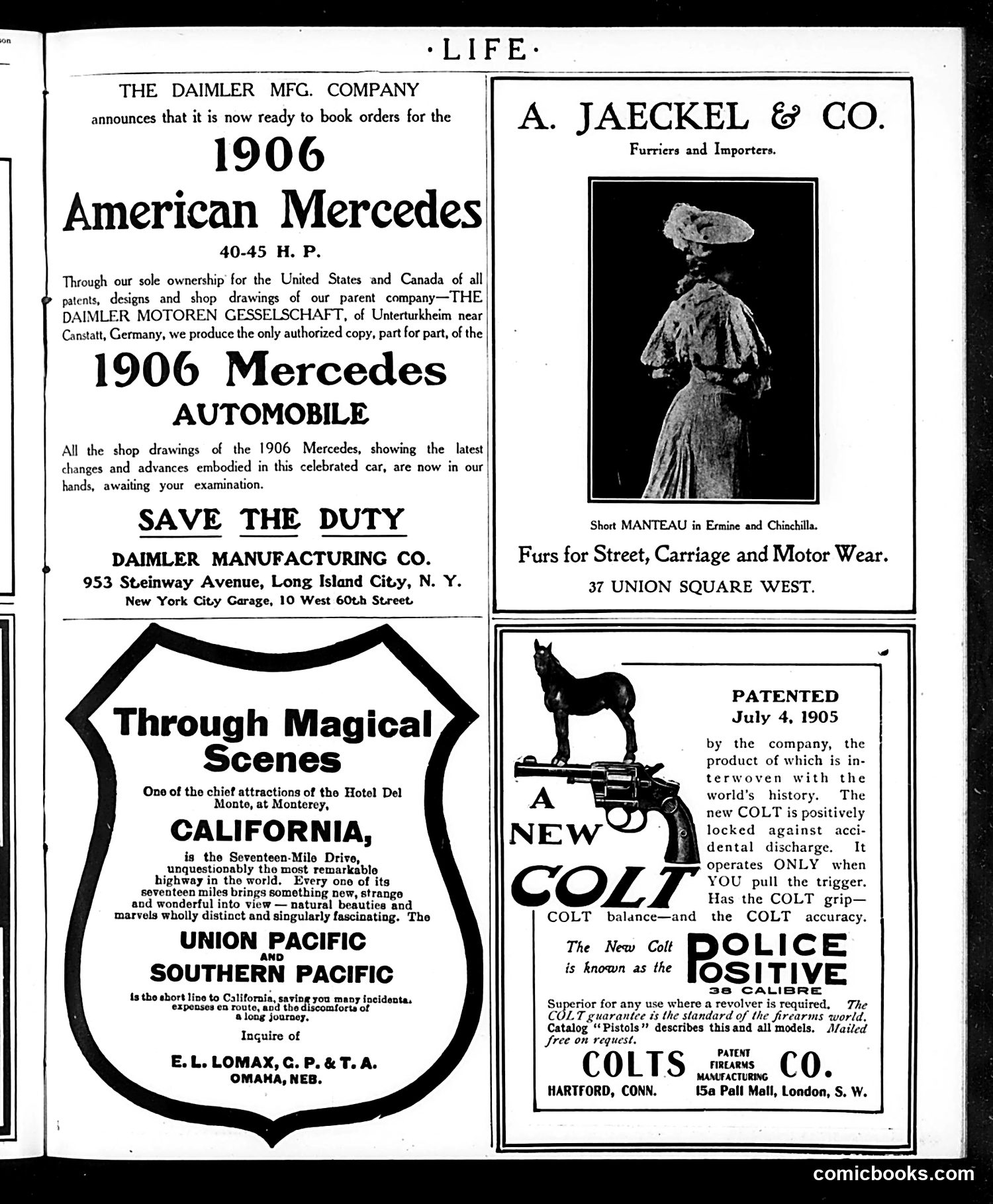
This page is **primarily advertising** with no editorial cartoon content. It contains four advertisements: 1. **Daimler Manufacturing Co.** announces 1906 American Mercedes automobiles, emphasizing they hold exclusive U.S./Canadian patents from the German parent company. 2. **A. Jaeckel & Co.** advertises fur garments ("Short MANTEAU in Ermine and Chinchilla") for fashionable women's wear at their Union Square location. 3. **Union Pacific and Southern Pacific Railways** promote California travel via the scenic Seventeen-Mile Drive. 4. **Colts Patent Firearms Company** advertises their new "Colt Positive" revolver, patented July 4, 1905, claiming superiority for dental work and other applications. The page reflects early 1900s consumer culture with no satirical commentary evident.
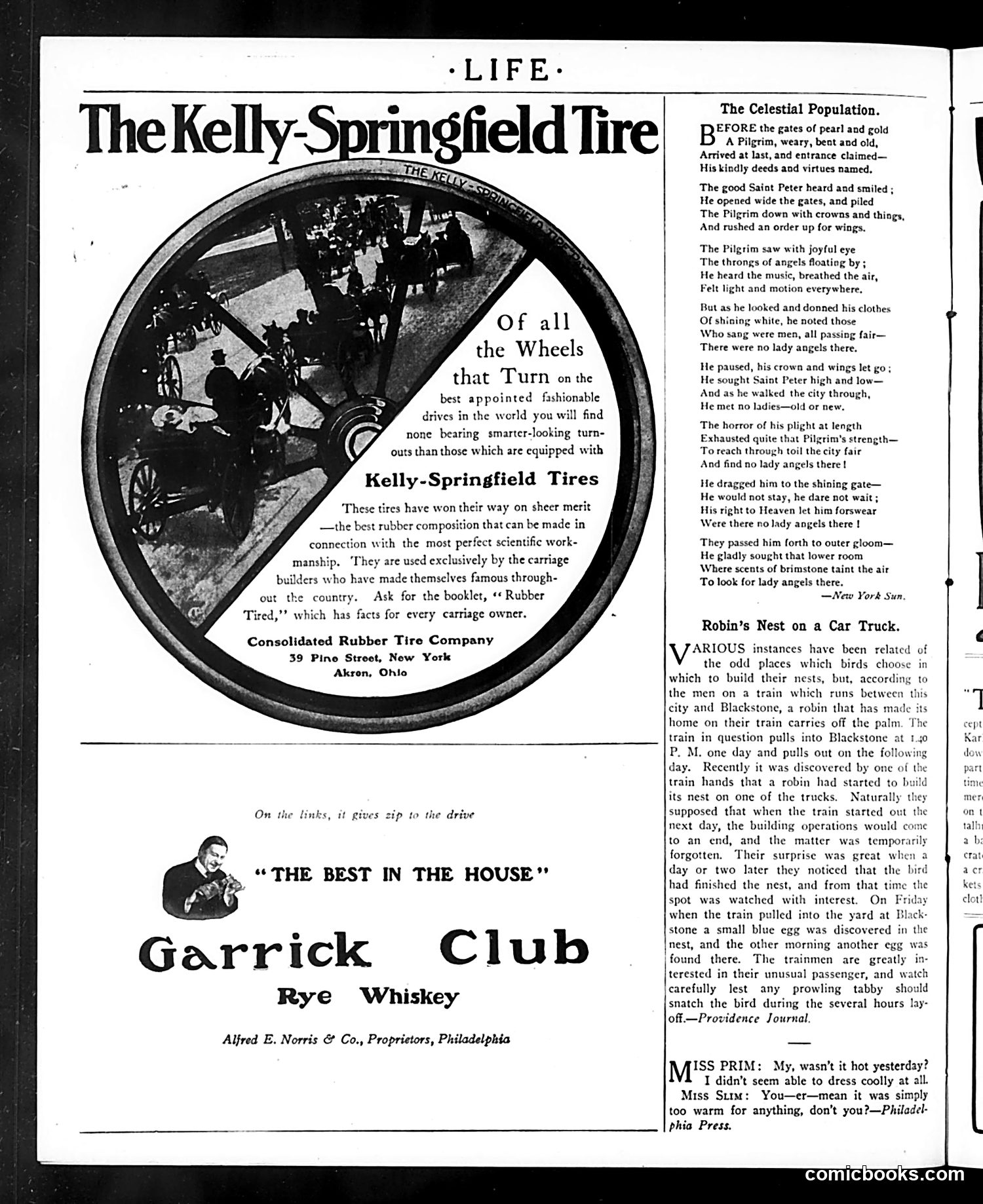
This page is primarily **advertising** rather than political satire. The dominant content consists of: 1. **Kelly-Springfield Tire advertisement** (large circular image): promotes carriage tires as superior for "fashionable drives," emphasizing scientific manufacturing and exclusive use by carriage builders. 2. **Garrick Club Rye Whiskey advertisement**: positions the product as "the best in the house." 3. **"The Celestial Population"** (right column): a humorous poem about Saint Peter admitting a pilgrim to Heaven, with no clear political reference—appears to be general satirical verse about the afterlife. 4. **"Robin's Nest on a Car Truck"** (right column): a brief anecdote about a robin building a nest on a railway car, presented as a curiosity piece. The page reflects early 20th-century Life magazine's mix of advertising and light humor rather than sharp political commentary.
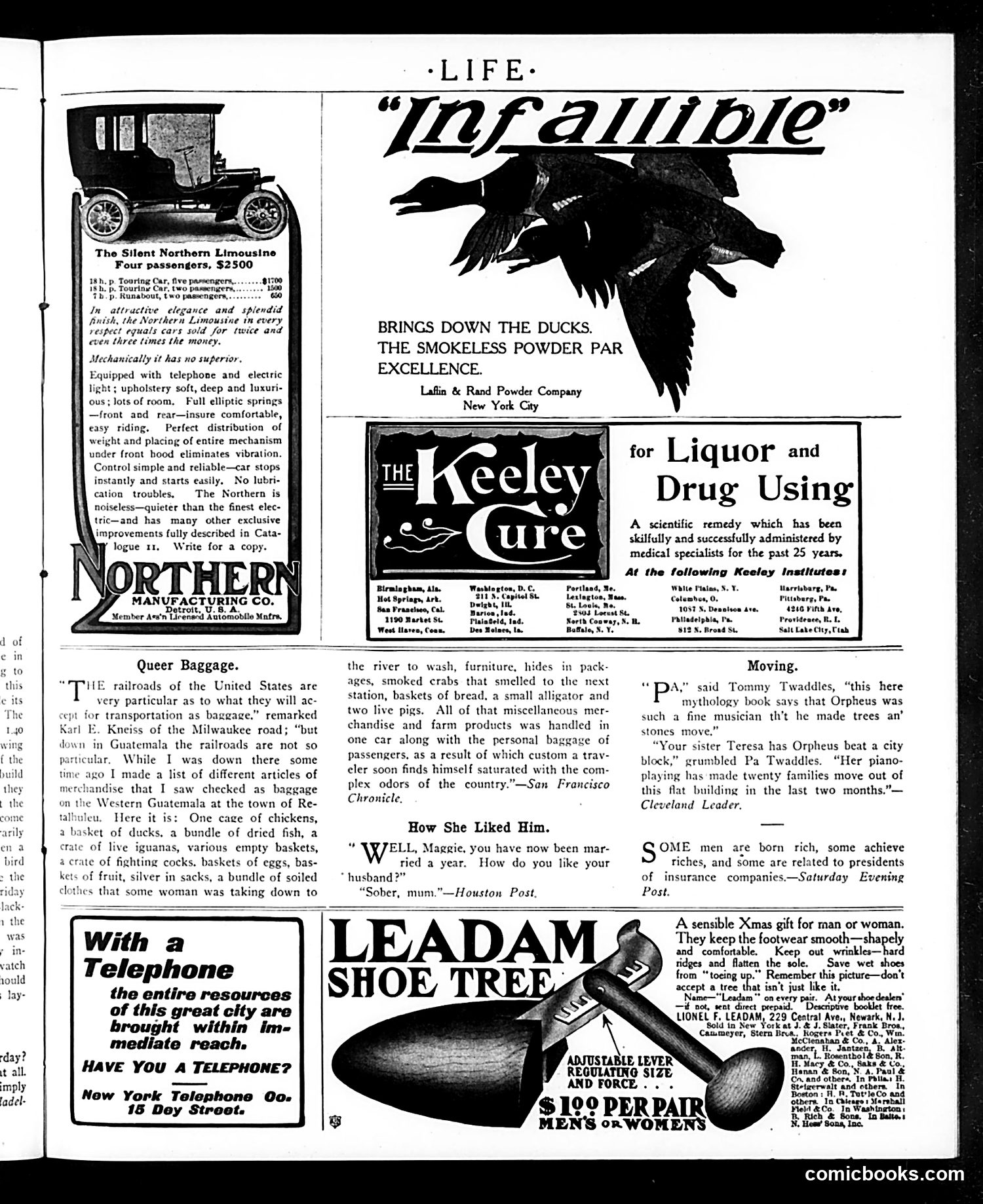
This page is primarily **advertisements** interspersed with brief humorous anecdotes rather than political cartoons. The ads include: - A Northern Manufacturing limousine - "Infallible" smokeless powder (with dramatic duck-hunting imagery) - The Keeley Cure for alcohol and drug addiction - A telephone company ad - Leadam Shoe Trees ($1.00 per pair) The short humor pieces ("Queer Baggage," "How She Liked Him," "Moving") are domestic comedies with no apparent political content—just gentle jokes about marriage, baggage handling, and household matters. The **Keeley Cure advertisement** is historically significant as a period remedy for substance addiction, reflecting early-20th-century approaches to treatment. Overall, this appears to be a typical Life magazine page from the 1910s-1920s era, mixing commercial advertising with light social humor rather than political satire.
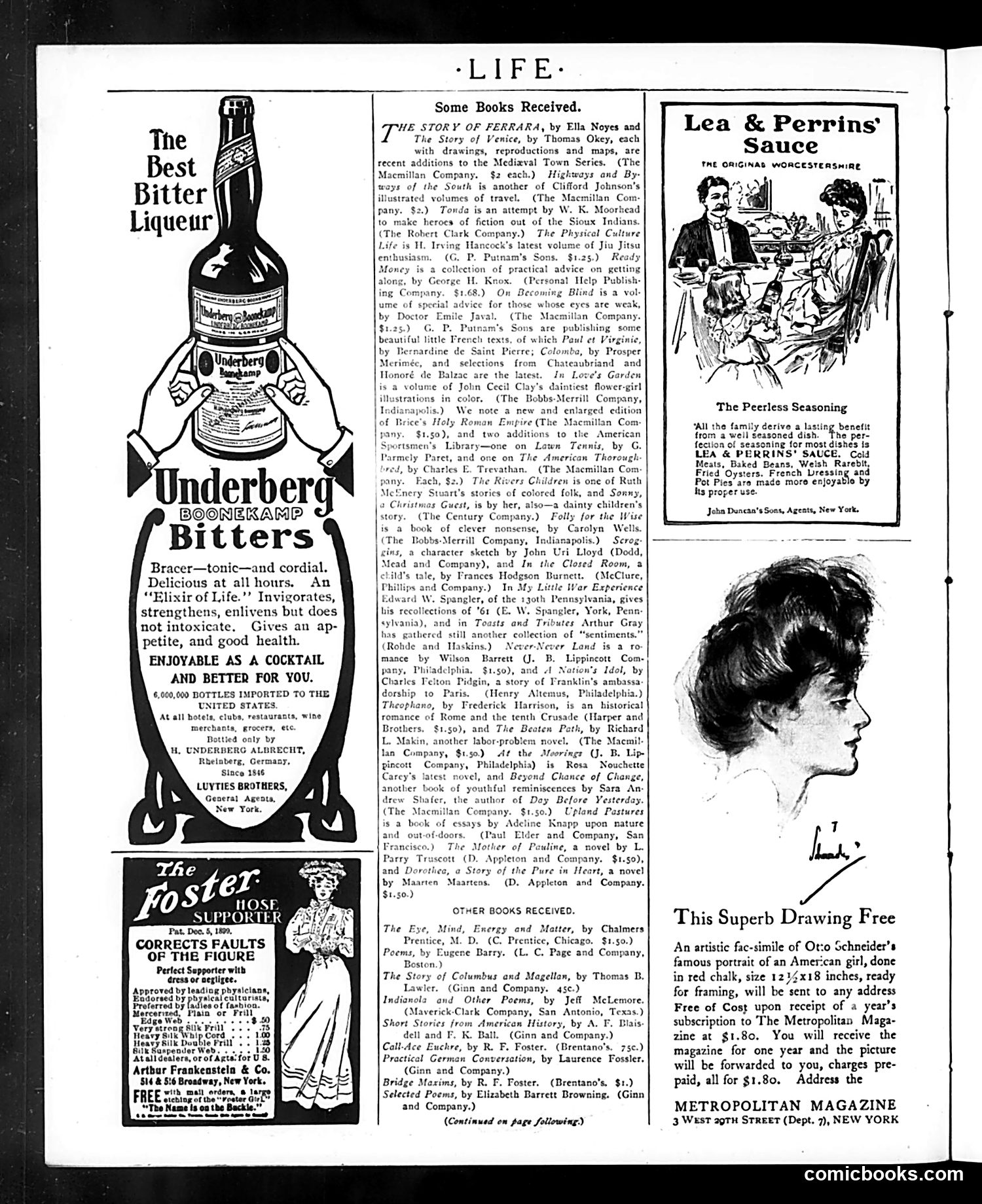
This page is **primarily advertising and book reviews** rather than political satire. The main advertisements feature: - **Underberg Bitters** (German liqueur) - promoting it as a digestive aid and cocktail ingredient - **Foster Hose Supporter** - a corset-like garment marketed for figure correction - **Lea & Perrins' Sauce** - with an illustration showing family dining The central content is a lengthy book review section titled "Some Books Received," listing recent publications across various genres—travel, history, fiction, and poetry. A small drawing appears on the right: a profile portrait labeled "This Superb Drawing Free," advertising a facsimile of artist Oro Schneider's portrait available to Metropolitan Magazine subscribers. **No significant political cartoon or satire is present on this page.** The content reflects early 20th-century consumer culture and literary publishing.
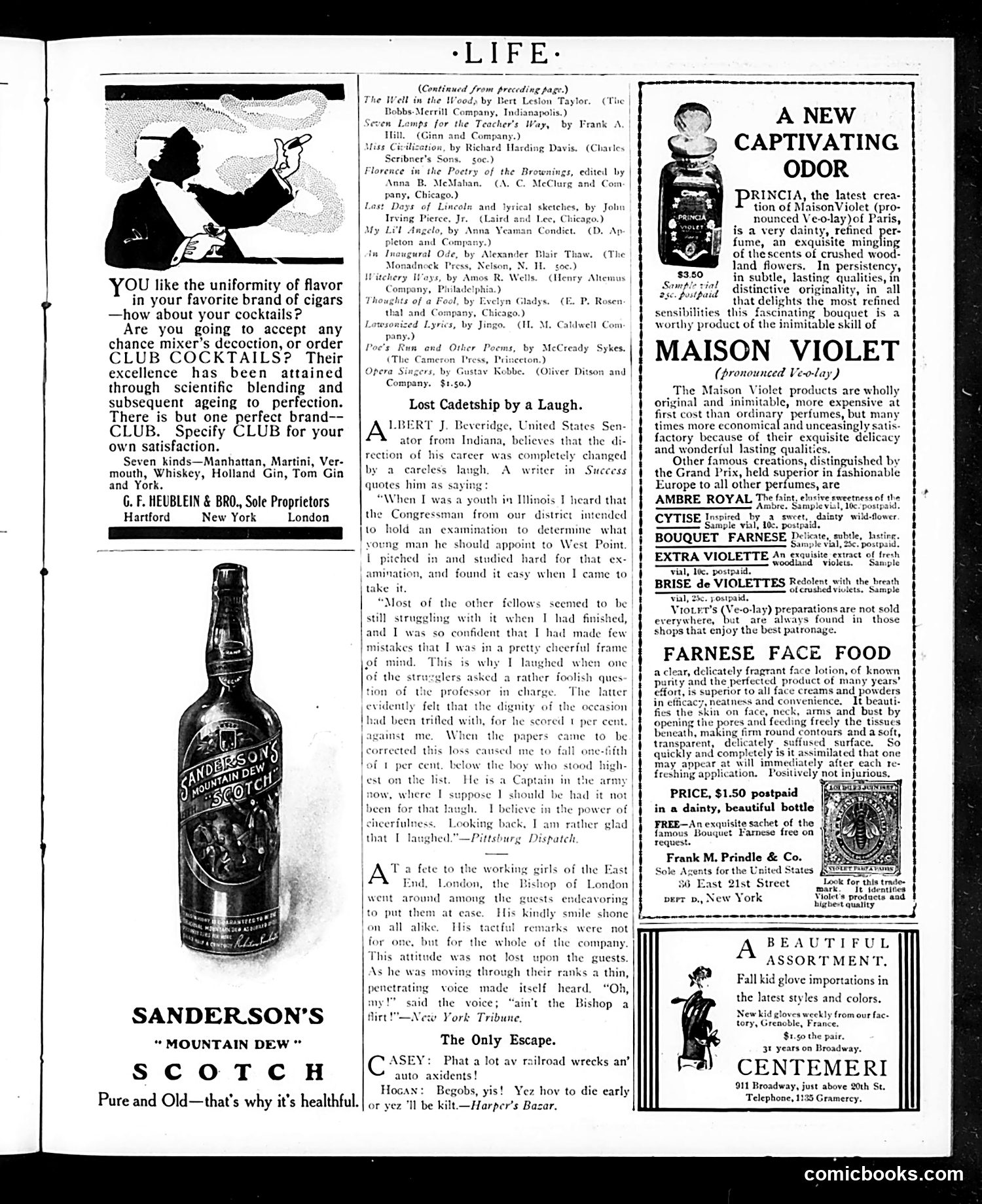
This page is primarily **advertising and book reviews** rather than political satire. The top section lists recent book publications. Below that is an article titled "Lost Cadetship by a Laugh" featuring a story by Albert J. Beveridge, a U.S. Senator from Indiana. The anecdote recounts how Beveridge's career direction changed after he laughed during a congressional examination, causing an examiner to score him lower—a humorous account of how minor behavior can have unexpected consequences. The rest of the page consists of product advertisements: Sanderson's "Mountain Dew" Scotch whisky, Maison Violet perfume, Farnese Face Food cosmetics, and Centemeri kid gloves. No political cartoon appears on this page.
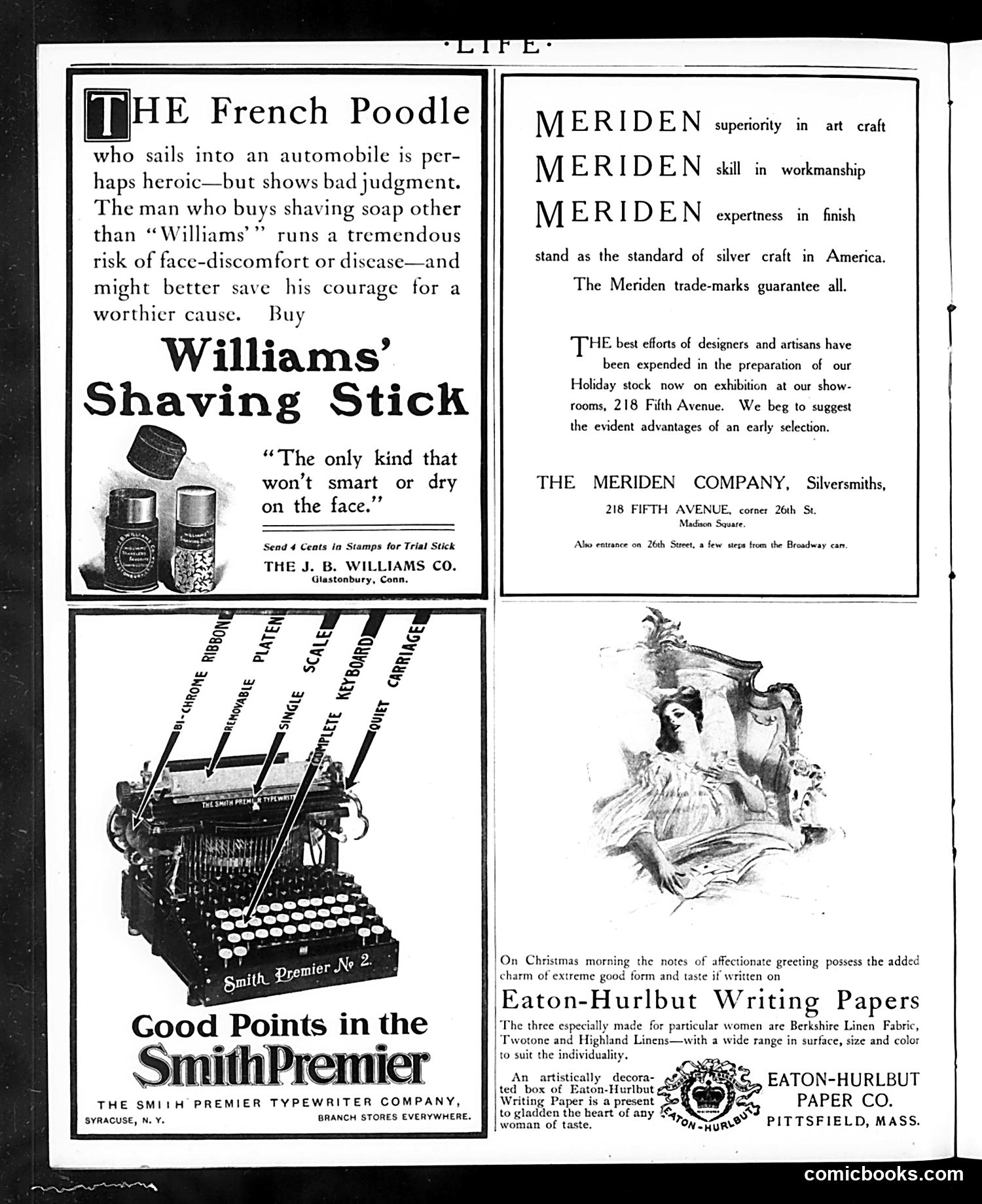
This page consists entirely of **period advertisements** from what appears to be the early 20th century. There are no political cartoons or satirical content. The ads promote: 1. **Williams' Shaving Stick** — humorously warns against inferior shaving soaps, claiming they cause "face-discomfort or disease" 2. **Smith Premier Typewriter** — emphasizes "Good Points" in design 3. **Meriden Company** — silver craft goods, positioned as the American standard 4. **Eaton-Hurlbut Writing Papers** — marketed as refined Christmas gifts for women, emphasizing taste and aesthetic presentation The advertising copy uses period marketing conventions: health fears, quality claims, and appeals to gentility. These reflect early 1900s consumer culture and gender-coded product marketing (writing papers specifically for women). No satirical commentary is present—this is straightforward commercial advertising.
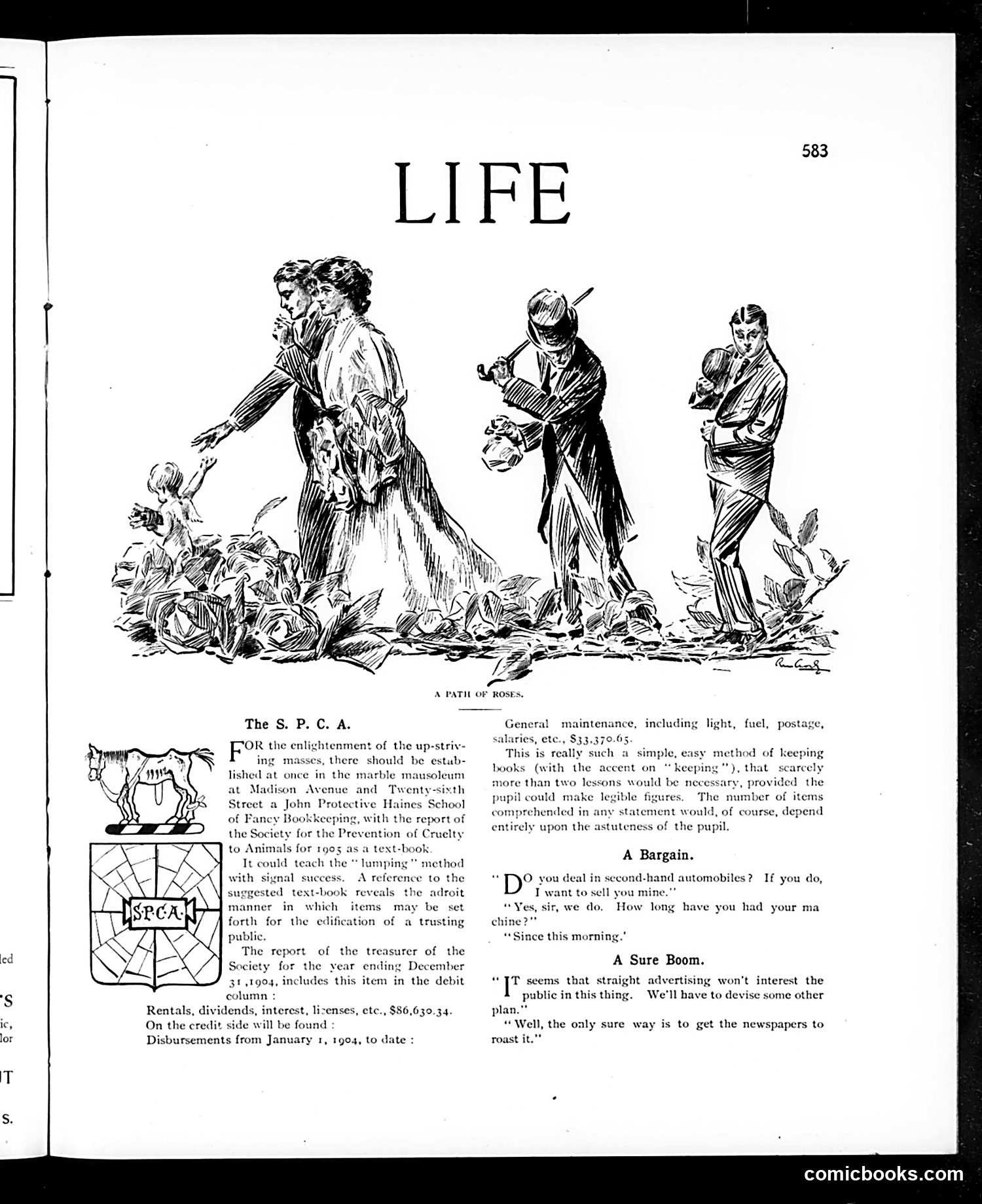
This page features **"A Path of Roses,"** a political cartoon criticizing the S.P.C.A. (Society for the Prevention of Cruelty to Animals). The illustration shows three men in formal dress walking through thorns and debris, while one figure (appearing to represent S.P.C.A. leadership) scatters roses ahead of them. The satire suggests the S.P.C.A. presents an idealized public image while the organization's actual operations are difficult and unglamorous. The text discusses establishing a mausoleum at a New York address for teaching animal care methods, and references the organization's financial reports. Below are two brief humorous anecdotes: "A Bargain" (about used car sales) and "A Sure Boom" (about advertising strategy), typical of Life's satirical short-form humor.
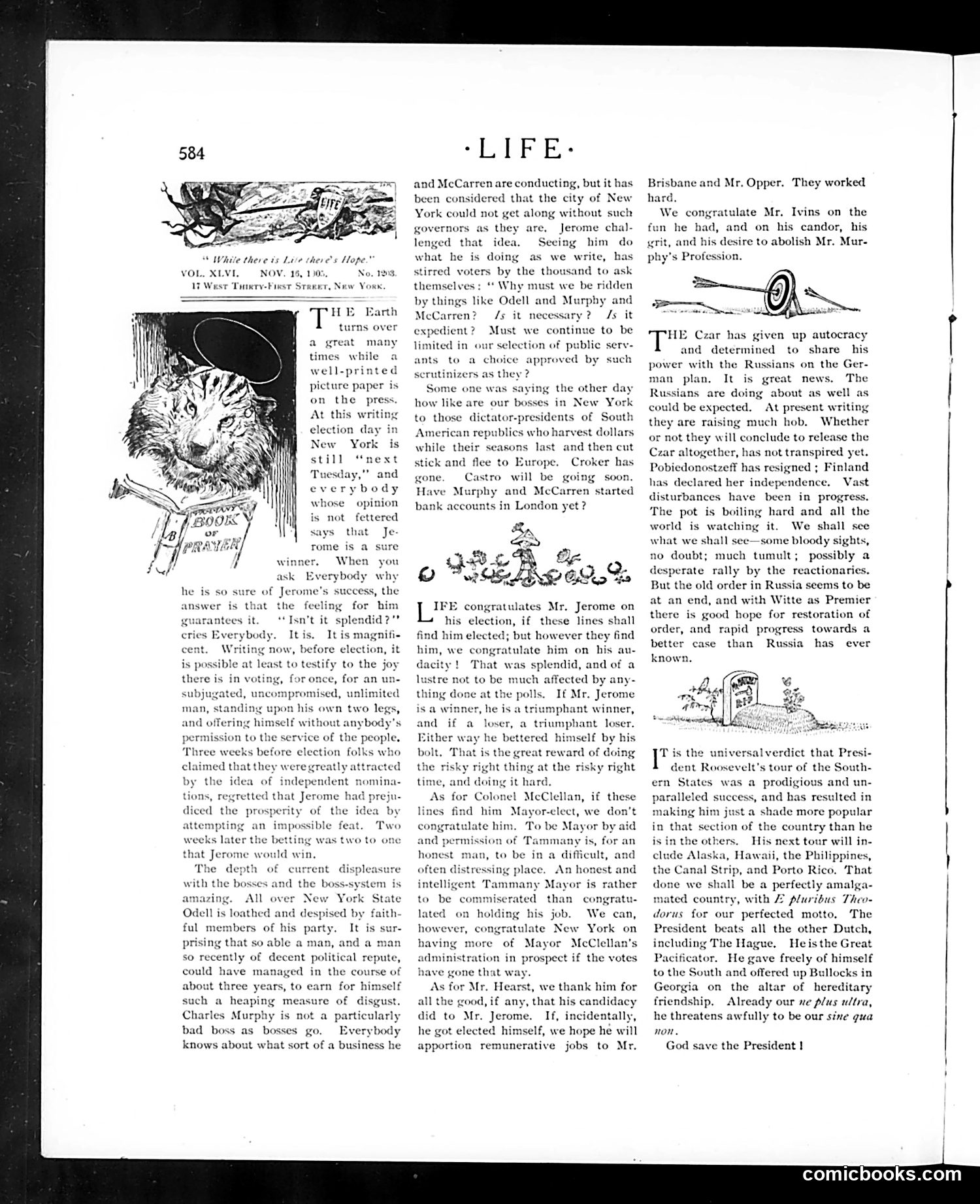
This page satirizes recent New York City elections and political figures. The main cartoon depicts an exaggerated face labeled with electoral references, mocking the city's political leadership. The text discusses Mayor Jerome's election victory, congratulating him while questioning whether New York truly needs "governors" like Odell and Murphy—likely referring to political bosses who wielded informal power. The piece expresses skepticism about whether Jerome's election represents genuine reform or merely reshuffles the same corrupt system. The commentary also addresses broader political concerns: Russia's internal upheaval, President Roosevelt's Southern tour gaining popularity, and various political appointments. The tone is characteristically satirical—appearing to congratulate politicians while actually criticizing their fitness for office and questioning whether meaningful change is possible in New York's political establishment.
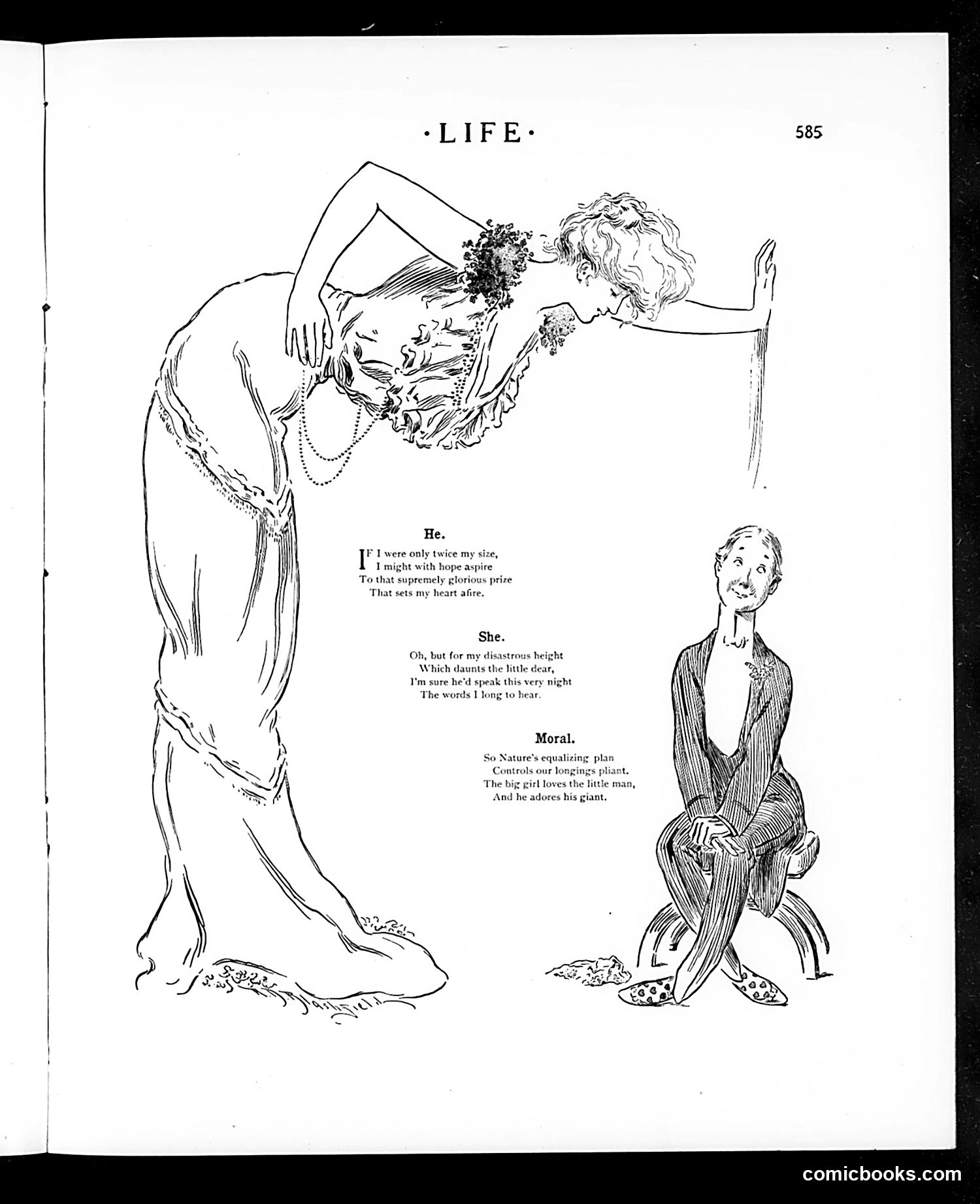
This is a satirical illustration about height disparity in romance. The page shows two figures with contrasting heights and their perspectives: **"He"** (tall man): Expresses hope that if he were "twice my size," the woman might reciprocate his romantic feelings—suggesting his current stature is an impediment. **"She"** (petite woman): Worries that her "disastrous height" prevents the man from speaking, implying she fears being too short to interest him. **"Moral"**: The accompanying verse humorously resolves the irony: "Nature's equalizing plan / Controls our longings' plant, / The big girl loves the little man, / And he adores his giant." The satire mocks how people create obstacles to romance based on physical characteristics, when compatibility might exist if both parties simply recognized their mutual attraction despite size differences. It's a gentle commentary on superficial dating anxieties.
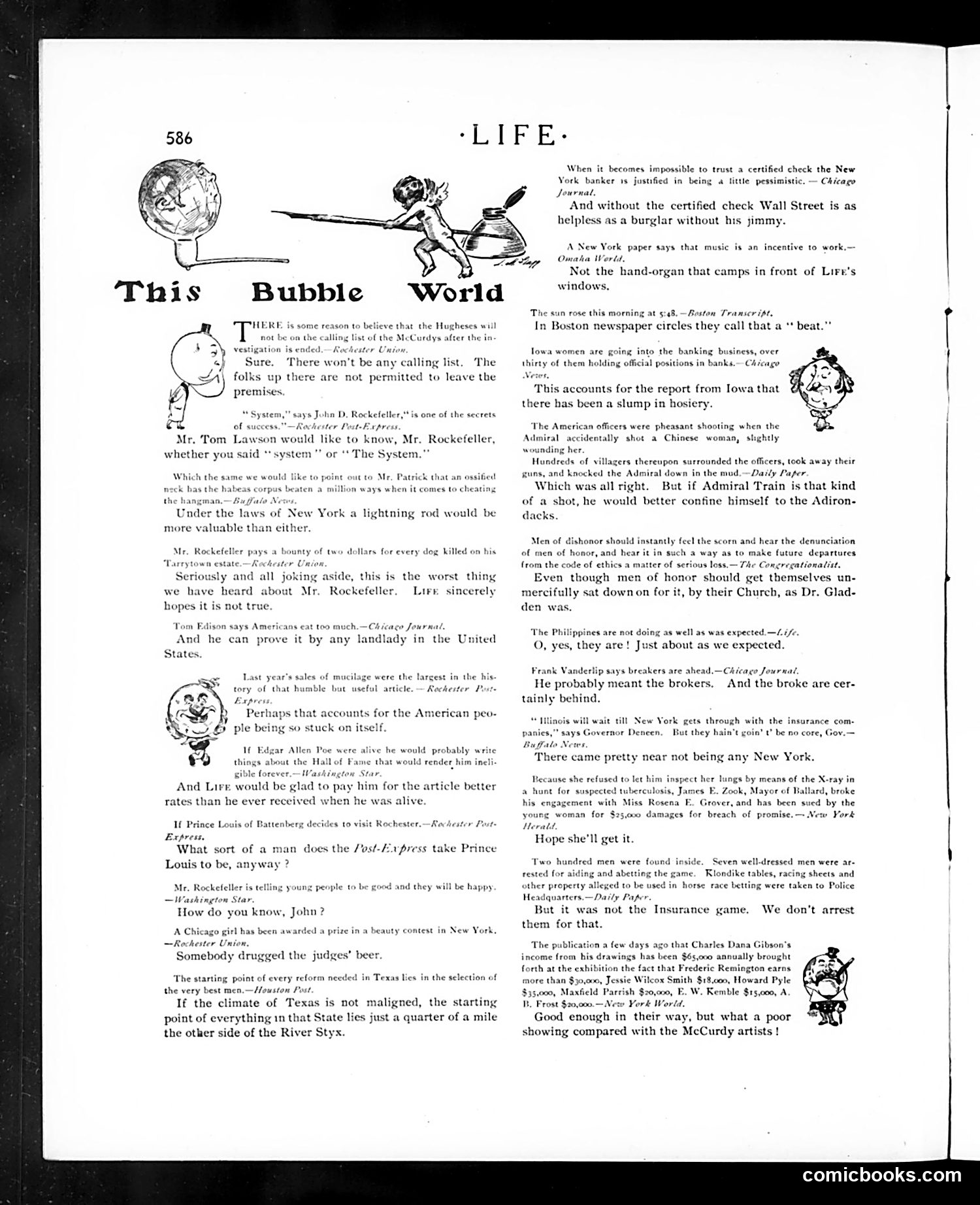
This page satirizes early 1900s American financial and social follies. The title cartoon depicts bubbles—literal and figurative—representing economic instability and false confidence. The text mocks: - **Banking uncertainty**: References to certified checks and Wall Street's unreliability during financial instability - **Rockefeller's wealth**: Jokes about his dominance and the "System" of concentrated power - **Various scandals**: Including military incompetence (an admiral shooting a Chinese woman), insurance fraud, and beauty contests The small cartoon figures (bubbles with faces) reinforce the theme of fragile, inflated realities. The page criticizes how American institutions—financial, military, and social—operated on false pretenses and poor judgment, using humor to expose their absurdity to readers concerned about genuine instability in their era.
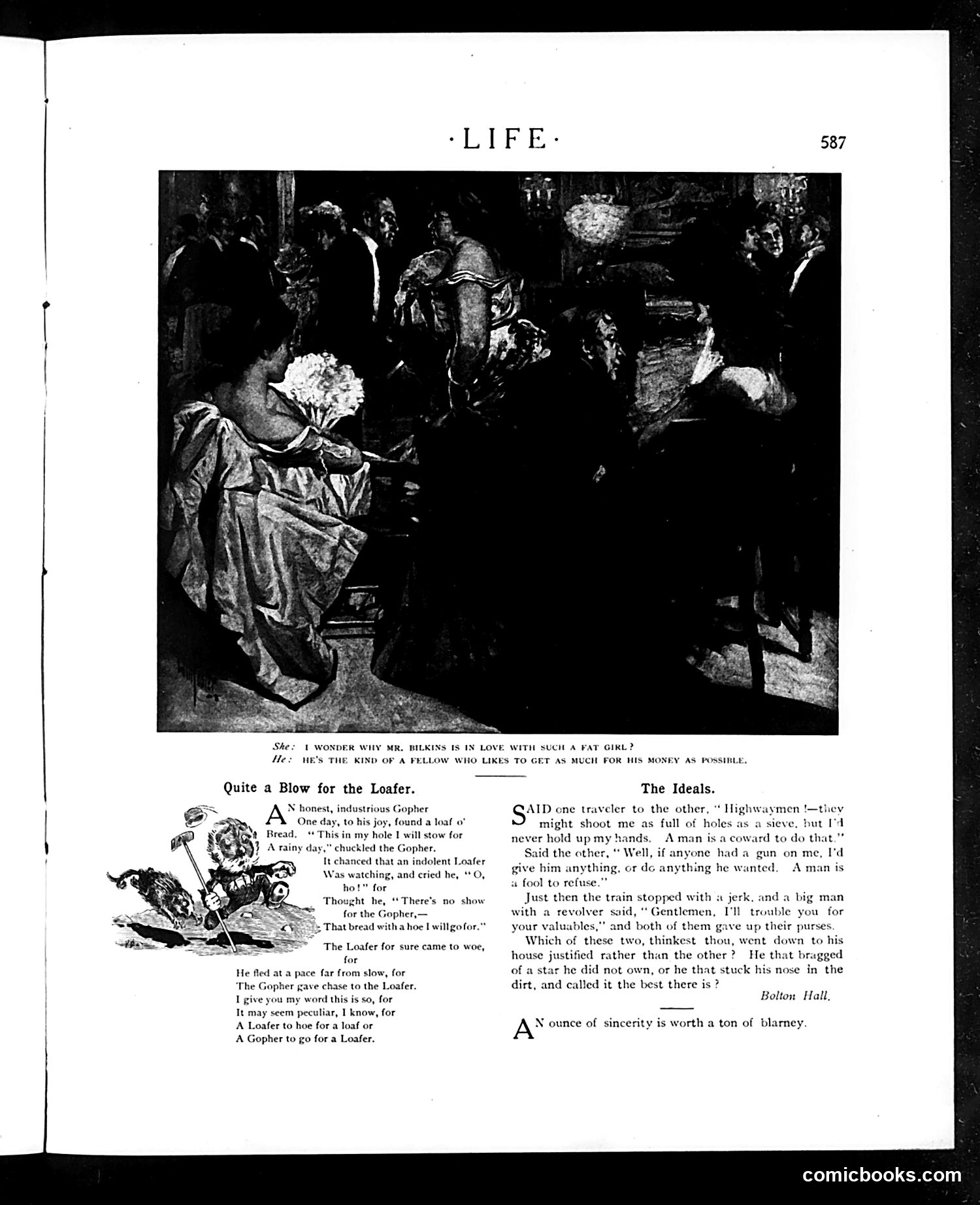
This page contains two distinct pieces of satirical content: **Top Image & Caption**: A domestic scene captioned with dialogue mocking a man named Bikkins for being infatuated with an overweight woman. The joke relies on body-shaming humor typical of early 20th-century satire—ridiculing his romantic choice as financially motivated ("likes to get as much for his money as possible"). **"Quite a Blow for the Loafer"**: A poem with illustration mocking an unemployed man (the "Loafer") who encounters a Gopher. The verse humorously suggests that even a Gopher outperforms this idle man, using animal comparison as social criticism of laziness. **"The Ideals"**: A dialogue contrasting two men's philosophies about honesty and material wealth, ultimately endorsing sincere poverty over corrupt wealth. These pieces collectively satirize laziness, greed, and moral compromise—common middle-class anxieties of the era.
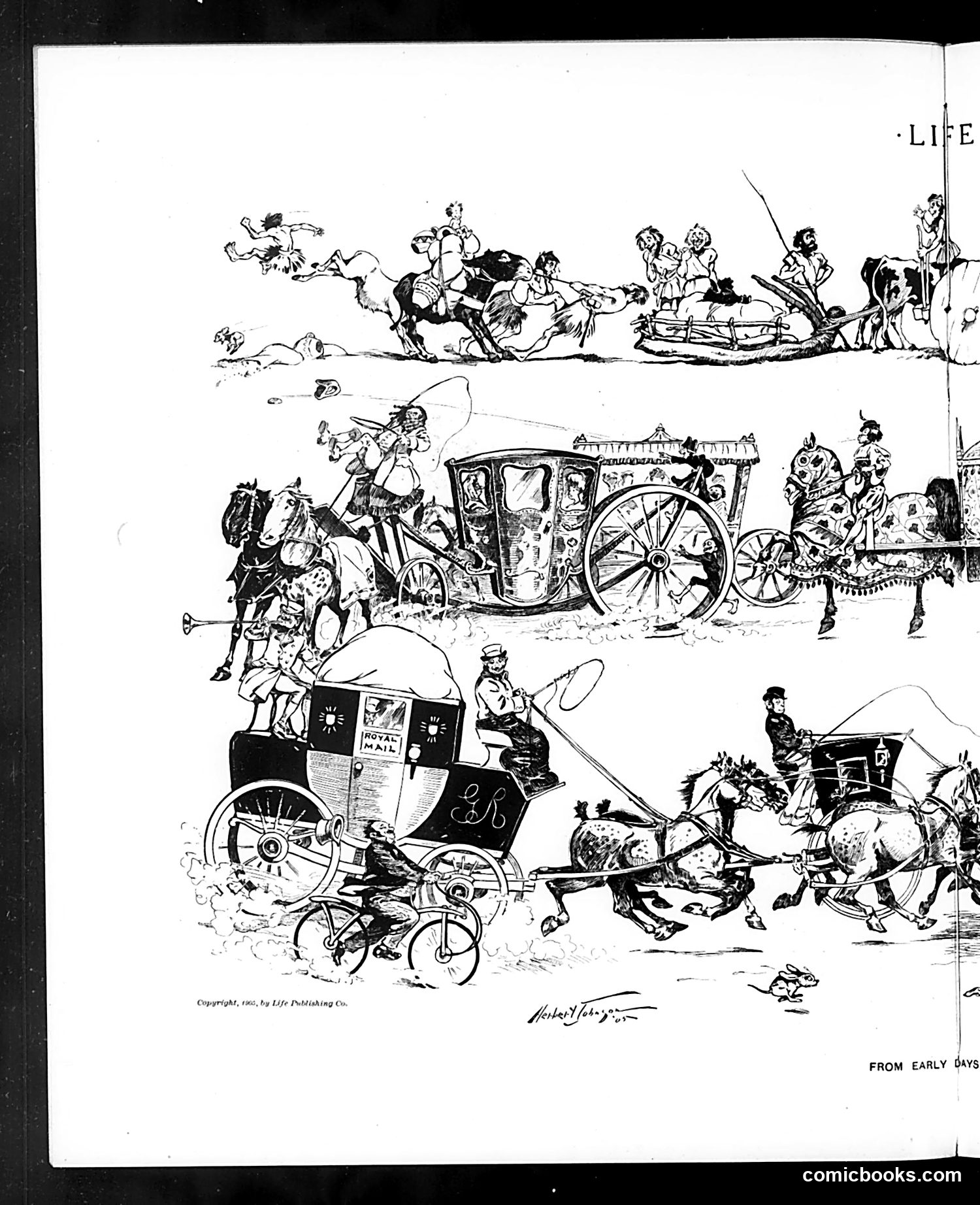
This page from *Life* magazine appears to be a satirical illustration titled "From Early Days," showing the evolution of transportation and social customs across three horizontal panels. The cartoons depict increasingly elaborate and chaotic processions: - **Top panel**: Simple early travel with minimal participants - **Middle panel**: A ornate carriage with horses and attendants, suggesting Victorian-era formality - **Bottom panel**: A Royal Mail coach surrounded by numerous figures in comedic disarray The satire likely mocks the growing complexity and pretension of transportation, fashion, and social pageantry over time. The figures appear exaggerated and ridiculous, suggesting the artist is critiquing how society has made simple travel unnecessarily elaborate and absurd. The specific historical period or social commentary remains unclear without additional context.
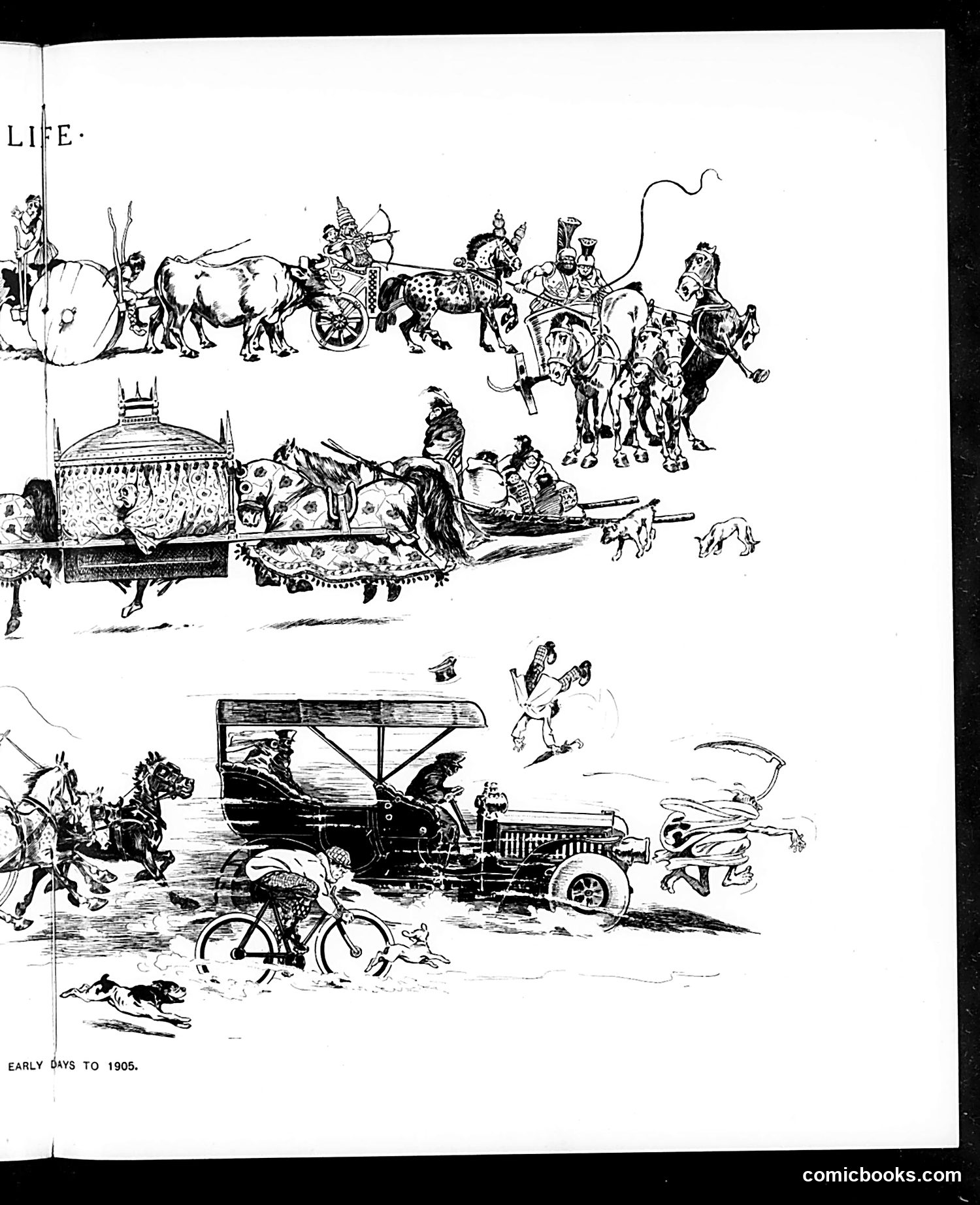
This page illustrates the **evolution of transportation and warfare** from ancient to modern times. The top panel depicts classical and medieval military processions—chariots, mounted archers, ornate war elephants, and armed cavalry in elaborate costumes. The middle section shows a transition with decorated horses and ceremonial vehicles. The bottom panel contrasts sharply: modern automobiles, motorcycles, and mechanical vehicles surround chaotic scenes of collision and accident, with figures tumbling and scattering. **The satire's point**: This is likely mocking the rapid, disruptive modernization of early 20th-century America. While ancient warfare was orderly and ritualistic, the new automobile age brings only confusion, danger, and comic disaster. It's a commentary on technology's double-edged nature—progress creating new hazards and social disruption rather than clear improvement.
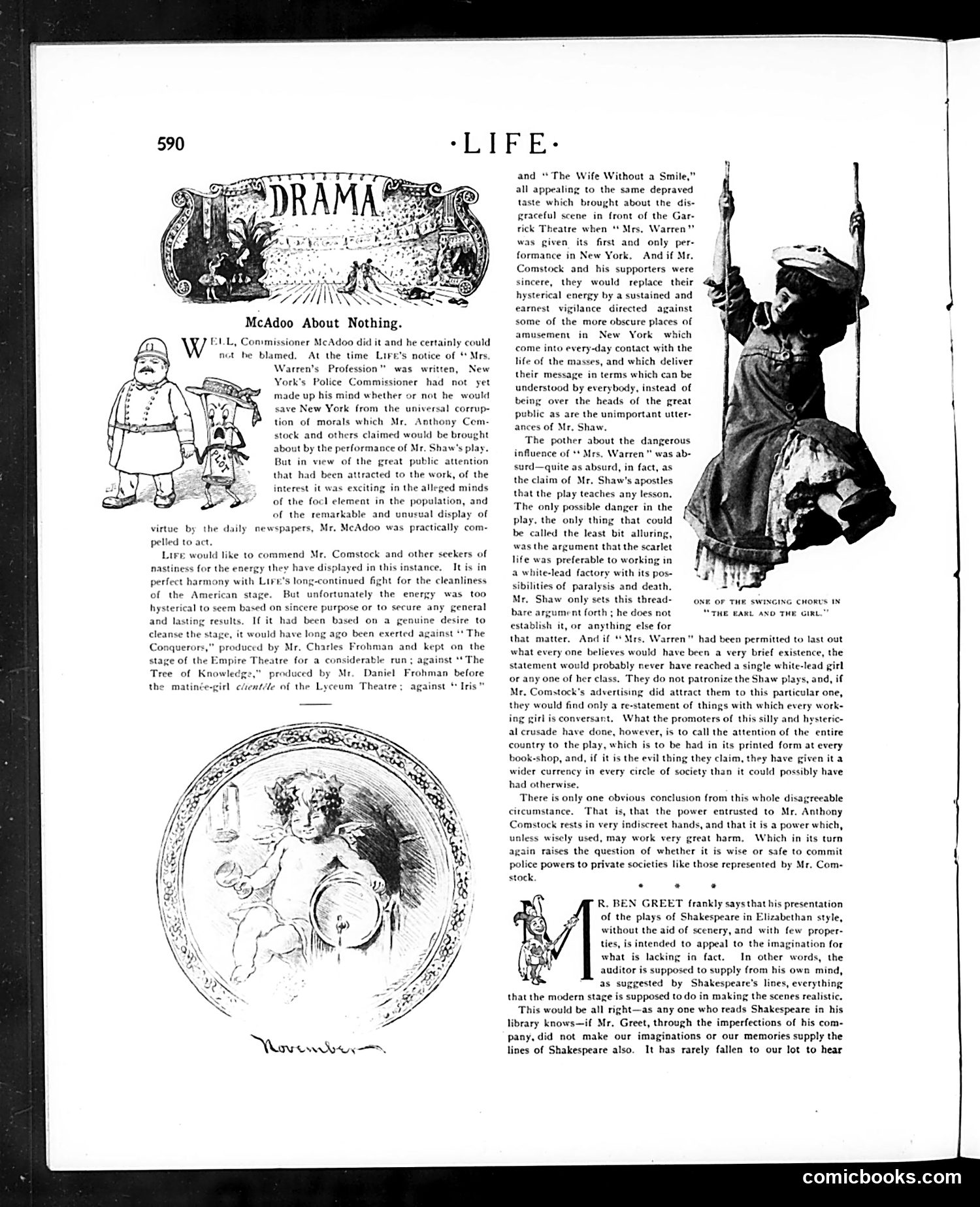
This satirical piece criticizes Police Commissioner McAdoo's decision to ban George Bernard Shaw's play *Mrs. Warren's Profession* in New York. The article argues McAdoo and moral crusader Anthony Comstock applied standards selectively and hypocritically. Life's point: they targeted Shaw's intellectual play while ignoring other "obscene" theatrical productions by major producers (Frohman, etc.) and sleazy venues that actually reached working-class audiences. The magazine mocks their moral vigilantism as performative—the censorship actually *increased* the play's notoriety and distribution through book sales. The cartoon depicting "Commissioner McAdoo" suggests his decision was foolish and arbitrary. Life advocates for consistent theatrical regulation based on genuine harm rather than which plays attract police attention or offend society's sensibilities.
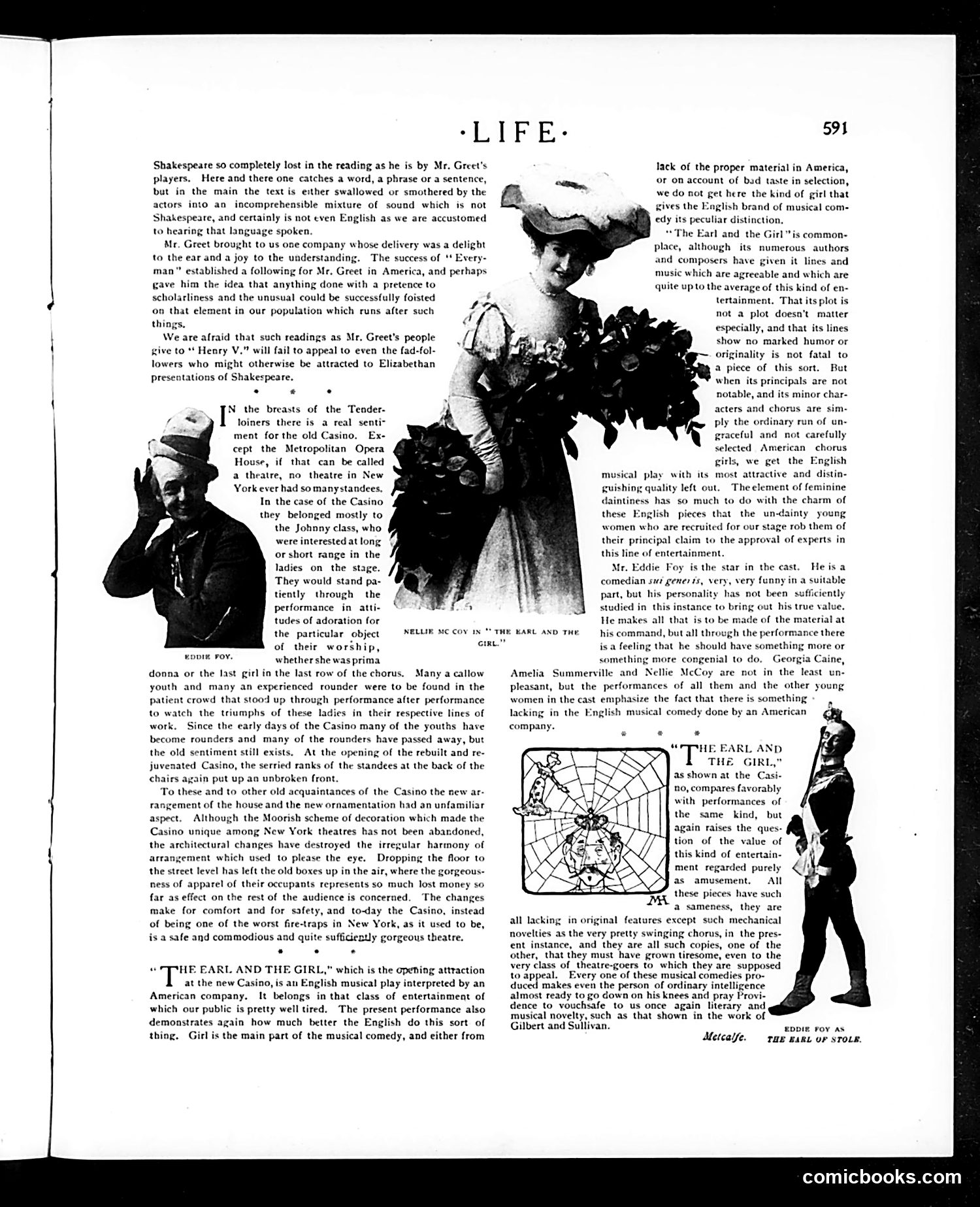
This page critiques **Mr. Greet's Shakespeare productions** and reviews the reopened **Casino Theatre** in New York. ## The Shakespeare Criticism The text attacks Greet's theatrical company for incomprehensible delivery of Shakespeare—actors mumble and obscure the text rather than illuminate it. The author acknowledges Greet had success with "Everyman" but fears his current approach to "Henry V" will fail even among fashionable audiences who normally follow such trends. ## The Casino Theatre Review The piece celebrates the Casino's historic appeal to "standees"—working-class men who stood through performances to watch chorus girls. Though nostalgic about this tradition, the author approves the theater's renovation: the Moorish décor remains, but structural improvements eliminated fire hazards and improved sightlines (though expensive boxes now float awkwardly). ## "The Earl and the Girl" Review The new musical comedy—an English play performed by an American company—receives mixed criticism. While the score is pleasant, the production lacks the refined "girl" character that distinguishes English musical comedy. The implication: American producers and performers fail to match English standards in this entertainment genre.
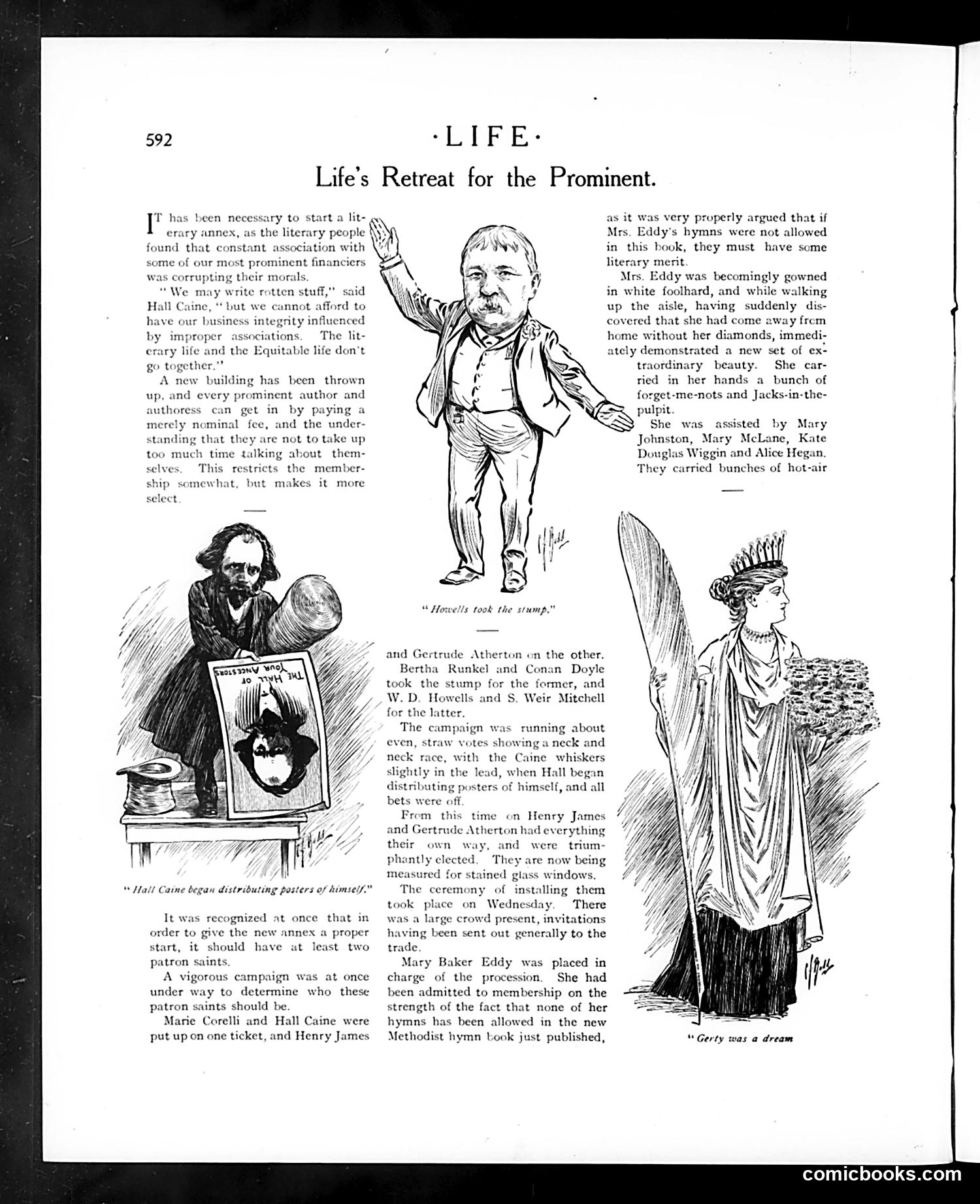
This satirical article mocks the literary establishment's attempt to separate itself from corrupt financiers by creating a separate "annex." The joke centers on prominent authors of the era—**Hall Caine, Marie Corelli, Henry James, and Gertrude Atherton**—who become candidates for "patron saints" of this new retreat. The satire highlights **Hall Caine's self-promotion**, shown distributing posters of himself, which ironically secures Henry James and Gertrude Atherton's election instead. The cartoons depict these literary figures as absurdly self-important: Caine portrayed as an egotistical promoter, and a woman (likely representing one of the female authors) as angelic but vapid. The article also mocks **Mary Baker Eddy** (founder of Christian Science), sarcastically praising her for admission based on her hymns being *excluded* from Methodist hymnals—inverting expected standards. The overall point: despite claims of moral superiority, the literary elite are just as vain, self-serving, and ridiculous as the financiers they're avoiding.
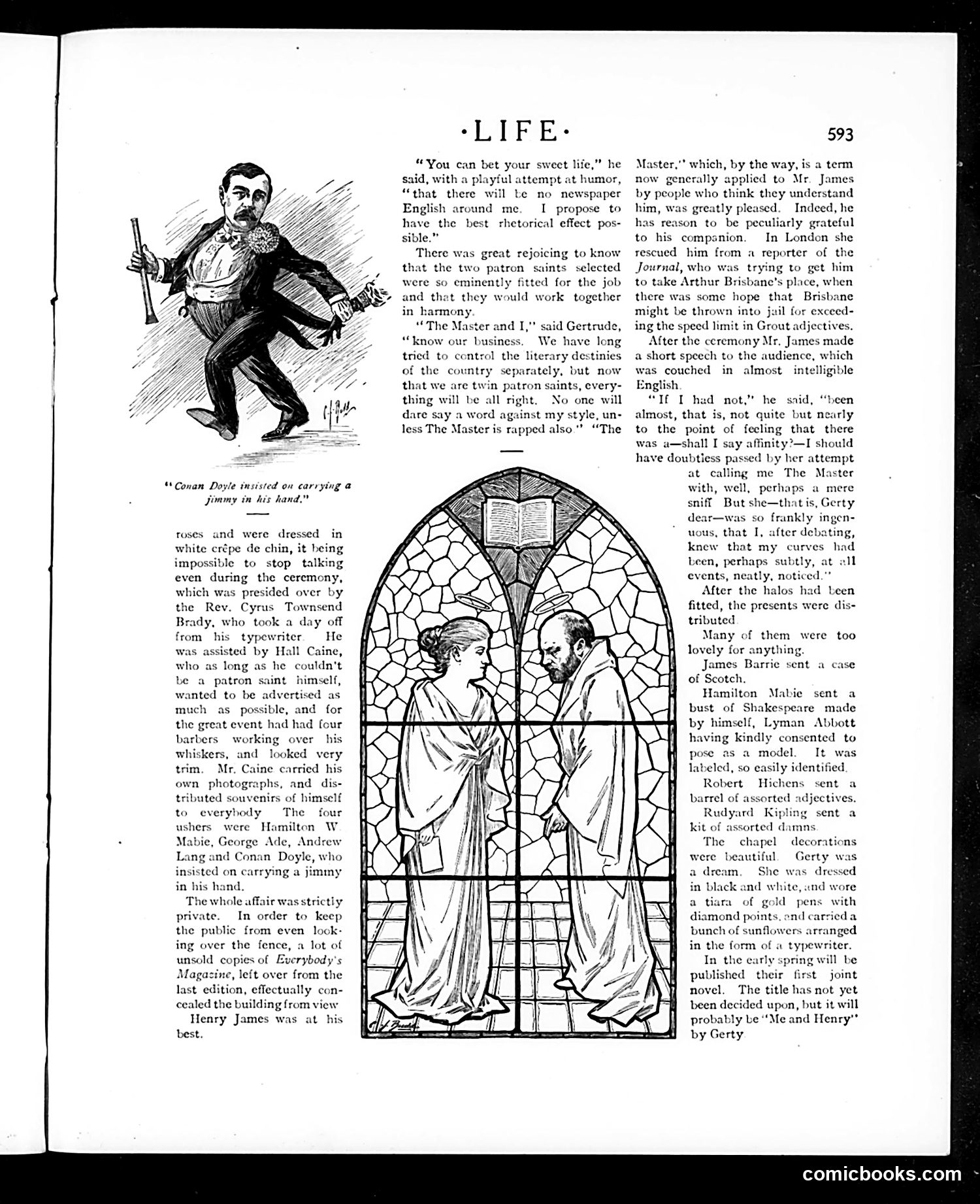
This page satirizes a wedding between literary figures, likely Gertrude Atherton and Henry James (referenced as "The Master"). The humor mocks pretentious authors and their self-importance. **Key targets:** Henry James, who speaks in incomprehensibly convoluted English; Hall Caine, a self-aggrandizing writer who distributes his own photographs as party favors; and the celebrity worship surrounding famous authors. **The satire's points:** - Authors' absurd vanity (Caine's barber and photograph distribution) - James's impenetrable prose style (his wedding speech is deliberately nonsensical) - The ridiculousness of literary cliques controlling "literary destinies" - Absurd wedding gifts like "a barrel of assorted adjectives" and "a kit of assorted damns" (mocking these writers' stylistic affectations) The ornate stained-glass window illustration contrasts formal ceremony with the frivolous subject matter. The proposed novel title "Me and Henry" caps the satire—even their collaboration will be narcissistic.
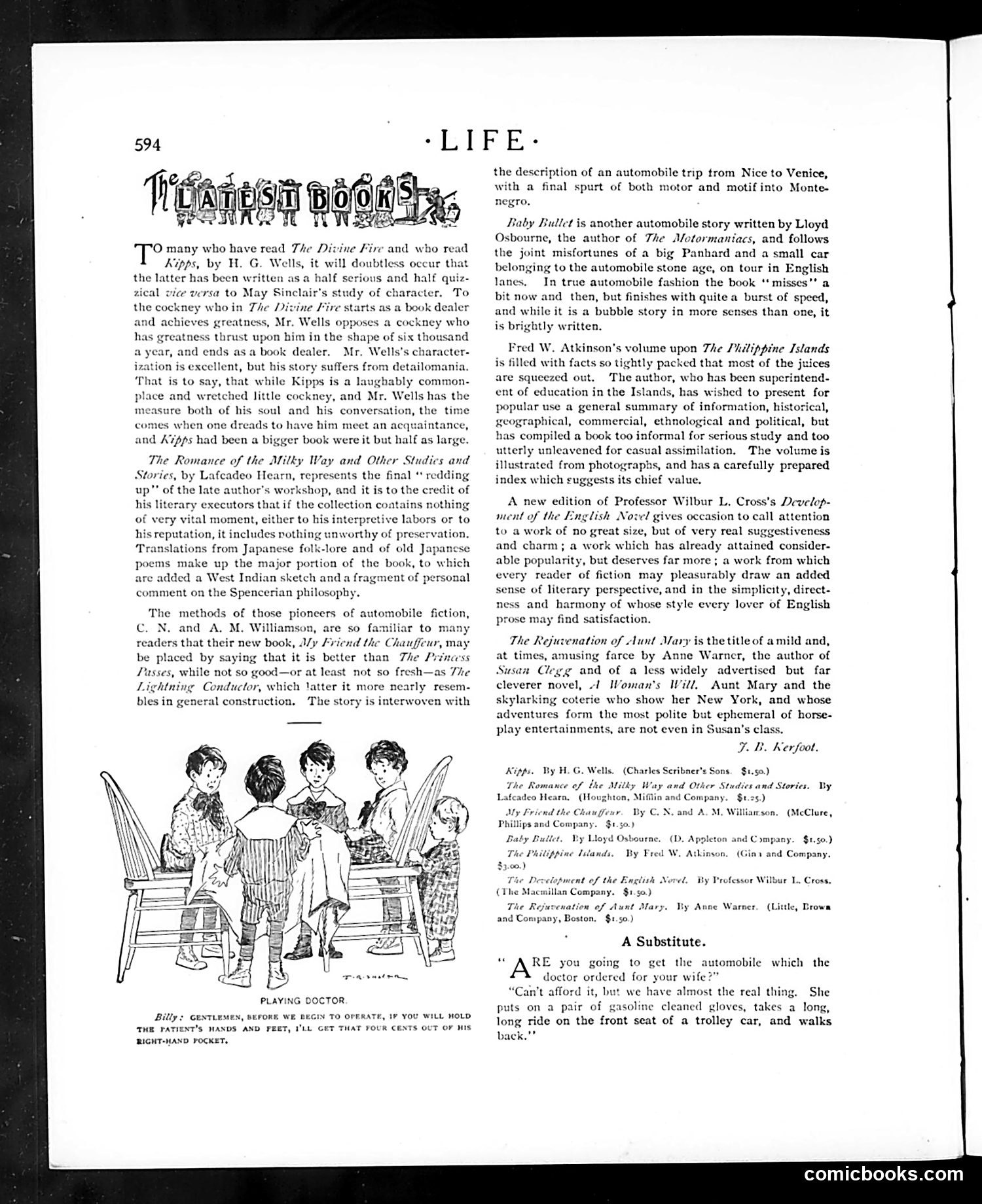
This cartoon satirizes the emerging phenomenon of **automobile tourism and the commercialization of leisure travel** in the early 1900s. The sketch depicts children playing "doctor," but with a modern twist: instead of traditional medical roleplay, one child (the "doctor") is extracting money from another child's pocket—a direct jab at the **high costs of automobile ownership and touring**. The caption's joke about getting "four cents out of his right-hand pocket" mocks how automobiles drain owners' finances through constant expenses. The surrounding page reviews automobile-themed novels (including books titled *The Divine Fire*, *Baby Bullet*, and *My Friend the Chauffeur*), indicating that **automobile culture had become a major literary and social obsession** by this period. The satire suggests that automobiling—promoted as leisurely adventure—was actually a money-hungry enterprise that exploited wealthy enthusiasts. The children's game reflects how deeply this commercial anxiety had penetrated American culture.
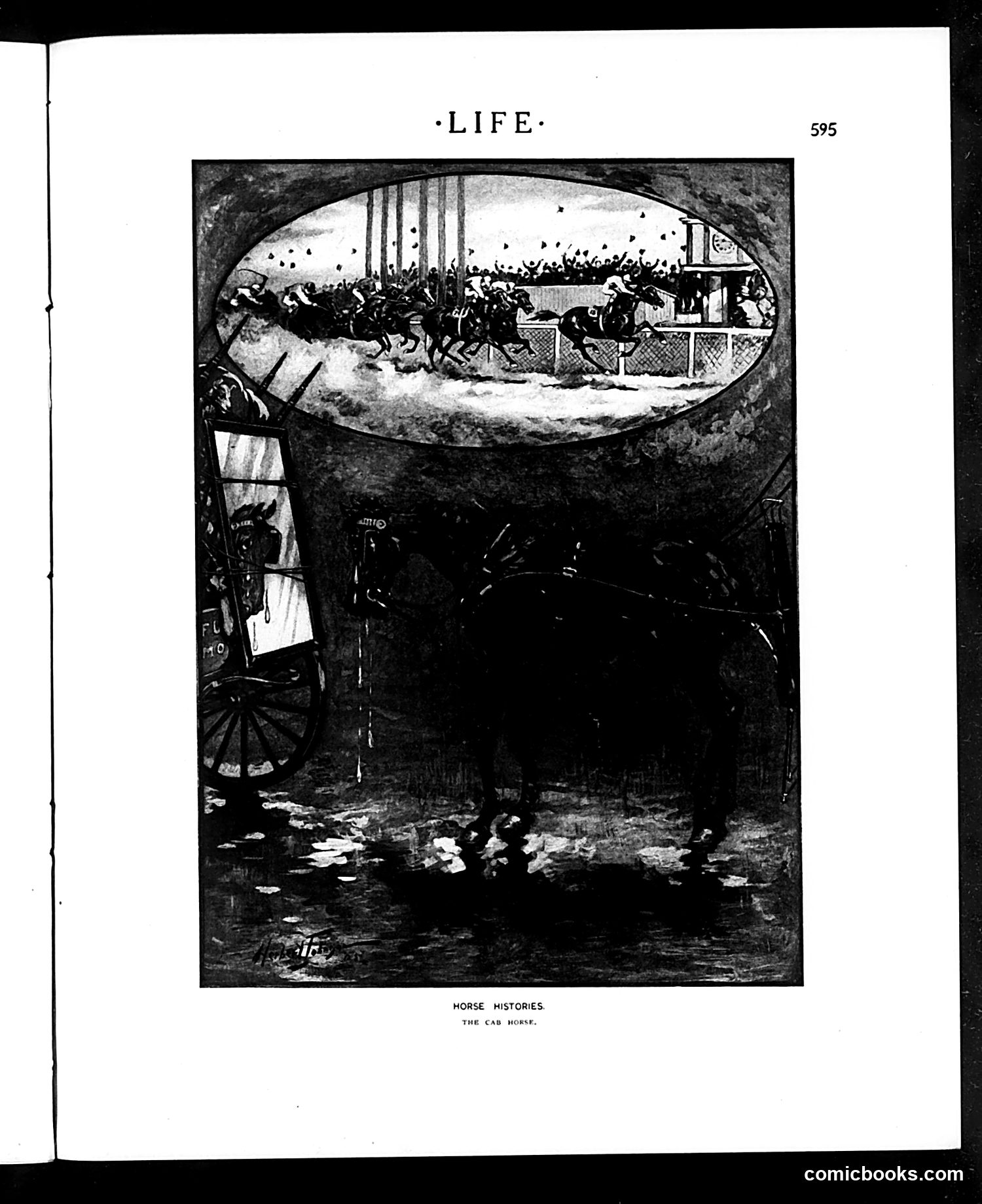
This satirical illustration from *Life* magazine depicts the working life of a cab horse through a split composition. The upper half shows a bright, crowded scene of horse racing—horses running at speed with spectators cheering in a grandstand, suggesting glamour and excitement. The lower half contrasts sharply: a dark, gloomy urban setting where a cab horse stands in shadow, harnessed to a vehicle, seemingly exhausted. The satire critiques the stark disparity between a horse's potential for glory (racing) versus the grim reality of its typical existence as a city cab horse—hard labor in dark, dirty conditions. It's commentary on labor conditions and the contrast between idealized versus actual working life, presented through the lens of animal welfare.
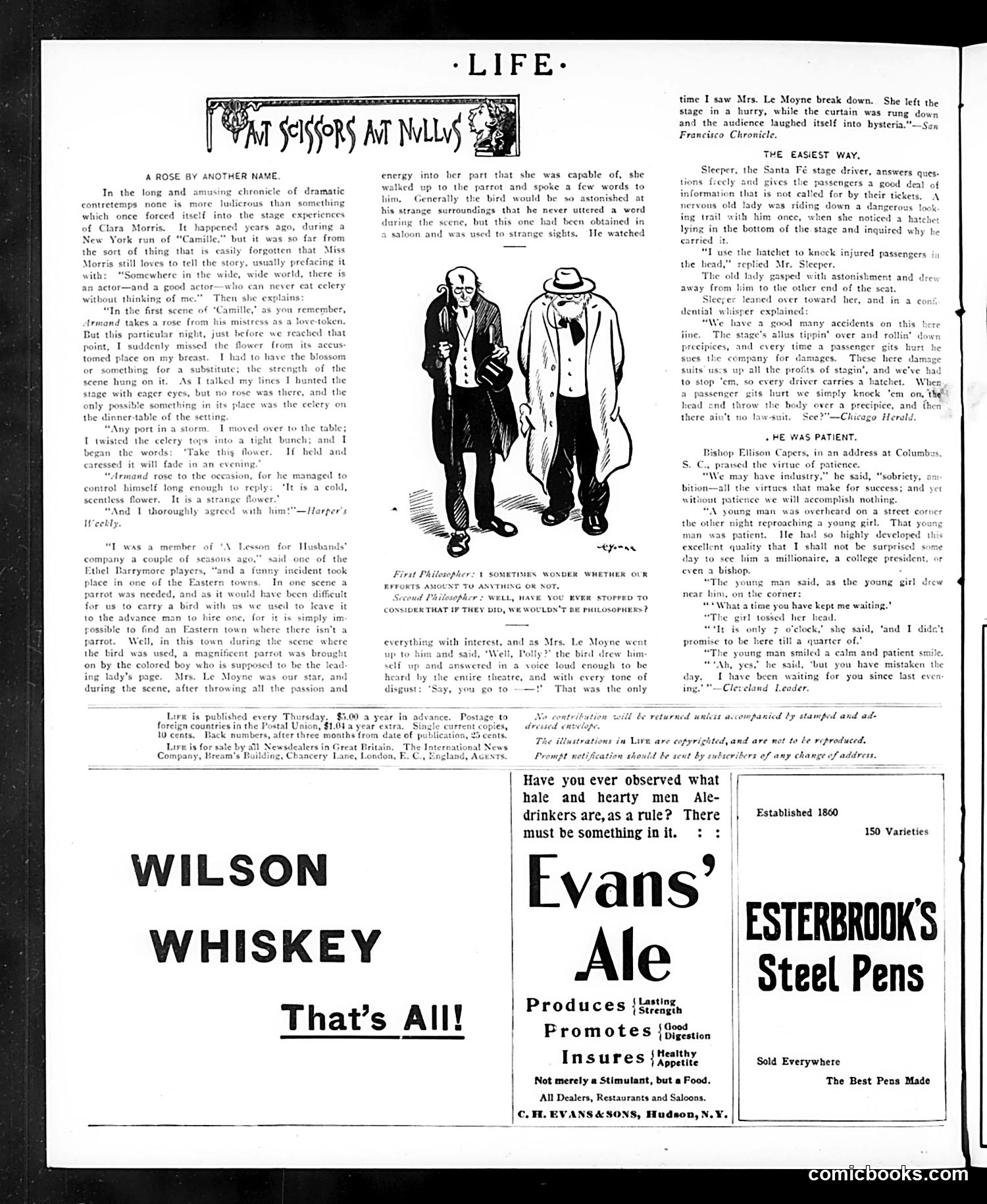
This page from *Life* magazine combines entertainment journalism with period advertising. The main content features actress **Clara Morris** recounting an embarrassing theatrical mishap involving a parrot prop during a New York production of "Camille." The anecdote—about frantically substituting celery for a missing rose during a crucial scene—illustrates how actors must improvise under pressure. The accompanying illustration shows two men in conversation, likely depicting the "First Philosopher" and "Second Philosopher" exchange at the page's bottom, where they discuss whether human efforts "amount to anything or not." The page also includes period advertisements for **Wilson Whiskey**, **Evans' Ale**, and **Esterbrook's Steel Pens**—typical products marketed in early 20th-century *Life*. A separate anecdote about Bishop Ellison Capers praising patience rounds out the content. The humor relies on recognizing these public figures and appreciating theatrical mishaps as relatable entertainment.
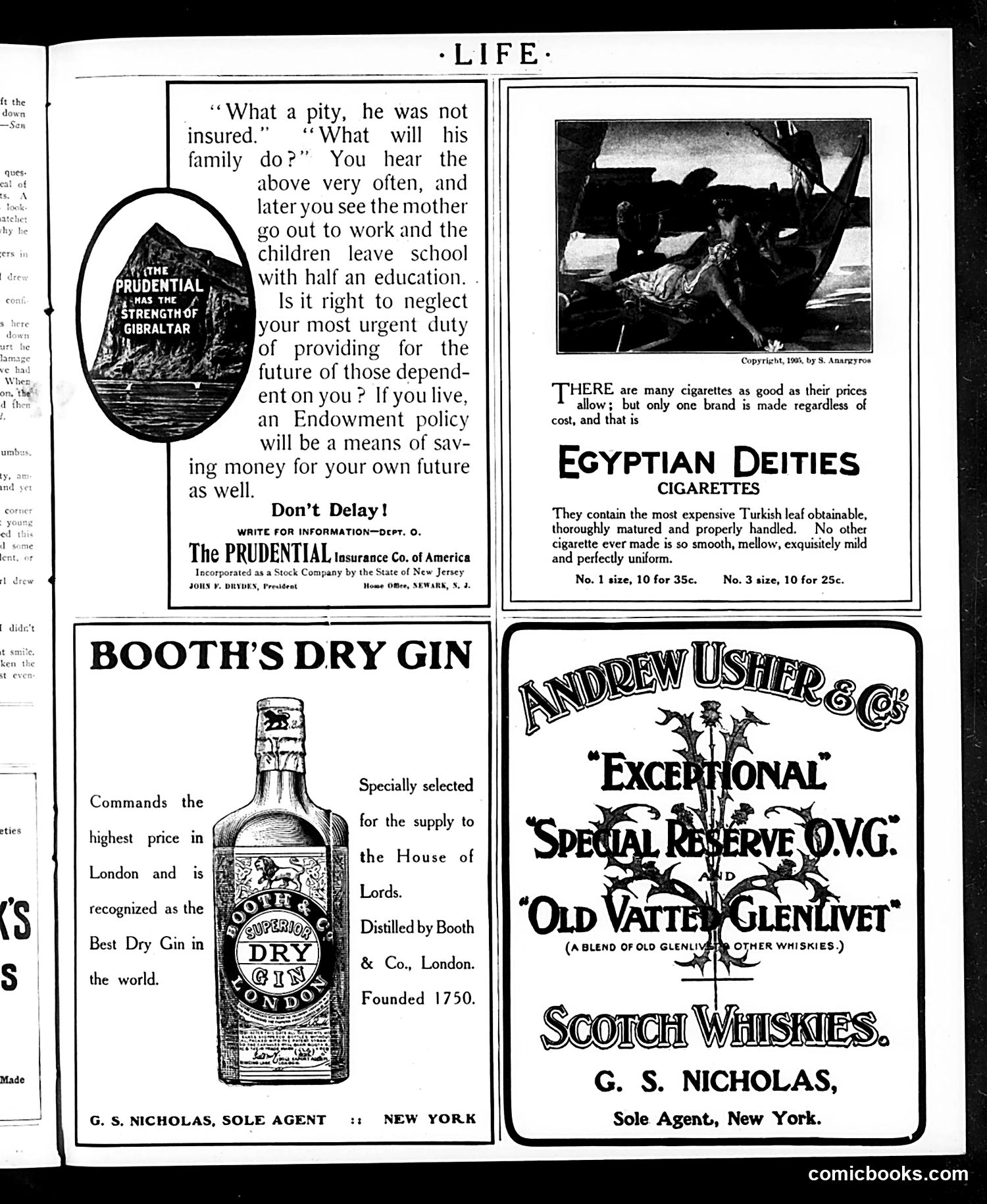
This page contains **primarily advertisements** rather than satire or editorial cartoons. The content reflects early 20th-century consumer messaging: **Top Left:** A Prudential Insurance advertisement uses emotional appeal—depicting a widow and fatherless children as cautionary tale—to sell endowment policies. The pitch: without insurance, families face destitution and children leave school early. **Top Right & Bottom:** Luxury product ads for **Egyptian Deities Cigarettes**, **Booth's Dry Gin**, and **Andrew Usher Scotch Whiskies**. These showcase expensive imported goods marketed to wealthy consumers (note Booth's claim of being supplied to the "House of Lords"). **The Social Context:** These ads reveal early 1900s anxieties about economic security alongside conspicuous consumption by the affluent. The Prudential ad's emotional manipulation contrasts sharply with ads for luxury spirits—a stark illustration of class division in the era. This is **not satirical commentary** but rather a cross-section of period advertising reflecting contemporary concerns and consumer culture.
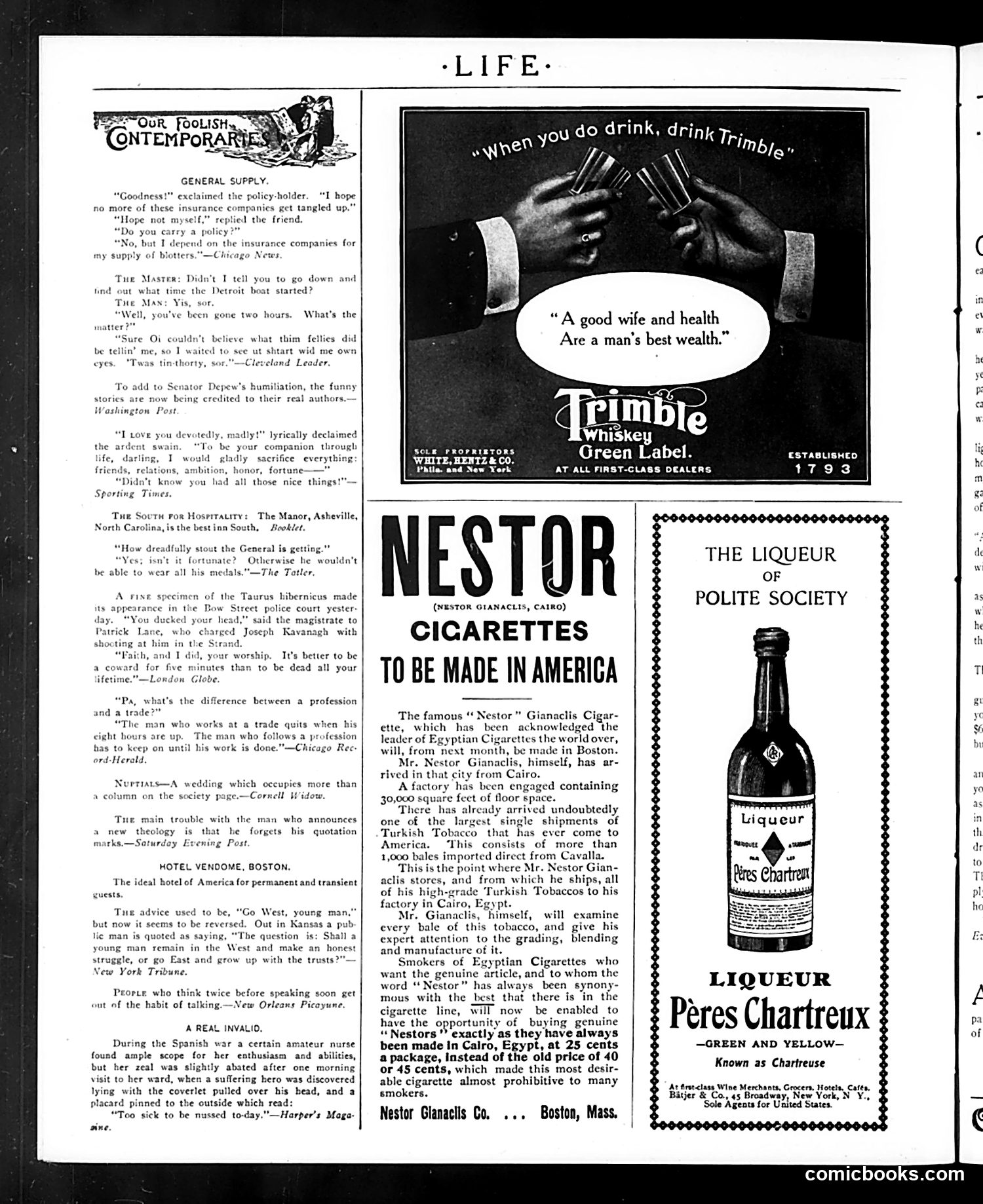
This page from *Life* magazine contains primarily **short humorous anecdotes** satirizing early 20th-century American society, plus advertisements. The cartoons/jokes mock: - **Insurance company corruption**: A policy-holder hopes companies stop getting "tangled up" (implying fraud) - **Irish immigrant labor**: A servant's thick accent and incompetence, stereotyping working-class Irish workers - **Social pretension**: A man's dramatic romantic declaration proven insincere when his lover discovers he only loved her when she had money and status The advertisements promote **Trimble Whiskey** (emphasizing "a good wife and health / Are a man's best wealth") and **Nestor Cigarettes**, newly manufactured in Boston using imported Turkish tobacco—presenting luxury imported goods as now accessible domestically. The page reflects period concerns: labor stereotyping, insurance scandals, class mobility, and marketing of imported luxury products to American consumers.
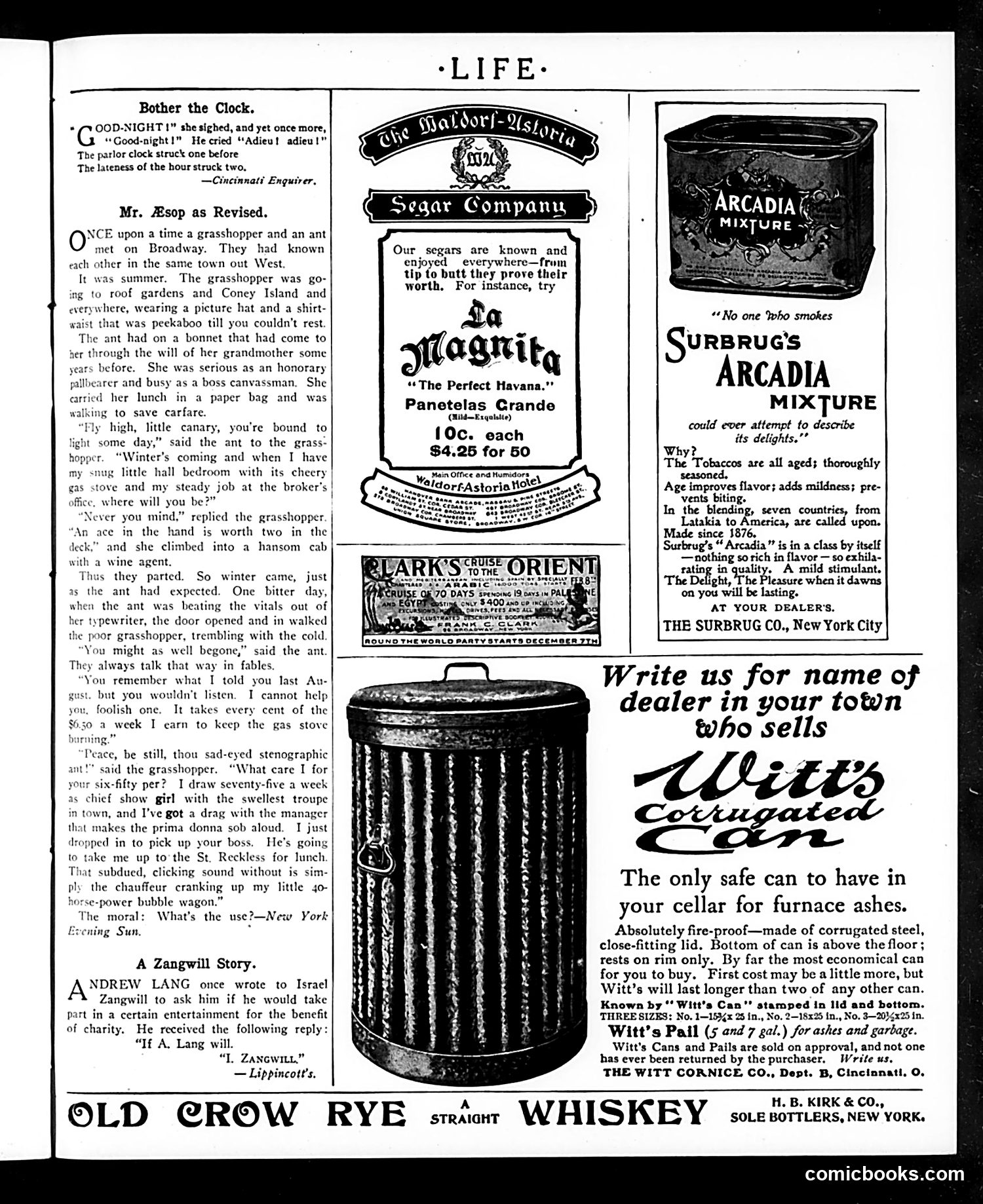
This page from *Life* magazine contains three separate humorous pieces: **"Bother the Clock"** satirizes romantic parlor scenes—a couple saying prolonged goodbyes while the clock strikes one, then two, mocking the melodramatic drawn-out farewells of Victorian courtship. **"Mr. Aesop as Revised"** retells the grasshopper-and-ant fable with modern urban twist: the improvident grasshopper becomes a prosperous show girl with connections, while the prudent ant remains a struggling stenographer. The satire inverts Aesop's moral—hard work doesn't guarantee success in the modern city; charm and connections matter more. **"A Zangwill Story"** is a brief anecdote (likely apocryphal) about writer Israel Zangwill declining a charity performance request with cryptic wit. The remainder consists of period advertisements for cigars, whiskey, tobacco, corrugated ash cans, and cruise ships—typical of early 1900s *Life* magazine content.
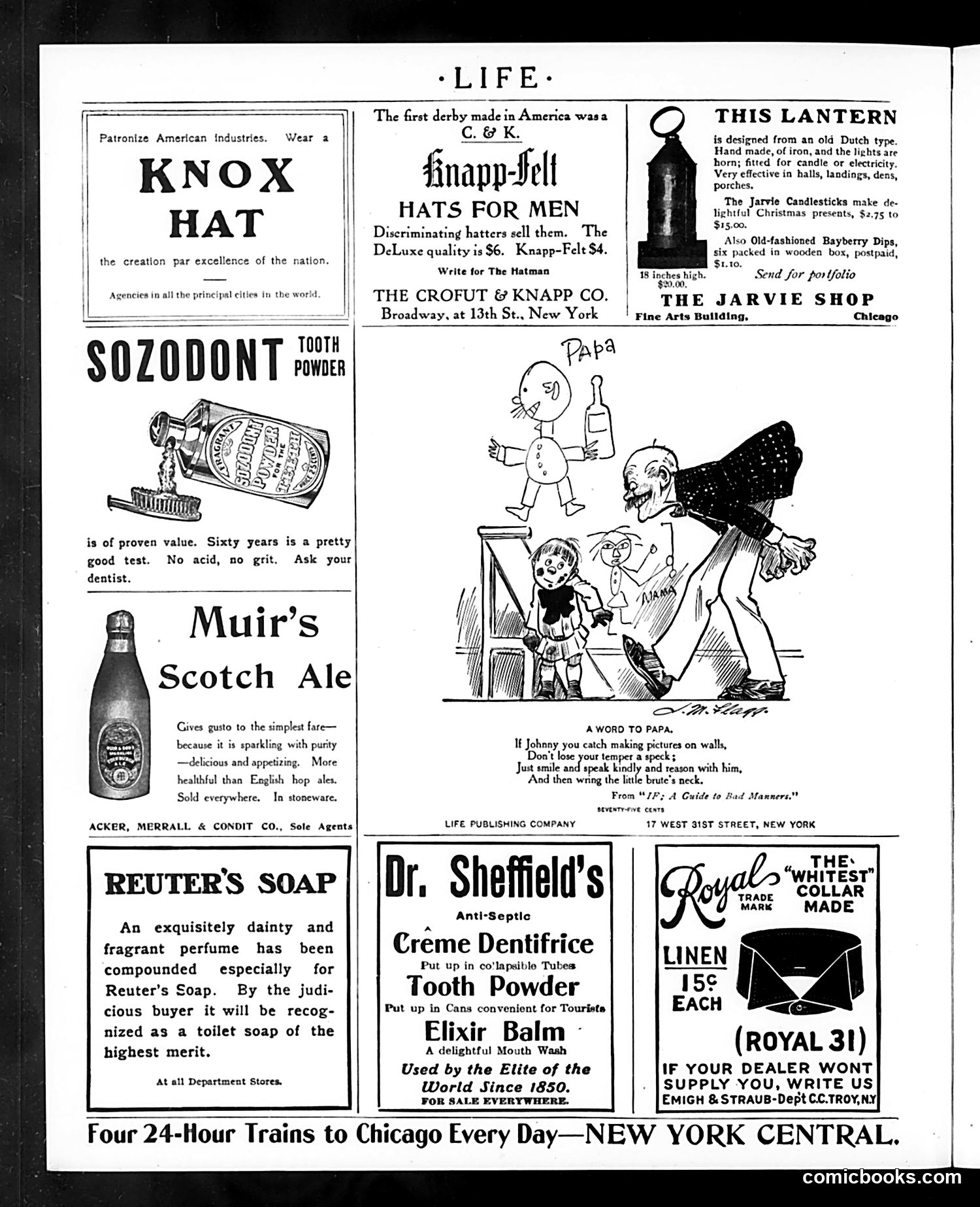
This page is primarily advertising, but features one notable cartoon titled "A Word to Papa." The illustration depicts a mischievous child drawing on walls while an exasperated father gestures in frustration. The accompanying text, credited to "A Guide to Bad Manners," humorously advises parents not to lose their temper when catching children vandalizing walls. Instead, it sarcastically recommends smiling, speaking kindly, and reasoning with "the little brute." The joke satirizes contemporary parenting advice and discipline philosophies, likely mocking either overly permissive child-rearing approaches or advice-column clichés of the era. The cartoon's tone suggests the author finds such patient responses absurdly impractical when faced with destructive behavior—the sarcasm implies most parents would prefer immediate, firm correction rather than gentle reasoning.
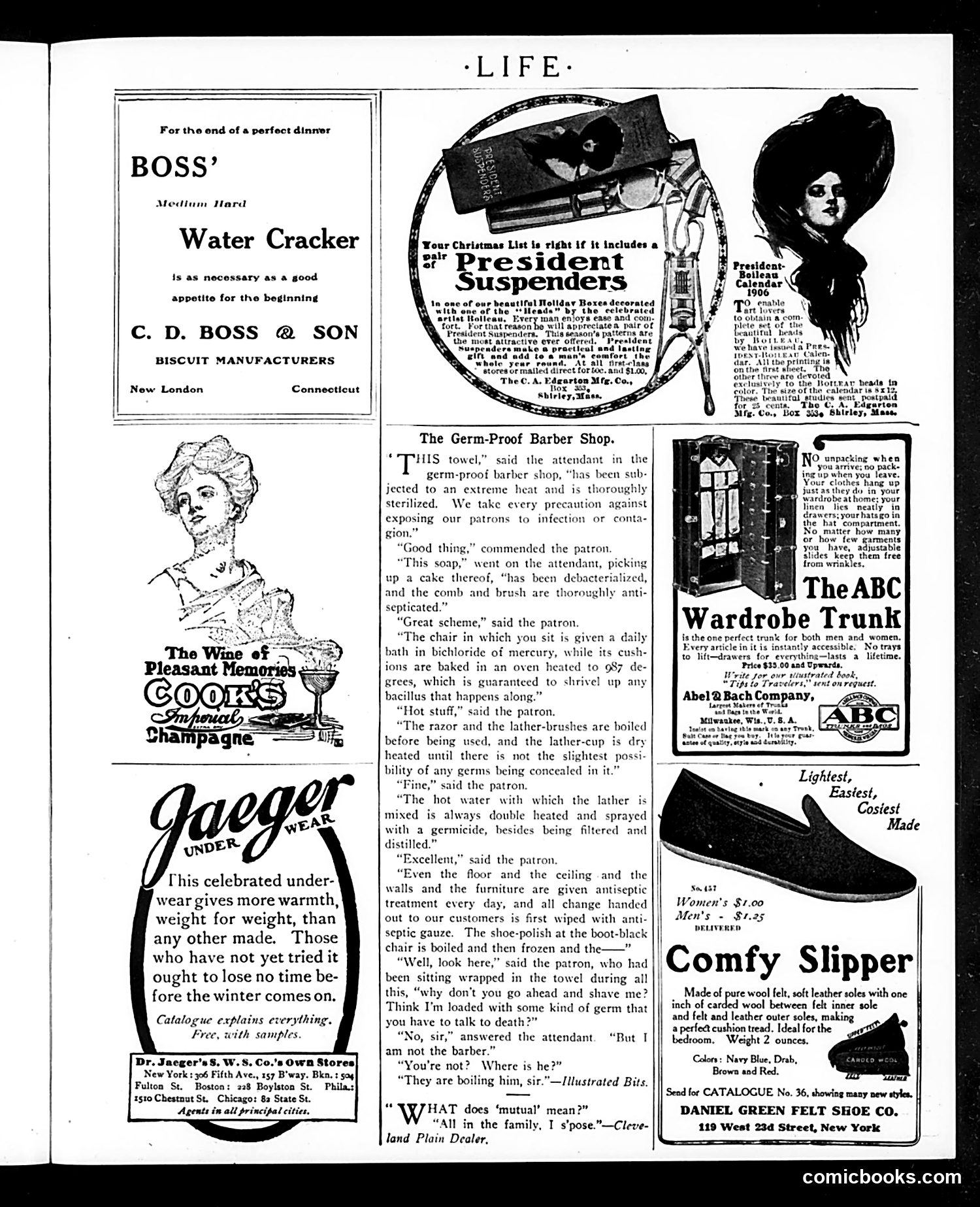
This cartoon satirizes early-20th-century obsession with germ theory and antiseptic hygiene. The barber shop's attendant describes increasingly elaborate sterilization procedures—boiled tools, mercury baths (987 degrees), germicide-sprayed water, antiseptic gauze for handling change—treating germs as an existential threat requiring extreme measures. The joke's payoff mocks this excess: after cataloging all these precautions, the patron learns the barber himself is "being boiled"—the logical absurdist endpoint of germophobia. This reflects genuine contemporary anxieties following discoveries about bacterial transmission, but exaggerates them for humor. The cartoon gently ridicules how quickly Americans adopted hygienic theater, treating cleanliness rituals almost superstiously. The patron's growing frustration ("you have to talk to death?") captures impatience with over-explaining protective measures that seem performative rather than practical. The rest of the page is period advertising (underwear, trunks, slippers) unrelated to the cartoon.
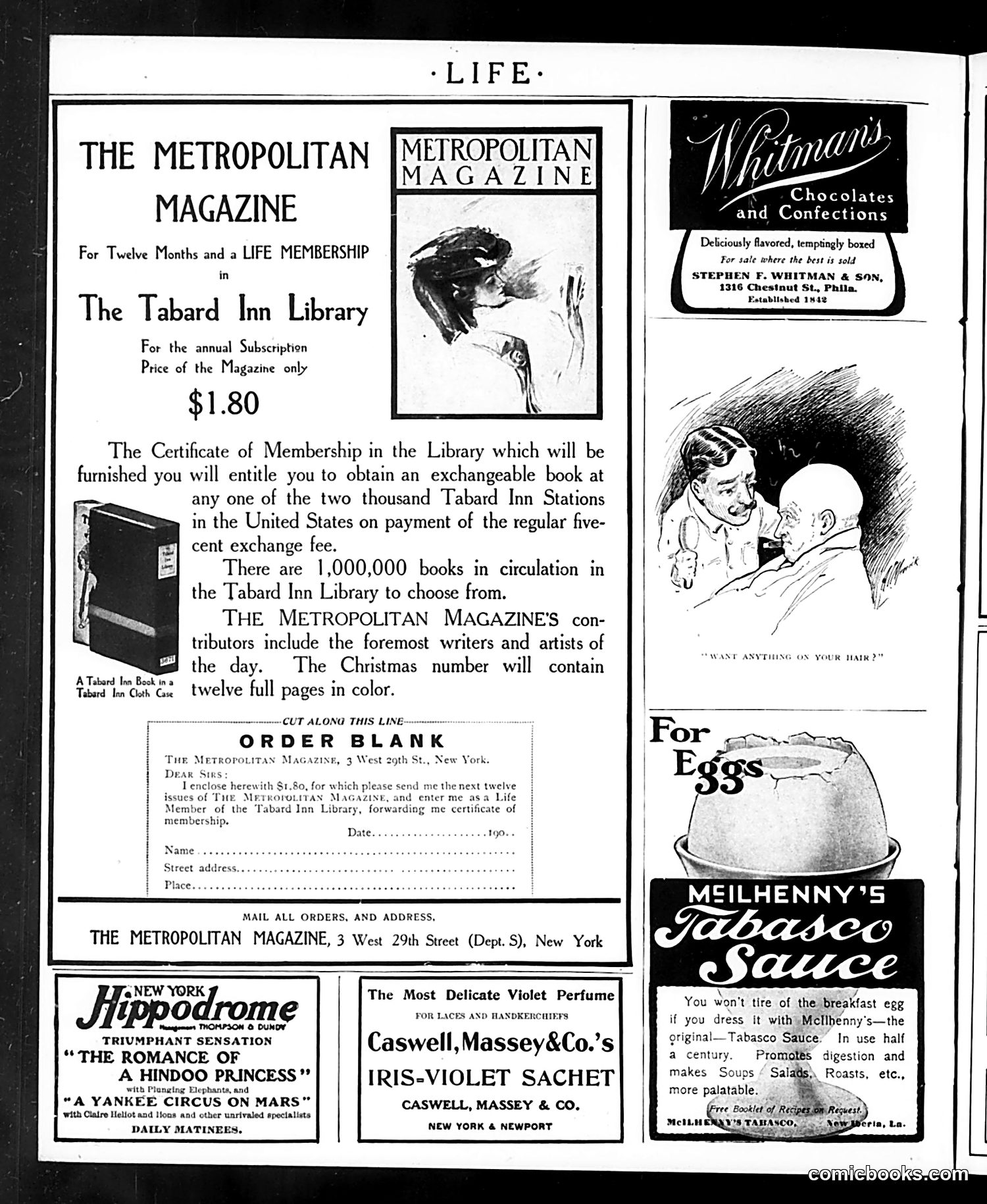
This page is primarily **advertising content**, not satire or political commentary. It consists of subscription offers and product advertisements typical of early 20th-century magazines. The main content advertises **The Metropolitan Magazine** subscription ($1.80 annually) bundled with membership in the Tabard Inn Library, a book-circulation system with 1,000,000 volumes available at 2,000 stations nationwide for a five-cent exchange fee. Surrounding advertisements promote period consumer goods: Whitman's chocolates, Caswell Massey's violet perfume sachets, Tabasco sauce, McIlhenny's products, and entertainment at the New York Hippodrome theater (featuring "The Romance of a Hindoo Princess" and "A Yankee Circus on Mars"). The single cartoon—a sketch labeled "Want anything on your hair?"—appears to be a light, generic joke rather than political commentary. **No significant political or social satire is evident on this page.**
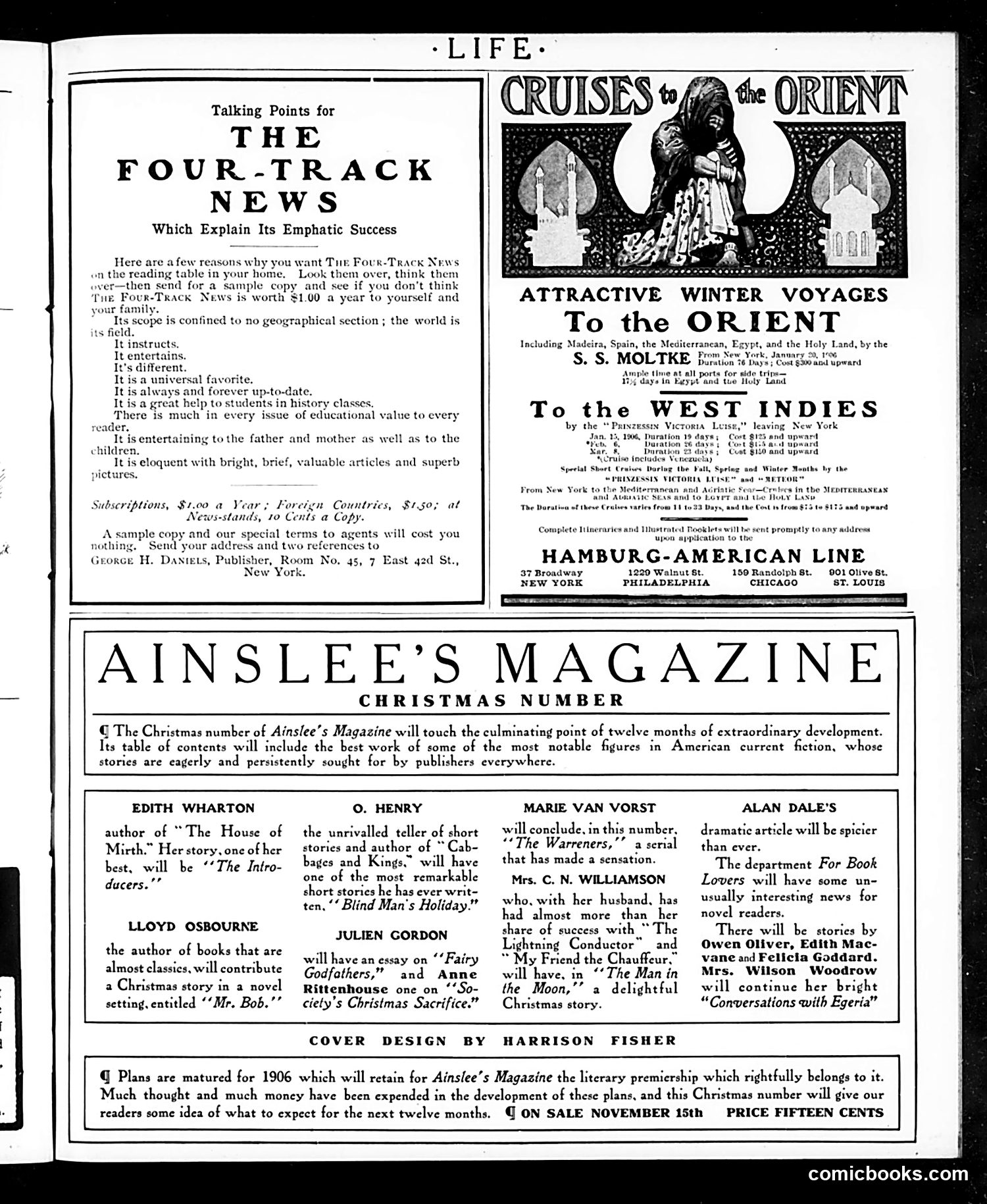
This page is primarily **advertising and promotional content**, not political satire. It contains: 1. **Four-Track News promotion** (left): A publication pitching itself as educational and entertaining for families, priced at $1/year. 2. **Hamburg-American Line cruises** (top right): Advertisements for luxury winter voyages to the Orient and West Indies—leisure travel for wealthy Americans. 3. **Ainslee's Magazine Christmas Number** (bottom): The main content announces the forthcoming holiday issue, featuring celebrated American authors including O. Henry, Edith Wharton, and others. The names and story titles are promotional hooks for readers. There is **no political cartoon or satire visible**. This appears to be a standard magazine page from approximately 1905, combining subscription pitches with literary advertisements—typical of *Life* magazine's mixed advertising/content format of that era. The references are straightforward marketing rather than satirical commentary.
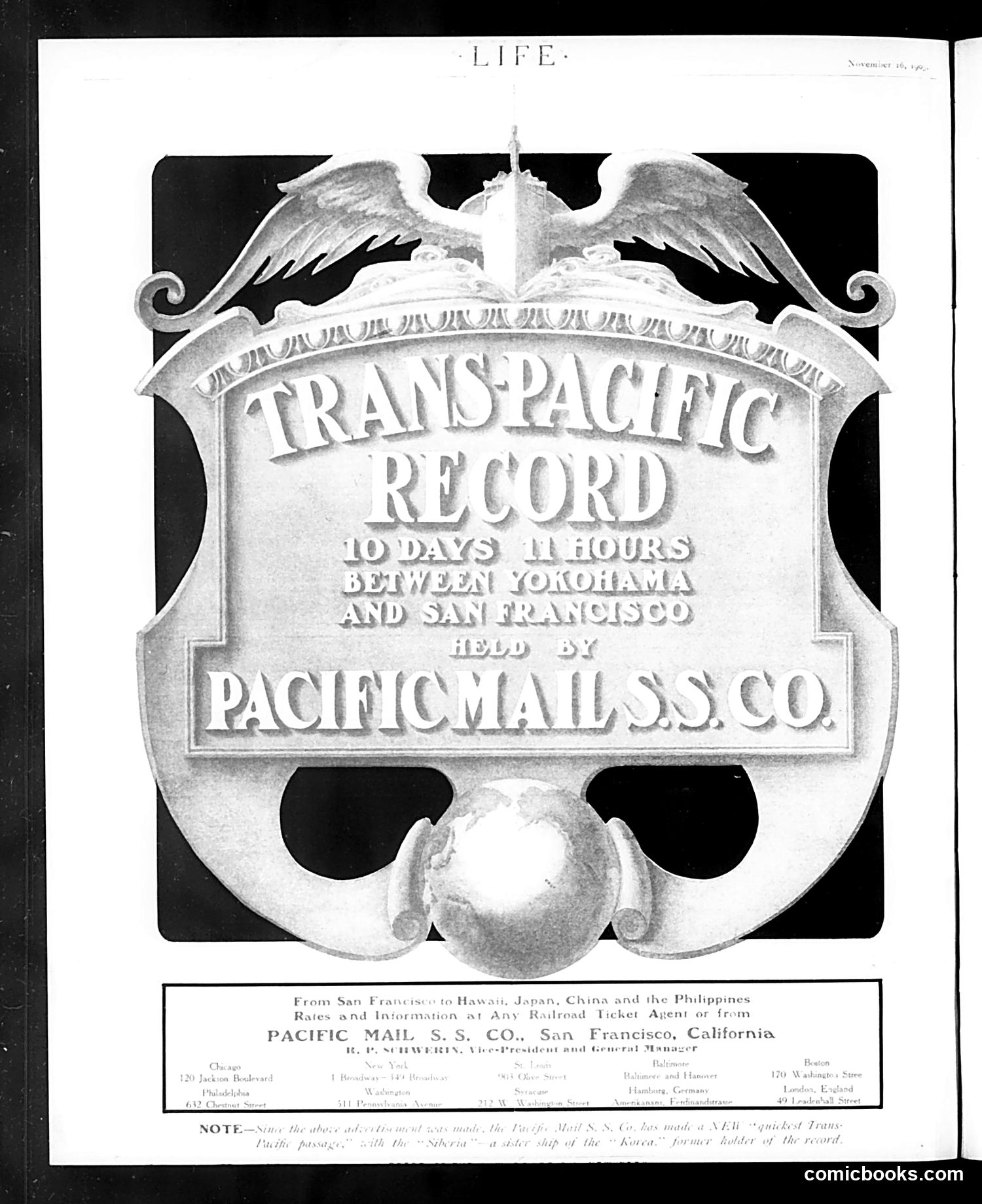
This is an advertisement rather than a political cartoon. It promotes a "Trans-Pacific Record" of 10 days 11 hours for travel between Yokohama and San Francisco, held by Pacific Mail S.S. Co. (a steamship company). The ornate shield design with eagle and decorative elements emphasizes the achievement's prestige. The ad directs readers to contact railroad ticket agents or Pacific Mail's San Francisco office for rates and information about passage to Hawaii, Japan, China, and the Philippines. This reflects early-20th-century American commercial expansion into the Pacific, marketing rapid steamship service as a modern marvel and business opportunity during the era of significant U.S. Pacific trade and influence.