
Life, 1905-11-16 · page 16 of 30
Life — November 16, 1905 — page 16: what you’re looking at
What you’re looking at
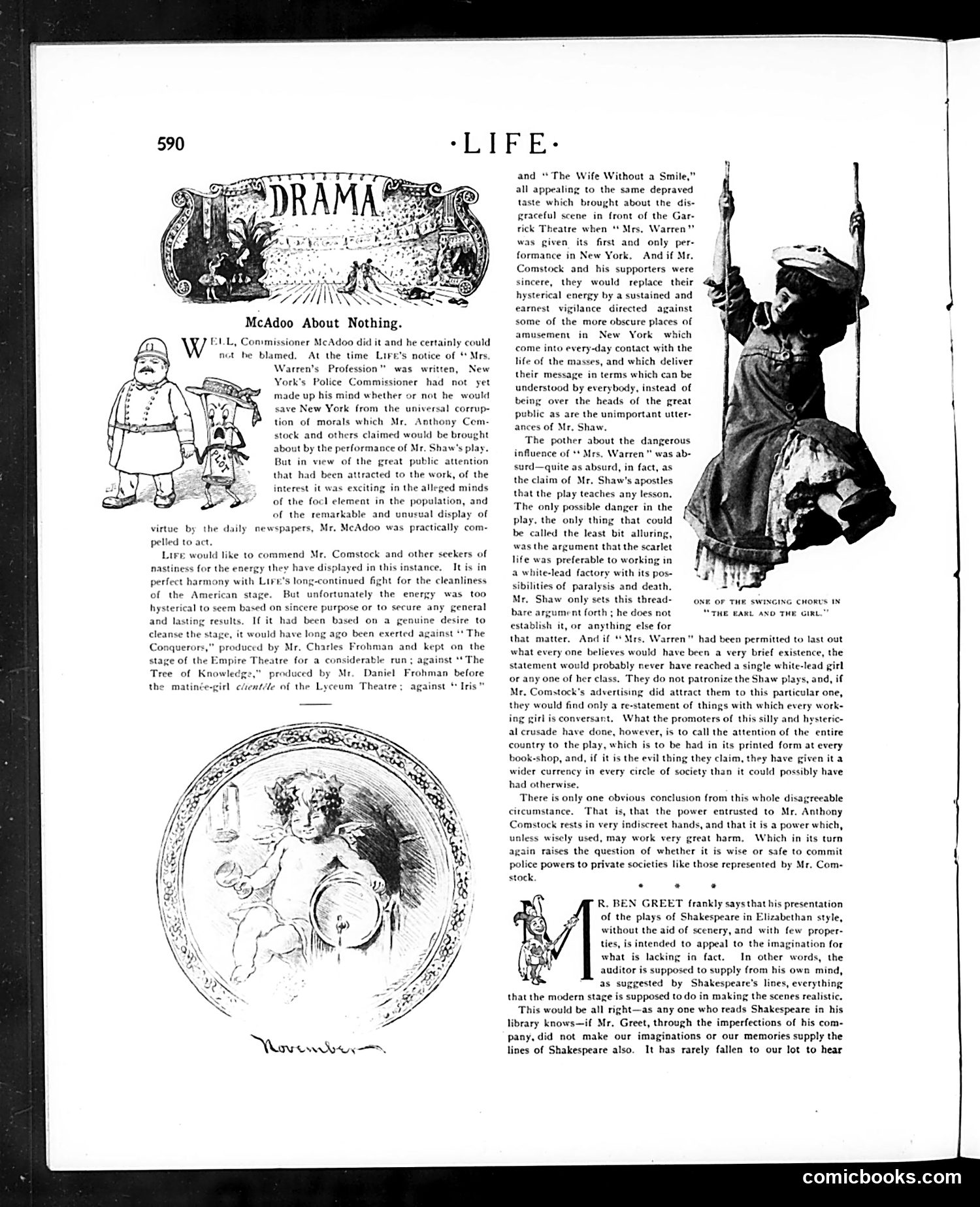
This satirical piece criticizes Police Commissioner McAdoo's decision to ban George Bernard Shaw's play *Mrs. Warren's Profession* in New York. The article argues McAdoo and moral crusader Anthony Comstock applied standards selectively and hypocritically. Life's point: they targeted Shaw's intellectual play while ignoring other "obscene" theatrical productions by major producers (Frohman, etc.) and sleazy venues that actually reached working-class audiences. The magazine mocks their moral vigilantism as performative—the censorship actually *increased* the play's notoriety and distribution through book sales. The cartoon depicting "Commissioner McAdoo" suggests his decision was foolish and arbitrary. Life advocates for consistent theatrical regulation based on genuine harm rather than which plays attract police attention or offend society's sensibilities.
📄 Transcribed text from this page (OCR, searchable)
Machine-transcribed from the original scan — historical spelling and the odd misread are preserved.
McAdoo About Nothing. ELL, Conimissioner McAdoo did it and he certainly could not be blamed, At the time Lire’s notice of + Mrs Warren's Profession" was written, New York's Police Commissioner had not yet made up his mind whether or not he would save New York from the universal corrup- tion of morals which Mr. Anthony Coi stock and others claimed would be broug about by the performance of Mr. But in view of the great public attention that had been attracted to the work, of the interest it was exciting in the alleged minds of the focl element in the population, and of the remarkable and unusual display of e daily newspapers, Mr, McAdoo was practically com- Shaw's play virtue by to act. Lire would like to commend Mr. Comstock and other seekers of nastiness for the energy they have displayed in this instance. It is in perfect harmony with Lire’s long-continued fight for the cleanliness of the American stage. But unfortunately the energy was too hyster eneral and lasting results, If it had been based on a genuine desire to cleanse the stag been exerted against The Conquerors," produced by Mr, Charles Frohman and kept on the stage of the Empire T inst Tree of Knowledge,” produced by Mr. Daniel Frohman before eatre; against “Iris” al to seem based on sincere purpose or to secure any it would have long a atre for a considerable run; a he the matinée-girl clrentile of the Lyceum Vue and “The Wife Without a Si all appealing to the same depraved taste which brought about the dis- graceful scene in front of the Gar- rick Theatre when * Mrs, Warren” was given its first and only per- formance in New York, And if Mr. Comstock and his supporters were sincere, they would replace their hysterical energy by a sustained and earnest vigilance directed against some of the more obscure places of amusement in New York which come into every-day contact with the life of the masses, and which deliver their message in terms which can be understood by everybody, instead of being over the heads of the great public as are the unimportant utter- ances of Mr. Shaw. The pother about the dangerous influence of ** Mrs, Warren" was ab- surd—quite as absurd, in fact, as the claim of Mr, Shaw's apostles that the play teaches any lesson, The only possible danger in the play. the only thing that could be called the least bit alluring, was the argument that the scarlet life was preferable to working in a white-lead factory with its pos- sibilities of paralysis and death, Mr, Shaw only sets this thread- owe oF THE SWINGING CHORUS IN bare argument forth ; he does not establish it, or anything else for that matter. And if “ Mrs. Warren had been permitted to last out what every one believes would have been a very brief existence, the statement would probably never have reached a single white-lead girl or any one of her class. They do not patronize the Shaw plays, and, if Mr. Comstock’s advertising did attract them to this particular one, they would find only a re-statement of things with which every work ing girl is conversant, What the promoters of this silly and hysteric- al crusade have done, however, is to call the attention of the entire country to the play, which is to be had in its printed form at every book-shop, and, if it is the evil thing they claim, they have given it a wider currency in every circle of society than it could possibly have had otherwise, There is only one obvious conclusion from this whole disagreeable citcumstance. That is, that the power entrusted to Mr. Anthony Comstock rests in very indiscreet hands, and that it is a power which, unless wisely used, may work very great harm, Which in its turn again raises the question of whether it is wise or safe to commit police powers to private societies like those represented by Mr. Com- “THE EARL ANO THE GIRL.” . . * R. BEN GREET frankly saysthat his presentation of the plays of Shakespeare in Elizabethan style, without the aid of scenery, and with few proper- ties, is intended to appeal to the imagination for what is lacking in fact. In other words, the auditor is supposed to supply from his own mind, as suggested by Shakespeare's lines, everything that the modern stage is supposed to do in making the scenes realistic. This would be all right—as any one who reads Shakespeare in his library knows—if Mr. Greet, through the imperfections of his com- pany, did not make our imaginations or our memories supply the lines of Shakespeare also. It has rarely fallen to our lot to hear comicbooks.com