
Life, 1905-11-16 · page 20 of 30
Life — November 16, 1905 — page 20: what you’re looking at
What you’re looking at
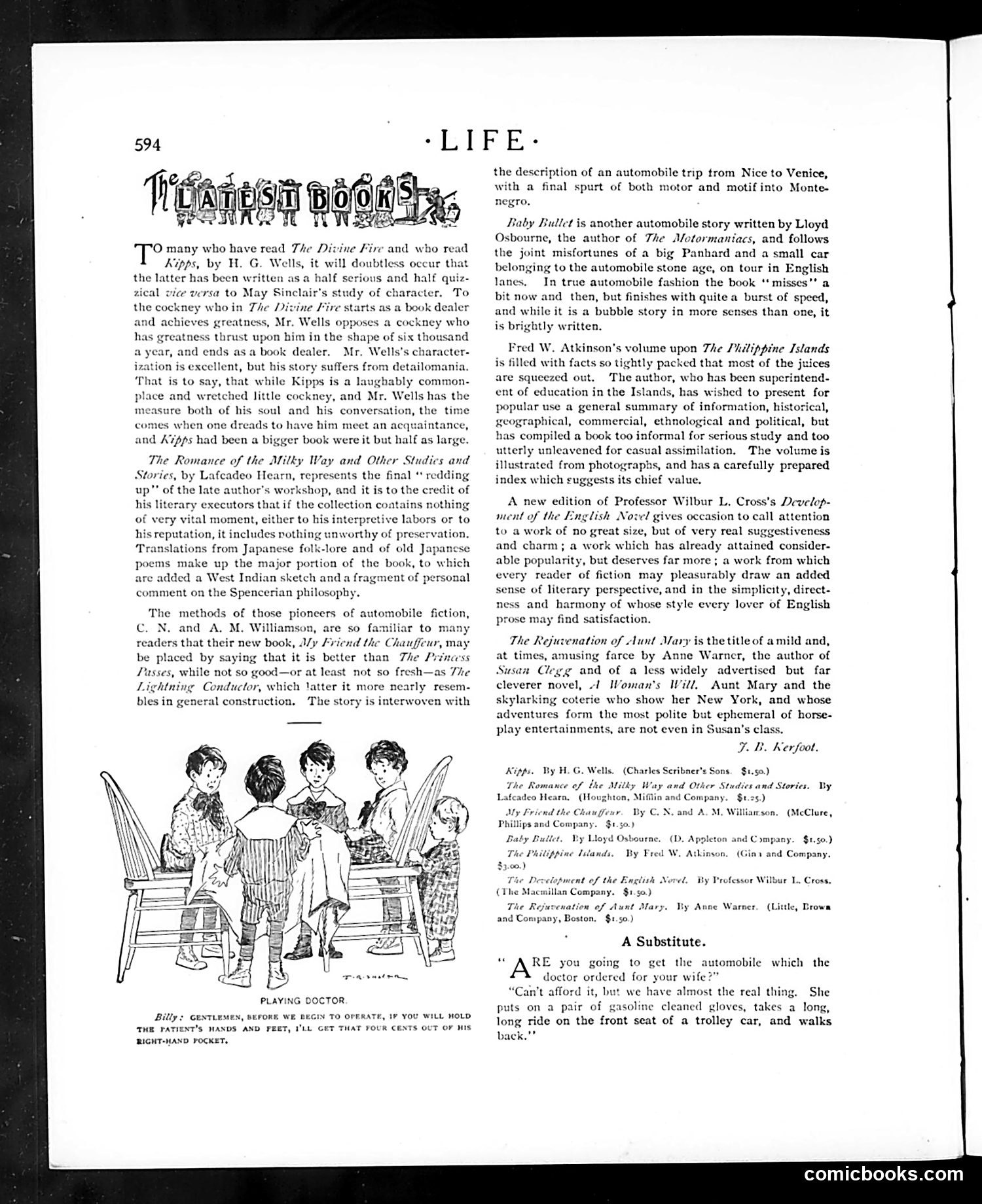
This cartoon satirizes the emerging phenomenon of **automobile tourism and the commercialization of leisure travel** in the early 1900s. The sketch depicts children playing "doctor," but with a modern twist: instead of traditional medical roleplay, one child (the "doctor") is extracting money from another child's pocket—a direct jab at the **high costs of automobile ownership and touring**. The caption's joke about getting "four cents out of his right-hand pocket" mocks how automobiles drain owners' finances through constant expenses. The surrounding page reviews automobile-themed novels (including books titled *The Divine Fire*, *Baby Bullet*, and *My Friend the Chauffeur*), indicating that **automobile culture had become a major literary and social obsession** by this period. The satire suggests that automobiling—promoted as leisurely adventure—was actually a money-hungry enterprise that exploited wealthy enthusiasts. The children's game reflects how deeply this commercial anxiety had penetrated American culture.
📄 Transcribed text from this page (OCR, searchable)
Machine-transcribed from the original scan — historical spelling and the odd misread are preserved.
-LIFE- 'O many who have read The Divine Fire and who read Aipps, by H. G. Wells, it will doubtless occur th: the latter has been written as a half serious and half qui zical vice versa to May Sinel the cockney who in The Diz and achieves greatness, Mr. Wells opposes a y has greatness thrust upon him in the shape of six thousand a year, and ends asa book dealer. Mr. Wells's character- ization is excellent, but his story suffers from detailomania. ‘That is to say, that while Kipps is a laughably common- place and wretched little cockney, and Mr. Wells has the measure both of his soul and his conversation, the tim comes when one dreads to have him meet an acquaintance, and Apps had been a bigger book were it but half as large. The Romance of the Mitky Way and Other Studies and Stories, by Lafcadeo Hearn, represents the final “ redding up"’ of the late author's workshop, and it is to the his literary executors that if the collection cc of very vital moment, either to his interpretive labors or to his reputation, it includes pothing unworthy of preservation. Translations from Japanese folk-lore and of old Japanese poems make up the major portion of the book, to which are added a West Indian sketch and a fragment of personal comment on the Spencerian philosophy. The methods of those pioneers of automobile fiction, C. N. and A, M. Williamson, are so familiar to many readers that their new book, A/y Friend the Chauffeur, may be placed by saying that it is better than The Princess Passes, while not so good—or at least not so fresh—as The Lightning Conductor, which latter it more ne bles in general construction. The story is interwoven with PLAYING DOCTOR, GENTLEMEN, BEFORE WE BEGIN TO OFRATE, 1F YOU WILL HOLD NT'S HANDS AND FEET, I'LL GET THAT YOUR CENTS OUT OF WIS MAND POCKET, the description of an automobile trip trom Nice to Venice, with a final spurt of both motor and motif into Monte. negro, Raby Bullet is another automobile story written by Lloyd Osbourne, the author of The A/otormaniacs, and follows the joint misfortunes of a big Panhard and a small car belonging to the automobile stone age, on tour in English lanes. In true automobile fashion the book ‘* misses"? a bit now and then, but finishes with quite a burst of speed, and while it a bubble story in more 's than one, it is brightly written. Fred W. Atkinson's volume upon The /hilippine Islands is filled with facts so tightly packed that most of the juices are squeezed out, The author, who has been superintend- ent of education in the Islands, has wished to present for popular use a general summary of information, historical, geographical, commercial, ethnological and political, but has compiled a book too informal for serious study and too utterly unleavened for casual assimilation. ‘he volume is illustrated from photographs, and has a carefully prepared index which suggests its chief value. A new edition of Professor Wilbur L. Cross’s Develop- ment of the English Novel gives occasion to call attention to a work of no great but of very real suggestiveness and charm; a work which has already attained consider- able popularity, but deserves far more ; a work from which every reader of fiction may pleasurably draw an added sense of literary perspective, and in the simplicity, direct- ness and harmony of whose style every lover of English prose may find satisfaction. The Rejuvenation of Aunt Mary is the title of a mild and, at times, amusing farce by Anne Warner, the author of Susan Clegg and of a less widely advertised but far cleverer novel, 1 Woman's Will, Aunt Mary and the skylarking coterie who show her New York, and whose adventures form the most polite but ephemeral of horse- play entertainments, are not even in Susan's class. J.B. Kerfoot. Kipps. By HG. Wells. (Charles Scribner's Sons. $1.50.) and Other Studies and Stories. By ) By C. N, and A.M, Williarson, (McClure, Phillips $t.50.) Baby Bullet, By Lloyd Osbourn 1 Company $1.50.) “Philippine Islands. By F (Giay and Company. By Professor Wil Development of the English Novel. 1. Cross. y lan Company. $1.50.) venation of Aunt Mary. ay, Boston, $1.50.) A Substitute. ae RE you going to get the automobile which the doctor ordered for your wife “Can't afford it, but we have almost the real thing. She puts on a pair of ned gloves, takes a long, long ride on the front seat of a trolley car, and walks back.’* Ny Anne Warner. (Little, Brows gasoline cl comicbooks.com