
A complete issue · 24 pages · 1905
Life — September 14, 1905
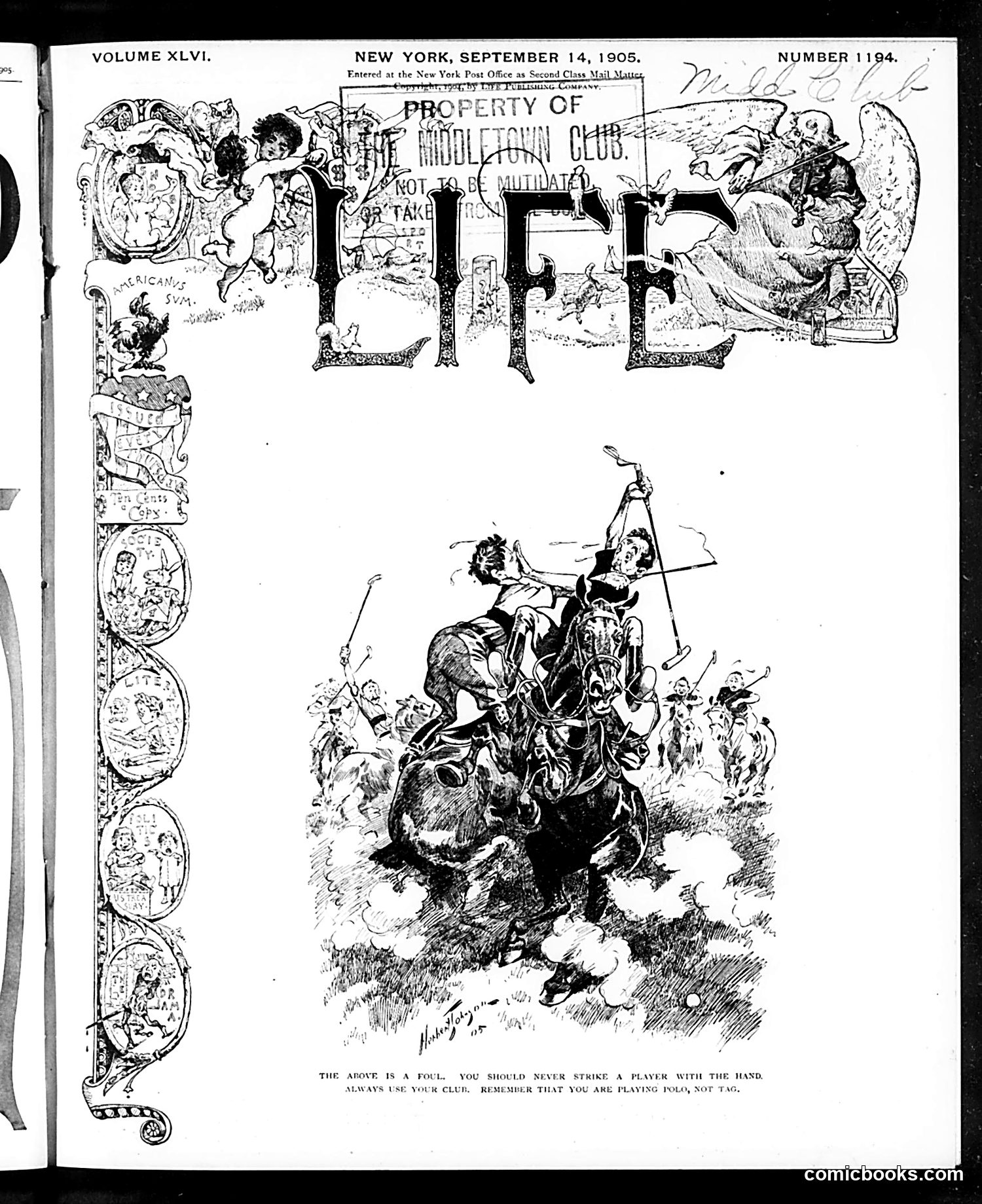
This page satirizes dangerous play in polo, the wealthy sport popular among American elites. The main illustration depicts a chaotic polo match where players on horseback wield mallets aggressively near spectators. The caption warns: "THE ABOVE IS A FOUL. YOU SHOULD NEVER STRIKE A PLAYER WITH THE HAND. ALWAYS USE YOUR CLUB. REMEMBER THAT YOU ARE PLAYING POLO, NOT TAG." The humor is darkly ironic—the instruction to use a club (polo mallet) instead of hands sarcastically suggests polo players were prone to abandoning equipment in favor of brawling. This mocks both the sport's physical brutality and the assumption that wealthy gentlemen players behaved like "tag" players rather than disciplined athletes. The elaborate decorative border and masthead identify this as *Life* magazine's satirical social commentary.
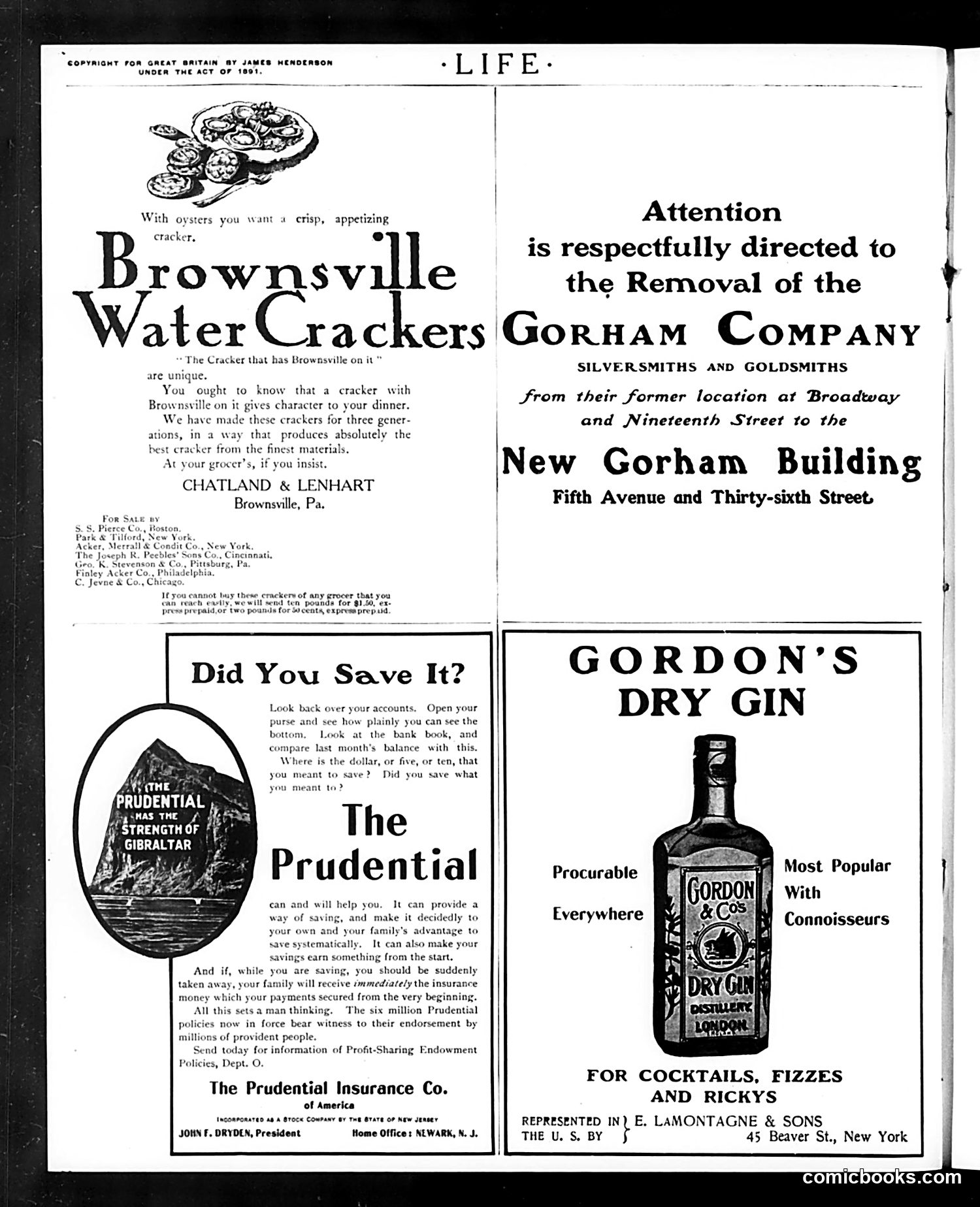
This page contains **no political cartoons or satire**—it's primarily **advertisements** from an early 20th-century issue of *Life* magazine. The ads include: - **Brownsville Water Crackers** (food product) - **Gorham Company** (silversmiths/goldsmiths) announcing a location move - **The Prudential Insurance Co.** ("The Strength of Gibraltar") promoting savings and insurance benefits - **Gordon's Dry Gin** advertising it as popular for cocktails The only potentially humorous element is the Prudential ad's rhetorical "Did You Save It?" which plays on common financial anxiety—encouraging readers to examine their savings habits. Otherwise, this is straightforward period advertising with no satirical content or caricatures to decode.
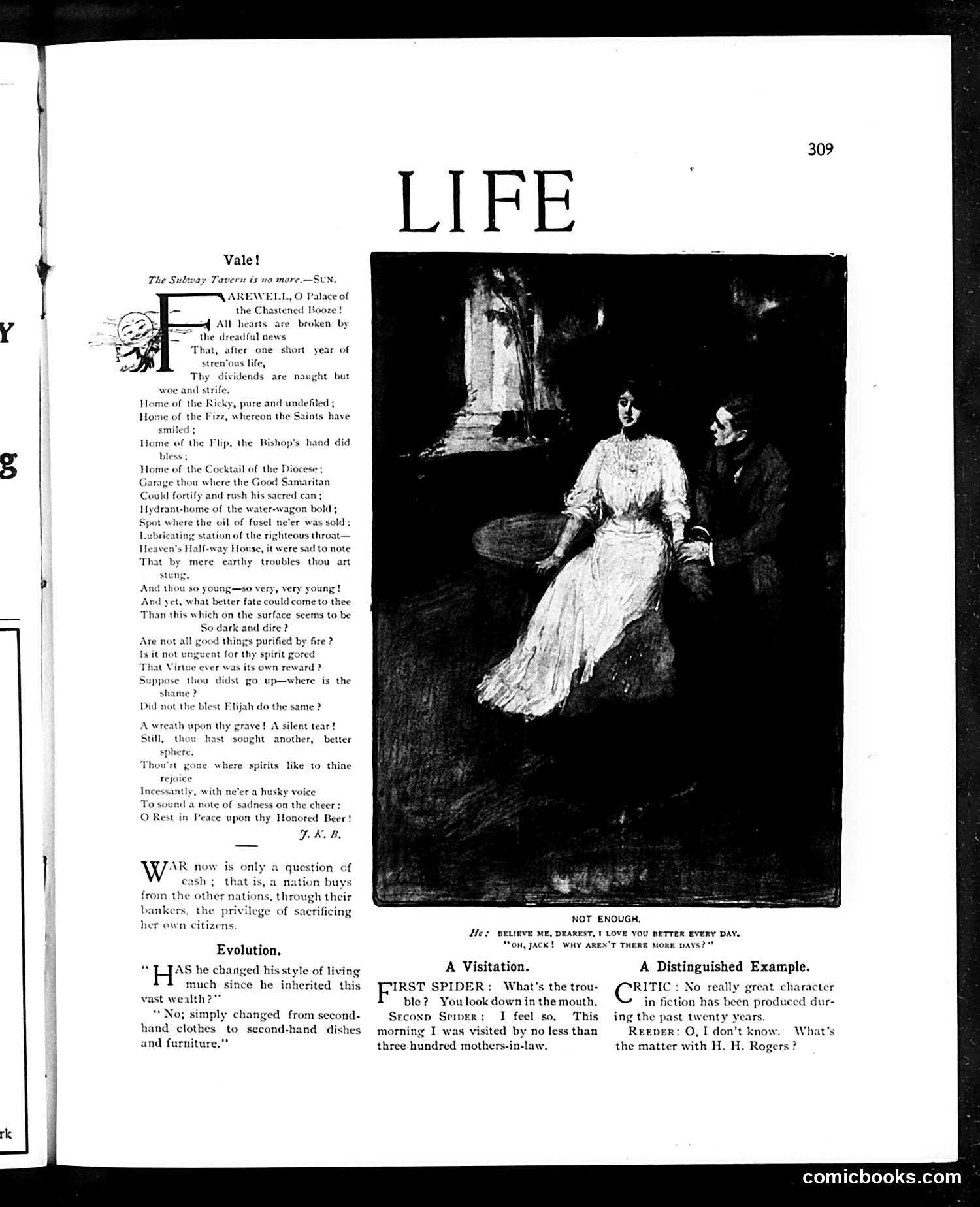
This page from *Life* magazine contains several distinct satirical pieces: **"Vale1" (top left)**: A poem mourning the "Subway Tavern" establishment, apparently closed after one year. The satire targets various social institutions—the church, charitable organizations, and civic infrastructure—suggesting the tavern served important social functions these institutions failed to provide. **"Not Enough" (center image)**: A domestic scene depicting a woman complaining to her husband about insufficient affection, with the caption implying marital dissatisfaction. **"Evolution," "A Visitation," and "A Distinguished Example" (bottom)**: Three brief comic exchanges about changing social customs, mothers-in-law visits, and literary criticism regarding H.H. Rogers (likely the Standard Oil magnate). The page's overarching theme appears to satirize contemporary American social institutions and domestic life.
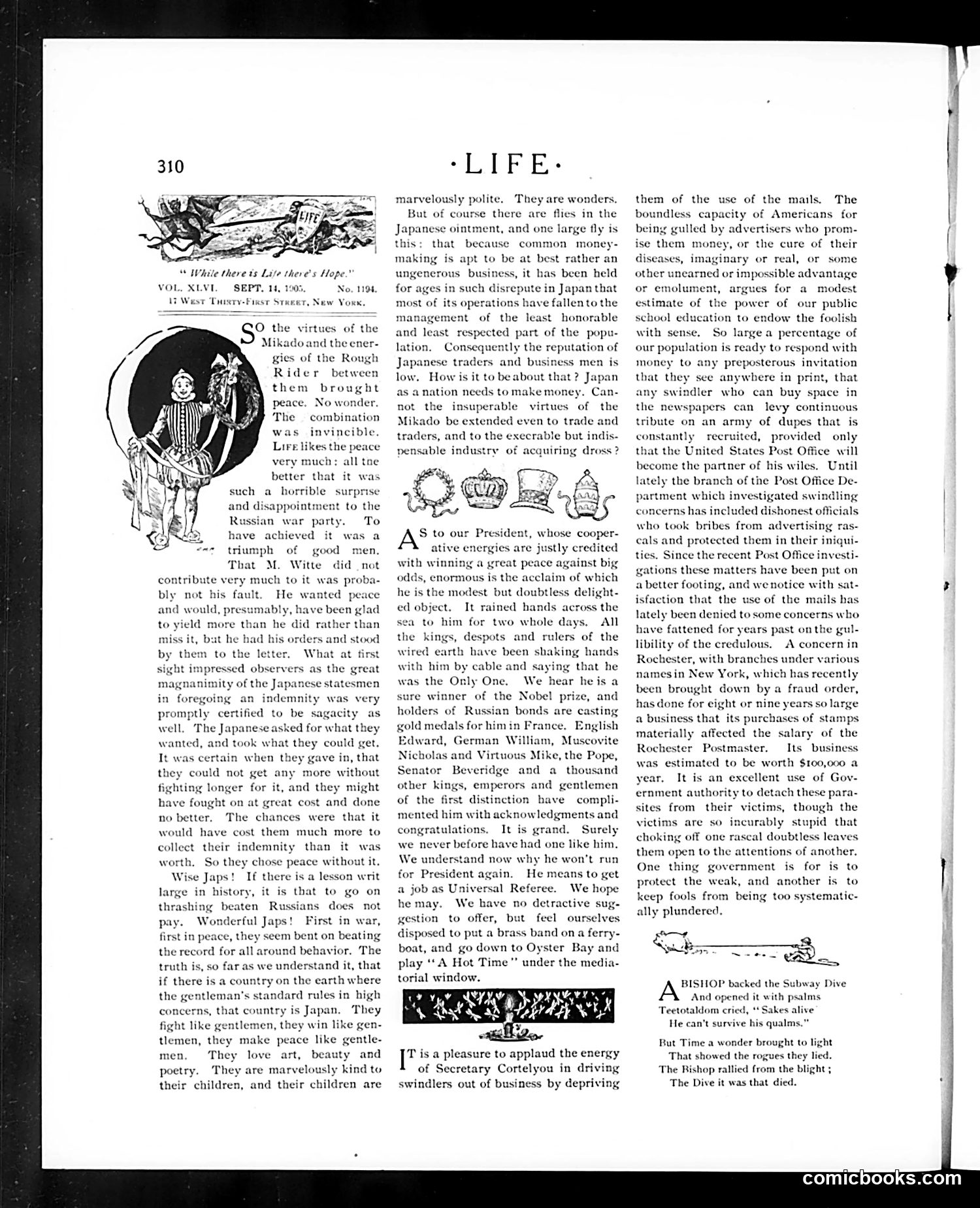
This page satirizes American attitudes toward Japan and Japanese business practices. The main illustrated figure (left) appears to be a Japanese trader or businessman, depicted in exaggerated stereotypical style typical of early 1900s American satire. The text discusses Japan's reputation for dishonorable business practices and trade, criticizing Japanese merchants while also praising Japan's role in the Russo-Japanese peace negotiations. There's ironic commentary on American hypocrisy: the article notes Americans readily accept bribes through advertising in newspapers, yet judge Japanese traders as unethical. The satirical point critiques American self-righteousness about Japanese commercial morality while ignoring comparable corruption at home—particularly regarding postal service scandals and newspaper advertising fraud.
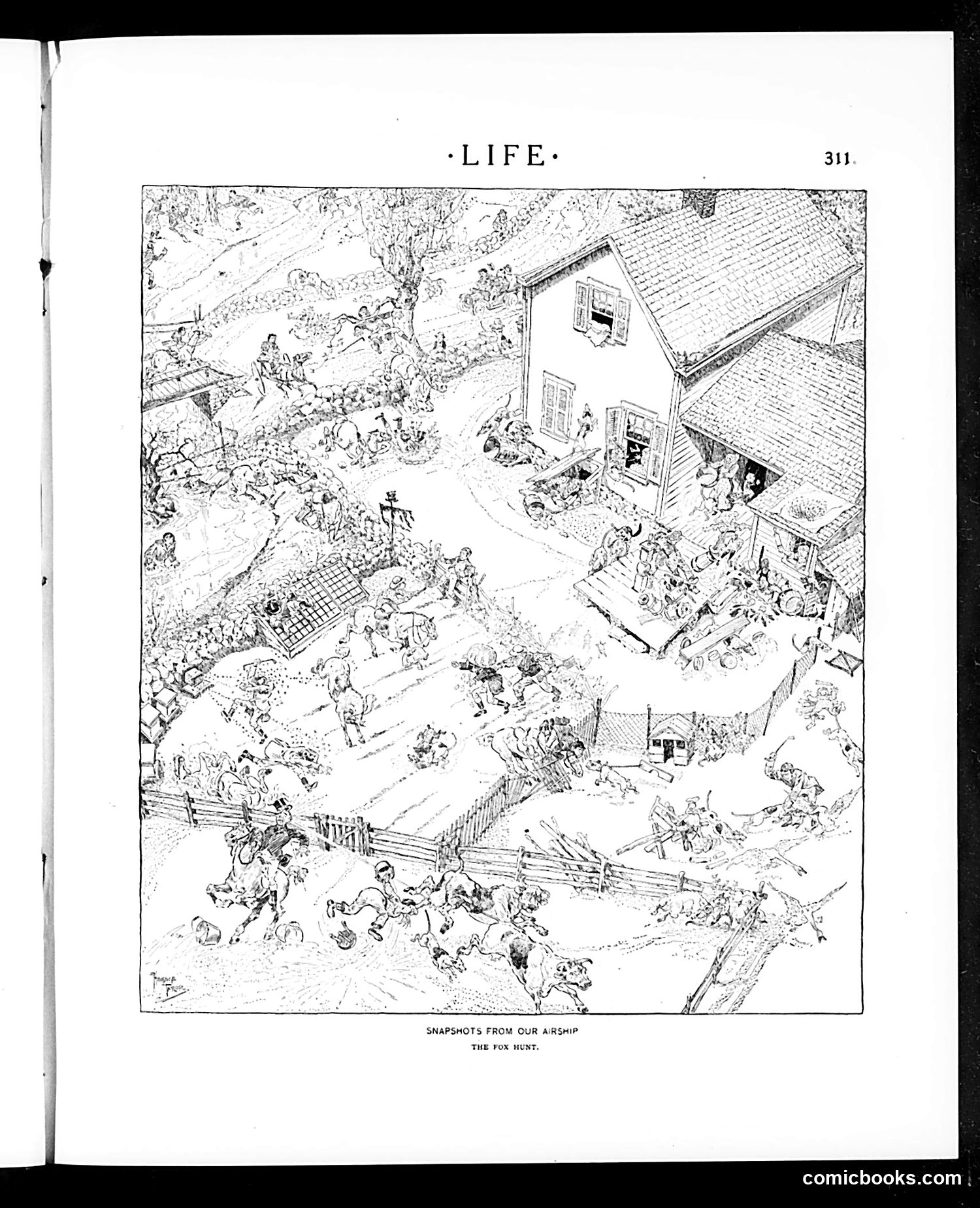
This is a satirical illustration titled "Snapshots from Our Airship: The Fox Hunt," depicting an aerial view of a traditional English fox hunt. The cartoon shows numerous hunters on horseback, hounds, and countryside estates arranged across a pastoral landscape. The satire likely mocks the pretensions and chaos of fox hunting—a stereotypically aristocratic British pastime. By presenting it from an "airship" perspective (a modern technological vantage point), the artist creates ironic distance from the hunt's supposed elegance. The crowded, messy composition emphasizes the disorder beneath this genteel sport's dignified facade. The "airship" framing device was contemporary to Life's era, suggesting this dates to early-to-mid twentieth century. The humor derives from juxtaposing modern technology with antiquated upper-class traditions.
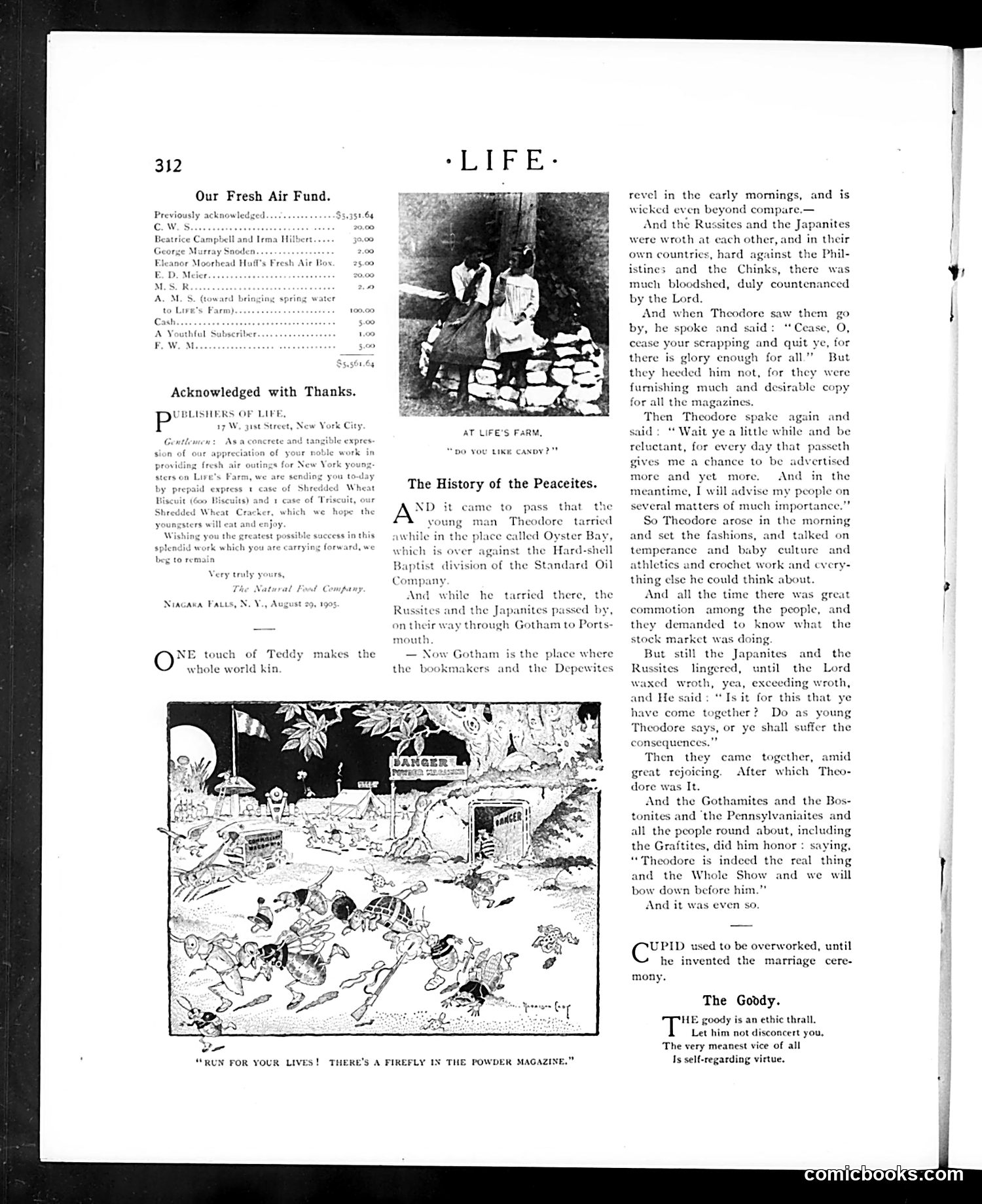
**"Our Fresh Air Fund"** section lists charitable donations, followed by acknowledgments thanking Life's readers for supporting fresh air programs for children. **The main cartoon**, captioned "RUN FOR YOUR LIVES! THERE'S A FIREFLY IN THE POWDER MAGAZINE," depicts chaos and panic. This is a humorous exaggeration — a firefly (a harmless insect) near gunpowder sparks extreme, disproportionate terror. The satire likely mocks overreaction to minor threats or sensational fear-mongering, possibly referencing contemporary anxieties being blown out of proportion. **"The History of the Peaceites"** is a fictional narrative about Theodore [Roosevelt] encountering religious sects (Russites, Japanites) in conflict. It satirizes rival groups claiming moral superiority while actually pursuing self-interest — a commentary on hypocrisy in religious or political movements.
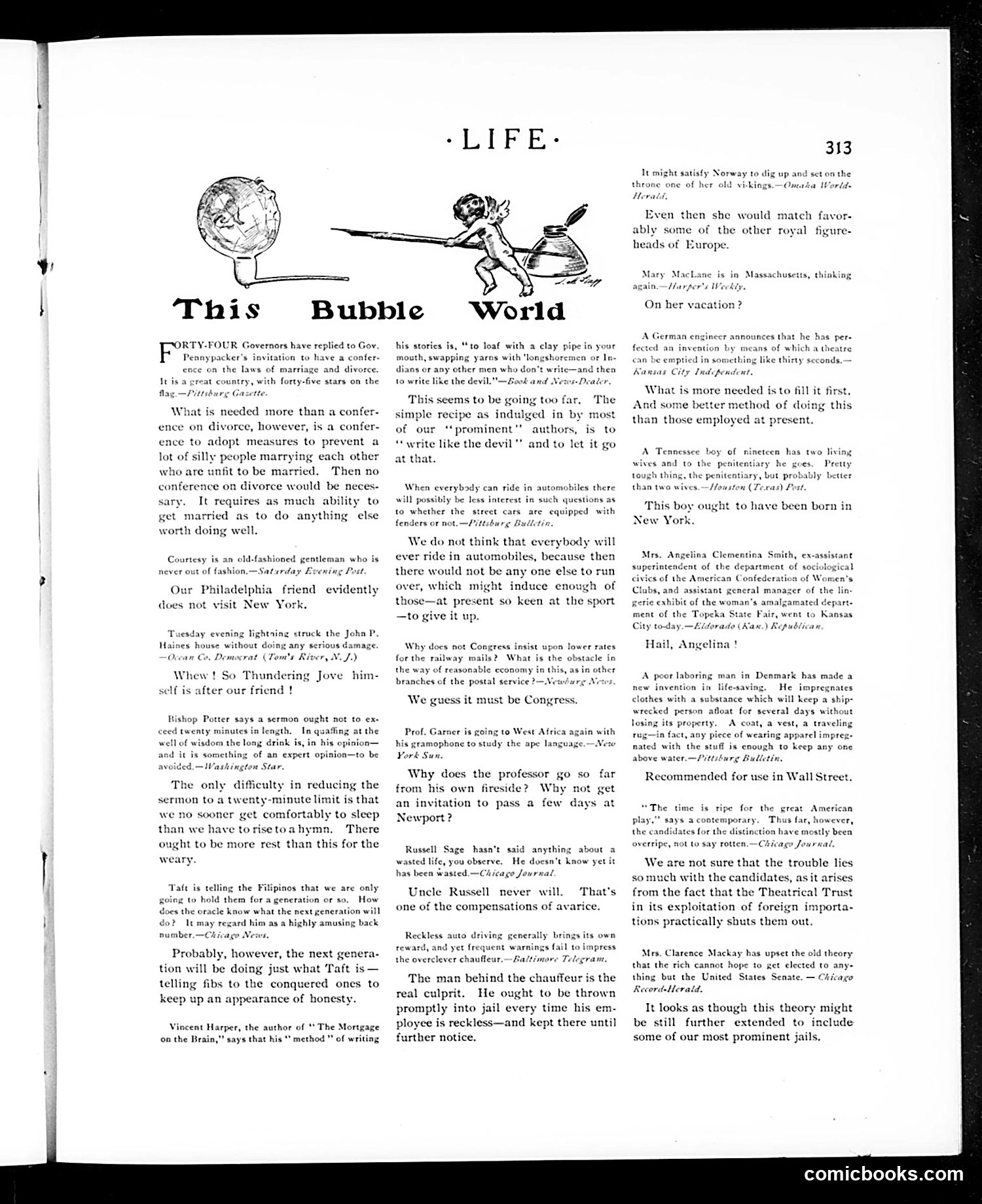
The cartoon depicts a cherub or cupid figure holding a large soap bubble labeled with a globe. This illustrates the article's central metaphor: modern society is fragile and illusory—a "bubble world." The accompanying satirical essay critiques contemporary social problems. It discusses forty-four governors proposing conferences on divorce and marriage laws, mocking the notion that legislative conferences can solve deeper social issues. The author argues that enabling everyone to "ride in automobiles" creates false satisfaction and distraction from real problems. The satire suggests that modern conveniences and governmental posturing create an illusion of progress and stability, when society remains fundamentally unstable—much like a soap bubble, beautiful but destined to burst. The piece targets both political ineffectiveness and consumer culture's superficial solutions to genuine social problems.
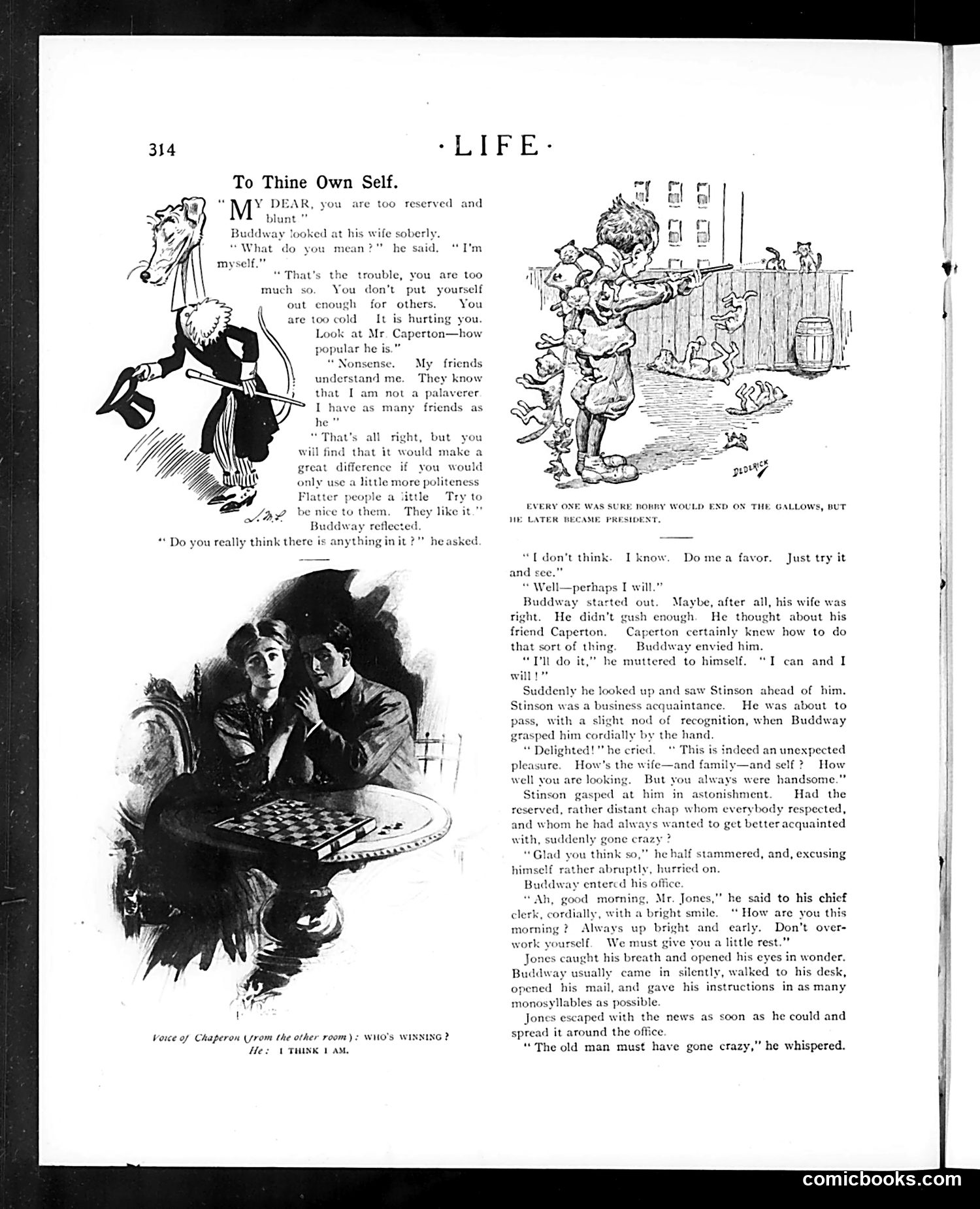
This page satirizes excessive social reserve and emotional restraint. The story shows "Buddway" (a fictional character) being advised by his wife that he's "too reserved" and should be warmer to others, citing the popular Mr. Caperton as an example of friendliness. The cartoons illustrate the contrast: one shows Buddway's stiff, uncomfortable demeanor; another depicts two figures playing chess, captioned "Voice of Caperton (from the other room): WHO'S WINNING? HE: I THINK I AM." The satire mocks how some men maintain rigid emotional distance even in casual social situations, suggesting that genuine warmth—even performative politeness—would serve them better socially. It's a gentle critique of emotional guardedness as a character flaw.
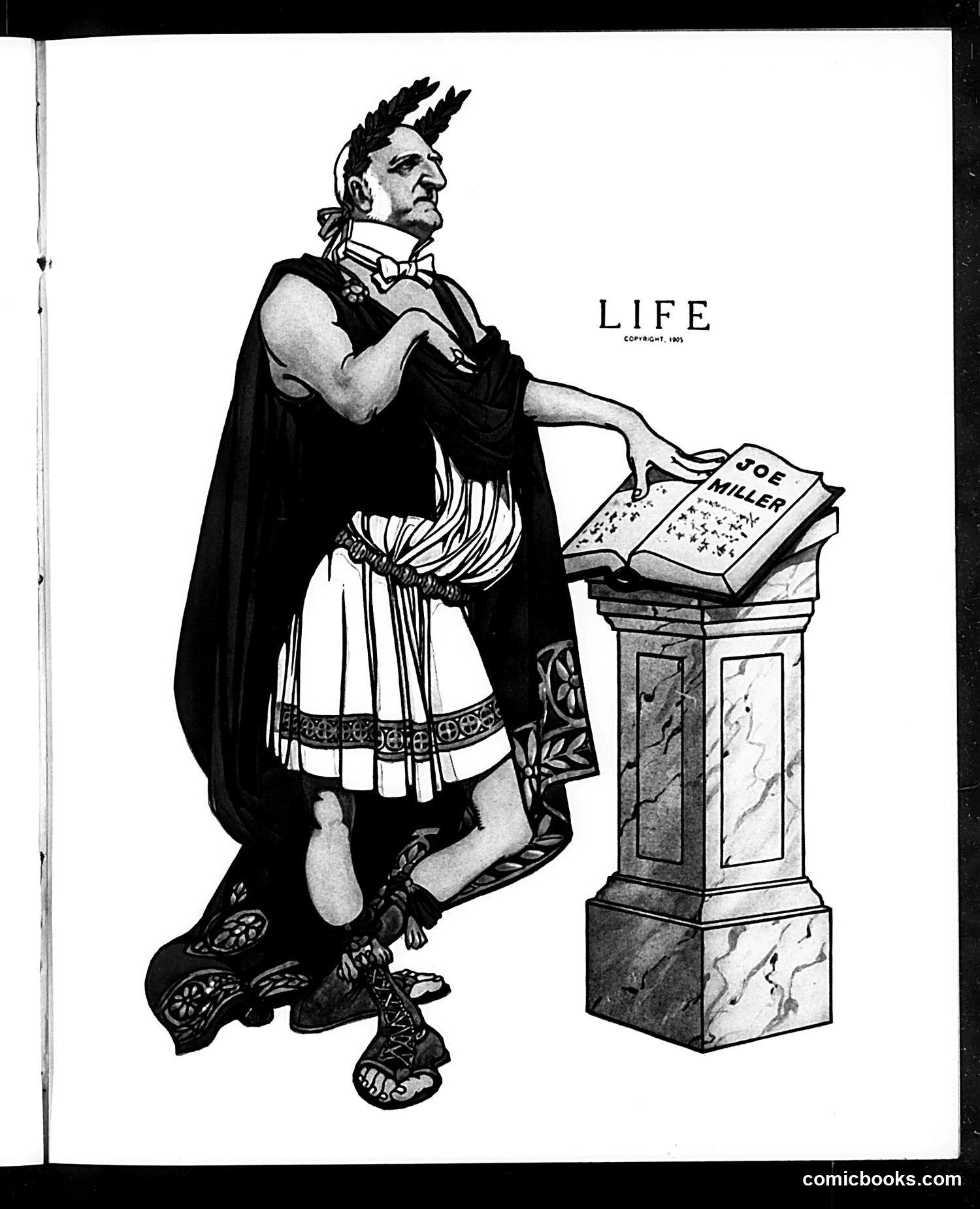
This Life magazine cover (copyright 1903) depicts a Native American figure in classical warrior dress consulting a stack of books labeled "JOE MILLER." The figure's serious expression and the pedestal presentation suggest satirical commentary on Native American intellectual engagement with American literature or education. "Joe Miller" likely refers to a popular joke collection of the era—suggesting the cartoon mocks either Native Americans' relationship to American culture or, conversely, critiques American attitudes toward Native peoples. The classical warrior styling contrasts with the modern literary reference, emphasizing the tension between traditional identity and assimilation into American society. Without additional context, the exact satirical target remains somewhat unclear, but the juxtaposition critiques racial attitudes prevalent in early 1900s America.

I can see this is a blank or nearly blank page from what appears to be a Life magazine issue. The page shows primarily white space with black borders/binding on the left and right edges, and a footer crediting "comicbooks.com" at the bottom right. Without visible cartoon imagery, text content, or other editorial material on this particular page, I cannot identify any figures, political references, or satirical points. This appears to be either a blank page, a page divider, or the OCR process failed to capture legible content from the original publication. To provide meaningful analysis of the cartoon(s) or content, a page with visible imagery or readable text would be needed.
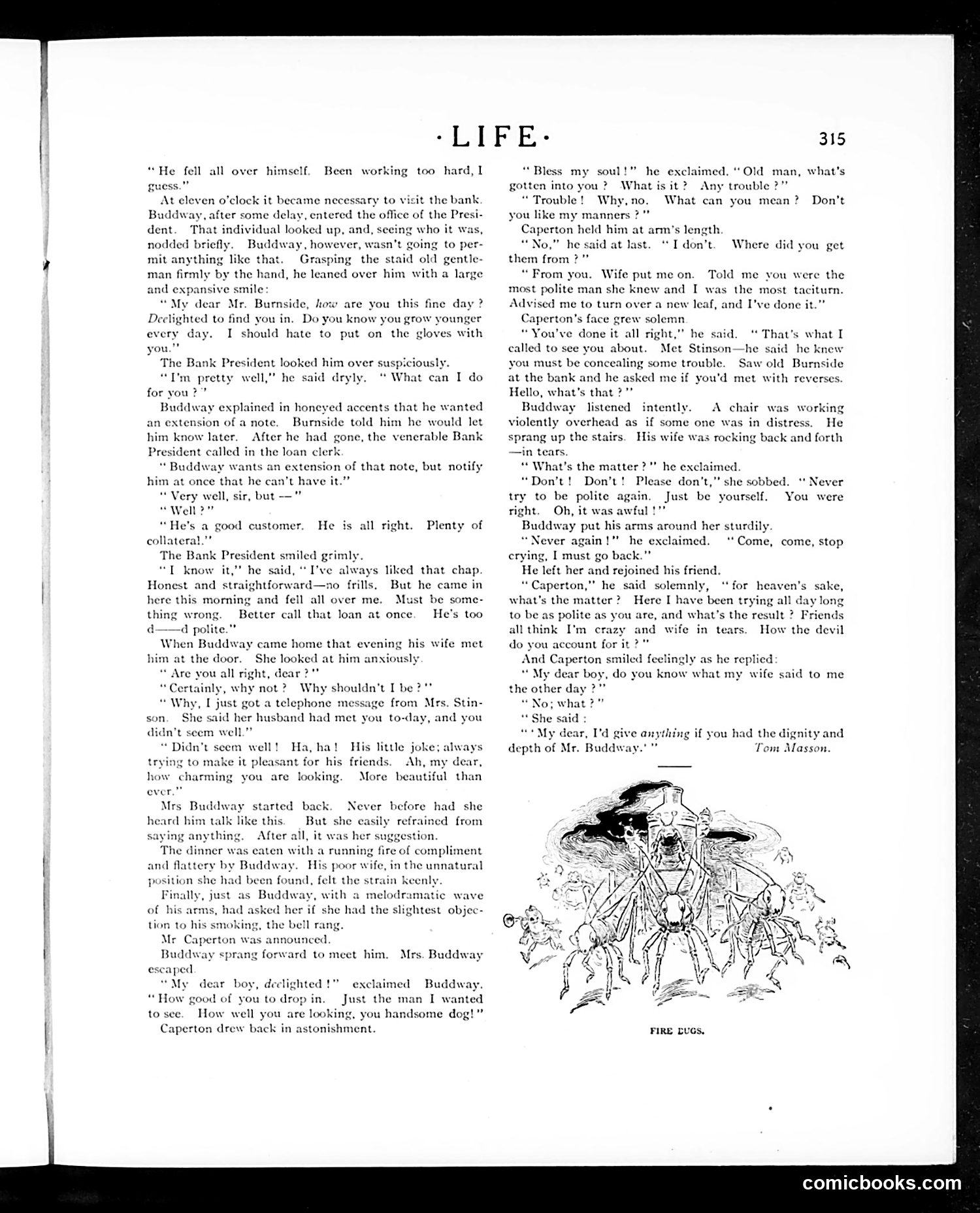
This page from *Life* magazine contains a narrative story about a character named Buddway and his social mishaps. At the bottom is an illustration labeled "FIRE BUGS" depicting grotesque insect-like creatures. Without clear historical context visible on the page, the cartoon's specific satirical target is unclear. However, "fire bugs" typically refers to arsonists or destructive individuals. The grotesque illustration style suggests social criticism of some group or type of person the magazine's readers would recognize. The accompanying story about Buddway's embarrassments and social pretensions suggests the page may be satirizing middle-class social anxiety and attempts at respectability—common themes in early 20th-century American humor. More context about the magazine's date would help identify specific contemporary references.
This page appears to be a title page or section divider from *Life* magazine, showing only the word "LIFE" printed vertically on the left margin. The image itself—rotated 90 degrees—is quite dark and unclear in reproduction, making it difficult to discern specific details, figures, or caricatures with confidence. Without legible text or a clear image, I cannot reliably identify what cartoon or content this represents, what political or social commentary it contains, or what contemporary references it might satirize. The poor image quality and minimal visible text prevent accurate analysis of the satire's intended meaning or targets. To properly explain this page's significance to a modern reader, I would need either a clearer reproduction or additional contextual information about the *Life* issue date.
This page contains a black and white photograph showing what appears to be a figure in period costume or formal dress. The caption reads: **"'HO! LOST TO SHIFT, TO MEMORY DEAR!'"** The image quality and orientation make specific identification difficult, but the theatrical or formal nature of the costume suggests this may be illustrating a literary or historical reference—possibly a Shakespearean quote or similar classical allusion, given the archaic phrasing of the caption. Without clearer visibility of details or additional context from surrounding pages, I cannot confidently identify the specific figure, event, or satirical point being made. The page appears to be documenting a theatrical performance or historical reenactment rather than presenting political commentary in the traditional cartoon sense.
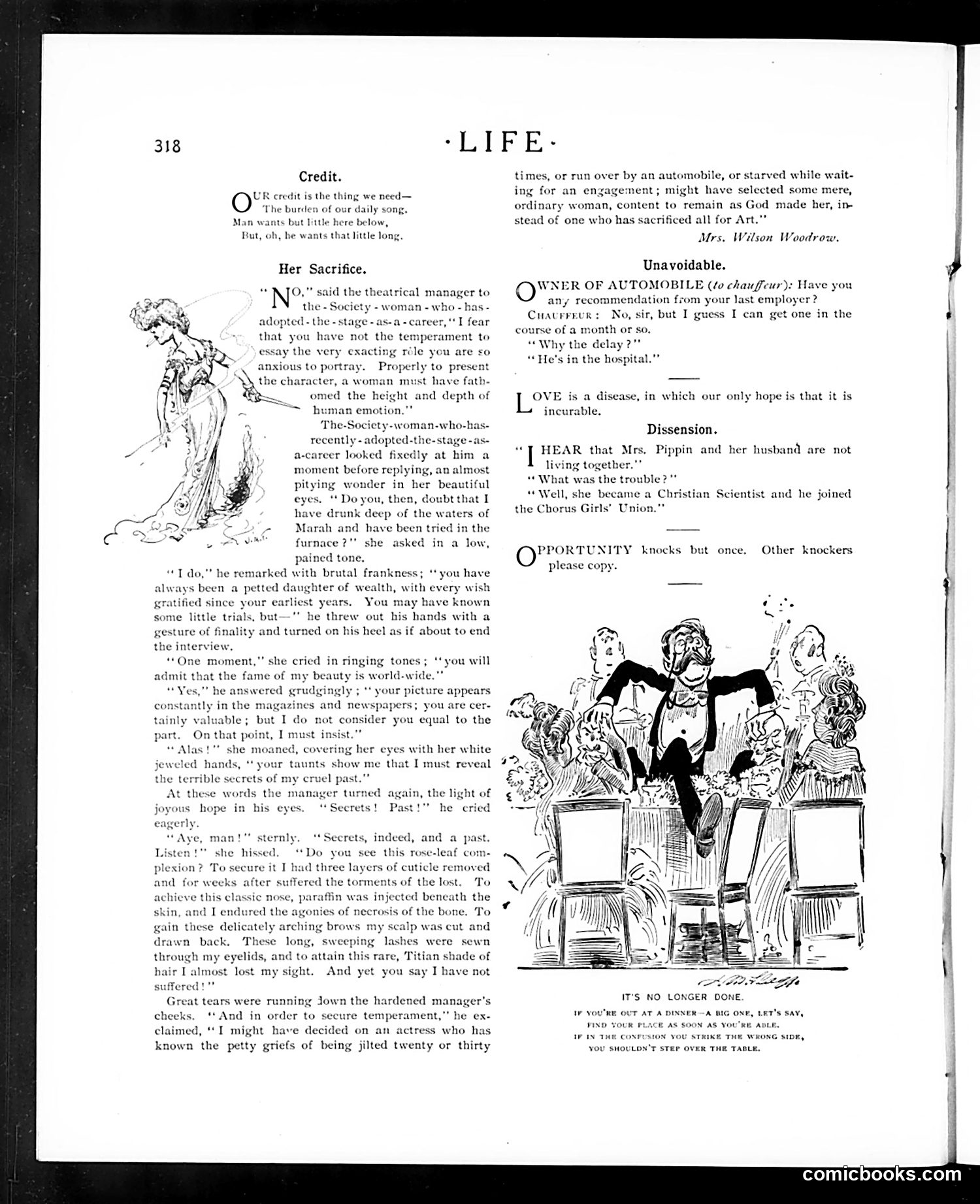
This page contains several satirical pieces mocking early 20th-century social pretensions: **"Her Sacrifice"** (main story with illustration): A theatrical manager rejects a wealthy society woman seeking an acting role, doubting her emotional depth. She responds by dramatically cataloging extreme cosmetic procedures—cuticle removal, paraffin injections, artificial eyelashes sewn through eyelids, scalp surgery for eyebrows—claiming she's suffered for her beauty. The satire targets both the artificiality of wealthy women's beauty standards and their self-pitying claims of "sacrifice" compared to ordinary women's genuine hardships. **"Unavoidable"** (brief joke): An automobile chauffeur explains his predecessor is hospitalized, suggesting careless or reckless driving by the employer. **"Dissension"**: Humor about marital conflict—a wife becoming a Christian Scientist while her husband joins the Chorus Girls' Union (implying infidelity). **"Opportunity Knocks"** (illustration): A cartoon showing proper dinner etiquette rules about not stepping over the table. The page satirizes vanity, class pretension, and modern social anxieties among the wealthy.
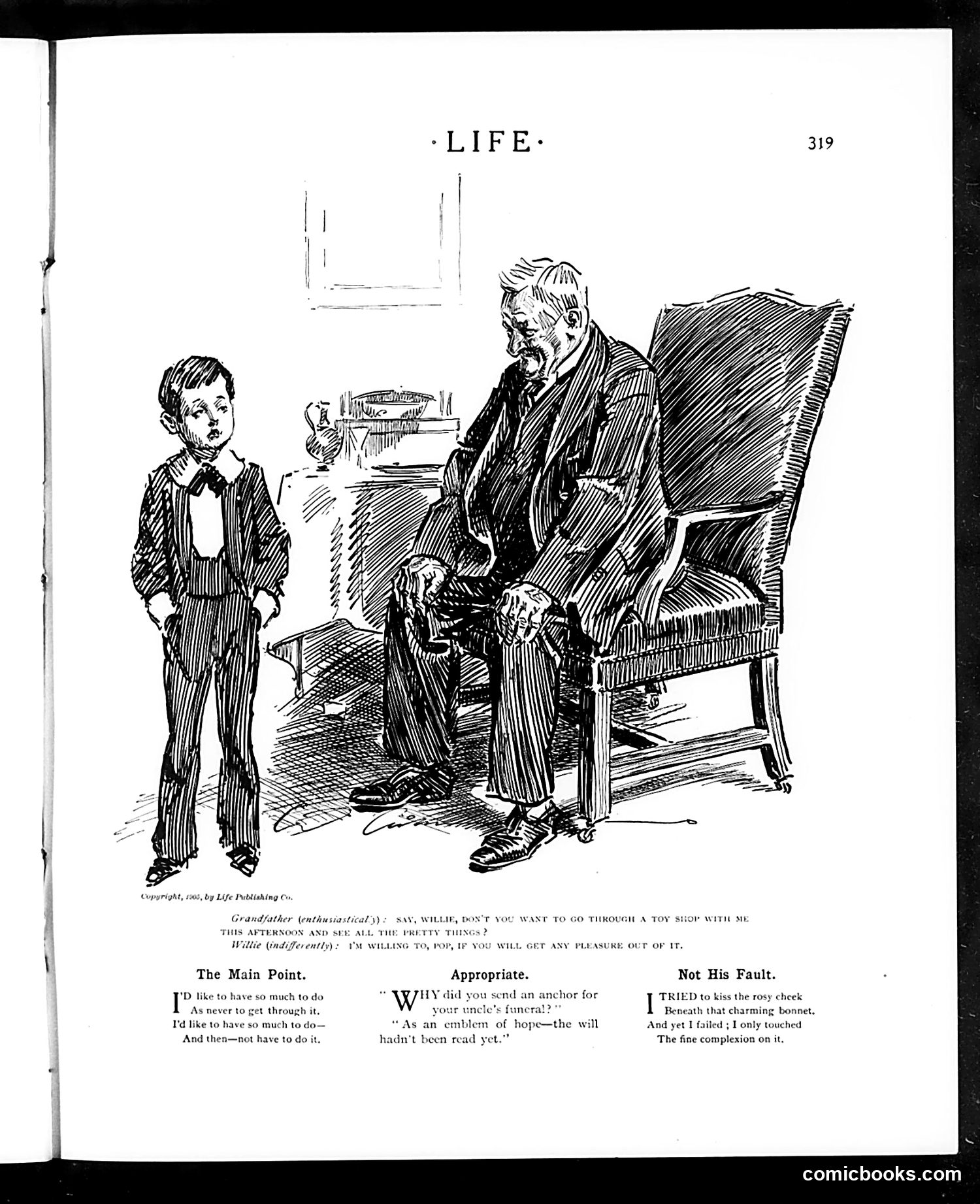
This page presents three brief humorous vignettes about social etiquette and relationships: **The Main Point**: A man complains about having too much to do and wanting to avoid obligations. **Appropriate**: A dialogue about sending an anchor as a funeral gift, with the punchline that it serves as "an emblem of hope—the will hadn't been read yet." This satirizes the mercenary behavior of relatives anticipating inheritances. **Not His Fault**: A man attempts to kiss a woman wearing a bonnet, but only touches the fabric instead of her cheek, blaming the garment for the failed romantic gesture. The top illustration shows a well-dressed boy with a man seated in a chair, likely depicting a toy-shop visit mentioned in the dialogue. These pieces mock everyday social awkwardness, financial greed among relatives, and the impracticality of women's fashion accessories.
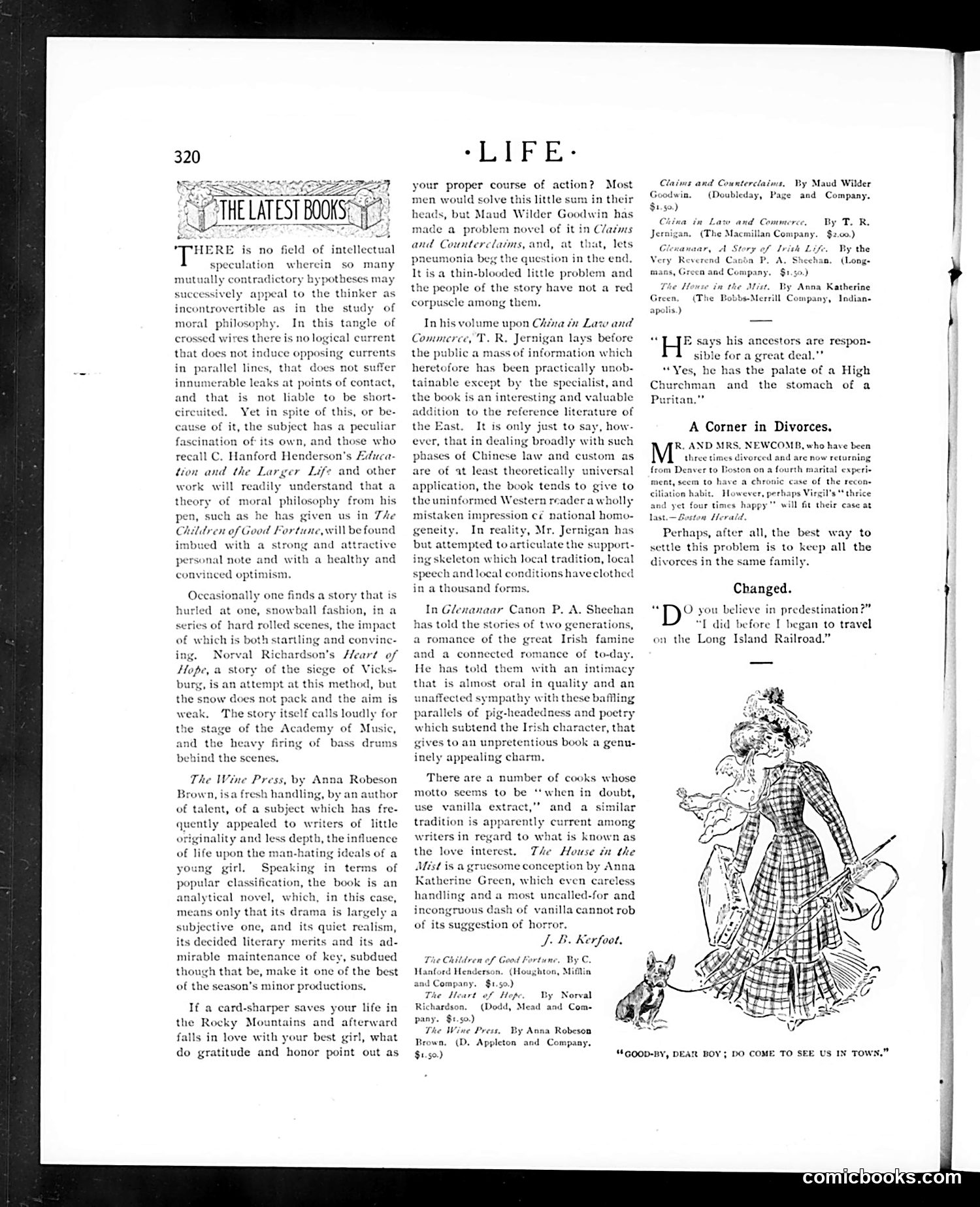
This illustration depicts a fashionable woman in an elegant plaid dress and hat, waving goodbye—likely to a departing gentleman. The caption suggests a social farewell between acquaintances of the upper classes. The satirical point, typical of *Life* magazine's social commentary, appears to mock the insincere courtesy rituals of wealthy society. The woman's elaborate outfit and theatrical pose underscore the performative nature of such polite farewells—the exaggerated friendliness ("Do come to see us") that wealthy hosts extended to departing guests without genuine expectation they would actually visit. This gentle satire critiques the hollow social conventions and affected manners of the Gilded Age upper classes, where such pleasantries were formulaic rather than heartfelt invitations.
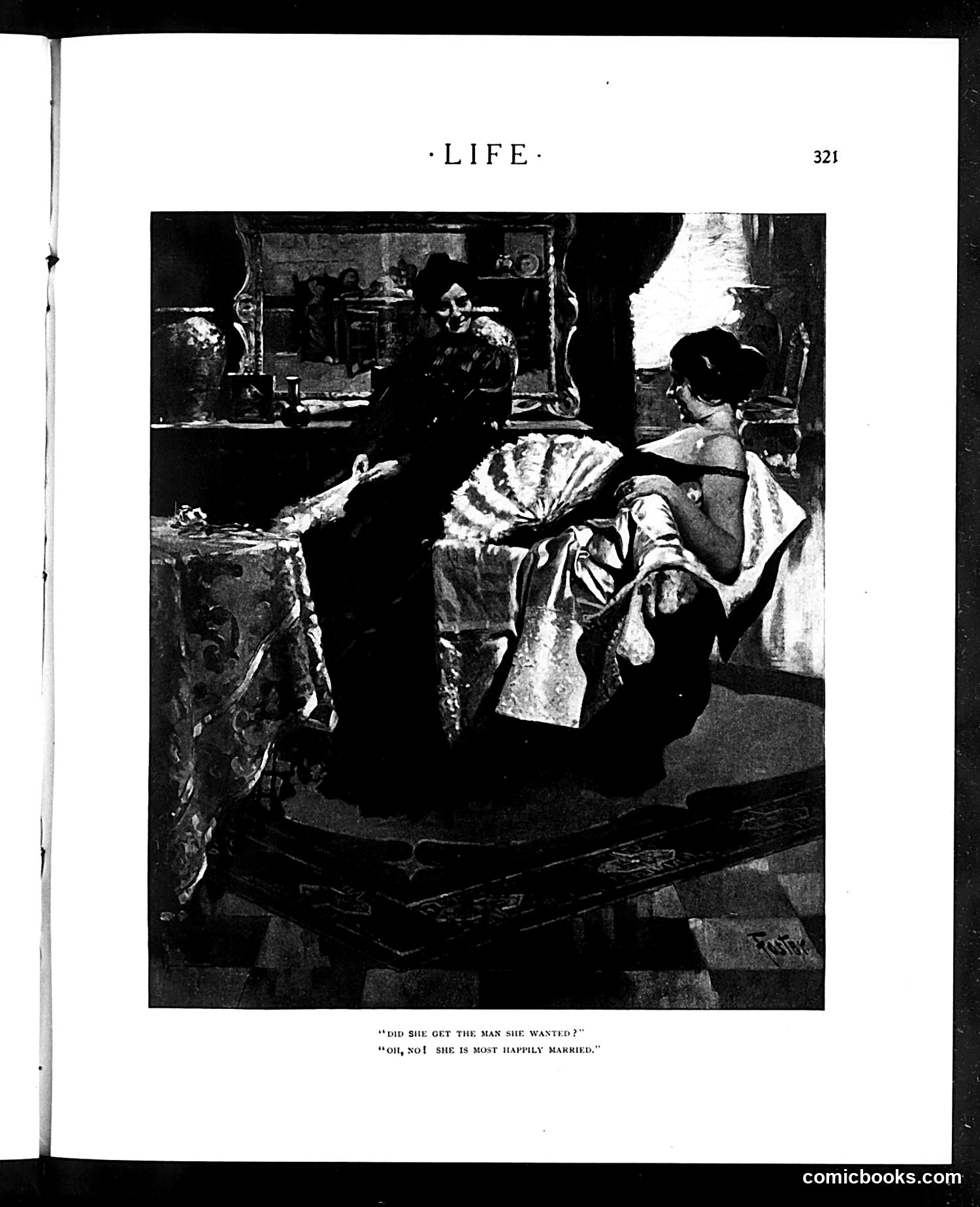
This page from *Life* magazine (page 321) presents a satirical cartoon about marriage and romantic expectations. The image shows what appears to be a domestic scene with figures in period dress, and the dialogue reveals the joke's point: A questioner asks if a woman obtained "the man she wanted." The response—"Oh, no! She is most happily married"—delivers the satire: the implication is that the man a woman *wants* romantically differs from the man she actually *marries*. This reflects early-20th-century satirical commentary on marriage as a practical or compromised institution rather than one based on romantic fulfillment. The cartoon mocks both female romantic idealism and the gap between courtship fantasy and marital reality—common themes in *Life*'s social satire of the period.
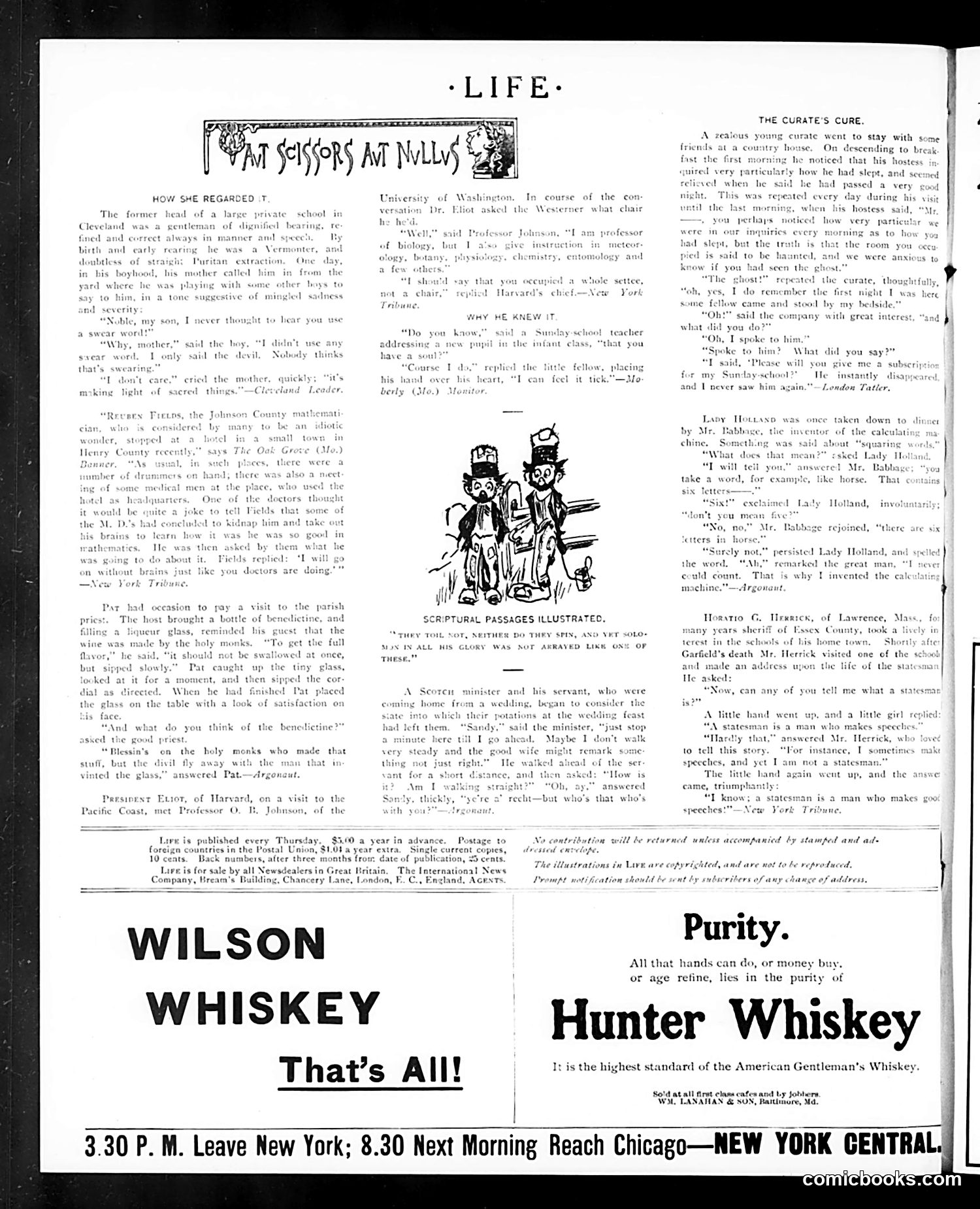
This page from *Life* magazine contains three distinct sections: **"Wit, Scissors and Nulls"** (top): A humorous anecdote about a school principal who regained his composure after being insulted. The joke illustrates how dignified restraint can be more effective than angry response—a common theme in period humor about gentlemanly behavior. **"Scriptural Passages Illustrated"** (center): A series of brief jokes contrasting biblical passages with modern observations. One jokes about a statesman who makes speeches but isn't actually a statesman—likely satirizing verbose politicians of the era who lacked substance. **Advertisements** (bottom): Wilson Whiskey and Hunter Whiskey ads, plus a New York Central railroad timetable. The page exemplifies *Life*'s format: satirical humor targeting pretense, pomposity, and social affectation mixed with commercial advertisements. The jokes rely on readers understanding period class conventions and rhetorical expectations.
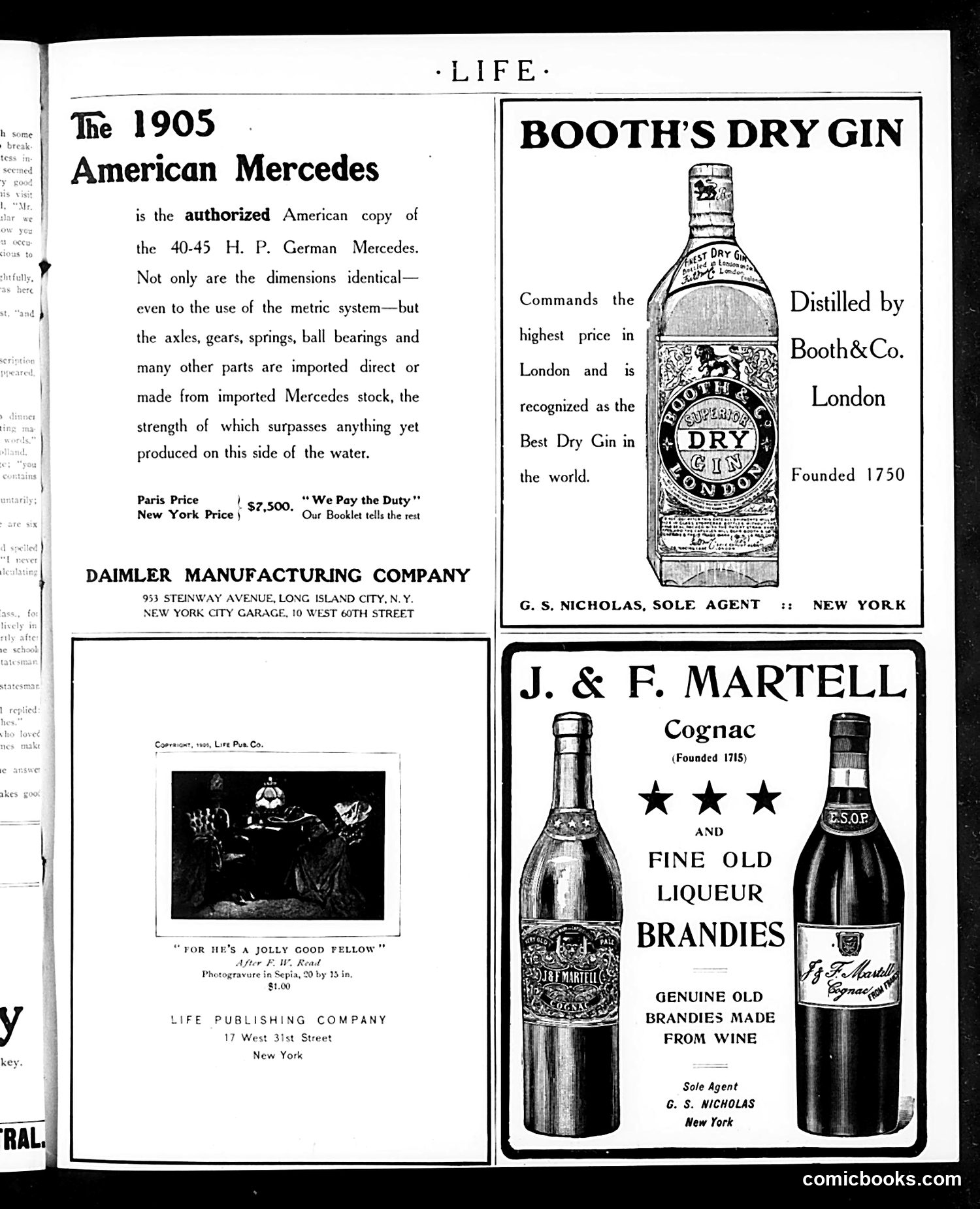
This is primarily an **advertising page**, not satirical content. It features four luxury product advertisements: 1. **1905 American Mercedes**: Promotes an authorized American-made copy of a German Mercedes automobile, emphasizing that components are either imported directly or made from imported German stock—a selling point suggesting superior quality. 2. **Booth's Dry Gin**: Markets a London gin founded in 1750, claiming it commands "the highest price in London" and is "the Best Dry Gin in the world." 3. **J. & F. Martell Cognac**: Advertises French cognac and brandies (founded 1715), distributed through G.S. Nicholas in New York. 4. **Life Publishing Company**: A small ad for a photogravure reproduction. The page reflects **early 20th-century American consumer culture**, where European imports and European-made goods commanded premium prices and prestige. There is no apparent satire—these are straightforward luxury advertisements. The repeated mention of "G.S. Nicholas, Sole Agent" suggests he was a major importer of fine European goods to New York.
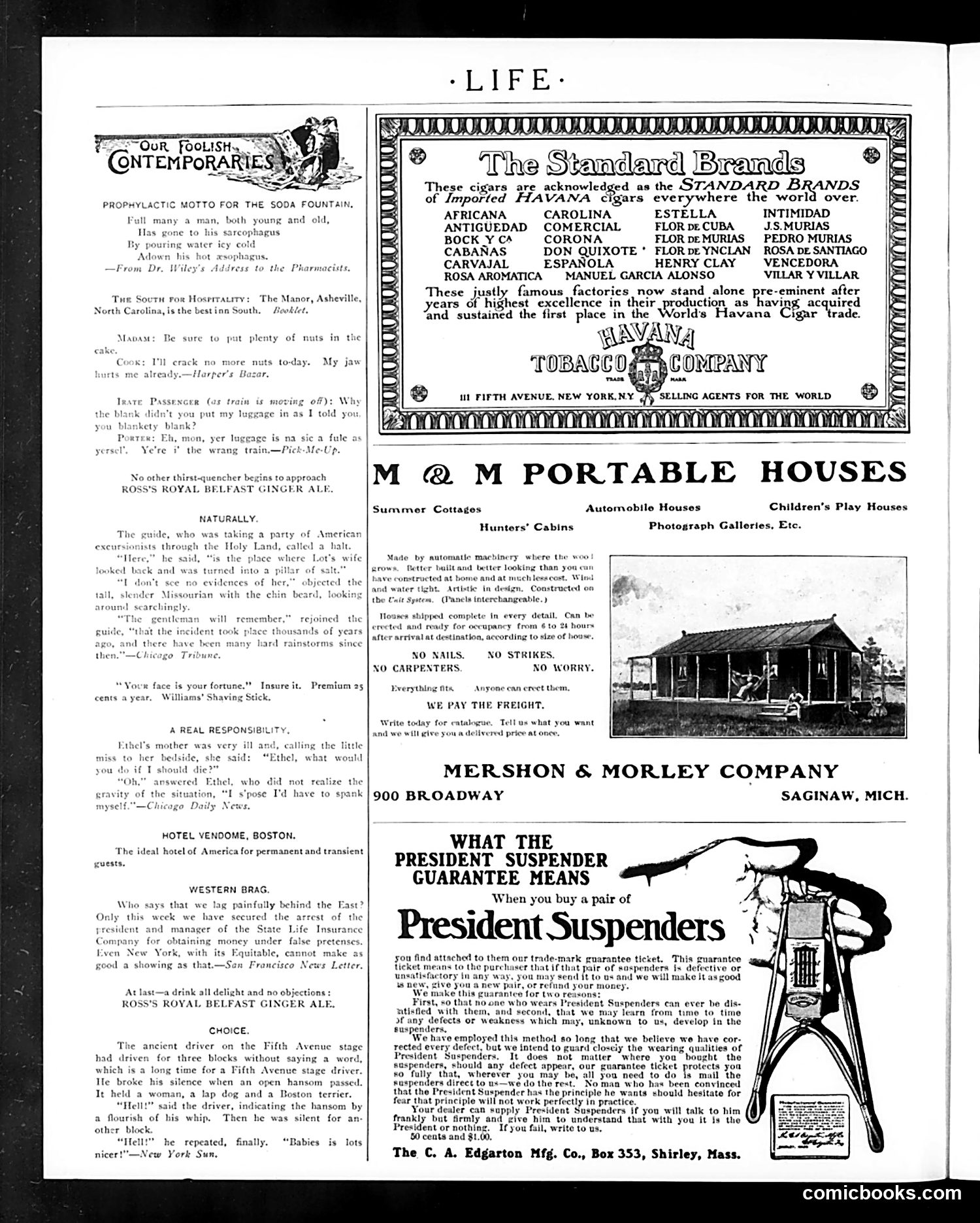
This page is primarily **advertising**, not political satire. The dominant content includes: **Main advertisements:** - **Havana Tobacco Company**: Lists prestigious cigar brand names, emphasizing Cuban imports' market dominance - **M&M Portable Houses**: Pre-fabricated homes shipped complete, marketed as convenient and quick to assemble - **President Suspenders**: Highlights a guarantee system protecting buyers against defective merchandise **Smaller humorous items** ("Our Foolish Contemporaries") include brief satirical observations: - A soda fountain motto about men dying from drinking hot water - Anecdotes mocking pretentiousness and absent-mindedness - References to Dr. Wiley (likely the muckraking food safety advocate) **Context for modern readers**: The portable house advertisement reflects early 20th-century optimism about industrial manufacturing solving housing shortages. The suspender guarantee represents emerging consumer protection concepts. The page captures an era when magazines mixed serious advertising with light social commentary.
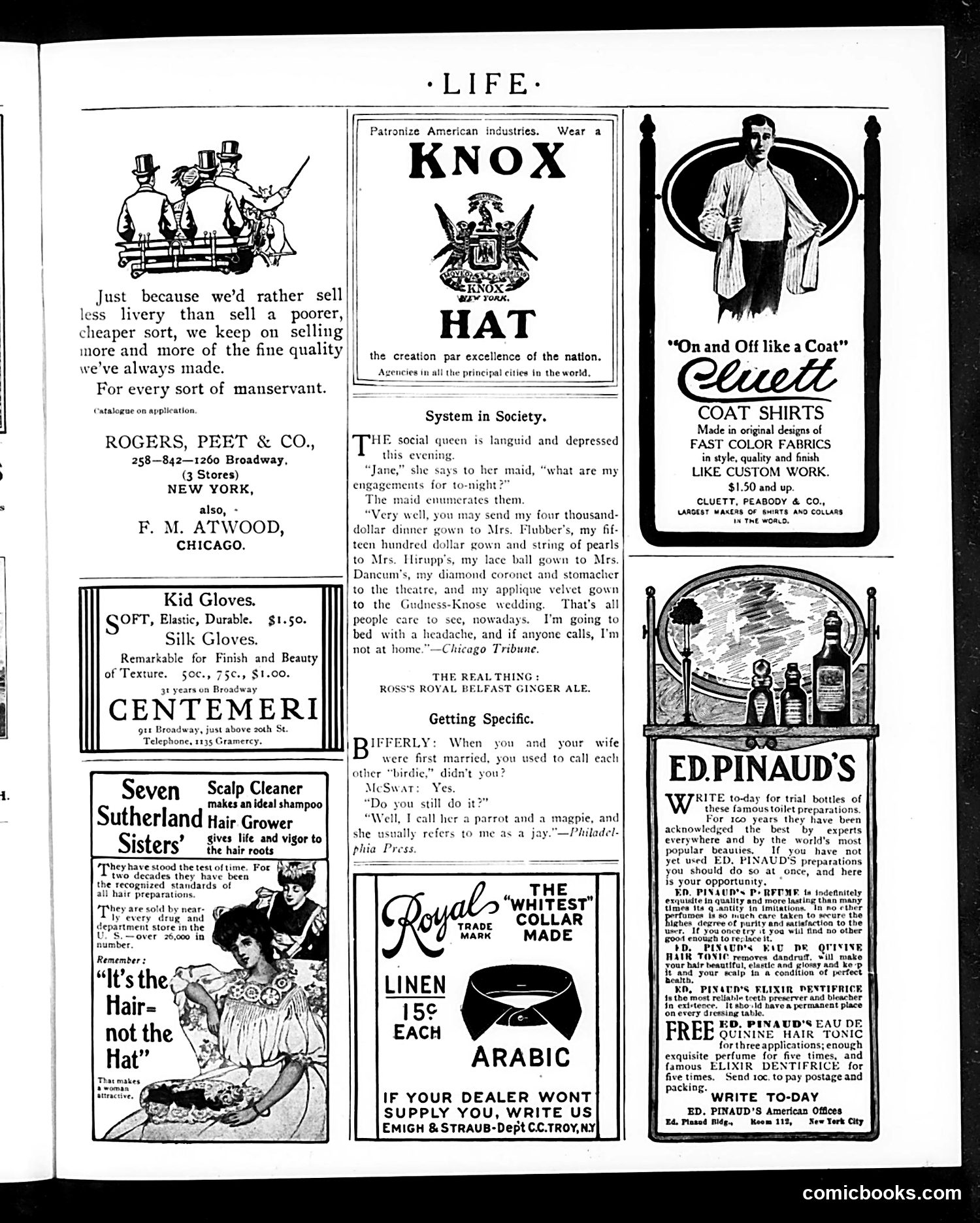
This page is primarily **advertising**, with one short satirical piece embedded among the ads. ## The Satire: "System in Society" The cartoon mocks wealthy socialite culture. A bored "social queen" tells her maid to send her expensive gowns and jewels to various society events—but she herself won't attend. Instead, she'll stay home with a headache. The joke: high society has become so obsessed with *displaying* wealth through possessions that the actual owner's presence is irrelevant. People only care about seeing the expensive items, not the person wearing them. The tagline (from *Chicago Tribune*) underscores the absurdity of this materialistic posturing. ## Supporting Content Below this sits a brief comedic exchange ("Getting Specific") about how married couples' pet names devolve from "birdie" to less flattering animal comparisons—satirizing how romance dies in marriage. The rest of the page consists of period advertisements for clothing (Knox hats, Cluett shirts), gloves, hair products, and toiletries—typical of early 20th-century *Life* magazine content.
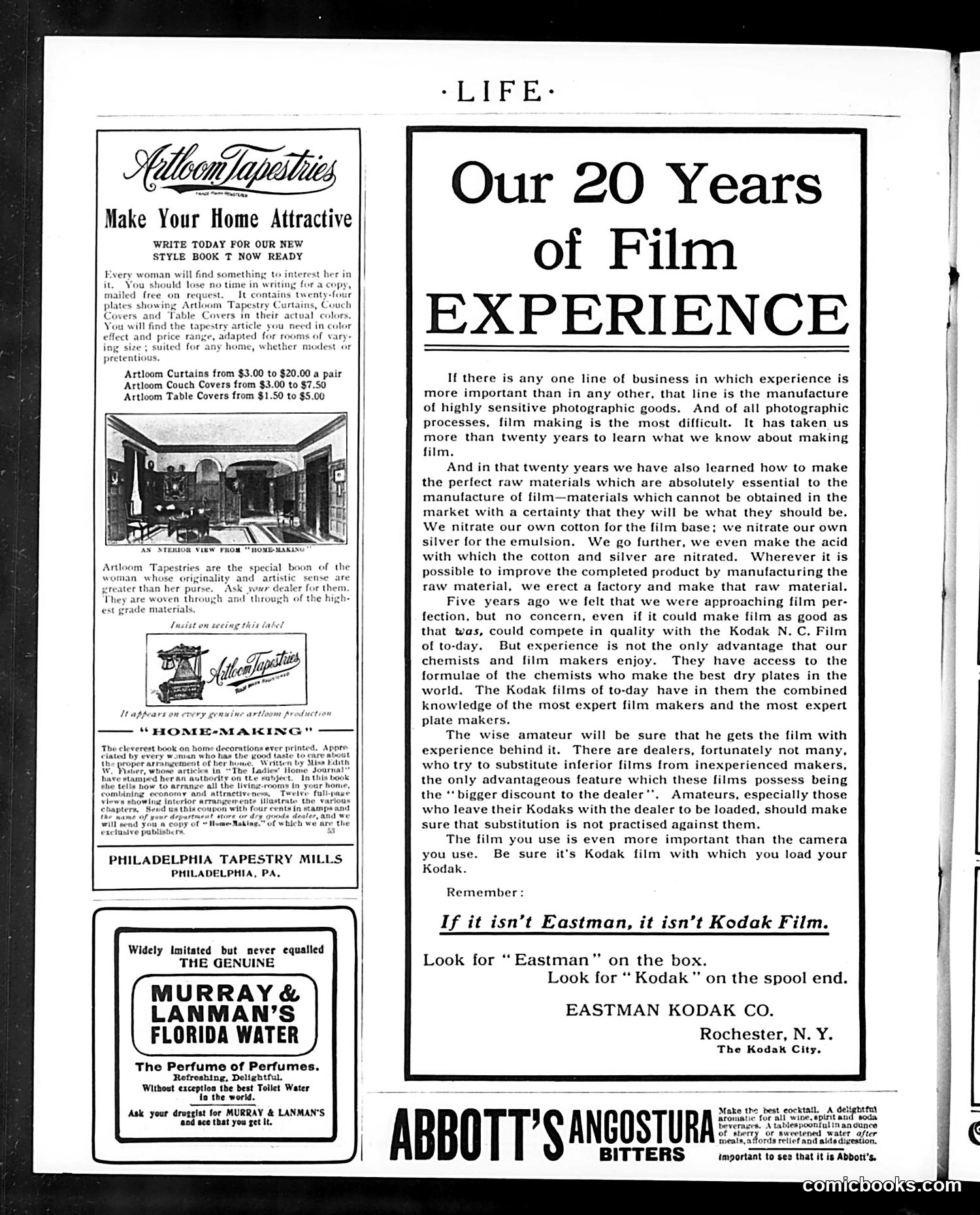
This page contains no cartoons—it's primarily **advertisements** from a 1910s-era *Life* magazine. The main content is a full-page ad from **Eastman Kodak Company** defending their film's superiority through claims of "20 Years of Film Experience." The ad addresses a real market problem: dealers were substituting cheaper, inferior films from competitor manufacturers and offering them as Kodak products, relying on the "bigger discount to the dealer." Kodak's pitch emphasizes vertical integration—they manufactured their own raw materials (cotton, silver, acids) to ensure quality, unlike less experienced competitors. The sidebar advertisements for home furnishings (tapestries, curtains), perfume, and bitters represent typical luxury goods marketing of the era. The language targets affluent homeowners concerned with respectability and quality. **The satire point**: Kodak positions experience and quality against mere price-cutting, essentially warning consumers that bargain films weren't bargains—a theme still relevant in quality-versus-cost debates today.
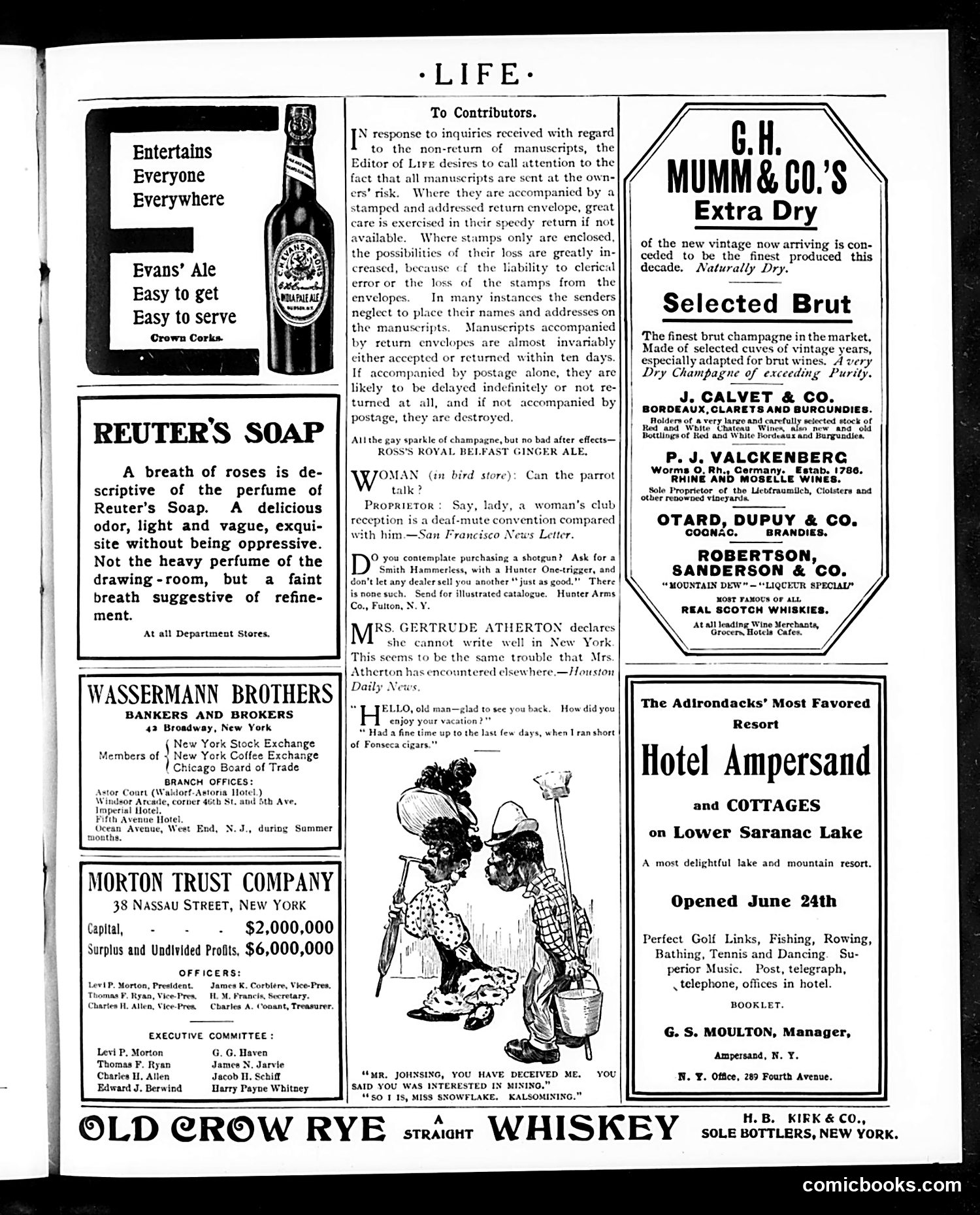
This page is primarily **advertisements and editorial content**, not political cartoons. The main satirical element is a small cartoon dialogue at the bottom center: A man and woman in formal dress exchange flirtation. He boasts about his recent vacation. She deflates him: "Had a fine time up to the last few days, when I ran short of Fonseca cigars"—implying even good times become intolerable without luxury goods. The humor mocks both romantic pretension and consumer materialism. Below this, another brief dialogue shows a man claiming interest in "mining" to a woman; she later discovers he meant "kalsomining" (whitewashing/painting)—a pun on deception and class aspiration. The page is otherwise dominated by **period liquor and banking advertisements**: champagne brands, whiskey, ale, and financial services (Wassermann Brothers, Morton Trust Company). This reflects Prohibition-era America where alcohol advertising remained legal in magazines like LIFE, though it would soon face restriction. The humor is light social satire, not political commentary.
This is a straightforward **product advertisement**, not satire or political commentary. Schlitz beer uses the headline "A Million" to claim massive annual sales and global distribution ("Our agencies dot the whole earth"). The ad's central pitch emphasizes **purity** as the reason for success, arguing consumers increasingly demand it. The closing rhetorical question challenges readers to compare Schlitz favorably against "poor beer," particularly regarding "after-effects"—implying inferior beers cause worse hangovers or health consequences. The decorative border and prominent branding reflect early-1900s advertising design. "The Beer That Made Milwaukee Famous" was Schlitz's actual slogan, reflecting Milwaukee's dominance in American beer production during this era.