
Life, 1905-09-14 · page 16 of 24
Life — September 14, 1905 — page 16: what you’re looking at
What you’re looking at
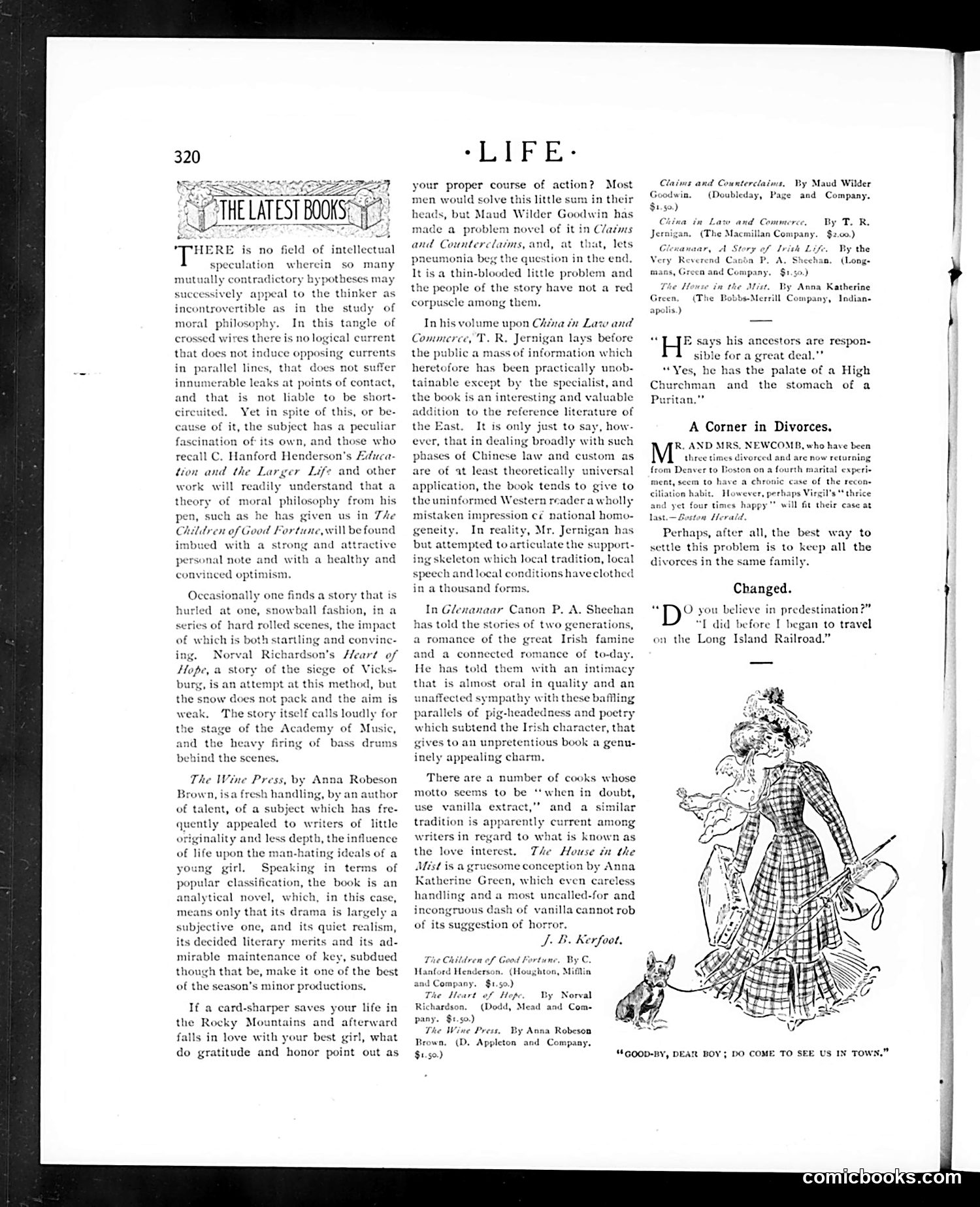
This illustration depicts a fashionable woman in an elegant plaid dress and hat, waving goodbye—likely to a departing gentleman. The caption suggests a social farewell between acquaintances of the upper classes. The satirical point, typical of *Life* magazine's social commentary, appears to mock the insincere courtesy rituals of wealthy society. The woman's elaborate outfit and theatrical pose underscore the performative nature of such polite farewells—the exaggerated friendliness ("Do come to see us") that wealthy hosts extended to departing guests without genuine expectation they would actually visit. This gentle satire critiques the hollow social conventions and affected manners of the Gilded Age upper classes, where such pleasantries were formulaic rather than heartfelt invitations.
📄 Transcribed text from this page (OCR, searchable)
Machine-transcribed from the original scan — historical spelling and the odd misread are preserved.
HERE is no field of intellectual speculation wherein so many radictory hypotheses may e thinker mutually c successively appeal to incontrovertible as in the study of moral philosophy. In this tangle of ical current s no log crossed wires th that does not ind opposing currents in parallel lines, that does not suffer innumerable leaks at points of contact, and that is not liable to be s cireuited. Yet in spite of this, or be- cause of it, the subject has a peculiar fascination of its own, and those who recall C. Hanford Henderson's Educa- tion and the Larger Life and other work will readily underst: theory of moral philosophy from his P as given us in The ort. such as he h; personal note and with a bh con nism, ced op Oceasionally one h one, snowball fashion, in a series of hard rolled scenes, the impact of which is both startling and convine- ing. Norval Richardson's /leart of Hope, a story of the siege of Vicks- is an attempt at this method, but t pack and the aim is nds a story that is led burg the snow does 1 weak. ‘The story itself calls loudly for ne Academy of Music, ring of bass drums the stage of nd the heavy behind the scenes, The Wine Press, by Anna Robeson Brown, isa fresh handling, by an author of talent, of a subject which has fre- quently appealed to writers of little originality and less depth, the influence of life upon the man-hating ideals of a young girl. Speaking in terms of popular classification, the book is an lytical novel, which, in this case, means only that its drama is largely a and its quict realism, subjective one, its decided literary merits and its ad- mirable maintenance of key, subdued though that be, make it one of the best of the season's minor productions, If a card-sharper saves your life in the Roc! Mountains and afterward falls in love with your best girl, what do gratitude and honor point out as *-LIFE- your proper course of action? Most men would solve this little sum in their » but Maud Wilder Goodwin has made a problem novel of it in Claéms and Counterclaims, and, that, lets P a beg the question in the end. t isa thin-blooded little problem and the people of the story have not a red head: eum corpuscle among them, In his volume upon China in Law and Commerce, T. R. Jernigan lays before the public a mass of information which heretofore has been practically unob- tainable except by the specialist, and the book is an interesting and valuable addition to the reference literature of the East. It is only just to say, how- in dealing broadly with such phases of Chinese law and custom as are of at least theoret y universal application, the book tends ve to the uninformed Western reader a wholly mistaken impression ef na homo- geneity. In reality, Mr. Jernigan has but attempted to articulate the support- ing skeleton which local tradition, local speech and local conditions haveclothed in a thousand forms. In Glenanaar Canon P. A. Sheeh: as told the stories of two generations, at Irish famine and a connected rom to-day. He } with an intimacy that is almost oral in quality and an naffected sym y with these baffling d a romance of the gr parallels of pig-headedness and poetry which subtend the Irish character, that gives to an unpretentious book a genu- y appealing charm. inel. Th motto seems to be ‘when in doubt, use vanilla extract,” and a si tradition is apparently current among writers in regard to what is known as the love interest. The House in the Mist is a gruesome conception by Anna Katherine Green, which even ¢ handling and a most uncalled-for and incongruous dash of vanilla cannot rob reless, of its suggestion of ho J.B. Kerfoot. Tie Children of Good Fortune, By C. Mifflin $1.50.) The Heart of Hope. Wy Norval hardson. (Dodd, Mead and Com- $1.50.) Wine Press, By Anna Robeson Brown. (D. Appleton and C $4.50) are a number of cooks whose hilar Claims and Counterclains, Wy Maud Wilder Goodwin. (Doubleday, Page and Company. $4.50.) China in Law and Commerce, By TR (The Macmillan Company. $2.00.) fenanaar, A Story of Ivith Life. Vy the Very Reverend Canda P, A, Sheehan, (Longe seen and Company. $1.50.) Mist, 1 Green, (The Bobbs-Merrill Co apolis.) Katherine pany, Indians says his ancestors are respon- sible for a great deal.”” “Yes, he has the palate of a High Churchman and the stomach of a Puritan.” A Corner in Divorces, M* AND MRS, NEWCOMB, who have been three times divorced and re now returning h marital experi« 's thrice F case at from Denver to nona fo ment, seem to have a chron ciliat on habit, However, perhaps Virgil y" will Ge yet four a ton Herd Perhaps, after all, the best way to settle this problem is to keep all the divorces in the same family. Changed. “D)O you believe in predestination?” “Edi ore I began to travel he Long Island Railroad.” “Goop-ny, DEAR BOY; DO COME TO SEE US IN TOWN