
A complete issue · 24 pages · 1905
Life — August 31, 1905
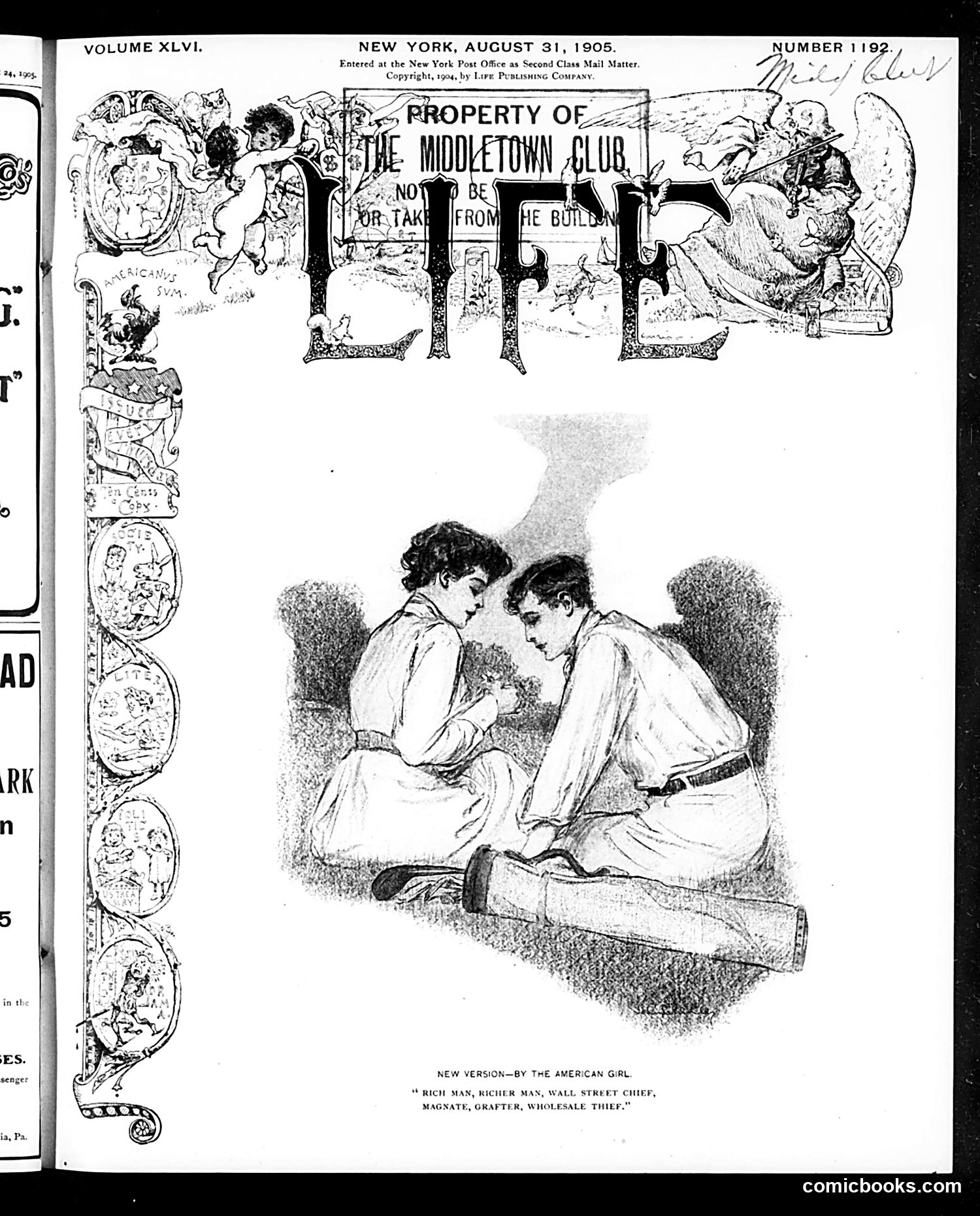
This page features a satirical cartoon titled "New Version—By The American Girl" with the subtitle "Rich Man, Richer Man, Wall Street Chief, Magnate, Grafter, Wholesale Thief." The central illustration shows two young men in casual dress sitting together outdoors, apparently playing a children's game or rhyme. The satire appears to mock American wealth hierarchy and corruption by presenting a modern "American Girl" version of what was likely a traditional nursery rhyme or children's counting game. The title and subtitle suggest the cartoon critiques the interconnected nature of wealth acquisition in early 1900s America—implying that "rich men," Wall Street figures, corporate magnates, and grafters/thieves exist on a continuum rather than as distinct categories. The casual, youthful presentation of these serious social criticisms adds ironic humor to the commentary on systemic corruption.
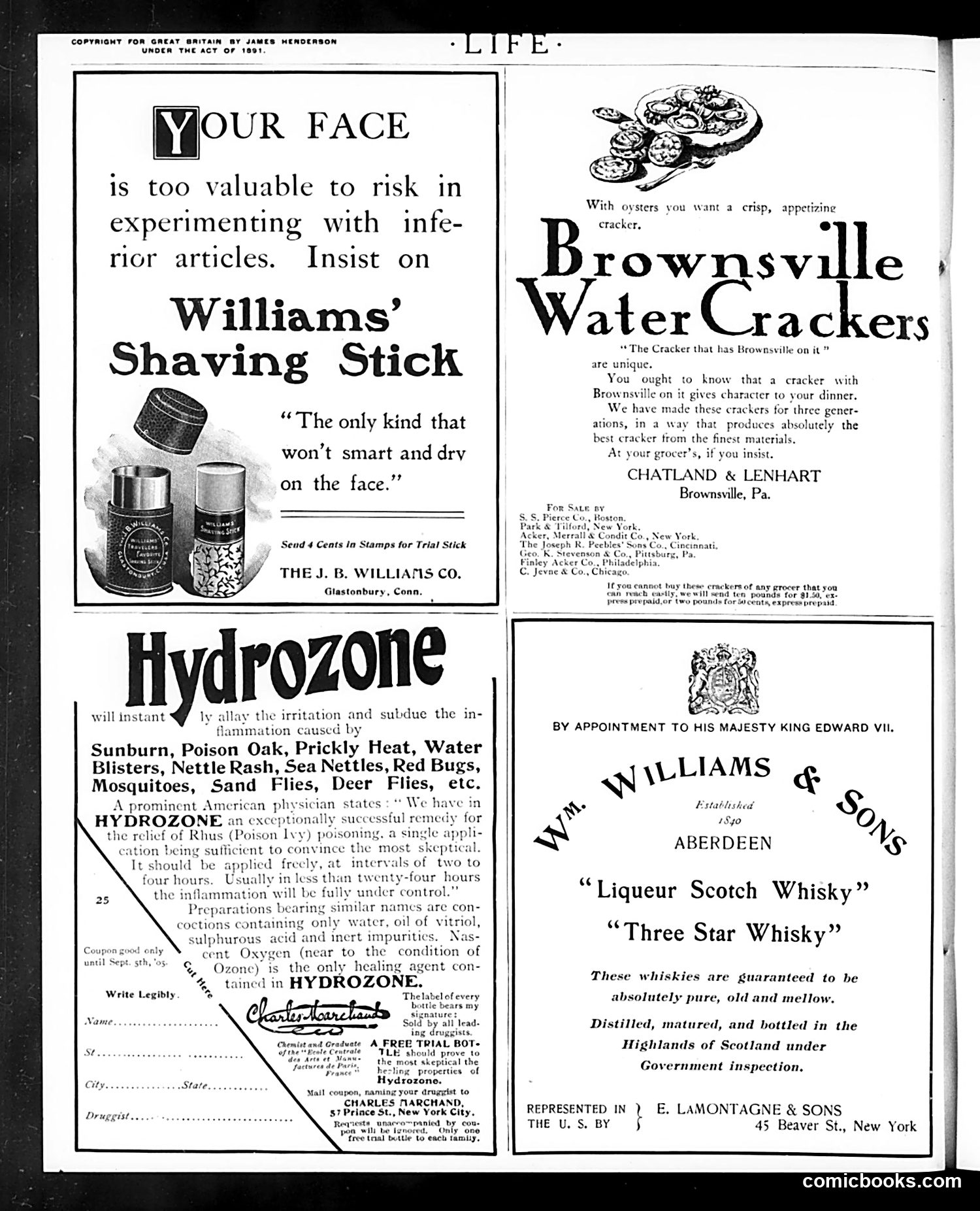
This page is primarily **advertising**, not editorial content or satire. It contains four separate product advertisements from the early 20th century: 1. **Williams' Shaving Stick** — positioned as superior to inferior competitors, emphasizing it won't dry out on the face 2. **Brownsville Water Crackers** — marketed as a quality companion to oysters for dinner 3. **Hydrozone** — a medicinal product claiming to treat various skin irritations and insect bites; includes a coupon for a free trial bottle 4. **W.M. Williams & Sons Whisky** — a Scottish whisky brand with royal appointment to King Edward VII There is no political cartoon or satire on this page. The advertising reflects period consumer goods and patent medicine marketing conventions typical of Life magazine's revenue model.
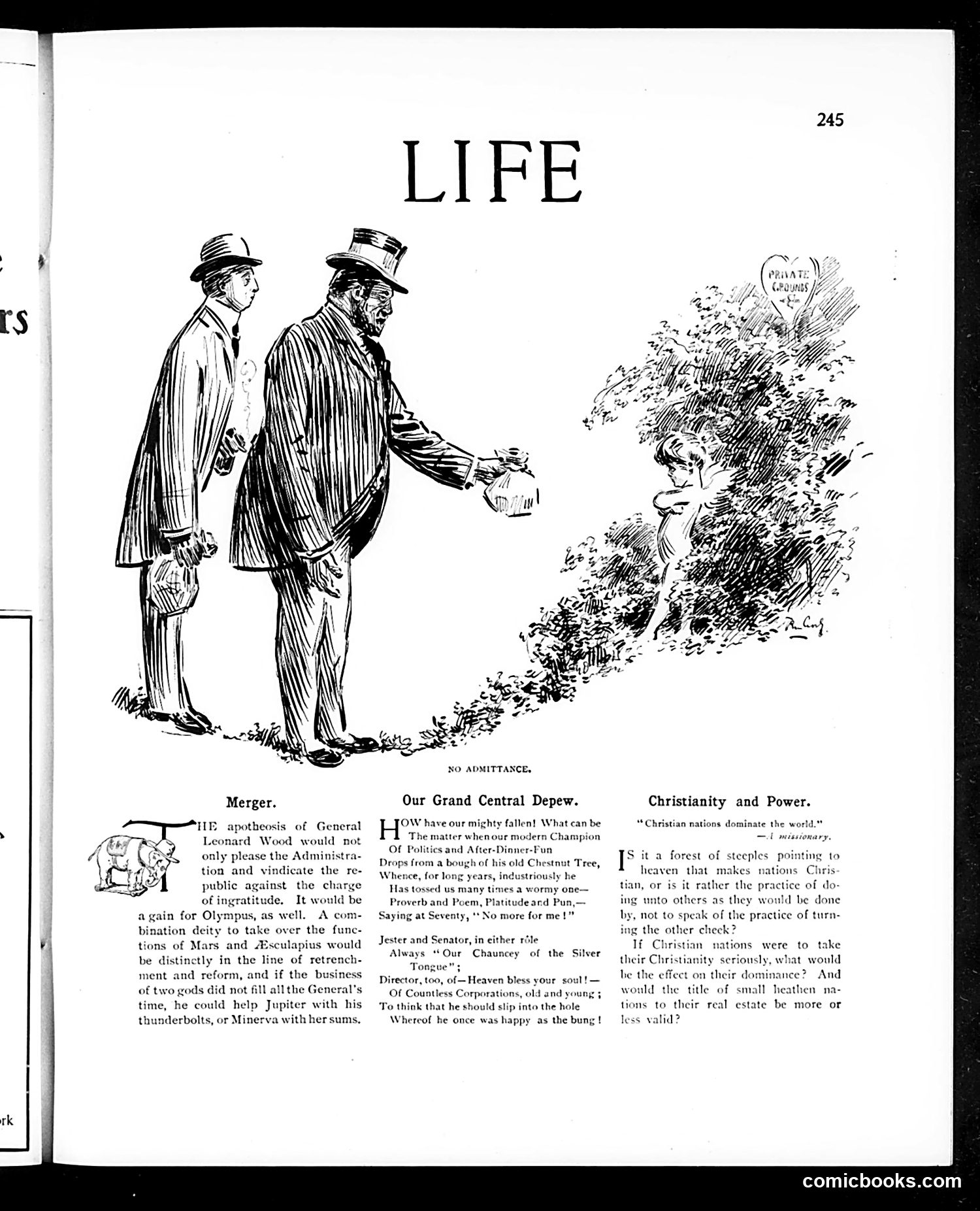
**Main Cartoon ("No Admittance"):** Two well-dressed men attempt to enter a thicket labeled "Private Grounds," but are blocked. This appears to satirize efforts to access exclusive spaces or privileges being denied to outsiders—likely referencing corporate monopolies or closed political circles of the era. **"Merger" Section:** References General Leonard Wood's potential administration, suggesting he could help Jupiter with thunderbolts or Minerva with wisdom—mocking the idea that military leaders possess special governing abilities. **"Our Grand Central Depew":** Critiques a public figure (likely Chauncey Depew, a railroad executive/politician) through satirical verse about corporate excess and empty political rhetoric. **"Christianity and Power":** Argues Christian nations' dominance depends on actual moral practice, not merely religious identity.
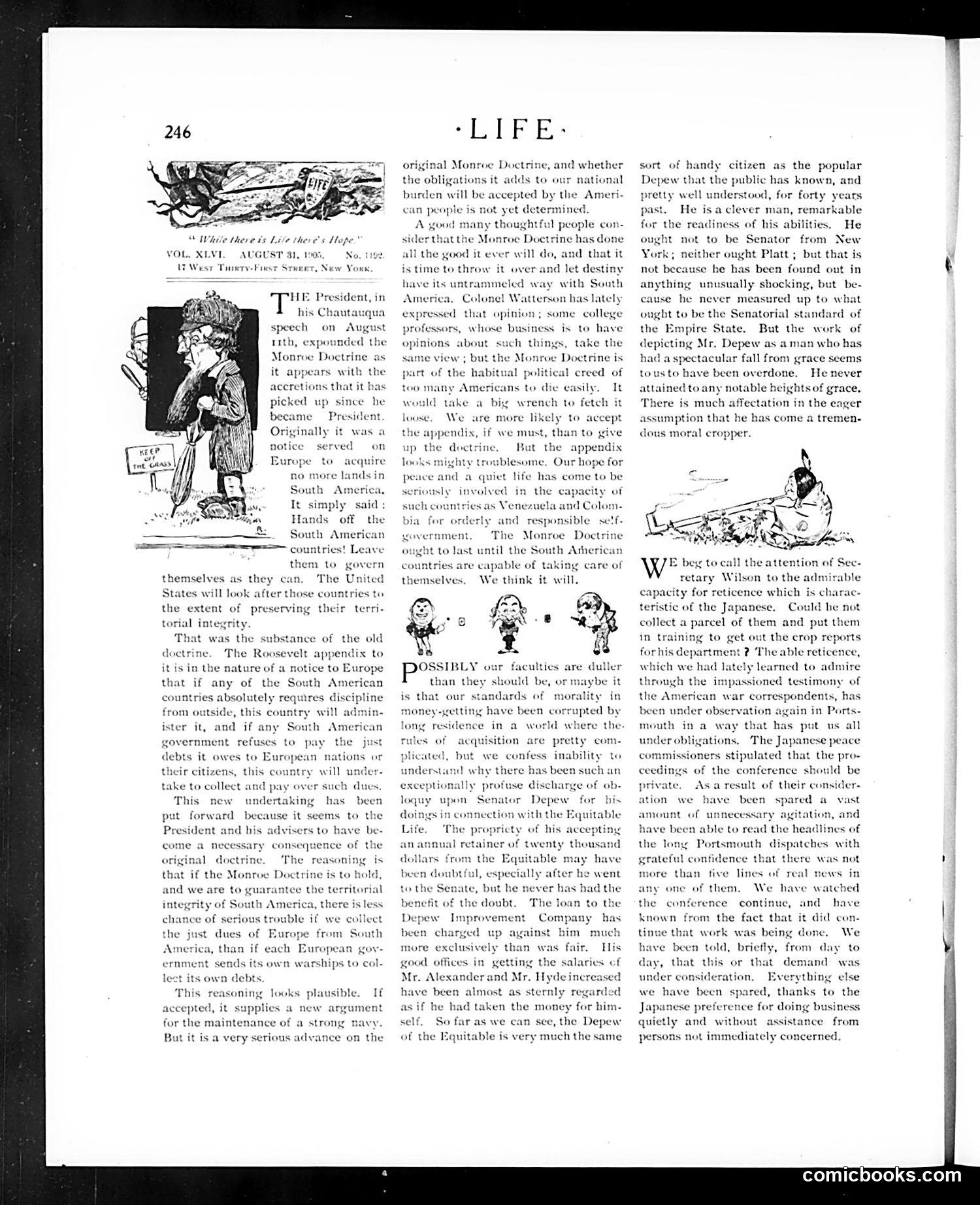
This page contains editorial commentary on President Theodore Roosevelt's August 11th Chautauqua speech regarding the Monroe Doctrine. The text debates whether the doctrine should be maintained as stated or modified. The left cartoon depicts a figure (appears to be a European power) being warned away from South America—illustrating the Monroe Doctrine's core principle of opposing European interference in the Western Hemisphere. The right illustration shows what appears to be Japanese figures, connecting to a separate discussion about Secretary White's admiration for Japanese efficiency and reticence. The text notes Japanese preference for conducting business "quietly and without assistance from persons not immediately concerned." The page satirizes both American foreign policy debates and comparative observations about international diplomatic styles during the Progressive Era.
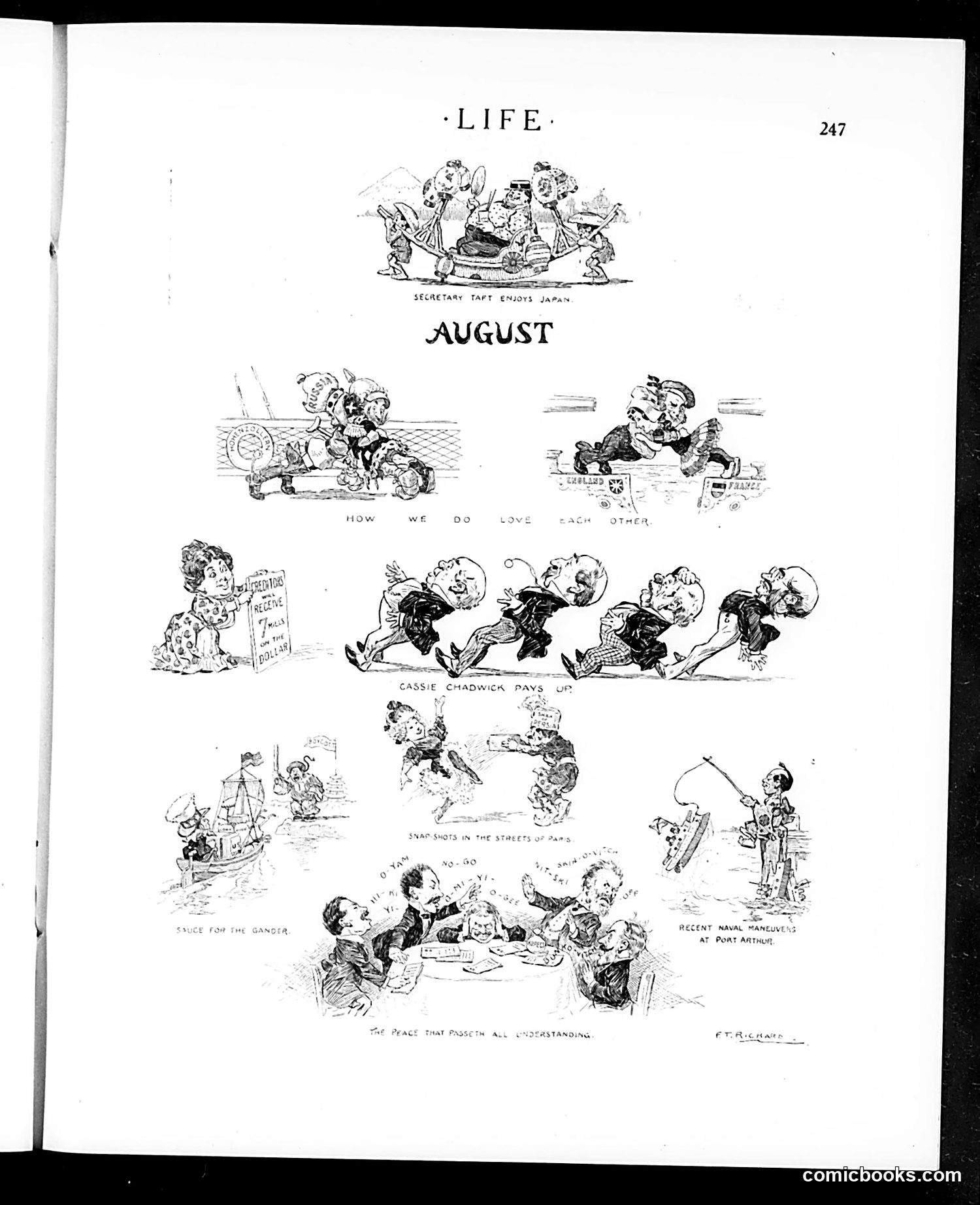
This page presents multiple cartoon vignettes mocking various social situations and current events. The top section references "Secretary Taft Enjoys Japan," likely commenting on Secretary of War William Howard Taft's diplomatic visit. The middle panels include "How We Do Love Each Other" and "Cassie Chadwick Pays Up"—the latter referencing Cassie Chadwick, a notorious con artist of the early 1900s who defrauded banks. Other sketches mock naval affairs ("Recent Naval Maneuvers at Port Arthur"), street scenes in Japan, and dining situations. The final panel, "The Peace That Passeth All Understanding," appears to satirize diplomatic negotiations, likely referencing contemporary peace efforts. The cartoons use exaggerated caricature to ridicule social pretenses, fraud, and international politics of the Edwardian era.
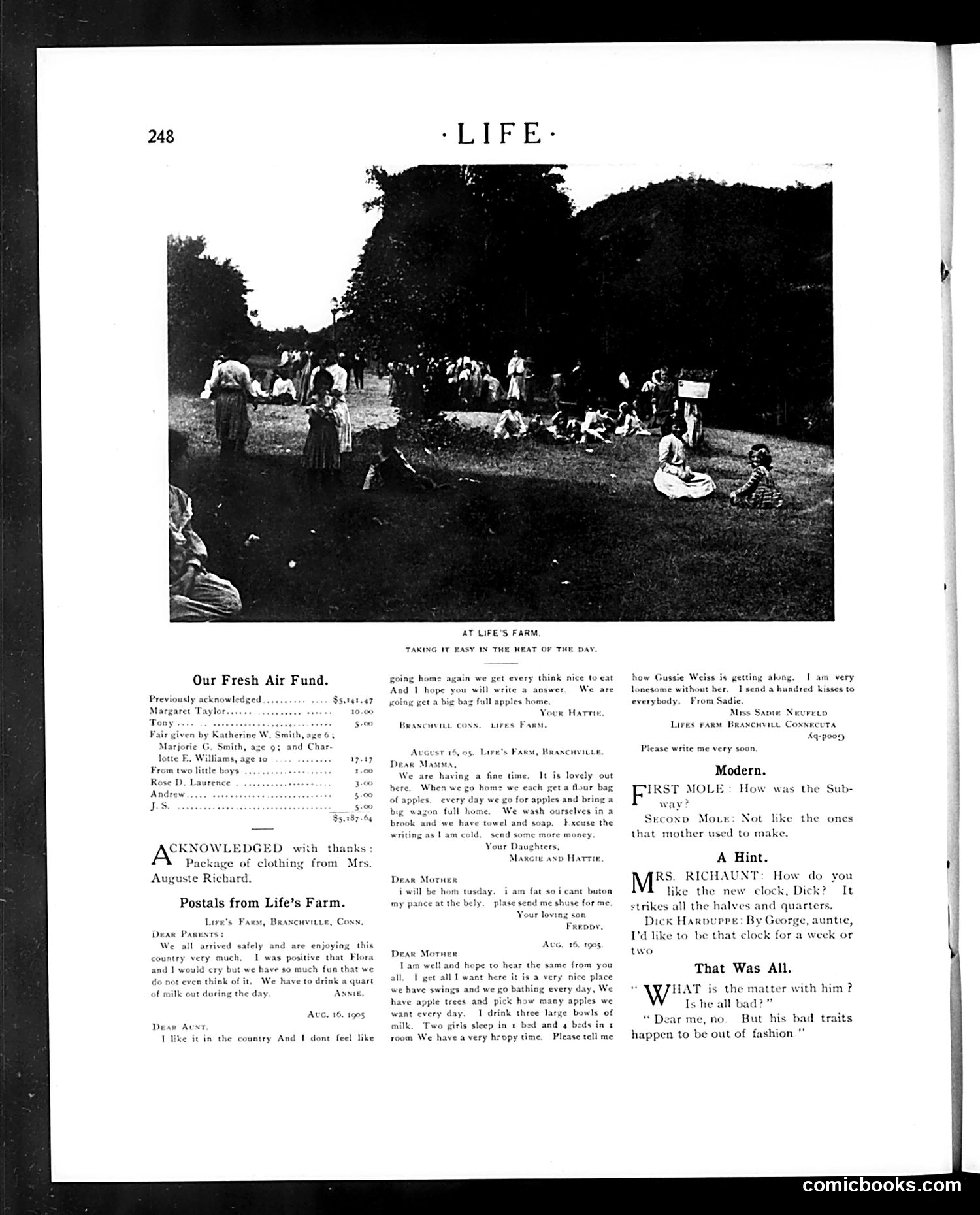
This page primarily contains letters to the editor and a humorous "Modern" section with joke exchanges—not political cartoons or satire requiring historical context. The main image shows "At Life's Farm: Taking It Easy in the Heat of the Day"—a pastoral photograph of people relaxing outdoors during summer, illustrating the "Fresh Air Fund," a charitable program providing city children countryside visits. The text sections are reader submissions about farm life experiences and a brief comedic dialogue between two moles debating whether modern clocks striking "all the halves and quarters" is an improvement, concluding that "bad traits happen to be out of fashion." This is primarily lifestyle/humor content reflecting early 20th-century American leisure and genteel comedy rather than political satire.
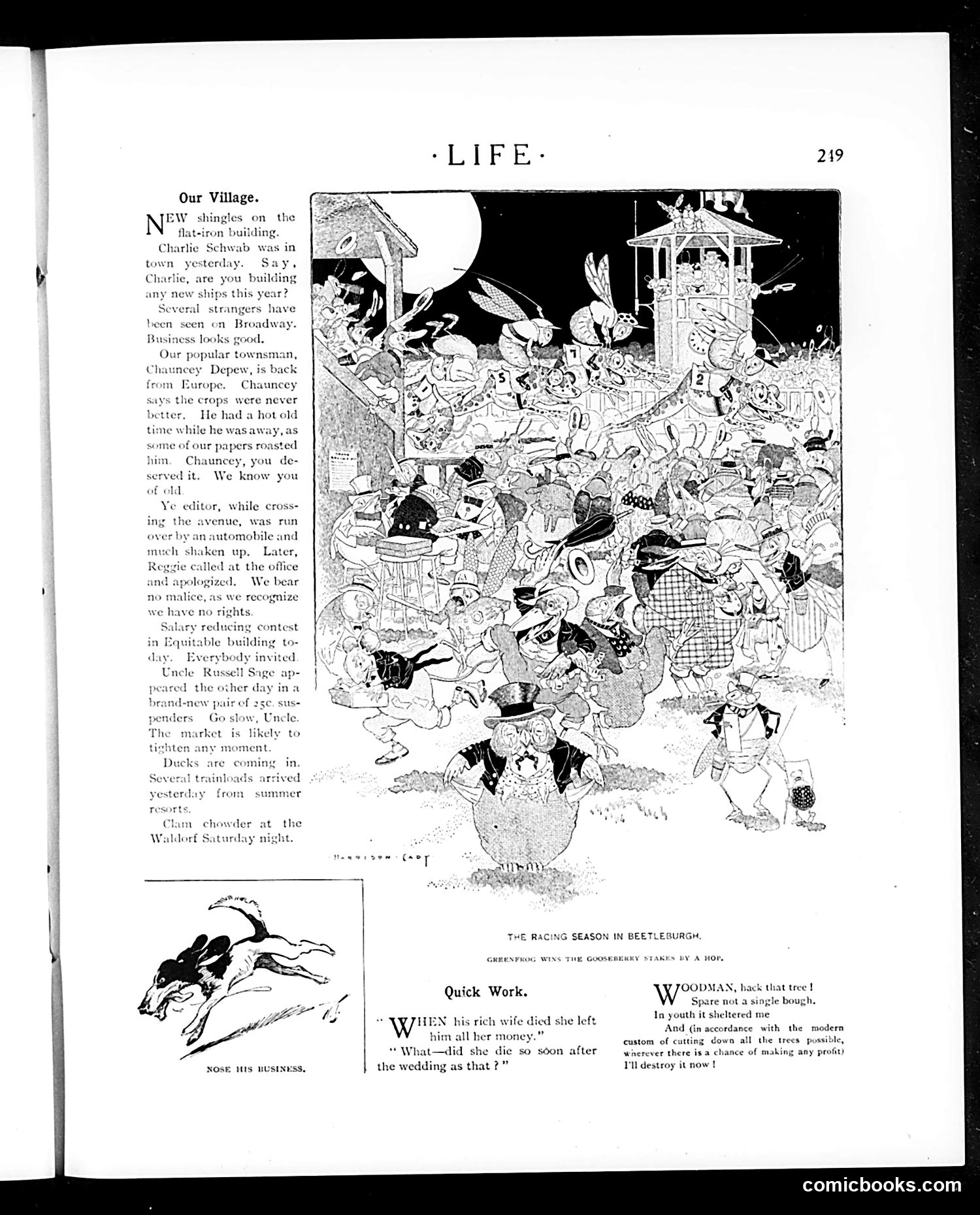
This page presents humorous village gossip and satirical illustrations. The main cartoon depicts a chaotic village scene with numerous characters engaged in various activities around a gazebo, labeled "The Racing Season in Beetleburgh" with a subtitle about winning the "Gooseberry Stakes by a Hop." A smaller cartoon titled "Nose His Business" shows a dog in pursuit. The text column "Our Village" contains gossipy commentary about local figures: Charlie Schwab's building plans, Chauncey Depew's return from Europe, a salary-reducing contest, Russell Sage's appearance, and market tightening. "Quick Work" presents a joke about a widow who inherited her deceased rich husband's money and quickly remarried. The satire gently mocks small-town life, local personalities, and social pretension.
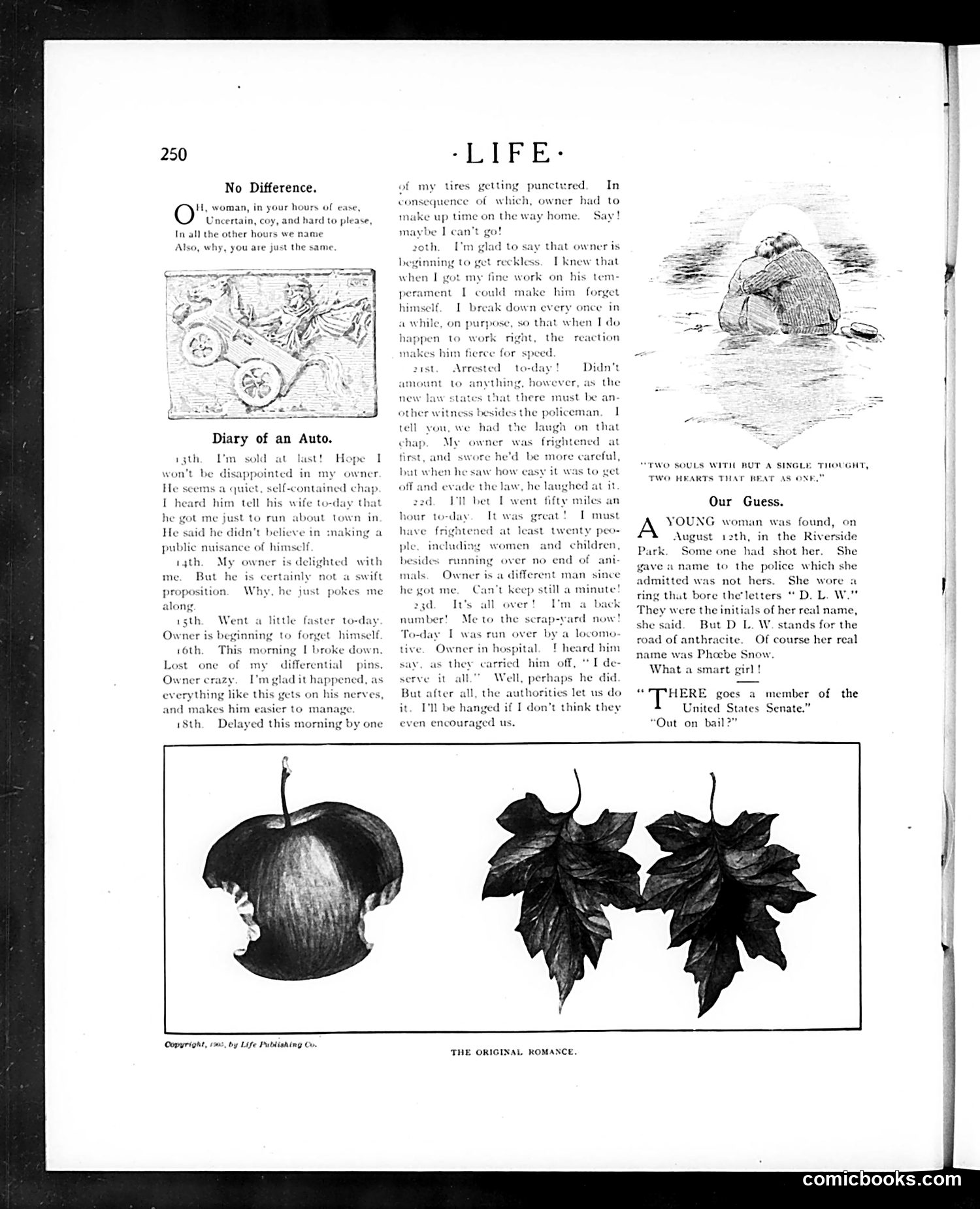
This page contains three distinct pieces: 1. **"No Difference"** — A satirical poem about a woman's leisure time, with an accompanying sketch of an auto accident. The joke appears to be about gender equality: whether working or resting, women are "the same." 2. **"Diary of an Auto"** — A humorous first-person narrative from a car's perspective, documenting mishaps with its owner, including tire punctures and run-ins with police. It's automotive satire common to early 1900s Life. 3. **"Our Guess"** — A brief anecdote about a woman found in Riverside Park calling herself "D. L. W." The punchline reveals her real name is Phoebe Snow, likely referencing a contemporary figure or advertisement character. 4. **"The Original Romance"** — An illustration captioning an apple and maple leaves, a visual pun about fruit and nature representing romance.
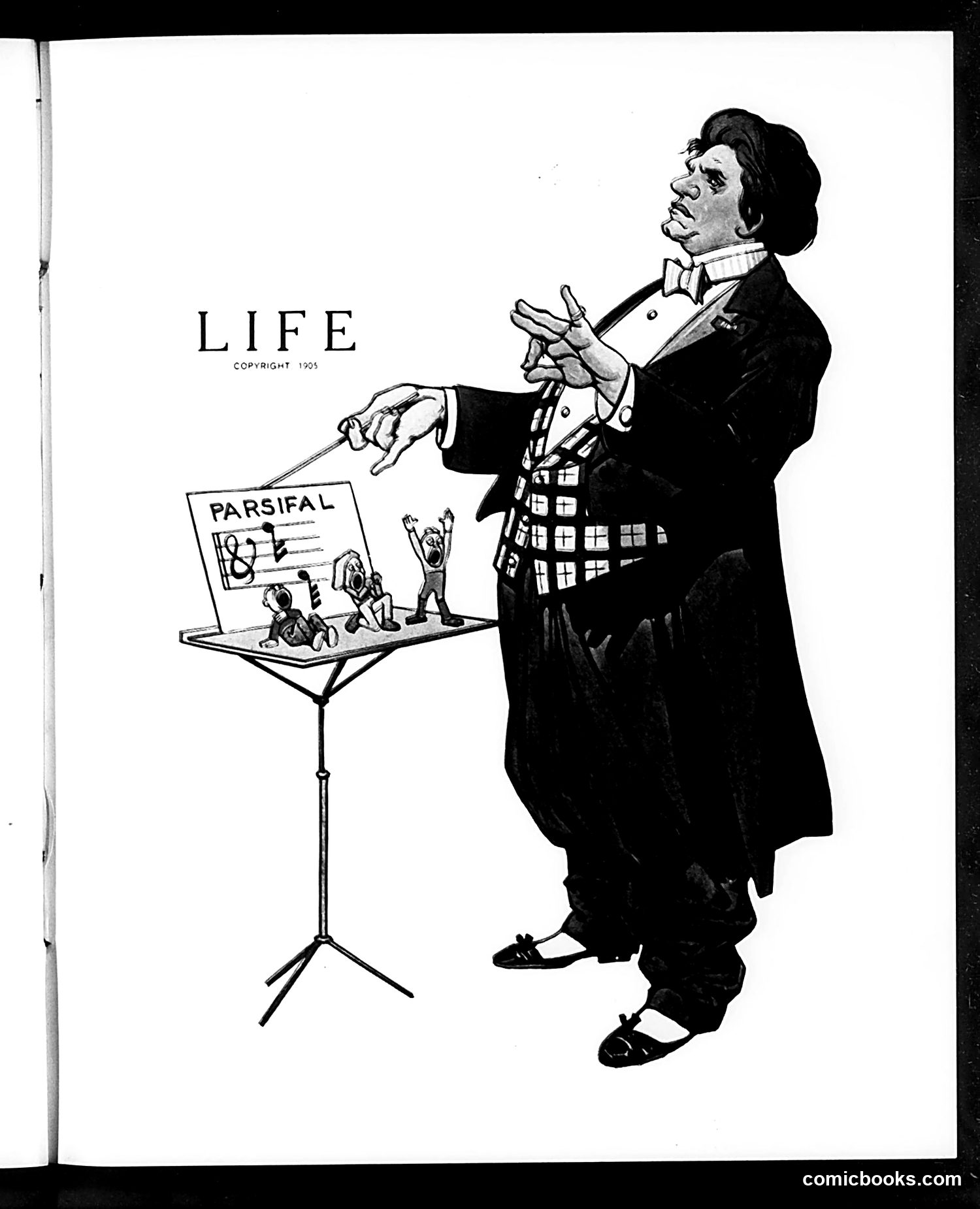
This is a Life magazine cover from 1905 featuring a conductor or maestro in formal attire directing an orchestra. On the music stand before him is a score labeled "PARSIFAL" with small figures representing musicians or performers. The satire likely references Richard Wagner's opera *Parsifal*, which was controversial in America at the time—it was considered avant-garde and elitist. The caricatured conductor, with his exaggerated features and theatrical posture, appears to mock the pretentiousness of classical music connoisseurs and operatic culture. The diminutive figures on the score suggest the musicians are subordinate to the ego of the conductor. This reflects Life's editorial stance mocking high-culture pretension and artistic snobbery among American elites during the Gilded Age.

I can see this is a blank or nearly blank page from Life magazine, with only "comicbooks.com" visible at the bottom right corner. The page appears to be either: 1. A blank page between articles/cartoons (common in magazines) 2. A title or section divider page 3. Advertising space 4. A scanning artifact where content failed to capture Without any visible cartoon, illustration, text content, or other imagery to analyze, I cannot identify any figures, political references, or satirical commentary. To provide the historical analysis you've requested, I would need a page with actual visible content.
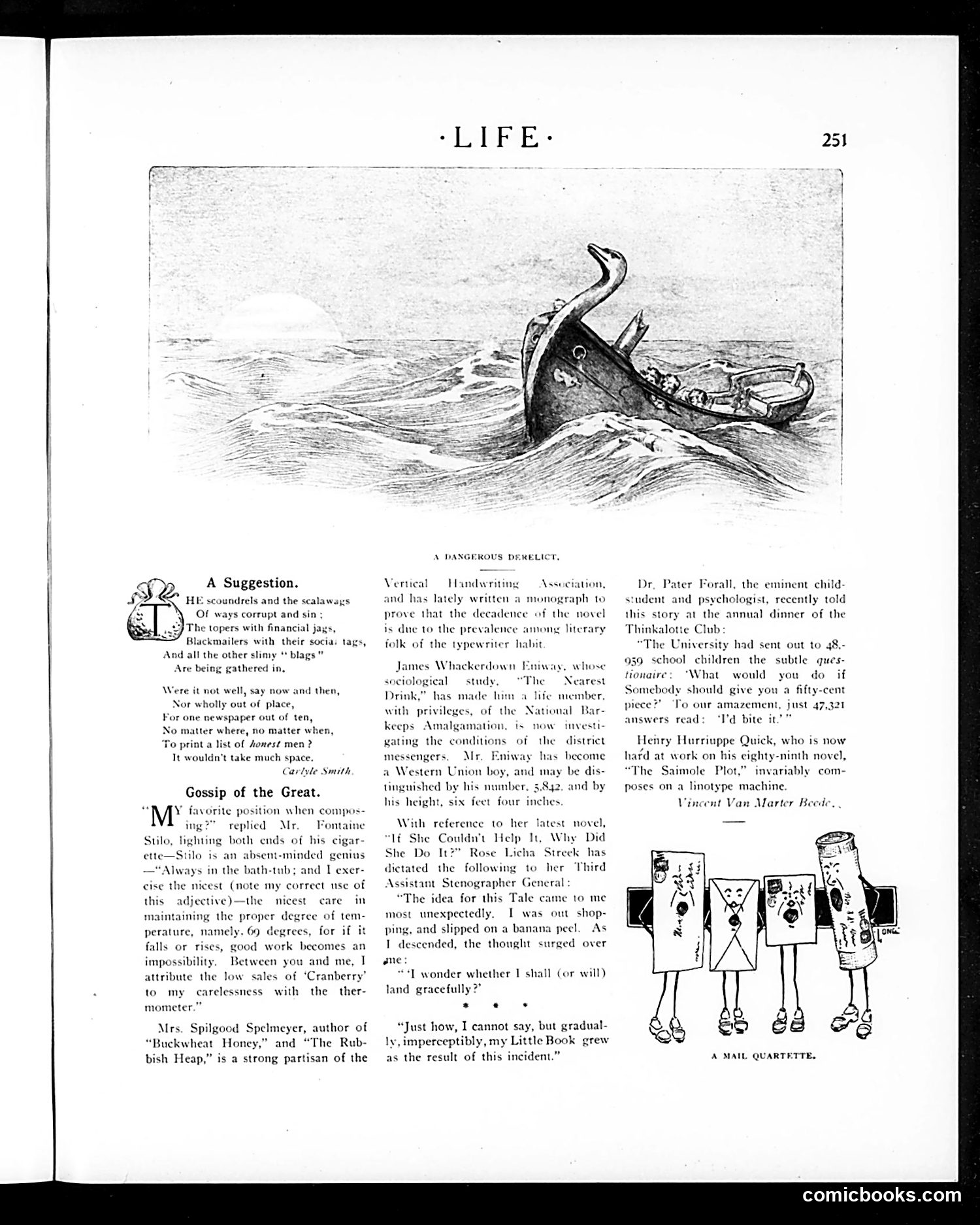
This page contains literary commentary and social humor rather than political cartooning. The main content includes: **"A Suggestion"** - A poem criticizing the corrupting influence of wealth and privilege on society. **"Gossip of the Great"** - Commentary on literary figures, including Mrs. Spilgood Spelmeyer (author of "Buckwheat Honey" and "The Rubbish Heap"), and Dr. Pater Forell, a child psychologist who apparently won $47,321 in a competition by saying he'd "bite it." **"A Mail Quartette"** - A cartoon showing four stick-figure characters holding postcards, illustrating humorous correspondence. The engraving at top depicts a damaged ship in rough seas, likely illustrating one of the literary discussions. Overall, this is a sophisticated humor and literary criticism page typical of Life magazine's satirical approach to contemporary society and letters.
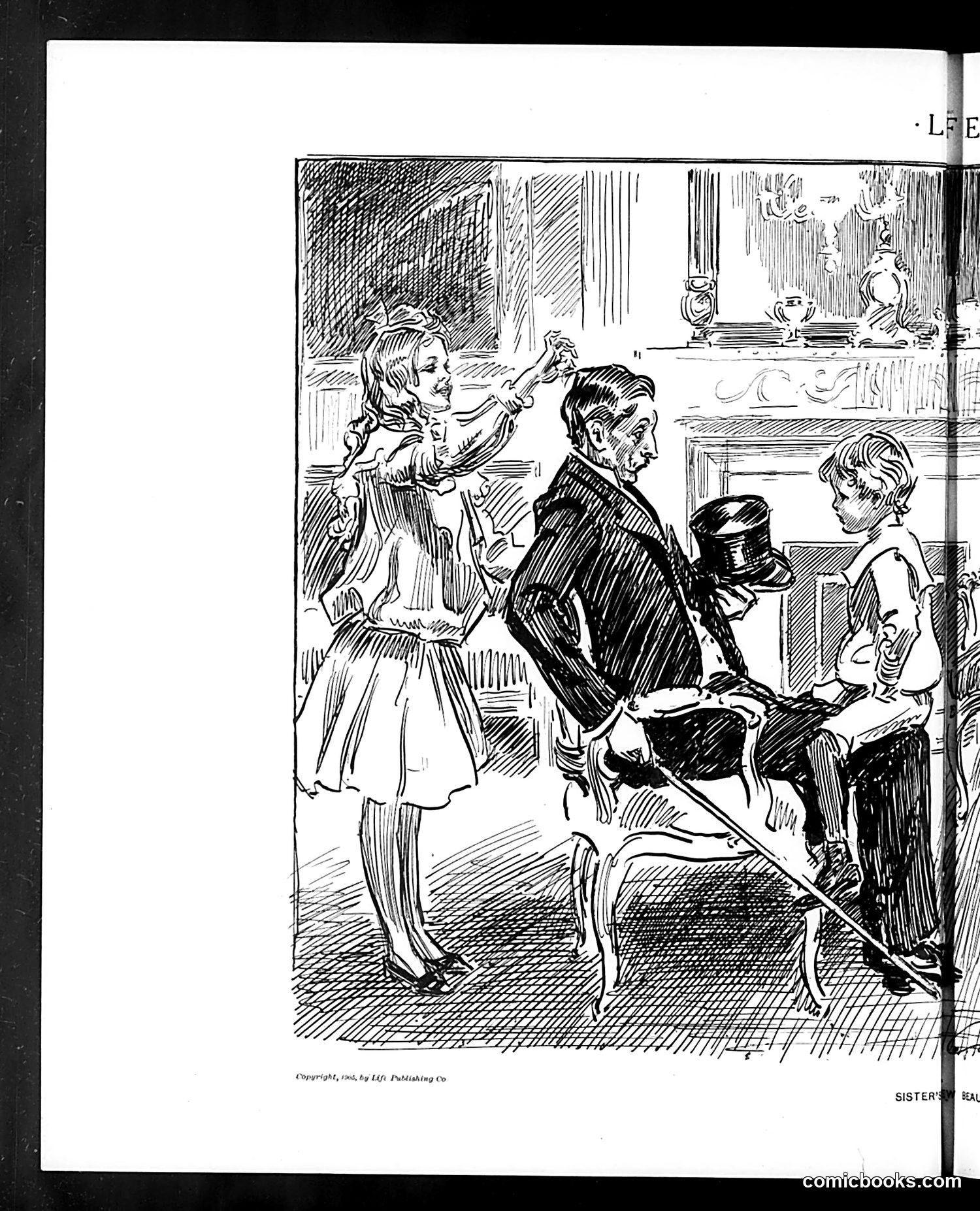
This is a satirical illustration from *Life* magazine (copyright 1903, per the visible text). The cartoon depicts a domestic scene where a well-dressed man in a top hat appears to be receiving criticism or complaints from a woman, while children and what appears to be a maid look on in the background. The satire likely concerns gender dynamics and domestic authority in early 1900s American households. The woman's animated gesturing and the man's somewhat defensive posture suggest a marital dispute or confrontation over household matters. The presence of servants and children emphasizes the social class context and the performative nature of domestic conflict within formal Victorian/Edwardian households. Without additional caption text visible, the specific social commentary remains unclear, but it appears to mock either marital relationships, women's demands for authority, or domestic management debates of the period.
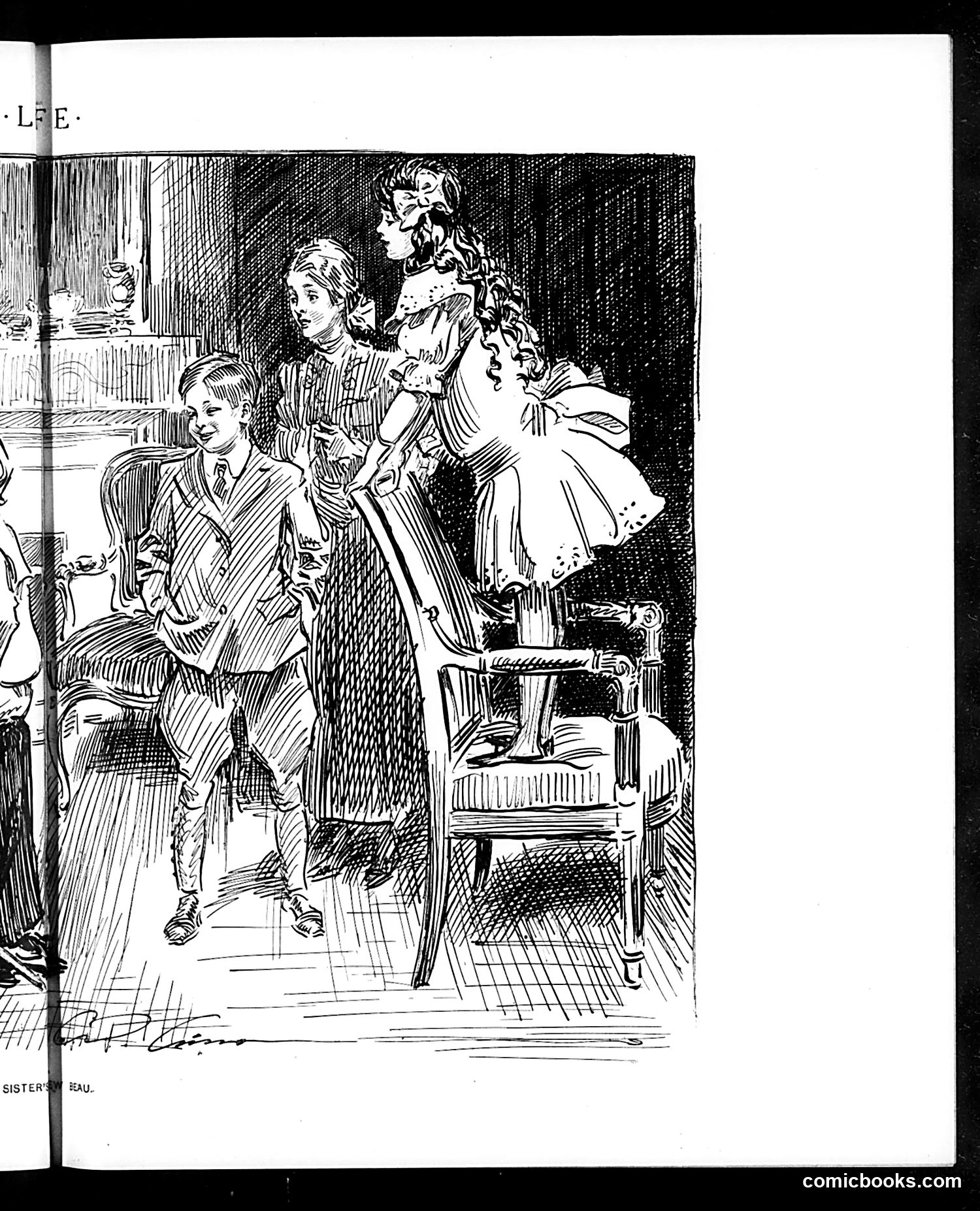
This illustration depicts a domestic scene with three figures in early 20th-century dress. A young boy in a suit sits on the left, while two women stand—one in a dark dress and one in a light dress with an elaborate bow. The caption reads "SISTER'S BEAU," indicating the standing man (partially visible on right) is courting the sister. The satire likely mocks courtship rituals of the era—specifically the awkward dynamic when a young suitor visits to court a woman with family present. The boy's amused expression and the formal, staged positioning suggest this is humorous commentary on Victorian-era dating propriety, where suitors faced scrutiny from family members. The illustration captures the tension and artificiality of supervised romantic encounters typical of that social period.
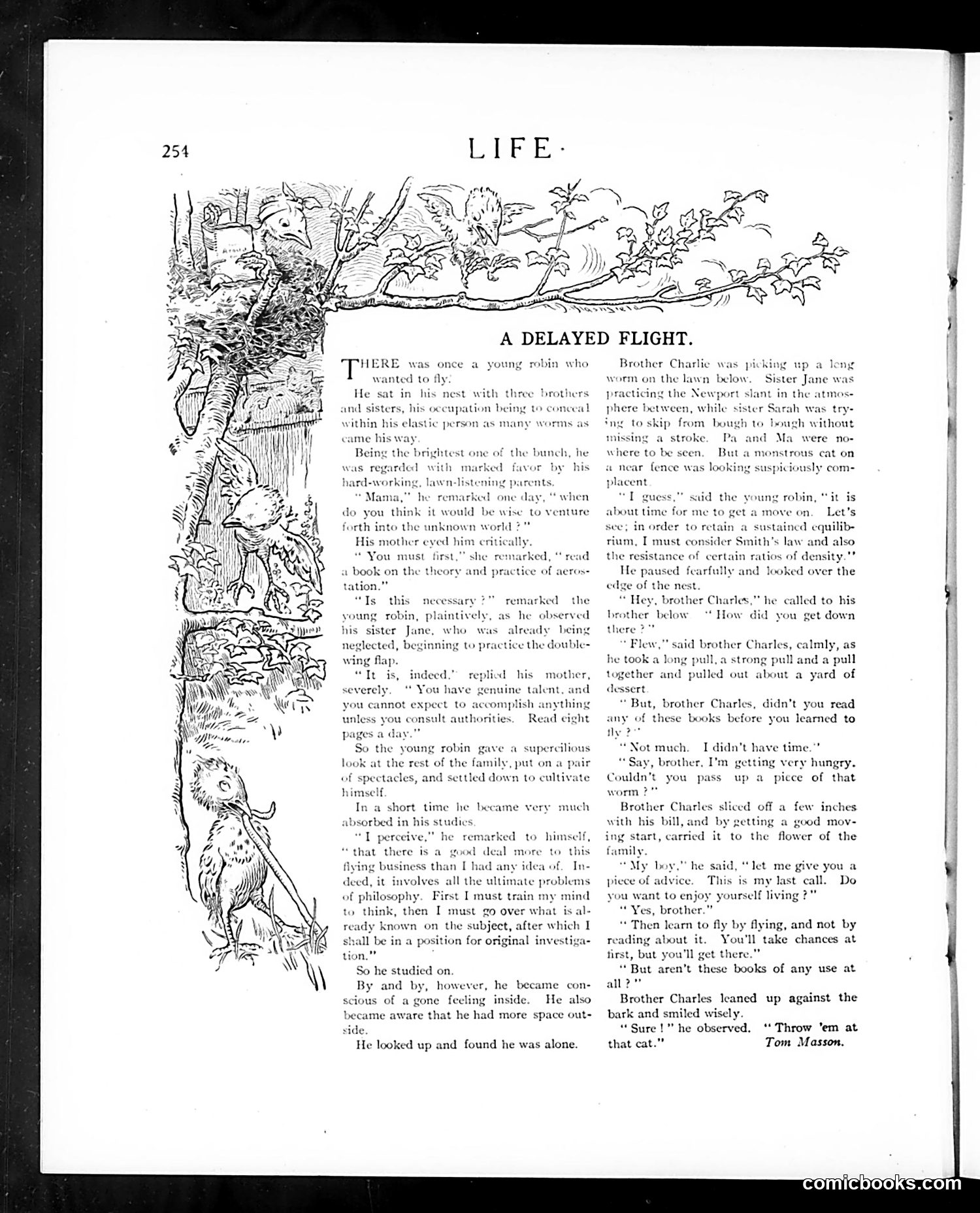
This is a humorous fable criticizing over-intellectualization and academic pedantry. A young robin wants to learn to fly but consults books on "theory and practice of aerostation" rather than simply attempting flight like his practical brother Charlie. The satire targets the era's tendency to overthink simple matters through excessive study—the young robin gets lost in philosophy, studying "ultimate problems" and proper "training of the mind" while his siblings naturally accomplish the task through experience. The punchline arrives when the starving young robin finally asks brother Charlie how he learned: Charlie admits he didn't read the books, just did it. When asked what the books are good for, he replies: "Throw 'em at that cat"—suggesting they're only useful as a weapon against danger, not for actual learning. **Attribution**: Credited to Tom Masson at bottom. The illustration shows robins in a nest, accompanying this early 20th-century critique of academic over-preparation versus practical action.
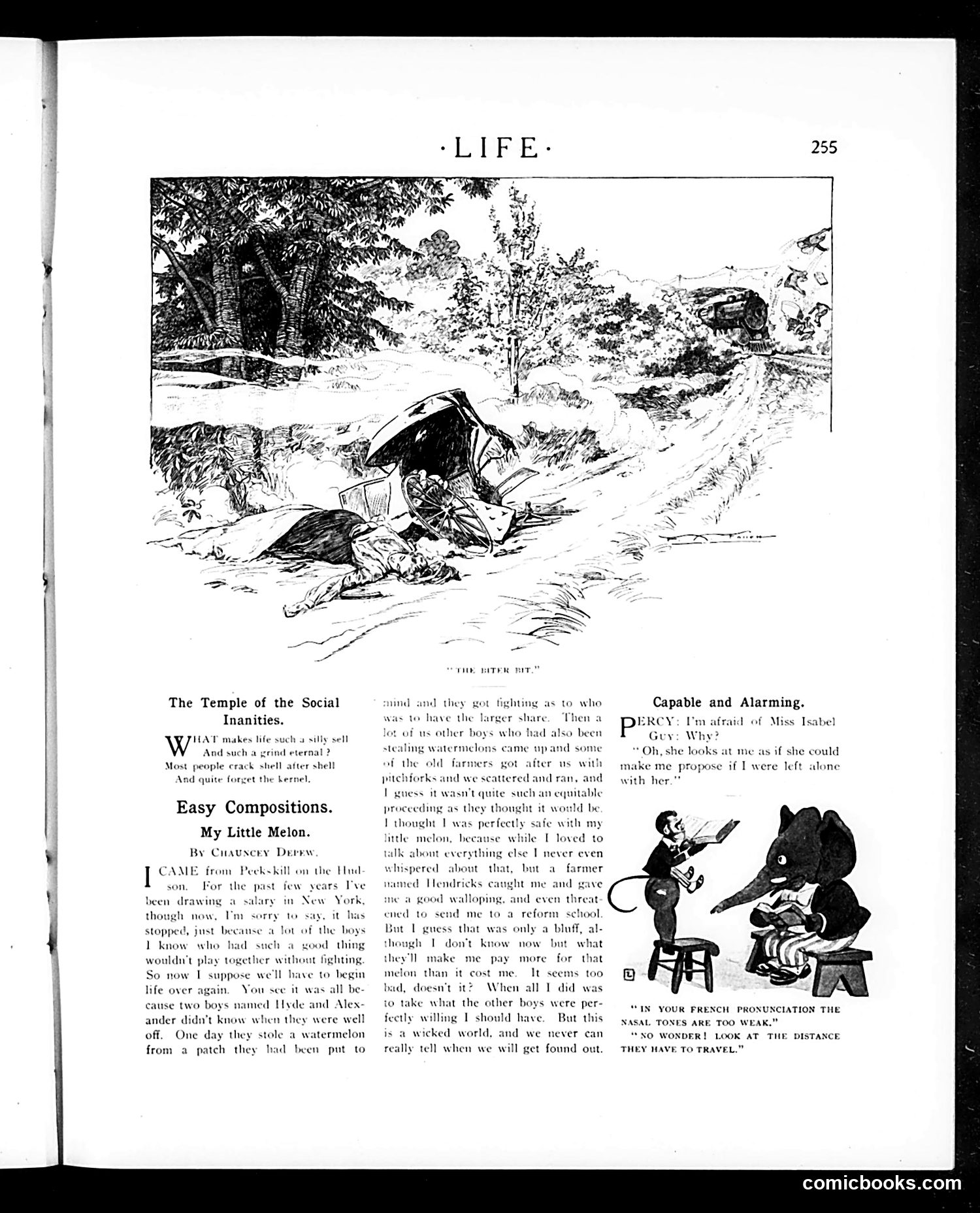
This page contains two separate pieces of satirical humor typical of early 20th-century *Life* magazine: **"My Little Melon"** (essay by Chauncey Depew): A humorous memoir where the author recalls stealing watermelons as a boy in Peekskill, New York. The joke centers on moral hypocrisy—he felt safe stealing because he never *talked* about it, yet got caught anyway. The satire mocks how people rationalize wrongdoing through arbitrary distinctions. **"Capable and Alarming"** (cartoon): A comedic exchange between two men about a woman named Miss Isabel. The humor relies on the period's gender dynamics: the man fears she's so forward and confident that she might propose to *him* if given the chance. This plays on anxiety about "New Women" gaining independence and social assertiveness—behavior considered shocking and role-reversing for the era. Both pieces use gentle satire to mock human nature and social pretension rather than targeting specific political figures or events.
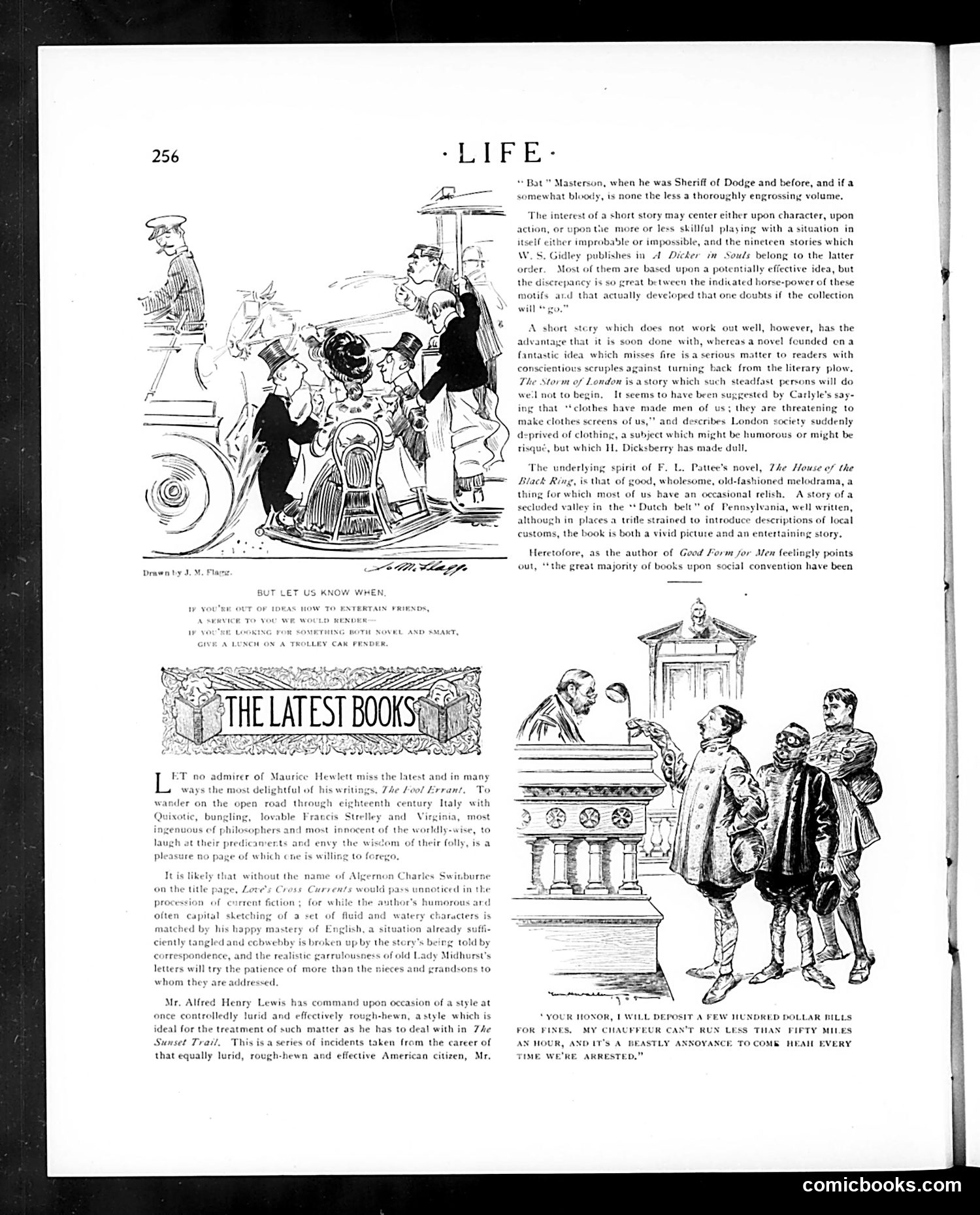
This page contains **book reviews** and **two cartoons** satirizing early 20th-century American social issues. ## Top Cartoon Depicts a chaotic trolley-car lunch scene, illustrating the text's suggestion for entertaining friends with a "lunch on a trolley car fender"—clearly absurd and impractical, mocking upper-class entertainment ideas. ## Bottom Cartoon Shows a wealthy man (identifiable by dress and demeanor) addressing a judge, offering to pay fines for traffic violations. His complaint—that his chauffeur cannot drive slower than 50 mph, making arrests "a beastly annoyance"—satirizes **wealthy elites' presumption that money exempts them from traffic laws**. The humor targets the notion that the rich can simply pay penalties rather than obey regulations like ordinary citizens. Both cartoons mock the pretensions and entitlement of the affluent classes during the automobile era, when speeding and reckless driving by the wealthy were becoming social problems.
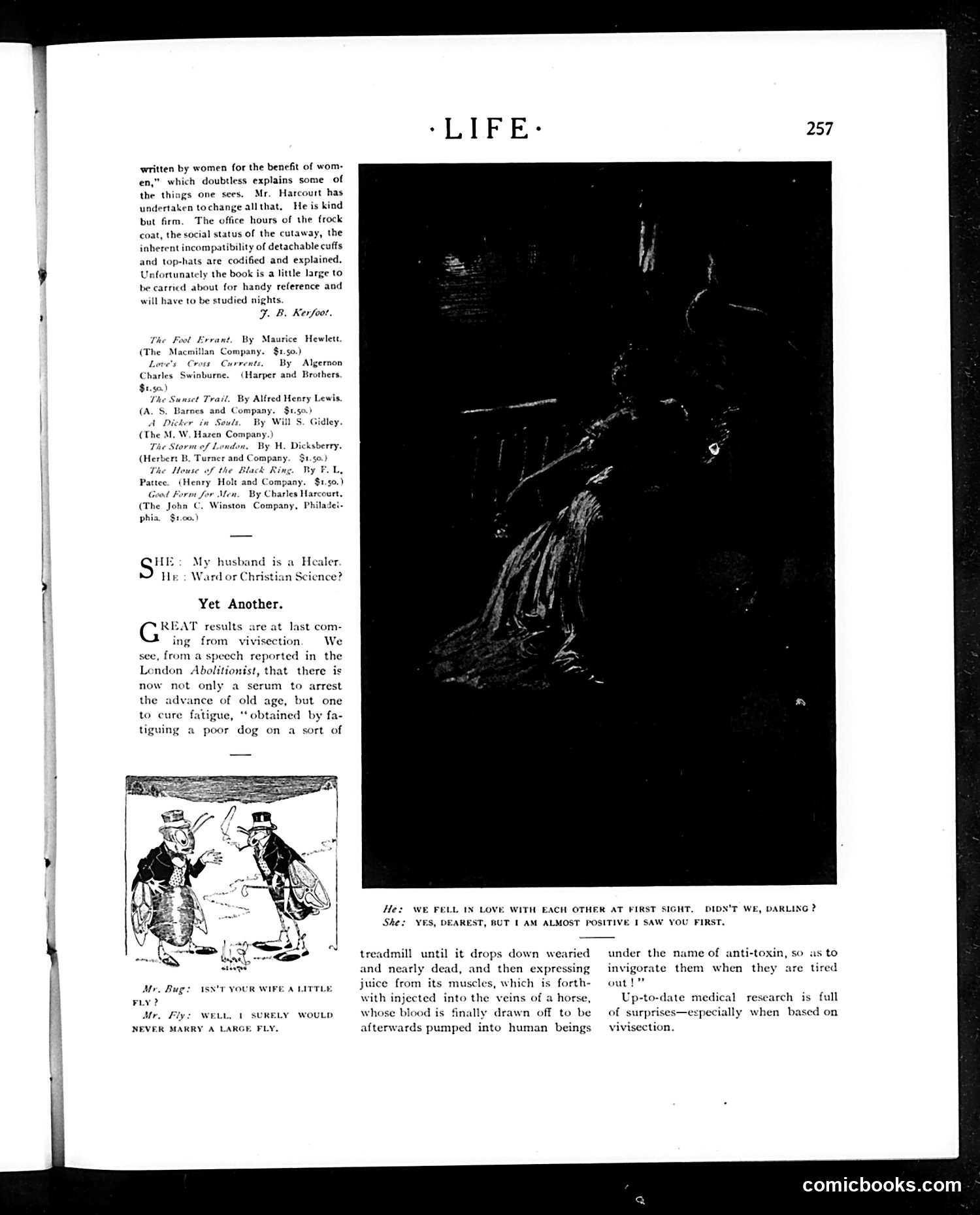
This page contains several satirical pieces mocking contemporary social trends: **Book Reviews Section**: Lists recently published books on etiquette and romance, including Charles Harcourt's "Good Form for Men"—the text jokes that Harcourt's guide to proper dress codes (frock coats, cutaways, detachable cuffs) is too large to carry for handy reference. **The Cartoon**: Shows two well-dressed men in conversation. One claims his husband is a "Healer"—the other sarcastically asks if he means a "Ward or Christian Science?" This mocks the era's proliferation of alternative medicine practitioners and faith healers, conflating them with Christian Science practitioners. **The Vivisection Satire**: The main text ridicules claims that animal experimentation yields anti-aging serums and fatigue cures. The satire is biting: they extract fluid from exhausted dogs via treadmill torture, then inject it into horses, whose blood is then transfused into humans. The writer sarcastically concludes medical research is "full of surprises—especially when based on vivisection," implying the logic is absurd. **The Bug Dialogue**: A simple visual pun about marrying a large fly.
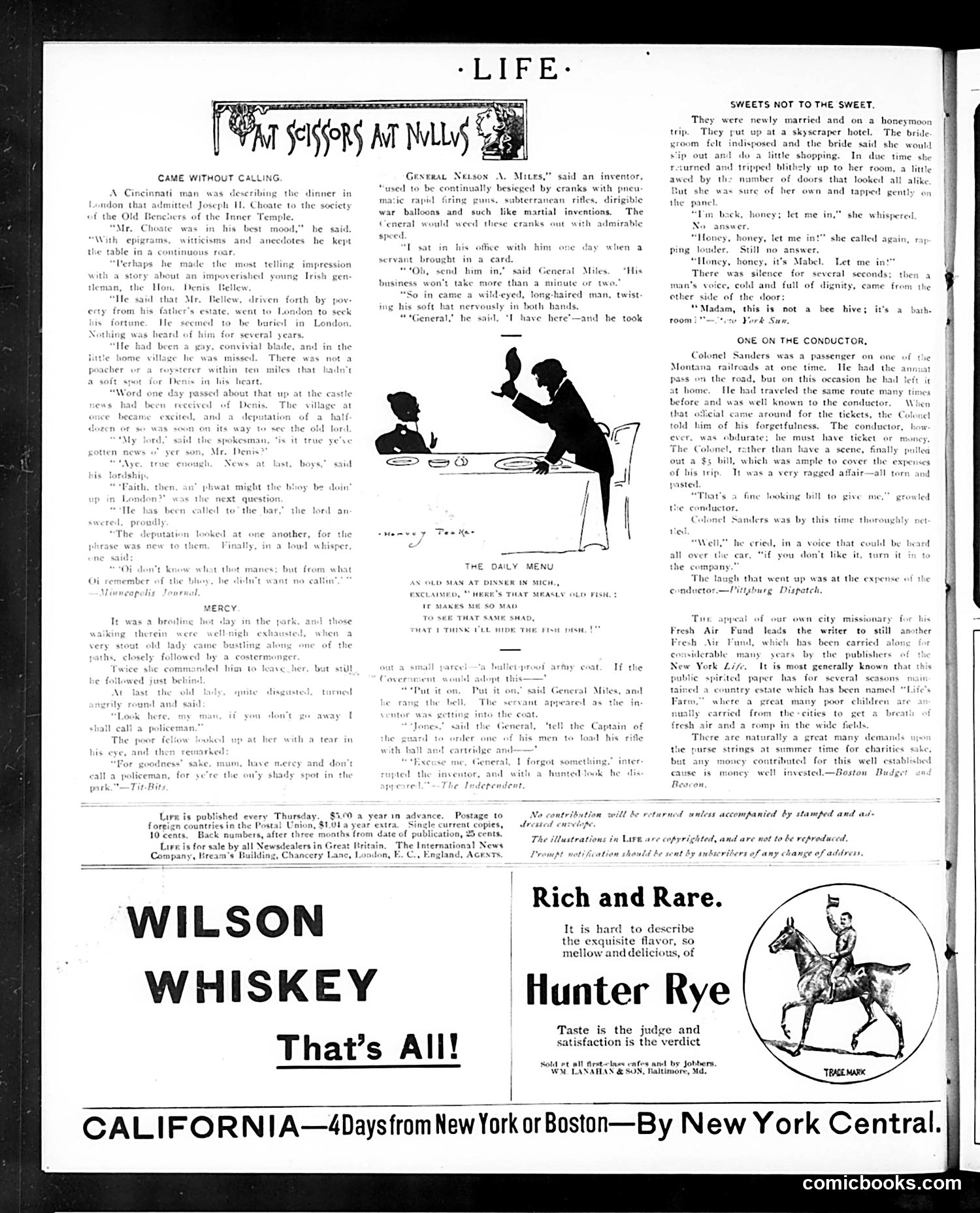
This page from *Life* magazine contains three distinct humor pieces: **"Scissors at Nulls"** ("Came Without Calling"): A anecdote mocking Joseph H. Choate's social pretensions—he was admitted to the prestigious Old Benchers of the Inner Temple despite being a self-made man, not born to privilege. The joke satirizes class barriers and social climbing. **"The Daily Menu"** cartoon: Depicts someone at a formal dinner complaining bitterly about old fish, illustrating working-class frustration with poor institutional food—likely satirizing military or institutional dining. **"One on the Conductor"**: A brief anecdote where passenger Colonel Sanders outwits a rigid railroad conductor. When the conductor refuses to accept Sanders's explanation for lacking a ticket, Sanders loudly suggests the conductor turn in the worthless $5 bill, embarrassing him publicly. The joke celebrates common sense defeating bureaucratic rigidity. The page also contains period advertisements for Wilson Whiskey and Hunter Rye, and mentions the Fresh Air Fund charity. Overall, the humor targets social pretension, bureaucratic inflexibility, and class friction—typical *Life* magazine satire of the era.
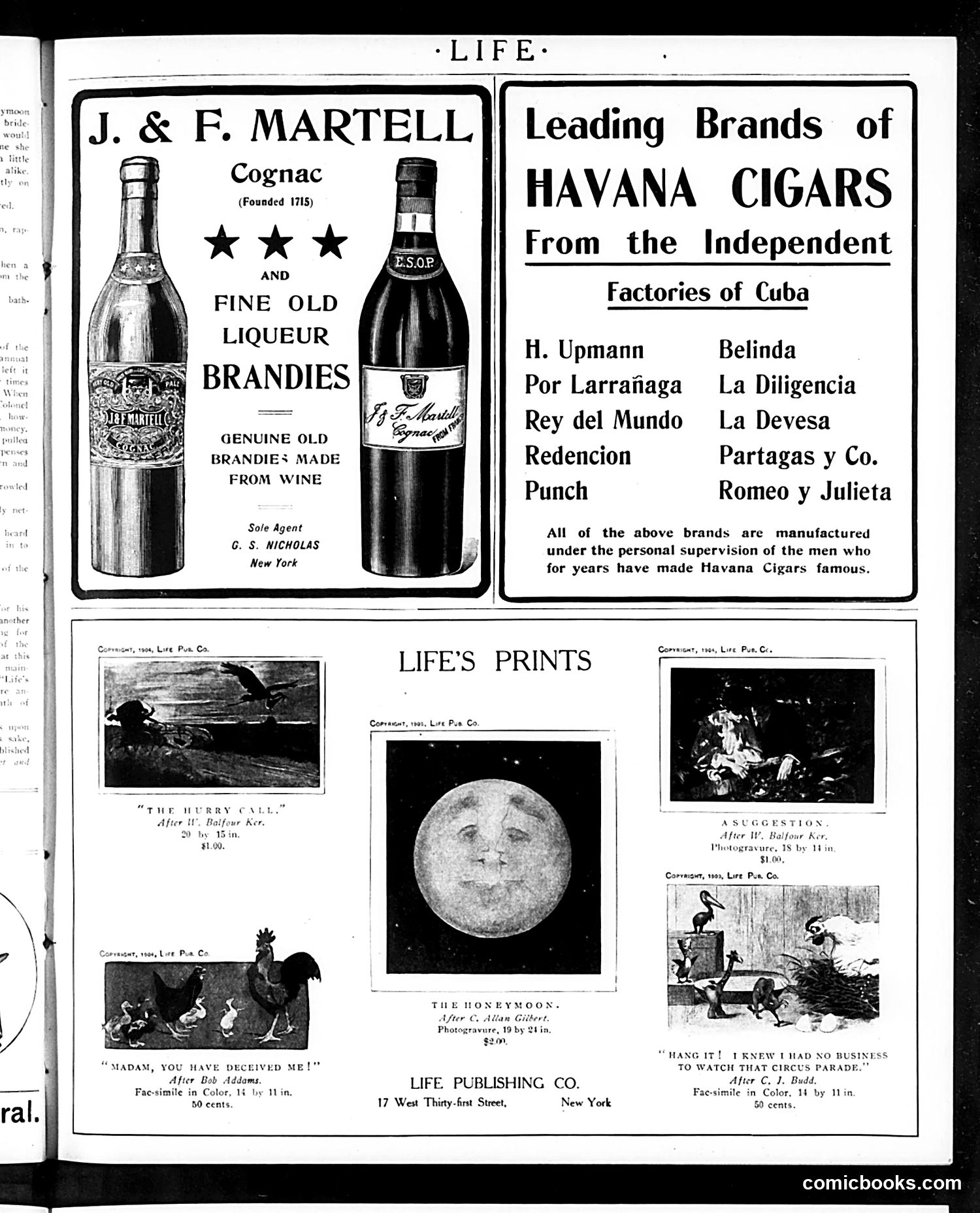
This page combines **advertisements with humorous cartoon prints** for sale. The top half features two liquor ads: J. & F. Martell Cognac (founded 1715) and Havana cigars from Cuban factories. These are straightforward commercial advertisements targeting wealthy consumers. The bottom half advertises "Life's Prints"—satirical cartoon reproductions available for purchase. The visible cartoons include: - "The Flurry" (Hallow'en scene) - "Madam, You Have Deceived Me!" (after Bob Addams)—depicting domestic marital discord - "The Honeymoon" (a moon-faced photograph, likely satirizing sentimental romance) - "A Suggestion" and "Hang It! I Knew I Had No Business to Watch That Circus Parade" (after C.J. Budd)—depicting comedic domestic or social mishaps These cartoons represent *Life's* typical satirical humor: poking fun at middle-class social situations, marriage complications, and everyday embarrassments. They were sold as affordable prints (50 cents to $2) for home decoration.
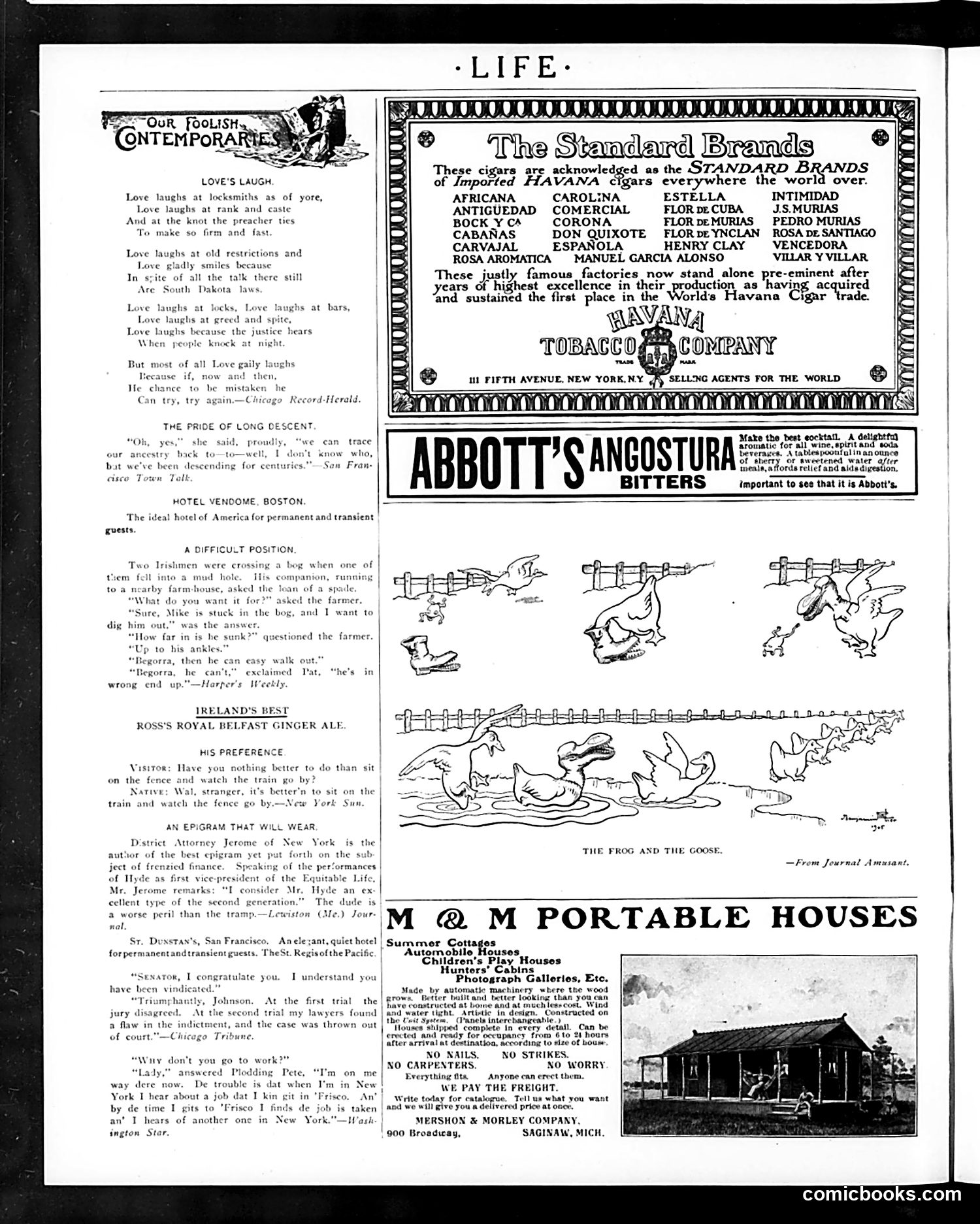
This is primarily an **advertising page** from Life magazine, with decorative literary content and satirical humor pieces around the margins. The main content includes: **"OUR FOOLISH CONTEMPORARIES"** — A poetry section titled "Love's Laugh" about love overcoming social barriers (class, caste, laws). **Central Advertisement**: The Havana Tobacco Company showcases premium imported cigar brands, claiming they represent the finest quality in the world's Havana cigar trade. **Smaller Advertisements & Humor**: - Abbott's Angostura Bitters (cocktail ingredient) - Hotel Vendome Boston - Various satirical brief anecdotes about Irish immigrants, legal cases, and social situations - Comic illustrations depicting "The Frog and the Goose" - **M&M Portable Houses** — innovative pre-fabricated homes shipped complete, requiring no carpentry or nails The page reflects early 1900s consumer culture: luxury cigars, patent medicines, travel, and emerging industrial products. The scattered humor pieces satirize contemporary society's pretensions and absurdities.
This page is primarily **advertisements** interspersed with three brief **humorous anecdotes**—typical Life magazine content from the early 1900s. The ads promote American consumer goods: hats, gloves, soap, fabric, shirts, and perfume, reflecting the era's focus on personal grooming and "patronizing American industries." The three jokes are gentle period humor: 1. **"Definition of an Orphan"**: A child defines an orphan as "a woman who wants to get married and can't"—satirizing women's limited independence and marriage obsession. 2. **"Bobby's Contribution"**: A boy chooses the smaller donation because he can give it more "cheerfully," cynically subverting religious virtue. 3. **"Unavoidably Detained"**: A prisoner sentenced to twenty years asks the judge to tell his wife not to wait dinner—absurdist dark humor about marital domesticity trumping legal consequence. These are lighthearted social observations typical of early 20th-century American humor magazines, poking fun at conventional attitudes toward marriage, religion, and domestic life without serious political intent.
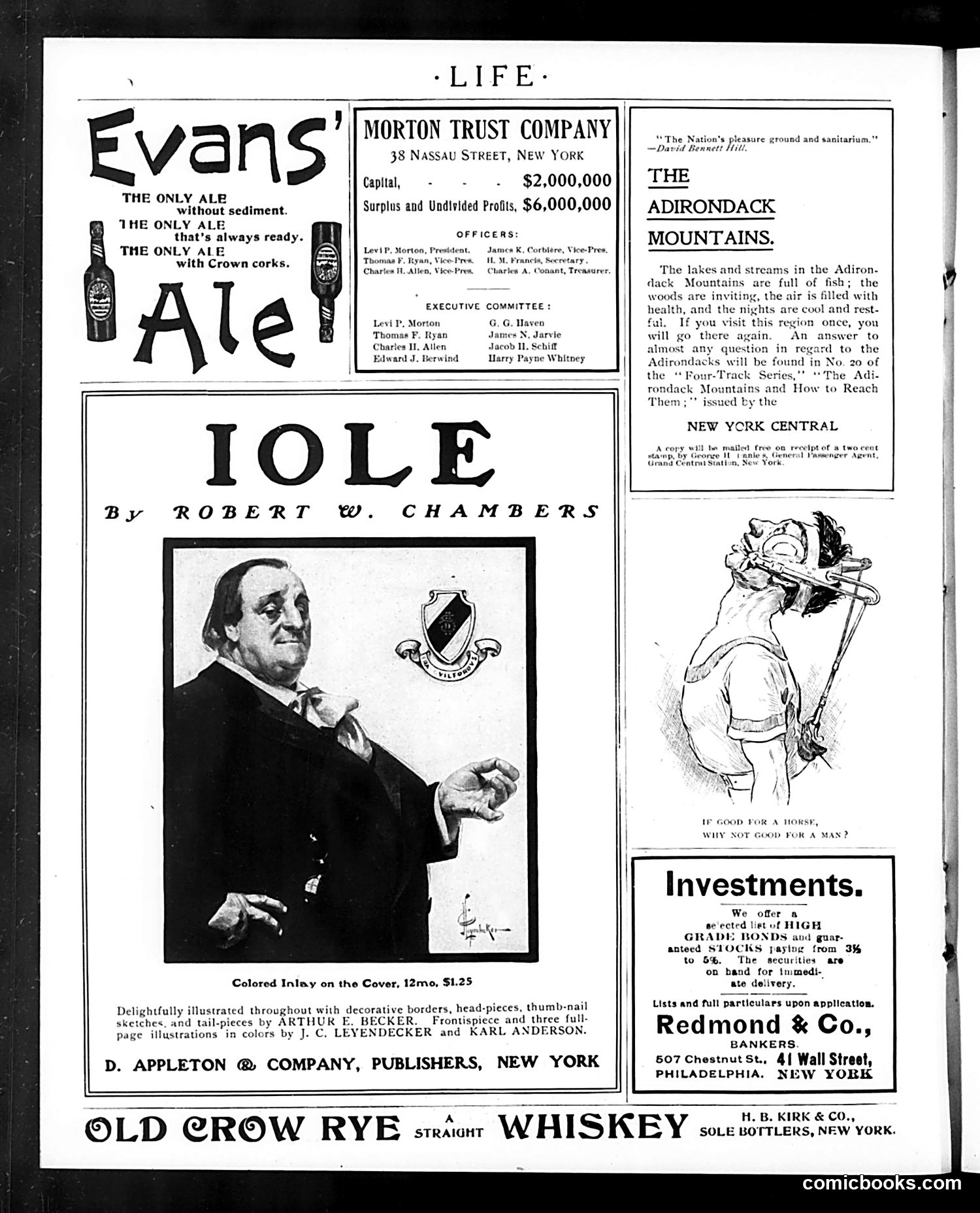
This page mixes advertising with a book advertisement for *Aiole*, a novel by Robert W. Chambers published by D. Appleton & Company. The central image shows a man in formal dress with a mustache, pointing to a heraldic shield—likely the book's protagonist or a symbolic figure representing the story's themes. The page is primarily **commercial content**: ads for Evans' ale (emphasizing its purity and reliability), Morton Trust Company (a financial institution), the Adirondack Mountains resort region, investment bonds, and Old Crow whiskey. The Adirondacks ad quotes David Bennett Hill, a contemporary New York politician, promoting the region as a health destination. The "If good for a horse, why not good for a man?" caption beneath the illustration sarcastically suggests the advertised products (likely whiskey or tonics) have universal benefits. This reflects early 20th-century advertising practices mixing editorial content with commercial pitches in magazines aimed at affluent readers.
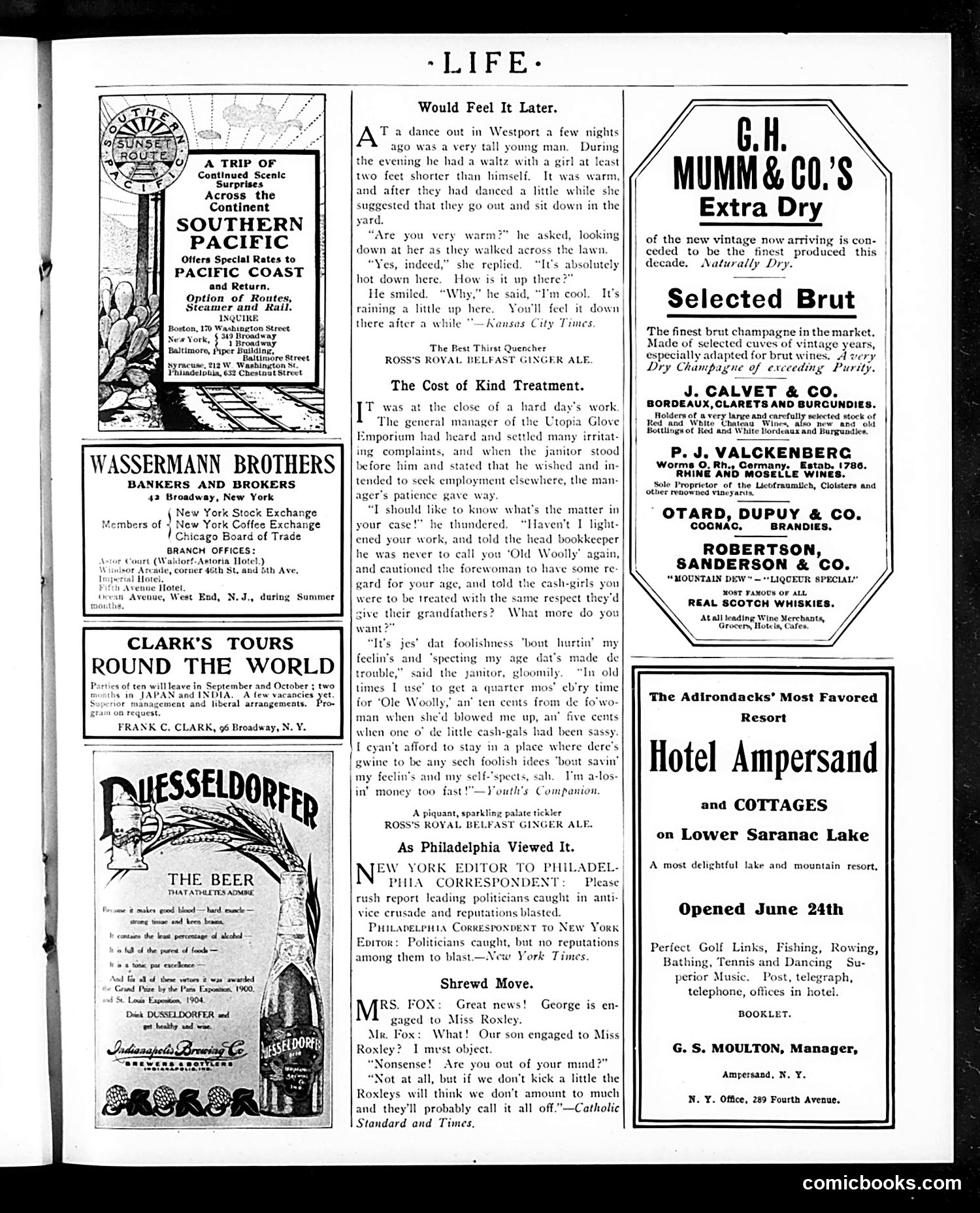
This is primarily an **advertising page** with two short humorous stories embedded among commercial notices for travel companies, financial services, and beverages (beer, champagne, wine). The two comedic pieces are: 1. **"Would Feel It Later"**: A mild flirtation joke where a tall man dancing with a much shorter woman claims it's "raining" on his head while she's cool below—a double entendre suggesting physical height differences during close dancing. 2. **"The Cost of Kind Treatment"**: A brief racial comedy featuring a janitor character (written in dialect) who paradoxically quits his job *because* the manager treated him kindly—removing the abuse that previously motivated him to stay. The humor relies on period stereotypes about African American workers. Both stories reflect early 20th-century magazine humor conventions: light romantic situations and servile worker caricatures. The page's real purpose is selling luxury goods (champagne, tours, banking services) to Life's affluent readership.
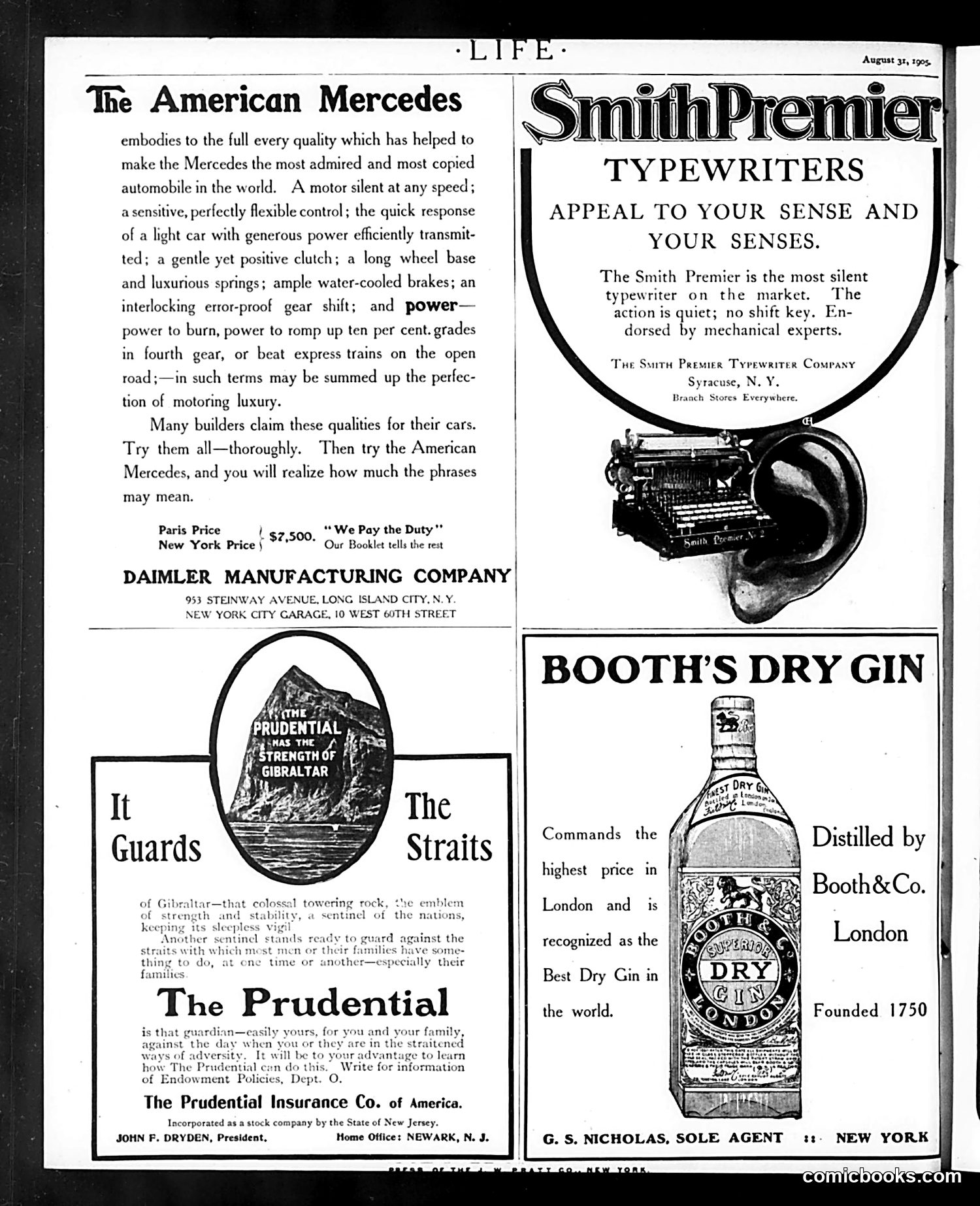
This page is primarily **advertising**, not political satire or editorial cartooning. It contains four distinct advertisements from August 31, 1905: 1. **American Mercedes** (top left): Luxury automobile advertisement emphasizing silent motors, powerful performance, and smooth handling at $7,500. 2. **Smith Premier Typewriters** (top right): Promotes the typewriter as "the most silent" on the market, with no shift key. 3. **The Prudential Insurance** (bottom left): Uses the Rock of Gibraltar as a symbol of strength and stability, positioning insurance as protection for families against hardship. 4. **Booth's Dry Gin** (bottom right): British gin distilled in London since 1750, sold through a New York agent. There is no political cartoon or satire present. This is a standard magazine advertising page reflecting early 20th-century consumer goods marketed to wealthy readers.