
Life, 1905-08-31 · page 4 of 24
Life — August 31, 1905 — page 4: what you’re looking at
What you’re looking at
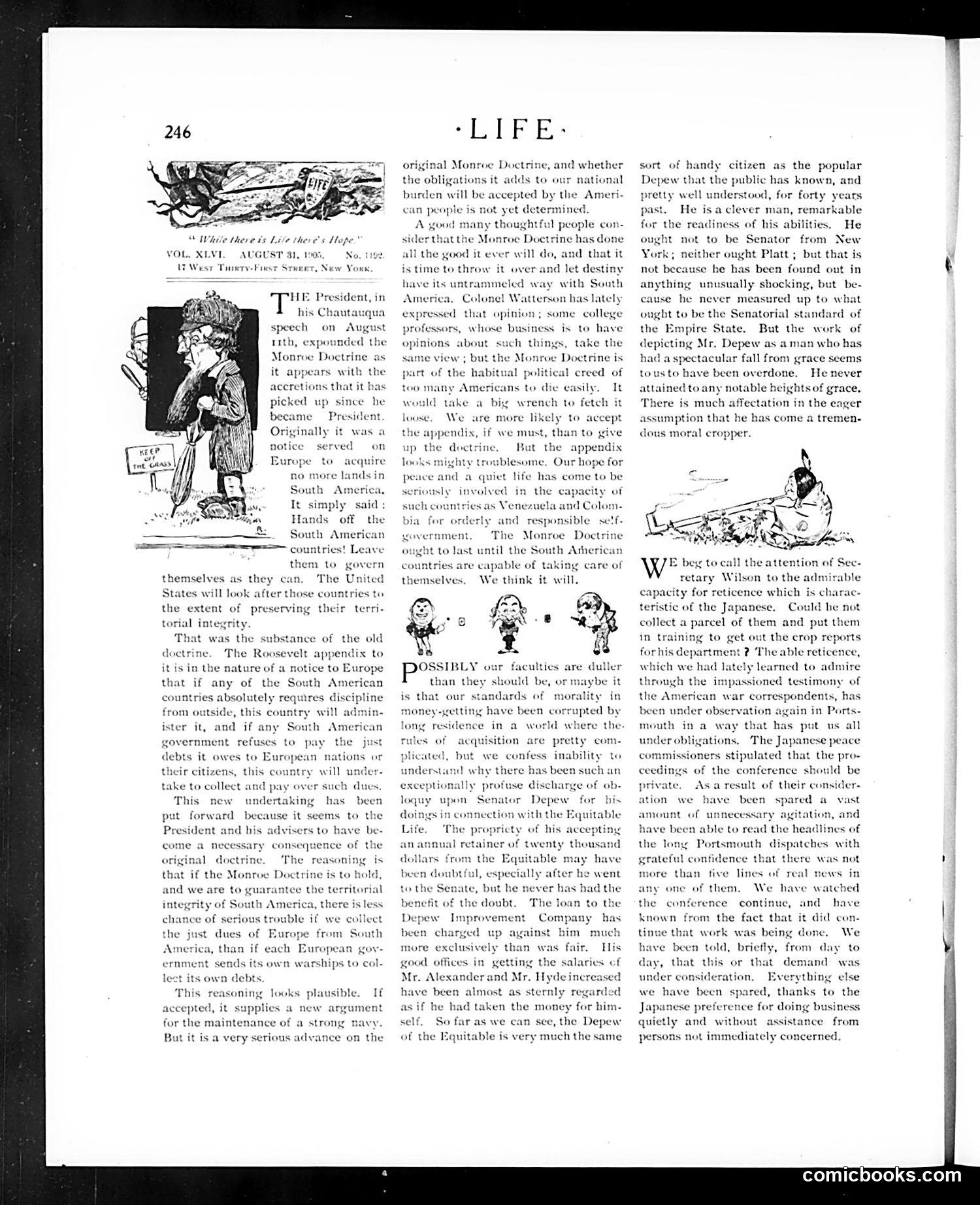
This page contains editorial commentary on President Theodore Roosevelt's August 11th Chautauqua speech regarding the Monroe Doctrine. The text debates whether the doctrine should be maintained as stated or modified. The left cartoon depicts a figure (appears to be a European power) being warned away from South America—illustrating the Monroe Doctrine's core principle of opposing European interference in the Western Hemisphere. The right illustration shows what appears to be Japanese figures, connecting to a separate discussion about Secretary White's admiration for Japanese efficiency and reticence. The text notes Japanese preference for conducting business "quietly and without assistance from persons not immediately concerned." The page satirizes both American foreign policy debates and comparative observations about international diplomatic styles during the Progressive Era.
📄 Transcribed text from this page (OCR, searchable)
Machine-transcribed from the original scan — historical spelling and the odd misread are preserved.
“White there ts Life there's Hope.” LVL AUG) No. 1192. Wes Trnery-Fuest Srreer, New Yous, HE Py his Chautauqu esident, in speech on August rith, expounded the Monroe Doctrine as it appears with the accretions that it picked up since he became President Originally i notice served = on was a Europe to acquire no m nds in outh Ar It simply Hands o' South Americ countries! Leave the to govern The United States will look after those countries to themselves as the the extent of preserving their terri- torial integrity. That was the substance of the old doctrin The Roosevelt appendix to it is in the nature of a notice to Europe that if any of the South American psolutely requires discipline from outside, this country will ad ister it, and if any South Ame: countries government refuses to pay the ju debts it owes to European nations their citizens, this coun take to collect an This new try will und pay over such dues. dertaking has been put forward because it seems to the Presi ne a neces Jent and his advisers to have be- ary consequence of the riginal doctrine. The reasoning is that if the Monroe Doctrine is to hold, rantee the territorial th chance of serious trouble if we collect Surope from South and we are to gus integrity of South Americ: cis less e just dues of America, than if each European gov- rships to col- t sends its own wv rome ect its own debts. This reasoning looks plausible. If accepted, it supplies a new argument for the mainte: But nance of a strong t is a very serious advance on the burden will be accepted by the Ameri- cin people is not yet determined, A yood many thoughtful people con- sider thatthe Monroe Doctrine has done and that it is time to throw it over and let destiny all the yood it ever will de a ath have its untrammeled way with S America. Colonel Watterson has lately expressed that opinion some college professors, whose business is to have opinions about such things, take the Monroe Doctrine is ne view ; but th part of the habitual political creed of » many Americans to die easily, It would take a big wrench to fetch i loose. We are more likely to accept the appendix, if we must, than to give 1p the doctrine. But the appendix hty troublesome. Our hope for looks peace and a quiet life has come to be seriously involved in the capacity of such countries as Venezuela and Colom- bia for orderly and responsible se! vernment The Monroe Doctrine ought to last until the South Atherican countries are capable of taking care of themselves. We think it will. OSSIBLY our than the is that our st aculties are duller uld be, or maybe it ndards of ality in money-xetting have been corrupted by long residence in a world where the acquisition are pretty com. cated, but we confess inability to ndersti why there has been such an b- exceptionally profuse discharge « loquy upon’ Si doings in con Life. The p an annual retainer of nator Depew for bis itable priety of his accepting twenty thousand nection with the Eq dollars from the Equitable n ay have rhe went ithe ally aft e never has ie doubt. The loan to benefit of t Dey been cha ew Improvement Company bas im much air, His good offices in getting the salaries cf Mr. Alexander and Mr. Hyde increased rded uinst sed up more exclusively than wa have been almost as sternly reg: as if he had taken the moncy for bim- self aras we can sce, the Depew of the juitable is very much the same sort of handy citizen as Depew that the public h the popular known, and d, for forty years past. He isa clever man, remarkable for the readiness of his abilities. He pretty well underst ought not to be Senator from New ork; neither ought Platt; but that is not because he has been found out in anything unusually shocking, but be- cause he never measured up to what ought to be the Senatorial standard of the Empire Stat But the work of depicting Mr. Depew as a man who has had a spectacular fall from grace seems t attained to any nota There is much affectation assumption that he isto have been overdone. He never ple heights of grace, or s come a tremen- the eag moral cropper. W E beg to call the attention of Sec- retary Wilson to the admirable capacity for reticence which is charac- vuld he not collect a parcel of them 1 put th in tri to get out the crop reports for his depart ? The able reticence hich we had Jately learned to admire teristic of the Japanese, C em ini through he impassioned testimony of the American war correspondents, has been under observation again in Ports- mouth in a way that has put us all under obligations, The Japanese peace m7 commissioners stipulated that the pro- ceedings of the conference should be private, Asa result of their consider- ation we have been spared amount of unnecessary agitation ve been able to read the head! the long Portsmouth dispatches with grateft more th one of them, We have watched l confidence that there was not an five lines of real news in the conference continue, and have known from the fact that it did con- tinue that work was being done. We told, briefly, from day to day, that this or that demand was under consideration, Everything else red, thanks to the se preference for doing business we have been sy Japar quietly and without assis nce from persons not immediately concerned, comicbooks.com