
Life, 1905-08-31 · page 14 of 24
Life — August 31, 1905 — page 14: what you’re looking at
What you’re looking at
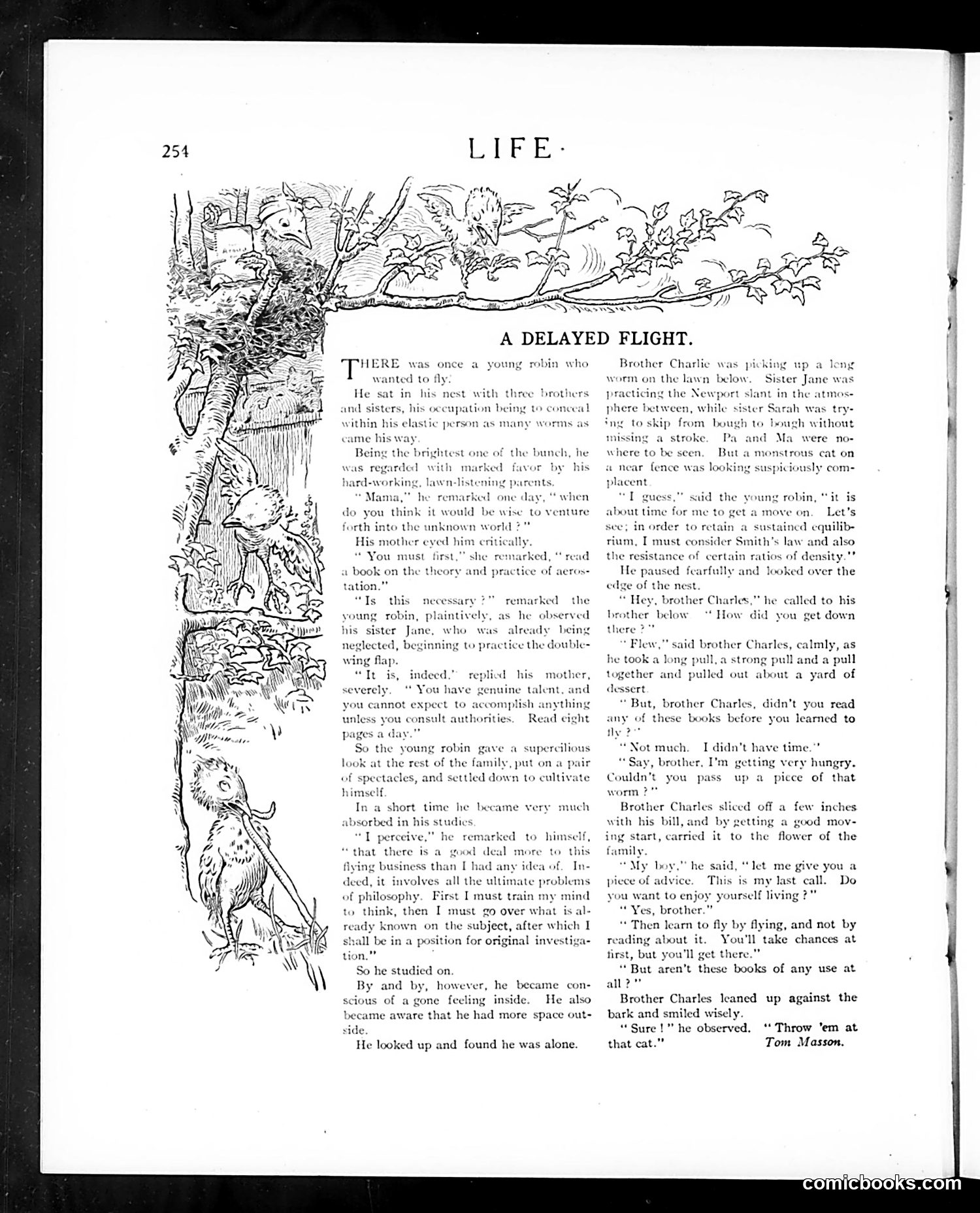
This is a humorous fable criticizing over-intellectualization and academic pedantry. A young robin wants to learn to fly but consults books on "theory and practice of aerostation" rather than simply attempting flight like his practical brother Charlie. The satire targets the era's tendency to overthink simple matters through excessive study—the young robin gets lost in philosophy, studying "ultimate problems" and proper "training of the mind" while his siblings naturally accomplish the task through experience. The punchline arrives when the starving young robin finally asks brother Charlie how he learned: Charlie admits he didn't read the books, just did it. When asked what the books are good for, he replies: "Throw 'em at that cat"—suggesting they're only useful as a weapon against danger, not for actual learning. **Attribution**: Credited to Tom Masson at bottom. The illustration shows robins in a nest, accompanying this early 20th-century critique of academic over-preparation versus practical action.
📄 Transcribed text from this page (OCR, searchable)
Machine-transcribed from the original scan — historical spelling and the odd misread are preserved.
HERE was once wanted to fly; He sat in his nest with and sisters, his occupation being to ¢ a young robin who within his elastic perso asm, ame his way B rightest one of the bune as regarded with marked favor by ard-working, lawn-listening parents. * Ma: he remarked one day, “ when 1 be wise de » you think it wou to venture rth into the unknown w His mother eyed him er “You must a book on the theory and pra first,” she remarked, ked as he observed this young robin, plaintively necessary the his sister Jane, who was already De to practice the double= ¢ flap. “Tt is, dd." replied his mother, severely nuine talent, and you cannot expect to accomplish ties. Ri unless you consult at pages a ¢ So the young robin gave a supercilious look at the rest of the family, put on a pair spectacles, and settled down to cultiv himself In a short time he absorbed in his studies I perceive," he t there is a ness than [ became very much remarked to himself, to this 1 any idea of deal more flying In- deed, it involves all the ultimate problems First I must train my mind to think, then I must go over what i: ready known on the subject, after which I hall be in a position for original investi tion.” So he studied on By and by, however, he became con- scious of a ing inside. He also are that he had more space out- of philosophy became a side. He looked up and found he was alone. A DELAYED FLIGHT. Brother Charlie worm on the lawn below practicin: phere between, while ing to skip fr was er Jane was the Newport slant in the atmo: missing a stro! were no- jonstrous cat on cre to be se a near fence was looking suspiciously com- jacent suid the young robin, “it is Let's 1 sustained equilib- mith’s law and also I guess," about time for me to get a move on see; in order to retai rium, I must consider the resistance f certain ratios of density He paused fearfully and looked over the edge of the nest. “ Hey, brother Charles," he called to his below“ How did you get down lew,” said brother Charles, calmly, as he took a Jong pull,a strong pull and a pull together and pulled out about a yard of dessert “ But, brother Charles, didn’t you read of these books before you learned to Ny 2 “Not much. I didn’t have time. “Say, brother, I'm getting very hungry. Couldn't up a piece of that worm ?"* Brother Charles sliced off a few inches etting a good mov- start, carried it to the flower of the family you pass “Yes, brother. “ Then learn to fly by flying, and not by reading about it. You'll take chances at first, but you'll get there.” “ But aren’t these books of any use at all?” Brother Charles leaned up against the bark and smiled wisely. Sure!" he observed. that cat.” “Throw ‘em at Tom Masson.