
A complete issue · 24 pages · 1905
Life — July 27, 1905
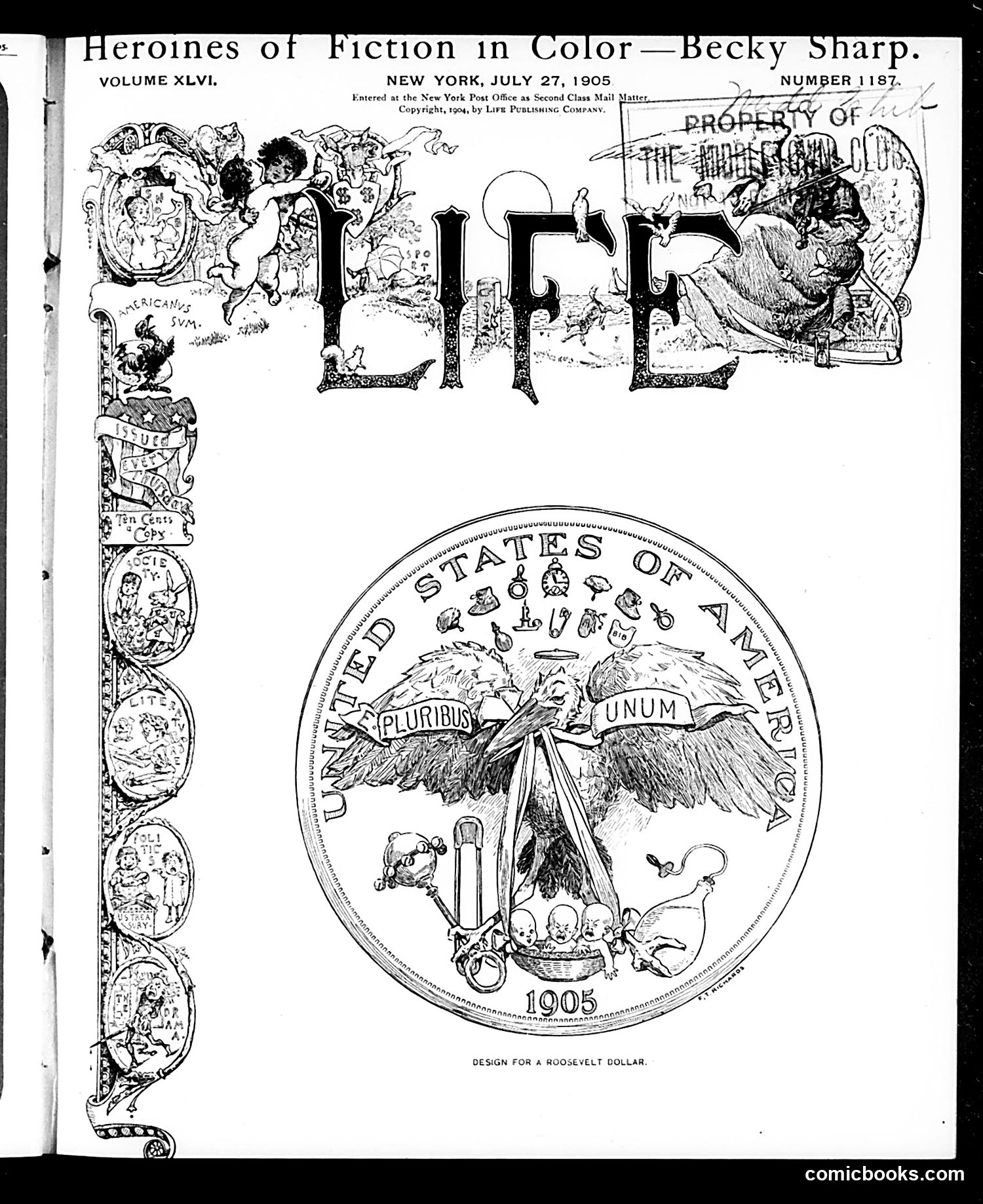
This is a cover for *Life* magazine's "Heroines of Fiction in Color" series by artist Becky Sharp. The central image shows a design for a Roosevelt Dollar coin, featuring an eagle with spread wings holding a banner reading "E PLURIBUS UNUM," surrounded by cherubs and dated 1905. The satirical point likely mocks President Theodore Roosevelt's prominence and popularity during his second term—suggesting his image dominated American currency and culture. The decorative border on the left contains classical vignettes, reinforcing the grandiose treatment of Roosevelt-era imagery. The magazine title "LIFE" dominates the top with ornamental lettering, typical of *Life's* satirical style toward political figures and contemporary events of the Progressive Era.
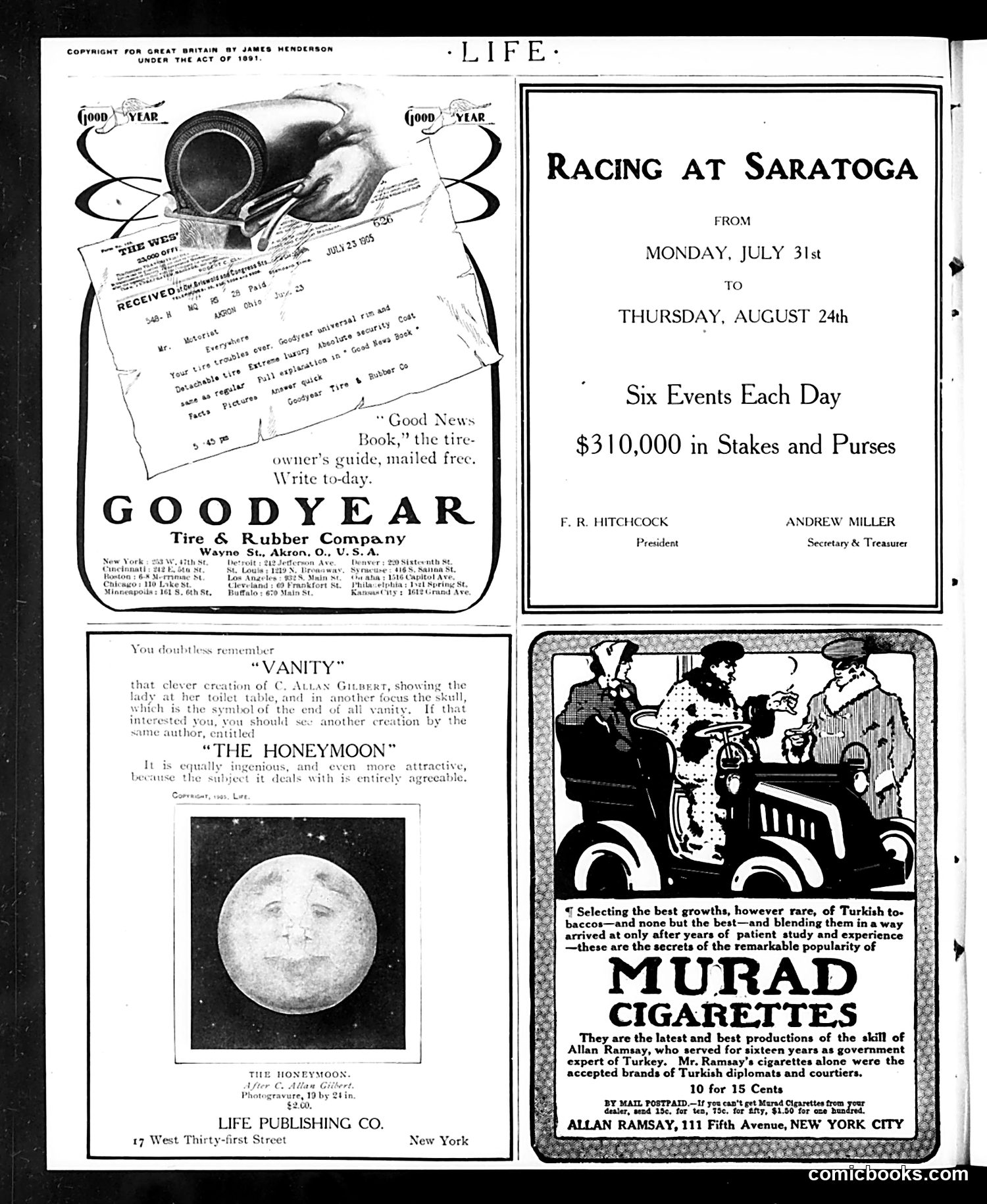
This page is primarily **advertising**, not political satire. It contains: 1. **Goodyear Tire & Rubber Company ad** (left): Promotes a free tire owner's guide using a "Good Year" visual pun with a anthropomorphized barrel or container. 2. **Saratoga Racing announcement** (top right): Details for horse racing events July 31–August 24, featuring six daily events and $310,000 in stakes—a straightforward sporting promotion. 3. **Literary advertisement** (bottom left): Promotes "The Honeymoon," a book by C. Allan Gilbert, featuring an eerie moon-face image—appears to be supernatural or gothic fiction marketing. 4. **Murad Cigarettes ad** (bottom right): Markets Turkish tobacco cigarettes with an automobile scene, emphasizing selection quality and Turkish expertise. The page reflects early 20th-century consumer advertising rather than editorial political content.
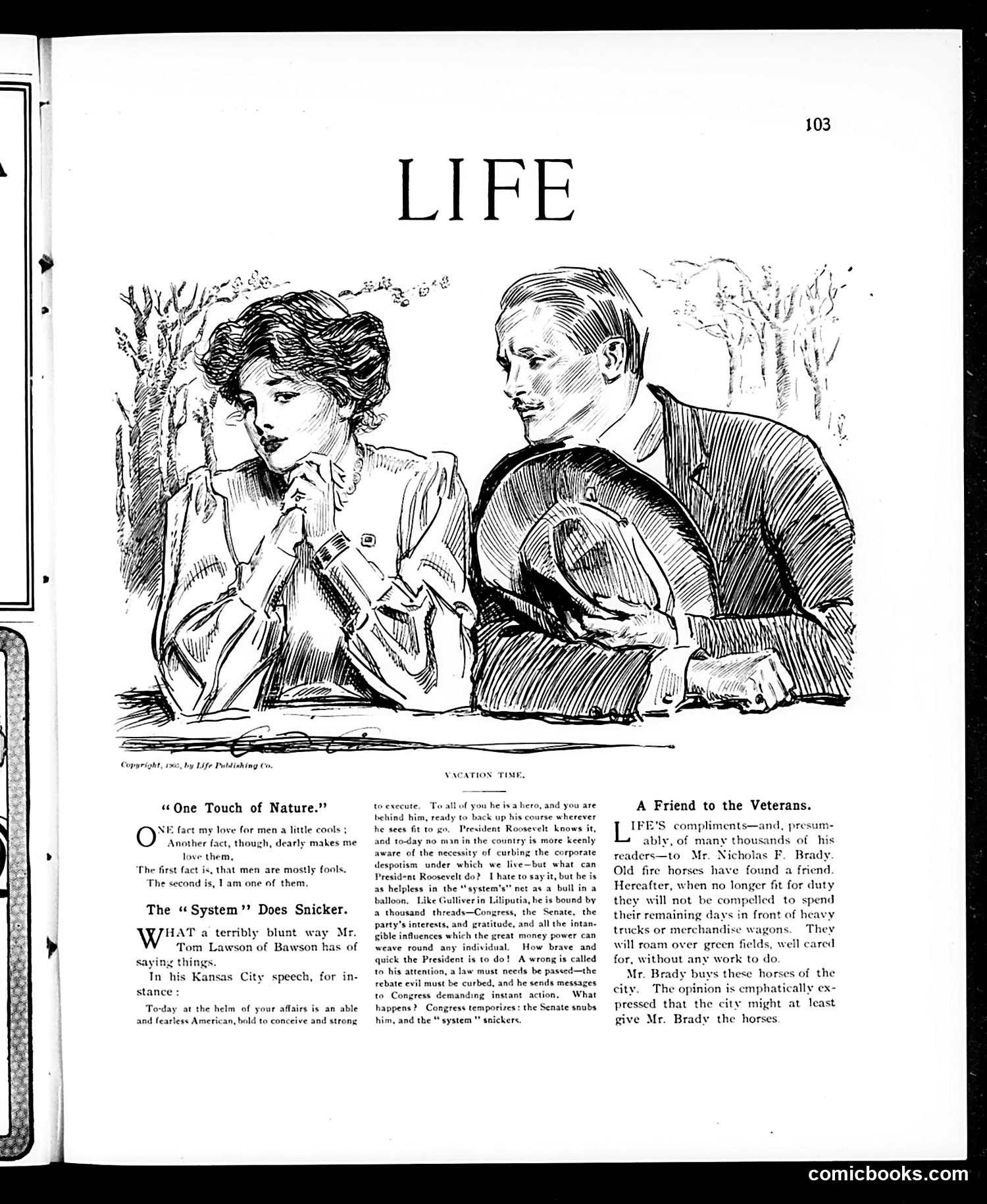
This *Life* magazine page satirizes President Theodore Roosevelt's political communication style. The main cartoon shows a couple on vacation, with the woman expressing concerns while the man responds with characteristic Roosevelt bombast. The text mocks Roosevelt's tendency toward aggressive rhetoric and direct action. "The System Does Snicker" critiques his blunt approach to governance, quoting his Kansas City speech about American boldness. The piece suggests Roosevelt's solutions—demanding Congress pass legislation quickly—reflect impatience with democratic processes rather than practical problem-solving. "A Friend to the Veterans" praises Roosevelt for supporting Mr. Brady's old cavalry horses, presenting him as a man of action who cares for details others overlook. The satire captures early-1900s frustration with Roosevelt's energetic but sometimes ham-fisted executive style.
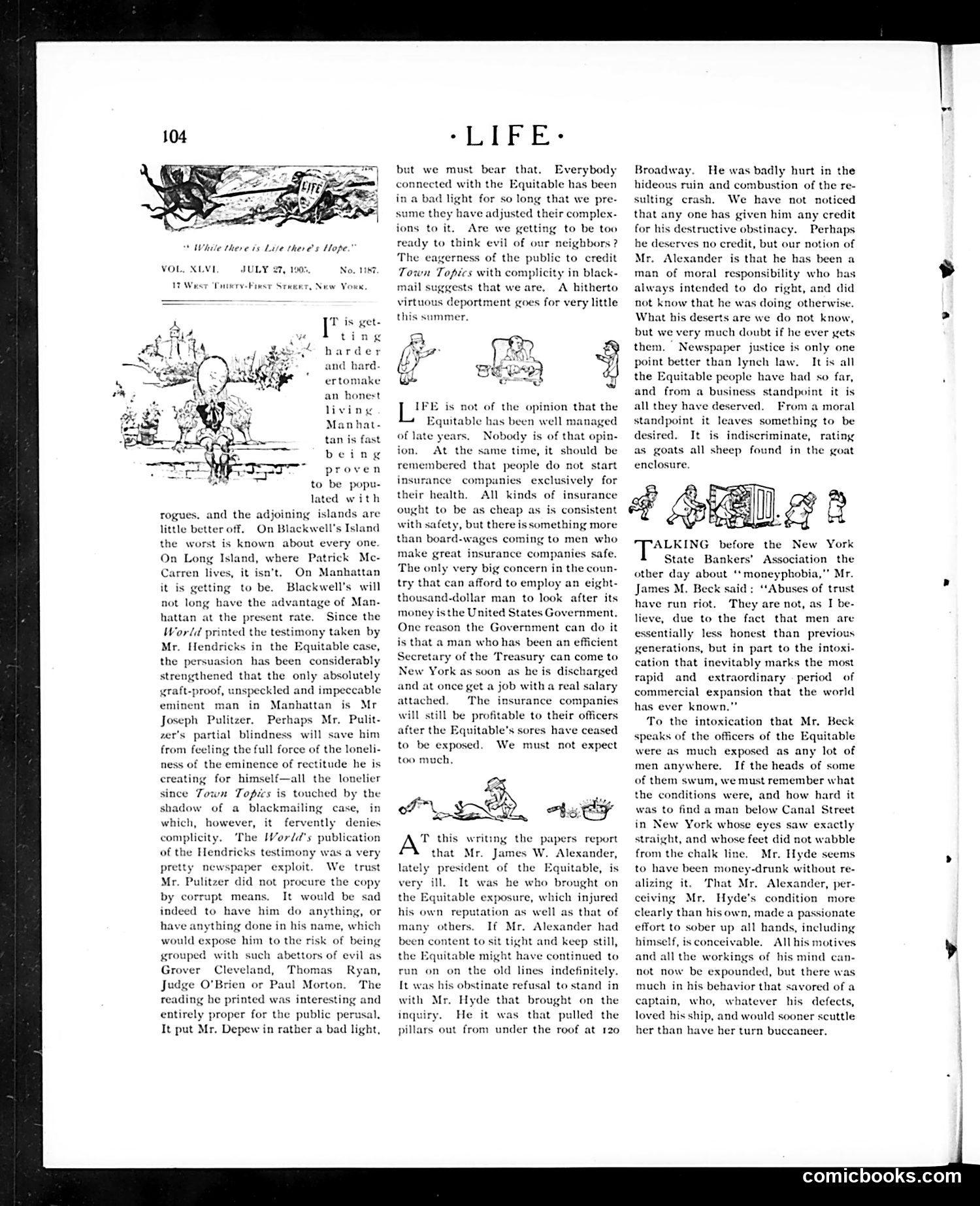
The main cartoon, titled "While There's Life There's Hope," depicts Manhattan as a chaotic organism infested with parasites and disease. The satire critiques corruption in New York City government and business, particularly regarding insurance fraud and mismanagement. The accompanying text discusses the Equitable Life Insurance scandal, referencing figures like James W. Alexander (Equitable's president, who became ill) and Mr. Hendricks. The article criticizes insurance company officers for dishonesty and suggests government officials like a discharged Treasury Secretary could expose corruption if employed to investigate. The cartoon's grotesque imagery and the text's sarcastic tone mock both corporate malfeasance and the public's naive trust in institutions—typical Progressive Era satire targeting monopolies and fraud.
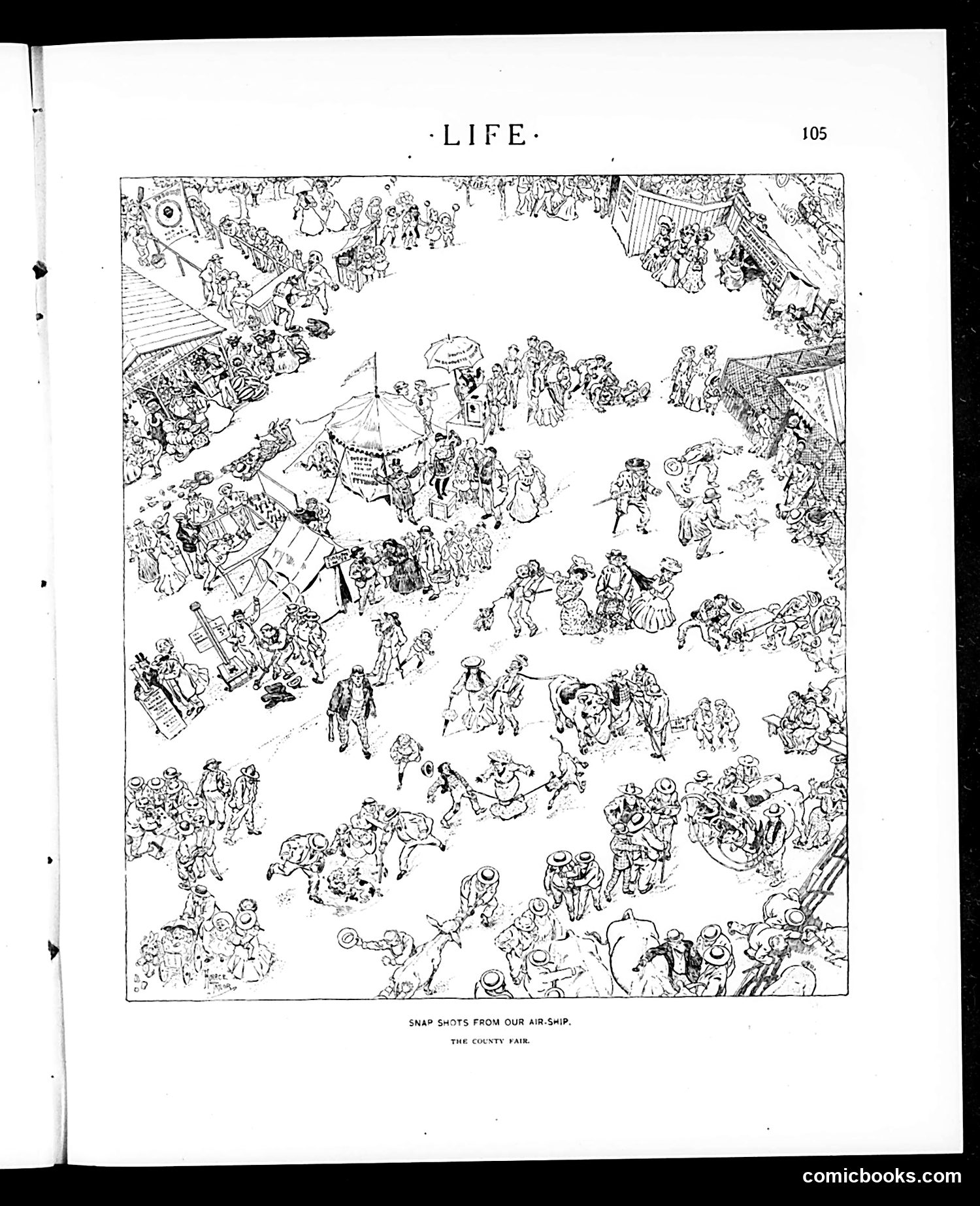
This is a bird's-eye view illustration of a county fair, presented as if photographed from an aircraft above. The drawing depicts numerous fairgoers scattered across the grounds engaging in typical county fair activities—viewing exhibits, watching performances, and enjoying attractions. A large tent dominates the left side, with various booths and structures visible throughout. The satire likely plays on the novelty of aerial photography and aircraft technology (relatively new in the early 1900s when Life published this), presenting an amusing overhead perspective of ordinary rural American life. The humor derives from the contrast between sophisticated modern aviation and humble small-town fair activities, rendered in intricate detail showing human activity from an unfamiliar vantage point.
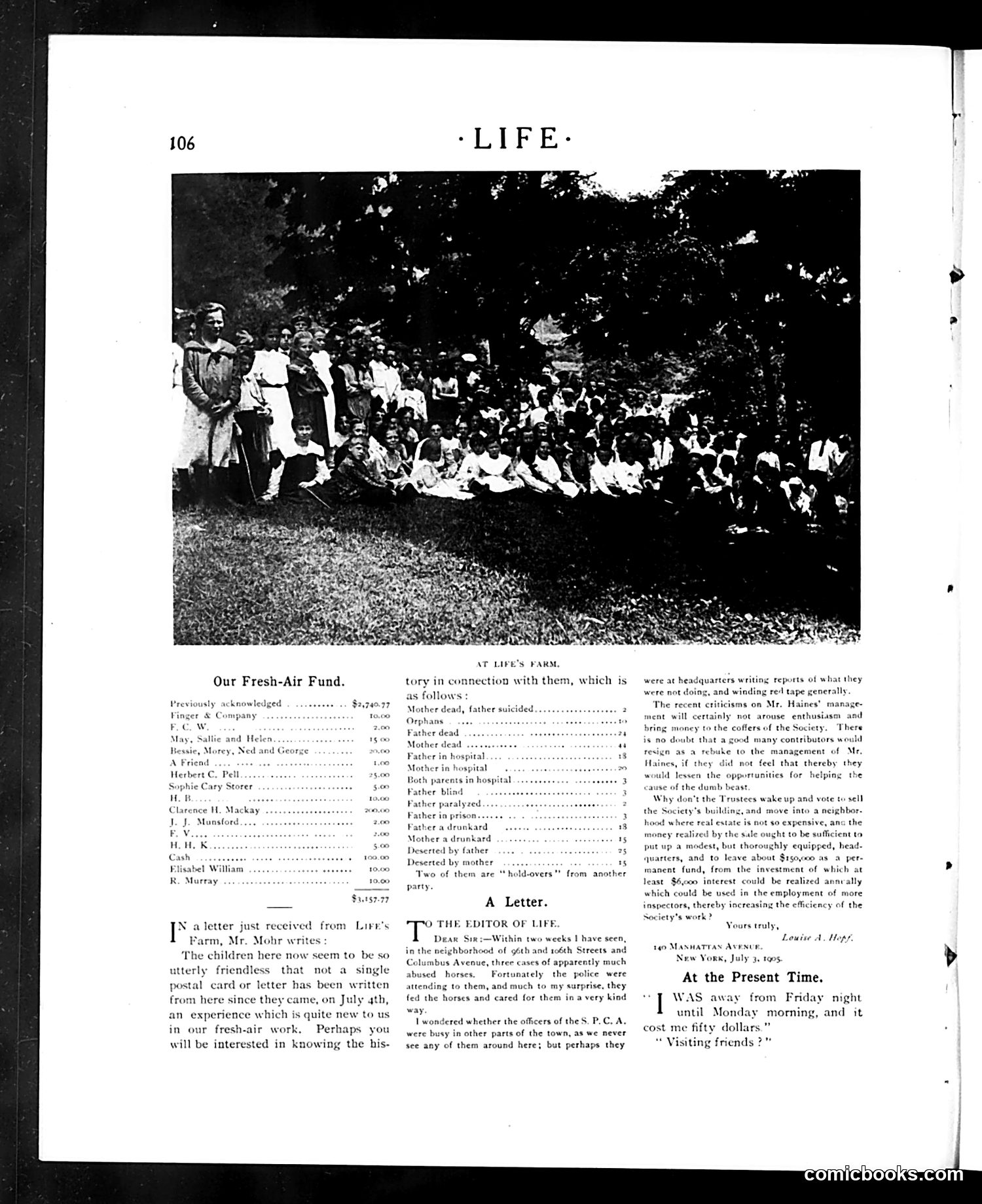
The page features a photograph labeled "AT LIFE'S FARM" showing a large group gathering outdoors. Below it are three separate sections: 1. **"Our Fresh-Air Fund"** - A donation list documenting contributions to what appears to be a charitable initiative providing outdoor relief, likely for underprivileged urban children (a common Progressive-era cause). 2. **"A Letter"** - Correspondence describing animal abuse cases involving horses in Columbus Avenue, with the writer questioning whether the S.P.C.A. (Society for the Prevention of Cruelty to Animals) adequately addresses such incidents across the city. 3. **"At the Present Time"** - A brief anecdotal piece about weekend visitors and their costs. The content reflects early 20th-century urban charity work and animal welfare advocacy rather than political satire.
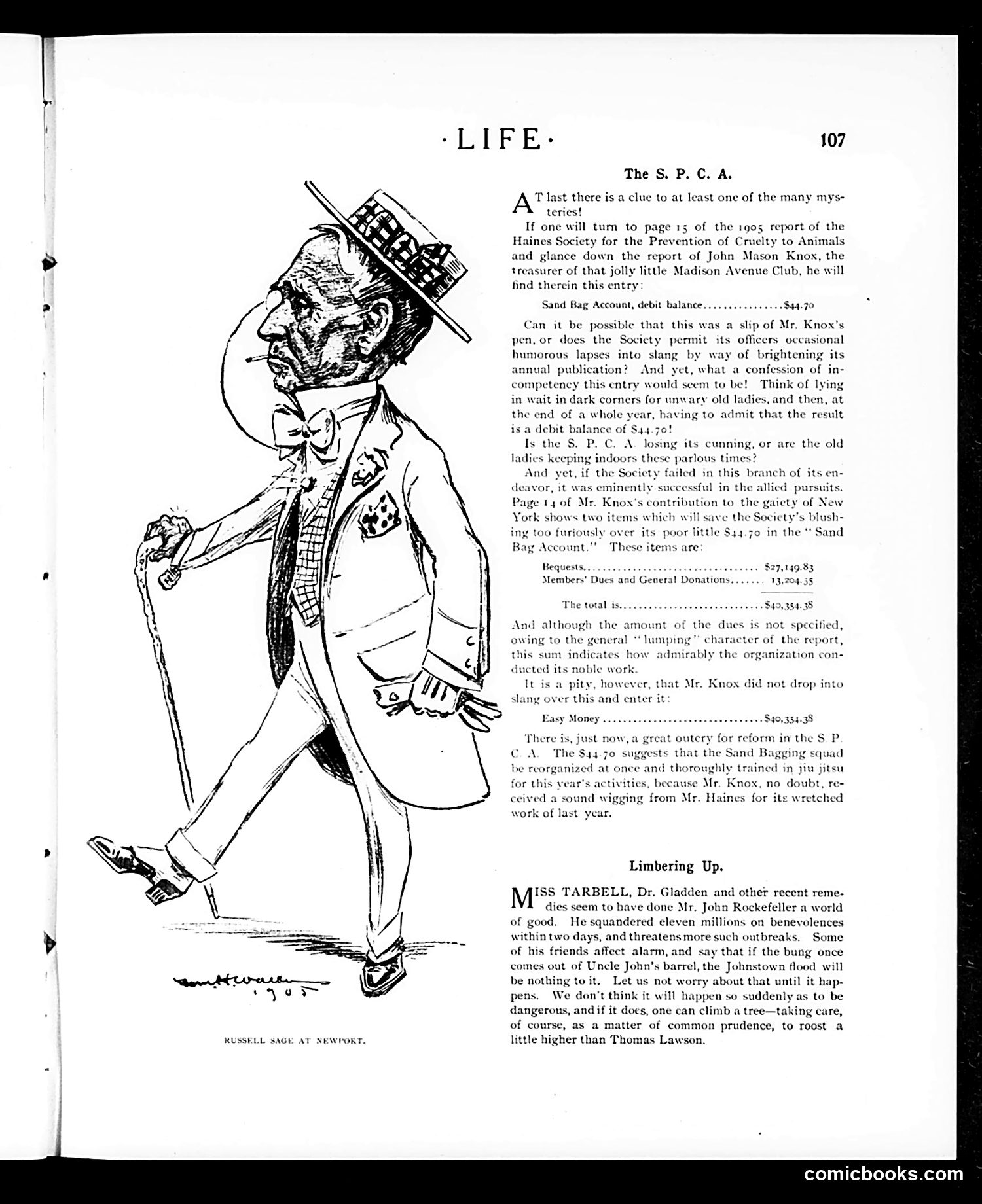
The cartoon depicts a caricatured man in formal dress carrying a large building (labeled as a club) on his head, captioned "Russell Sage at Newport." The accompanying text discusses the S.P.C.A. (Society for the Prevention of Cruelty to Animals), critiquing what appears to be a bookkeeping error—a "$44.70" debt balance in their "Sand Bag Account." The satire targets wealthy philanthropist Russell Sage, suggesting that despite his charitable donations and public benevolence, even prestigious organizations like the S.P.C.A. struggle with financial mismanagement. The visual joke of Sage literally "carrying" institutions comments on how the wealthy shoulder organizational burdens, while the text questions whether such sloppiness undermines their credibility and noble intentions.
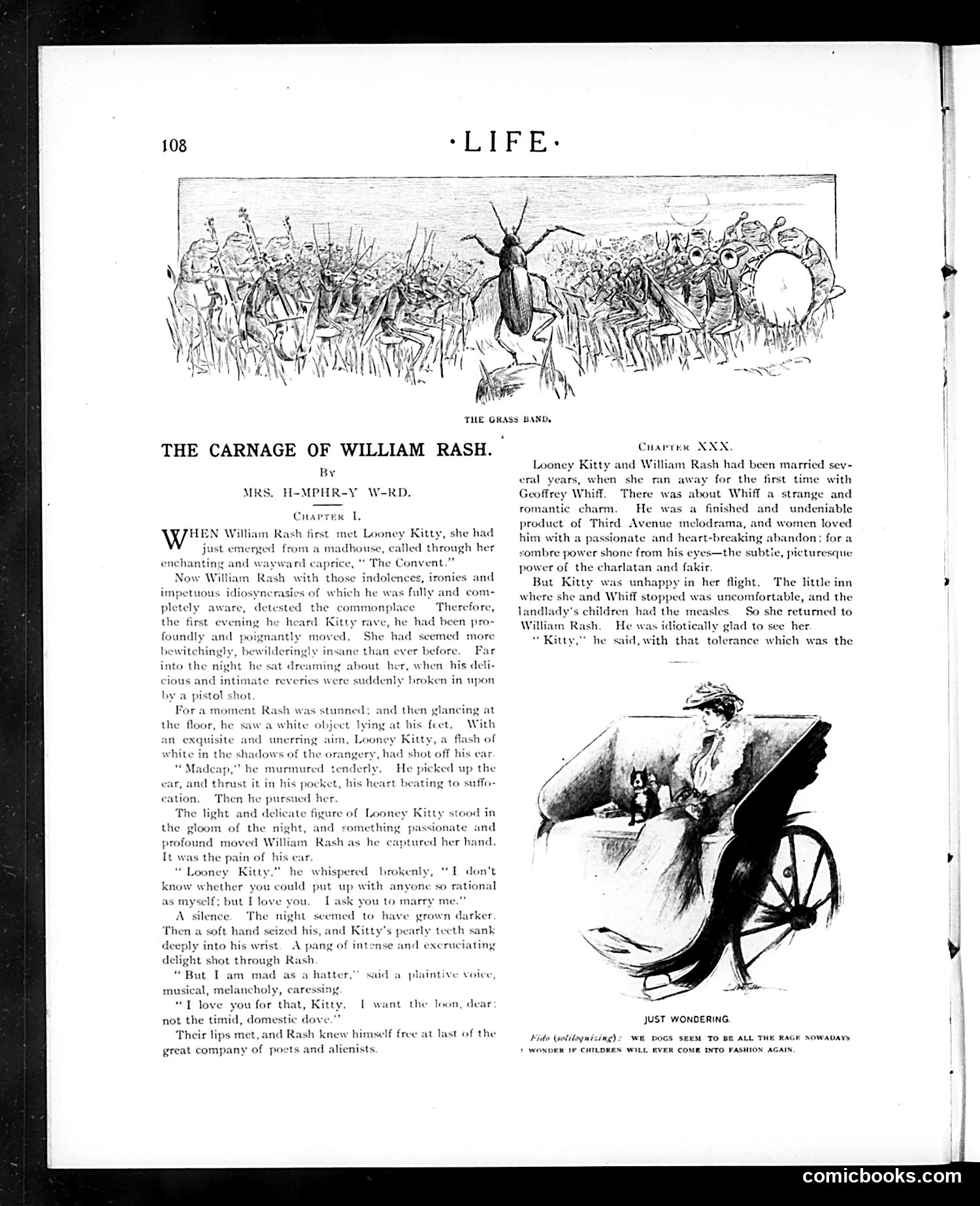
This page contains a serialized fictional story titled "The Carnage of William Rash" by Mrs. H-mphr-y W-rd (author's name partially obscured). It's a romantic narrative about William Rash and Loomey Kitty's relationship, featuring their first meeting and a marriage proposal. The top illustration shows "The Grass Band"—a humorous insect gathering, likely satirizing human social conventions by depicting insects in a concert or social assembly. The lower illustration, captioned "Just Wondering," shows a woman on a bicycle with a child in a seat, accompanied by text questioning children's fashion trends. This is **not political satire** but rather **lifestyle/social commentary**—typical of Life magazine's gentle humor about contemporary domestic life, courtship customs, and social behaviors in the early 20th century.
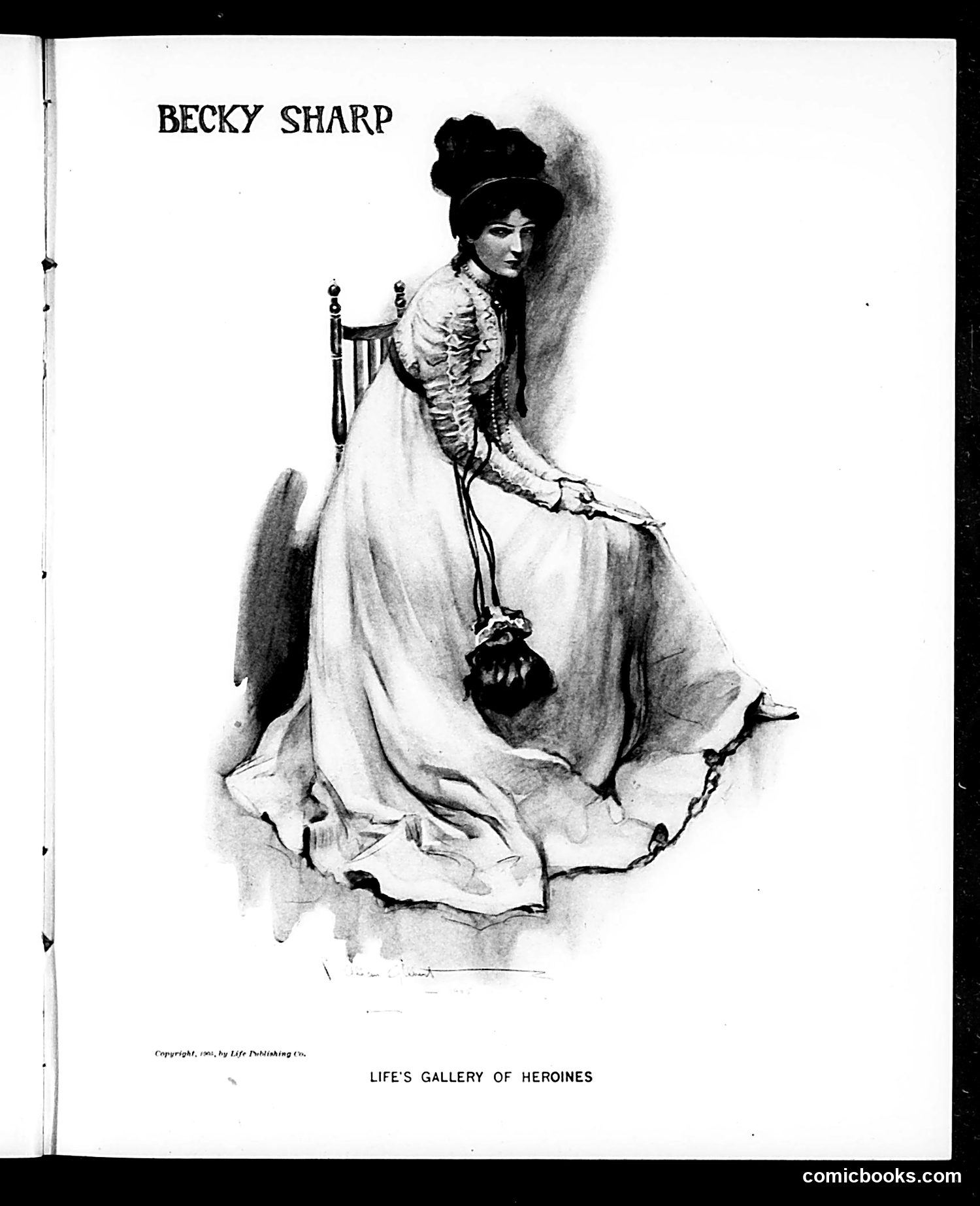
This is a portrait illustration titled "Becky Sharp" from "Life's Gallery of Heroines," a series featuring notable female characters. The figure is drawn in an elegant Edwardian style, seated and wearing a flowing white gown with ornate patterned sleeves, an elaborate upswept hairstyle with feathered decoration, and holding a small decorative bag. Becky Sharp is the central character from William Makepeace Thackeray's 1848 novel *Vanity Fair*. She's portrayed as an ambitious, cunning social climber who uses charm and manipulation to advance herself. This series likely celebrated famous female literary characters for *Life* magazine readers. The illustration captures her as sophisticated yet calculating—fitting for a character whose name became synonymous with social ambition and moral flexibility in Victorian literature.

I can see this is a page from Life magazine, but the image shows essentially a blank white page with only the "comicbooks.com" watermark visible at the bottom right and what appears to be binding marks on the left and right edges. There is no visible cartoon, illustration, text content, or other substantive material on this page that I can analyze. The OCR text provided appears to be empty or failed to capture any actual content. Without visible imagery or legible text to examine, I cannot identify figures, caricatures, political/social references, or explain any satirical points. This appears to be either a blank page, a scanning error, or a page from an advertisement section.
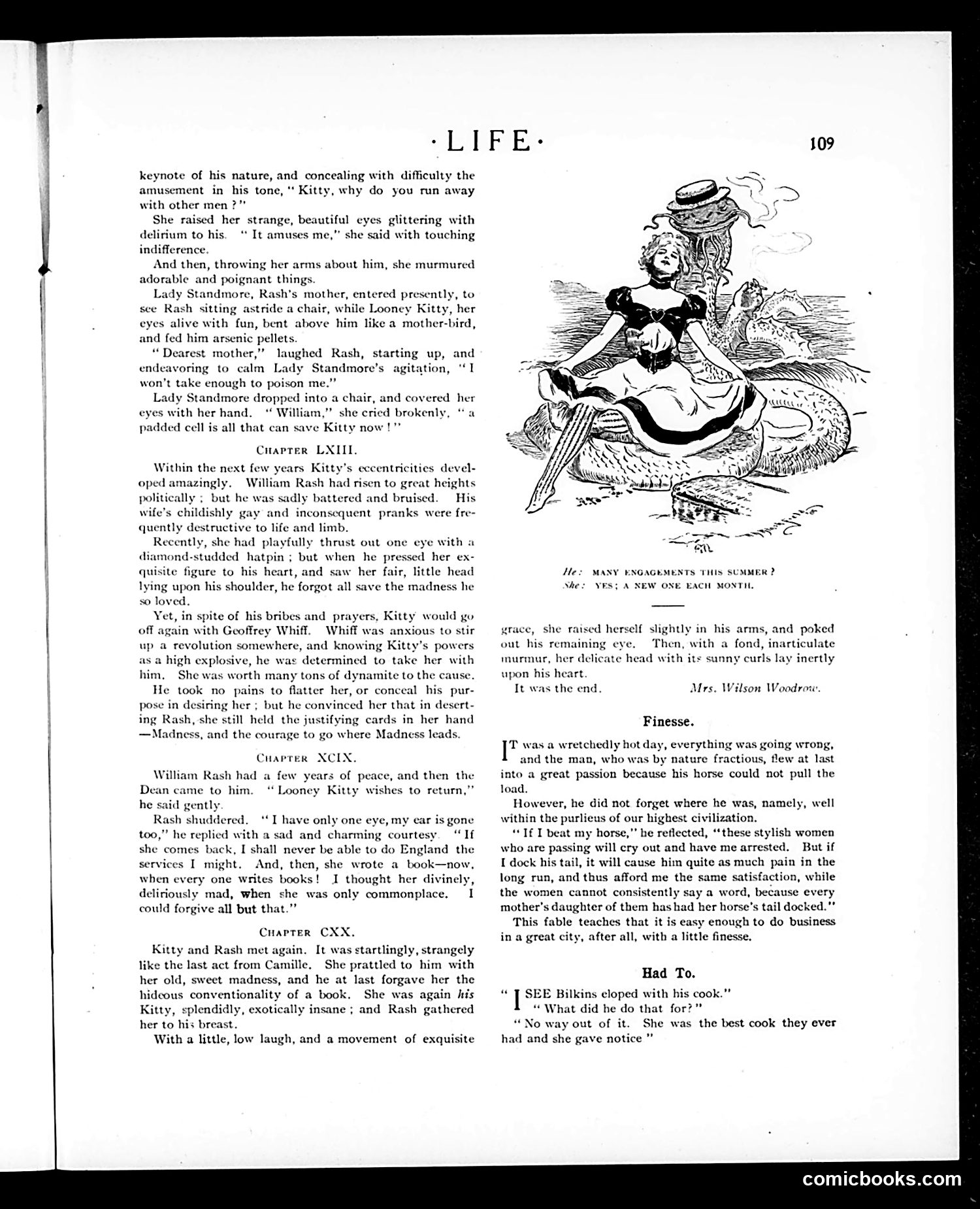
This page contains literary fiction rather than political satire. The text describes chapters from what appears to be a serialized novel featuring characters named William Rash, "Looney Kitty," and Lady Standmore. The illustration shows a woman in Edwardian-era dress seated outdoors with a man, likely depicting a romantic scene from the narrative. Below the main fiction are two short humorous pieces: "Finesse" (satirizing how men justify mistreating horses in cities) and "Had To" (a brief comic dialogue about a cook's resignation). This page represents Life magazine's mix of serialized fiction and light humor rather than its better-known political cartoons. Without additional context about the novel's publication dates or authors, specific historical references cannot be identified.
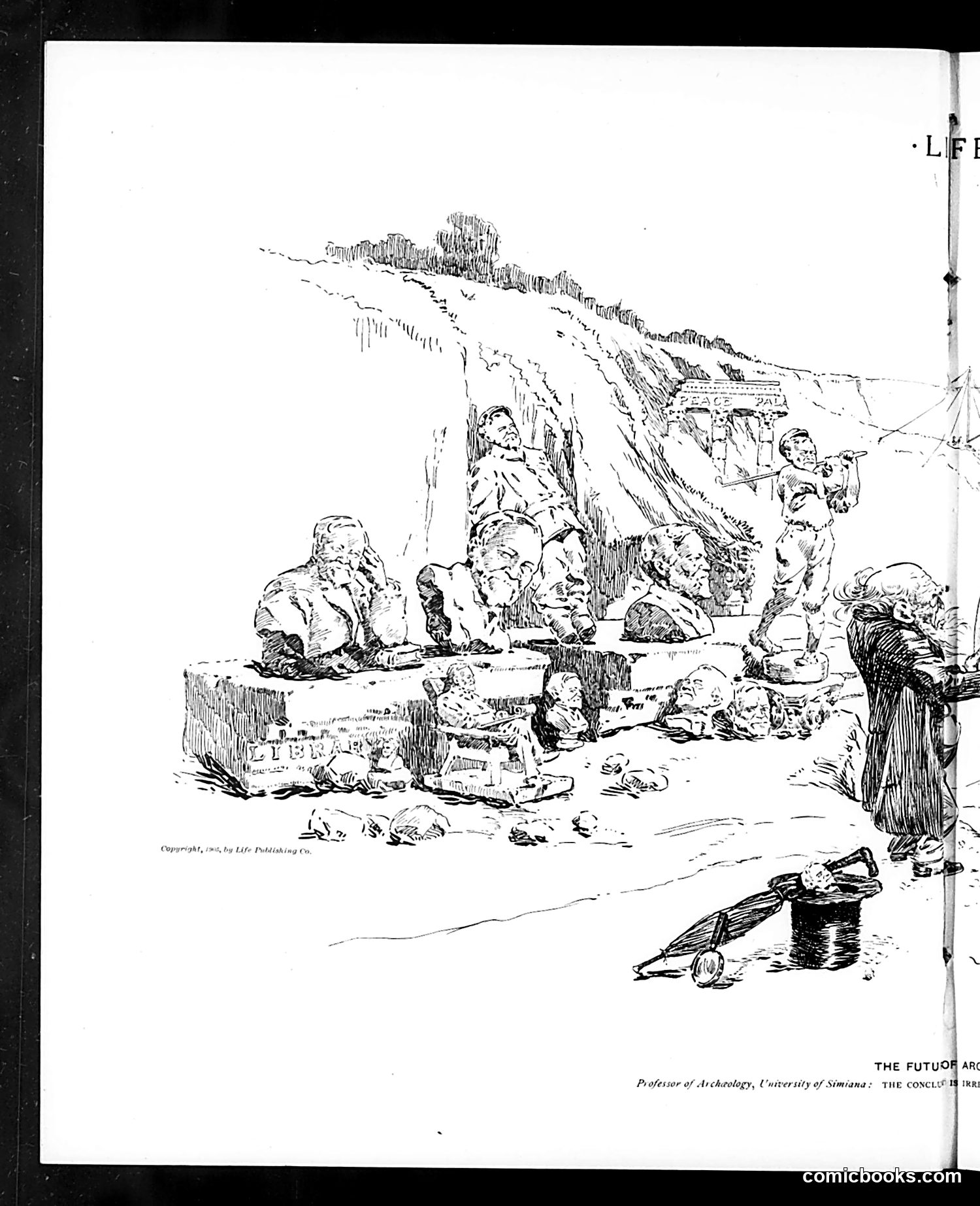
This satirical illustration depicts an archaeological excavation scene at what appears to be an ancient site, with cliffs and ruins visible. The caption references "Professor of Archaeology, University of Simiana" and mentions "The Conclusion" of something (text partially cut off). The cartoon appears to be satirizing academic pretension or archaeological speculation—possibly mocking scholars who make grand claims about ancient civilizations based on limited evidence. The numerous figures examining artifacts and engaging in animated discussion suggest the chaos of competing interpretations. The casual, almost comic treatment of the "serious" academic work implies skepticism toward the field's conclusions. Without the complete caption, the specific target remains unclear, though the satire likely critiques how archaeologists or academics present uncertain findings as definitive truth.
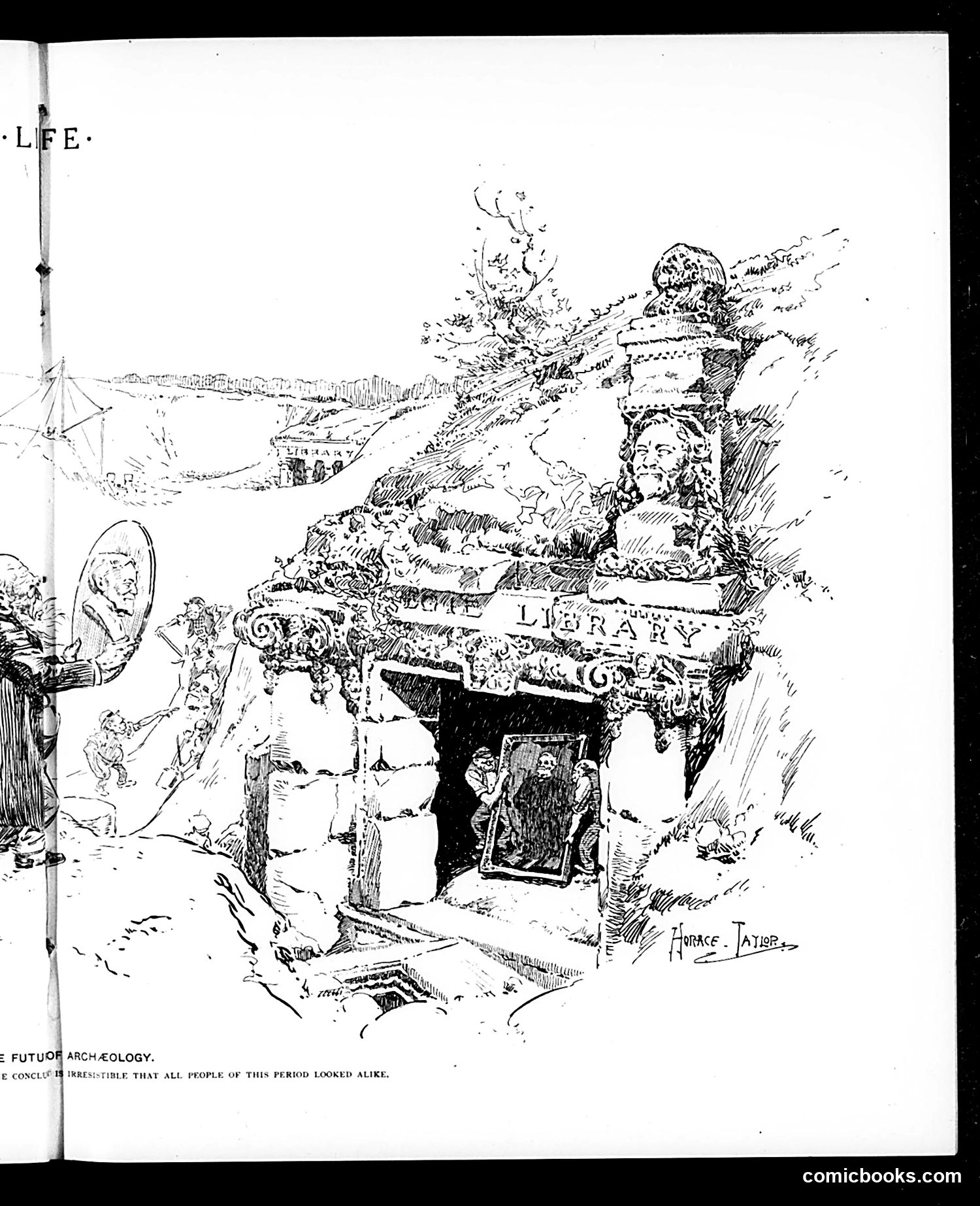
This is a satirical illustration by Horace Tayler depicting "Future Archaeology." The caption states the artist's conclusion that "all people of this period looked alike." The cartoon imagines future archaeologists excavating and studying artifacts from the present day. It shows a classical-style library or monument with busts and sculptures, suggesting how future scholars might misinterpret or misunderstand contemporary civilization through limited material remains. The satire likely critiques either: 1. **Standardization of modern life**—that contemporary society produces uniform, indistinguishable people and culture, or 2. **Archaeological/scholarly methods**—mocking how historians and archaeologists make sweeping conclusions from incomplete evidence The exaggerated, identical-looking sculptural faces reinforce the joke about homogenization or faulty historical interpretation.
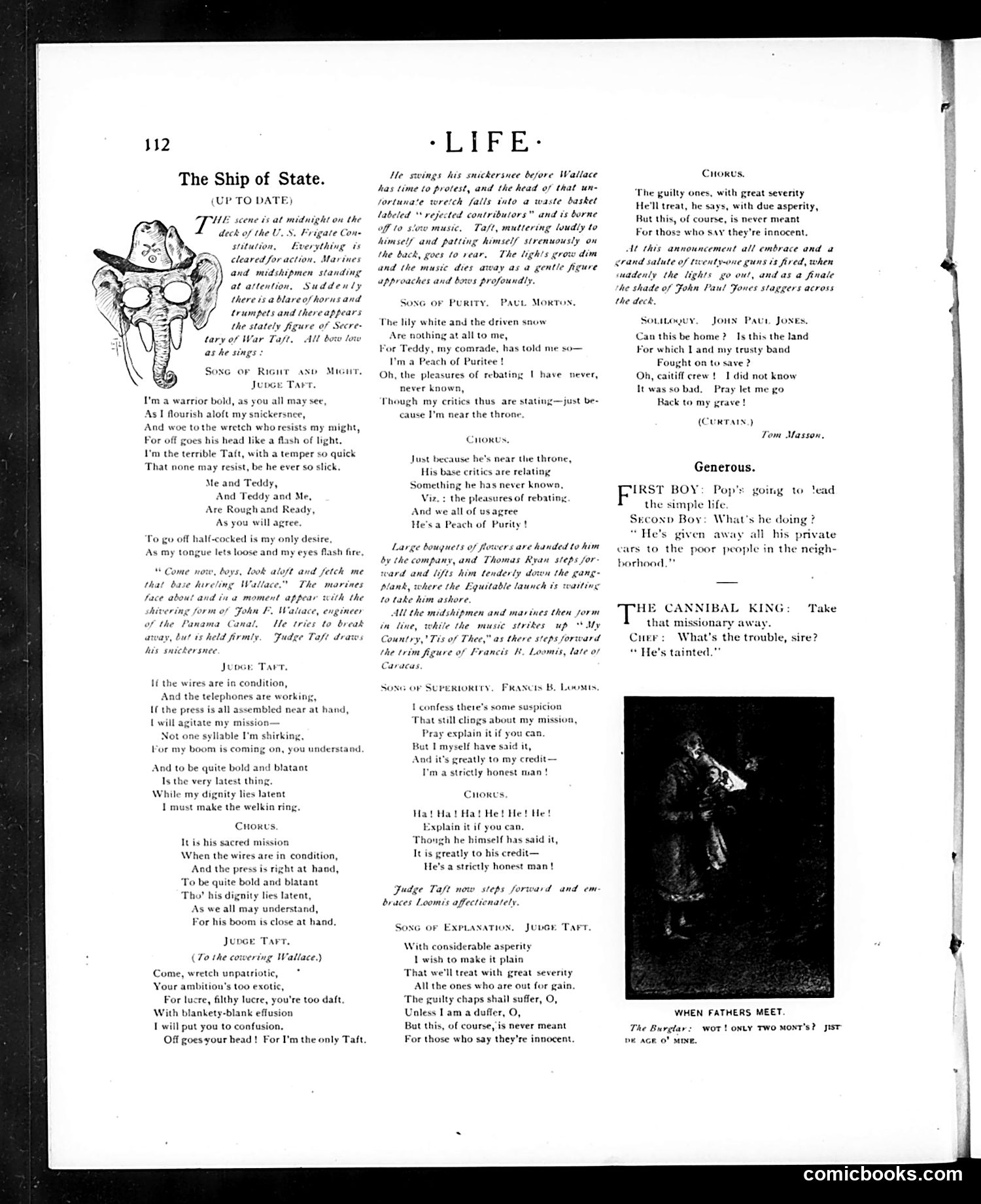
This is a satirical musical theatrical piece mocking President Theodore Roosevelt's administration, circa 1909. The cartoon depicts the USS Constitution as a stage where political figures perform. **Key figures identified:** - **Judge/Secretary William Howard Taft** - portrayed as a violent, temperamental warrior with a sword ("snickersnee"), dominating the narrative - **John F. Wallace** - engineer of the Panama Canal, literally beheaded for disloyalty (rejected as a "contributor") - **Paul Morton** - depicted singing about "purity" while receiving flowers - **Francis B. Loomis** - former diplomat, performing a song defending his controversial mission to Caracas **The satire's point:** The piece mocks Roosevelt's inner circle as theatrical performers pretending to virtue (purity, honesty) while actually wielding power arbitrarily and violently. Taft, positioned as Roosevelt's successor, is caricatured as aggressive and destructive toward those deemed disloyal. The musical format emphasizes the performative nature of their public righteousness versus private ruthlessness. This reflects contemporary Progressive-era criticism of executive power and political hypocrisy.
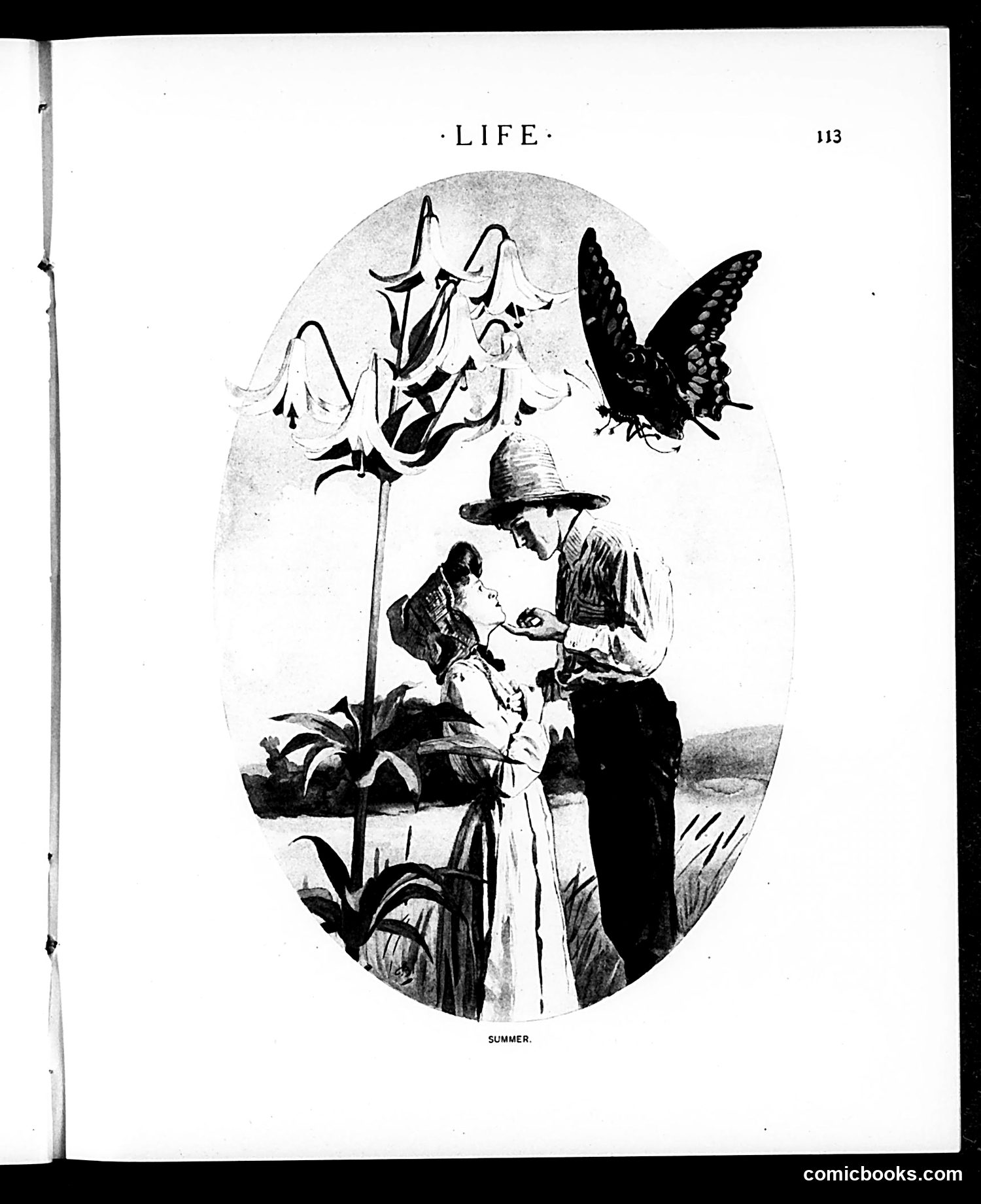
This is a seasonal illustration titled "Summer" from *Life* magazine (page 113). The image depicts a romanticized rural scene: a young woman in light dress and a man wearing a straw hat stand together among flowering plants. A butterfly hovers above the blooms, and rolling hills are visible in the background. The illustration appears to be sentimental rather than satirical—it's a straightforward romantic image celebrating summer leisure and pastoral courtship. There's no apparent political commentary or caricature. It likely served as decorative content or accompanied a story about summer romance or rural life, reflecting early 20th-century *Life* magazine's mix of humor, illustration, and lifestyle content.
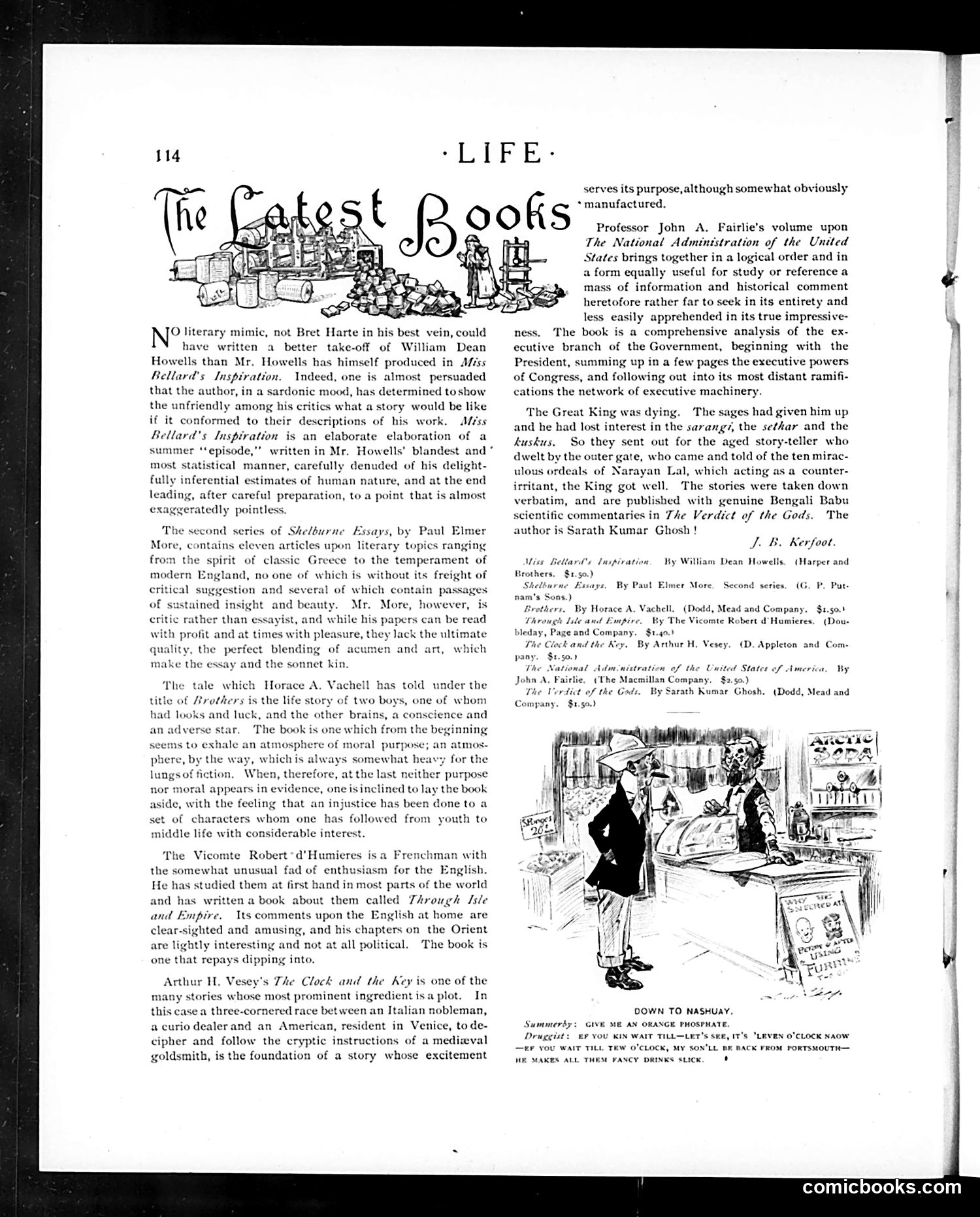
The cartoon depicts a man at what appears to be a ticket window or counter, speaking to an attendant. The caption reads: "Summers! Give me an orange phosphate / Bragget! Ever tried one, sir? / 'Never,' says I, 'levels o'clock now / If you wait till two o'clock, my son, I'll be back from Portsmouth—' / He says all their fancy drinks slick." This appears to be a humorous scene about a traveler or visitor requesting a beverage (an "orange phosphate"—a popular early 1900s soft drink). The joke seems to involve timing: the attendant claims he'll only be back from Portsmouth at two o'clock, suggesting the traveler must wait or go elsewhere for the drink. It's a light social satire about small-town New England inconvenience or the limited availability of modern refreshments, playing on period expectations about rural service establishments.
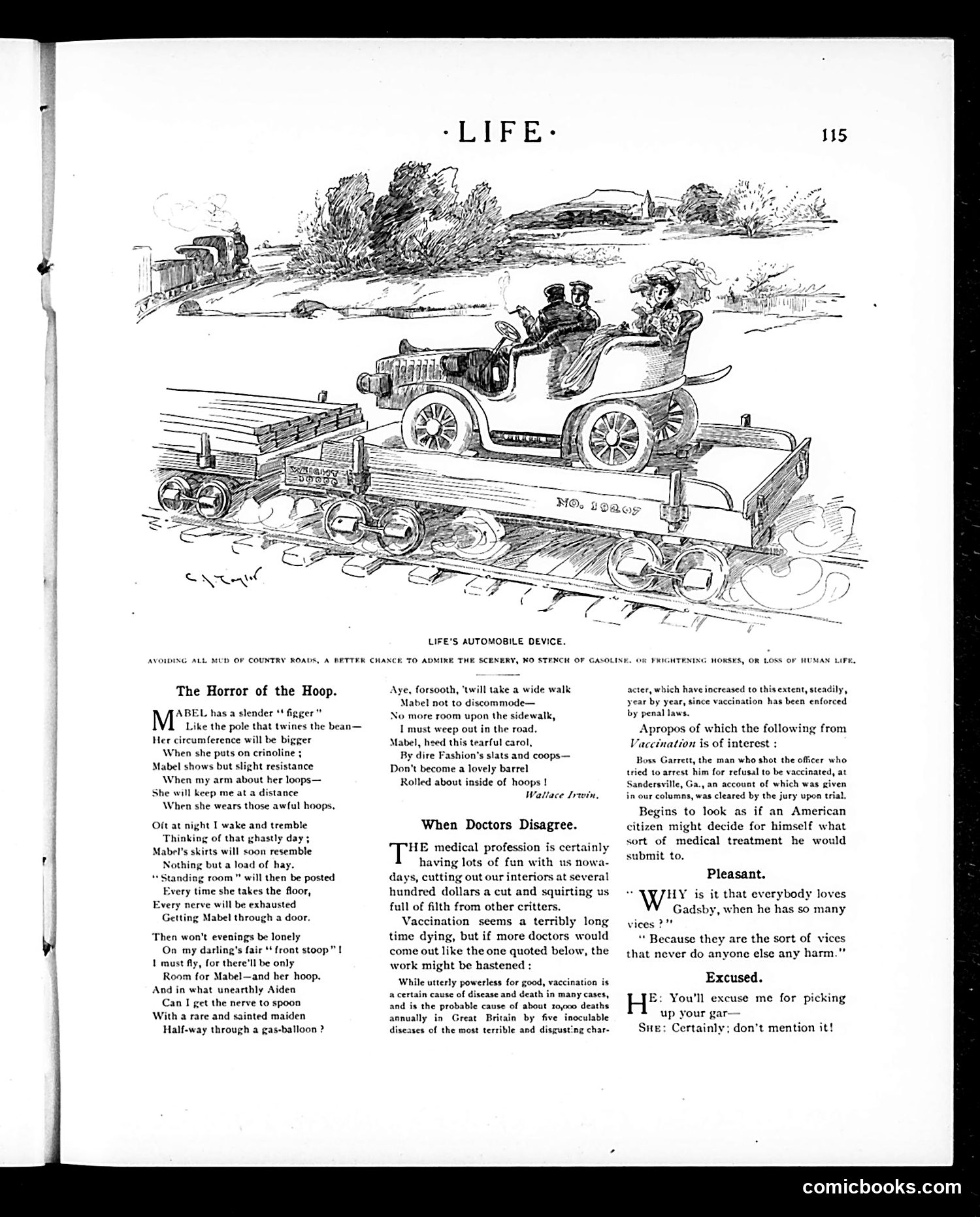
This page contains three separate satirical pieces reflecting early 20th-century social concerns: **"The Horror of the Hoop"** (poem by Wallace Irwin): Mocks the fashionable women's hoop skirt, exaggerating its absurd width. The male narrator laments that his courtship of "Mabel" will become impossible once she adopts this garment—she'll take up entire doorways and sidewalks, leaving no room for romance. The satire ridicules both the impracticality of women's fashion and male anxieties about it. **"Life's Automobile Device"** (illustration): Shows an early automobile loaded onto railroad flatcars to avoid muddy roads, satirizing both the fragility of primitive automobiles and the poor state of American infrastructure. **"When Doctors Disagree"**: Critiques mandatory vaccination, quoting an anti-vaccination doctor and celebrating a Georgia man acquitted for shooting an officer enforcing vaccination laws. This reflects genuine anti-vaccination sentiment of the era, presenting it as a freedom-of-choice issue. The remaining snippets ("Pleasant," "Excused") are brief humorous dialogues.
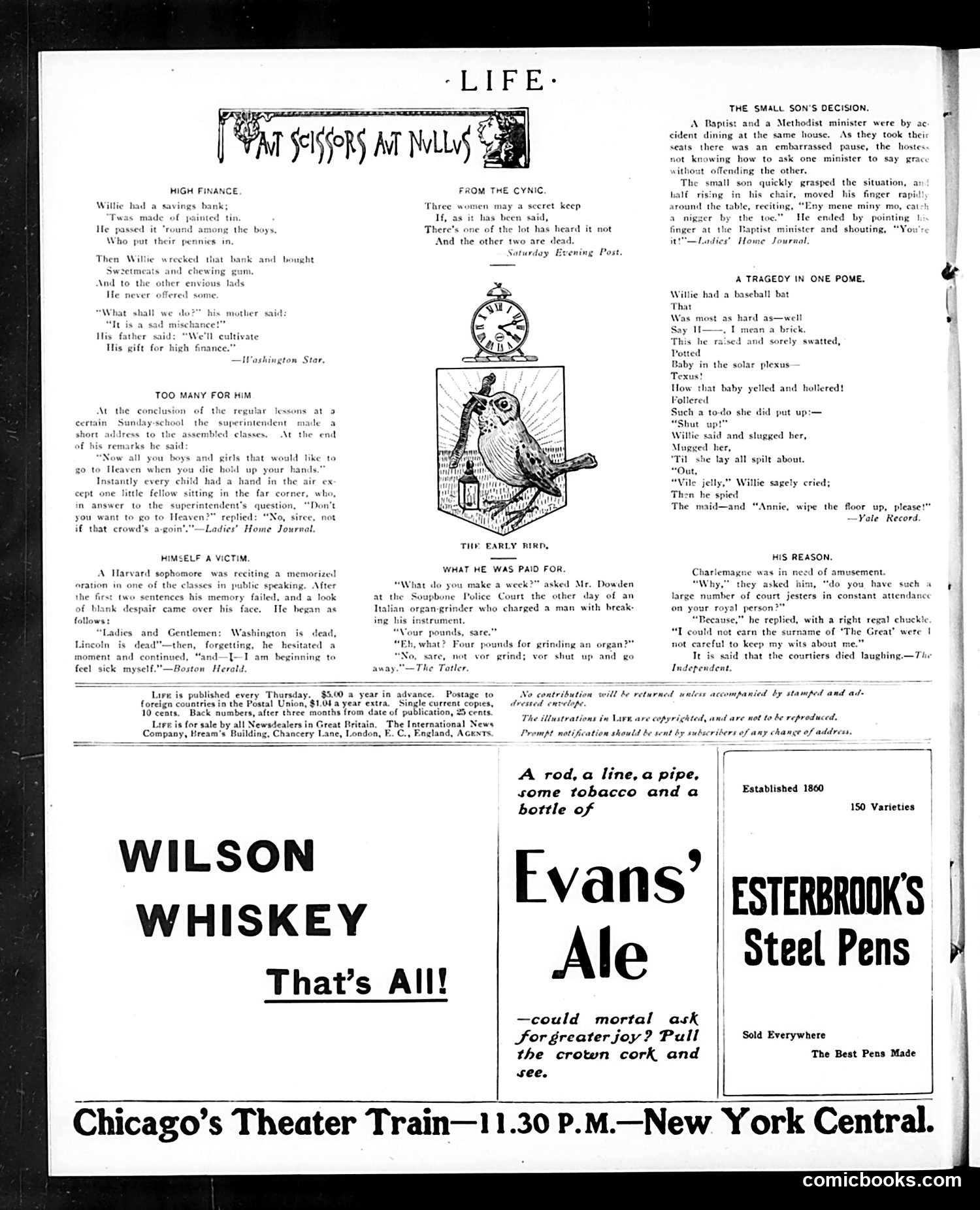
This page contains several humorous short pieces satirizing American society circa early 1900s: **"High Finance"** mocks child financial literacy—Willie's savings bank teaches him nothing; he squanders it on candy and refuses to share, illustrating greed masquerading as prudent behavior. **"Too Many For Him"** satirizes overzealous Sunday school instruction, where a superintendent asks children if they want to go to Heaven. One boy, unable to answer, represents the absurdity of forcing religious doctrine on confused children. **"Himself a Victim"** ridicules memorization-based education when a Harvard student, having memorized a speech, freezes mid-delivery and can only repeat fragments. **"The Small Son's Decision"** humorously depicts childhood pragmatism: when a host cannot decide which minister (Baptist or Methodist) to ask grace, the small son solves the dilemma by reciting it himself—sidestepping adult religious anxieties. The remaining pieces mock journalism, legal procedures, and historical pretension similarly. The page is primarily satirical content with period advertisements below.
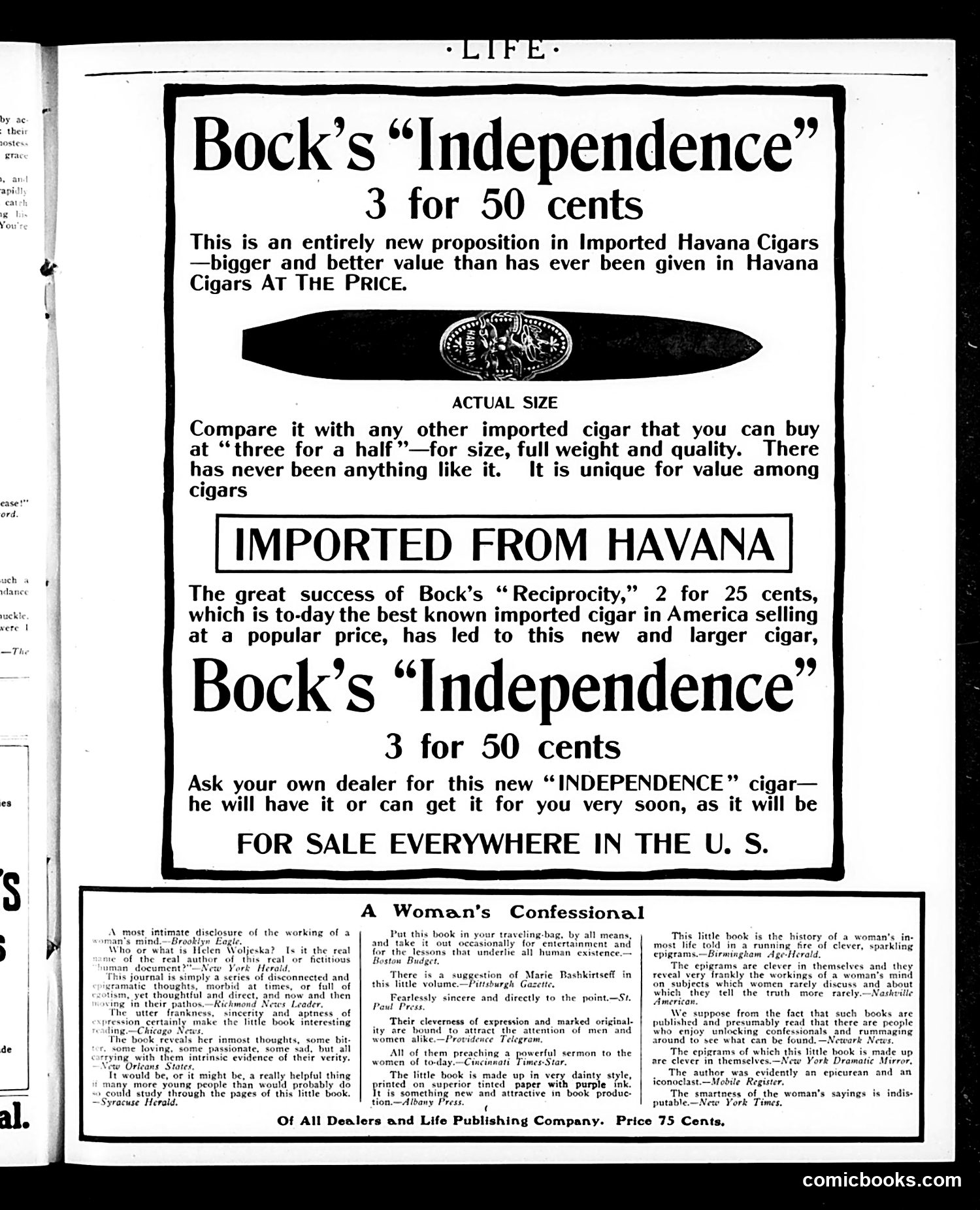
This page is primarily **advertising**, not satirical content. It contains two product advertisements: 1. **Bock's "Independence" Cigars**: A full-page ad for imported Havana cigars priced at 3 for 50 cents. The ad emphasizes value and size, comparing favorably to competitors' "three for a half" pricing. It references the success of an earlier Bock product called "Reciprocity" (2 for 25 cents). The cigar's name "Independence" appears designed to appeal to American patriotic sentiment, though no satirical commentary is evident—this is straightforward commercial promotion. 2. **"A Woman's Confessional"**: A smaller ad for a 75-cent book described as a woman's intimate reflections on life. Various newspaper endorsements are quoted praising its honesty and cleverness. Both ads are typical early 20th-century commercial placements in *Life* magazine. There is **no political cartoon or satirical commentary** visible on this page—it functions as a standard advertising spread.
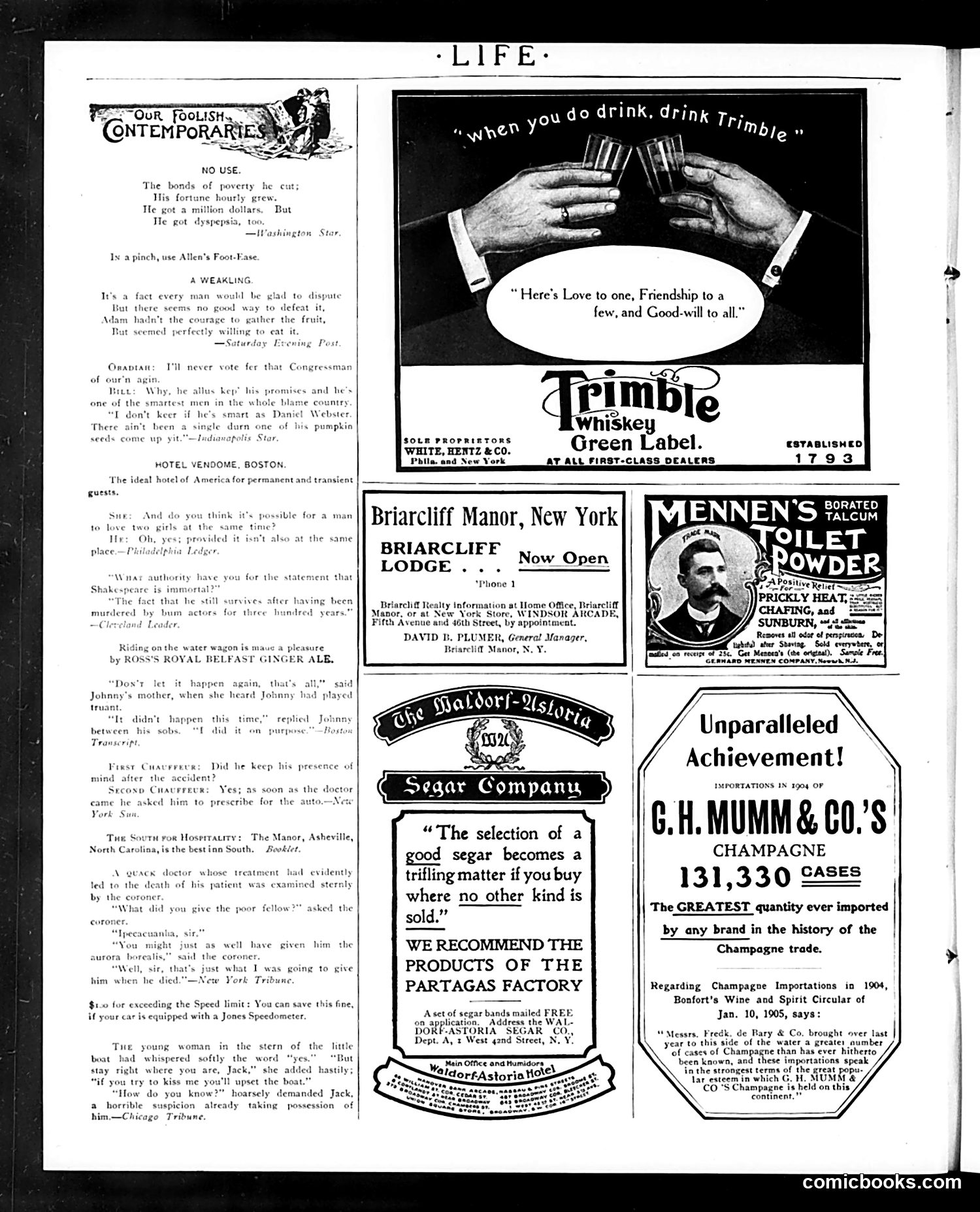
This page is primarily **advertisements and humor columns**, not political cartoons. The left column contains brief satirical quips about contemporary figures and situations—typical of Life's "Our Foolish Contemporaries" section. These mock a Congressman's intelligence, a weakling husband, and a quack doctor. The humor relies on absurdist dialogue rather than identifying specific public figures. The right side features **product advertisements**: Trimble Whiskey, Briarcliff Lodge, Mennen's Talcum Powder, Waldorf-Astoria Cigars, and G.H. Mumm Champagne. The champagne ad notably boasts of importing 131,330 cases in 1904—positioning it as the market leader by volume. **Historical context**: The ads reflect early 1900s luxury goods marketing and the prominence of alcohol advertising in mainstream magazines. The humor pieces target generic social types rather than named individuals, making them difficult for modern readers to place specifically. The page demonstrates Life's mixed format of satirical commentary and premium advertising targeting affluent readers.
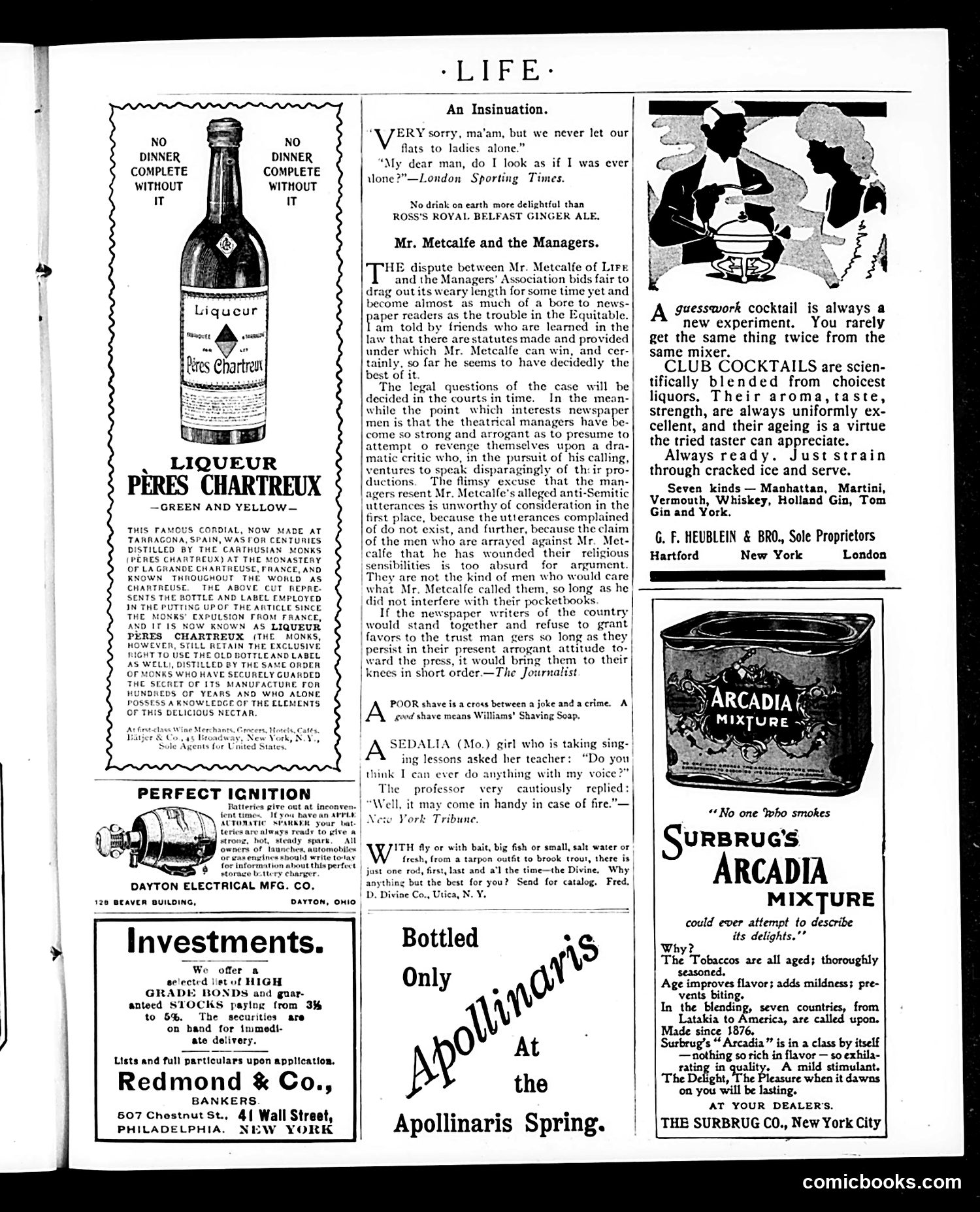
This page is primarily **advertisements and short humorous items** rather than political satire. The main article discusses a dispute between Mr. Metcalfe (apparently a drama critic for *Life* magazine) and theatrical managers' association. The managers allegedly retaliated against Metcalfe for unfavorable reviews, falsely claiming he made anti-Semitic remarks. The piece argues the managers' retaliation was arrogant and warns that if newspaper writers united against such treatment, they could force managers to capitulate. The page also contains several brief jokes: a woman deflecting a landlord's concern about unmarried female tenants; a singing student asking if her voice might be useful "in case of fire." The remainder consists of period advertisements for liqueurs, ginger ale, fishing equipment, electrical parts, and banking services—typical *Life* magazine filler content.
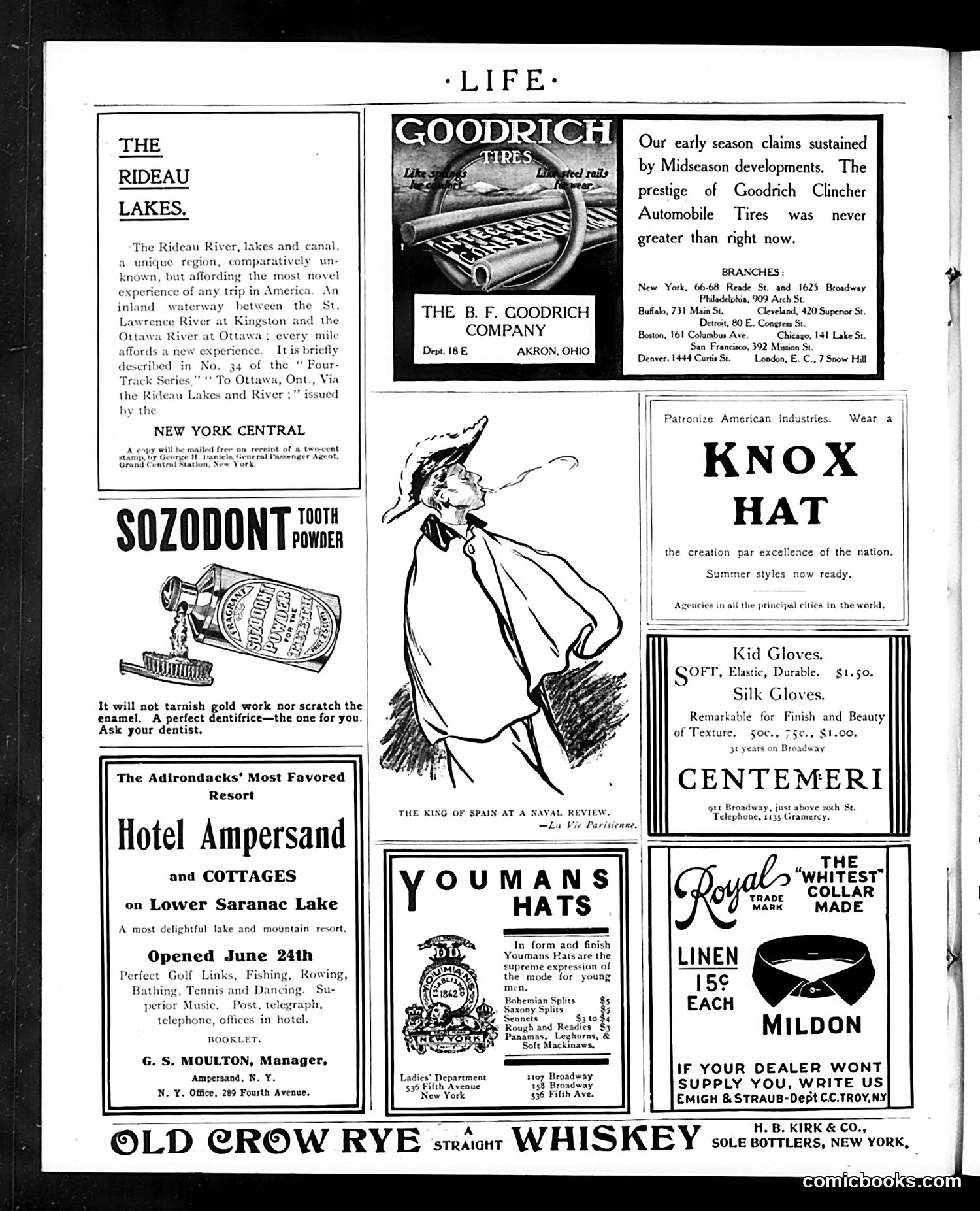
This is primarily an **advertising page**, not a satirical cartoon page. However, it contains one small cartoon captioned "The King of Spain at a Naval Review" (credited to *La Vie Parisienne*, a French publication). The cartoon depicts a figure in military dress looking upward in an exaggerated manner—apparently meant as a humorous commentary on Spanish royalty at a formal naval event. Without seeing the original French context, the specific satire is unclear, but it appears to mock either the King's pretension, vanity, or the formality of naval ceremonies. The rest of the page is dominated by period advertisements for automobile tires (Goodrich), tooth powder (Sozodont), hats (Knox, Youmans), gloves, linen collars, whiskey (Old Crow), and resort hotels—typical early 20th-century magazine advertising reflecting consumer goods and leisure activities of the era.
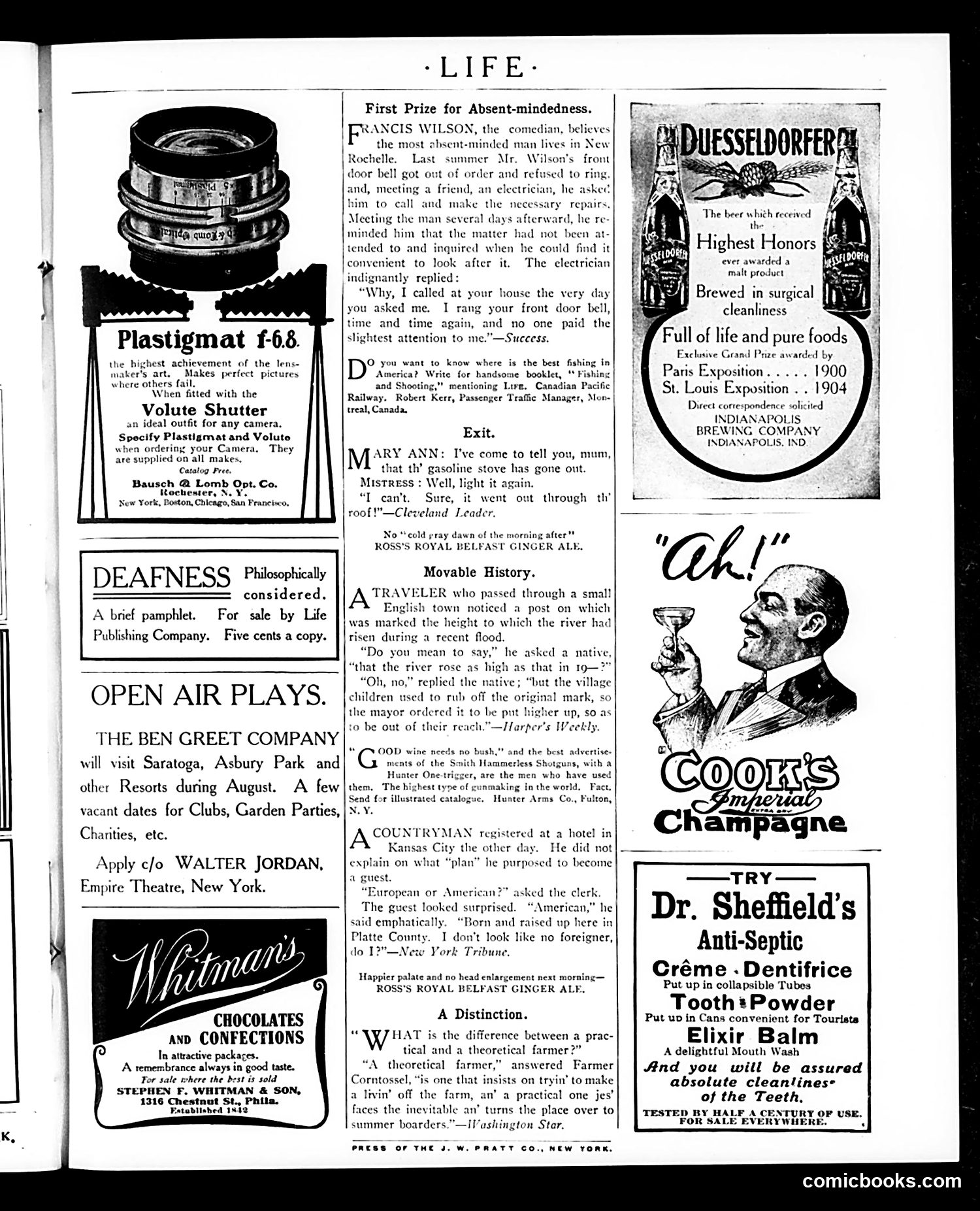
This page is primarily **advertisements and comic anecdotes** rather than political cartoons. The content includes: **Advertisements** for cameras, chocolate, dental products, champagne, and beverages—typical early 20th-century commercial copy. **Humorous short stories** under "Life" magazine's signature satirical heading, including: - A joke about an absent-minded New Rochelle resident who forgets the electrician called - An anecdote about a flood-mark post that children kept erasing, so officials raised it higher - A dialog between a hotel clerk and a country guest about being "American" - A farmer's joke contrasting theoretical versus practical farming These are **gentle, conversational humor pieces** poking fun at common human foibles—forgetfulness, rural naiveté, and the absurdities of daily life—rather than sharp political satire. The tone reflects *Life* magazine's approach as a **humorous weekly** aimed at educated, middle-class readers seeking entertaining diversions.
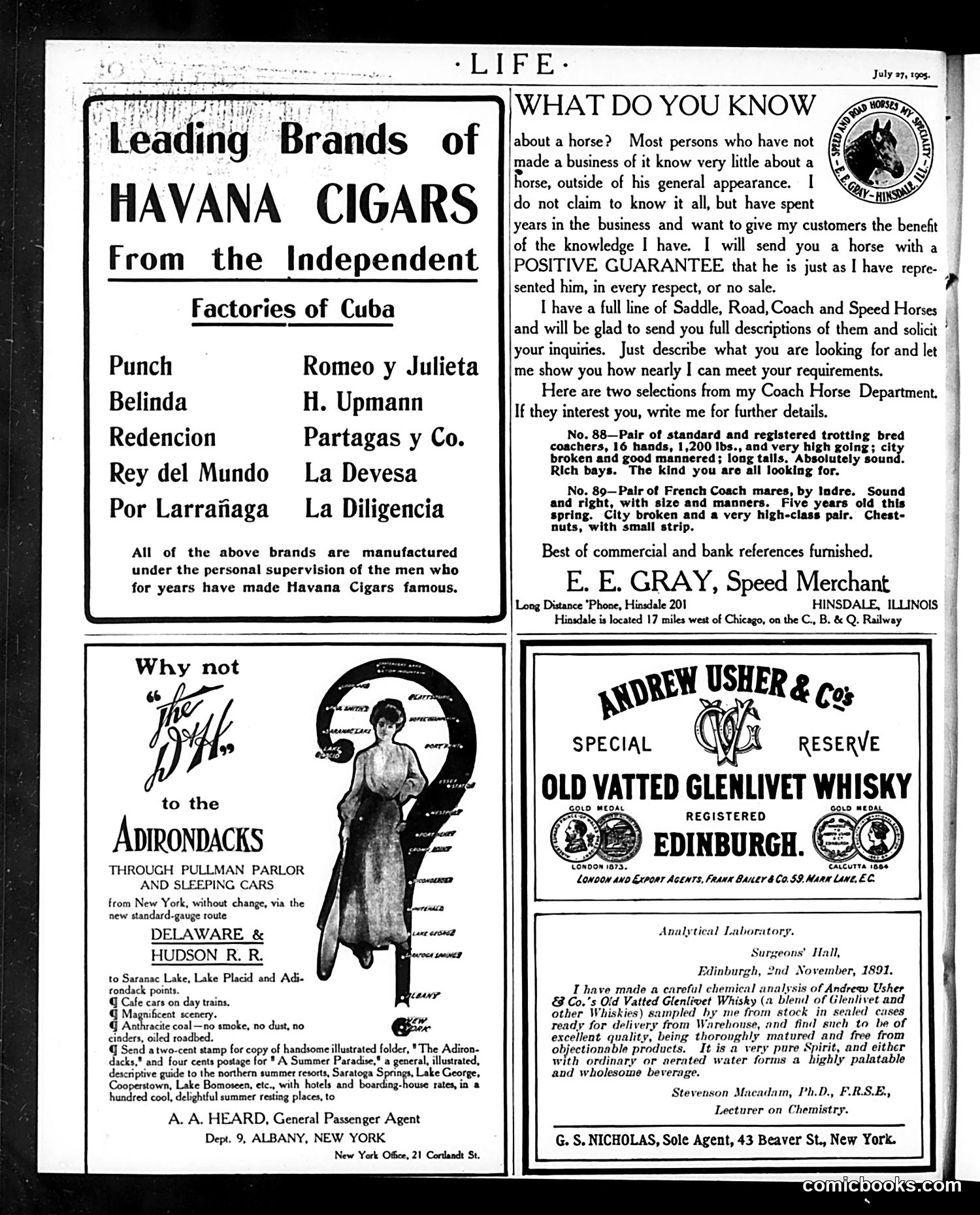
This page is primarily **advertisements**—not satire or political commentary. It contains period commercial pitches for: 1. **Havana cigars** from Cuban factories (pre-Embargo era) 2. **Delaware & Hudson Railroad** promoting Adirondacks vacation travel via new standard-gauge routes from New York 3. **E. E. Gray's horse-trading business** in Illinois, with detailed breed descriptions and guarantees 4. **Andrew Usher whisky** from Edinburgh, including a scholarly certification from a chemist attesting to the spirit's purity The only visual element approaching illustration is a woman's silhouette figure in the railroad ad. These ads reflect early-1900s American commerce: luxury tourism, livestock trade, imported spirits, and Cuban tobacco before US trade restrictions. There is no apparent satire or political commentary on this page—it's straightforward commercial content typical of *Life* magazine's advertising revenue model.