
Life, 1905-07-27 · page 16 of 24
Life — July 27, 1905 — page 16: what you’re looking at
What you’re looking at
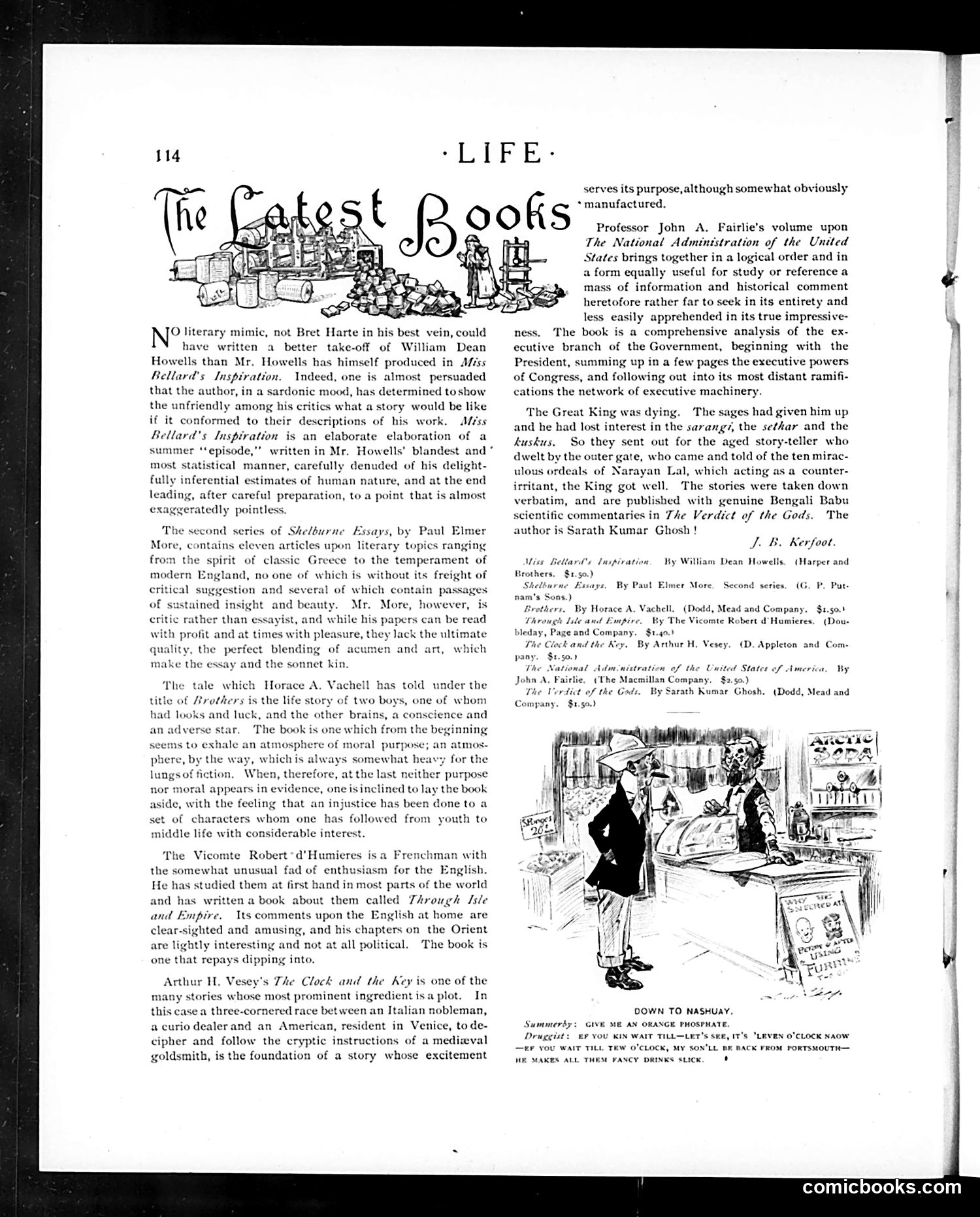
The cartoon depicts a man at what appears to be a ticket window or counter, speaking to an attendant. The caption reads: "Summers! Give me an orange phosphate / Bragget! Ever tried one, sir? / 'Never,' says I, 'levels o'clock now / If you wait till two o'clock, my son, I'll be back from Portsmouth—' / He says all their fancy drinks slick." This appears to be a humorous scene about a traveler or visitor requesting a beverage (an "orange phosphate"—a popular early 1900s soft drink). The joke seems to involve timing: the attendant claims he'll only be back from Portsmouth at two o'clock, suggesting the traveler must wait or go elsewhere for the drink. It's a light social satire about small-town New England inconvenience or the limited availability of modern refreshments, playing on period expectations about rural service establishments.
📄 Transcribed text from this page (OCR, searchable)
Machine-transcribed from the original scan — historical spelling and the odd misread are preserved.
O literary mimic, not Bret Harte in his best vein, could have written a better take-off of William Dean Howells than Mr. Howells has himself produced in Aféss Rellard’s Inspiration. Yndeed, one is almost persuaded that the author, in a sardonic mood, has determined to show the unfriendly among his critics what a story would be like if it conformed to their descriptions of his work. AMéss Bellard's Inspiration is an elaborate elaboration of a summer “episode,” written in Mr. Howells’ blandest and most statistical manner, carefully denuded of his delight- fully inferential estimates of human nature, and at the end leading, after careful preparation, to a point that is almost exaggeratedly pointless. ‘The second series of Shelburne E More, contains eleven articles upon literary topics ranging from the spirit of classic Greece to the temperament of modern England, no one of which is without its freight of cr nd several of which cont of sustained insight and beauty. Mr. More, however, is critic rather than essayist, and while his papers can be r ith ith pleasure, they lack the ultimate blending of nen and art, which make the essay and the sonnet kin. says, by Paul Elmer tical suggestion wi fit and at times w pre quality, the perfe The tale which Ho A. Vachell has told under the title of Brothers is the life story of two boys, one of whom had looks and luck, and the other brains, a conscience and rse star. The book is one which from the beginning seems to exhale an atmosphere of moral purpose; an atmos- lwa for the re, atthe last neither purpose an adv ys somewhat hea phere, by lungsof fiction, When, theref nor moral appears in evidence, one isinclined to lay the book the way, whichis aside, with the feeling that an injustice has been done to a set of characters whom one has followed from youth to middle life with considerable interest. The Vicomte Robert “d’Humieres isa Frenchman with the somewhat unusual fad of enthusiasm for the English. He has studied them at first hand in most parts of the world and has written a book about them called Through Isle and Empir Its comments upon the English at home are clear-sighted and amusing, and his chapters on the Orient are lightly interesting and not at all political. ‘The book is one that repays dipping into, Arthur H. Vesey's The Clock and the Key is one of the many stories whose most prominent ingredientisa plot. In this case a three-cornered race between an Italian nobleman, curio dealerand an American, resident in Venice, to de- cipher and follow the cryptic instructions of a medieval goldsmith, is the foundation of a story whose excitement serves its purpose, although somewhat obviously * manufactured. Professor John A, Fairlie’s volume upon The National Administration of the United States brings together in a logical order and in a form equally useful for study or reference a mass of information and historical comment heretofore rather far to seek in its entirety and less easily apprehended in its true impressive: ness, ‘The book is a comprehensive analysis of the ex- ecutive branch of the Government, beginning with the President, summing up in a few pages the executive powers of Congress, and following out into its most distant ramifi- tions the network of executive machinery. ca ‘The Great King was dying. The sages had given him up and he had lost interest in the sarangy, the se¢thar and the kuskus, So they sent out for the aged story-teller who dwelt by the outer gate, who came and told of the ten mirac ulous ordeals of Narayan Lal, which acting as a counter- irritant, the King got well. The stories were taken down verbatim, and are published with genuine Bengali Babu scientific commentaries in The Verdict of the Gods. The author is Sarath Kumar Ghosh ! J. B. Kerfoot. Miss Bellard’s Inspiration. Wy W Brothers. $1.50.) Shelburne Essays, By Paul Elmer More. Second series, (G. P. Puts ams Sons.) Brothers, By Horace A. Vachell, (Dodd, Mead and Company. $1.50." Through Lite and Empire, By The Vicomte Robert d'Humieres. (Dou- bleday, Page and Company. $1.49.) Clock and the Key. By Arthur H, Vesey. (D. Appleton and Com- pany. $2.50.) The National Admnistration of the United States of America. By John A, Fairlie, (The Macmillan Company. $2.50 The Verdict of the Gods. By Sarath Kumar Ghos pany. $1.50.) liam Dean Howells, (Harper and (Dodd, Mead and a APA WPA | DOWN TO NASHUAY. Summerby: GIVE MEAN ORANGE PHOSPHATE. Druggist: €P YOU KIN WAIT TILL—LET’S SKE, IT'S "LEVEN O'CLOCK NAOW EF YOU WAIT TILL TEW O'CLOCK, MY SON'LL BF BACK PROM FORTSMOUTH— WE MAKES ALL THEM FANCY DRINKS Stick. | comicbooks.com