
Life, 1905-07-27 · page 4 of 24
Life — July 27, 1905 — page 4: what you’re looking at
What you’re looking at
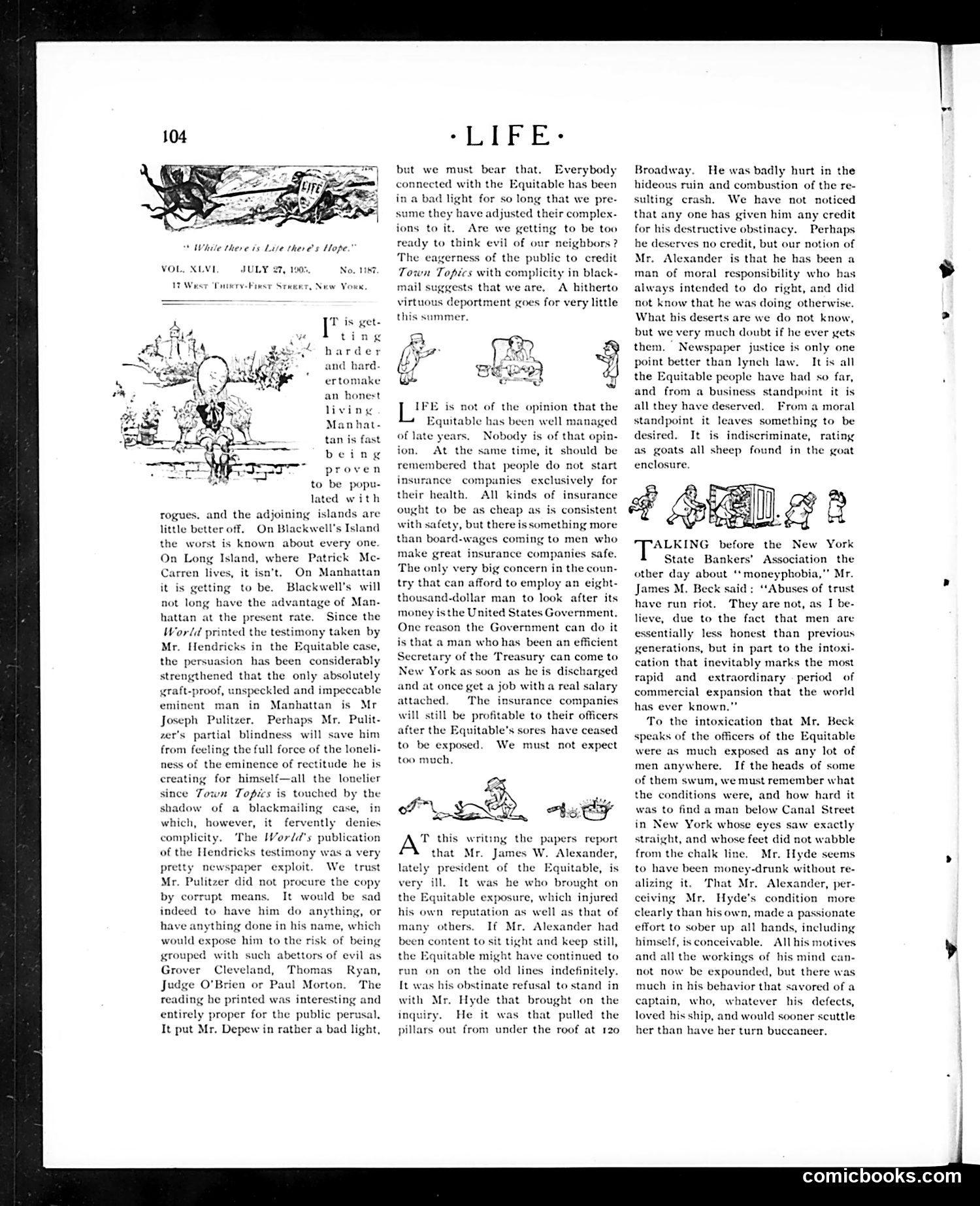
The main cartoon, titled "While There's Life There's Hope," depicts Manhattan as a chaotic organism infested with parasites and disease. The satire critiques corruption in New York City government and business, particularly regarding insurance fraud and mismanagement. The accompanying text discusses the Equitable Life Insurance scandal, referencing figures like James W. Alexander (Equitable's president, who became ill) and Mr. Hendricks. The article criticizes insurance company officers for dishonesty and suggests government officials like a discharged Treasury Secretary could expose corruption if employed to investigate. The cartoon's grotesque imagery and the text's sarcastic tone mock both corporate malfeasance and the public's naive trust in institutions—typical Progressive Era satire targeting monopolies and fraud.
📄 Transcribed text from this page (OCR, searchable)
Machine-transcribed from the original scan — historical spelling and the odd misread are preserved.
“While there és Lise there's Hope VOL, XLVI, JULY 22, 1905, No. Wrst Toiery-Fiest Sriee «New Yous. an honest living Manhat- tan is fast being proven to be popu- lated with rogues, and the adjoining islands are little better off. On Blackwell's Island the worst is known about every one On Long Island, where Patrick Me- Carren lives, it isn’t, On Manhattan ing Blackwell's will not long have the advantage of Man- hattan at the present rate. Since the World printed the testimony taken by Mr. Hendricks in the Equitable ca the persuasion has been considerably strengthened that the only absolutely graft-proof, unspeckled and impeccable eminent man in Manhattan is Mr Joseph Pulitzer. Perhaps Mr, Pulit- zer’s partial blindness will save him from feeling the full force of the loneli- ness of the eminence of rectitude he is creating for himself—all the lonelier since Town Topics is touched by the shadow of a blackmailing case, in which, however, it fervently denies The World's publi of the Hendricks testimony was a very pretty newspaper exploit. We trust Mr. Pulitzer did not procure the copy by corrupt means. It would be sad indeed to have him do anything, or have anything done in his name, which to be. se, complicit would expose him to the risk of being grouped with such abettors of Grover Cleveland, Thoma Ryan, Judge O'Brien or Paul Morton. The reading he printed was interesting and entirely proper for the public perusal, It put Mr. Depew in rather a bad light, evil as “LIF Es bear that. Everybody connected with the Equitable has been in a bad light for so long that we pre- sume they have adjusted their complex- ions to it. Are we getting to be too ready to think evil of our neighbors? The eagerness of the public to credit Town Topics with complicity in bla mail suggests that we A hitherto rtuous deportment goes for very little but we must are, this summer. IFE is not of the opinion that the Equitable has been well managed years, Nobody is of that opin- At the same time, it should be remembered that people do not start insurance companies exclusively for their health, All kinds of insurance ought to be as cheap as is consistent with safety, but there is something more than board-wages coming to men who make great insurance companies safe. The only very big concern in the coun- try that can afford to employ an eight- of 1, ion, thousand-dollar man to look after its money isthe United States Government. One reason the Government can do it is that a man who has been an efficient Secretary of the Treasury can come to New York as soon as he is discharged and at once get a job witha real salary attached. The insurance companies will still be profitable to their officers after the Equitable’s sores have ceased to be exposed. We must not expect too much, A’ this writing the papers report that Mr. James W. Alexander, lately president of the Equitable, is very ill, It was he who brought on the Equitable exposure, which injured his own reputation as well as that of If Mr. Alexander had been content to sit tight and keep still, Equitable might have continued to run on on the old lines indefinitely. It was his obstinate refusal to stand in with Mr, Hyde that brought on the inquiry. He it was that pulled the pillars out from under the roof at 120 ma others, Broadway. He was badly hurt in the hideous ruin and combustion of the re- sulting crash. We have not noticed that any one has given him any credit for his destructive obstinacy. Perhaps he deserves no credit, but our notion of Mr. Alexander is that he has been a man of moral responsibility who has always intended to do right, and did not know that he was doing otherwise. What his deserts are we do not know, but we very much doubt if he ever yets them. Newspaper justice is only one point better than lynch law. It is all the Equitable people have had so and from a business all they have deserved standpoint it leaves something to be desired. It is indiscriminate, rating as goats all sheep found in the goat enclosure. standpoint it is From a moral PALES before the New York State Bankers’ Association the other day about ‘moneyphobia,”” Mr. James M. Beck said; “Abuses of trust have run riot. They are not, as I be- lieve, due to the fact that men are essentially less honest than previous generations, but in part to the intoxi- cation that inevitably marks the most rapid and extraordinary period of commercial expansion that the world has ever known," To the intoxication that Mr. Beck speaks of the officers of the Equitable were as much exposed as any lot of men anywhere. If the heads of some of them swum, we must remember what the conditions were, and how dit was to find a man below Canal Street in New York whose ey actly straight, and whose feet did not wabble from the chalk li Mr. Hyde seems to have been money-drunk without re- alizing it. ‘That Mr. Alexander, per- ceiving Mr. Hyde's condition more clearly than his own, made a passionate effort to sober up all hands, including himself, is conceivable. All his motive and all the workings of his mind can- not now be expounded, but there was. much in his behavior that savored of a captain, who, whatever his defects, loved his ship, and would sooner scuttle her than have her turn buccaneer. eS saw comicbooks.com