
A complete issue · 26 pages · 1905
Life — June 22, 1905
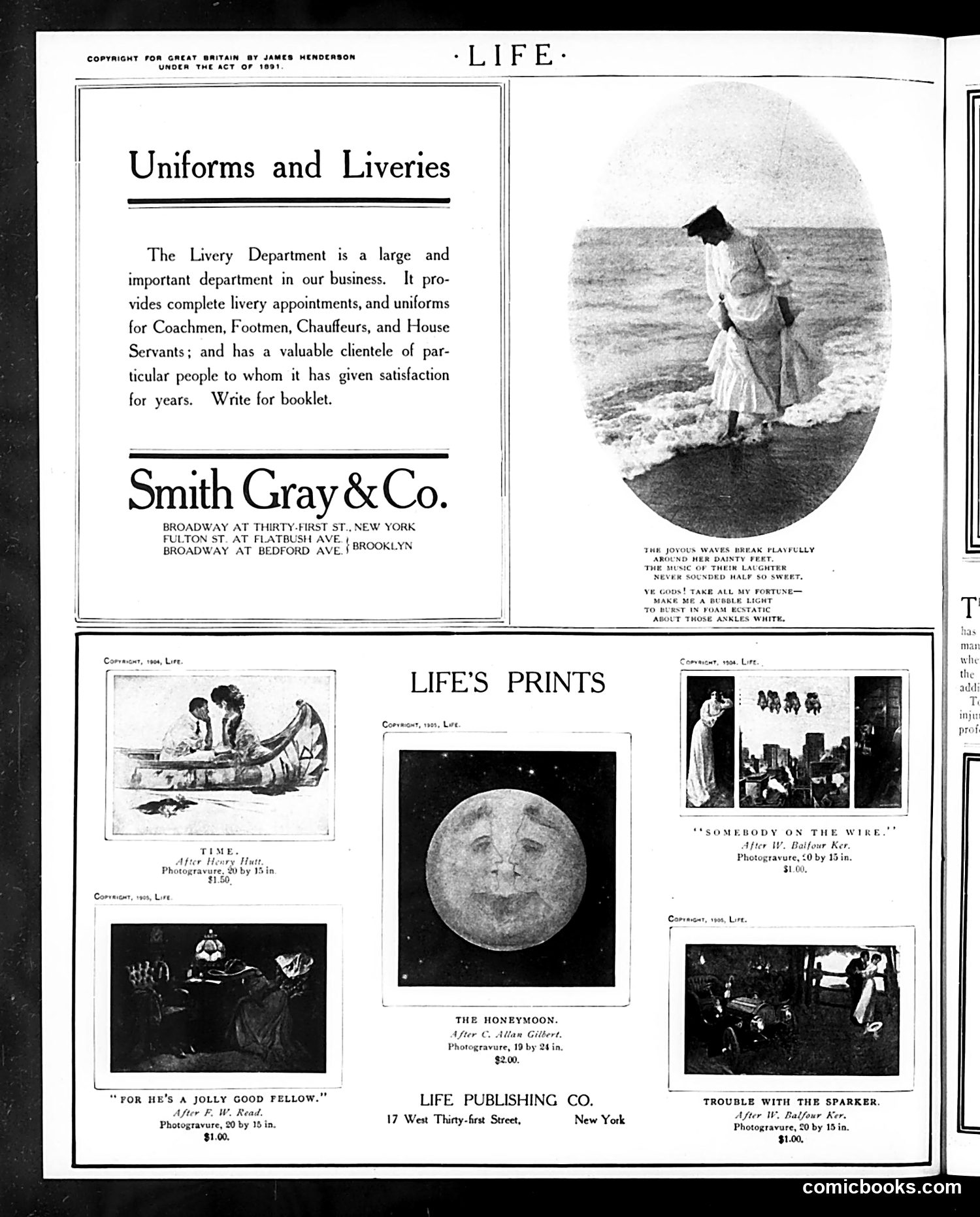
This page is primarily **advertising and product promotion** rather than political satire. The top half features a Smith Gray & Co. advertisement for livery services (uniforms for coachmen, footmen, and house servants), accompanied by a romantic illustration of a couple by the seaside. The bottom half showcases "Life's Prints"—photogravure art reproductions available for purchase, including works titled "Time," "For He's a Jolly Good Fellow," "The Honeymoon," "Somebody on the Wire," and "Trouble with the Sparker." These appear to be sentimental or humorous domestic scenes typical of early 20th-century popular art. The page demonstrates Life magazine's mixed business model: combining editorial content with advertising and merchandise sales.
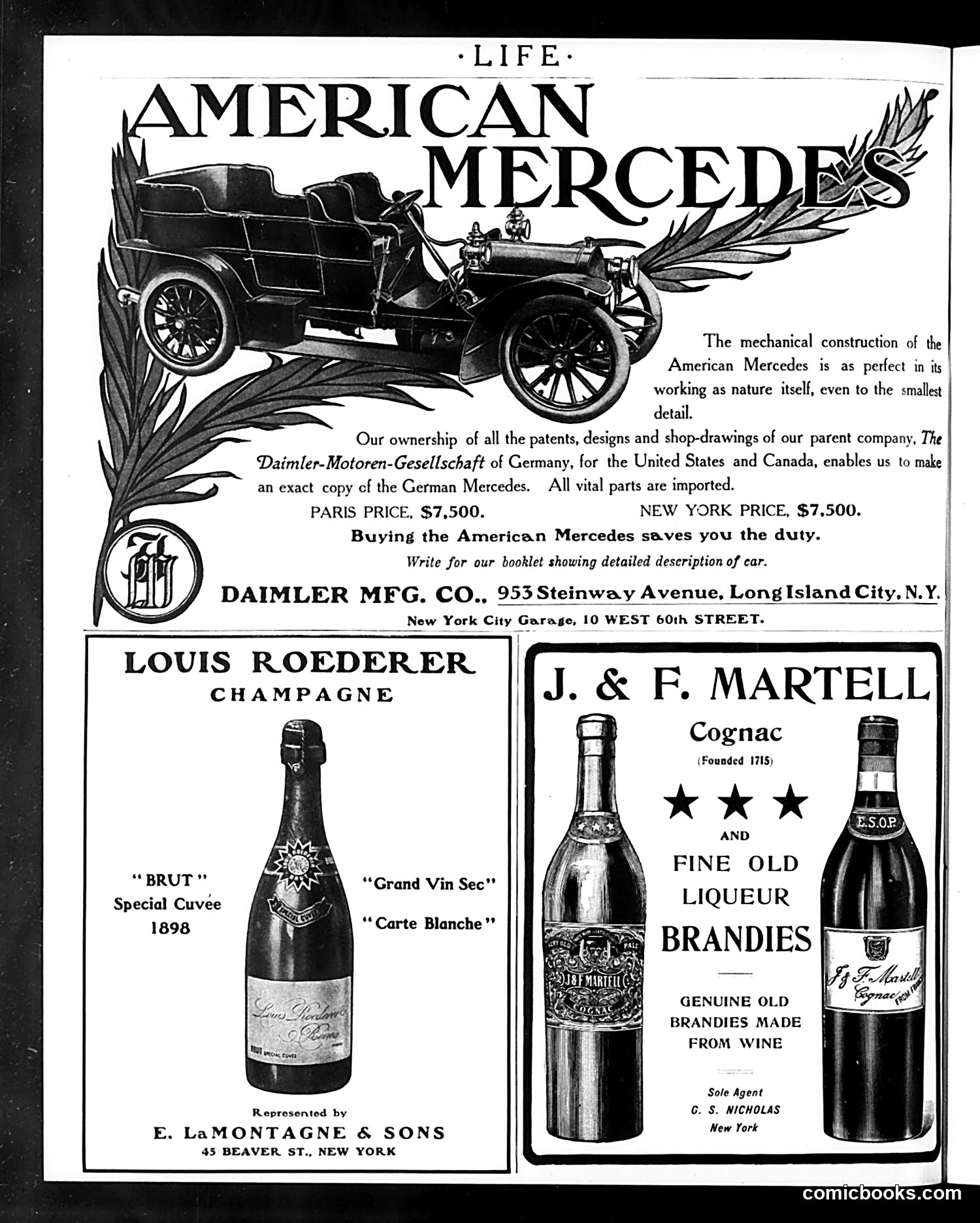
This page is primarily **advertising, not satire or political commentary**. The dominant advertisement promotes the **American Mercedes automobile** (priced at $7,500), manufactured under license by Daimler in Long Island City. The ad emphasizes that vital parts are imported from Germany, positioning the car as a precise copy of the German original—a selling point suggesting European engineering superiority to American readers. Below are luxury product advertisements: **Louis Roederer Champagne** (represented by E. La Montagne & Sons) and **J. & F. Martell Cognac and Brandies** (founded 1715). This reflects the **pre-WWI era** when European luxury goods—automobiles, wines, spirits—held prestige among affluent American consumers. The page targets wealthy readers with disposable income for expensive imports.
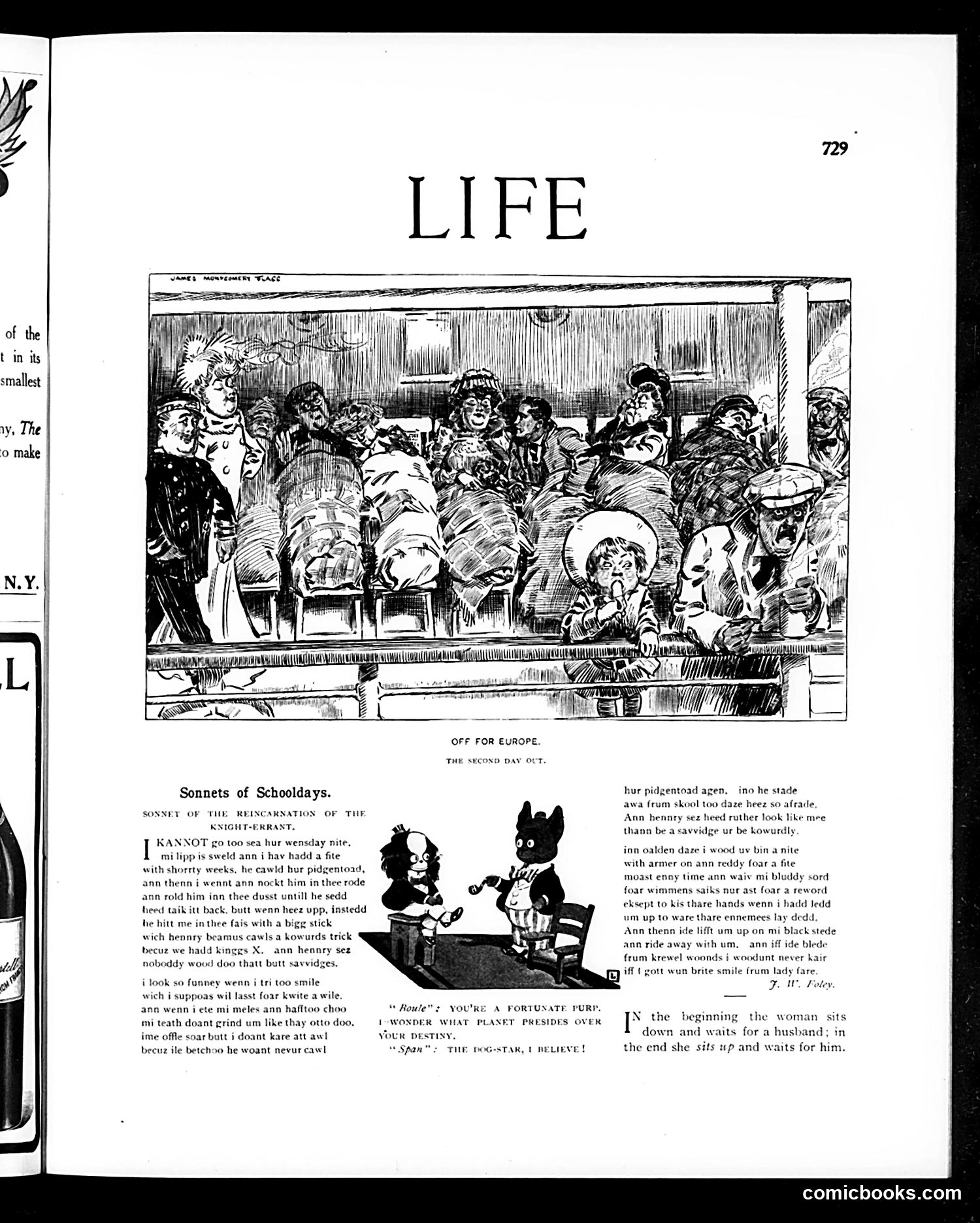
**Top Cartoon: "Off for Europe. The Second Day Out."** This depicts steerage passengers on an immigrant ship, crowded together in poor conditions. The satire targets the brutal reality of transatlantic emigration—the cramped, unsanitary quarters where poor immigrants endured the voyage to America. The caption's darkly humorous timing ("second day out") emphasizes how quickly conditions became unbearable. **"Sonnets of Schooldays" Section:** Below is satirical poetry about schoolboy experiences, accompanied by illustrations of anthropomorphic animals (appears to be cats or dogs) in school situations. The dialect verse mocks both nostalgic reminiscence and working-class speech patterns, likely poking fun at sentimental Victorian attitudes toward education and childhood. The page overall critiques social conditions and pretension.
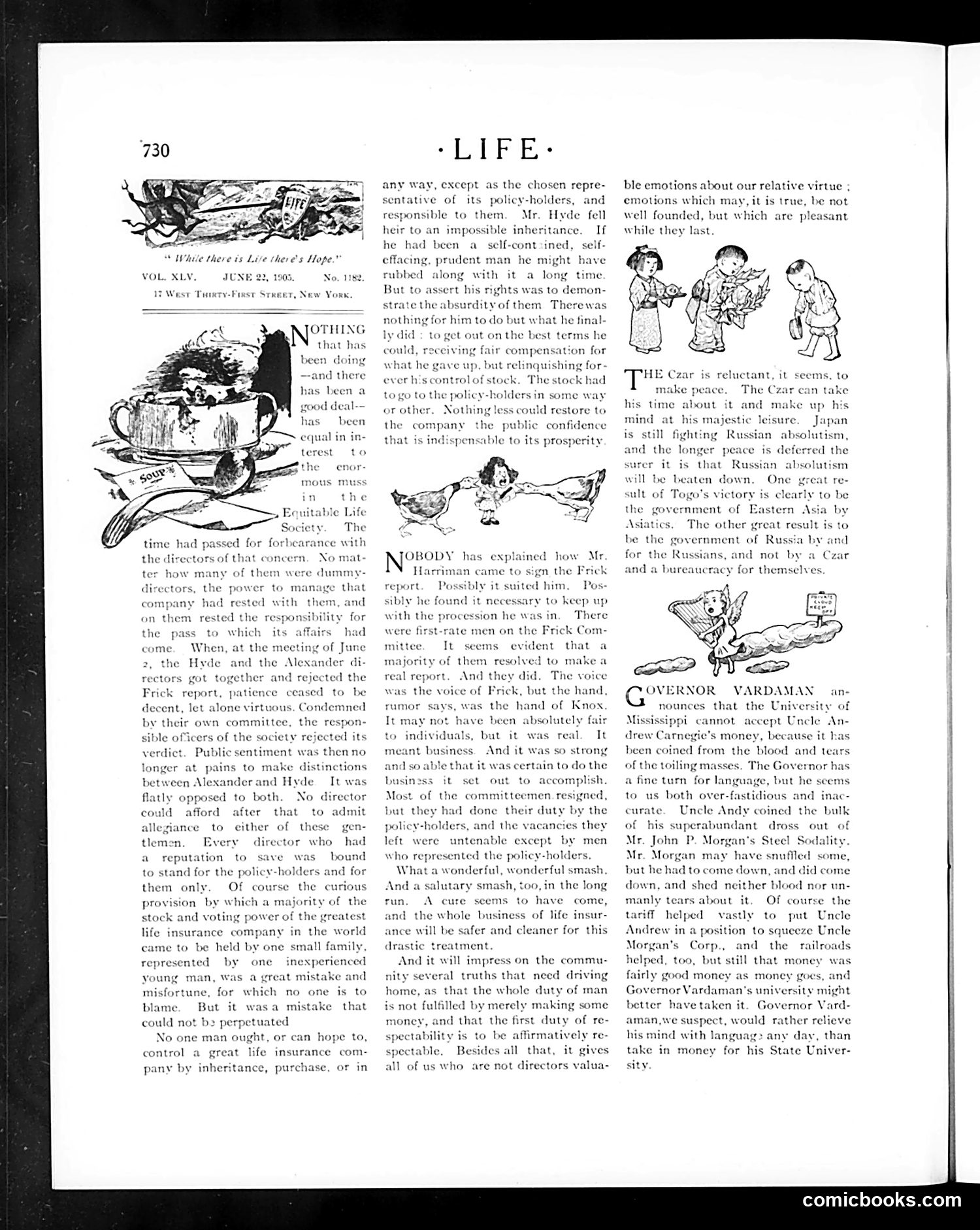
This page contains editorial commentary on insurance industry governance, illustrated with satirical cartoons. The main text discusses a conflict between life insurance company directors and policyholders over the Frick Report—an investigation into company management practices. The cartoons mock incompetence: one shows a figure drowning or flailing in water (labeled "LIFE"), symbolizing the industry's dysfunction. Another depicts anthropomorphized animals in similarly chaotic situations. The piece criticizes how directors mismanaged the company while claiming to represent policyholders' interests. The author argues that directors must cede control to resolve public distrust in insurance companies and ensure fair compensation for policyholders. A separate item discusses Governor Vardaman's university donation, presented as self-serving rather than genuinely charitable. The satire targets corporate mismanagement and hypocrisy.
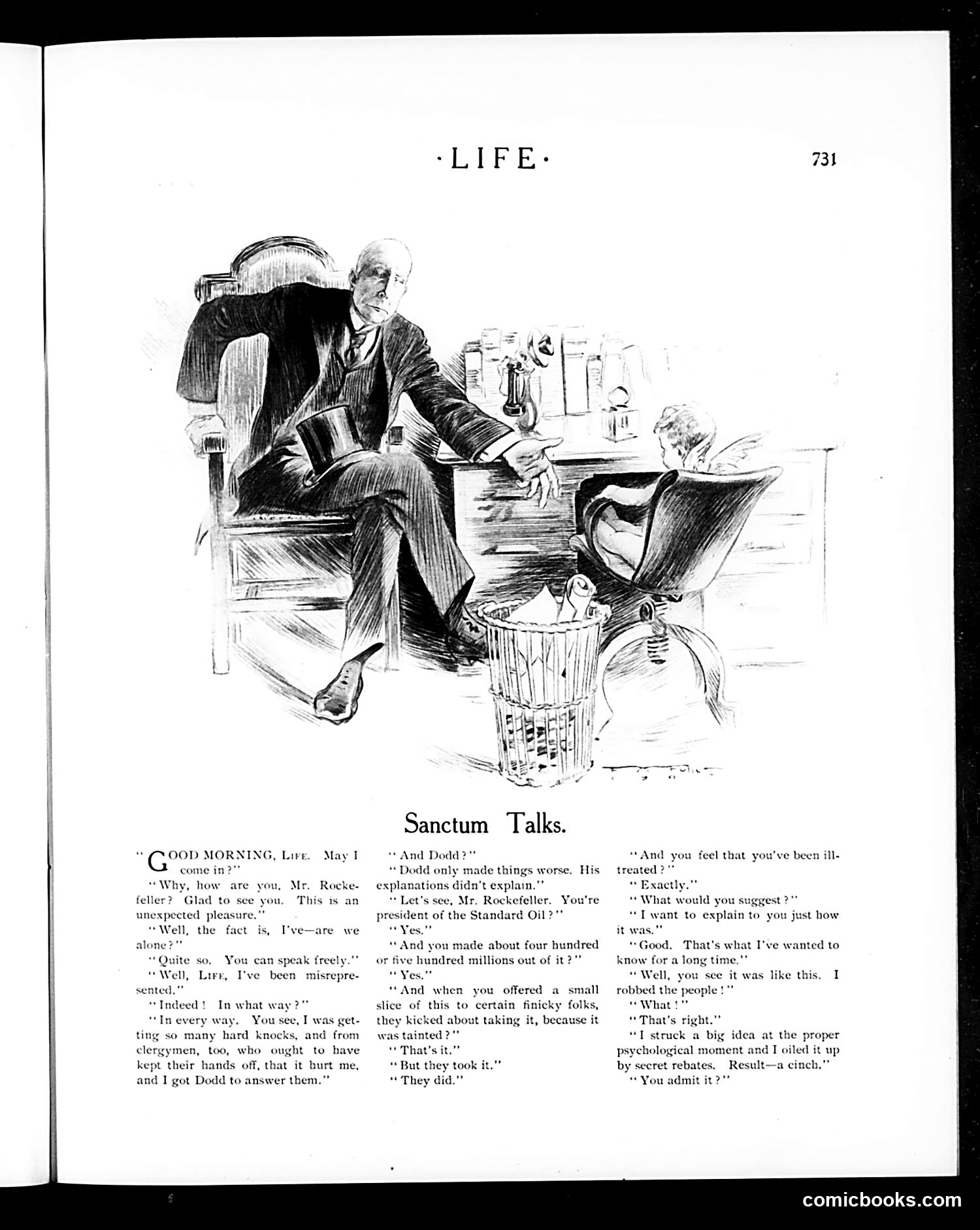
This cartoon depicts a conversation in what appears to be a newspaper editor's office (the "sanctum"). An elderly man in formal dress—likely representing a newspaper publisher or editor—sits at his desk speaking with a visitor about Standard Oil and John D. Rockefeller. The dialogue reveals satirical commentary on Rockefeller's business practices: he allegedly offered bribes to "certain finicky folks" to suppress criticism, but they "kicked" at taking it because "it was tainted." The visitor boasts of using "secret rebates" instead—a reference to Standard Oil's notorious practice of undercutting competitors through hidden railroad discounts. The cartoon mocks both corporate corruption and the apparent moral gymnastics used to justify unethical business tactics during the Gilded Age.
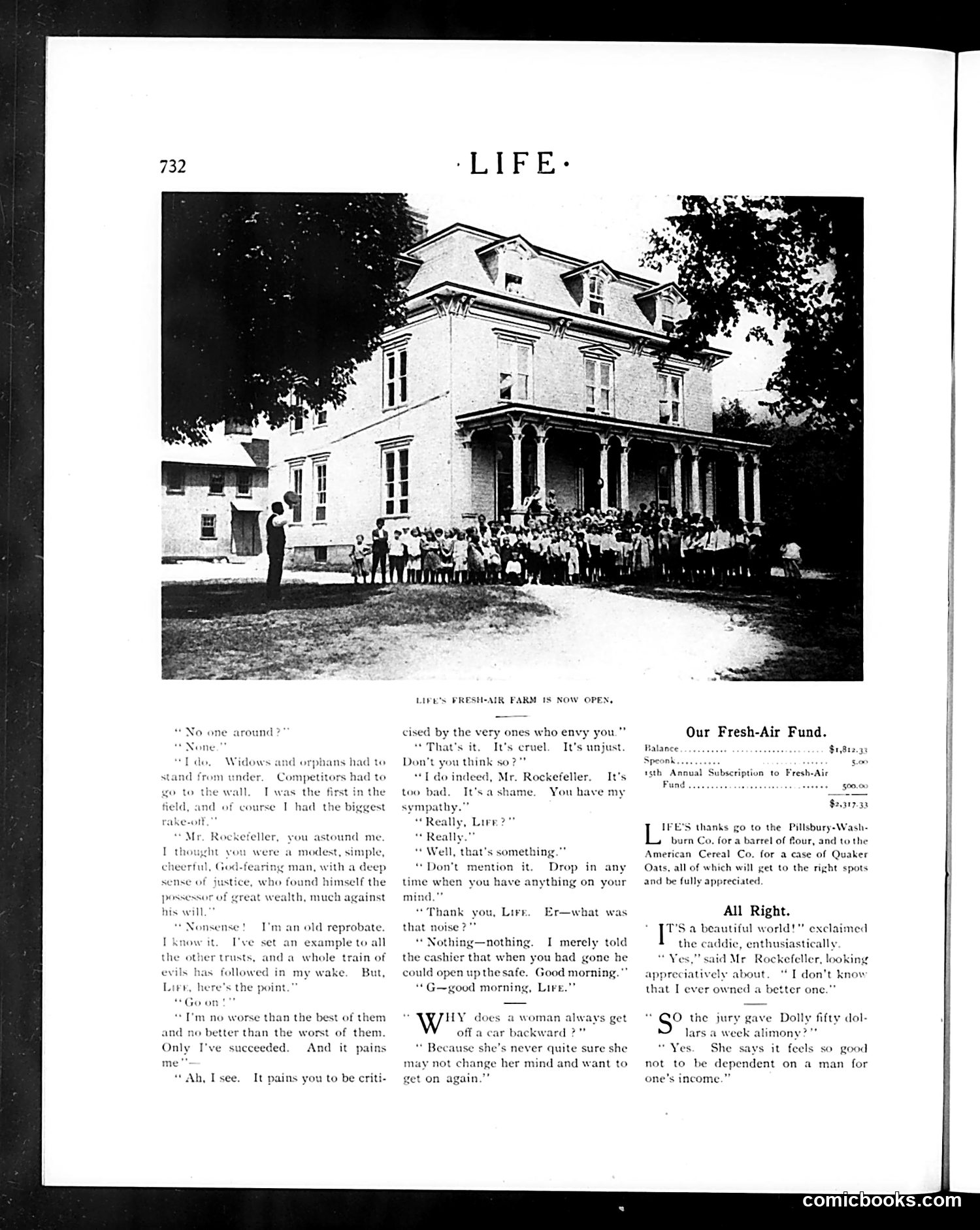
This page features a photograph of Life's Fresh-Air Farm opening, with accompanying dialogue. The image shows a large Victorian mansion with a colonnade, surrounded by crowds of children and adults. The text includes a conversation between two figures—one appears to be Mr. Rockefeller, discussing the farm's purpose. The dialogue centers on themes of charity, wealth, and social responsibility. References to "widows and orphans" and "the poor" indicate this was a philanthropic initiative serving disadvantaged populations. The "Fresh-Air Fund" box on the right credits the Pillsbury-Washburn Co. and American Cereal Co. for donations, suggesting corporate sponsorship of charitable work. The satire appears gentle, praising Rockefeller's modesty about his wealth while addressing contemporary debates about the responsibilities of the extremely rich toward society's most vulnerable members.
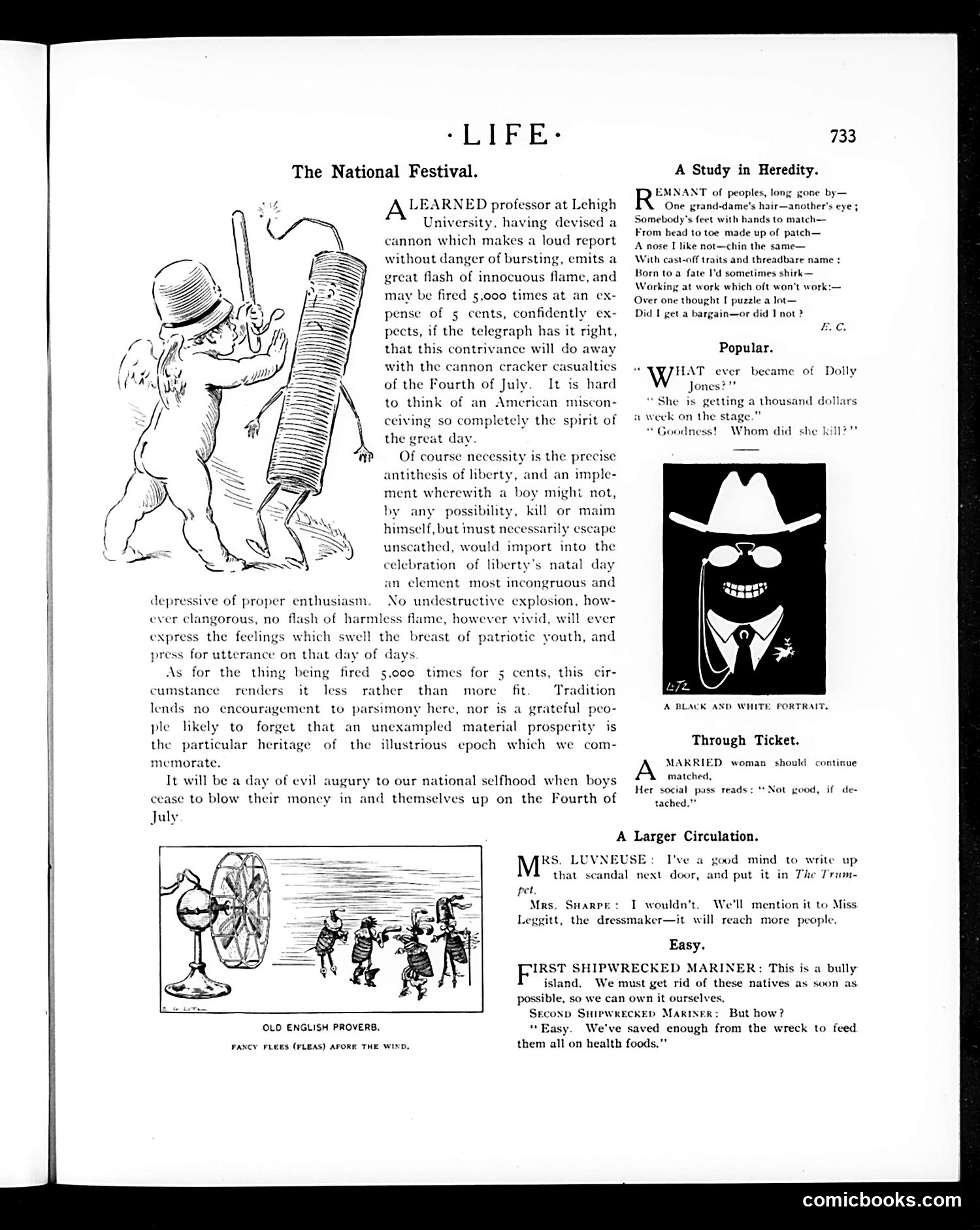
This satirical piece criticizes the American celebration of Independence Day (Fourth of July). The cartoon depicts a small figure struggling to control an oversized cannon labeled to fire 5,000 times for 5 cents—a reference to commercial Fourth of July fireworks and firecrackers that were popular and dangerous. The satire argues that allowing boys to detonate explosives celebrates liberty in a way that contradicts patriotic values. The author contends that uncontrolled explosions cause injuries and deaths ("cannon cracker casualties"), making the practice incongruous with genuine patriotism. The piece mocks the irony that Americans claim to honor freedom while permitting a dangerous tradition that harms their own children, calling it "a day of evil augury to our national selfhood."
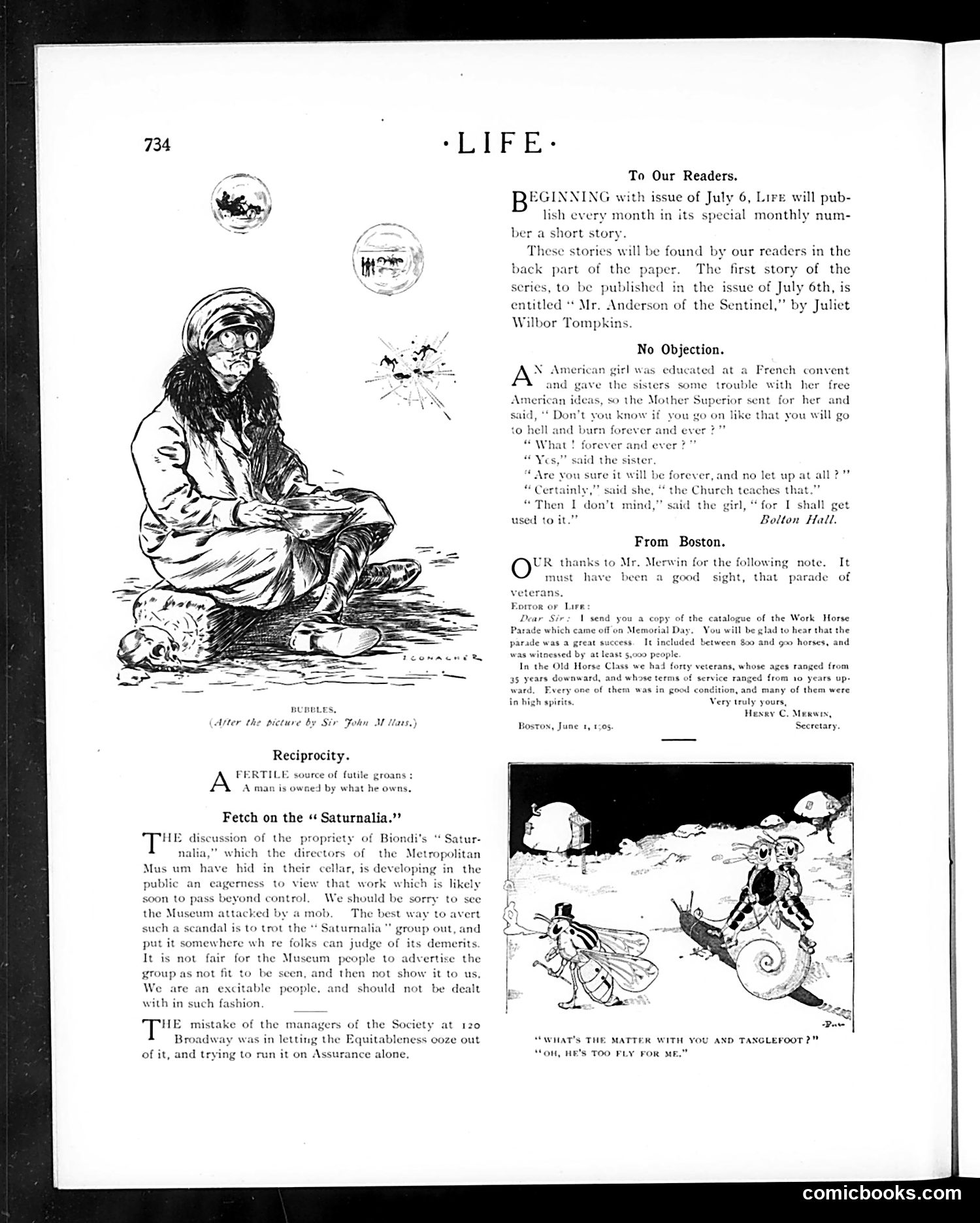
This page contains editorial content and satirical commentary rather than political cartoons. The main illustrated item is "Bubbles," a Sir John Tenniel sketch of an old person sitting with soap bubbles, likely symbolizing ephemeral or false promises. The "Reciprocity" section mocks wealthy people claiming ownership based on possessions—a commentary on capitalist ideology. "Fetch on the 'Saturnalia'" criticizes the Metropolitan Museum's handling of Bondi's "Saturnalia" painting, arguing museum directors mismanaged the work and shouldn't advertise things they haven't properly displayed. The piece advocates for ethical institutional practices. The bottom right cartoon shows anthropomorphic insects with text "What's the matter with you and Tanglefoot?" —likely a pun on a contemporary adhesive product brand, though the specific reference remains unclear.
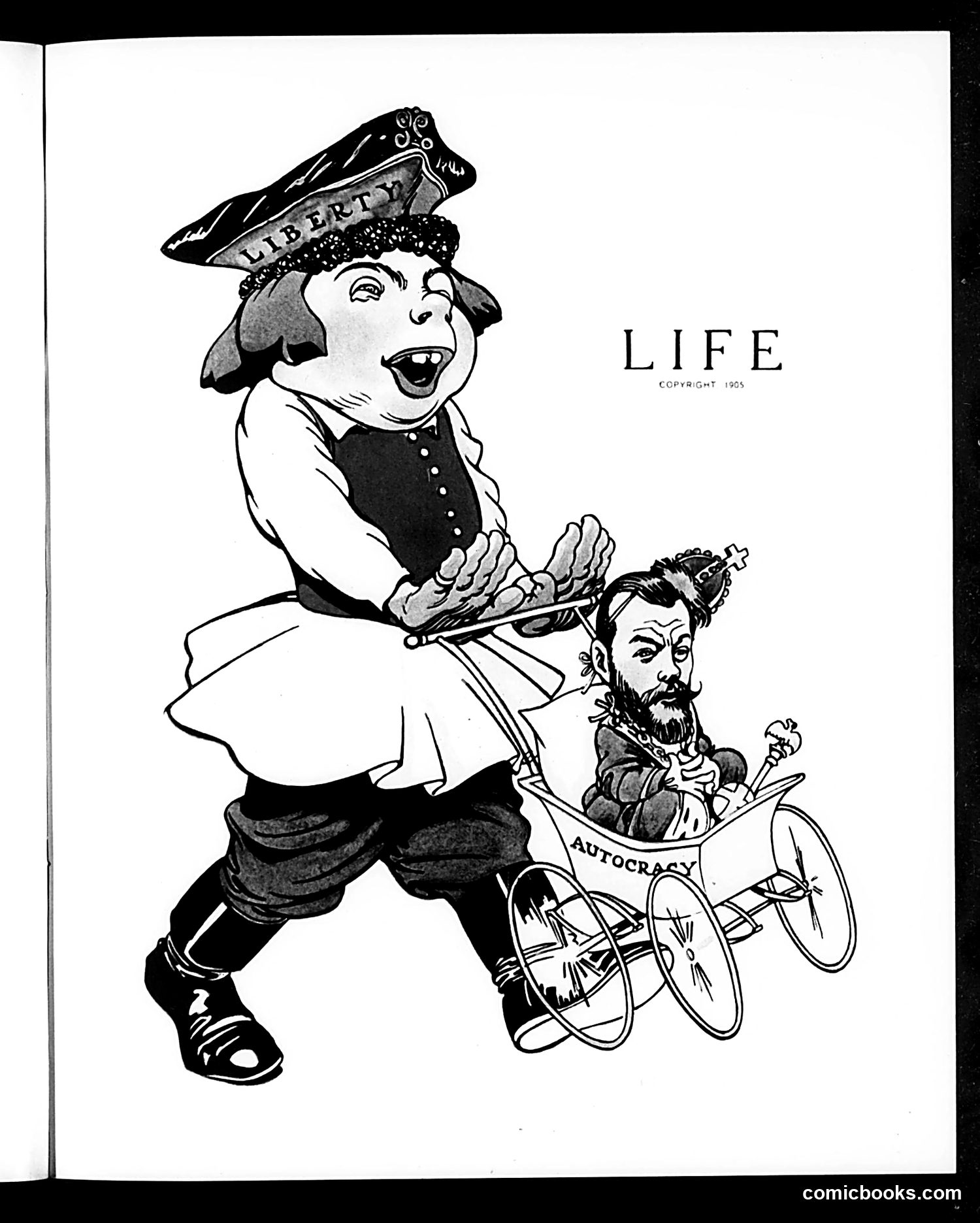
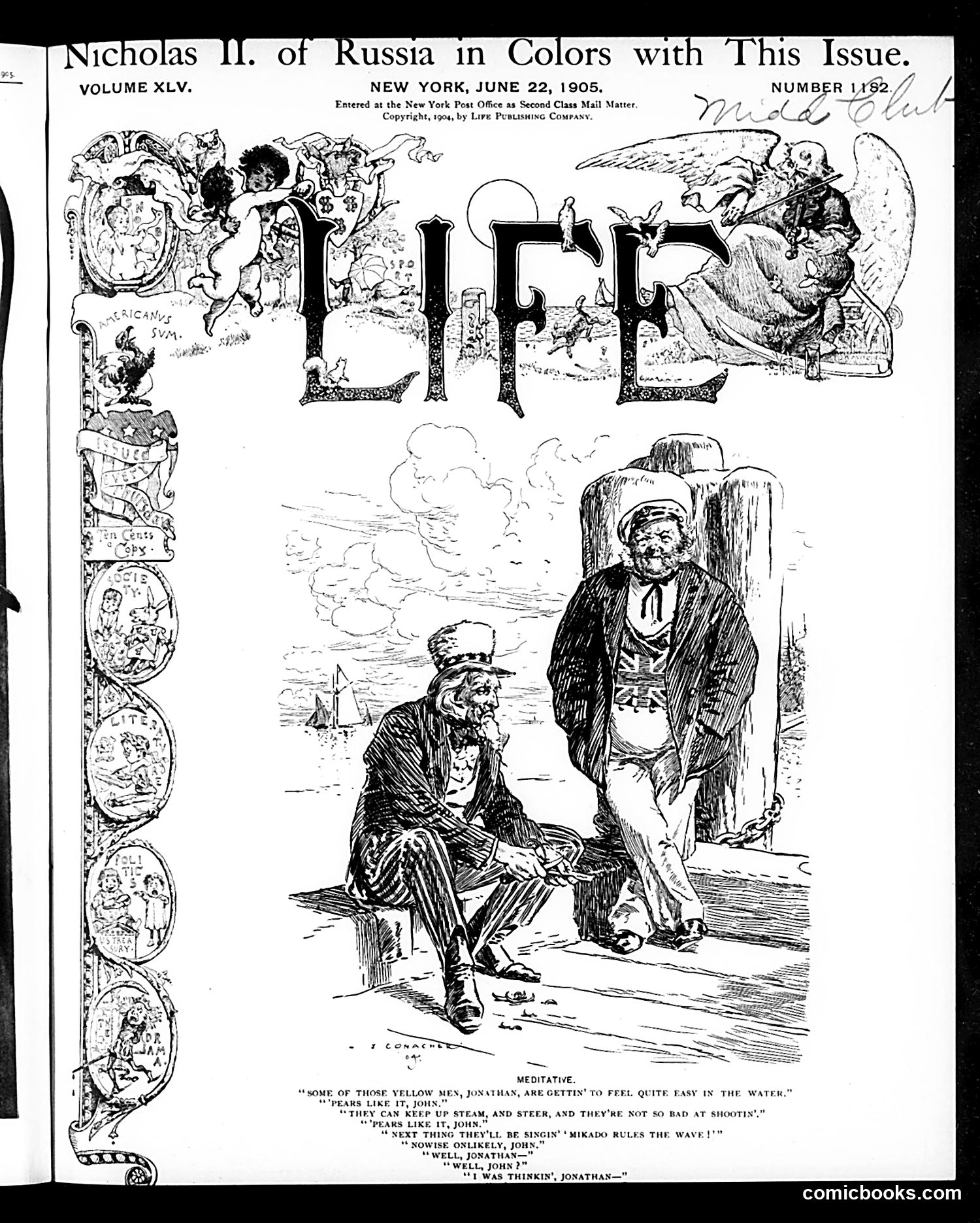
This is a title page for *Life* magazine, copyright 1905. The cartoon depicts a large figure wearing a tricorn hat labeled "LIBERTY" pulling a small carriage labeled "AUTOCRACY" containing a bearded man (likely representing an autocratic ruler or foreign monarch). The satire contrasts American liberty with autocratic government systems. The exaggerated proportions suggest Liberty's dominance over autocracy, implying American superiority and the triumph of democratic ideals over authoritarian rule. Given the 1905 date, this likely references contemporary geopolitical tensions, possibly relating to conflicts involving autocratic powers like Russia during the Russo-Japanese War period. The figure of Liberty, a traditional American symbol, is presented as actively opposing and restraining autocratic systems—a patriotic message for American readers.

I can see this is a blank or nearly blank white page from what appears to be a Life magazine publication (based on the "comicbooks.com" watermark visible at the bottom). The page contains no visible cartoon, illustration, text content, or other meaningful material that I can analyze. Without actual content to examine—whether political cartoons, satirical commentary, advertisements, or editorial material—I cannot identify any figures, caricatures, historical references, or satirical points. This appears to be either a blank page from the magazine's interior, a page where the original content failed to reproduce in this scan, or a title/separator page. To provide meaningful historical and contextual analysis, I would need a page with actual visible content.
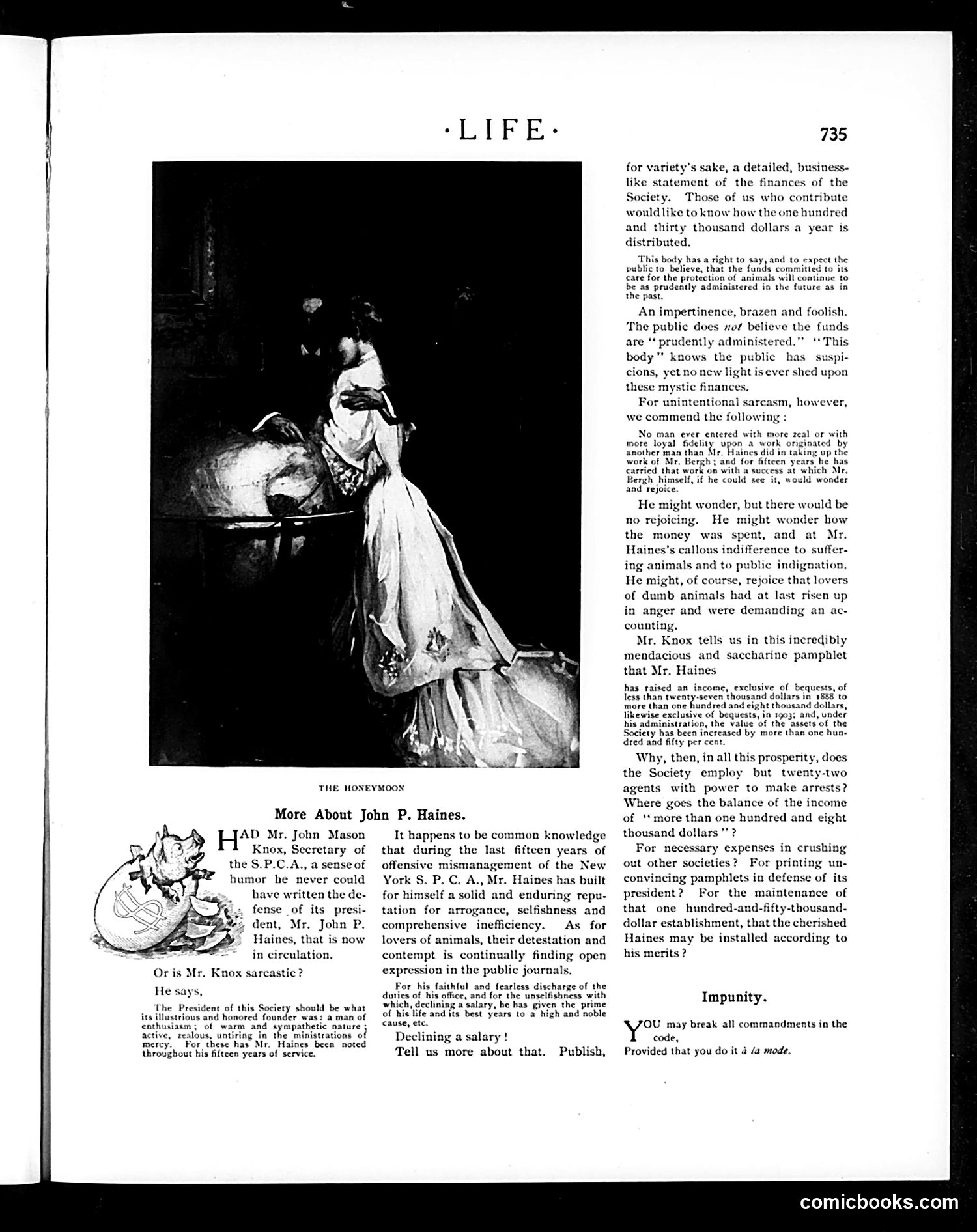
This is a satirical attack on John P. Haines, president of the New York S.P.C.A. (Society for the Prevention of Cruelty to Animals). The article mocks a defensive pamphlet written by S.P.C.A. Secretary John Mason Knox praising Haines's "fifteen years of service." **The satire's targets:** - Haines is accused of "arrogance, selfishness and comprehensive inefficiency" despite Knox's defense - The claim that Haines "declined a salary" is questioned—the author demands transparent financial accounting - Despite raising income from $27,000 (1888) to $108,000 (1903), the Society employs only 22 arrest agents, raising questions about fund misuse - The editorial suggests money goes to maintain Haines's "hundred-and-fifty-thousand-dollar establishment" rather than helping animals **The point:** Despite organizational prosperity and noble claims, Haines allegedly ignores animal suffering while enriching himself—epitomized by the closing couplet mocking how wealthy elites escape accountability through propriety and style ("à la mode").
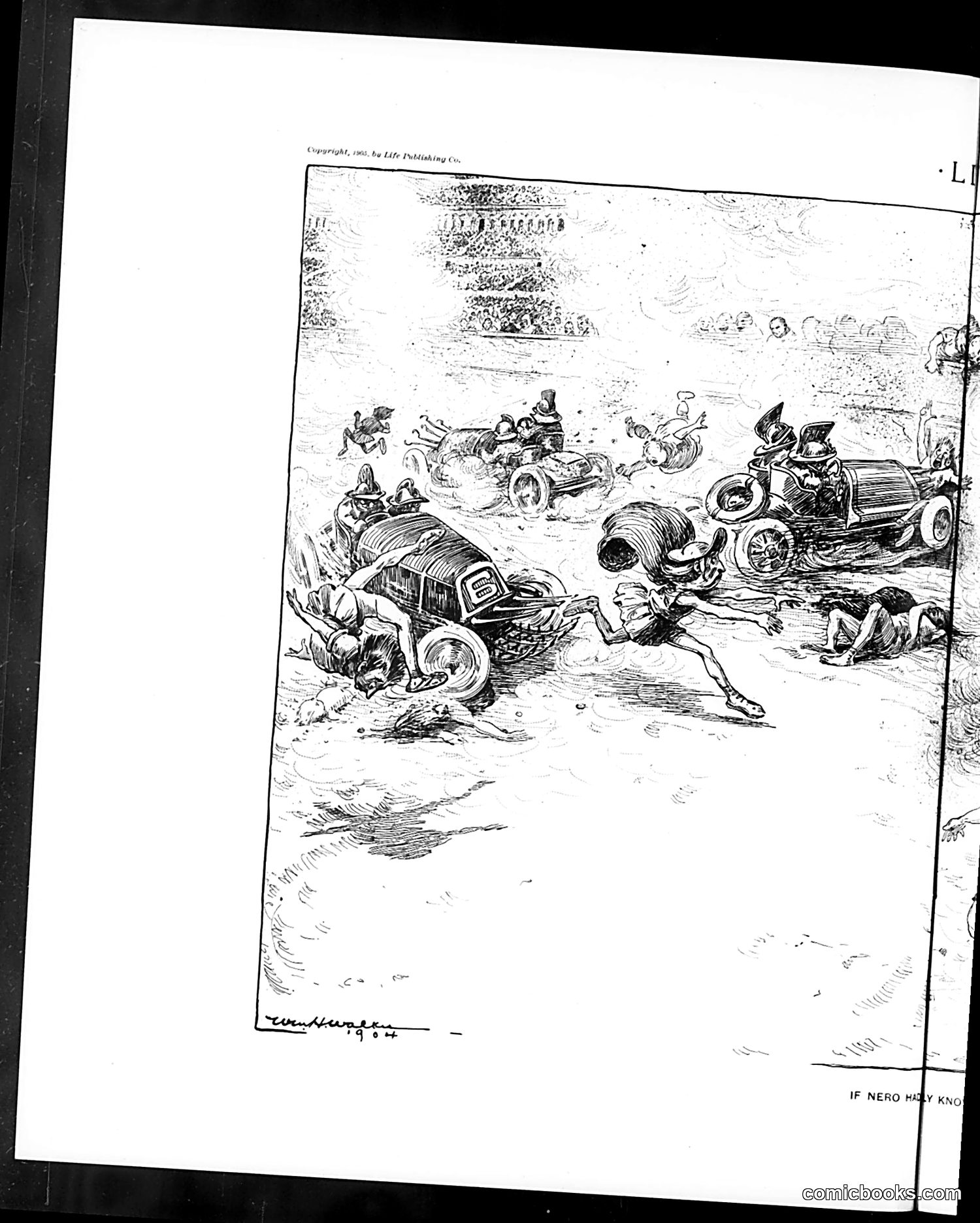
This is a satirical cartoon from Life magazine (copyright 1905) depicting a chaotic automotive scene. The drawing shows multiple early automobiles crashing, colliding, and causing mayhem on a road, with figures being thrown from vehicles and scattered about in disarray. The partial caption "IF NERO HAD KNOWN" (visible at bottom) suggests a comparison between the Roman emperor Nero—historically associated with chaos and destruction—and the pandemonium of early automobile culture. The satire mocks the dangerous, uncontrolled nature of early motoring: the unpredictable vehicles, reckless drivers, and accidents that characterized this new technology around 1905. The cartoon critiques automobiles as agents of destruction and disorder, presenting them as a modern version of civilizational chaos.
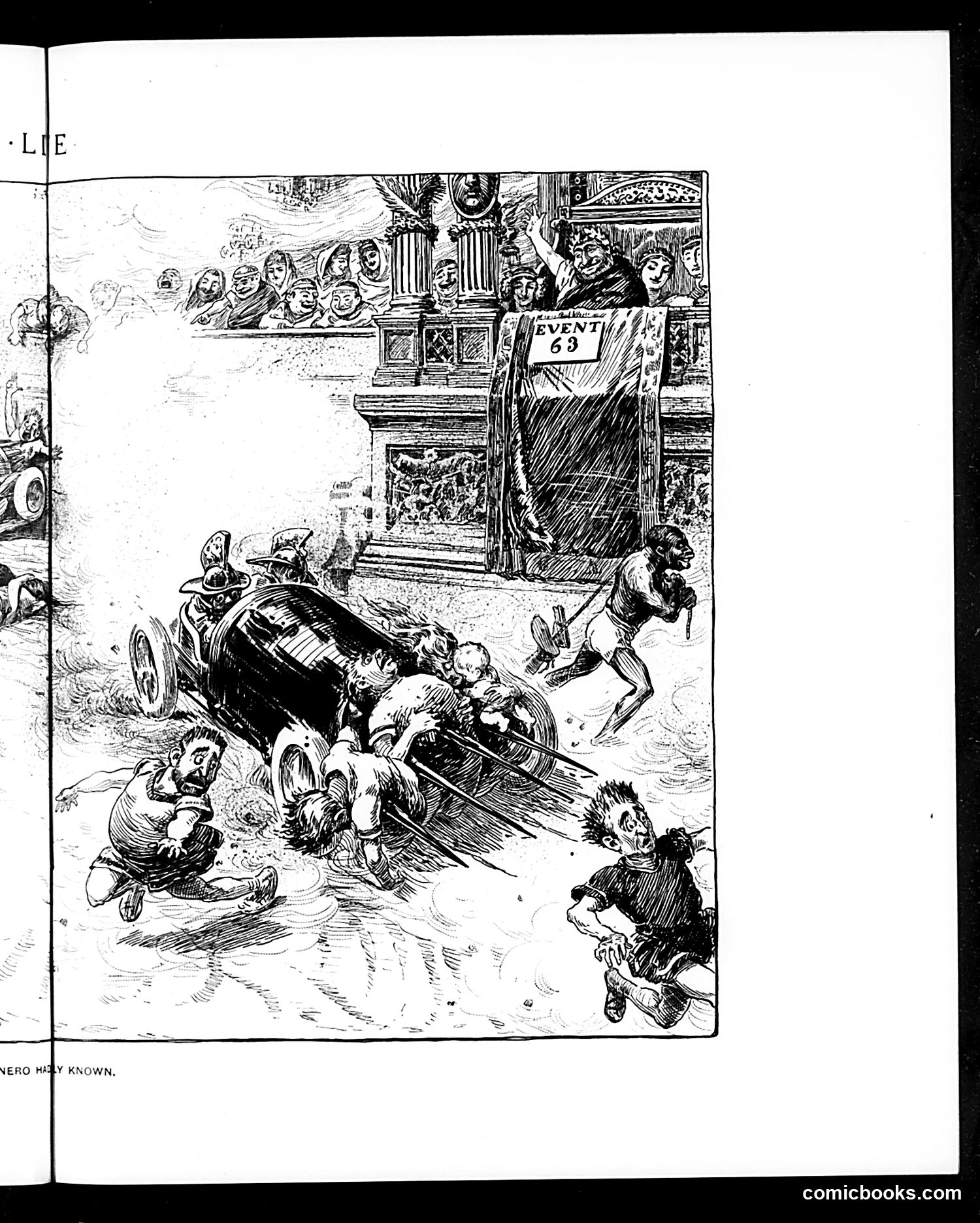
This is a single satirical illustration from *Life* magazine showing a chaotic scene of children playing with toys outside what appears to be a grand classical building (marked "EVENT 69"). The cartoon depicts young children in various states of rowdy play—some in a toy wagon or carriage, others running and tumbling on the ground. The exaggerated, energetic style suggests commentary on childhood behavior or possibly social disorder. The "EVENT 69" label and classical architecture suggest this may reference a specific political or social event, but without additional context or clearer text, the exact reference is unclear. The tone appears to mock either childish chaos, public disorder, or possibly political events represented through the metaphor of children's misbehavior—a common *Life* magazine satirical technique.
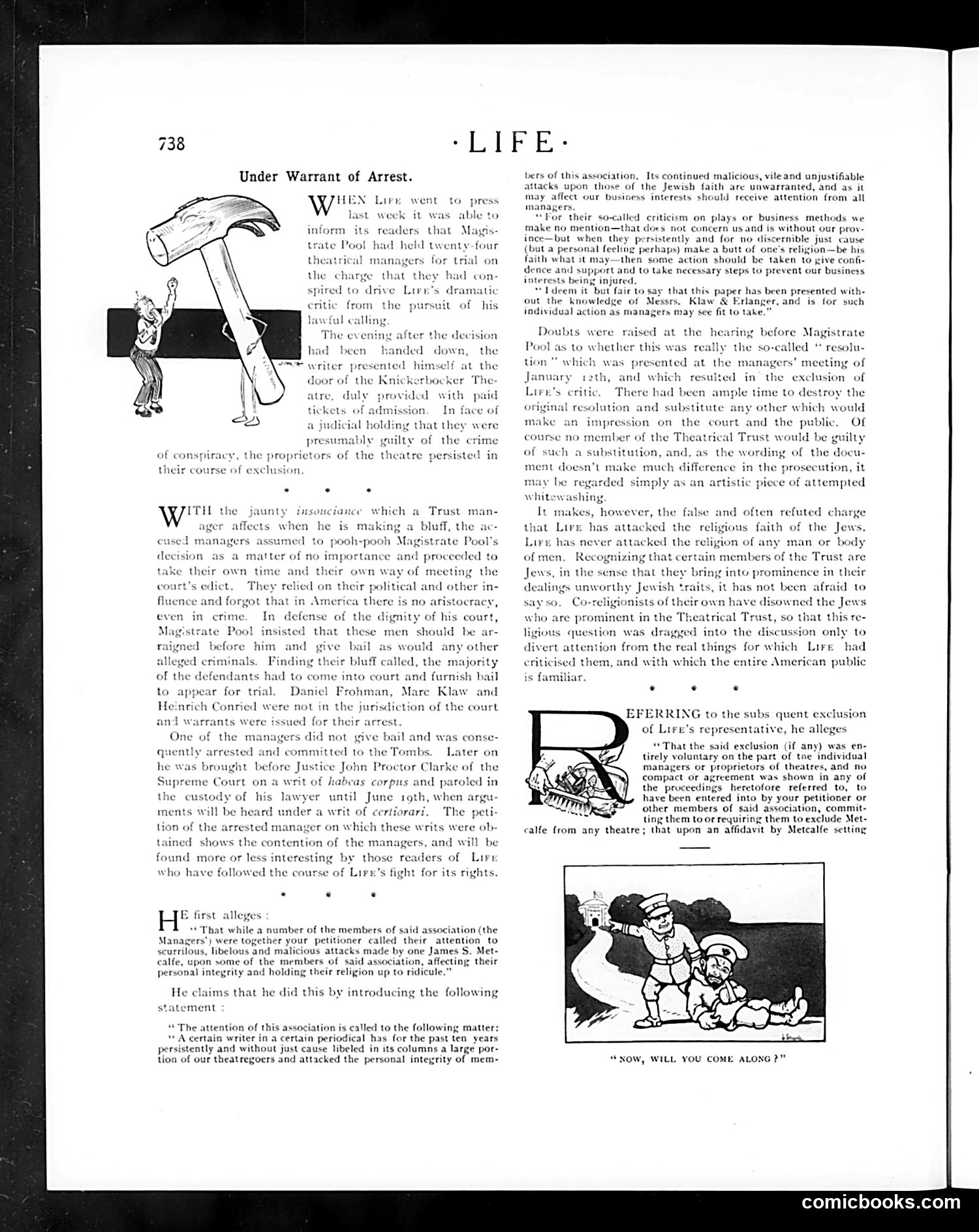
This page documents Life's legal battle with theatrical managers of the Theatrical Trust (a monopolistic organization controlling American theaters). The cartoons depict Life's critic being arrested for his reviews. The core conflict: Life published harsh criticism of plays managed by the Trust, particularly attacking what it characterized as unworthy conduct by Jewish members (Klaw, Erlanger, Frohman, Conried). The managers responded by excluding Life's critic from theaters. Life's defense claims it never attacked "the religion" itself, only the "unworthy Jewish traits" of specific individuals. This distinction—criticizing individuals' behavior versus their faith—appears designed to deflect charges of antisemitism, though the framing is deeply problematic by modern standards. The "warrant of arrest" refers to legal proceedings against Life. Magistrate Pool ultimately sided with Life's right to review, forcing the managers to appear in court and post bail. The cartoons mock the managers' initial arrogance and their eventual legal comeuppance.
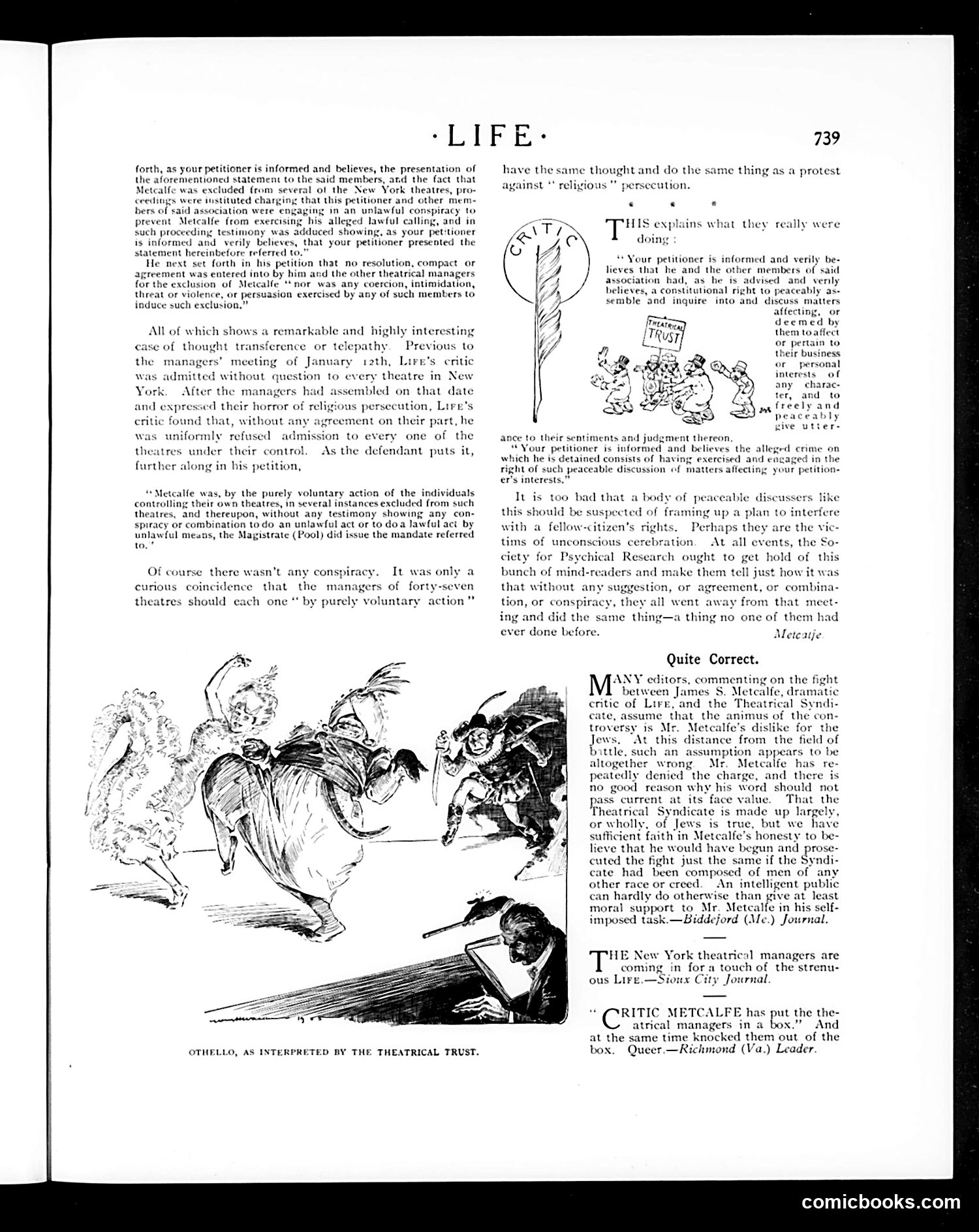
This page satirizes a real conflict between James S. Metcalfe (Life's drama critic) and the "Theatrical Trust"—a powerful cartel controlling New York theaters. Metcalfe was excluded from multiple theaters simultaneously after criticizing the trust's practices. The satire's central joke: theater managers claimed their exclusion of Metcalfe was purely coincidental "voluntary action," not conspiracy. Life ridicules this by invoking "thought transference or telepathy"—how could forty theaters independently make identical decisions without coordination? The cartoon shows Othello (Shakespeare's tragic hero) being manipulated by villainous forces, paralleling how Life portrays the Trust orchestrating theater managers like puppets. The piece attacks the managers' obvious hypocrisy: they publicly condemned "religious persecution" while simultaneously blacklisting a critic through coordinated action they denied coordinating—a textbook conspiracy dressed as coincidence.
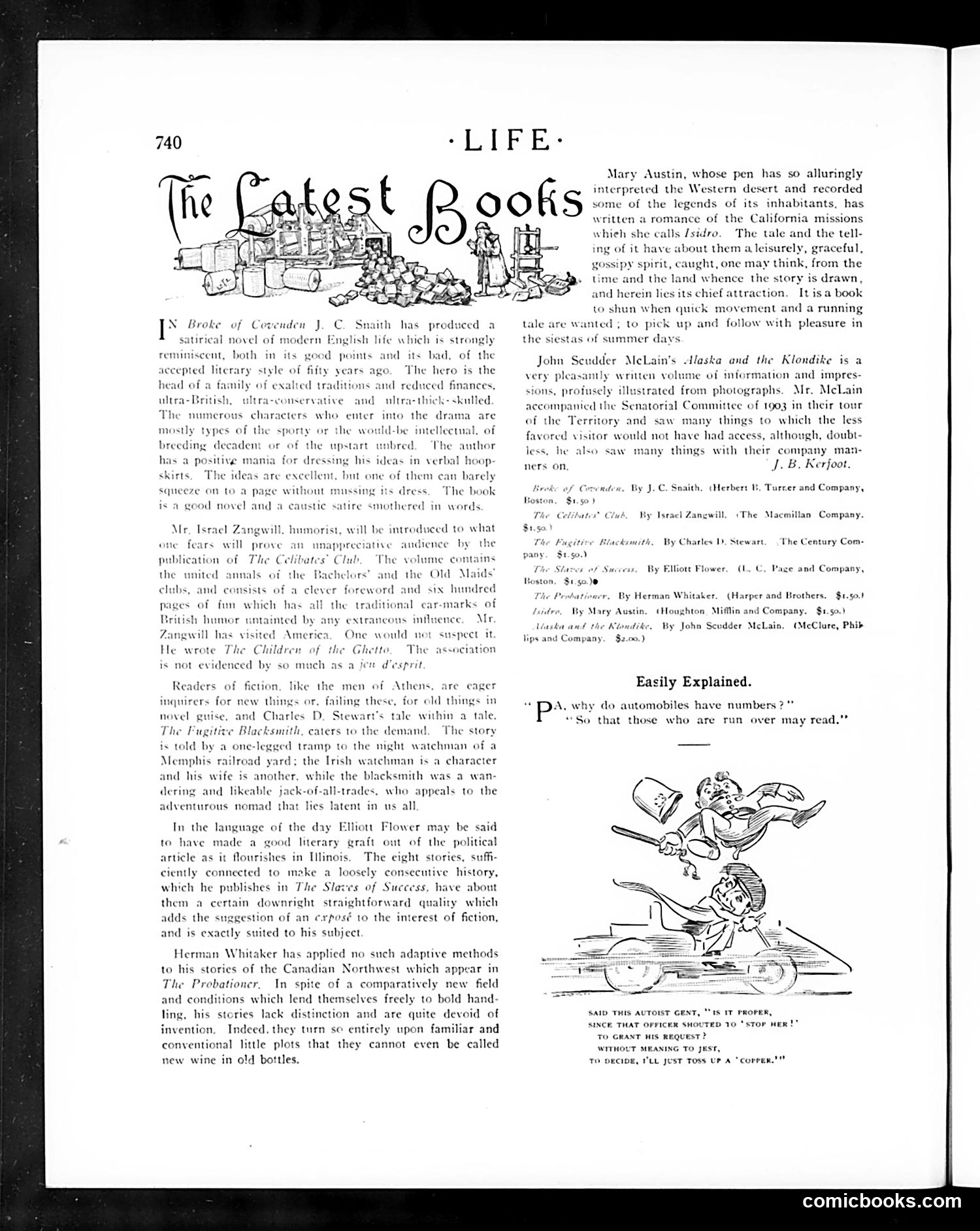
This page reviews recent books, but the notable content is the cartoon titled "Easily Explained" at bottom right. It depicts an automobile accident victim being struck, with the caption joking: "Pa, why do automobiles have numbers?" / "So that those who are run over may read." **The satire:** This is dark humor about early automobiles' dangers. The joke mocks both the rapid adoption of dangerous vehicles and insurance/identification systems. By having the victim "read" their automobile's number while being hit, the cartoon satirizes society's casual acceptance of automobile fatalities—a new public health crisis in the early 1900s. It's gallows humor about how automobiles were killing pedestrians at alarming rates, yet society normalized this danger through bureaucratic systems (registration numbers) rather than safety measures. The reviews above discuss contemporary novels by authors like Mary Austin and Israel Zangwill, providing context that this is early 20th-century Life magazine content.
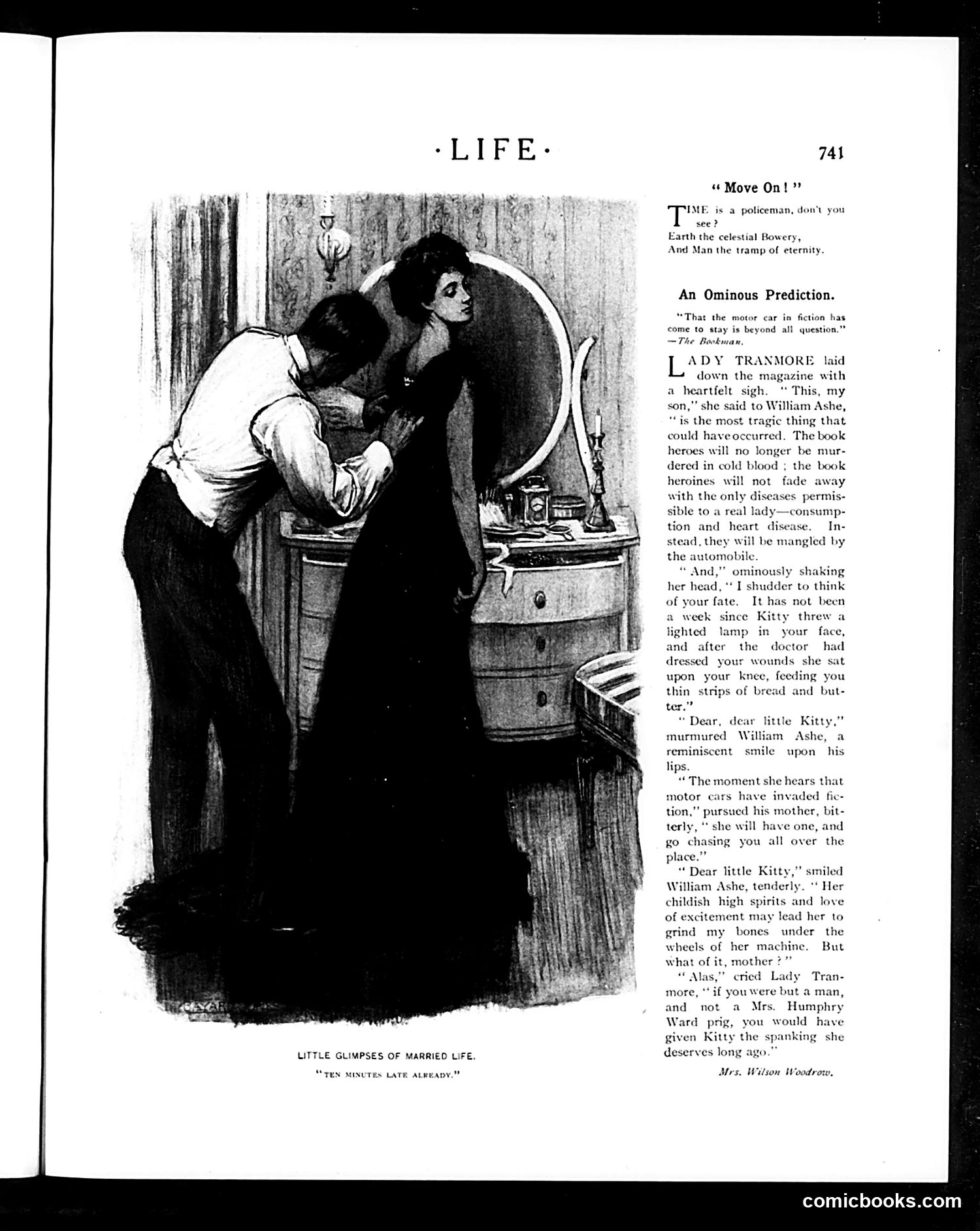
**The Image:** A sketch titled "Little Glimpses of Married Life: Ten Minutes Late Already" depicts a woman at a vanity mirror while a man (presumably her husband) waits impatiently behind her. **The Satire:** This is domestic humor about marriage, specifically the stereotype of wives delaying husbands by taking excessive time with personal grooming. The caption "ten minutes late already" emphasizes the recurring marital friction over punctuality. **The Text Content:** The right side contains "An Ominous Prediction," a humorous short piece mocking the emerging popularity of automobiles in fiction. A mother warns her son that literary heroines will now be killed by motor cars rather than the traditional "acceptable" female deaths (consumption, heart disease). She jests that his wife Kitty will inevitably obtain a motor car and use it recklessly. **Historical Context:** Both pieces reflect early 20th-century anxieties—about gender roles in marriage and about the disruptive social impact of automobiles—presented through light satirical commentary typical of LIFE magazine's format.
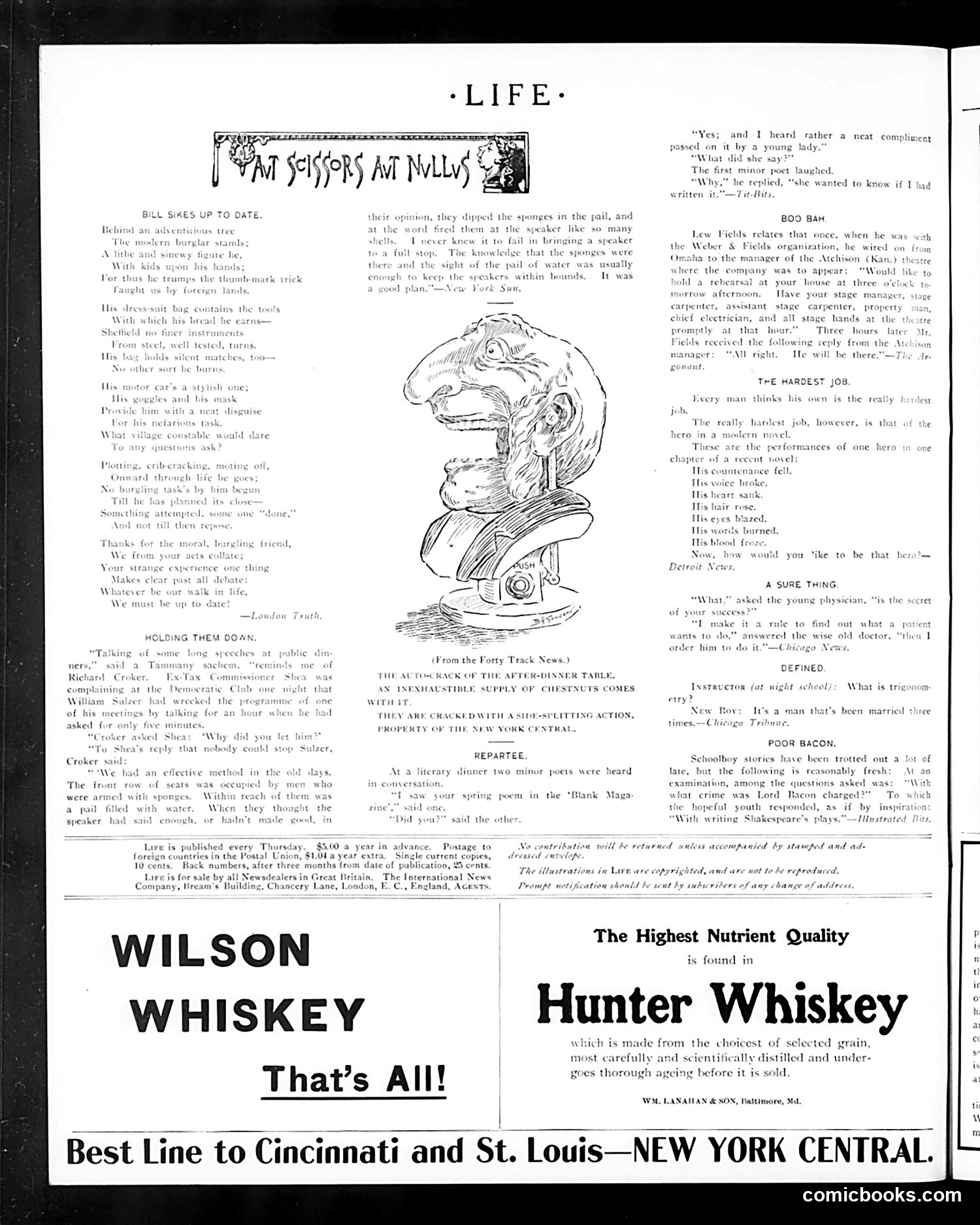
This page from *Life* magazine contains several short humorous anecdotes and jokes typical of the publication's satirical content, rather than a single unified cartoon. **Key content includes:** - **"Boo Bah"**: A joke about Lew Fields (of the famous vaudeville duo Weber & Fields) recounting a theater anecdote. - **"The Hardest Job"**: A quip about the difficulty of being a modern hero—suggesting that traditional heroism has become complicated or impossible. - **"A Sure Thing"**: A doctor's joke about diagnosing patients by determining what they want to hear. - **"Holding Them Down"**: References Tammany Hall politics and Ex-Tax Commissioner Croker, likely critiquing Democratic political corruption or machine politics. - **"Poor Bacon"**: A schoolboy anecdote about Shakespeare. The page is primarily **advertising** (Wilson Whiskey, Hunter Whiskey, New York Central Railroad), with scattered brief humor pieces rather than substantive political satire. The references to Tammany Hall suggest contemporary urban political humor was a regular feature.
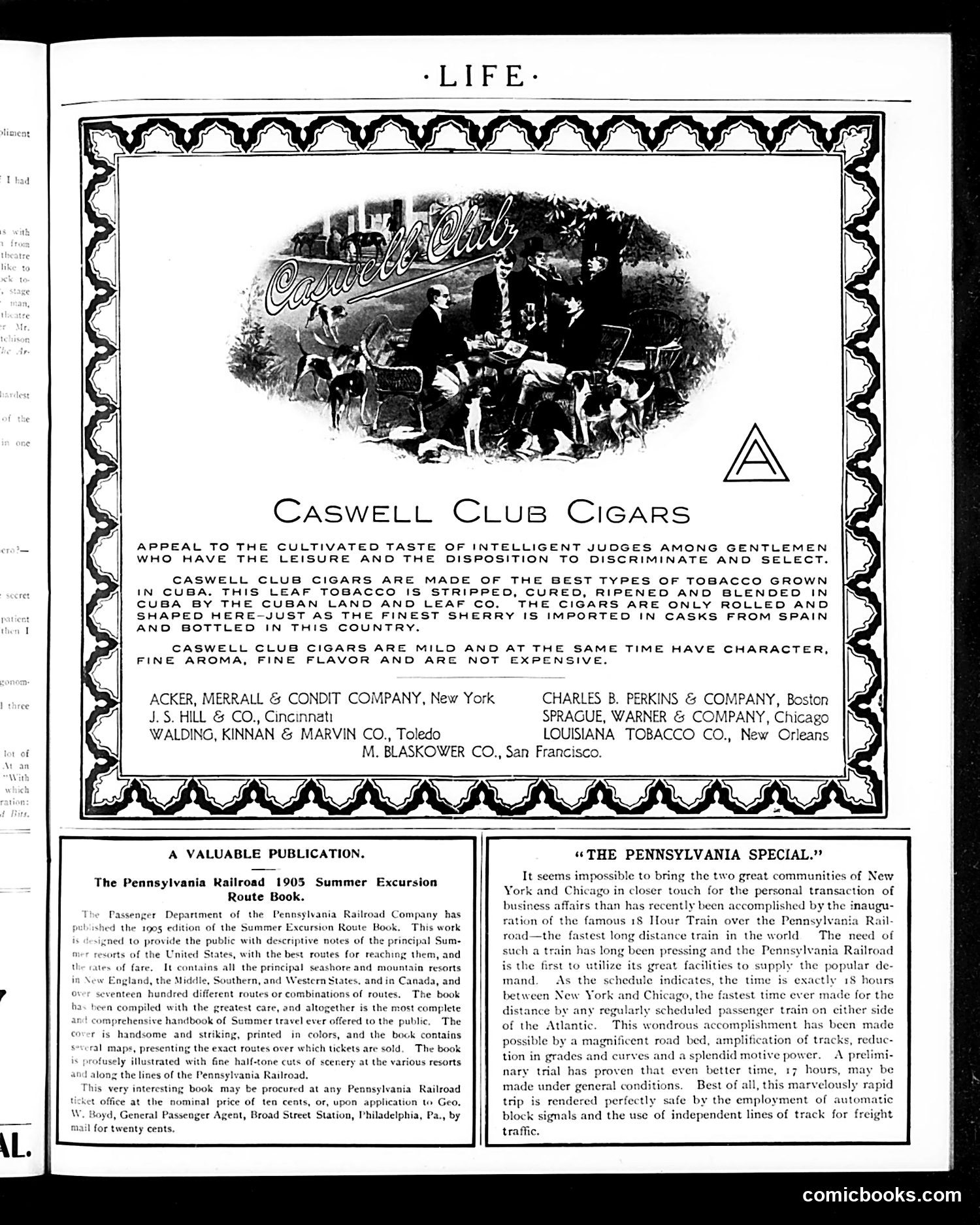
This page is primarily **advertising**, not political satire. The dominant image shows a **Caswell Club Cigars advertisement** featuring a social scene of well-dressed gentlemen relaxing outdoors under trees at what appears to be an exclusive club. The ad's appeal is explicitly **class-based**: it targets "intelligent judges among gentlemen" with "leisure" and "disposition to discriminate." The messaging emphasizes luxury markers—Cuban tobacco imported like fine Spanish sherry, mild yet characterful, "not expensive" (implying good value for the affluent). The numerous distributors listed across major cities reinforce premium positioning. Below are two separate **promotional texts**: one for Pennsylvania Railroad's 1905 Summer Excursion guide, the other touting "The Pennsylvania Special," an 18-hour express train between New York and Chicago for business travel. Together, the page targets the same demographic: affluent, leisured gentlemen interested in refined pleasures (cigars) and efficient modern conveniences (rail travel).
This page is primarily **advertising and contributor guidelines**, not political satire. The main content includes: **Advertisements**: M&M Portable Houses, Hotel Vendome Boston, Rogers Peet & Co. (clothing), Borden's Evaporated Cream, and Talbot fishing reels dominate the layout. **Contributor Guidelines**: The prominent "To Our Contributors" box states Life will pay five cents per word for short stories (under 2,500 words), accepting any interesting material, with submission instructions to their New York office. **Comic Anecdotes**: Several brief humorous stories appear in left column—"Our Foolish Contemporaries"—offering mild workplace and domestic humor typical of the era (servants, horses, milkmen), but these lack political significance. **One Small Cartoon**: Shows a horse jumping over a fence with a rider, illustrating the text's comparison that "the average good tailor can no more make correct livery than the average good horse can jump." This is essentially a **magazine back page** mixing advertisements with submission information—typical of early 1900s publications. No significant political or social satire is present.
This page is primarily **advertising with one substantive editorial piece**. The main content is "A Common-Sense View," a theater-industry critique arguing that theatrical **monopolies suppress legitimate criticism**. The writer contends that theater syndicate managers unfairly exclude critics who write negative reviews, claiming such criticism "injures" business. The author asserts this practice kills honest theater discourse and harms the art form itself. The piece references a specific incident involving critic **Metcalfe** being excluded for warning the public against poor performances. The remainder consists of period advertisements: collars, gloves, farming land, whiskey, bitters, hats, and travel promotions to California and Colorado resorts. A brief courtroom humor section includes Irish stereotypes (questioning an "Irishman's Reason" about mosquitoes). The page reflects early 1900s commercial publishing and theater industry labor tensions.
This article satirizes twenty-four theatrical managers who excluded Mr. Metcalfe (likely a performer or impresario) from their organization. The piece criticizes the managers for violating "the cardinal principle of American fair play" by acting without warrant or justification. The satire mocks their strategy as a "sure thing" that will inevitably fail—suggesting their coordinated action against Metcalfe will backfire legally and reputationally. The author argues that even if a New York magistrate finds them guilty of a penal offense, the real damage is to their credibility and public trust in theatrical institutions. The piece defends Metcalfe as having "questioned the methods of would-be throttlers and cinchers"—portraying him as standing up to monopolistic control. The underlying criticism targets the theatrical trust system itself: coordinated exclusion by powerful players to suppress competition or dissent.
This page consists primarily of **advertisements and filler content** rather than substantive satire or political commentary. The small poems at the top ("The Average Razor," "Those Foreigners," "Full Moon," "Hopeless") appear to be light humor—jokes about dull razors, foreign travelers, and romantic mishaps. They lack specific political targets. The main content includes ads for the **Hippodrome theater** in New York (promoting its performers and daily shows), the **Great Northern Steamship Company** advertising Pacific routes to Asia (Japan, China, Hong Kong), and a **Pennsylvania Railroad promotional booklet** for Asbury Park. The only illustration is a small silhouette cartoon labeled "A Wedding March" showing what appears to be a figure carrying a child, likely a generic domestic humor gag. This appears to be a typical early 20th-century magazine page mixing light verse, theatrical promotion, and travel advertising with minimal editorial cartooning or satirical content.
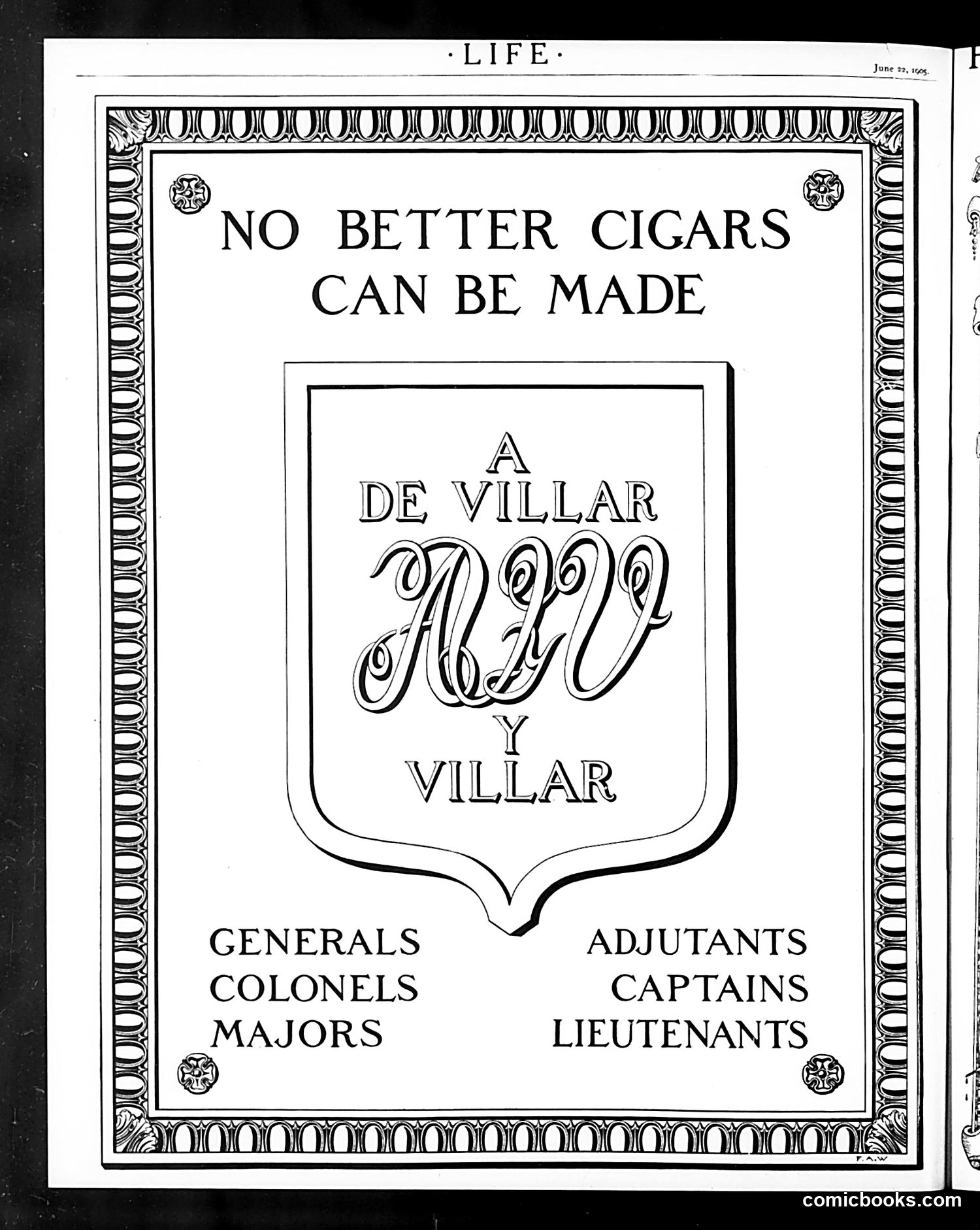
This is a cigar advertisement, not political satire. It promotes "A de Villar" cigars with the slogan "No Better Cigars Can Be Made." The ad uses a shield design featuring the brand name in decorative script. The listing of military ranks—generals, colonels, majors, adjutants, captains, and lieutenants—appears designed to appeal to a military or upper-class audience, suggesting these cigars are prestigious enough for officers. This was a common marketing strategy in early 20th-century advertising, using association with authority and status to promote luxury goods. The ornate decorative border and formal typography reflect the design aesthetic typical of *Life* magazine advertisements from this era.