
Life, 1905-06-22 · page 18 of 26
Life — June 22, 1905 — page 18: what you’re looking at
What you’re looking at
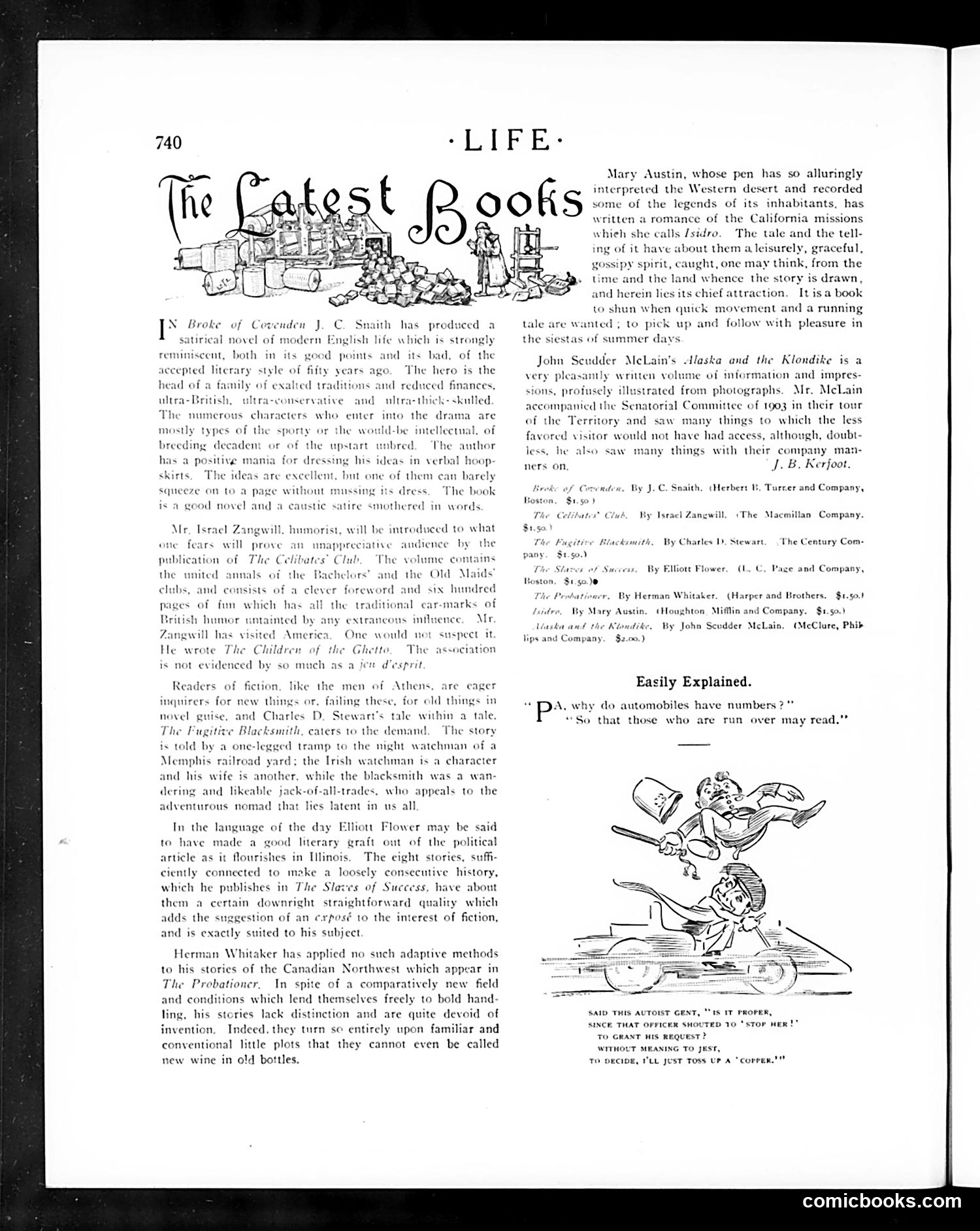
This page reviews recent books, but the notable content is the cartoon titled "Easily Explained" at bottom right. It depicts an automobile accident victim being struck, with the caption joking: "Pa, why do automobiles have numbers?" / "So that those who are run over may read." **The satire:** This is dark humor about early automobiles' dangers. The joke mocks both the rapid adoption of dangerous vehicles and insurance/identification systems. By having the victim "read" their automobile's number while being hit, the cartoon satirizes society's casual acceptance of automobile fatalities—a new public health crisis in the early 1900s. It's gallows humor about how automobiles were killing pedestrians at alarming rates, yet society normalized this danger through bureaucratic systems (registration numbers) rather than safety measures. The reviews above discuss contemporary novels by authors like Mary Austin and Israel Zangwill, providing context that this is early 20th-century Life magazine content.
📄 Transcribed text from this page (OCR, searchable)
Machine-transcribed from the original scan — historical spelling and the odd misread are preserved.
Mary Austin, whose pen has so alluringly interpreted the Western desert and recorded some of the legends of its inhabitants, has written a romance of the California missions. whieh she calls /stdro. The tale and the tell- of it have about them a leisurely, graceful, y spirit, caught, one may think, from the time and the land whence the story is drawn, and herein lies its chief attraction. It isa book to shun when quick movement and a running of Covenden J. C. Snaith has produced a tale are wanted; to pick up and follow with pleasure in urical novel of tern English life which is strong] the siestas of summer days. reminiscent, both in it mts_and of John Scudder MeLain's llaska and the Klondike is a very pleasantly written volume of information and impres- 1s, profusely illustrated from photographs. Mr. McLain accompanicd the Senatorial Committee of 1903 in their tour f the Territory and saw many things to which the less favored visitor would not have had access, although, doubt- jess, he also saw many things with their company man- ners on J.B. Kerfoot. accepted literary style of years ago. The hero is the head of a family of exalted traditions and reduced finances, ultra-British, ultra-conservative and. ultra-thick-skulled The numerous characters who enter into the drama are mostly types of the sporty or the would-be intellectual, of ig decadent or of the upstart unbred. The author has a positive mania for dressing his ideas in verbal hoop ideas are excellent, but one of them can barely squeeze on to a page without mussing its dress. The book rook By J.C. Snaith, (Herbert 0. Turcer and Company, is a good novel and a caustic satire smothered in: words. Ry Isracl Zangwill. /The Macmillan Company. Mr, Israel Zangwill, humorist, will be introduced to what one fears will prove an unappreciative audience by 1 ugitt tekamith. By Charles D. Stewart. ‘The Century Com- publication of The Celibates’ The volume contains the united annals of the Bachelors’ and the Old Ma mecesss By Piliott Rlawier., (Ini. Rage sed Company, clubs, and consists of a clever foreword and six hundred =. op usrann lala. oleae ET pages of fun which has all the traditional car-marks of Hpitaey Astin} “MGuabtGn, MiMin Aid Compal. $9) Vaska ant the Klondike. By John Scudder McLain. (McClure, Phib British humor untainted by any extrancons influence. Mr Zangwill has visited America. One would 1 spect it He wrote The Children of the ¢ T association is not evidenced by so much as a jet d'esprit Readers of fiction, like the men of Athens, : Easily Explained. inquirers for new things or. failing these, for old things in “ P " ul il , why do automobiles have numbers?" novel gutise, and Charles D, Stewart's tale within a ta ' Y “So that those who are run over may read.” The Fugitive Blacksmith, caters to the demand. The story is told by a one-legged tramp to the night watchman of a Memphis railroad yard; the Irish watchman is a character and his wife is another. while the blacksmith was a wan- dering and likeable jack-of-all-trades. who appeals to. the adventurous nomad that lies latent in us all In the language of the day Elliott Flower may be said to have made a good literary graft out of the political article as it flourishes in Illinois. The eight stories, suffi- ciently connected to make a loosely consecutive history, which he publishes in The Slaves of Success, have about them a certain downright straightforward quality which adds the suggestion of an crposé to the interest of fiction, and is exactly suited to his subject. Herman Whitaker has applied no such adaptive methods to his stories of the Canadian Northwest which appear in The Probationer, In spite of a comparatively new. field and conditions which lend themselves freely to bold hand- ling, his stories lack distinction and are quite devoid of SAID THIS AUTOIST GENT, ‘18 IT PROPER, invention. Indeed, they turn so entirely upon familiar and SINCE THAT OFFICER SHOUTED TO * sTOr conventional little plots that they cannot even be called beeper les ; WITHOUT MEANING TO JEST, new wine in old bottles. TO DECIDE, MLL JUST Toss UP A ‘corren.!” comicbooks.com