
Life, 1905-06-22 · page 16 of 26
Life — June 22, 1905 — page 16: what you’re looking at
What you’re looking at
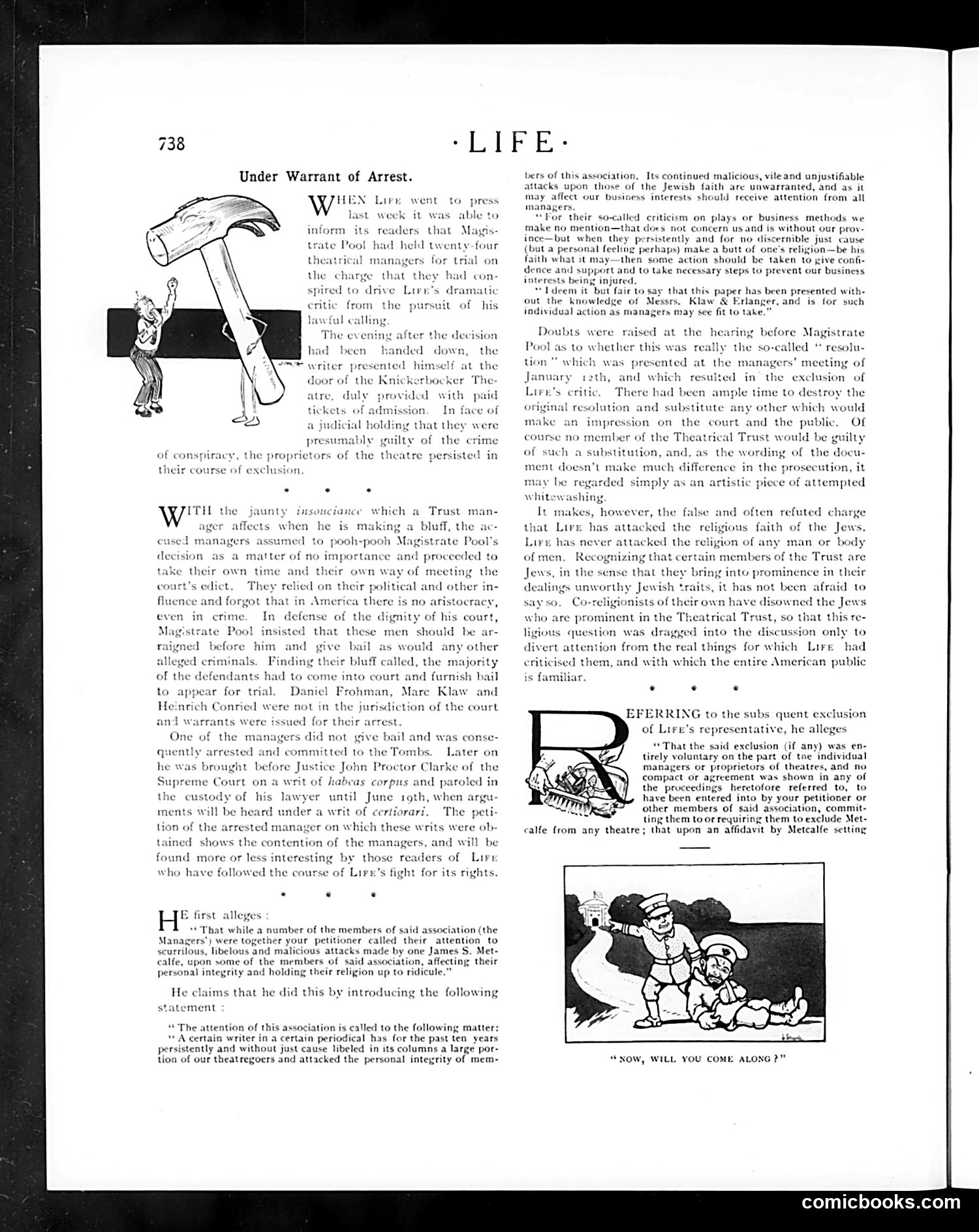
This page documents Life's legal battle with theatrical managers of the Theatrical Trust (a monopolistic organization controlling American theaters). The cartoons depict Life's critic being arrested for his reviews. The core conflict: Life published harsh criticism of plays managed by the Trust, particularly attacking what it characterized as unworthy conduct by Jewish members (Klaw, Erlanger, Frohman, Conried). The managers responded by excluding Life's critic from theaters. Life's defense claims it never attacked "the religion" itself, only the "unworthy Jewish traits" of specific individuals. This distinction—criticizing individuals' behavior versus their faith—appears designed to deflect charges of antisemitism, though the framing is deeply problematic by modern standards. The "warrant of arrest" refers to legal proceedings against Life. Magistrate Pool ultimately sided with Life's right to review, forcing the managers to appear in court and post bail. The cartoons mock the managers' initial arrogance and their eventual legal comeuppance.
📄 Transcribed text from this page (OCR, searchable)
Machine-transcribed from the original scan — historical spelling and the odd misread are preserved.
‘LIP E- Under Warrant of Arrest. bers of this association, Its continued malicious, vile and unjustifiable attacks upon those of the Jewish faith are unwarranted, and as it GEN Die iv to press My affect our business interests should receive attention from all are P nagers, last week it was able to “For their so-called criticism on plays or business methods we orm: its readers’ that’ Magi make no mention—that does not concern us and is without our prov- vi ince—but when they persistently and for no discernible just cause (but a personal feeling perhaps) make a butt of one’s religion—be his theatrical managers for trial c faith what it may—then some action should be taken to give confi- dence and support and to take necessary steps to prevent our business terests being injured. spired to drive Lire's dramatic *Ideem it but fair to say that this paper has been presented with- out the knowledge of Messrs, Klaw & Erlan is for such individual action as managers may see fit to take.” trate Pool had held twenty-four the char that they had con- critic from the pursuit of his. lawful call: he-ovoning alter hOdeeisOn Doubts were raised a hearing before Magistrate been handed down, the Pool as to whether this was really the so-called “ resolu- writer presented himself at the tion" which was presented at the managers’ meeting of door of the Knickerbocker The anuary 12th, and which resulted in’ the exclusion of atre; iuly ded with paid Lire’s critic. There had been ample time to destroy the tickets of admission. In face of OTiginal resolution and substitute any other which would a judicial holding that they were Make an impression on the court and the public. Of presumably guilty of the crime Course no member of the Theatrical Trust would be guilty ShRenapteAgy, LHS Proprietors of the theatre persisted of such a substitution, and, as the wording of the docu- LeRGuFS Of exeli ment doesn’t make much difference in the prosecution, it may be regarded simply as an artisti whitewas! the jaunty insouciance which a Trust man- It makes, however, the false and often refuted charge tic piece of attempted ager affects when he is making a bluff, the ac- that Lire has attacked the religious faith of the Jews. cused managers assumed to pooh-pooh Magistrate Pool’s Lire has never attacked the religion of any man or body decision as a matter of no importance and proceeded to of men. Recognizing that certain members of the Trust are take their own time and their own way of meeting the Jews, in the sense that they bring into prominence in their court's ediet. ied on their politi nd other in- dealings unworthy Jewish traits, it has not been afraid to fluence and forgot America the! no aristocracy, say so. Co-religionists of their own have disowned the Jews even in crime. In defense of the dignity of his court, who are prominent in the Theatrical Trust, so that this re- Magistrate Pool insisted that these men should be ar- — ligious question was dragyed into the discussion only to raigned before him and give bail as would any other — divert attention from the real things for which Lire 1 alleged criminals. Finding their bluff called, the majority criticised them, and with which the entire American public of the defendants had to come into court and furnish bail is familiar. to appear for trial. Danicl Frohman, Mare Klaw and * : Heinrich Conried were not in the jurisdiction of tt FERRING to the subs quent exclusion and warrants were issued for their arrest. . p of Lire's representative, he alleges One of the managers did not give bail and was conse- “That the said exclusion (if any) was en- tirely voluntary on the part of the individual he was brought before Justice John Proctor Clarke of the managers oF proprietors of theatres, and no compact or agreement was shown in any of the proceedings heretofore referred to, to custody of his lawyer until June roth, when argu- have been entered into by your petitioner or ments will be heard under a writ of certiorari, The peti- %” other members of said association, commit- : oe ting them to or requiring them to exclude Met- tion of the arrested manager on which these writs were ob- calfe from any theatre; that upon an affidavit by Metcalfe setting tained shows the contention of the managers, and will be quently arrested and committed to the Tombs. Later on Supreme Court on a writ of habeas corpus and paroled in found more or less interesting by those readers of Li who have followed the course of Lire’s fight for its rights. H first alleges “That while a number of the members of said association (the Managers’) were together your petitioner called their attention to scurrilous, libelous and malicious attacks made by one James S. Met- calfe, upon some of the members of said association, affecting their personal integrity and holding their religion up to ridicule. He claims that he did this by introducing the following statement “ The attention of this association is called to the following matter: certain writer in a certain periodical has for the past ten years persistently and without just cause libeled in its columns a large por- tion of our theatregoers and attacked the personal integrity of mem- “NOW, WILL YOU COME ALONG ?”" comicbooks.com