
A complete issue · 40 pages · 1905
Life — February 2, 1905
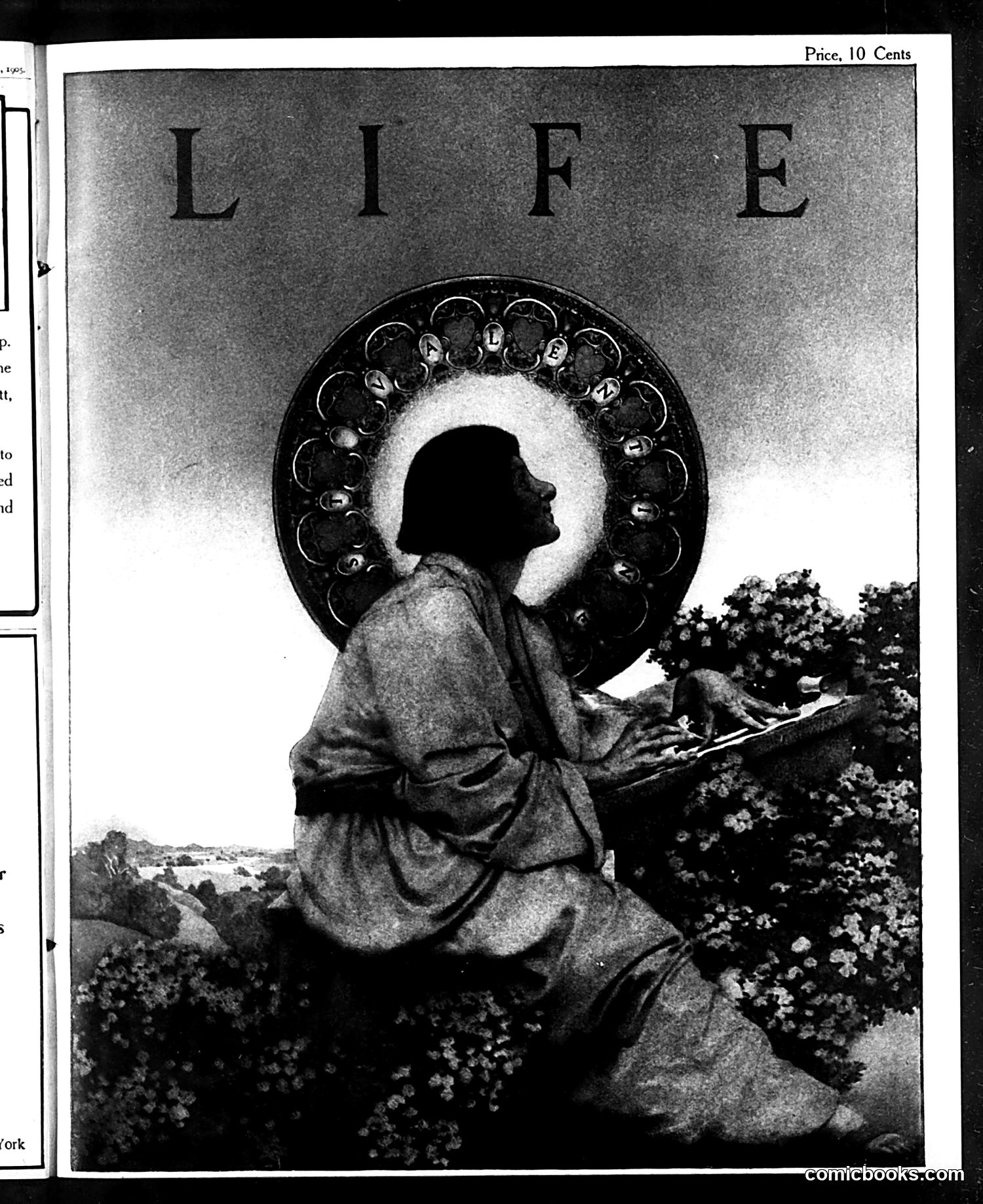
This Life magazine cover (priced at 10 cents) features a silhouetted profile of a man's head set within an ornate circular frame, surrounded by flowering plants in a landscape. The word "LIFE" appears at the top. The image appears to be symbolic rather than depicting a specific named individual—the silhouette technique was common in early 20th-century Life covers for philosophical or thematic commentary rather than political caricature of particular figures. Without additional OCR text from the page's interior or a visible date, I cannot definitively identify the specific historical reference, political commentary, or satirical point this cover intended to make. The allegorical composition suggests themes of human nature, growth, or reflection, but the precise meaning requires contextual information not clearly available from the image alone.
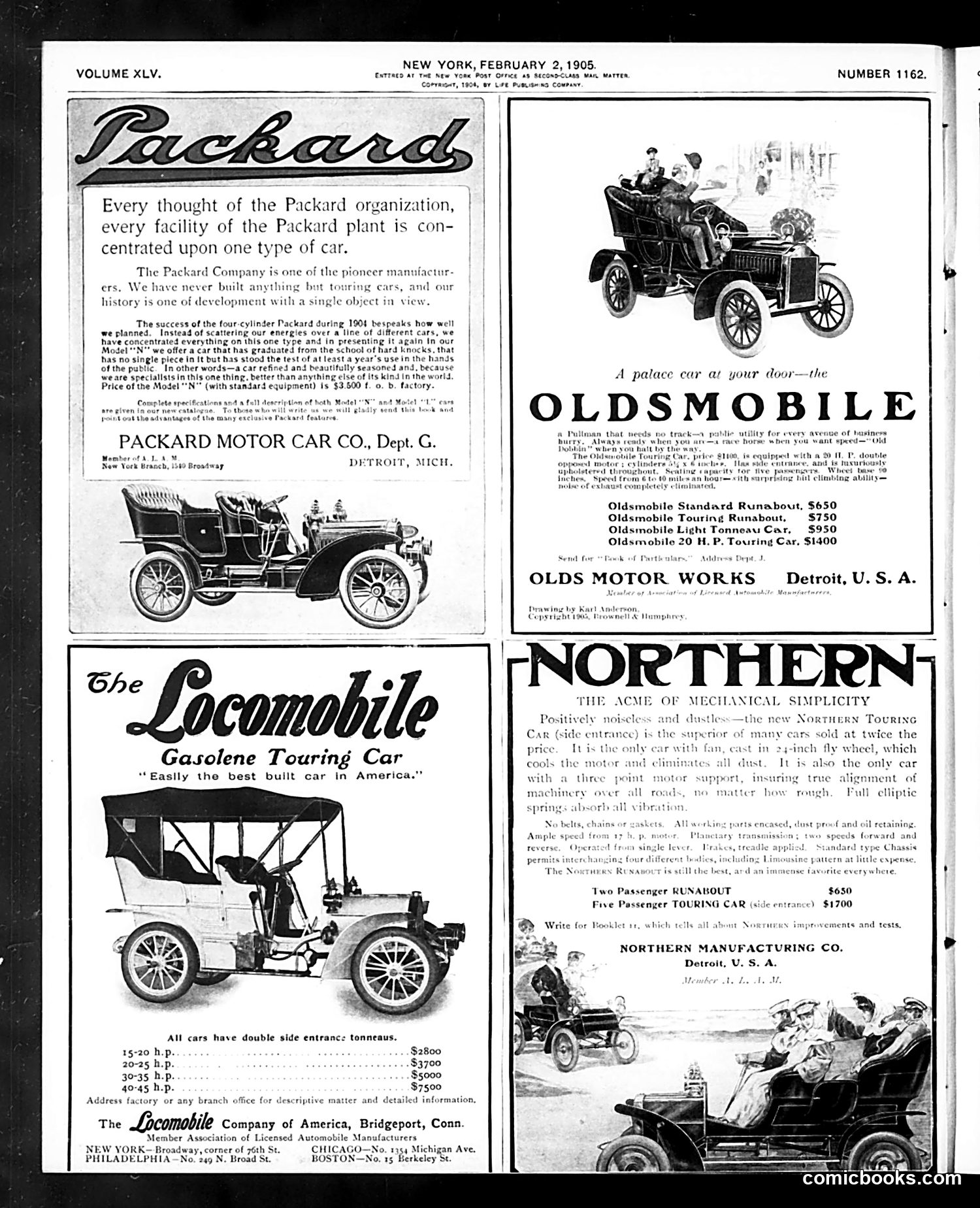
This page is **not a political cartoon or satire**—it is primarily **automobile advertising** from February 2, 1905. The page contains four car advertisements: 1. **Packard** (top left): emphasizes their focus on touring cars 2. **Oldsmobile** (top right): advertises multiple models with prices ranging from $650-$1400 3. **Locomotile** (bottom left): a gasoline touring car priced $2800-$5000 4. **Northern** (bottom right): markets their touring car as "the acme of mechanical simplicity" These ads target wealthy buyers interested in automobiles—still a luxury novelty in 1905. The illustrations show early motorcar designs with open seating and primitive engineering. There is no satirical content; this reflects the period's genuine excitement about automobile manufacturing as a major American industry.
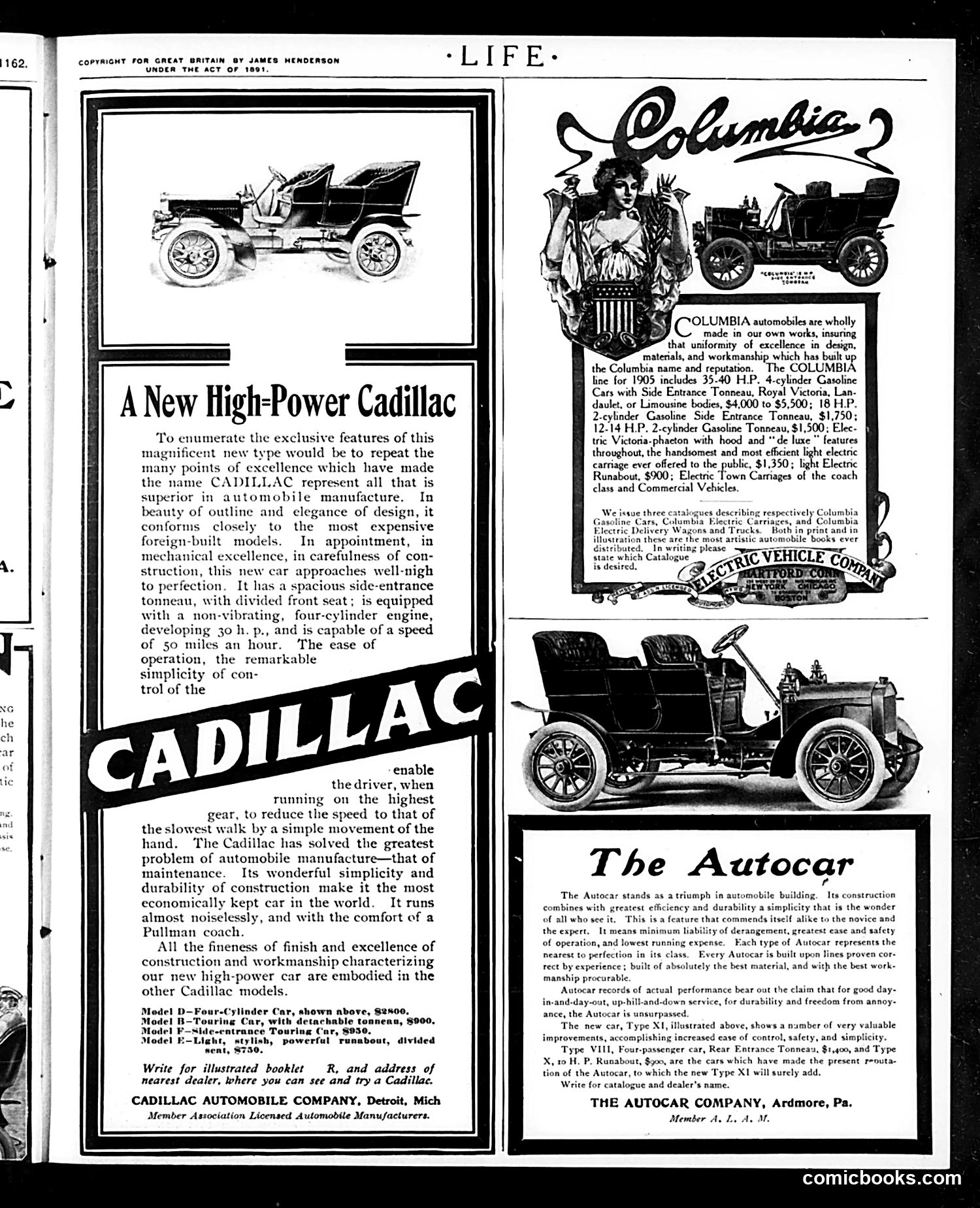
This page is **primarily advertising**, not satire or political commentary. It contains two automobile advertisements from circa 1905: 1. **Left side**: A Cadillac ad emphasizing the car's mechanical simplicity, reliability, and ease of operation—key selling points for early automobiles when mechanical complexity was a major consumer concern. 2. **Right side**: Advertisements for Columbia automobiles (featuring a female allegorical figure representing the brand) and the Autocar, highlighting durability and performance. The ads reflect early automotive industry competition and marketing strategies targeting affluent buyers. There is no apparent political satire, caricature, or social commentary on this page—it's a straightforward commercial section of the magazine.
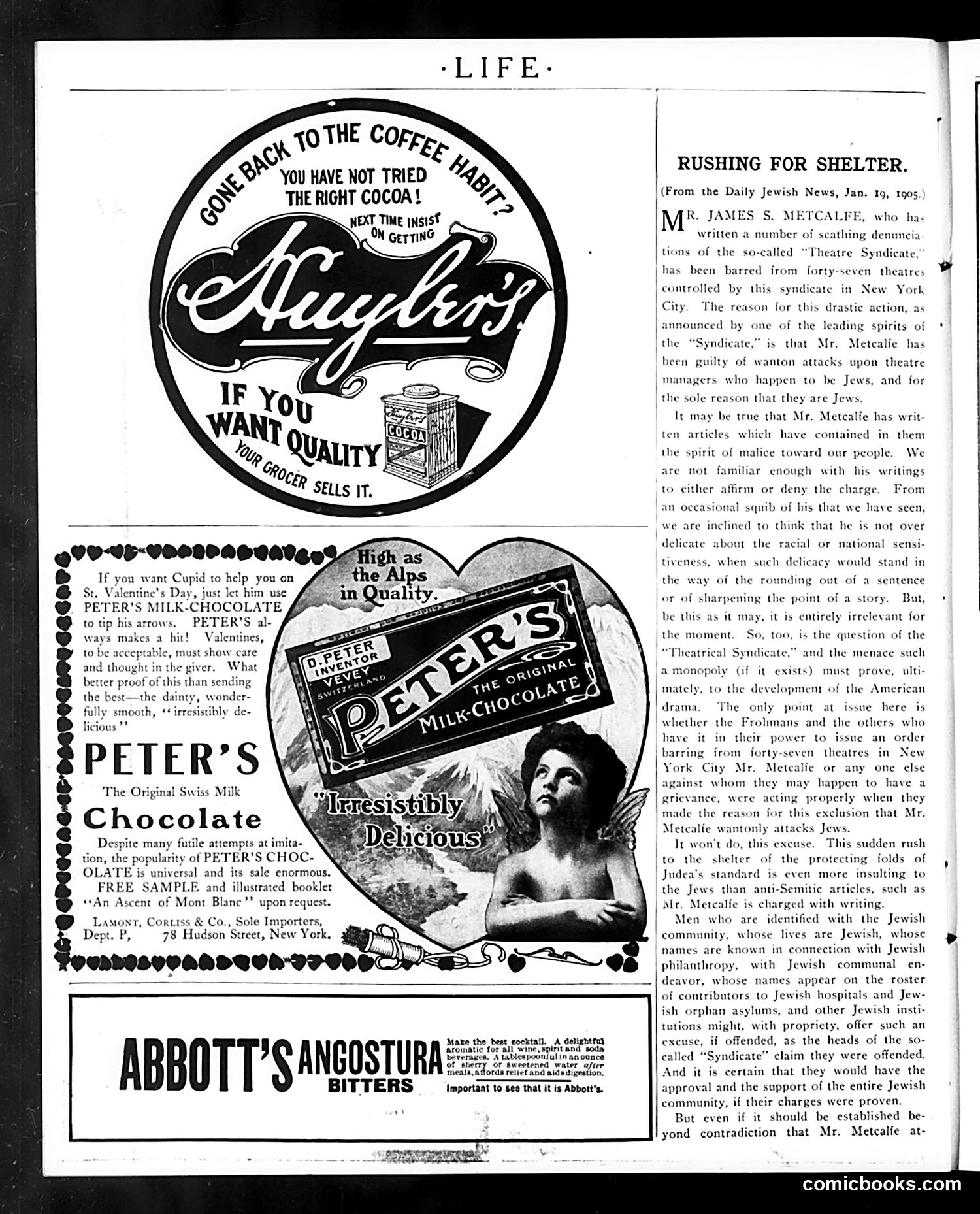
This page contains three product advertisements (Alupheny cocoa, Peter's chocolate, and Abbott's bitters) with no political cartoons. The right column features an article titled "Rushing for Shelter" (from the Daily Jewish News, Jan. 19, 1925) discussing James S. Metcalfe's accusations against the "Theatre Syndicate." Metcalfe claims the syndicate has barred Jewish theatre managers from forty-seven theatres, alleging they attack managers specifically because they are Jewish. The article defends against these charges as inflammatory and argues the exclusion has nothing to do with religion—that Metcalfe is simply making unfounded attacks. The piece emphasizes that many prominent Jewish individuals support Jewish institutions and charitable causes. This reflects 1920s anti-Semitic discrimination in American theatre management.
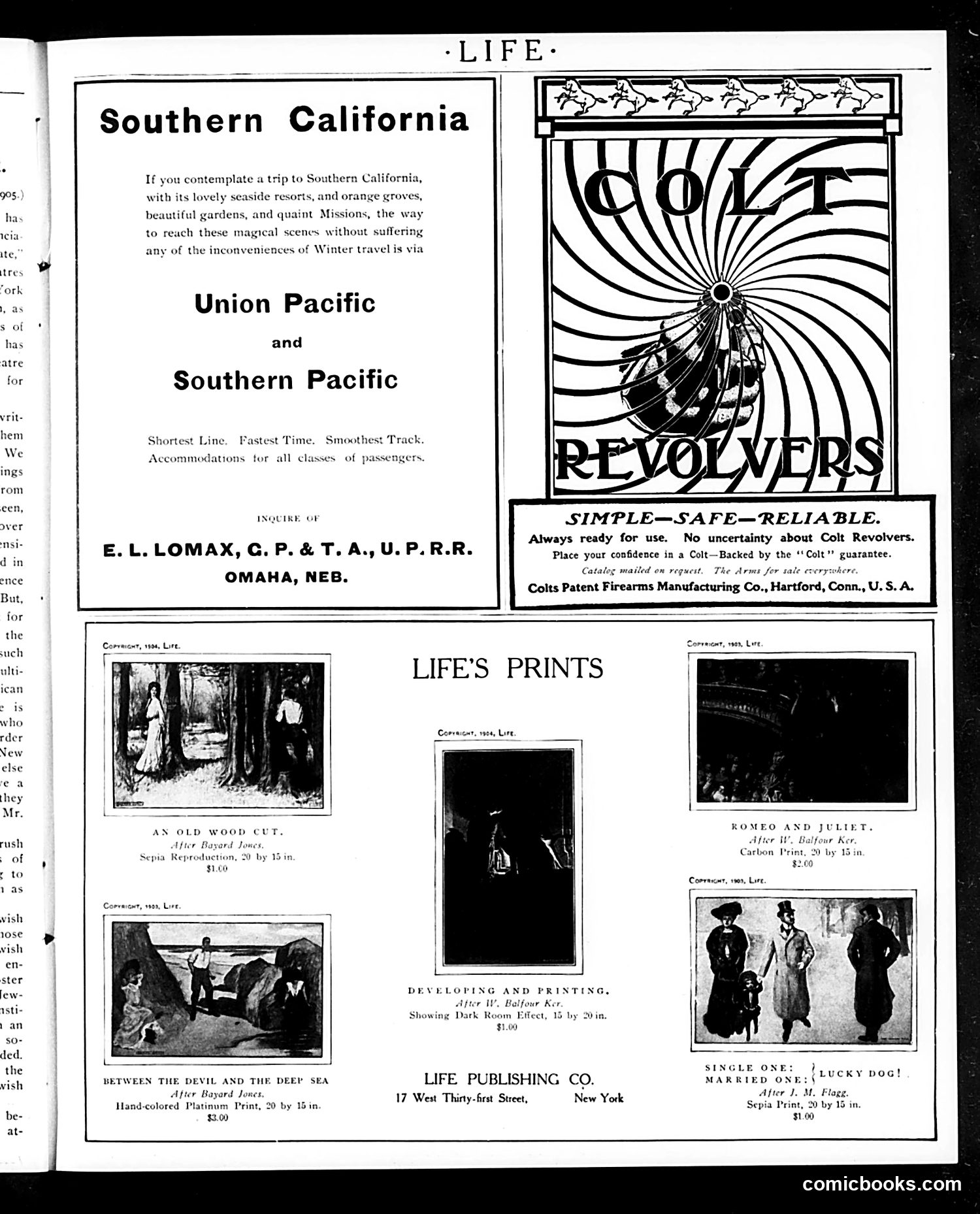
This page is **primarily advertising** rather than editorial content or political satire. The top half contains two ads: one promoting Union Pacific and Southern Pacific railroad travel to Southern California, and another for Colt Revolvers emphasizing reliability ("Simple-Safe-Reliable"). The bottom half showcases "Life's Prints"—art reproductions sold by Life Publishing Company. These include theatrical or literary scenes: "An Old Wood Cut" (After Bayard Jones), "Between the Devil and the Deep Sea" (hand-colored platinum print), "Developing and Printing" (showing darkroom work), "Romeo and Juliet" (After W. Balfour Key), and "Single One; Lucky Dog!" (After J.M. Flagg). The page reflects early 20th-century commercial culture: transportation promotion, firearms marketing, and the sale of fine art reproductions to middle-class consumers.
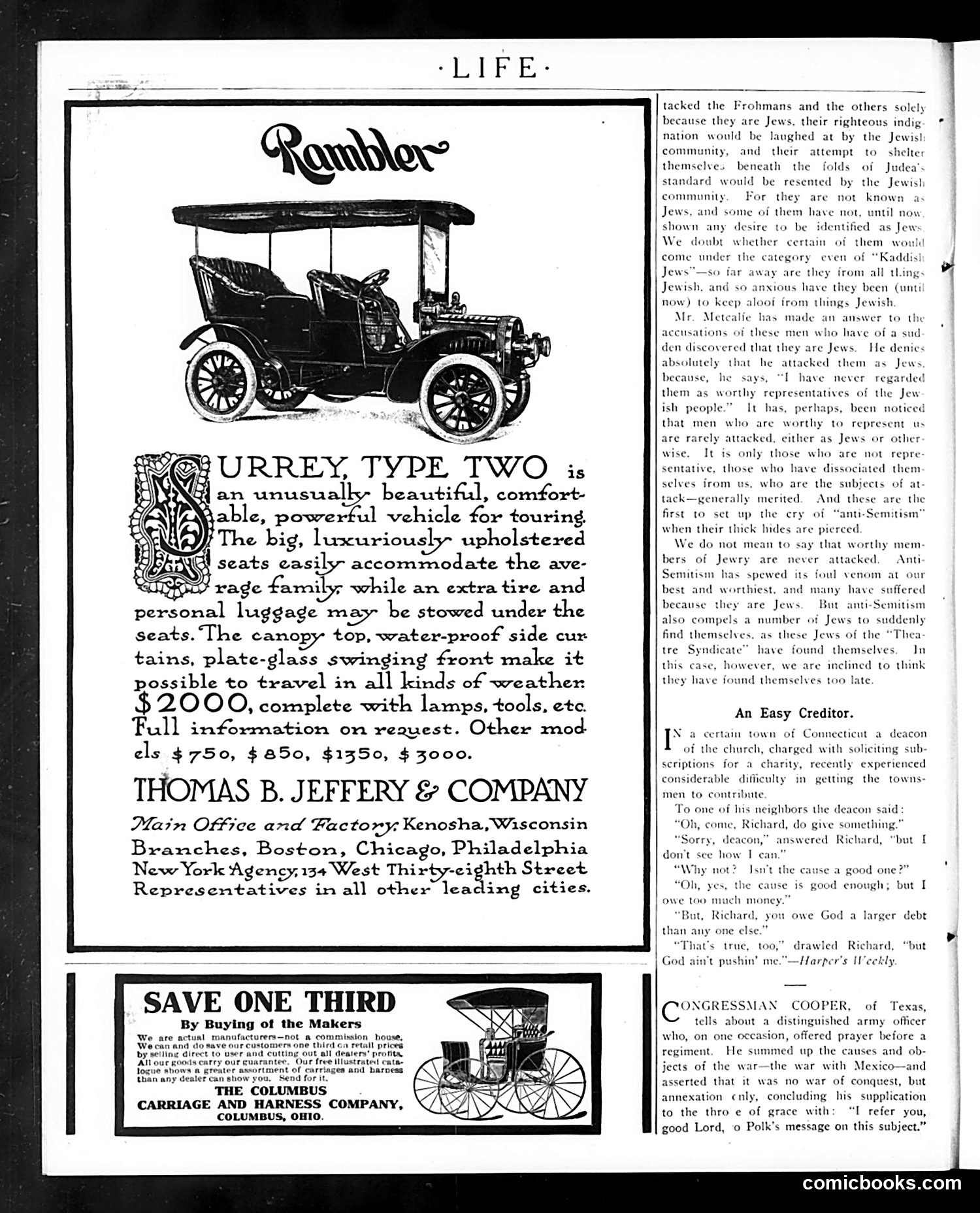
This page contains **primarily advertisements** rather than political cartoons. The main content advertises a Rambler automobile (THOMAS B. JEFFERY & COMPANY) and a Columbus carriage business. The right column includes two brief **humorous anecdotes**: "An Easy Creditor" depicts a deacon struggling to collect church donations, and a second item quotes Congressman Cooper of Texas making a joke about prayer during the Mexican-American War. **Notably**, the upper right text contains **antisemitic commentary**, discussing accusations against unnamed "Frohmans" (likely referring to Jewish theater producers) and defending them against charges of "anti-Semitism"—reflecting the casual prejudice of the era. This hateful content appears alongside ostensibly satirical material, illustrating how bigotry was normalized in early 20th-century American publications.
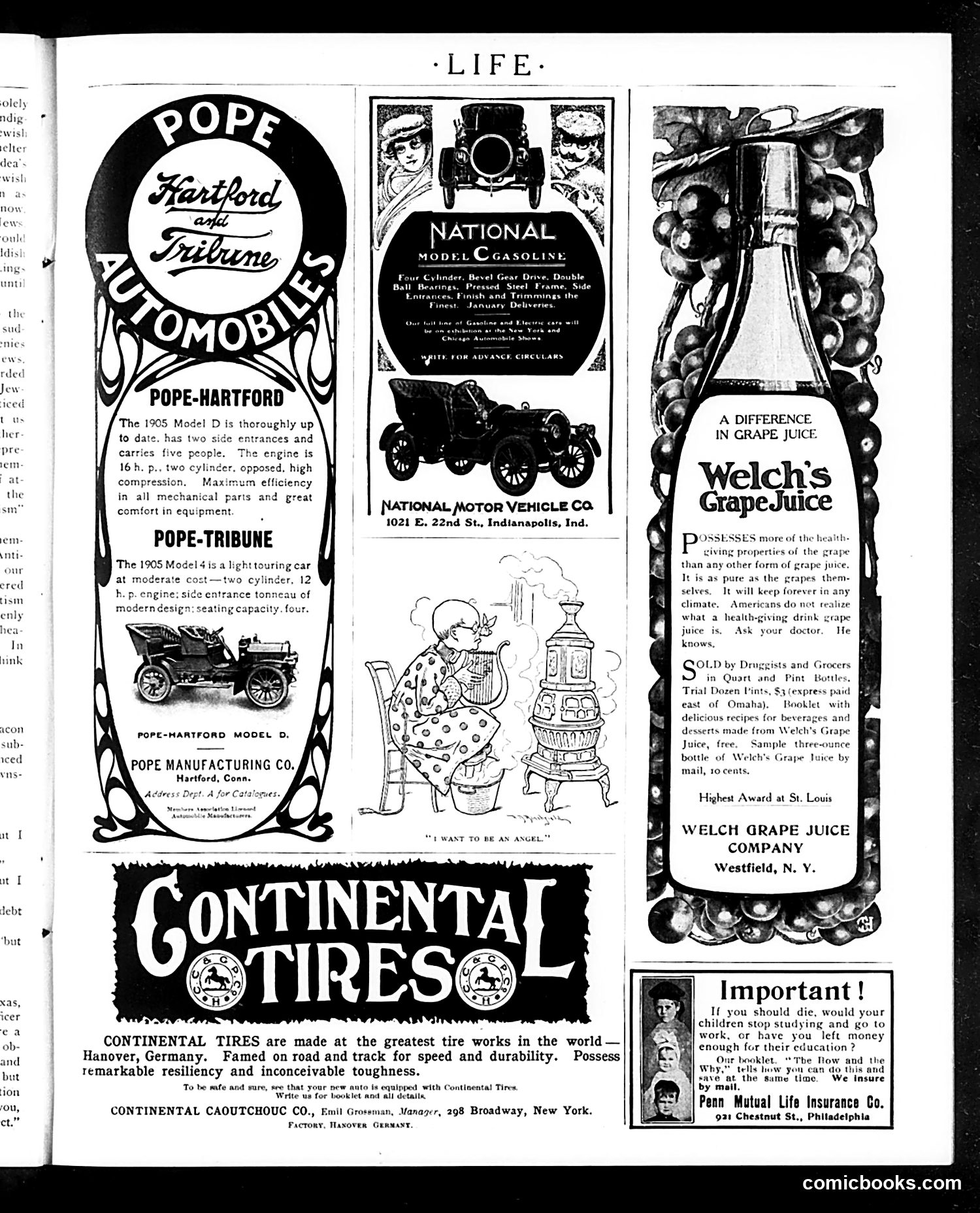
This is primarily an **advertising page** from Life magazine, not satirical content. It contains four distinct advertisements: 1. **Pope-Hartford Automobiles** — promoting 1905 Model D and Model 4 cars with technical specifications 2. **National Motor Vehicle Co.** — advertising a Model C gasoline car from Indianapolis 3. **Welch's Grape Juice** — emphasizing health benefits, with a small cartoon showing a woman wanting "to be an angel" (likely a gentle joke about the product's wholesomeness) 4. **Continental Tires** — claiming superior durability, manufactured in Hanover, Germany 5. **Penn Mutual Life Insurance** — a small ad asking readers to consider their children's education The page reflects early 1900s consumer culture, with automobiles and branded products prominently featured. The grape juice cartoon is the only satirical element—a mild visual pun equating healthful juice consumption with angelic virtue.
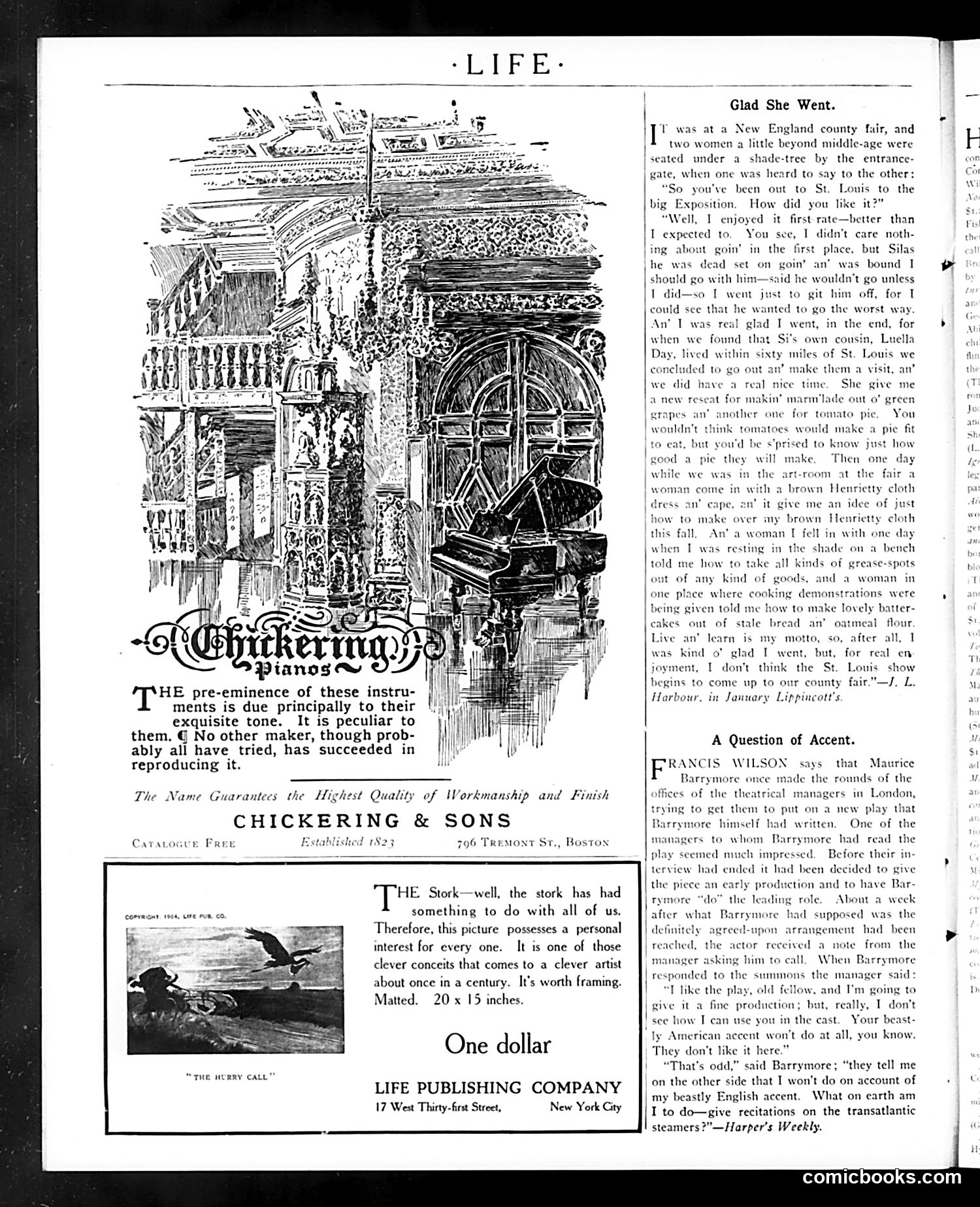
This page contains **primarily advertising and miscellaneous content** rather than political satire. The main elements are: 1. **"Glad She Went"** — a humorous anecdote about two women at a New England county fair discussing a trip to the St. Louis Exposition. The joke centers on the woman's complaint that her companion Silas was reluctant to go, then proved impossible to get home—illustrating marital frustration through travel narrative. 2. **"A Question of Accent"** — a brief theatrical anecdote about Maurice Barrymore's accent, poking gentle fun at efforts to adopt American theatrical conventions while maintaining English identity. 3. **Large advertisements** for Chickering pianos and Life Publishing Company's art print offering. The content is **social humor rather than political satire**, targeting everyday domestic situations and theatrical pretension.
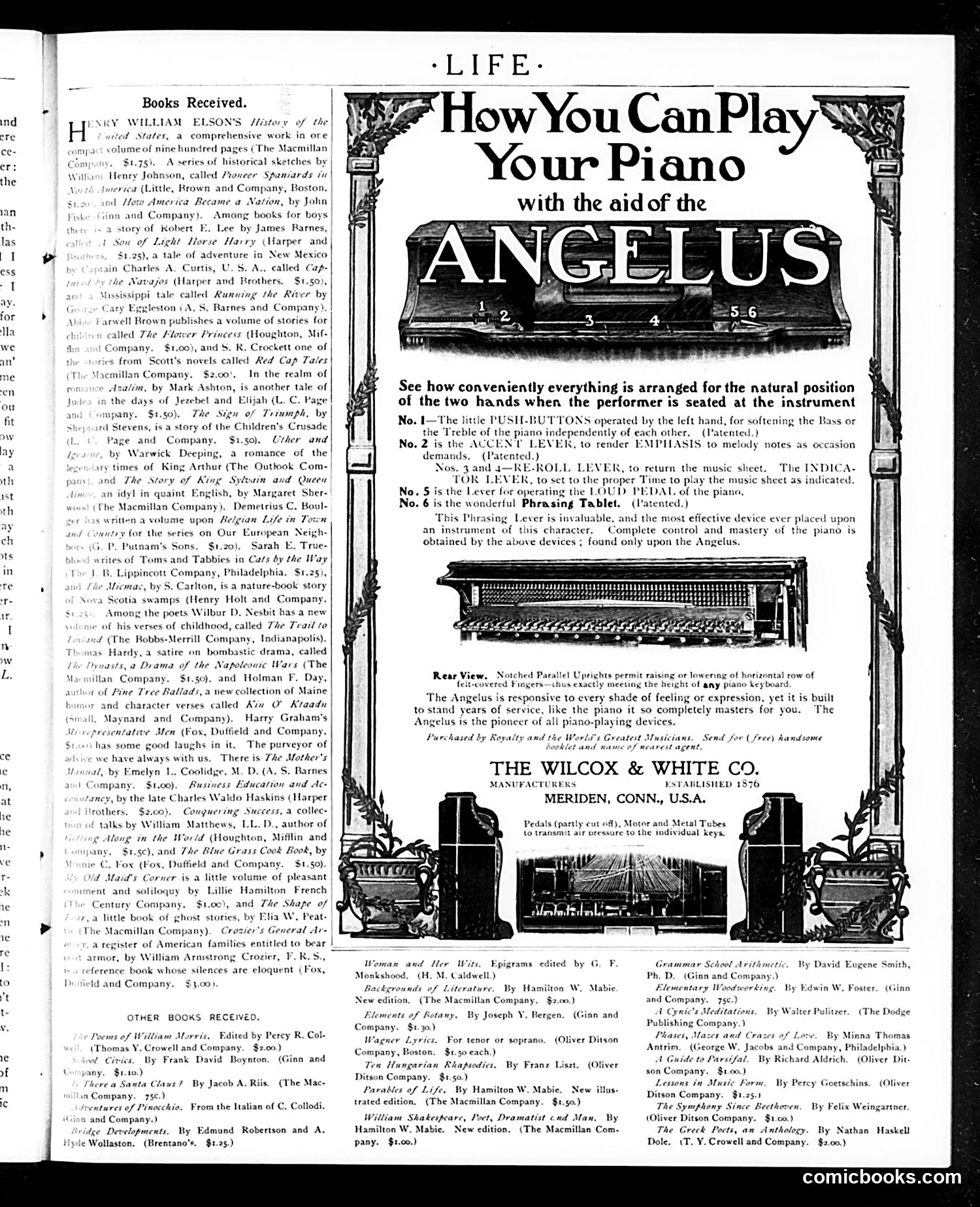
This page is **primarily an advertisement**, not political satire. The main content is a full-page ad for the "Angelus" piano attachment manufactured by Wilcox & White Co. of Meriden, Connecticut (established 1876). The ad explains how this mechanical device allows people to play piano "with the aid of the Angelus" — essentially an early player piano system using push-buttons and levers operated by the left hand. The advertisement emphasizes convenience and mastery without traditional skill. The left column contains "Books Received," a standard Life magazine feature listing newly published volumes. There is **no political cartoon or satire** visible on this page — it's a straightforward product advertisement marketed to early 20th-century consumers interested in affordable mechanical music performance.
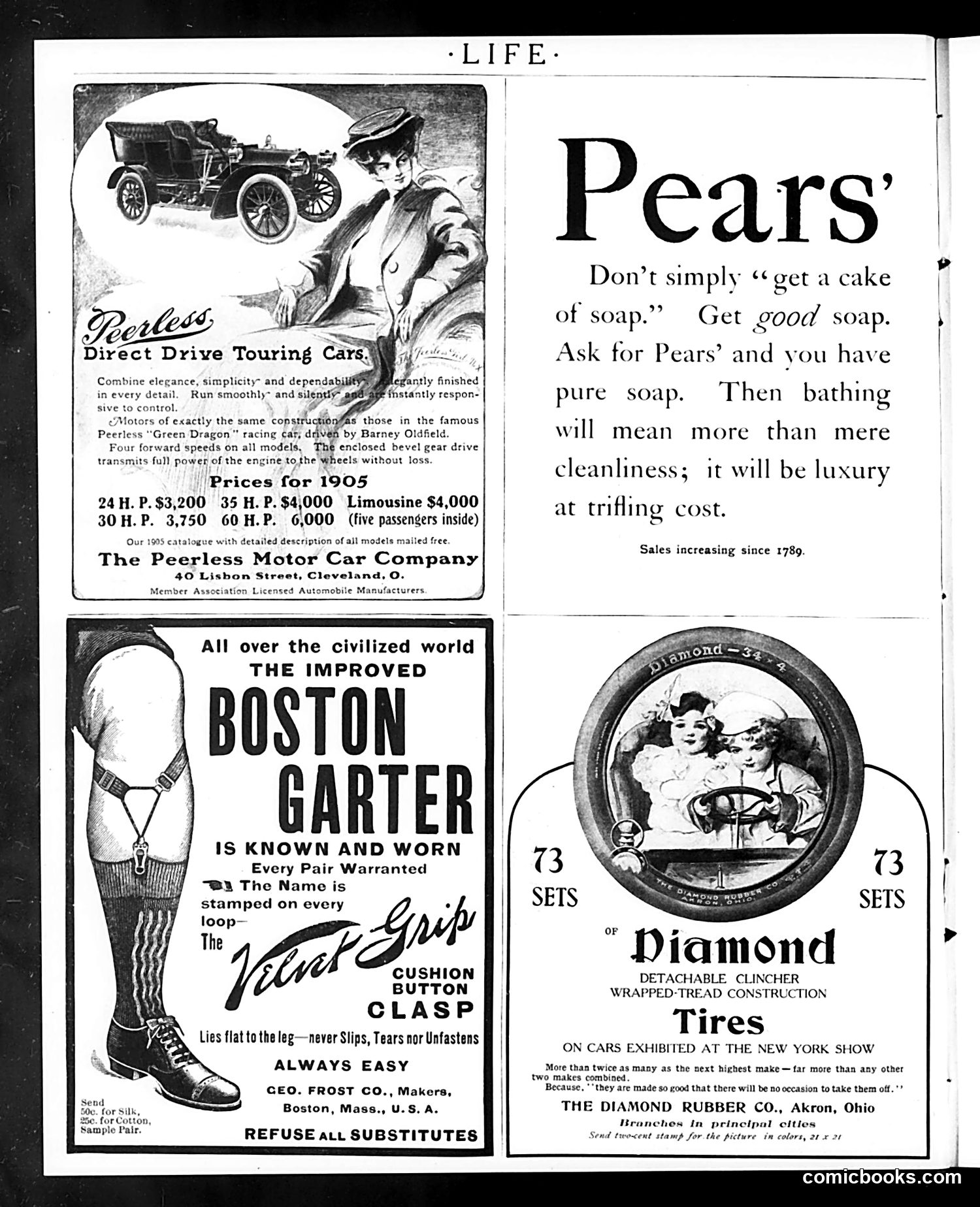
This page is primarily **advertising content**, not satirical cartoons. It contains four product advertisements from the early 1900s: 1. **Peerless Motor Cars** — promoting 1905 touring automobiles with various engine sizes and prices 2. **Pears' Soap** — a luxury soap brand emphasizing purity and quality 3. **Boston Garter** — a men's garter with a "Velvet Grip" clasp, claiming superiority over competitors 4. **Diamond Tires** — promoting wrapped-tread tire construction, exhibited at the New York Auto Show The advertisements employ period conventions: illustrated women (in automotive and tire ads) presented as aspirational, claims of superiority over unnamed competitors, and appeals to quality and luxury. The language reflects early 20th-century marketing rhetoric rather than political satire. There are no political cartoons or caricatures present on this page.
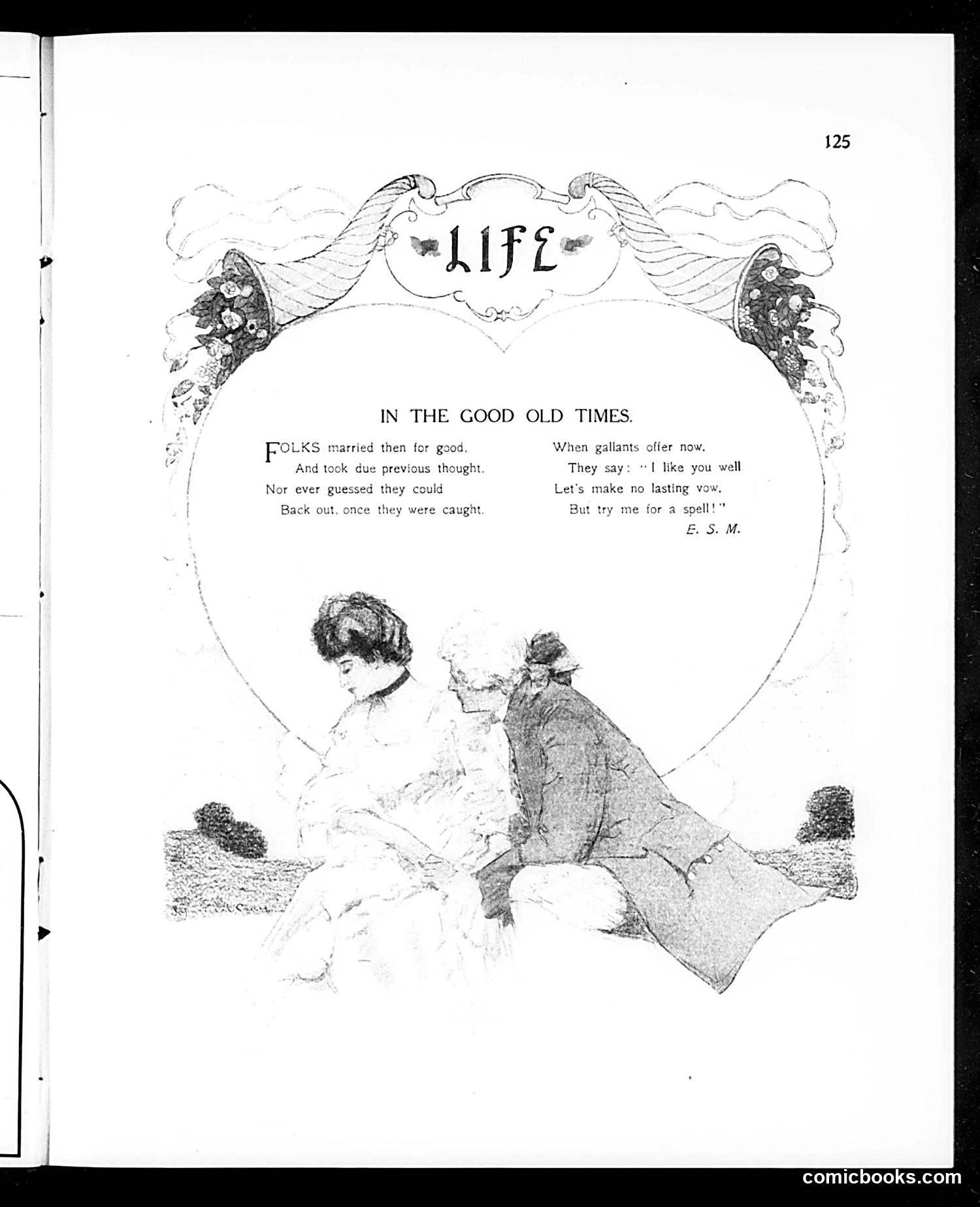
This page satirizes changing courtship and marriage customs. The heading "IN THE GOOD OLD TIMES" contrasts past with present practices. The poem (attributed "E. S. M.") nostalgically claims that people once "married then for good" and "took due previous thought," unable to back out once committed. The modern counterpoint mocks contemporary gallants who casually say: "I like you well / Let's make no lasting vow, / But try me for a spell"—suggesting temporary, non-binding romantic arrangements. The illustration shows a couple in a pastoral setting, depicting idealized "old times" romance. The satire criticizes modern men's reluctance to commit to permanent marriage, framing contemporary courtship as superficial and temporary compared to earlier generations' supposedly more serious intentions.
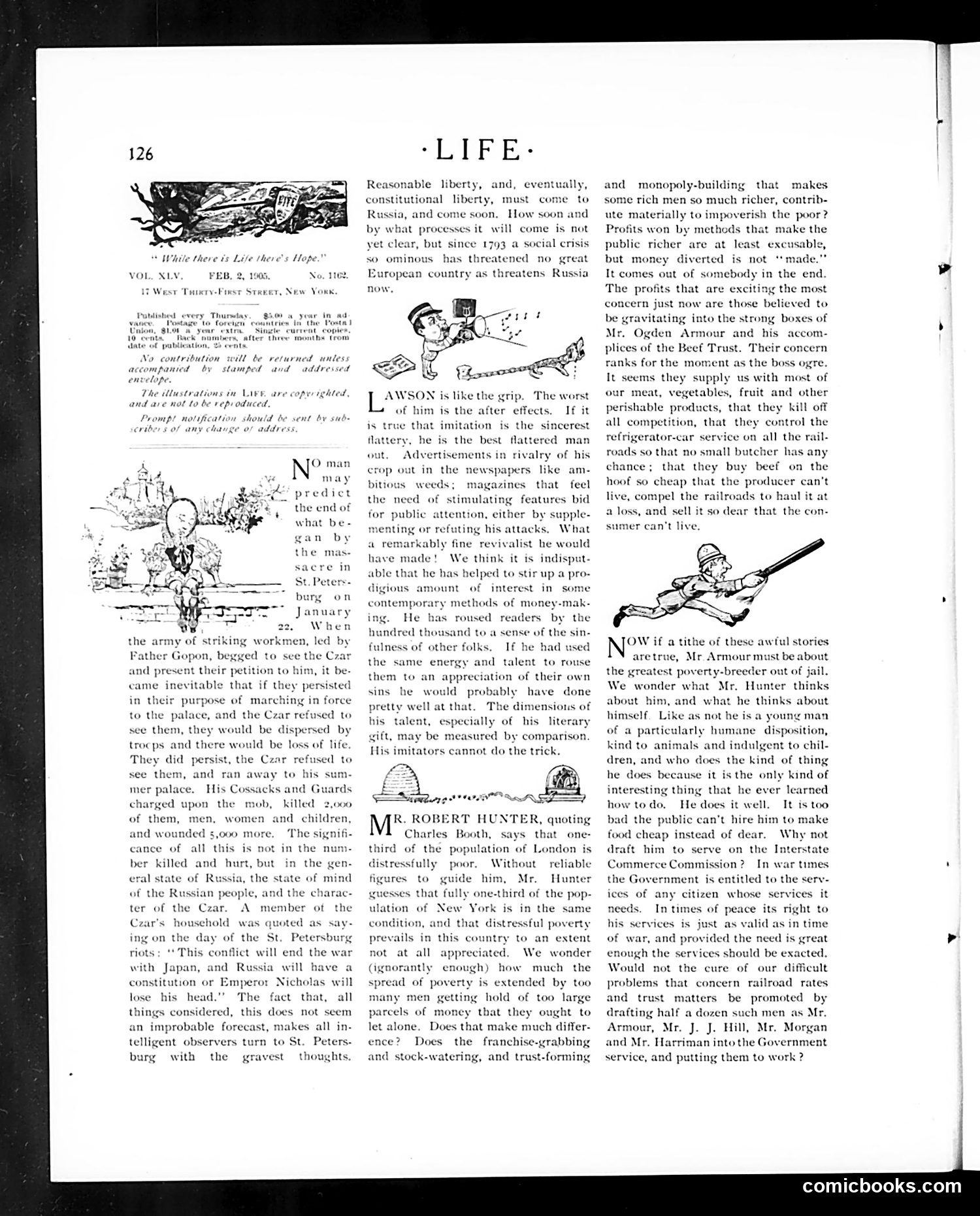
This page contains several satirical cartoons and commentary on contemporary social issues. The top cartoon depicts a figure being pulled or controlled like a puppet, labeled "LAWSON," likely referencing a public figure involved in media or business manipulation. The middle cartoon shows a man surrounded by chaotic elements, illustrating the text's discussion of how sensationalism and rivalry operate in newspapers and magazines. The bottom cartoon depicts a figure in horizontal flight or falling position, accompanying text about "Mr. Armour" and poverty issues, suggesting satire about wealthy industrialists' indifference to poverty. The text critiques monopoly-building, media sensationalism, and the concentration of wealth among "rich men" controlling essential goods like meat and vegetables, reflecting Progressive Era concerns about corporate power and social inequality in early 1900s America.
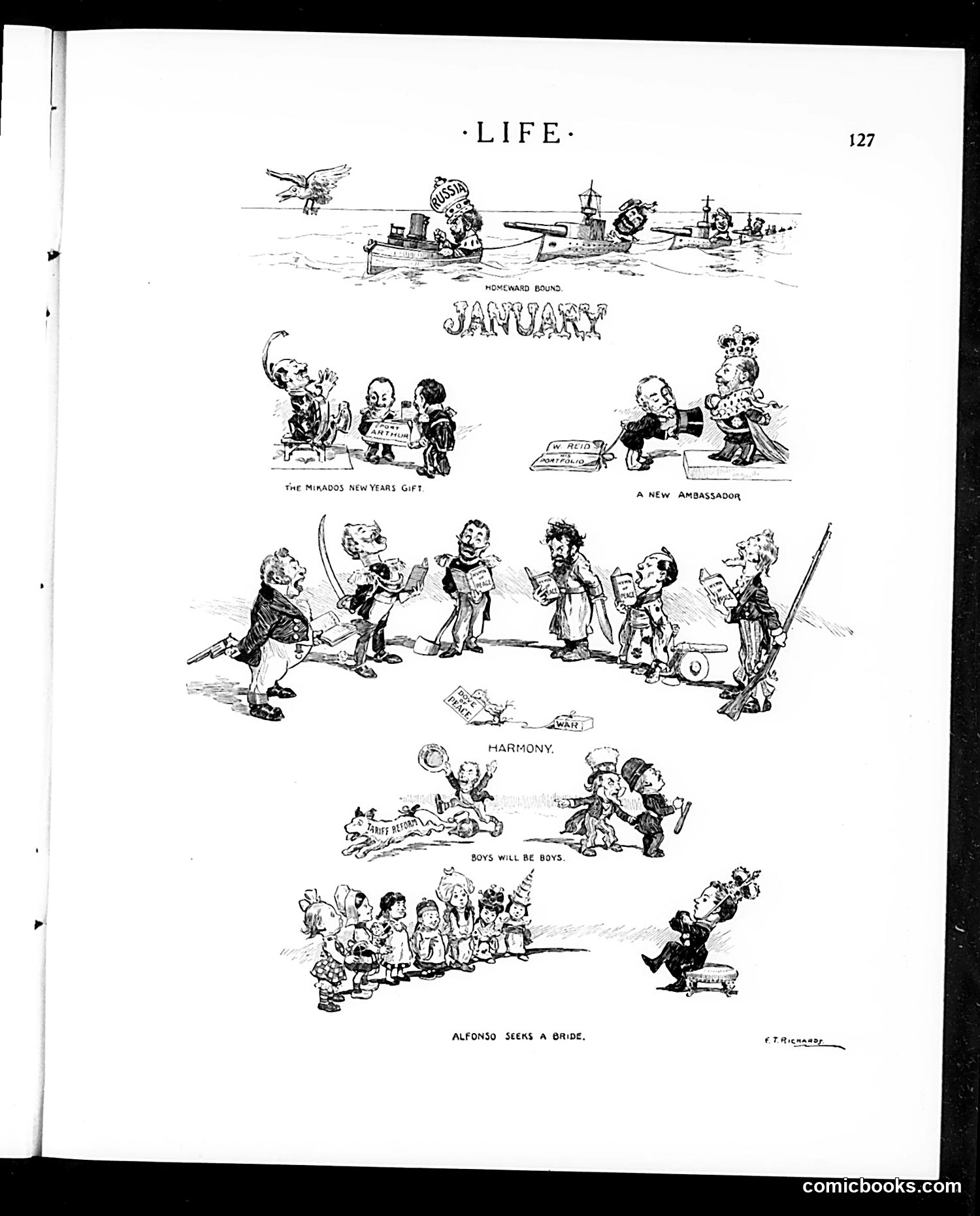
This page from *Life* magazine's January issue contains several political cartoons mocking contemporary events. The top illustration shows "Homeward Bound" naval vessels, likely referencing WWI-era military affairs. The central cartoon "Harmony" depicts children playing instruments, seemingly satirizing political cooperation or peace efforts. The bottom cartoon, "Alfonso Seeks a Bride," appears to reference King Alfonso XIII of Spain seeking a marriage alliance—a real historical event. The exaggerated caricatures and comedic staging suggest mockery of diplomatic maneuvering or Spanish politics. "A New Ambassador" and "The Mikado's New Year's Gift" likely reference international diplomatic appointments and gifts between nations, typical subjects of *Life*'s political satire during this period. The cartoons use caricature and visual humor to comment on government, diplomacy, and social conditions of the era.
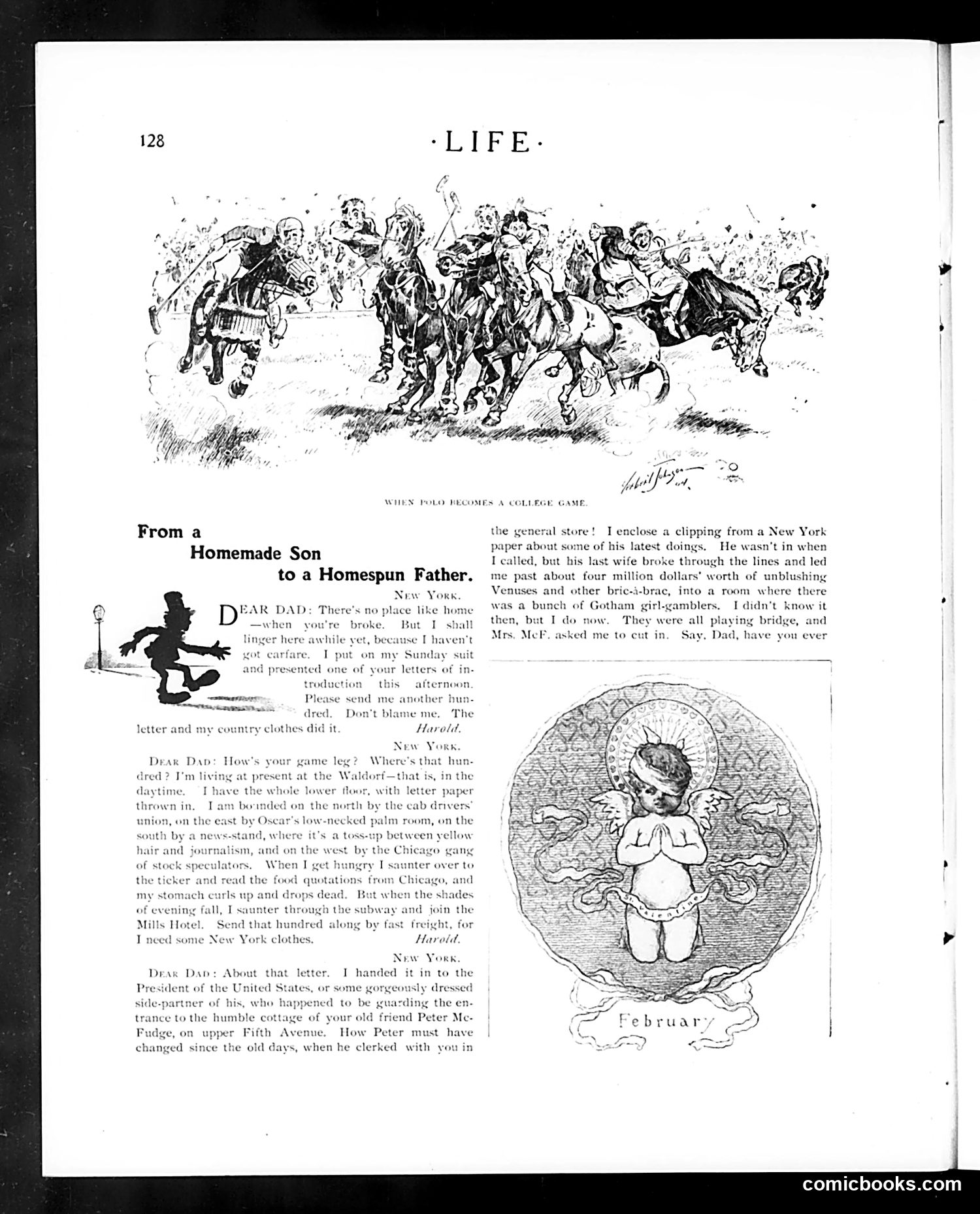
This page satirizes the corruption of American values through wealth and social climbing. The top illustration shows polo—traditionally an elite sport—being played chaotically by college students, mocking how the wealthy's pastimes trickle down and become vulgarized. The main feature is a humorous exchange of letters between a father and son in New York. The son describes his shabby circumstances (living in cheap hotels, needing clothes), then mentions casually handing a letter to "the President of the United States" who happened to be guarding a cottage door. The implication is darkly satirical: even the nation's highest office has become just another tool of the wealthy elite. The subsequent revelation—that this president is actually Peter McFudge, an old store clerk—underscores the joke: anyone can become "president" if you're rich enough. The son's visit to McFudge's mansion reveals trophy wives, gambling women, and ostentatious art—all symbols of ill-gotten wealth and moral decay among the nouveau riche. The satire targets Gilded Age excess and the corruption of American institutions.
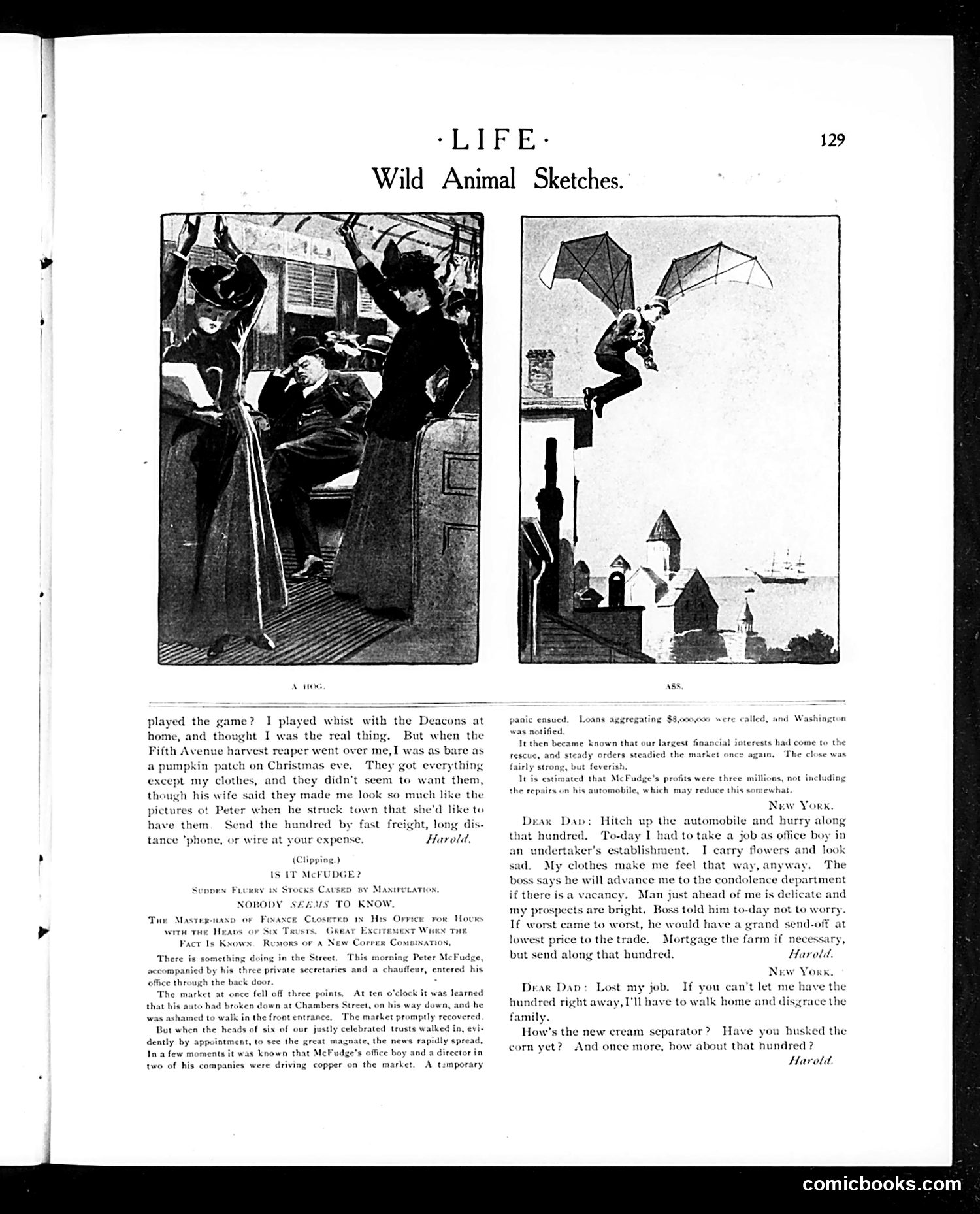
This page contains two satirical cartoons titled "Wild Animal Sketches"—a darkly humorous reference comparing human behavior to animal instinct. **Left cartoon ("A Hog"):** Depicts Peter McFudge, apparently a wealthy financier, entering his office through the back door. His arrival triggers market panic: stocks drop three points, loans worth $8 million are called in, and Washington is notified. The satire mocks how a single wealthy man's movements can manipulate financial markets—he's portrayed as a destructive force ("hog") whose mere presence causes economic chaos. **Right cartoon ("An Ass"):** Shows a man using umbrellas as parachutes while jumping from a rooftop above a coastal town. This appears to be satirizing foolish financial speculation or reckless decision-making—the visual metaphor of an "ass" attempting an obviously doomed venture. The accompanying text letters further mock financial desperation and class anxiety during what appears to be an economic downturn, with references to job losses and financial strain. The overall theme: wealthy speculators and desperate working people are both "wild animals" driven by base instinct rather than reason.
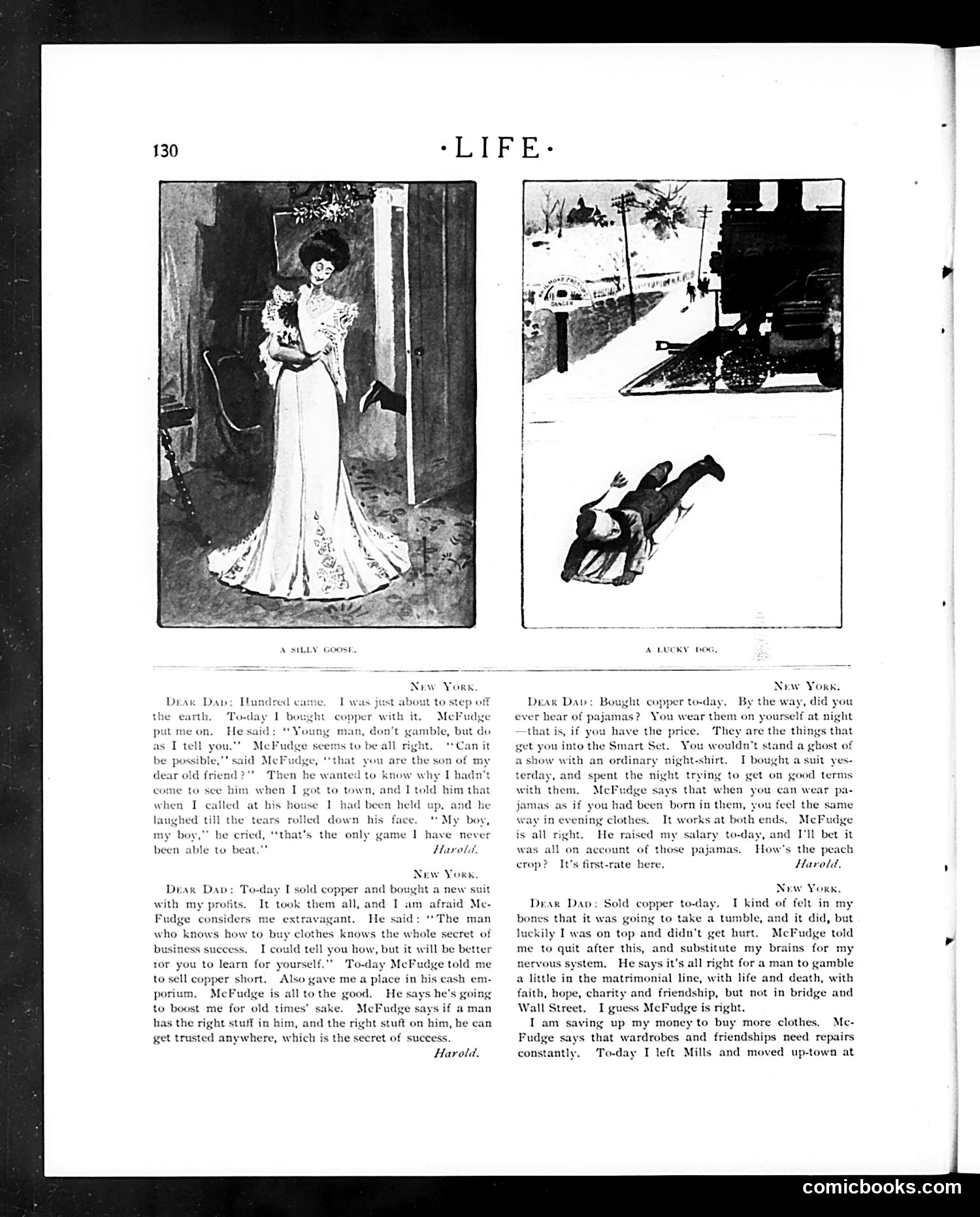
This page contains two illustrated vignettes with accompanying letters to "Dear Dad," satirizing early 1900s American materialism and social aspiration. **Left image ("A Silly Goose"):** Shows an elegantly dressed woman in a flowing gown—likely mocking pretentious fashion consciousness. **Right image ("A Lucky Dog"):** Depicts a man falling or sprawling on a street, illustrating physical misfortune. **The Satire:** The letters reveal the joke: a young man named Harold writes about his mentor "McFudge," who dispenses cynical business and social advice. Harold obsesses over acquiring fashionable clothes (particularly pajamas—then a luxury novelty), buying/selling copper stocks, and "moving up-town." McFudge cynically suggests success depends on "the right stuff in him, and the right stuff on him"—meaning character *and* fashionable clothing. The satire mocks nouveau riche social climbers who believe material goods and financial speculation equal respectability, while ignoring genuine virtue. Harold's breathless letters about pajamas and apartment upgrades expose the superficiality of his aspirations, making him the "silly goose" and "lucky dog" simultaneously.
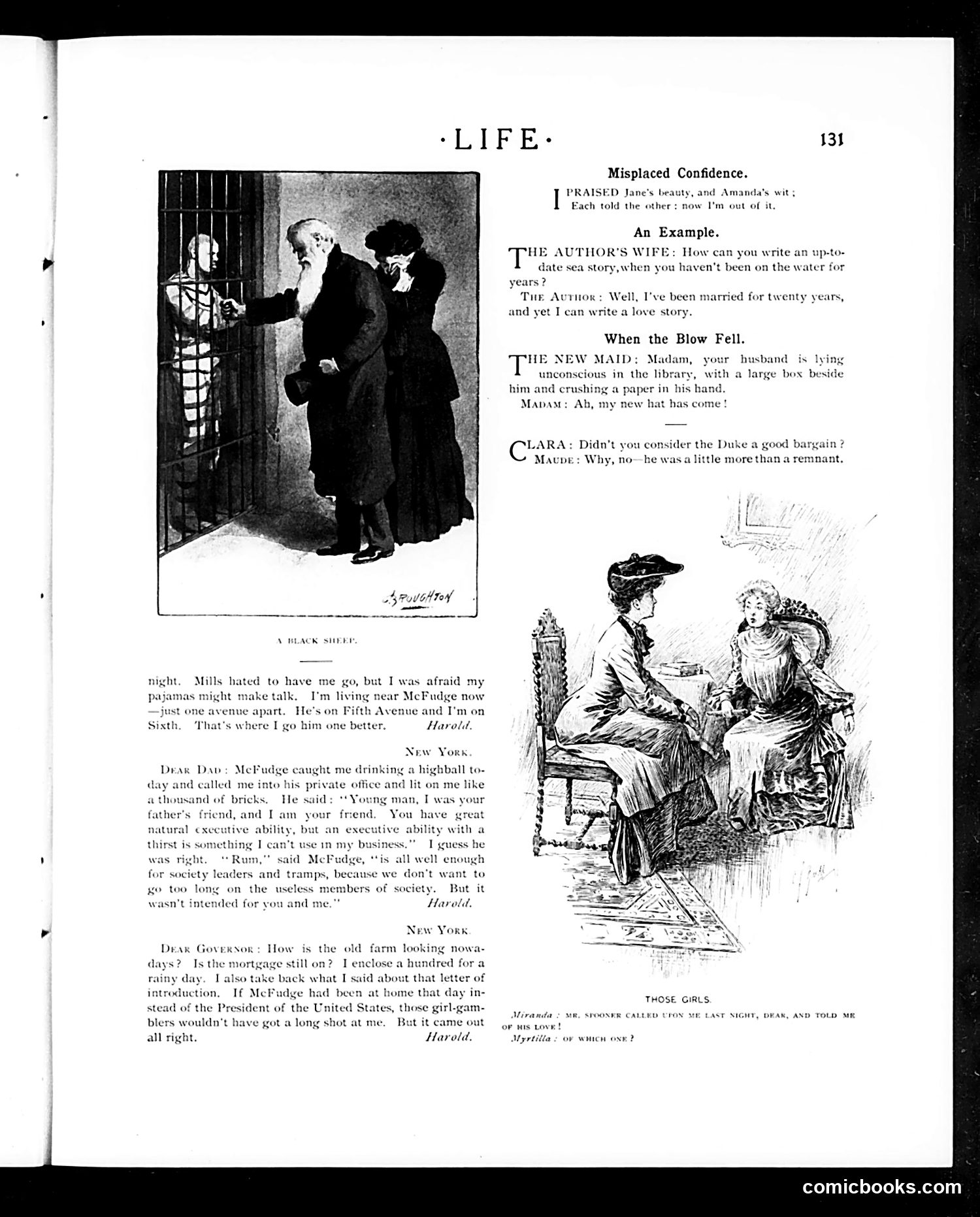
This page contains several short humorous sketches satirizing American middle and upper-class social pretensions: **"An Example"** mocks writers who claim expertise without experience—the author writes love stories despite never being at sea or married long. **"When the Blow Fell"** jokes about a wife's priorities: her husband lies unconscious in the library, but she's only concerned her new hat has arrived. **"A Black Sheep"** and the letters from "Harold" satirize young men justifying questionable behavior (drinking, living separately from employers) through sophistical reasoning about social geography. The sketch **"Those Girls"** (bottom right) appears incomplete but references a Mr. Spooner calling on women. Overall, the page targets vanity, hypocrisy, and self-serving logic among respectable society. The tone is gentle mockery rather than harsh criticism—typical of Life's approach to social comedy during this era.
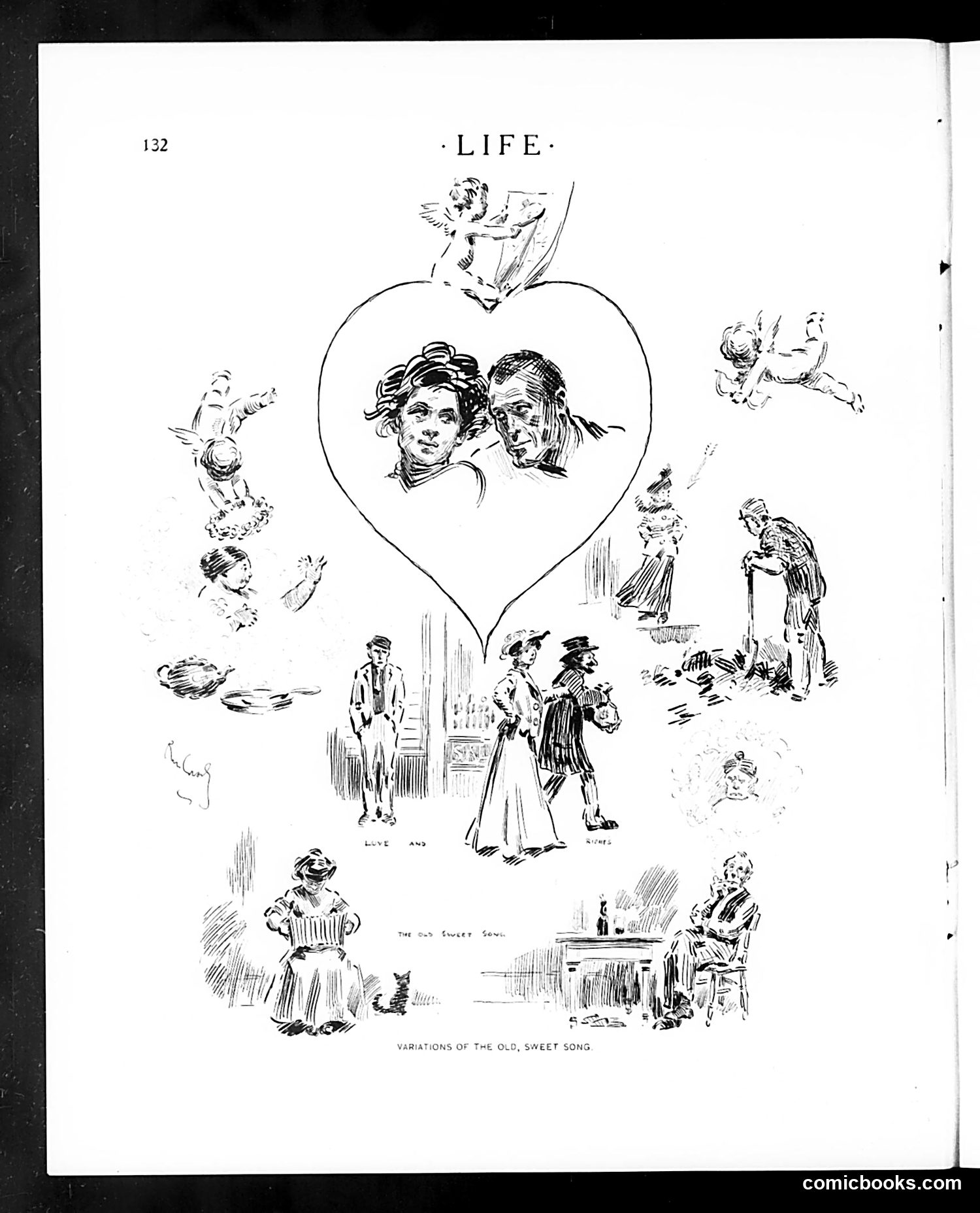
This satirical illustration depicts romantic and domestic scenarios arranged around a heart containing two faces—a woman and man. The page shows various "variations" of courtship and marriage through different social scenes: couples meeting, proposing, domestic life, and what appears to be marital discord or dissolution. The caption "Variations of the Old, Sweet Song" suggests these are different permutations of the same romantic narrative—love leading to marriage. The surrounding vignettes likely mock how the same basic romantic story plays out differently depending on social class, circumstance, or individual character. The title page number (132) and "LIFE" masthead indicate this is from Life magazine's satirical commentary on American courtship, romance, and marriage customs of the era.
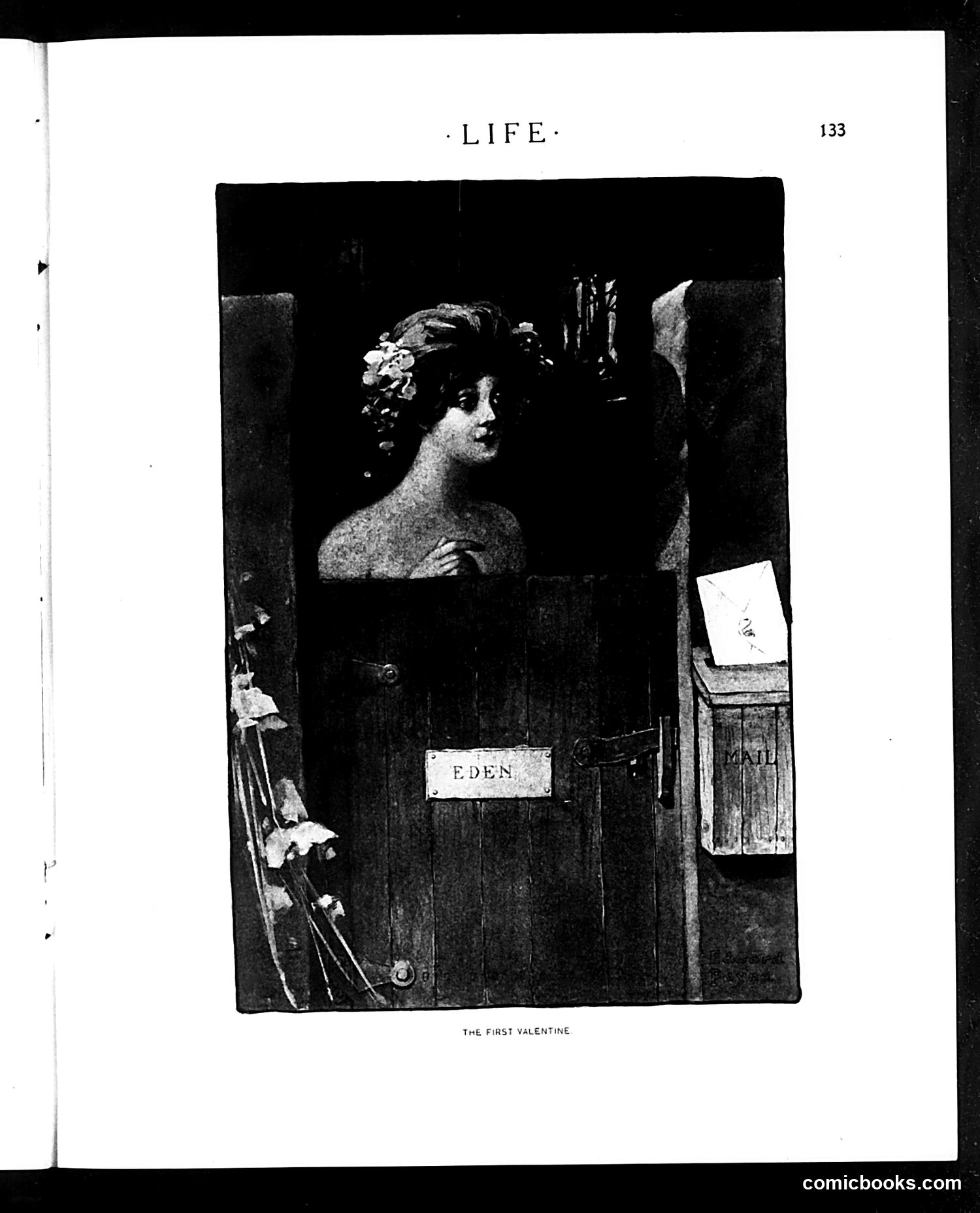
This artwork depicts a classical or allegorical female figure labeled "EDEN," positioned in what appears to be a doorway or frame. The figure wears flowers in her hair and is rendered in a neoclassical style, gazing to the side. The caption "THE FIRST VALENTINE" suggests this illustrates the biblical Garden of Eden and Eve—presenting her as humanity's "first valentine," likely a romantic or sentimental reference to the origin of love itself. The artwork appears to be satirical commentary on romantic idealization, possibly mocking the notion of feminine perfection or the romanticization of biblical/classical female figures. Without additional context about Life magazine's editorial stance during this period, the precise satirical target remains unclear, though it likely comments on contemporary attitudes toward romance, beauty, or women.
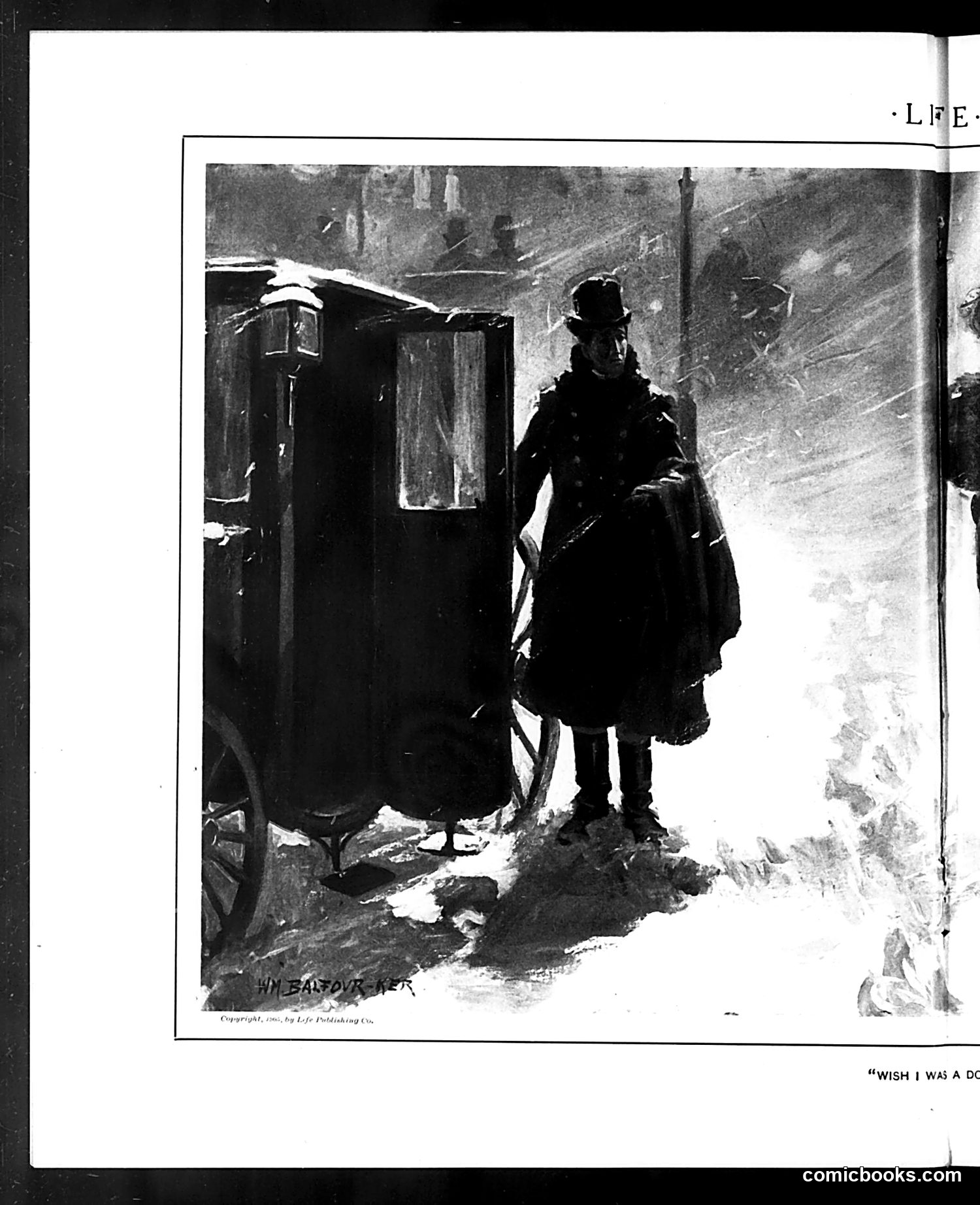
This appears to be a satirical illustration from Life magazine showing a figure in a top hat and formal coat standing outside what looks like a modest wooden structure or shack. The figure appears to be a well-dressed gentleman in stark contrast to the humble dwelling. The caption beginning "WISH I WAS A DO[G]" (text cut off) suggests social commentary about class disparity or longing for a simpler existence. The contrast between the refined, formally-dressed person and the poor living conditions suggests satire about wealth inequality or perhaps regret about one's elevated social position compared to simpler life. Without the complete caption, the specific target of the joke remains partially unclear, though the visual juxtaposition clearly critiques some aspect of class or social pretension.
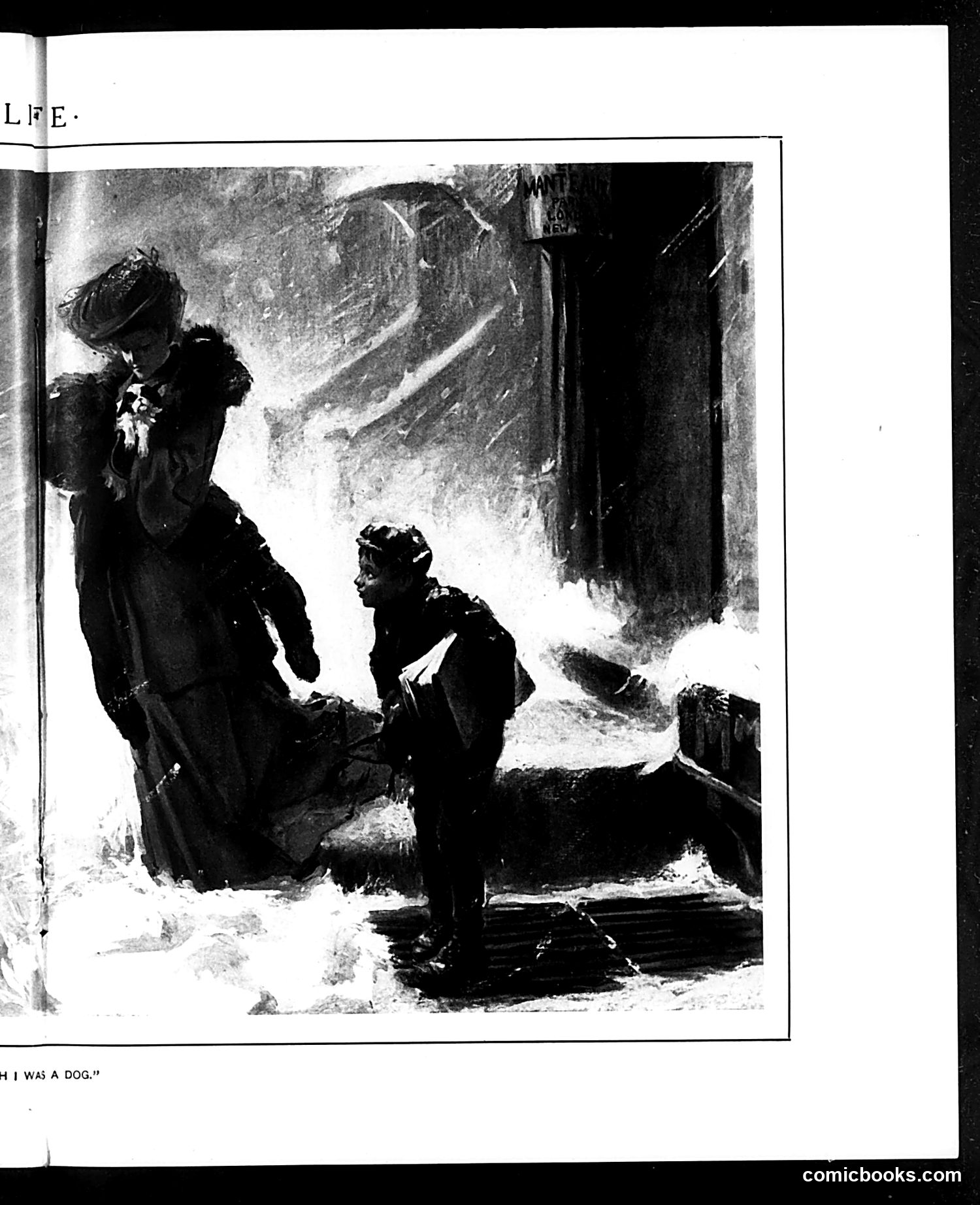
This appears to be a dramatic illustration from *Life* magazine showing two figures in dark clothing in what looks like a snowy, decrepit urban setting. One figure stands while another crouches or sits below. The caption reads "I was a dog," suggesting a narrative about degradation or transformation—likely social commentary on poverty or class decline. The stark black-and-white imagery and deteriorated surroundings emphasize hardship. Without additional context or visible date information, the specific historical reference is unclear. However, *Life's* satirical tradition suggests this critiques social conditions, possibly poverty, immigration, or urban decay in early 20th-century America. The surreal statement "I was a dog" may reference dehumanization through poverty or suggest a transformation narrative common to morality tales of the era.
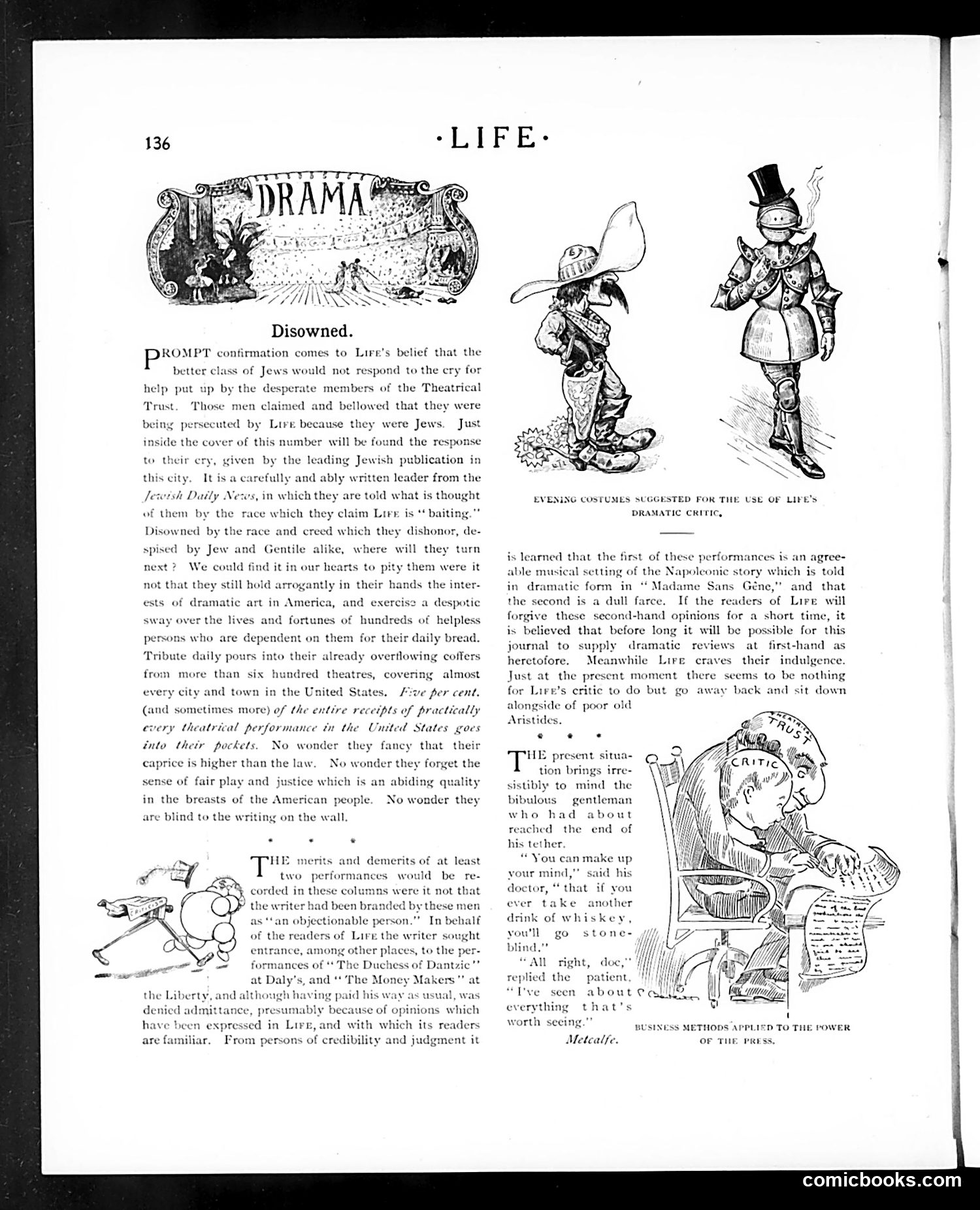
This page satirizes Life magazine's treatment of Jewish theatrical producers. The text reveals that Life's dramatic critic was denied entry to performances, which Life attributed to Jewish producers "baiting" the publication. However, the *Jewish Daily News* (a leading Jewish publication in the city) publicly disowned Life's claims, rejecting their narrative. The satire mocks Life's situation: their critic is now effectively sidelined, unable to review plays firsthand, compared to the ancient Greek figure Aristides (famous for integrity). The cartoon bottom-right depicts a doctor warning a drunk patient about drinking—a metaphor suggesting Life has become intoxicated by its own power and bias, now "stone-blind" to reality. The page's title, "Business Methods Applied to the Power of the Press," indicates the satire targets how media outlets weaponize their influence. Life is portrayed as abusing journalistic authority through alleged discrimination rather than fair criticism.
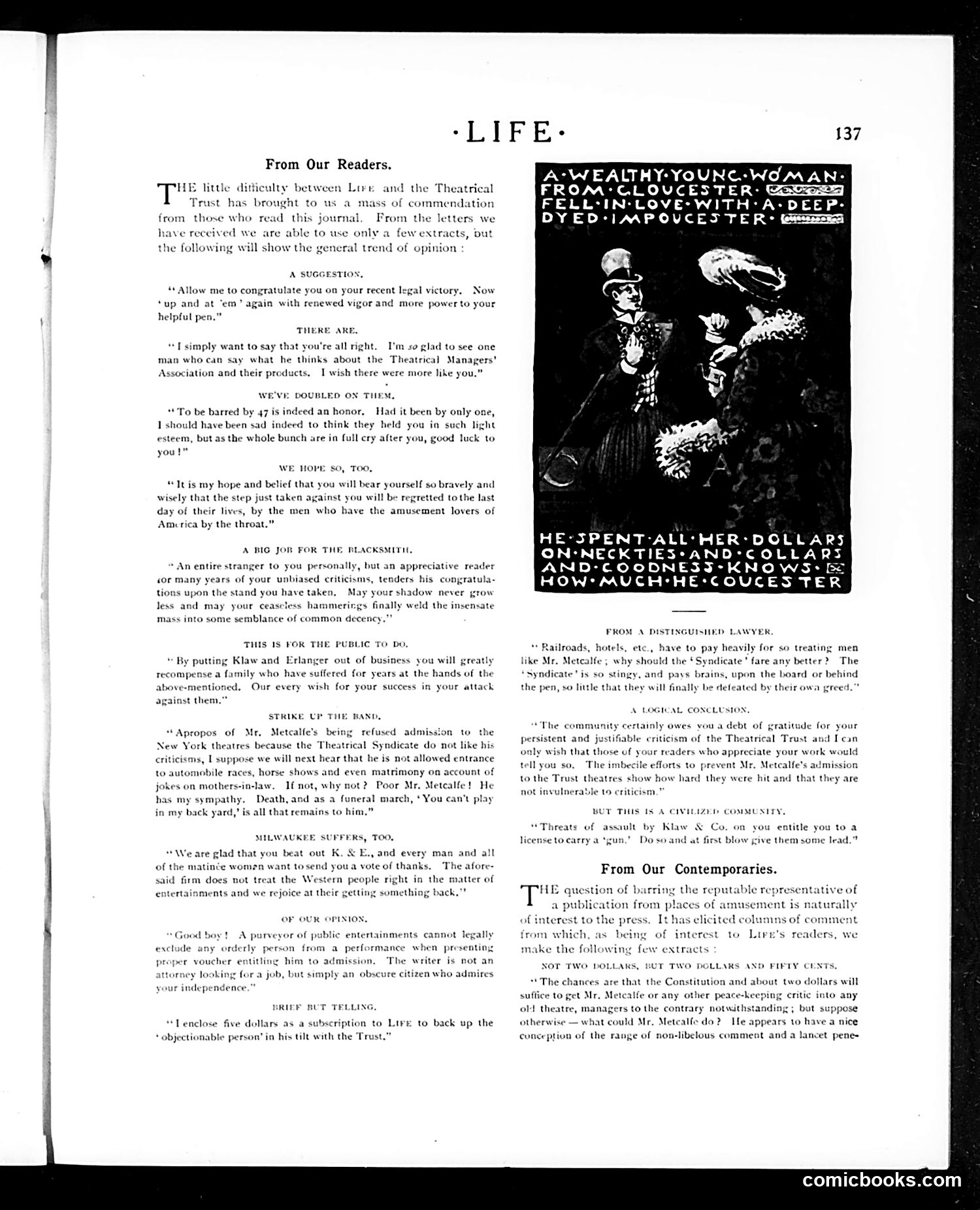
This page documents Life magazine's editorial victory in a battle against the **Theatrical Trust** (Klaw & Erlanger), a monopolistic organization controlling American theater distribution. The reader letters praise Life's criticism and support for theater critic **Mr. Metcalfe**, whom the Trust attempted to exclude from venues. The cartoon (top right) illustrates the satire's subject: a wealthy young woman from Gloucester who spent lavishly on a supposedly impoverished Englishman ("Deep-Dyed Impoverished"). The caption implies she was financially exploited—he "gouged" her through romantic deception, spending her dollars on luxuries while claiming poverty. The cartoon's relevance here appears tangential—likely illustrating themes of trust and deception that parallel the Theatrical Trust's manipulative practices. Both involve the exploitation of naive parties by organized schemes. The letters represent Life readers celebrating the magazine's anti-monopoly stance and calling for broader public support against entertainment industry gatekeeping.
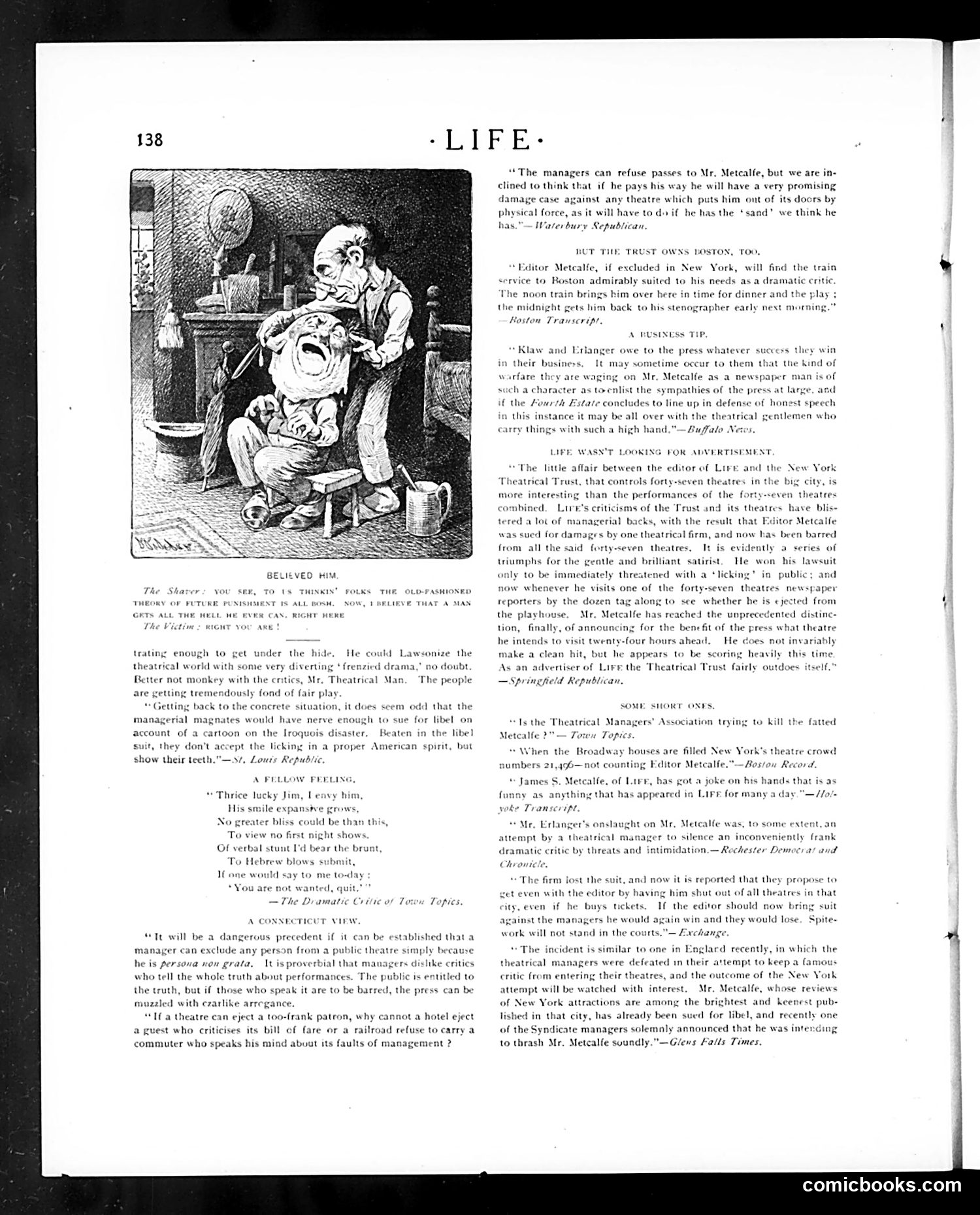
This is a satirical commentary on a real dispute between **Editor Metcalfe of Life magazine** and the **Theatrical Trust** (Klaw and Erlanger), which controlled 47 New York theaters. **The cartoon's meaning:** The barber (representing the theatrical managers) is violently shaving a customer (Metcalfe/the press), suggesting the Trust is trying to "silence" critical journalism through intimidation and exclusion. **The context:** Life's editor had been barred from Trust-controlled theaters after publishing harsh theatrical criticism. Multiple newspaper quotes debate whether theaters have the right to exclude paying patrons and whether this will constitute a legal liability for the Trust. The surrounding text presents this as a business dispute with free-speech implications—some papers worry the managers are creating unwanted publicity by their heavy-handed response. **The satire:** The various editorial comments mock both sides, while the cartoon depicts the managers' attempt to silence critics as both violent and absurd.
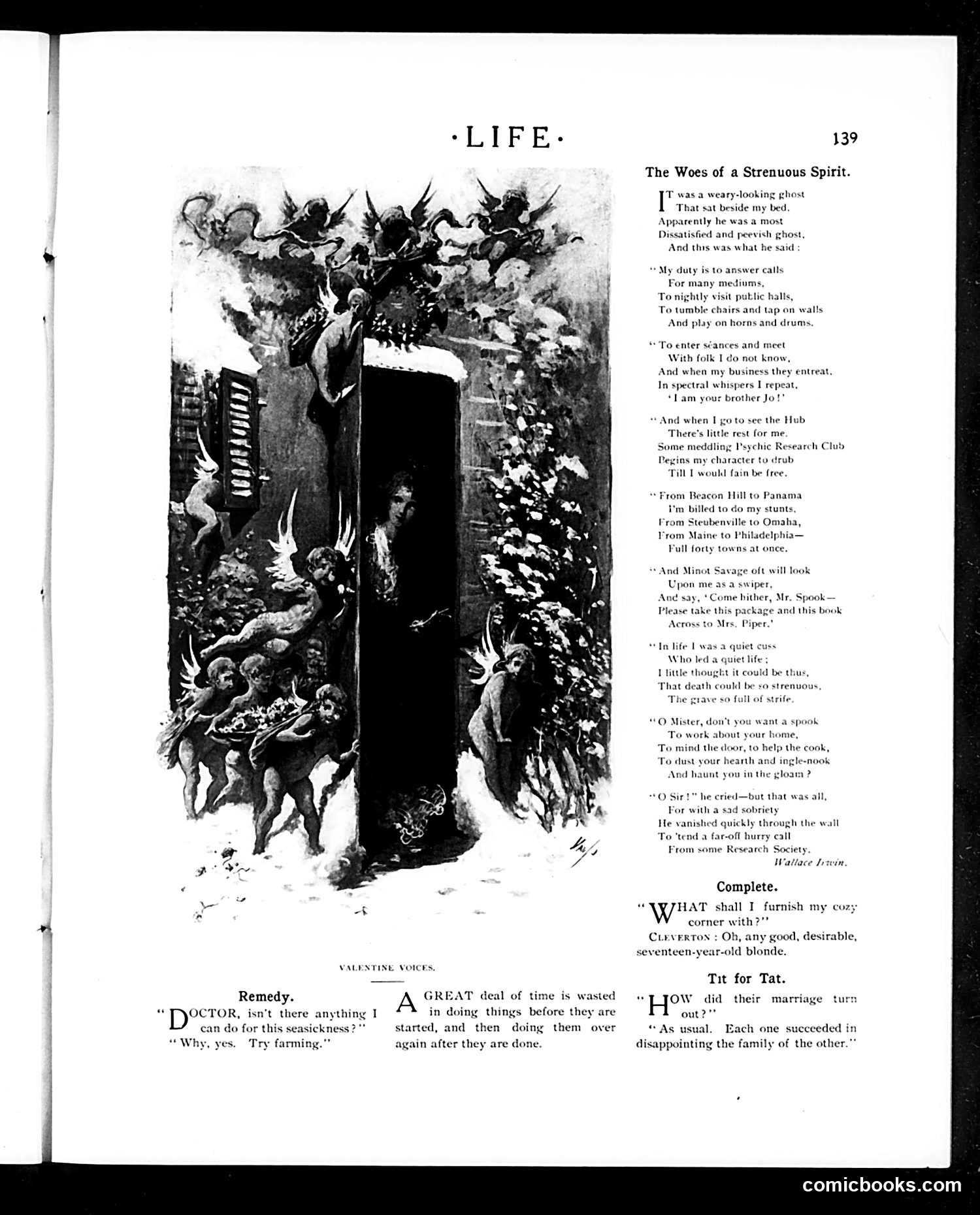
This page contains three satirical pieces typical of early 20th-century American humor: **"The Woes of a Strenuous Spirit"** (main illustration): A ghost complains about being overworked by spiritualist mediums and "Psychic Research Clubs." The satire mocks the era's spiritualism craze—séances, spirit communication, and mediums who claimed to contact the dead. The exhausted ghost's grievance that he's "billed to do stunts" in forty towns simultaneously ridicules both the commercialization of spiritualism and the public's gullible belief in it. Reference to "Minot Savage" (likely a real spiritualist figure) grounds it in contemporary spiritualist culture. **"Remedy"**: A doctor prescribes farming for seasickness—absurdist humor suggesting an obviously wrong solution. **"Complete"** and **"Tit for Tat"**: Brief jokes about matrimony and romantic disappointment, reflecting common satirical themes about marriage as mutually unsatisfying. The spiritualism critique was timely satire during spiritualism's American popularity boom of the 1880s-1920s.
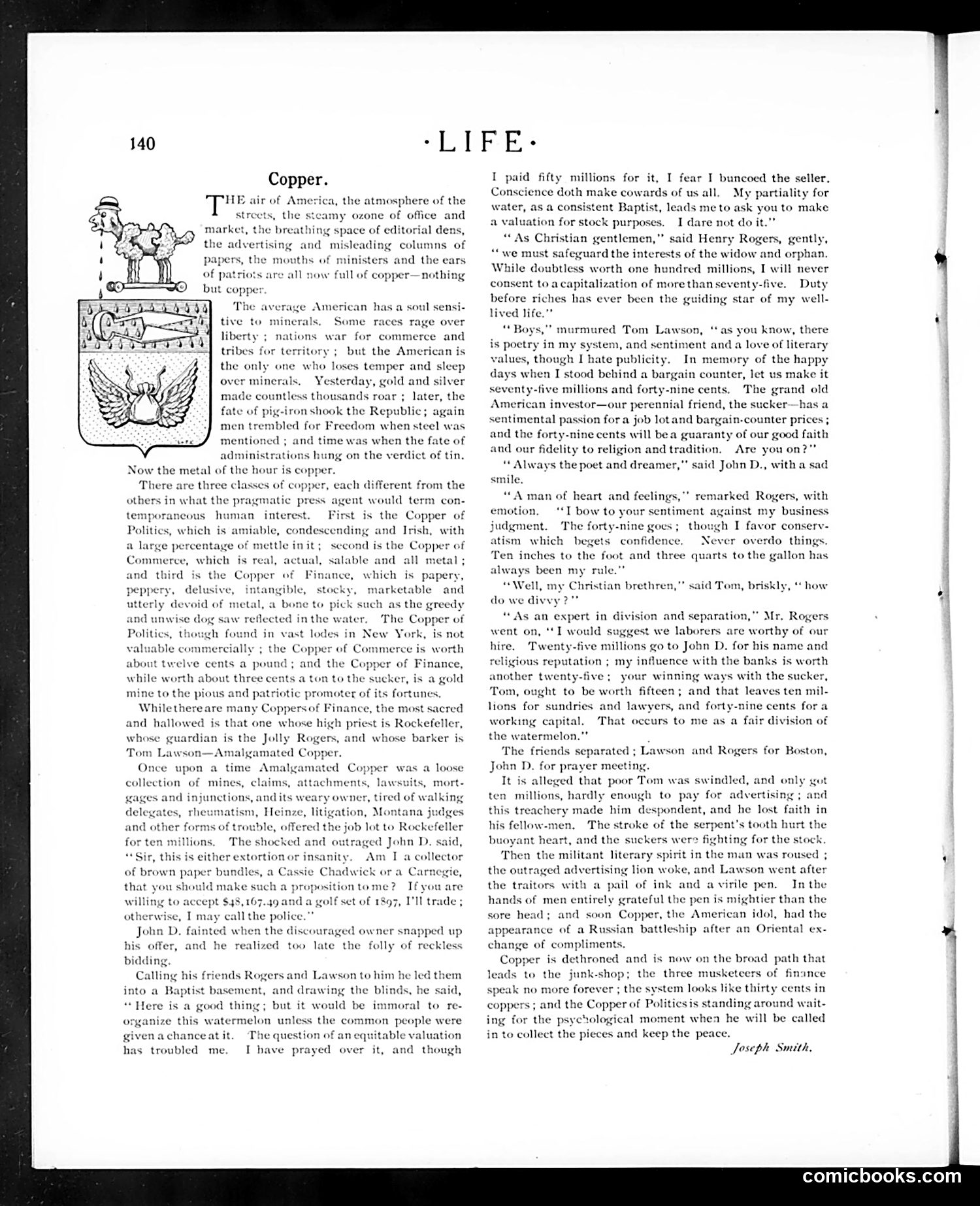
This article satirizes American obsession with mineral speculation, particularly copper. The piece traces how Americans successively fixate on different commodities—gold, silver, pig-iron, steel, tin—before turning to copper as the object of financial fever. The satire focuses on three figures identified in the text: **Rockefeller** (guardian of Finance copper), **Henry Rogers**, and **Tom Lawson**—likely the actual financiers involved in copper dealings. The narrative ridicules their moral pretense: Rockefeller claims conscience over paying $50 million for copper mines, while Rogers and Lawson cynically agree to undervalue the property at $75 million "for the widow and orphan." The cartoon mocks how wealthy speculators use religious and ethical language to justify questionable financial manipulations. The broader satire suggests Americans are psychologically driven to gamble on minerals, losing "temper and sleep" over commodities while pretending virtue guides their business decisions.
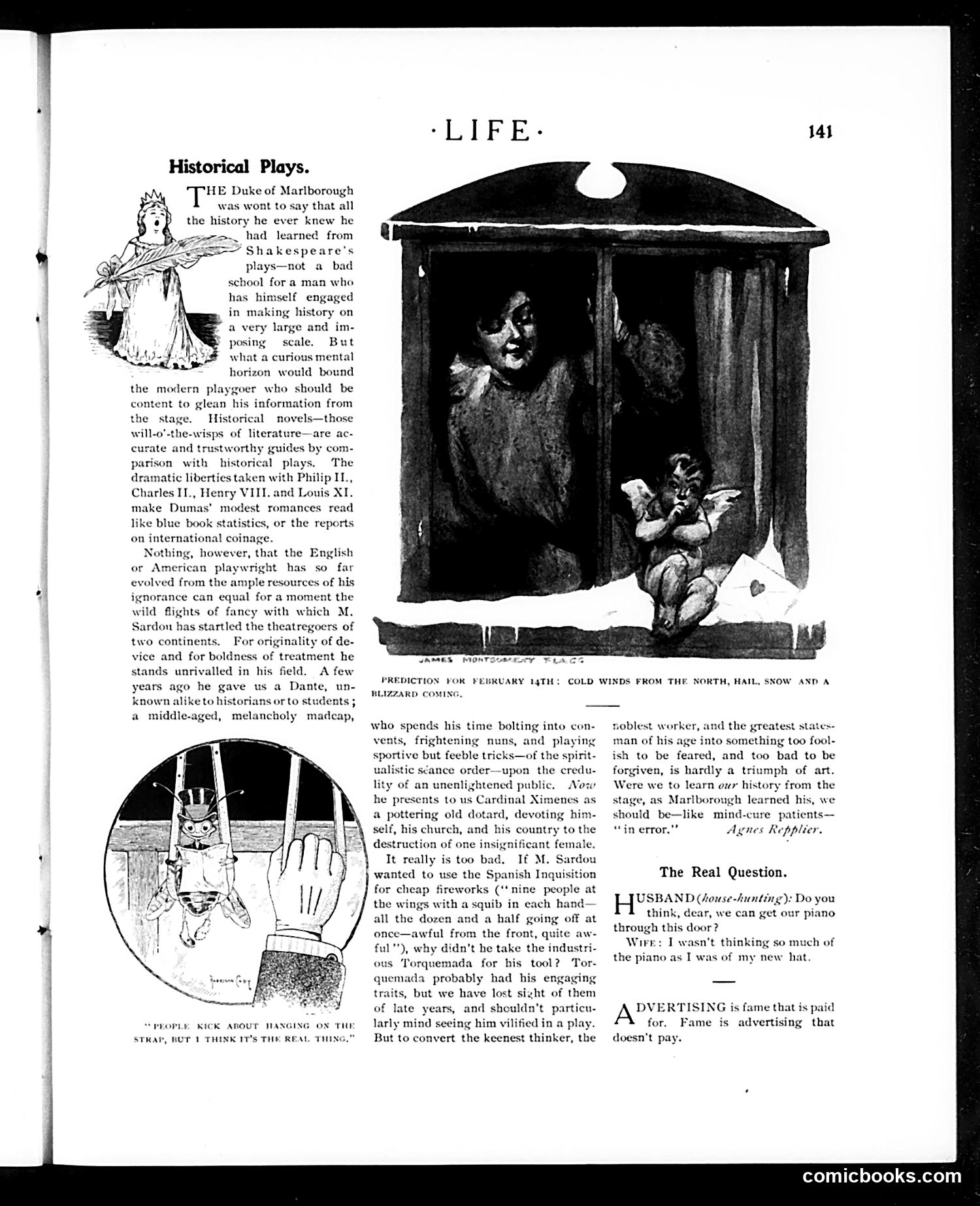
This page critiques playwright Victorien Sardou's historical dramas. The article argues that while Shakespeare's plays teach history effectively, Sardou takes reckless dramatic liberties—distorting real historical figures like Cardinal Ximenes and Torquemada for theatrical effect. The satire targets Sardou's "wild flights of fancy," claiming he transforms noble historical figures into ridiculous caricatures merely for stage spectacle (like cheap fireworks displays). The two cartoons below offer lighter social humor: one mocks people debating the ethics of hanging while missing "the real thing" (likely about actual social problems), and another features a husband-wife exchange where the wife prioritizes her new hat over practical moving concerns—a jab at women's materialism. The page reflects early 20th-century concerns about historical accuracy in entertainment and traditional gender stereotypes.
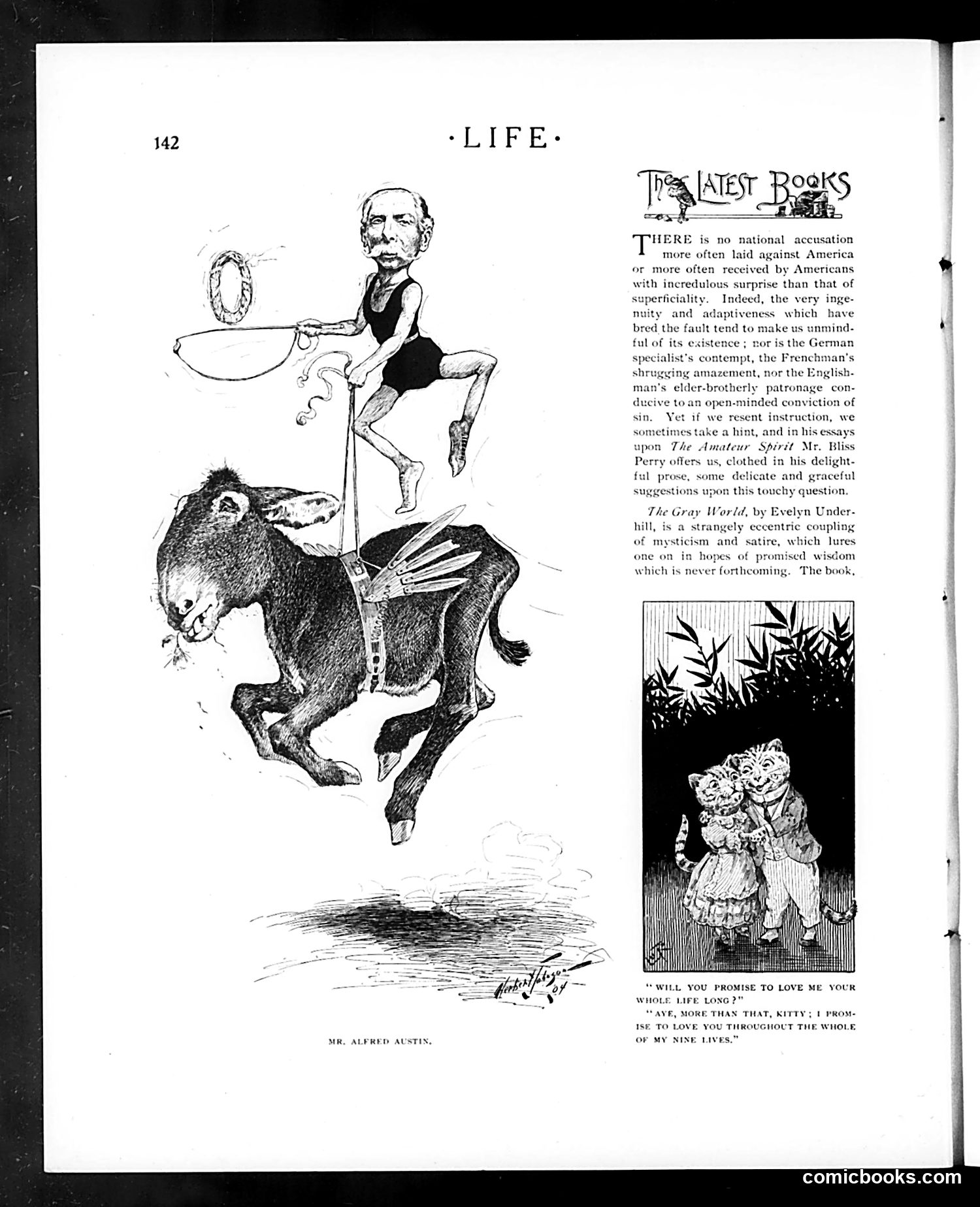
The main cartoon depicts **Mr. Alfred Austin** riding a donkey while precariously balancing a large bowl or vessel. Austin was a British poet and critic known for superficiality in his literary judgments—a quality Life frequently mocked. The exaggerated, unstable composition satirizes his precarious intellectual position and the absurdity of his pretensions. The smaller illustration shows two anthropomorphic cats in domestic dress with accompanying dialogue about promising lifelong love, likely a sentimental parody of romantic poetry or greeting-card sentimentality. The accompanying text discusses American "superficiality" and reviews books including one by Bliss Perry on "The Amateur Spirit." The page critiques both British cultural pomposity (represented by Austin) and shallow American attitudes. The satire targets both specific literary figures and broader cultural pretension of the era.
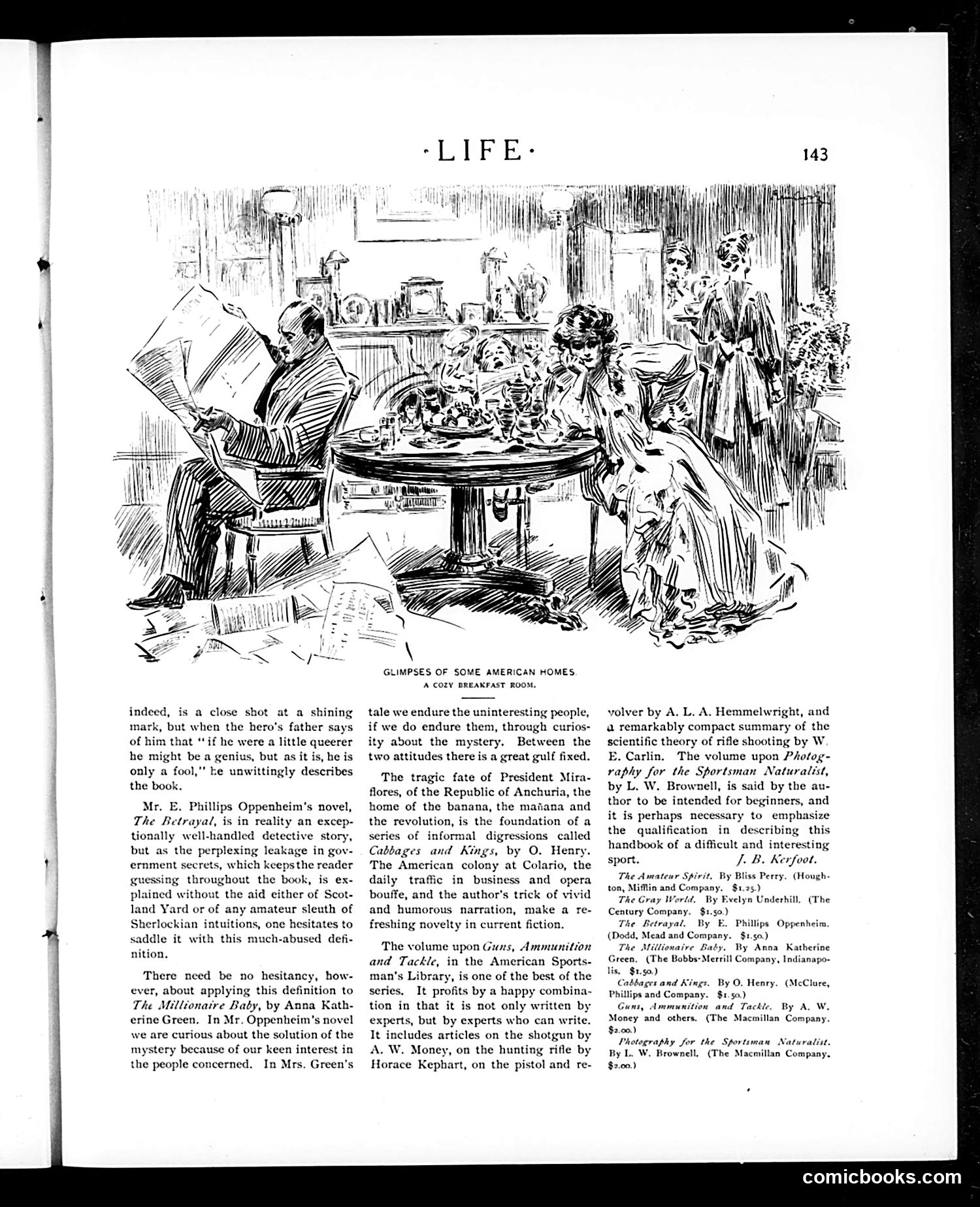
This illustration satirizes American domestic life and upper-class pretension. The sketch shows an elegantly dressed couple at a round breakfast table surrounded by servants and attendants in an ornate, curtained room—depicting what Life presents as an idealized "cozy" breakfast scene. The satire lies in the contrast between the caption's modest claim of coziness and the illustration's obvious display of wealth, formality, and excess. A truly "cozy" breakfast would be intimate and informal; instead, this scene is stiff, servants-attended, and ostentatious. The cartoonist mocks the American wealthy for their self-deception about luxury—calling their elaborate, impersonal domestic arrangements "cozy" reveals their disconnect from authentic comfort. This appears as filler content between book reviews, using visual humor to critique contemporary upper-class American manners and self-awareness.
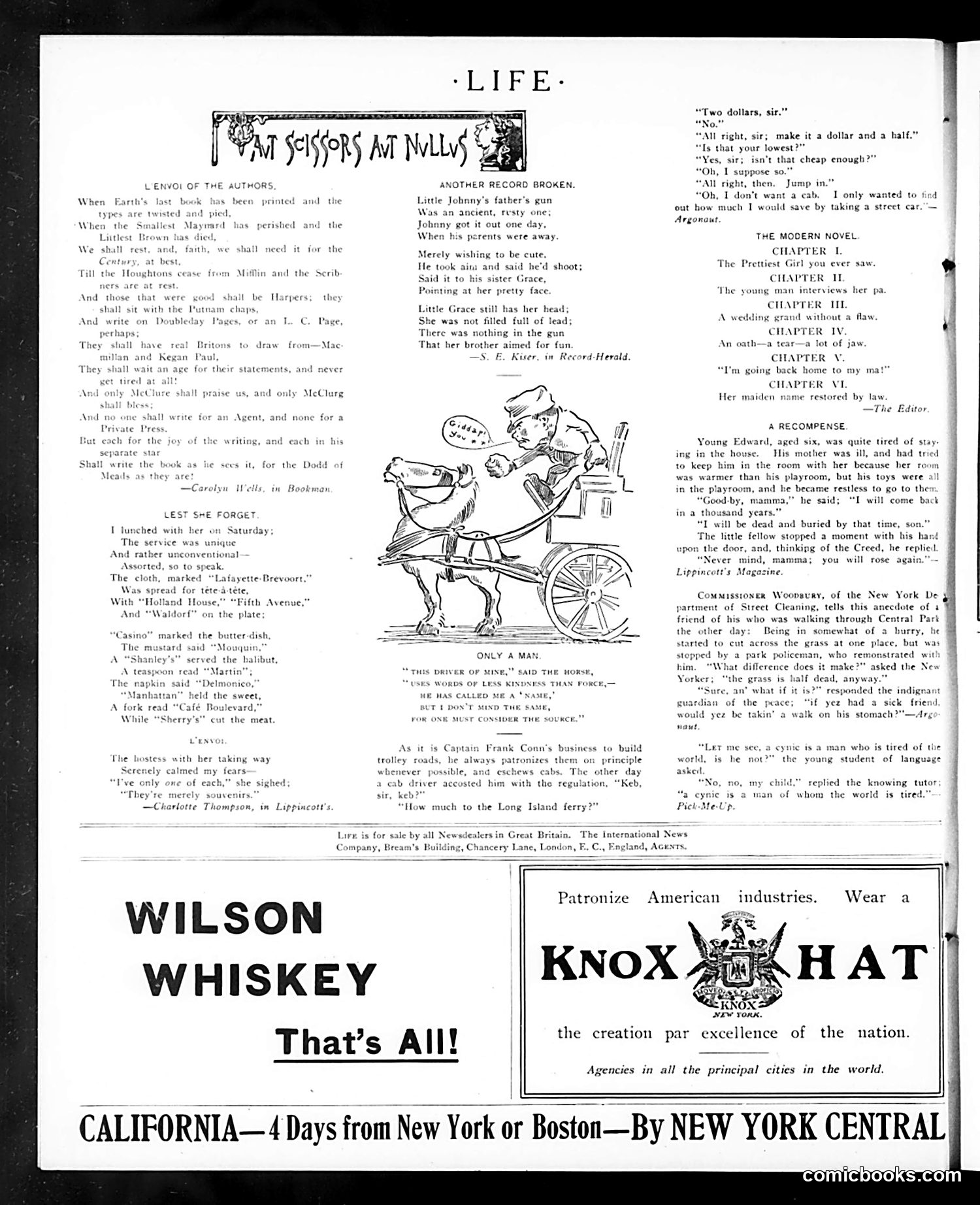
This page from *Life* magazine comprises satirical poetry, humorous anecdotes, and advertisements typical of early 20th-century American humor. **Main Content:** The page opens with an "L'Envoi" (farewell poem) by the authors, mocking contemporary publishers (Harpers, Houghton Mifflin, Scribners) and literary magazines, suggesting only McClure's magazine will praise their work. The anecdotes include: - A joke about a woman who entertained using napkins marked with fancy NYC locations—a commentary on social pretension - A grim tale of a child playing with an unloaded gun aimed at his sister - A cab driver duped by a customer asking inflated prices only to choose the cheaper trolley instead **Satirical targets:** Publishing pretension, upper-class affectation, and foolish frugality. **Advertisements:** Wilson Whiskey and Knox Hats, urging "patronize American industries." The page reflects *Life*'s formula of gentle, class-conscious satire aimed at educated, urban readers.
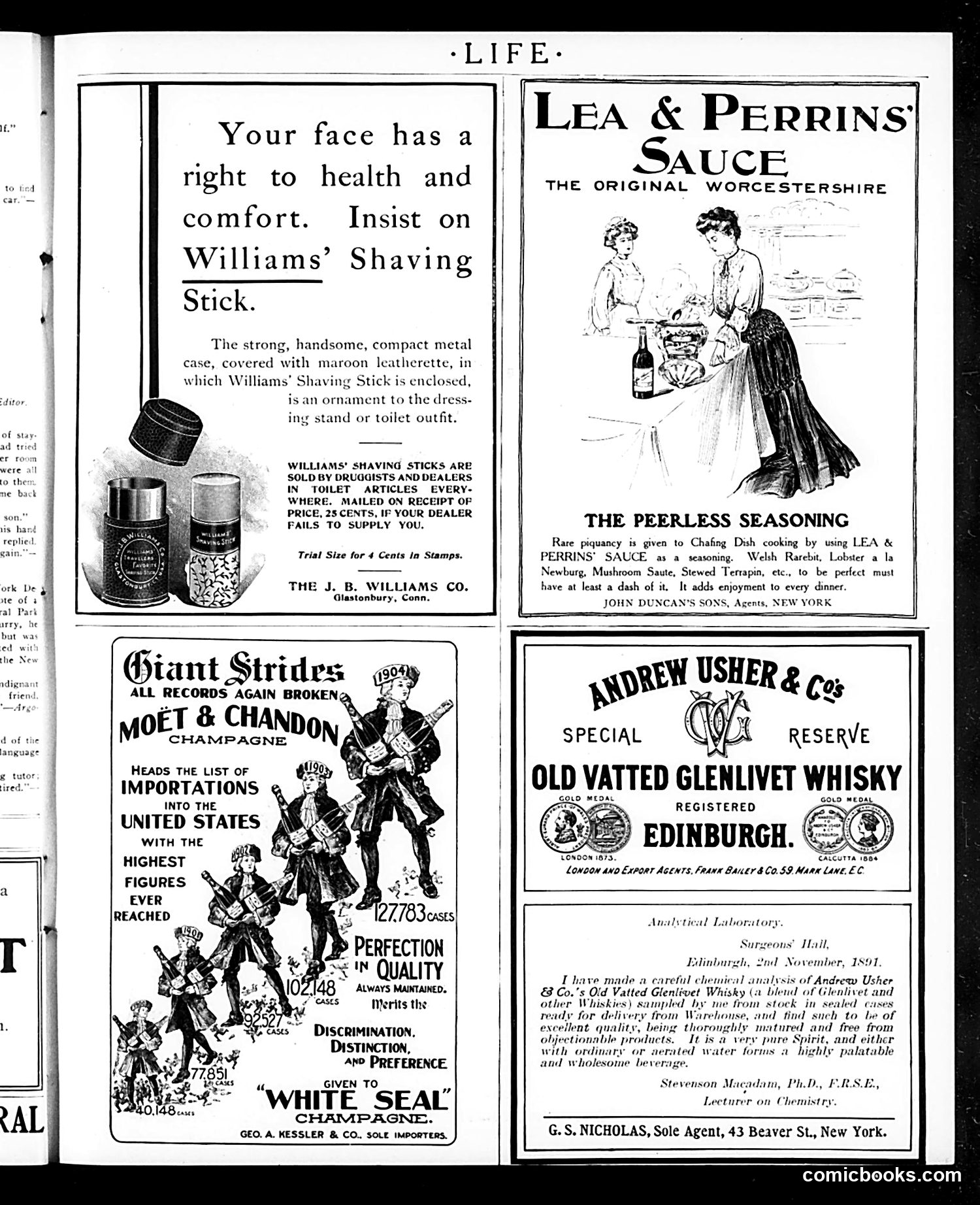
This is **not a political cartoon or satire page**—it's a straightforward advertising section from *Life* magazine. The page contains four product advertisements typical of the 1890s era: 1. **Williams' Shaving Stick**: Marketed as a grooming essential in an attractive metal case, emphasizing health and comfort for the face. 2. **Lea & Perrins' Sauce**: The original Worcestershire sauce, positioned as an essential seasoning for upscale dishes like Welsh Rarebit and Lobster Newburg. 3. **Moët & Chandon Champagne**: Highlights import statistics and sales figures, claiming record importation numbers and "perfection in quality." 4. **Andrew Usher Old Vatted Glenlivet Whisky**: Features a formal chemical analysis letter from an Edinburgh chemist (dated 1891) authenticating the whisky's quality. All ads appeal to affluent consumers through luxury goods, scientific/professional endorsements, and emphasis on quality and taste. There is no satirical commentary—this reflects genuine late-19th-century advertising practices.
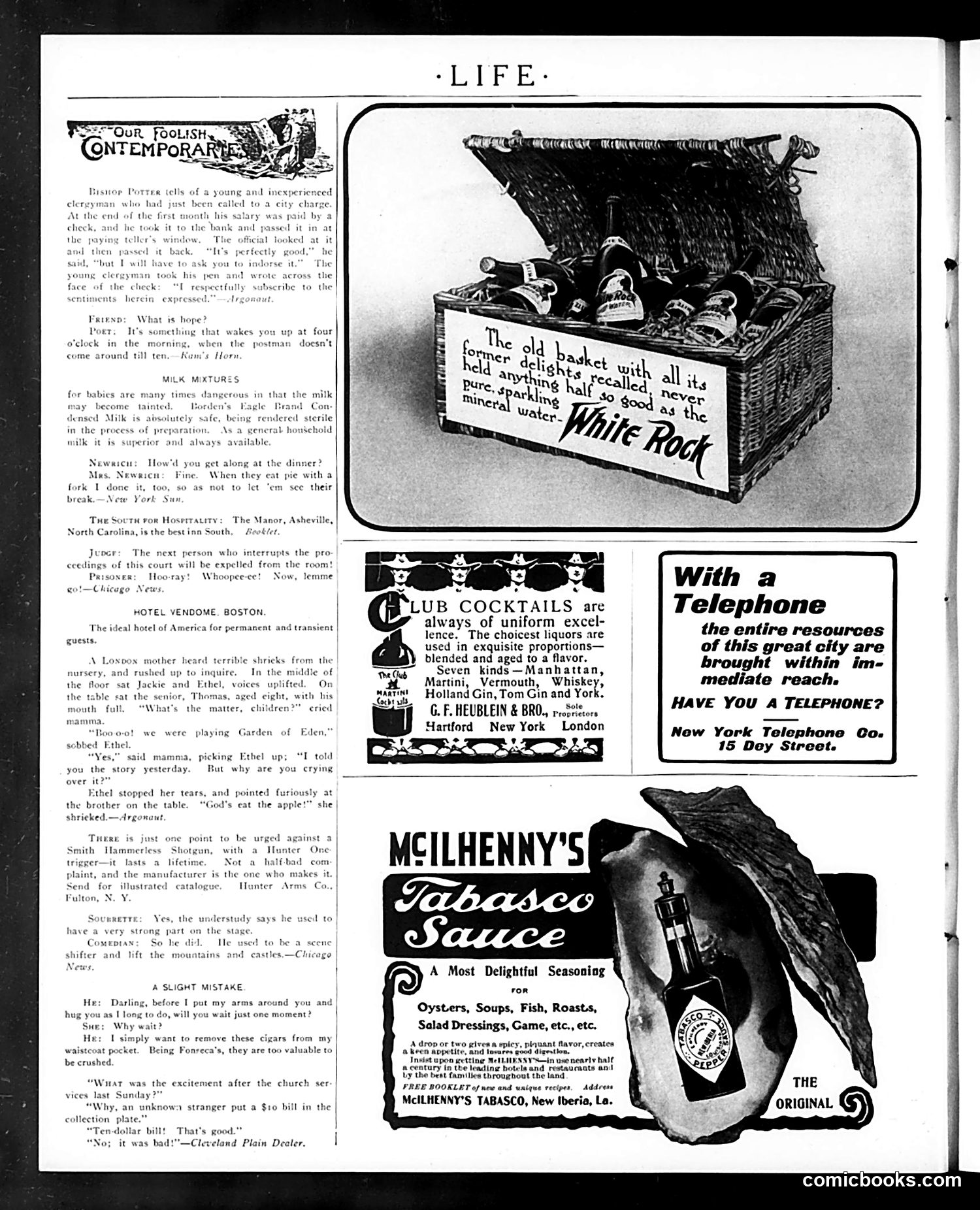
This page consists primarily of **humorous anecdotes and advertisements** rather than political cartoons. The content reflects early 20th-century American humor and consumer goods. The text snippets are brief jokes about domestic life, courtship, and social situations—typical of *Life* magazine's satirical humor. One notable piece mocks a clergyman's banking practices; another jokes about a couple's romantic moment interrupted by concern over expensive cigars (a commentary on consumer materialism and courtship awkwardness). The advertisements dominate: **White Rock mineral water, club cocktails, telephone service, Tabasco sauce, and a Boston hotel**. These ads target affluent readers and reflect the era's emerging consumer culture and technological enthusiasm (the telephone ad emphasizes urban connectivity). The overall tone is genteel, class-conscious satire aimed at middle and upper-class readers—poking fun at propriety, romance, and material consumption without challenging social structures. The humor is domestic and light rather than politically pointed.
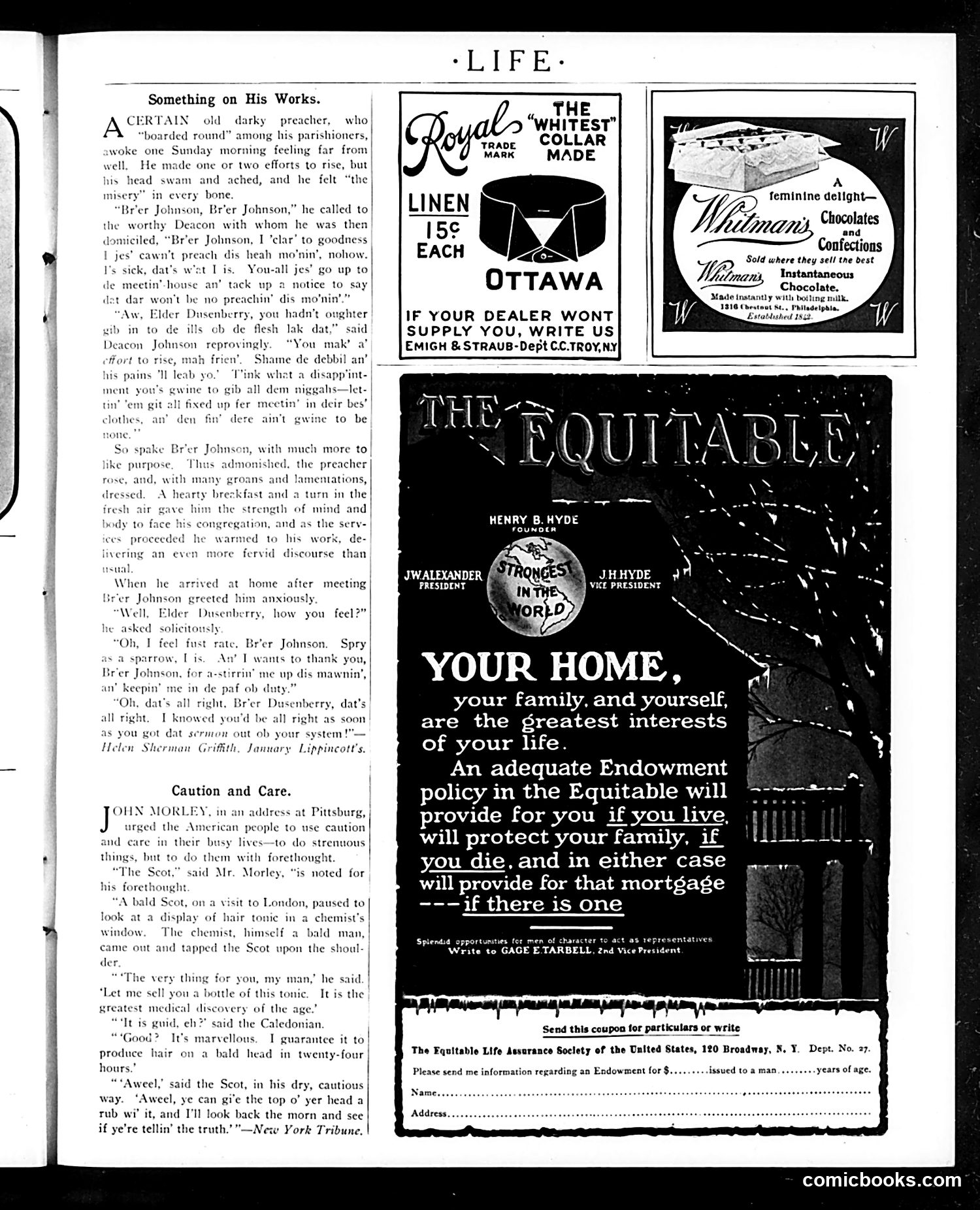
This page contains two satirical stories and period advertisements typical of early-20th-century Life magazine. **"Something on His Works"** is a dialect humor piece featuring a Black preacher (Elder Dusenberry) who feels ill and cancels Sunday services. When he recovers after delivering his sermon anyway, Deacon Johnson attributes the cure to the sermon itself—suggesting the preacher's own words worked as medicine. The humor relies on the era's common (and offensive) practice of rendering African American speech in exaggerated dialect for white audiences' entertainment. **"Caution and Care"** is a brief anecdote about a Scottish man (the "Scot") who skeptically tests a hair-tonic salesman's claims. The joke plays on Scottish stereotypes of frugality and practical skepticism—the Scot agrees to try the product only if the salesman tests it first on himself. The advertisements include Royal linen collars, Whitman's chocolates, Ottawa products, and a major Equitable Life Insurance pitch emphasizing family protection—representative of early consumer and financial services marketing.
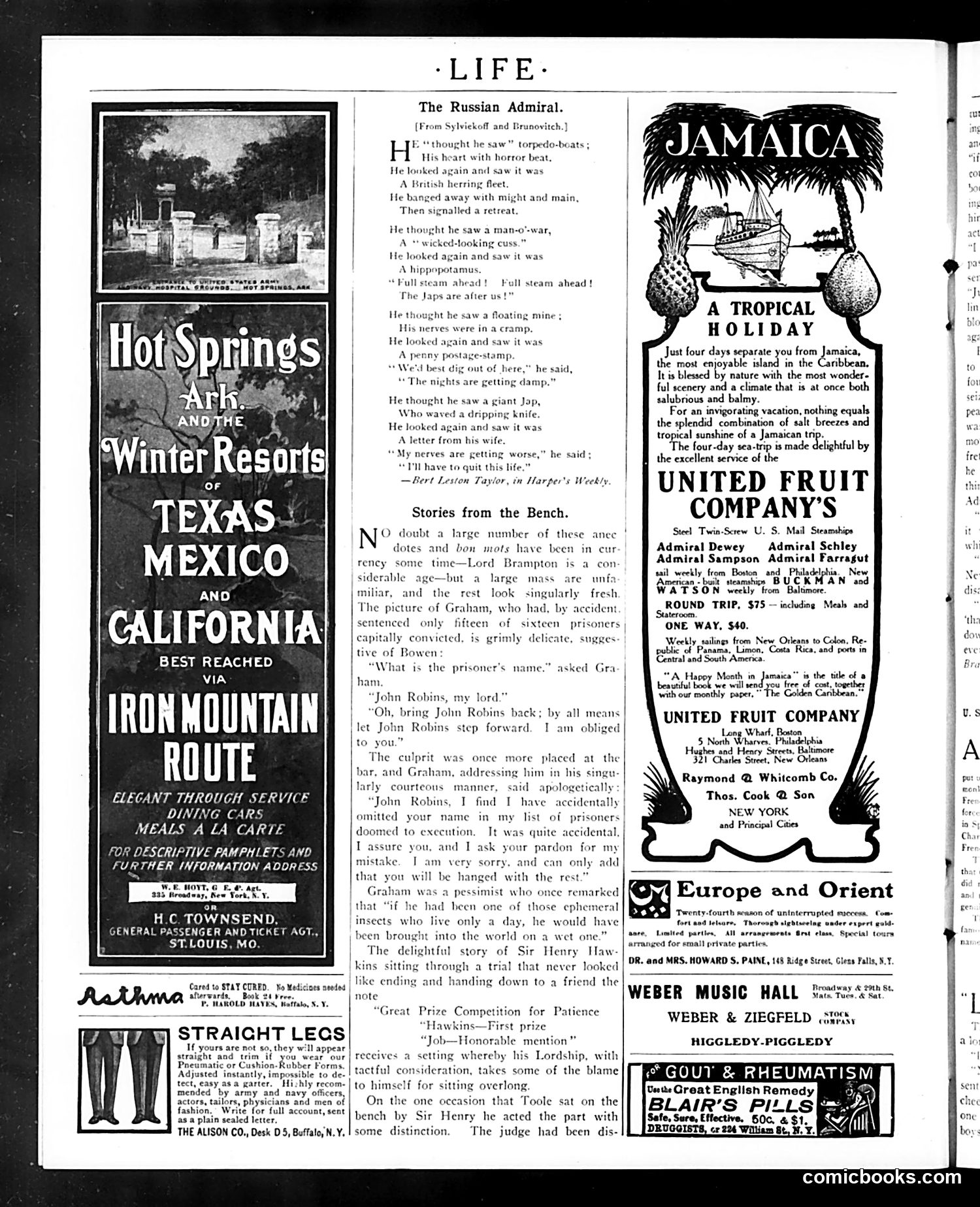
This page is primarily **advertising and humorous content** rather than political satire. **Main visual content:** 1. **"The Russian Admiral"** — A humorous poem mocking Russian naval incompetence during the Russo-Japanese War. The Admiral mistakes ordinary objects (torpedo boats, hippopotamuses, floats, even a letter from his wife) for enemy threats, reflecting on Russian military weakness. The joke relies on Russian naval defeats in that recent conflict. 2. **Travel and cruise advertisements** dominate the page—promoting Hot Springs, Jamaica vacations, and rail routes—reflecting early 1900s leisure tourism marketing. 3. **Commercial product ads** (straightening leg devices, etc.) are interspersed throughout. The Russian Admiral joke is the only political reference: it satirizes Russian military vulnerability during the Russo-Japanese War (1904-1905), a major news event of the period. The humor is straightforward mockery of perceived incompetence rather than complex satire.
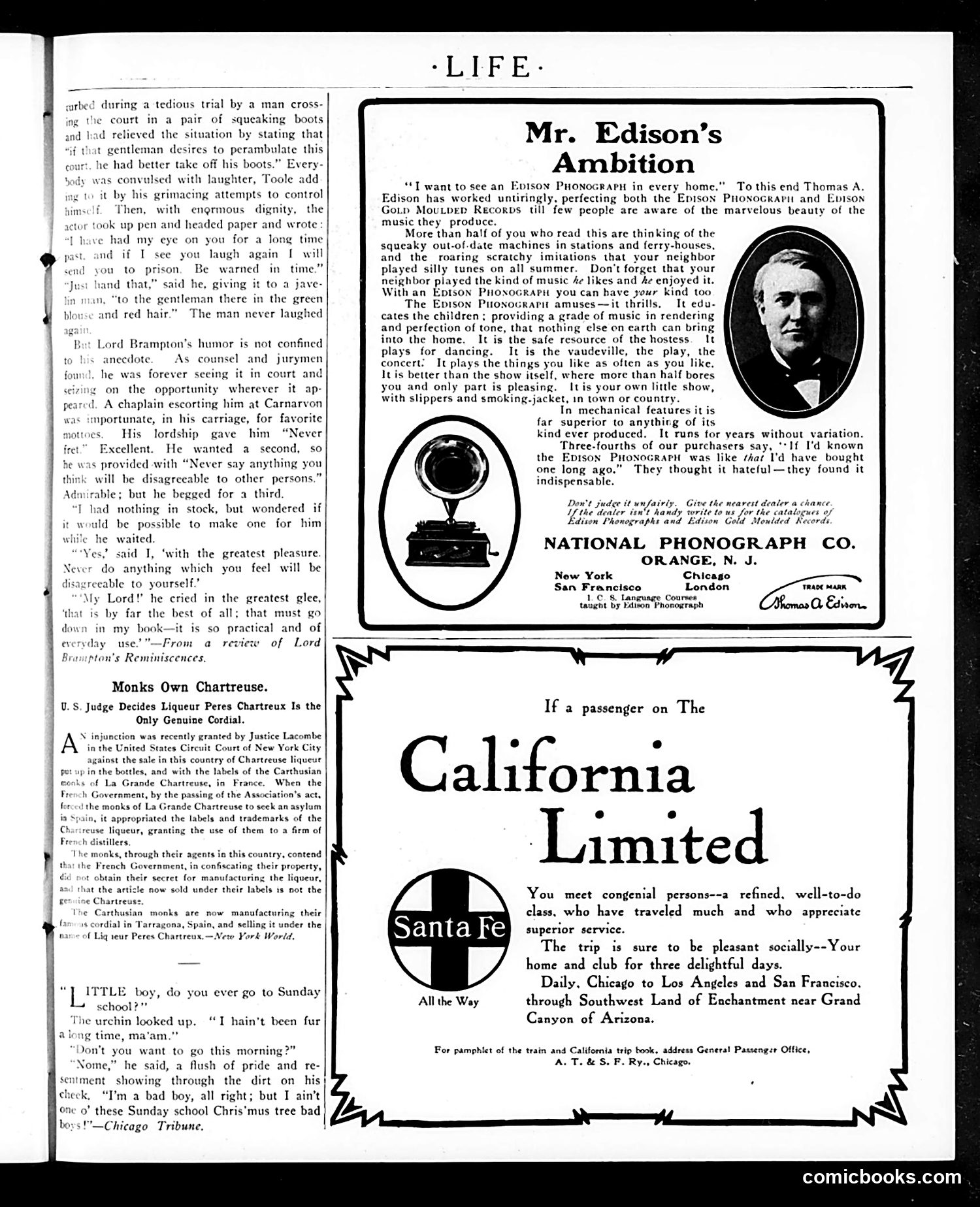
This page contains three distinct pieces: **Main Feature: "Mr. Edison's Ambition"** - An advertisement/promotional article featuring Thomas Edison's stated goal to place a phonograph in every home. The text emphasizes that Edison Phonographs have improved dramatically from the "squeaky out-of-date machines" people remember from public spaces. This is essentially advertorial content promoting Edison's Gold Moulded Records technology as superior to competitors' products. The accompanying portrait shows Edison himself. **Legal Notice: "Monks Own Chartreuse"** - A news item about a U.S. court injunction regarding genuine Chartreuse liqueur. French Carthusian monks were forced into exile in Spain, and the French government appropriated their trademark. The monks now manufacture authentic Chartreuse in Spain while French distillers sell imitation versions, leading to legal disputes over authenticity. **Humor Column: "Little Boy and Sunday School"** - A brief joke about a street child refusing Sunday school, claiming he's not "one o' these Sunday school Chris'mus tree bad boys"—implying the charity aspect embarrasses him. **Bottom: Santa Fe Railway Advertisement** for the "California Limited" train service.
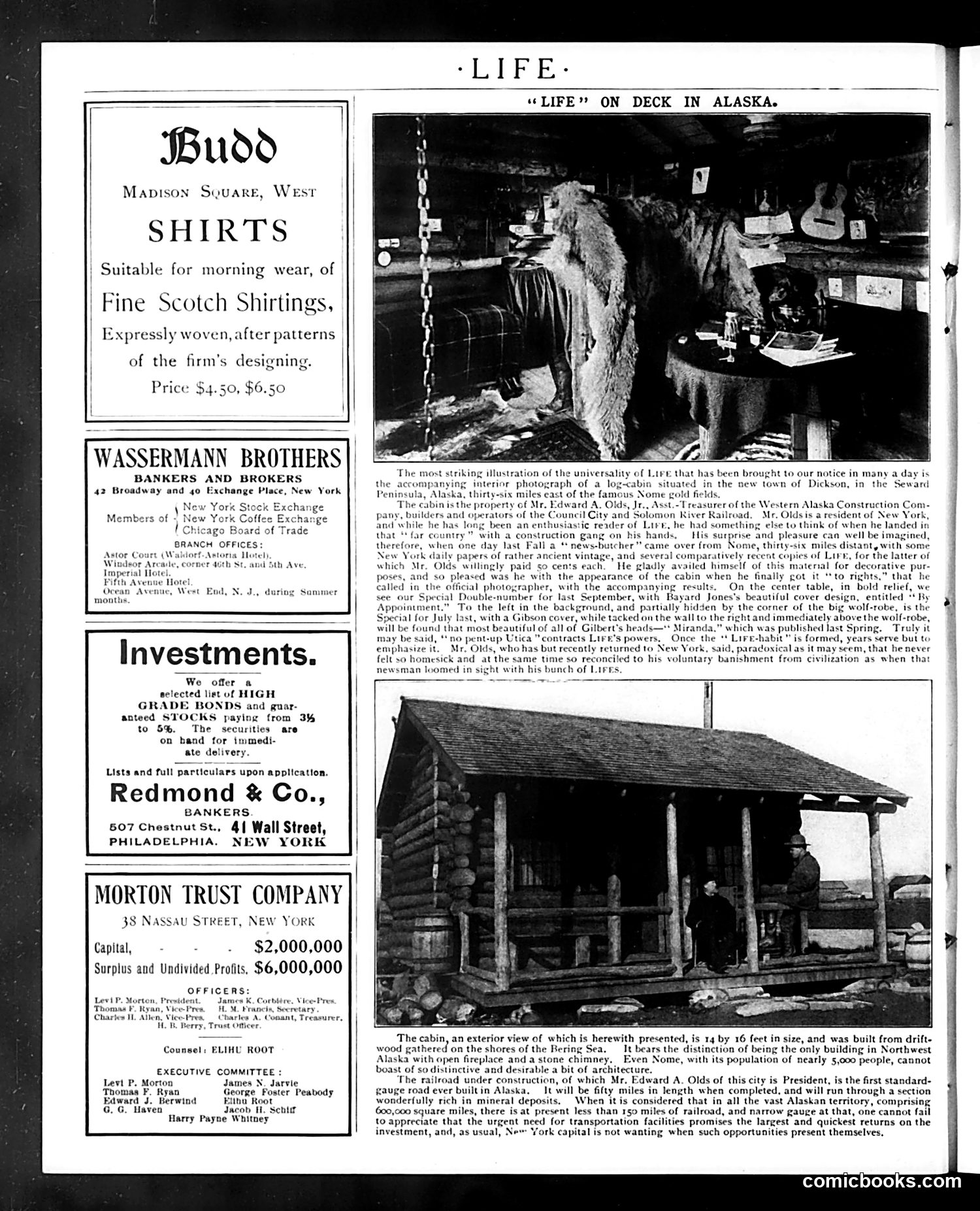
This page is primarily **advertising and business notices**, with one feature article about Alaska. The main content is "Life on Deck in Alaska," which profiles Edward A. Olds Jr., a railroad executive in Nome during the Alaska gold rush. The piece celebrates how *Life* magazine itself has achieved such universal popularity that even in remote Alaskan cabins, prospectors willingly pay 50 cents per copy. Olds's log cabin is decorated with *Life* issues—including the September special double-number and July Gibson cover—demonstrating the magazine's reach and cultural prestige. The satire is subtle: the article humorously suggests that *Life's* appeal is so irresistible that even isolated gold miners in the Arctic consider it essential reading. The cabin photo serves as proof of the magazine's influence across America's frontiers. The remainder consists of financial advertisements for Wassermann Brothers (bankers), Redmond & Co., and Morton Trust Company—typical of period *Life* magazine layouts mixing editorial content with high-end business advertising.
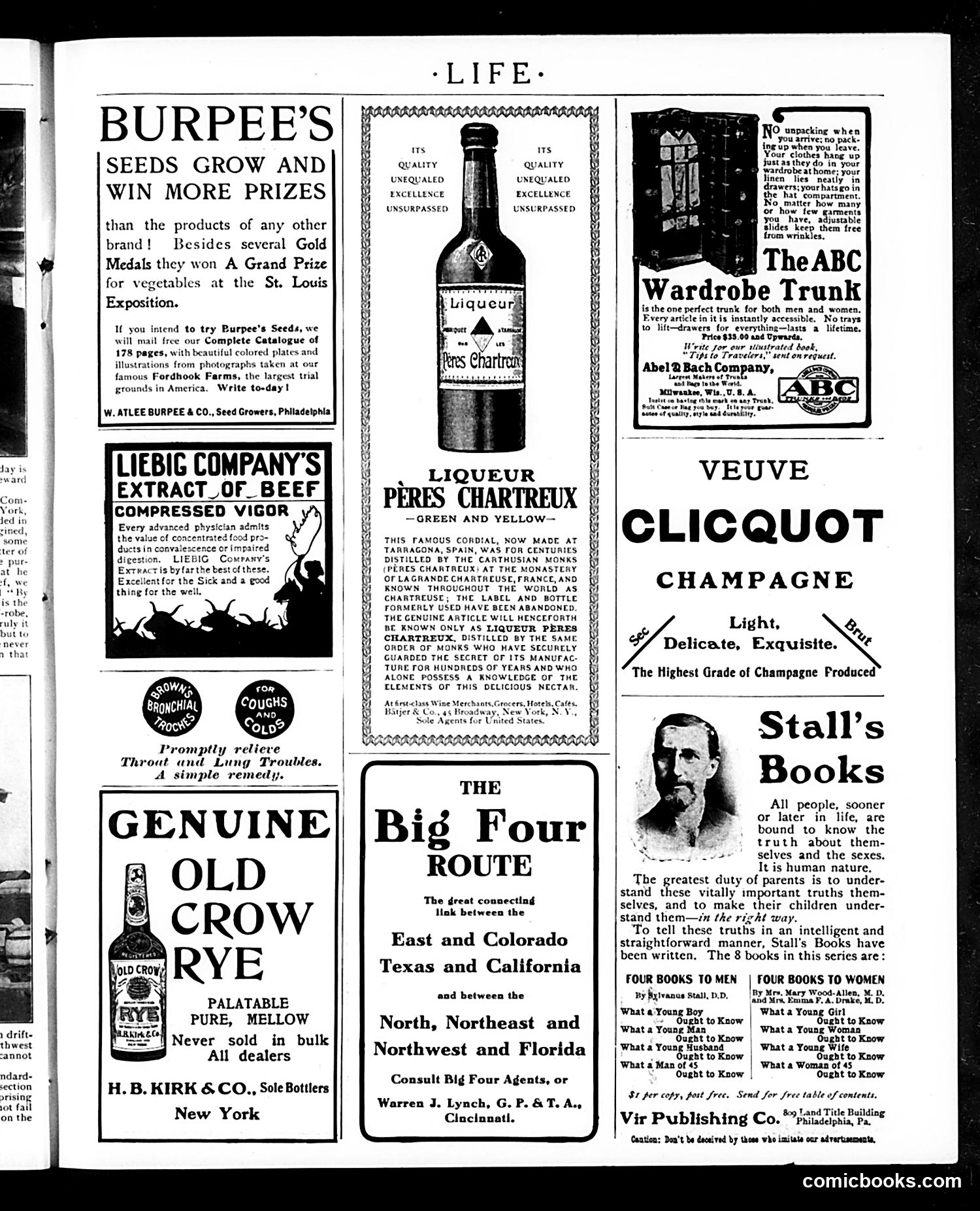
This page is primarily **advertising** rather than political satire or cartoons. It contains multiple commercial advertisements from the early 1900s: **Notable ads include:** - **Burpee's Seeds**: Emphasizes winning medals and prizes at exhibitions - **Liebig Company's Beef Extract**: Markets a health product for invalids and convalescents - **Liqueur Pérès Chartreux**: A cordial formerly made by Carthusian monks in France, now produced in Spain - **ABC Wardrobe Trunk**: A travel storage solution - **Veuve Clicquot Champagne**: Positioned as premium quality - **Stall's Books**: Sex education guides for men and women, addressing "truths about themselves and the sexes" — reflecting early 1900s attitudes toward sexuality education - **The Big Four Route**: Railroad service connecting various U.S. regions The page reflects commercial messaging and social values of the period, particularly the frank but formal approach to discussing sexual education.
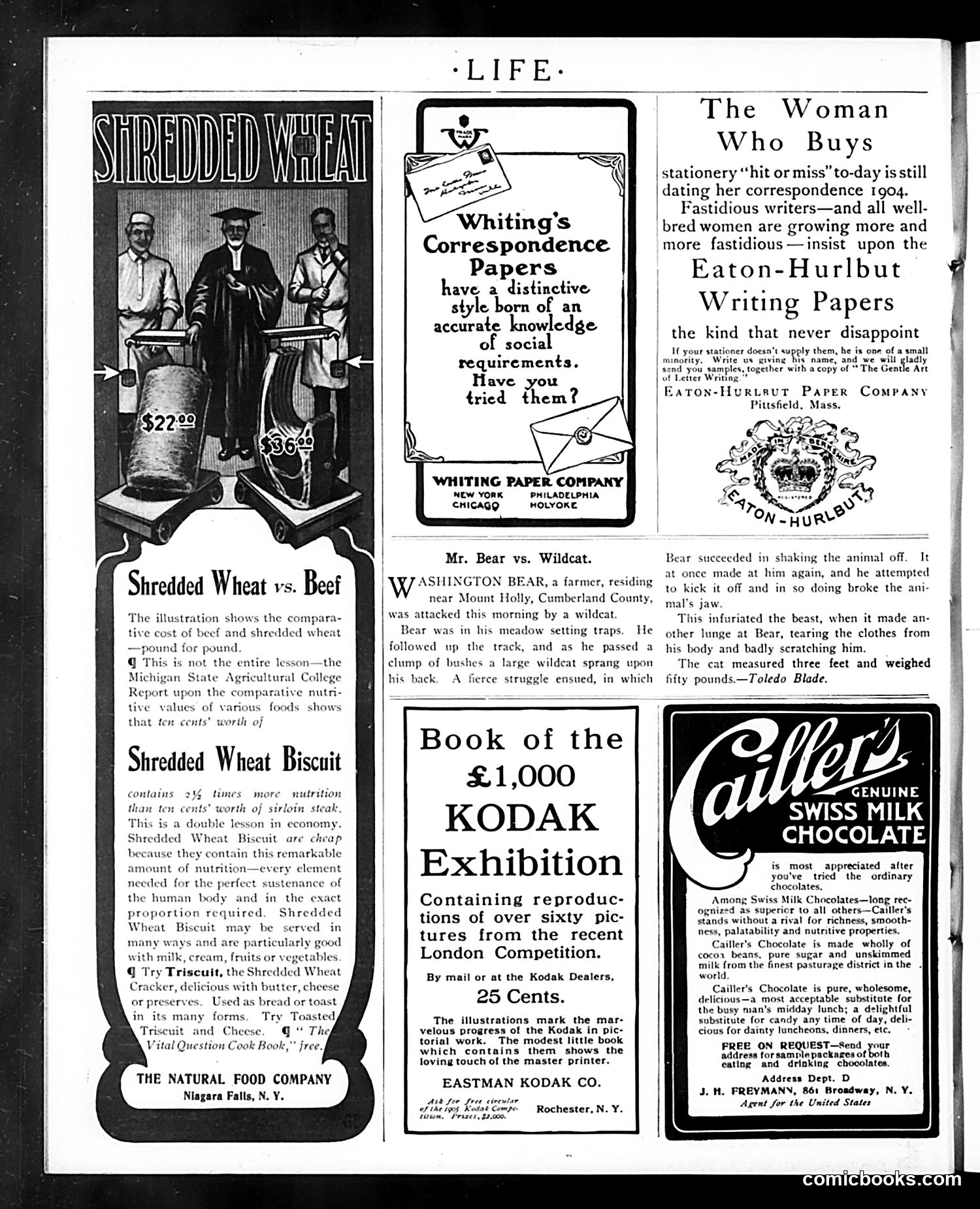
This page is primarily **advertisements** rather than satirical cartoons. The layout features several product ads with minimal editorial content. The main notable section is a brief anecdote titled "Mr. Bear vs. Wildcat"—a humorous play on names. A farmer named Washington **Bear** is attacked by a wildcat near Mount Holly, Cumberland County. During the struggle, Bear breaks the animal's jaw, and the wildcat retaliates by tearing his clothes and scratching him badly. The cat weighed fifty pounds. The joke relies entirely on the farmer's surname coincidentally matching the animal he fights; there's no political satire here. The remaining content consists of advertisements for Shredded Wheat Biscuit (emphasizing nutritional economy versus beef), Whiting's stationery, Eaton-Hurlbut writing papers, Kodak photography books, and Cailler's Swiss chocolate. These ads appeal to middle-class consumers, particularly women concerned with propriety and refined taste.
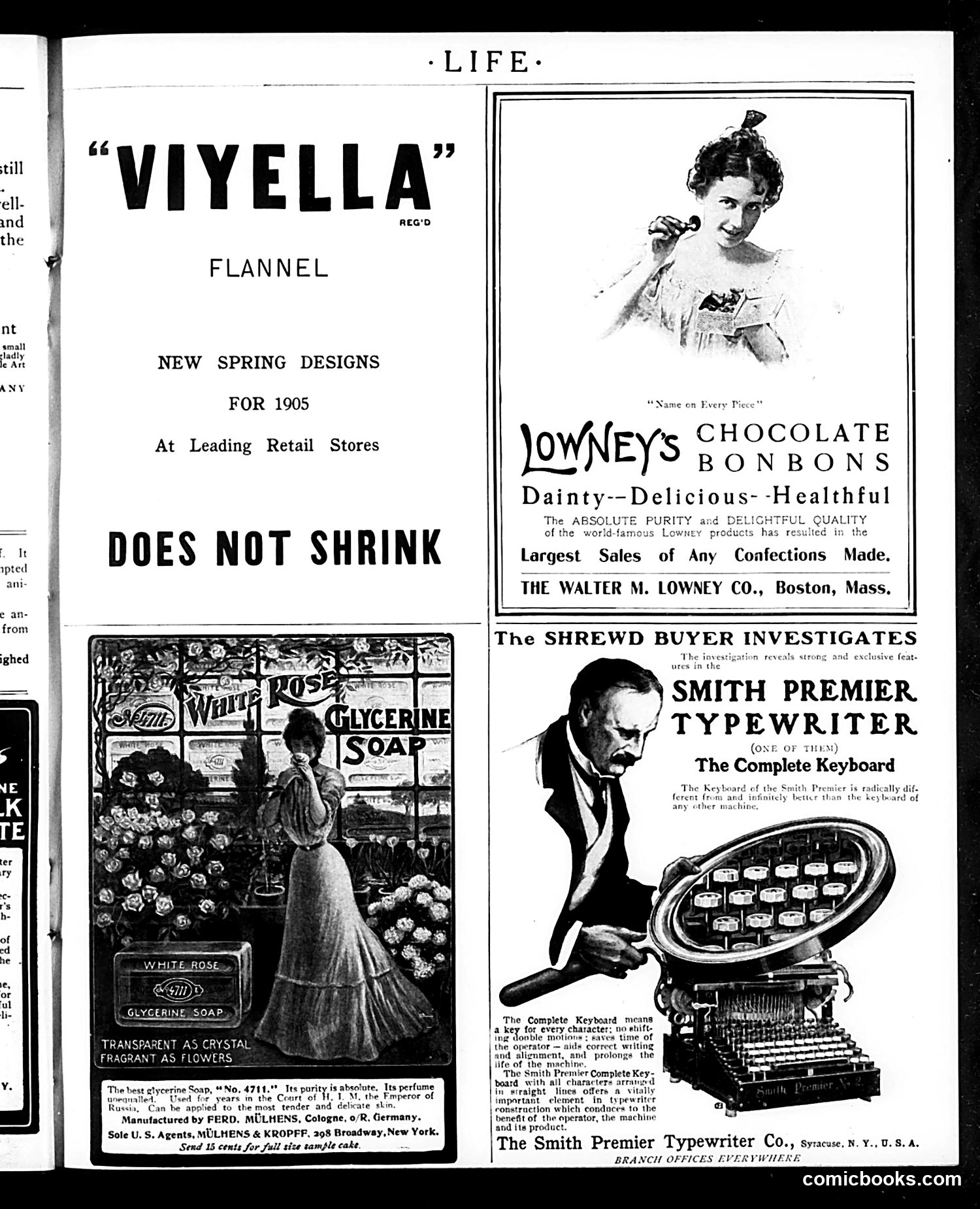
This is primarily an **advertising page** from Life magazine (1905), not a political cartoon. It contains four product advertisements typical of the era: 1. **Viyella Flannel** — promoting a fabric that "does not shrink," addressing a common consumer concern with early 1900s textiles. 2. **Lowney's Chocolate Bonbons** — emphasizing purity and quality as major selling points, with an illustration of an elegant woman. 3. **White Rose Glycerine Soap** — marketed as transparent, fragrant, and used by European royalty (the "Court of H.I.M., the Emperor of Russia"), suggesting luxury and refinement. 4. **Smith Premier Typewriter** — highlighting its "complete keyboard" as a technological advancement, with an illustration of a businessman examining the machine. The page reflects **consumer culture anxieties** of 1905: shrinking fabrics, product purity, and mechanical reliability. There is no satire here—these are straightforward advertisements appealing to middle-class aspirations for quality goods and modern technology.
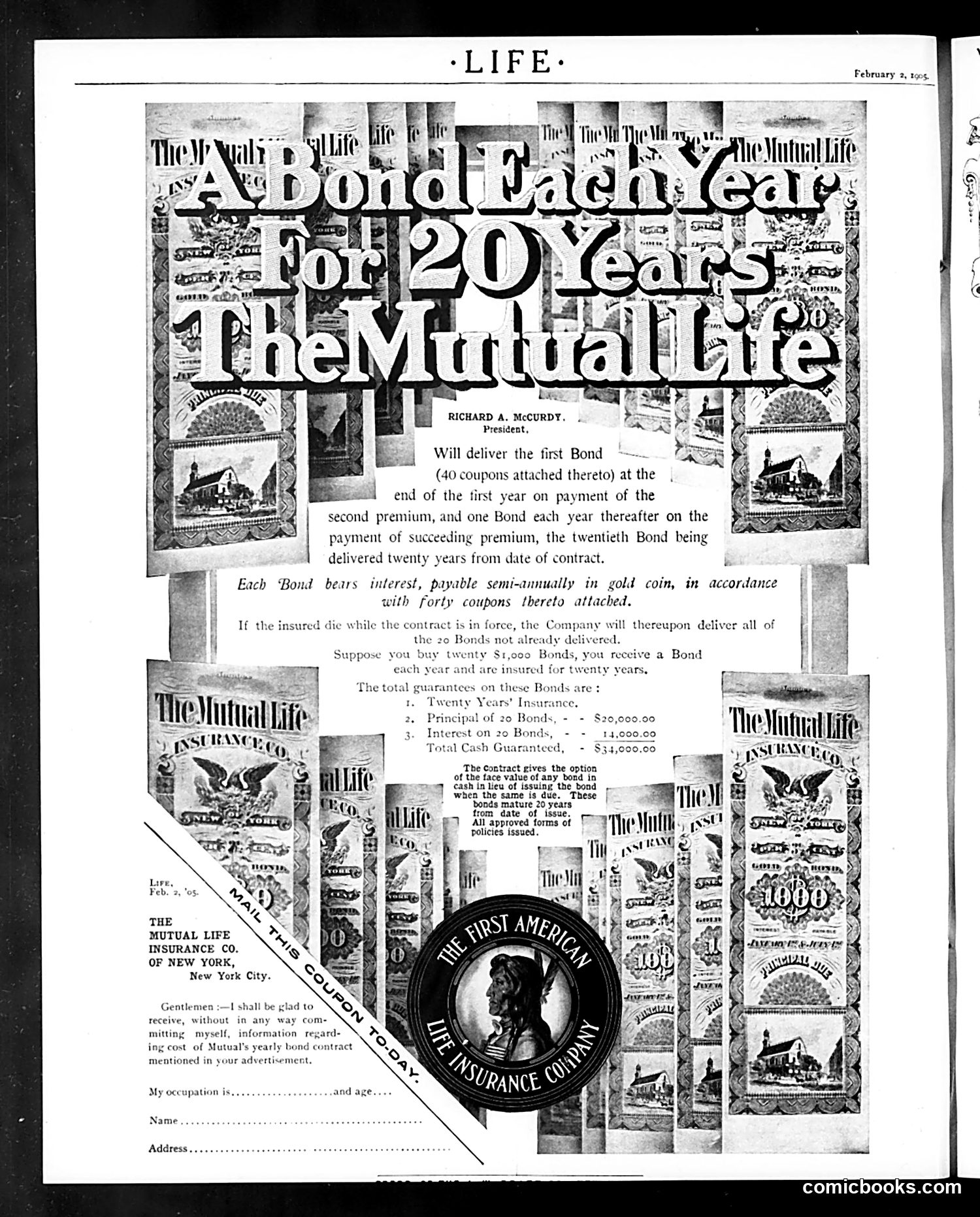
This page is primarily **advertising**, not satire or political commentary. It's a Life magazine advertisement for The Mutual Life Insurance Company of New York, dated February 2, 1905. The ad promotes Richard A. McCurdy (the company's president) and a specific insurance product: a "Bond Each Year" contract delivering twenty bonds over twenty years. The design uses layered images of Mutual Life insurance documents and certificates to create visual impact. The small circular seal shows "The First American Life Insurance Company" with a Native American profile—a period branding choice (unclear if meant ironically, though Life was a satirical publication). The bottom section contains a tear-off coupon for interested readers to request information. **For modern readers**: This is a straightforward insurance pitch dressed in elaborate Victorian-era marketing design, not social commentary. It targets gentlemen investors seeking long-term financial security through life insurance bonds.