
Life, 1905-02-02 · page 12 of 40
Life — February 2, 1905 — page 12: what you’re looking at
What you’re looking at
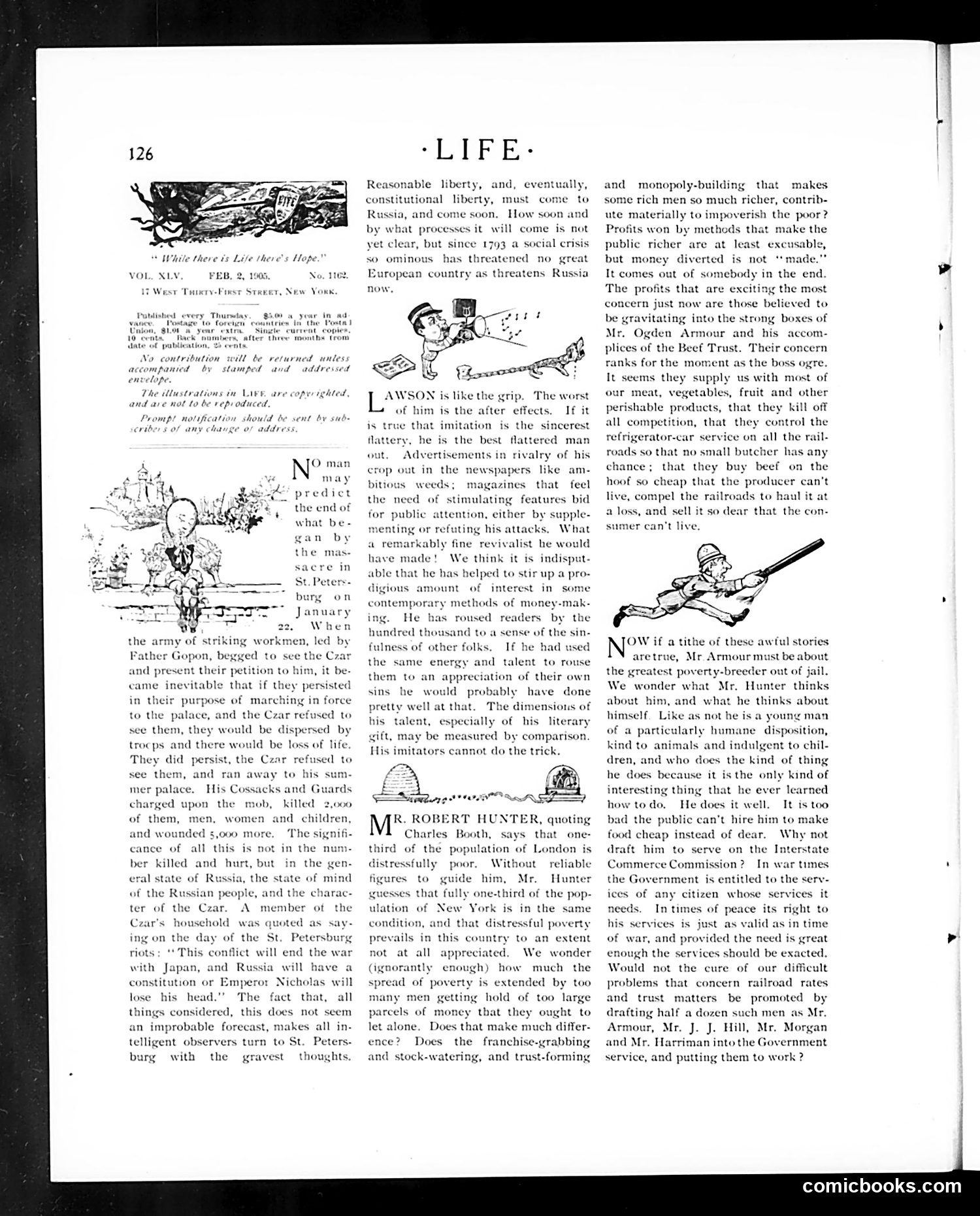
This page contains several satirical cartoons and commentary on contemporary social issues. The top cartoon depicts a figure being pulled or controlled like a puppet, labeled "LAWSON," likely referencing a public figure involved in media or business manipulation. The middle cartoon shows a man surrounded by chaotic elements, illustrating the text's discussion of how sensationalism and rivalry operate in newspapers and magazines. The bottom cartoon depicts a figure in horizontal flight or falling position, accompanying text about "Mr. Armour" and poverty issues, suggesting satire about wealthy industrialists' indifference to poverty. The text critiques monopoly-building, media sensationalism, and the concentration of wealth among "rich men" controlling essential goods like meat and vegetables, reflecting Progressive Era concerns about corporate power and social inequality in early 1900s America.
📄 Transcribed text from this page (OCR, searchable)
Machine-transcribed from the original scan — historical spelling and the odd misread are preserved.
* While there is Life there's Hope VOL. XLV 2, 1905, No, 1102, r Streer, New Yorn, No contribution will be returned untess accompanied by 4 and addressed The itlustrations in Lavt. are coperighted, and are not to be reproduced. Prompt nolifi should 6 criber sof an address ation ent by sub= O man may e end of what be- gan by the mas- sacre in St. Peters- burg January . When + Gopon, begged to see the Cz and present their petition to him, it be- came inevitable that if they 4 in their pul to the palace, and the Czar refused to see them, they would be dispersed by rsisted pose of marching in force trocps and there would be loss of life They did persist, the Czar re see them, and ran away t used to his sum- His Cossacks and Guards 1b, killed nd child: mer palace. charged upon the of them, men, wome and wounded 5,000 more. all this and n, ‘The signifi- in the num- hurt, but in the gi Russia, the state of m of the Russian people, : the Czar. A uschold was quoted as say- ing on the day of the St cance of ber killed eral state of is not the ter of member ot Czar's } Petersburg riots: ‘This conflict will end the war with Japan, and Russia will have a constitution or Emperor Nicholas will his head.” The fact that, all things considered, this does not seem an improbable forecast, makes all in- telligent observers turn to St burg with the lose Peters- gravest thoughts. “LIF B: Reasonable liberty, and, eve constitutional liberty Rus by wh: must co} to and come soon. How soon and will yet clear, but since 1793 a social crisis come is not t processes it so ominous has threatened no great European country as threatens Russia now. Rawr GN AWSON of him is true that The worst If it is the sincerest is like the grip. is the after effects. imitation flattery, he is the best flattered man out, Advertisements in rivalry of his © am- that feel need of stimulating features bid crop out in the newspapers 1 bittous the weeds; magazines for public attention, either by supple- What a remarkably fine revivalist he would have made! We think it is indisput- able that he has helped to stir up a pro- ting or refuting his attacks. digi IS amount of interest. in some contemporary methods of money-mak- ing. He has roused readers by the hundred thousand to a sense of the sin- fulness of other folks. If he had used the energ them to an appre same and lent to rouse ion of their own sins he would probably done pretty well at that. The dimensions of hb gift, may be measured by comparison His imitators cannot do the trick. =... =- M*. ROBERT HUNTER, quoting Charles Booth, says that one- third of the populat London is stressfully Without reliable him, Mr. Hu sses that fully one-third of the pop- New York is in the same tion, and that distressful poverty prevails in this coun! not at all have s talent, especially of his literary poor. figures to guide ulation of cond to an extent We wonder much the dof poverty is extended by too many men getting hold of too large parcels of money that they ought to let alone. Does that make much differ- Does the franchise-grabbing and stock-watering, and trust-forming appreciated (ignorantly enough) how sp ence? and monopoly-building that makes. some rich men so much richer, contrib- ute materially to impoverish the poor? Profits won by methods that make the public richer are at least excusable, but money diverted is not ‘ made." It comes out of somebody in the end. The profits that are exciting the most concern just now are those believed to be gravitating into the strong boxes of Mr. Ogden Armour and his accom- plices of the Beef Trust. ‘Their concern ranks for the moment as the boss ogre. It seems they supply us with most of our meat, vegetables, fruit and other perishable products, that they kill off all competition, that they control the refrigerator-car service on all the rail- roads so that no small butcher has any chance; that they buy beef on the hoof so cheap that the producer can't live, compel the railroads to haul it at nd sell it sumer can't live. a loss, so dear that the con- OW if a tithe of these awful stories aretrue, Mr Armour must be about the greatest poverty-breeder out of jail. We wonder what Mr. Hunter thinks about him, and what he thinks about himself. Like as not he is a young man a particularly humane disposition, kind to animals and indulgent to chil- dren, and who does the kind of thing he does because it is the only kind of interesting thing that he ever learned how tod He does it well. It is too bad the public can’t hire him to make food cheap instead of dear, Why not draft him to serve on the Interstate Commerce Commission? In war times the Government is entitled to the serv- ices of any citizen whose services it needs. In times of peace its right to his services is just as valid as in time of war, and provided the need is great enough the services should be exacted. Would not the cure of our difficult problems that concern railroad rates and trust matters be promoted by drafting half a dozen such men as Mr. Armour, Mr. J. J. Hill, Mr. Morgan and Mr. Harriman into the Government service, and putting them to work ? comicbooks.com