
A complete issue · 38 pages · 1905
Life — January 19, 1905
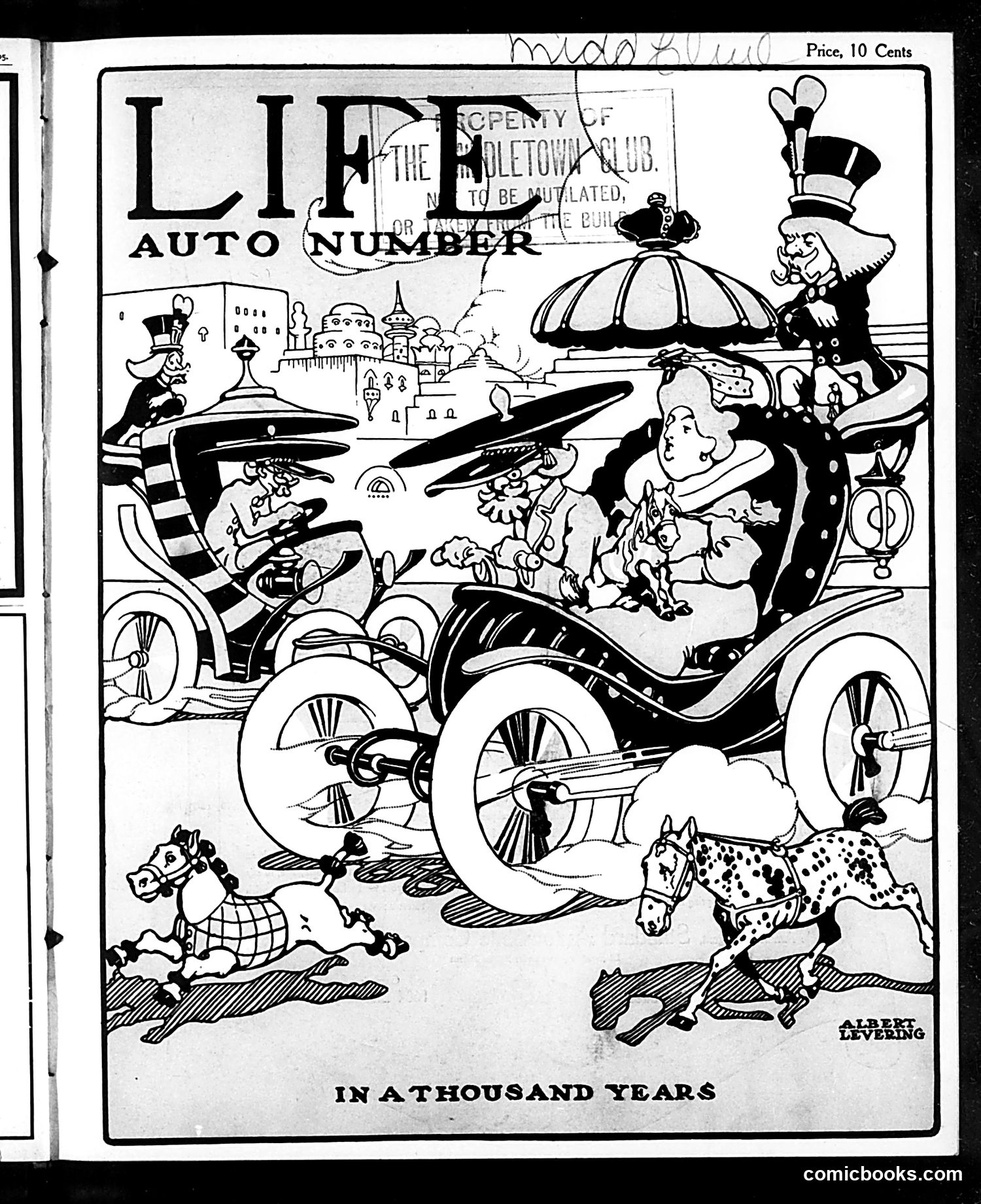
This satirical cover by Albert Levering imagines a fantastical future where automobiles have become so dominant that society has transformed into an absurdist monarchy. Elaborately dressed rulers and nobles travel in ornate, oversized automobiles pulled by horses, while smaller cars carry passengers through a surreal landscape with castles and domed buildings. The satire likely mocks the early automobile craze and rapid motorization of American society in the 1910s-1920s. By extrapolating this trend to an exaggerated extreme—depicting cars as the center of civilization and royal status—Levering critiques society's obsession with this new technology and questions what prioritizing automobiles above all else might mean for human culture and values.
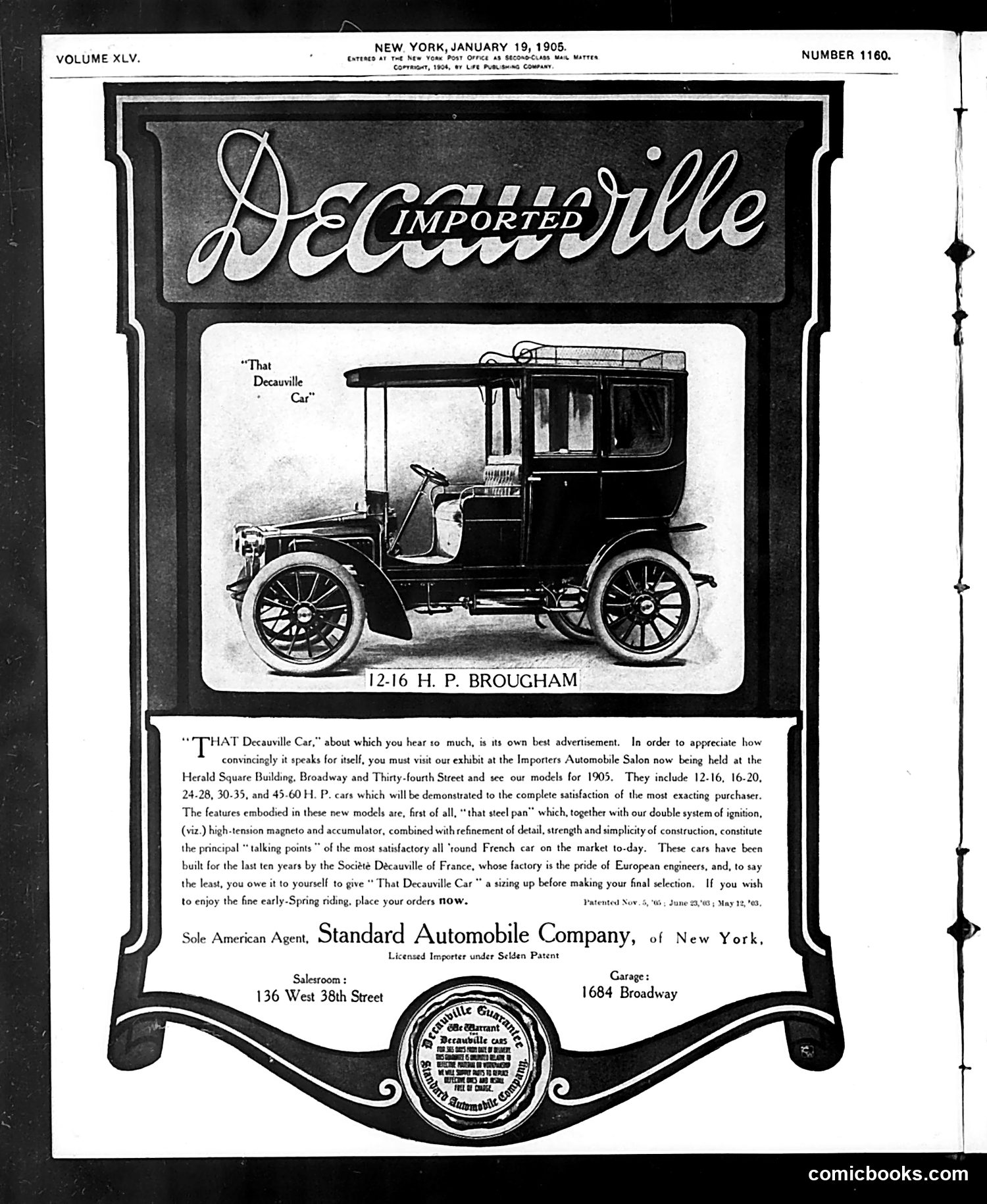
This is **not a political cartoon or satire** — it's a straightforward advertisement for the Decauville automobile, placed in Life magazine's January 19, 1905 issue. The ad features a line drawing of an early motorcar and promotes the French-made Decauville brand through the Standard Automobile Company in New York. It emphasizes the car's features: a "steel pan," double ignition system, and refined construction. The ad notes these models (12, 16, 20, 24-28, 30-35, and 45 horsepower variants) have been manufactured for ten years by the Société Decauville in France. The phrase "That Decauville Car" appears designed to suggest the vehicle was already well-known enough to be referenced familiarly. The ad targets wealthy purchasers considering early automobiles.
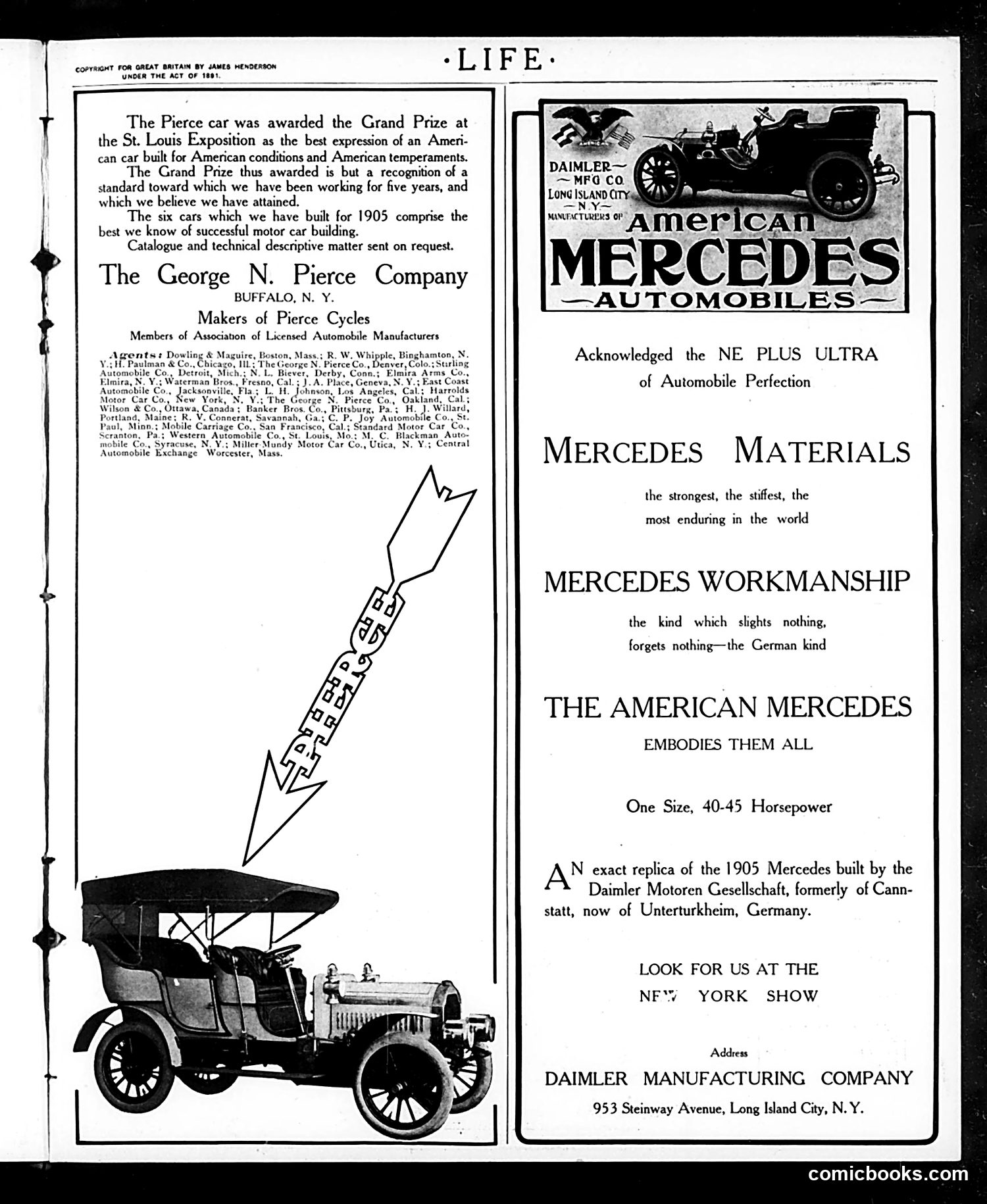
This page contains **two advertisements**, not satire or political cartoons. The left side advertises Pierce automobiles from Buffalo, NY, highlighting that a Pierce car won the Grand Prize at the 1904 St. Louis Exposition. The ad emphasizes Pierce's manufacturing quality and lists dealers across North America. The right side advertises American Mercedes automobiles, positioning them as replicas of the 1905 German Mercedes built by Daimler. It emphasizes German engineering excellence ("Mercedes Materials," "Mercedes Workmanship") while marketing the American-made version to American consumers. These ads reflect early 1900s automotive competition and American consumers' regard for European engineering quality during the nascent automobile industry. There is no satirical content on this page.
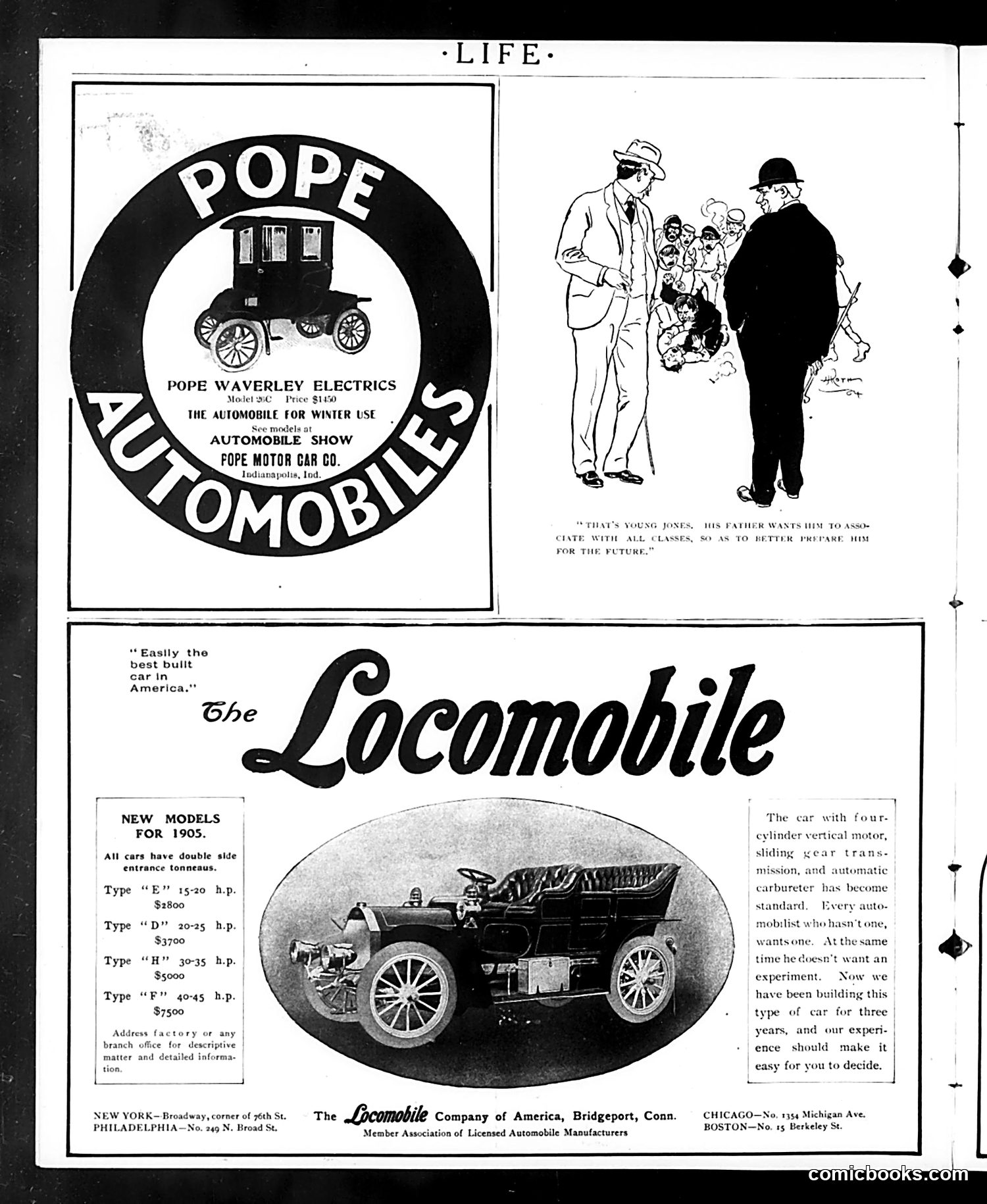
This Life magazine page is primarily **advertising** for early automobiles rather than political satire. The top section advertises the **Pope Waverley Electrics** (Model 30-C, $1,150)—an electric vehicle marketed as "the automobile for winter use" by Pope Motor Car Co. of Indianapolis. The cartoon above shows a father and son with other children, captioned about the boy associating "with all classes" to prepare for the future—likely a gentle social commentary about class mobility through education. The lower half advertises **The Locomobile**, claimed as "easily the best built car in America," with multiple engine types and pricing ($2,800-$7,500). It emphasizes the four-cylinder motor's reliability. This reflects the early 1900s automotive boom when competing manufacturers aggressively marketed competing technologies (electric vs. gasoline engines) to American consumers.
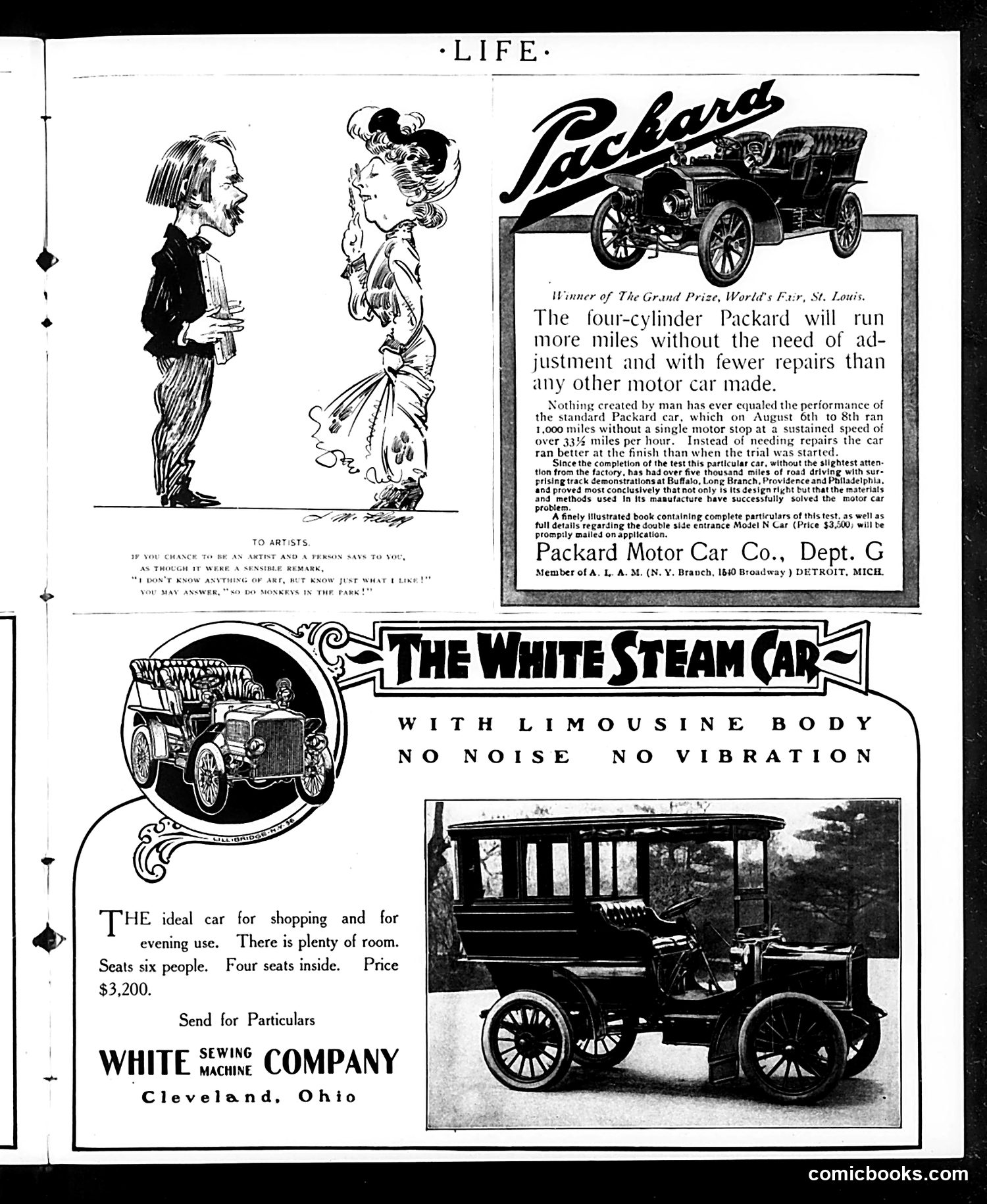
This page is primarily **advertising** rather than editorial content. The top cartoon titled "To Artists" appears to be a humorous social comment: a well-dressed man speaks to an elegantly dressed woman, saying he doesn't know "anything of art" but knows "just what I like" — a common philistine remark that mocks people who claim taste without understanding. The rest of the page features automobile advertisements: a **Packard Motor Car** (highlighting durability and performance), and a **White Steam Car** (emphasizing comfort and quiet operation for shopping and evening use, priced at $3,200). The ads reflect early 1900s automotive marketing, showcasing competing technologies and luxury features to affluent readers. No political satire is evident on this particular page.
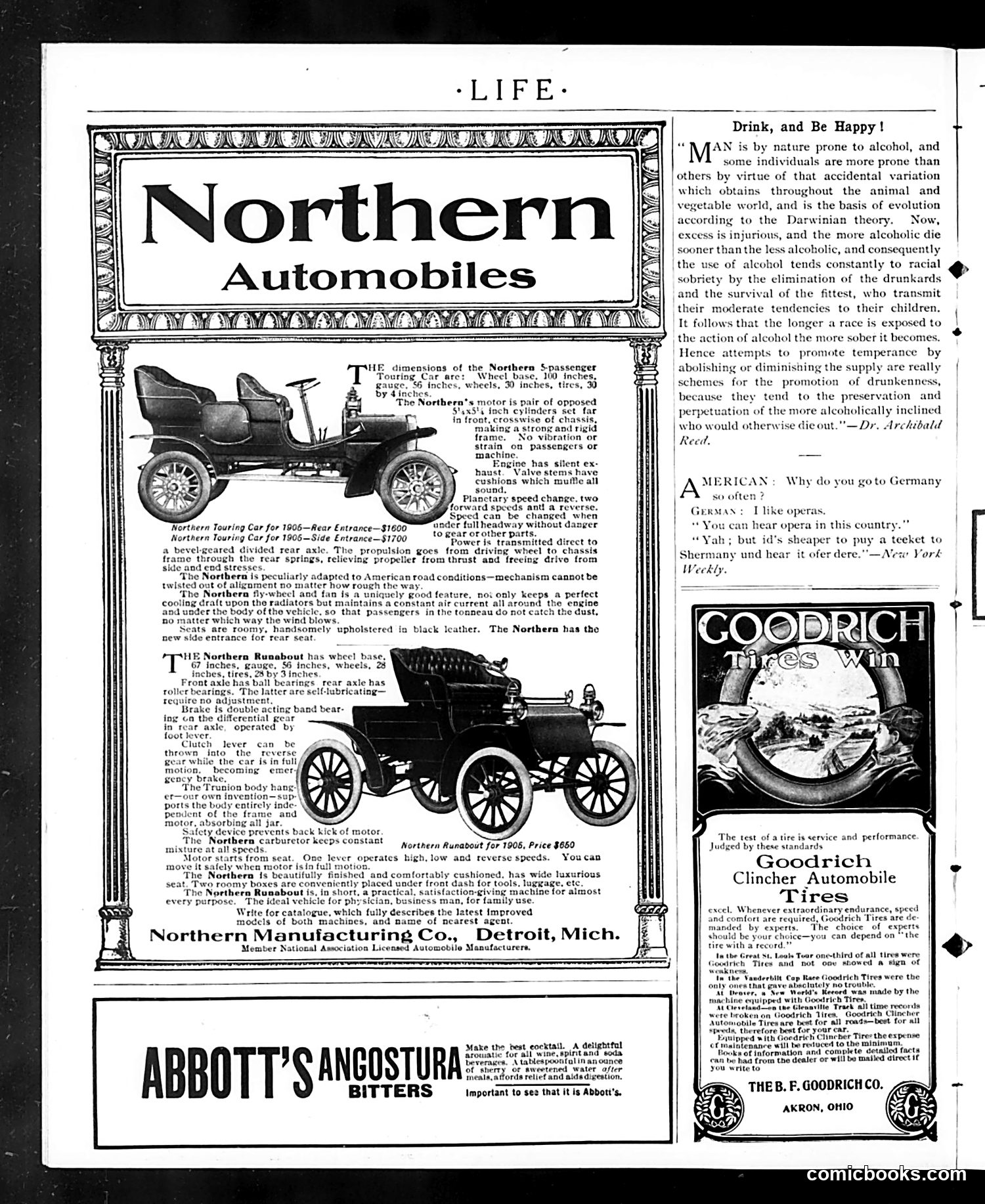
This page is primarily **advertising rather than political satire**. It contains three separate ads: 1. **Northern Automobiles** (center): Detailed product advertising for a 1906 touring car, emphasizing mechanical features like its motor design and suspension system. 2. **Abbott's Angostura Bitters** (bottom): A spirits advertisement claiming the product is essential for making cocktails. 3. **Goodrich Clincher Automobile Tires** (right): Tire advertising emphasizing durability and performance. The only satirical element appears to be a brief **American-German dialogue** mocking German opera preferences and suggesting Germany offers cheaper goods—mild xenophobic humor typical of early 1900s publications. The page represents Life magazine's mixed advertising-editorial format from this era.
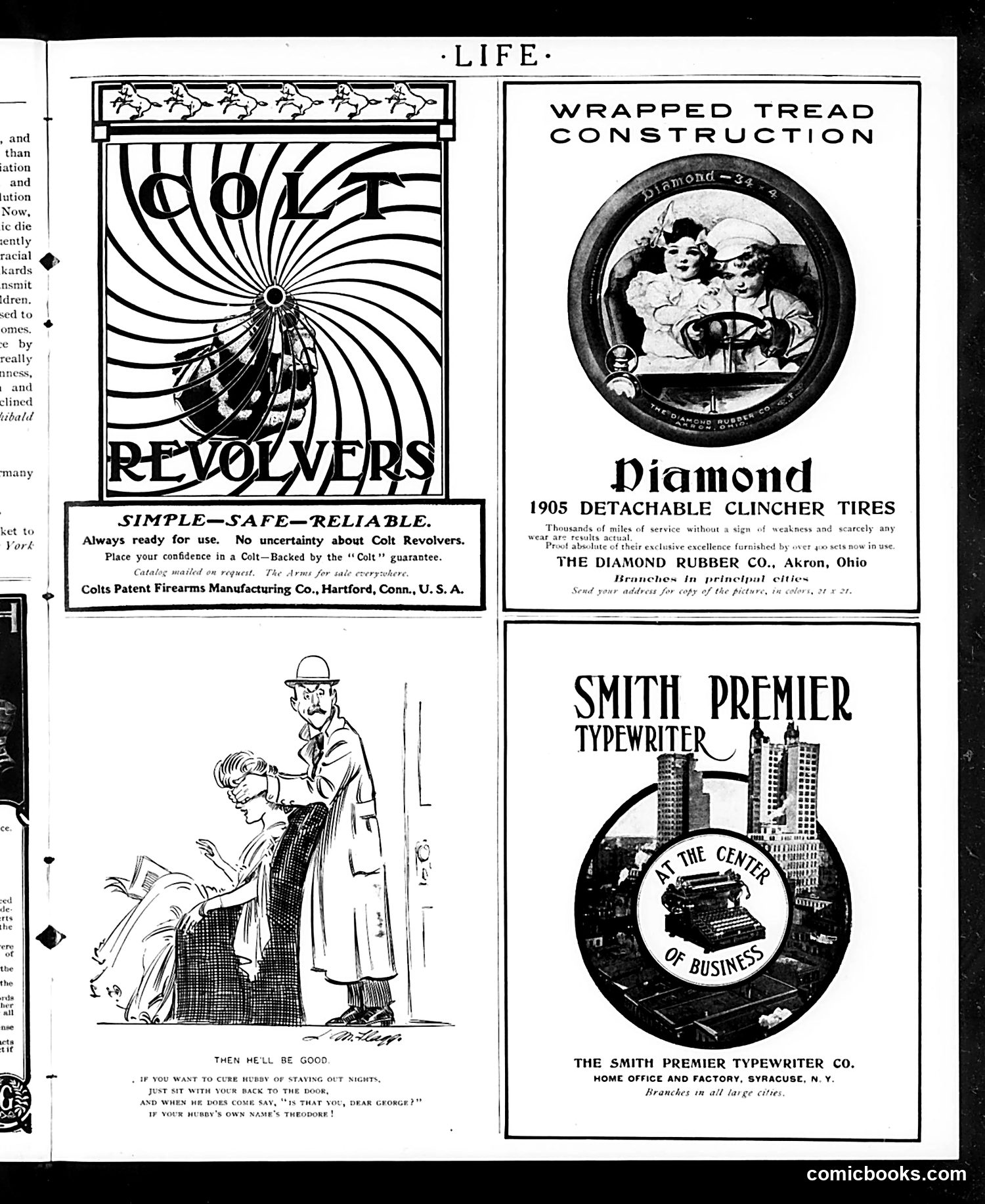
This page consists entirely of advertisements from approximately 1905, not editorial cartoons. **Top left**: Colt Revolvers ad emphasizing reliability ("Simple—Safe—Reliable"), marketed to consumers who want dependable firearms. **Top right**: Diamond Rubber Company tire advertisement for "1905 Detachable Clincher Tires," featuring an illustrated couple in a vehicle, highlighting wrapped tread construction as a selling point. **Bottom left**: A humorous illustration about marital dynamics—depicting a man confronting his wife about late nights out, with text suggesting domestic comedy about spouses' accountability. **Bottom right**: Smith Premier Typewriter advertisement positioning the machine as essential to business operations ("At the Center of Business"). These ads reveal early-1900s consumer culture and gender roles: firearms for men, automobiles for leisure, typewriters for business, and marital humor reflecting contemporary domestic attitudes.
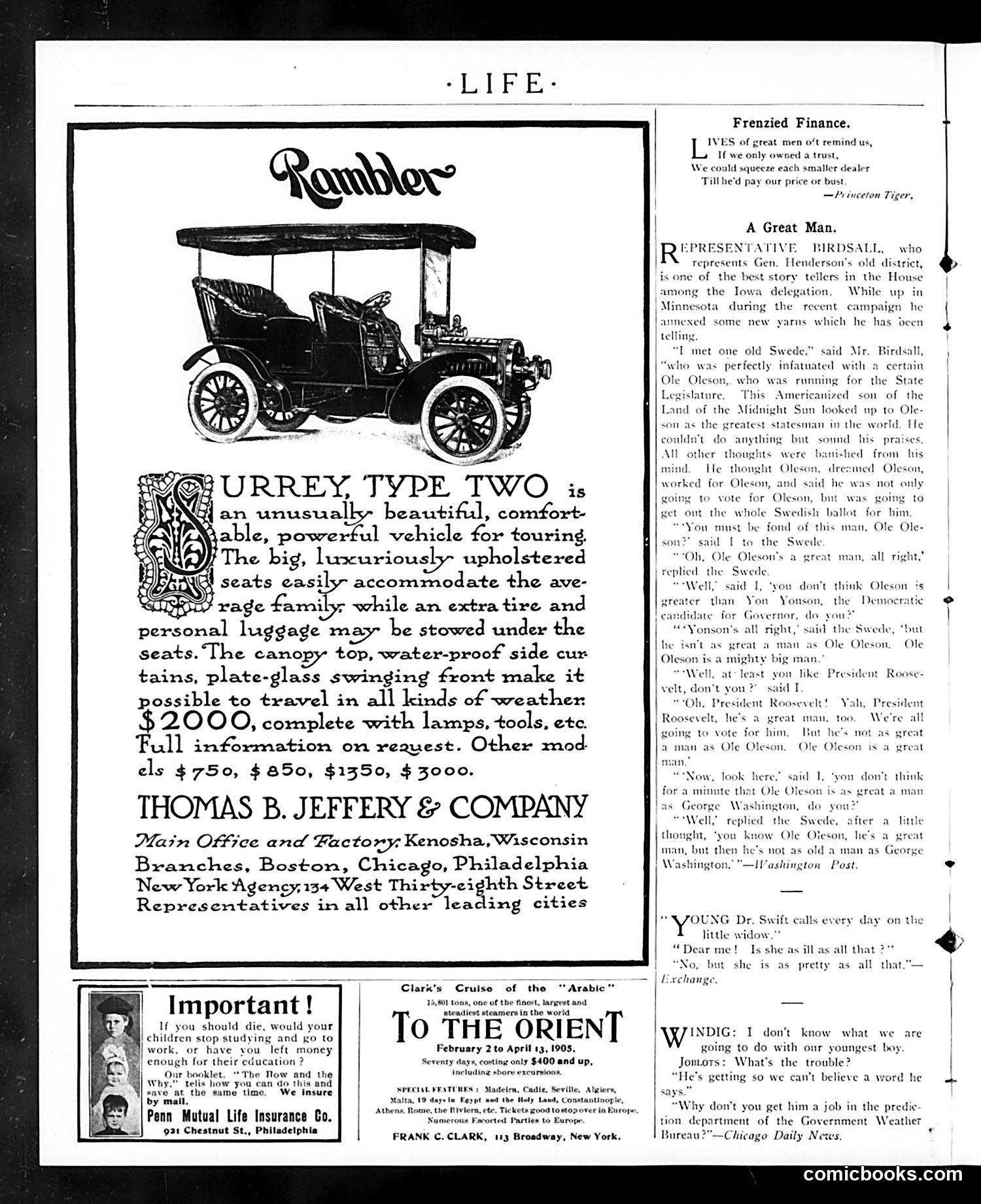
This is primarily **advertising and lighter content**, not political satire. The page features: 1. **Rambler automobile ad** (top): Promotes the Rambler Surrey Type Two as a luxurious touring vehicle, listing models from $750-$3000 and office locations in Kenosha, Wisconsin. 2. **"A Great Man"** (right column): A humorous anecdote about a Swedish delegate who insists Ole Oleson (a Minnesota politician) is greater than George Washington or President Roosevelt. The joke satirizes provincial pride and inflated local reputations—common themes in Life's humor. 3. **Additional ads**: Penn Mutual Life Insurance, a Mediterranean cruise, and small items like "Young Dr. Swift." The content reflects early 1900s preoccupations with automobiles, travel, and insurance, with gentle satire of Midwestern boosterism rather than hard political commentary.
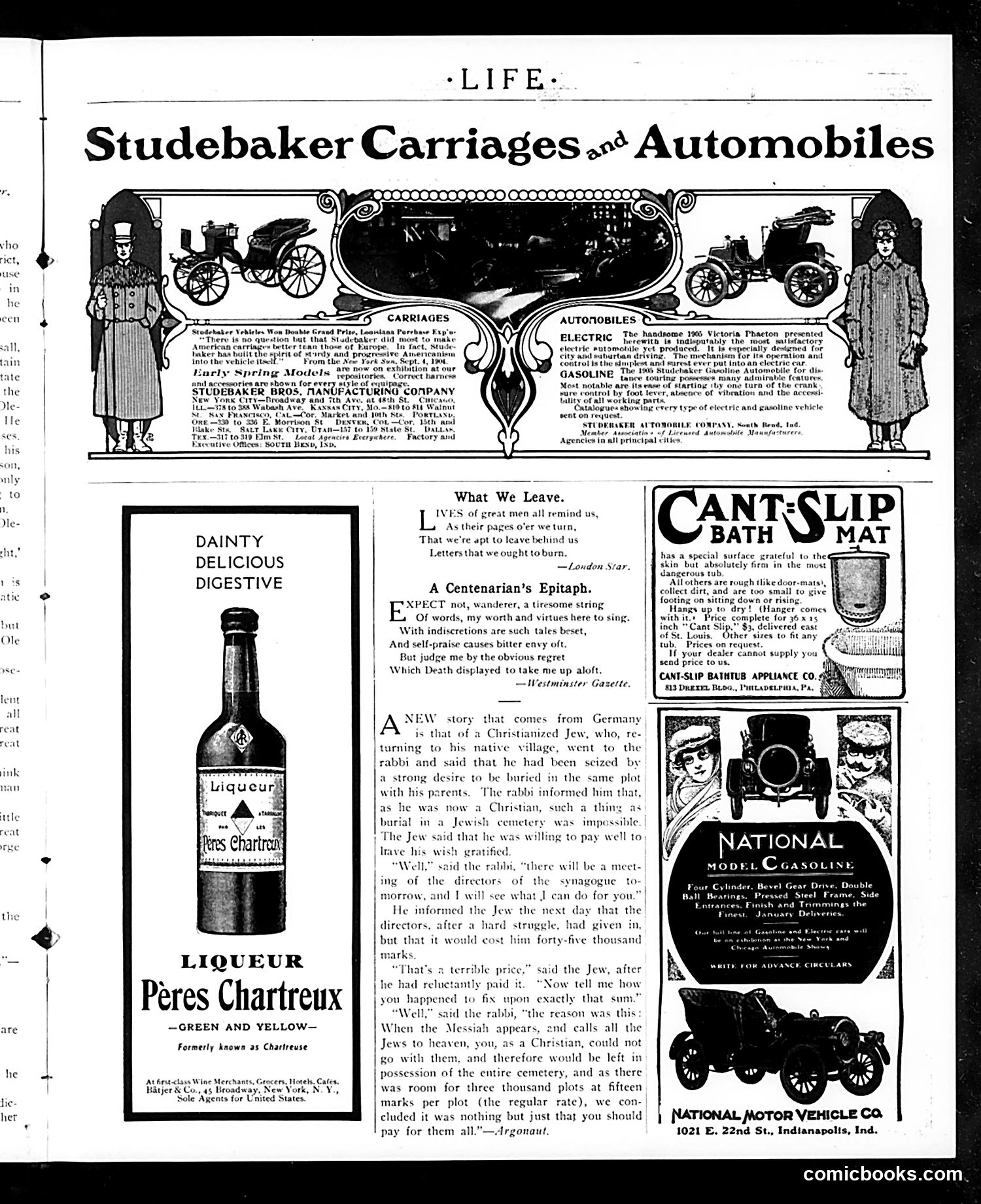
This page is primarily **advertising and editorial content** rather than political satire. The top section advertises **Studebaker Carriages and Automobiles**, highlighting both their traditional carriage business and new automobile lines (electric and gasoline models). This reflects the transitional period when manufacturers were shifting from horse-drawn to motorized vehicles. Below are three advertisements: **Père Chartreaux Liqueur** (a digestive drink), **Cant-Slip Bath Mat** (a non-slip bathing product), and **National Model Gasoline** automobiles. The main editorial feature, "A Centenarian's Epitaph," is a humorous anecdote (attributed to *Argonaut*) about a Christianized Jewish man negotiating cemetery burial rights with a rabbi. It's a joke about religious bureaucracy and financial negotiation, not political commentary. The page reflects early 1900s consumer culture and domestic concerns.
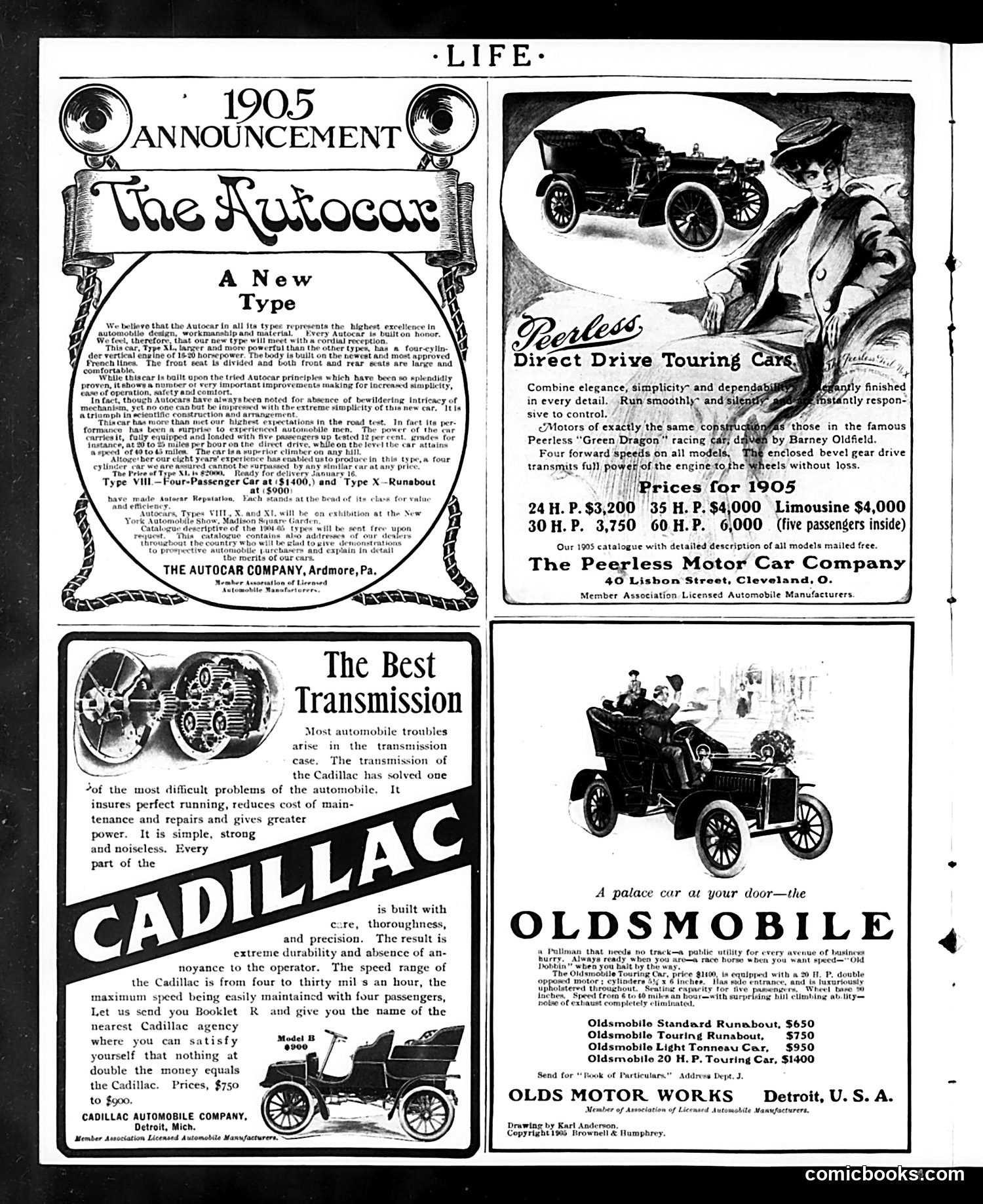
This page consists entirely of **automobile advertisements** from 1905, not political satire or cartoons. It features four luxury car brands competing for wealthy consumers: 1. **Autocar** - emphasizes "highest excellence" and mechanical reliability 2. **Peerless** - highlights smooth, silent operation with direct drive 3. **Cadillac** - boasts superior transmission design solving automobile problems 4. **Oldsmobile** - positions itself as "a palace car at your door" The ads reflect early automotive industry competition, with manufacturers targeting the affluent by emphasizing engineering superiority, comfort, and prestige. Prices range from $650-$4,000 (substantial sums in 1905). The imagery shows elegantly dressed passengers, reflecting automobiles as luxury status symbols rather than practical transportation.
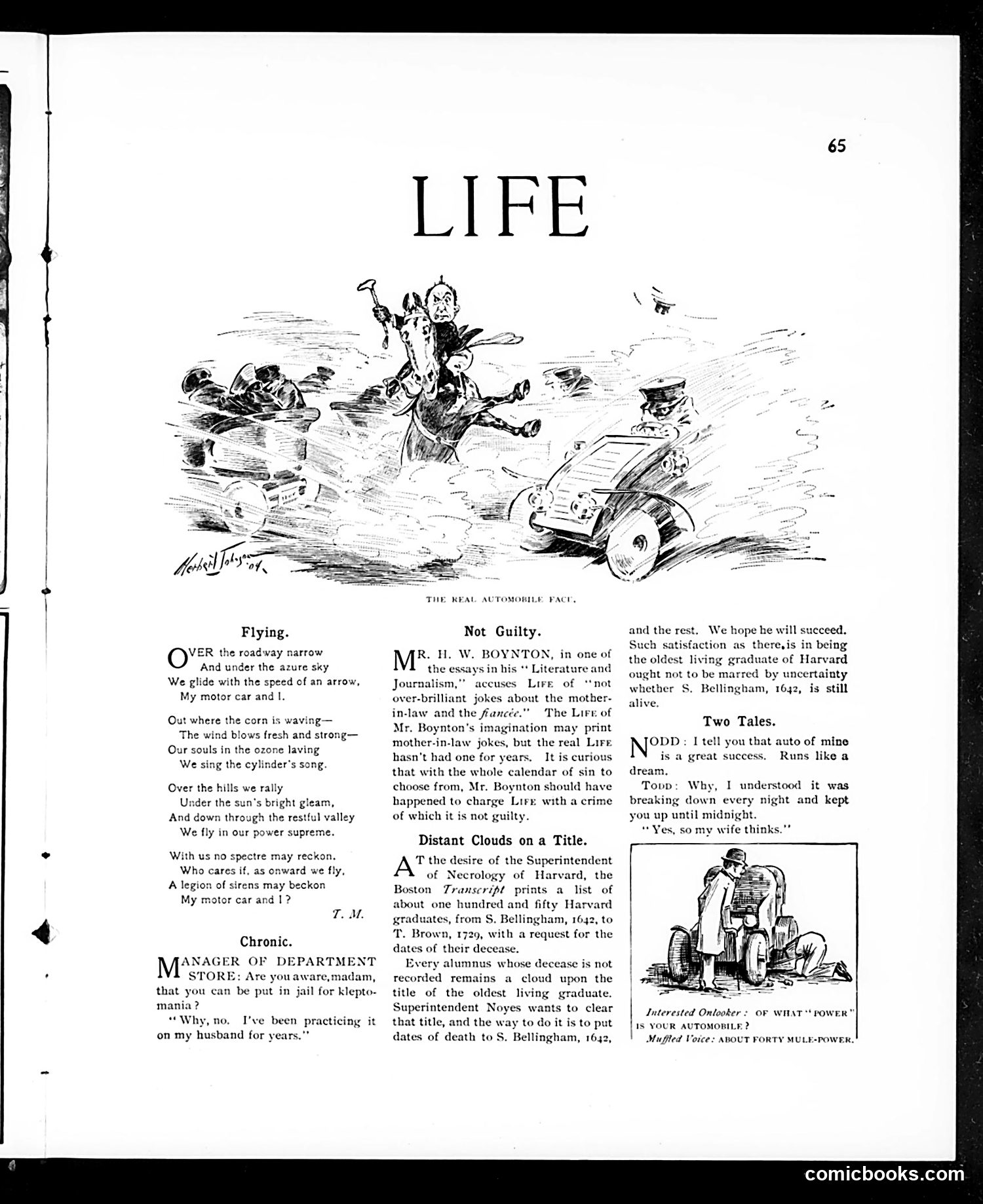
**Main Illustration:** "The Real Automobile Fact" depicts a chaotic scene of early automobiles crashing and flying apart, with occupants being thrown violently from vehicles. This satirizes the dangerous, unreliable nature of early automobiles. **Poems & Content:** - "Flying" celebrates the speed and freedom of motoring - "Not Guilty" defends Life magazine against critic M.R.H. Boynton's accusations of making "over-brilliant jokes about the mother-in-law and the fiancée" - "Chronic" jokes about keeping a husband in jail for "kleptomania" - "Distant Clouds on a Title" discusses Harvard's alumni death records **The Satire:** The central irony contrasts romantic poetry about automobiles with the brutal reality of crashes—mocking both automotive unreliability and society's romantic enthusiasm for dangerous new technology.
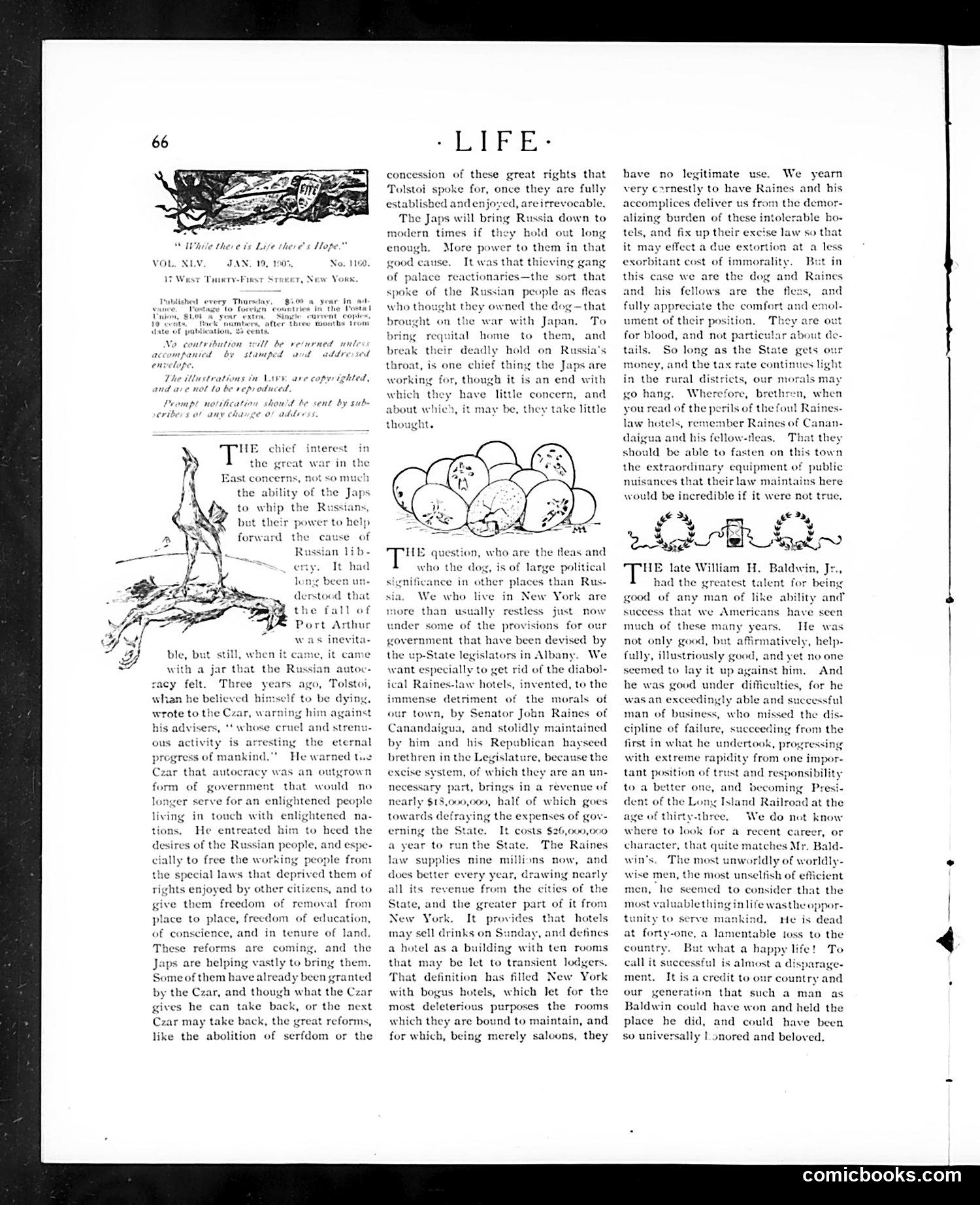
This page discusses Russian reform and American politics, with a small illustration of a figure in formal dress appearing to gesture or bow. The text criticizes the "Raines law hotels"—establishments in New York created under legislation by Senator John Raines that supposedly restricted alcohol sales but actually created loopholes allowing saloons to operate as hotels. The main satire targets these hotels as hypocritical moral failures that enriched the state while corrupting the city. The article also praises the late William H. Baldwin Jr., an American businessman and reformer, contrasting his integrity with the moral compromise represented by the Raines-law system. The cartoon likely satirizes American legal/political hypocrisy regarding alcohol regulation.
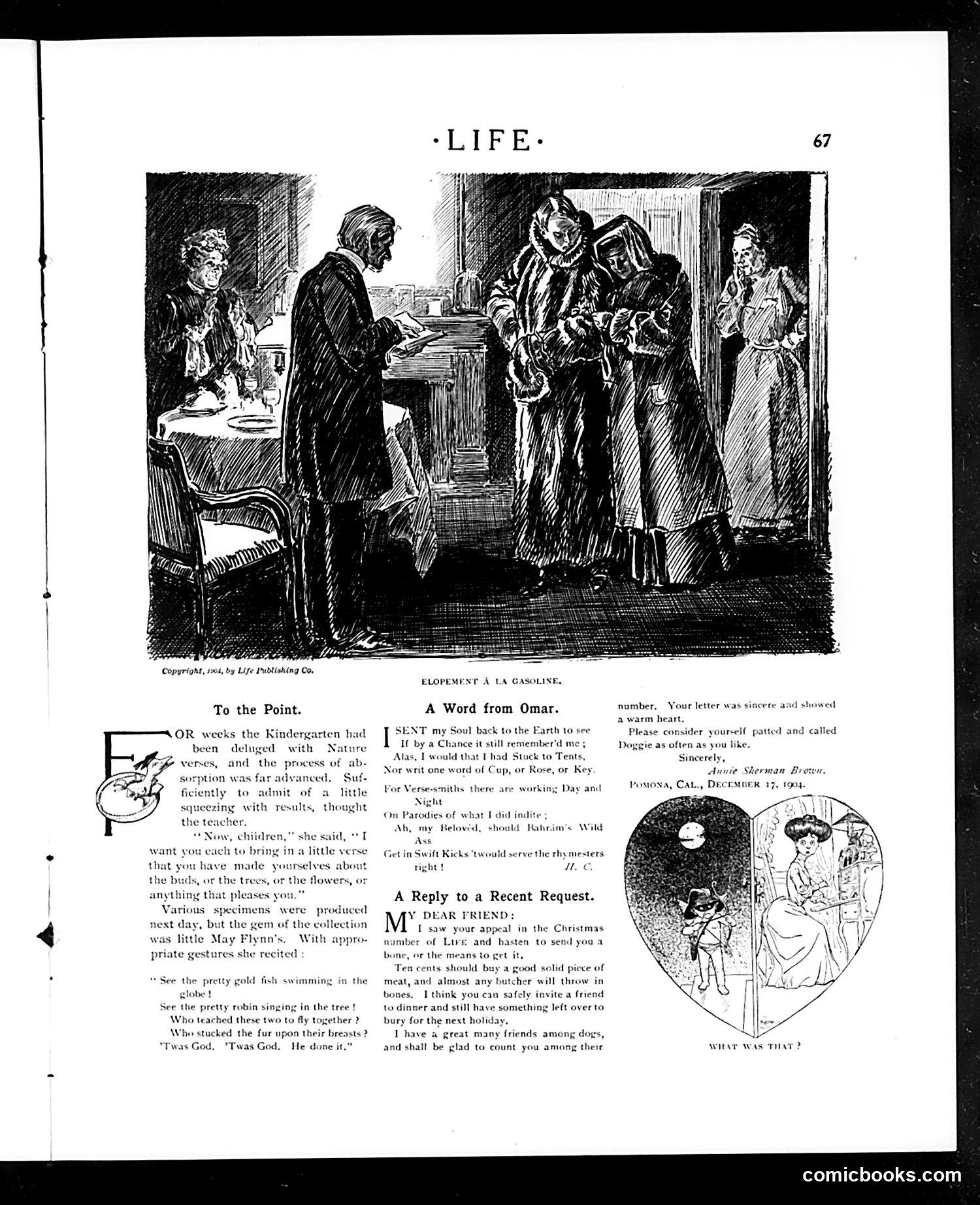
This page contains three distinct pieces of satirical humor: **"To the Point"** mocks kindergarten poetry assignments. A teacher asks students to write verses about nature. The "gem of the collection" is a child's poem with deliberately bad grammar ("teached," "stucked," "He done it"), suggesting both the absurdity of expecting literary merit from small children and, possibly, a jab at poorly educated teachers who fail to correct such errors. **"Elopement à la Gasoline"** appears to be a satirical cartoon about modern automobile culture enabling romantic escapades—suggesting social anxiety about how new technology (automobiles) was changing courtship and social behavior. **"A Reply to a Recent Request"** is a humorous advice column where a woman responds to someone's Christmas appeal for help by suggesting they invite a dog to dinner instead of needy people—dark satire on wealthy indifference to poverty. The page reflects early 20th-century Life magazine's focus: social criticism through humor targeting education, modern technology, and class attitudes.
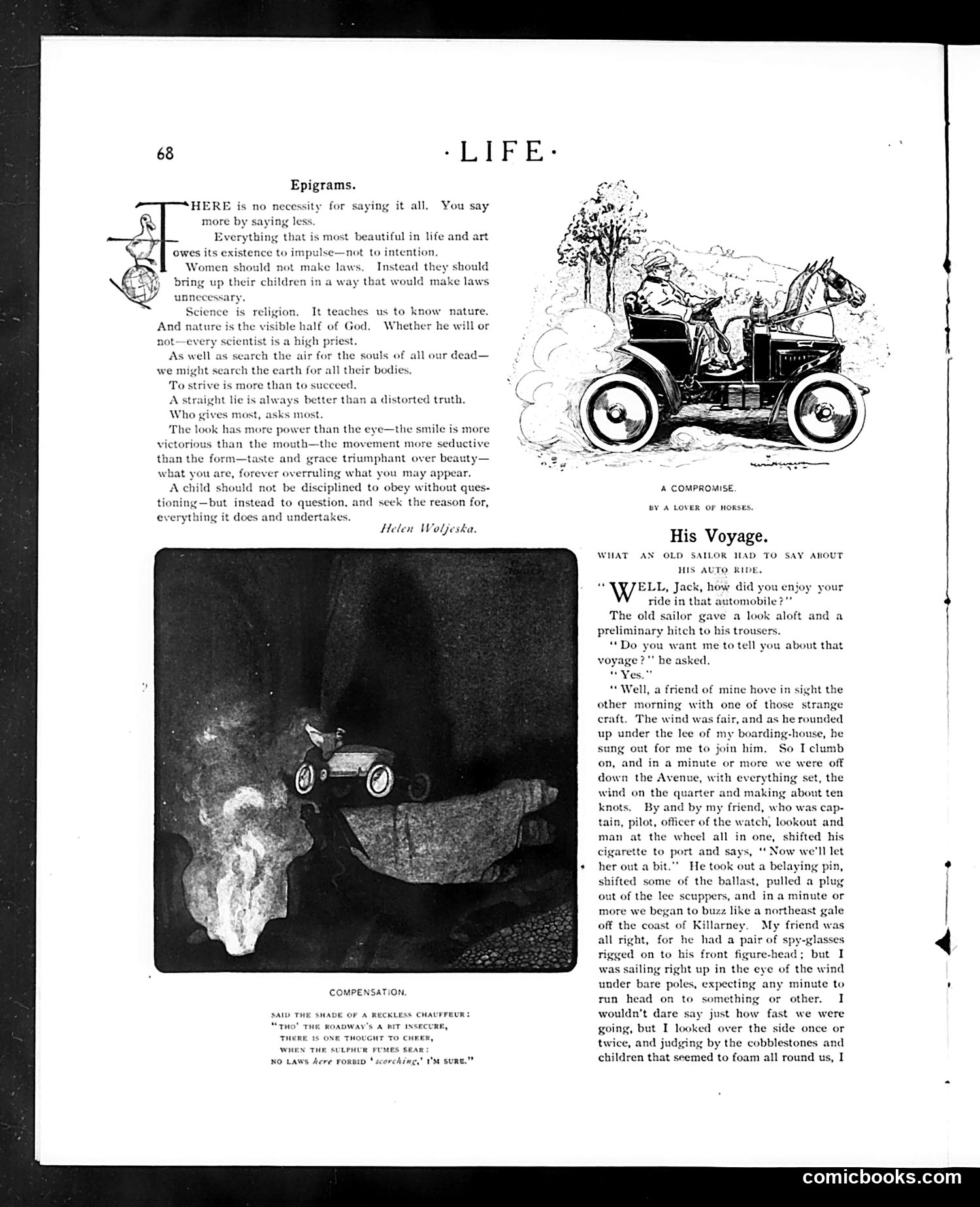
This page contains early 20th-century American satire about automobiles, still a novel technology. **"Compensation" cartoon:** A ghost of a "reckless chauffeur" boasts that though he caused chaos on the road, the "sulphur fumes" of exhaust fumes searing everyone's lungs provide cosmic justice. The joke satirizes both dangerous early drivers and the noxious pollution cars created—presenting poisoned air as ironic comeuppance. **"His Voyage" story:** An old sailor describes his first automobile ride using nautical language—treating the car like a ship with "ballast," "scuppers," and "bare poles." The humor comes from the anachronistic mismatch: a traditional sailor bewildered by modern technology, describing acceleration as nautical speed, and terrified by street-level chaos (cobblestones, pedestrians) he mistakes for ocean spray. Both pieces mock the automobile as a dangerous, disruptive new invention that poisons the air and terrorizes city streets—reflecting genuine contemporary anxieties about early motorization.
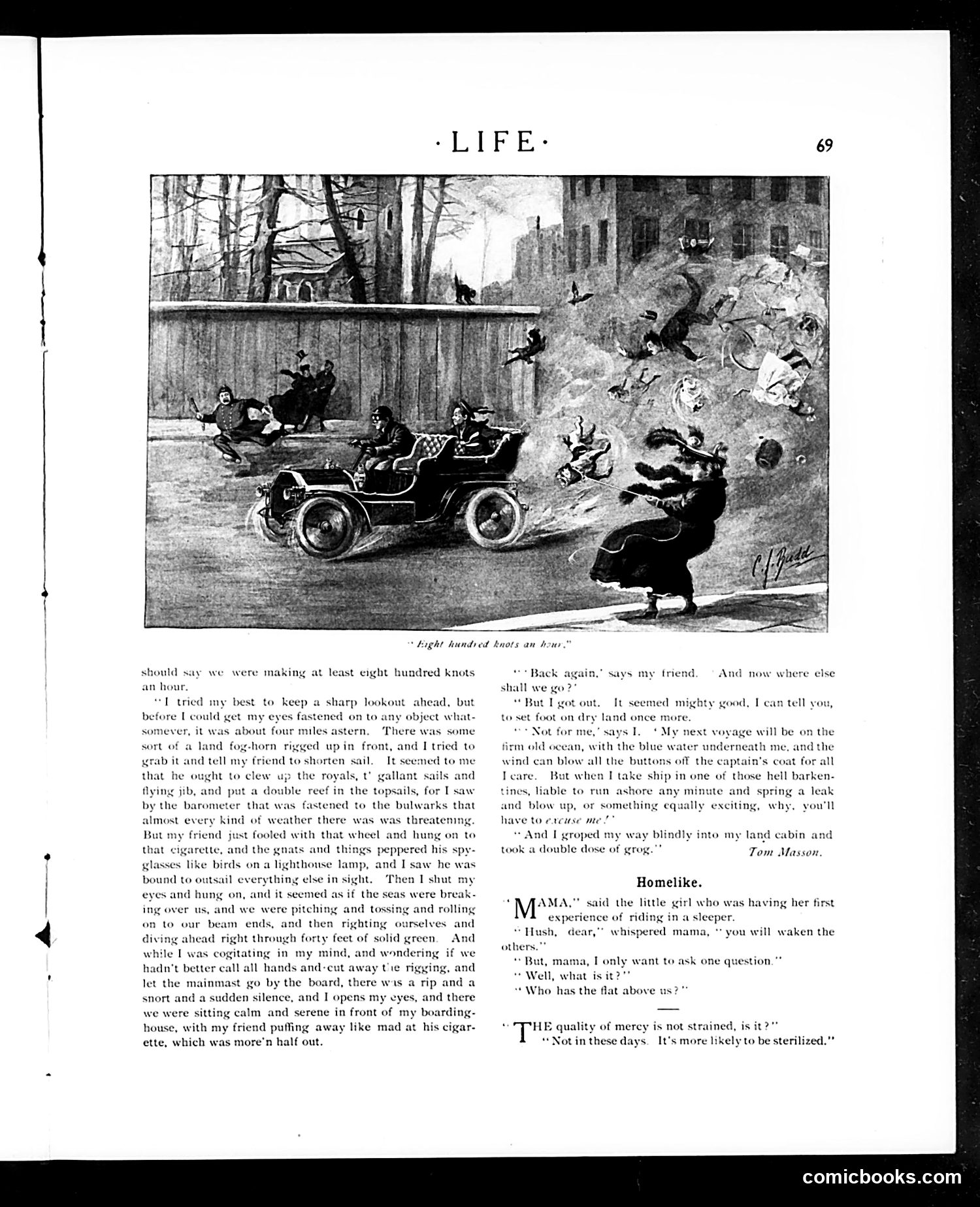
This page contains two humorous short stories typical of Life's satirical content. **Top illustration and text ("Eight hundred knots an hour"):** A man recounts a wild automobile ride where his friend drives recklessly at breakneck speed, treating the car like a ship at sea. The friend ignores all danger signs—barometer readings, warnings to slow down—while smoking a cigarette. The joke satirizes the early automobile era's dangerous driving and the false sense of control drivers had. The exaggerated nautical language (reefs, topsails, mainmast) mocks comparing cars to ships. **"Homelike" section:** A child in a railway sleeper car (overnight train) asks her mother "Who has the flat above us?"—confusing the upper berth with an apartment above. This gently mocks children's literal interpretations and the unfamiliar experience of rail travel. The closing dialogue about "mercy" being "sterilized" appears unrelated, likely a separate joke fragment. Both pieces use everyday modern transportation as subjects for gentle, family-friendly humor characteristic of early 20th-century Life magazine.
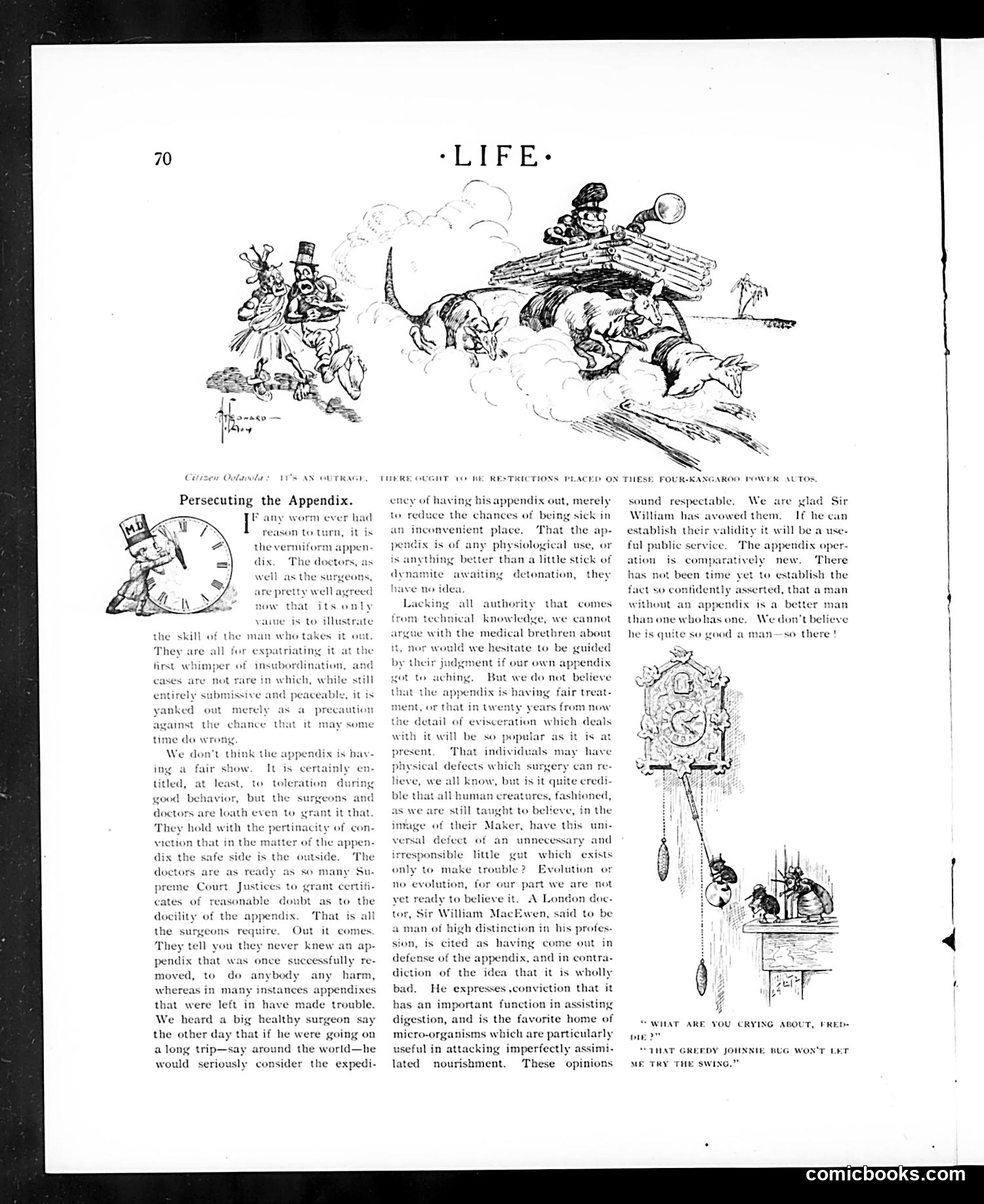
This *Life* magazine page satirizes the medical profession's enthusiasm for appendix removal. The main article, "Persecuting the Appendix," argues that doctors are too quick to surgically remove appendixes as a precaution, yanking them out at the slightest complaint. The satire targets medical arrogance: surgeons treat appendix removal as proof of skill, while dismissing the organ's potential biological function. The author challenges their certainty, noting that removing a healthy appendix hasn't been proven safer than keeping one, and questions whether all humans truly have this "defective" organ. A counterargument from London doctor Sir William MacEwen is cited—he believed appendixes aid digestion and host useful microorganisms—suggesting the debate was genuinely unsettled. The cartoon illustrations (top and bottom) appear to mock medical procedures and patients, though specific figures are unclear. The humor lies in exposing medical overconfidence during an era when appendectomy was becoming routine surgery.
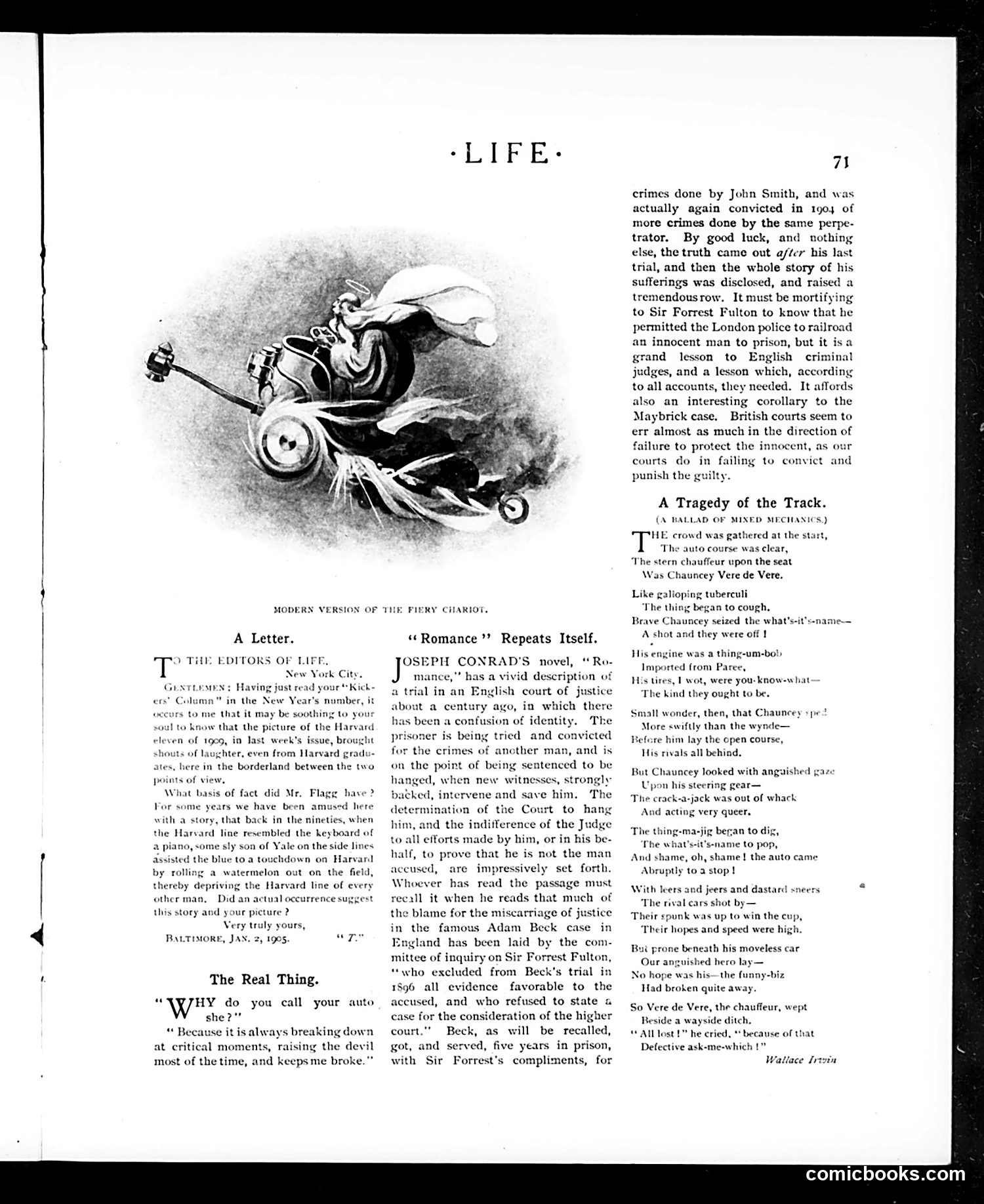
This page satirizes early 1900s automobiles and legal injustice through multiple pieces: **The "Fiery Chariot" Cartoon** depicts an early motorcar as chaotic and dangerous—rendered as a wild, demonic vehicle, mocking the newfangled automobile technology that frequently broke down and endangered drivers. **"The Real Thing"** is a joke about unreliable automobiles: a man calls his car "she" because it constantly breaks down at critical moments, costs him money, and "raises the devil"—playing on contemporary frustration with early automotive failures. **"A Tragedy of the Track"** is a mock-heroic poem about racing driver Chauncey Vere de Vere whose supposedly superior imported car malfunctions mid-race, allowing rival competitors to overtake him. It satirizes both automobile unreliability and pretentious naming conventions. **"Romance Repeats Itself"** references the real Adam Beck case, where an innocent man served five years in prison after Sir Forrest Fulton excluded exculpatory evidence. The piece critiques British judicial failure to protect the innocent, comparing it to Joseph Conrad's novel about mistaken identity trials.
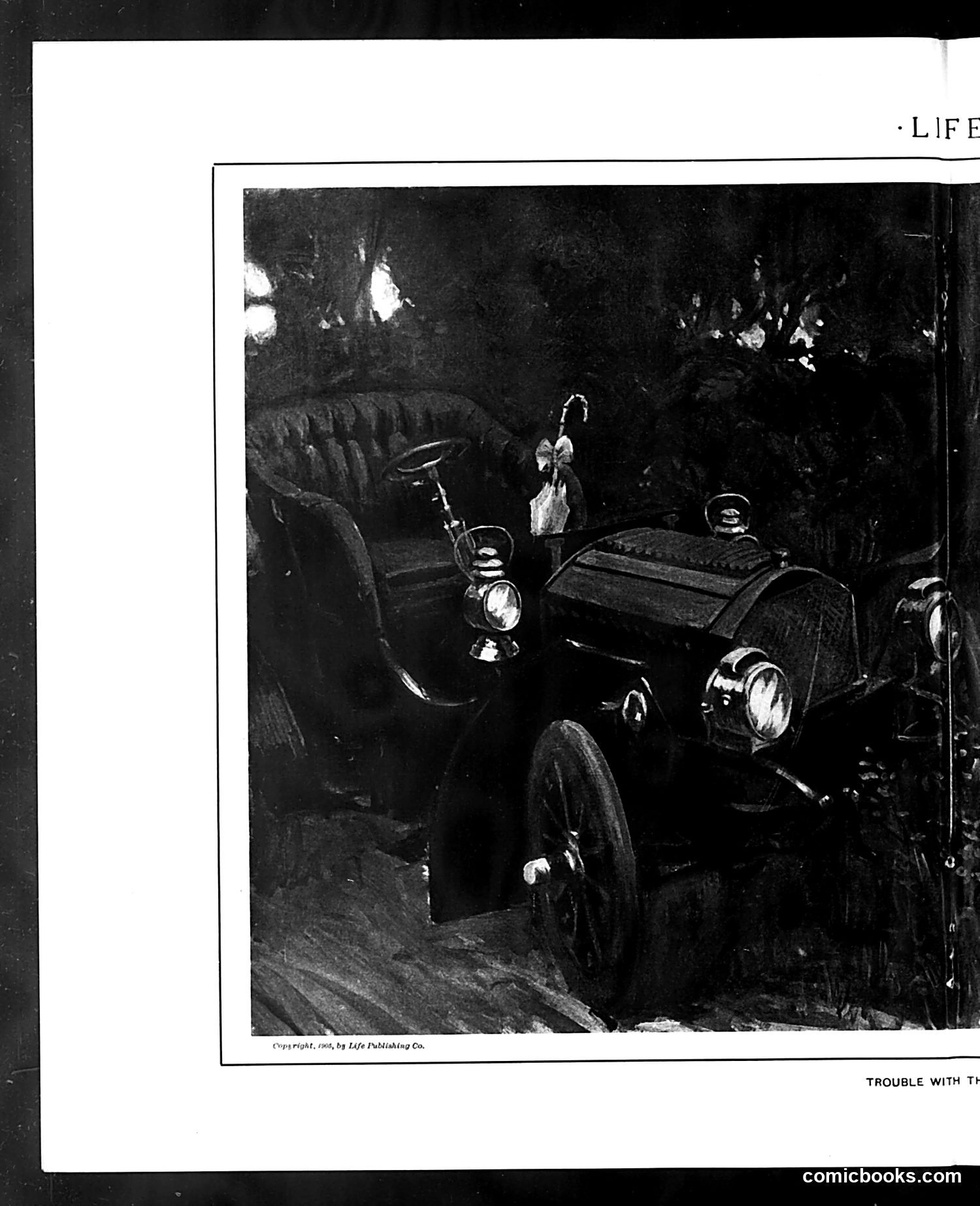
This black and white photograph shows an early automobile in what appears to be an indoor garage or workshop setting, with period lighting and furnishings visible in the background. The image is credited to Life Publishing Co. The page header reads "TROUBLE WITH T[...]" (cut off), and the caption visible at bottom suggests this relates to some kind of automotive trouble or problem. Without the complete text visible, I cannot definitively identify which specific vehicle, manufacturer, or satirical point is being made. However, given Life magazine's satirical nature and the early automobile era depicted, this likely mocks a particular car model's mechanical reliability issues—possibly referring to Henry Ford's Model T, which, despite its popularity, was known for various mechanical problems. The exact joke or critique remains unclear without the full accompanying text.
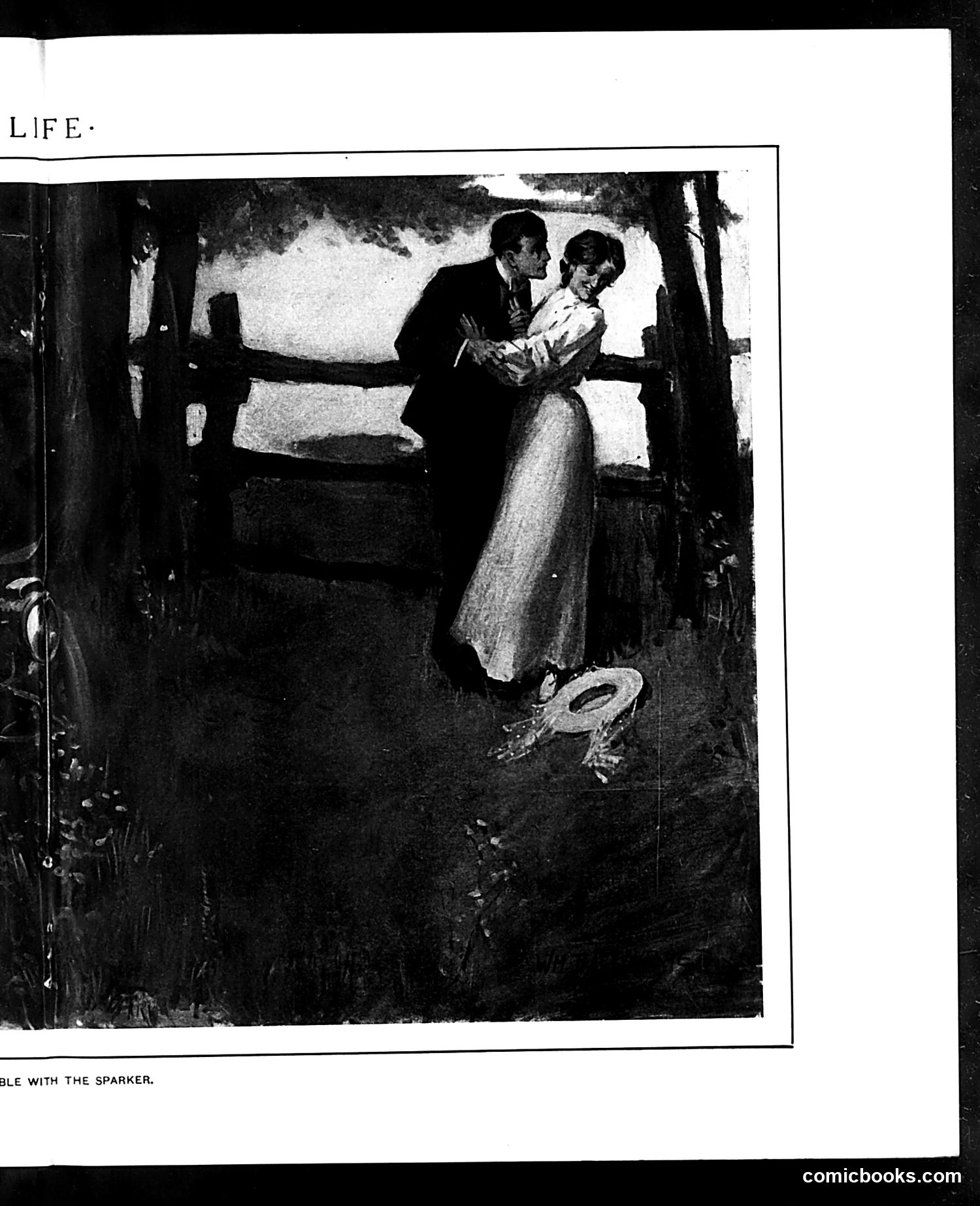
This appears to be a page from Life magazine showing a romantic or comedic scene. The visible text fragment "BLE WITH THE SPARKER" (likely part of a longer caption ending in "TROUBLE WITH THE SPARKER") suggests the image illustrates a humorous situation. The black-and-white photograph depicts a man in formal dress and a woman in a light-colored dress near what appears to be a wooden gate or fence, with a hat visible on the ground. The staging and composition suggest this is either an illustration for a story or a staged photograph meant to be humorous. Without the complete caption or surrounding text, the specific satirical point remains unclear, though "the sparker" likely refers to a romantic male figure or suitor. The scene appears to depict some kind of romantic entanglement or comedic domestic situation typical of early-to-mid 20th century American humor magazines.
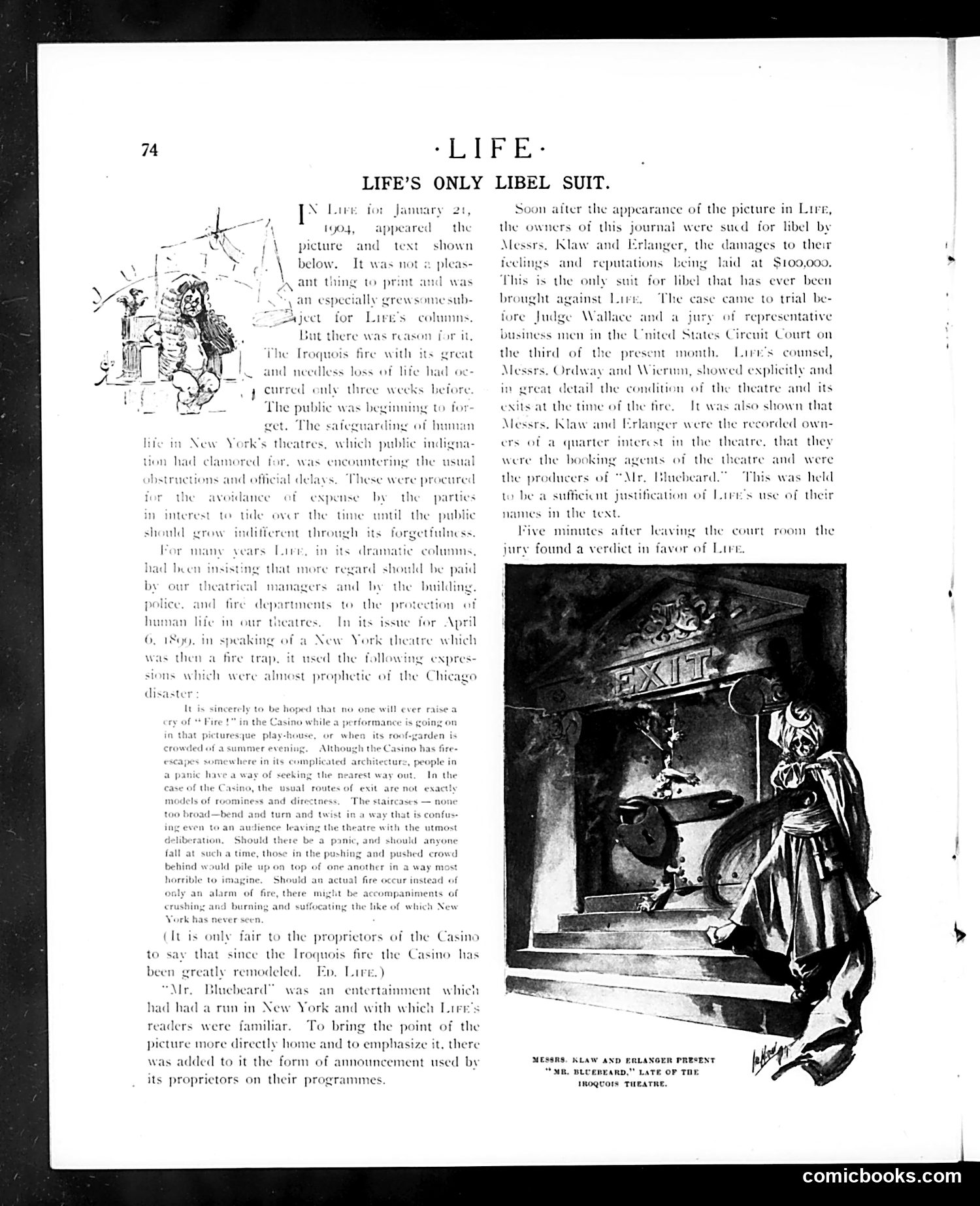
This article documents **Life's only libel suit**—a legal victory following the **1903 Iroquois Theatre fire** in Chicago, which killed hundreds. Life had previously published safety warnings about theatre fire hazards. After the Iroquois disaster, Life ran a critical illustration accompanying a picture from the theatrical entertainment "Mr. Bluebeard," produced by **Klaw and Erlanger** (major theatre operators). The image highlighted dangerous exit conditions and fire safety failures. Klaw and Erlanger sued for $100,000 in damages. At trial before Judge Wallace, Life's lawyers proved the theatre owners held financial interest in the venue, were its booking agents, and produced the show—justifying the publication's use of their names in criticizing safety conditions. The jury ruled in Life's favor. The article celebrates this as vindication for Life's long campaign pressuring theatrical managers and city officials to prioritize public safety—a prescient advocacy, given the tragedy that followed.
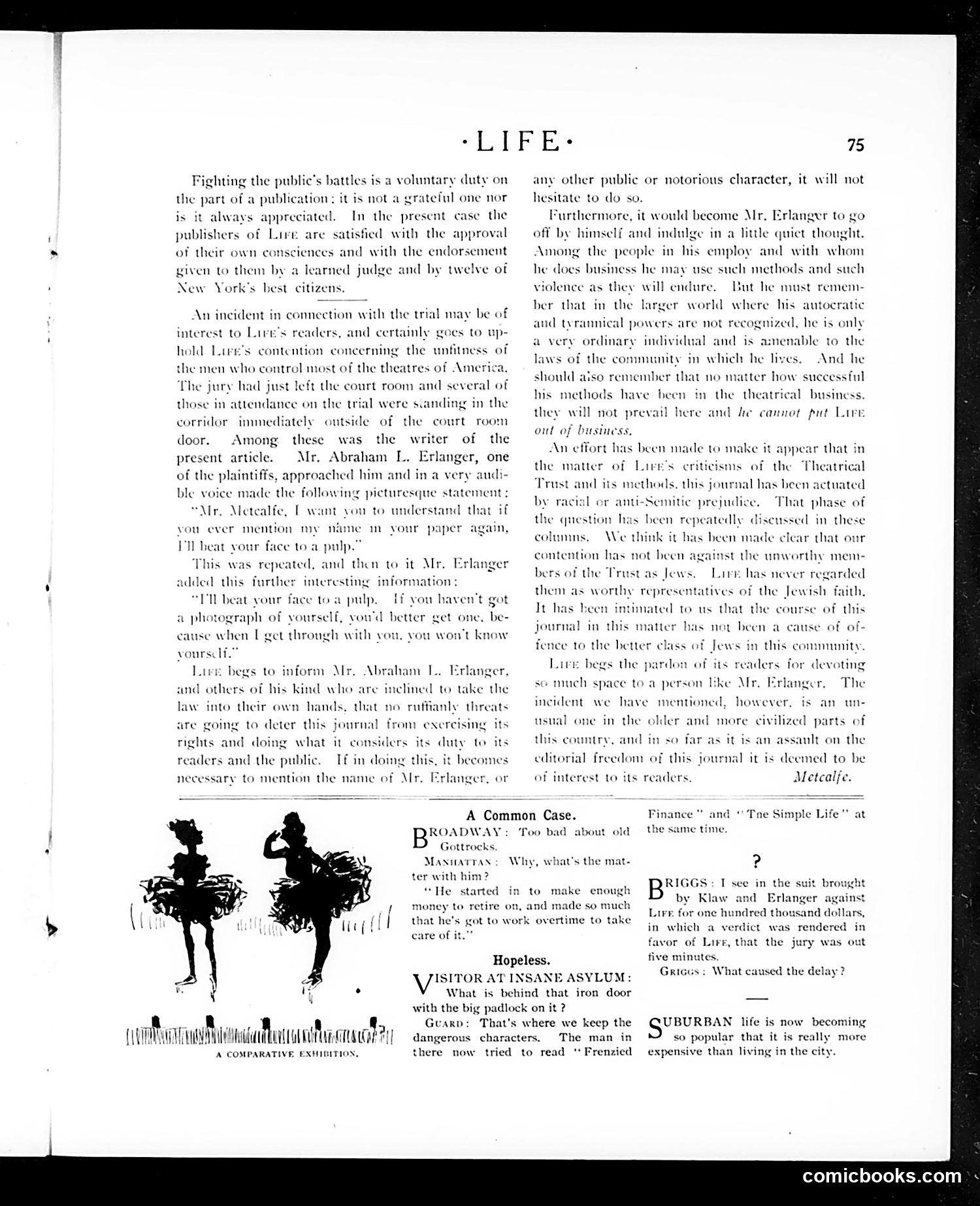
This page documents a legal dispute between *Life* magazine and **Abraham L. Erlanger**, a prominent Broadway theater producer and member of the "Theatrical Trust"—a monopolistic theater cartel controlling most American theaters. The main article describes Erlanger's alleged intimidation of the magazine's writer outside a courtroom, threatening physical violence ("I'll beat your face to a pulp") if they continued publishing his name. *Life* uses this incident to expose what it sees as Erlanger's autocratic abuse of power—acceptable within his theatrical empire but illegitimate in the public sphere. The satire targets theatrical monopolists who wielded disproportionate influence but expected immunity from press criticism. A secondary element addresses accusations that *Life's* criticism was antisemitic, which the editors deny, claiming they've opposed the Trust's methods, not its Jewish members' faith. The cartoons and brief jokes below appear tangential to this main controversy.
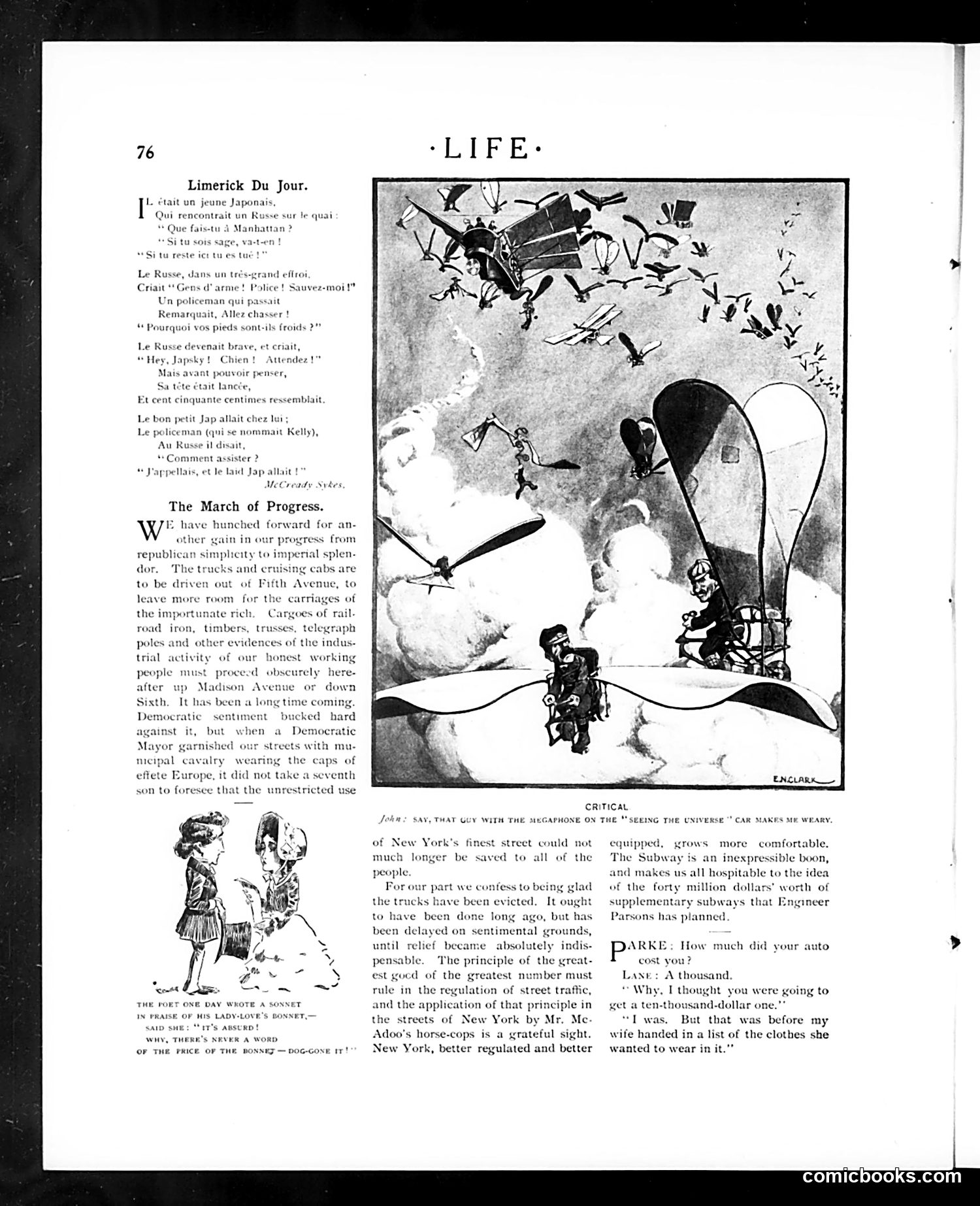
This page contains satirical commentary on New York City's urban development, circa 1910s-1920s. **"The March of Progress"** critiques the removal of trucks and commercial traffic from Fifth Avenue to make room for wealthy residents' carriages. The author sarcastically celebrates this decision while noting it displaces working people and industrial activity to less desirable areas like Madison Avenue and Sixth Avenue. The piece mocks the principle of "greatest good for the greatest number" when applied by NYC's Police Commissioner McAdoo, whose horse-mounted police enforce traffic rules benefiting the rich. **The cartoon** (credited to Cesare, likely Enrico Cesare) depicts a surreal "Seeing the Universe" car—appearing to be an early automobile or viewing device—with figures inside observing their surroundings. The caption jokes that the passenger with the megaphone makes observers "weary." **The dialogue joke** at bottom contrasts a husband's thousand-dollar car purchase against his wife's clothing expenses, suggesting spousal financial conflicts are universal. The page blends French verses (likely contemporary verse humor) with American satirical commentary on class divisions in modernizing New York.
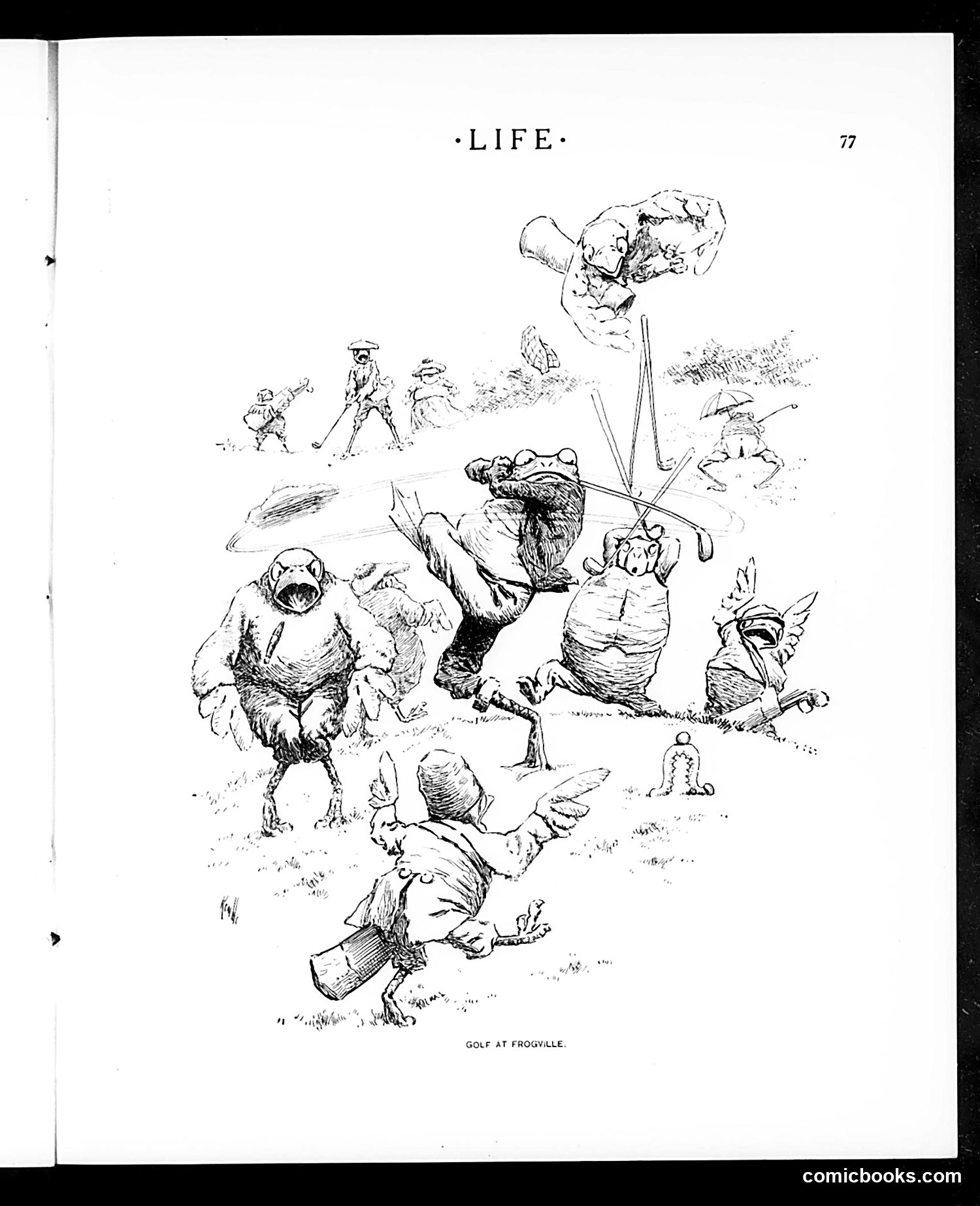
This is a whimsical cartoon depicting anthropomorphic frogs and toads engaged in playing golf. The creatures are rendered in various states of golf activity—swinging clubs, putting, and observing—across a pastoral landscape with a large toadstool visible overhead. The satire appears to target the contemporary popularity and pretensions of golf among the upper classes. By transplanting this fashionable sport to "Frogville," the cartoonist mocks golf culture through absurdist humor, suggesting the game's artificial conventions and social status-seeking are equally ridiculous when performed by creatures naturally suited to swamps rather than manicured courses. The cartoon is likely from the late 19th or early 20th century, when golf was gaining prominence as an elite leisure activity in America.
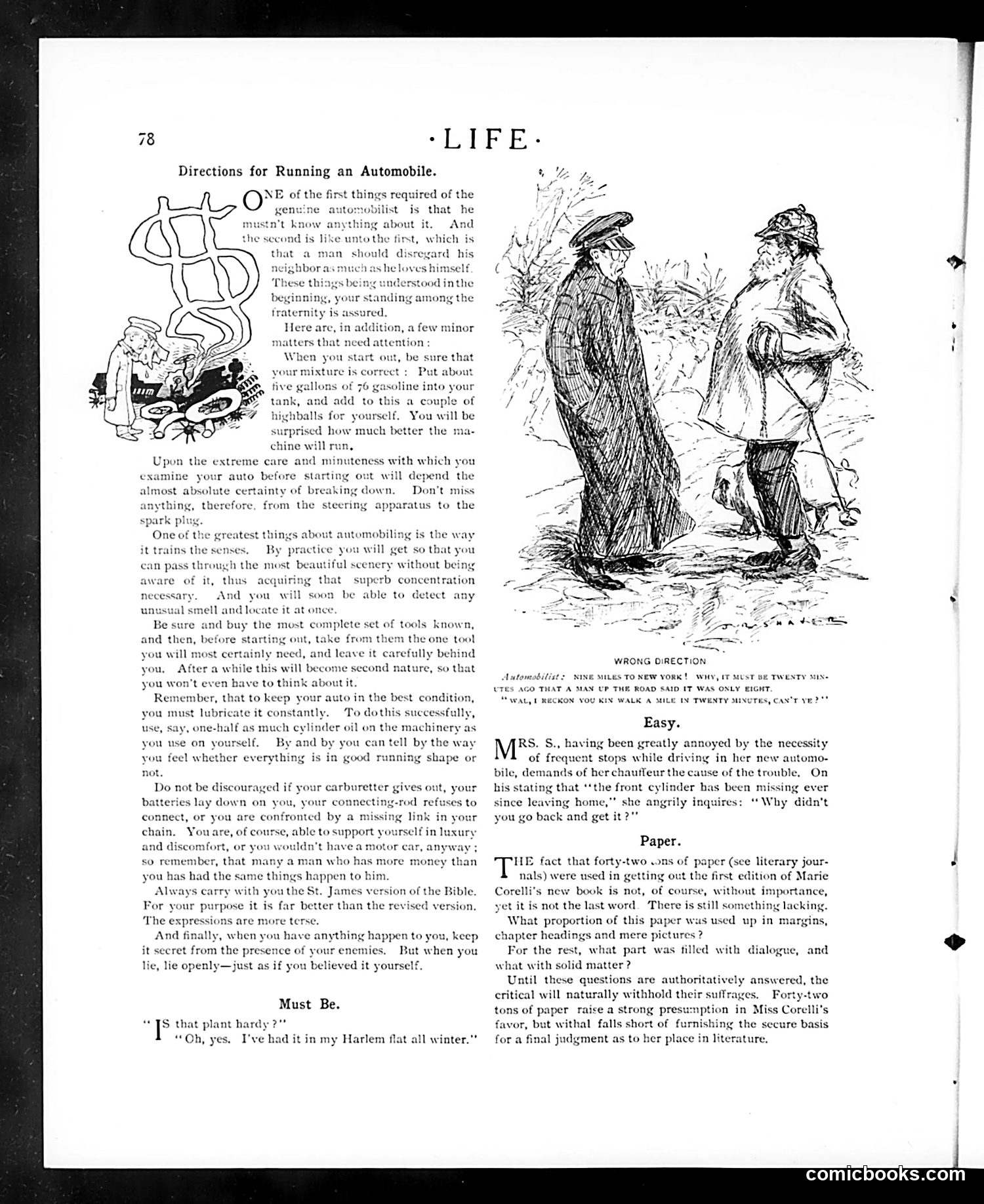
This page satirizes early automobile culture (circa 1900s-1910s) through three separate pieces: **"Directions for Running an Automobile"** mock-heroically presents absurd advice for car ownership, treating automobiles as temperamental, unreliable machines requiring constant maintenance and specialized knowledge. The humor lies in treating basic car operation as impossibly complex—a fair reflection of early automobiles' actual unpredictability. **"Wrong Direction"** cartoon shows two figures discussing distances to New York. One claims it's "twenty and" miles away; another says it's only eight. The humor targets rural Americans' (depicted in dialect) unfamiliarity with automobiles and modern travel—they're confused about distances and suggest walking. This reflects class/urban-rural divides regarding new technology. **"Easy"** jokes about Mrs. S. demanding her chauffeur retrieve a "missing" front cylinder from her car, misunderstanding mechanical terminology. The satire targets wealthy women's mechanical ignorance while relying on hired help to operate vehicles. All three pieces mock automobiles as unreliable and their operators (whether owners or novices) as absurdly incompetent.
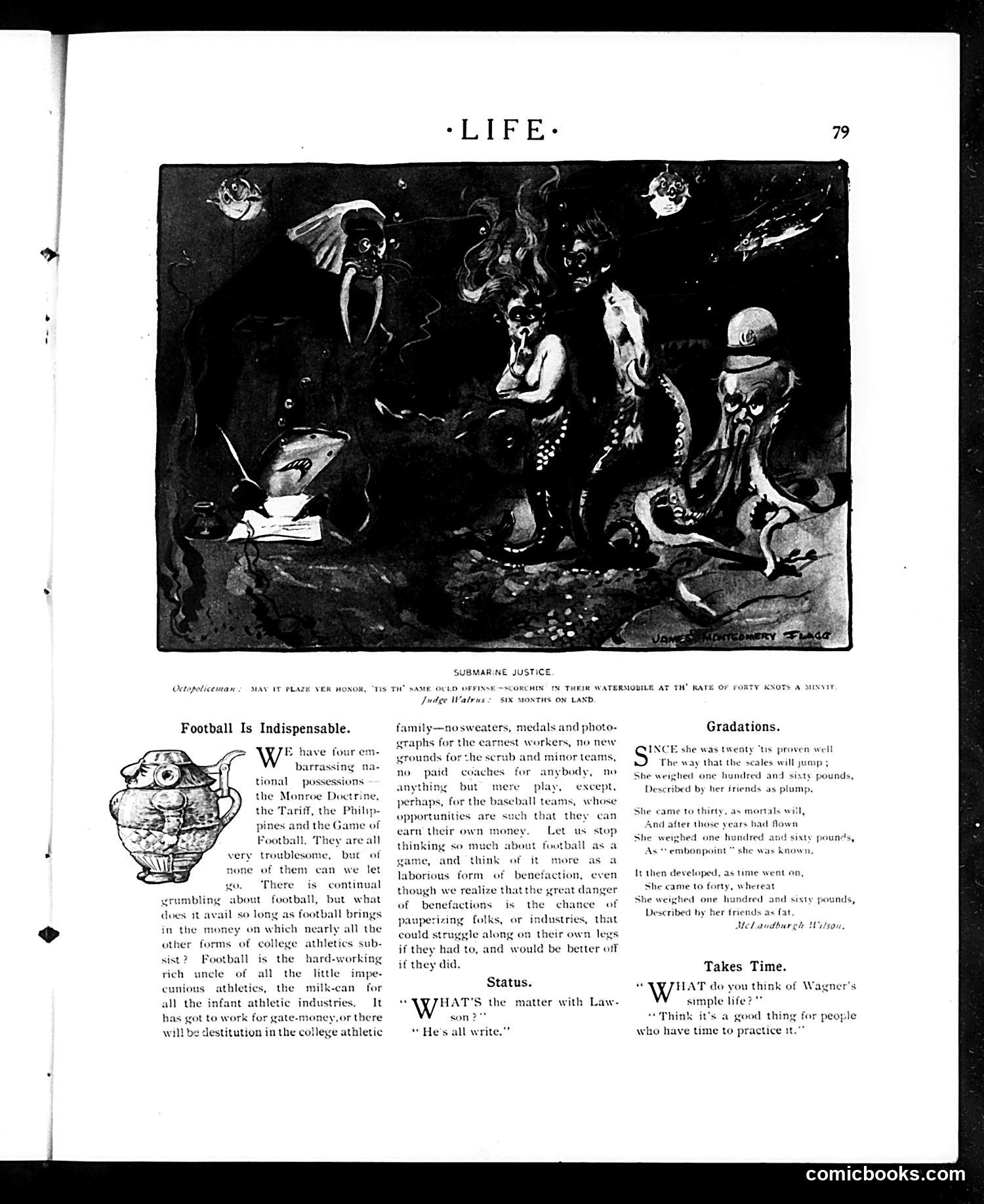
The page contains three distinct satirical pieces: **"Submarine Justice"** (top illustration): A dark cartoon depicting an "Octopoliceman" enforcing wartime justice on a submarine, with figures being executed at sea. The caption references a court martial ("Judge Watrus") condemning someone to six months on land—satirizing the harsh, arbitrary nature of military justice during what appears to be WWI submarine warfare. **"Football Is Indispensable"** (left column): A critique of college football's dominance. The author argues football is treated like a "national possession" (alongside the Monroe Doctrine and Tariff), claiming it's indispensable only because colleges depend on gate-money revenue. The satire suggests football perpetuates pauperism by preventing workers from improving their own circumstances through self-reliance. **"Gradations"** and **"Takes Time"** (right side): Humorous verses about a woman's weight gain over time and a joke about Wagner's "simple life" requiring leisure time to practice—both light social satire. The magazine's tone is typical Progressive-era critique of American institutions and class economics.
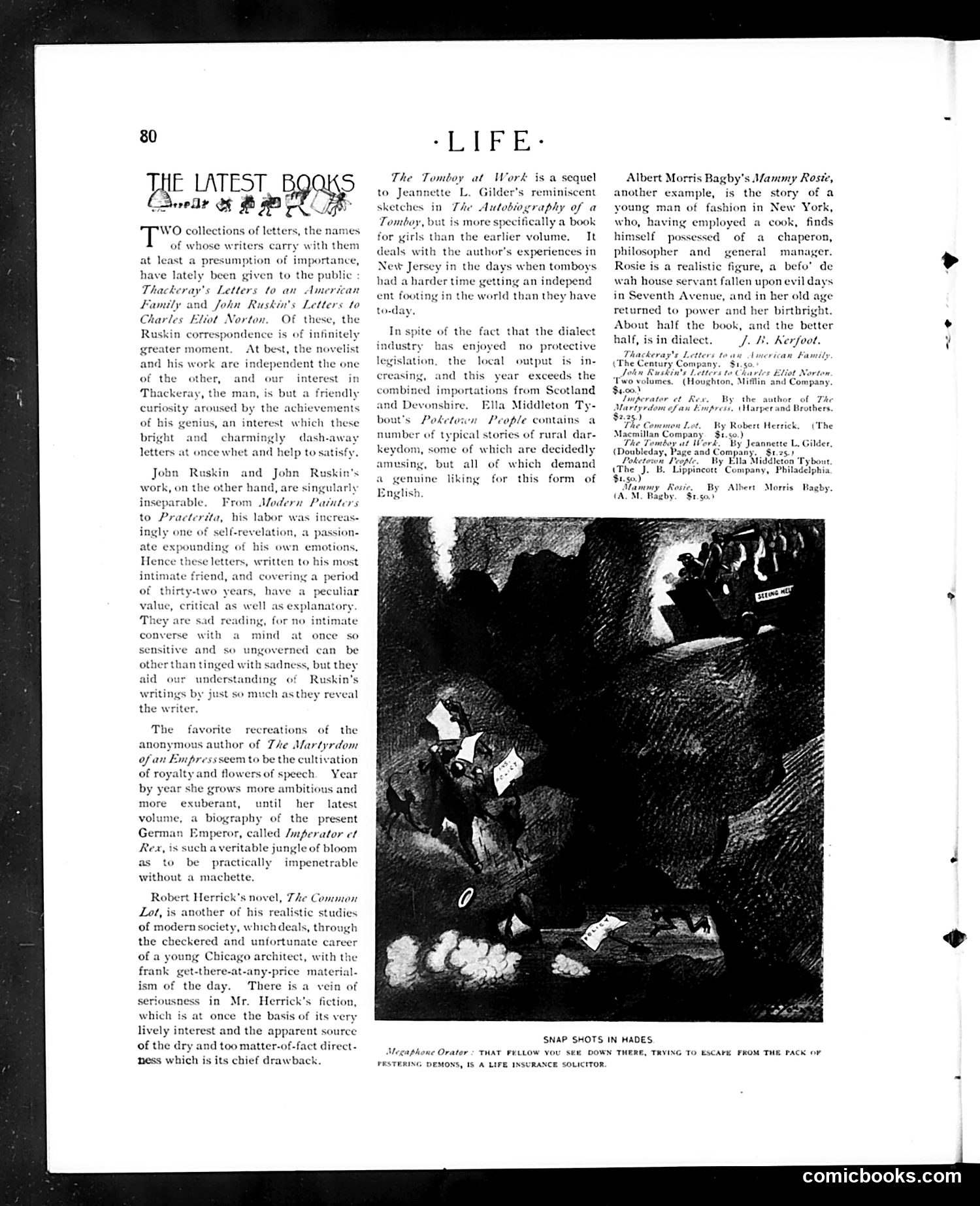
This page contains literary reviews rather than political cartoons. The single illustration—titled "Snap Shots in Hades"—depicts a satirical scene of damned souls in the underworld, with the caption identifying one figure as a "life insurance solicitor," suggesting he belongs among the tormented for his dubious profession. The reviews discuss contemporary novels and letter collections, including works by Thackeray, Ruskin, and Robert Herrick. One notable review addresses *Poketown People*, which contains "typical stories of rural darkey-dom"—revealing period attitudes toward dialect literature and African American characters that would be considered deeply offensive today. The page exemplifies *Life*'s role as a literary and cultural arbiter for educated American readers, combining genteel book criticism with gentle social satire about professional conduct and literary taste.
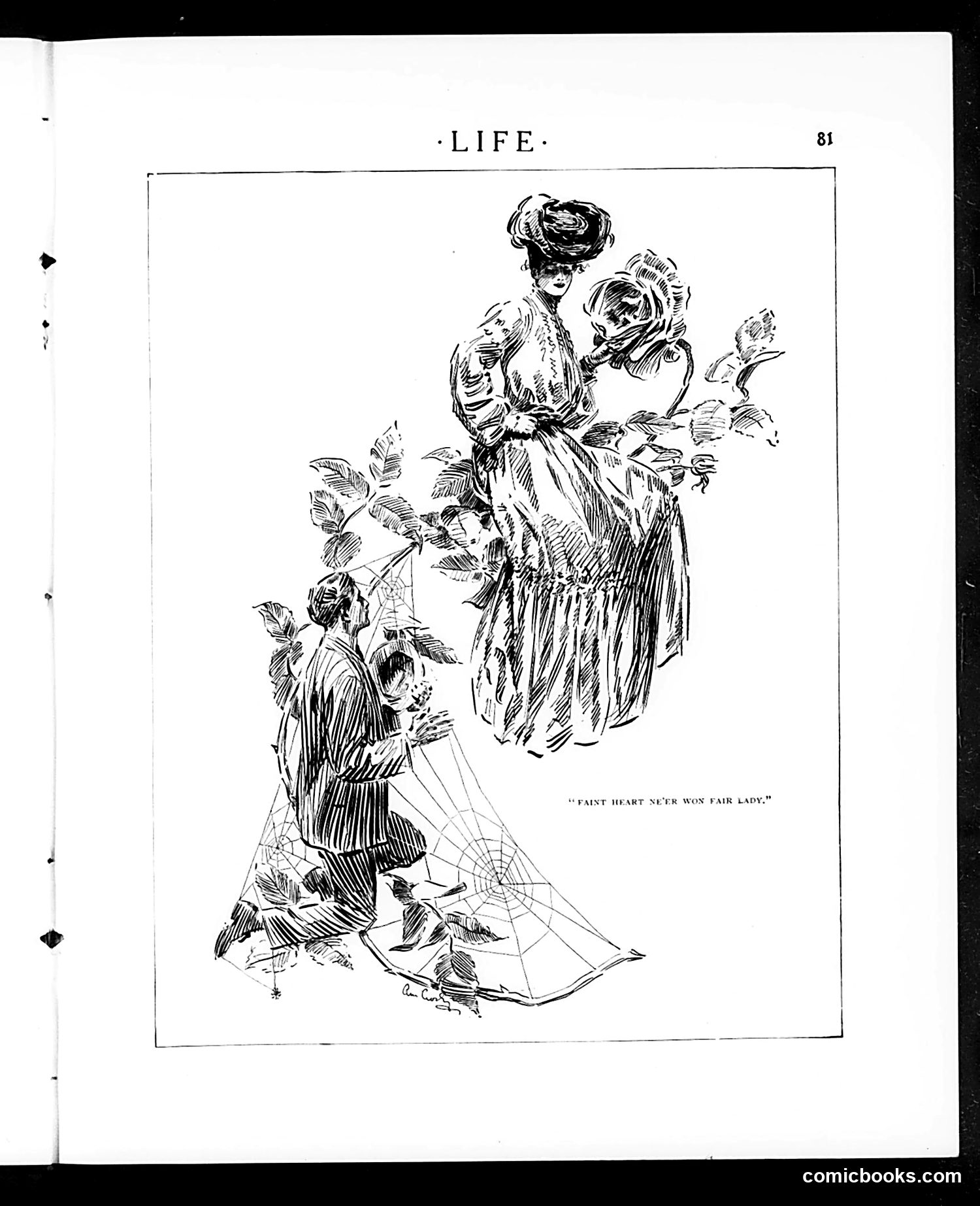
This is a romantic illustration from *Life* magazine's page 81. The sketch shows two figures in Edwardian-era clothing—a man kneeling below and a woman standing above him holding roses. The caption reads: "FAINT HEART NE'ER WON FAIR LADY." This is a straightforward romantic illustration playing on the traditional proverb. It depicts a courtship scene where the man, despite his timid posture (kneeling, appearing hesitant), is attempting to win the woman's affection with flowers. The joke lies in the irony: his "faint heart" (lack of boldness) contradicts the proverb's suggestion that timidity won't succeed—yet he's pursuing her anyway. It's gentle social commentary on Victorian romance conventions and male courtship behavior of the era.
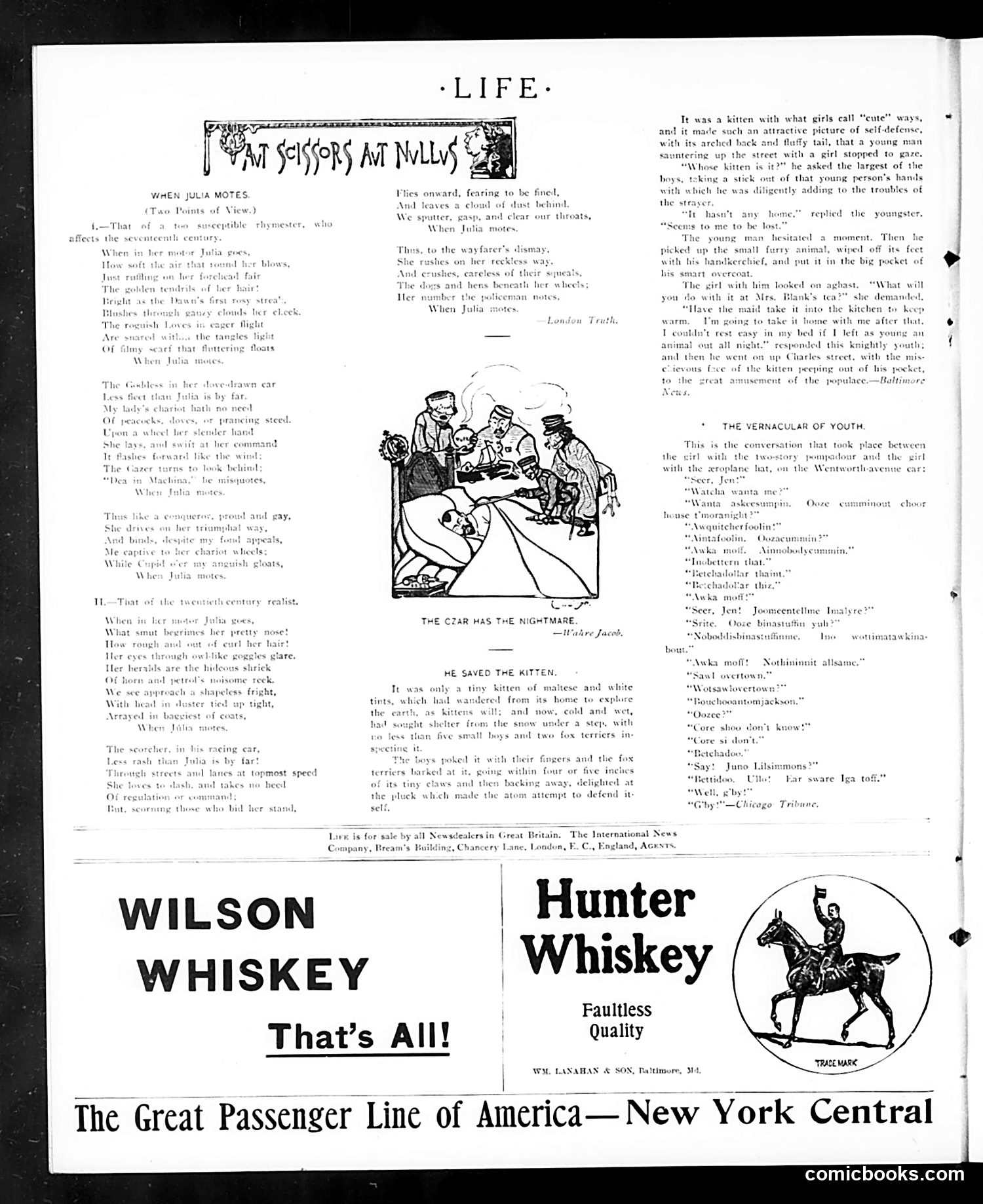
This page is primarily **advertising** with minimal satirical content. The main cartoon, titled "The Czar Has the Nightmare," depicts a Russian Tsar experiencing distressing dreams—likely referencing anti-Tsarist sentiment or revolutionary anxieties circa the Russian Revolution era. The illustration shows the Tsar in bed surrounded by menacing figures. The page includes two whiskey advertisements (Wilson and Hunter brands) and a New York Central Railroad advertisement, which dominated Life magazine's revenue. The text discusses a kitten anecdote unrelated to the cartoon. Without clearer context about the specific historical moment or the cartoon's original caption/artist attribution, the precise political meaning remains unclear—though the Tsar nightmare imagery suggests commentary on Russian political instability or American anti-monarchist sentiment.
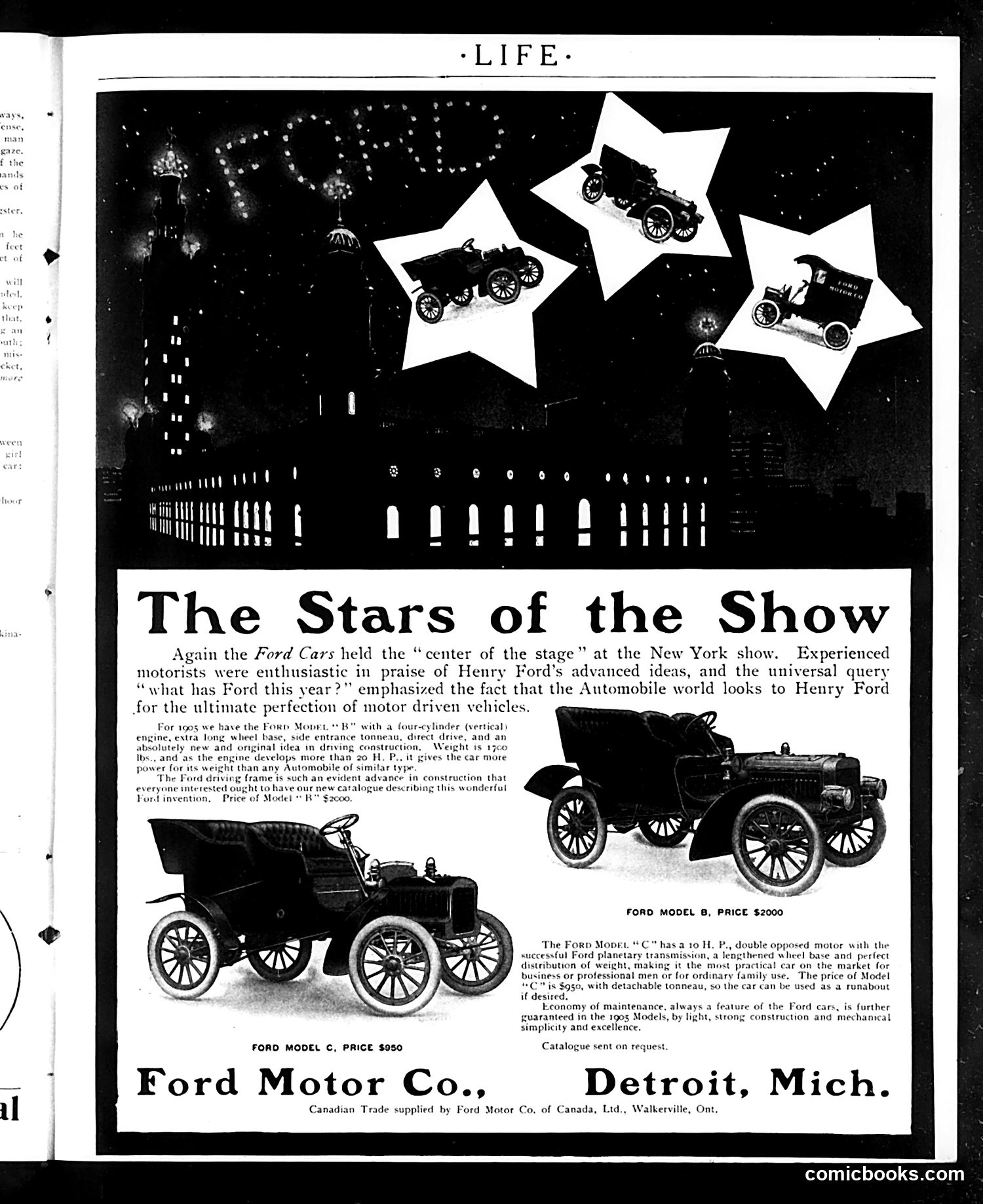
This is not a political cartoon but rather a **Ford Motor Company advertisement** from Life magazine, likely from around 1903-1905. The page promotes three Ford automobile models (B, C, and an unlabeled model) displayed at what appears to be the New York Auto Show. The "stars" metaphor in the title—illustrated by cars nestled in giant white stars against a nighttime cityscape—positions Ford vehicles as the show's highlights. The text emphasizes Henry Ford's "advanced ideas" and positions Ford as the leader in automotive innovation, claiming the "Automobile world looks to Henry Ford for the ultimate perfection of motor driven vehicles." This is straightforward commercial promotion rather than satire. The advertisement highlights technical specifications (horsepower, wheel base, transmission type) and prices ($950-$2000) to appeal to middle and upper-class buyers. No political satire or social commentary is present—it's simply product marketing in Life's pages.
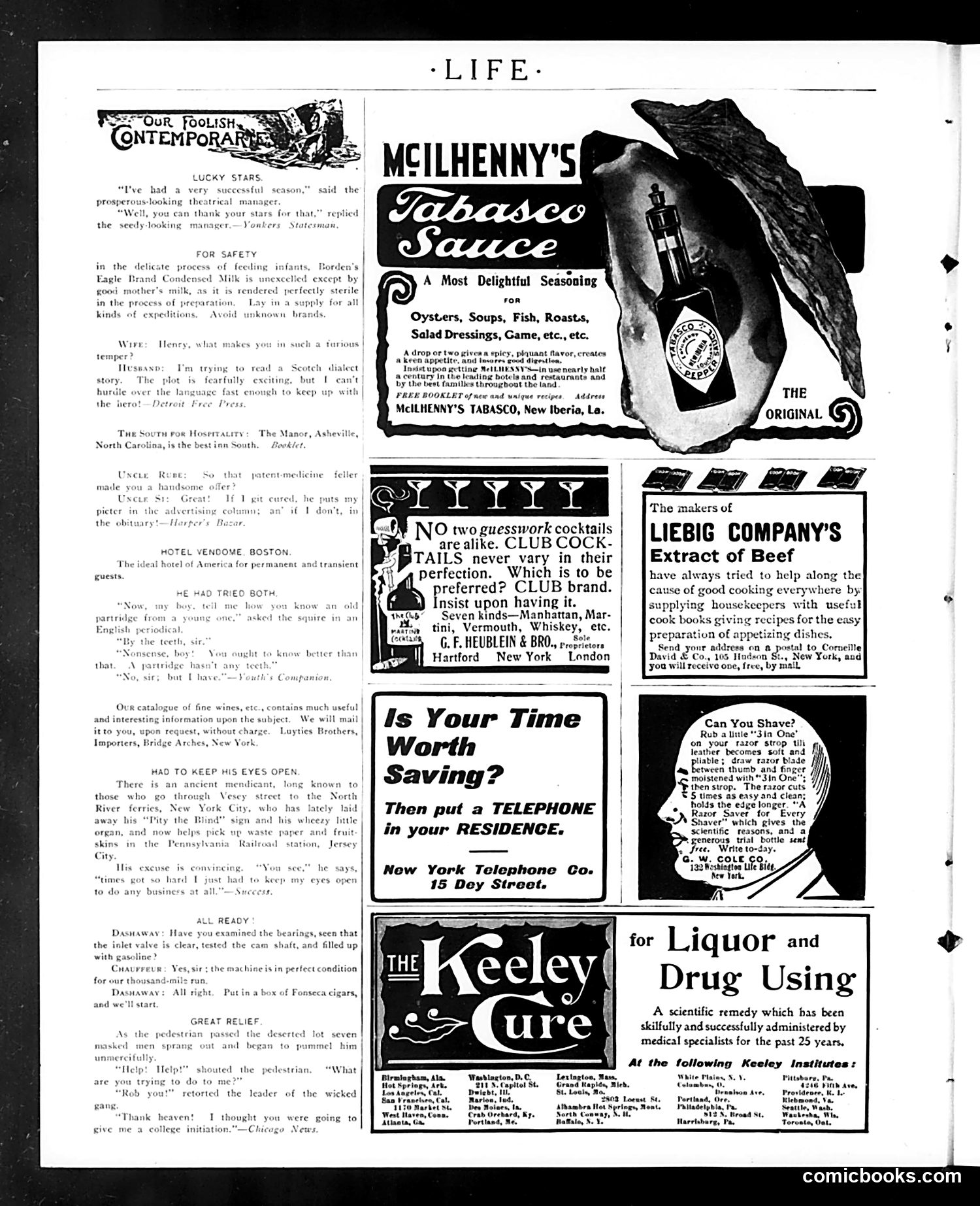
This page is primarily **advertisements** interspersed with short humor pieces ("Our Foolish Contemporaries"). The brief comedic sketches mock everyday absurdities: a theatrical manager claiming lucky stars for success, a husband struggling with Scotch dialect, and exchanges about automobiles and partridges. These are gentle, observational humor rather than political satire. The advertisements dominate—McIlhenny's Tabasco Sauce, Liebig's Beef Extract, Club brand cocktails, New York Telephone Company, razors, and notably "The Keeley Cure," a commercial medical treatment for "Liquor and Drug Using" administered at various institutes nationwide. The Keeley Cure ad is historically significant: it represents early 20th-century commercial remedies for addiction, marketed as "scientific" treatments by "medical specialists." This reflects the era before modern addiction medicine, when such establishments were common and their efficacy questionable. Overall, the page reflects Life's mixed commercial-satirical format circa 1900s, with period-specific products and naive medical marketing now appearing quaint or problematic.
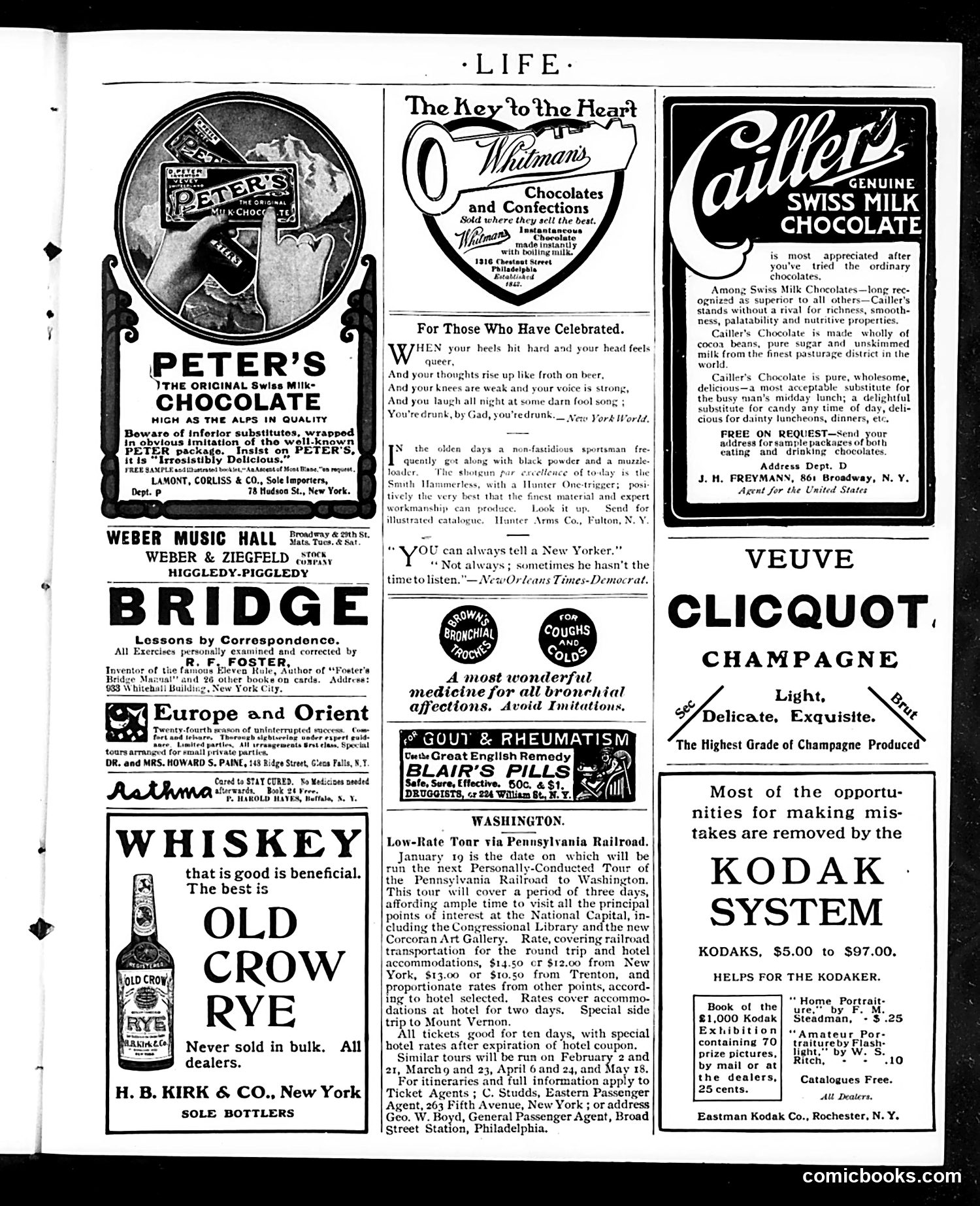
This page is primarily **advertisements** for luxury consumer goods and services, with minimal editorial cartoon content. **Key advertisements include:** - **Peter's Swiss Chocolate** and **Cailler's Swiss Milk Chocolate** — competing premium chocolate brands emphasizing Alpine quality and purity - **Old Crow Rye Whiskey** — positioned as "beneficial" - **Veuve Clicquot Champagne** — luxury French beverage - **Kodak Camera System** — photography equipment - **Weber Music Hall** — music instruction - **Bridge lessons** — card game instruction - Medicinal products (**Blair's Pills** for bronchial ailments, **Gout & Rheumatism remedy**) - **Pennsylvania Railroad tour to Washington** — travel promotion **The only substantial editorial content** is a brief humorous piece titled "For Those Who Have Celebrated," making light of hangovers with verse about drunkenness, and a joke distinguishing New Yorkers' listening habits. This reflects early 1900s *Life* magazine's business model: sophisticated advertising aimed at affluent readers alongside light humor and satire.
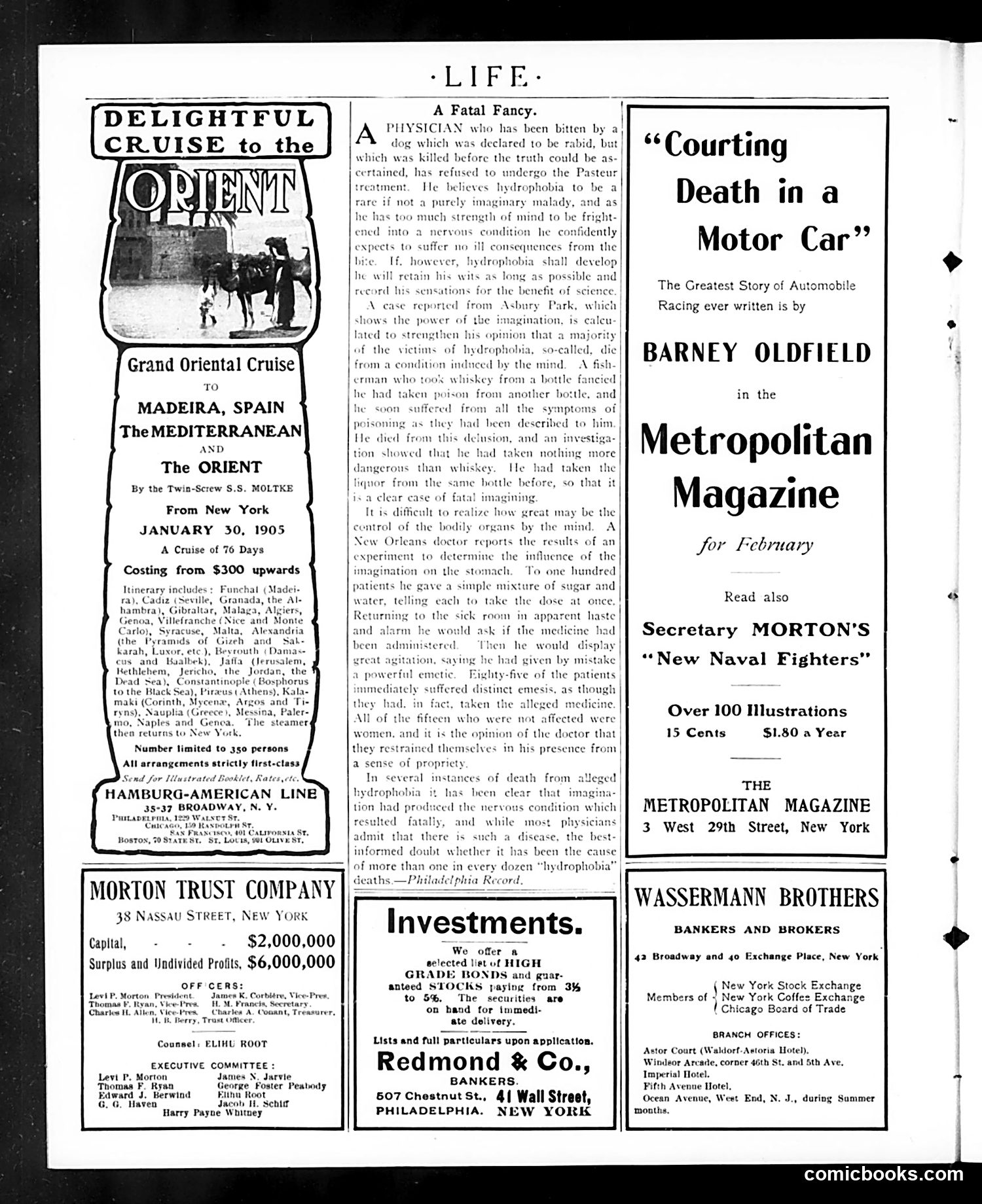
This is primarily an **advertising and content page** from Life magazine's February 1905 issue, not a political cartoon. The main editorial content is "A Fatal Fancy," a medical essay exploring **psychosomatic illness**—specifically whether hydrophobia (rabies fear) can be fatally induced by imagination alone. The piece describes a physician bitten by a rabid dog who refuses Pasteur treatment, believing the disease imaginary. It recounts anecdotes of patients who suffered poisoning symptoms from placebo treatments and a New Orleans doctor's experiment proving mind's power over the body. The essay concludes that imagination has indeed caused death in documented hydrophobia cases. The page is otherwise filled with **cruise ship advertisements** (Hamburg-American Line's Oriental cruises), **financial services** (Morton Trust Company, Redmond & Co. bankers), and **magazine promotions**, including Barney Oldfield's automobile racing story in *Metropolitan Magazine*. The content reflects early 20th-century fascination with psychology and the mind-body connection—a serious medical topic dressed in Life's typically sensationalized style.
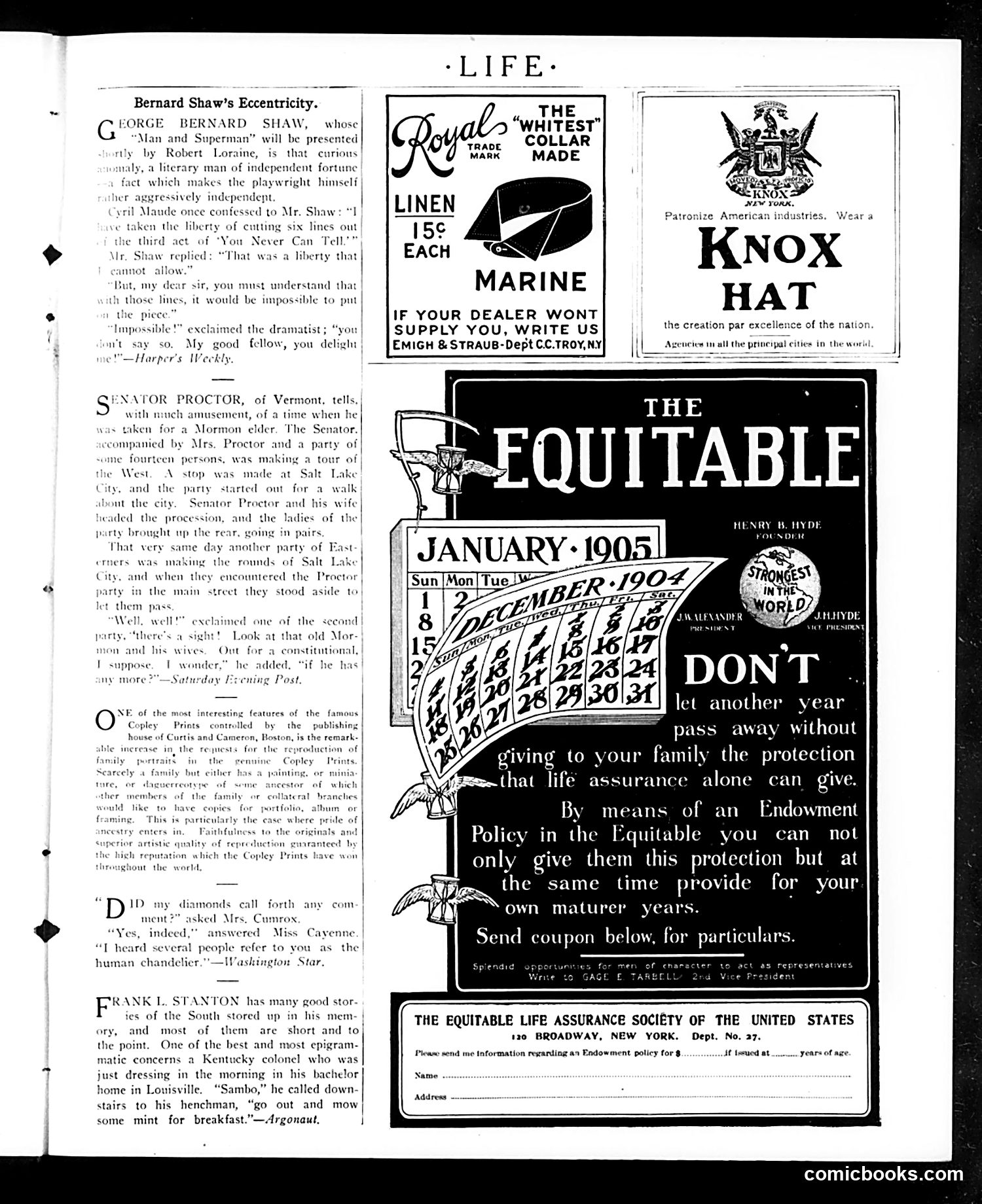
This page from *Life* magazine (circa 1904-1905) contains literary anecdotes and period advertisements rather than political cartoons. **Text Content:** The page features three short humorous stories: one about playwright George Bernard Shaw's eccentricity regarding theatrical liberty; another about Senator Proctor of Vermont mistaking a Mormon elder and his wives for a tour group; and a third about a Kentucky colonel's nostalgic command to his servant using antebellum dialect ("go mow some mint for breakfast"). **Advertisements:** The right side displays ads for Knox Hats, Royal White Collar linen products, and a large Equitable Life Assurance Society life insurance ad featuring a calendar graphic and urgent messaging about family protection. **Historical Context:** These anecdotes reflect early-20th-century American attitudes: reverence for literary figures, gentle mockery of religious groups, and nostalgia for the Old South. The insurance ad's aggressive tone ("don't let another year pass away") typifies period marketing tactics.
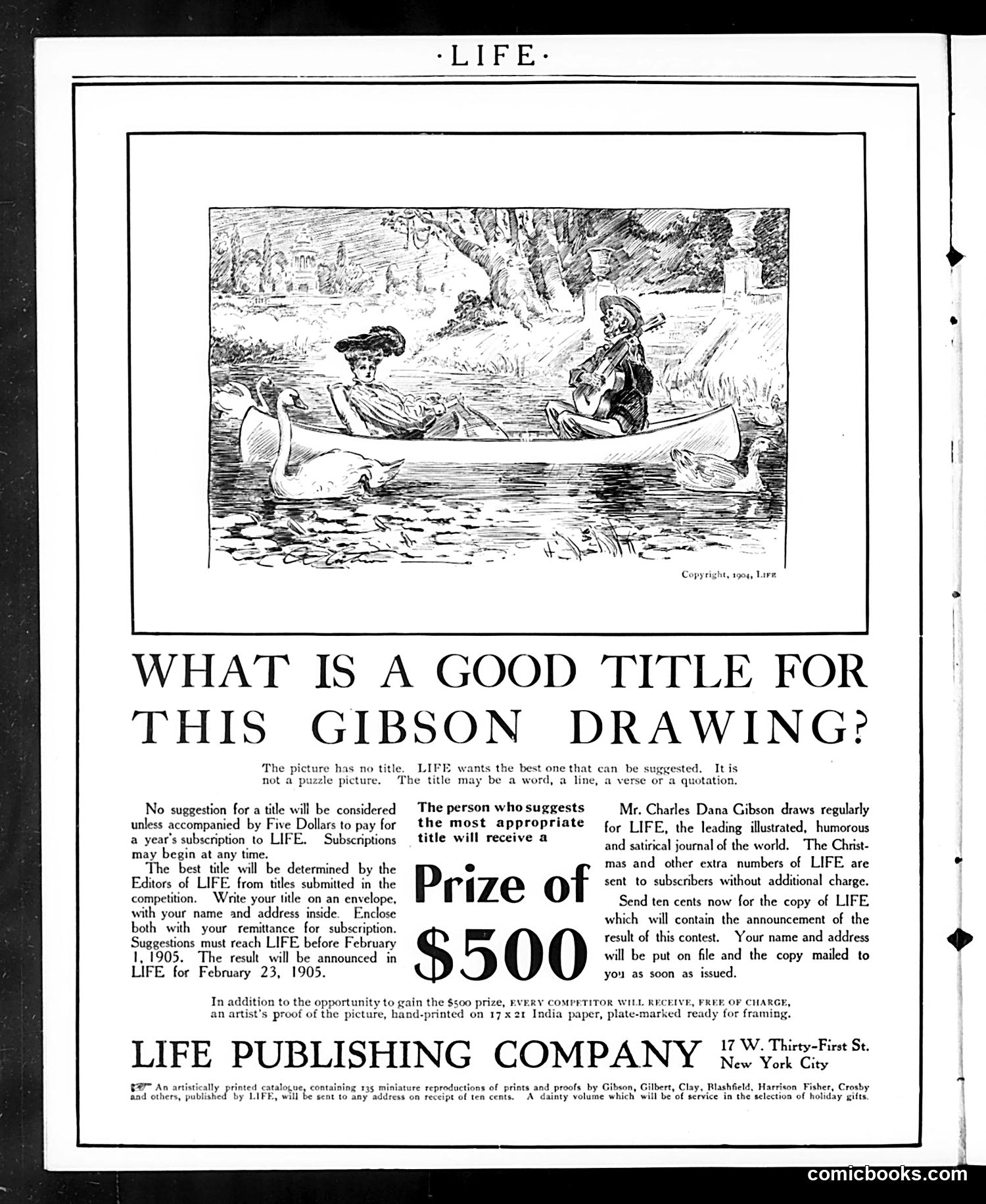
This page is primarily a **contest advertisement** rather than a satirical cartoon. Life magazine is soliciting title suggestions from readers for a Gibson drawing depicting two well-dressed figures in a canoe with swans. The image shows a romantic scene typical of Charles Dana Gibson's "Gibson Girl" era illustrations—elegant figures in an idyllic setting. The contest offered a $500 prize (substantial for 1904) to whoever suggested the best title, requiring a $5 subscription entry fee. The satire is subtle: Life positions itself as arbiter of taste and culture, confident readers will pay to participate. The romantic boating scene itself appears straightforward—no obvious political content is visible. The appeal relies on Gibson's popularity and the magazine's prestige among educated, affluent readers who could afford both subscription fees and leisure time pursuits like boating.
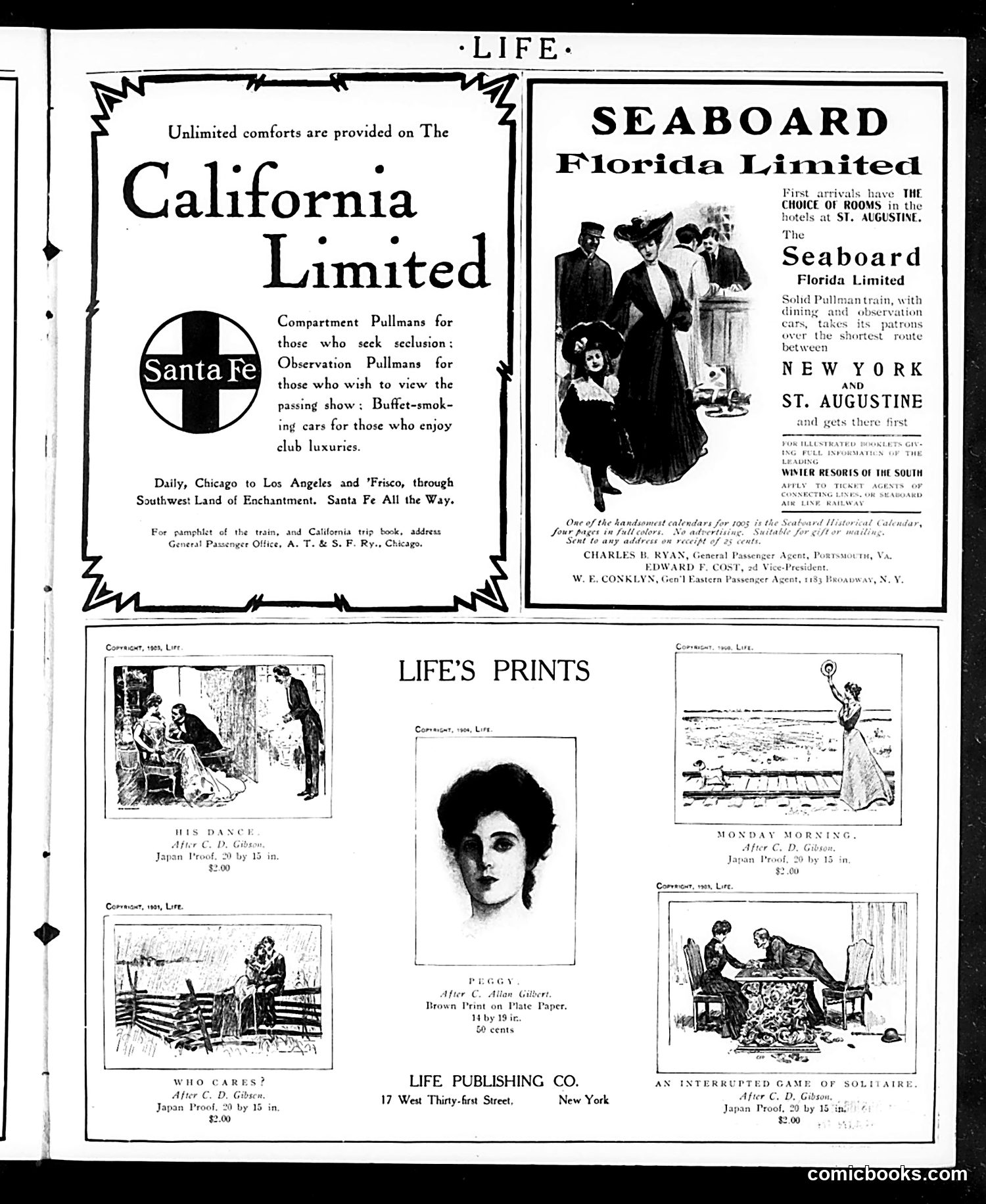
This is primarily an **advertising and art print sales page** from Life magazine, circa 1925, rather than satirical content. The top half features two railroad advertisements: the Santa Fe's "California Limited" and the Seaboard's "Florida Limited," promoting luxury train travel with Pullman cars and observation decks—typical early 20th-century leisure advertising targeting affluent travelers. The bottom half is **"Life's Prints,"** a mail-order art section selling reproductions of drawings by C.D. Gibson (a famous illustrator). The four prints shown are domestic genre scenes: "His Dance," "Who Cares?," "Monday Morning," and "An Interrupted Game of Solitaire." These appear to depict genteel, humorous situations from upper-class life—Gibson's trademark subject matter. A portrait labeled "Peggy" appears in the center, likely a Gibson original or model. The page's main function is **commercial rather than satirical**: selling transportation and art prints to Life's affluent readership.
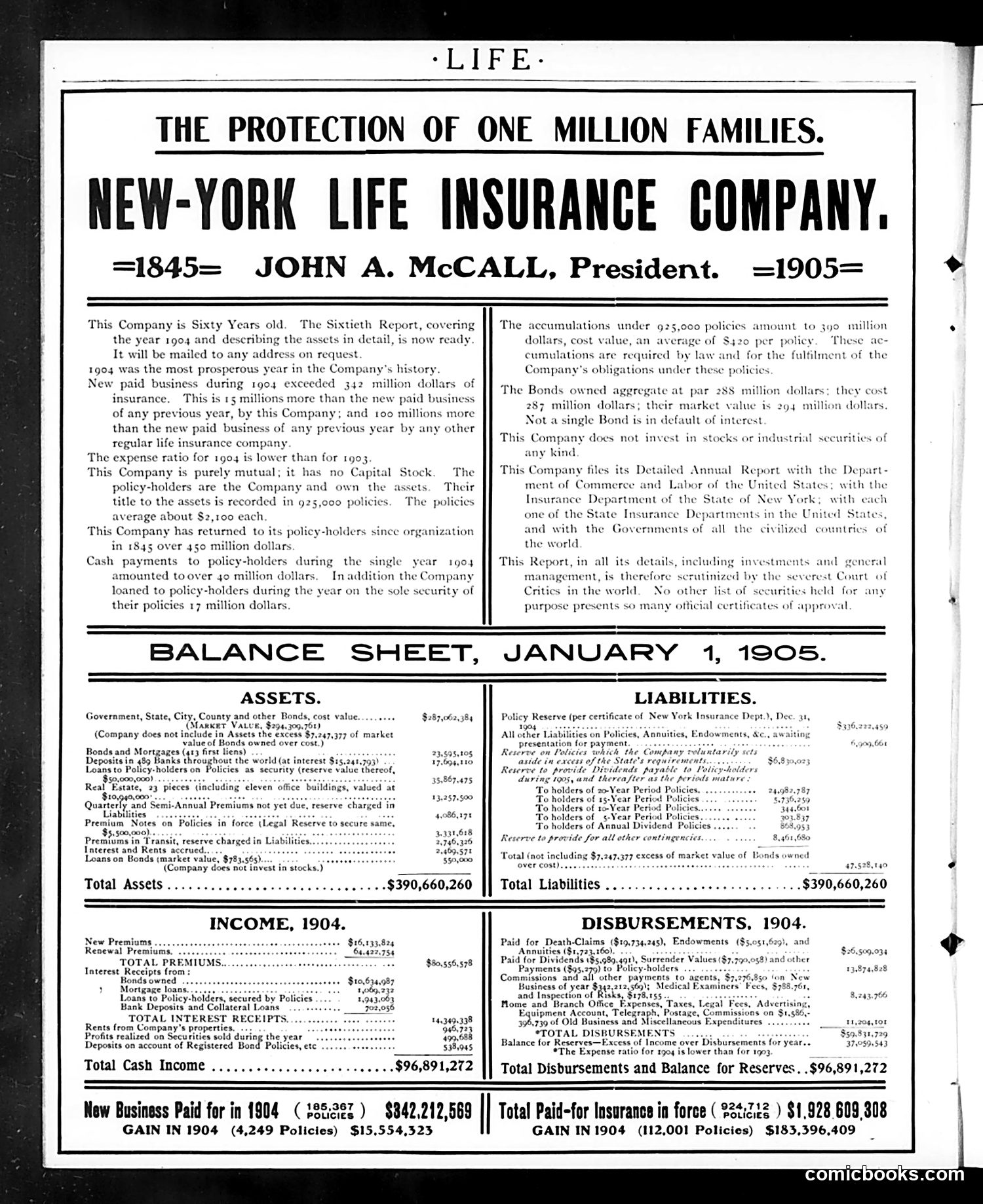
This is **not a cartoon or satire**—it's a straightforward corporate advertisement, though it appears in *Life*, which was primarily a humor magazine. The page promotes New-York Life Insurance Company's financial strength to potential customers. Key claims include: the company is 60 years old (founded 1845); 1904 was its most prosperous year; it returned over $450 million to policyholders since inception; it holds $390 million in assets; and crucially, it invests only in bonds and mortgages—**explicitly avoiding stocks**, which suggests post-1890s caution following market volatility. The "Protection of One Million Families" tagline emphasizes security and reliability. President John A. McCall's name appears prominently. The detailed balance sheet and income statement serve as proof of financial stability—important reassurance in an era when insurance companies occasionally failed, leaving policyholders unprotected. This represents early 20th-century corporate PR strategy: using detailed financial transparency as marketing.
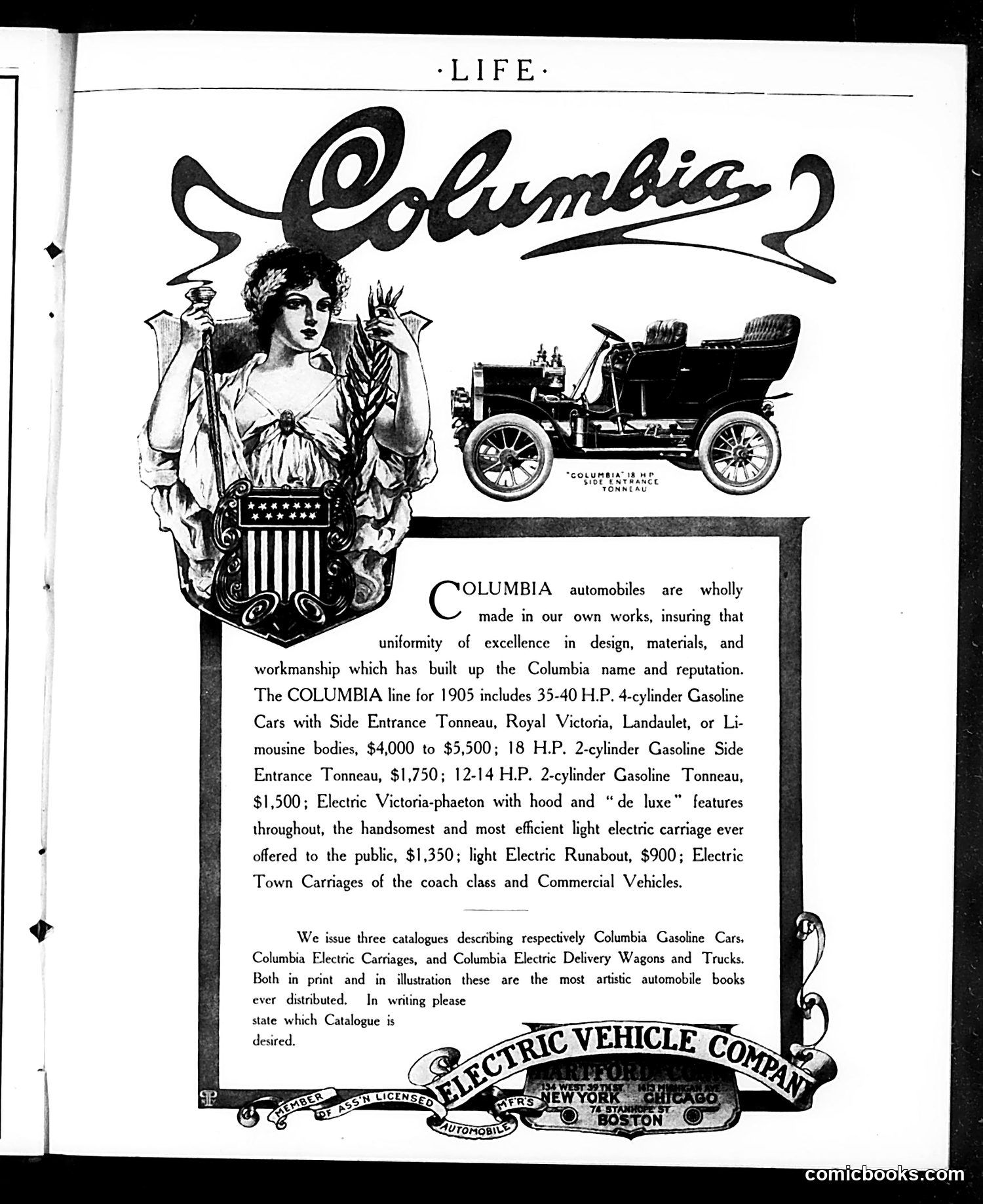
This is a full-page advertisement, not satire. It promotes Columbia automobiles for 1905, featuring the company's logo (a woman representing Columbia, the personification of America) and an image of one of their vehicles. The ad emphasizes domestic manufacturing ("wholly made in our own works") and lists their product line: gasoline cars ($1,500–$5,500), electric vehicles ($900–$1,350), and commercial trucks. The company highlights the artistic quality of their catalogs and offers separate publications for gasoline cars, electric carriages, and delivery wagons. The page reflects early automotive history when electric vehicles were competitive luxury options alongside gasoline cars—a detail modern readers often find surprising given electricity's later disappearance from consumer vehicles.
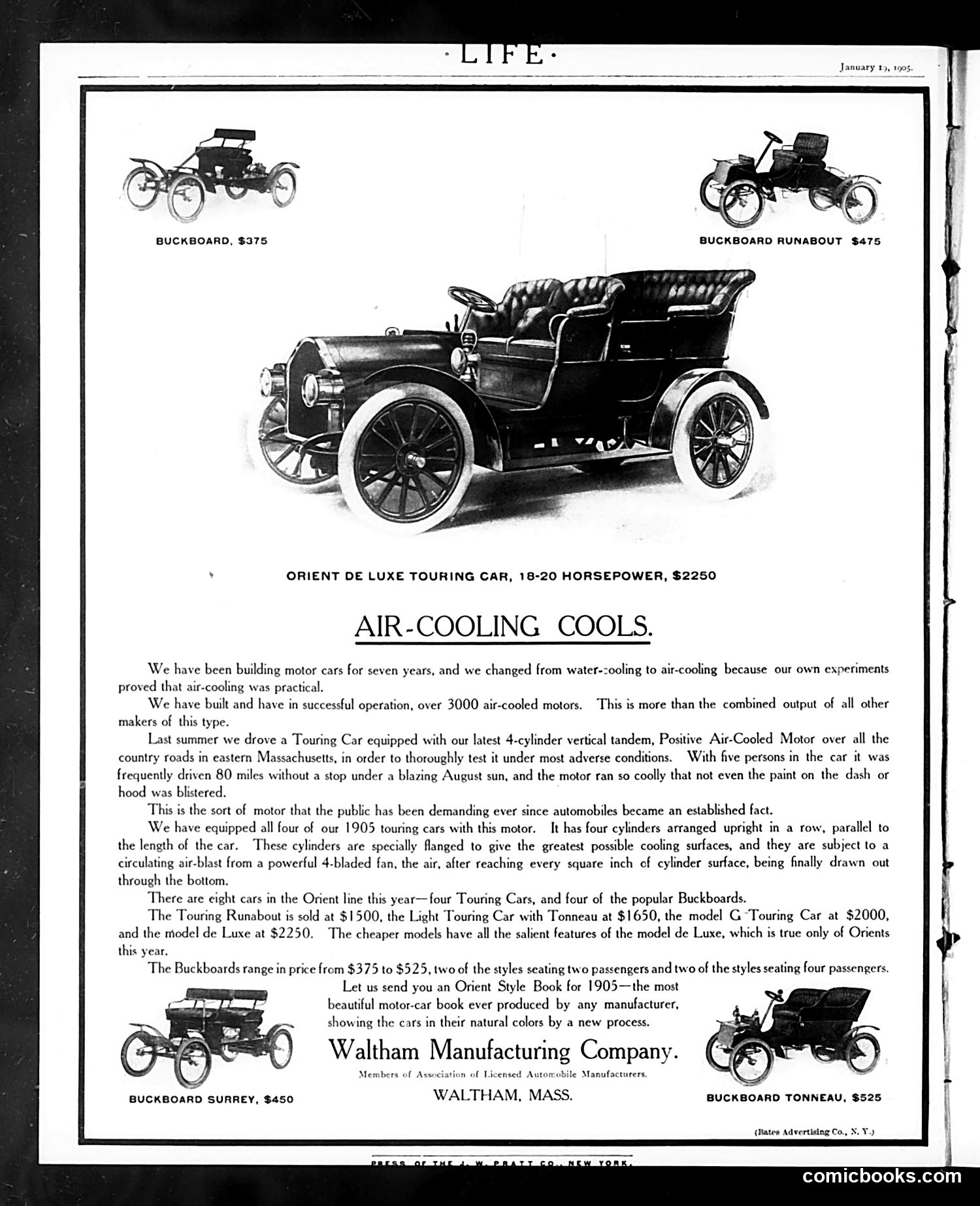
This is primarily **advertising**, not satire or political commentary. The page showcases Waltham Manufacturing Company's 1905 automobile line. The content centers on promoting **air-cooled engines** as a technological innovation. The company claims superiority: they've built over 3,000 air-cooled motors—"more than the combined output of all other makers of this type." They emphasize practical proof, describing a summer test drive in Massachusetts where the engine remained so cool that dashboard paint didn't blister even under intense heat and heavy load. The page displays four vehicle models with prices ranging from $375 (Buckboard) to $2,250 (Orient de Luxe Touring Car). The text argues that air-cooling—rather than water-cooling—is what "the public has been demanding." **For modern readers:** This reflects early automotive competition when engine cooling was a genuine technical challenge and selling point. The advertisement's emphasis on durability testing and competitive claims represents early 20th-century marketing strategy in an emerging industry.