
Life, 1905-01-19 · page 24 of 38
Life — January 19, 1905 — page 24: what you’re looking at
What you’re looking at
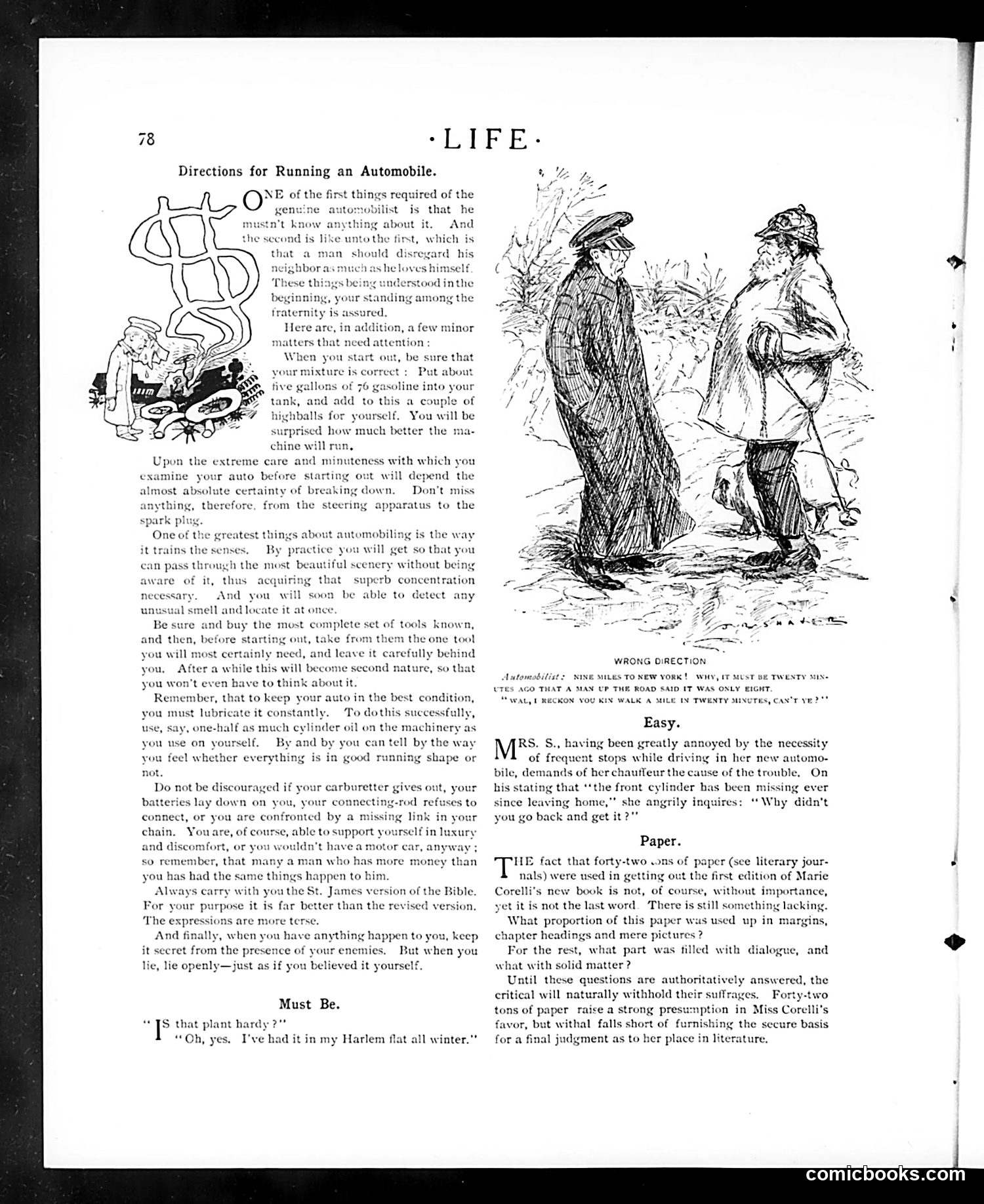
This page satirizes early automobile culture (circa 1900s-1910s) through three separate pieces: **"Directions for Running an Automobile"** mock-heroically presents absurd advice for car ownership, treating automobiles as temperamental, unreliable machines requiring constant maintenance and specialized knowledge. The humor lies in treating basic car operation as impossibly complex—a fair reflection of early automobiles' actual unpredictability. **"Wrong Direction"** cartoon shows two figures discussing distances to New York. One claims it's "twenty and" miles away; another says it's only eight. The humor targets rural Americans' (depicted in dialect) unfamiliarity with automobiles and modern travel—they're confused about distances and suggest walking. This reflects class/urban-rural divides regarding new technology. **"Easy"** jokes about Mrs. S. demanding her chauffeur retrieve a "missing" front cylinder from her car, misunderstanding mechanical terminology. The satire targets wealthy women's mechanical ignorance while relying on hired help to operate vehicles. All three pieces mock automobiles as unreliable and their operators (whether owners or novices) as absurdly incompetent.
📄 Transcribed text from this page (OCR, searchable)
Machine-transcribed from the original scan — historical spelling and the odd misread are preserved.
Directions for Running an Automobile. ed of the that he NE of the first things re vilist is about it. And second is like unto the first, which is that n should di ard his. dint standing among the few minor on: be sure that : Put about ne into your tank, and add to this a couple of 5 ourself, You will be surprised how much better t chine will Upon the extreme and minuteness with which you mine your auto before st st will depend the yst absolute certainty of breaking down, Don't miss highbs ing ¢ ything, therefore irk One of th ins t from the steering apparatus to the greatest things about automobiling is the wa t so that you ful scenery without b ne senses, By practice you will gi the most beau it, thus ai can pass throug! erb concentration y aware nat SUj necessary. be able to detect a uni soon And you al smell and locate it at once, Be sure and buy the most complete set of tools known, and then, be one tool you will most cert ave it carefully behind you. Af you won't even have to th Remember, that to keep your auto in the best condition, you must lubricate it constant! To dothis successfully, ed, and le: ta while this will become second nature, so that ¢, Say, one-half as much cy’ By and by you can tell by the way er everything is in good running shape or you use on yc u feel whe not. Do not be discouraged if your carburetter gives out, your batteries lay down on you, your connect w-rod refuses to your connect, or you You ¢ confronted by a ble to Support and discon Idn’t have aber, that many a man who has more 1 you has had the same things happen to him. Always carry with 5 or your purpose it is missing link ir fin luxury so reme the Bible. ed version, James version 0 er than the rev pressions are m And finall. it secret from the pres , when you anything happen to yi nce of your enemies. u, keep But when you lie, lie openly—just as if you believed it yourself. Must Be. S that plant hard I've had it in my Harlem flat all winter.” -LIFE- WRONG DIRECTION Lutomobilist ¢ SING MILES TO NEW YORK! WHY, (T MUST BE TWENTY AN- AGO THAT A MAN UP THE ROAD SAID IT WAS ONLY EIGHT. WAL, 1 RECKON VOU KIN WALK AMILE IN TWENTY SHNUTES, CAN'T VE?" Easy. RS. S., having been greatly annoyed by the necessity of frequent stops while driving in her new automo- bile, demands of her chauffeur the cause of the trouble, On his stating that ‘the front cylinder bas been missing ever she angrily inquires: “Why didn't since leaving home,” you go back and get it? Paper. HE fact that forty-two wons of paper (s nals) were used in getting out the first edition of Marie Corelli's new book is not, of course, without importance, yet it is not the last word. There is still something lacking What proportion of this paper wus used up in margins, chapter headings and mere pictures ? For the rest, what part was filled with dialogue, and what with solid matter? Until these questions are authoritatively answered, the critical will naturally withhold their suffi Fi two tons of paper raise a strong presumption in Miss Corelli's vor, but withal falls short of furnishing the ure basis for a final judgment as to her place in literature. ¢ literary jour- comicbooks.com