
A complete issue · 22 pages · 1904
Life — November 24, 1904
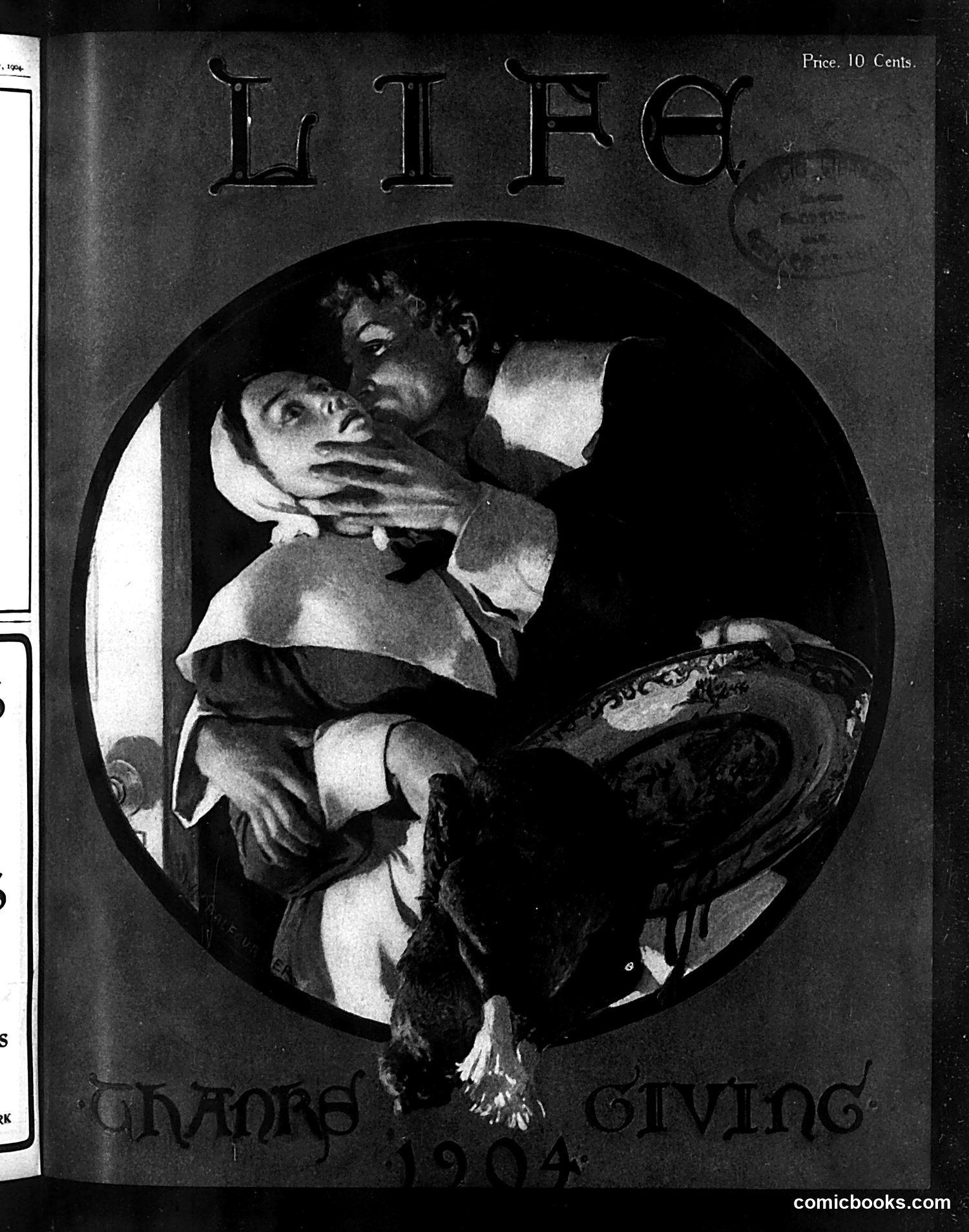
This is a **Thanksgiving issue cover** (price 10 cents). The circular illustration depicts a figure force-feeding a child—likely representing the American public or a particular demographic—with food or ideology. The visual metaphor suggests the government or dominant power is imposing something unwanted. The title "LIFE" and "THANKSGIVING 1904" frame the image. Without clearer OCR text identifying specific figures, the exact political target remains uncertain, but the satire appears to critique **forced consumption**—whether literal food policy, imperialism, or political ideology being imposed on an unwilling populace during Theodore Roosevelt's presidency, a period of American expansion and controversial domestic policies. The grotesque imagery emphasizes the violence of this "giving."
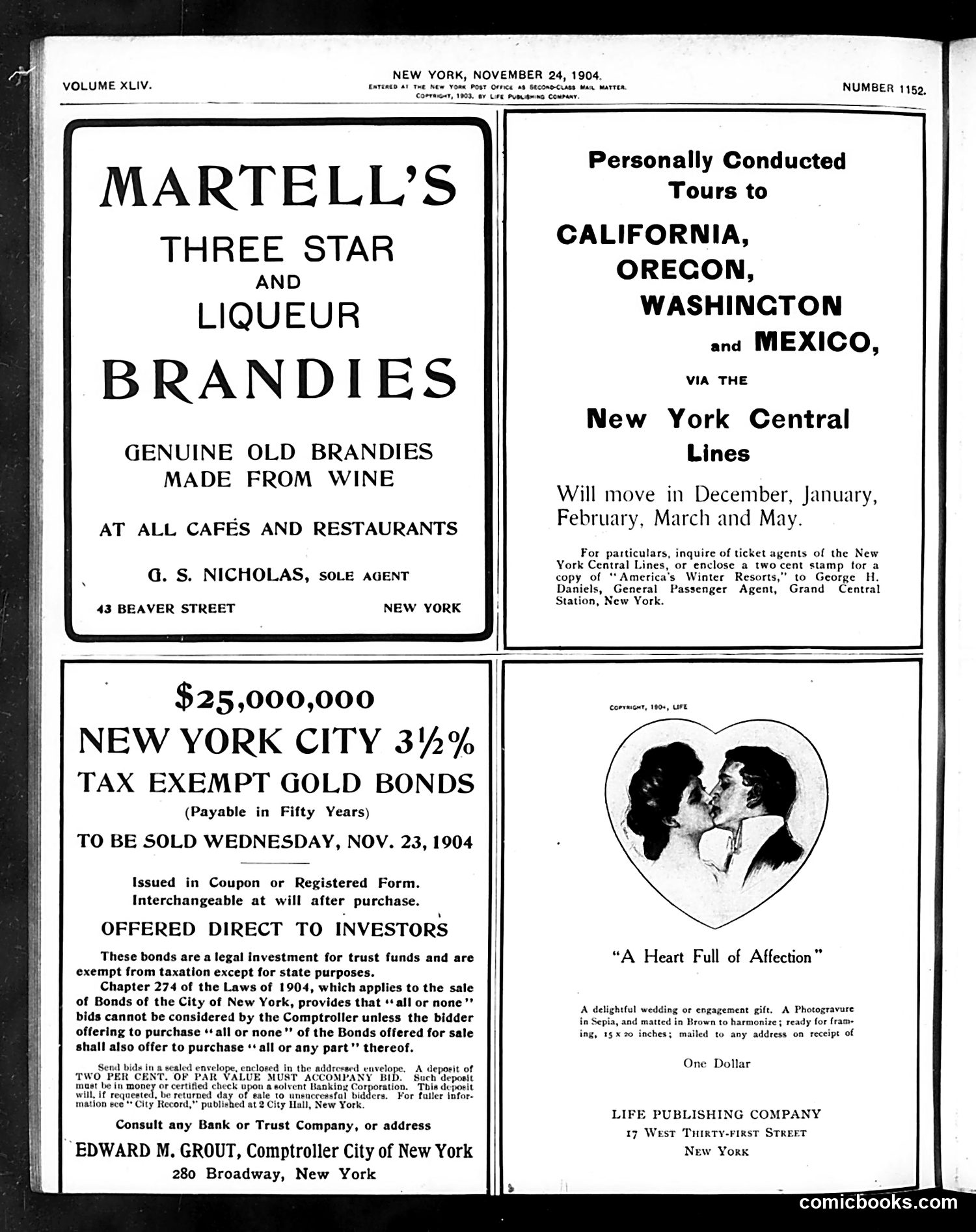
This page consists primarily of **advertisements** rather than editorial cartoons. The visible content includes: 1. **Martell's Brandy ad** - promoting French brandies available at cafés and restaurants 2. **New York Central railroad tour advertisement** - offering conducted trips to California, Oregon, Washington, and Mexico 3. **Municipal bond offering** - $25 million in NYC tax-exempt gold bonds 4. **"A Heart Full of Affection"** - a sentimental illustration showing two figures in profile about to kiss, presented as an engagement/wedding gift photograph available from Life Publishing Company for one dollar The page reflects early 1900s consumer culture and advertising practices. The romantic image appears designed to appeal to Life's audience as an inexpensive keepsake gift option.
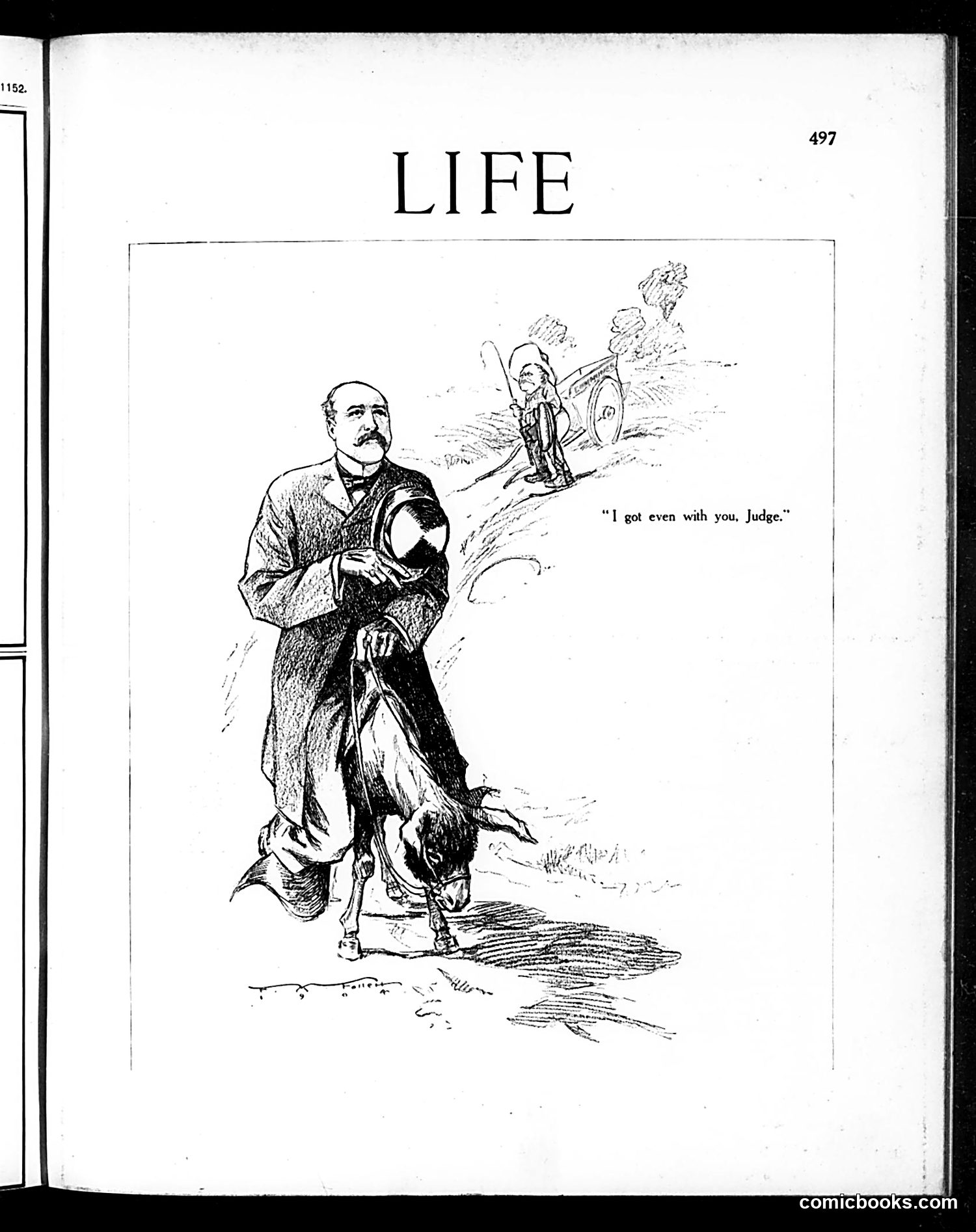
This cartoon depicts a man on horseback holding his hat, with the caption "I got even with you, Judge." In the background, a figure drives away in a cart loaded with what appears to be hay or supplies. The humor appears to involve settling a score—the man on horseback has apparently gotten revenge on someone called "Judge" by doing something (possibly taking or damaging goods, given the loaded cart). The caption suggests this is payback for a prior grievance. Without additional context about the specific historical moment or figures involved, the exact nature of the dispute remains unclear. However, the cartoon satirizes the concept of personal revenge and suggests themes of rural justice or settling accounts outside formal legal channels.
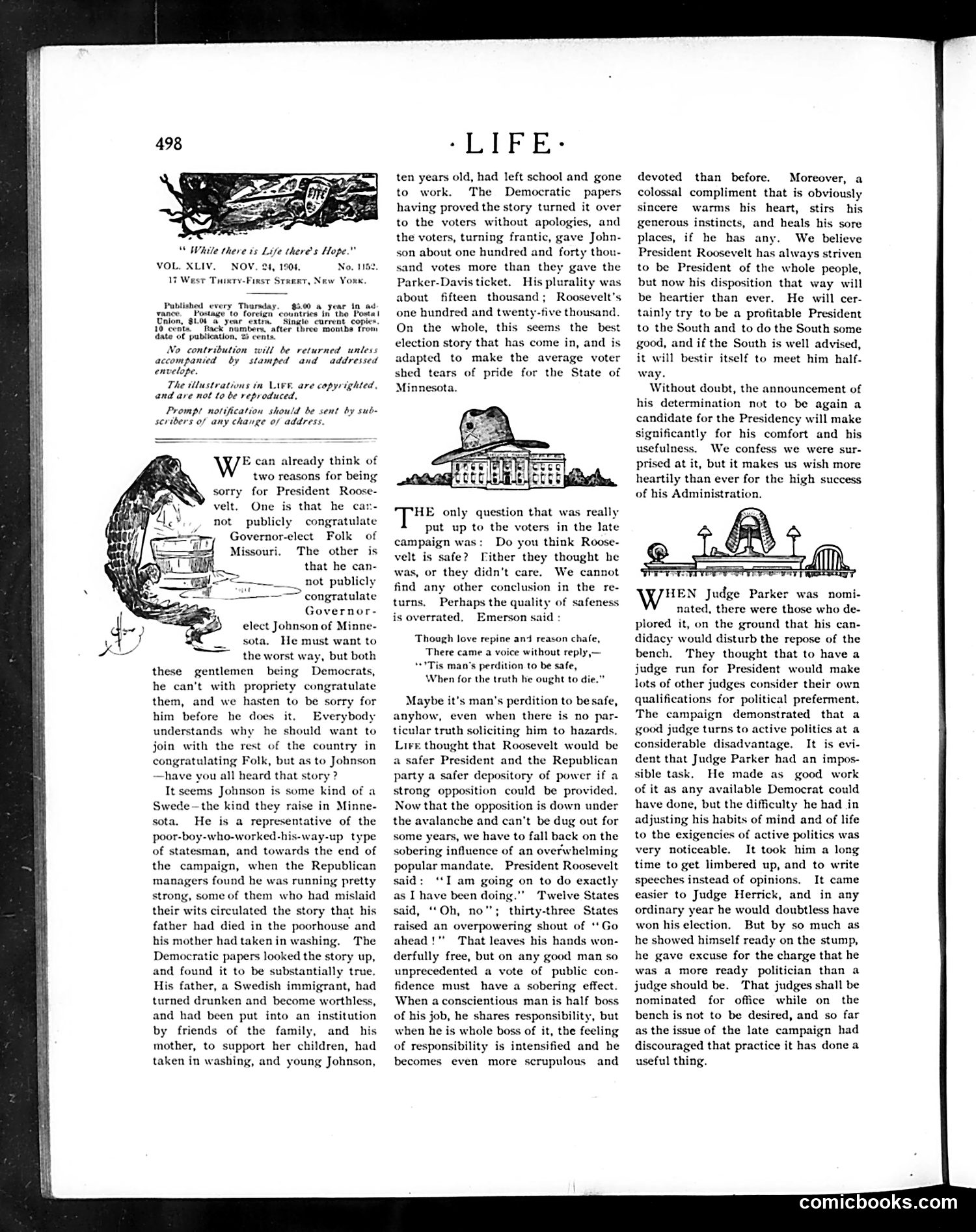
This page discusses the 1904 presidential election and Judge Alton Parker's nomination as the Democratic candidate against President Roosevelt. **The cartoons illustrate:** 1. **Left cartoon**: Shows a figure (appears to be a Democratic voter or politician) struggling with congratulating the Democratic nominee—depicting reluctance about Parker's candidacy. 2. **Center/top cartoon**: A building labeled to represent Democratic Party headquarters or convention space, reinforcing the political context. 3. **Right cartoon**: Appears to show judicial/political figures, likely referencing Parker's background as a judge and concerns about judges entering active politics. **The satire's point**: The text and cartoons mock Democrats struggling to enthusiastically support Parker while questioning whether he's a safer choice than Roosevelt, and critiquing the nomination of judges for political office.
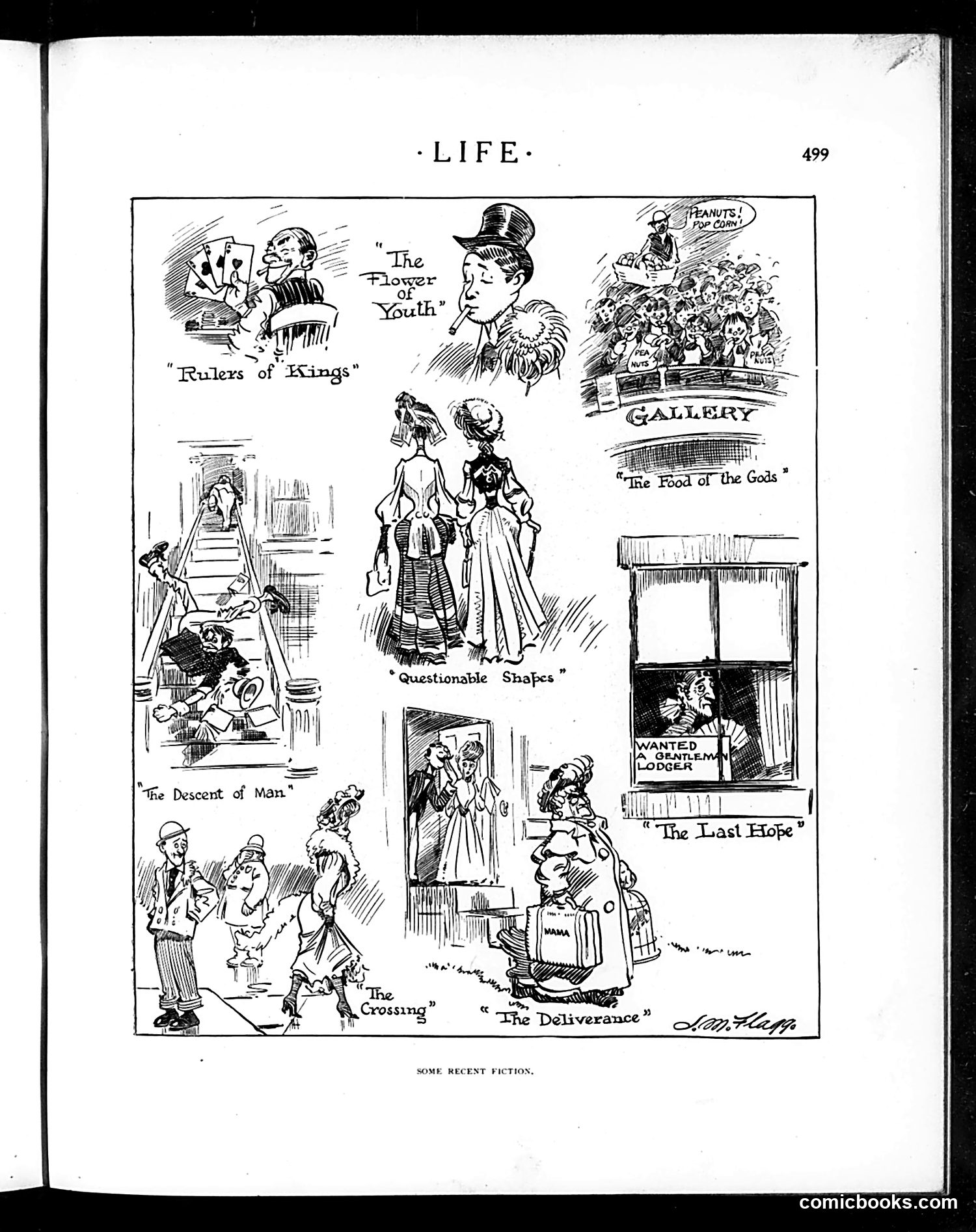
This page presents nine cartoon vignettes mocking popular literary and theatrical works of the era. Each sketch caricatures a well-known story's themes: - **"Rulers of Kings"** ridicules gambling and card games - **"The Flower of Youth"** depicts a dandyish character in a top hat - **"Peanuts! Pop Corn!"** satirizes crowd spectacles - **"The Descent of Man"** parodies Darwin's evolutionary theory - **"The Crossing"** shows working-class characters - **"Questionable Shapes"** features women in fashionable dress - **"The Food of the Gods"** references a H.G. Wells novel - **"The Last Hope"** depicts urban poverty with a "Wanted Gentleman Lodger" sign - **"The Deliverance"** shows a domestic scene The cartoonist (signed bottom right) uses exaggerated line-work to mock contemporary literature's pretensions and themes. The commentary appears critical of period fiction's sensationalism and social preoccupations.
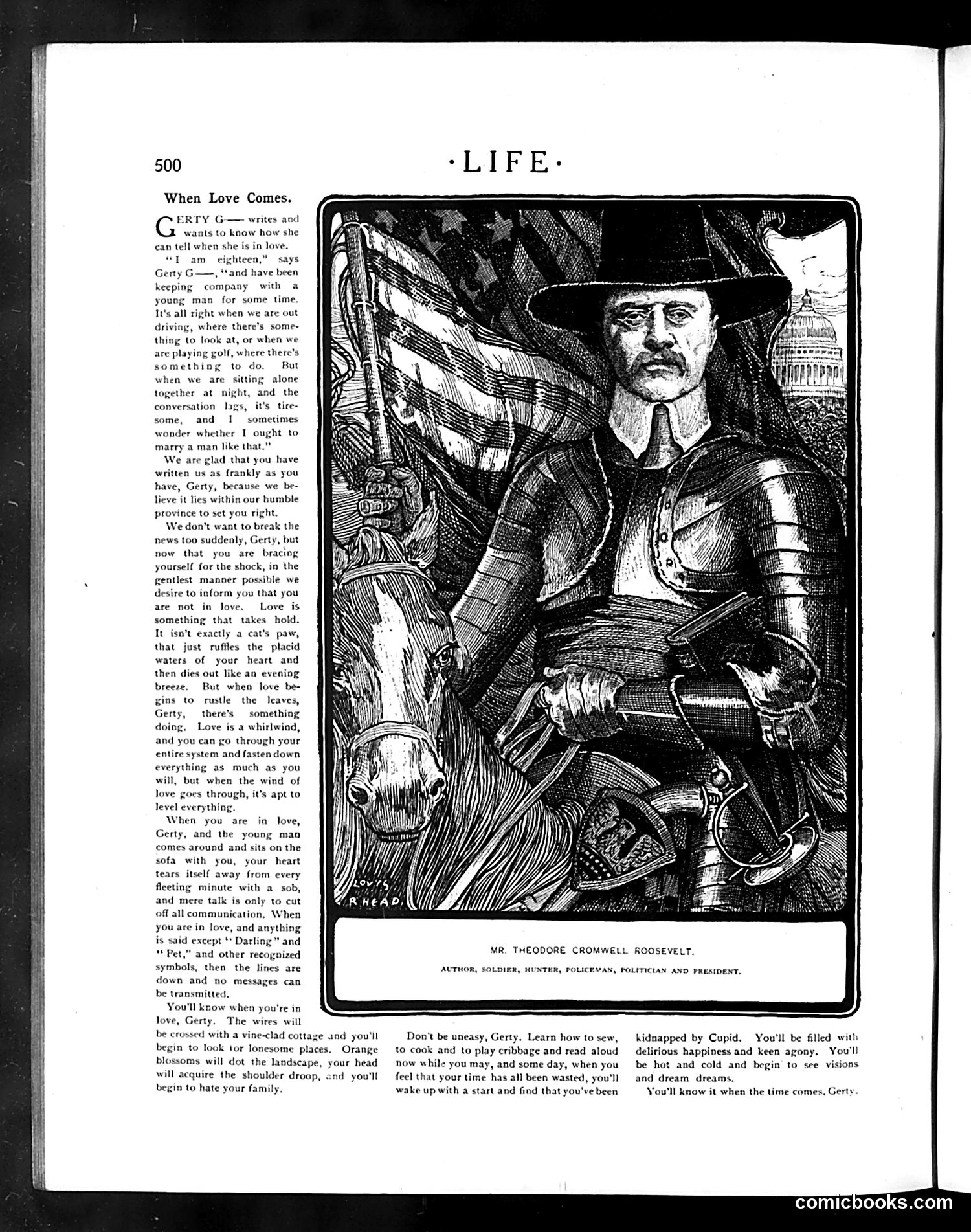
This page features a portrait illustration captioned "Mr. Theodore Cromwell Roosevelt, Author, Soldier, Hunter, Policeman, Politician and President." The illustration depicts a man in medieval knight's armor with a prominent mustache and wide-brimmed hat, holding a rifle. The armor appears to be satirical commentary—presenting Roosevelt in exaggerated, chivalric costume rather than modern dress. The accompanying article titled "When Love Comes" offers romantic advice to a woman named "Gerty," discussing courtship and marriage prospects. The satire likely mocks Roosevelt's well-known image as a vigorous, combative "man of action"—his reputation as a hunter, soldier, and rough-rider. By rendering him as a medieval warrior, Life magazine appears to be commenting humorously on his hypermasculine public persona and adventurous self-presentation.
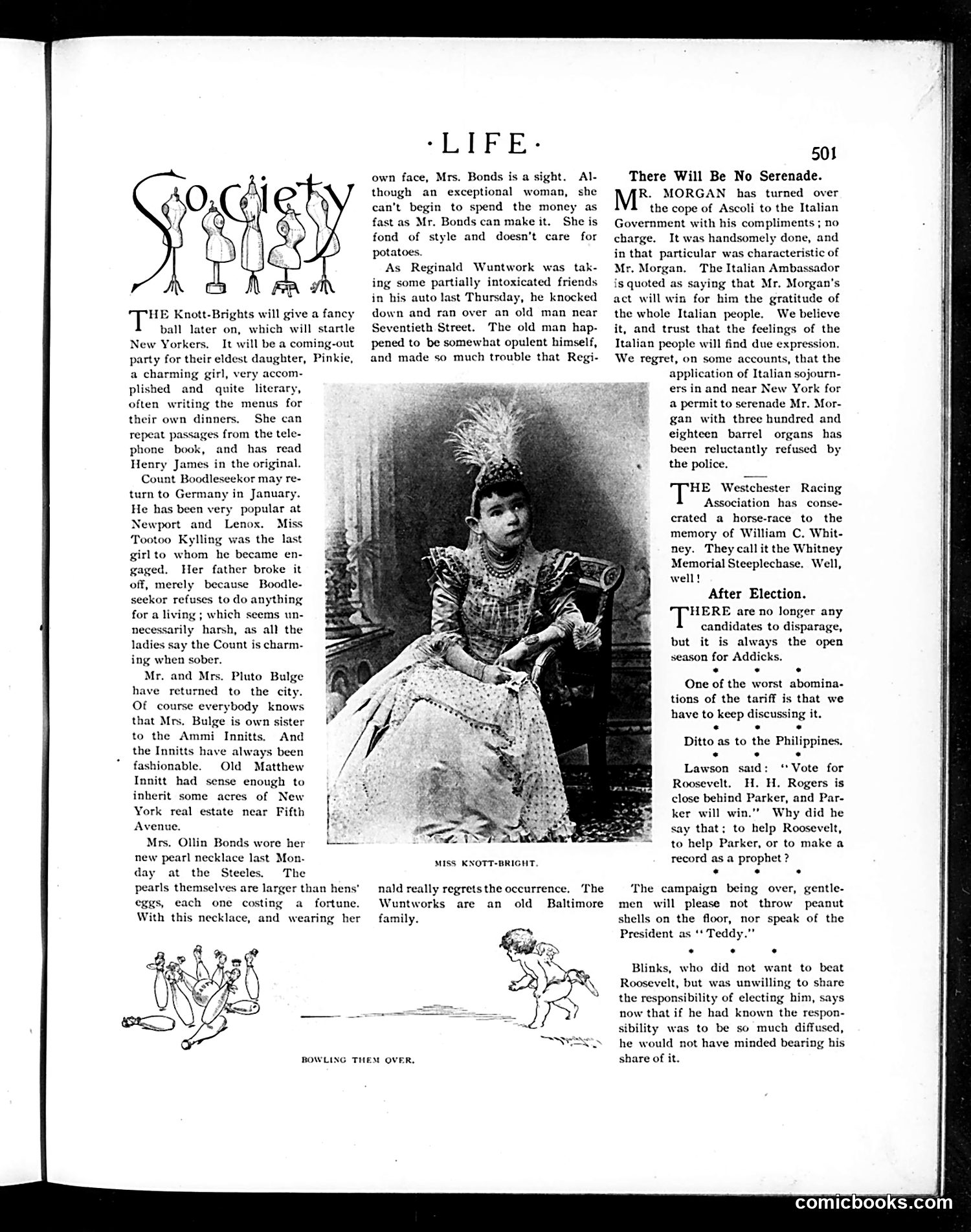
This page contains society gossip and political commentary rather than political cartoons. The main photograph shows "Miss Knott-Bright," described as an accomplished young woman from a prominent New York family who writes menus and reads Henry James. The text includes brief satirical jabs at 1912 election politics, referencing Roosevelt, Parker, Rogers, and Blinks. One comment mocks political candidates who disappear after elections—an "open season for Addicks" (likely referring to a specific political figure). The cartoons at bottom show people "Bowling Them Over," likely social satire about leisure activities among the wealthy elite. The page primarily targets New York's elite social circles and contemporary political figures, employing gentle mockery of their pretensions and behaviors typical of Life magazine's approach.
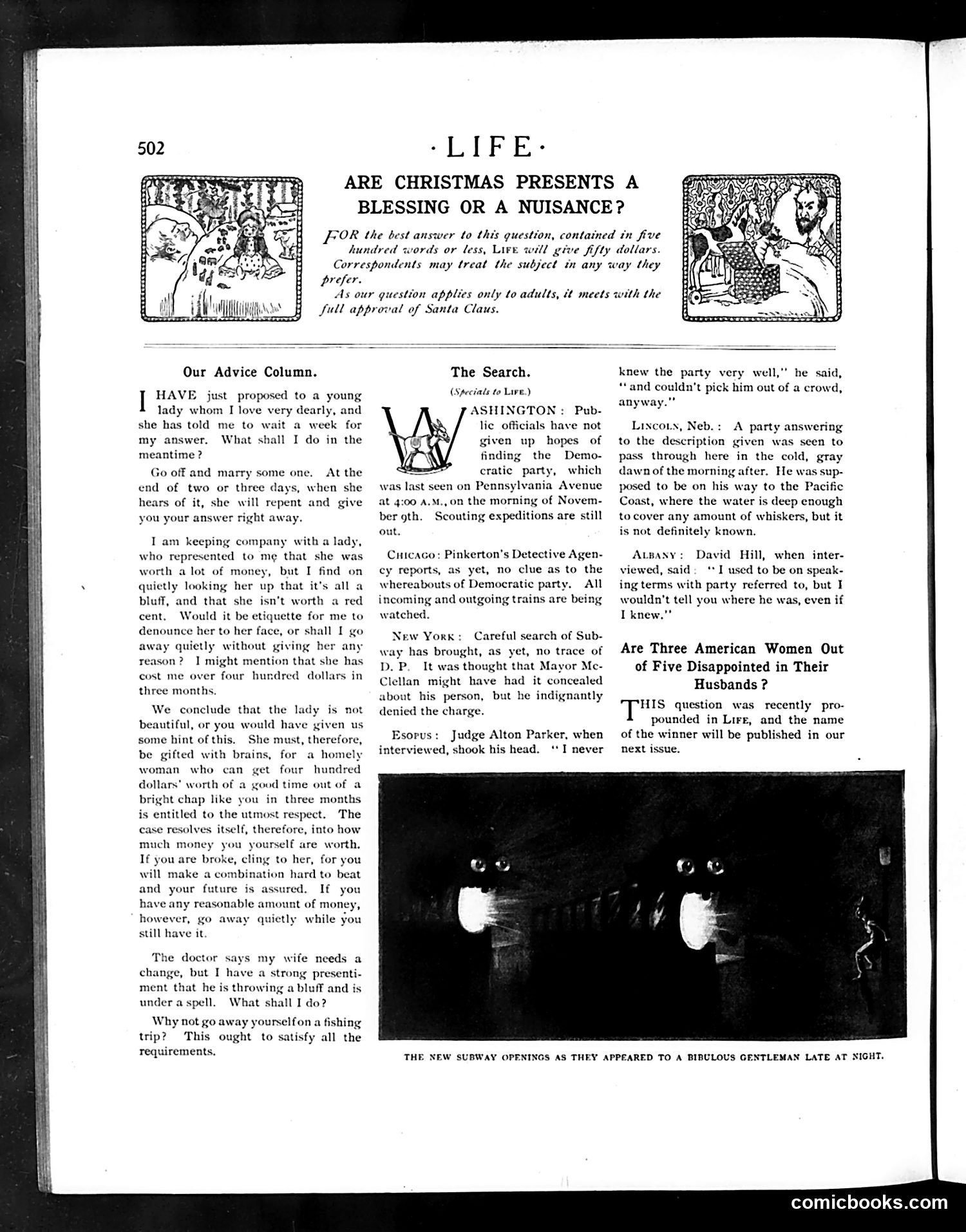
This page contains three separate advice column items and a photograph. The main content includes "Our Advice Column" addressing etiquette questions—whether a young woman should wait for a man's proposal, and how to handle a wife's need for a change of scenery. The responses offer practical, somewhat sardonic guidance about relationships and money. "The Search" section references contemporary news: Democratic Party officials searching for missing party members in Washington D.C., with reports from Chicago and New York about ongoing investigations. These appear to reference actual 1910s-era political disappearances or scandals, though the specific identities of those sought aren't clearly identified here. The photograph at bottom shows subway tunnel openings, humorously captioned as appearing "to a bibulous gentleman late at night"—satirizing drunk perceptions of the newly-opened New York subway system.
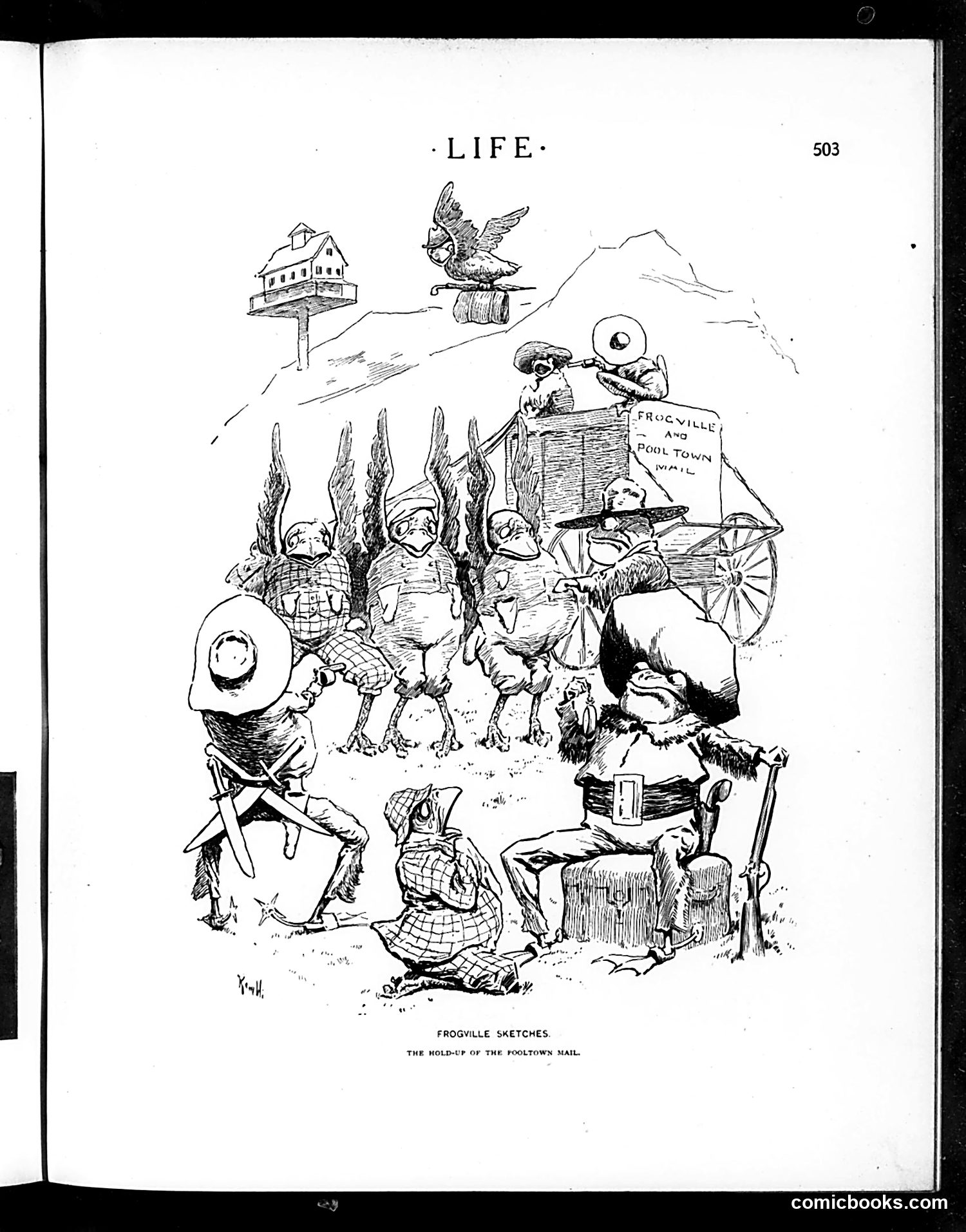
This is a humorous anthropomorphic cartoon depicting frogs as characters in a Wild West scenario. The frogs are staging a hold-up of a mail delivery cart labeled "Frogville and Pooltown Mail." The scene parodies frontier bandits: armed frog bandits confront mail carriers, with one bandit prominently wearing a large hat. A birdhouse serves as a frontier structure in the background, and a bird on a post watches the action—establishing a whimsical animal-world setting. The satire appears to be gentle humor rather than sharp political commentary, playing on the contrast between dignified mail delivery and chaotic bandit activity. The "Frogville" setting suggests this is part of a serialized humorous feature about a fictional frog community and their everyday (if absurd) adventures.
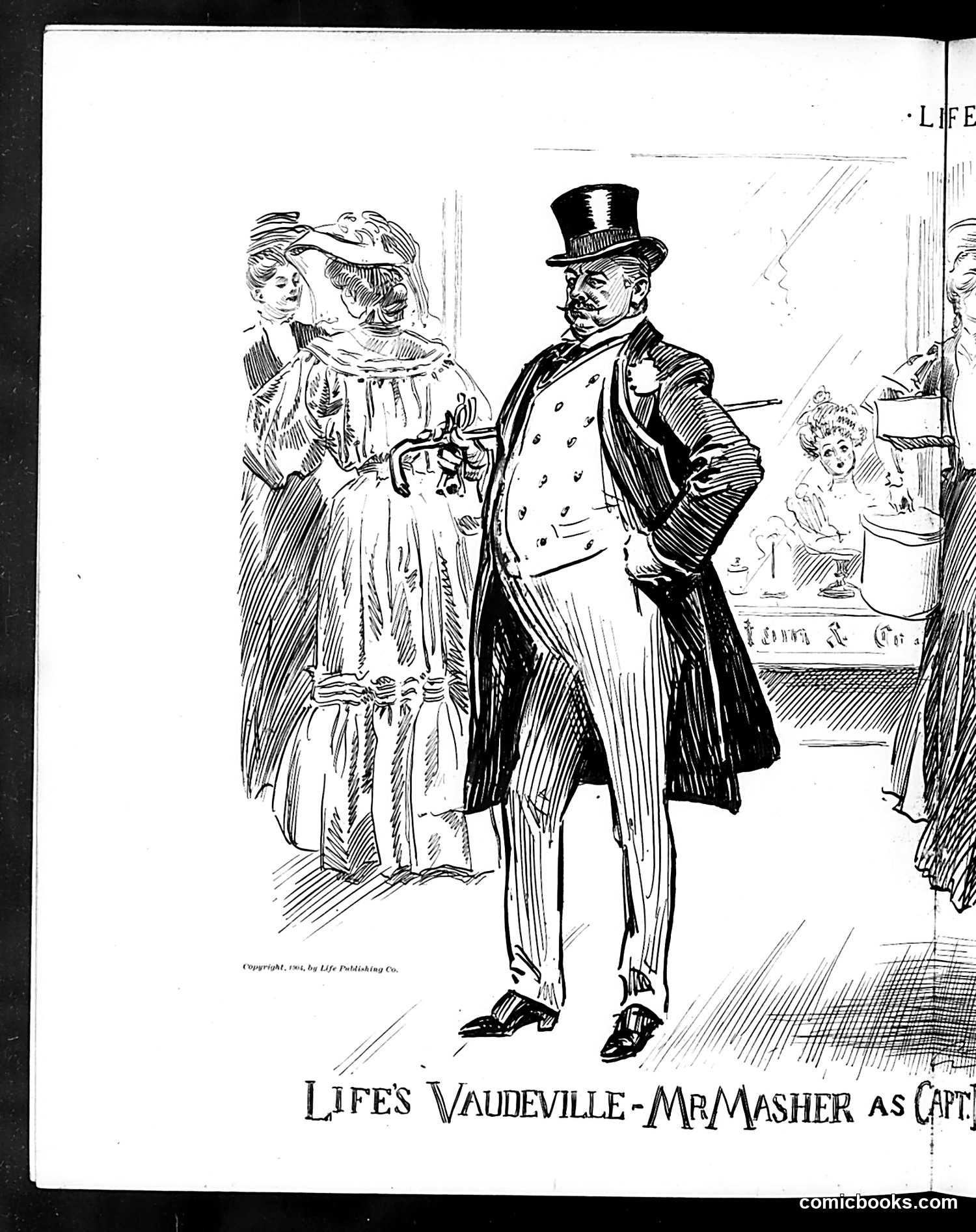
This illustration depicts a well-dressed gentleman in formal attire (top hat, coat with polka dots) identified as "Mr. Masher" in a vaudeville or theatrical sketch. The caption indicates he's playing the character of a "Captain." The term "masher" was period slang for an aggressive flirt or man who pursued women. The scene appears to show him interacting with fashionable women in what looks like a social setting, likely satirizing his theatrical portrayal of a coquettish military officer character—a common vaudeville stock character. The satire targets both theatrical conventions (the exaggerated "Captain" type) and contemporary social behavior (the "masher" archetype), suggesting audiences would recognize this as parody of recognizable vaudeville performance styles and social archetypes of the era.
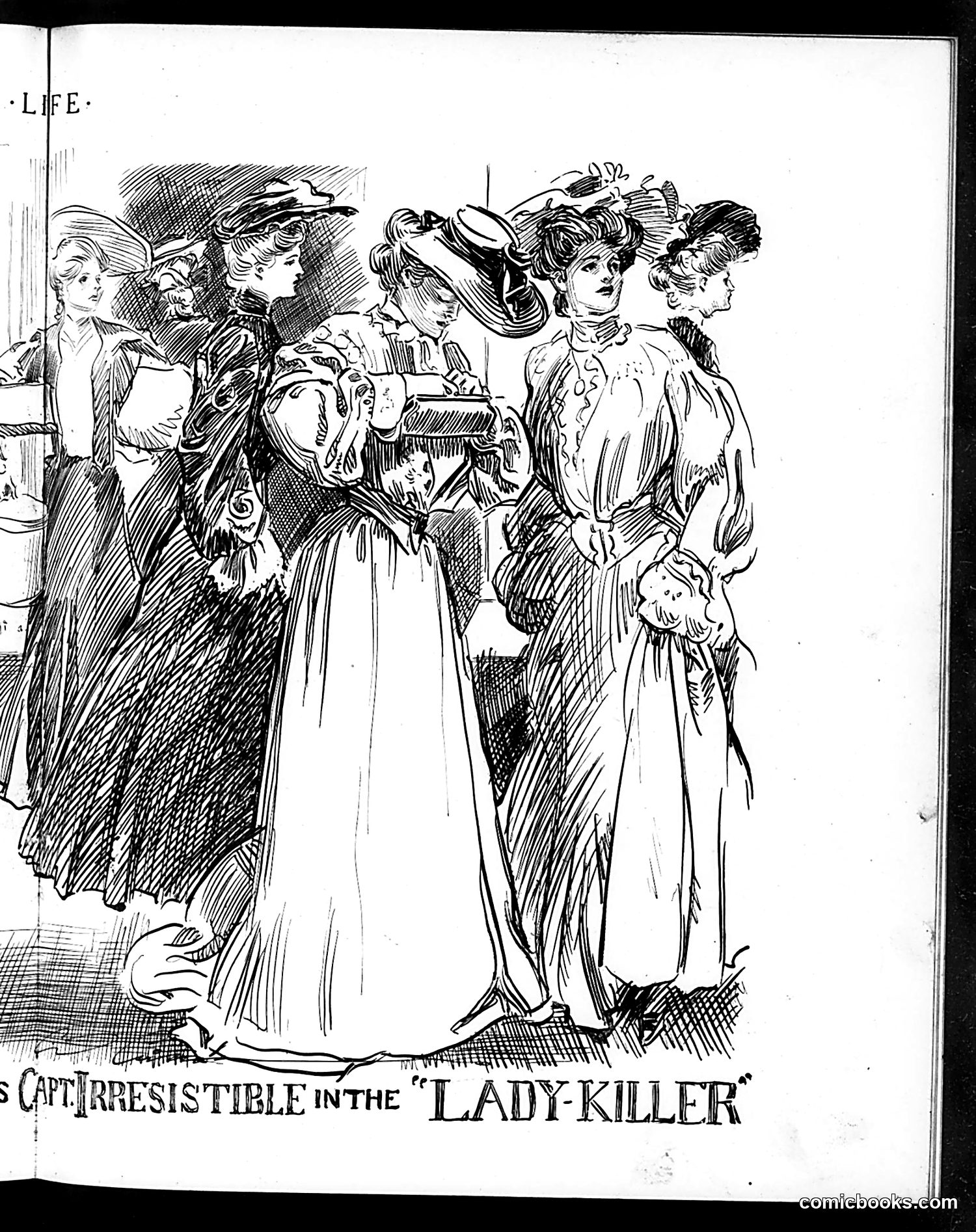
This appears to be a satirical illustration from *Life* magazine depicting a man (labeled "Captain Irresistible") surrounded by admiring women in early 1900s dress. The satire plays on the common literary and theatrical trope of the irresistibly charming male character who attracts female attention effortlessly. The joke likely mocks either: - A specific theatrical production or popular novel featuring such a character - The vanity of men who consider themselves "lady-killers" (charming seducers) - Contemporary romantic melodrama conventions The elaborately dressed women with their attention focused on the central male figure emphasize the exaggerated, performative nature of such masculine appeal. Without additional context about the specific production referenced, the exact target remains unclear, though the satire critiques romantic pretension generally.
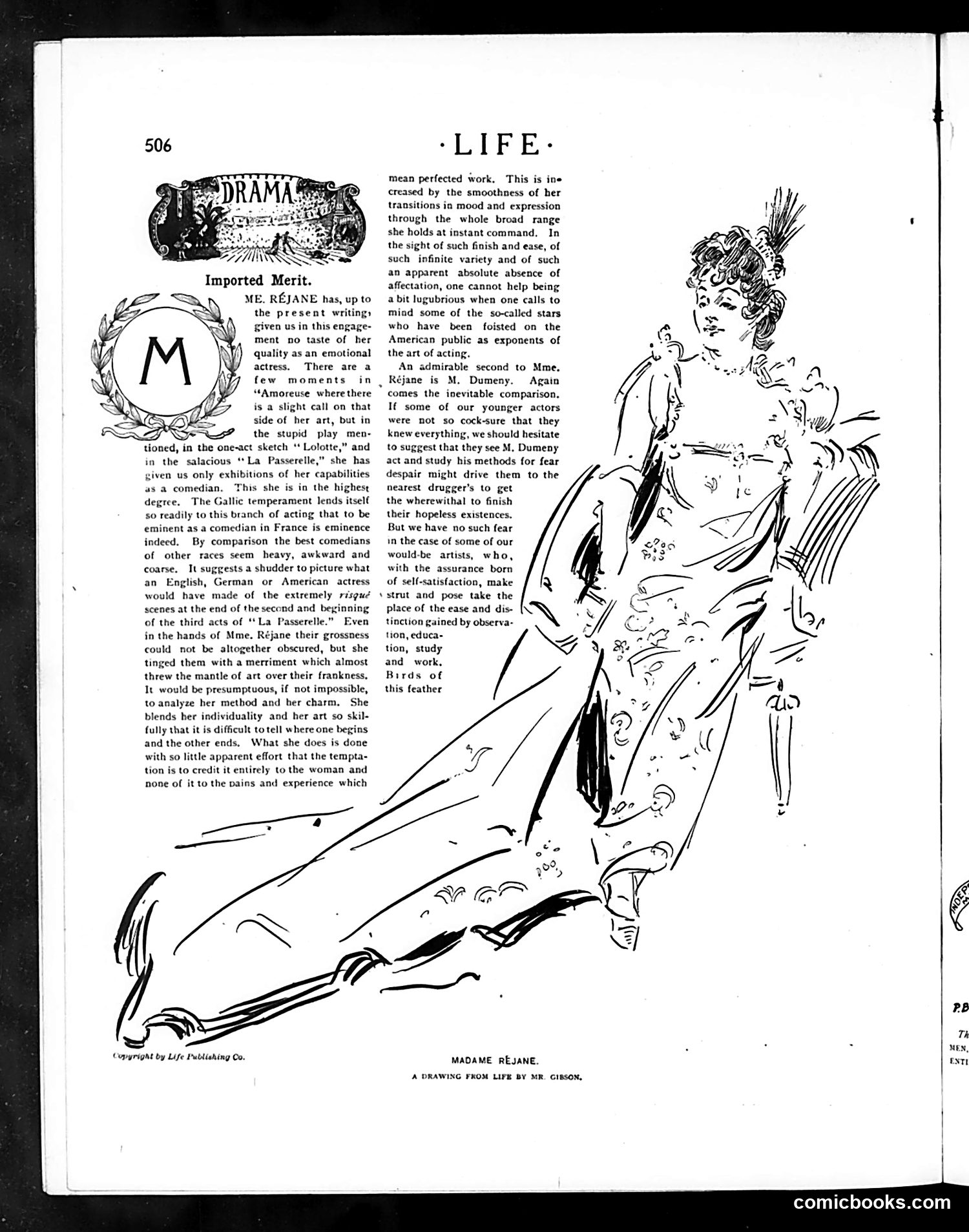
This page critiques American theater's admiration for French actresses. The article praises **Madame Réjane**, a French performer, while comparing her favorably to American actresses. The author argues that while Réjane demonstrates technical mastery and emotional range, American actresses lack her training and sophistication. The satire targets American audiences' assumption that European (particularly French) talent is inherently superior. The accompanying sketch by Sir Gibson depicts Réjane in an exaggerated, theatrical pose—suggesting the very artificiality the text claims makes her great. The piece implies that American theater-goers are culturally insecure, too readily dismissing homegrown talent in favor of imported prestige.
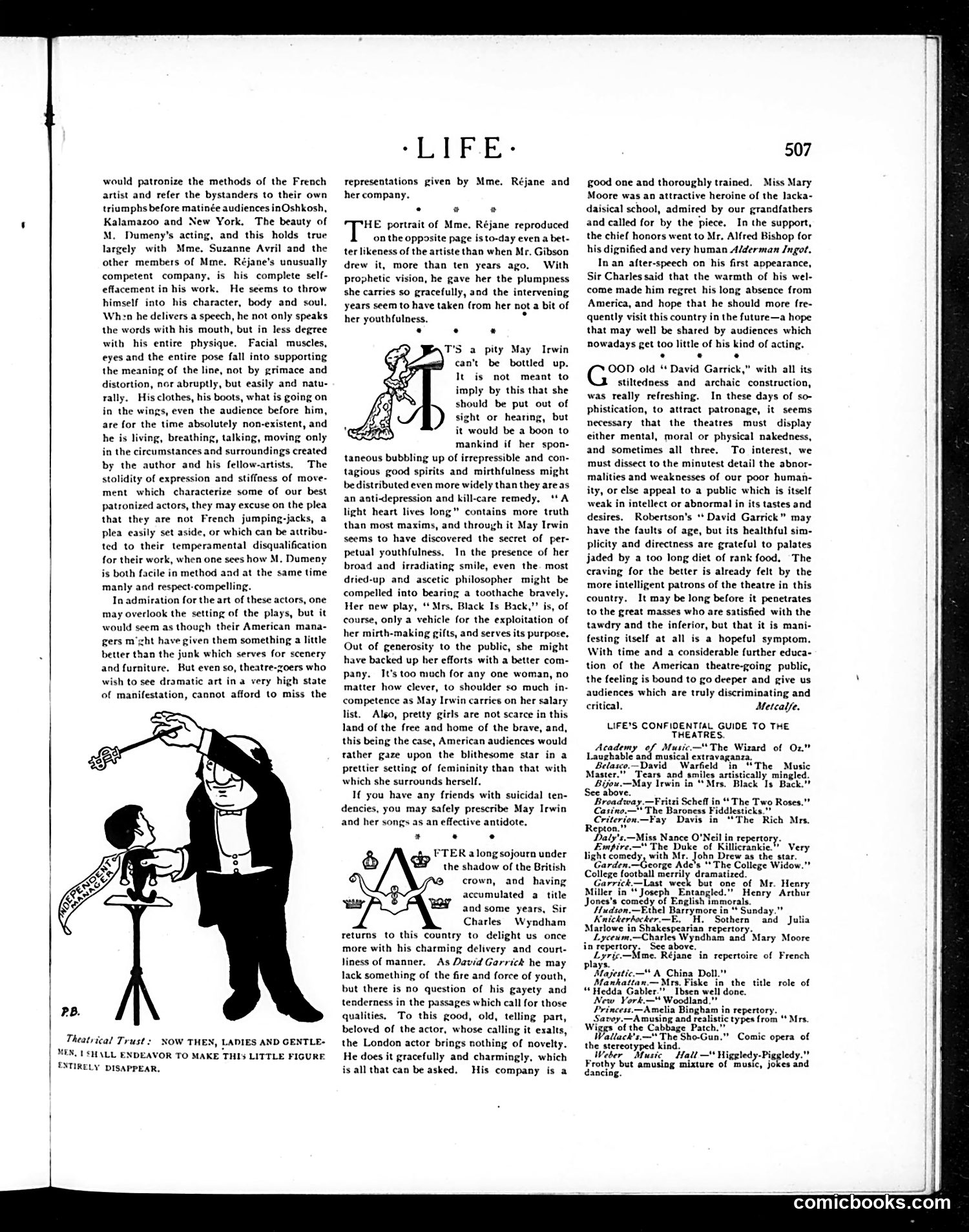
This page contains theatrical criticism and satire targeting the American theater establishment circa early 1900s. **The Main Cartoon** ("Theatrical Trust") depicts a magician attempting to make a small figure disappear—satirizing the theatrical monopoly's attempt to eliminate independent or competing theatrical productions. The "Theatrical Trust" was a real cartel controlling American theaters at this time. **The Text** praises French actress Mme. Réjane's company for their naturalistic acting method, contrasting it favorably with American theater's often stilted performances. The critic admires how French actors inhabit their characters authentically rather than performatively. The piece also celebrates comedian May Irwin's infectious energy and youthfulness, though criticizing her supporting cast as incompetent and suggesting she deserves better theatrical production values. The satire critiques American commercial theater as inferior to European artistry, while the cartoonist mocks the Trust's monopolistic control over theatrical presentation.
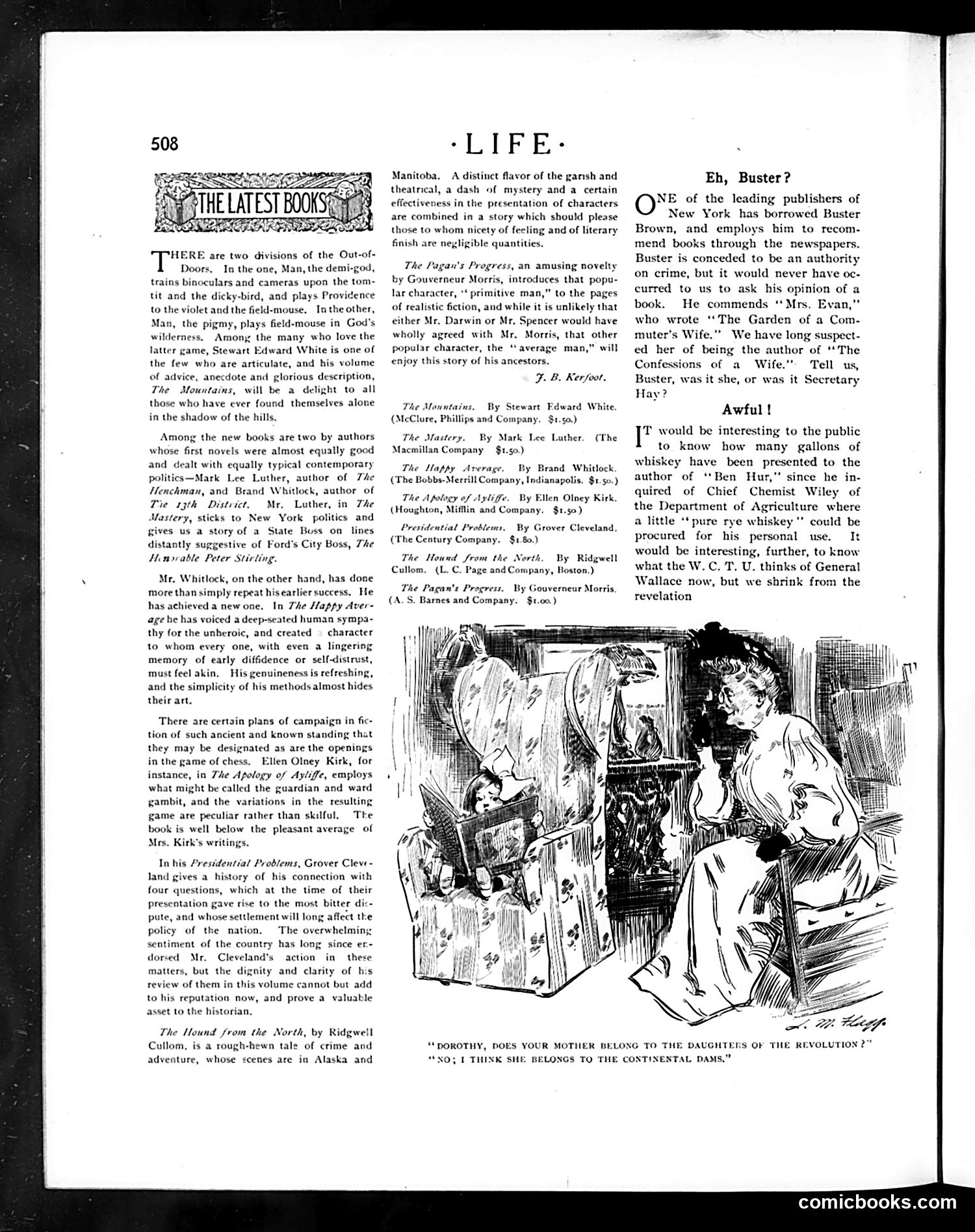
This page from *Life* magazine features two main elements: a book review section and a satirical cartoon. **The Cartoon:** The illustration depicts a woman showing a man (likely a customs official or authority figure) the contents of a trunk, with the caption: "DOROTHY, DOES YOUR MOTHER BELONG TO THE DAUGHTERS OF THE REVOLUTION?" "NO; I THINK SHE BELONGS TO THE CONTINENTAL DAMES." **The Satire:** This is a joke about American genealogical societies and social snobbery. The "Daughters of the American Revolution" (DAR) was a prestigious hereditary organization requiring descent from Revolutionary War patriots. The humor plays on the woman's evasive answer—suggesting her mother belongs to a lesser or more obscure patriotic lineage group ("Continental Dames"), poking fun at the pretentiousness of such exclusive organizations and the obsession with proving aristocratic American ancestry. The cartoon satirizes the era's class consciousness and genealogical one-upmanship among wealthy Americans. **The Book Reviews:** The text reviews contemporary novels dealing with politics, nature writing, and historical works, including Grover Cleveland's *Presidential Problems*.
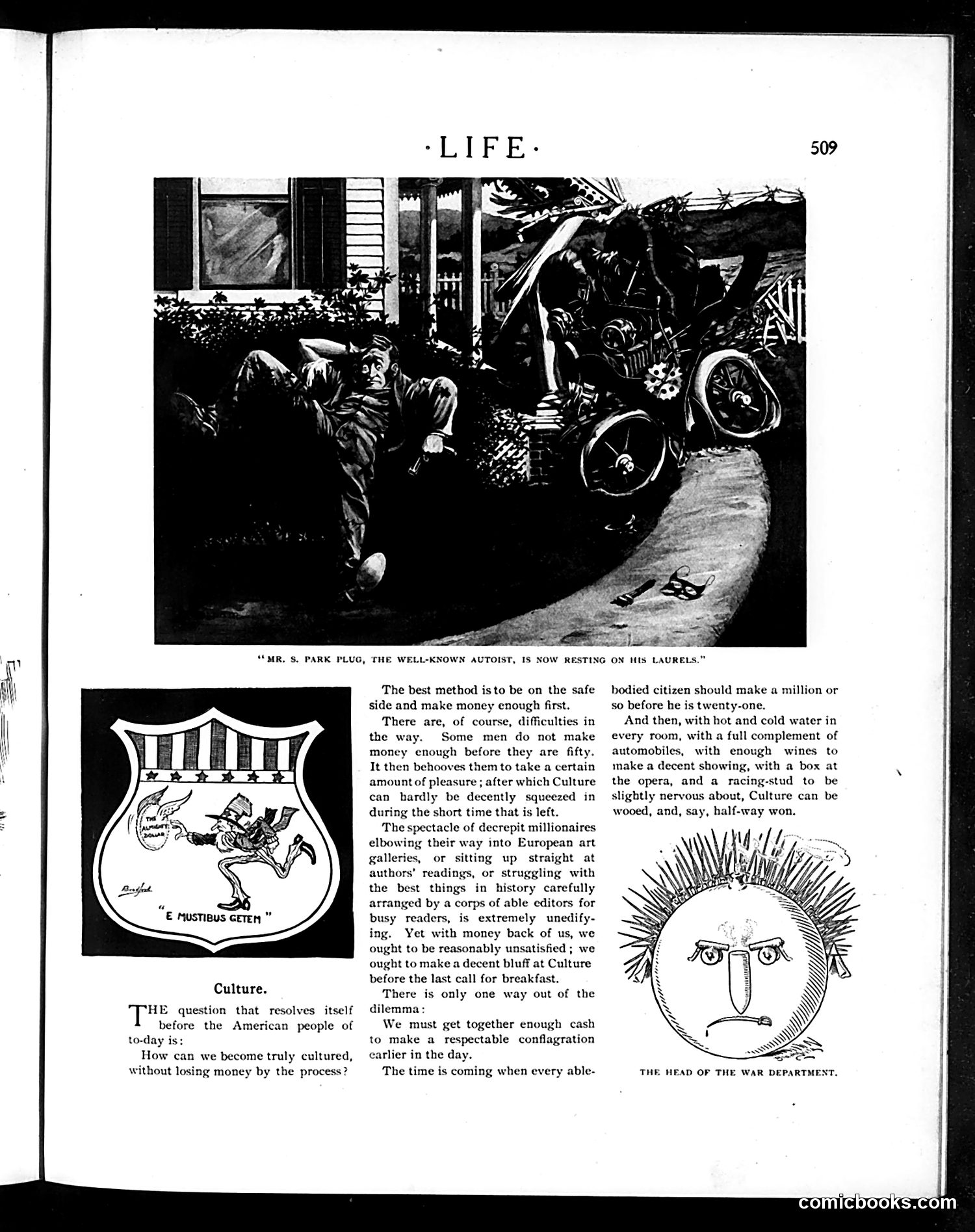
This page satirizes American attitudes toward "Culture" and wealth. The main text argues that Americans prioritize making money over cultivating refined tastes, then awkwardly attempt to appear cultured only after accumulating wealth—visiting European art galleries, attending readings, and acquiring luxury trappings like opera boxes and racing horses. The satire suggests this approach is backwards and hollow. The author proposes a tongue-in-cheek solution: young men should become millionaires by age twenty-one, then use their wealth to genuinely pursue culture. The top illustration shows a car crash victim ("Mr. S. Park Plug, the well-known autoist"), darkly humorizing the era's automobile danger. The shield emblem labeled "E Pluribus Unum" (appearing to be a pun or parody) and the angry face captioned "Head of the War Department" appear to be separate satirical cartoons about American institutions, though their specific references remain unclear without additional context.
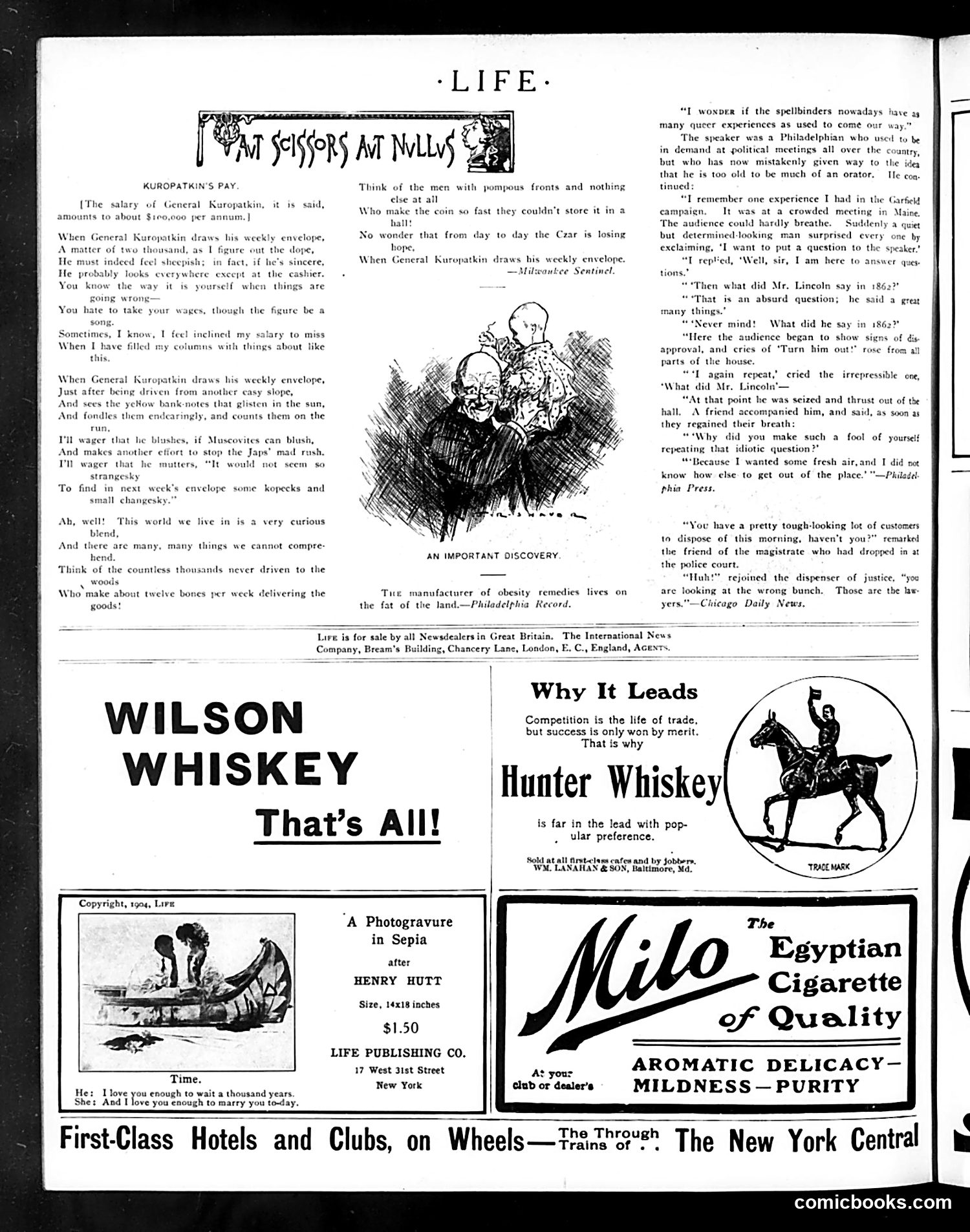
**Main Cartoon: "Kuropatkin's Pay"** This satirizes General Kuropatkin, a Russian military commander during the Russo-Japanese War (1904-1905). The cartoon mocks the apparent contradiction that while Kuropatkin draws a substantial salary, Russia is losing the war to Japan daily. The poem suggests he's profiting financially while failing militarily—implying either incompetence or indifference to Russia's battlefield defeats. The satire targets both the general's inadequacy and the broader absurdity of paying military leadership handsomely for failure. **Secondary Item: "An Important Discovery"** A brief joke noting that the manufacturer of obesity remedies profits from people's excess weight—a wordplay on "living off the fat of the land." **Context:** Life magazine in 1904 was following the Russo-Japanese War closely, treating Russian setbacks as fodder for American political humor. The page is otherwise filled with period advertisements for whiskey, cigarettes, and hotels.
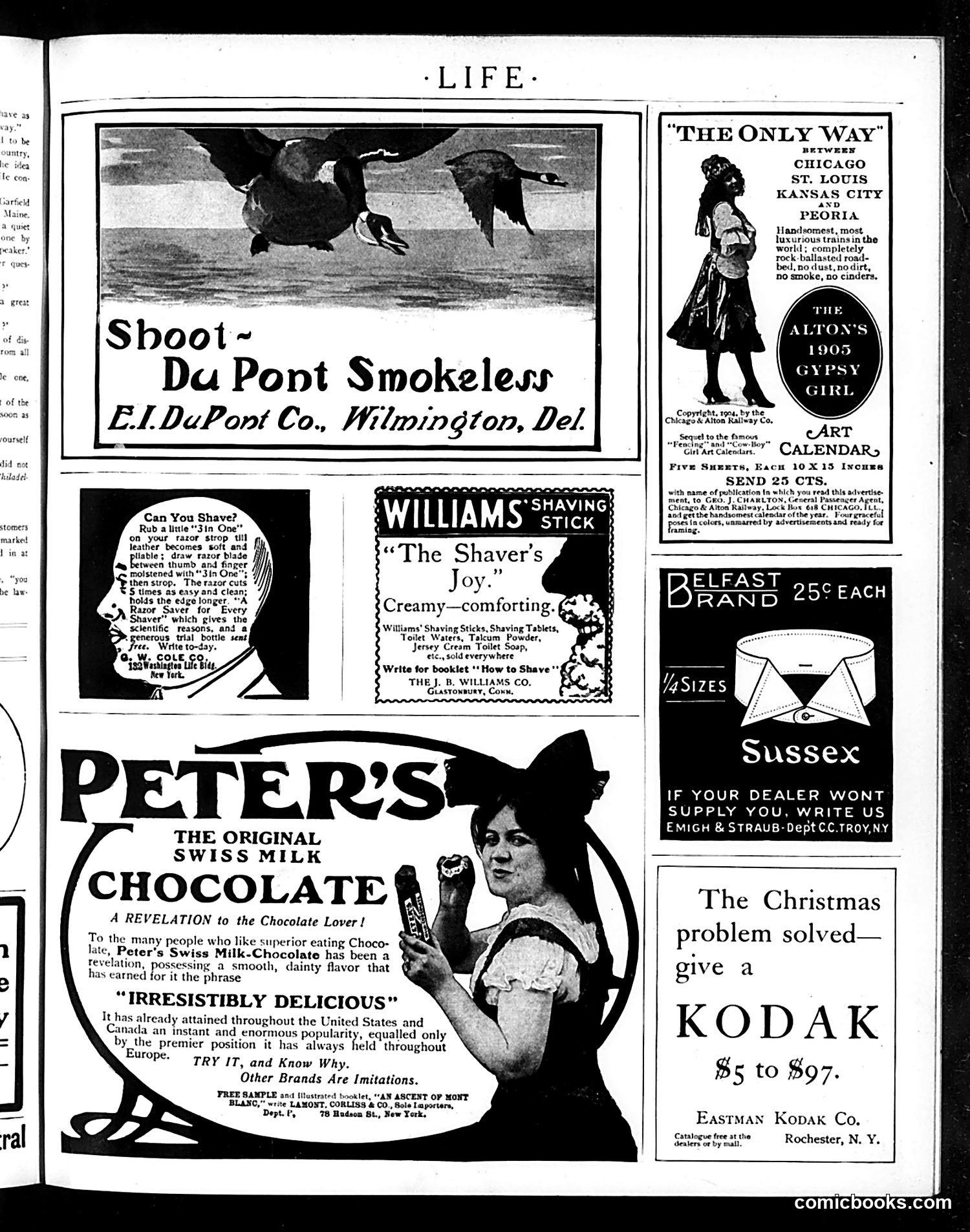
This page is primarily **advertising**, typical of early 1900s magazines. The content includes: **Major Advertisements:** - Du Pont smokeless powder (top left, with hunting dogs) - Peter's Swiss Milk Chocolate (center, large ornate frame) - Williams Shaving products - Alton Railway's "Gypsy Girl" calendar promotion - Kodak cameras - Sussex collars and Belfast Brand products **Relevant Context for Modern Readers:** The ads reflect Edwardian-era consumer culture and manufacturing innovation. Du Pont's emphasis on "smokeless" powder represents recent technological advancement. The chocolate ad's claims of "irresistibly delicious" Swiss quality reflects period assumptions about European superiority in luxury goods. The railway advertisement emphasizes modern comfort ("rock ballasted roadbed, no dust, no dirt, no smoke"), showcasing America's industrial pride around 1905. The shaving products ad uses technical language to legitimize grooming as scientific rather than frivolous—a common marketing approach when male grooming was becoming commercialized. **There is no political cartoon or satire on this page.**
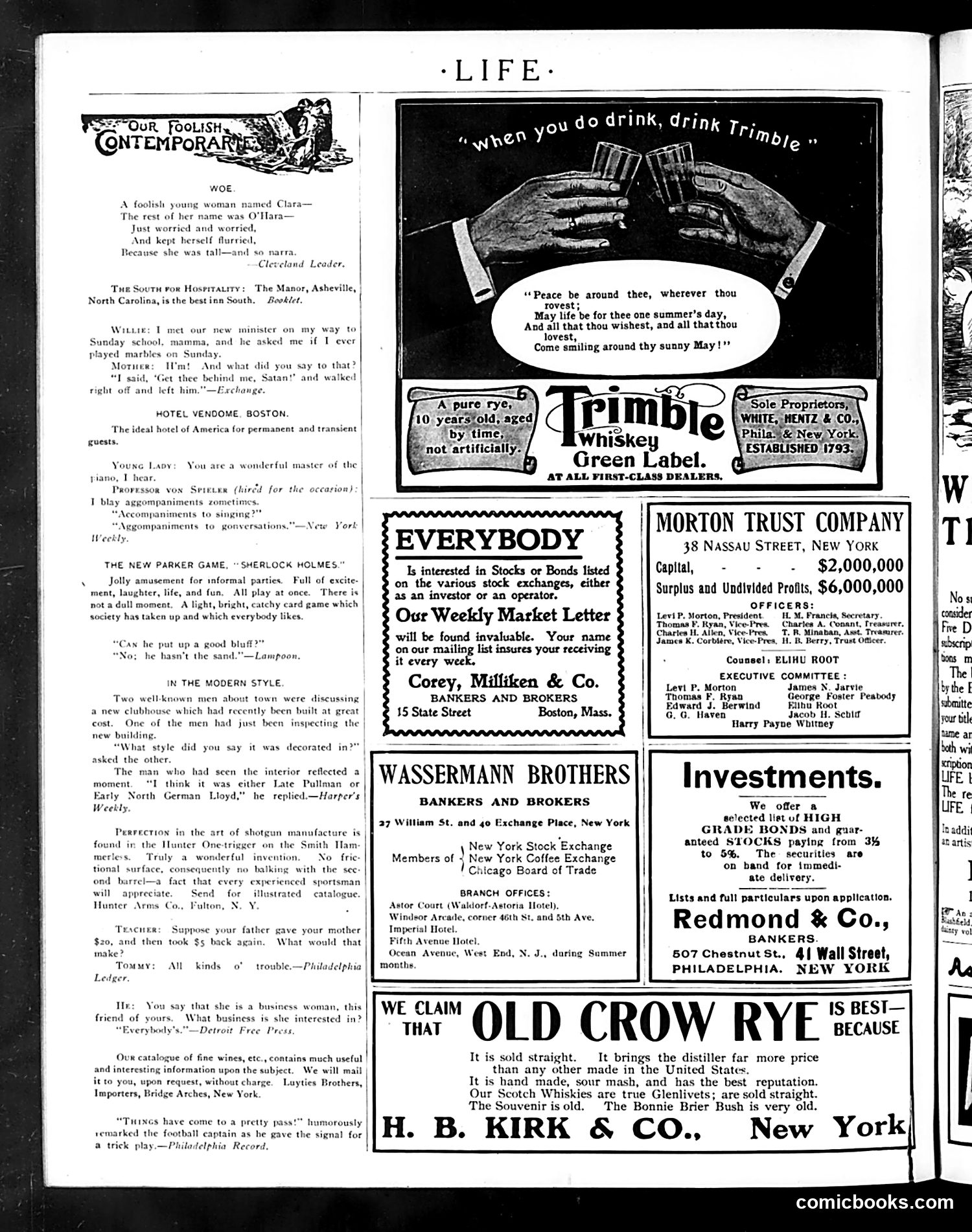
This page from Life magazine consists primarily of **advertising** and **brief humorous anecdotes** rather than political cartoons. The satirical content includes short jokes about social etiquette and class pretension. "Our Foolish Contemporary" mocks a woman named Clara O'Hara for her anxious social climbing, despite being tall. Other brief pieces lampoon middle-class pretensions—like a man describing a clubhouse's décor as "Late Pullman or Early North German Lloyd" (comparing interior design to steamship styles, suggesting confused gentility). The page is dominated by financial advertisements from banks and brokers (Morton Trust Company, Wassermann Brothers, Redmond & Co.). There is one substantial **advertisement for Trimble Whiskey** featuring an illustration of toasting hands with sentimental verse about peace and summer pleasures. The anecdotes are light social humor typical of early 1900s Life magazine—jokes about ministers, piano lessons, and father-daughter economics—rather than serious political satire.
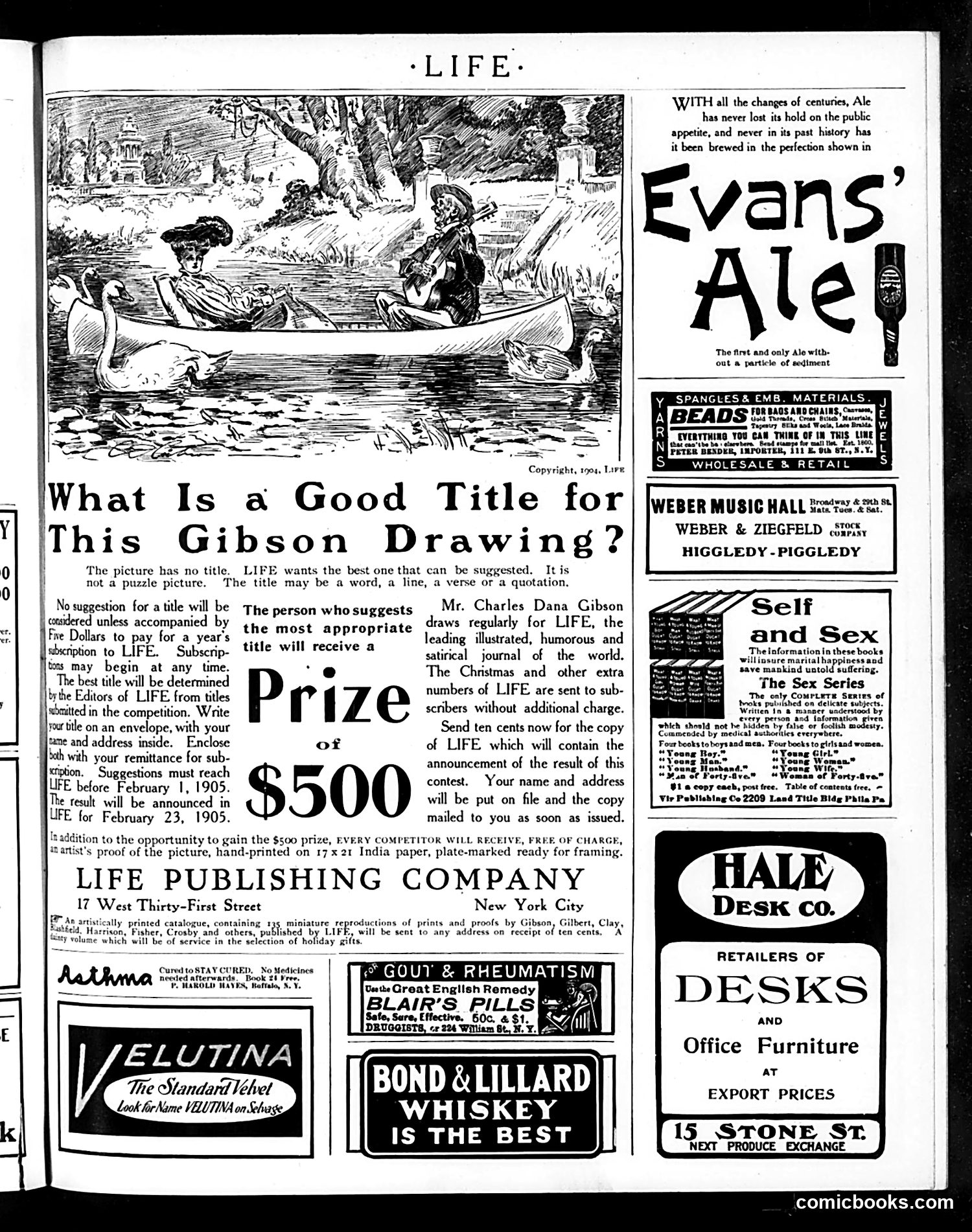
This page centers on a **Gibson Girl drawing contest**. Charles Dana Gibson, the famous illustrator whose idealized depictions of American women defined the era, created an untitled sketch showing a couple in a rowboat on a pastoral river. Life magazine is crowdsourcing a title from readers, offering a **$500 prize**—substantial money at the time. The cartoon itself appears to be a romantic scene with no obvious satirical content; the satire lies in Life's *contest format* rather than the image itself. This was typical of Life's participatory humor and its audience engagement strategy. The remainder is **advertising**: remedies (gout pills, velvet fabric), furniture, whiskey, and books on marital relations—representative of early 1900s consumer culture. The layout reflects Life's identity as both satirical journal and commercial magazine seeking revenue through ads.
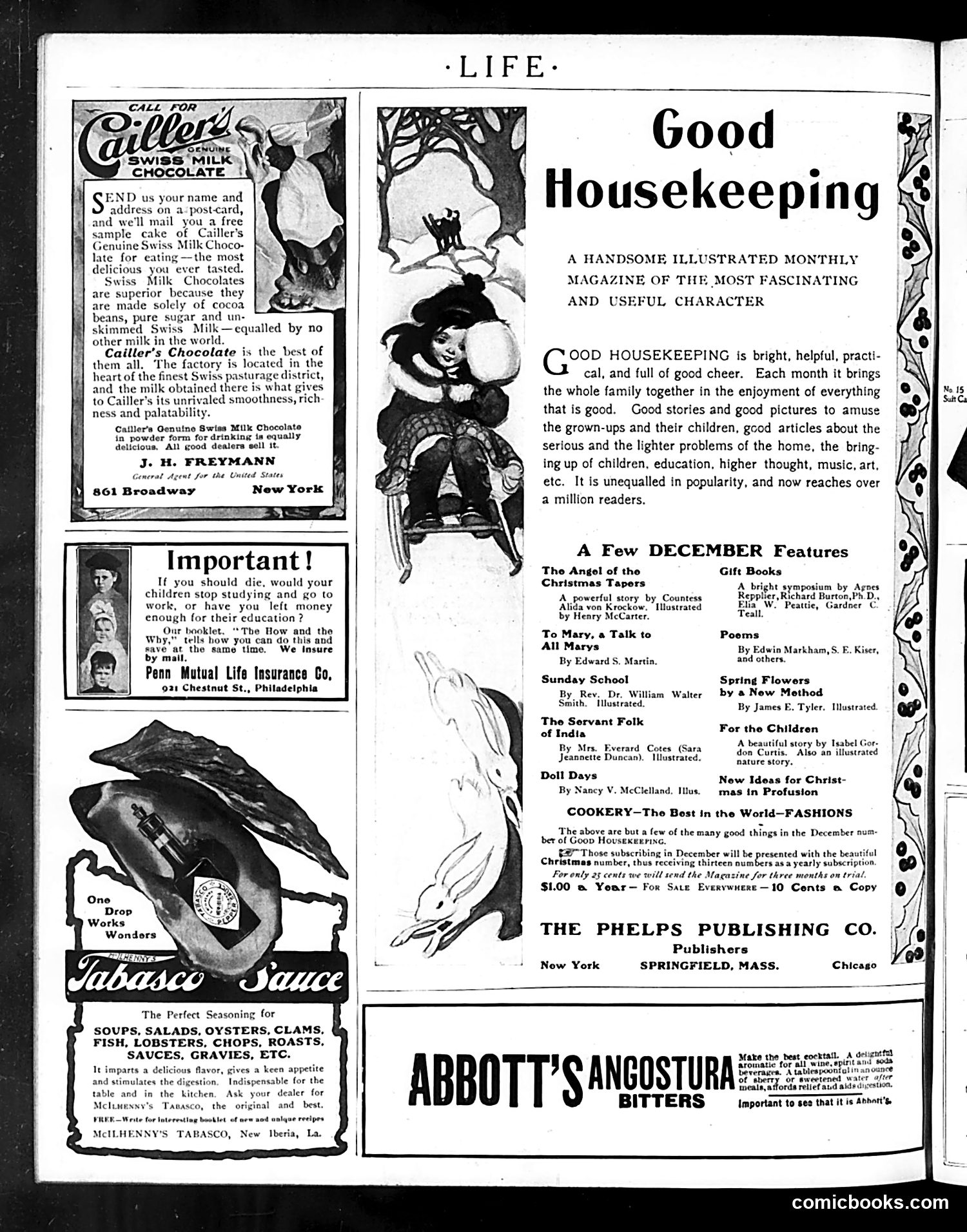
This is primarily an **advertising and magazine promotion page** rather than a satirical cartoon page. The content includes: **Advertisements:** - Cailler's Swiss chocolate (sample offer) - Penn Mutual Life Insurance (emphasizing financial security for children's education) - Tabasco sauce - Abbott's Angostura Bitters (cocktail ingredient) **Magazine Promotion:** The right side promotes *Good Housekeeping* magazine, emphasizing its appeal to families with content spanning serious domestic issues, child-rearing, education, and lighter entertainment (stories, poetry, fashion, cooking). **Social Context:** The insurance ad reflects early-20th-century concerns about economic security and children's futures. The prominence of household-focused content reflects the era's gender roles and domestic ideology. The cocktail bitters advertisement suggests this predates Prohibition (or was published early in the Prohibition era). There is **no political satire visible** on this page—it's a commercial publication mixing product advertising with magazine marketing to attract middle-class readers.
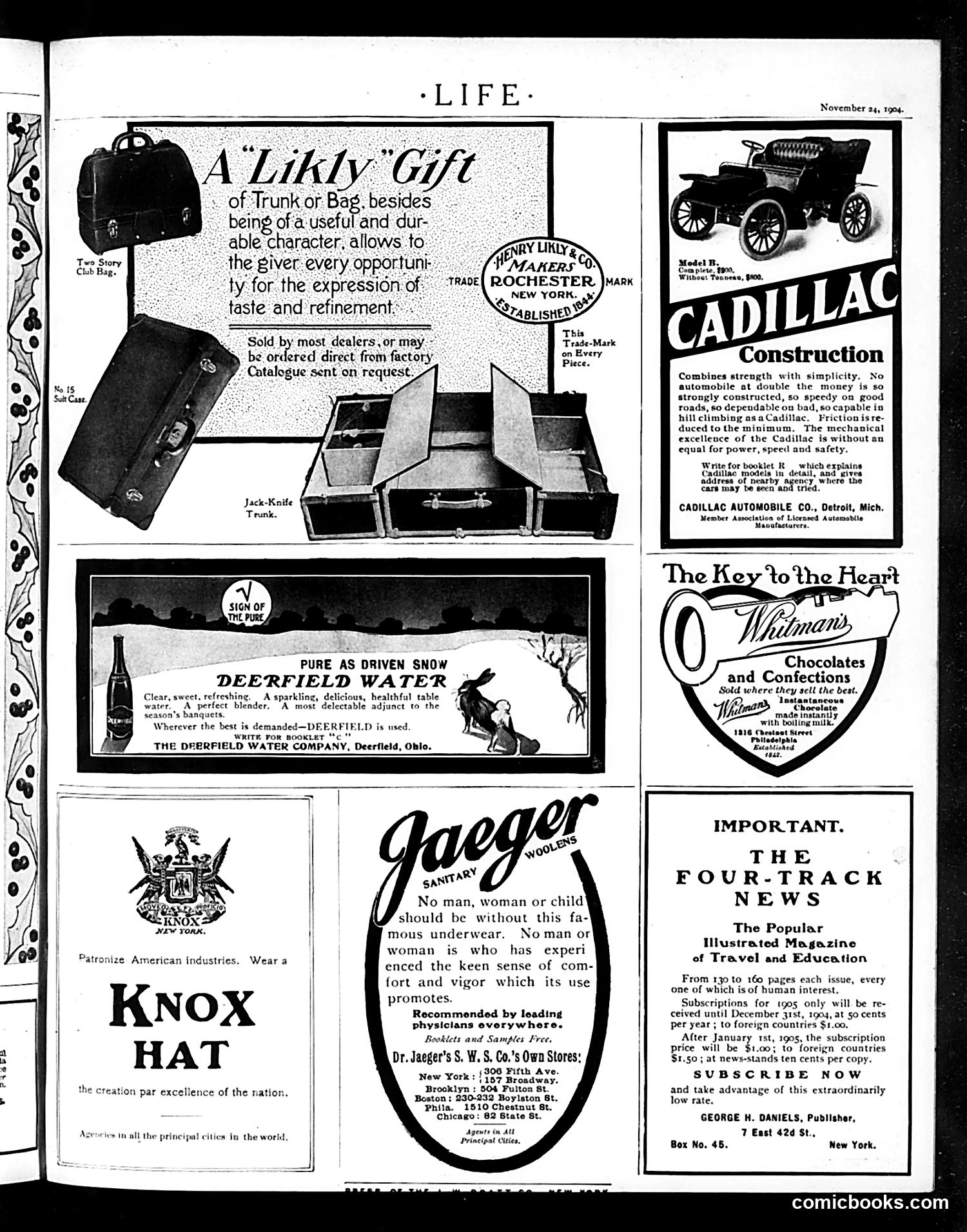
This is primarily an **advertising page** from Life magazine (November 24, 1904), not a satirical cartoon. It contains multiple product advertisements typical of early 1900s publications: **Main advertised items include:** - Luxury trunks and bags (positioned as refined gifts) - Cadillac automobiles (emphasizing durability and mechanical excellence) - Deerfield Water (pure drinking water) - Whitman's Chocolates - Knox Hats (described as "the creation par excellence of the nation") - Jaeger sanitary woolens/underwear - The Four-Track News magazine The page reflects **early 20th-century consumer culture**: products are marketed with appeals to taste, American patriotism ("patronize American industries"), health benefits, and middle/upper-class refinement. The advertisements assume readers have disposable income for luxury goods—trunks, automobiles, quality chocolates—which dates this to a period of significant American prosperity before WWI. No political satire or caricature is present; this is straightforward commercial advertising.
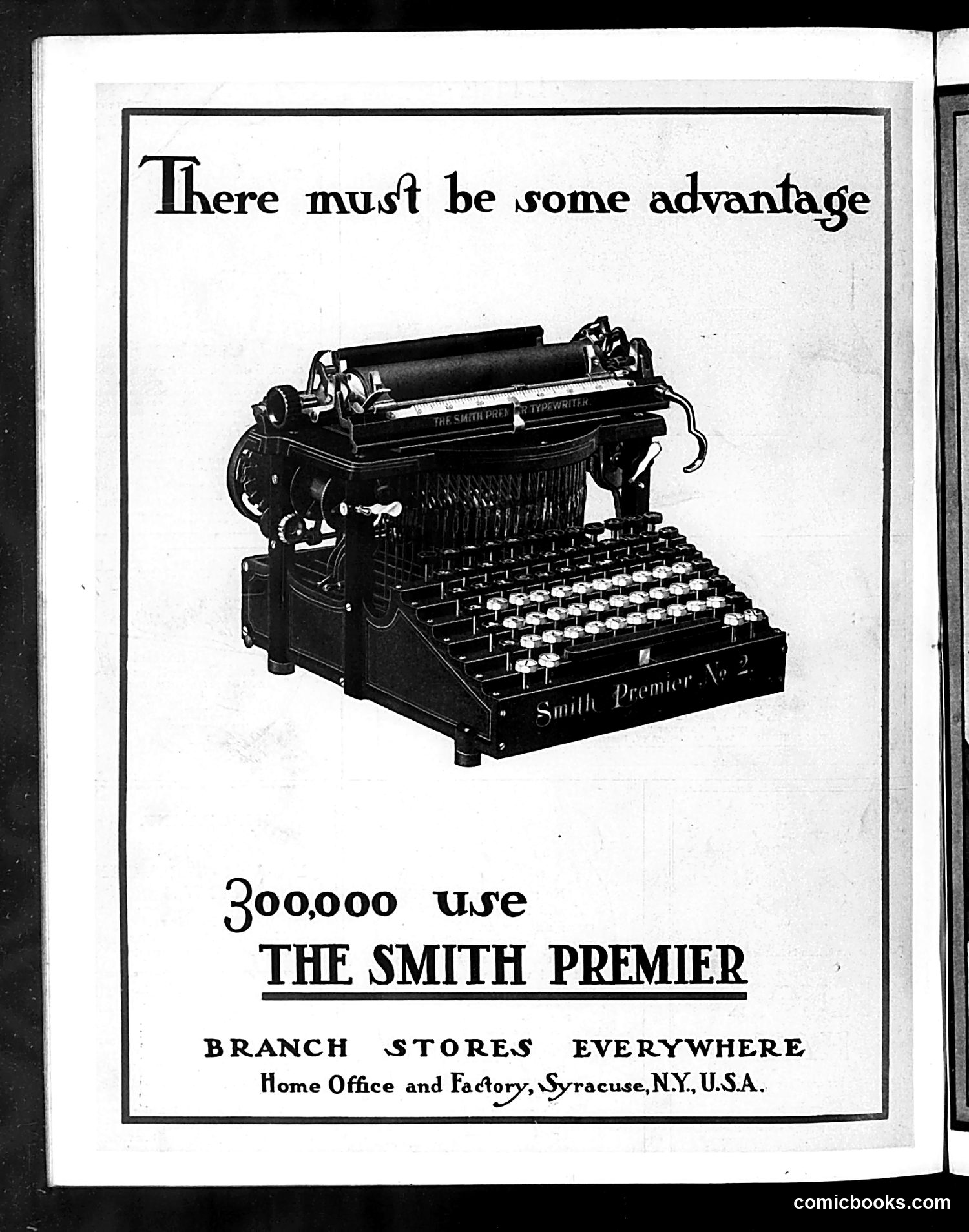
This is a **typewriter advertisement**, not political satire or a cartoon. The Smith Premier typewriter company used a simple marketing claim: "There must be some advantage" to explain why 300,000 people use their product. The ad appeals to consumer logic—if so many customers chose Smith Premier, it must offer benefits worth considering. The imagery shows the Smith Premier No. 2 typewriter in detail, positioned as an attractive, well-engineered machine. The Syracuse, New York manufacturer emphasizes widespread availability through "branch stores everywhere." This represents early 20th-century advertising strategy: using large adoption numbers as social proof to persuade potential buyers. The implied message is straightforward commercial persuasion rather than satire or political commentary.