
Life, 1904-11-24 · page 4 of 22
Life — November 24, 1904 — page 4: what you’re looking at
What you’re looking at
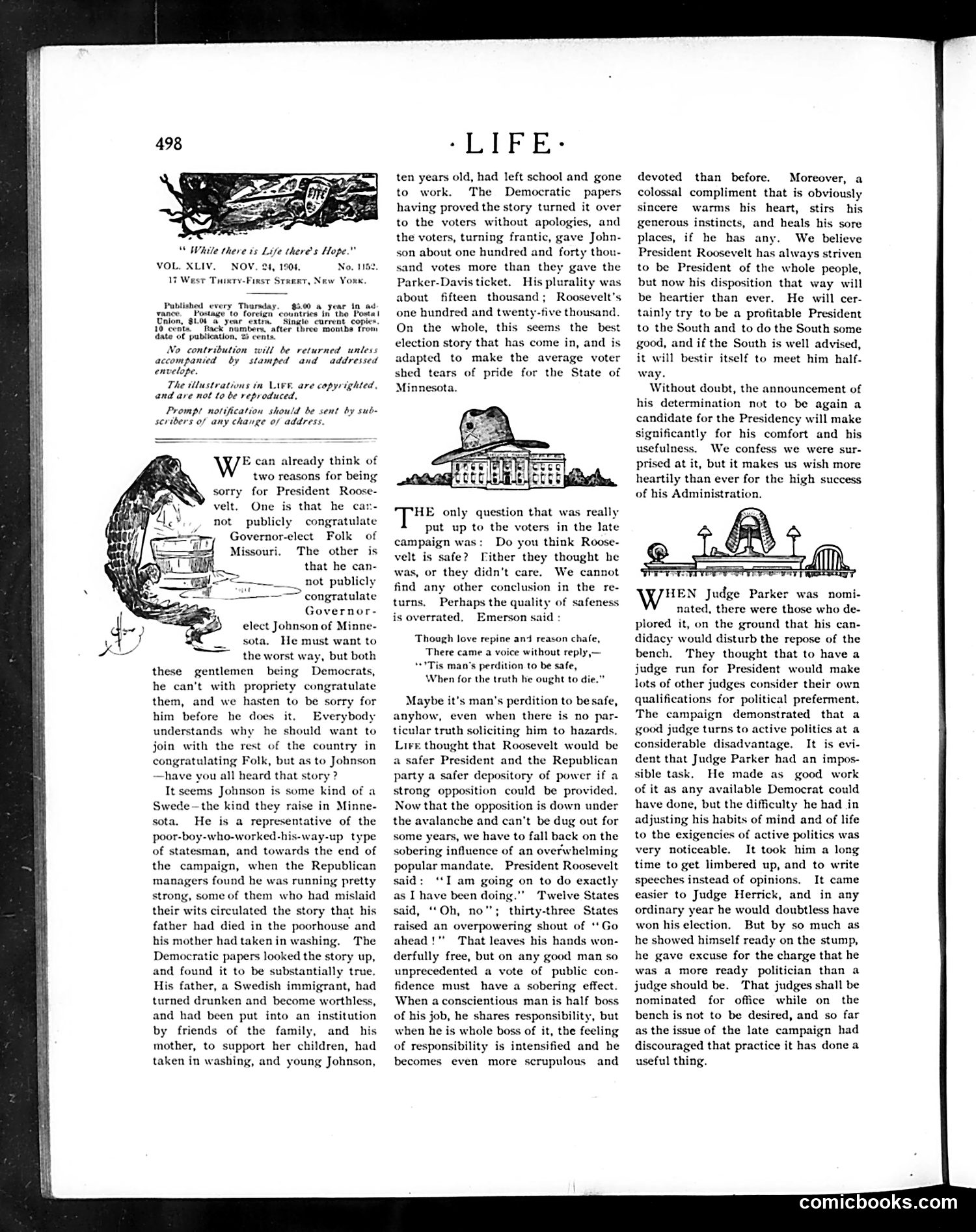
This page discusses the 1904 presidential election and Judge Alton Parker's nomination as the Democratic candidate against President Roosevelt. **The cartoons illustrate:** 1. **Left cartoon**: Shows a figure (appears to be a Democratic voter or politician) struggling with congratulating the Democratic nominee—depicting reluctance about Parker's candidacy. 2. **Center/top cartoon**: A building labeled to represent Democratic Party headquarters or convention space, reinforcing the political context. 3. **Right cartoon**: Appears to show judicial/political figures, likely referencing Parker's background as a judge and concerns about judges entering active politics. **The satire's point**: The text and cartoons mock Democrats struggling to enthusiastically support Parker while questioning whether he's a safer choice than Roosevelt, and critiquing the nomination of judges for political office.
📄 Transcribed text from this page (OCR, searchable)
Machine-transcribed from the original scan — historical spelling and the odd misread are preserved.
“\ While there is Life there's Hope.” VOL. XLIV. NOV. 24, 1904. No. 1152. 17 West Tnixry-Fiest Steerer, New Yor Published Tharwlay. $3.00 a year in ad: vance. Postage to foreign countries in the Postal Union, $1.06 a year extra. Single current copies, 10 cents." Rack numbers. after three months from dato of publication, 25 cents No contribution will be returned unless accompanied by stamped and addressed envelope. The illustrations in Lave, are copyrighted, and are not to be reproduced, Prompt notification should be sent by sub- sevibers of any change of address. W* can already think of two reasons for being for President Roose. One is that he publicly congratulate Folk of The other is that he can- _ not publicly — congratulate Governor- elect Johnson of Minne- sota, He must want to the worst way, but both these gentlemen being Democrats, he can’t with propriety congratulate them, and we hasten to be sorry for him before he does it. Everybody understands why he should want to join with the rest of the country in congratulating Folk, but as to Johnson —have you all heard that story ? It seems Johnson is some kind of a Swede—the kind they raise in Minne- sota. He is a representative of the poor-boy-who-worked-his-way-up type of statesman, and towards the end of the campaign, when the Republican managers found he was running pretty strong, some of them who had mislaid their wits circulated the story that his father had died in the poorhouse and his mother had taken in washing. The Democratic papers looked the story up, and found it to be substantially true. His father, a Swedish immigrant, had turned drunken and become worthless, and had been put into an institution by friends of the family, and his mother, to support her children, had taken in washing, and young Johnson, sorry velt. not ~, Governor-elect Missouri. sLIFE= ten years old, had left school and gone to work. The Democratic papers having proved the story turned it over to the voters without apologies, and the voters, turning frantic, gave John- son about one hundred and forty thou- sand votes more than they gave the Parker-Davis ticket. His plurality was about fifteen thousand; Roosevelt's one hundred and twenty-five thousand. On the whole, this seems the best election story that has come in, and is adapted to make the average voter shed tears of pride for the State of Minnesota. HE only question that was really put up to the voters in the late campaign was: Do you think Roose- velt is safe? Tither they thought he was, or they didn't care. We cannot find any other conclusion in the re- turns. Perhaps the qua of safeness is overrated, Emerson said : Though love repine an4 reason chafe, There came a voice without reply,— ‘Tis man’s perdition to be safe, When for the truth he ought to die.” Maybe it’s man's perdition to be safe, anyhow, even when there is no par- ticular truth soliciting him to hazards. Li ‘hought that Roosevelt would be afer President and the Republican party a safer depository of power if a strong opposition could be provided. Now that the opposition is down under the avalanche and can't be dug out for some years, we have to fall back on the sobering influence of an overwhelming popular mandate. President Roosevelt said: ‘I am going on to do exactly as I have been doing.” Twelve States said, ‘Oh, no"; thirty-three States raised an overpowering shout of ‘Go ahead!" That leaves his hands won- derfully free, but on any good man so unprecedented a vote of public con- fidence must have a sobering effect. When a conscientious man is half boss of his job, he shares responsibility, but when he is whole boss of it, the feeling of responsibility is intensified and he becomes even more scrupulous and devoted than before. Moreover, a colossal compliment that is obviously sincere warms his heart, stirs his generous instincts, and heals his sore places, if he has any. We believe President Roosevelt has always striven to be President of the whole people, but now his disposition that way will be heartier than ever. He will cer- tainly try to be a profitable President to the South and to do the South some good, and if the South is well advised, it will bestir itself to meet him half- way Without doubt, the announcement of his determination not to be again a candidate for the Presidency will make significantly for his comfort and his sefulness. We confess we were sur- prised at it, but it makes us wish more heartily than ever for the high success of his Administration. WHex Judge Parker was nomi- nated, there were those who de- plored it, on the ground that his can- didacy would disturb the repose of the bench. They thought that to have a judge run for President would make lots of other judges consider their own qualifications for political preferment. The campaign demonstrated that a good judge turns to active politics at a considerable disadvantage. It is evi- dent that Judge Parker had an impos- sible task. He made as good work of it as any available Democrat could have done, but the difficulty he had in adjusting his habits of mind and of life to the exigencies of active politics was very noticeable. It took him a long time to get limbered up, and to write speeches instead of opinions. It came easier to Judge Herrick, and in any ordinary year he would doubtless have won his election, But by so much as he showed himself ready on the stump, he gave excuse for the charge that he was a more ready politician than a judge should be. That judges shall be nominated for office while on the bench is not to be desired, and so far as the issue of the late campaign had discouraged that practice it has done a useful thing. comicbooks.com