
Life, 1904-11-24 · page 13 of 22
Life — November 24, 1904 — page 13: what you’re looking at
What you’re looking at
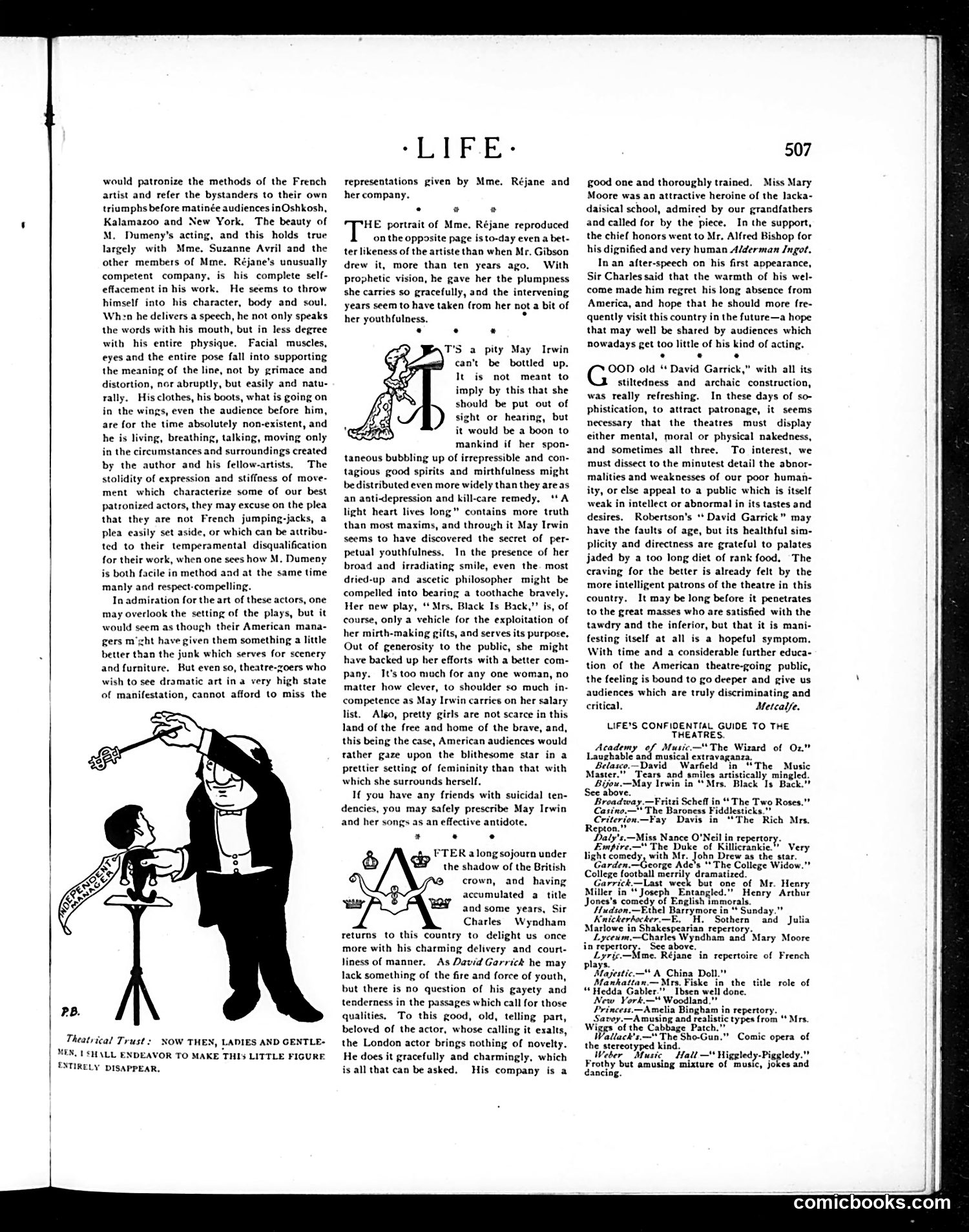
This page contains theatrical criticism and satire targeting the American theater establishment circa early 1900s. **The Main Cartoon** ("Theatrical Trust") depicts a magician attempting to make a small figure disappear—satirizing the theatrical monopoly's attempt to eliminate independent or competing theatrical productions. The "Theatrical Trust" was a real cartel controlling American theaters at this time. **The Text** praises French actress Mme. Réjane's company for their naturalistic acting method, contrasting it favorably with American theater's often stilted performances. The critic admires how French actors inhabit their characters authentically rather than performatively. The piece also celebrates comedian May Irwin's infectious energy and youthfulness, though criticizing her supporting cast as incompetent and suggesting she deserves better theatrical production values. The satire critiques American commercial theater as inferior to European artistry, while the cartoonist mocks the Trust's monopolistic control over theatrical presentation.
📄 Transcribed text from this page (OCR, searchable)
Machine-transcribed from the original scan — historical spelling and the odd misread are preserved.
would patronize the methods of the French artist and refer the bystanders to their own triumphs before matinée audiences inOshkosh, Kalamazoo and New York. The beauty of M. Dumeny’s acting, and this holds true largely with Mme. Suzanne Avril and the other members of Mme. Réjane’s unusually competent company, is his complete self- effacement in his work. He seems to throw himself into his character, body and soul, When he delivers a speech, he not only speaks the words with his mouth, but in less degree with his entire physique, Facial muscles, eyes and the entire pose fall into supporting the meaning of the line, not by grimace and distortion, nor abruptly, but easily and natu- rally. His clothes, his boots, what is going on in the wings, even the audience before him, are for the time absolutely non-existent, and he is living, breathing, talking, moving only in the circumstances and surroundings created by the author and his fellow-artists, The stolidity of expression and stiffness of move- ment which characterize some of our best patronized actors, they may excuse on the plea that they are not French jumping-jacks, a plea easily set aside, or which can be attribu- ted to their temperamental disqualification for their work, when one sees how M. Dumeny is both facile in method and at the same time manly and respect-compelling. In admiration for the art of these actors, one may overlook the setting of the plays, but it would seem as though their American mana- gers m'ght have given them something a little better than the junk which serves for scenery and furniture, But even so, theatre-zoers who wish to see dramatic art ina very high state of manifestation, cannot afford to miss the Theatrical Trust : NOW THEN, LADIES AND GENTLE- MEN, | SHALL ENDEAVOR TO MAKE THIS LITTLE FIGURE ENTIRELY DISAPPEAR. ‘LUE « representations given by Mme. Réjane and her company. . * * HE portrait of Mme, Réjane reproduced on the opposite page is to-day even a bet- ter likeness of the artiste than when Mr. Gibson drew it, more than ten years ago. With prophetic vision, he gave her the plumpness she carries so gracefully, and the intervening years seem to have taken (rom her not a bit of her youthfulness. . . . a pity May Irwin can’t be bottled up. It is not meant to imply by this that she should be put out of sight or hearing, but it would be a boon to mankind if her spon- taneous bubbling up of irrepressible and con- tagious good spirits and mirthfulness might be distributed even more widely than they areas an anti-depression and kill-care remedy. “A light heart lives long” contains more truth than most maxims, and through it May Irwin seems to have discovered the secret of per- petual youthfulness, In the presence of her broad and irradiating smile, even the. most dried-up and ascetic philosopher might be compelled into bearing a toothache bravely. Her new play, ‘Mrs, Black Is Back,’’ is, of course, only a vehicle for the exploitation of her mirth-making gifts, and serves its purpose. Out of generosity to the public, she might have backed up her efforts with a better com- pany. It’stoo much for any one woman, no matter how clever, to shoulder so much in- competence as May Irwin carries on her salary list. Also, pretty girls are not scarce in this land of the free and home of the brave, and, this being the case, American audiences would rather gaze upon the blithesome star in a prettier setting of femininity than that with which she surrounds herself. If you have any friends with suicidal ten- dencies, you may safely prescribe May Irwin and her songs as an effective antidote, * . . & Node TER atone sojoura under the shadow of the British crown, and having accumulated a title ag E27 and some years, Sir Charles Wyndham returns to this ‘country to delight us once more with his charming delivery and court- liness of manner. As David Garrick he may lack something of the fire and force of youth, but there is no question of his gayety and tenderness in the passages which call for those qualities, To this good, old, telling part, beloved of the actor, whose calling it exalts, the London actor brings nothing of novelty. He does it gracefully and charmingly, which is all that can be asked, His company is a 507 good one and thoroughly trained. Miss Mary Moore was an attractive heroine of the lacka- daisical school, admired by our grandfathers and called for by the piece. In the support, the chief honors went to Mr. Alfred Bishop for his dignified and very human Alderman Ingot. In an after-speech on his first appearance, Sir Charles said that the warmth of his wel- come made him regret his long absence from America, and hope that he should more fre- quently visit this country in the future—a hope that may well be shared by audiences which nowadays get too little of his kind of acting. . . . OON old “ David Garrick,” with all its stiltedness and archaic construction, was really refreshing. In these days of so- phistication, to attract patronage, it seems necessary that the theatres must display either mental, moral or physical nakedness, and sometimes all three. To interest, we must dissect to the minutest detail the abnor- malities and weaknesses of ovr poor human- ity, or else appeal to a public which is itself weak in intellect or abnormal in its tastes and desires. Robertson's ** David Garrick” may have the faults of age, but its healthful sim- plicity and directness are grateful to palates jaded by a too long diet of rank food. The craving for the better is already felt by the more intelligent patrons of the theatre in this country. It may be long before it penetrates to the great masses who are satisfied with the tawdry and the inferior, but that it is mani- festing itself at all is a hopeful symptom. With time and a considerable further educa- tion of the American theatre-going public, the feeling is bound to go deeper and give us audiences which are truly discriminating and ical. Metcalfe. LIFE’S CONFIDENTIAL GUIDE TO THE THEATRES. Academy of Music.—The Wizard of Oz." Laughable and musical extravaganza, Belasco.—David Warfield in “The Music Master."’ Tears and smiles artistically mingled. BY May Irwin in ‘“*Mrs. Black Is Back.’ See above. Broadway —Fritzi Scheff in * The Two Roses.” Casino.—" The Baroness F ks. Criterion—Fay Davis in “The Rich Mrs. Repton,”” 2 he Duke of K Very light comedy, with Mr. John Drew as the star. Garden.—George Ade's "* The College Widow." College football merrily dramatized. Garrich.—Last week but one of Mr. Henry Miller in “Joseph Entangled.” Henry Arthur Jones's comedy of English immorals. Hudson.—Etthel Barrymore in ** Sunday.” Knickerhocker.—E, H. Sothern and Julia Marlowe in Shakespearian repertory. | Lyceum.—Charles Wyndham and Mary Moore in Fepertory: "Seg above, EzrieSme. Réjane in repertoire of French plays. Majestic.—* A China Doll.” Manhattan. — Mrs. Fiske in the title role of “ Hedda Gabler.” Ibsen well done. New York.—* Woodland. Princess. Bingham in repertory. pey.— Amusing and realistic types from * Mrs Wiggs of the Cabbage Patch. Watlack’s.—* The Sho-Gun.’ the stereotyped kind. Weber Music Halt —* Higgledy-Piggledy.”” Frothy but amusing mixture of music, jokes and dancing. Comic opera of =) comicbooks.com