
A complete issue · 20 pages · 1904
Life — March 24, 1904
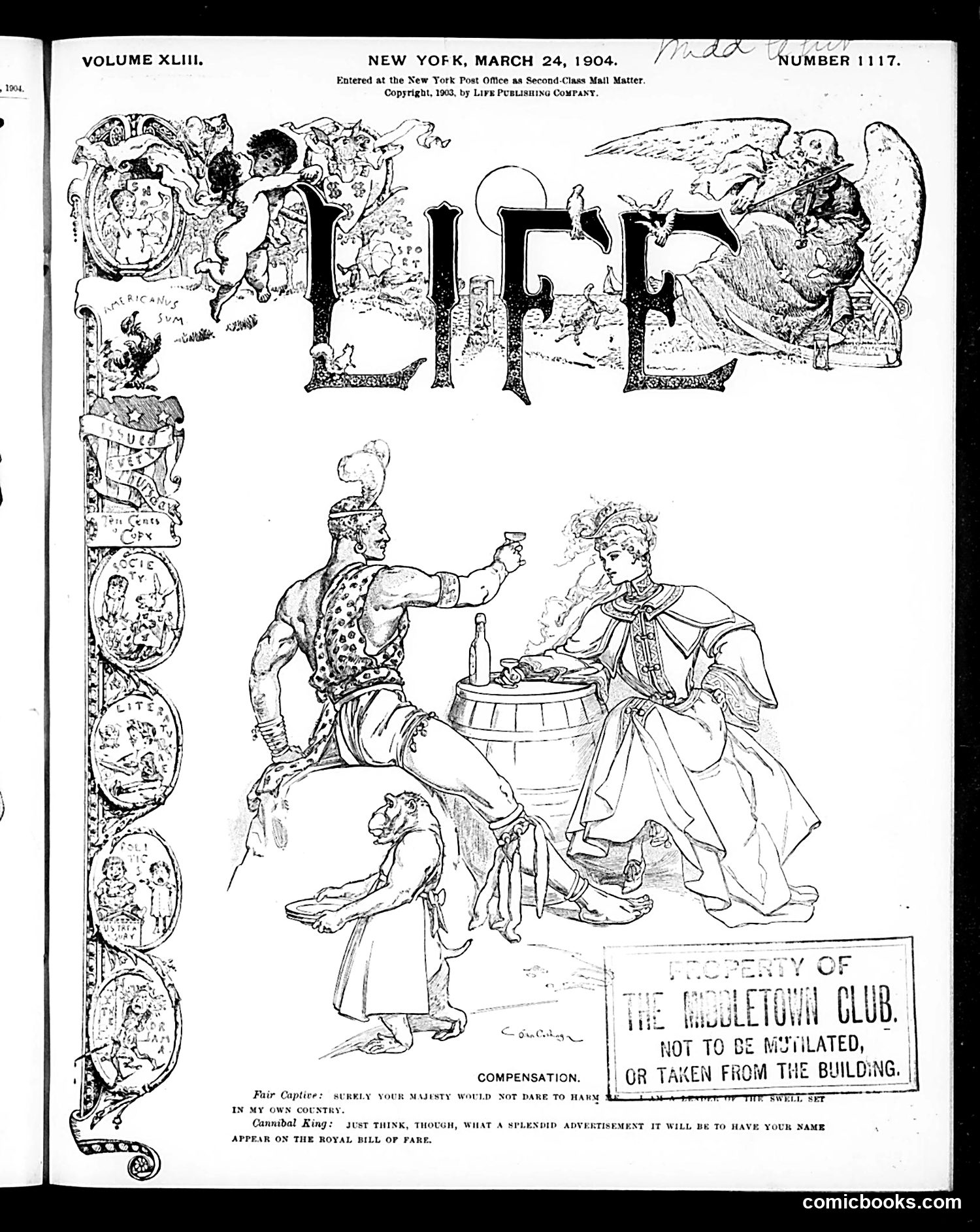
This cartoon satirizes a negotiation between a "Fair Captive" (a woman, likely representing a nation or territory) and a "Cannibal King" (a non-Western ruler depicted in exaggerated colonial-era caricature). The humor centers on compensation for seized sovereignty. The Fair Captive protests that the King wouldn't dare "harm" her in her own country, while the King counters that a prominent royal advertisement would be excellent publicity—suggesting he'll exploit her status in exchange for not harming her interests. This reflects turn-of-the-century American imperial attitudes and racial stereotypes. The "Cannibal King" caricature represents colonial anxieties about non-Western leaders, while the negotiation mocks both imperial power-plays and vanity-driven "compensation" arrangements common in that era's international dealings.
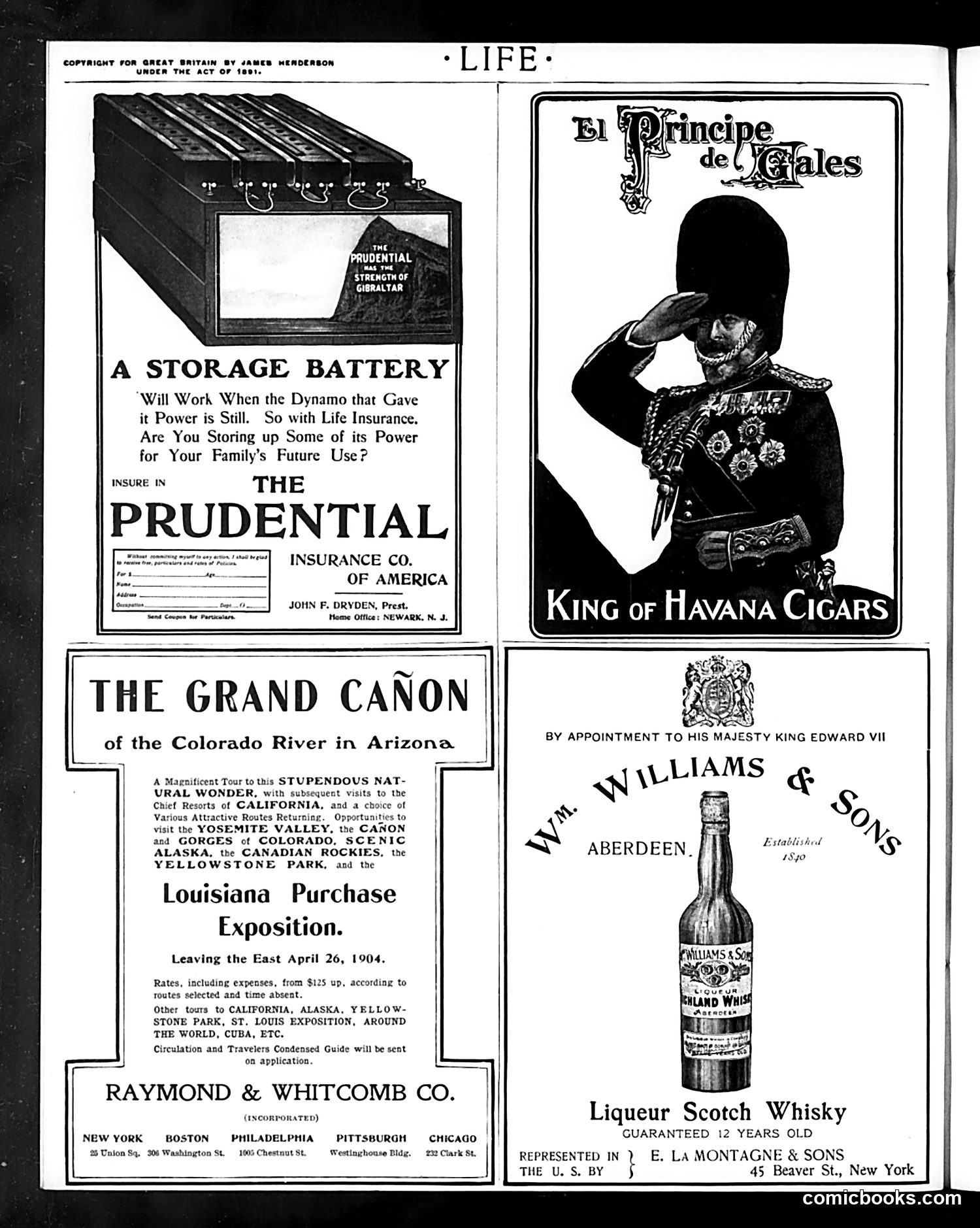
This page consists entirely of **period advertisements**, not editorial cartoons or satire. The ads reflect early 1900s consumer products and services: 1. **Prudential Insurance**: Uses metaphor comparing life insurance to a "storage battery"—financial security for families. 2. **El Príncipe de Gales Cigars**: Features a military figure in dress uniform, likely referencing royalty to suggest premium quality. 3. **Grand Canyon Tour**: Advertises the 1904 Louisiana Purchase Exposition, offering Western travel packages. 4. **Williams & Sons Whisky**: Scottish liquor marketed with royal appointment seal to King Edward VII, emphasizing prestige and age. 5. **Raymond & Whitcomb**: Travel company promoting exposition tours. The page demonstrates how early Life magazine monetized through luxury goods advertising targeting affluent readers.
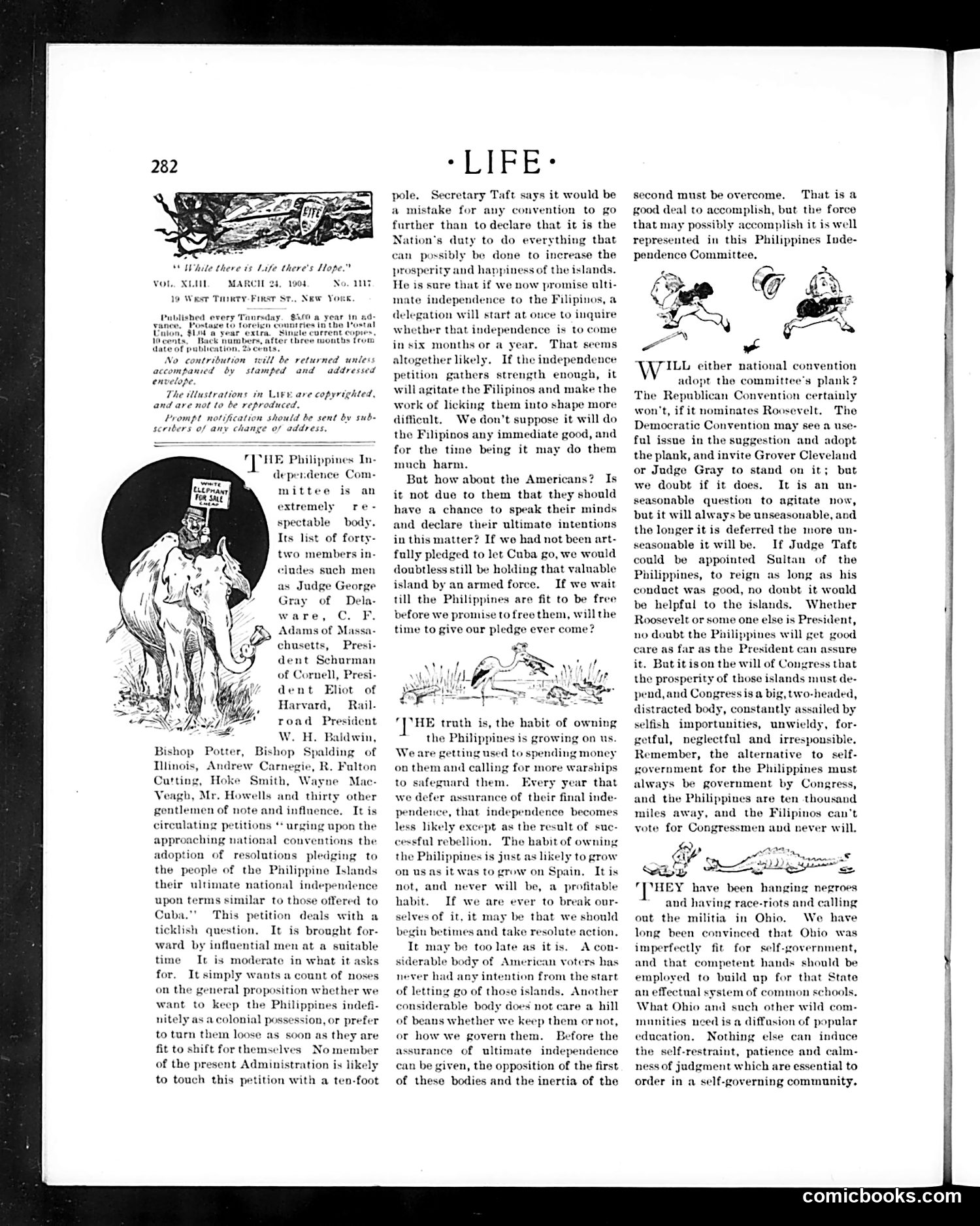
The main cartoon depicts a donkey labeled "Philippine Independence Committee" being ridden by multiple figures identified as prominent American politicians and judges, including Judge George Gray, C.F. Adams, and President Schurman of Cornell. The satire targets the Philippine Independence Committee's advocacy for Philippine autonomy. The donkey—a traditional symbol of Democratic obstinacy—represents the committee itself, while the various riders embody influential Americans pushing the independence agenda. The text criticizes the committee's pressure on the McKinley administration, arguing that premature Philippine independence would be reckless and that Americans should retain colonial control. The cartoon ridicules the independence movement as an unruly force being piloted by well-meaning but misguided elites.
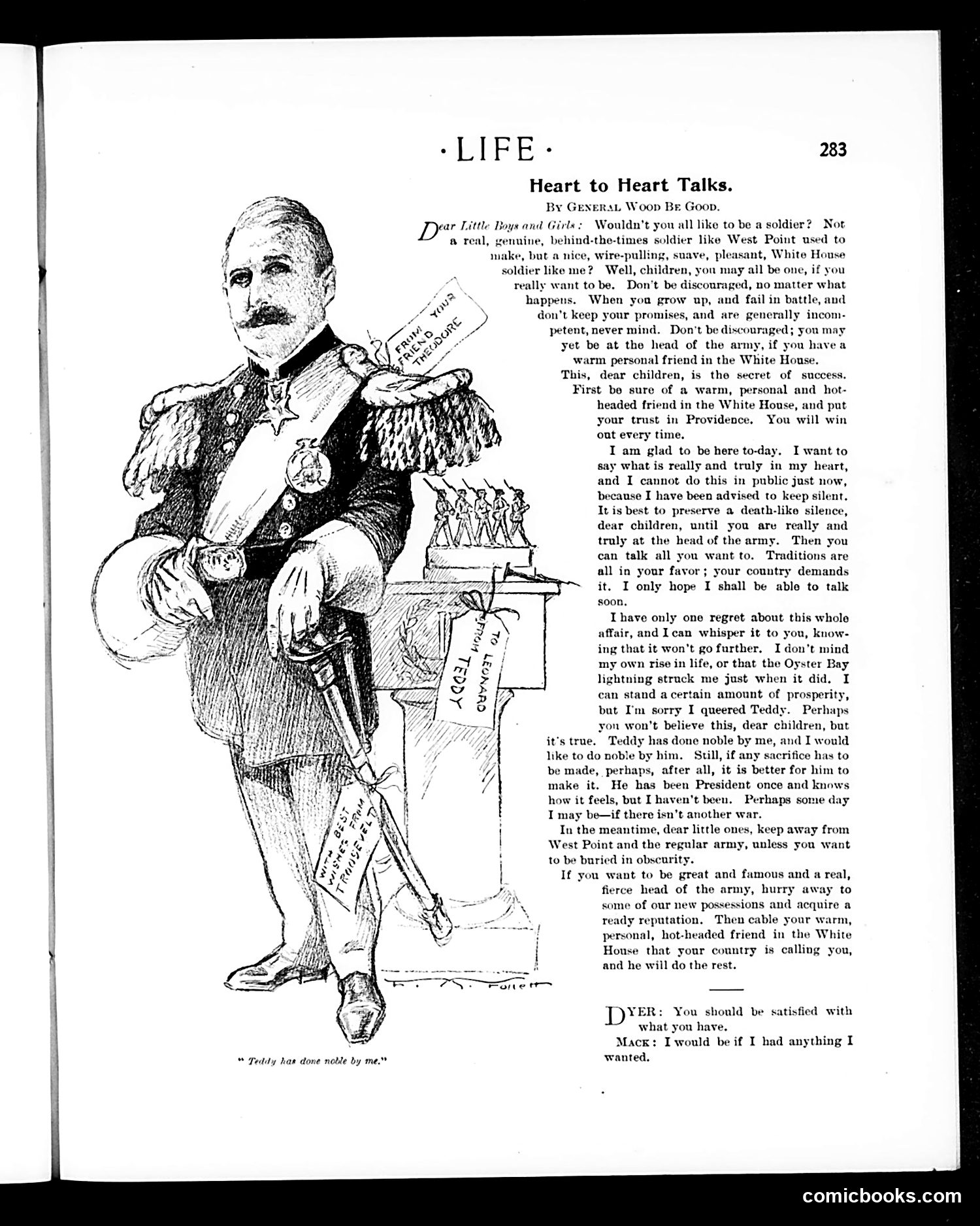
The cartoon depicts a military figure laden with labels representing various scandals and controversies ("Teddy has done noble by me" reads the caption). The "Heart to Heart Talks" text by General Wood Be Good addresses children, ostensibly offering patriotic advice about military service and ambition. However, the cartoon appears to satirize Theodore Roosevelt (or a Roosevelt-era military figure) by showing him weighed down by multiple labeled failings or broken promises. The accompanying dialogue between "DYER" and "MACK" suggests hypocrisy—advocating satisfaction with what one has while simultaneously desiring more. The satire targets military ambition, political corruption, or unfulfilled promises made by prominent military/political figures of the Progressive era. Without clearer labels on each burden shown, the specific scandals referenced remain unclear, but the overall message mocks inflated military authority and its questionable ethics.
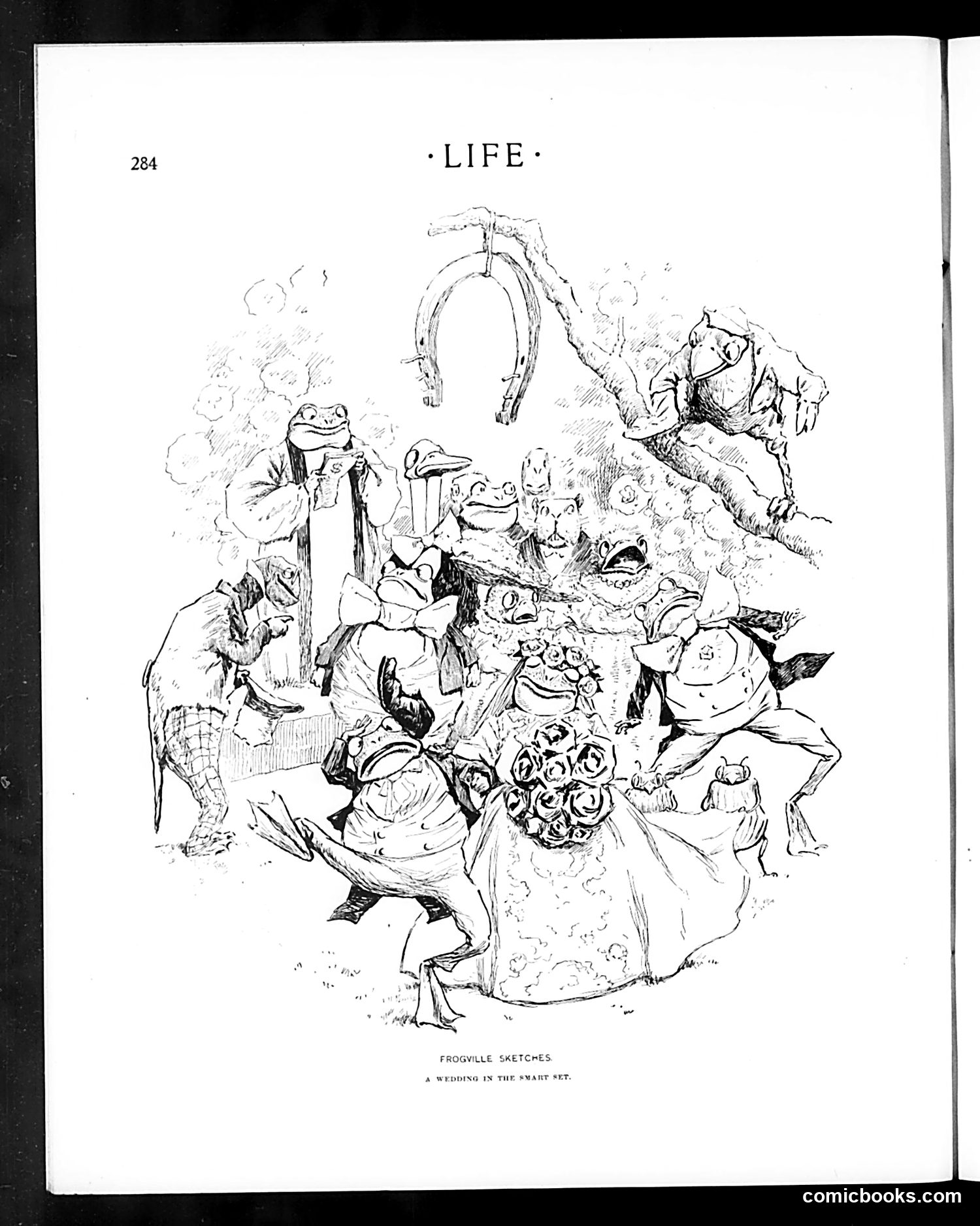
This is a whimsical anthropomorphic cartoon depicting frogs dressed as wedding party members gathered around what appears to be a bride frog holding a bouquet. The frogs wear human clothing—suits, dresses, and formal attire—in a humorous contrast to their animal nature. The satire likely mocks high society wedding customs and their pretensions by transplanting them to a "swamp" setting. By showing frogs mimicking human formality and ceremony, the artist ridicules the elaborate social rituals of the wealthy elite. The crude, informal nature of the swamp setting undercuts the dignity these occasions typically claim, suggesting that such ceremonial pomp is inherently absurd regardless of social status—whether among humans or amphibians.
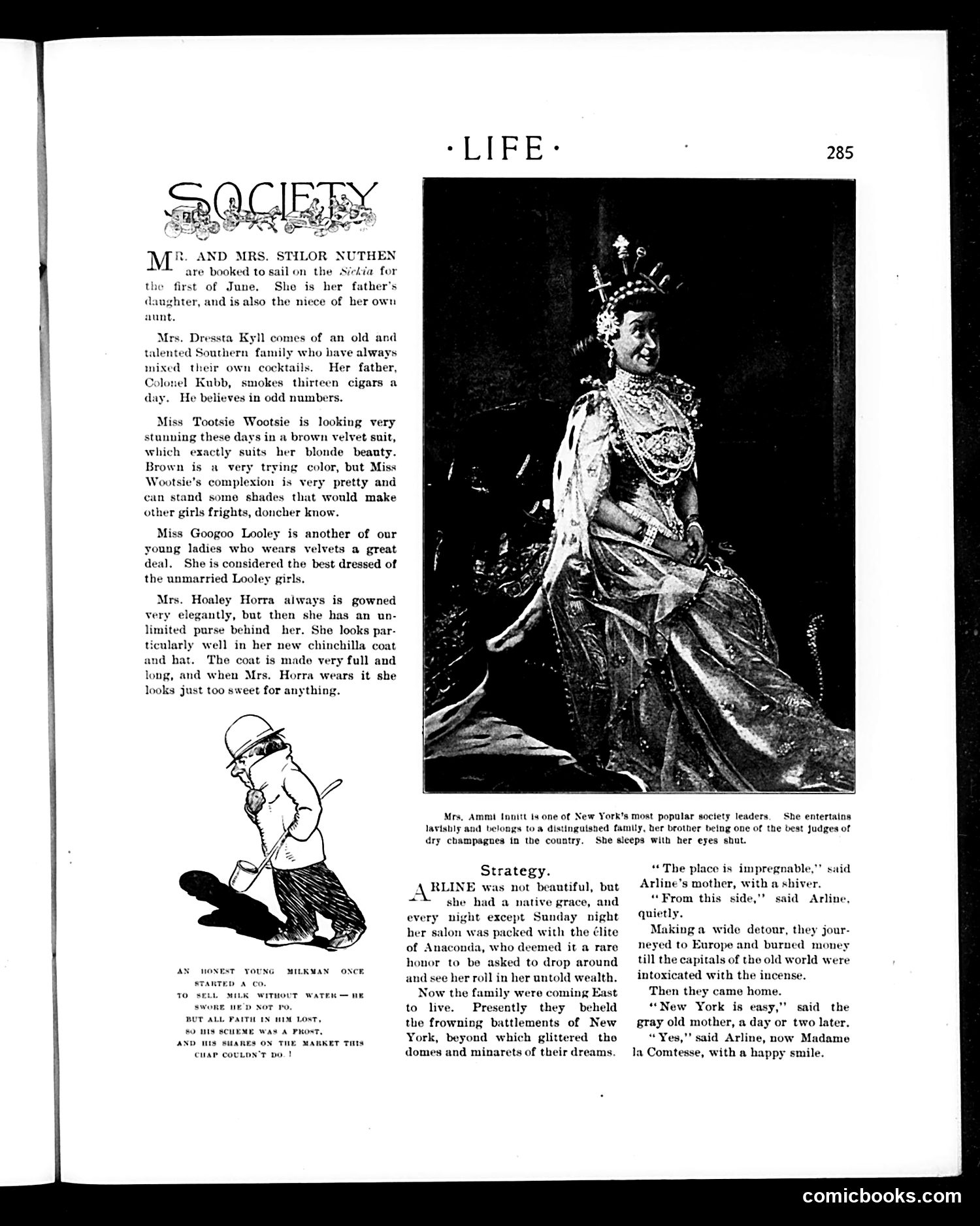
This is a **society gossip page**, not political satire. The text discusses New York's wealthy social figures, including Mrs. Stilor Nuthen, Mrs. Dressa Kyll, and Mrs. Ammi Inutt (identified as "one of New York's most popular society leaders"). The **small cartoon** shows a milkman—labeled as "honest" and having "faith in his lost" scheme—who believed his business plan would succeed but failed. It's a humorous morality tale about naive entrepreneurship, captioned with commentary on his misplaced optimism. The **large photograph** depicts a woman in elaborate royal or theatrical costume with crown and jewels, though the caption doesn't clearly identify who she represents or the context of this formal portrait.
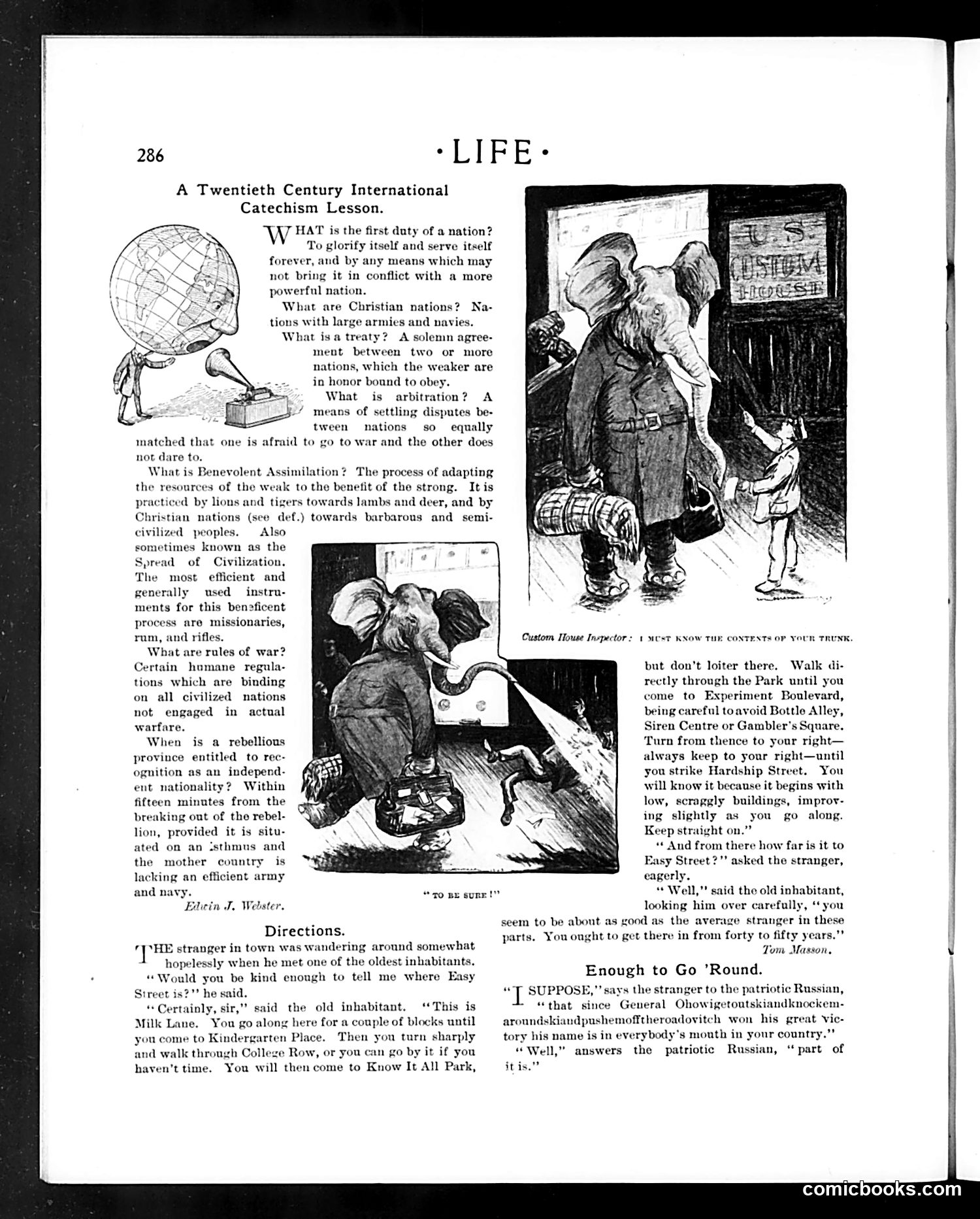
This page contains educational and satirical content from Life magazine. The left side features "A Twentieth Century International Catechism Lesson"—a mock-educational Q&A about nations, treaties, arbitration, and "Benevolent Assimilation" (likely referencing American imperialism). The illustrations by Edwin J. Weilder appear to satirize colonial conquest and civilization narratives. The right side shows a narrative titled "Directions" where a stranger asks an "old inhabitant" for directions to Easy Street in what appears to be a major city (likely London, given references to Hardship Street and Know It All Park). The satire suggests Easy Street is practically unreachable—a comment on economic inequality and the difficulty of achieving prosperity for ordinary people, despite promises of opportunity.
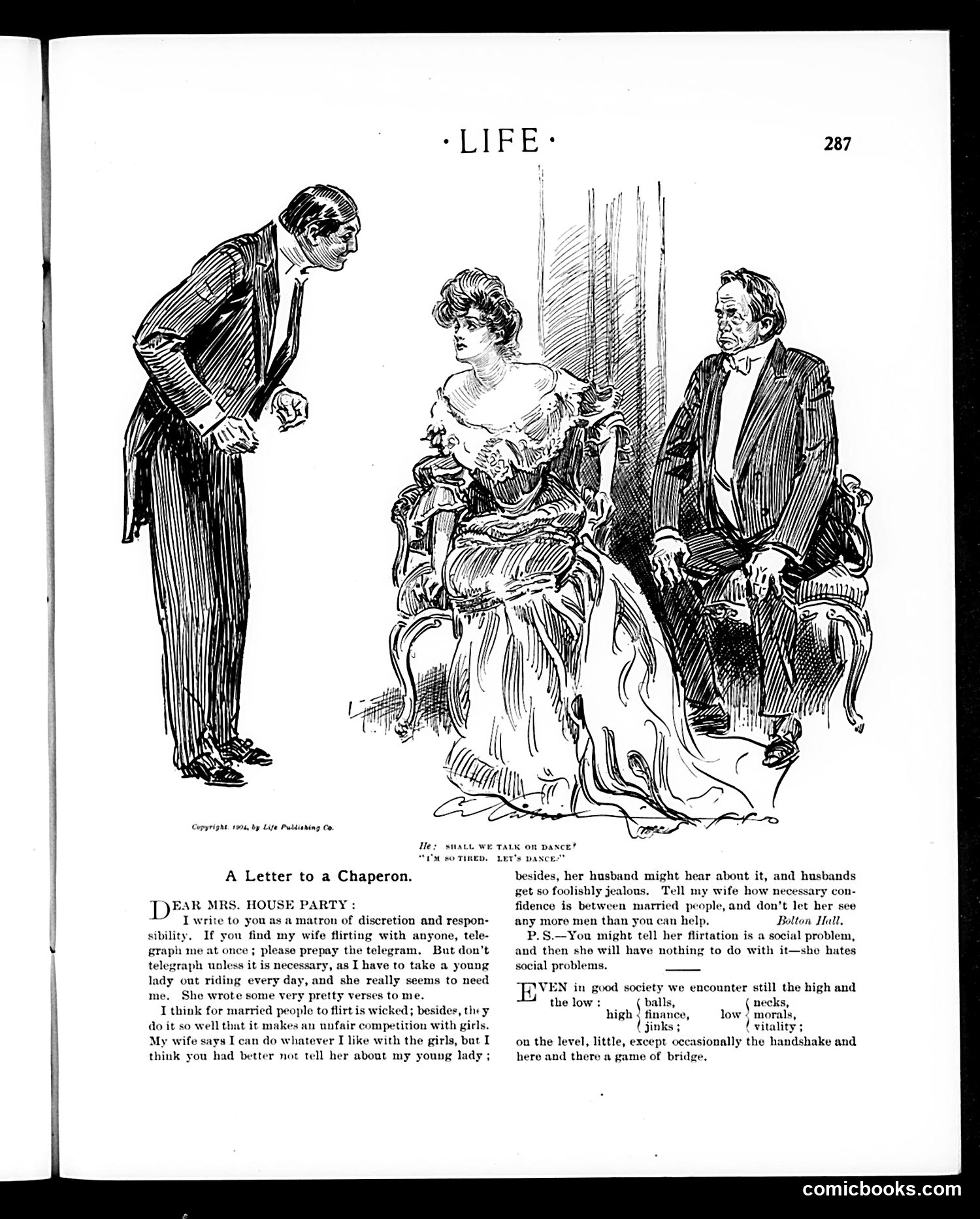
This illustration satirizes married men's flirtation habits and social propriety. The cartoon shows three seated figures (a woman and two men) being addressed by a fourth man standing to the left. The accompanying letter humorously complains about a correspondent's wife flirting with others socially. The writer argues that flirtation among married people is "wicked" and suggests the chaperon (the seated woman, likely an older social supervisor) should monitor the young lady's behavior. The satire targets upper-class social conventions of the era, mocking both the husband's jealousy and the absurd expectation that chaperons could control adult behavior at social gatherings. The joke implies that flirtation, dancing, and socializing were common despite Victorian propriety claims—and that husbands' attempts to police wives' behavior were futile and ridiculous.
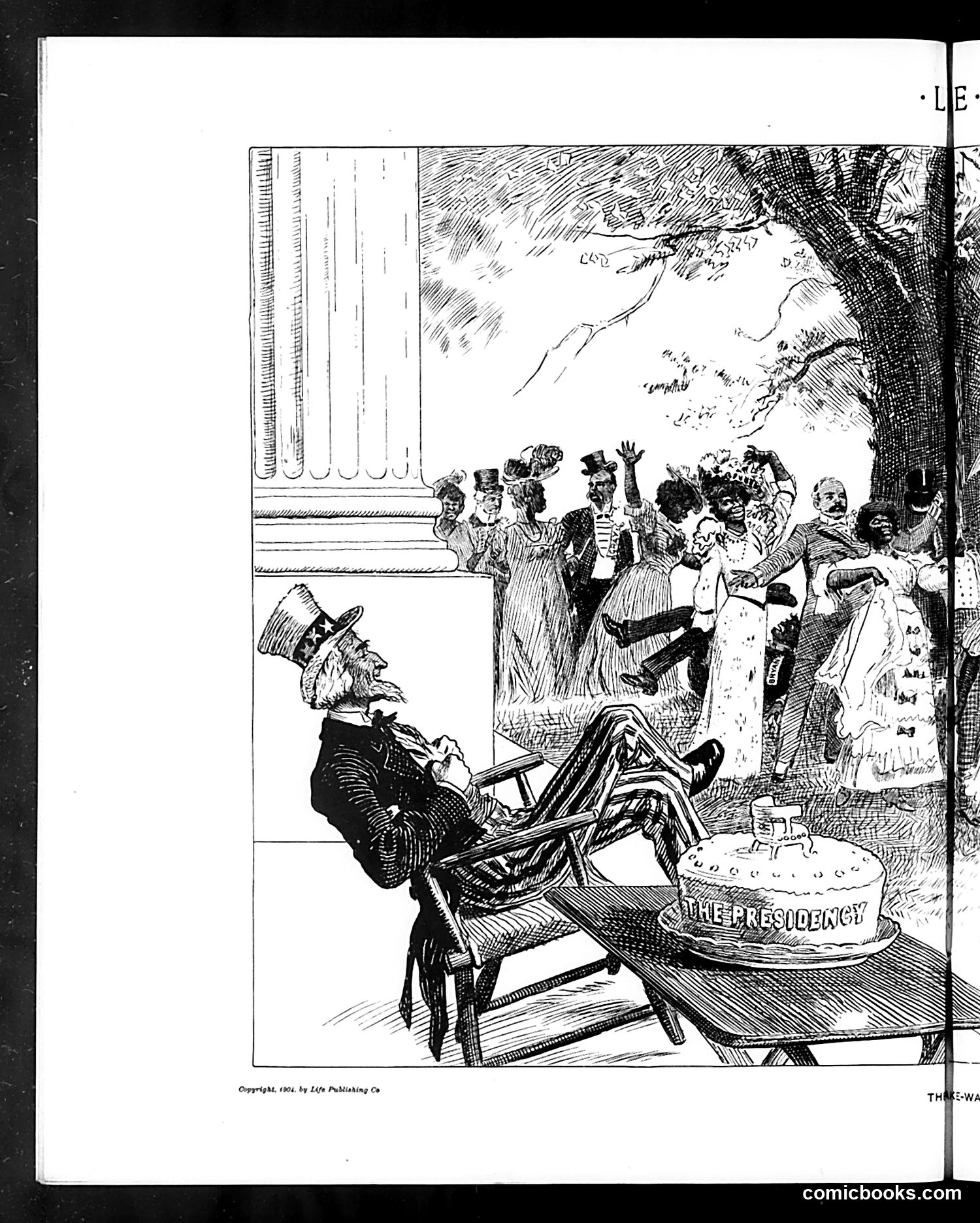
This cartoon satirizes presidential power and social access. A caricatured figure in formal attire reclines in a chair labeled "THE PRESIDENCY," appearing relaxed and self-satisfied while observing a crowd of well-dressed women and socialites gathered behind him at what appears to be a White House reception or social event. The satire likely critiques how a president conducts official duties—suggesting he's more focused on social entertaining and leisure than serious governance. The contrast between his reclined, indulgent posture and the formal gathering highlights the tension between presidential responsibility and social pageantry. Without the full publication date or OCR text visible, the specific president targeted remains unclear, though the image dates from Life magazine's early satirical era.
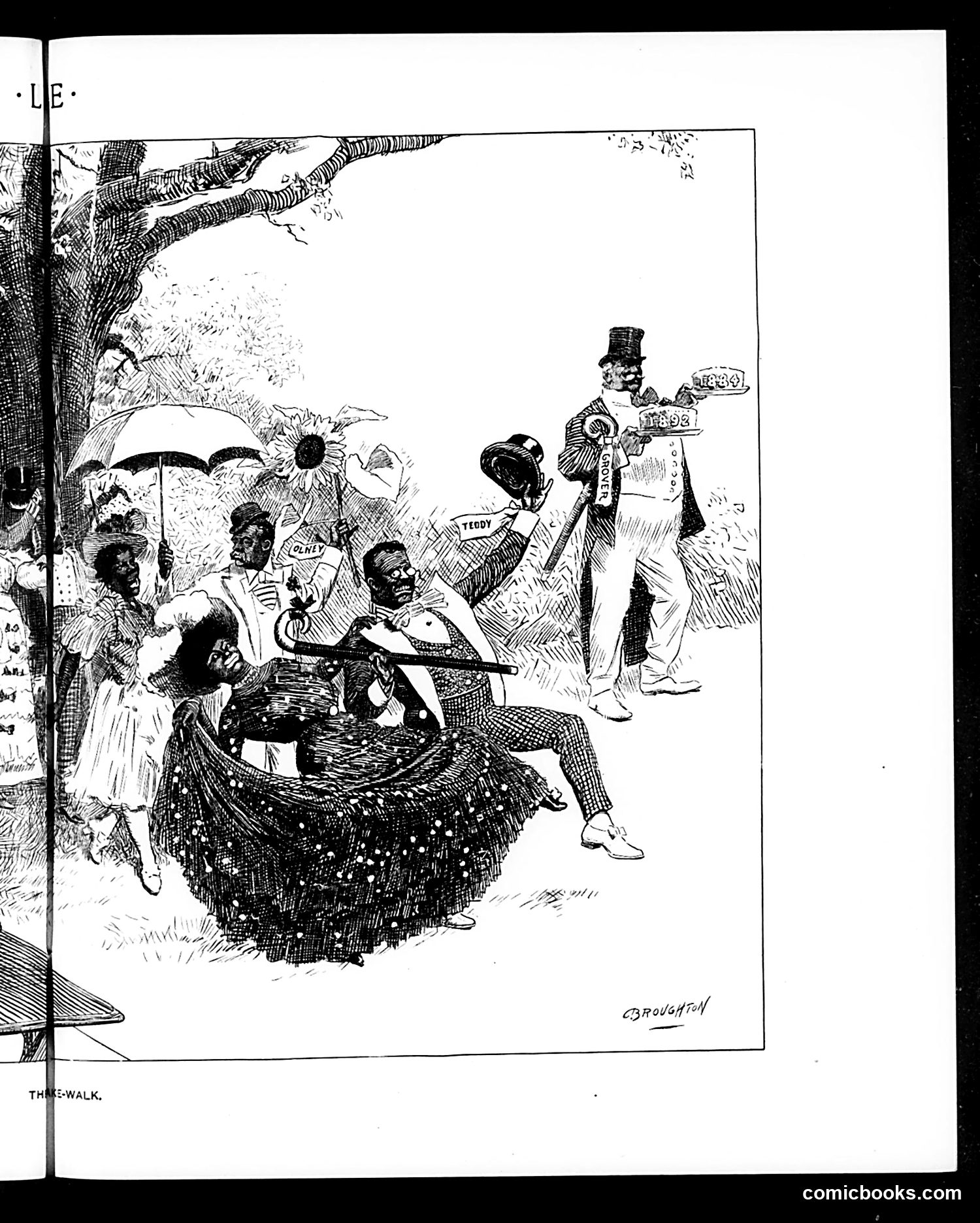
This satirical cartoon depicts a theatrical scene with racial caricature and social commentary. A figure in an elaborate, heavily-detailed skirt performs what appears to be a dance move in the center, while onlookers (including someone with an umbrella and figures labeled "TEDDY") observe from the left. A tall figure in a top hat and formal attire stands to the right, appearing to conduct or direct the scene. The title "THREE-WALK" and the theatrical staging suggest this references a specific dance or performance trend of the era. The caricatured style and racial imagery reflects the deeply problematic conventions of early 20th-century American satire in *Life* magazine. Without additional context about the specific date or event, the exact political target remains unclear, though it appears to mock contemporary entertainment or social behavior.
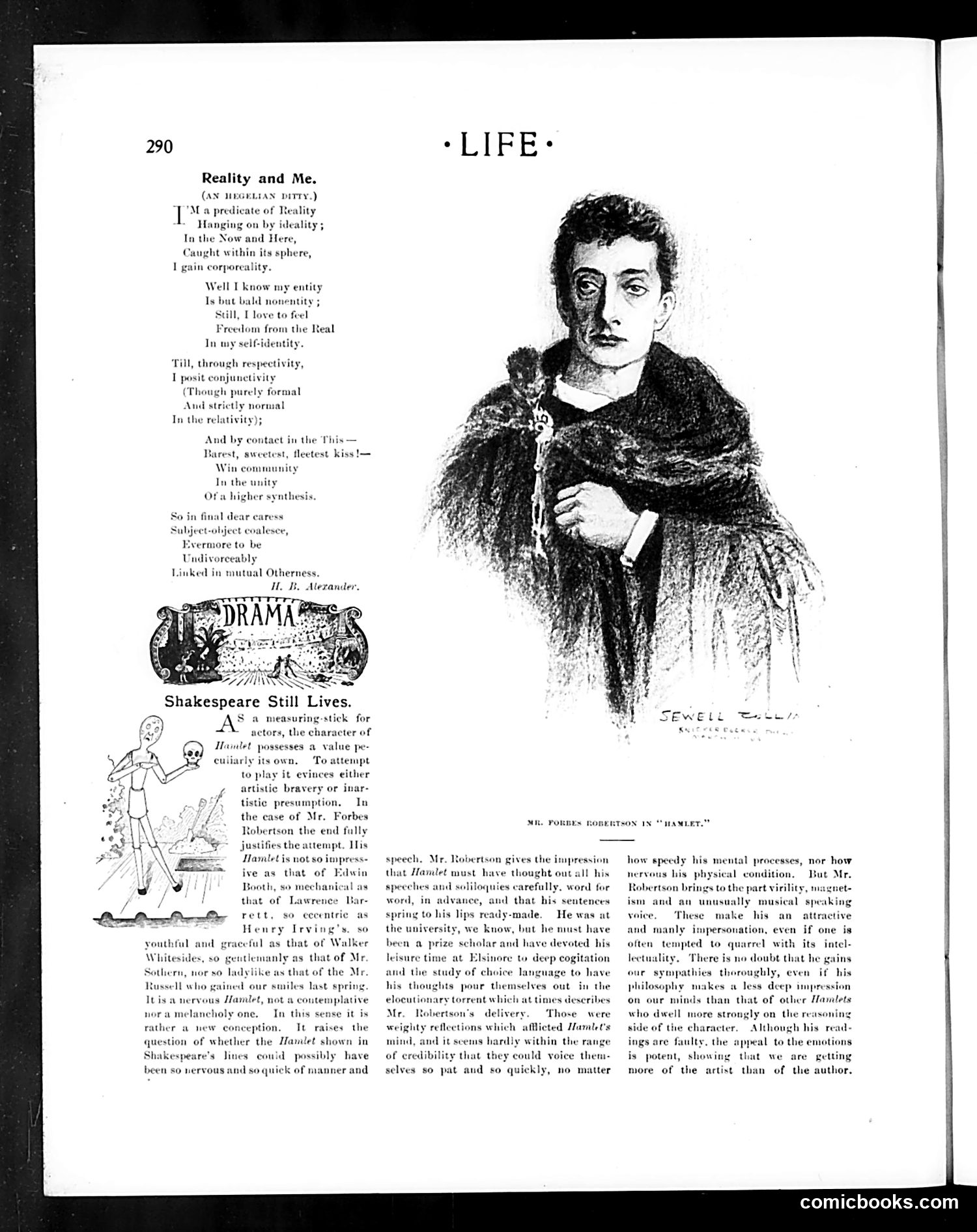
This page features a portrait sketch labeled "Mr. Forbes Robertson in 'Hamlet'" alongside theatrical commentary. The article discusses Robertson's performance of Hamlet, praising his delivery while analyzing whether Shakespeare's character could credibly speak his famous soliloquies naturally. A small decorative illustration shows a classical figure gesturing dramatically near what appears to be a skull—referencing Hamlet's graveyard scene. The piece argues that Robertson successfully conveys Hamlet's philosophical depth through careful articulation and musical speaking voice, though the author notes this requires more artistic skill than strict realism might suggest. The satire gently questions whether even brilliant actors can make Shakespeare's elaborate speeches seem genuinely spontaneous rather than performative.
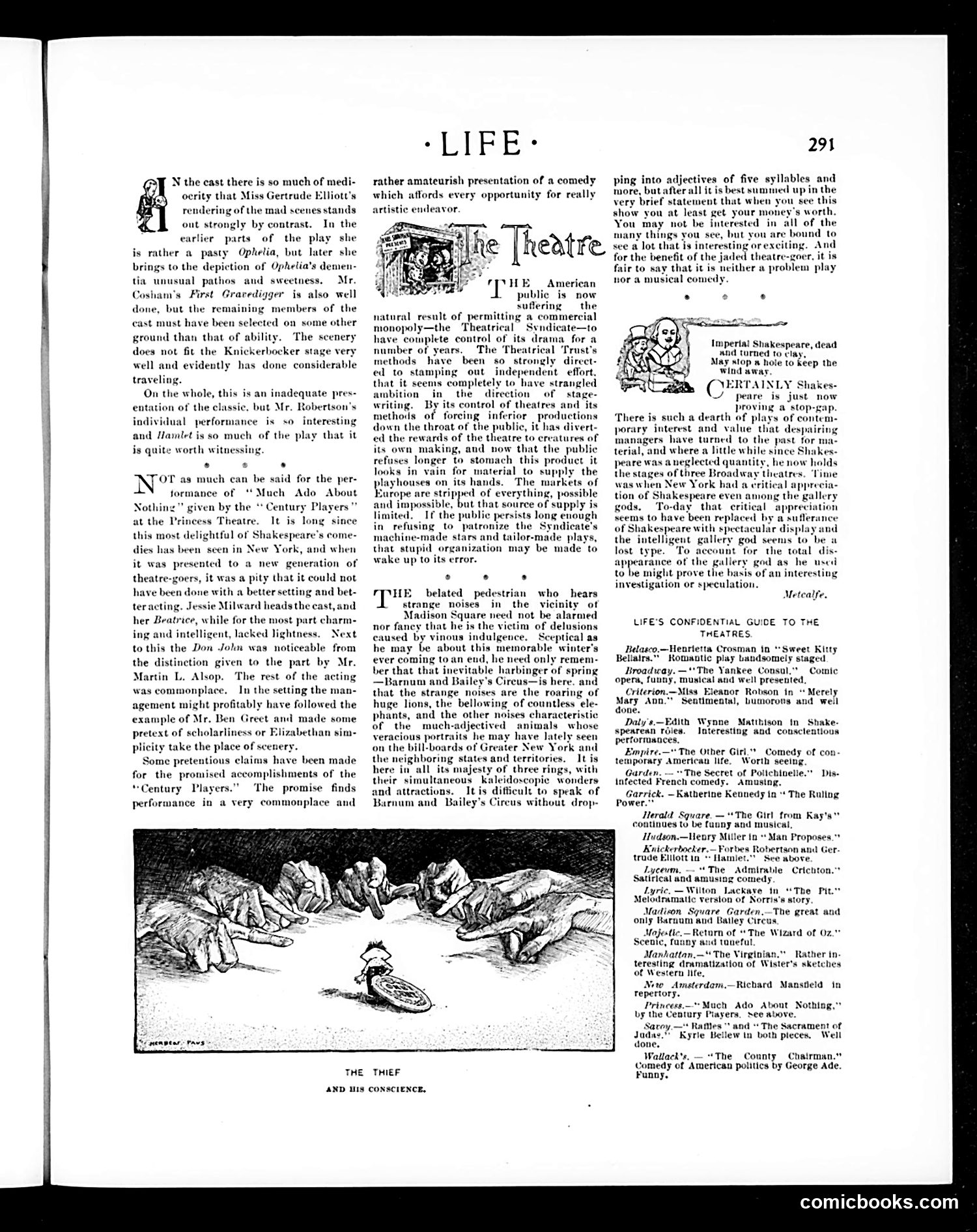
This page contains theater reviews and criticism typical of Life's cultural commentary. The main illustration, "The Thief and His Conscience," depicts a figure stealing from sleeping people—likely satirizing theatrical producers or the "Theatrical Syndicate" (a commercial monopoly controlling American theater). The text reviews recent Shakespeare productions and criticizes the **Theatrical Trust/Syndicate**—a real commercial monopoly that controlled American theater distribution. The author argues this monopoly has: - Strangled independent theatrical effort - Forced inferior productions on audiences - Diverted theater profits to mediocre performers - Exhausted European sources for quality plays The reviews are mixed: praising individual performances (Gertrude Elliott, Martin L. Alsop) while condemning overall productions as amateurish and poorly staged. The page concludes with lighter commentary on Barnum and Bailey's Circus arriving in Madison Square Garden, noting the "strange noises" (animal sounds) as a harbinger of spring. The satire targets theatrical corporate monopolization and its cultural damage.
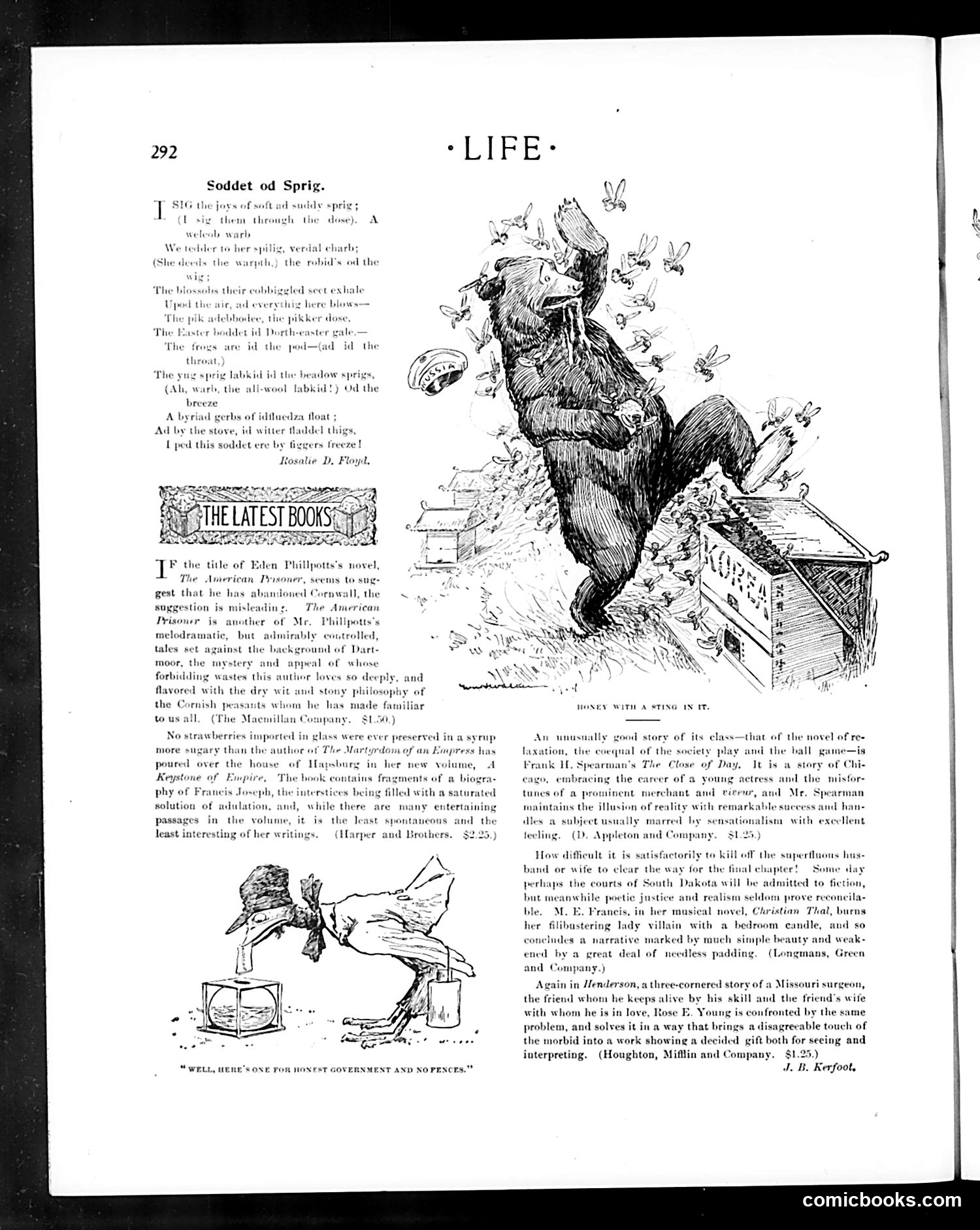
This page contains two editorial cartoons satirizing government and political themes. The main cartoon depicts a bear being attacked by bees, labeled "Honey with a Sting in It"—a visual metaphor suggesting that something appearing attractive or beneficial (honey/government promises) actually contains hidden dangers or painful consequences (bee stings/harsh realities). The bottom cartoon shows a figure at a table with the caption "Well, here's one for honest government and no fences," likely mocking the gap between political rhetoric about integrity and actual governmental practice. The page also reviews several contemporary novels. The bulk is a literary section discussing books including Eden Phillpotts' *The American Prisoner* and Frank H. Spearman's *The Close of Day*. The layout and tone suggest this is satire-focused *Life* magazine commentary on both politics and popular literature of the era.
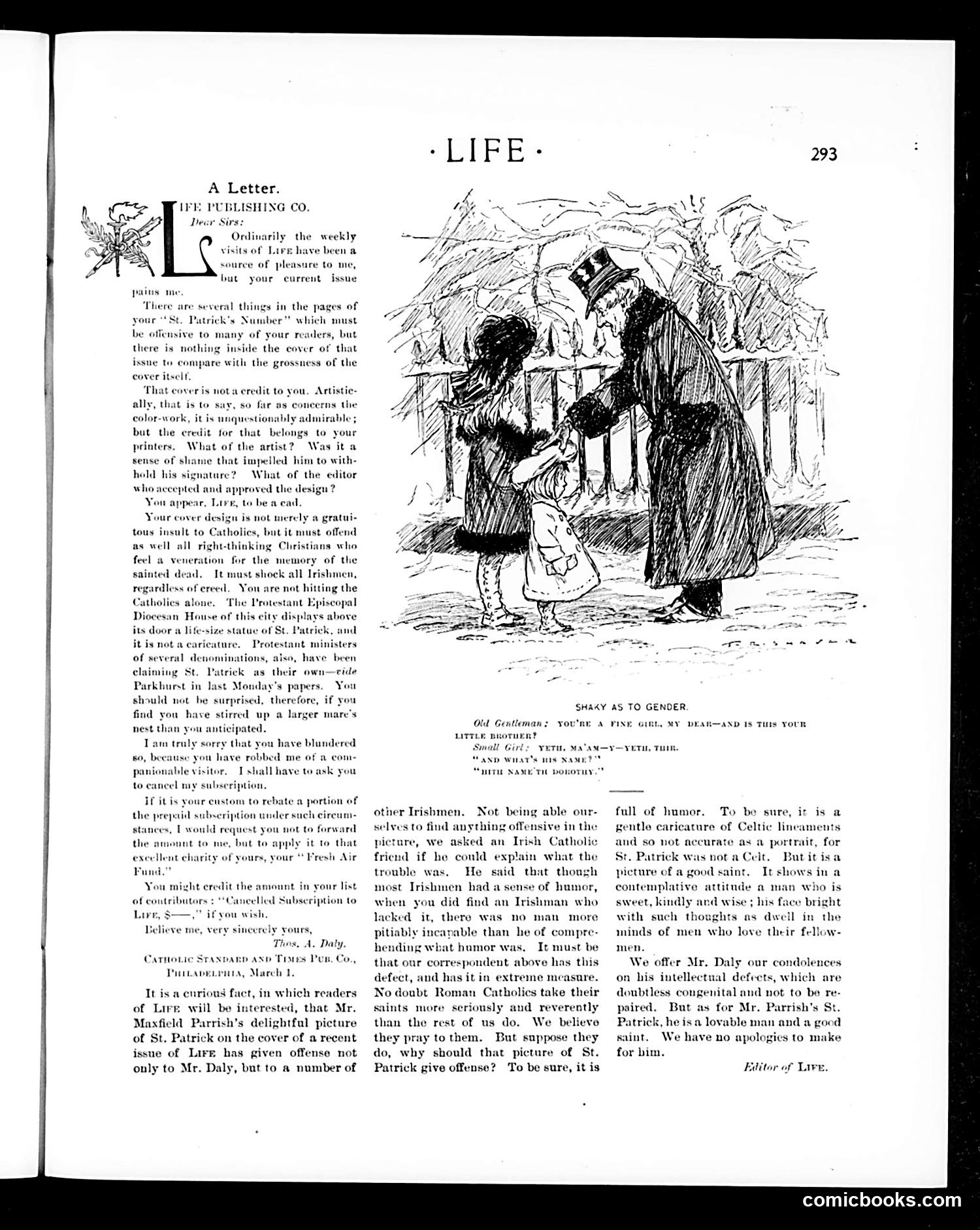
This page documents a controversy over Life magazine's St. Patrick's Day cover, illustrated by renowned artist Maxfield Parrish. A Catholic reader (signing as "Catholic Standard and Times Pub. Co.") complains the cover caricature of St. Patrick is offensive to Catholics and Irish people, mocking a sacred religious figure. Life's editor responds dismissively, arguing the illustration is affectionate and humorous rather than insulting—depicting Patrick as "sweet, kindly and wise." The editor suggests the complainant lacks humor and intellectual capacity, a condescending rebuttal typical of the era's sectarian tensions. The small cartoon "Shaky as to Gender" appears unrelated—a joke about gender ambiguity in a child's appearance. This exchange reflects early 20th-century anti-Catholic prejudice in mainstream American media and the Irish community's sensitivity to stereotyping, while also revealing how institutions dismissed religious objections to mocking sacred figures.
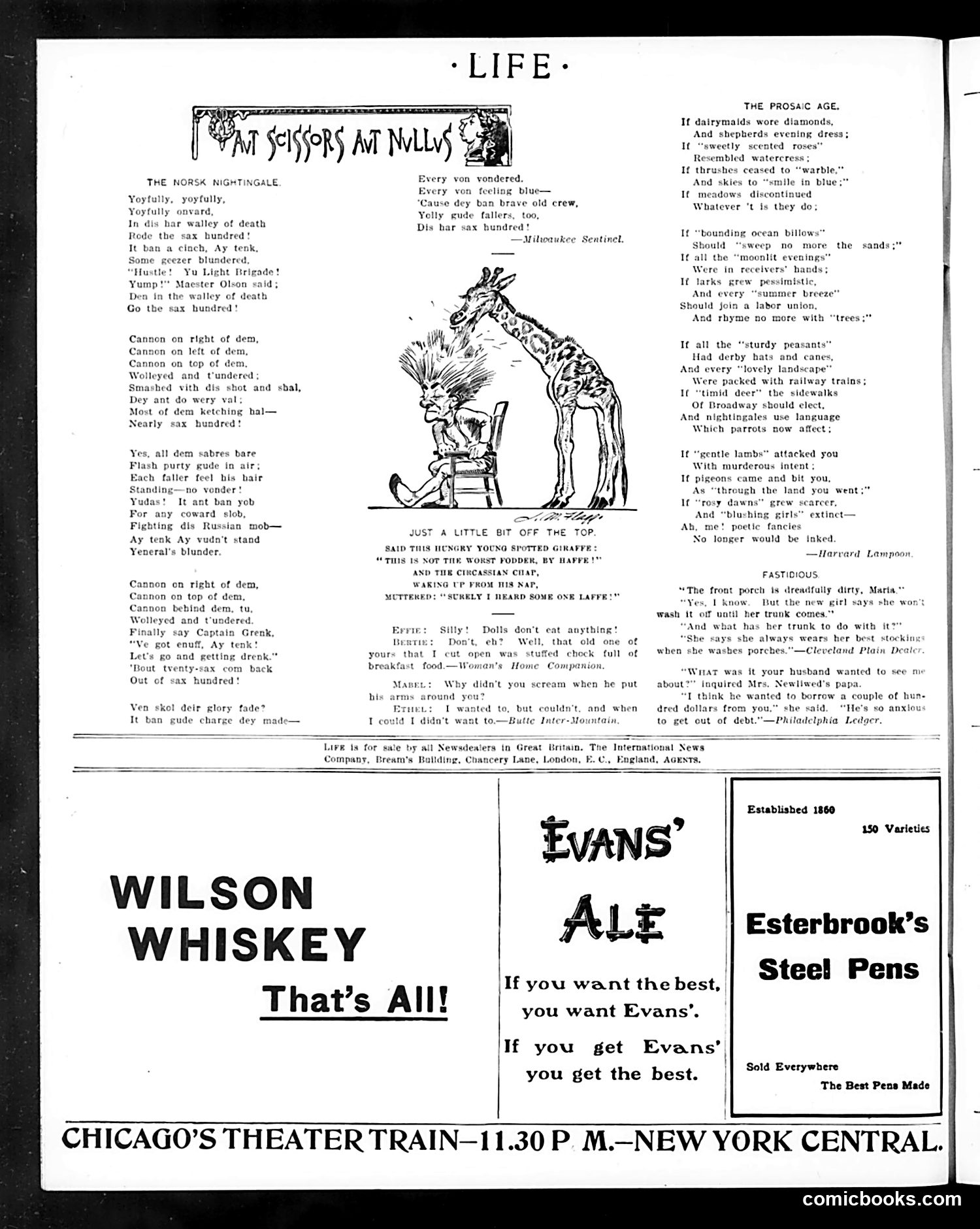
This page contains **two distinct satirical pieces**: ## "The Norse Nightingale" (left column) A humorous poem in heavy Swedish-immigrant dialect mocking the famous Charge of the Light Brigade. The speaker adopts a Scandinavian accent ("Ay tenk," "ven skol") to recount a military disaster, making fun of both the original poem's romanticism and immigrant speech patterns. The repeated "sax hundred" (six hundred) references Tennyson's celebrated but tragic cavalry charge. ## "The Prosaic Age" (right column) A satirical poem imagining a world where romantic literary imagery becomes mundane or contradictory—if roses smelled like watercress, if ocean waves unionized, if lambs attacked violently. It mocks Victorian poetry's overwrought sentimentality by showing how absurd these tropes would be in reality. Both pieces ridicule the gap between **romantic literary conventions and actual life**—one through immigrant dialect comedy, the other through logical absurdism. The surrounding advertisements and brief humor vignettes are typical of Life's satirical magazine format from this era.
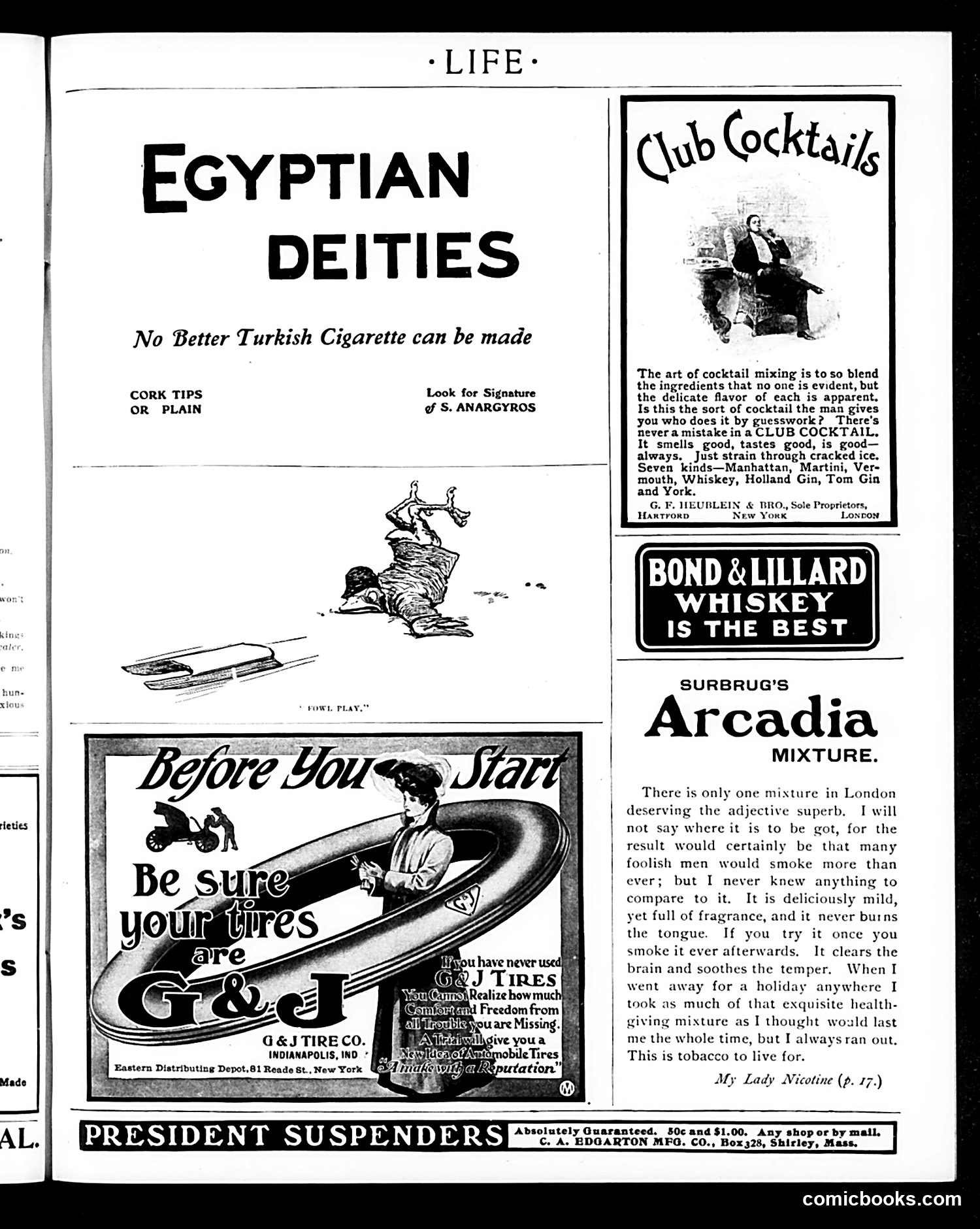
This is primarily an **advertising page** with minimal satirical content. The "Egyptian Deities" headline appears to be a humorous section title for cigarette ads rather than political commentary. The main elements are product advertisements: - **Egyptian Deities cigarettes** (S. Anargyros brand) — a Turkish cigarette ad - **Club Cocktails** — promoting seven cocktail varieties with mixing instructions - **G&J Tires** — a large advertisement featuring a couple in a boat, emphasizing tire quality and safety ("Before You Start, Be sure your tires are G&J") - **Bond & Lillard Whiskey** - **Surbrug's Arcadia Mixture** tobacco, with a testimonial attributed to "My Lady Nicotine" - **President Suspenders** at bottom The page reflects early 20th-century consumer culture, with lifestyle advertising targeting leisure activities (boating, cocktails, smoking). No identifiable political figures or satirical commentary is evident—this appears to be a standard advertising-heavy issue of Life magazine.
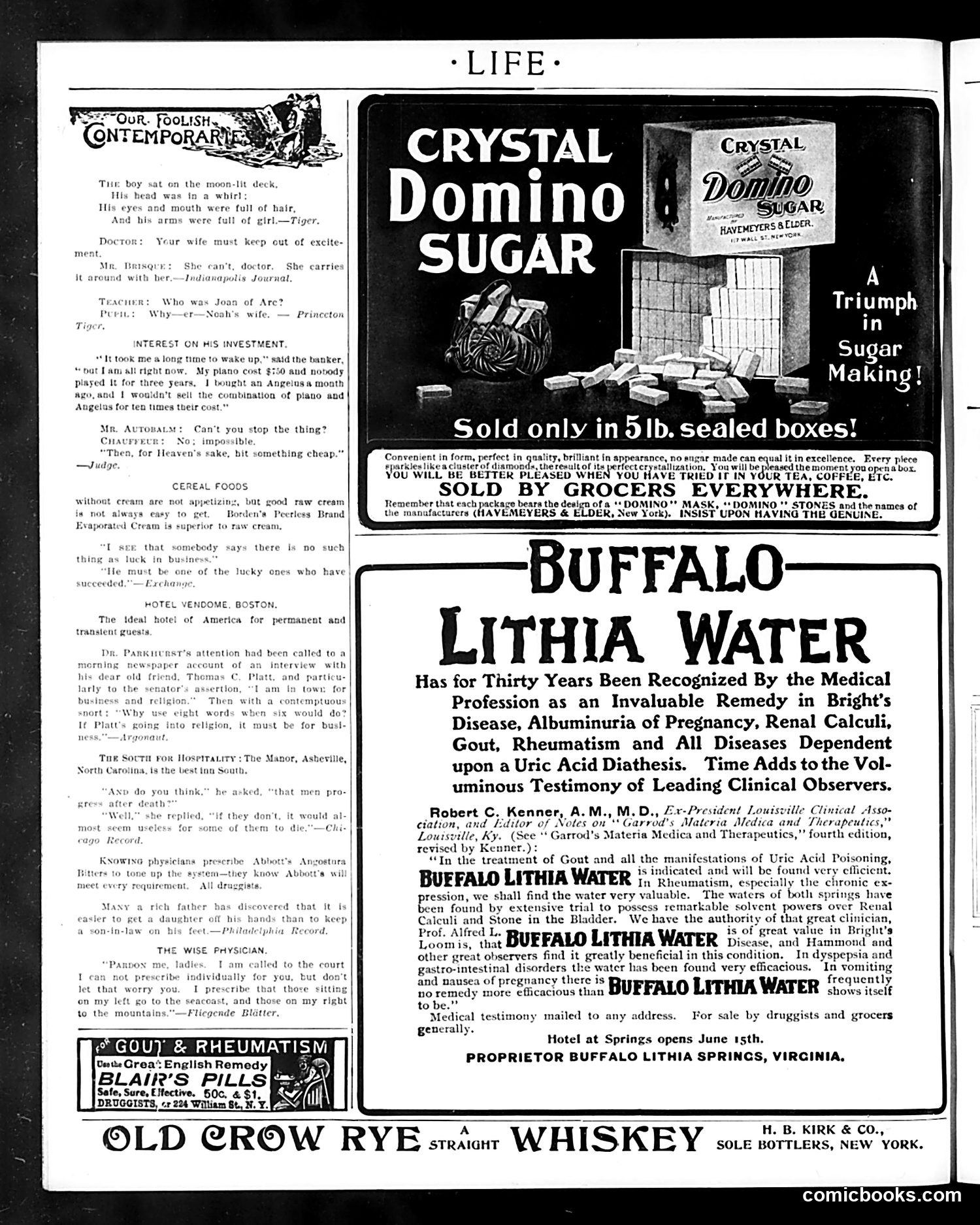
This page is primarily **advertising with brief satirical humor sections** rather than political cartoons. The "Our Foolish Contemporaries" section presents **short jokes mocking everyday social situations** typical of the era: - A doctor's exasperation with a patient's excitable wife - A student confusing Joan of Arc with someone's wife - A banker's satisfaction with purchasing a player piano (Angelus brand), treating it as a financial investment The **satire targets** common absurdities: masculine frustration with women's emotional volatility, student ignorance, and the nouveau riche treating consumer goods as serious investments. The page is otherwise dominated by **patent medicine advertisements**—Crystal Domino Sugar, Buffalo Lithia Water (claiming to treat gout, kidney disease, and pregnancy ailments), and Blair's Pills. These ads cite medical authorities and testimonials, reflecting early 20th-century marketing practices before FDA regulation. The whiskey ad at bottom suggests Life's audience and advertising standards of the period.
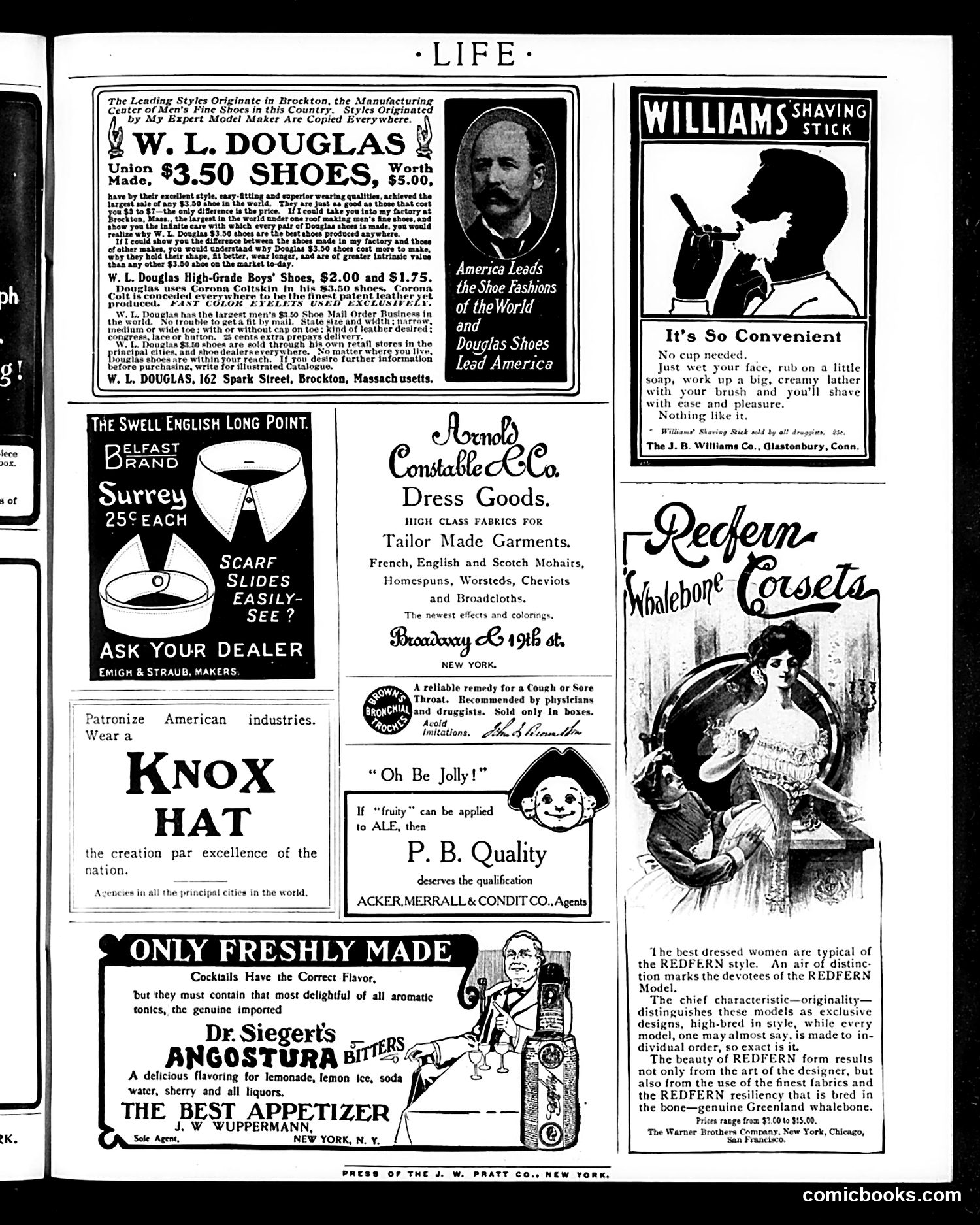
This is primarily an **advertising page**, not a satirical cartoon. The content consists of early 20th-century product advertisements with minimal political or social commentary. Notable ads include: - **W.L. Douglas Shoes**: Claims American manufacturing superiority, positioning Brockton, Massachusetts as the fashion center that other countries copy - **Knox Hat**: Appeals to nationalist sentiment ("Patronize American industries") - **Williams Shaving Stick**: Emphasizes modern convenience - **Dr. Siegert's Angostura Bitters**: Promotes imported luxury goods - **Redfern Corsets**: Markets exclusivity and refined femininity to wealthy women The **implicit messaging** reflects pre-WWI American values: industrial pride, nationalism, class distinction, and gender roles. The corset ad's emphasis on "whalebone" and high prices ($2-$15) targets affluent women, while shoe ads emphasize practicality and value for broader audiences. No specific political figures or satirical cartoons appear here—this is straightforward commercial advertising typical of Life's revenue model during this era.
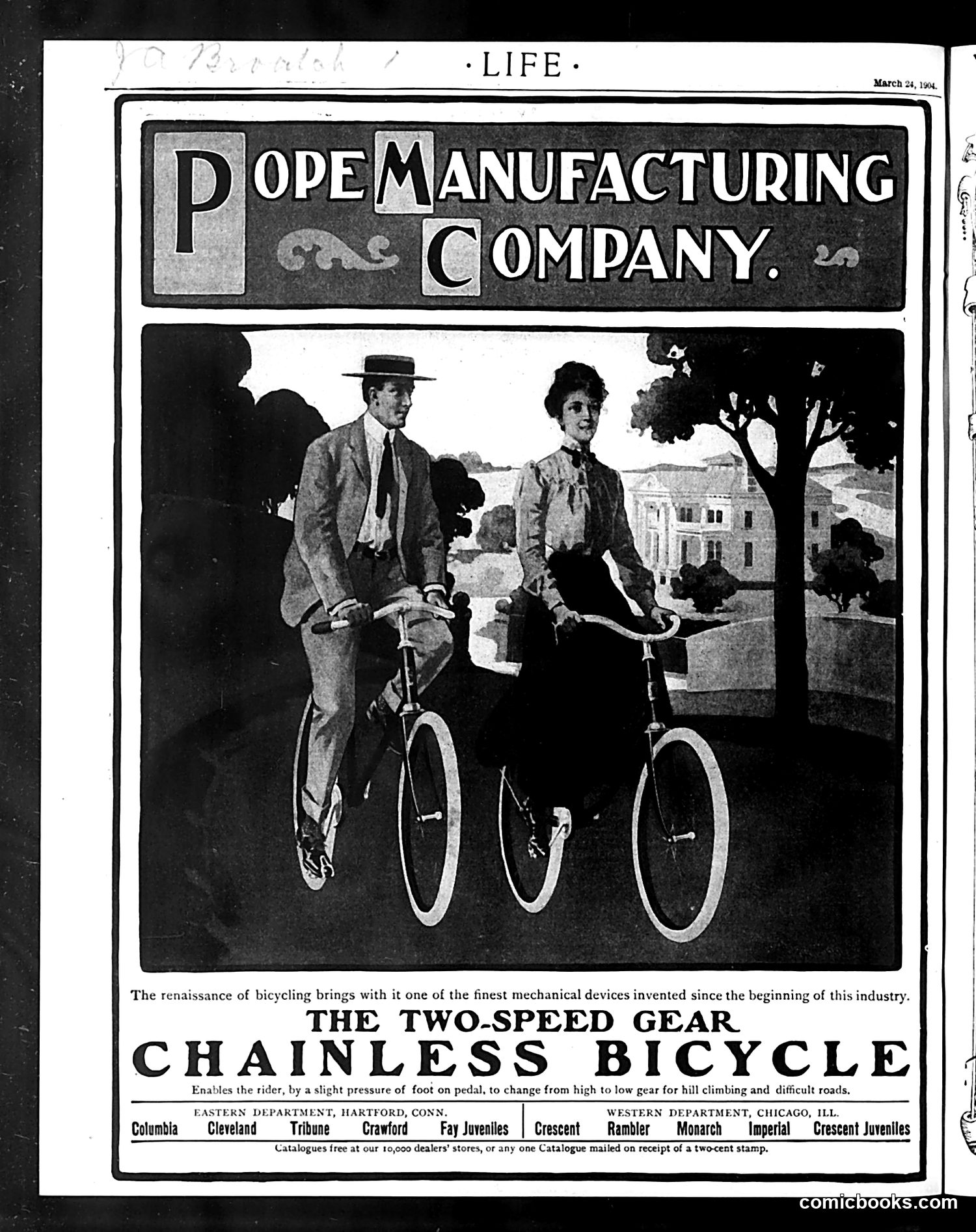
This is a straightforward **bicycle advertisement**, not political satire. The Pope Manufacturing Company is promoting their "Two-Speed Gear Chainless Bicycle," emphasizing it as a modern mechanical innovation that allows riders to shift gears by foot pressure for hill climbing. The image shows a well-dressed man and woman riding bicycles in an idyllic countryside setting, reflecting the **"bicycle craze" of the 1890s**—a period when bicycles were fashionable leisure items for the middle and upper classes. The advertisement lists multiple Pope brand names (Columbia, Cleveland, Tribune, etc.) and notes their widespread availability at 10,000 dealers' stores. This represents early automotive-era marketing: promoting mechanical innovation as a consumer product tied to leisure, modernity, and respectability.