
Life, 1904-03-24 · page 8 of 20
Life — March 24, 1904 — page 8: what you’re looking at
What you’re looking at
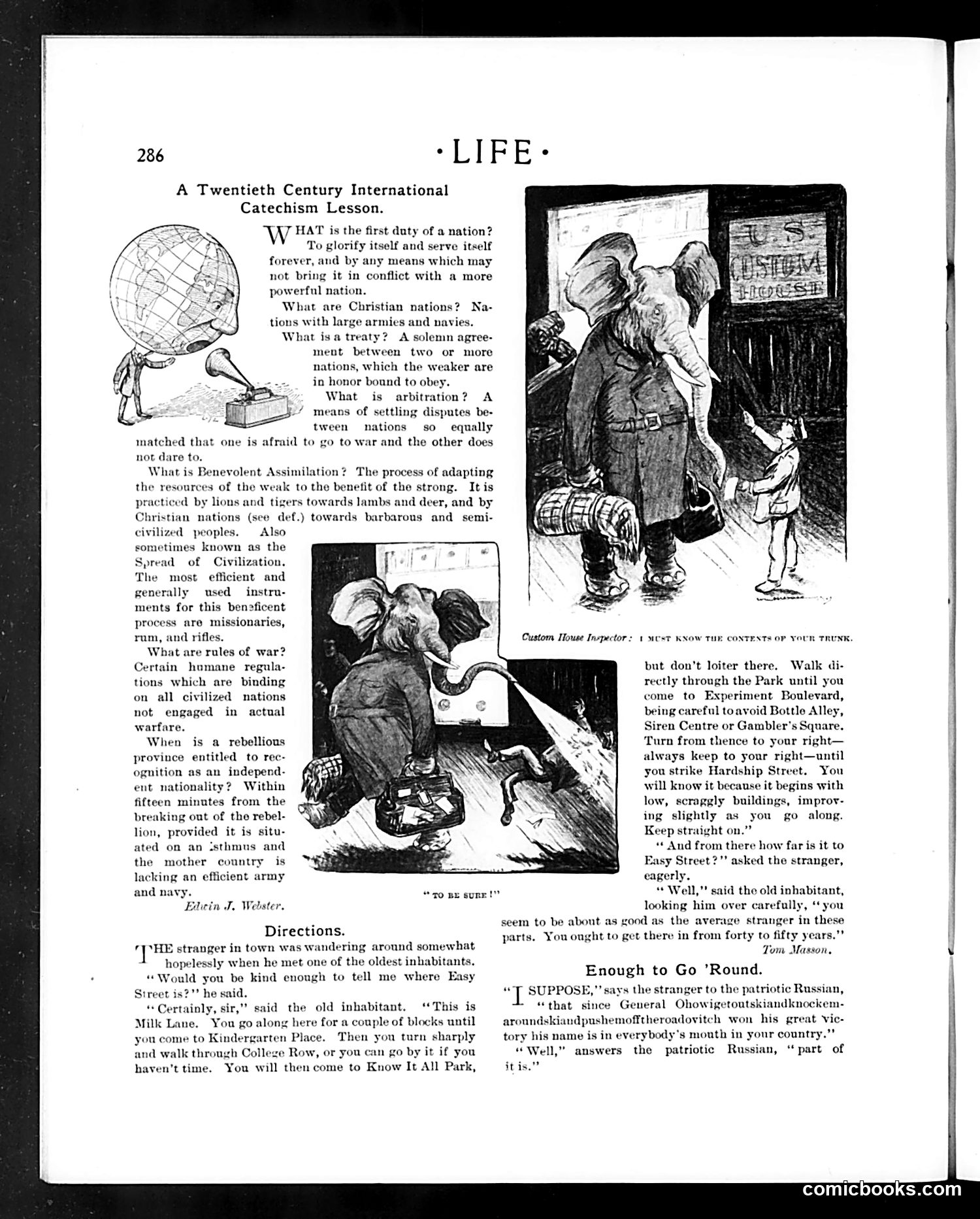
This page contains educational and satirical content from Life magazine. The left side features "A Twentieth Century International Catechism Lesson"—a mock-educational Q&A about nations, treaties, arbitration, and "Benevolent Assimilation" (likely referencing American imperialism). The illustrations by Edwin J. Weilder appear to satirize colonial conquest and civilization narratives. The right side shows a narrative titled "Directions" where a stranger asks an "old inhabitant" for directions to Easy Street in what appears to be a major city (likely London, given references to Hardship Street and Know It All Park). The satire suggests Easy Street is practically unreachable—a comment on economic inequality and the difficulty of achieving prosperity for ordinary people, despite promises of opportunity.
📄 Transcribed text from this page (OCR, searchable)
Machine-transcribed from the original scan — historical spelling and the odd misread are preserved.
286 A Twentieth Century International Catechism Lesson. HAT is the first duty of a nation? Ve W To glorify itself and serve itself forever, and by any means which may not bring it in conflict with a more powerful nation. What are Christian nations? Na- tions with large armies and navies. What isa treaty? A solemn agree- ment between two or more nations, which the weaker are in honor bound to obey. What is arbitration? A -/ means of settling disputes be- tween ations so equally matched that one is afraid to go to war and the other does not dare to. What is Benevolent Assimilation? The process of adapting the resources of the weak to the benefit of the strong. It is practiced by lions and tigers towards lambs and deer, and by Christian nations (see def.) towards barbarous and semi- civilized peoples. Also sometimes known as the Spread of Civilization. The most efficient and generally used instru- ments for this beneficent process are missionaries, rum, and rifles. What are rules of war? Certain homane regula- tions which are binding on all civilized nations not engaged in actual warfare. When is a rebellious province entitled to rec- ognition as an independ- ent nationality? Within fifteen minutes from the breaking out of the rebel- lion, provided it is situ- ated on an isthmus and the mother country is lacking an efficient army and navy. Edicin J, Webster. “70 Br sunr!” Directions. He stranger in town was wandering around somewhat hopelessly when he met one of the oldest inhabitants. “Would you be kind enough to tell me where Easy Street is?’? he said. ‘Certainly, sir,” said the old inhabitant. ‘This is Milk Lane. You go along here for a couple of blocks until you come to Kindergarten Place. Then you turn sharply nd walk through College Row, or you can go by it if you haven't time. You will then come to Know It All Park, *LIPE* but don’t loiter there. Walk di- rectly through the Park until you come to Experiment Boulevard, being careful to avoid Bottle Alley, Siren Centre or Gambler's Square. Turn from thence to your right— always keep to your right—until you strike Hardship Street. You will know it because it begins with low, scraggly buildings, improv- ing slightly as you go along. Keep straight on.” ud from there how far is it to Easy Street ?’’ asked the stranger, eagerly, * Well,” said the old inhabitant, looking him over carefully, you seem to be about as good as the average stranger in these parts. You ought to get there in from forty to fifty years.”” Tom Masson, Enough to Go ’Round. says the stranger to the patriotic Russian, “that since General Ohowigetontskiandknockem- aronndskiandpushemofftheroadovitch won his great vie- tory his name is in everybody's mouth in your country." “Well,” answers the patriotic Russian, “part of comicbooks.com