
Life, 1904-03-24 · page 13 of 20
Life — March 24, 1904 — page 13: what you’re looking at
What you’re looking at
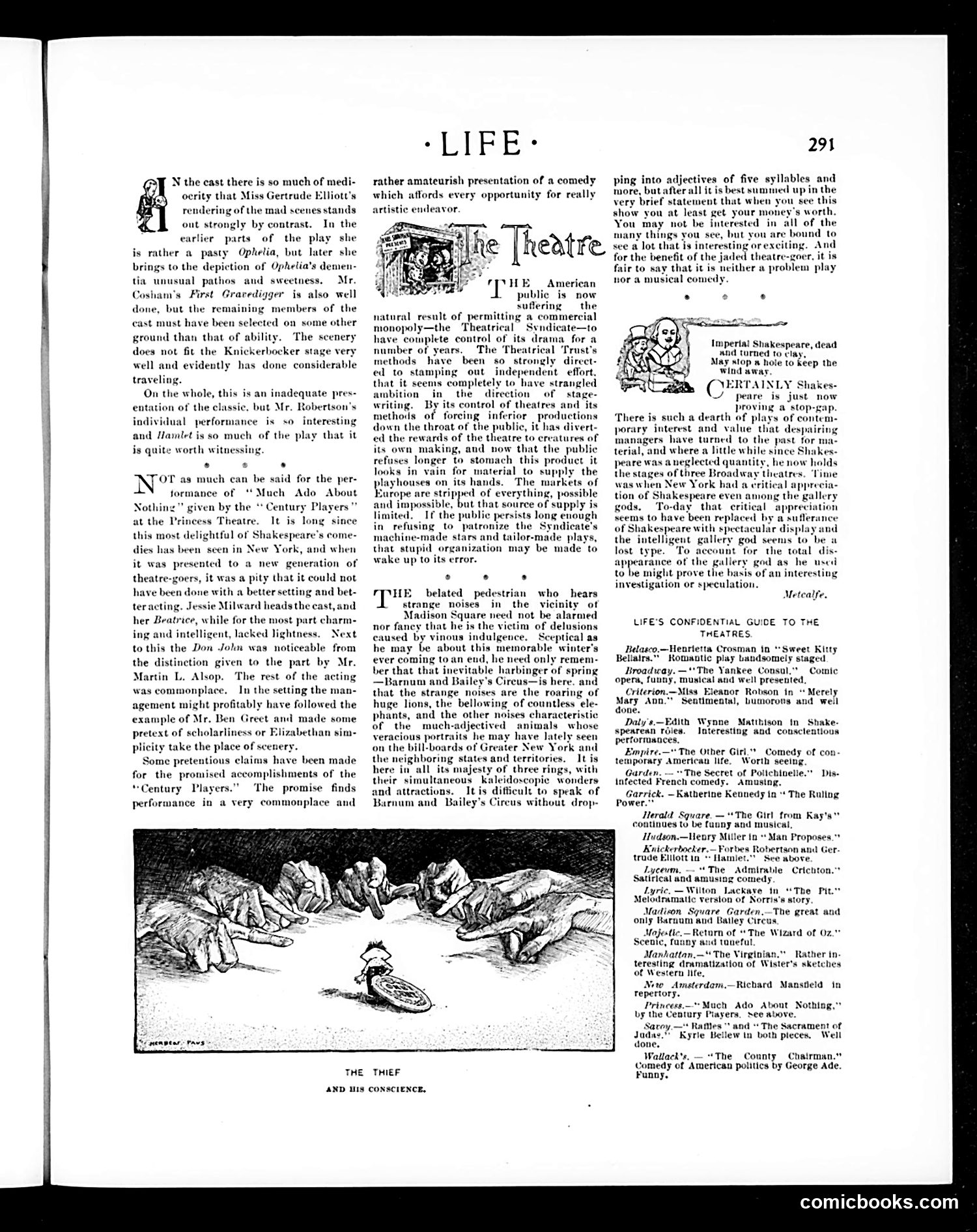
This page contains theater reviews and criticism typical of Life's cultural commentary. The main illustration, "The Thief and His Conscience," depicts a figure stealing from sleeping people—likely satirizing theatrical producers or the "Theatrical Syndicate" (a commercial monopoly controlling American theater). The text reviews recent Shakespeare productions and criticizes the **Theatrical Trust/Syndicate**—a real commercial monopoly that controlled American theater distribution. The author argues this monopoly has: - Strangled independent theatrical effort - Forced inferior productions on audiences - Diverted theater profits to mediocre performers - Exhausted European sources for quality plays The reviews are mixed: praising individual performances (Gertrude Elliott, Martin L. Alsop) while condemning overall productions as amateurish and poorly staged. The page concludes with lighter commentary on Barnum and Bailey's Circus arriving in Madison Square Garden, noting the "strange noises" (animal sounds) as a harbinger of spring. The satire targets theatrical corporate monopolization and its cultural damage.
📄 Transcribed text from this page (OCR, searchable)
Machine-transcribed from the original scan — historical spelling and the odd misread are preserved.
AN the cast there is so much of medi- ocrity that Miss Gertrude Elliott's rendering of the mad scenes stands out strongly by contrast. In the earlier party. of the play she is rather a pasty Ophelia, but later she brings to the depiction of Ophetia’s deme! tia w Cosham's First avedigger is also well done, but the remaining members of th cast must h ground than that of ability. The scenery does not fit the Knickerbocker stage very well and evidently has done considerable traveling. On the whole, this is an inadequate pres- entation of the classic, but Mr. Robertson's individual performance is so interesting and Hamlet is so much of the play that it isual pathos aud sweetness, Mr. e been selected on some other is quite worth witnessing. ° ° . TOT as much can be said for the pe formance of ‘Much Ado About Not! given by the “Century Pl ' at the Princess Theatre. It is long since this most delightful of Shakespeare's come- dies has been seen in New York, and when it was presented to a new generation of theatre-goers, it was a pity that it could not have been done with a better setting and bet- teracting. Jessie Milward heads the cast, and her Beatrice, while for the most part charm- ing and intelligent, lacked lightness. Next to this the Don John was noticeable from the distinction given to the part by Mr. Martin L, Alsop. The rest of the acting was commonplace. In the setting the man- agement might profitably have followed the example of Mr. Ben Greet and made some pretext of scholarliness or Elizabethan sim- ity take the place of scenery. me pretentious claims ha been made for the promised accomplishments of the “Century Players.” The promise finds performance in a very commonplace and Se qenpenr: raes THE AND us ‘LIFE rather amateurish presentation of a comedy which affords every opportunity for rei artistic ¢ T HE — American public is now suffering — the natural result of permitting a commercial monopoly—the Theatrical” Svndicate—to have complete control of its drama for a number of years, The Theatrical Trust's methods have been so strongly direet- ed to stamping out independent effort. that it seems completely to have strangled ambition in the direction of stage- writing. By its control of theatres and its methods of forcing inferior productions down the throat of the public, it has divert- ed the rewards of the theatre to creatures of its own making, and now that the public refuses longer to stomach this product it looks in vain for material to supply the y house its hands. The markets of Europe are stripped of everything, possible and impossible, but that source of supply is limited. If the public persists long enough n refusing to patronize the Syndicate's machine-made stars and tailor-made plays, that stupid organization may be made to wake up to its error. ° ° . TPHE belated pedestrian who hears strange noises in the vicinity of Madison Sq 1 not be alarmed nor faney that he ictim of delusions caused by vinous indulgence, Sceptical as he may be about this memorable winter's ever coming to an end, he need only remem- ber that that inevitable harbinger of spring —Barnum and Bailey's Circus—is here. and that the strange noises are the roaring of huge lions, the bellowing of countless ele- phants, and the other noises characteristic of the much-adjectived animals whose veracious portraits he may have lately seen on the bill-boards of Greater New York and the neighboring states and territories. It is here in all its majesty of three rings, with their simultaneous kaleidoscopic wonders and attractions. It is difticult to speak of Barnum and Bailey's Cireus without drop- THIEF conscience, 291 ping into adjectives of five syllables and more, butafter all it is best summed up in the very brief statement that when you see this show you at least get your money's worth. You may not be interested in all of the many things you s 1 are bound to see a lot that is interesting orexciting. And for the benefit of the jaded theatre-goer, i fair to say that it is neither a problem play nor a musical come | Imperial Shakespeare, dead ‘ ie} ‘and turned to riay, May stop x hole to keep the WA Wind away tata, CERTAINLY Shakes: J “peare is just’ now proving a ‘stop-gap. ‘There is such a dearth of plays of contem- ry interest and value that despairing managers have turned to the past for n terial, and where a little while since § e8- peare was a neglected quantity, he now holds the stages of three Broadway theatres. ‘Time was when N rk had a critical apprecia- tion of Shakespeare even among the gallery gods, To-day that critical appreciation seems to have been replaced by a suflerance of Shakespeare with spectacular display and the intelligent gallery god seems to be a lost type. To account for the total dis- appearance of the gallery god as he used to be might prove the basis of an interesting investigation or speculation. Metcalfe. LIFE'S CONFIDENTIAL GUICE TO THE THEATRES. Belasco.—Henrietta Crosman in Sweet Kitty Beliairs.” Romantic play bandsomely staged Broadway. —**The Yankee Consul,” Comic opera, funny, musical and well presented, Criterion.—Miss Eleanor Robson in “ Merely MaryAnn.” “Sentimental, Lumorons and weil jone. Daty's.—Ealth Wynne Mathison in Shake- spearean roles. Interesting and consctentious performances. Empire.—" The Other Giri.» Comedy of con- temporary American life. Worth seeing. Garden. — “The Secret of Polichinelie.” Dis- Infected French comedy. Amusing, Garrick. — Katherine Kennedy in “ The Rullug Power.” Herat Square. — “The Girl from Kay's" continues to be fauny and musical, Hudson.—Wenry Milter tn “ Man Proposes.» Knickerbocker.— Forbes Robertson and Ger. trade Elllott in *- Hamlet." See above. _Lycem. — “The Admirable Cricuton.”* Satirical and amusing comedy Lyric. —Wilton Lackaye in “Tbe Pit.” Melodramatic version of Norris's story, Mattison Square Garden.—The great and only Barnum and Bailey Circus, _ Mojetic.—Retumn of “The Wizard of 02." Se y aud taneful Manhattan,—“ The Virginian.” Rather in- teresting dramatization of Wister's sketches of Western life, to Amsterdam,—Richard Mansfield in repertory. Princess. Much Ado About Nothing,” by the Century Players, See above. Saroy.— RaMes" and “The Sacrament of Judas.” Kyrie Bellew tn both pieces, Well done, Wattack's, — “The Connty Chairman Comedy of Amertcan politics by George Ade. Funny. comicbooks.com