
A complete issue · 26 pages · 1904
Life — February 25, 1904
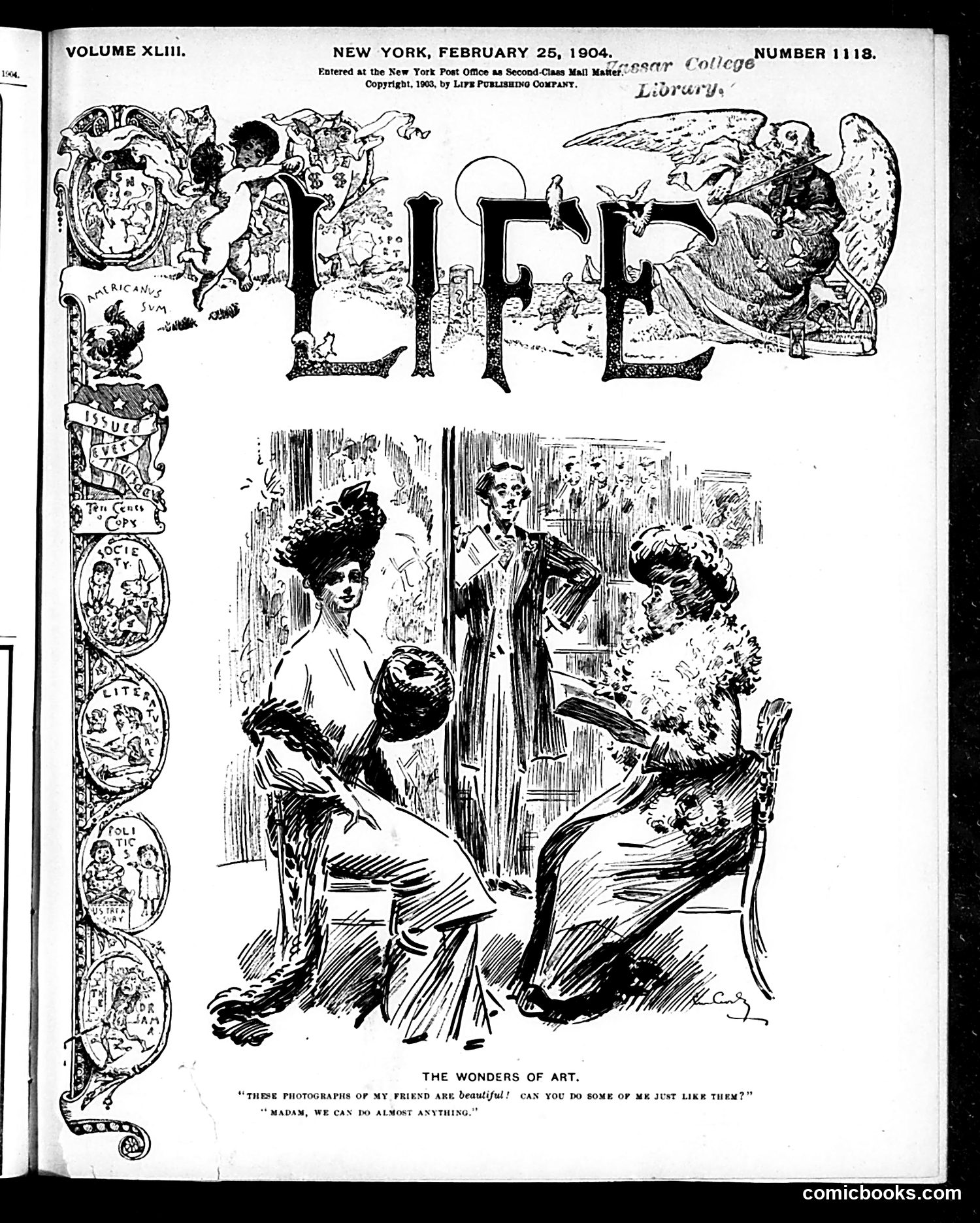
This satirical cartoon from Life (February 25, 1904) mocks amateur artistic pretension. The caption quotes a conversation where someone shows photographs of a friend, calling them "beautiful," then asks "Can you do some of me just like them?" The response—"Madam, we can do almost anything"—is dripping with irony. The joke targets wealthy society women who mistake flattering photography for genuine artistic skill. The cartoonist satirizes both the vanity of subjects seeking idealized portraits and the willingness of photographers to promise miraculous transformations through their craft. The elaborate decorative border and the woman's fashionable Edwardian dress establish the upper-class social context of this vanity.
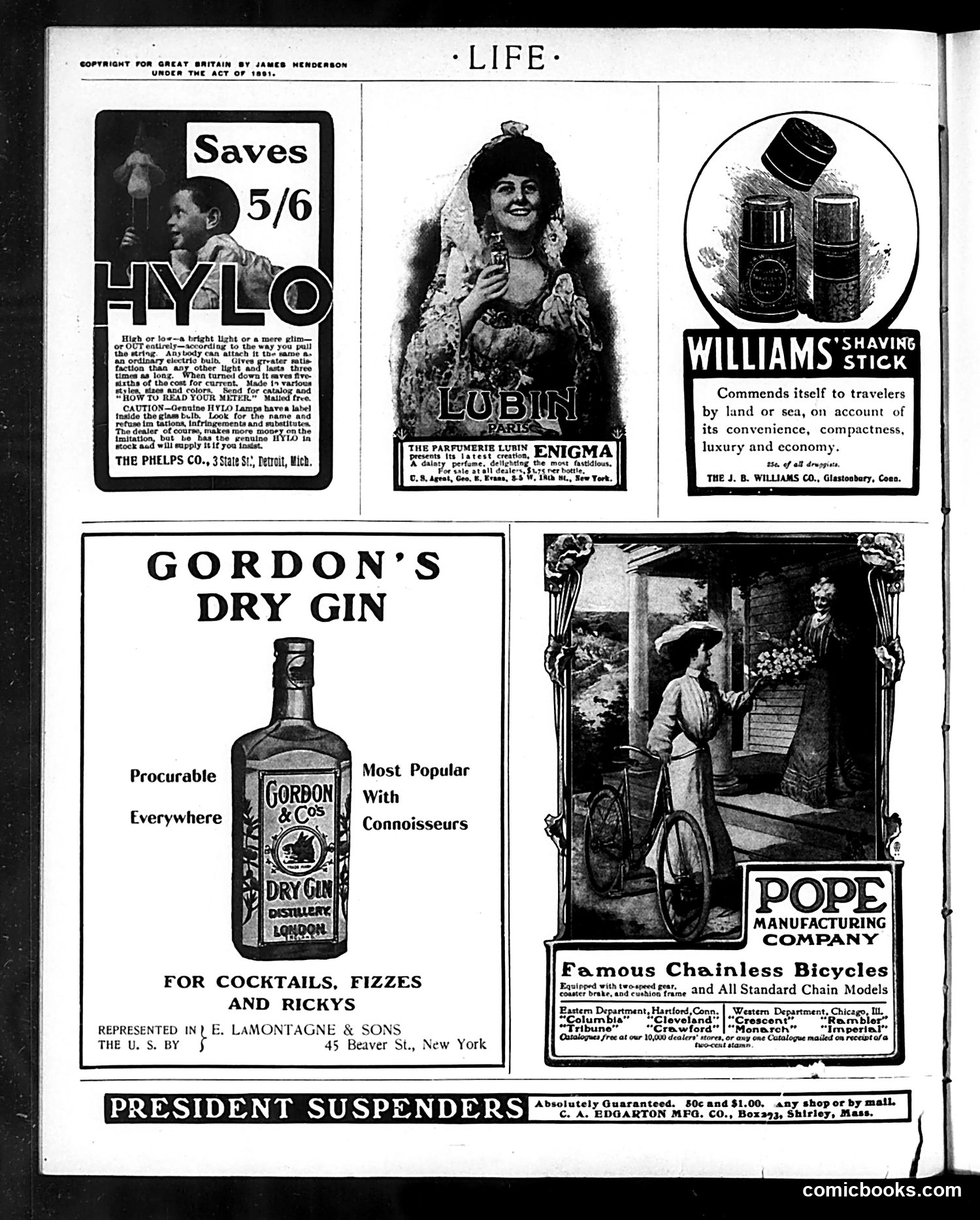
This page is primarily **advertising**, not satire or political commentary. It contains five vintage advertisements: 1. **HYLO** lamp—claims to save 5/6 in costs compared to other lights 2. **Lubin Enigma** perfume from Paris 3. **Williams' Shaving Stick**—emphasizes convenience for travelers 4. **Gordon's Dry Gin**—marketed as popular with connoisseurs 5. **Pope Manufacturing Company** bicycles—featuring "Famous Chainless Bicycles" At the bottom is a small ad for **President Suspenders**. The page reflects early 20th-century consumer products and advertising approaches. There is no evident political cartoon or satire—this is a straightforward advertising page from *Life* magazine's commercial section, showcasing luxury and practical goods marketed to affluent readers of the era.
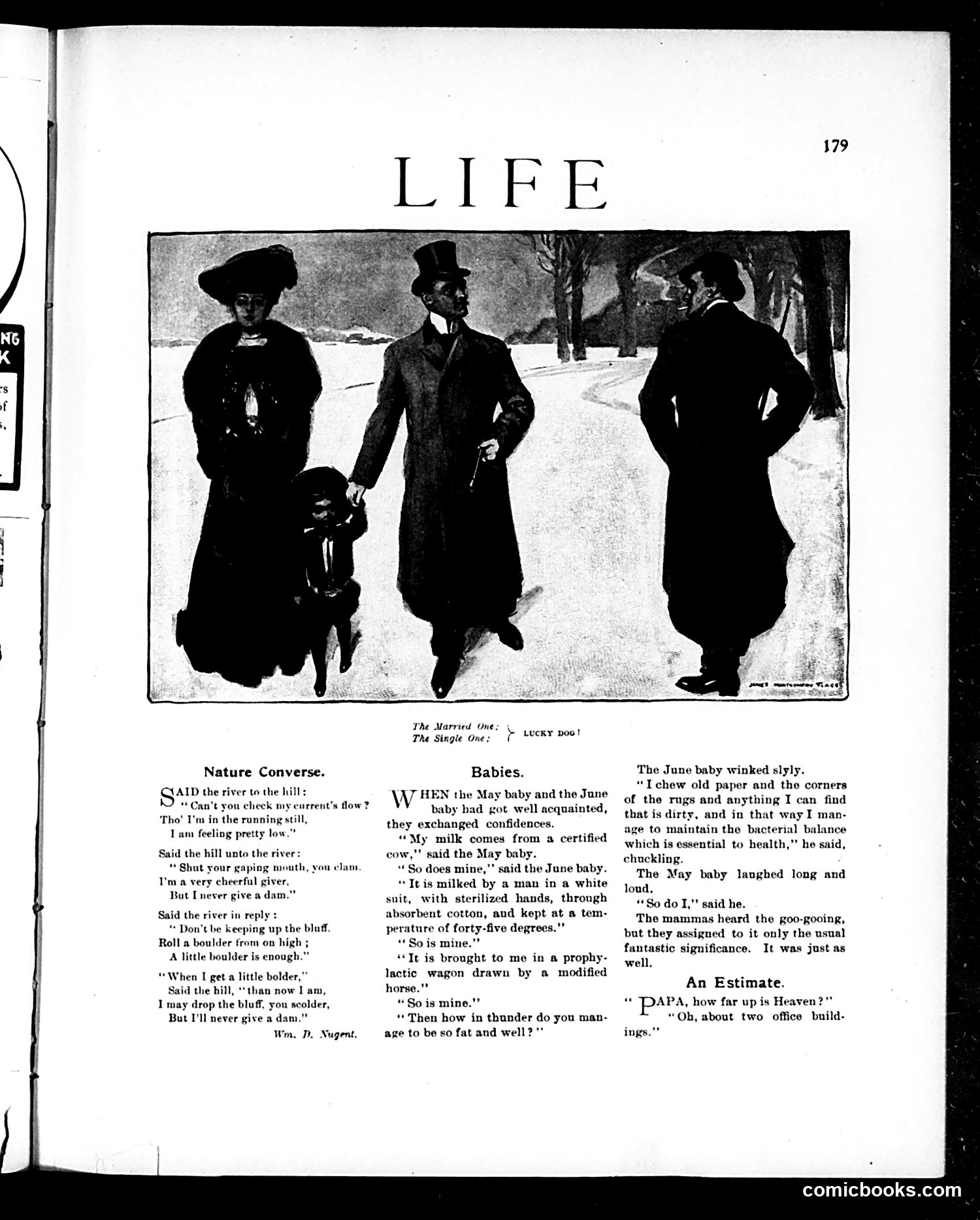
The main illustration depicts four formally dressed figures on a snowy street—a woman, a small child, a man in a top hat, and another man. The caption reads "The Married One: The Single One:" with "LUCKY DOG!" written below. This is a social satire contrasting married versus unmarried life. The "lucky dog" reference suggests the single man is envied for his freedom, while the married man is burdened with family obligations (the woman and child). The joke reflects early 20th-century attitudes about marriage as a constraint on male independence. The page also contains humorous dialogue pieces ("Nature Converse," "Babies," "An Estimate") presenting witty exchanges between characters on mundane topics—typical of *Life* magazine's satirical content style during this era.
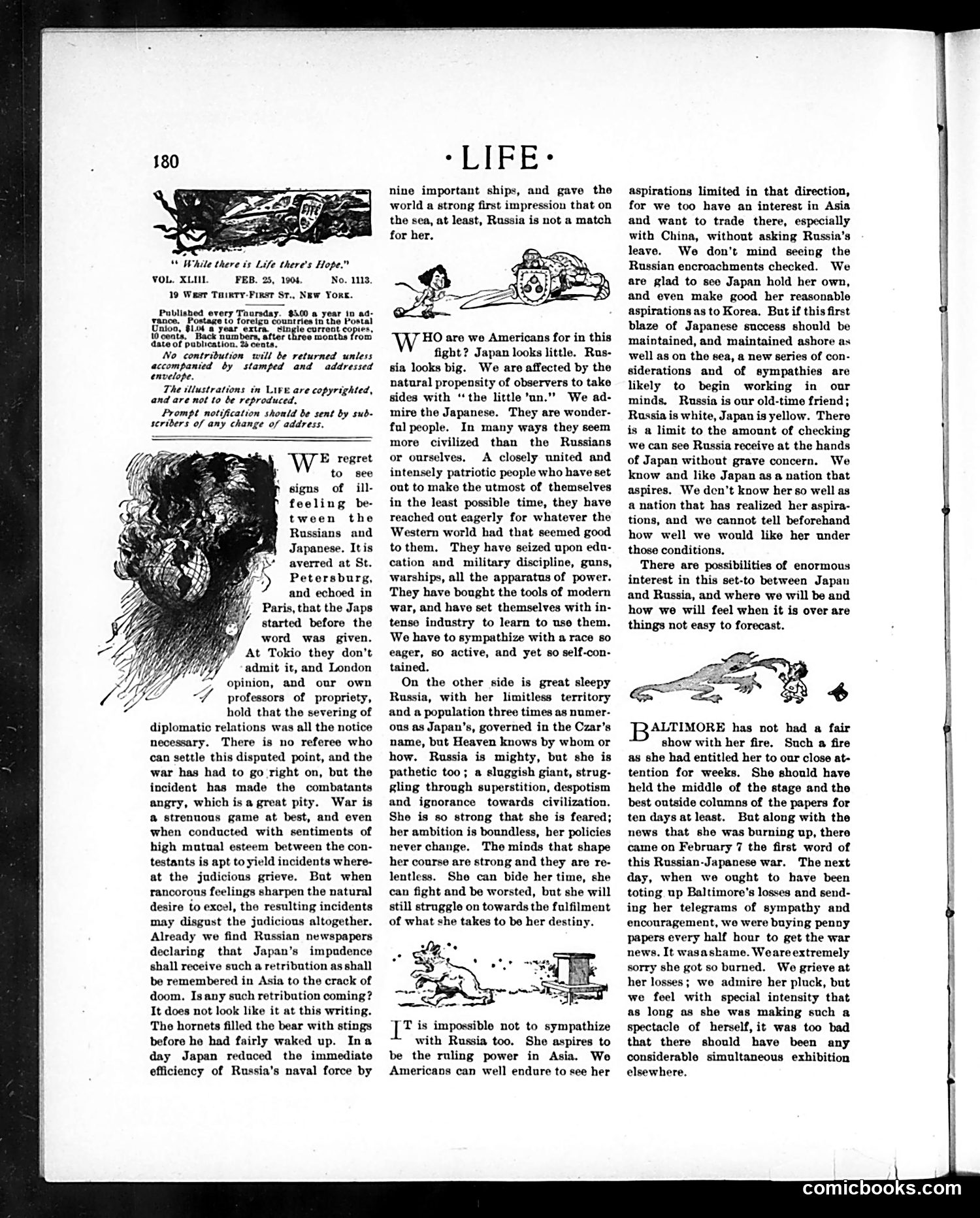
This editorial page addresses the Russo-Japanese War, then underway. The text argues that Americans should sympathize with Japan as the underdog "little 'un" against Russia's vast imperial power. The author contends that while Russia appears mighty, she is actually stagnant and governed by autocratic despotism, whereas Japan represents modern, energetic civilization. The satirical angle: the piece portrays Russia as a sleeping, complacent giant, while Japan demonstrates vigor and progress. The author acknowledges Americans have commercial interests in Asia and prefer seeing Japanese (rather than Russian) dominance in the region. The bear sketches likely represent Russia using the common period caricature of Russia as a bear—a standard political cartoon trope of the era.
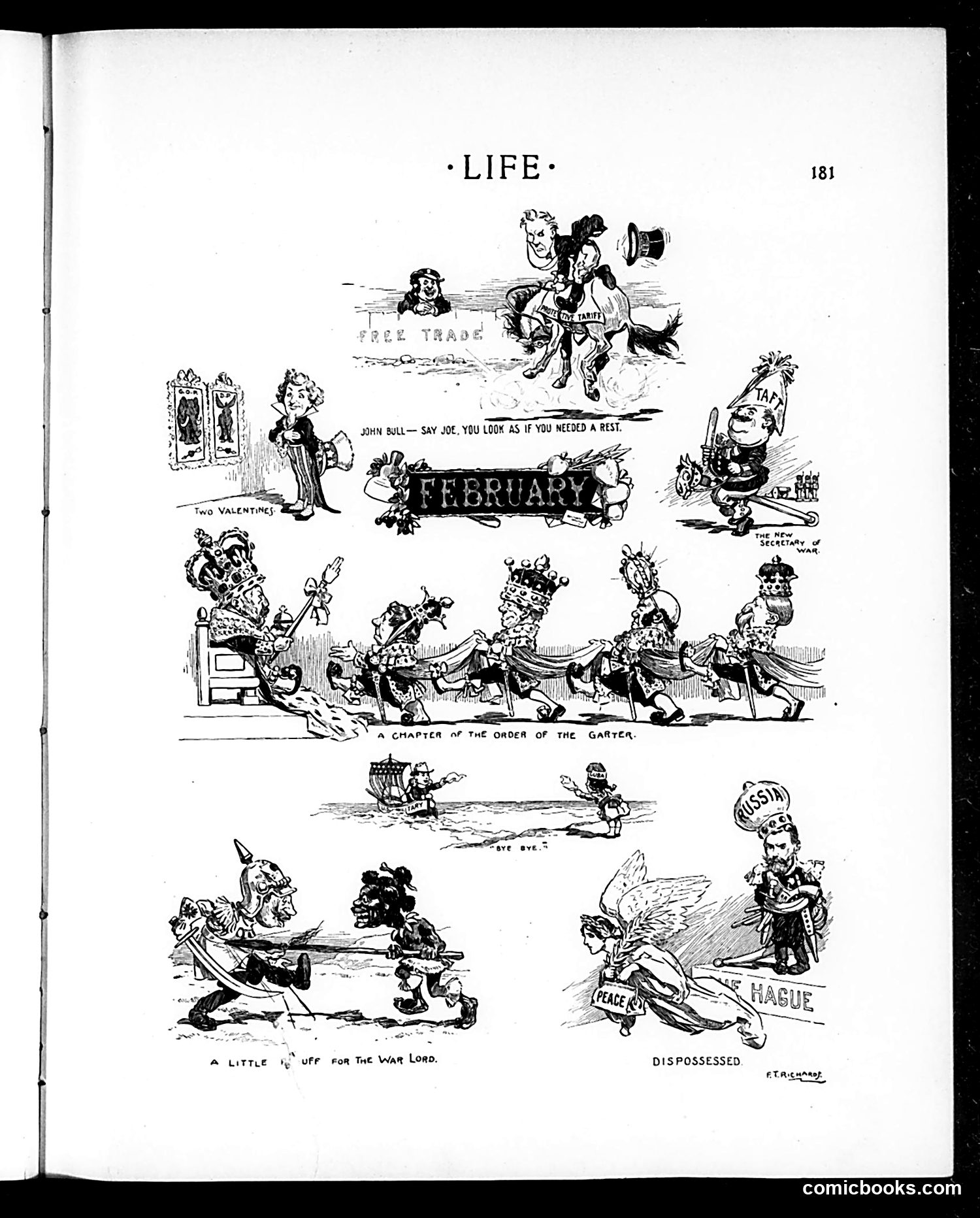
This page presents political cartoons from early 20th-century America, likely WWI-era based on references visible. The central "Chapter of the Order of the Garter" depicts military/political figures in a procession, appearing to satirize British honors and military hierarchy during wartime. The scattered vignettes comment on contemporary issues: "Two Valentines" references romantic/political relationships; "The New Secretary of War" suggests military appointment controversy; "A Little 'U' for the War Lord" and "Dispossessed" appear critical of war leadership and its consequences. The "John Bull" reference invokes the British character. "Peace" imagery suggests satire about peace negotiations or anti-war sentiment. The overall tone mocks military pomp and questions wartime authority, typical of Life's satirical approach to politics.
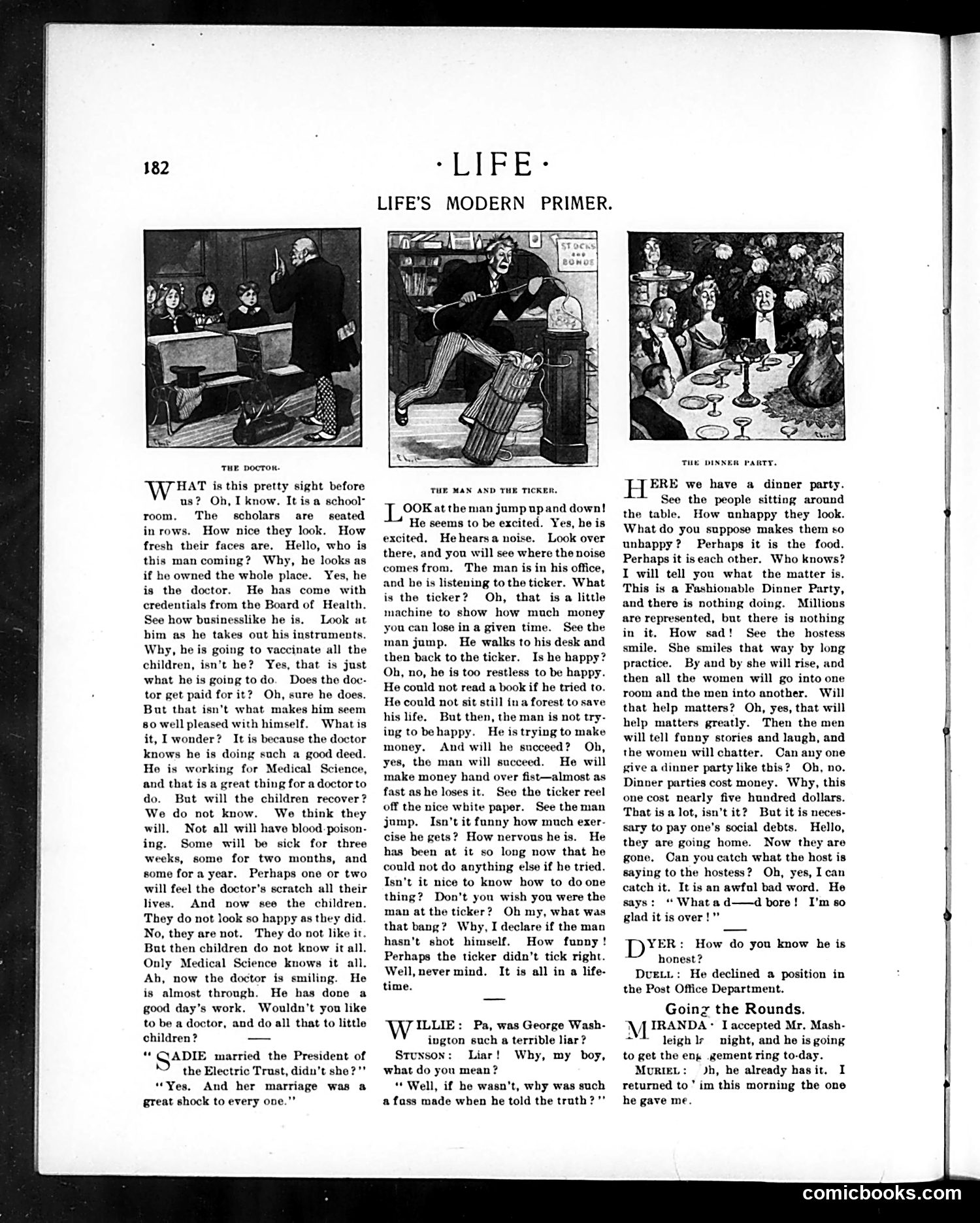
This page presents three satirical vignettes mocking modern social situations through a "primer" format—teaching readers about contemporary life's absurdities. **"The Doctor"**: Critiques medical professionalism, showing a doctor visiting a schoolroom. The text sarcastically praises his work despite unclear purpose, suggesting doctors' inflated social status regardless of actual benefit. **"The Man and the Ticker"**: A man frantically reacts to stock-market news. The satire mocks obsessive financial speculation and anxiety, portraying him as neurotic over trivial fluctuations—commentary on 1920s investment mania. **"The Dinner Party"**: Depicts wealthy socialites at an elaborate dinner, presented as tedious and pointless. The satire suggests upper-class gatherings are expensive status performances devoid of genuine enjoyment. All three target pretension in professional, financial, and social spheres.
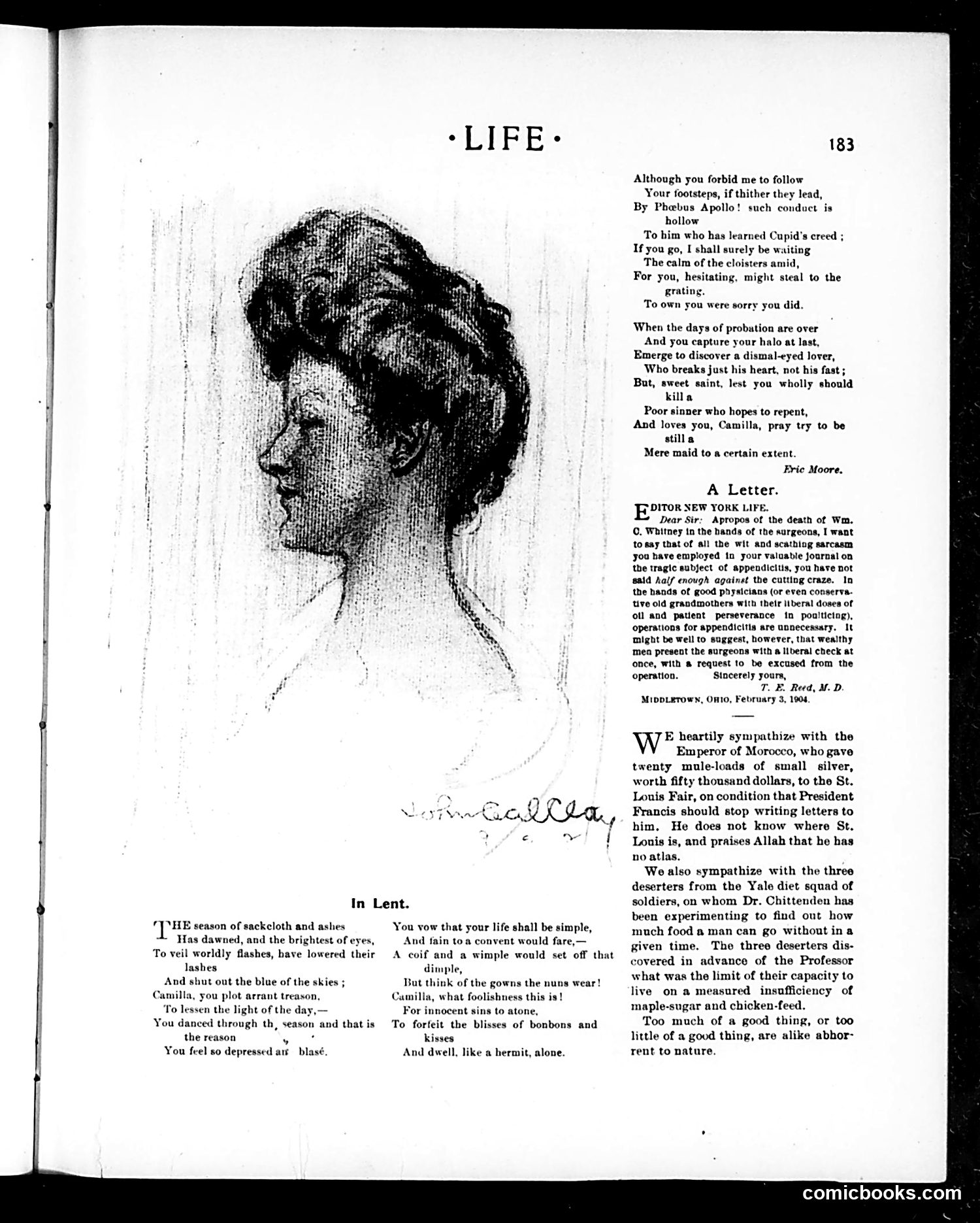
This page from *Life* magazine (page 183) contains poetry and letters rather than political cartoons. The visual element is a sketch portrait of a woman's profile in the upper left. The content includes: - A poem titled "In Lent" about religious observance and asceticism - A poem by Eric Moore titled "A Letter" addressing moral conduct - Two letters to the editor: one from a physician (T.F. Reed, M.D.) discussing appendicitis surgery, and another sympathizing with the Emperor of Morocco regarding gifts and the Yale diet squad's food restrictions The page is primarily literary and editorial rather than satirical cartooning. The letters touch on medical practices and contemporary news items, but without additional context about the specific date or events referenced, the precise satirical targets remain unclear.
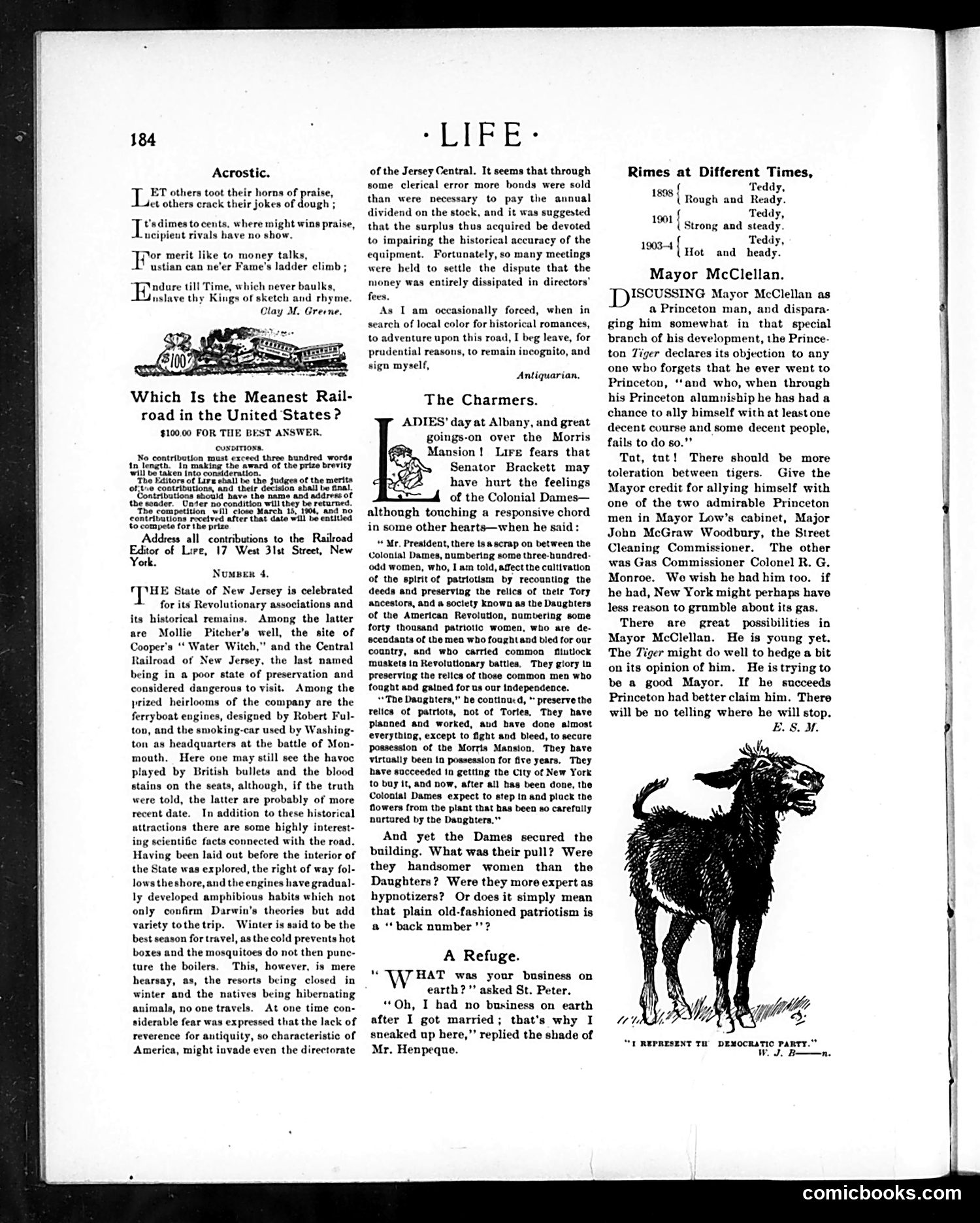
This page contains several distinct pieces of satirical content: **"The Charmers"** section discusses New Jersey's historical sites, particularly the Colonial Dames and their preservation efforts. The text sarcastically questions whether the Dames were truly patriotic or simply fashionable. It mocks them as "back number" (outdated) patriots, suggesting their historical preservation work masks less noble motivations. **The cartoon** (bottom right) depicts a goat labeled "I REPRESENT THE DEMOCRATIC PARTY," likely satirizing Democratic political weakness or stubbornness during this era. **"Mayor McClellan"** discusses Princeton alumnus Mayor John McGraw Woodbury, comparing him unfavorably to Mayor McClellan, suggesting New York's leadership is superior. The overall tone mocks both historical pretension and contemporary Democratic politics through gentle ridicule.
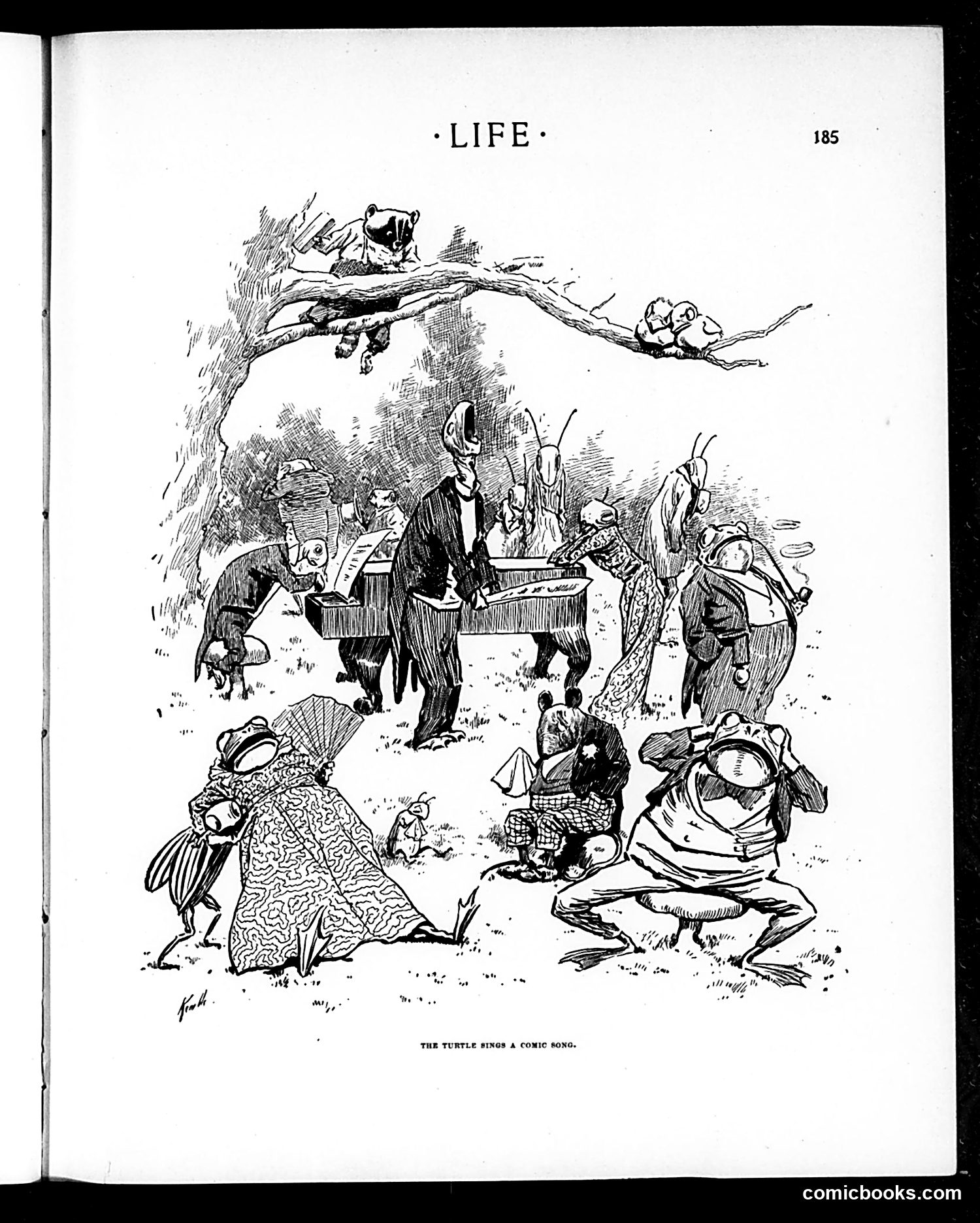
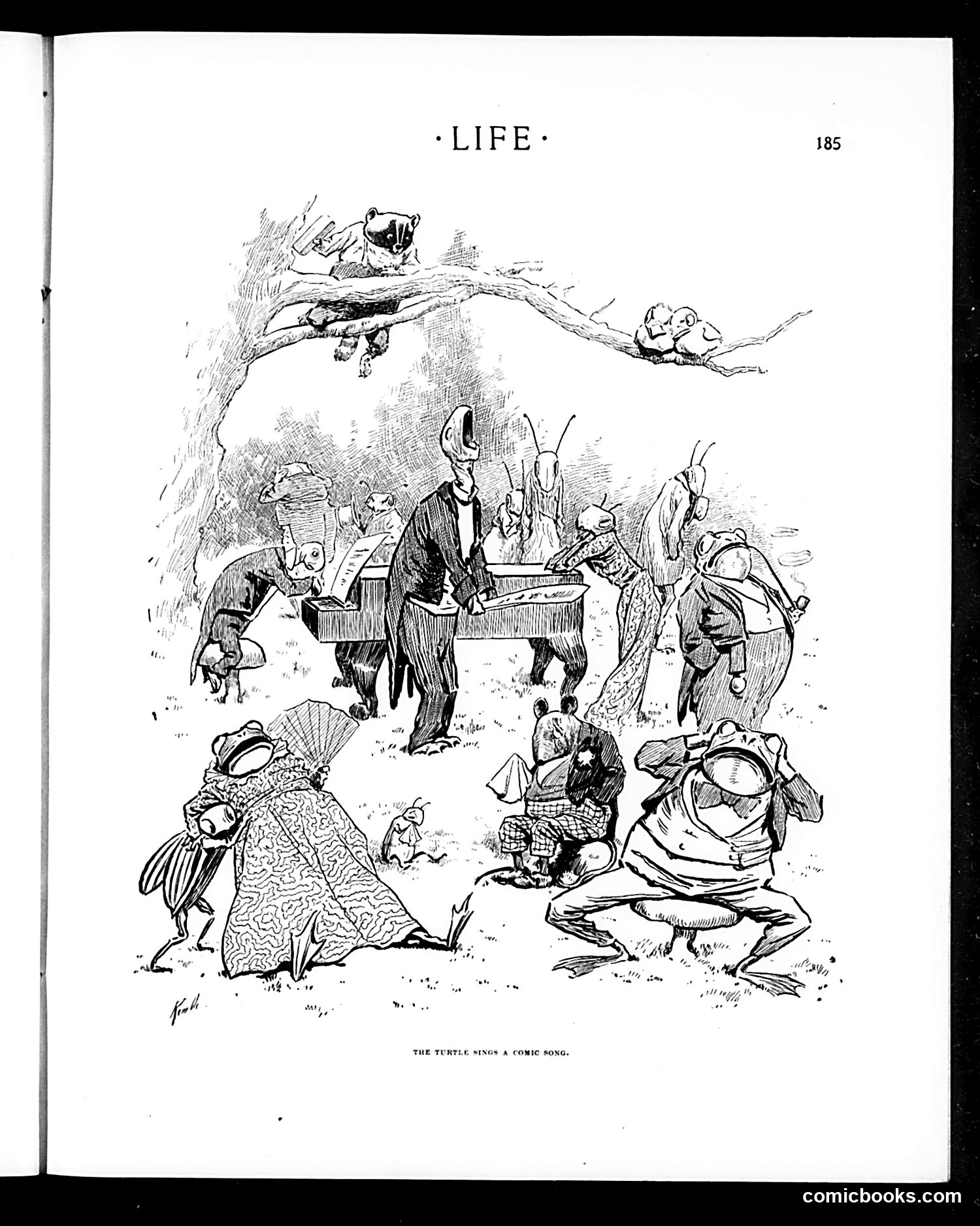
This whimsical cartoon depicts anthropomorphic animals—primarily turtles and other creatures—gathered in a woodland scene beneath a gnarled tree. The animals appear to be performing or singing together, with some standing upright in human poses and wearing clothing. The caption "The Turtle Sings a Comic Song" suggests this is a humorous illustration rather than political satire. It appears to be a fanciful children's or light-hearted piece typical of Life magazine's satirical humor, focusing on absurdist animal behavior rather than social commentary. The style and composition suggest entertainment through whimsy and visual gags rather than commentary on contemporary events or figures. Without additional context, the specific satirical point remains unclear.
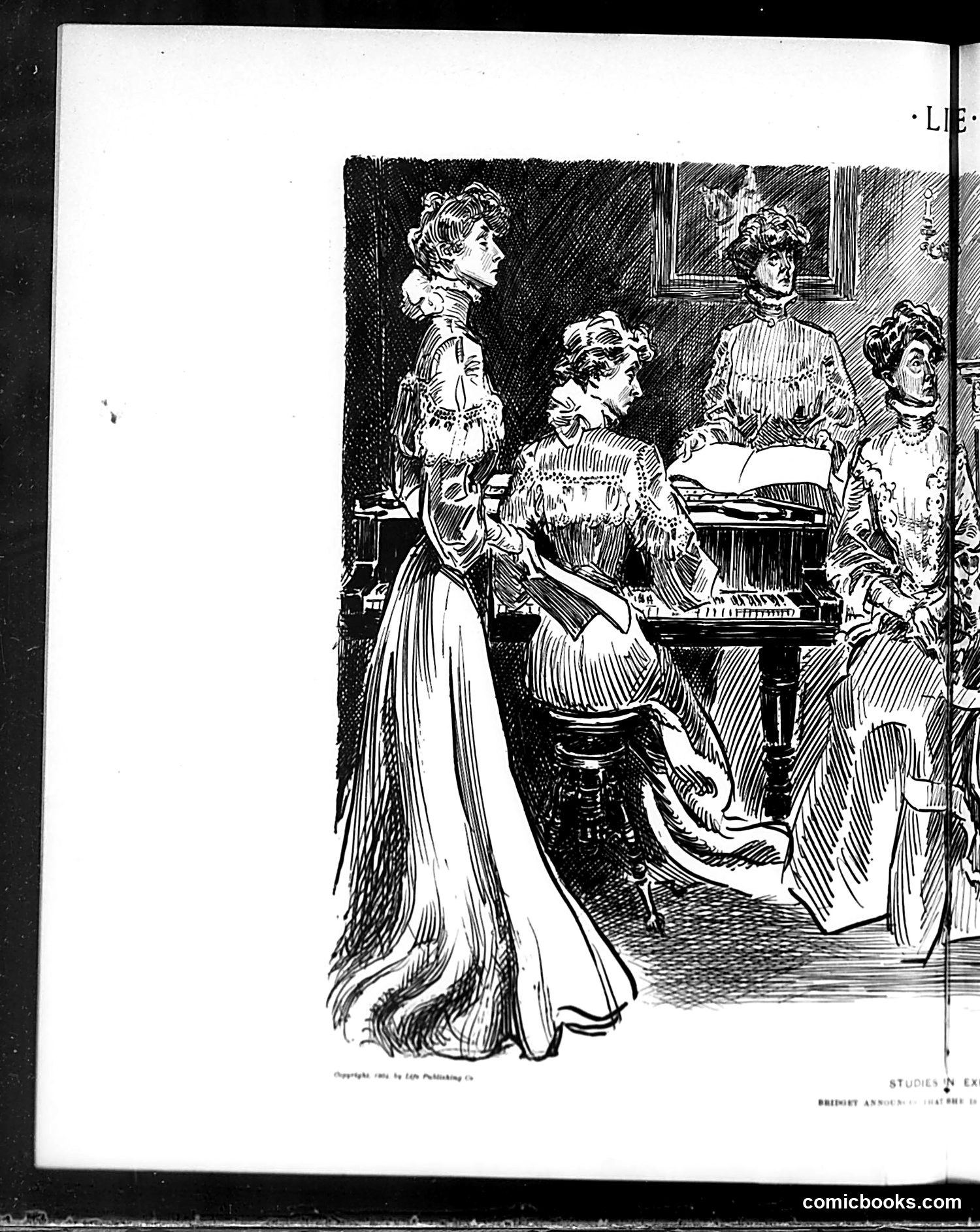
This appears to be an illustration from *Life* magazine depicting an elegant social gathering, likely from the early 1900s based on the clothing styles and artistic technique. The scene shows several well-dressed women in elaborate gowns gathered around a piano in what appears to be a parlor or drawing room. The specific satirical point is unclear from the image alone without accompanying caption or article text. However, given *Life*'s satirical nature, this likely comments on upper-class social customs, possibly mocking formal musical performances, pretentious salon culture, or the rigid etiquette governing Victorian/Edwardian society. The detailed cross-hatching and line work is characteristic of *Life*'s editorial illustration style. Without visible caption text, the exact target of satire cannot be definitively determined.
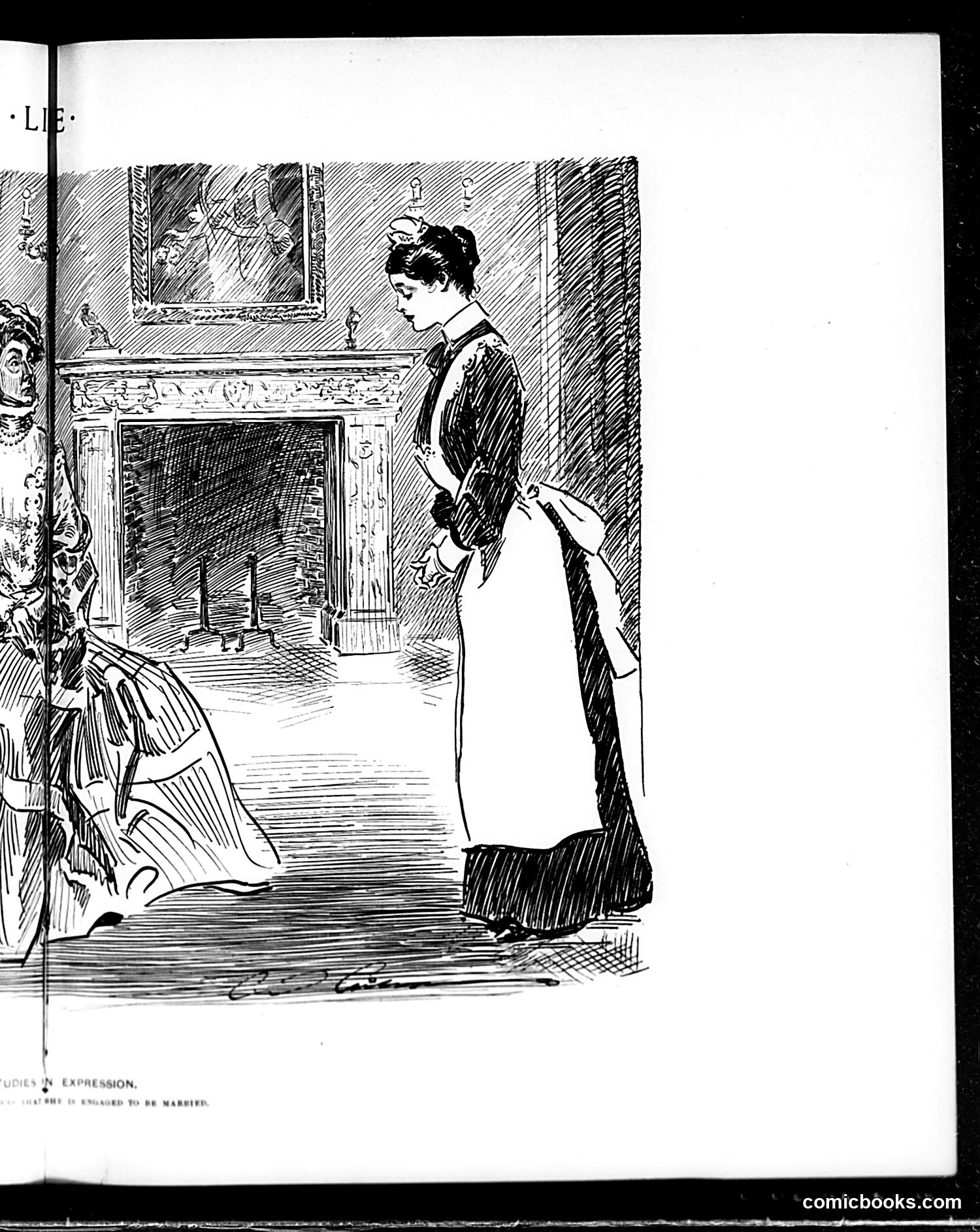
This page contains a single ink illustration depicting a domestic interior scene. A woman in Edwardian-era dress stands in a parlor facing a fireplace, while another figure (partially visible on the left) appears to be seated or reclining. The partially visible OCR text at bottom references "STUDIES IN EXPRESSION" and mentions someone being "ENGAGED TO BE MARRIED," suggesting this cartoon comments on marriage or courtship behavior. However, without clearer text or additional context clues visible in the image itself, I cannot definitively identify the specific satirical point, the named individuals involved, or which social/political commentary this illustration targets. The drawing style and clothing suggest early 20th century American publication, but the specific joke or critique remains unclear from this page alone.
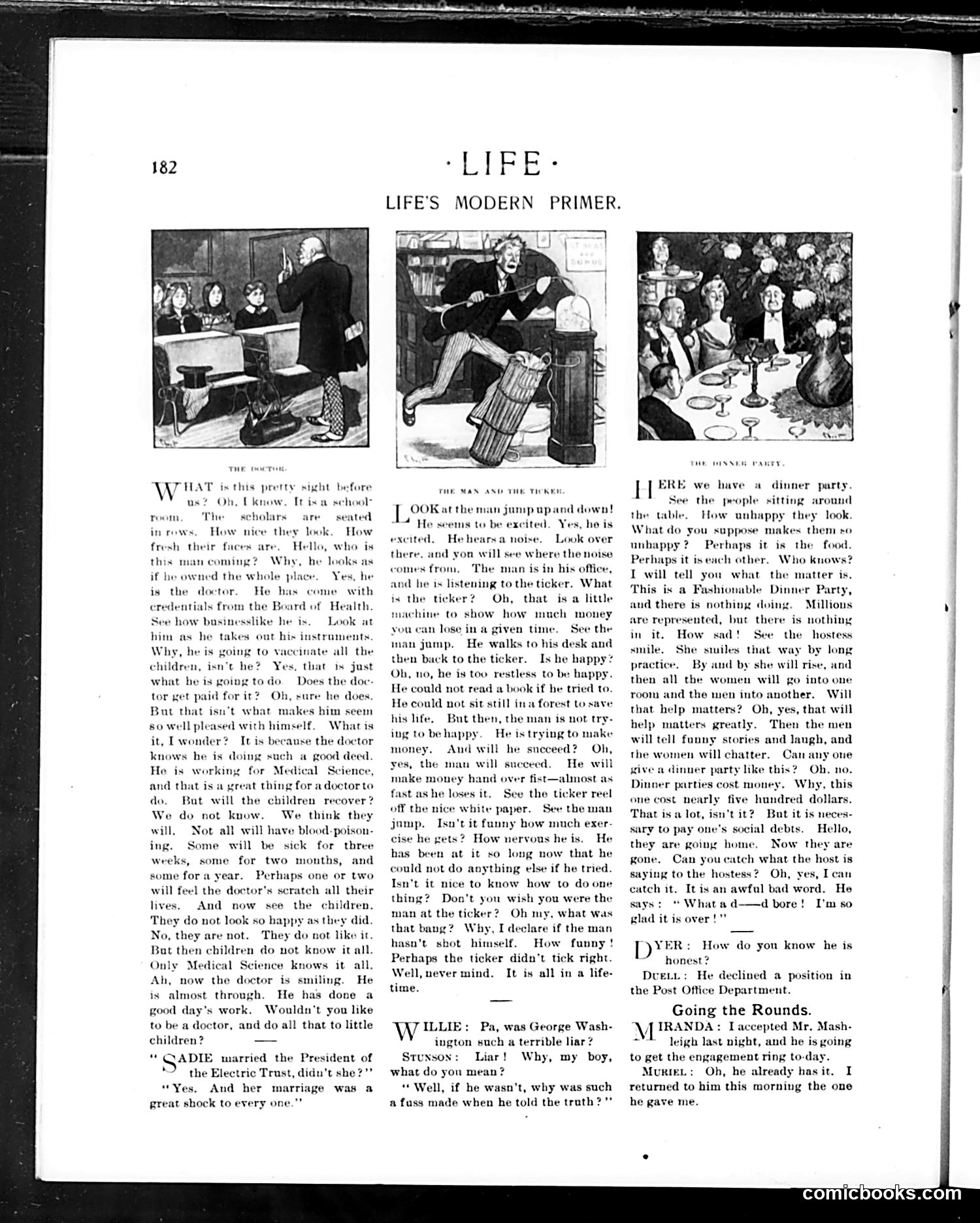
This page presents three cartoon vignettes satirizing modern life through dialogue, titled "Life's Modern Primer." **The Doctor** (left): Mocks medical practice—a doctor arriving to treat schoolchildren, suggesting doctors profit from minor illnesses rather than preventing serious disease. **The Man and the Ticker** (center): Satirizes stock market obsession. A man compulsively checks a stock ticker machine, so absorbed by financial speculation he cannot rest or find happiness, even jumping excitedly at price movements. **The Dinner Party** (right): Ridicules social pretension. Wealthy hosts throw expensive dinner parties as status displays despite their unhappiness, with guests making superficial conversation. The overall satire critiques early 20th-century American culture: medical commercialism, speculative capitalism, and wealthy society's empty materialism masquerading as sophistication.
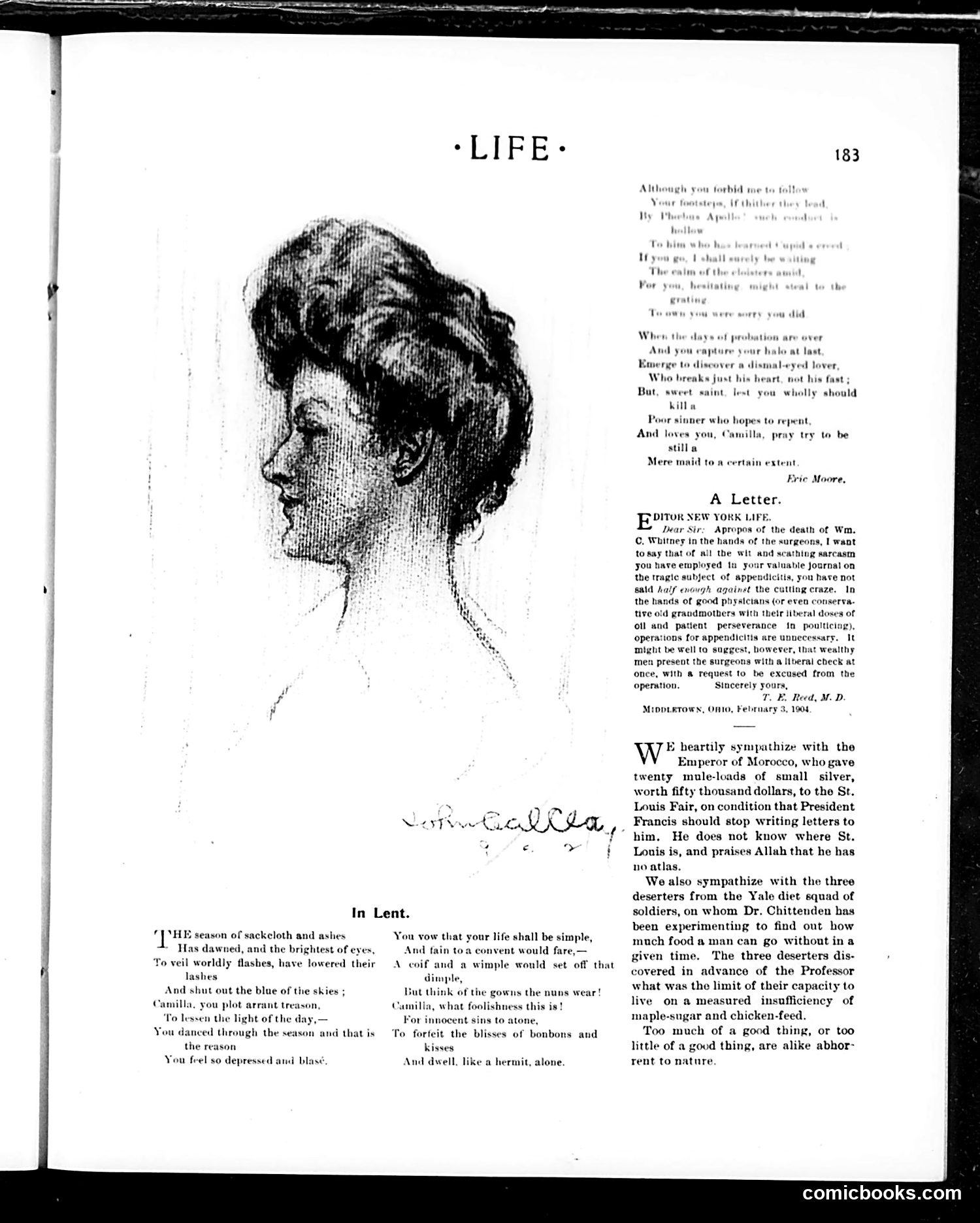
This page from *Life* magazine contains several distinct satirical pieces: **"In Lent"** (poem): Mocks the performative piety of wealthy people during Lent—particularly women who affect poverty and simplicity while secretly coveting luxury goods like fine gowns. The satire suggests their religious devotion is shallow vanity. **Letter from "T.B. Reed, M.D."**: Criticizes the trend of wealthy patients undergoing unnecessary appendectomy surgery (the "cutting craze"). Reed sarcastically suggests rich men simply bribe surgeons to avoid operations, mocking both the wealthy and surgeons' eagerness to operate. **Editorial commentary**: Satirizes the Emperor of Morocco for bribing President Francis (likely referring to the St. Louis World's Fair) to stop writing letters, and jokes about Yale researchers experimenting on deserters to determine starvation limits—implying both are absurd situations. The overall tone ridicules medical fads, wealthy pretension, and international absurdities of the era.
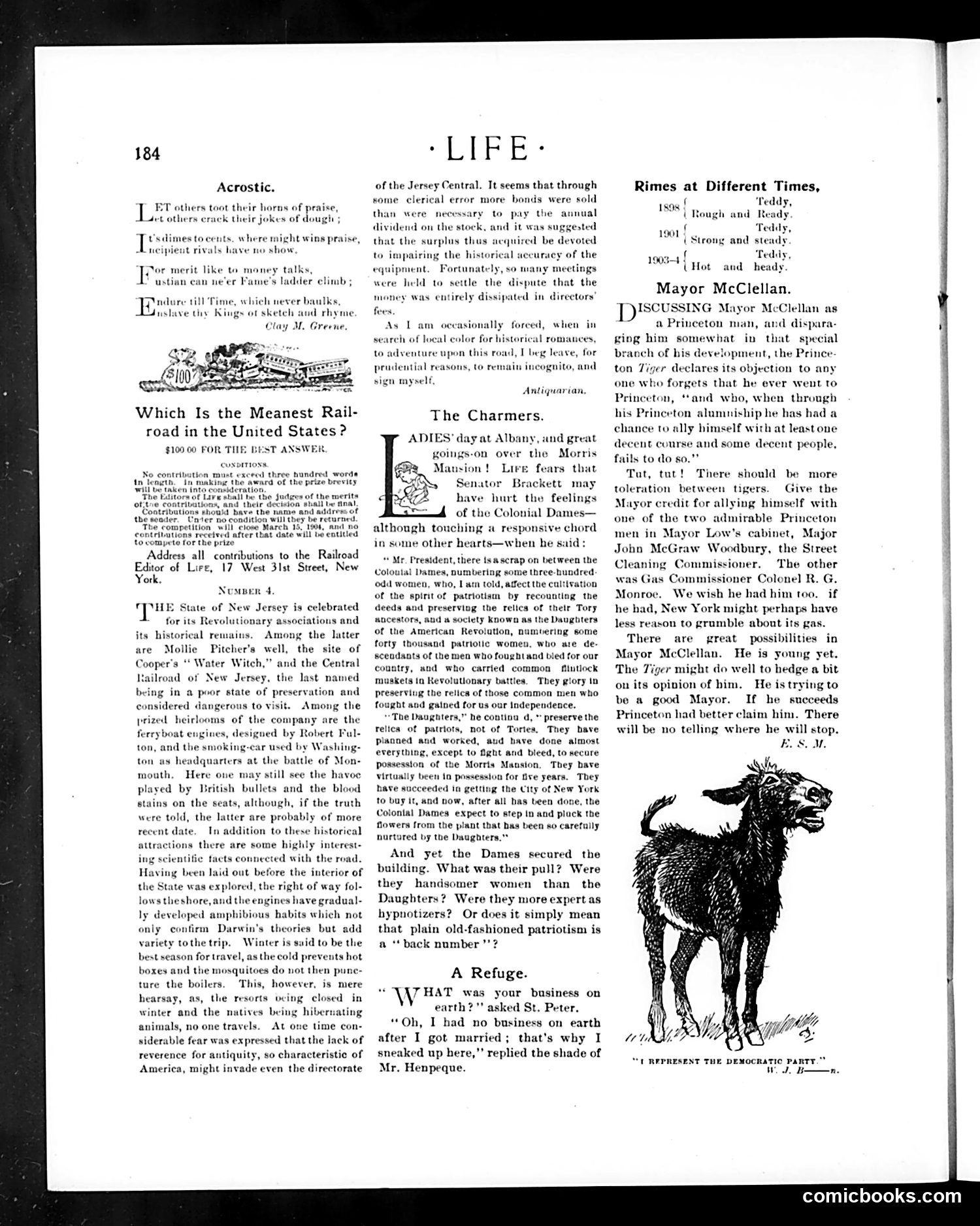
This page contains satirical content attacking the Central Railroad of New Jersey through a humorous contest asking readers to identify "the meanest railroad in the United States." The satire mocks the railroad's poor condition, danger to passengers, and amphibious incompetence—the text jokes that engines have "developed amphibious habits" due to the line's poorly-chosen route along the shore. The second article, "The Charmers," satirizes a rivalry between two women's patriotic societies: the Colonial Dames (described mockingly as descendants of Tory ancestors) and the Daughters of the American Revolution (portrayed as more legitimately patriotic). Senator Brackett's remarks create tension by implying the Colonial Dames' patriotism is suspect. The cartoon depicts a donkey labeled "I REPRESENT THE DEMOCRATIC PARTY," likely suggesting Democratic involvement in the dispute or commenting on the parties' broader foolishness. The acrostic poem at top appears to be separate literary content.
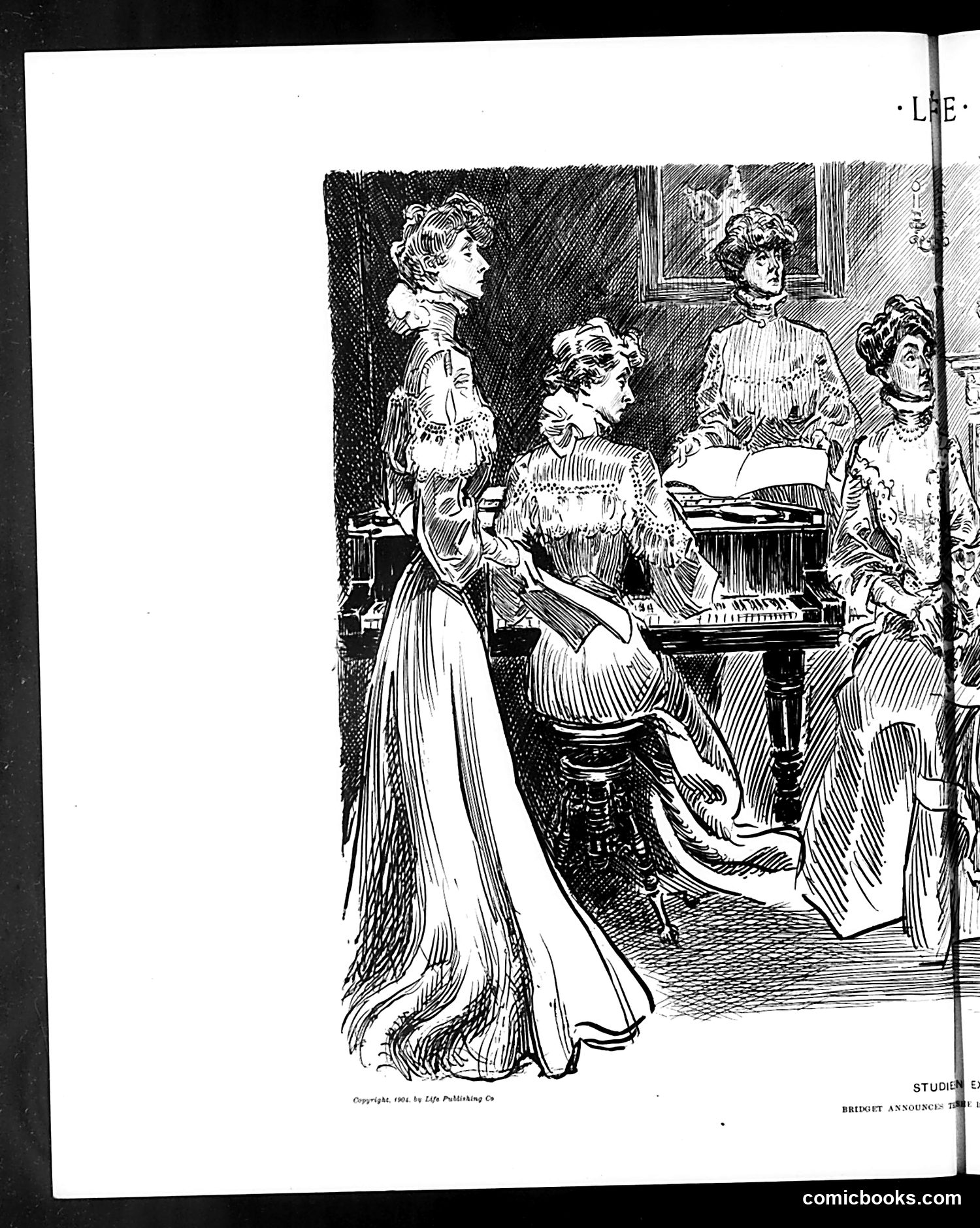
This 1904 Life Magazine illustration depicts a domestic servant scene, likely satirizing servant-employer relations of the Edwardian era. The figure in the foreground—identified by the OCR text as "Bridget," a common stereotypical Irish servant name—appears to be announcing something to a group of well-dressed women in an interior setting, possibly a drawing room or parlor. The satire likely plays on the social dynamics between working-class domestic staff and upper-class employers. The incomplete OCR text ("ANNOUNCES 78 eA") prevents identifying the specific announcement's content, but the composition suggests humor derived from the contrast between Bridget's position and the gathered ladies' reactions. The illustration exemplifies early 20th-century class-based humor common to Life Magazine's satirical tradition.
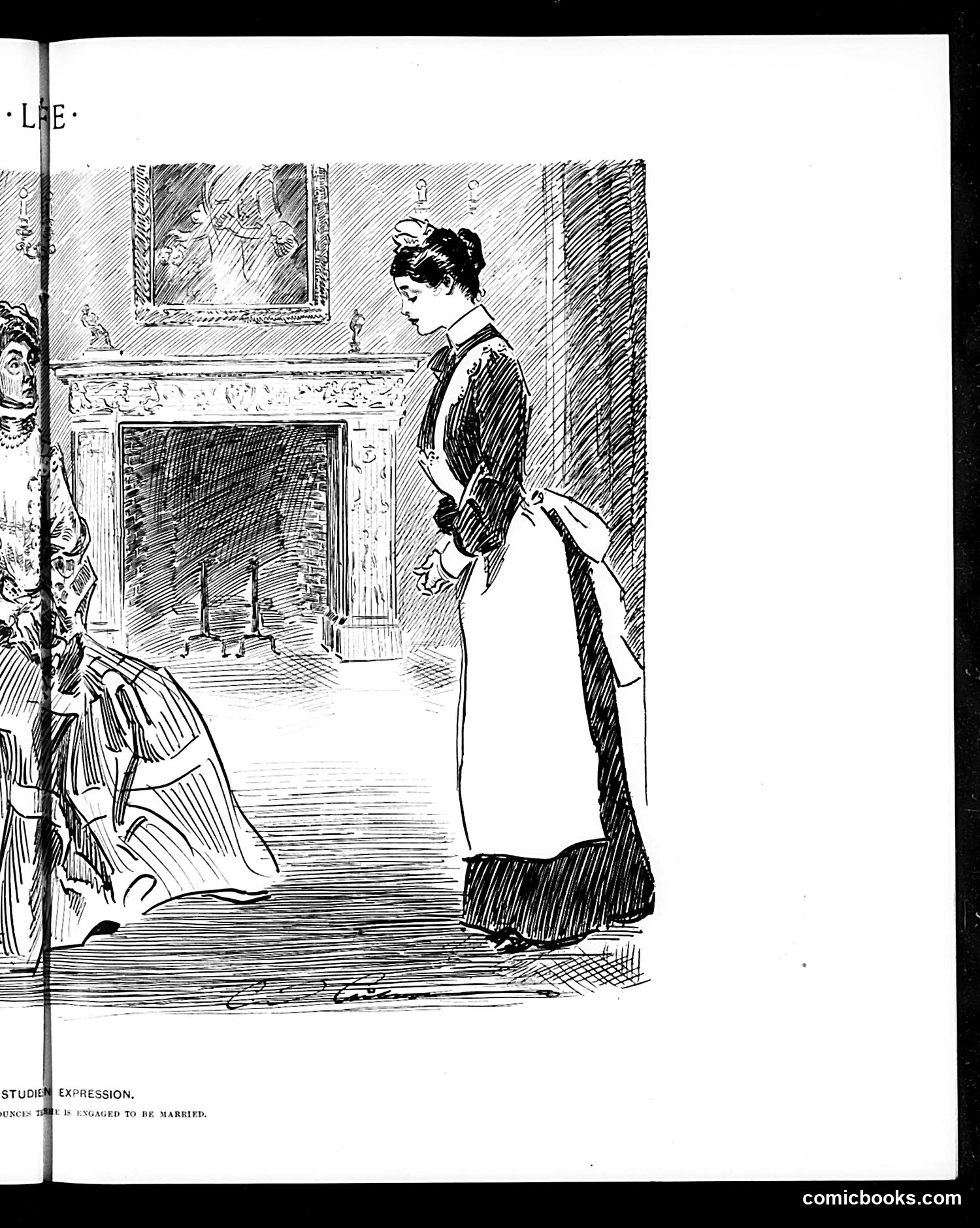
This appears to be a satirical sketch about social performance and artifice, likely from early 20th-century *Life* magazine. The image shows a well-dressed woman in an elegant interior, posed deliberately near a fireplace—her posture and expression carefully arranged as if for observation or judgment. The caption "STUDIED EXPRESSION" suggests the satire targets the performative nature of high society: the idea that fashionable women cultivate and maintain deliberate, artificial demeanors rather than displaying genuine emotion. The partially visible text below mentions someone "ENGAGED TO BE MARRIED," implying this studied composure may relate to courtship rituals or social expectations around marriage. The sketch ridicules the superficiality and calculated self-presentation demanded by upper-class social conventions of the era.
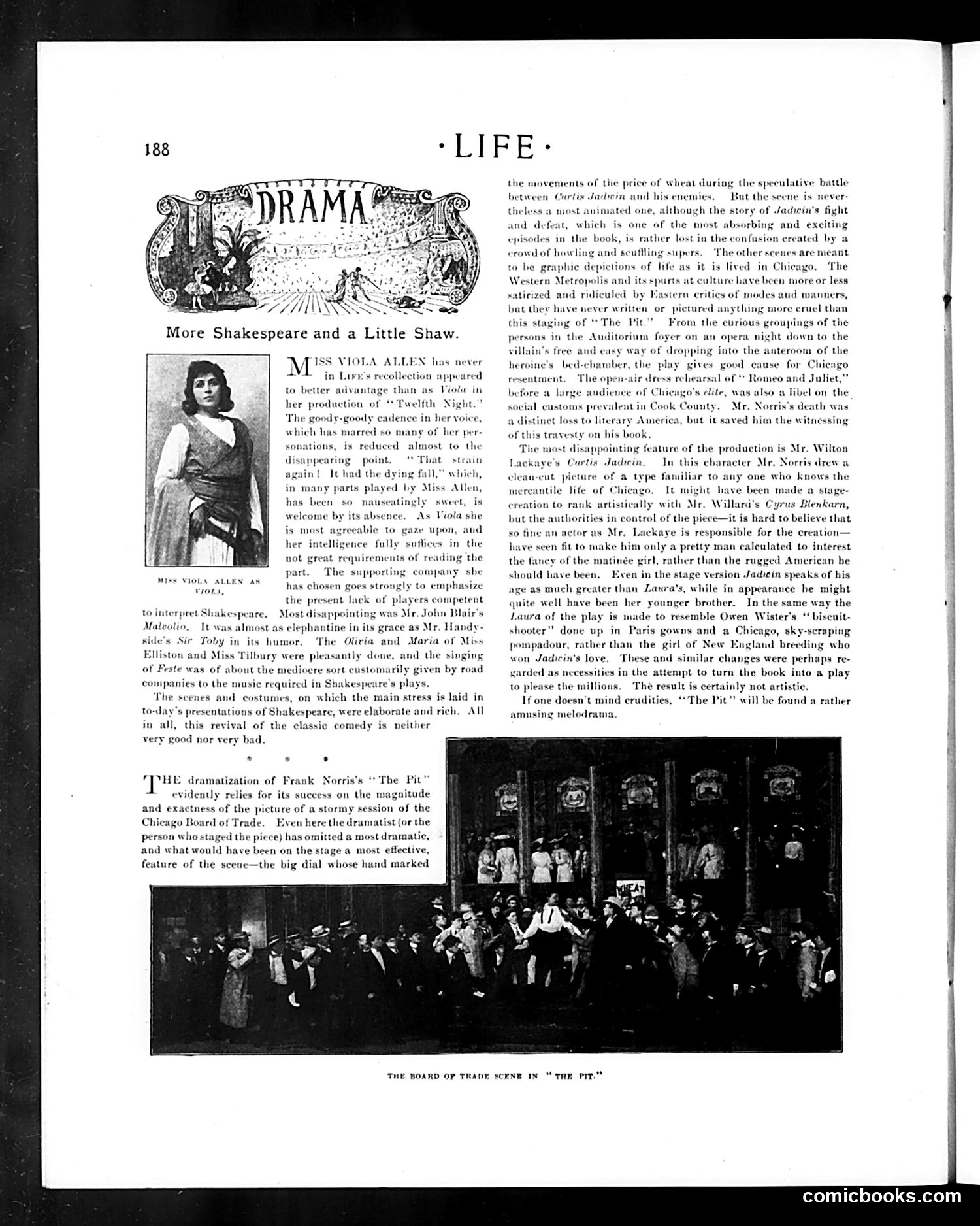
This page reviews Frank Norris's novel "The Pit" adapted for the stage. The critic praises the Chicago Board of Trade scene's spectacle but criticizes the dramatist's omission of wheat price fluctuations—the novel's dramatic heart. The main complaint concerns actor Wilton Lackaye's portrayal of Curtis Jadwin. The critic objects that Lackaye plays him as an overly refined, pretty man rather than the "rugged American" Norris wrote. Similarly, the actress playing Laura is styled as a fashionable Chicago socialite in "Paris gowns" rather than the English-bred woman from the novel. These casting choices, apparently made to appeal to mass audiences, undermine the story's artistic integrity. The review concludes the production sacrifices fidelity to literature for commercial appeal.
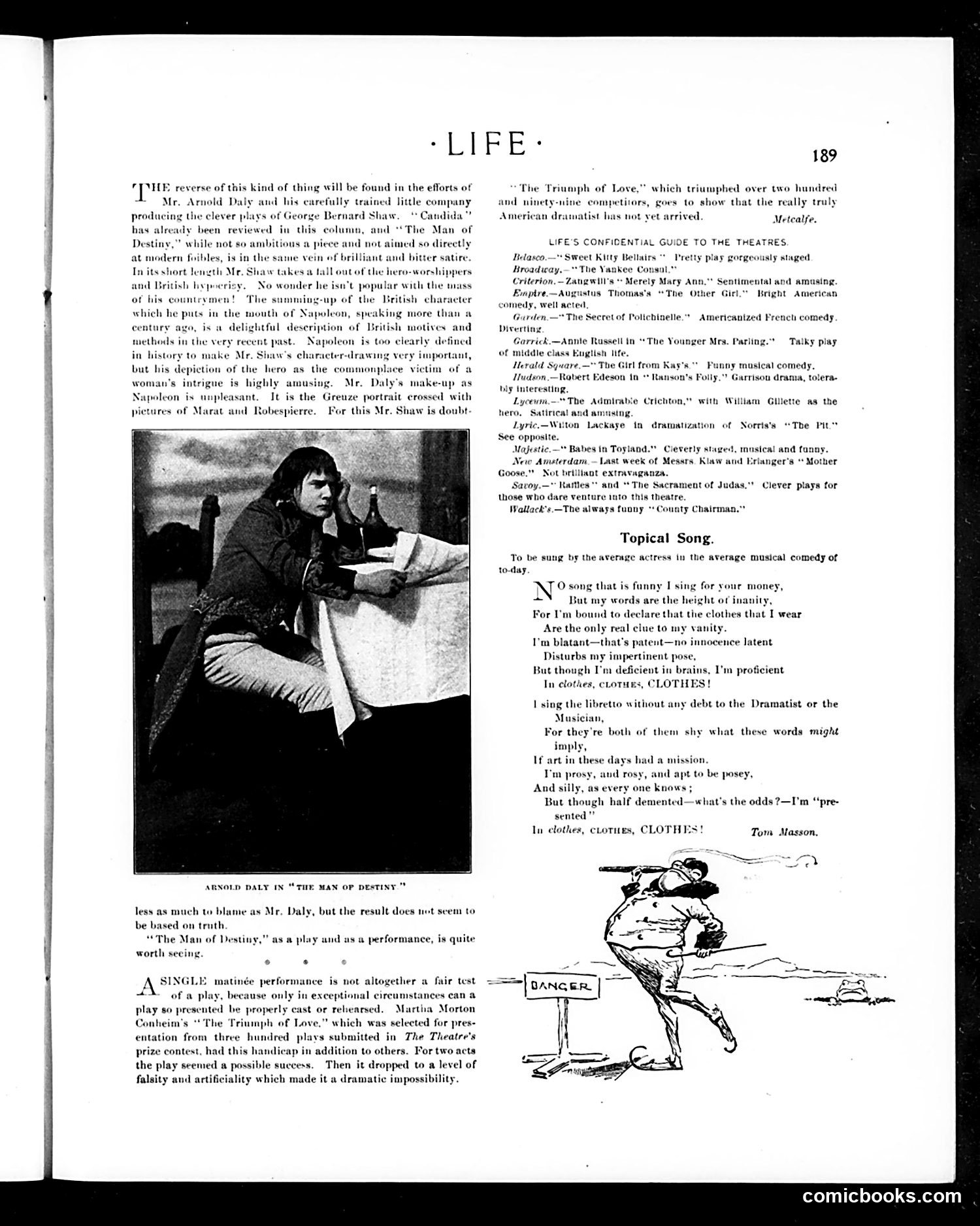
This page from *Life* magazine contains theater reviews and satirical commentary on early 1900s American drama. The photograph shows **Arnold Daly** in "The Man of Destiny," a play by George Bernard Shaw about Napoleon. The accompanying text critiques both the play and Daly's performance, suggesting his portrayal of Napoleon lacks historical authenticity and relies too heavily on makeup effects rather than genuine character work. Below, a cartoon labeled "DANGER" depicts a rotund figure in classical dress, likely satirizing overwrought theatrical pretension or melodramatic acting styles of the era. The "Topical Song" section parodies shallow musical comedy conventions, mocking actresses who sing vapid lyrics focused entirely on fashion and vanity while ignoring dramatic substance. This satirizes the low artistic standards of contemporary musical theater, where costume and appearance supposedly matter more than actual talent or meaningful content. The theater guide listings review contemporary Broadway productions, indicating this reflects the active theatrical scene of the period.
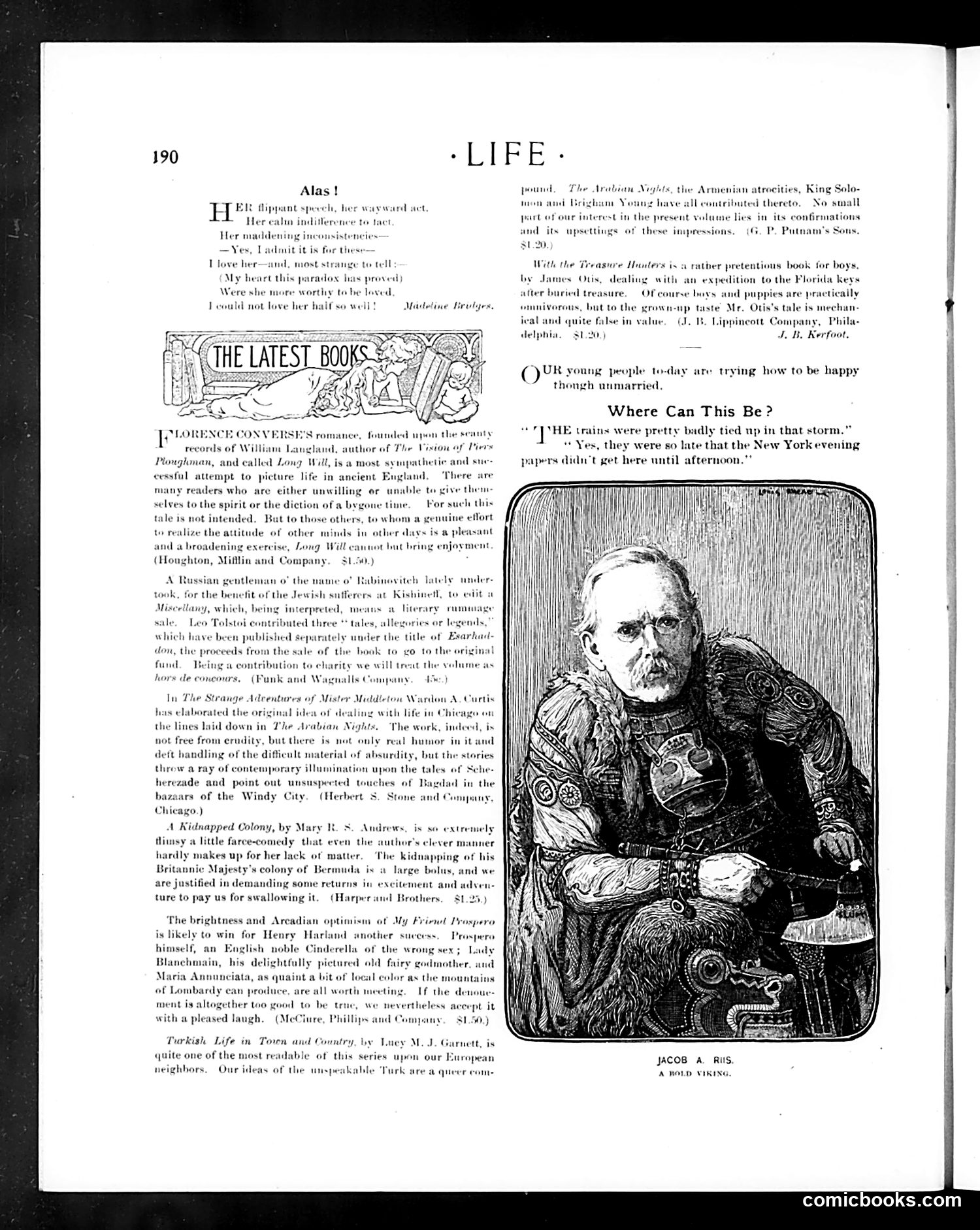
This page is primarily a **book review section** titled "The Latest Books," containing literary criticism rather than political satire. The single illustration shows **Jacob A. Riis**, labeled "A Bold Viking," likely referencing his work documenting urban poverty and tenement conditions in America. The one cartoon-like element is the brief joke titled "Where Can This Be?" — a mild satirical jab at **New York newspaper delivery**. The humor depends on the absurdity that evening papers couldn't reach a location (implied to be far from New York City) until the following afternoon due to train delays, making them effectively useless as "evening" editions. This reflects early 20th-century frustrations with transportation infrastructure and media timeliness. The remainder of the page reviews contemporary fiction including works set in ancient England, Chicago, and dealing with themes of adventure and romance—standard literary fare for Life's educated readership.
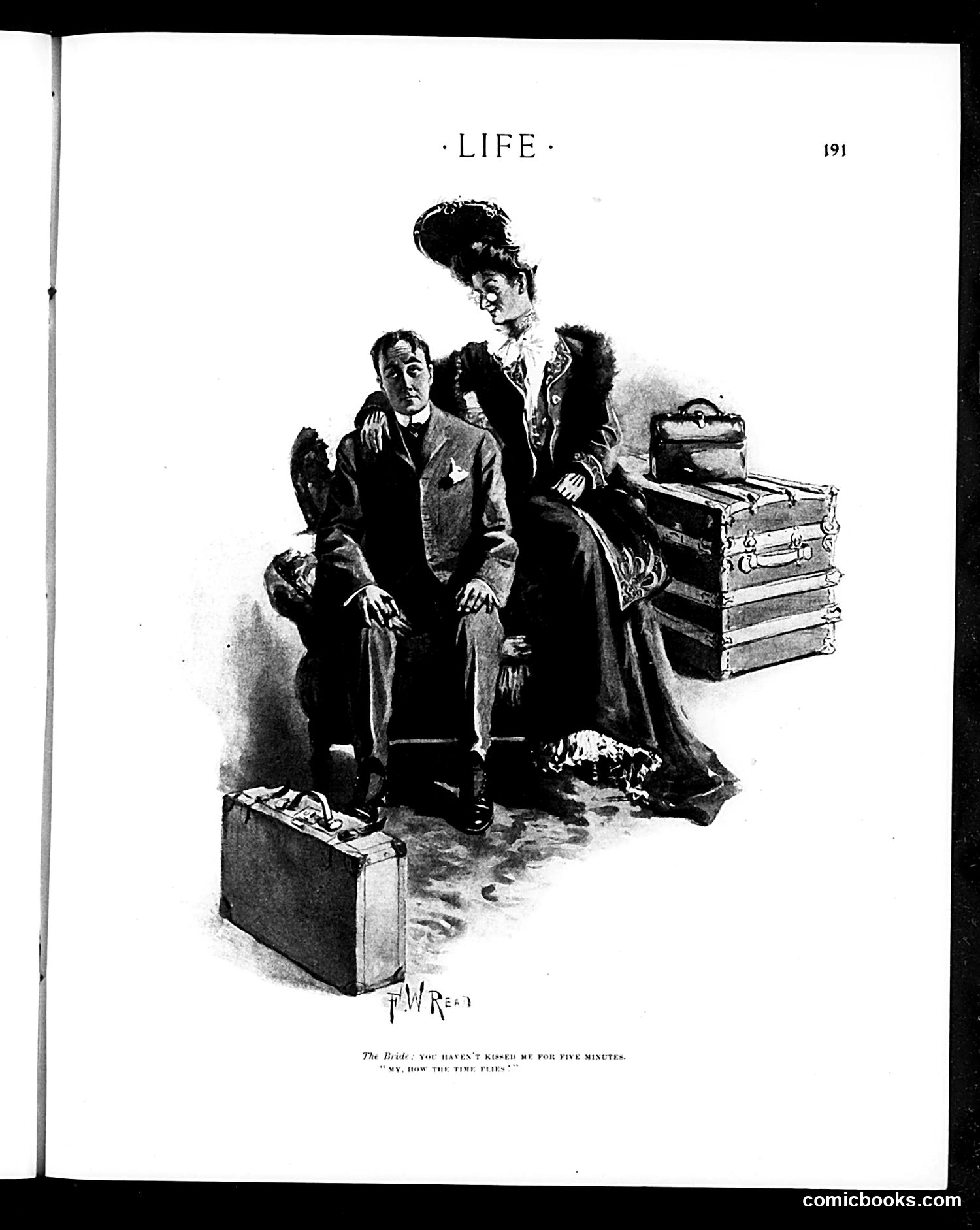
This is a satirical illustration from *Life* magazine (page 191) depicting a domestic scene with social commentary. A well-dressed woman stands beside a seated man surrounded by packed suitcases and luggage, suggesting travel or departure. The caption reads: "The Bride: 'YOU HAVEN'T KISSED ME FOR FIVE MINUTES. MY, HOW THE TIME FLIES!'" The satire targets newlywed dynamics, specifically mocking how quickly romantic affection supposedly diminishes in marriage. The woman's complaint about five minutes without a kiss—framed as an eternity—satirizes both the wife's expectations of constant attention and the implication that the husband has already grown indifferent. The packed luggage may suggest either a honeymoon or, ironically, marital discord. The cartoon reflects early-20th-century attitudes toward marriage and gender relations through gentle domestic humor.
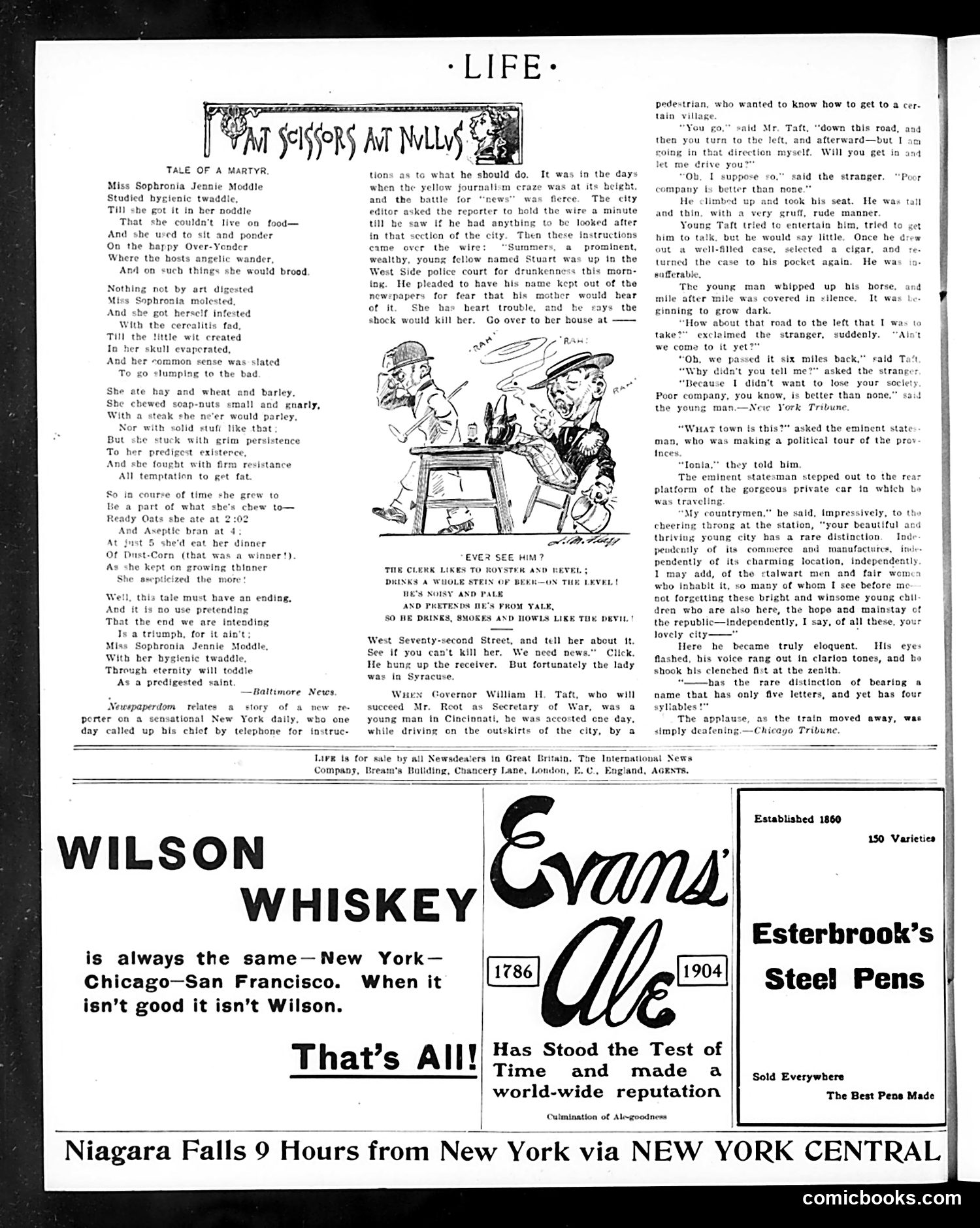
This page contains **three distinct pieces of satire** from early 1900s Life magazine: 1. **"I'm Scissors at Nulls"** (poem + cartoon): A mock-heroic tale mocking health fads. The cartoon shows two rowdy men in a carriage—likely satirizing "yellow journalism" reporters competing for sensational "news" stories, referenced in the accompanying text about a wealthy drunk named Stuart. 2. **"Tale of a Martyr"** (right column): Mocks obsessive health-food crazes by describing "Miss Sophronia Jennie Moddle," who eats only "hygienic" foods (Ready Oats, Dust-Corn, soap-nuts) and wastes away. The satire targets pseudo-scientific health movements popular at the time. 3. **Two brief anecdotes** (lower right): Gentle jokes—one about a taciturn stranger insulting a chatty driver; another about a politician making grandiose speeches to a small town. The **advertisements** (Wilson Whiskey, Evans Ale, Esterbrook's Steel Pens) fill remaining space. Overall: satire targeting yellow journalism, health fads, and pompous politicians—concerns of that era's middle-class readers.
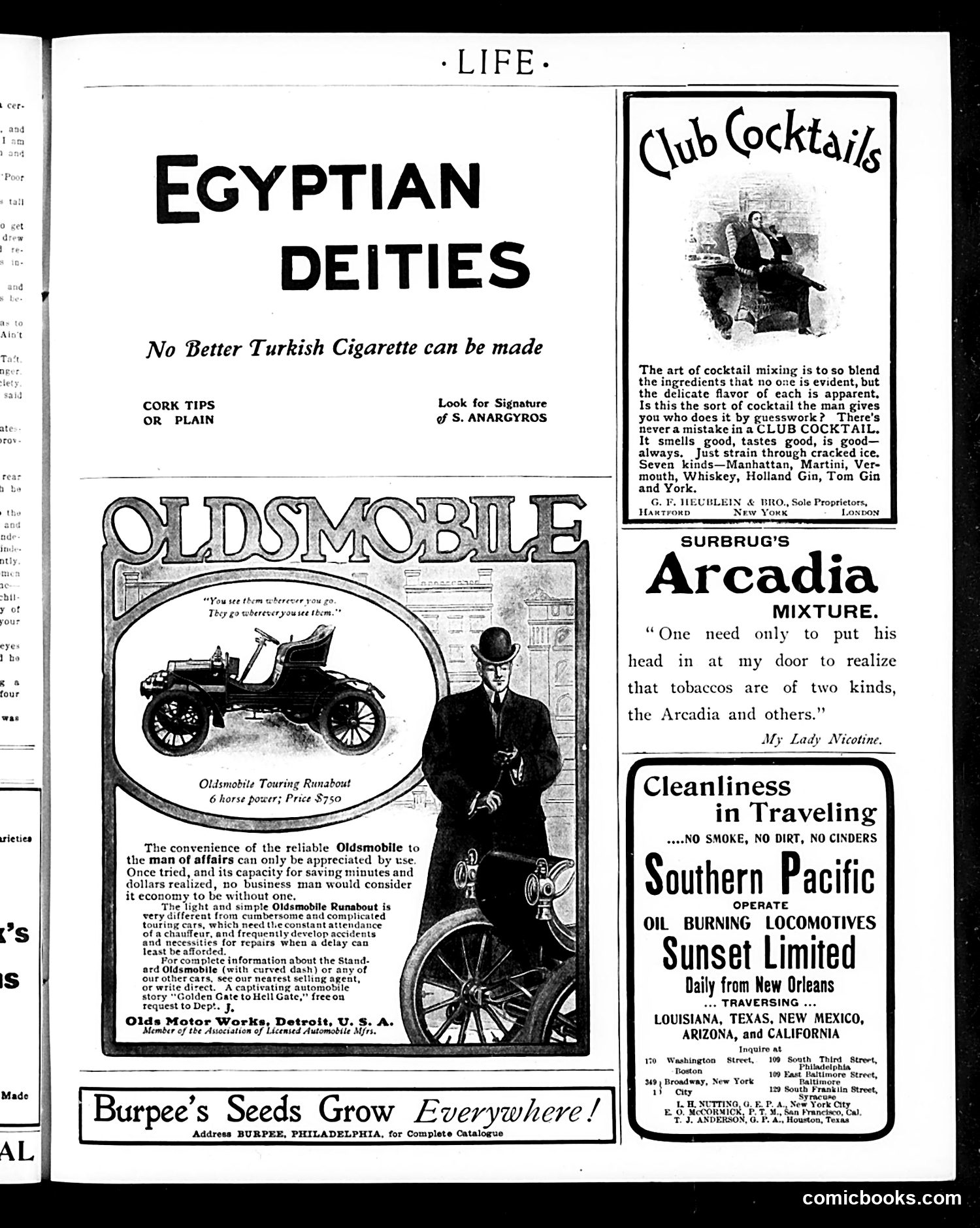
This is primarily an **advertising page** from Life magazine with no political cartoon or satire. The page features several period advertisements (early 1900s): 1. **Egyptian Deities cigarettes** — a Turkish cigarette brand 2. **Oldsmobile** — promoting their affordable $750 Touring Runabout as practical for businessmen 3. **Club Cocktails** — a prepared cocktail mix brand emphasizing consistency and quality 4. **Burpee's Seeds** — a simple tagline ad 5. **Surbrugg's Arcadia tobacco mixture** — using a literary quote to suggest superiority 6. **Southern Pacific Railway's Sunset Limited** — advertising oil-burning locomotives as clean travel ("no smoke, no dirt, no cinders") The advertisements reflect early-20th-century consumer culture: motorized transportation, convenience products, and leisure goods marketed to middle-class businessmen. There is no identifiable satire or political commentary—this is straightforward commercial promotion typical of Life's mixed content format.
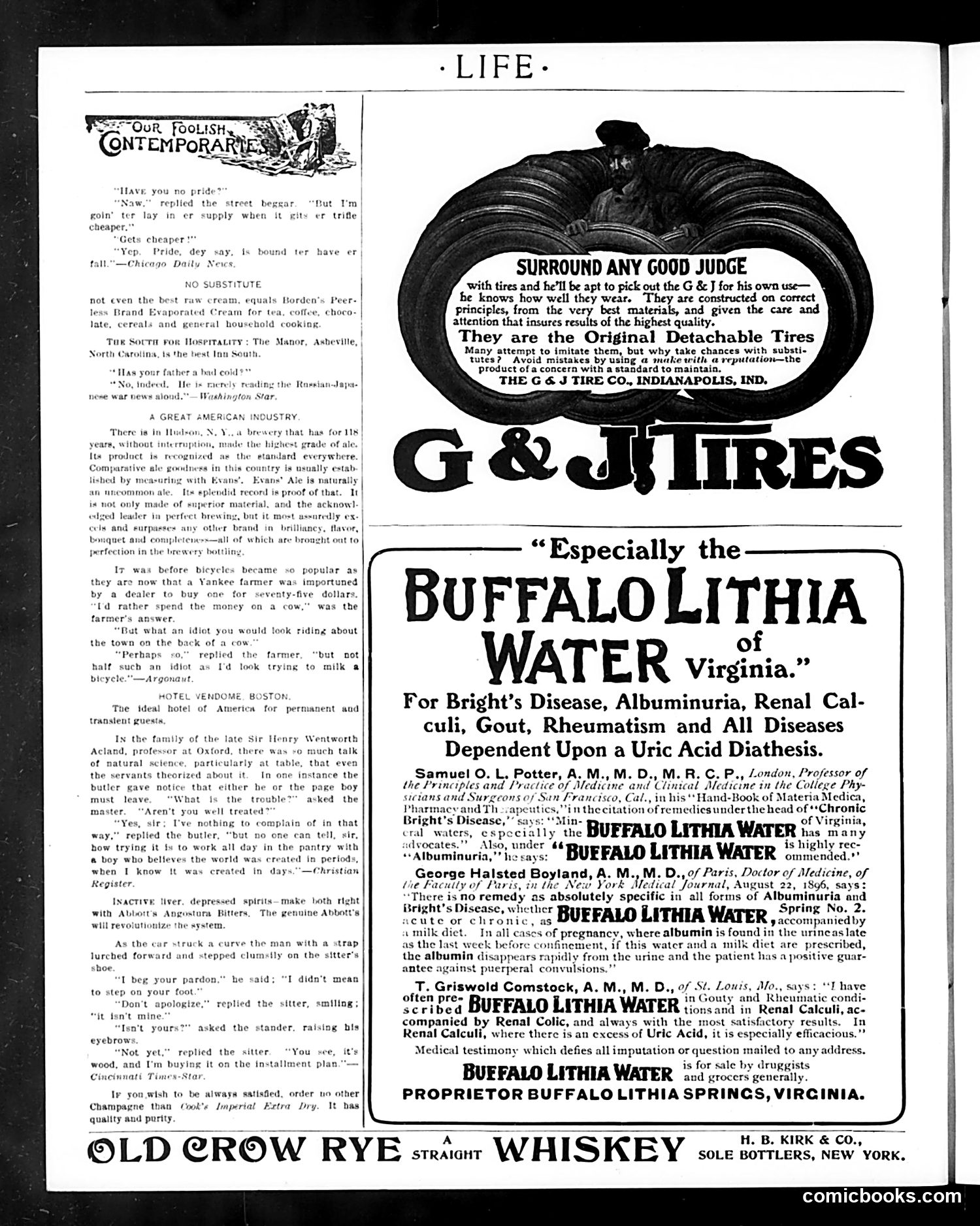
This page is primarily **advertising**, not political satire. It contains multiple product advertisements interspersed with brief humor anecdotes in Life's typical format. The visible content includes: 1. **G & J Tires advertisement** - A large tire shown with text claiming these are "Original Detachable Tires" that judges and experts prefer, positioning them against inferior imitators. 2. **Buffalo Lithia Water advertisement** - The dominant ad promoting mineral water from Virginia as a cure for kidney/urinary diseases (Bright's Disease, gout, rheumatism). It includes endorsements from medical professionals, a common advertising practice of the era. 3. **Old Crow Rye Whiskey** - Footer advertisement. 4. **Brief humorous anecdotes** - Short jokes about pride, bicycles versus cows, and hotel life, typical of Life's satirical content. The page reflects early 20th-century advertising practices, including medical claims later prohibited by the FDA, and demonstrates how magazines mixed humor with commerce.
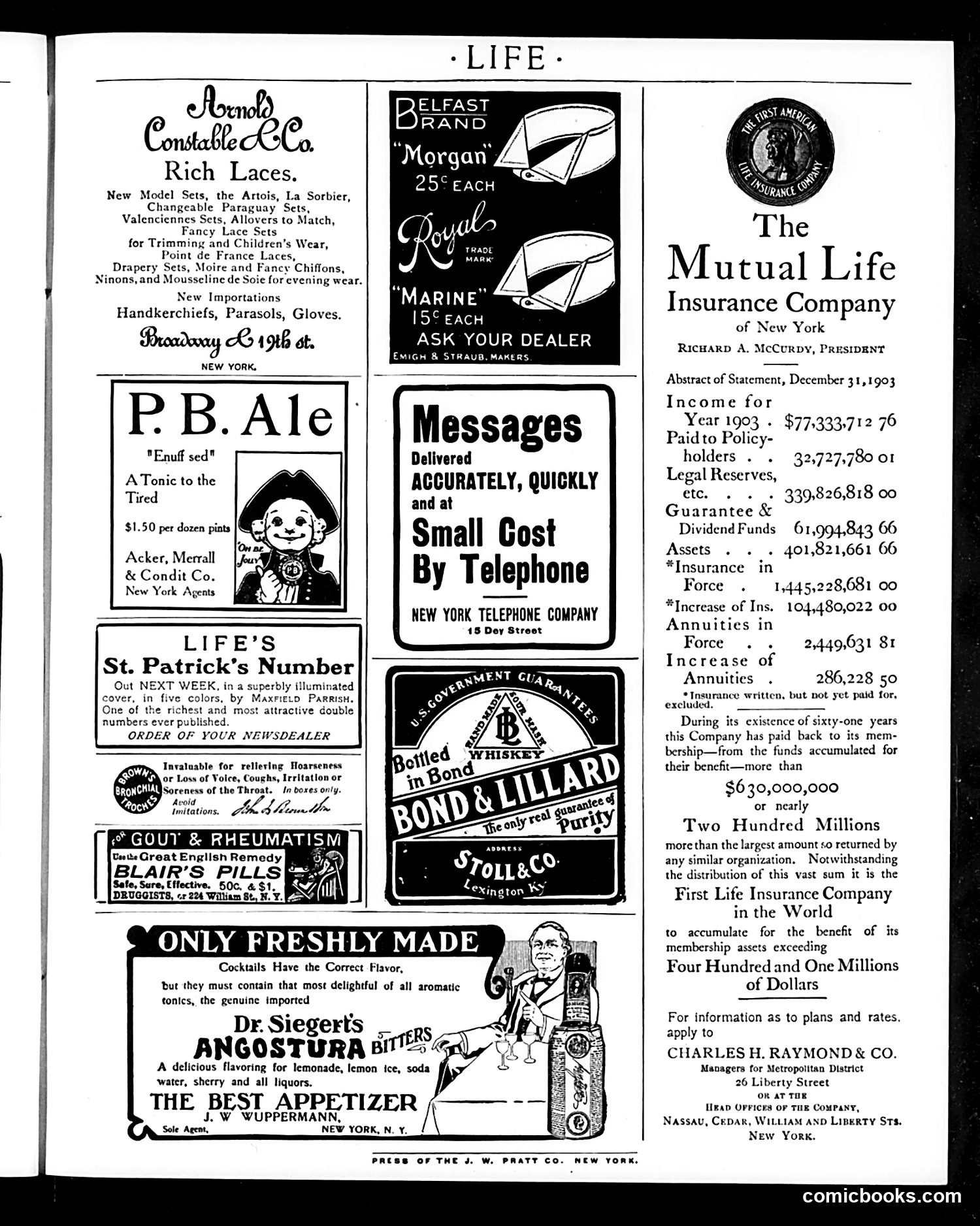
This page is primarily **advertising**, not political satire or editorial cartoons. It's from Life's issue dated around 1904 (based on the Mutual Life Insurance Company's December 31, 1903 financial statement). The notable content includes: **St. Patrick's Number promotion**: An announcement that next week's issue will feature a cover by **Maxfield Parrish** (a celebrated illustrator), suggesting Life marketed themed special issues. **Product advertisements** reflecting early-1900s consumer goods: P.B. Ale, Belfast Brand collars, telephone services, whiskey, patent medicines (Blair's Pills for throat ailments), and Dr. Siegert's Angostura Bitters. **The Mutual Life Insurance ad** is substantial, emphasizing the company's financial stability and payouts to members—important messaging during an era before modern insurance regulation. The page reveals period concerns: throat ailments, fatigue, the novelty of telephone service, and emerging consumer culture. There is **no political cartoon or satire evident** on this page.
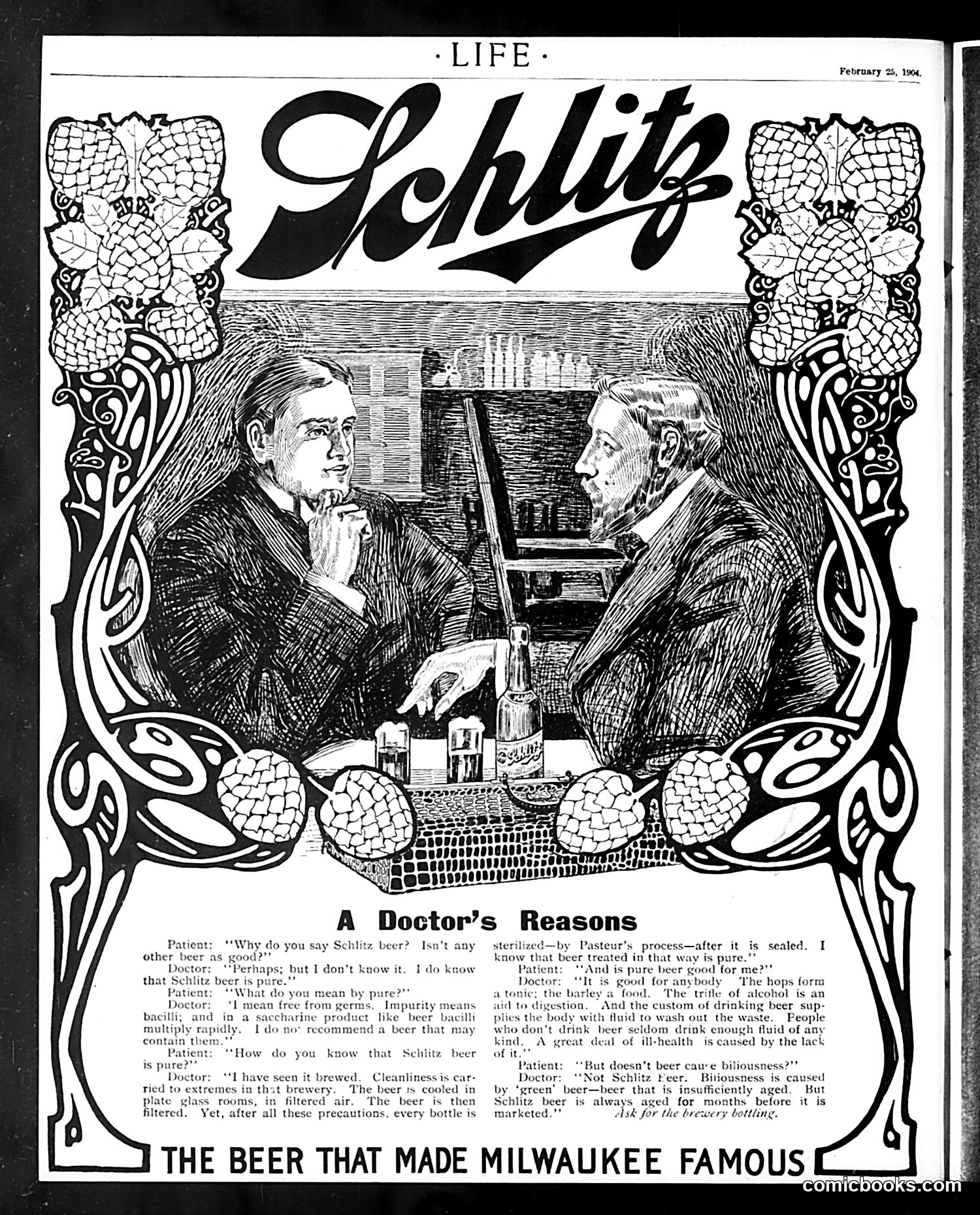
This page is primarily a **Schlitz beer advertisement** dressed up as satirical editorial content in *Life* magazine (February 25, 1904). The format mimics a doctor-patient dialogue titled "A Doctor's Reasons," where a physician defends Schlitz beer's purity and health benefits. The two figures appear to be a patient (left) and doctor (right) in conversation over bottles of beer. The satire lies in the **exaggerated health claims**: the doctor argues beer is medically beneficial because it provides hydration, contains nutritious hops, and contains only a small amount of alcohol. He emphasizes the brewery's sanitation practices as proof of purity. For modern readers: this reflects early-1900s **patent medicine-era marketing**, when alcohol and dubious products were openly promoted as medicinal tonics. The satirical framing—presenting commercial advertising as serious medical advice—was typical of *Life*'s irreverent approach, though the ad still serves its promotional purpose. The tagline "The Beer That Made Milwaukee Famous" is Schlitz's actual slogan.